


Abstract
Future contributions to sea level rise from the Antarctic Ice Sheet due to climate change remain one of the largest uncertainties for future sea level. Improving predictions of ice mass loss is a major goal of numerical ice sheet models, but a major difficulty is that ice sheet models assume an empirical fit to modern-day observed speeds to infer sliding parameters. While this results in accurate modern-day comparisons, predictions for future or past climates that have substantially different conditions will be inaccurate if the empirical sliding law used is not appropriate. To help constrain which basal physics is most appropriate and therefore which basal parameterizations should be used in ice sheet models, here, we pursue an understanding of which physical mechanisms are most likely to explain the spatial variability in flowline speeds throughout the Antarctic Ice Sheet. Specifically, we compare observed flowline surface speeds with predictions of speeds from internal ice deformation and Weertman sliding using a conservative range of physical parameters. Despite large uncertainties, we find a number of flowlines where the predictions can be distinguished from each other and one can infer that one of the two mechanisms, or a third mechanism, Coulomb frictional failure, may likely be principally responsible. Geographic patterns in the dominant mechanism are observed. Weertman sliding appears dominant in several flowline clusters in East Antarctica, and there are regional consistencies in the estimated nearness to flotation at locations of inferred initiation of Coulomb failure. Weertman sliding at faster rates is also observed within regions of inferred Coulomb failure, consistent with theoretical expectations. The key finding that the dominant deformation mechanism varies along and between Antarctic flowlines may complicate how ice sheet models need to be parameterized if accurate predictions of future ice loss and sea level rise are to be accurate.
1. Introduction
Basal conditions of the Antarctic Ice Sheet are critical to modeling ice sheet dynamics, especially because these conditions are important for sea level rise predictions. Studies have shown that Antarctic ice streams grounded below sea level with beds sloping towards the ice sheet interior are unstable because of dynamical instabilities [1,2,3], as well as because of rapid melting by ocean water at the grounding line [4,5]. On account of the complicated array of physical laws governing ice sheet dynamics, there is no known general constitutive relation between stress and strain for the entire ice sheet system. Many ice sheet models make simplifying assumptions, particularly for how basal drag is parameterized, due to poorly constrained basal conditions. Depending on basal conditions, the dominant physical basal drag mechanism may involve enhanced creep around obstacles, regelation (melting and refreezing of ice around obstacles), and Coulomb failure (sliding dependent on effective pressure, potentially within a till layer or at the ice–rock interface).
Ice sheet models often assume a nonlinear power-law form of the creep relation between basal stress and basal velocity, with parameters estimated using theoretical tools or by fitting to observations [2,6,7]. If different nonlinear power-law forms of the creep relation are parameterized empirically, then it is difficult to distinguish between different forms of the creep relation [8]. Assuming a nonlinear power-law relation as the dominant deformation mechanism also neglects the possibility that an alternative form of deformation mechanism dominates. Pralong and Gudmundsson [9] prescribe a nonlinear power-law form of the creep relation at the bed, and using a Bayesian statistical inference method, they conclude that the coefficient of their chosen basal drag formulation, which they name basal slipperiness, increases as ice approaches the grounding line. While true physical basal slipperiness (e.g., a type of friction coefficient) might, in fact, increase as ice approaches the grounding line, it is also possible that the basal velocity increases as ice approaches the grounding line because the chosen power-law basal sliding formulation stops dominating basal drag and effective pressure from the ocean becomes important [3,10,11,12]. Various studies have concluded that a power-law creep relation is insufficient for describing basal conditions in regions of rapid sliding, and that higher pore water pressure in these regions likely controls flow in ice streams [2,13,14]. Instead of assuming one basal drag relationship and drawing conclusions based on the best-fitting parameters of that model, this paper tests several physical basal drag relationships using a conservative range of inferred parameter values against observations in order to determine where one necessarily fits better than another given a range of possible parameter inputs. The difference between this study’s approach and the approach of other models is subtle, but useful in deciding which basal drag relationship is most appropriate and drawing conclusions about the physical basal properties at the ice–bed interface. For example, unlike Maier et al. [15], whose goal is also to distinguish between different physics controlling ice flow (in Greenland), we do not perform empirical fits with free parameters and instead only allow for physical parameters within a conservative, plausible range.
2. Choice of Basal Rheology
This study neglects longitudinal stress components by assuming a shallow-ice approximation (SIA) framework, a reasonable choice if surface slopes are calculated over a length scale significantly greater than the ice thickness [2,16]. We limit our analysis to analyzing speeds averaged over these large length scales so that the SIA is reasonable. The surface velocity of ice sheets is the sum of basal slip and internal deformation, which is creep distributed throughout a vertical column of ice. This study tests surface speed predictions, initially assuming just two different types of deformation, (i) internal ice deformation and (ii) Weertman basal sliding, to determine where each type of mechanism is dominant. Internal deformation relates strain rate and basal shear stress by Glen’s flow law:
which can be integrated across the entire ice sheet thickness to get
where ui is the speed from internal deformation (m s−1), n is Glen’s flow law exponent (unitless), A is the creep parameter (Pa−3 s−1), τb is the basal shear stress (Pa), and H is the ice thickness (m). Although internal deformation occurs throughout a vertical column of ice, it is greatest at heights just above the bed, since
where g is the gravitational constant (m s−2), and α is the acute angle between the horizontal and the ice surface (unitless) [17]. Internal deformation thus describes ice as deforming by creep alone, with no consideration of the effects of bedrock obstacles or subglacial water pressure, even though most of that creep may be concentrated near the bed.
Basal sliding describes ice deformation in terms of interactions with obstacles at the bed. Weertman [1] defines basal sliding as the combined effects of enhanced creep around obstacles and regelation. This commonly used Weertman basal sliding formulation relates stress and basal velocity as follows:
where uw is the speed from Weertman sliding (m s−1), Rf is the bed roughness parameter (unitless) and is the ratio of obstacle length to obstacle wavelength (distance between two obstacles), kr is the thermal conductivity of bedrock (W m−1 K−1), β is a constant taken to be approximately 7.4 × 10⁻⁸ K Pa−1, ρ is the density of ice (kg m−3), and L is the specific latent heat of fusion of ice (J kg−1) [1,17]. All other variables are the same as defined for internal deformation.
A third mechanism called Coulomb frictional failure is expected to accommodate rapid sliding in regions of high water pressure [11,13]. Schoof [18] summarizes that models where basal sliding is prescribed by the Weertman formulation often overestimate the observed basal shear stress. Schoof explains that this discrepancy might be due to till failure: the sediment layer at the base of an ice sheet experiences failure when pore water pressure increases enough to counteract ice overburden pressure, which induces rapid sliding. Coulomb failure is thus expected in regions of high basal water pressure, such as over subglacial lakes and marine-terminating ice sheets near the grounding line where ocean water may intrude. The Coulomb relationship is expressed as
where f is a friction coefficient (unitless),
is the ice pressure (Pa), and p is the water pressure (Pa) [3]. Predicting speeds using this formulation of Coulomb friction is complicated because Equation (5) does not explicitly relate basal slip and shear stress and there are no reliable modeled or measured data for water pressure. The Coulomb relationship is included here to recognize the effective pressure dependence of shear stress, offering an alternative explanation for observed trends when the two power-law relationships fail to accurately describe flow along a flowline (a path in the direction of ice flow). We note that while there could be gradual transitions between Weertman sliding and Coulomb behavior, Tsai et al. [3] predict a sharp transition between them, and we follow this prediction to classify speeds as being dominantly in one of the three categories described above. We also note that in contrast to Maier et al. [15], who consider any power-law relationship between u and τb (including both Equations (2) and (4)) to be in the category of ‘hard bed’, one of our main goals is to distinguish between the physics of Equations (2) and (4). As described more in Section 4, our criteria for achieving the Coulomb limit of Equation (5) are also very different from those of Maier et al. [15].
3. Data and Methods
The Antarctic Ice Sheet generally exhibits flow from one of several ice divides down to the coastline of the continent. Each comparison between predicted and observed speeds was made along a flowline. Flowlines were constructed using InSAR-based gridded velocity data from the MEaSUREs project [19,20,21,22,23,24,25], as described in Appendix A. The conclusions drawn in Section 4 account for the data uncertainties of the InSAR-based velocities, which are reported in figures as black vertical error bars. We analyzed 66 flowlines distributed throughout Antarctica. They vary in length: the shortest measures approximately 100 km and the longest measures approximately 1400 km. Most run through ice streams, chosen in order to investigate the expected transition from power-law mechanisms to the Coulomb mechanism in regions of rapid sliding. There are a few flowlines tested in non-ice stream regions where observed speeds are slower in order to explore differences between the two tested power-law mechanisms in these regions. Some of these non-ice stream flowlines are far upstream of the nearest grounding line so that the power-law mechanisms can be compared to observations without the expectation of a dominant Coulomb mechanism.
Surface speed predictions are calculated using Equations (2) and (4). Although the two mechanisms share a τb- and A-dependence, we may be able to distinguish between their predictions because τb and A vary spatially along a flowline and are raised to different exponents in the two deformation formulations, such that differences in speed predicted by the two deformation mechanisms become apparent along a flowline. Ice thickness, ice elevation, and bedrock depth data used in calculations are sourced from the Bedmap2 data set [22,26]. The basal shear stress in Equation (3) was calculated using the ice elevation data and an interpolating polynomial (Appendix B). The surface slopes calculated using surface elevation, the ice thickness, and the observed speeds were all smoothed with the same length scale using an ‘rloess’ routine, which is a local regression that assigns lower weight to outliers using weighted least squares and a 2nd-degree polynomial. Smoothing is to ensure that predicted speed profiles do not document small-scale noise that detracts from broader trends. An ‘rloess’ routine was chosen because it does not assume any function to fit the data, it is not sensitive to outliers, and its use of a 2nd-degree polynomial makes it advantageous for modeling curvature on an intermediate scale. Still, we recognize that for some flowlines the ‘rloess’ routine produces local curvature and sometimes oscillation that is an artifact of smoothing, which we keep in mind for comparisons between observed and predicted speed profiles. The shear stress τb was calculated at locations where the surface slope is evaluated.
The objective was to compare observed and predicted speeds using a conservative range of possible inputs for each physical parameter, rather than assuming one form of a predictive model with parameter choices that minimize deviation from observations. The creep parameter A is present in the internal deformation and Weertman sliding formulations. It is known that A depends strongly on temperature and fabric (the crystal alignment of ice grains), and to a lesser degree on grain size and impurity content [17]. We adopt an Arrhenius relationship between creep parameter and temperature that also accounts for softening due to high water content:
where A* is a pre-factor equal to the value of A at −10 °C, which we take to be 3.5 × 10⁻²⁵ Pa−3 s−1; Th is the ice temperature (K) adjusted for melting point depression; T* is the transition temperature equal to −10 °C (263.15 K); Qc is the activation energy (J mol−1); and R is the universal gas constant (J mol−1 K−1) [17].
Equation (7) requires ice temperature as an input, but there are few in situ observations of Antarctic Ice Sheet temperature at depth, so we relied on a simple 1D steady-state diffusion model for internal ice sheet temperature. Robin [27] derived an equation for the temperature at any height above the bed, assuming a negligible horizontal temperature gradient, expressed as
where θH is the temperature at the surface (K); θh is the temperature at a height h above bedrock (K); (dθ/dh)bottom is the bedrock temperature gradient (K m−1); H is the total ice thickness (m); k is the thermal diffusivity of ice, approximated as 1.18 × 10⁻² m2 s−1; and da/dt is the average rate of ice accumulation at the surface, approximated as 0.075 m yr−1 [28]. The predictions of the Robin model are supported by those of a newer model for ice velocities less than 10 m yr−1; for ice speeds greater than 10 m yr−1, horizontal advection can no longer be neglected and the Robin model becomes less accurate [29]. The implications of assuming the Robin model for regions of high velocity are explored further in the discussion. Surface temperatures θH are temperatures 2 m above the ice surface, retrieved from reanalysis data [30]. For each point on the flowline, first, (dθ/dh)bottom was calculated by assuming that the temperature 0 m above the bed is 0 °C, a reasonable assumption since heat sources tend to concentrate at the base of a glacier, such that a glacier is warmest at its base [17]. It is important to note that there are cold-based glaciers in Antarctica where ice is frozen to its bed, such that our estimates of (dθ/dh)bottom for these glaciers have greater uncertainty. Where basal ice is below freezing, basal sliding is expected to be inhibited, though not eliminated entirely [31]. Given (dθ/dh)bottom at each point on the flowline, θh was calculated from 1 m to 1200 m above the bed in 10 m increments. A conservative range of 1 m to 1200 m was chosen in order to reflect the broad range where basal and internal deformation occur. For a point on a flowline, each calculated temperature corresponding to a sampled height above the bed was input to Equation (7) to calculate the creep parameter. If the thickness at that location on the flowline was less than 1200 m, the internal temperature and creep parameter were calculated only between 1 m above the bed and the total thickness.
To make the workflow less computationally expensive, only a subset of potential values for each parameter was sampled for the Weertman model. For the creep parameter, only the values corresponding to 1 m above the bed, 1200 m above the bed (or the maximum height less than the smallest sampled thickness along the flowline), and half the maximum height above the bed were input to the Weertman model. There are available measurements of the thermal conductivity of bedrock kr in Antarctica, but coverage is not comprehensive [32]. The mean, mean minus standard deviation, and mean plus standard deviation of the distribution of continent-wide thermal conductivity measurements were chosen as representative values of the thermal conductivity for input into the Weertman model. Thirty values of the bed roughness parameter Rf between 0.007 and 0.25 were sampled by the Weertman model. Roughness values outside of this range yielded speed predictions that were either much larger or smaller than observed speeds along the entire flowline. While multiple combinations of parameters are tested, our analysis assumes that a single set of parameters is reasonable for predicting speeds along a flowline, meaning that physical parameters kr, n, and Rf do not vary arbitrarily along a flowline. The continent-wide distribution of measured thermal conductivity shows values clustered about the mean of 1.0848 W m−1 K−1 with a standard deviation of 0.4514 W m−1 K−1, which is only 16% of the range of possible values [32]. This suggests that on long length scales, thermal conductivity does not vary strongly, and a single value appropriately describes a flowline. While obstacle size and spacing may vary on short length scales, these differences may average out over length scales on the order of several hundred kilometers. Thus, a single roughness value may be appropriate for an entire flowline. The creep parameter A should vary spatially because temperature varies along a flowline (Equations (7) and (8)); thus, variability in A is not arbitrary and is set by the modeled temperature field as discussed above.
The assumption of n = 3 is reasonable given conclusions from many borehole closure and tilting experiments and models [17]. However, there is significant uncertainty in the value of n, with n in the range of 2 to 4 being possible [33,34,35,36]. This presents significant uncertainty in inferring whether internal deformation or Weertman sliding is dominant, since one of the major differences in predictions between the two models is whether the exponent relating stress to velocity is to the nth power as in Equation (2) or to the (n + 1)/2 power as in Equation (4). While there is a possibility that n varies across the Antarctic Ice Sheet, we find that all observed profiles considered below can be understood as resulting from one of the three mechanisms discussed above, assuming a constant n = 3, and that this would not have been the case using a constant value of n significantly higher or lower than that. We consider this fair evidence that a constant n = 3 is a reasonable assumption, but acknowledge that some of our conclusions regarding which mechanism is dominant could be interpreted instead as resulting from spatially variable n. We discuss this point further in the Discussion.
Using Equations (2) and (4) with thickness and basal shear stress sampled at the locations where the surface slope is approximated, and parameter choices as described above (Table 1), speeds were predicted along each flowline. For the internal deformation prediction, speeds were predicted along the flowline using a different set of creep parameters and different assumptions for the thickness of the basal deforming region. For the Weertman prediction, a profile of speeds was plotted along the flowline for each representative thermal-conductivity value, roughness value, and representative heights above the bed between 1 m and 1200 m. Given uncertainties in the height at which deformation occurs, the creep parameter A was estimated using temperatures corresponding to multiple heights above the bed. By interpolating from gridded velocity data, observed speeds were sampled at the same locations where speeds were predicted, and observations were smoothed on the same length scale and with the same ‘rloess’ routine. Predicted and observed profiles were compared with the objective of determining where one model agrees with observations while the other fails, and where neither model can determine observed speeds for any choice of sampled parameters and the Coulomb model would provide better predictions. These judgments are based on the general shape of the predicted speed profile on scales greater than ~50 km, in addition to absolute values. Comparing predicted and observed absolute values is necessary for ruling out predictions that significantly over- or underestimate observations; considering the large-scale profile shape focuses on whether one model exhibits robust profile signatures apparent in the observed profile. We calculated the normalized root mean square error (RMSE) to quantify the degree to which one model dominates over another. Normalized RMSE is normalized by the mean of the observed values.
Table 1.
Summary of variable parameters in internal deformation and Weertman sliding models.
4. Results
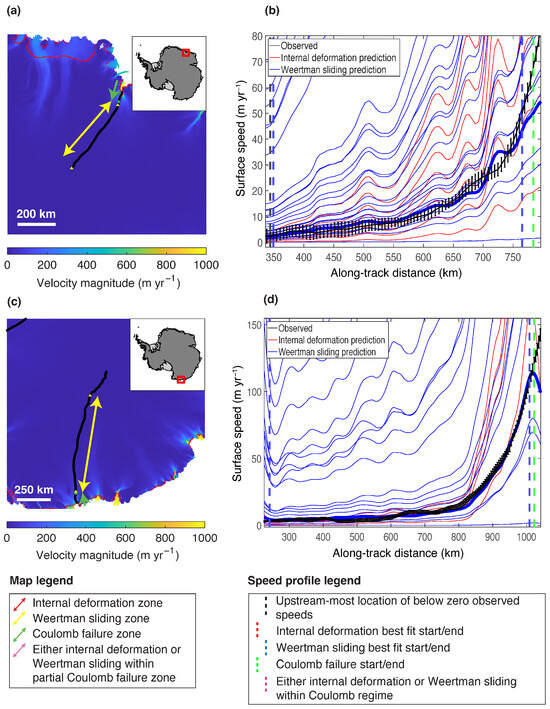
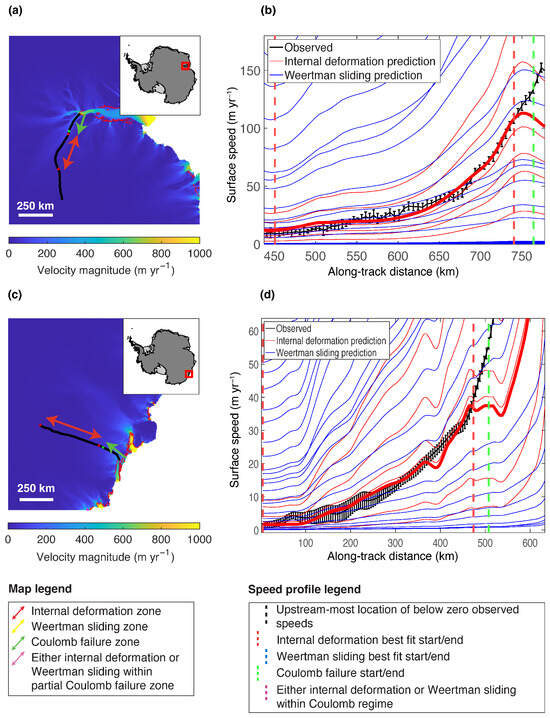
Of the 66 flowlines where predicted speeds were compared to observations, five are shown here (Figure 1b,d, Figure 2b,d, Figure 3b and Figure 4b). The five example flowlines illustrate four important patterns: regions where Weertman basal sliding is the dominant mechanism upstream of inferred Coulomb failure (Figure 1), regions where internal deformation is the dominant mechanism upstream of inferred Coulomb failure (Figure 2), the necessary transition of flow governed by internal deformation or Weertman sliding to Coulomb failure (Figure 3), and good agreement between (fast) Weertman basal sliding predictions and observations within a region governed by Coulomb failure (Figure 4). The dominant deformation mechanism is determined by continuous agreement in absolute value and speed profile shape between predictions and observations. When both models are initially (upstream) close to observations, but they diverge some distance downstream and only the speed profile of one model exhibits close agreement with observations over a length scale greater than 50 km, then that model is defined to be dominant from the upstream location where both models initially agree with observations through to the downstream region where only that model agrees with observations. The region of dominance ends where neither model exhibits continuous, close agreement with observations. The predicted and observed speed profiles for all 66 flowlines are found in Figure S1, with flowlines labeled according to the ice stream or ice shelf region. We were able to classify a dominant deformation mechanism between internal deformation and Weertman sliding, either upstream of Coulomb failure or within a Coulomb failure regime, for 32 of the 66 flowlines in Figure S1. The normalized RMSE was evaluated for each region where either internal deformation or Weertman sliding was identified as the dominant mechanism, for each of these 32 flowlines, in order to validate qualitative conclusions. Normalized RMSE results are documented in Table 2 for these 32 flowlines, including those flowlines for which Weertman sliding or internal deformation may also be dominant within a Coulomb failure region. There are 34 flowlines where we could not discern whether internal deformation or Weertman sliding dominates anywhere on the flowline, but we identified a Coulomb failure regime for 28 of these 34 flowlines. In the remaining 6 of these 34 flowlines without a discernible dominant mechanism between internal deformation and Weertman sliding, we could not conclude Coulomb failure anywhere.
Figure 1.
Representative regions where Weertman sliding dominates: Ice speeds predicted for a range of parameter values compared with observed speeds along flowlines. (a) Map view of Shirase Ice Stream with flowline marked with dominant mechanism. (b) Speed profile for the flowline in (a). (c) Map view of an ice stream draining into Cook Ice Shelf with flowline marked with dominant mechanism. (d) Speed profile for the flowline in (c). The dominant deformation zones are bracketed in map view (a,c) using arrows, and in profile view (b,d) using dashed vertical lines. The best fitting Weertman sliding profile upstream of inferred Coulomb failure is bolded.
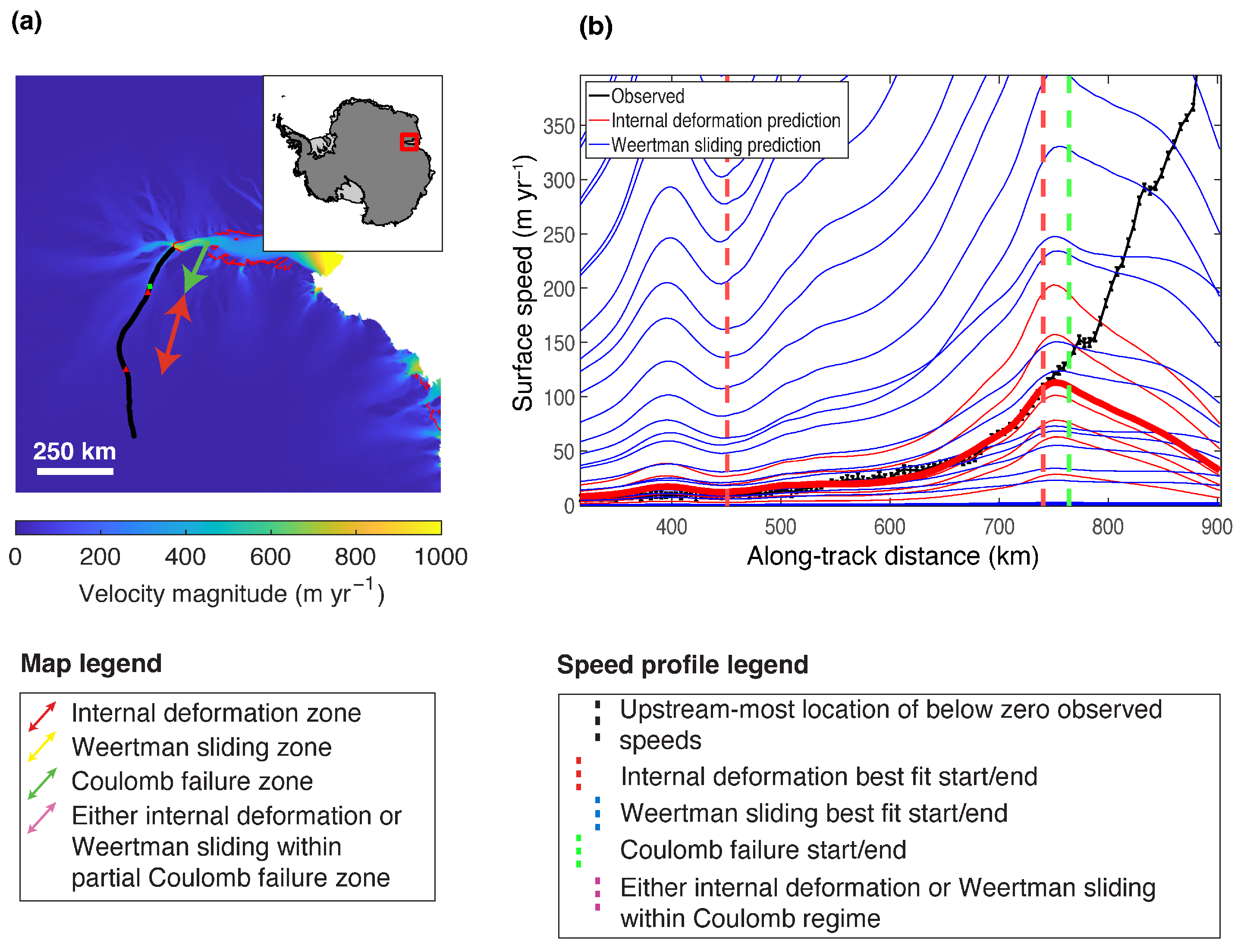
Figure 2.
Representative regions where internal deformation dominates: Ice speeds predicted for a range of parameter values compared with observed speeds along flowlines. (a) Map view of Lambert Ice Stream with flowline marked with dominant mechanism. (b) Speed profile for the flowline in (a). (c) Map view of Moscow University Ice Stream with flowline marked with dominant mechanism. (d) Speed profile for the flowline in (c). The dominant deformation zones are bracketed in map view (a,c) using arrows, and in profile view (b,d) using dashed vertical lines. The best fitting internal deformation profile upstream of inferred Coulomb failure is bolded.
Figure 3.
Representative region where Coulomb failure is reached: Ice speeds predicted for a range of parameter values compared with observed speeds along a flowline. (a) Map view of Lambert Ice Stream with flowline marked with dominant mechanism. (b) Speed profile for Lambert Ice Stream, a zoomed-out view of Figure 2b. The dominant deformation zones are bracketed in map view (a) using arrows, and in profile view (b) using dashed vertical lines. The best-fitting internal deformation profile upstream of inferred Coulomb failure is bolded. Coulomb failure is inferred in the region where neither model demonstrates continuous agreement with observed speeds, neither in absolute value nor profile shape.
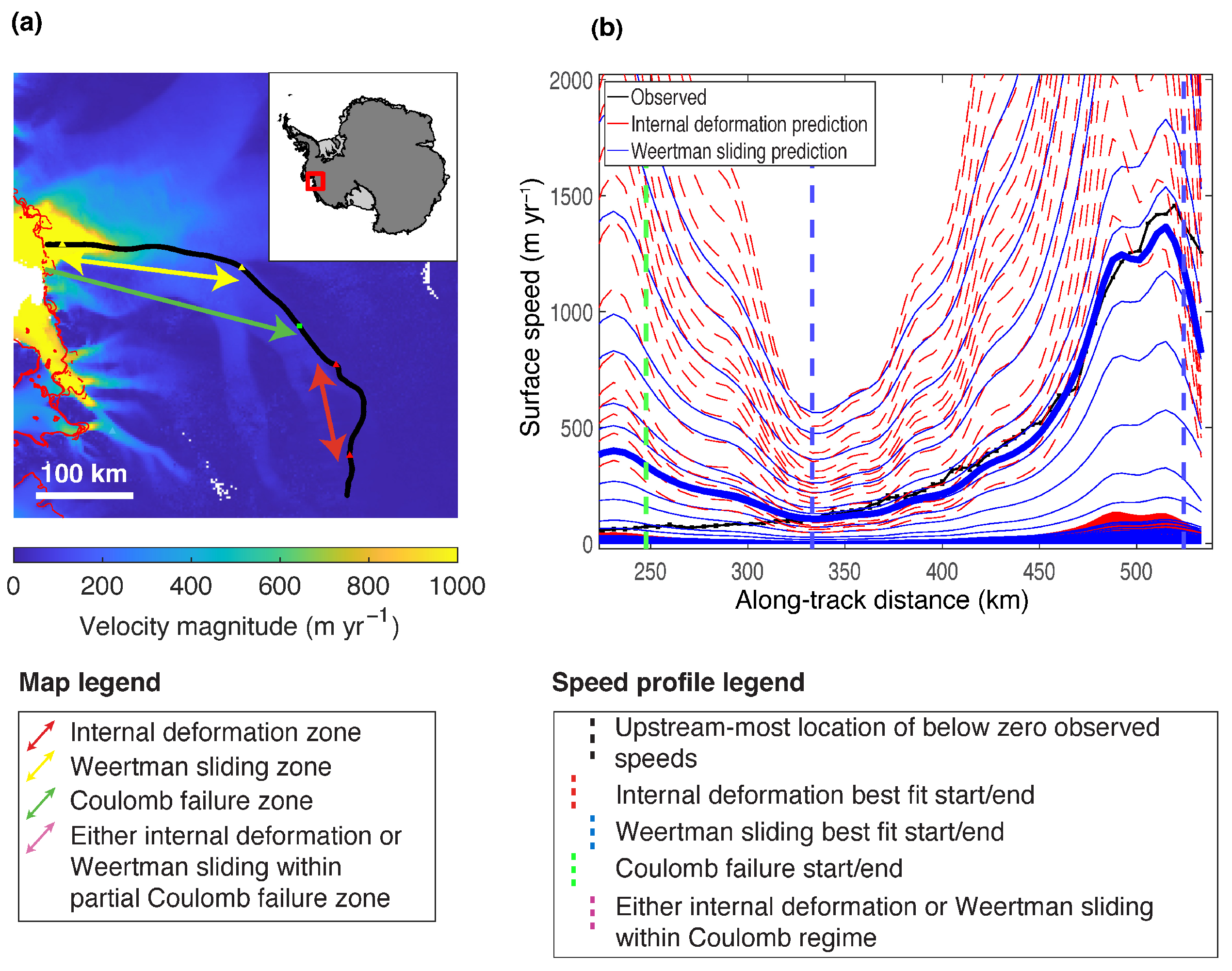
Figure 4.
Representative region where fast Weertman sliding fits observed speeds within a region of Coulomb failure: Ice speeds predicted for a range of parameter values compared with observed speeds along a flowline. (a) Map view of Thwaites Glacier and (b) speed profile for flowline in (a). The dominant deformation zones are bracketed in map view using arrows, and in profile view using dashed vertical lines. The best-fitting Weertman sliding profile within the Coulomb failure region is bolded. The dashed red profiles are the internal deformation predictions for creep parameters scaled up by a factor of 100, plotted to compare the shape of internal deformation profiles to the observed profile. Higher local basal shear stress is expected in a partial-Coulomb-failure region such as this, which explains why, for both models, agreement between observations and predictions is achieved for different parameters within a Coulomb failure regime and upstream of it.
Table 2.
Minimum normalized RMSE for both models (internal deformation and Weertman sliding). The RMSE misfit is calculated for each model in each region where a qualitative conclusion about the dominant deformation regime has been made. When the ratio of one normalized RMSE to the other is within 5% (i.e., <1.05), the classification may be less robust.
The flowline through Shirase Ice Stream in East Antarctica exhibits an approximately 400 km stretch where Weertman basal sliding predictions agree better with observations than internal deformation (Figure 1b). Internal deformation profiles that accurately predict curvature upstream between 350 and 550 km become too steep relative to the observed profile between 550 and 765 km, while the Weertman profiles remain in close agreement with observations from 350 and 765 km. Small-scale oscillations on the order of ~30 km in the predicted profiles are interpreted as artifacts of the surface slope calculation and smoothing routine. The qualitative conclusion that Weertman sliding offers a better fit to observations is supported by normalized RMSE tests: the best-fitting Weertman profile has a normalized RMSE of 0.1693, meaning that on the whole, the best-fitting Weertman profile deviates from observations by about 17% of the observed values. By contrast, the best-fitting internal deformation profile has a normalized RMSE of 0.3619 (Table 2). Similar conclusions in favor of Weertman sliding are found for the ice stream feeding Cook Ice Shelf (Figure 1c,d).
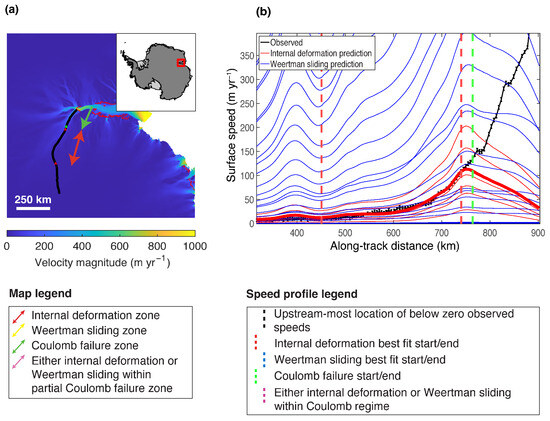
The flowline through Lambert Ice Stream in East Antarctica demonstrates an approximately 300 km stretch where internal deformation agrees better with observations than Weertman sliding (Figure 2b). While both models offer a close fit to observations from 450 and 600 km, the Weertman profiles do not rise steeply enough to match observations and the internal deformation profiles do. The qualitative conclusion that internal deformation offers a better fit to observations is supported by the normalized RMSE results: the best-fitting internal deformation profile has a normalized RMSE of 0.1128, meaning that on the whole, the best-fitting internal deformation profile deviates from observations by about 11% of the observed values. By contrast, the best-fitting Weertman sliding profile has a normalized RMSE of 0.1985 (Table 2). Similar conclusions in favor of internal deformation are found for Moscow University Ice Stream (Figure 2c,d).
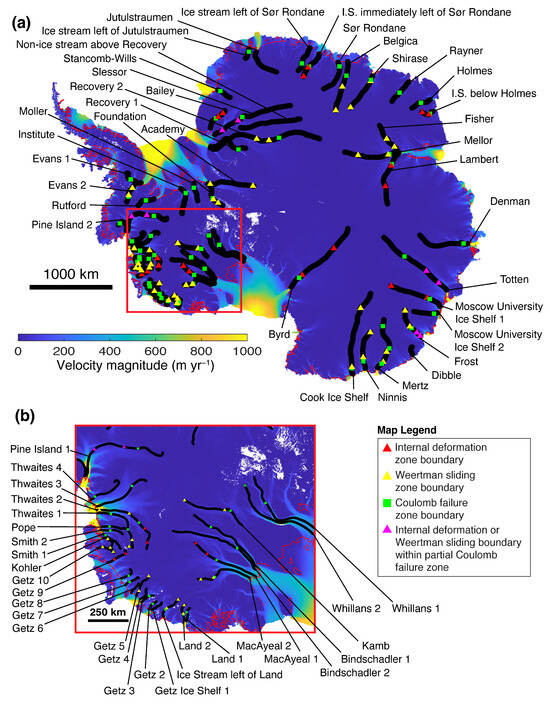
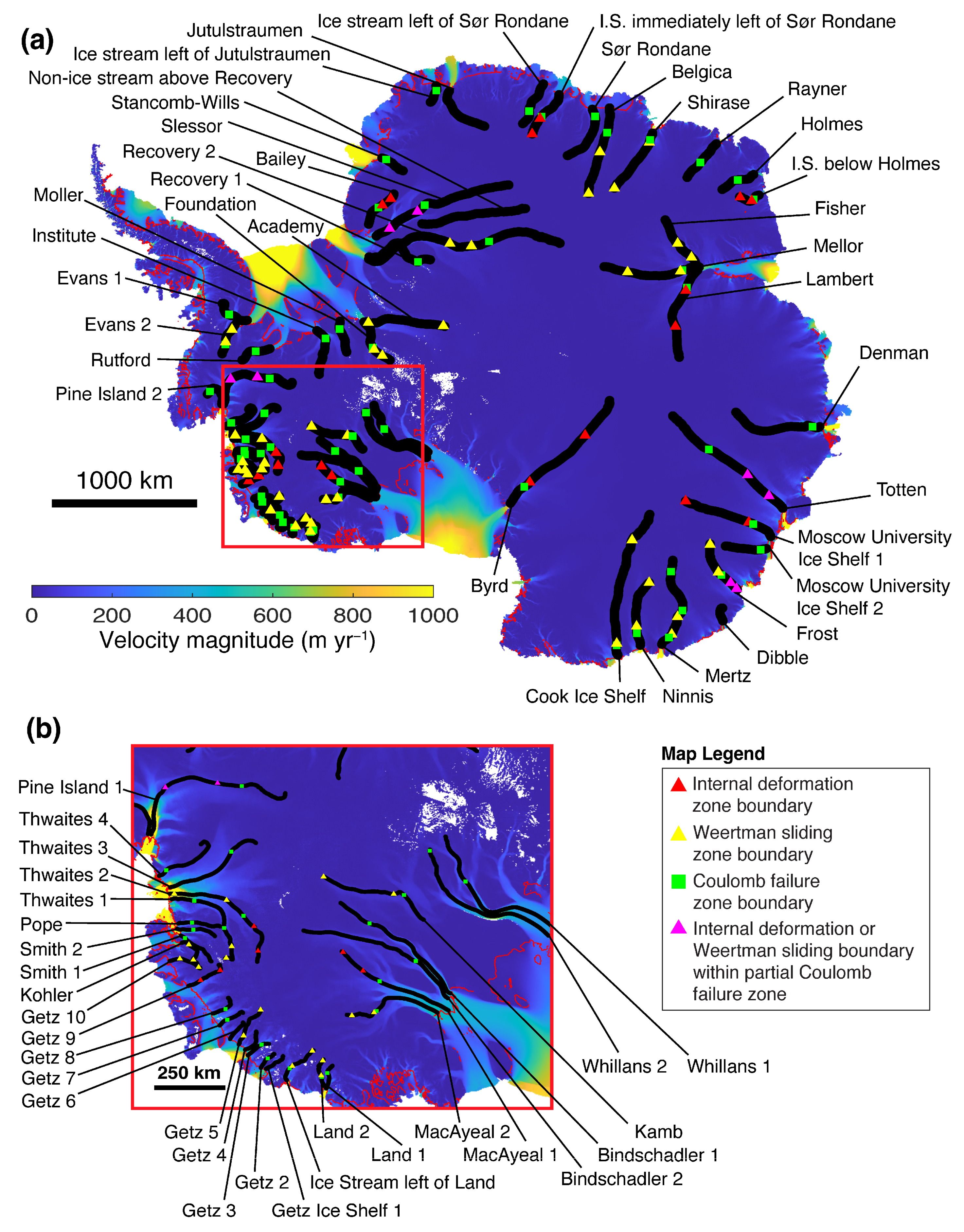
Figure 3b is a zoomed-out version of Figure 2b, showing how ice speeds governed by internal deformation upstream transition to speeds likely described by Coulomb failure downstream. Internal deformation describes creep due to the weight of overlying ice, while Weertman basal sliding describes creep and regelation in the presence of bedrock obstacles. Together, internal deformation and Weertman sliding depend on the material and physical properties of the bed and ice. If neither mechanism can model observed speeds, then water pressure, another physical parameter not considered by either physical mechanism, is likely important for predicting speeds. The Coulomb friction rheology has a natural water pressure dependence. If neither model can accurately explain observed speed behavior for a distance greater than ~50 km, and observed speeds are significantly greater than upstream predicted speeds, then we classify this region as being best described by a Coulomb basal rheology, as shown clearly for Lambert Ice Stream in Figure 3b. Note that our criteria are very different from those of other authors (e.g., [15,37]) who require speeds (u) to be independent of τb to classify sliding as due to Coulomb failure. At approximately 740 km downstream of the flowline start, the observed speed profile diverges from both internal deformation and Weertman sliding profiles. Downstream of this location, it is likely that water pressures are higher than upstream and, thus, that Coulomb failure governs ice speeds (Figure 3b). For most flowlines where Coulomb failure is inferred, the Coulomb region is unbounded on the downstream end of the flowline. In other words, once Coulomb failure is inferred, there is no downstream reappearance in agreement between observations and either the Weertman or internal deformation profiles that offered good agreement upstream. There are, however, a few flowlines that exhibit good agreement between Weertman sliding or internal deformation profiles within an inferred Coulomb failure regime, but for a different set of parameters than those offering good agreement upstream of Coulomb failure (Figure 4b). This behavior is explored in greater detail further on in the Section 4 and Section 5. There are also a few flowlines exhibiting local Coulomb failure, manifested by stretches longer than ~50 km where observations are greater than predictions and have a different profile shape, but at some locations downstream, observations realign in curvature and absolute value with either the Weertman or internal deformation profiles that offer good agreement upstream. Local Coulomb failure is likely caused by locally high subglacial water pressure [13,38]. This kind of behavior is not shown in any of the five examples here, but a few of these flowlines appear in the continent-wide regime map (Figure 5).
Figure 5.
Summary of flowline classifications. (a) Map view of 66 sampled Antarctic flowlines, with conclusions about dominant deformation mechanisms marked for each flowline. Markers denote deformation zone boundaries, such that all points between boundaries of the same deformation type have speeds best described by that deformation type. For most flowlines studied, Coulomb failure initiates some distance downstream of the ice divide and remains dominant until the grounding line, such that Coulomb failure start boundaries are marked but end boundaries are not. There are a few flowlines where Coulomb failure is identified locally, transitioning to a dominant Weertman sliding or internal deformation mechanism further downstream. In these flowlines, Coulomb failure is marked by start and end boundaries. (b) Enlarged view of the region in the red square in (a). Flowlines are labeled with the glacier names used throughout.
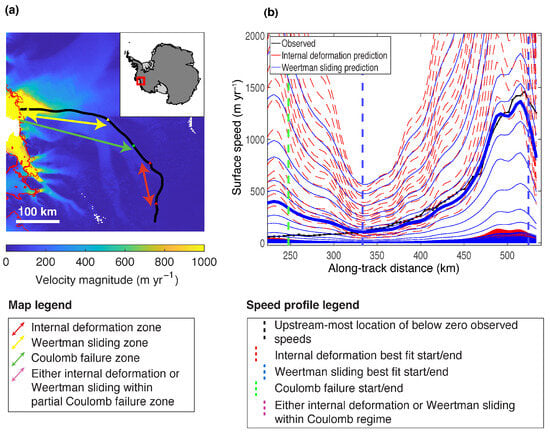
Some flowlines exhibit good agreement between Weertman basal sliding predictions and observations within an inferred Coulomb failure regime (Figure 4b). In this case, Weertman sliding profiles downstream of the inferred Coulomb failure start have shapes similar to the observed profile, except that the parameters of the best-fitting Weertman profile downstream of the inferred-Coulomb-failure start are different from those of the best-fitting Weertman profile upstream of the inferred Coulomb failure. Although there is good agreement between the Weertman sliding model and observations upstream and downstream, no single set of Weertman parameters accomplishes consistent agreement along the flowline. The flowline through Thwaites Glacier in West Antarctica exhibits observed speeds governed by internal deformation far upstream (see Figure 4a). Then, internal deformation likely transitions to Coulomb failure at approximately 250 km from the upstream start of the flowline. Coulomb failure is inferred at this location because neither internal deformation nor Weertman sliding can model observations, which start to increase steeply. Further downstream, internal deformation profiles with higher values than upstream are too steep relative to the observed profile between 450 and 524 km, while Weertman sliding profiles with higher values than upstream roughly agree with the observed curvature in this range (Figure 4b). The qualitative conclusion that Weertman sliding offers a better fit to observations in this Coulomb region is supported by normalized RMSE tests: the best-fitting Weertman profile has a normalized RMSE of 0.1072, meaning that on the whole, the best-fitting Weertman profile deviates from observations by about 11% of the observed values. By contrast, the best-fitting internal deformation profile has a normalized RMSE of 0.5053 (Table 2). To match the higher speeds observed downstream and interpreted to be partial Coulomb failure, Weertman model parameters would need to change significantly from upstream to downstream. In this case, the sampled creep parameters are the same for the best-fitting Weertman profile upstream and downstream, but the effective roughness decreases by a factor of 2.16 and the effective thermal conductivity decreases by a factor of 1.71 from best-fitting Weertman profiles upstream to downstream. According to Equation (4), these parameter changes increase predicted speeds by a factor of ~16 from upstream to downstream. For reasons that will be discussed later, we believe that agreement between Weertman sliding and observations within an inferred Coulomb failure regime likely does not result from physical parameters in Equation (3) changing physically from upstream to downstream, but instead that the ice–bed contact area is reduced in a Coulomb-failed region [39].
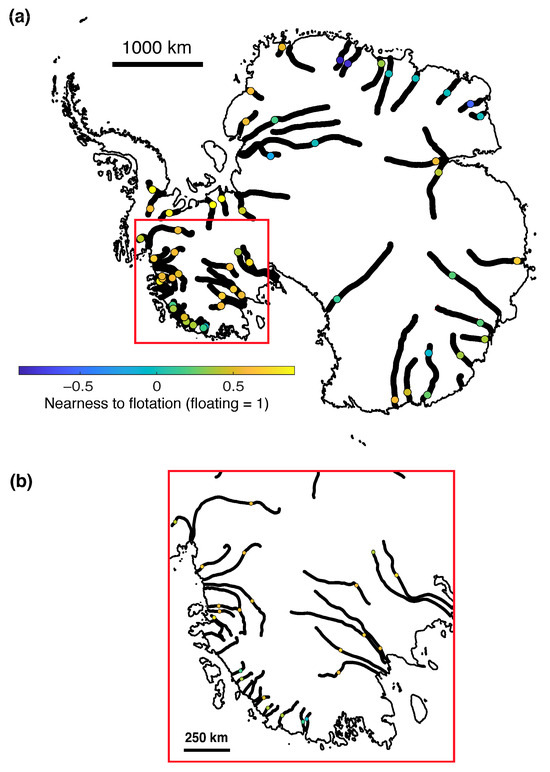
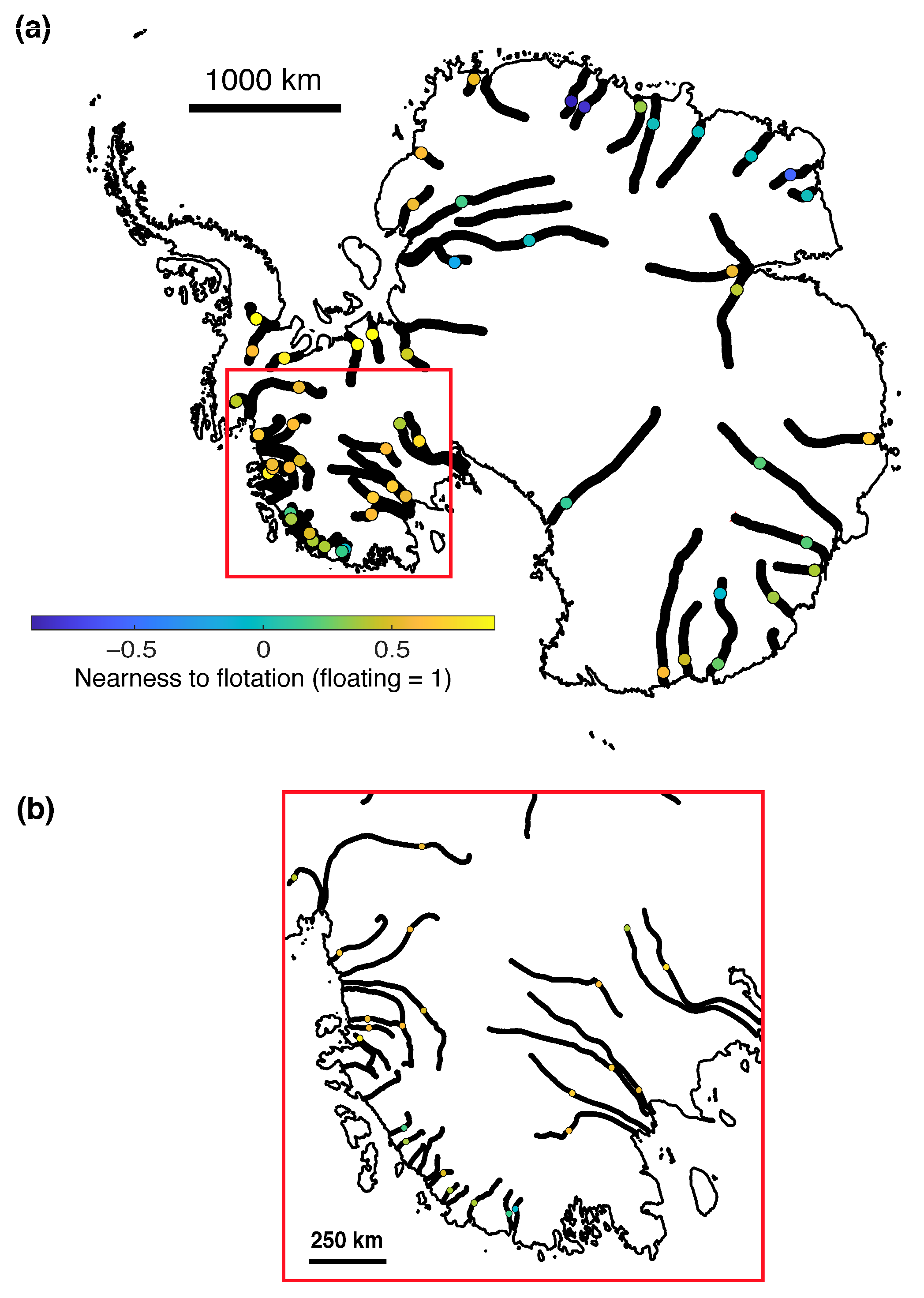
Figure 5 synthesizes basal-deformation regime markers for all 66 tested flowlines. While these 66 flowlines are not comprehensive, they span a significant area of the Antarctic Ice Sheet. One goal of this study is to search for consistency between flowline regions where Coulomb failure likely describes observed speeds. We are interested in whether there are certain physical parameter values that might be indicative of Coulomb failure. A simple possibility is that there is consistency in the distance from the grounding line to the inferred start location of Coulomb failure across flowlines. No such pattern is apparent based on Figure 5. Based on the reasoning that Coulomb failure is expected at locations of relatively high water pressure, estimates of the nearness to flotation for each inferred upstream start location of Coulomb failure can be compared between flowlines to search for patterns in Coulomb failure initiation. At the grounding line, grounded ice sheets transition to floating ice shelves because water pressure equals ice overburden pressure, expressed as
where the water density ρw is 1000 kg m−3, hgl is the ice thickness at the grounding line in meters, and bgl is the bedrock depth at the grounding line in meters [2]. Evaluating Equation (9) at the Coulomb failure start instead of at the grounding line and dividing the right-hand side by the left-hand side gives a fraction less than 1. This fraction is interpreted as near flotation if close to 1 and not near flotation if close to 0. Since Coulomb failure occurs for relatively high subglacial water pressure, we expect Coulomb failure to occur for ice near flotation, but regional consistencies and differences between nearness to flotation values are also of interest. The results are recorded in Figure 6 and Table S1. The flotation condition in Equation (9) assumes hydrostatic water pressure, which is likely not valid, especially for ice grounded above sea level, but is useful to evaluate nonetheless.
Figure 6.
Nearness to flotation. (a) Nearness to flotation is calculated using Equation (9) for the inferred upstream start of Coulomb failure for each flowline. A value of 1 signifies flotation, and a positive value less than 1 signifies that hydrostatic water pressure is less than ice overburden pressure, thus being further from flotation. Negative values indicate basal ice grounded above sea level. (b) Enlarged view of the region in the red square in (a).
5. Discussion
We find that neither the internal deformation nor Weertman sliding model provides generally better agreement with observations for the entire Antarctic Ice Sheet. We do find regional consistencies in the dominant mechanism. The bottom right region in map view (eastern East Antarctica), including flowlines feeding into Cook Ice Shelf, Ninnis, Mertz, and Frost Ice Streams, exhibits upstream speeds best described by Weertman sliding (Figure 5; Table 2). The upstream segments best described by Weertman sliding are spatially consistent between the four flowlines in this region. One of the flowlines in this region, passing through Mertz Glacier, exhibits isolated inferred Coulomb failure upstream, likely the result of locally high subglacial water pressure. Still, the flowline through Mertz Glacier exhibits Weertman sliding behavior midstream that is consistent with nearby flowlines. The upper-right region of the Antarctica map (western East Antarctica) exhibits upstream surface speeds best described by Weertman sliding on the whole (Figure 5; Table 2). There are a few flowlines in the upper-right region that exhibit dominant internal deformation upstream, but the four flowlines with upstream ends closest to ice divides (flowlines through Mellor, Fisher, Shirase, and Belgica ice streams) all exhibit upstream speeds governed by Weertman sliding. In West Antarctica, we were unable to conclude the dominant mechanism for several flowlines because they are too short. However, the lower region of the West Antarctic Ice Sheet (western West Antarctica) contains a cluster of four nearby flowlines with upstream speeds all governed by Weertman sliding (Figure 5). Where Weertman sliding predictions are consistent with observed upstream speeds, the physical assumptions underlying the Weertman sliding mechanism are supported. In these regions, the Weertman sliding assumption that ice rests on rock or non-deforming till is also supported [1], potentially because pore pressures are not high enough or roughness is sufficient [39].
Within flowline segments where Coulomb failure is inferred, there are three segments where the Weertman model matches predictions and four segments where both internal deformation and Weertman sliding models may match observations. Within a Coulomb-failed regime, the basal layer may be completely or partially Coulomb-failed. Coulomb failure occurs because water pressure increases to support part of the normal stress. For partial Coulomb failure, if a portion of the ice is supported by water pressure, all of the basal shear stress would be concentrated on a reduced area of the bedrock, which would increase the local shear stress by some factor [39]. Where Weertman sliding profiles agree with observed profiles in these regions, Weertman sliding is interpreted as dominant in the ice–bed contact with reduced area. Assuming the same parameters that apply upstream of the Coulomb regime (creep parameter, roughness coefficient, thermal conductivity of bedrock), a higher shear stress results in higher basal slip speeds (Equations (2) and (4)). Our models do not account for the reduced-area effect on shear stress, but predictions are made for different combinations of parameters, or for a range of parameters in the case of internal deformation. As was shown in Figure 4, the best-fitting Weertman sliding profiles in a region inferred to be Coulomb-failed have different parameters than the best-fitting Weertman sliding or internal deformation profiles upstream of Coulomb failure. The change in parameters from the best-fitting profile upstream to the best-fitting profile within a Coulomb-failed region imitates the increase in speeds that results from a shear stress increase. In Figure 4b, for example, the roughness parameter Rf corresponding to the best-fitting Weertman sliding profile within the Coulomb-failed region is lower than the Rf corresponding to the best-fitting Weertman sliding profile upstream of Coulomb failure. It is important to recognize that downstream agreement with the Weertman model is likely not because parameters physically change along a flowline, but rather the shear stress increases due to a reduced ice–bed contact area. These instances where some basal area is partially Coulomb-failed and the remaining area is dominated by Weertman sliding are consistent with assumptions underlying the sliding law formulated by Tsai et al. [39]. We observe no segments where internal deformation profiles offer clearly better predictions than Weertman profiles within a Coulomb-failed region. If much of the basal ice is Coulomb-failed, there is locally high meltwater content, which indicates basal temperatures at the melting point, suggesting that basal deformation includes regelation in addition to creep around obstacles. Thus, we might not expect internal deformation to govern flow in partially Coulomb-failed ice. Another potential explanation for the agreement between the Weertman predictions and observations in a partially Coulomb-failed region is lower bedrock roughness caused by erosion, which could occur in tandem with increased shear stress.
Although there are no continent-wide trends in inferred-Coulomb-failure location and nearness to flotation, there are regional consistencies. The Siple Coast in West Antarctica features several flowlines where the inferred upstream start locations of Coulomb failure all have a nearness to flotation within the range of 0.54 and 0.71, with the exception of one of the flowlines through Whillans Ice Stream, which has a nearness to flotation of 0.39 (Figure 6). Regional consistency in nearness to flotation justifies each of the individual qualitative judgments of inferred-Coulomb-failure start locations in that region. Consistency in nearness to flotation also suggests that Coulomb failure occurs along the Siple Coast for a ratio of hydrostatic water pressure to ice overburden pressure of approximately 0.63. This threshold value is different in other regions. For the flowlines feeding into the Getz Ice Shelf, for example, nearness to flotation values fall within the range 0.19 to 0.37 (Figure 6). The region encompassing flowlines through Shirase, Rayner, and Holmes Ice Streams, and the ice stream below (east of) Holmes exhibit nearness to flotation in the range of −0.5 to −0.004. Negative nearness to flotation values indicate that the inferred upstream start of Coulomb failure occurs above sea level. This could be caused, for example, by a highly pressured upstream water source, resulting in high water pressures far upstream of where ocean water infiltrates the bed.
There are a few limitations to our analysis that could be adjusted to improve results. Basal and near-basal ice temperatures were estimated using the Robin model in Equation (8), which has been shown to be inaccurate for ice at speeds greater than 10 m yr−1 because it ignores horizontal advection [29]. Accounting for horizontal advection in our temperature estimates would transport cooler temperatures downstream and decrease estimated temperatures, which would decrease estimated creep parameters and predicted speeds downstream [17]. This might improve agreement between predictions and observations in some cases, but in other cases agreement would worsen. Thus, we do not expect that neglecting horizontal advection introduces bias to the results because it would not affect the qualitative assessments in any particular direction. An improvement to this study may estimate vertical temperature profiles using more complicated numerical solutions to the vertical conduction model with an advection contribution [17]. These vertical temperature profiles might allow for more-accurate creep parameter estimates as an input to both deformation models.
Arguably, the most important complication to our analysis is the creep parameter n. As mentioned previously, a value of n = 3 is frequently assumed, but n in the range of 2 to 4 may also be expected. We note that without strong constraints on n, there is some ambiguity in our predictions. Our qualitative assessments determine the dominant deformation mechanism based on predicted profile shape. If n were allowed to vary spatially, then predicted profile shapes in this study may be inaccurate. It is worth noting that our predictions generally agree with observations for realistic values of other parameters, at least for part of each tested flowline, which suggests that n = 3 is a reasonable assumption. Furthermore, while spatial variability in n might account for some of the variability in observed speeds, we do not expect variability in n to account for all observed variability. The observed speed profiles demonstrate drastic changes in speed that even a transition from n = 2 to n = 4 could not accommodate (Figure 1b,d, Figure 2b,d, Figure 3b and Figure 4b). Given that n = 3 is broadly supported by experimental and theoretical studies, it is the most appropriate choice for an investigation into consistency in deformation type on a regional and continent-wide scale.
As discussed previously, the smoothing routine may also be improved such that small-scale oscillations are reduced. This study uses an ‘rloess’ routine, but other smoothing routines (like ‘rlowess’) may smooth oscillations further (for ‘rlowess’, because it smooths using a first-degree polynomial instead of a second-degree polynomial), therefore capturing more-robust trends in predicted profiles rather than small-scale departures from these trends. Regardless of the smoothing routine used, the analysis used in this study remains subjective, so there is an inherent uncertainty in assessing the dominant deformation mechanism or Coulomb failure start location. Still, the misfit analysis using normalized RMSE provides quantitative justification to qualitative assessments, confirming our conclusions.
Finally, we acknowledge that the true physics describing ice motion in Antarctica could potentially be physics that is not encompassed by the range of physics we allowed in our simple tests, or could be a combination of the mechanisms. The fact that nearly all data could be reasonably well fit by one of the three endmember categories of internal deformation, Weertman sliding or Coulomb friction suggests to us that this is not the case, but one cannot rule out the possibility. If future physical models are proposed, those would need to be tested via a similar study as the present one to determine the likelihood that these models perform better or worse than the three models we tested.
6. Conclusions
This study assesses the dominant basal-deformation mechanism in various Antarctic Ice Sheet flowlines. With certain caveats, we conclude that it is possible to distinguish between internal deformation and Weertman sliding, two mathematically similar deformation mechanisms describing different physical conditions. Distinguishing between these two mechanisms may be useful in defining constraints on basal slip in glaciological models, particularly for future or past times when empirical laws may be inaccurate. We have shown that there are regional consistencies in the dominant type of deformation, which may help to further constrain deformation in models. This study identifies several regions where surface speeds appear generally governed by Weertman sliding. We document several flowlines throughout Antarctica where Weertman sliding appears to dominate within a partially Coulomb-failed region, consistent with theoretical expectations [39]. This study also finds regional consistencies in nearness to the flotation condition at inferred Coulomb failure start locations: Coulomb failure occurs nearer to flotation on the Siple Coast than upstream of Getz Ice Shelf, for example. These conclusions highlight that Coulomb failure dominates far upstream of the grounding line for many ice streams, which underscores the importance of including a Coulomb basal rheology in glaciological models and shifting away from only assuming a power-law rheology.
Supplementary Materials
The following supporting information can be downloaded at: https://www.mdpi.com/article/10.3390/glacies3010005/s1, Table S1: Nearness to flotation for inferred upstream start locations of Coulomb failure, calculated using Equation (9), for each flowline. A negative nearness to flotation value indicates that the start location of Coulomb failure occurs for ice above sea-level. The distance between start locations of Coulomb failure and the upstream ends of each flowline are reported; Figure S1: Predicted and observed speed comparisons for each flowline studied, with corresponding ice stream or shelf regions specified.
Author Contributions
Conceptualization, V.C.T. and H.R.; methodology, V.C.T. and H.R.; software, H.R.; validation, H.R.; formal analysis, H.R.; investigation, H.R. and V.C.T.; resources, V.C.T. and H.R.; data curation, H.R.; writing—original draft preparation, H.R.; writing—review and editing, V.C.T.; visualization, H.R.; supervision, V.C.T.; project administration, V.C.T.; funding acquisition, H.R. and V.C.T. All authors have read and agreed to the published version of the manuscript.
Funding
This research was funded by the Brown University Undergraduate Teaching and Research Award (UTRA) program BrownConnect Summer Projects for Research, Internships, and Teaching (SPRINT) Award.
Institutional Review Board Statement
Not applicable.
Informed Consent Statement
Not applicable.
Data Availability Statement
The data presented in this study are available. The code for processing data, computing predicted speeds, and comparison with observed speeds can be obtained online at https://doi.org/10.5281/zenodo.7047128. The ERA-Interim reanalysis data used to estimate the ice temperature at depth are publicly available and were downloaded from https://www.ecmwf.int/en/forecasts/datasets/archive-datasets/reanalysis-datasets/era-interim (accessed on 1 April 2022). Ice thickness, ice elevation, bedrock topography data and relevant Matlab functions were sourced from the Bedmap2 data set, available from Matlab File Exchange: https://www.mathworks.com/matlabcentral/fileexchange/42353-bedmap2-toolbox-for-matlab (accessed on 1 April 2022). Ice velocity and grounding line data were sourced from MEaSUREs data set, available from Matlab File Exchange: https://www.mathworks.com/matlabcentral/fileexchange/47329-measures?s_tid=ta_fx_results (accessed on 1 April 2022). All data sources and their relevant literature are cited in the References.
Acknowledgments
The authors thank Colleen Dalton, Chris Huber, and Jan Tullis for their helpful comments on H.R.’s undergraduate senior thesis, which led directly to this contribution. We also thank two anonymous reviewers for their comments.
Conflicts of Interest
The authors declare no conflicts of interest.
Appendix A. Constructing Flowlines
Continent-wide grounding lines were plotted using the MEaSUREs toolbox. Flowlines were constructed by selecting a single location just upstream or inland of the grounding line. Using known velocity directional components at grid points spaced 1 km apart, a streamline was created in the opposite direction of flow between the downstream end and an upstream location. A few flowlines were initiated far upstream of the coastline. Far upstream near the ice divide, there is greater uncertainty in flow direction such that flowlines would exhibit looping over themselves or zig-zagging, which are not realistic flowline behaviors. To ensure that uncertainty in flowline direction upstream did not affect results, the entire flowline was plotted with a maximum of 1500 grid points allowed, and the flowline was clipped at the upstream-most point before any two flowline points were less than 800 m apart (indicative of looping or zig-zagging). At a few locations in Antarctica, namely the Transantarctic Mountains in West Antarctica, flowlines terminated abruptly upon intercepting rock outcrops, which represents a limitation of the MEaSUREs dataset in capturing flow around surface obstacles. Since these rock outcrops are uncommon, and since rock outcrops occur far enough upstream that the flowline tracks a large distance, we conclude that these outcrops do not significantly affect results. The order of flowline points was then reversed to reflect the actual flow of ice from upstream to downstream.
Appendix B. Computing Surface Slope a
Points on a flowline constructed using the streamline function in Matlab (version R2022a) are approximately but not exactly 1 km apart (Appendix A). The surface slope needed to compute α was thus calculated using a second-order Lagrange interpolating polynomial, useful for numerical differentiation of unequally spaced data [40]. The Lagrange interpolating polynomial calculates the slope using elevation data at three points, computing the slope through those points at a chosen point 1 km upstream of the middle point. A distance of 5 km between each of the three points was chosen (10 km between the first and third points) because this satisfies the SIA assumption of surface slopes calculated over a horizontal distance that is greater than the vertical ice thickness. A 5 km separation between points is also not so large as to neglect mesoscale—between 20 and 30 km—variations in surface slope.
References
- Weertman, J. On the sliding of glaciers. J. Glaciol. 1957, 3, 33–38. [Google Scholar] [CrossRef] [Scilit]
- Schoof, C. Marine ice-sheet dynamics. Part 1. The case of rapid sliding. J. Fluid Mech. 2007, 573, 27–55. [Google Scholar] [CrossRef] [Scilit]
- Tsai, V.C.; Stewart, A.L.; Thompson, A.F. Marine ice-sheet profiles and stability under Coulomb basal conditions. J. Glaciol. 2015, 61, 205–215. [Google Scholar] [CrossRef] [Scilit]
- Catania, G.; Hulbe, C.; Conway, H. Grounding-line basal melt rates determined using radar-derived internal stratigraphy. J. Glaciol. 2010, 56, 545–554. [Google Scholar] [CrossRef] [Scilit]
- Rignot, E.; Mouginot, J.; Morlighem, M.; Seroussi, H.; Scheuchl, B. Widespread, rapid grounding line retreat of Pine Island, Thwaites, Smith, and Kohler glaciers, West Antarctica, from 1992 to 2011. Geophys. Res. Lett. 2014, 41, 3502–3509. [Google Scholar] [CrossRef] [Scilit]
- Budd, W.F.; Jenssen, D.; Smith, I.N. A three-dimensional time-dependent model of the West Antarctic Ice Sheet. Ann. Glaciol. 1984, 5, 29–36. [Google Scholar] [CrossRef] [Scilit]
- Muszynski, I.; Birchfield, G.E. A coupled marine ice-stream—Ice-shelf model. J. Glaciol. 1987, 33, 3–15. [Google Scholar] [CrossRef] [Scilit]
- Joughin, I.; MacAyeal, D.R.; Tulaczyk, S. Basal shear stress of the Ross ice streams from control method inversions. J. Geophys. Res.-Sol. Ea. 2004, 109, B09405. [Google Scholar] [CrossRef] [Scilit]
- Pralong, M.R.; Gudmundsson, G.H. Bayesian estimation of basal conditions on Rutford Ice Stream, West Antarctica, from surface data. J. Glaciol. 2011, 57, 315–324. [Google Scholar] [CrossRef] [Scilit]
- Iverson, N.R. Coupling between a glacier and a soft bed: II. Model results. J. Glaciol. 1999, 45, 41–53. [Google Scholar] [CrossRef]
- Tulaczyk, S.; Kamb, W.B.; Engelhardt, H.F. Basal mechanics of Ice Stream B, West Antarctica: 1. Till mechanics. J. Geophys. Res. 2000, 105, 463–481. [Google Scholar] [CrossRef] [Scilit]
- Zoet, L.K.; Iverson, N. A slip law for glaciers on deformable beds. Science 2020, 368, 76–78. [Google Scholar] [CrossRef] [Scilit] [PubMed]
- Iverson, N.R.; Hooyer, T.S.; Baker, R.W. Ring-shear studies of till deformation: Coulomb-plastic behavior and distributed strain in glacier beds. J. Glaciol. 1998, 44, 634–642. [Google Scholar] [CrossRef] [Scilit]
- Truffer, M.; Echelmeyer, K.A.; Harrison, W.D. Implications of till deformation on glacier dynamics. J. Glaciol. 2001, 47, 123–134. [Google Scholar] [CrossRef] [Scilit]
- Maier, N.; Gimbert, F.; Gillet-Chaulet, F.; Gilbert, A. Basal traction mainly dictated by hard-bed physics over grounded regions of Greenland. Cryosphere 2021, 15, 1435–1451. [Google Scholar] [CrossRef] [Scilit]
- Jiskoot, H. Dynamics of Glaciers. In Encyclopedia of Snow, Ice and Glaciers; Singh, V.P., Singh, P., Haritashya, U.K., Eds.; Springer: Dordrecht, The Netherlands, 2011; pp. 245–256. [Google Scholar] [CrossRef] [Scilit]
- Cuffey, K.M.; Paterson, W.S.B. The Physics of Glaciers, 4th ed.; Elsevier: Amsterdam, The Netherlands, 2010. [Google Scholar]
- Schoof, C. A variational approach to ice stream flow. J. Fluid Mech. 2006, 556, 227–251. [Google Scholar] [CrossRef] [Scilit]
- Rignot, E.; Mouginot, J.; Scheuchl, B. Ice flow of the Antarctic Ice Sheet. Science 2011, 333, 1427–1430. [Google Scholar] [CrossRef] [Scilit]
- Rignot, E.; Mouginot, J.; Scheuchl, B. MEaSUREs Antarctic Grounding Line from Differential Satellite Radar Interferometry, National Snow and Ice Data Center [Data Set]. 2011. Available online: https://nsidc.org/data/nsidc-0498/versions/1 (accessed on 1 April 2022).
- Rignot, E.; Mouginot, J.; Scheuchl, B. MEaSUREs InSAR-Based Antarctica Ice Velocity Map, Version 2, NASA National Snow and Ice Data Center Distributed Active Archive Center [Data Set]. 2017. Available online: https://nsidc.org/data/nsidc-0484/versions/2 (accessed on 1 April 2022).
- Greene, C.A.; Gwyther, D.E.; Blankenship, D.D. Antarctic Mapping Tools for Matlab. Comput. Geosci. 2017, 104, 151–157. [Google Scholar] [CrossRef] [Scilit]
- Greene, C.A. MEaSUREs, MATLAB Central File Exchange [Code]. 2022. Available online: https://www.mathworks.com/matlabcentral/fileexchange/47329-measures (accessed on 1 April 2022).
- Mouginot, J.; Rignot, E.; Scheuchl, B.; Millan, R. Comprehensive annual ice sheet velocity mapping using Landsat-8, Sentinel-1, and RADARSAT-2 data. Remote Sens. 2017, 9, 364. [Google Scholar] [CrossRef] [Scilit]
- Mouginot, J.; Scheuchl, B.; Rignot, E. MEaSUREs Annual Antarctic Ice Velocity Maps 2005–2016, Version 1, NASA National Snow and Ice Data Center Distributed Active Archive Center [Data Set]. 2017. Available online: https://nsidc.org/data/nsidc-0720/versions/1 (accessed on 1 April 2022).
- Fretwell, P.; Pritchard, H.D.; Vaughan, D.G.; Bamber, J.L.; Barrand, N.E.; Bell, R.; Bianchi, C.; Bingham, R.G.; Blankenship, D.D.; Casassa, G.; et al. Bedmap2: Improved ice bed, surface and thickness datasets for Antarctica. Cryosphere 2013, 7, 375–393. [Google Scholar] [CrossRef] [Scilit]
- Robin, G.d.Q. Ice movement and temperature distribution in glaciers and ice sheets. J. Glaciol. 1955, 2, 523–532. [Google Scholar] [CrossRef] [Scilit]
- Lenaerts, J.T.M.; Van Den Broeke, M.R.; Van De Berg, W.J.; Van Meijgaard, E.; Kuipers Munneke, P. A new, high-resolution surface mass balance map of Antarctica (1979–2010) based on regional atmospheric climate modeling. Geophys. Res. Lett. 2012, 39, L04501. [Google Scholar] [CrossRef] [Scilit]
- Macelloni, G.; Leduc-Leballeur, M.; Montomoli, F.; Brogioni, M.; Ritz, C.; Picard, G. On the retrieval of internal temperature of Antarctica Ice Sheet by using SMOS observations. Remote Sens. Environ. 2019, 233, 111405. [Google Scholar] [CrossRef] [Scilit]
- European Centre for Medium-Range Weather Forecast (ECMWF): The ERA-Interim Reanalysis Dataset, Copernicus Climate Change Service (C3S) [Data Set]. 2011. Available online: https://www.ecmwf.int/en/forecasts/datasets/archive-datasets/reanalysis-datasets/era-interim (accessed on 1 April 2022).
- Shreve, R.L. Glacier sliding at subfreezing temperatures. J. Glaciol. 1984, 30, 341–347. [Google Scholar] [CrossRef] [Scilit]
- Burton-Johnson, A.; Dziadek, R.; Martin, C. Review article: Geothermal heat flow in Antarctica: Current and future directions. Cryosphere 2020, 14, 3843–3873. [Google Scholar] [CrossRef] [Scilit]
- Raymond, C.F. Inversion of flow measurements for stress and rheological parameters in a valley glacier. J. Glaciol. 1973, 12, 19–44. [Google Scholar] [CrossRef] [Scilit]
- Martin, P.J.; Sanderson, T.J.O. Morphology and dynamics of ice rises. J. Glaciol. 1980, 25, 33–46. [Google Scholar] [CrossRef] [Scilit]
- Jezek, K.C.; Alley, R.B.; Thomas, R.H. Rheology of glacier ice. Science 1985, 227, 1335–1337. [Google Scholar] [CrossRef] [Scilit] [PubMed]
- Ranganathan, M.; Minchew, B.; Meyer, C.R.; Pec, M. Recrystallization of ice enhances the creep and vulnerability to fracture of ice shelves. Earth Planet. Sci. Lett. 2021, 576, 117219. [Google Scholar] [CrossRef] [Scilit]
- Minchew, B.; Simons, M.; Bjornsson, H.; Palsson, F.; Morlighem, M.; Seroussi, H.; Larour, E.; Hensley, S. Plastic bed beneath Hofsjokull Ice Cap, central Iceland, and the sensitivity of ice flow to surface meltwater flux. J. Glaciol. 2016, 62, 147–158. [Google Scholar] [CrossRef] [Scilit]
- Iken, A.; Bindschadler, R.A. Combined measurements of subglacial water pressure and surface velocity of Findelengletscher, Switzerland: Conclusions about drainage system and sliding mechanism. J. Glaciol. 1986, 32, 101–119. [Google Scholar] [CrossRef] [Scilit]
- Tsai, V.C.; Smith, L.C.; Gardner, A.S.; Seroussi, H. A unified model for transient subglacial water pressure and basal sliding. J. Glaciol. 2022, 68, 390–400. [Google Scholar] [CrossRef] [Scilit]
- Arfken, G.B.; Weber, H.J.; Harris, F.E. Mathematical Methods for Physicists, 7th ed.; Academic Press: New York, NY, USA, 2013. [Google Scholar]

Disclaimer/Publisher’s Note: The statements, opinions and data contained in all publications are solely those of the individual author(s) and contributor(s) and not of MDPI and/or the editor(s). MDPI and/or the editor(s) disclaim responsibility for any injury to people or property resulting from any ideas, methods, instructions or products referred to in the content. |
© 2026 by the authors. Licensee MDPI, Basel, Switzerland. This article is an open access article distributed under the terms and conditions of the Creative Commons Attribution (CC BY) license.