Skip Content
You are currently on the new version of our website. Access the old version .
  • 63 days
    Time to First Decision

Hardware

Hardware is an international, peer-reviewed, open access journal on open source hardware designs published quarterly online by MDPI.

All Articles (41)

Quartz Crystal Microbalance with Dissipation monitoring (QCM-D) systems are widely used for the real-time analysis of mass changes and viscoelastic properties in biological samples, enabling applications such as biomolecular interaction studies, biosensing, and fluid characterization. However, their accessibility has been limited by high acquisition costs. To address this limitation, a low-cost, open-source QCM-D system was developed. Unlike other affordable, open-hardware alternatives, this system is specifically optimized for potential biomedical applications by integrating active thermal control to preserve the physical properties of the samples and dissipation monitoring to characterize their viscoelastic behavior. A 10 MHz quartz crystal with a sensor module and a control and acquisition unit were integrated. The full system was built at a total cost below USD 500. Performance validation showed a temperature stability of ±0.13 °C, a frequency stability of ±2 Hz in air, and a limit of detection (LOD) of 0.46% polyethylene glycol (PEG), thereby enabling stable, reproducible measurements and the sensitive detection of small mass and interfacial changes in low-concentration samples. These results demonstrate that key QCM-D sensing capabilities can be achieved at a fraction of the cost, providing an accessible and reliable platform for potential biomedical research.

2 February 2026
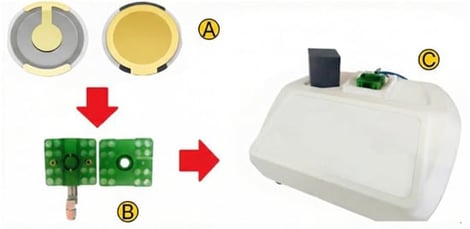
QCM-D system. The quartz crystal (A) is positioned within the sensor module (B), which is placed on the Peltier element located in the housing containing the control and acquisition unit (C). Samples are deposited into the sensor module, after which a protective cover (gray box in (C)) is placed over it. Temperature control is then initiated prior to acquiring the corresponding measurements.

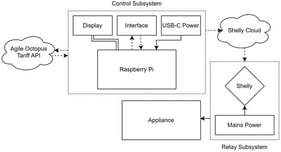
Dynamic demand response (DDR) is the process of shifting power consumption towards periods of lower demand based on real-time energy pricing data. It is a flexibility measure utilised in the decarbonisation of the UK’s power system to reduce peak demand. Dynamic time-of-use (dTOU) tariffs, such as Agile Octopus, incentivise DDR by providing half-hourly electricity prices for each day. Through this incentive, households are offered the opportunity to reduce their energy costs by applying DDR to energy-intensive, deferrable loads. This paper presents an open-source, Internet of Things (IoT)-based system designed to automate DDR and streamline its implementation. The system identifies the period of lowest electricity prices and activates a relay during this period each day. For validation, the system was tested over a one-month experiment, which showed that, in a favourable scenario, it could reduce an appliance’s electricity costs by up to 44%. These results highlighted the system’s potential to deliver substantial energy cost savings, while also encouraging households to participate in flexibility measures that alleviate pressure on the National Grid.

2 February 2026

Diagram of the IoT-based system. Solid arrows indicate power connections, dashed arrows represent wireless communication, and double-lined arrows represent I2C data connections.

Construction of an Educational Prototype of a Differential Wheeled Mobile Robot

  • Celso Márquez-Sánchez,
  • Jacobo Sandoval-Gutiérrez and
  • Daniel Librado Martínez-Vázquez

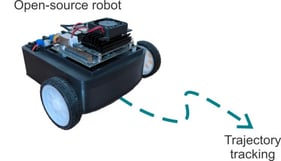
This work presents the development of a differential-drive wheeled mobile robot educational prototype, manufactured using 3D additive techniques. The robot is powered by an embedded ARM-based computing system and uses open-source software. To validate the prototype, a trajectory-tracking task was successfully implemented. The aim of this contribution is to provide an easily replicable prototype for teaching automatic control and related engineering topics in academic settings.

23 January 2026

Robot chassis base.

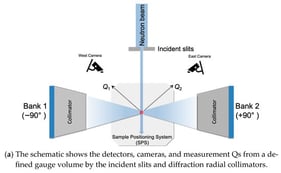
High-flux neutron beams and high-efficiency detectors enable rapid neutron diffraction measurements at the Engineering Materials Diffractometer (VULCAN) at the Spallation Neutron Source (SNS), Oak Ridge National Laboratory (ORNL). To optimize beam time utilization, efficient sample exchange, alignment, and automated measurements are essential. Recent advances in artificial intelligence (AI) have expanded the capabilities of robotic systems. Here, we report the development of a Robotic Interactive Control and Handling (RICH) system for sample handling at VULCAN, designed to support high-throughput experiments and reduce overhead time. The RICH system employs a six-axis desktop robot integrated with AI-based computer vision models capable of recognizing and localizing samples in real time from instrument and depth-resolving cameras. Vision algorithms combine these detections to align samples with designated measurement positions or place them within complex sample environments such as furnaces. This integration of machine learning-assisted vision with robotic handling demonstrates the feasibility of autonomous sample detection and preparation, offering a pathway toward fully unmanned neutron scattering experiments.

14 January 2026

VULCAN instrument layout.

News & Conferences

Issues

Open for Submission

Editor's Choice

Get Alerted

Add your email address to receive forthcoming issues of this journal.

XFacebookLinkedIn
Hardware - ISSN 2813-6640