
Development of a Low-Cost, Open-Source Quartz Crystal Microbalance with Dissipation Monitoring for Potential Biomedical Applications

 , , , ,
Abstract
1. Introduction
- -
- Cost-effectiveness: Development of a complete QCM-D system with a significantly lower cost than commercial alternatives;
- -
- Active temperature control: Integration of an active thermal management system to preserve the physical properties of temperature-sensitive biological samples;
- -
- Dissipation monitoring: Implementation of a data acquisition routine capable of characterizing the viscoelastic properties of soft biological matter;
- -
- Portability and modularity: A compact, open-source design, allowing for rapid customization and future upgrades;
- -
- Biomedical applicability: A platform suitable for practical analysis of biological fluids, supporting potential applications in biomolecular interaction studies, biosensing, and fluid characterization.
2. Design
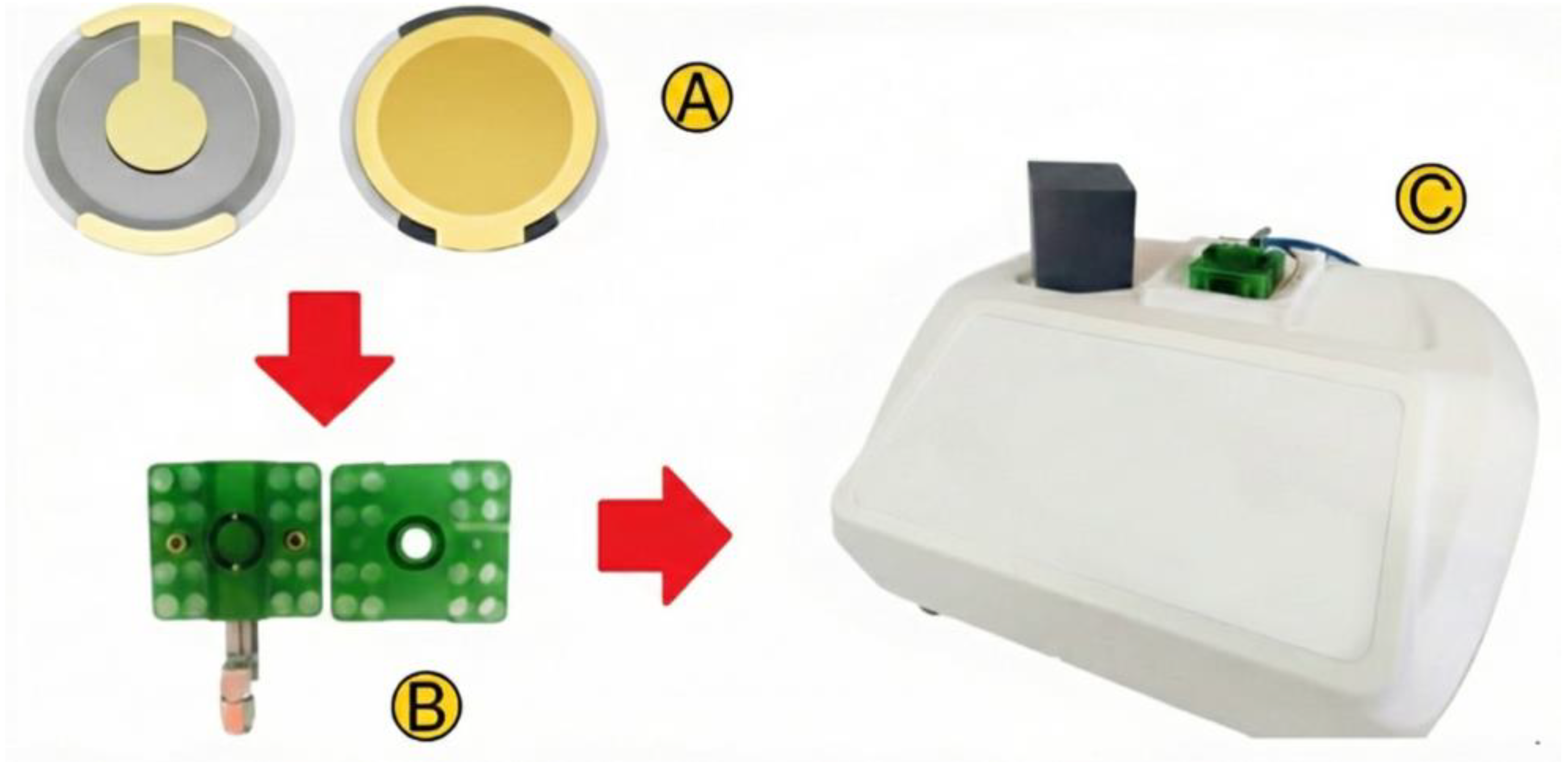
2.1. Sensor Module
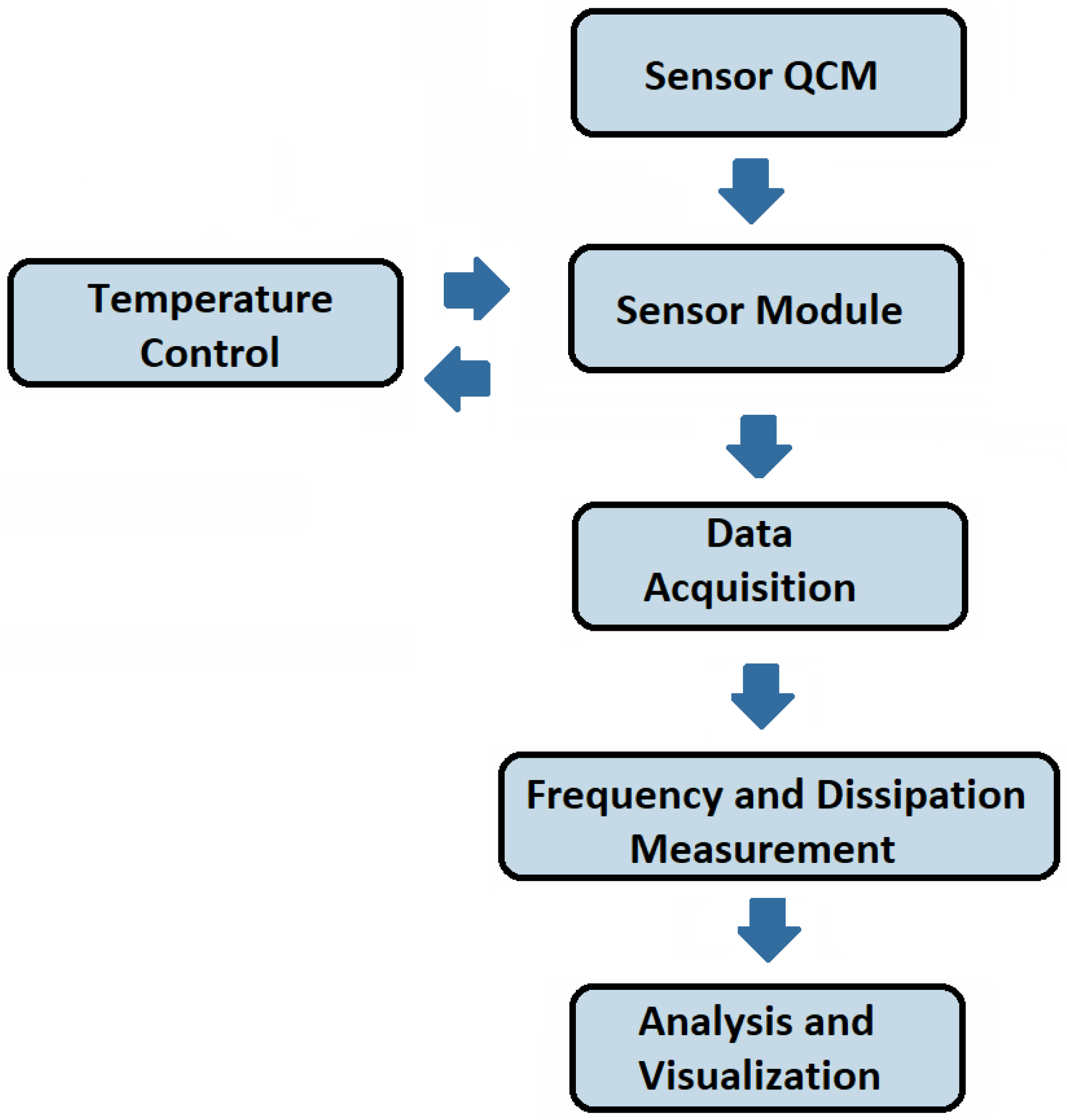
2.2. Control and Acquisition Unit
2.3. NanoVNA Software
3. Build Instructions
3.1. Materials and Tools
3.2. Sensor Module Construction
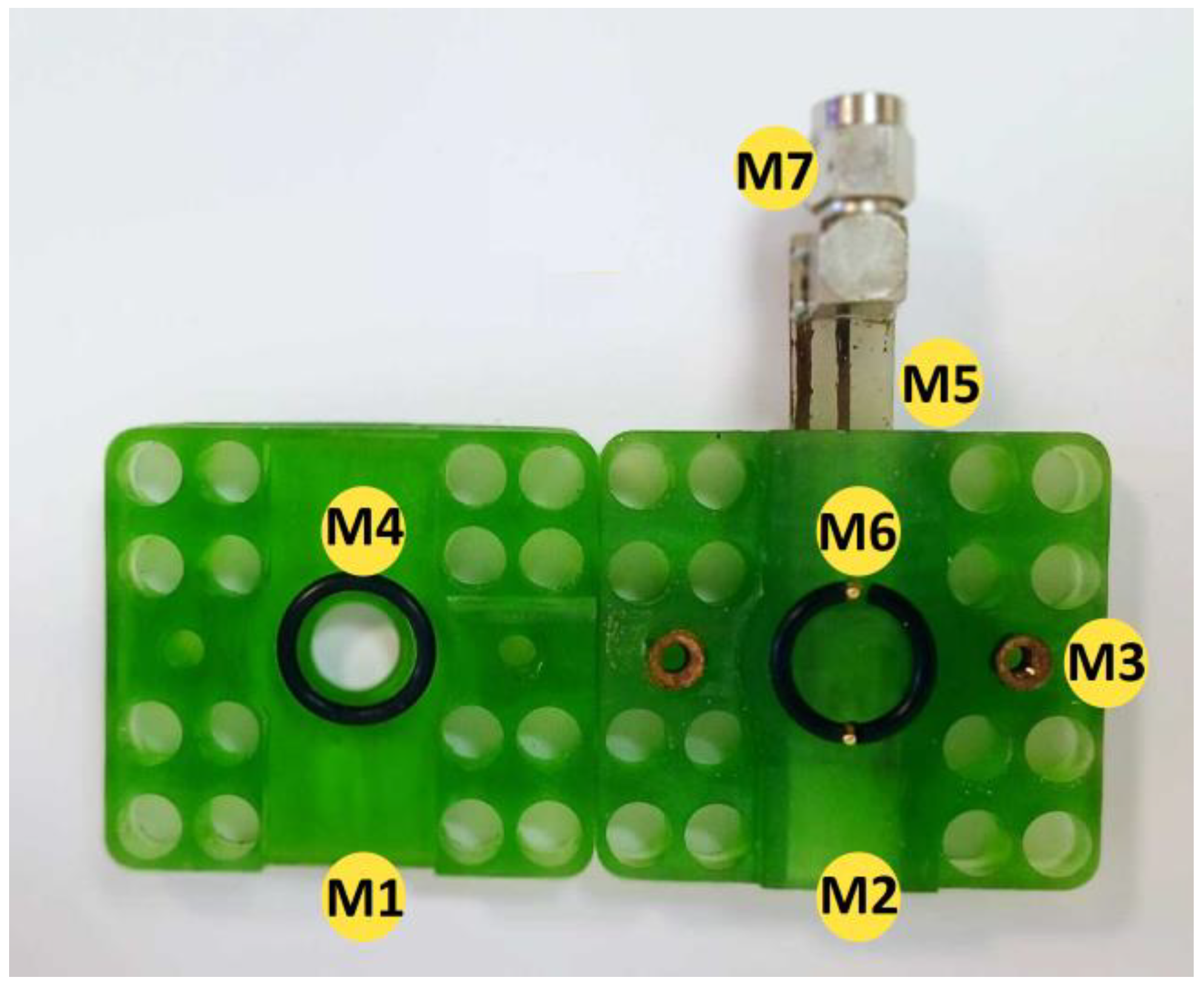
- Fabricate the custom PCB (M5).
- Solder the SMA connector (M7) and pogo pins (M6) onto the PCB.
- Print the pieces (M1 and M2) with a 3D printer.
- Attach the soldered PCB (step 2) to the sensor module base (M2) using glue.
- Insert O-rings (M4) into the base and the upper part of the sensor module.
- Insert two pogo pins (M6) where the lower O-ring sits.
- Place two inserts (M3) in M2.
- Perform a leak test. Before actual use, assemble the module with two strips of indicator paper between the parts. Add distilled water, wait for one hour, and verify that the paper remains dry.
3.3. Housing and Accessories
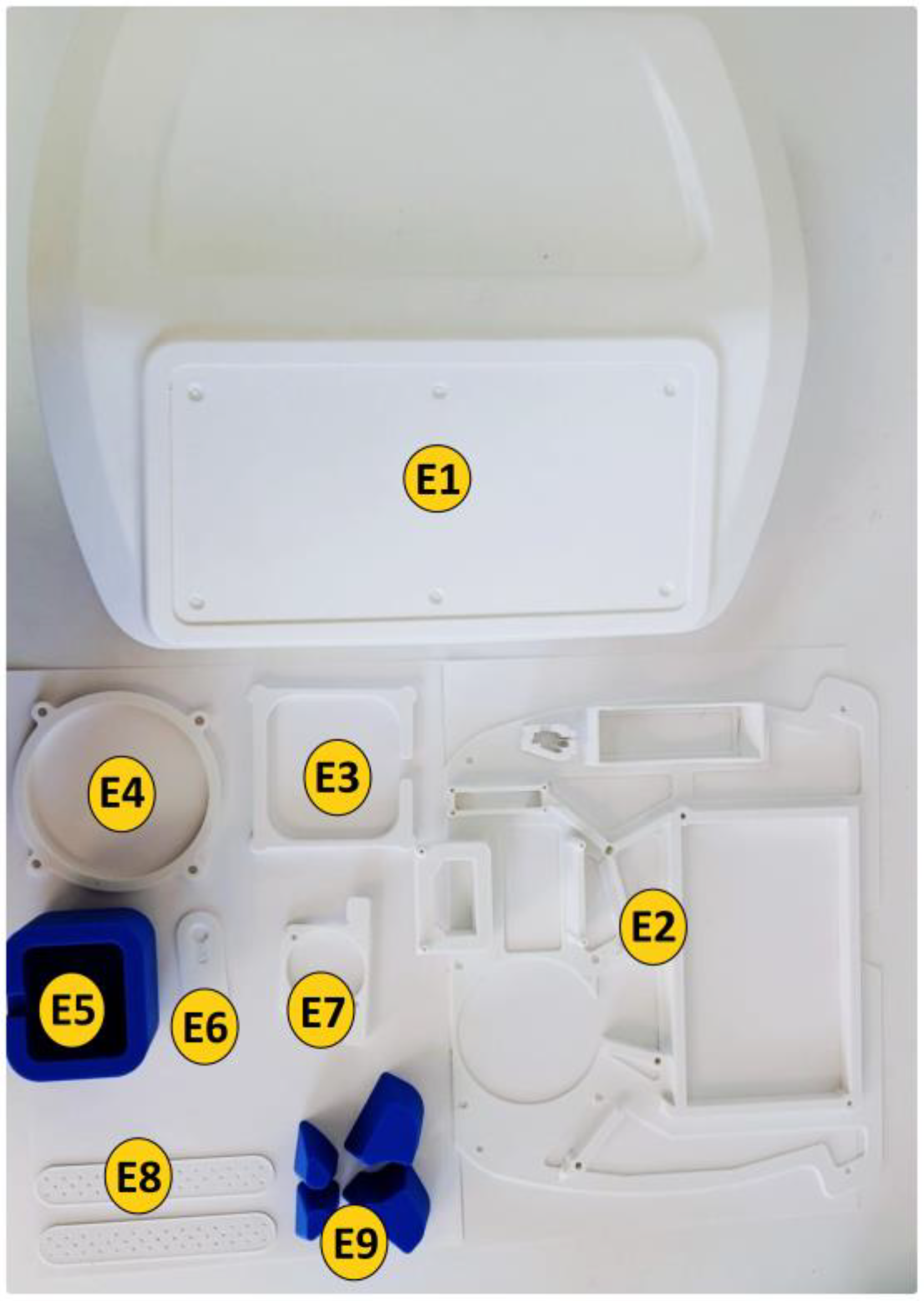
- Print the 3D accessories (Figure 6).
- Mark and drill holes in the housing (E1) for the air outlet, the Peltier module, and the power and signal connectors.
- Mount the 3D-printed accessories inside the E1 housing.
- Attach the components to the pre-cut holes.
- Secure all elements with screws or adhesive as needed.
- Ensure proper airflow and cable routing inside the housing.
3.4. Power Supply and Communication
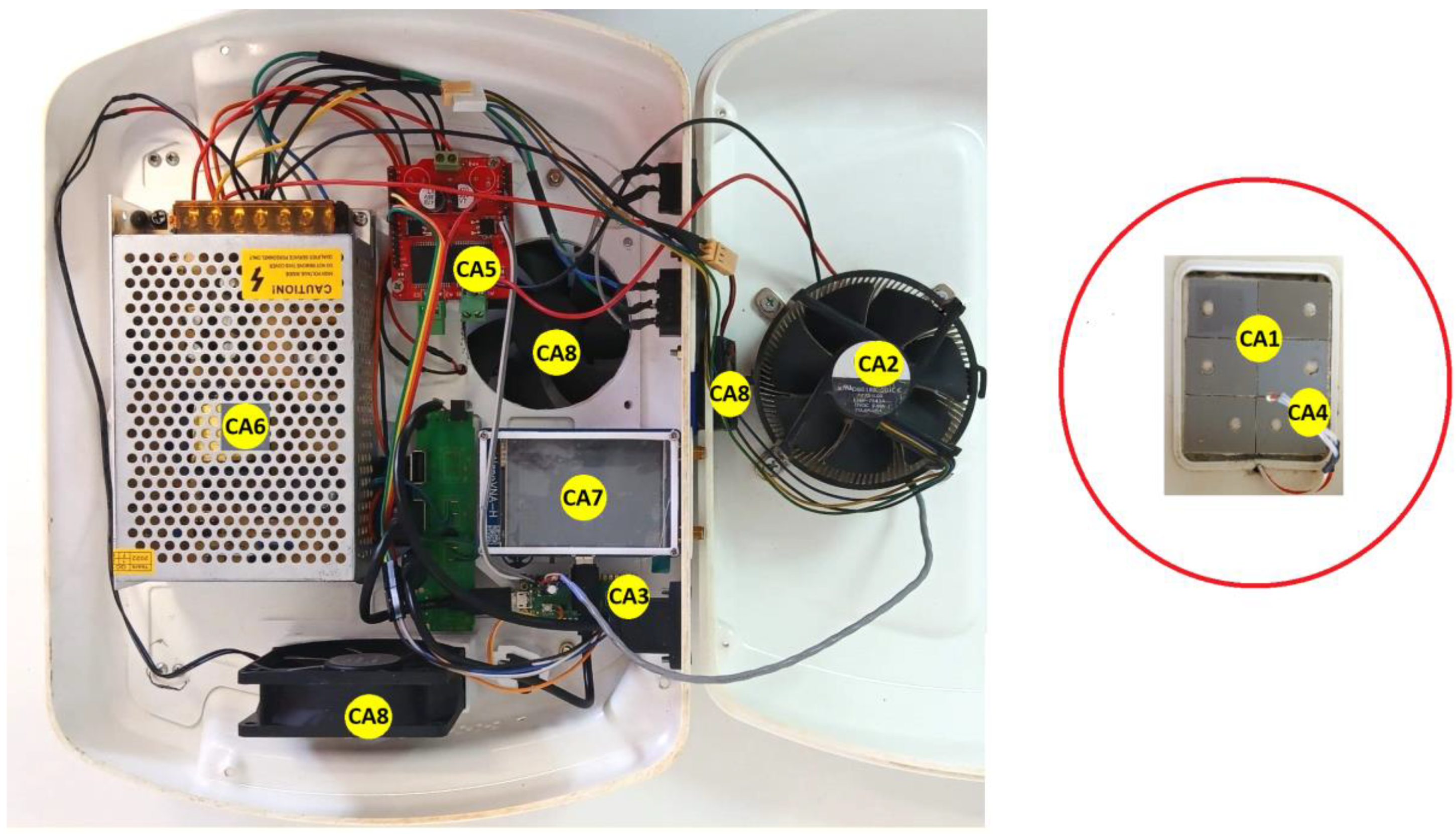
- Connect the 12 V/10 A power supply (CA6) to the mains via the power cable (PC1) and connector (PC2).
- Install a switch (PC4) in series with the live line to allow for manual control of power delivery.
- Power the cooling fans (CA2, CA8) and the VNH2SP30 30 A dual-channel driver (CA5) directly from the power supply.
- Utilize a commercial USB hub (PC5) to centralize communication between the NanoVNA-H (CA7), the Raspberry Pi Pico (CA3), and the host PC via a USB cable (PC8).
- Integrate two relays (PC3) that act as switches, allowing the Raspberry Pi Pico and NanoVNA-H to power on only when the power supply is active.
3.5. Temperature Control
- Load the firmware onto the Raspberry Pi Pico and connect the microcontroller to the USB port while holding down the BOOTSEL button. It mounts as a storage device named RPI-RP2. Download the firmware from Supplementary Materials, then drag and drop the .uf2 file onto the RPI-RP2 drive.
- Connect an electrolytic capacitor (CA10) between pins 36 and 35 of the Raspberry Pi Pico to filter noise.
- Build a resistive voltage divider with an NTC 3950 (CA4). Connect the NTC 3950 between 3.3 V (pin 36) and the middle node (pin 34). Connect a fixed 100 kΩ resistor from the middle node to GND (pin 33).
- Connect the VNH2SP30 driver (CA5) to the Raspberry Pi Pico (CA3) by making the following connections:
- a.
- VNH2SP30 GND to Raspberry Pi Pico GND (pin 39);
- b.
- VNH2SP30 +5 V to Raspberry Pi Pico 5 V (pin 40);
- c.
- VNH2SP30 EN1 to Raspberry Pi Pico (pin 17);
- d.
- VNH2SP30 B1 to Raspberry Pi Pico (pin 14);
- e.
- VNH2SP30 A1 to Raspberry Pi Pico (pin 15);
- f.
- VNH2SP30 PWM to Raspberry Pi Pico (pin 16).
- Connect the VNH2SP30 driver (CA5) to the power supply (CA6); then, connect the Peltier cell (CA1) to the output terminals (A1 and B1) of the driver.
4. Operating Instructions
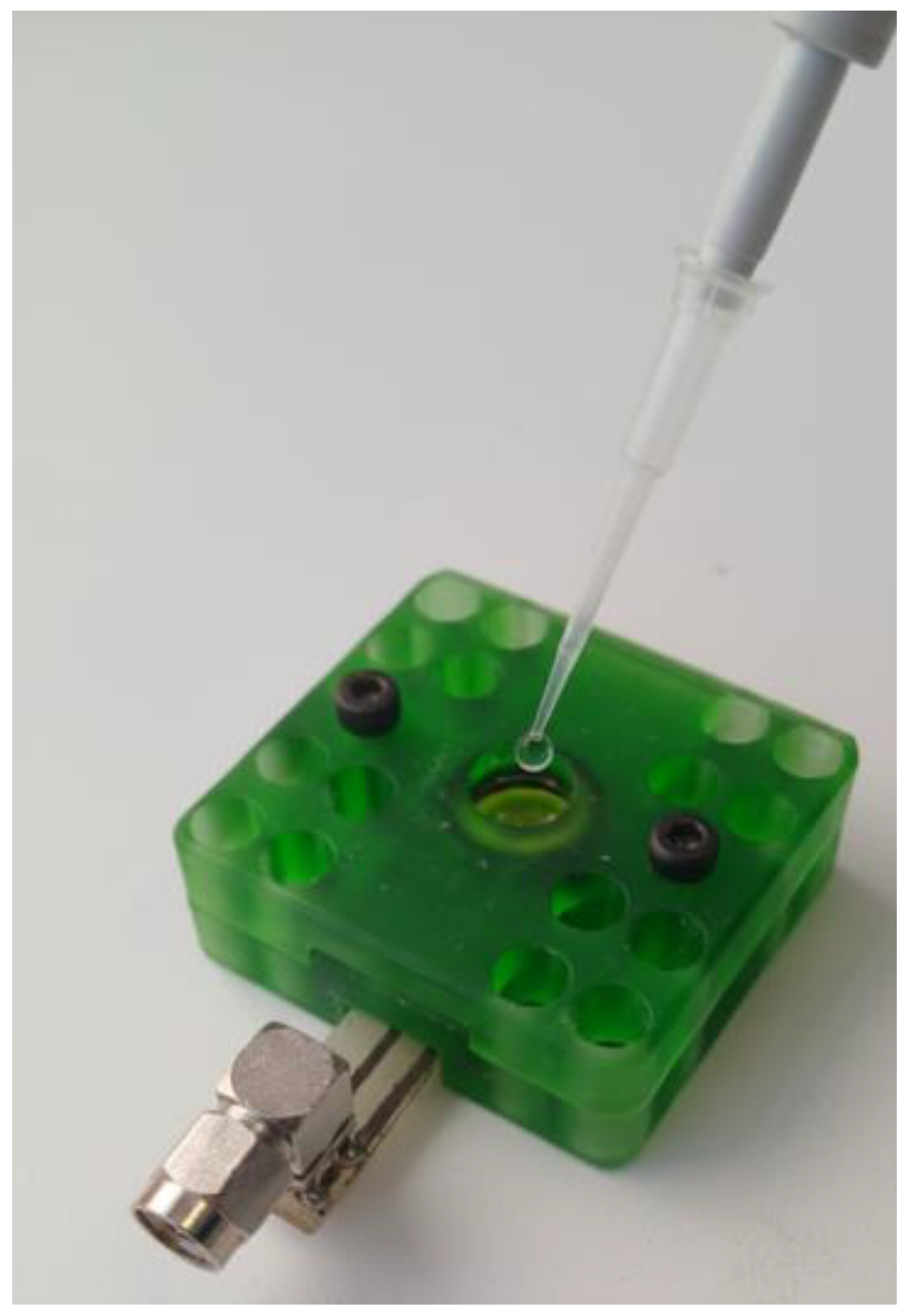
4.1. Sensor Module Assembly and Usage
- The screws are loosened using an Allen wrench.
- The base is separated from the top, and the top is placed with the inner side facing upward.
- The quartz crystal is positioned onto the O-ring inside the top.
- The base is repositioned onto the top.
- It is verified that the electrodes on the back of the crystal are in proper contact with the pogo pins on the base.
- The screws are tightened with the Allen wrench to securely close the sensor module.
4.2. Crystal Cleaning
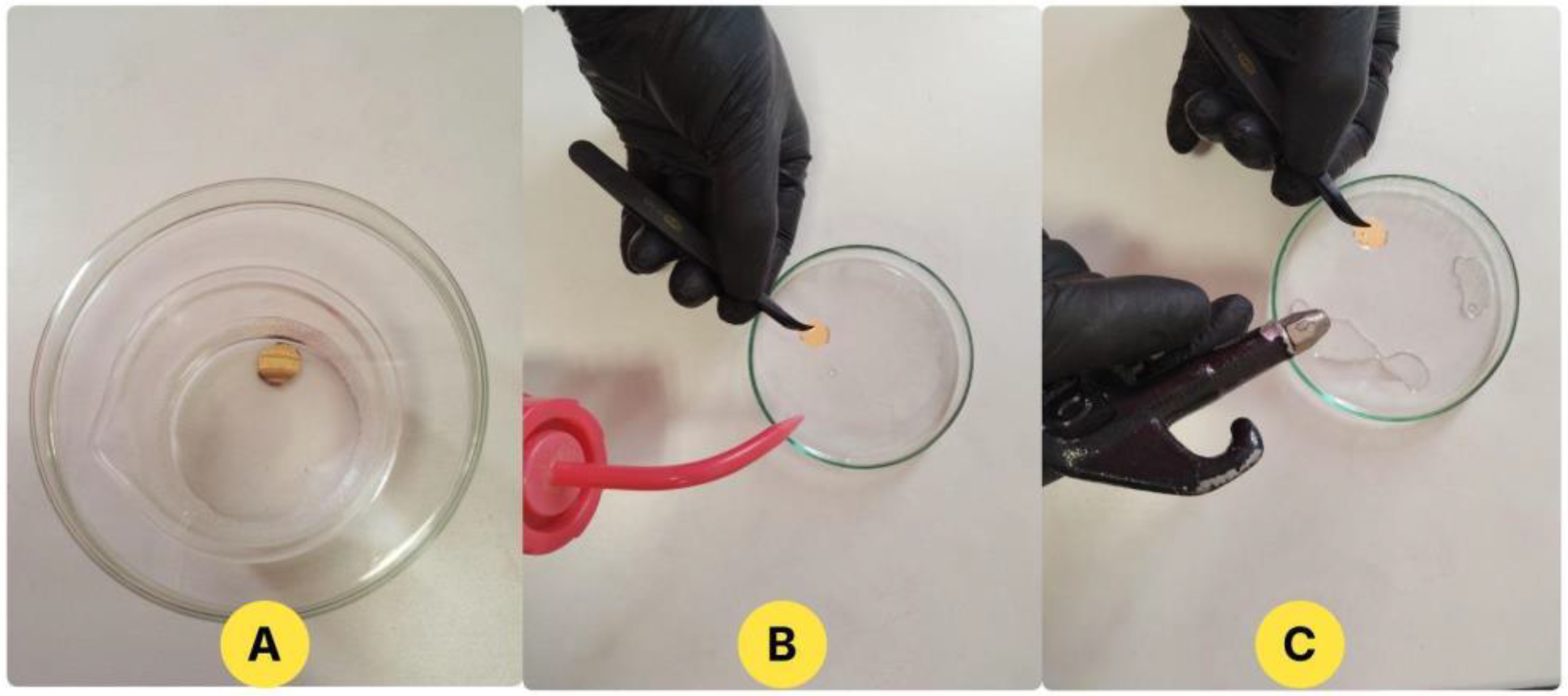
- Immersion: Submerge the crystal in a 2% Sodium Dodecyl Sulfate (SDS) solution for 5 min to remove protein residues and contaminants (Figure 8A).
- Rinsing: Rinse the crystal thoroughly with distilled water to remove all traces of detergent (Figure 8B).
- Drying: Dry the crystal surfaces using a gentle stream of high-purity nitrogen gas or filtered compressed air to prevent water spots (Figure 8C).
4.3. Custom Software
5. Validation
5.1. Temperature Performance
5.2. Analytical Validation: Repeatability, Sensitivity, and Limit of Detection
6. Conclusions
Supplementary Materials
| Name | Type | Description |
| 3D Models and Hardware | Zip | STL files for system fabrication and PCB design file |
| Figures and Results | Zip | Article figures and complete validation results |
| Software and Firmware | Zip | Device software (developed in Python) and Raspberry Pi firmware for temperature control |
Author Contributions
Funding
Institutional Review Board Statement
Informed Consent Statement
Data Availability Statement
Acknowledgments
Conflicts of Interest
Abbreviations
| ADC | Analog-to-Digital Converter |
| CA | Control and Acquisition Unit |
| D | Dissipation |
| fr | Resonance Frequency |
| LOD | Limit of Detection |
| M | Sensor Module |
| NTC | Negative Temperature Coefficient |
| PCB | Printed Circuit Board |
| PEG | Polyethylene Glycol |
| PID | Proportional–Integral–Derivative |
| PLA | Polylactic Acid |
| QCM | Quartz Crystal Microbalance |
| S | Sensitivity |
| SAW | Surface Acoustic Wave |
| SD | Standard Deviation |
| SDS | Sodium Dodecyl Sulfate |
| SMA | SubMiniature version A |
| VNA | Vector Network Analyzer |
References
- Javaid, M.; Haleem, A.; Rab, S.; Singh, R.P.; Suman, R. Sensors for daily life: A review. Sens. Int. 2021, 2, 100121. [Google Scholar] [CrossRef]
- Shaukat, H.; Ali, A.; Bibi, S.; Altabey, W.A.; Noori, M.; Kouritem, S.A. A Review of the Recent Advances in Piezoelectric Materials, Energy Harvester Structures, and Their Applications in Analytical Chemistry. Appl. Sci. 2023, 13, 1300. [Google Scholar] [CrossRef]
- Jiao, P.; Egbe, K.J.; Xie, Y.; Matin Nazar, A.; Alavi, A.H. Piezoelectric Sensing Techniques in Structural Health Monitoring: A State-of-the-Art Review. Sensors 2020, 20, 3730. [Google Scholar] [CrossRef] [PubMed]
- Kaushal, J.B.; Raut, P.; Kumar, S. Organic Electronics in Biosensing: A Promising Frontier for Medical and Environmental Applications. Biosensors 2023, 13, 976. [Google Scholar] [CrossRef] [PubMed]
- Na Songkhla, S.; Nakamoto, T. Overview of quartz crystal microbalance behavior analysis and measurement. Chemosensors 2021, 9, 350. [Google Scholar] [CrossRef]
- Alanazi, N.; Almutairi, M.; Alodhayb, A. A Review of Quartz Crystal Microbalance for Chemical and Biological Sensing Applications. Sens. Imaging 2023, 24, 10. [Google Scholar] [CrossRef]
- Huang, X.; Chen, Q.; Pan, W.; Yao, Y. Advances in the Mass Sensitivity Distribution of Quartz Crystal Microbalances: A Review. Sensors 2022, 22, 5112. [Google Scholar] [CrossRef]
- Easley, A.D.; Ma, T.; Eneh, C.I.; Yun, J.; Thakur, R.M.; Lutkenhaus, J.L. A practical guide to quartz crystal microbalance with dissipation monitoring of thin polymer films. J. Polym. Sci. 2021, 60, 1090–1107. [Google Scholar] [CrossRef]
- Palleschi, S.; Silvestroni, L.; Rossi, B.; Dinarelli, S.; Magi, M.; Giacomelli, A.; Bettucci, A. Simple and sensitive method for in vitro monitoring of red blood cell viscoelasticity by Quartz Crystal Microbalance with dissipation monitoring (QCM-D). Biosens. Bioelectron. X 2024, 21, 100554. [Google Scholar] [CrossRef]
- Chen, Z.; Zhou, T.; Hu, J.; Duan, H. Quartz Crystal Microbalance with Dissipation Monitoring of Dynamic Viscoelastic Changes of Tobacco BY-2 Cells under Different Osmotic Conditions. Biosensors 2021, 11, 136. [Google Scholar] [CrossRef]
- MuYilmaz-Aykut, D.; Yolacan, O.; Deligoz, H. A comparative QCM-D study for various drug sorption behaviors and chemical degradation of chitosan/PAA LbL multilayered films. J. Polym. Res. 2023, 30, 307. [Google Scholar] [CrossRef]
- Muñoz, G.G.; Millicovsky, M.J.; Cerrudo, J.I.; Peñalva, A.; Machtey, M.; Reta, J.M.; Torres, R.M.; Campana, D.M.; Zalazar, M.A. Exploring tear viscosity with quartz crystal microbalance technology. Rev. Sci. Instrum. 2024, 75, 075107. [Google Scholar] [CrossRef] [PubMed]
- Hampitak, P.; Jowitt, T.A.; Melendrez, D.; Fresquet, M.; Hamilton, P.; Iliut, M.; Nie, K.; Spencer, B.; Lennon, R.; Vijayaraghavan, A. A point-of-care immunosensor based on a quartz crystal microbalance with graphene biointerface for antibody assay. ACS Sens. 2020, 5, 3520–3532. [Google Scholar] [CrossRef] [PubMed]
- Biolin Scientific. Available online: https://www.biolinscientific.com (accessed on 3 April 2025).
- Gamry Instruments. Available online: https://www.gamry.com/ (accessed on 25 August 2025).
- Adel, M.; Allam, A.; Sayour, A.E.; Ragai, H.F.; Umezu, S.; Fath El-Bab, A.M.R. Design and development of a portable low-cost QCM-based system for liquid biosensing. Biomed. Microdevices 2024, 26, 11. [Google Scholar] [CrossRef]
- Melendrez, D.; Hampitak, P.; Jowitt, T.; Iliut, M.; Vijayaraghavan, A. Development of an open-source thermally stabilized quartz crystal microbalance instrument for biomolecule-substrate binding assays on gold and graphene. Anal. Chim. Acta 2021, 1156, 338329. [Google Scholar] [CrossRef]
- Millicovsky, M.; Schierloh, L.; Kler, P.; Muñoz, G.; Cerrudo, J.; Peñalva, A.; Reta, J.; Zalazar, M. Low-Cost Open-Source Biosensing System Prototype Based on a Love Wave Surface Acoustic Wave Resonator. Hardware 2025, 3, 9. [Google Scholar] [CrossRef]
- Nair, M.P.; Teo, A.J.T.; Li, K.H.H. Acoustic Biosensors and Microfluidic Devices in the Decennium: Principles and Applications. Micromachines 2022, 13, 24. [Google Scholar] [CrossRef]
- Muñoz, G.G.; Millicovsky, M.J.; Reta, J.M.; Cerrudo, J.I.; Peñalva, A.; Machtey, M.; Torres, R.M.; Zalazar, M.A. Quartz Crystal Microbalance with dissipation monitoring for biomedical applications: Open source and low cost prototype with active temperature control. Hardware X 2023, 14, e00416. [Google Scholar] [CrossRef]
- Carvajal Ahumada, L.A.; Sandoval Cruz, A.F.; García Foz, M.A.; Herrera Sandoval, O.L. Useful piezoelectric sensor to detect false liquor in samples with different degrees of adulteration. J. Sens. 2018, 218, 6924094. [Google Scholar] [CrossRef]
- Kanazawa, K.K.; Gordon, J.G. Frequency of a quartz microbalance in contact with liquid. Anal. Chem. 1984, 57, 1770–1771. [Google Scholar] [CrossRef]
- Johannsmann, D. The quartz crystal microbalance in soft matter research: Fundamentals and modeling. Soft Biol. Matter 2015, 1, 143–168. [Google Scholar]
- Corradi, E.; Agostini, M.; Greco, G.; Massidda, D.; Santi, M.; Calderisi, M.; Signore, G.; Cecchini, M. An objective, principal-component-analysis (PCA) based, method which improves the quartz-crystal-microbalance (QCM) sensing performance. Sens. Actuator Phys. 2020, 315, 112323. [Google Scholar] [CrossRef]
- Izsák, T.; Varga, M.; Kočí, M.; Szabó, O.; Dragounová, A.K.; Vanko, G.; Gál, M.; Korčeková, J.; Hornychová, M.; Poturnayová, A.; et al. Diamond-coated quartz crystal microbalance sensors: Challenges in high yield production and enhanced detection of ethanol and SARS-CoV-2 proteins. Mater. Des. 2024, 248, 113474. [Google Scholar] [CrossRef]
- Nic, M.; Hovorka, L.; Jirat, J.; Kosata, B.; Znamenacek, J. IUPAC Compendium of Chemical Terminology, 5th ed.; International Union of Pure and Applied Chemistry: Research Triangle Park, NC, USA, 2025; Online version 5.0.0. [Google Scholar] [CrossRef]
- AWensors. Available online: https://awsensors.com/aws-x4-advanced-multichannel-qcmd-system (accessed on 13 January 2026).
- Zhao, H.; Li, X.; Lei, S.; Zhang, M.; Qiu, G.; Tang, W.; Chen, Y.; Shi, Y.; Wang, P.; Yu, S.; et al. Quartz Crystal Microbalance (QCM)-Based Portable System for Visualizing Reaction Kinetics in Secondary Chemistry Education. J. Chem. Educ. 2025, 102, 3661–3670. [Google Scholar] [CrossRef]
- Hernández-Acosta, M.A.; Martines-Arano, H.; Soto-Ruvalcaba, L.; Martínez-González, C.L.; Martínez-Gutiérrez, H.; Torres-Torres, C. Fractional thermal transport and twisted light induced by an optical two-wave mixing in single-wall carbon nanotubes. Int. J. Therm. Sci. 2020, 147, 106136. [Google Scholar] [CrossRef]



| Designator | File Name | File Type 1 | Localization of File |
|---|---|---|---|
| D1 | Top_sensor_module | 3D Printing | Supplementary Materials |
| D2 | Base_sensor_module | 3D Printing | Supplementary Materials |
| D3 | Protective_cover | 3D Printing | Supplementary Materials |
| D4 | Back_legs_housing | 3D Printing | Supplementary Materials |
| D5 | Front_legs_housing | 3D Printing | Supplementary Materials |
| D6 | Internal_base_housing | 3D Printing | Supplementary Materials |
| D7 | VNA_port_cover | 3D Printing | Supplementary Materials |
| D8 | Back_fan_trim | 3D Printing | Supplementary Materials |
| D9 | Fan_bracket | 3D Printing | Supplementary Materials |
| D10 | Top_holder | 3D Printing | Supplementary Materials |
| D11 | Vent_cover | 3D Printing | Supplementary Materials |
| D12 | PCB_from_Kicad | PCB Design | Supplementary Materials |
| D13 | Raspberry_Pi_firmware | Software | Supplementary Materials |
| D14 | Device_Software | Software | Supplementary Materials |
| Designator | Component | Number | Cost per Unit—USD | Total Cost—USD | Source of Material |
|---|---|---|---|---|---|
| M1 | ^ Top_sensor_module | 1 | 37.58 | 37.58 | AMAZON |
| M2 | ^ Base_sensor_module | 1 | 37.58 | 37.58 | AMAZON |
| M3 | Insert | 2 | 0.09 | 0.18 | AMAZON |
| M4 | O-ring | 2 | 2.72 | 5.44 | Ebay |
| M5 | PCB board | 1 | 7.29 | 7.29 | AMAZON |
| M6 | Pogo-pin | 2 | 1.06 | 2.12 | DIGIKEY |
| M7 | SMA Connector | 1 | 10.66 | 10.66 | MOUSER |
| E1 | Housing | 1 | 50.00 | 50.00 | PRODUCTOS TERMOFORMADOS S.R.L |
| E2 | * Internal base housing | 1 | 24.69 | 24.69 | AMAZON |
| E3 | * Top holder | 1 | 24.69 | 24.69 | AMAZON |
| E4 | * Fan bracket | 1 | 24.69 | 24.69 | AMAZON |
| E5 | * Protective_cover | 1 | 24.69 | 24.69 | AMAZON |
| E6 | * VNA port cover | 1 | 24.69 | 24.69 | AMAZON |
| E7 | * Back fan trim | 1 | 24.69 | 24.69 | AMAZON |
| E8 | * Vent cover | 2 | 24.69 | 24.69 | AMAZON |
| E9 | * Legs | 4 | 24.69 | 24.69 | AMAZON |
| CA1 | TEC1-12706 Peltier cell | 1 | 10.80 | 10.80 | DIGIKEY |
| CA2 | Fan and Heatsink 12 V 0.6 A | 1 | 20.00 | 20.00 | eBAY |
| CA3 | Raspberry Pi Pico | 1 | 18.65 | 18.65 | AMAZON |
| CA4 | NTC 3950 analog sensor | 1 | 0.55 | 0.55 | DIGIKEY |
| CA5 | VNH2SP30 30 A 2-channel driver | 1 | 42.00 | 42.00 | AMAZON |
| CA6 | Power supply 12 V/10 A | 1 | 20.57 | 20.57 | AMAZON |
| CA7 | Nano Vector Network Analyzer | 1 | 40.85 | 40.85 | eBAY |
| CA8 | 12 V, 80 mm fan | 2 | 5.05 | 10.10 | DIGIKEY |
| CA9 | Resistor 100 Kohm | 1 | 0.03 | 0.03 | DIGIKEY |
| CA10 | Electrolytic Capacitor | 1 | 0.03 | 0.03 | AMAZON |
| PC1 | Power Cable | 1 | 3.0 | 3.0 | DIGIKEY |
| PC2 | Power connector | 1 | 2.0 | 2.0 | DIGIKEY |
| PC3 | 2-Channel Relay Module for Arduino 12 V | 1 | 4.0 | 4.0 | eBAY |
| PC4 | Switch | 1 | 1.0 | 1.0 | DIGIKEY |
| PC5 | Hub | 1 | 6.88 | 6.88 | AMAZON |
| PC6 | 15 cm USB-A to Micro USB Cable | 2 | 3.03 | 6.06 | eBAY |
| PC7 | 15 cm USB-A to USB-C Cable | 2 | 2.00 | 4.00 | eBAY |
| PC8 | USB Type-A Male to Type-B Male Cable | 1 | 1.00 | 2.00 | eBAY |
| PC9 | Crystal openQCM 10 MHz | 10 | 28.40 | 284.00 | open QCM |
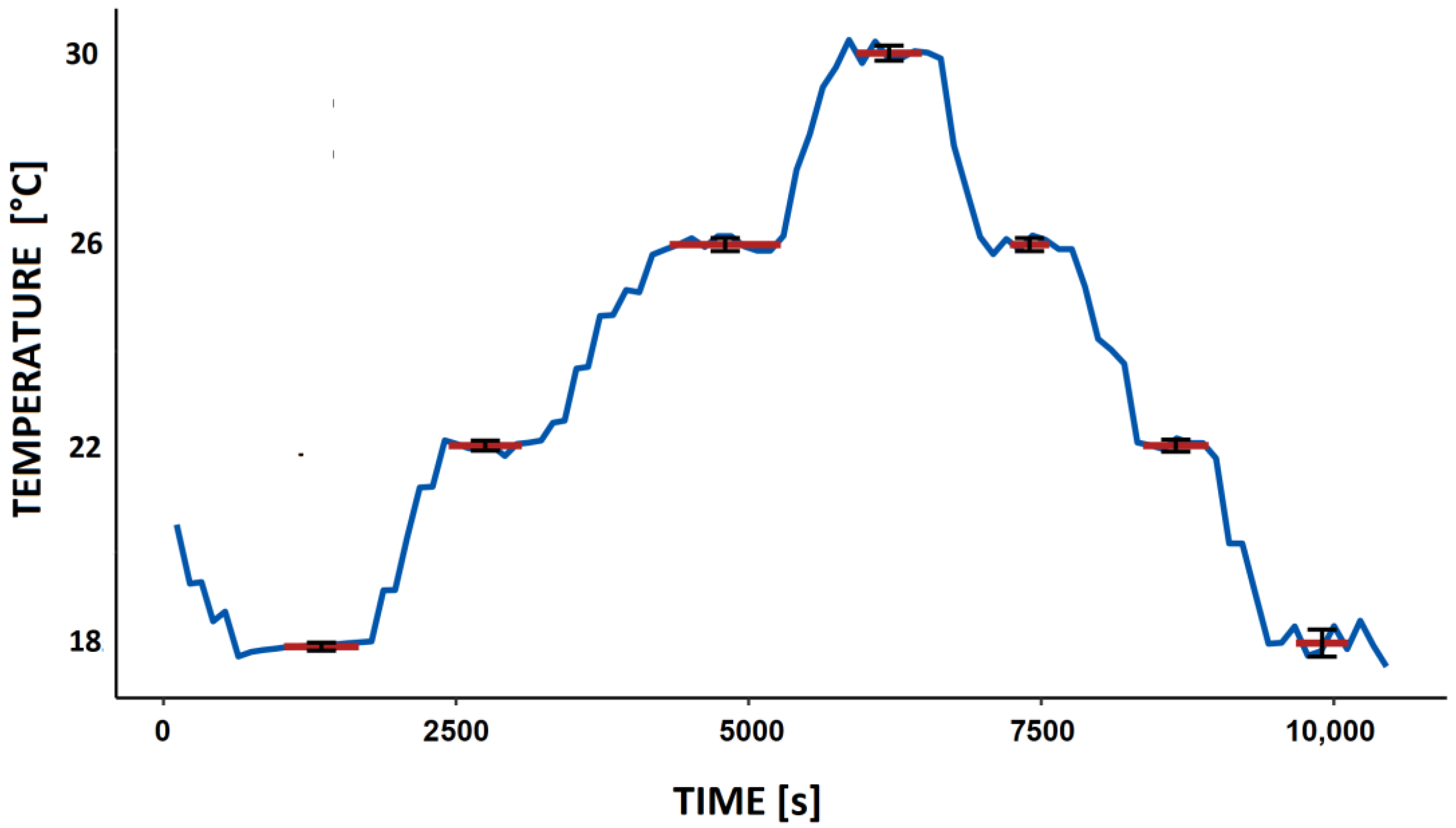
| Temperature Step [°C] | Stability Time [s] | Stable Temp. (Mean ± SD) [°C] |
|---|---|---|
| 18 | 639 | 18.12 ± 0.08 |
| 18 to 22 | 626 | 22.12 ± 0.10 |
| 22 to 26 | 950 | 26.12 ± 0.13 |
| 26 to 30 | 560 | 29.93 ± 0.15 |
| 30 to 26 | 336 | 26.12 ± 0.13 |
| 26 to 22 | 560 | 22.12 ± 0.12 |
| 22 to 18 | 448 | 18.19 ± 0.27 |
Disclaimer/Publisher’s Note: The statements, opinions and data contained in all publications are solely those of the individual author(s) and contributor(s) and not of MDPI and/or the editor(s). MDPI and/or the editor(s) disclaim responsibility for any injury to people or property resulting from any ideas, methods, instructions or products referred to in the content. |
© 2026 by the authors. Licensee MDPI, Basel, Switzerland. This article is an open access article distributed under the terms and conditions of the Creative Commons Attribution (CC BY) license.
Share and Cite
Muñoz, G.G.; Millicovsky, M.J.; Peñalva, A.; Cerrudo, J.I.; Reta, J.M.; Zalazar, M.A. Development of a Low-Cost, Open-Source Quartz Crystal Microbalance with Dissipation Monitoring for Potential Biomedical Applications. Hardware 2026, 4, 4. https://doi.org/10.3390/hardware4010004
Muñoz GG, Millicovsky MJ, Peñalva A, Cerrudo JI, Reta JM, Zalazar MA. Development of a Low-Cost, Open-Source Quartz Crystal Microbalance with Dissipation Monitoring for Potential Biomedical Applications. Hardware. 2026; 4(1):4. https://doi.org/10.3390/hardware4010004
Chicago/Turabian StyleMuñoz, Gabriel G., Martín J. Millicovsky, Albano Peñalva, Juan I. Cerrudo, Juan M. Reta, and Martín A. Zalazar. 2026. "Development of a Low-Cost, Open-Source Quartz Crystal Microbalance with Dissipation Monitoring for Potential Biomedical Applications" Hardware 4, no. 1: 4. https://doi.org/10.3390/hardware4010004
APA StyleMuñoz, G. G., Millicovsky, M. J., Peñalva, A., Cerrudo, J. I., Reta, J. M., & Zalazar, M. A. (2026). Development of a Low-Cost, Open-Source Quartz Crystal Microbalance with Dissipation Monitoring for Potential Biomedical Applications. Hardware, 4(1), 4. https://doi.org/10.3390/hardware4010004