


Abstract
As mandated by the EU and the national risk management duties, pesticide residues were determined by four specialized laboratories in 9924 samples taken from 119 crops of economic importance in Hungary and imported foodstuffs during 2017–2021. The screening method applied covered 622 pesticide residues as defined for enforcement purposes. The limit of detection ranged between 0.002 and 0.008 mg/kg. The 1.0% violation rate concerning all commodities was lower than in the European Union. No residue was detectable in 45.9% of the samples. For detailed analyses, six commodities (apple, cherry, grape, nectarine/peach, sweet peppers, and strawberry) were selected as they were analyzed in over 195 samples and most frequently contained residues. Besides testing their conformity with national MRLs, applying 0.3 MRL action limits for pre-export control, we found that 73% of the sampled lots would be compliant with ≥90% probability based on a second independent sampling. Multiple residues (2–23) in one sample were detected in 36–50% of the tested lots. Considering the provisions of integrated pest management, and the major pests and diseases of selected crops, normally three to four and exceptionally, seven to nine active ingredients with different modes of action should suffice for their effective and economic protection within four weeks before harvest.
1. Introduction
Many cultivated plants, used as food, feed, or industrial raw material, must be protected from arthropod pests, diseases and weeds. Chemical substance-based pesticides and micro-organisms are used for their protection. The popularity of the so-called bio-products, cultivated with limited or no pesticide use, is on the rise. However, their proportion in the total production is low. According to the available information, bio-farming was conducted in 9.2% of the whole agricultural area within the European Union (in Hungary about 6%) in 2020 [1].
Because pesticides are generally toxic substances, their authorization and use are strictly regulated worldwide. In the European Union (EU) the European Parliament (EP) and the Council or the Council alone, issue regulations concerning the place of chemical and micro-biological plant protection products on the market [2,3,4,5,6].
Each Member State shall take a sufficient number and range of samples ensuring that they the results are representative of the market. The process should take into account, the results of previous control programs. Such sampling shall be carried out as close to the point of supply as is reasonable, to allow for subsequent enforcement action to be taken [6].
Owing to legal obligations and vested interest, many national authorities regularly monitor the pesticide residues in food and feed products. For example, extensive control is in place and the results are published by Austria, Australia, Germany, Japan and the USA [7,8,9,10,11]. The main objectives of the programs, for instance, are to provide data and information for testing the compliance of marketed foodstuffs with the legal limits, preventing marketing products with unacceptable residues, performing dietary exposure assessment, and managing the identified risks [12,13].
Besides the nationwide monitoring programs, researchers often determine the pesticide residues in/on specialty crops or specific groups of plant commodities [14,15,16,17,18], including feed [19], and fish [20,21]. They perform dietary risk assessment based on the residue levels found and corresponding food consumption data. Moreover, various non-profit activity groups, such as the Environmental Working Group (EWG) in the USA conduct surveys of pesticide residues and other toxic chemicals in food and environmental samples to provide information needed to make “smart, healthy choices” [22]. The EWG recently published the list of “dirty dozen” and “clean 15” commodities based on the frequency and concentration of detected pesticide residues. Our findings in Hungary largely agree with those of EWG.
In addition to the national control programs, the European Commission (EC) has selected certain foodstuffs that constitute major components of the diet in which pesticide residues should be monitored since 2009. The changes in residue levels are monitored within the compulsory coordinated multiannual control programs [23]. The European Food Safety Authority (EFSA) evaluates the results of the national and coordinated monitoring programs. The results show that out of 96,302 and 88,141 samples 2.3% and 3.6% were non-compliant in 2019 and 2020, respectively. Based on the acute and chronic risk assessment it was concluded that the residue levels are unlikely to pose any concern for consumer health [24,25].
Despite the low frequency of residues exceeding the MRLs, 40% of European citizens consider pesticide residues in food as a health risk [26].
To test conformity with MRLs, the residues defined for enforcement purposes [27,28] should be determined in the portion/part of the commodity to which the MRLs apply, and which is analyzed [6,29]. The test portion should represent the composite sample containing the specified minimum number of primary samples taken from the sampled material [30,31]. For the evaluation of the test results the measurement uncertainty should always be considered according to ISO Standard 17025 and Codex GL [32,33]. Where the compliance of locally marketed products is tested, the combined relative uncertainty of the within laboratory reproducibility (CVL) [34] or the 0.25 default value introduced by the EU [35] should be used. For the control of imported products, specific import MRLs apply, if available. However, when the results of pre-export control are evaluated, the combined uncertainty of the whole process, including that of sampling, ought to be considered [36] in combination with a properly selected action limit [37,38,39].
The sampling uncertainty was determined based on analyses of over 10,000 duplicate supervised trial results [38,40]. The practical application of the action limit was explained in detail in a recent article [36].
The objectives of this article are to present the summary results of the Hungarian national pesticide residue monitoring conducted between 2017 and 2021, and to evaluate, as an example, the compliance of six selected commodities with the Hungarian (EU) MRLs, and to predict the potential acceptability of the sampled lots if they were exported to the EU. Furthermore, we critically review the plant protection practice that resulted in multiple residues detected in the selected crops. However, we do not discuss the analytical methods for the determination of pesticide residues.
2. Materials and Methods
2.1. Sampling
The sampling plan was prepared by the Central Office of the Hungarian National Food Chain Safety Office (NFCSO) considering, in general, the principles of risk-based monitoring programs [41] and the coordinated multi-annual control plan of the European Commission [23,42].
The plant protection or quarantine inspectors took samples at farm gates, border control points and in wholesale markets or large supermarkets over the whole country. The specified number of primary samples and the minimum mass of the composite sample were collected from randomly selected positions according to the Codex [30] and EC sampling standard/instruction [31]. Once collected, the samples were transported to the laboratories in cooled transport vans. The sampling records were directly uploaded to the central online database. The laboratory staff could download and insert the data relevant to the analyses of samples in the laboratory sample registry book [36]. The authorized officials of NFCSO undertook the necessary official control actions. The system allows authorized personnel to access records from their offices thereby enabling real-time observation of operational progress. Moreover, it eliminates the need for repeated manual data entry and potential errors.
2.2. Analyses of Pesticide Residues
Four laboratories of NFCSO were involved in the analyses of pesticide residues in plant commodities in 2017–2021. The laboratories considered the samples as having an unknown pesticide treatment history even if the pesticide applications were indicated on the sampling record sheet. Altogether, over 9000 samples comprised of fruits, vegetables, cereals, and baby food were analyzed. The scope of the screening included 465 pesticide active substances and their metabolites as defined for enforcement purposes. The limit of detection ranging from 0.002 to 0.008 mg/kg enabled detection of any unauthorized use of pesticides also. The laboratories applied different versions of the QuEChERS methodology in combination with LC–MS/MS and GC–MS/MS detection depending on the physicochemical properties of the residues [43,44,45]. As a function of the water content of the sample matrix, additional water is added to the 5–10 g portions of the sample material and homogenized thoroughly with dry ice and then extracted with 10 mL acetonitrile. Details of the basic procedures applied for fruits and vegetables as well as for cereal grains are given in our previous publication [46]. The pesticide residues were divided into subgroups depending on the methods and detection conditions applied. Some very polar compounds such as glyphosate and glufosinate and some others such bromide-ion and dithiocarbamates required single residue methods.
The laboratories worked in coordination and shared the tasks of method validation, performance verification, and confirmation of critical results. However, the rolling program of the recovery tests were carried out in each laboratory at the LOQ and MRL levels. The criteria for the acceptable performance parameters established by the European Commission [35] were the basis of their internal quality control. The performance of the laboratories was verified by their good results achieved in the European Proficiency tests (Table 1), similar to that reported previously [47].

Table 1.
Summary of the results obtained in EP proficiency tests.
2.3. Assessment of Compliance with Legal Limits (MRL)
For making a fair decision on the compliance of a sampled lot with the relevant MRLs, the uncertainty of measured residues should always be considered as per ISO Standard 17025 [32]. The practical application of the principles is explained in detail by Ambrus et al. [34].
There are two principally different situations:
- (a)
- the sampled lot is intended for the local market;
- (b)
- the lot is sampled before export.
Case (a): when a commodity is placed on the local market the average residue content of the tested composite sample (R) should be equal or lower than the corresponding MRL taking into account the expanded within laboratory reproducibility relative standard deviation (CVL):
If the residue calculated with the expanded uncertainty (Equation (1)) exceeds the MRL, the sampled lot should not be marketed.
However, the European Union only rejects an imported product if the measured residue (R′) adjusted with its combined relative uncertainty exceeds the MRL. For facilitating uniform decisions, a default among laboratories relative reproducibility of 0.25 is used within the EU [35].
It practically means that the sampled lot would only be accepted if the measured residue, R′, is equal to or less than two times the MRL.
Applying this rule, the probability of wrongly rejecting a lot by the importing country is about 2.3–2.5% which is a fair treatment according to the principles of Codex GL on settling dispute [33].
EFSA applies the same principle and distinguishes cases of exceedance of MRL in the evaluation of monitoring data. For example, in 2020 the analyses of 88,141 samples were reported. The residues exceeded the MRL in 5.1% of the samples of which 3.6% were non-compliant after taking the expanded measurement uncertainty into account [25].
In Case (b) the compliance of the exported commodity will be decided by the importing country based on the analyses of an independently taken composite sample at the border control point. Consequently, the likely upper 95–98% tail of the distribution of the residues in repeated composite samples should be predicted and compared to the MRL of the importing county to make sure that the exported lot will be accepted. Therefore, for pre-export control the sampling uncertainty should also be accounted for in the combined uncertainty of the whole determination process (CVR) [34,37]. For this reason, an action limit (AL) lower than the MRL should be used as the acceptance criterion.
The value of k is contingent upon the targeted compliance level that is typically 95–98%.
Applying an action limit for facilitating compliance with export MRLs is a relatively new approach. In addition to pesticide residues [36,48], it was recently applied for mycotoxins [49] and gluten in oat groats [39]. In view of its applicability for three different analyte–matrix combinations, its use can be generally recommended during pre-marketing control.
Based on the evaluation of over 10,000 supervised trial results, Farkas and co-workers [38,41] concluded that a default action limit should be chosen at around 0.3 MRL to assure with about 95–98% probability that the sampled product would be accepted in the EU, taking into account the decision rule specified with equation 2.
The pre-export evaluation of residues in a tested commodity is illustrated with the example of acetamiprid residues in apple (MRL = 0.4 mg/kg). Figure 1 shows the operation characteristic curves if a single sample is taken from a lot and 0.12 mg/kg, 0.15 mg/kg and 0.2 mg/kg action limits are considered. Moreover, the targeted compliance level is 98% (the probability of rejection is 2%).
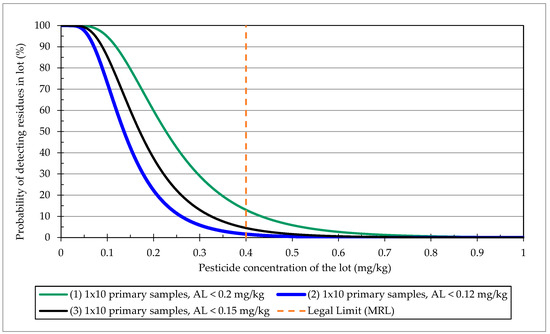
Figure 1.
Operation characteristic curves indicating the probability of detection of acetamiprid residues when single samples containing ten apples each are analyzed.
The figure shows the probability of detection of pesticide residues in composite samples taken from the tested lot. The probabilities of finding ≥ 0.4 mg/kg residue in repeated samples are 2, 4.5 and 12.5% if the samples did not contain residues above the action limits of 0.12, 0.15 and 0.2 mg/kg, respectively. Moreover, the figure indicates that the probability of finding residues ≥ 0.8 mg/kg decision limit (Equation (2)) is practically zero if action limits 0.12 and 0.15 mg/kg were applied at the time of pre-export sampling of the apple lot. On the other hand, residues above 0.8 mg/kg may occur at low probability if an AL of 0.2 mg/kg was considered.
The relative sampling uncertainty (CVS) varies between 1.2 and 1.7 in the case of fruits and vegetables [38,40]. Therefore, a default action limit of 0.3 MRL is recommended for general use to account for the sampling uncertainty.
Refined action limit can be chosen based on the CVS values determined by Farkas and co-workers.
3. Results
3.1. Summary of the Results of Pesticide Residue Monitoring during 2017–2021
During the period of 2017–2021 pesticide residues were determined in 9924 samples taken from 119 crops. Altogether, over 2.6 million analyte-sample combinations were tested. In view of the very large database, the results obtained by the analyses of six commodities containing the most frequently detected residues were selected, as an example, for their evaluation in this article. Table 2 shows the main parameters and results of the tests carried out.
Table 2.
Summary information on the pesticide residue analyses carried out during 2017–2021.
Table A1 and Table A2 indicate the number of samples in which the residues of active substances were detected by the laboratories. The residue components included in the definition of residues for enforcement purposes were analyzed with the methods applied, but they are not listed separately in the tables. Nevertheless, the active substance concentration reported, was calculated from their measured concentrations and expressed in the reported active substance equivalent.
The table indicates the frequency of occurrence of various residues and provides guidance for the relevance of their inclusion in the scope of the screening method(s) applied. It is especially important if the selected ion monitoring detection mode is used. Moreover, it should be emphasized that the 0.01 * mg/kg default limit is applicable for all substances for which MRL has not been established.
3.2. Assessment of Compliance of Residues with MRLs
3.2.1. Commodities Marketed in Hungary
The authorizations of several active substances were withdrawn by the European Commission during 2017–2021. After the grace period, these substances must not be used, and their residues should not be present in detectable concentrations in/on food and feed commodities. The R > MRL cases indicated in Table 1 for the selected six commodities resulted from the unauthorized use of these substances.
This was the case in other Member Countries of the EU [24,25] where multiple residues were detected in many samples at varying concentrations below the corresponding MRLs. The summary of findings related to the selected crops is given in Table 2 and Table 3. A few samples contained residues above the corresponding MRLs: one sour cherry (dimethoate (0.052 mg/kg) + omethoate (0.101 mg/kg) in 2018); two peppers (chlorpyrifos (0.058 mg/kg and 0.036 mg/kg) in 2020 and 2021); three strawberries (flonicamid (0.32 mg/kg), tebuconazole (0.17 mg/kg) in 2019 and propiconazole (0.064 mg/kg) in 2020). The residue concentrations were generally low indicating that the pesticides were likely applied within the four weeks period before harvest and the pre-harvest intervals were considered. Moreover, we consider in Section 3.3 if the presence of multiple residues reflects good plant protection practice.
Table 3.
Summary of compliance of exported lots with EU MRLs.
3.2.2. Prediction of Potential Compliance with MRLs if the Sampled Products Were Exported
We postulate that the tested lots might have been exported to the EU and subjected to repeated sampling by the importing country as part of the border control. To verify compliance with export MRLs, the sampling uncertainty shall also be included in the combined uncertainty of the results.
Taking the recommended 0.3 MRL action limit, we evaluated the potential compliance of the tested lots considering the residues of all active substances detected in the samples taken from the selected commodities.
The results, shown in Table 3, indicate the number of lots that would comply with the given high probability if any of the active substances analyzed were applied to them, except those which are listed individually.
Of the detected residues in the selected commodities, the grace period is over for several active substances. They should not be present in detectable concentration (MRL = 0.01 *) in the samples:
- apple: chlorothalonil, chlorpyrifos, chlorpyrifos-methyl, fenhexamid, imidacloprid and methoxyfenozide;
- grape: chlorpyrifos, chlorpyrifos-methyl, diflubenzuron, dimethoate/omethoate, famoxadone, iprodione, pirimicarb and thiophanate-methyl;
- cherry: chlorpyrifos, dimethoate, omethoate, prochloraz;
- peach: chlorpyrifos, chlorpyrifos-methyl, diflubenzuron, fenbuconazole, imazalil, imidacloprid and propamocarb;
- peppers: buprofezin, chlorpyrifos-methyl, napropamid, triadimefon, triadimenol.
In addition, the residues of glyphosate (0.1 *), captan and THPI (0.03 *), thiophanate-methyl (0.1 *) should not be present in detectable concentrations in the commodities listed in Table 2.
The test results obtained during the grace period hold no relevance for the present assessment and, thus, were not considered. The restricted substances should be included in the scope of screening methods with LOD lower than the MRLs (LOQ values) indicated with an asterisk.
Moreover, those lots exhibiting detectable concentrations of these substances must not be exported or marketed in Hungary either.
3.3. Evaluation of Plant Protection Practice
Multiple residues were detected in many samples at varying concentrations below the corresponding MRLs. Based on their residue levels, most of the detected active substances were likely applied in the period of four weeks before harvest.
Table 4.
Summary of samples containing multiple residues.
Table 5.
Number of AS detected in individual samples.
At first sight the number of active substances look surprisingly high. However, one of the most important tools for avoiding pest resistance to pesticides is to use alternate or tank-mix substances of different chemical structures and modes of actions, and limiting the number of applications of the chemicals with site-specific modes of action, and avoidance of their eradicant use. It is the general recommendation for resistance management in agriculture. Pesticide resistance has been documented in a large number of key diseases and arthropod pests of the selected crops, e.g., apple scab, powdery mildews, downy mildew, gray mold, brown rot of stone fruits, codling moth, cotton bollworm, white flies, several aphid and spider mite species, etc. In the last decade the authorization of several broad-spectrum insecticides was withdrawn (e.g., organophosphates, several synthetic pyrethroids and zoocide carbamates). Both plant pathogens and arthropod pest species differ significantly, for this reason there is no possibility to control all with only one or two active substances. Therefore, the growers must combine and apply different plant protection products to provide high quality crops to the consumer.
Nevertheless, the residues of 23, 15, 12 and 11 different active ingredients detected in apple, pepper, grape and strawberry, respectively, are considered high. In an average year diseases and pests can be effectively controlled with a lower number of applications. Depending on the weather conditions and the pest situation in the given orchard, 2–2 combined applications are justified against plant pathogens and pests in apple, cherry, peach and nectarine within the period of four weeks before harvest. In the case of peppers and probably strawberries, a greater number of applications are reasonable in this period. There is no general rule for the number of treatments, this depends on the life cycles and flight activity of the pests, the developmental stages of the crops, the weather conditions during the growing season (temperature, precipitation, humidity), the variety, the training system, and the presence of insect pollinators, among others. For choosing the compounds to be applied, besides the pest communities present in the orchard and vineyard, it is very important to take into account the mode of action of the active substances. To carry out integrated pest management, continuous and precise pest forecasting (monitoring, scouting, pheromone trapping) in the orchard is necessary.
In apples the most important diseases and arthropod pests are apple scab, powdery mildew, codling moths, leaf miner moths, aphids and woolly aphids. In certain years fire blight, tortrix moths, spider mites and apple clearwing can cause problems, too. On average, the applications of three to four active substances (Table 5), is well justified. As many as eight or nine active substances may be required, because of the need for resistance management.
During the four week period before harvest, pesticide treatments are required to control codling moth and tortrix moths (acetamiprid, etofenprox, indoxacarb, chlorantraniliprole, thiacloprid), spider mites (etoxazole, spirodiclofen), apple scab and powdery mildew (difenoconazole, dithianon, fluopyram, pyraclostrobin, pyrimethanil, tebuconazole) and the storage diseases (cyprodinil, fludioxonil, fluopyram, pyraclostrobin).
In sour cherries the pesticides used for the control of the most important diseases and insect pests were as follows: cherry fruit flies and black cherry aphid (acetamiprid, deltamethrin, lambda-cyhalothrin, pirimicarb and thiacloprid), brown rot and anthracnose (boscalid, captan, cyprodinil, dithiocarbamates, fenhexamid, fludioxonil, fluopyram, penconazole, prochloraz and tebuconazole). The period from last decade of May until the middle of June is of crucial importance in pest management of this stone fruit in Hungary. An average of three to four active substances sprayed per growing season is not a high number given the numerous diseases and arthropod pests.
In table grapes the growers must effectively control several key diseases and arthropod pests which infest both leaves and berries, such as powdery mildew, downy mildew, gray mold (botrytis blight), grape berry moths, Northern American grapevine leafhopper (Scaphoideus titanus) and phytophagous mites during the growing season. The majority of the active substances were applied against diseases caused by fungi. Usually, three to four active substances applied per growing season is not a high number. The number of target pests and diseases and the number of applications are closely related. Because of the different fungal pathogen species, different active substances must be applied against powdery mildew and gray mold. Similarly, for the control of grape berry moths an acaricide which is efficacious against spider mites is not suitable.
In the period of flowering and fruit development the effective control of powdery mildew (azoxystrobin, fluopyram, metrafenone, myclobutanil, penconazole, pyraclostrobin, spiroxamine, tebuconazole), downy mildew (cyazofamid, dimethomorph, dithiocarbamates, fluopicolide, folpet, mandipropamid, metalaxyl), gray mold (boscalid, cyprodinil, fenhexamid, fenpyrazamin, fludioxonil, fluopyram, folpet, iprodione, pyrimethanil), grapevine leafhopper (chlorpyrifos, imidacloprid, lambda-cyhalothrin, spinosad, spirotetramat, thiamethoxam) and grape berry moth (chlorantraniliprol, chlorpyrifos, lambda-cyhalothrin, spinosad, tau-fluvalinate) is essential.
In the case of nectarine and peach the relevant diseases are: peach leaf curl, peach shot hole, bacterial dieback, Cytospora canker, brown rot, peach twig borer, Oriental fruit moth, aphids, scale insects and mites. Therefore, spraying is necessary to control peach twig borer and Oriental fruit moth (acetamiprid, indoxacarb, lambda-cyhalothrin), aphids (acetamiprid, flonicamid, pirimicarb) and brown rot (boscalid, captan, cyprodinil, fenhexamid, fenpyrazamine, fluopyram, penconazole, tebuconazole). On the average, treatments with three to four, and even seven to nine active substances per year are justified.
For the successful production of peppers, the efficacious control of the following key diseases and insect pests is essential, i.e., root rots, bacterial spots, powdery mildew, soil-dwelling insects, thrips species and cotton bollworm. In the period of flowering and fruit development the effective control of thrips species (abamectin, acetamiprid, spinosad, thiamethoxam), aphids (acetamiprid, flonicamid, pirimicarb, thiacloprid, thiamethoxam), cotton bollworm (chlorantraniliprol, lambda-cyhalothrin, spinosad) and powdery mildew (azoxystrobin, boscalid, difenoconazole, penconazole, pyraclostrobin) is necessary. Besides fungicides and zoocides, in peppers herbicides were also used and detected in some samples (napropamid, pendimethalin).
The strawberry growers must effectively control several key diseases and arthropod pests, such as soil pathogens, leaf diseases, gray mold (fruit rot), strawberry blossom weevil, strawberry rhynchites, strawberry root weevil, aphids and strawberry mite. The number of target pests and diseases and the number of applications are closely related. An average of three to five active substances applied per growing season is not a high number because different pesticides have to be used to control, for instance, soil pathogens and leaf diseases or gray mold, or aphids and mites.
In the period of flowering and fruit development the control of gray mold (boscalid, cyprodinil, fenhexamid, fenpyrazamin, fludioxonil, fluopyram), strawberry blossom weevil and aphids (lambda-cyhalothrin, thiacloprid, thiamethoxam) and strawberry mite (abamectin, bifenazate, hexythiazox) is very important.
4. Discussion and Conclusions
Altogether the residues of 622 pesticide active ingredients were analyzed in 9924 samples taken mostly from 119 fruits and vegetables of economic importance grown in Hungary as well as imported during 2017–2021. The pesticide residue–sample combinations amounted to over 2.6 million. The risk-based sampling plan was developed by the NFCSO. It also incorporated the samples specified by the multi-annual control program of the European Commission [42].
The analyses were performed in laboratories accredited according to the ISO 17025 Standard [32]. The accuracy of their results and in general the technical level of laboratory analyses was demonstrated with the successful participation in EU proficiency tests covering fruits, vegetables and cereals.
Considering the very large number of results, six crops having the largest frequency of detectable pesticide residues were selected to illustrate the results and our evaluation methods.
Out of the 9924 samples/lots 102 (1.0%) contained residues above the Hungarian (EU) MRLs. The violation rate was lower than that reported by EU Member countries. In Hungary, the violation of the MRLs resulted from the use of unauthorized pesticides which were applied after the grace period expired. Such a situation requires action from the regulatory agency. The growers who misused pesticides were fined and advised on the changed authorization status of these substances to reduce the chance of placing plant commodities containing unauthorized residues on the market in the future.
The very low MRL violation rate and the fact that about 10–50% of the samples did not contain detectable residues provide broad confidence that, under current pesticide regulations, the food supply is broadly safe for consumption.
In addition to assessing compliance to legal MRLs of commodities marketed in Hungary, we examined the fictive situation of their potential export to the EU. For making a decision on whether the tested lot would contain residues below the corresponding MRLs upon the border control in the importing country, we used an action limit of 0.3 MRL for the evaluation of detected residue concentrations. In view of its applicability for three different analyte–matrix combinations [37,39,48], we recommend its use generally for pre-marketing control.
In the evaluation of residue data, the proportion of lots that contained residues ≤ 0.3 MRL was considered compliant. It was found that all tested residues in 79% of apple, 83% of cherry, 88% of grape, 89% of peach/nectarine, 73% of pepper and 76% of strawberry lots would comply with the import MRLs with >90% probability. The residues of active substances that would lead to a lower level of probability of compliance were identified.
Our results draw attention to a very important practical situation. Notwithstanding that the residues in tested lots conformed with the EU MRLs based on the first sampling, it cannot be excluded that a certain proportion of these lots would contain higher residues and be rejected, based on the results of repeated independent sampling, even if both sampling was representative, and the analyses provided accurate results. The inevitable variation in the results of repeated random sampling is caused by the very heterogeneous distribution of residues in primary samples [50,51] and consequently in the composite samples, too. Therefore, to avoid rejection of export shipments, the lots to be exported should be selected based on pre-export sampling and analyses. Their results should be evaluated applying the appropriate action limit.
The wide scope of the screening methods and low LOD values enabled the detection of all residues present even in trace concentrations. As a result, we found that 36–50% of samples of selected crops contained multiple residues ranging from 2 to 23. The frequency of multiple residues was within the same range in European countries.
The residue levels in the samples analyzed in Hungary were typically low, indicating that some of the pesticides were applied well before the harvest of the crops. Since the residue levels are compared to the corresponding MRLs [6,52] individually, the samples containing multiple residues complied with MRLs.
Given the high number of pesticide residues present in some samples, we examined whether the application of those active substances could be justified based on the principles of integrated pest management and good practice in the application of pesticides. Considering the major pests and diseases of the selected crops as well as the need for the rotation of active substances and treatments with mixtures of pesticides to reduce the chance for the development of resistance, we concluded that the use of 23, 15, 12 and 11 different pesticides in apple, pepper, grape and strawberry, respectively, do not represent good plant protection practice in a normal growing season. On average, the application of three to four active substances within the four-week period before harvest of apples is well defensible. Similarly, three to four pesticide treatments of cherries and peaches and three to five in strawberries are reasonable. Even seven to nine active substances may be needed for effective protection under special circumstances (e.g., severe infestation of arthropod pests, serious and sustained infection of plant pathogens) and for resistance management.
When a high number of pesticide treatments is witnessed, even though there is no risk to the health of the consumers deriving from the exposure to pesticide residues, the farm owners should be informed and advised to seek the help of a plant protection specialist who would examine the actual growing conditions prevailed during the growing season and advise the farmers on the effective and economical use of pesticides.
Considering the results of our evaluation based on the selected crops, we can conclude that the national monitoring program conducted over the past 5-year period served its purpose and met the requirements of the European Commission specified in regulation 396/2005. Moreover, it provided well-supported information for the regulators on the appropriate level of plant protection practice in Hungary.
Nevertheless, the monitoring of pesticide residues should be continued to provide up-to-date information for exporters of agricultural products and regulators to take timely action assuring the safe and effective use of pesticides, if necessary.
Author Contributions
Conceptualization, original draft preparation, manuscript finalization, Á.A.; data collection and formatting A.V.; methodology Á.A., H.S.-D. and G.R.; review, Á.A., G.R., A.V. and J.S.-C.; editing J.S.-C. All authors have read and agreed to the published version of the manuscript.
Funding
This research received no external funding.
Institutional Review Board Statement
Not applicable.
Informed Consent Statement
Not applicable.
Data Availability Statement
Not applicable.
Conflicts of Interest
The authors declare no conflict of interest.
Abbreviations
| AL | Action Limit |
| AS | Active Substance |
| EFSA | European Food Safety Authority |
| FAO | Food and Agriculture Organization |
| GAP | Good Agricultural Practices |
| JMPR | Joint Meeting on Pesticide Residues |
| LOD | Limit of Detection |
| LOQ | Limit of Quantification |
| MRL | Maximum Residue Limit |
| NFCSO | Hungarian Food Chain Safety Office |
| US FDA | United States Food and Drug Administration |
| WHO | World Health Organization |
Appendix A
Table A1.
Summary of number of samples and active substances tested.
Table A1.
Summary of number of samples and active substances tested.
| Number of Tests | Apples | Cherries | Grapes | Green Peppers | Peaches and Nectarines | Active Substances 1 |
|---|---|---|---|---|---|---|
| No. of samples tested | 803 | 122 | 783 | 588 | 468 | 349 |
| No. of residues—matrix combinations tested | 227,571 | 32,962 | 113,132 | 165,388 | 90,851 | 60,458 |
| No. of ASs tested | 459 | 441 | 459 | 459 | 445 | 447 |
Note: 1: The residue components included in the residue definition defined by various European Commission regulations were measured separately or as their common derivative. The reported residue concentration was calculated from the measured residues.
Table A2.
Number of samples in which the active substances were detected.
Table A2.
Number of samples in which the active substances were detected.
| Active Substances 1 | Apples | Cherries | Grapes, Table | Green Peppers | Peaches and Nectarines | Strawberries |
|---|---|---|---|---|---|---|
| 2,4-D | 202 | 52 | 212 | 148 | 80 | 99 |
| 2,4-DB | 48 | 12 | 42 | 19 | 13 | 32 |
| 2-Phenylphenol | 588 | 81 | 499 | 438 | 367 | 153 |
| 3,5-Dichloroaniline | 219 | 42 | 156 | 139 | 68 | 95 |
| 3-Chloroaniline | 158 | 40 | 125 | 90 | 53 | 70 |
| Abamectin (sum) | 449 | 41 | 166 | 346 | 190 | 92 |
| Acephate | 759 | 99 | 386 | 573 | 302 | 204 |
| Acetamiprid | 765 | 108 | 394 | 586 | 321 | 212 |
| Acetochlor | 694 | 102 | 316 | 489 | 278 | 178 |
| Aclonifen | 163 | 10 | 63 | 92 | 61 | 32 |
| Acrinathrin | 766 | 102 | 389 | 577 | 311 | 206 |
| Alachlor | 542 | 81 | 273 | 381 | 192 | 140 |
| Aldicarb (sum) | 572 | 92 | 343 | 471 | 248 | 165 |
| Aldrin and Dieldrin (sum) | 724 | 104 | 387 | 568 | 312 | 205 |
| Alphamethrin | 184 | 29 | 77 | 145 | 91 | 39 |
| Ametoctradin | 404 | 38 | 157 | 257 | 148 | 70 |
| Ametryn | 370 | 52 | 203 | 214 | 122 | 107 |
| Amidosulfuron | 140 | 18 | 36 | 97 | 75 | 35 |
| Aminopyralid | 14 | |||||
| Amitraz (sum) | 161 | 40 | 126 | 94 | 53 | 68 |
| AMPA | 14 | 1 | 11 | 15 | 4 | 2 |
| Atraton | 207 | 42 | 140 | 122 | 61 | 75 |
| Atrazine | 593 | 95 | 287 | 423 | 239 | 162 |
| Azamethiphos | 247 | 18 | 67 | 134 | 88 | 25 |
| Azinphos-ethyl | 700 | 103 | 320 | 494 | 287 | 178 |
| Azinphos-methyl | 769 | 103 | 393 | 581 | 318 | 206 |
| Aziprotryne | 370 | 52 | 203 | 214 | 122 | 107 |
| Azoxystrobin | 765 | 110 | 394 | 586 | 322 | 211 |
| Beflubutamid | 137 | 18 | 34 | 96 | 75 | 33 |
| Benalaxyl (sum of isomers) | 698 | 104 | 317 | 490 | 273 | 177 |
| Bendiocarb | 122 | 11 | 41 | 107 | 44 | 15 |
| Benfluralin | 379 | 71 | 210 | 289 | 131 | 108 |
| Bentazone (sum) | 218 | 41 | 104 | 207 | 103 | 48 |
| Benthiavalicarb (Benthiavalicarb-isopropyl) | 169 | 10 | 131 | 102 | 61 | 34 |
| Benzovindiflupyr | 151 | 13 | 320 | 83 | 31 | 8 |
| Bifenazate | 163 | 10 | 359 | 92 | 61 | 32 |
| Bifenox | 694 | 102 | 331 | 490 | 279 | 178 |
| Bifenthrin (sum of isomers) | 769 | 108 | 155 | 588 | 322 | 212 |
| Biphenyl | 565 | 79 | 316 | 417 | 210 | 151 |
| Bitertanol (sum of isomers) | 759 | 107 | 617 | 574 | 307 | 209 |
| Bixafen | 709 | 107 | 396 | 493 | 290 | 177 |
| Boscalid | 773 | 108 | 308 | 588 | 322 | 212 |
| Bromfenvinfos | 167 | 12 | 396 | 98 | 64 | 37 |
| Bromide ion | 14 | |||||
| Bromophos-methyl | 688 | 105 | 309 | 473 | 288 | 177 |
| Bromophos-ethyl | 691 | 105 | 170 | 477 | 287 | 177 |
| Bromopropylate | 771 | 108 | 395 | 587 | 321 | 212 |
| Bromoxynil and its salts | 382 | 65 | 356 | 246 | 132 | 106 |
| Bromuconazole (sum of diasteroisomers) | 696 | 108 | 63 | 499 | 290 | 184 |
| Bupirimate | 779 | 111 | 393 | 585 | 324 | 215 |
| Buprofezin | 759 | 108 | 203 | 583 | 314 | 211 |
| Butocarboxim | 146 | 18 | 70 | 103 | 77 | 35 |
| Butralin | 172 | 29 | 39 | 167 | 70 | 33 |
| Butylate | 370 | 52 | 39 | 214 | 122 | 107 |
| Cadusafos | 698 | 106 | 362 | 495 | 98 | 179 |
| Captafol | 221 | 32 | 291 | 200 | 298 | 55 |
| Captan (sum) | 692 | 99 | 386 | 540 | 304 | 211 |
| Carbaryl | 754 | 101 | 380 | 576 | 322 | 205 |
| Carbendazim and benomyl (sum) | 765 | 108 | 318 | 586 | 297 | 212 |
| Carbofuran (sum) | 697 | 103 | 336 | 556 | 231 | 349 |
| Carboxin | 696 | 108 | 39 | 499 | 16 | 184 |
| Carfentrazone-ethyl (sum) | 293 | 40 | 210 | 243 | 288 | 54 |
| Chinomethionat | 379 | 71 | 73 | 289 | 156 | 108 |
| Chlorantraniliprole | 766 | 108 | 7 | 578 | 228 | 202 |
| Chlorbromuron | 163 | 10 | 361 | 92 | 280 | 32 |
| Chlordane (sum of cis- and trans-chlordane) | 653 | 104 | 40 | 468 | 280 | 171 |
| Chlorfenapyr | 692 | 99 | 140 | 541 | 271 | 205 |
| Chlorfenson | 207 | 42 | 19 | 122 | 39 | 75 |
| Chlorfenvinphos | 690 | 102 | 58 | 487 | 61 | 177 |
| Chlorfluazuron | 134 | 15 | 36 | 73 | 75 | 11 |
| Chloridazon | 506 | 98 | 380 | 389 | 16 | 151 |
| Chlorobenzilate | 374 | 54 | 307 | 220 | 61 | 108 |
| Chlorothalonil | 772 | 108 | 390 | 587 | 283 | 212 |
| Chlorotoluron | 706 | 107 | 285 | 494 | 307 | 182 |
| Chloroxuron | 140 | 18 | 397 | 100 | 321 | 35 |
| Chlorpropham | 578 | 81 | 396 | 435 | 18 | 145 |
| Chlorpyrifos | 803 | 108 | 311 | 588 | 321 | 212 |
| Chlorpyrifos-methyl | 803 | 108 | 1 | 588 | 215 | 212 |
| Chlorsulfuron | 1 | 4 | 318 | 14 | 321 | 10 |
| Chlozolinate | 208 | 42 | 63 | 123 | 123 | 71 |
| Cinidon-ethyl | 370 | 52 | 398 | 214 | 122 | 107 |
| Clethodim (sum) | 184 | 30 | 318 | 167 | 314 | 33 |
| Clofentezine | 759 | 108 | 1 | 583 | 283 | 211 |
| Clomazone | 706 | 107 | 393 | 494 | 321 | 182 |
| Clopyralid | 1 | 248 | ||||
| Clothianidin | 722 | 99 | 206 | 535 | 60 | 189 |
| Coumaphos | 653 | 93 | 321 | 443 | 322 | 173 |
| Cyanazine | 113 | 10 | 140 | 58 | 32 | 10 |
| Cyanofenphos | 207 | 42 | 3 | 122 | 61 | 75 |
| Cyantraniliprole | 47 | 2 | 328 | 7 | 8 | |
| Cyazofamid | 656 | 105 | 53 | 491 | 299 | 186 |
| Cycloate | 516 | 70 | 71 | 316 | 199 | 142 |
| Cycloxydim (sum) | 169 | 10 | 394 | 102 | 61 | 34 |
| Cyflufenamid | 273 | 45 | 186 | 254 | 102 | 37 |
| Cyfluthrin (sum of isomers) | 741 | 102 | 553 | 569 | 299 | 187 |
| Cymoxanil | 765 | 108 | 203 | 586 | 322 | 212 |
| Cypermethrin (sum of isomers) | 802 | 108 | 394 | 588 | 321 | 212 |
| Cyproconazole | 754 | 106 | 15 | 576 | 305 | 203 |
| Cyprodinil | 780 | 107 | 388 | 587 | 315 | 211 |
| Cyprosulfamide | 5 | 2 | ||||
| Cyromazine | 21 | 307 | 70 | 8 | 14 | |
| Dazomet | 58 | 17 | 322 | 17 | 14 | 40 |
| DDT | 701 | 108 | 322 | 501 | 290 | 184 |
| Deltamethrin | 803 | 108 | 204 | 588 | 322 | 212 |
| Demeton-S-Methyl | 367 | 54 | 82 | 219 | 124 | 108 |
| Desethyl-Atrazine | 552 | 86 | 275 | 385 | 196 | 144 |
| Desisopropyl-Atrazine | 552 | 86 | 214 | 385 | 196 | 144 |
| Desmedipham | 402 | 63 | 189 | 257 | 168 | 129 |
| Dialifos | 207 | 42 | 395 | 122 | 61 | 75 |
| Diazinon | 773 | 108 | 387 | 588 | 322 | 212 |
| Dicamba | 146 | 48 | 252 | 97 | 62 | 72 |
| Dichlobenil | 525 | 94 | 63 | 396 | 212 | 145 |
| Dichlofenthion | 535 | 96 | 320 | 401 | 227 | 145 |
| Dichlofluanid | 696 | 106 | 336 | 493 | 287 | 183 |
| Dichlormid | 338 | 59 | 146 | 276 | 121 | 94 |
| Dichlorprop | 210 | 52 | 74 | 139 | 74 | 82 |
| Dichlorvos | 771 | 108 | 176 | 586 | 322 | 212 |
| Diclobutrazol | 163 | 10 | 259 | 91 | 32 | 10 |
| Dicloran | 595 | 81 | 394 | 457 | 215 | 155 |
| Dicofol (sum of p, p’ and o, p’ isomers) | 712 | 99 | 615 | 519 | 340 | 213 |
| Dicrotophos | 372 | 62 | 1 | 232 | 135 | 114 |
| Diethofencarb | 765 | 108 | 318 | 586 | 322 | 212 |
| Difenoconazole | 766 | 108 | 141 | 586 | 322 | 212 |
| Diflovidazin (Flufenzin) | 204 | 44 | 394 | 127 | 63 | 76 |
| Diflubenzuron | 765 | 108 | 321 | 586 | 322 | 212 |
| Diflufenican | 696 | 108 | 120 | 499 | 290 | 184 |
| Dimethachlor | 700 | 107 | 203 | 491 | 275 | 181 |
| Dimethenamid (sum of isomers) | 370 | 52 | 286 | 214 | 122 | 107 |
| Dimethipin | 379 | 71 | 394 | 289 | 131 | 108 |
| Dimethoate | 765 | 108 | 101 | 586 | 322 | 212 |
| Dimethomorph (sum of isomers) | 767 | 108 | 318 | 586 | 322 | 212 |
| Dimoxystrobin | 707 | 107 | 393 | 494 | 283 | 182 |
| Diniconazole (sum of isomers) | 759 | 108 | 140 | 583 | 314 | 211 |
| Dioxacarb | 1 | |||||
| Dioxathion | 207 | 42 | 273 | 122 | 61 | 75 |
| Diphenylamine | 591 | 81 | 394 | 439 | 215 | 153 |
| Diquat | 317 | 1 | ||||
| Disulfoton (sum) | 488 | 79 | 255 | 348 | 184 | 133 |
| Ditalimfos | 698 | 106 | 142 | 493 | 288 | 177 |
| Dithianon | 243 | 30 | 324 | 172 | 105 | 35 |
| Dithiocarbamates | 605 | 77 | 320 | 399 | 247 | 176 |
| Diuron | 690 | 108 | 202 | 496 | 282 | 183 |
| Dodine | 423 | 37 | 157 | 335 | 169 | 90 |
| Emamectin B1a (free base) | 421 | 52 | 535 | 337 | 171 | 84 |
| Endosulfan (sum) | 772 | 108 | 395 | 588 | 322 | 212 |
| Endrin | 701 | 108 | 322 | 501 | 290 | 184 |
| Endrin Aldehyde | 692 | 108 | 109 | 495 | 290 | 178 |
| Endrin, Keto- | 312 | 37 | 394 | 205 | 160 | 74 |
| EPN | 769 | 106 | 362 | 535 | 319 | 207 |
| Epoxiconazole | 766 | 108 | 29 | 586 | 322 | 212 |
| epsilon-HCH | 48 | 8 | 35 | 48 | 25 | 13 |
| EPTC (ethyl dipropylthiocarbamate) | 207 | 42 | 140 | 122 | 61 | 75 |
| Ethephon | 60 | 46 | 44 | 30 | ||
| Ethiofencarb | 119 | 7 | 46 | 68 | 32 | 12 |
| Ethiofencarb-Sulfone | 119 | 7 | 46 | 68 | 32 | 12 |
| Ethiofencarb-Sulfoxide | 119 | 7 | 392 | 68 | 32 | 12 |
| Ethion | 767 | 103 | 394 | 579 | 318 | 206 |
| Ethirimol | 765 | 108 | 388 | 586 | 322 | 210 |
| Ethofumesate | 367 | 54 | 126 | 219 | 124 | 108 |
| Ethoprophos | 699 | 106 | 157 | 495 | 288 | 179 |
| Ethoxyquin | 222 | 55 | 143 | 164 | 116 | 93 |
| Etofenprox | 781 | 99 | 204 | 575 | 301 | 203 |
| Etoxazole | 404 | 38 | 148 | 257 | 148 | 74 |
| Etridiazole | 208 | 42 | 322 | 123 | 60 | 71 |
| Etrimfos | 698 | 106 | 327 | 495 | 288 | 179 |
| Famoxadone | 592 | 90 | 393 | 458 | 229 | 171 |
| Fenamidone | 759 | 108 | 396 | 583 | 314 | 211 |
| Fenamiphos (sum) | 566 | 88 | 324 | 450 | 228 | 155 |
| Fenarimol | 760 | 102 | 393 | 574 | 303 | 205 |
| Fenazaquin | 759 | 108 | 394 | 583 | 314 | 211 |
| Fenbuconazole | 763 | 108 | 18 | 584 | 317 | 211 |
| Fenbutatin oxide | 47 | 394 | 27 | 19 | 9 | |
| Fenchlorphos (sum) | 487 | 92 | 245 | 372 | 217 | 138 |
| Fenhexamid | 765 | 108 | 391 | 586 | 322 | 212 |
| Fenitrothion | 765 | 106 | 140 | 571 | 317 | 193 |
| Fenoxycarb | 765 | 108 | 1 | 586 | 322 | 212 |
| Fenpicoxamid | 15 | 151 | 3 | |||
| Fenpropathrin | 771 | 106 | 392 | 582 | 319 | 207 |
| Fenpropidin | 763 | 108 | 392 | 585 | 320 | 212 |
| Fenpropimorph (sum of isomers) | 706 | 90 | 308 | 524 | 256 | 171 |
| Fenpyrazamine | 276 | 40 | 394 | 260 | 96 | 34 |
| Fenpyroximate | 765 | 108 | 396 | 586 | 322 | 212 |
| Fenson (Fenison) | 207 | 42 | 388 | 122 | 61 | 75 |
| Fensulfothion | 649 | 100 | 39 | 458 | 278 | 168 |
| Fensulfothion-Oxon | 113 | 7 | 39 | 58 | 32 | 10 |
| Fensulfothion-Sulfone | 113 | 7 | 388 | 58 | 32 | 10 |
| Fenthion (sum) | 515 | 83 | 242 | 399 | 221 | 145 |
| Fenuron | 1 | 4 | 398 | 14 | 18 | 10 |
| Fenvalerate (sum) | 801 | 108 | 140 | 588 | 322 | 212 |
| Fipronil (sum) | 733 | 103 | 390 | 570 | 313 | 204 |
| Flazasulfuron | 137 | 18 | 316 | 96 | 75 | 33 |
| Flonicamid (sum) | 447 | 78 | 255 | 353 | 176 | 110 |
| Florasulam | 385 | 80 | 138 | 302 | 151 | 116 |
| Fluazifop-P | 180 | 52 | 333 | 152 | 73 | 88 |
| Fluazifop-P-butyl | 22 | 270 | 46 | 9 | 18 | |
| Fluazinam | 690 | 105 | 211 | 495 | 281 | 182 |
| Flubendiamide | 580 | 74 | 394 | 468 | 261 | 126 |
| Flucythrinate (sum of isomers) | 376 | 73 | 297 | 294 | 133 | 109 |
| Fludioxonil | 766 | 108 | 392 | 586 | 322 | 212 |
| Flufenacet | 646 | 105 | 3 | 465 | 261 | 162 |
| Flufenoxuron | 741 | 108 | 39 | 575 | 305 | 188 |
| Flumethrin | 113 | 7 | 243 | 58 | 32 | 10 |
| Flumetralin | 6 | 141 | 5 | |||
| Flumioxazine | 341 | 39 | 377 | 269 | 131 | 67 |
| Fluometuron | 513 | 72 | 351 | 322 | 201 | 143 |
| Fluopicolide | 764 | 105 | 268 | 573 | 321 | 210 |
| Fluopyram | 615 | 92 | 175 | 475 | 230 | 163 |
| Fluoxastrobin | 500 | 58 | 388 | 359 | 210 | 101 |
| Flupyradifurone | 29 | 3 | 3 | |||
| Fluquinconazole | 755 | 104 | 15 | 578 | 305 | 206 |
| Flurochloridone | 597 | 88 | 1 | 376 | 230 | 153 |
| Fluroxypyr (sum) | 16 | 11 | 246 | 25 | 38 | 17 |
| Flusilazole | 761 | 104 | 354 | 580 | 313 | 207 |
| Flutolanil | 503 | 78 | 47 | 332 | 171 | 131 |
| Flutriafol | 771 | 104 | 182 | 578 | 313 | 206 |
| Fluvalinate (sum of isomers) | 768 | 106 | 783 | 581 | 410 | 249 |
| Fluxapyroxad | 421 | 49 | 361 | 296 | 179 | 88 |
| Folpet (sum) | 684 | 92 | 252 | 522 | 270 | 192 |
| Fomesafen | 163 | 10 | 39 | 92 | 61 | 32 |
| Fonofos | 521 | 77 | 297 | 327 | 210 | 143 |
| Foramsulfuron | 146 | 18 | 204 | 103 | 77 | 35 |
| Forchlorfenuron | 140 | 18 | 292 | 100 | 75 | 35 |
| Formetanate | 429 | 77 | 322 | 359 | 166 | 128 |
| Formothion | 624 | 92 | 8 | 428 | 243 | 161 |
| Fosetyl-Al (efozit-Al) | 330 | 24 | ||||
| Fosthiazate | 763 | 108 | 354 | 586 | 201 | 203 |
| Fuberidazole | 308 | 28 | 140 | 195 | 130 | 67 |
| Furilazole | 207 | 42 | 7 | 122 | 32 | 75 |
| Glufosinate | 27 | 11 | ||||
| Glyphosate | 82 | 2 | 36 | 27 | 75 | 17 |
| Halosulfuron methyl | 140 | 18 | 138 | 100 | 8 | 35 |
| Haloxyfop | 201 | 52 | 592 | 208 | 353 | 104 |
| Heptachlor (sum) | 653 | 104 | 307 | 471 | 280 | 177 |
| Heptenophos | 698 | 106 | 322 | 495 | 143 | 179 |
| Hexachlorobenzene | 701 | 108 | 205 | 501 | 315 | 184 |
| Hexachlorocyclohexane, alpha-isomer | 700 | 108 | 322 | 501 | 290 | 183 |
| Hexachlorocyclohexane, beta-isomer | 700 | 108 | 495 | 501 | 290 | 183 |
| Hexachlorocyclohexane, delta-isomer | 679 | 100 | 398 | 482 | 276 | 176 |
| Hexaconazole | 775 | 107 | 394 | 581 | 124 | 210 |
| Hexaflumuron | 394 | 60 | 391 | 245 | 290 | 110 |
| Hexazinone | 382 | 54 | 394 | 221 | 322 | 108 |
| Hexythiazox | 765 | 108 | 207 | 586 | 322 | 212 |
| Imazalil | 765 | 108 | 128 | 586 | 143 | 212 |
| Imazamox | 353 | 78 | 7 | 278 | 53 | 109 |
| Imazapyr | 164 | 40 | 394 | 100 | 321 | 69 |
| Imazethapyr | 6 | 391 | 10 | 2 | ||
| Imidacloprid | 765 | 108 | 141 | 586 | 315 | 212 |
| Indoxacarb | 775 | 107 | 141 | 581 | 63 | 210 |
| Iodosulfuron-methyl | 184 | 27 | 94 | 164 | 288 | 33 |
| Ioxynil | 204 | 44 | 389 | 127 | 199 | 76 |
| Ipconazole | 516 | 70 | 394 | 317 | 313 | 142 |
| Iprodione | 765 | 104 | 38 | 578 | 322 | 206 |
| Iprovalicarb | 765 | 108 | 322 | 586 | 35 | 212 |
| Isocarbophos | 768 | 107 | 204 | 576 | 68 | 208 |
| Isodrin | 116 | 12 | 312 | 64 | 287 | 15 |
| Isofenphos | 698 | 106 | 390 | 495 | 270 | 178 |
| Isofenphos-methyl | 688 | 99 | 90 | 484 | 305 | 176 |
| Isoprocarb | 367 | 54 | 249 | 219 | 284 | 108 |
| Isoprothiolane | 693 | 108 | 34 | 508 | 178 | 197 |
| Isoproturon | 493 | 79 | 210 | 337 | 75 | 133 |
| Isopyrazam | 205 | 18 | 335 | 120 | 124 | 35 |
| Isoxaben | 137 | 18 | 56 | 96 | 143 | 33 |
| Isoxadifen-ethyl | 431 | 53 | 140 | 301 | 42 | 106 |
| Isoxaflutole | 376 | 60 | 393 | 239 | 175 | 109 |
| Kresoxim-methyl | 770 | 107 | 398 | 578 | 251 | 209 |
| Lambda-cyhalothrin | 802 | 108 | 322 | 588 | 290 | 213 |
| Lenacil | 696 | 108 | 394 | 499 | 290 | 184 |
| Lindane | 701 | 108 | 380 | 501 | 322 | 184 |
| Linuron | 765 | 108 | 371 | 586 | 276 | 212 |
| Lufenuron | 719 | 99 | 383 | 535 | 287 | 180 |
| Malathion (sum) | 721 | 100 | 383 | 564 | 322 | 199 |
| Mandipropamid | 765 | 108 | 319 | 586 | 70 | 212 |
| MCPA and MCPB | 180 | 52 | 138 | 121 | 73 | 81 |
| Mecarbam | 688 | 108 | 389 | 493 | 73 | 183 |
| Mecoprop (sum) | 180 | 52 | 169 | 121 | 305 | 81 |
| Mefenpyr-diethyl | 172 | 29 | 138 | 167 | 282 | 33 |
| Mepanipyrim | 764 | 104 | 204 | 575 | 124 | 205 |
| Mepiquat | 141 | |||||
| Mepronil | 367 | 54 | 36 | 219 | 63 | 108 |
| Meptyldinocap | 204 | 44 | 281 | 127 | 75 | 76 |
| Mesosulfuron-methyl | 146 | 18 | 3 | 103 | 62 | 35 |
| Mesotrione | 194 | 44 | 391 | 113 | 315 | 76 |
| Metaflumizone (sum of E- and Z- isomers) | 548 | 90 | 2 | 395 | 265 | 148 |
| Metalaxyl and metalaxyl-M (sum of isomers) | 771 | 104 | 455 | 578 | 373 | 206 |
| Metaldehyde | 163 | 10 | 321 | 92 | 318 | 32 |
| Metamitron | 696 | 108 | 390 | 499 | 275 | 184 |
| Metazachlor | 700 | 107 | 395 | 491 | 302 | 181 |
| Metconazole (sum of isomers) | 688 | 105 | 345 | 498 | 287 | 177 |
| Methabenzthiazuron | 140 | 18 | 305 | 100 | 212 | 35 |
| Methacrifos | 616 | 100 | 388 | 461 | 1 | 167 |
| Methamidophos | 767 | 103 | 317 | 579 | 290 | 206 |
| Methidathion | 760 | 102 | 395 | 575 | 321 | 201 |
| Methiocarb (sum) | 598 | 90 | 327 | 455 | 316 | 162 |
| Methomyl | 766 | 108 | 394 | 586 | 322 | 212 |
| Methoxychlor | 701 | 108 | 356 | 501 | 32 | 184 |
| Methoxyfenozide | 765 | 108 | 39 | 586 | 290 | 212 |
| Metobromuron | 696 | 108 | 32 | 499 | 92 | 184 |
| Metolachlor and S-metolachlor (sum of isomers) | 705 | 98 | 678 | 496 | 468 | 171 |
| Metoxuron | 113 | 10 | 316 | 58 | 322 | 10 |
| Metrafenone | 764 | 108 | 113 | 547 | 273 | 211 |
| Metribuzin | 695 | 104 | 321 | 487 | 157 | 177 |
| Metsulfuron-methyl | 332 | 48 | 39 | 270 | 288 | 70 |
| Mevinphos | 698 | 106 | 133 | 493 | 77 | 179 |
| Molinate | 516 | 70 | 63 | 317 | 291 | 142 |
| Monocrotophos | 686 | 98 | 203 | 534 | 61 | 195 |
| Monolinuron | 163 | 10 | 39 | 92 | 122 | 32 |
| Myclobutanil | 775 | 107 | 362 | 581 | 199 | 210 |
| N,N-Diethyl-m-toluamid (DEET) | 652 | 105 | 302 | 462 | 266 | 174 |
| Napropamide (sum of isomers) | 370 | 52 | 243 | 214 | 77 | 107 |
| Nicosulfuron | 146 | 18 | 167 | 103 | 201 | 35 |
| Nitenpyram | 513 | 72 | 204 | 322 | 90 | 143 |
| Nitrofen | 300 | 49 | 203 | 165 | 124 | 84 |
| Novaluron | 367 | 54 | 294 | 219 | 122 | 108 |
| Nuarimol | 370 | 52 | 112 | 214 | 249 | 107 |
| o.p’-DDD | 631 | 92 | 322 | 434 | 251 | 164 |
| o.p’-DDE | 631 | 92 | 203 | 434 | 290 | 164 |
| Ofurace | 370 | 52 | 73 | 214 | 309 | 107 |
| Omethoate | 728 | 108 | 393 | 575 | 105 | 205 |
| Oxadiazon | 198 | 19 | 394 | 130 | 314 | 53 |
| Oxadixyl | 759 | 108 | 39 | 583 | 322 | 211 |
| Oxamyl | 765 | 108 | 1 | 586 | 77 | 212 |
| Oxasulfuron | 146 | 18 | 247 | 103 | 168 | 35 |
| Oxathiapiprolin | 15 | 284 | 3 | 118 | ||
| Oxycarboxin | 163 | 10 | 322 | 92 | 249 | 172 |
| Oxydemeton-methyl (sum) | 551 | 83 | 374 | 442 | 216 | 161 |
| Oxyfluorfen | 492 | 78 | 294 | 347 | 61 | 32 |
| Paclobutrazol | 760 | 104 | 389 | 580 | 218 | 140 |
| Paraoxon | 526 | 77 | 362 | 324 | 318 | 206 |
| Parathion | 773 | 108 | 391 | 541 | 322 | 212 |
| Parathion-methyl (sum) | 768 | 106 | 391 | 580 | 318 | 211 |
| Penconazole | 772 | 104 | 110 | 578 | 269 | 175 |
| Pencycuron | 765 | 108 | 87 | 586 | 315 | 210 |
| Pendimethalin | 775 | 107 | 390 | 581 | 68 | 33 |
| Penflufen (sum of isomers) | 205 | 18 | 303 | 115 | 313 | 206 |
| Penthiopyrad | 282 | 42 | 203 | 202 | 321 | 212 |
| perchlorate | 1 | 107 | ||||
| Permethrin (sum of isomers) | 772 | 108 | 242 | 587 | 122 | 142 |
| Pethoxamid | 370 | 52 | 320 | 214 | 199 | 182 |
| Phenkapton | 207 | 42 | 245 | 122 | 61 | 75 |
| Phenmedipham | 402 | 63 | 394 | 257 | 168 | 129 |
| Phenthoate | 516 | 70 | 5 | 317 | 200 | 143 |
| Phorate (sum) | 342 | 78 | 41 | 282 | 158 | 115 |
| Phorate (sum) | 700 | 106 | 8 | 495 | 288 | 179 |
| Phosmet (sum) | 595 | 81 | 394 | 438 | 216 | 151 |
| Phosphamidon | 700 | 106 | 358 | 495 | 288 | 179 |
| Phosphane and phosphide salts | 1 | 320 | 12 | |||
| Phoxim | 513 | 72 | 102 | 323 | 270 | 143 |
| Picolinafen | 516 | 70 | 229 | 317 | 282 | 139 |
| Picoxystrobin | 690 | 108 | 63 | 496 | 244 | 32 |
| Piperonyl butoxide | 163 | 10 | 6 | 92 | 53 | 9 |
| Pirimicarb | 773 | 103 | 394 | 579 | 102 | 212 |
| Pirimicarb, desmethyl- | 333 | 63 | 140 | 219 | 107 | 110 |
| Pirimiphos-ethyl | 654 | 94 | 389 | 476 | 319 | 207 |
| Pirimiphos-methyl | 769 | 106 | 17 | 582 | 313 | 19 |
| Prochloraz (sum) | 507 | 87 | 54 | 412 | 42 | 18 |
| Procymidone | 750 | 99 | 388 | 569 | 199 | 205 |
| Profenofos | 759 | 102 | 348 | 574 | 131 | 178 |
| Profluralin | 379 | 71 | 255 | 289 | 273 | 133 |
| Promecarb | 326 | 48 | 245 | 267 | 215 | 138 |
| Prometryn | 571 | 86 | 394 | 398 | 201 | 212 |
| Propachlor | 516 | 73 | 337 | 316 | 298 | 184 |
| Propamocarb | 715 | 108 | 359 | 586 | 252 | 178 |
| Propaquizafop | 467 | 68 | 203 | 290 | 279 | 107 |
| Propargite | 650 | 96 | 102 | 518 | 122 | 67 |
| Propazine | 370 | 52 | 390 | 214 | 138 | 209 |
| Propetamphos | 309 | 28 | 394 | 195 | 307 | 212 |
| Propham | 516 | 70 | 210 | 317 | 303 | 108 |
| Propiconazole (sum of isomers) | 768 | 107 | 276 | 578 | 322 | 141 |
| Propisochlor | 547 | 81 | 321 | 387 | 282 | 162 |
| Propoxur | 690 | 108 | 271 | 496 | 242 | 137 |
| Propyzamide | 765 | 108 | 320 | 586 | 192 | 183 |
| Proquinazid | 618 | 89 | 63 | 474 | 274 | 32 |
| Prosulfocarb | 605 | 74 | 309 | 483 | 61 | 180 |
| Prosulfuron | 163 | 10 | 178 | 92 | 291 | 80 |
| Prothioconazole: prothioconazole-desthio (sum of isomers) | 542 | 90 | 333 | 450 | 296 | 184 |
| Prothiofos | 693 | 107 | 102 | 481 | 136 | 67 |
| Pymetrozine | 540 | 74 | 43 | 482 | 61 | 20 |
| Pyraclostrobin | 765 | 108 | 164 | 586 | 288 | 78 |
| Pyraflufen-ethyl | 135 | 19 | 394 | 111 | 322 | 211 |
| Pyrazophos | 698 | 106 | 393 | 495 | 85 | 211 |
| Pyrethrins | 271 | 47 | 320 | 152 | 313 | 178 |
| Pyridaben | 759 | 108 | 100 | 583 | 286 | 6 |
| Pyridalyl | 151 | 13 | 204 | 134 | 143 | 108 |
| Pyridaphenthion | 696 | 102 | 207 | 486 | 31 | 109 |
| Pyridate | 353 | 78 | 391 | 278 | 124 | 210 |
| Pyrifenox | 367 | 54 | 285 | 219 | 315 | 164 |
| Pyrimethanil | 776 | 107 | 395 | 581 | 277 | 207 |
| Pyriofenone | 273 | 36 | 70 | 201 | 322 | 33 |
| Pyriproxyfen | 765 | 108 | 383 | 586 | 78 | 204 |
| Pyroxsulam | 184 | 27 | 242 | 161 | 301 | 142 |
| Quinalphos | 700 | 106 | 117 | 495 | 131 | 179 |
| Quinmerac | 503 | 98 | 393 | 388 | 68 | 211 |
| Quinoclamine | 190 | 18 | 300 | 112 | 314 | 170 |
| Quinoxyfen | 759 | 108 | 304 | 583 | 262 | 175 |
| Quintozene (sum) | 658 | 102 | 204 | 466 | 123 | 25 |
| Resmethrin (sum of isomers) | 366 | 54 | 243 | 216 | 63 | 143 |
| Rimsulfuron | 69 | 15 | 203 | 75 | 201 | 107 |
| Rotenone | 513 | 72 | 63 | 322 | 122 | 32 |
| Secbumeton | 309 | 28 | 102 | 196 | 138 | 177 |
| Sedaxane | 26 | 4 | 3 | 67 | ||
| Silthiofam | 309 | 65 | 196 | 168 | ||
| Simazine | 370 | 52 | 104 | 214 | 32 | 10 |
| Simetryn | 113 | 10 | 394 | 91 | 31 | 212 |
| Spinetoram (XDE-175) | 151 | 13 | 394 | 139 | 322 | 212 |
| Spinosad (sum) | 765 | 108 | 394 | 586 | 322 | 212 |
| Spirodiclofen | 765 | 108 | 187 | 586 | 317 | 78 |
| Spiromesifen | 770 | 106 | 38 | 582 | 175 | 39 |
| Spirotetramat (sum) | 540 | 67 | 344 | 406 | 324 | 142 |
| Spiroxamine (sum of isomers) | 775 | 107 | 102 | 581 | 138 | 2 |
| Sulfotep | 690 | 102 | 346 | 487 | 31 | 211 |
| Sulfoxaflor (sum of isomers) | 151 | 13 | 393 | 83 | 224 | 212 |
| Tau-Fluvalinate | 613 | 81 | 394 | 468 | 314 | 206 |
| Tebuconazole | 774 | 104 | 393 | 580 | 226 | 205 |
| Tebufenozide | 759 | 108 | 391 | 583 | 322 | 147 |
| Tebufenpyrad | 766 | 108 | 260 | 586 | 313 | 211 |
| Tecnazene | 535 | 96 | 388 | 403 | 314 | 33 |
| Teflubenzuron | 759 | 108 | 34 | 583 | 303 | 33 |
| Tefluthrin | 760 | 102 | 34 | 574 | 75 | 144 |
| Tepraloxydim | 137 | 18 | 322 | 96 | 201 | 32 |
| Terbacil | 516 | 73 | 63 | 320 | 288 | 10 |
| Terbufos | 698 | 106 | 39 | 494 | 61 | 10 |
| Terbufos-sulfone | 163 | 10 | 39 | 92 | 32 | 182 |
| Terbufos-sulfoxide | 113 | 7 | 361 | 1 | 61 | 162 |
| Terbumeton | 113 | 10 | 285 | 58 | 273 | 151 |
| Terbuthylazine | 651 | 98 | 396 | 516 | 237 | 146 |
| Terbutryn | 583 | 93 | 291 | 422 | 321 | 210 |
| Tetrachlorvinphos | 526 | 77 | 316 | 328 | 315 | 212 |
| Tetraconazole | 775 | 107 | 392 | 581 | 279 | 212 |
| Tetradifon | 772 | 108 | 252 | 587 | 201 | 178 |
| Tetramethrin | 695 | 102 | 394 | 490 | 321 | 32 |
| Thiabendazole | 765 | 105 | 394 | 585 | 321 | 70 |
| Thiacloprid | 766 | 108 | 40 | 586 | 321 | 212 |
| Thiamethoxam | 766 | 108 | 113 | 586 | 32 | 180 |
| Thiencarbazone-methyl | 128 | 10 | 394 | 61 | 157 | 69 |
| Thifensulfuron-methyl | 332 | 48 | 361 | 270 | 322 | 117 |
| Thiodicarb | 765 | 108 | 112 | 586 | 271 | 184 |
| Thiofanox | 326 | 48 | 340 | 267 | 180 | 205 |
| Thiometon | 470 | 74 | 254 | 287 | 270 | 35 |
| Thiophanate-methyl | 684 | 97 | 227 | 501 | 149 | 112 |
| Tolclofos-methyl | 759 | 102 | 307 | 574 | 75 | 48 |
| Tolylfluanid (sum) | 445 | 76 | 210 | 345 | 303 | 210 |
| Tralkoxydim | 140 | 18 | 391 | 100 | 280 | 210 |
| Triadimefon | 775 | 107 | 391 | 581 | 85 | 36 |
| Triadimenol | 775 | 107 | 39 | 581 | 124 | 35 |
| Tri-allate | 367 | 54 | 395 | 219 | 78 | 171 |
| Triasulfuron | 146 | 18 | 39 | 103 | 319 | 212 |
| Triazophos | 770 | 106 | 306 | 582 | 77 | 182 |
| Tribenuron-methyl | 146 | 18 | 394 | 103 | 267 | 108 |
| Trichlorfon | 518 | 70 | 313 | 319 | 149 | 12 |
| Triclopyr | 7 | 112 | 10 | 25 | ||
| Tricyclazole | 600 | 105 | 318 | 457 | 322 | 211 |
| Trifloxystrobin | 765 | 108 | 200 | 586 | 281 | 178 |
| Triflumizole | 690 | 105 | 394 | 495 | 132 | 101 |
| Triflumuron | 765 | 108 | 191 | 586 | 279 | 143 |
| Trifluralin | 694 | 102 | 7 | 506 | 114 | 69 |
| Triflusulfuron | 15 | 46 | 3 | 42 | ||
| Triforine | 327 | 50 | 243 | 192 | 200 | 177 |
| Trimethacarb | 326 | 48 | 1 | 267 | 272 | 151 |
| Triticonazole | 685 | 101 | 38 | 490 | 76 | 206 |
| Uniconazole | 144 | 18 | 279 | 95 | 32 | 182 |
| Valifenalate | 119 | 7 | 389 | 68 | 269 | |
| Vamidothion | 643 | 96 | 33 | 477 | 311 | |
| Vinclozolin | 765 | 102 | 319 | 577 | 13 | |
| Zoxamide | 690 | 122 | 495 |
Note: 1: The residue components included in the residue definition defined by various European Commission regulations were measured separately or as their common derivative. The reported residue concentration was calculated from the measured residues.
References
- Research Institute of Organic Agriculture (FIBL). European and Global Organic Farming Statistics. 2023. Available online: https://www.organic-world.net/statistics.html (accessed on 25 May 2023).
- European Council Regulation No 1107/2009 of the European Parliament and of the Council of 21 October 2009 Concerning the Placing of Plant Protection Products on the Market and Repealing Council Directives 79/117/EEC and 91/414/EEC. Available online: https://eur-lex.europa.eu/legal-content/EN/TXT/HTML/?uri=CELEX:32009R1107 (accessed on 25 May 2023).
- European Council. Commission Regulation No 2022/1438, Amending Annex II to Regulation (EC) No 1107/2009 as Regards Specific Criteria for the Approval of Active Substances that are Micro-Organisms. Available online: http://data.europa.eu/eli/reg/2022/1441/oj (accessed on 25 May 2023).
- European Commission Regulation No 283/2013 of 1 March 2013 Setting Out the Data Requirements for Active Substances, in Accordance with Regulation (EC) No 1107/2009 of the European Parliament and of the Council Concerning the Placing of Plant Protection Products on the Market. Available online: https://eur-lex.europa.eu/LexUriServ/LexUriServ.do?uri=OJ:L:2013:093:0001:0084:EN:PDF (accessed on 25 May 2023).
- European Commission Regulation No 546/2011 of 10 June 2011 Implementing Regulation (EC) No 1107/2009 of the European Parliament and of the Council as Regards Uniform Principles for Evaluation and Authorisation of Plant Protection Products. Available online: http://data.europa.eu/eli/reg/2009/1107/2022-11-21 (accessed on 25 May 2023).
- European Council Regulation No 396/2005 of the European Parliament and of the Council of 23 February 2005 on Maximum Residue Levels of Pesticides in or on Food and Feed of Plant and Animal Origin and Amending Council Directive 91/414/EEC. Available online: http://data.europa.eu/eli/reg/2005/396/2023-02-28 (accessed on 25 May 2023).
- Austrian Agency for Health and Food Safety. National Pesticide Residue Control Programmes. Available online: https://www.ages.at/en/plant/pesticides/pesticide-residues#c5252 (accessed on 25 May 2023).
- Australian Government Department of Agriculture, Fisheries and Forestry. National Residue Survey. Available online: https://www.agriculture.gov.au/agriculture-land/farm-food-drought/food/nrs (accessed on 25 May 2023).
- German Federal Office of Consumer Protection. Tables for the National Reporting of Pesticide Residues in food 2020. Available online: www.bvl.bund.de/DE/Arbeitsbereiche/01_Lebensmittel/01_Aufgaben/02_AmtlicheLebensmittelueberwachung/07_PSMRueckstaende/01_nb_psm_2020_tabellen/nbpsm_2020_tabellen_node.html (accessed on 25 May 2023).
- Japanese Ministry of Health, Labour and Welfare. Agricultural Chemical Residues in Foods. Available online: https://www.mhlw.go.jp/stf/seisakunitsuite/bunya/kenkou_iryou/shokuhin/zanryu/index_00016.htm (accessed on 25 May 2023).
- USDA. PDP Databases and Annual Summaries (1992–2020). Available online: www.ams.usda.gov/datasets/pdp/pdpdata (accessed on 25 May 2023).
- Zhang, M.; Zeiss, M.R.; Geng, S. Agricultural pesticide use and food safety: California’s model. J. Integr. Agric. 2015, 14, 2340–2357. [Google Scholar] [CrossRef]
- Jardim, A.N.O.; Caldas, E.D. Brazilian monitoring programs for pesticide residues in food-results from 2001 to 2010. Food Control 2012, 25, 607–616. [Google Scholar] [CrossRef]
- Lei, Y.; Luo, Y.; Fang, N.; Li, Y.; Wang, X.; He, H.; Jiang, J.; Yu, J.; Zhang, C.; Zhao, X. Residues and dietary risk assessment of imidacloprid in bamboo shoot (Phyllostachys praecox), winter jujube (Ziziphus jujuba Mill. cv. Dongzao), Dendrobium officinale Kimura et Migo, and Fritillaria. Agronomy 2023, 13, 1076. [Google Scholar] [CrossRef]
- Wang, X.; Fang, N.; Wang, X.; Zhao, X.; Zhang, C.; Wang, Q. Residue analysis and dietary risk assessment of metalaxyl in Chinese bayberry and Dendrobium officinale. Agronomy 2023, 13, 186. [Google Scholar] [CrossRef]
- Meftaul, M.; Venkateswarlu, K.; Parven, A.; Annamalai, P.; Megharaj, M. Human health risk assessment of pesticides in lettuce and spinach grown in urban backyard garden soils. J. Food Compos. 2023, 115, 104977. [Google Scholar] [CrossRef]
- Mandal, K.; Singh, R.; Sharma, S.; Kataria, D. Dissipation and kinetic studies of fluopyram and trifloxystrobin in chilli. J. Food Compos. 2023, 115, 105008. [Google Scholar] [CrossRef]
- Li, Q.; Zhang, J.; Lin, T.; Fan, C.; Li, Y.; Zhang, Z.; Li, J. Migration behavior and dietary exposure risk assessment of pesticides residues in honeysuckle (Lonicera japonica Thunb.) based on modified QuEChERS method coupled with tandem mass spectrometry. Food Res. Int. 2023, 166, 112572. [Google Scholar] [CrossRef]
- Penagos-Tabares, F.; Sulyok, M.; Faas, J.; Krska, R.; Khiaosa-ard, R.; Zebeli, Q. Residues of pesticides and veterinary drugs in diets of dairy cattle from conventional and organic farms in Austria. Environ. Pollut. 2023, 316, 120626. [Google Scholar] [CrossRef]
- Lajmanovich, R.; Repetti, M.R.; Cuzziol Boccioni, A.P.; Michlig, M.P.; Demonte, L.; Attademo, A.M.; Peltzer, P.M. Cocktails of pesticide residues in Prochilodus lineatus fish of the Salado River (South America): First record of high concentrations of polar herbicides. Sci. Total Environ. 2023, 870, 162019. [Google Scholar] [CrossRef]
- De Cock, A.; Forio, M.A.E.; Croubels, S.; Dominguez-Granda, L.; Jacxsens, L.; Lachat, C.; Roa-López, H.; Ruales, J.; Scheyvaerts, V.; Hidalgo, M.C.S.; et al. Health risk-benefit assessment of the commercial red mangrove crab: Implications for a cultural delicacy. Sci. Total Environ. 2023, 862, 160737. [Google Scholar] [CrossRef]
- Environmental Working Group. Dirty Dozen Clean Fifteen. Available online: https://www.ewg.org/https://www.ewg.org/foodnews/clean-fifteen.php (accessed on 25 May 2023).
- European Commission Implementing Regulation (EU) 2021/601 of 13 April 2021 Concerning a Coordinated Multiannual Control Programme of the Union for 2022, 2023 and 2024 to Ensure Compliance with Maximum Residue Levels of Pesticides and to Assess the Consumer Exposure to Pesticide Residues in and on Food of Plant and Animal Origin. Available online: http://data.europa.eu/eli/reg_impl/2021/601/oj (accessed on 25 May 2023).
- EFSA. National summary reports on pesticide residue analysis performed in 2020. EFSA Support. Publ. 2022, 19, 7216E. [Google Scholar] [CrossRef]
- EFSA; Carrasco Cabrera, L.; Medina Pastor, P. The 2019 European Union report on pesticide residues in food. EFSA J. 2021, 19, e06491. [Google Scholar] [CrossRef]
- EFSA. Eurobarometer 2022. Available online: www.efsa.europa.eu/sites/default/files/2022-09/EB97.2-food-safety-in-the-EU_report.pdf (accessed on 25 May 2023).
- FAO. Submission and Evaluation of Pesticide Residues Data for the Estimation of Maximum Residue Levels in Food and Feed, 3rd ed.; FAO Plant Production and Protection Paper 225; FAO: Rome, Italy, 1996; Available online: https://www.fao.org/3/i5452e/i5452e.pdf (accessed on 25 May 2023).
- Szenczi-Cseh, J.; Ambrus, Á. Uncertainty of exposure assessment of consumers to pesticide residues derived from food consumed. J. Environ Sci. Health B 2017, 52, 658–670. [Google Scholar] [CrossRef]
- FAO. Portion of Commodities to Which Codex MRLs Apply and Which Is Analyzed (CAC/GL 41-1993). Available online: http://www.fao.org/fao-who-codexalimentarius/sh-proxy/en/?lnk=1&url=https%253A%252F%252Fworkspace.fao.org%252Fsites%252Fcodex%252FStandards%252FCXG%2B41-1993%252FCXG_041e.pdf (accessed on 25 May 2023).
- FAO. Recommended Methods of Sampling for the Determination of Pesticide Residues for Compliance with MRLs CXG33-1999. Available online: www.fao.org/fao-who-codexalimentarius/sh-proxy/en/?lnk=1&url=https%253A%252F%252Fworkspace.fao.org%252Fsites%252Fcodex%252FStandards%252FCXG%2B33-1999%252FCXG_033e.pdf (accessed on 25 May 2023).
- European Commission Directive 2002/63/EK Establishing Community Methods of Sampling for the Official Control of Pesticide Residues in and on Products of Plant and Animal Origin and Repealing Directive 79/700/EEC. Available online: https://eur-lex.europa.eu/legal-content/EN/ALL/?uri=celex%3A32002L0063 (accessed on 25 May 2023).
- ISO. ISO/IEC 17025:2017 General Requirements for the Competence of Testing and Calibration Laboratories. Available online: www.iso.org/ISO-IEC-17025-testing-and-calibration-laboratories.html (accessed on 25 May 2023).
- FAO. CAC/GL 70-2009 Guidelines for Settling Disputes on Analytical (Test) Results. Available online: https://www.fao.org/fao-who-codexalimentarius/sh-proxy/en/?lnk=1&url=https%253A%252F%252Fworkspace.fao.org%252Fsites%252Fcodex%252FStandards%252FCXG%2B70-2009%252Fcxg_070e.pdf (accessed on 25 June 2023).
- Ambrus, Á.; Doan, V.V.N.; Szenczi-Cseh, J.; Szemánné-Dobrik, H.; Vásárhelyi, A. Quality control of pesticide residue measurements and evaluation of their results. Molecules 2023, 28, 954. [Google Scholar] [CrossRef]
- European Commission. Analytical Quality Control and Method Validation Procedures for Pesticide Residues Analysis in Food and Feed SANTE 11312/2021. Available online: https://food.ec.europa.eu/system/files/2022-02/pesticides_mrl_guidelines_wrkdoc_2021-11312.pdf (accessed on 25 May 2023).
- Ambrus, Á.; Szenczi-Cseh, J.; Doan, V.V.N.; Vásárhelyi, A. Evaluation of monitoring data in foods. Agrochemicals 2023, 2, 69–95. [Google Scholar] [CrossRef]
- Farkas, Z.; Slate, A.; Whitaker, T.; Kötelesné Suszter, G.; Ambrus, Á. Use of combined uncertainty information for testing compliance with MRLs. J. Agric. Food Chem. 2015, 63, 4418–4428. [Google Scholar] [CrossRef]
- Farkas, Z.; Cook, J.M.; Ambrus, Á. Estimation of uncertainty of measured residues and testing compliance with MRLs. In Food Safety Assessment of Pesticide Residues; Ambrus, Á., Hamilton, D., Eds.; World Scientific: Hackensack, NJ, USA, 2017; pp. 404–466. [Google Scholar]
- Sharma, G.M.; Pereira, M.; Wang, S.S.; Chirtel, S.J.; Whitaker, T.B.; Wehling, P.; Arlinghaus, M.; Canida, T.; Jackson, L.S.; Williams, K.M. Evaluation of sampling plans for measurement of gluten in oat groats. Food Control 2020, 114, 107241. [Google Scholar] [CrossRef]
- Farkas, Z.; Horváth, Z.; Szabó, I.J.; Ambrus, Á. Estimation of sampling uncertainty of pesticide residues based on supervised residue trial data. J. Agric. Food Chem. 2015, 63, 4409–4417. [Google Scholar] [CrossRef]
- Horváth, Z.; Ambrus, Á. Principles of control of small-scale production of fruits and vegetables and planning risk-based monitoring programmes. In Food Safety Assessment of Pesticide Residues, 1st ed.; Ambrus, Á., Hamilton, D., Eds.; World Scientific: Hackensack, NJ, USA, 2017; pp. 467–506. [Google Scholar]
- European Commission Implementing Regulation (EU) 2019/533 of 28 March 2019 Concerning a Coordinated Multiannual Control Programme of the Union for 2020, 2021 and 2022 to Ensure Compliance with Maximum Residue Levels of Pesticides and to Assess the Consumer Exposure to Pesticide Residues in and on Food of Plant and Animal Origin. Available online: https://eur-lex.europa.eu/legal-content/EN/TXT/?uri=CELEX%3A32019R0533 (accessed on 25 May 2023).
- Anastassiades, M.; Lehotay, S.J.; Štajnbaher, D.; Schenck, F.J. Fast and easy multiresidue method employing acetonitrile extraction/partitioning and ‘dispersive solid-phase extraction’ for the determination of pesticide residues in produce. J. AOAC Int. 2003, 86, 412–431. [Google Scholar] [CrossRef]
- Anastassiades, M.; Scherbaum, E.; Tasdelen, B.; Stajnbaher, D. Recent developments in QuEChERS methodology for pesticide multiresidue analysis. In Pesticide Chemistry. Crop Protection, Public Health, Environmental Safety; Ohkawa, H., Miyagawa, H., Lee, P.W., Eds.; Wiley-VCH Verlag GmbH & Co.: Weinheim, Germany, 2007; pp. 439–458. [Google Scholar] [CrossRef]
- Anastassiades, M.; Wachtler, A.K.; Kolberg, D.I.; Eichhorn, E.; Marks, H.; Benkenstein, A.; Zechmann, S.; Mack, D.; Wildgrube, C.; Barth, A.; et al. Quick Method for the Analysis of Highly Polar Pesticides in Food Involving Extraction with Acidified Methanol and LC-or IC-MS/MS Measurement I. Food of Plant Origin (QuPPe-PO-Method). Available online: https://www.eurl-pesticides.eu/userfiles/file/EurlSRM/EurlSrm_meth_QuPPe_PO_V11_1.pdf (accessed on 27 June 2023).
- Ambrus, Á.; Buczkó, J.; Hamow, K.Á.; Juhász, V.; Solymosné Majzik, E.; Szemánné Dobrik, H.; Szitás, R. Contribution of sample processing to variability and accuracy of the results of pesticide residue analysis in plant commodities. J. Agric. Food Chem. 2016, 64, 6071–6081. [Google Scholar] [CrossRef]
- Ambrus, Á.; Vásárhelyi, A. Pesticide residue analysis in Hungary between 1967 and 2015. J. Food Investig. 2016, 62, 919–942. Available online: http://real-j.mtak.hu/18410/1/EVIK2016-1.pdf (accessed on 20 June 2023).
- Ambrus, Á.; Szenczi-Cseh, J.; Griff, T.; Kerekes, K.; Miklós, G.; Szigeti, T.; Vásárhelyi, A. Food safety assessment of the mycotoxin and pesticide residue contamination of our foods, Part 1. Pesticide residues. J. Food Investig. 2020, 66, 2773–2801. Available online: https://eviko.hu/Portals/0/ujsagok/Arcivum/2020/1_szam/EVIK2020-1.pdf (accessed on 20 June 2023).
- Ambrus, Á.; Szenczi-Cseh, J.; Griff, T.; Kerekes, K.; Miklós, G.; Szigeti, T.J.; Vásárhelyi, A. Food safety assessment of the mycotoxin and pesticide residue contamination of our foods, Part 2. Mycotoxins. J. Food Investig. 2020, 66, 2923–2949. [Google Scholar]
- Ambrus, Á. Variability of pesticide residues in crop units. Pest Manag. Sci. 2006, 62, 693–714. [Google Scholar] [CrossRef]
- Horváth, Z.; Ambrus, Á.; Mészáros, L.; Braun, S. Characterization of distribution of pesticide residues in crop units. J. Environ. Sci. Health—B Pestic. Food Contam. Agric. Wastes 2013, 48, 615–625. [Google Scholar] [CrossRef]
- Commission Regulation No 149/2008 of 29 January 2008 Amending Regulation No 396/2005 of the European Parliament and of the Council by Establishing Annexes II, III and IV Setting Maximum Residue Levels for Products Covered by Annex I Thereto. Available online: https://eur-lex.europa.eu/legal-content/EN/ALL/?uri=celex%3A32008R0149 (accessed on 20 June 2023).
Disclaimer/Publisher’s Note: The statements, opinions and data contained in all publications are solely those of the individual author(s) and contributor(s) and not of MDPI and/or the editor(s). MDPI and/or the editor(s) disclaim responsibility for any injury to people or property resulting from any ideas, methods, instructions or products referred to in the content. |
© 2023 by the authors. Licensee MDPI, Basel, Switzerland. This article is an open access article distributed under the terms and conditions of the Creative Commons Attribution (CC BY) license (https://creativecommons.org/licenses/by/4.0/).