Brief Report

A Gamified Virtual Reality Escape Room as a Tool for Teaching Cardiac Anatomy: A Feasibility Study


Department of Biomedical Sciences, Colorado State University, Fort Collins, CO 80523-1617, USA
*
Author to whom correspondence should be addressed.
Virtual Worlds 2026, 5(2), 21; https://doi.org/10.3390/virtualworlds5020021
Submission received: 17 February 2026 / Revised: 21 April 2026 / Accepted: 7 May 2026 / Published: 11 May 2026

Abstract

Gamification, defined as the application of game elements in non-gaming contexts, has emerged as a promising tool for enhancing student engagement in content-heavy curriculums such as anatomy and physiology. This preliminary study describes the development of a virtual reality (VR) cardiac anatomy escape room and provides initial data on student engagement and confidence with learning objectives. Participants were recruited from Colorado State University following completion of a cadaveric anatomy course. The heart-themed escape room was developed using Unity 6000.1.7f1 and deployed on Meta Quest 3 headsets, featuring seven puzzle stations that generated cardiac structures upon successful completion. Players then assembled a complete heart model within a set time. Results showed high engagement and accomplishment, with students reporting improved understanding of visualizing cardiac structures and enjoyment in testing anatomical knowledge. All participants reported that they felt confident with the content following completion of the escape room. While VR has been successfully incorporated into curricula, VR escape rooms have the potential to serve as an engaging and fun supplementary learning tool for students. These findings suggest that virtual reality implementation can enhance anatomy education through immersive gamified learning environments.

1. Introduction

In an effort to address shifting priorities and funding cuts in anatomy education, innovative technologies have been increasingly incorporated in undergraduate, graduate, and medical education. While traditional cadaveric-donor education provides many benefits for student understanding, a shortage of available donors accompanied by increased demand has placed strains on this method of teaching [1]. Many universities in the low-to-medium income range face low availability of human body donors, driving these institutions to forgo dissection and rely on models or other substitutes [2]. Beyond availability concerns, human cadaver laboratories cost millions of dollars to build and require substantial space, while the bodies and care of the labs cost schools tens of thousands annually [1]. Additionally, cadaveric dissection is an inherently time-consuming process that restricts visibility of delicate or deep structures.
Virtual reality (VR) is well-positioned to alleviate some of these constraints and has been successfully incorporated into many curricula [3]. From a cost perspective, the reduction in cost of VR hardware has contributed to increased adoption in education, particularly as institutions seek alternatives to expensive laboratory infrastructure [4,5]. Additionally, VR eliminates the need for lengthy dissection procedures, allowing students to access complete anatomical systems instantaneously without the time constraints inherent to cadaveric work. Perhaps most significantly, VR addresses some of the comprehension challenges through its unique manipulation capabilities. Students can rotate, zoom in and out, manipulate structures, make them visible or invisible, and examine anatomical features from multiple perspectives, enabling detailed observation of structures that would be difficult or impossible to visualize clearly in a cadaveric specimen [6,7]. Immersive VR has demonstrated particular advantages in visual and spatial perception tasks, making it especially well-suited to anatomical education where three-dimensional understanding is critical [8].
VR helps students form a foundational understanding of anatomy by providing textbook-accurate depictions of structures [2]. This solid foundation enables students to examine unique anatomy and pathologies by building on initial content knowledge. Companies such as Microsoft and Facebook have invested in VR platforms and in some cases work with universities to develop anatomy programs [9]. Students’ academic performance has been demonstrated to be equal to or better than control methods across various VR/AR technologies, with studies finding high levels of student satisfaction [9,10]. Research has further shown that high levels of VR immersion significantly improve learning outcomes for both declarative and procedural knowledge, while also enhancing intrinsic motivation, self-efficacy, and positive emotional engagement [11]. When thoughtfully deployed, VR has emerged as a transformative tool in education, demonstrating improved student engagement and learning outcomes [12].

Gamification in Education

Gamification is a tool defined as using game elements in a non-gaming environment [13]. In the education system, specifically in content-heavy curricula such as anatomy and physiology, student engagement plays an important role in shaping educational success and has profound and lasting contributions to student performance and learning outcomes [14]. Traditional anatomy education often relies on the memorization of extensive material from textbooks and lectures, which can be cognitively overwhelming and fail to promote deep understanding of three-dimensional spatial relationships. Gamification in medical education may improve learning, motivation, and engagement, particularly by transforming passive learning into active participation [15]. There are many mechanisms underlying gamification’s effectiveness; by incorporating elements such as progressive challenges, immediate feedback, point systems, and narrative frameworks (as seen in many popular video games), gamified learning environments can enhance intrinsic motivation and promote sustained engagement with educational content [16]. Gamification can improve learning outcomes, especially when employing game attributes that enhance learning behaviors and positive attitudes toward learning [17,18]. These game elements create an environment where students can experiment, fail, and retry without the high-stakes pressure of traditional assessments, ultimately building confidence through iterative practice.
Research has demonstrated that anatomy-focused escape rooms can provide creative and intellectually stimulating opportunities for students to interact with classroom content [19]. Recent studies have utilized VR to enhance nursing students’ confidence in clinical practice competencies [20]. Game-based learning provides possibilities for combining learning activities like feedback, testing, and spaced repetition with active participation and self-direction, creating a more comprehensive educational experience [9]. VR facilitates the understanding of complex knowledge and promotes cognitive engagement through immersive learning experiences, making it a natural complement to gamified instructional frameworks [12]. The integration of gamification with virtual reality offers unique advantages beyond either approach alone. VR’s immersive environment enhances presence and focus, while gamification elements provide structure, motivation, and clear objectives [11]. This combination addresses both the cognitive challenges of learning complex anatomy and the motivational barriers that can hinder student engagement in traditional settings.
Several studies have explored the integration of VR and gamification within anatomy and cardiology education. Maresky et al. (2019) investigated the use of immersive three-dimensional VR for cardiac anatomy in undergraduate medical education, reporting improved spatial understanding of cardiac structures compared to traditional learning methods; however, the study focused primarily on learning outcomes and knowledge retention rather than student engagement or the feasibility of implementing gamified frameworks within the curriculum [21]. Similarly, a systematic review examining 112 studies found that combining gamification and VR in education yielded positive outcomes; most of the included studies were evaluative in nature, measuring whether students learned better using VR rather than assessing the practicality of deploying such tools within existing teaching programs [22]. Notably, none of these studies explored the use of an escape room framework as a mechanism for delivering immersive anatomical learning experiences. The present study therefore addresses this gap by examining the feasibility of a VR escape room themed around cardiac anatomy, with a focus on student engagement and feedback, rather than seeking to determine whether VR is a superior method of knowledge retention. By incorporating gamification into virtual reality, researchers aim to further increase student confidence and engagement, while also adding an element of fun to the learning process [8]. Understanding the specific impact of gamified VR experiences on anatomical learning remains an important area of investigation, particularly regarding which game elements most effectively promote knowledge retention and transfer to clinical contexts. This study describes the development of an anatomy-themed escape room in VR and shows preliminary data evaluating the impact of gamification on student engagement and confidence.
The following sections cover: Section 2, explaining how the VR escape room was created; Section 3 outlining what data the study collected; and finally Section 4 discussing improvements and future directions.

2. Materials and Methods

The following section will dive into the exact software and techniques used to develop and create the escape room experience. It will further outline the specific attributes within the game, enabling the reader to not only imagine what the game looks like but to see what the player sees.

2.1. Development

The virtual reality heart-themed escape room was developed using Unity version 6000.1.7f1 with the XR Interaction Toolkit 2.0 [23]. Unity was selected as the development platform due to its robust VR capabilities, cross-platform deployment options, and extensive prefabricated support for game development. The application was designed to run on Meta Quest 3 head-mounted displays (HMDs), utilizing an Android build platform to ensure compatibility with Quest 3’s Android-based operating system.
The cardiac anatomical model was sourced from Zygote Media Group (American Fork, UT, USA). To facilitate the escape room puzzle mechanics, the heart model was further segmented beyond its original component separation. This additional segmentation was performed to isolate individual cardiac structures (specifically the inferior and superior vena cava) using Blender version 4.3 [24]. The modified files were then imported into Unity, where the materials, textures, and colliders were configured to enable interactive manipulation within the VR environment.
Participant interactions and movement within the virtual environment were enabled by Meta Quest Touch Plus controllers. The VR escape room was programmed using C# scripting on Visual Studio 2022 within the Unity development environment [25]. The XR Interaction Toolkit provided the framework for implementing common VR interactions. Custom scripts managed the core puzzle logic, completion criteria, and game state transitions (introduction panel, solved, timed out/incomplete, finished but incorrect placement). Real-time clue feedback systems provided accuracy validation and triggered rewards that spawned pieces of the cardiac model upon correct completion of a puzzle. Additional verification scripts confirmed anatomical labeling and ensured correct heart structures were placed in their corresponding sockets on the model outline to determine successful completion of the game.

2.2. VR Environment

The VR escape room is set up to model a simple four-walled room with a floor. The room does not host a ceiling to ensure a spacious feeling for players. There is one entry/exit point where the player is spawned at the beginning of the game. Outside the room is a plane twice as large as the room where the player can roam before entering the room if desired. The plane is surrounded by four walls that are invisible but contain a physical interactor to prevent the player from falling off of the playing field.
Inside the room includes a set of seven puzzle stations. In the center of the room is an outline of a heart. There is a visible timer on one of the walls of the room displaying the time remaining to solve the game.
To begin playing, an overview panel prompts the player to read the storyline for the room, on which they then click a UI button to start the timer within the room. Once the button is clicked the panel disappears.
If the timer runs out before the completion of the heart model, an “escape failed” panel spawns in front of the player informing them the timer has reached zero.
If the game is solved before the timer runs out a “congratulations” panel appears in front of the player letting them know the duration of the attempt.
The puzzles throughout the room are presented in various formats. Wall-mounted elements included a Caesar cipher display, a periodic table with interactive buttons on specific elements and a welcome sign at the room’s entrance incorporating a steganography puzzle using unconventional capitalization that spells a structure of the heart. A bookshelf containing numbered red books corresponds to the Caesar cipher. Table-based stations include an anagram crossword with a board-style layout, a pictogram puzzle featuring visual clues (plum, canary, and swim trunk sprites), a riddle presented on a book stand designed to resemble an open page, and a table displaying tiles in a 3 × 3 grid layout with user interface (UI) buttons for a theme-matching task. While the puzzles such as the Caesar cipher and numbered bookshelves were not anatomically visual in nature, these clues were intentionally designed so that anatomical knowledge of the heart was a prerequisite to solving them. Players could not arrive at the correct answer without first identifying the correct heart structure or concept. Future iterations may incorporate more spatially immersive, anatomy-specific clues to leverage the capabilities of VR more fully. Players interact with puzzles using two primary input methods: spatial keyboard text input (cipher, pictogram, riddle, and steganography puzzles) and direct object manipulation through interactive buttons or sockets (anagram crossword, theme matching, and periodic table puzzle). The anagram crossword required participants to place letter tiles into the correct sockets, while the theme-matching puzzle challenged players to identify three groups of three words sharing common themes. The periodic table puzzle required players to spell an anatomical structure using element symbols selected in the correct sequence. Building the heart requires players to place each cardiac structure into a socket. Structures can be placed into any socket on the outline thus testing the player’s understanding of the anatomical components of the heart.
The escape room provided immediate visual feedback for all interactive puzzles. For text-based input puzzles (cipher, pictogram, riddle, and steganography), correct answers caused associated objects to turn green and a heart structure trophy piece to be presented, while incorrect entries produced no response. The anagram crossword provided binary feedback, with correctly placed tiles turning green and incorrectly placed tiles turning red. The theme-matching puzzle used a multi-stage feedback system: selected tiles turned gray (maximum three selections at a time), and correctly identified groups turned distinct colors (green, purple, and orange). The periodic table puzzle elements flashed green for correct element selections that remained illuminated when the complete sequence was accurate, while incorrect sequences flashed red before resetting. Building the heart outline correctly turns the structure green while also displaying an “escaped!” panel including time of completion and stopping the timer. Incorrect placement of structures leads to the structure turning red and the clock still running.
Each successfully completed puzzle generated a specific cardiac structure: the anagram crossword produced the superior vena cava, the Caesar cipher revealed the aortic arch artery, the pictogram puzzle generated the pulmonary trunk, the riddle uncovered the right atrium, the steganography puzzle produced the left atrium, the theme-matching tile task revealed both ventricles, and the periodic table puzzle displayed the inferior vena cava. The complete heart model, assembled through all seven puzzles, included the four chambers (left and right atria and ventricles), major vessels (superior and inferior vena cava, pulmonary trunk, and aortic arch artery), and structural details including coronary arteries and veins, as well as aortic and pulmonary valves. To successfully complete the escape room players needed to solve each clue, obtain the cardiac structures, and correctly build the heart within the outlining vessels.

2.3. Recruitment

The participants were recruited from Colorado State University students who had previously completed Human Gross Anatomy, an undergraduate prosection cadaveric laboratory and lecture course. The curriculum of this course included cardiac anatomy, establishing baseline content knowledge for all study participants. This course additionally required students to complete weekly assessments in virtual reality, thus increasing participant comfort in navigating VR. Participants with prior VR experience were deliberately recruited to minimize the potential effect of VR unfamiliarity on measures of engagement and sense of accomplishment with the escape room design. A total of 8 students consented to participate in this preliminary study. All 8 students that participated had also completed a graduate level Human Anatomy Dissection course, ensuring a high level of content familiarity. The Colorado State University Institutional Review Board approved all recruitment and study procedures.

2.4. Procedure

Prior to entering the VR headset participants were instructed on which buttons on the controllers performed which action. Specifically, they were told the grip buttons were used to grab objects, the trigger button was used to type, and the joystick was used for movement within the room. Unity enables different actions that can be assigned to different buttons on the controller, enabling the game developer to choose how players interact with the game. The students then proceeded to put on the headset and entered the escape room and completed the puzzles. Each puzzle generated a piece of the heart model which the participant fit together to complete the task. The time to complete all the puzzles was capped at 30 min to limit exposure to VR. After finishing the escape room, participants were then asked to take a brief survey assessing their level of confidence with cardiac anatomy and engagement while using VR. The survey included a series of open-ended questions and questions asking students to quantify their response with a 5-point Likert scale such as a question asking for them to rank their response from 1 (strongly disagree) to 5 (strongly agree) [26]. All open-ended questions were coded using a deductive approach by two researchers. General themes and common phrases were established, and then open-response answers were assessed based on these themes.

3. Results

The results suggested positive student engagement and motivation based on self-reported survey data. The data collected was intended not to determine proficiency with anatomical data or improvement in anatomical knowledge but to determine if gamification of anatomy through a VR escape room was a promising solution to addressing the need for more engaging teaching methods.
Following completion of the escape room, all participants reported confidence in identifying the structures of the heart (Figure 1A). As seen in Figure 1B, all participants found testing their knowledge in the escape room format to be both enjoyable and motivating (Figure 1B). All students reported a positive sense of accomplishment from solving the anatomical puzzles (Figure 1C,D). There was a 75% success rate for completing the puzzles and escaping the room, with an average time to escape of 18 min 56 s.
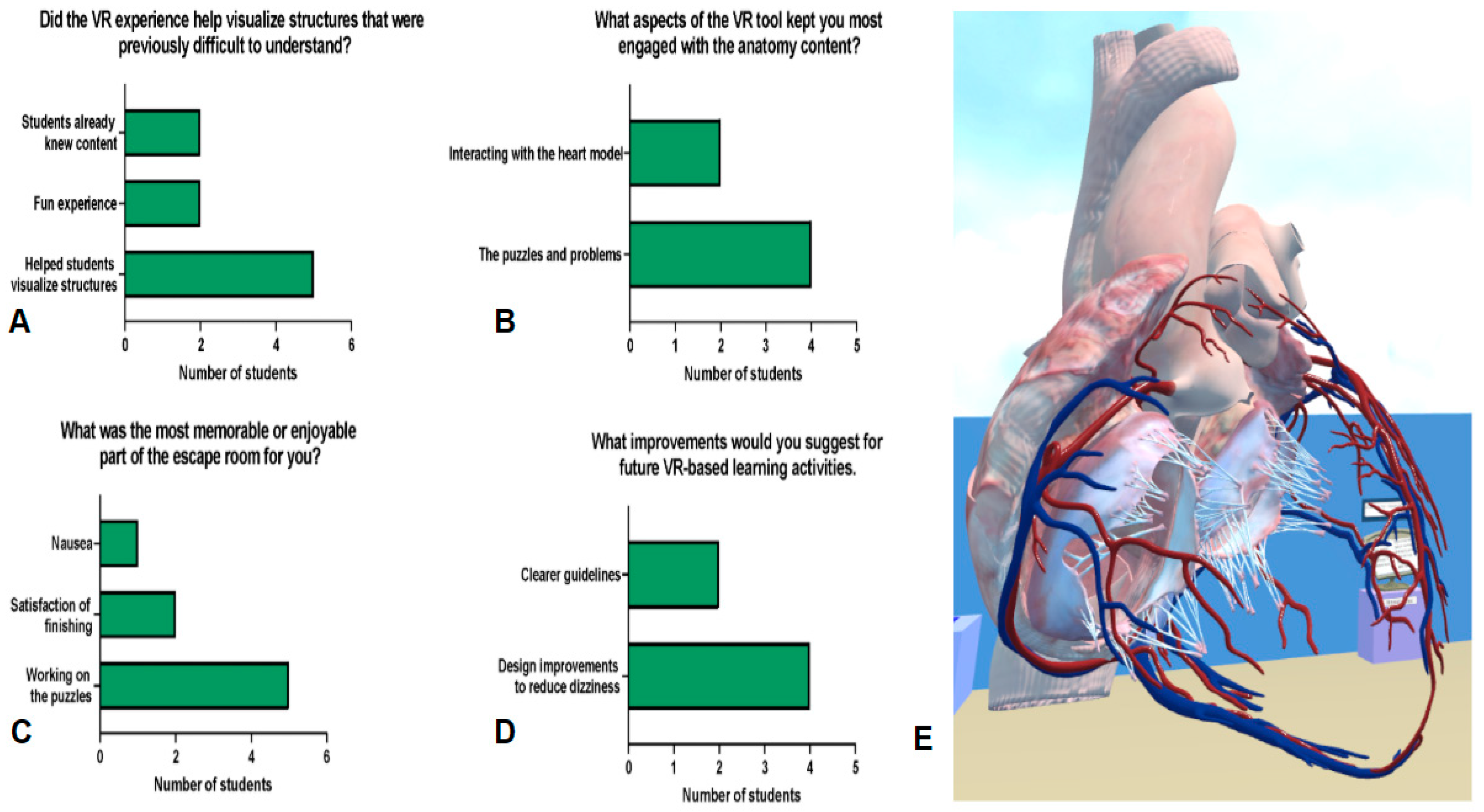
While a few students reported that they were already confident in spatial relationships and the content, other students reported that they valued the escape room as an overall fun experience and that the escape room was valuable in visualizing the anatomy of the heart (Figure 2A).
One student commented:
“I feel that the normal VR experience helps me to visualize structures. The escape room was a fun way to test that knowledge.”
Student engagement appeared consistently high throughout the experience, based on self-reported responses. Half of participants identified puzzle solving as the most engaging element (Figure 2B), and 62% strongly agreed they felt accomplished after solving puzzles, even when they did not complete the full escape room (Figure 1C). Notably, 62% cited the puzzles themselves as the most memorable aspect of the escape room (Figure 2C,E).
Other student comments highlighted the rewarding and enjoyable aspects of the escape room:
“I was thrilled when I actually solved the puzzles”
“Getting the puzzles right on the first try because of my anatomy knowledge.”
Additional questions asked on the survey included “using the escape room in VR helped me visualize spatial relationships between anatomical structures” and “how likely would you be to use an anatomy themed escape room as a study tool in the future?” Both questions utilized a Likert scale to assess responses.
The study also identified two key areas for optimization. First, 63% of participants (Figure 2D) reported dizziness. Recent research indicates cybersickness affects 65.2% of VR users, with 23.9% experiencing severe symptoms [27]. Participants were required to have completed an anatomy course with a VR component before participating in the study. The previously used VR application does not have students use controllers to move through the room, they would physically walk or move objects closer to where they are standing. This escape room was designed to allow use in a small space and movement was governed by the controllers, moving the room around the player. This discordance between visual and vestibular input, perceiving motion visually in the absence of corresponding physical movement, may have contributed to sensory conflict and could be associated with the presence of dizziness. Second, 25% of participants requested clearer assembly instructions for the heart model, as some students solved all puzzles with time to spare but struggled with assembling the final heart structure in the end. However prevalent cybersickness is with VR usage, this study identified potential improvements to the experience that would lend itself to students returning to attempt the escape room again if they failed the first time or to try additional escape rooms centered around different content. Upon initial brainstorming of ways to mitigate dizziness, it is possible to have the students physically walk through the room rather than utilizing controller-based movements. Another potential method to alleviate cybersickness is the implementation of teleportation-based navigation, where users point the controller at a target location and are instantaneously transported there rather than moving continuously through the environment. The escape room designers are currently exploring whether switching from continuous controller-based locomotion to teleportation may reduce the dizziness associated with cybersickness, while maintaining the spatial exploration required by the escape room format.
The positive feedback regarding engagement and sense of accomplishment suggests that escape room-based learning may represent a promising educational tool, though further investigation with larger samples is needed. With targeted modifications to address navigation-induced discomfort and provide more detailed instructions, future iterations can build on this foundation to further develop and evaluate immersive learning experiences for anatomical education.

4. Discussion

The primary aim of this study was not to use the VR escape room as a direct teaching method, but rather to evaluate its feasibility and acceptability as a scalable and engaging educational tool within an anatomy curriculum. The focus of this work was to document the design and implementation process in sufficient detail to allow replication by other institutions and to provide preliminary data on student engagement and experience. As such, this study represents a foundational step, and future iterations can use these findings to refine the activity toward targeting more complex spatial and relational anatomical concepts to better justify the associated costs of VR implementation.
This study demonstrates the possible benefits of an immersive virtual learning environment by introducing an innovative gaming experience for learners. For individuals that gravitate to problem solving and puzzles, the escape room in virtual reality harnesses the fun and engaging nature of in-person escape rooms while also giving students a chance to test their knowledge. Data collected from student experience suggests that gamification of curricula and virtual reality implementation can lead to an enhancement of anatomy education. These findings corollate to previous research indicating that immersive educational technologies can lead to enhanced student engagement and provide a novel way to apply knowledge. This research suggests not only a benefit to students but also to the educational institution by addressing the practical and financial constraints facing traditional cadaveric anatomy instruction.
The findings of the study are broadly consistent with those reported in the existing literature on VR previously mentioned in this report. In line with Maresky et al. (2019), participants demonstrated engagement with immersive cardiac anatomy content, suggesting that VR environments can support meaningful interaction with complex three-dimensional structures [21]. The positive student experience reported here also reflects the broader findings of Lampropoulos et al. (2024), whose systematic review identified improved engagement as a consistent outcome of gamified VR approaches in healthcare education [22]. However, the present study is preliminary in scope and lacks the standardized outcome measures needed to make definitive claims about learning efficacy. This reinforces the importance of the present work as a feasibility and implementation study, providing the methodological groundwork upon which more rigorous evaluations of learning outcomes can be built. To build on the initial findings of this preliminary study, additional research including larger sample sizes is needed to better understand the impacts of virtual reality escape rooms as an educational tool. Expanding the sample size will provide more opportunities for refinement. This study identified two key areas for improvement in developing this educational method. Future studies could incorporate objective measures of learning outcomes, such as pre- and post-assessments of anatomical knowledge, to more rigorously evaluate the educational effectiveness of VR escape rooms. Comparative studies examining VR escape room-based learning alongside traditional instructional approaches would further help establish the relative benefits of this methodology and strengthen the evidence for its adoption as an educational tool. Most notably, reducing the prevalence of cybersickness should be prioritized. Researchers plan to implement room-scale VR allowing participants to physically walk through the escape room rather than relying on controller-based movement. Additionally, participants identified the need to refine the directions for building the final heart structure to escape the room. The researchers will further develop these instructions and consider including demonstration videos or tips on how to manipulate and orient objects in VR. This should limit time spent figuring out how to use VR, allowing more time and energy to be devoted to problem solving in the escape room.
In future iterations, the researchers will design the escape room to be scalable and enable the ability to focus on additional anatomical content such as cranial nerves or the gastrointestinal system. At present, to modify the escape room to support learning of another organ or different parts of the body would require substantive redesign of the application. With the increased use of artificial intelligence (AI) applications, the researchers hope to find a way to incorporate an AI tool within the escape room. This would create an evolving escape room that increases difficulty or changes the challenges based on the performance of the player in the game.

Author Contributions

Conceptualization, H.M. and T.R.C.; Methodology, H.M., C.A.M., K.R.I. and H.H.; Software, H.M. and C.M.E.; Validation, H.M., C.A.M., H.H. and T.R.C.; Formal Analysis, H.M., C.A.M. and H.H.; Investigation, H.M. and C.A.M.; Resources, H.M., C.A.M. and C.M.E.; Data Curation, H.M., C.A.M. and H.H.; Writing—Original Draft Preparation, C.A.M. and H.M.; Writing—Review and Editing, H.M., C.A.M., C.M.E., K.R.I., H.H. and T.R.C.; Supervision, C.A.M. and T.R.C.; Project Administration, T.R.C. All authors have read and agreed to the published version of the manuscript.

Funding

This research received no external funding.

Institutional Review Board Statement

Ethical review and approval were waived for this study due to IRB determination that this protocol meets the criteria for exemption from IRB review under category 1. More information can be found in the Colorado State University IRB Protocol number 7482.

Informed Consent Statement

Informed consent was obtained from all subjects involved in the study.

Data Availability Statement

The data presented in this study are available on request from the corresponding authors due to risk of re-identification of individual participants.

Acknowledgments

We extend our sincere gratitude to all the experts who participated in our study and the review process of the survey. During the preparation of this manuscript, the authors used Claude AI (Sonnet 4.5) for the purposes of language editing, correcting spelling and grammatical errors, and refining the writing style. The authors have reviewed and edited the output and take full responsibility for the content of this publication.

Conflicts of Interest

The authors declare no conflicts of interest.

Abbreviations

The following abbreviations are used in this manuscript:
AIArtificial Intelligence
UIUser Interface
VRVirtual Reality

References

  1. Gholipour, B. Med School Without Cadavers? Available online: https://www.scientificamerican.com/article/med-school-without-cadavers/ (accessed on 10 February 2026).
  2. Bagian, L.K.; Wyatt, T.B.; Mosley, C.F.; Balta, J.Y. Investigating the status of whole-body donation across the United States of America. Anat. Sci. Educ. 2024, 17, 646–659. [Google Scholar] [CrossRef] [Scilit] [PubMed]
  3. Adnan, S.; Benson, A.C.; Xiao, J. How Virtual Reality is Being Adopted in Anatomy Education in Health Sciences and Allied Health: A Systematic Review. Anat. Sci. Educ. 2025, 18, 496–525. [Google Scholar] [CrossRef] [Scilit] [PubMed]
  4. Jampel, S. Medical Students Are Learning Anatomy from Digital Cadavers. Can Technology Ever Replace Real Human Bodies? Available online: https://www.smithsonianmag.com/science-nature/medical-students-are-learning-anatomy-from-digital-cadavers-can-technology-ever-replace-real-human-bodies-180987731/ (accessed on 10 February 2026).
  5. Abundez Toledo, M.; Ghanem, G.; Fine, S.; Weisman, D.; Huang, Y.M.; Rouhani, A.A. Exploring the Promise of Virtual Reality in Enhancing Anatomy Education: A Focus Group Study with Medical Students. Front. Virtual Real. 2024, 5, 1369794. [Google Scholar] [CrossRef] [Scilit]
  6. Zhou, X.; Xiong, H.; Wen, Y.; Li, F.; Hu, D. Global Trends in Cadaver Donation and Medical Education Research: Bibliometric Analysis Based on VOSviewer and CiteSpace. JMIR Med. Educ. 2025, 11, e71935. [Google Scholar] [CrossRef] [Scilit] [PubMed]
  7. Salimi, M.; Moosavi, M.S.; Farzan, A.; Moghaddasi, H. Efficacy of Virtual Reality and Augmented Reality in Anatomy Education: A Systematic Review and Meta-Analysis. Anat. Sci. Educ. 2024, 17, 1668–1685. [Google Scholar] [CrossRef] [Scilit] [PubMed]
  8. Conrad, M.; Kablitz, D.; Schumann, S. Learning Effectiveness of Immersive Virtual Reality in Education and Training: A Systematic Review of Findings. Comput. Educ. 2024, 4, 100053. [Google Scholar] [CrossRef] [Scilit]
  9. Moscova, M. Why Virtual Reality Won’t Replace Cadavers in Medical School. Available online: https://theconversation.com/why-virtual-reality-wont-replace-cadavers-in-medical-school-67448 (accessed on 10 February 2026).
  10. Minouei, M.A.; Omid, A.; Mirzaie, A.; Mohammadi, M. Effectiveness of Virtual Reality on Medical Students’ Academic Achievement in Anatomy: Systematic Review. BMC Med. Educ. 2024, 24, 1407. [Google Scholar] [CrossRef] [Scilit]
  11. Yu, N.; Shi, W.; Dong, W.; Kang, R. The Impact of Virtual Reality Immersion on Learning Outcomes: A Comparative Study of Declarative and Procedural Knowledge Acquisition. Behav. Sci. 2025, 15, 1322. [Google Scholar] [CrossRef] [Scilit]
  12. Lin, X.; Li, Y.; Yao, J.; Yang, H.; Zhang, J. The Impact of Virtual Reality on Student Engagement in the Classroom: A Critical Review of the Literature. Front. Psychol. 2024, 15, 1360574. [Google Scholar] [CrossRef] [Scilit]
  13. Li, M.; Ma, S.; Shi, Y. Examining the Effectiveness of Gamification as a Tool Promoting Teaching and Learning in Educational Settings: A Meta-Analysis. Front. Psychol. 2023, 14, 1253549. [Google Scholar] [CrossRef] [Scilit] [PubMed]
  14. Li, J.; Xue, E. Dynamic Interaction between Student Learning Behaviour and Learning Environment: Meta-Analysis of Student Engagement and Its Influencing Factors. Behav. Sci. 2023, 13, 59. [Google Scholar] [CrossRef] [Scilit] [PubMed]
  15. Will Cadavers in Medical School Soon Be a Thing of the Past? Available online: https://www.advisory.com/daily-briefing/2019/10/03/cadavers (accessed on 10 February 2026).
  16. Coelho, F.; Rando, B.; Aparício, D.; Pontífice-Sousa, P.; Gonçalves, D.; Abreu, A.M. The Impact of Educational Gamification on Cognition, Emotions, and Motivation: A Randomized Controlled Trial. J. Comput. Educ. 2025, 1–48. [Google Scholar] [CrossRef] [Scilit]
  17. Pottle, J. Virtual Reality and the Transformation of Medical Education. Future Healthc. J. 2019, 6, 181–185. [Google Scholar] [CrossRef] [Scilit] [PubMed]
  18. Huang, W.D.; Loid, V.; Sung, J.S. Reflecting on Gamified Learning in Medical Education: A Systematic Literature Review Grounded in the Structure of Observed Learning Outcomes (SOLO) Taxonomy 2012–2022. BMC Med. Educ. 2024, 24, 20. [Google Scholar] [CrossRef] [Scilit]
  19. Beger, A.W.; Hannan, S.; Patel, R.; Sweeney, E.M. Virtual escape rooms in anatomy education: Case studies from two institutions. Adv. Physiol. Educ. 2025, 49, 621–632. [Google Scholar] [CrossRef] [Scilit] [PubMed]
  20. Alfanash, H.; Al-Kalaldeh, M.; Alnawafleh, K.; Almagharbeh, W. Nursing Students’ Perspectives on the Relationship between Virtual Reality Simulation and Clinical Decision-Making, Confidence, and Anxiety: A Cross-Sectional Study. J. Adv. Med. Educ. Prof. 2025, 13, 191–197. [Google Scholar] [CrossRef] [Scilit] [PubMed]
  21. Maresky, H.S.; Oikonomou, A.; Ali, I.; Ditkofsky, N.; Pakkal, M.; Ballyk, B. Virtual reality and cardiac anatomy: Exploring immersive three-dimensional cardiac imaging, a pilot study in undergraduate medical anatomy education. Clin. Anat. 2019, 32, 238–243. [Google Scholar] [CrossRef] [Scilit] [PubMed]
  22. Lampropoulos, G.; Kinshuk. Virtual reality and gamification in education: A systematic review. Educ. Tech. Res. Dev. 2024, 72, 1691–1785. [Google Scholar] [CrossRef] [Scilit]
  23. Unity Technologies. Unity, version 6000.1.7f1; Unity Technologies: San Francisco, CA, USA, 2024.
  24. Blender Foundation. Blender, version 4.3; Blender Foundation: Amsterdam, The Netherlands, 2024.
  25. Microsoft Corporation. Visual Studio, version 2022; Microsoft Corporation: Redmond, WA, USA, 2022.
  26. Likert, R. A technique for the measurement of attitudes. Arch. Psychol. 1932, 22, 5–55. [Google Scholar]
  27. Garrido, L.E.; Frías-Hiciano, M.; Moreno-Jiménez, M.; Cruz, G.N.; García-Batista, Z.E.; Guerra-Peña, K.; Medrano, L.A. Focusing on Cybersickness: Pervasiveness, Latent Trajectories, Susceptibility, and Effects on the Virtual Reality Experience. Virtual Real. 2022, 26, 1347–1371. [Google Scholar] [CrossRef] [Scilit] [PubMed]
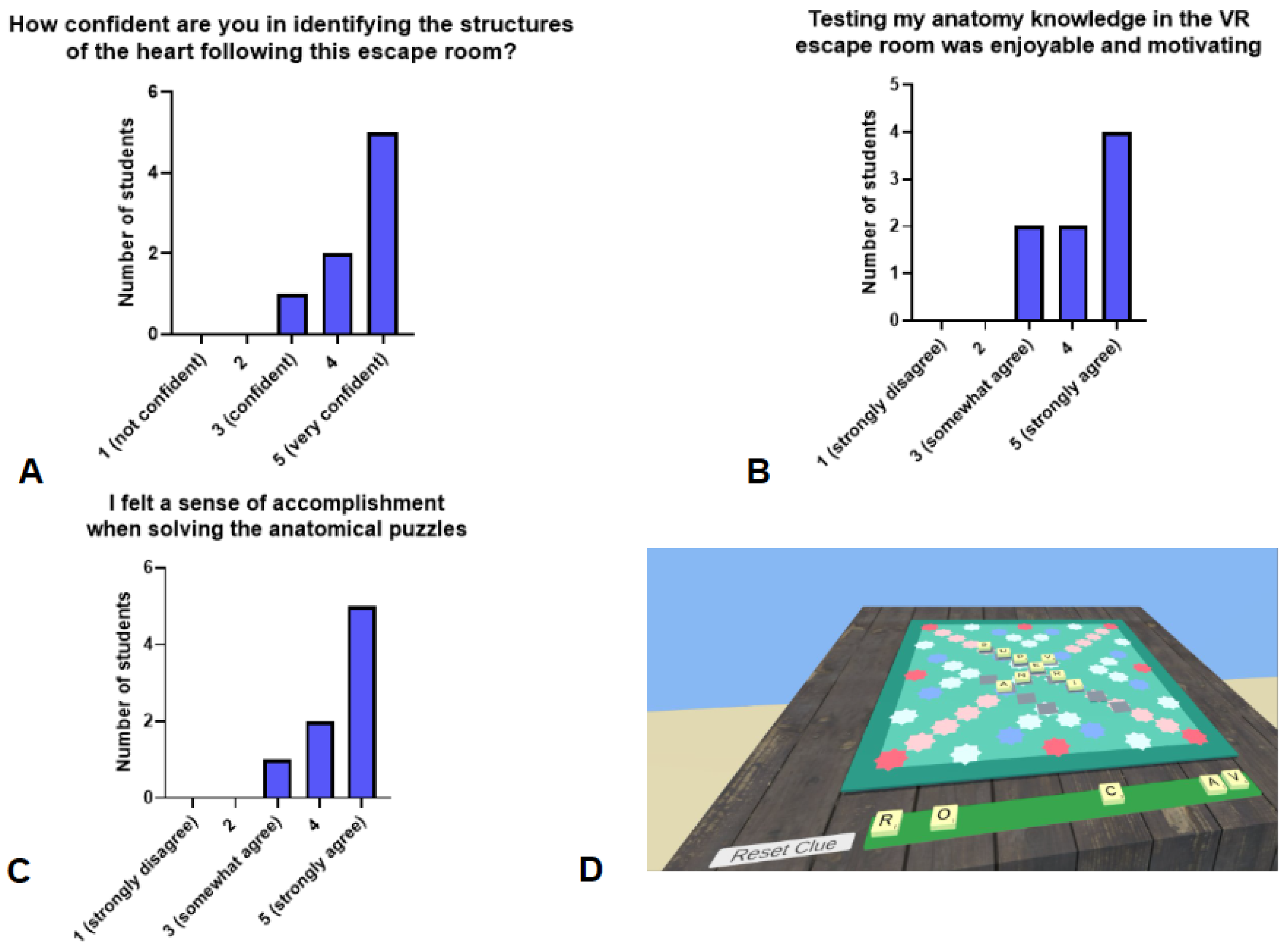
Figure 1. Quantitative feedback on student perceptions. (A) Student confidence with identifying structures of the heart. (B) Student enjoyment of testing knowledge with the escape room platform. (C) Student sense of accomplishment throughout the experience. (D) A sample of the puzzles within the game.
Virtualworlds 05 00021 g001
Figure 2. Coded open-response data of student perceptions. (A) Student comments on VR experience, specifically in visualizing structures. (B) Students report on the most engaging aspect of the escape room. (C) Student comments on the most memorable part of the experience. (D) Student feedback outlines areas for improvements. (E) The heart model in the process of being completed and solving the game.
Virtualworlds 05 00021 g002
Disclaimer/Publisher’s Note: The statements, opinions and data contained in all publications are solely those of the individual author(s) and contributor(s) and not of MDPI and/or the editor(s). MDPI and/or the editor(s) disclaim responsibility for any injury to people or property resulting from any ideas, methods, instructions or products referred to in the content.