Abstract
Modern agriculture is increasingly challenged by fungal diseases, with phytopathogens such as Fusarium species causing substantial yield and quality losses in major crops globally. Although synthetic fungicides remain widely used, their intensive application raises serious concerns regarding environmental safety, human health, and the rapid emergence of resistant pathogen populations in the environment. These limitations have accelerated the search for sustainable, biologically based alternatives. In this context, Bacillus species isolated from saline and hypersaline habitats have emerged as a distinctive and still underexplored group of microorganisms with dual functionality as biological control agents (BCAs) and plant growth–promoting rhizobacteria (PGPRs) in salt-affected agroecosystems. Their novelty lies in their combined ability to suppress phytopathogens, enhance plant growth, and tolerate or mitigate salinity stress. Owing to their exceptional metabolic adaptability, these bacteria remain active under osmotic stress and produce a wide range of bioactive compounds that collectively contribute to their antifungal activity and improved plant performance. This review critically synthesizes advances published over the last six years (2019–2025), providing a comprehensive overview of the current understanding of the mechanisms underlying the biocontrol potential of halophilic/halotolerant Bacillus species against Fusarium spp. and other fungal phytopathogens. Particular emphasis is placed on ecological adaptations, molecular mechanisms, and the dual roles of these bacteria as BCAs and PGPR. The exploration and exploitation of saline-adapted Bacillus strains offer promising, eco-friendly, and cost-effective strategies for managing Fusarium diseases, thereby contributing to resilient and sustainable agricultural systems under increasing environmental constraints in the future.
1. Introduction
Global agriculture is currently confronted with two interconnected challenges: continuous growth of the human population and gradual reduction in cultivable land. Together, these factors pose a serious threat to global food security. Estimates suggest that by the year 2050, the global population may reach approximately 9.7 billion, which would require an increase of roughly 70% in overall food production [1]. Meeting this demand is only possible through sustainable agricultural practices that can perform well under environmental stress. These stresses include abiotic factors such as drought, salinity, and temperature extremes, as well as biotic pressures caused by various pests and pathogens that drastically lower both yield and crop quality [2,3].
Among biotic stressors, fungal diseases are the most damaging. They are responsible for extensive yield loss at different stages of plant development [4]. Fungal pathogens are estimated to cause 10% and 42% yield losses in major crops every year, representing nearly 70–80% of all plant diseases reported globally [5,6]. Typical symptoms include blight, wilt, root rot, canker, and leaf spot diseases, most of which are attributed to soil-borne fungi such as Fusarium, Rhizoctonia, Phytophthora, Pythium, Botrytis, and Alternaria [7]. Within this group, Fusarium species are particularly important because of their wide distribution, high pathogenic variability, and impact on both field crops and stored products [8,9]. More than 300 phylogenetically distinct species have been described, forming approximately 23 recognized species complexes [10,11].
Soil salinization exacerbates disease pressure by reshaping plant–pathogen–microbe interactions. Salinity weakens plant defense systems through osmotic and ionic stress, nutrient imbalance, and oxidative damage, thereby increasing host susceptibility to fungal infections. Simultaneously, saline conditions can favor the emergence of halotolerant or opportunistic fungal pathogens, creating a “perfect storm” of compromised plant resistance coupled with persistent or stress-adapted disease pressure. This dual effect makes disease management in salt-affected soils particularly challenging and limits the effectiveness of conventional control strategies [12,13,14].
Traditionally, chemical fungicides have been used to manage these pathogens. Although they are generally effective, their intensive use has raised serious environmental and health concerns, in addition to the growing problem of resistant fungal strains in the field. However, their performance is often limited in saline and arid regions [15,16,17]. Consequently, the search for safer and more sustainable solutions has intensified, with biological control emerging as a promising alternative [18,19].
Biological control strategies employ beneficial microorganisms to reduce pathogen impact. These organisms act directly through antibiosis, mycoparasitism, or nutrient competition, and indirectly by triggering systemic resistance in plants. Many biological control agents BCAs also secrete bioactive compounds, such as antibiotics, hydrolytic enzymes, siderophores, and volatile organic compounds (VOCs), which strengthen their antifungal potential [20].
Over the past few decades, several bacterial species have been recognized as effective BCAs that can limit the development of numerous fungal diseases in plants. These beneficial bacteria act through various complementary mechanisms, including the production of hydrolytic enzymes that degrade fungal cell walls, sequestration of iron through siderophores, and the emission of VOCs. They may also trigger defense responses in plants, compete for nutrients and space in the rhizosphere, and influence the composition of the surrounding microbial community [21].
Microorganisms isolated from extreme habitats have recently attracted increasing attention. Saline and hypersaline environments, which are defined by their unique physicochemical characteristics and microbial diversity, often contain microorganisms that are well adapted to stress conditions [22]. Among them, halophilic/halotolerant bacteria exhibit remarkable physiological flexibility, allowing them to maintain their antagonistic activity even under high osmotic pressure. This resilience makes them particularly interesting for applications in biotechnology and agriculture, especially for the biological control of phytopathogens and stimulation of plant growth [23].
Several bacterial genera from such environments, including Bacillus, Halomonas, Paenibacillus, Streptomyces, and Pseudomonas, have demonstrated strong antifungal and biocontrol properties [24,25]. Within this group, Bacillus species have received the greatest attention because of their ecological adaptability, ability to form resistant endospores, and capacity to synthesize a wide array of antimicrobial metabolites. Their rapid growth, tolerance to environmental fluctuations, and broad-spectrum antagonistic effects make them suitable candidates for integration into sustainable agricultural systems [26].
Among bacterial genera, Bacillus has been one of the most intensively studied for its biological control potential [27]. These bacteria employ several complementary mechanisms to limit phytopathogen growth. They synthesize secondary metabolites, including antibiotics and LPs, which inhibit spore germination, lyse fungal hyphae, and disrupt pathogen communication (quorum quenching). In addition, they compete efficiently for nutrients and niches in the rhizosphere and can enhance plant resistance by activating of systemic defense [28,29,30]. Recent studies have highlighted that halophilic/halotolerant Bacillus strains exhibit particularly strong antifungal activity against Fusarium species, reinforcing their potential role in developing sustainable agricultural solutions [31,32].
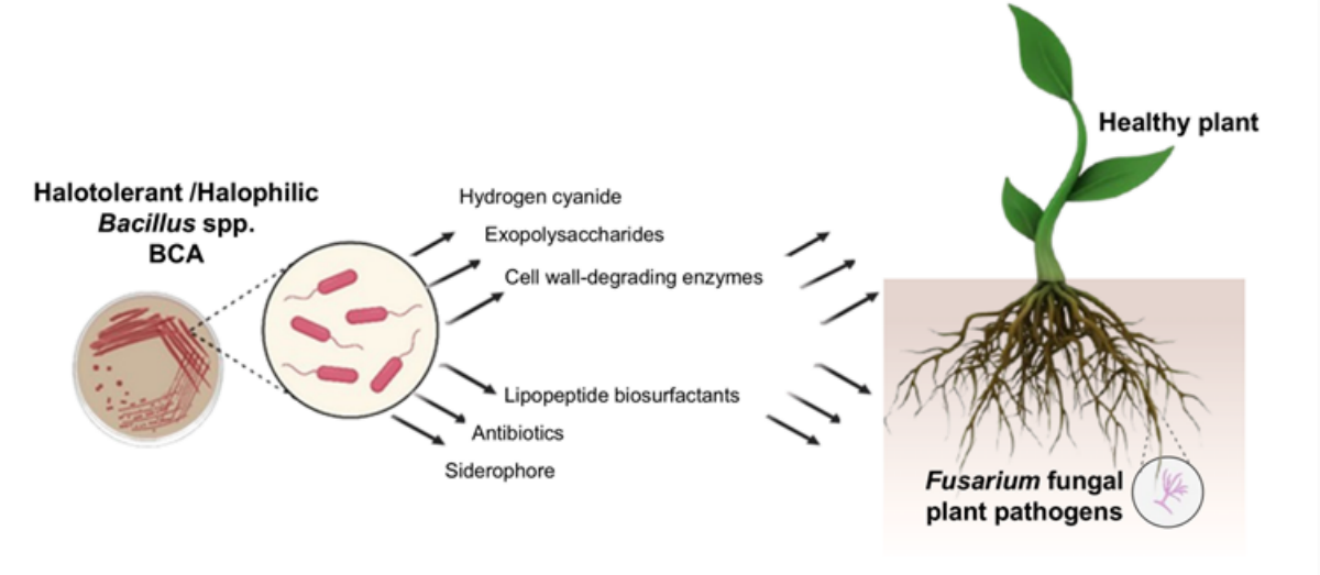
The multifunctional role of halophilic/halotolerant Bacillus spp. is summarized in the graphical abstract, illustrating their ability to produce antifungal metabolites and enzymes, protect the rhizosphere, and promote plant growth under saline conditions. The use of halophilic/halotolerant bacteria in agrobiotechnology has been extensively reported in book chapters, research articles, and review papers. Table 1 and Table 2 summarize recent research (2019–2025) on the applications of halophilic/halotolerant bacteria, with particular emphasis on Bacillus spp., for the biocontrol of fungal pathogens. This review focuses on the ecological functions, molecular and biochemical bases of antifungal activity, and importance of saline and hypersaline habitats as largely untapped reservoirs of stress-tolerant biocontrol strains, contributing to sustainable and environmentally friendly agricultural strategies.
2. Mechanisms Involved by Halophilic/Halotolerant Bacillus spp. in the Biocontrol of Fusarium and Other Fungal Plant Pathogens

Biological control has become one of the most promising and sustainable approaches for combating plant diseases, offering clear environmental and economic advantages over chemical-based management [33]. In recent years, halophilic/halotolerant bacteria, especially Bacillus species isolated from saline or hypersaline habitats, have drawn increasing scientific interest because of their strong biotechnological potential. These extremophilic microorganisms are not only well adapted to osmotic stress but also demonstrate powerful antifungal effects against Fusarium and other major phytopathogenic fungi [34,35].
Among the bacterial groups used as BCA, Bacillus is particularly notable for its ecological flexibility and consistent antagonistic performance against plant pathogens. Members of this genus are Gram-positive, spore-forming bacteria with wide genetic and phenotypic diversity, found in almost every type of environment [36]. Many Bacillus species are recognized as plant growth-promoting bacteria (PGPB) and efficient BCAs [37], and their success in agricultural settings is linked to several adaptive traits, including strong stress tolerance, the ability to form resistant endospores, rapid colonization of plant roots, and synthesis of numerous bioactive secondary metabolites [38].
The antifungal potential of Bacillus species results from a combination of complementary mechanisms. As summarized in Table 1, these bacteria produce a wide range of secondary metabolites, including LPs, VOCs, and other antifungal molecules that interfere with fungal development by disrupting hyphal structures and inhibiting spore germination [39,40,41]. In addition, Bacillus species release hydrolytic enzymes, including chitinases, β-glucanases, and proteases, which degrade fungal cell wall components and further contribute to pathogen inhibition.
Such multiple and often complementary actions explain why halophilic/halotolerant Bacillus strains can suppress a wide spectrum of fungal pathogens [42]. The combined effects of stress tolerance, diverse metabolite production, and enzymatic activity render these bacteria particularly valuable as eco-friendly BCA for crops cultivated in saline or degraded soils. The following sections discuss in detail the principal antifungal mechanisms identified in these bacteria and illustrate their efficiency against Fusarium and other important phytopathogenic fungi.
Table 1.
Summary of recent studies (2019–2025) on antifungal metabolites produced by halophilic/halotolerant Bacillus Species, highlighting their biocontrol potential against fungal plant pathogens.
Table 1.
Summary of recent studies (2019–2025) on antifungal metabolites produced by halophilic/halotolerant Bacillus Species, highlighting their biocontrol potential against fungal plant pathogens.
| Antifungal Metabolite(s)/Traits | Bacterial Strain | Saline Habitat/Origin | Target Fungal Pathogens | Disease/Crop | References |
|---|---|---|---|---|---|
| Siderophores | Bacillus subtilis | Dead Sea, Jordan | Fusarium culmorum | Crown rot/durum wheat | [43] |
| Antibiotics | B. subtilis D6A & Dar | Salt deserts, Iran | F. oxysporum, Aspergillus flavus, Botrytis cinerea | Postharvest and soilborne diseases | [44] |
| Protease, cellulase | Bacillus spp. | Sabkha and Chott, NW Algeria | F. oxysporum, F. verticillioides, Phytophthora capsici, B. cinerea | Vegetable crops | [45] |
| Siderophores, HCN, antibiotics, protease | B. halotolerans BFOA1–4 | Coastal saline depressions, Mediterranean Sea | F. oxysporum f. sp. albedinis | Bayoud disease/date palm | [46] |
| Siderophores, VOCs (acetoin, 2,3-butanediol), EPS | B. velezensis XT1 | Saline habitat, Spain | Alternaria alternata and Fusarium spp. | Tomato, cucumber | [47] |
| Chitinase | B. licheniformis J24 | Salt lake, Tunisia | Fusarium spp., Sclerotinia spp. | Corn | [48] |
| Protease, cellulase | B. siamensis S1-20 | Aral Sea, Uzbekistan | Fusarium spp., Verticillium dahliae | Potato, cotton | [49] |
| Siderophores, hydrolytic enzymes | Bacillus spp. | Salt pans, Formentera, Spain | Macrophomina phaseolina | Charcoal rot | [50] |
| VOCs (acetoin, acetic acid, 2,3-butanediol, sulfur compounds) | B. atrophaeus L193; B. velezensis XT1 | Saline and hypersaline environments | F. oxysporum, F. solani | Vine, potato, peach | [51] |
| Cyclic lipopeptides (surfactin, fengycin) | B. halotolerans KKD1 | Qinghai–Tibet Plateau | F. graminearum | Wheat, barley, maize | [52] |
| Siderophores; amylase, lipase, protease, glucanases | Bacillus spp. | Salt marshes, Goa, India | Fusarium spp., Rhizoctonia solani | Chili | [31] |
| Cyclic lipopeptides (mycosubtilin, surfactin, bacillaene, bacillibactin) | B. subtilis subsp. spizizenii MC6B-22 | Marine biofilm | Fusarium spp., Colletotrichum spp. | Not specified | [53] |
| Hydrolytic enzymes | Bacillus sp. QSLA1 | Qarun Lake, Egypt | F. oxysporum f. sp. lycopersici | Tomato | [54] |
| Glucanase | Marine B. subtilis BS90 | Gulf of Khambhat, India | F. oxysporum f. sp. ciceris | Chickpea | [32] |
| Lipase, protease, cellulase | B. zhangzhouensis | Hypersaline Aral Sea | Multiple Fusarium spp., Alternaria, Aspergillus spp, | Multicrop pathogens | [55] |
| EPS | B. tequilensis TSIS01 | Sambhar Lake, India | Alternaria solani, Fusarium spp., Xanthomonas citri | Tomato blight | [56] |
| Cyclic lipopeptide (surfactin) | B. amyloliquefaciens | Ribandar salt pans, Goa, India | F. solani | Soilborne disease | [57] |
| VOCs (DAPG, pyrrolnitrin), HCN, chitinase | Bacillus spp. | Lake Bogoria, Kenya | F. solani | Common bean | [35] |
Abbreviations: VOCs, volatile organic compounds; EPS, extracellular polymeric substances; HCN, hydrogen cyanide; DAPG, 2,4-diacetylphloroglucinol.
2.1. Siderophore
Microorganisms employ low-molecular-weight metal-chelating compounds, collectively termed metallophores, to acquire essential trace metals under conditions of limited bioavailability. These compounds vary in specificity, ranging from broad-spectrum metallophores capable of binding multiple transition metals to highly specific chelators [58]. Within this broader group, siderophores represent a specialized and ecologically dominant class of metallophores with high affinity for ferric iron (Fe3+) and play a central role in microbial nutrient acquisition, inter-microbial competition, and biocontrol interactions
Siderophores are small organic molecules, typically with molecular weights ranging from 500 to 1500 Da, secreted by microorganisms to cope with the limited bioavailability of iron in natural environments [59,60]. The term siderophore originates from the Greek terms sidero (iron) and phore (carrier), which aptly describes their central role in microbial iron acquisition [61,62]. To date, scientists have identified over 200 distinct siderophore structures, representing approximately 500 known compounds. They are commonly divided into four major classes: hydroxamates, catecholates (or phenolcatecholates), carboxylates, and pyoverdines, although many molecules show mixed or hybrid characteristics [63].
In Bacillus species, genes involved in siderophore biosynthesis and iron uptake are an important part of their adaptive machinery, particularly in nutrient-poor or saline environments. For instance, Bacillus subtilis produces a catecholate-type siderophore known as bacillibactin, the synthesis of which is closely linked to biofilm formation. The biofilm matrix appears to enhance iron acquisition through siderophores, thereby strengthening bacterial persistence and competition [64]. This interaction between iron metabolism and biofilm development contributes significantly to the biocontrol potential of Bacillus, enabling the bacteria to compete effectively with phytopathogens for iron, inhibit their growth, and improve plant health [65,66]. The genetic variation and regulatory control of siderophore-related clusters further support the ecological fitness and antagonistic performance of Bacillus spp. through efficient nutrient sequestration [66,67].
Halophilic/halotolerant bacteria are increasingly recognized as efficient extracellular siderophore producers. In saline and iron-deficient ecosystems, these compounds not only facilitate microbial growth but also act as effective BCA by depriving fungal pathogens of iron inquired for infection and growth [68]. By modulating iron availability in the rhizosphere, siderophore-producing bacteria indirectly suppress phytopathogens via competitive exclusion, thereby promoting plant vigor and stress resilience [69].
In halophilic/halotolerant Bacillus spp., siderophore-mediated iron sequestration primarily involves high-affinity chelators, such as bacillibactin, which tightly bind Fe3+ ions and restrict iron access to competing fungi. Iron limitation disrupts fungal metabolism and growth, induces oxidative stress through elevated reactive oxygen species and lipid peroxidation, and can lead to hyphal damage and cell death. Simultaneously, Bacillus spp. efficiently retrieves Fe3+ from siderophore complexes, maintaining a competitive advantage in iron-limited niches. In some interactions, siderophore production also suppresses specialized metabolite synthesis in antagonistic fungi, further facilitating bacterial colonization and dominance [70,71,72].
As documented in Table 1, several halophilic/halotolerant Bacillus strains exhibit strong siderophore-associated, antifungal activity. Bacillus halotolerans strains isolated from the Dead Sea exhibited strong antagonistic activity against Fusarium culmorum and F. oxysporum f. sp. albedinis [43,46], whereas Tunisian isolates suppressed Botrytis cinerea [73]. B. albus HB-17 produces both catecholate and hydroxamate siderophores [74], and B. subtilis RHF2, B. amyloliquefaciens RHF6, and Bacillus sp. RHFS10, isolated from Spanish salt pans, exhibited broad-spectrum antifungal activity [50]. Similarly, B. subtilis subsp. halotolerans from Goa showed activity against F. oxysporum and Rhizoctonia solani [31], and B. velezensis XT1 from Spain exhibited siderophore-linked inhibition against Fusarium spp., Alternaria alternata, Monilinia fructicola, Magnaporthe oryzae, and Sclerotinia sclerotiorum [47].
In contrast, Bacillus siderophores function within a multifactorial antagonistic system that integrates hydrolytic enzymes, LPs, and VOCs, whereas non-Bacillus halophilic/halotolerant bacteria primarily rely on siderophore-mediated competition as their primary antifungal strategy. This functional divergence underscores the ecological complementarity and potential synergism among halophilic/halotolerant bacterial genera in biocontrol. Owing to their natural origin, biodegradability, and efficiency under saline stress, siderophore-producing bacteria are promising candidates for sustainable and eco-friendly crop protection and biofertilizer development [69].
Beyond microbial competition, siderophores can enhance plant iron acquisition and alleviate abiotic stress, particularly in saline or iron-deficient soils, by solubilizing Fe3+ and modulating the expression of plant genes involved in iron homeostasis [75,76]. Additionally, siderophores can elicit induced systemic resistance (ISR), priming plants to respond more effectively to pathogen attacks, even in the absence of direct microbial contact [77,78]. However, most current studies have been limited to in vitro or greenhouse experiments, with few validated under field conditions where salinity, pH, and temperature fluctuate considerably [79]. The dual role of siderophores in regulating plant iron metabolism and activating immune responses highlights their untapped potential for sustainable agriculture. Integrating siderophore-producing strains with ISR inducers or micronutrient amendments could be a powerful approach to enhance disease suppression, nutrient efficiency, and stress resilience. However, more mechanistic and field-based studies are required to fully harness this potential [77,79].
Beyond their established role in plant–microbe interactions and biological control, metallophores, particularly siderophores, are increasingly recognized for their significance in human and environmental health. These low-molecular-weight chelating compounds exhibit a high affinity for iron and a wide range of metal ions, including cadmium, lead, mercury, and arsenic. Consequently, siderophores have emerged as promising tools for the bioremediation of metal-contaminated water and soil, as they facilitate metal mobilization, sequestration, and removal. Their biological origin, biodegradability, and effectiveness under diverse and extreme physicochemical conditions make them attractive, eco-friendly alternatives to conventional synthetic chelating agents, supporting their potential application in sustainable environmental remediation strategies [80].
In addition to their environmental applications, bacterial metallophores have gained increasing attention in biomedical research as promising antimicrobial development targets. Metallophore-mediated metal acquisition is essential for bacterial survival and virulence, particularly in pathogenic microorganisms exposed to host-imposed metal deficiencies. Consequently, disrupting metallophore biosynthesis, transport, or uptake pathways can severely impair pathogen fitness, offering a novel strategy for developing new antibiotic classes. Targeting these systems may also reduce the selective pressure associated with conventional antibiotics and help address the growing challenge of antimicrobial resistance (AMR) [81]. Collectively, these findings highlight that siderophores and related metallophores are not only central to microbial ecology and plant disease management but also hold substantial potential for applications in bioremediation, public health, and next-generation antimicrobial therapies, reinforcing their relevance beyond agricultural systems.
2.2. Antibiotics
The term antibiosis, derived from the Greek anti (against) and bios (life), describes an interaction in which one microorganism inhibits or kills another by producing bioactive compounds. Within the framework of biological control, this phenomenon typically involves the secretion of antibiotics that interfere with vital metabolic pathways in phytopathogens, thereby restraining their growth and reproduction [82,83]. These antibiotics are generally low-molecular-weight secondary metabolites that are synthesized during the stationary phase of microbial growth. Although not essential for the basic metabolism of the producer, they provide a strong ecological advantage by helping the organism compete in complex microbial environments [84]. Actinomycetes are estimated to be responsible for approximately 85% of known antibiotics, while fungi and other bacteria account for approximately11% and 4%, respectively [85].
Since the mid-20th century, microorganisms capable of producing antibiotics have been extensively studied as potential BCA. Their ability to inhibit a wide range of plant pathogens arises from mechanisms such as membrane disruption, interference with metabolic processes, and cell lysis [86]. Among these, Bacillus species have been particularly well-characterized. For example, Bacillus velezensis has multiple biosynthetic gene clusters that encode strain-specific antifungal compounds [87].
In recent years, halophilic/halotolerant Bacillus strains have attracted increasing attention because of their ability to produce antibiotics under saline and osmotic stress conditions. Representative examples are provided in Table 1; strains such as B. halotolerans (BFOA1–BFOA4) and isolates from Iranian salt deserts exhibit pronounced inhibitory effects against Fusarium, Aspergillus flavus, and Botrytis cinerea through the secretion of antibiotics [44,46]. Likewise, B. amyloliquefaciens and B. halotolerans QTH8 have been shown to act as antifungal agents and as plant growth promoters [88,89]. Bacillus safensis isolated from saline Indian soils also demonstrated strong antifungal activity against Sclerotium oryzae and Rhizoctonia solani, the causal pathogens of rice sheath blight [90].
Accumulating evidence indicates that antibiotic-producing microbes, particularly Bacillus species, play a central role in suppressing plant pathogens by releasing diverse antimicrobial peptides and secondary metabolites [91]. However, translating strong in vitro inhibition into consistent in planta efficacy remains challenging. Environmental factors, such as compound instability, microbial competition, and soil salinity, can reduce the effectiveness of antibiotics under field conditions. Additionally, methodological variability across studies complicates the comparison and evaluation of these compounds [92].
Recent advances in analytical and molecular techniques, including gas chromatography–mass spectrometry (GC–MS), liquid chromatography–mass spectrometry (LC–MS), and genome mining, have improved metabolite profiling and may enable more standardized assessments of biocontrol efficacy [93]. Future research should emphasize quantitative, field-validated strategies to identify antibiotic systems that are both potent and environmentally stable for sustainable agricultural applications [91,92].
One growing concern in antibiosis-based biocontrol is the possible emergence of antibiotic resistance genes (ARGs) in soil microbial communities. Prolonged exposure to antibiotic-producing agents can create selective pressure that favors resistant populations of bacteria. Yet, metagenomic studies indicate that some integrated biocontrol formulations, especially those combining antibiotics with micronutrients such as Mg2+ or with metabolites that trigger induced systemic resistance, may reduce the abundance of ARGs in treated plants [94]. The likelihood of resistance emergence depends largely on the agent’s mechanism of action. Microbial strains that combine antibiosis with nutrient competition, spatial exclusion, and activation of plant defenses are less prone to drive resistance than those that rely solely on antibiotic production [95,96].
Integrated management approaches are strongly recommended to mitigate these risks. These include deploying multi-strain consortia with complementary mechanisms, alternating BCA with distinct antimicrobial spectra, and optimizing agronomic practices to reduce pathogen pressure. The application of BCA at sublethal or threshold-based concentrations may also limit selective pressure without compromising disease suppression [95,96]. Similarly, threshold-based application strategies may help limit selective pressure when efficacy is maintained [94]. Moreover, because microbial biocontrol typically involves multiple mechanisms, including antibiosis, enzyme secretion, and induced resistance, it presents a much lower risk of resistance evolution than conventional single-target chemical pesticides [97].
2.3. Lipopeptide Biosurfactants
Lipopeptides (LPs) are a class of low-molecular-weight biosurfactants composed of fatty acids linked to short peptide chains, usually containing several D-amino acids. These amphiphilic molecules are well known for their ability to reduce surface and interfacial tension, as well as for their broad biological activities, including antimicrobial, cytotoxic, and surfactant properties [98,99]. Their amphiphilic structure, comprising a hydrophilic peptide moiety (often cyclic) covalently linked to a hydrophobic fatty acid chain, enables them to reduce both surface and interfacial tension and to interact efficiently with microbial membranes [57,100,101,102].
Cyclic lipopeptides (CLPs), in particular, are characterized by a ring-shaped oligopeptide (typically 7–10 residues) joined to a lipid tail of 10–19 carbon atoms, resulting in wide structural and functional diversity [101,103].
Most of the currently described LPs belong to well-known families, such as surfactins, iturins, fengycins, and lichenysins. However, newer compounds such as rhodoheptins and selidamides have further expanded the diversity of this group [101,104,105]. Members of the genus Bacillus, notably B. subtilis, B. licheniformis, and B. atrophaeus, are the most prolific LP producers because of their efficient biosynthetic gene clusters. Even so, other bacteria, including Pseudomonas, Serratia, Paenibacillus, and several marine or halophilic species, have been reported to synthesize structurally similar compounds [104].
LPs are generally assembled by large multienzyme complexes, known as nonribosomal peptide synthetases (NRPSs) [106]. Once secreted, these compounds contribute to microbial competitiveness via antagonism, biofilm formation, and surface motility. Within agricultural systems, LP-type biosurfactants act as both antifungal agents and inducers of plant defense. This dual action, which combines direct pathogen inhibition with the stimulation of systemic resistance, makes them attractive candidates for sustainable plant protection strategies [104,107]. Their antifungal mechanisms involve membrane permeabilization, disruption of cell wall synthesis, and induction of oxidative stress, ultimately leading to the death of fungal cells [108]. In parallel, LPs can elicit plant immune responses, resulting in long-term protection [109].
Nevertheless, the reported minimum inhibitory concentration (MIC) and half-maximal inhibitory concentration (IC50) values often vary considerably between studies due to differences in assay design (e.g., agar diffusion versus microdilution), biosurfactant purity, and the fungal species tested. Therefore, establishing standardized testing conditions is essential for meaningful cross-comparisons of LP efficacy.
Numerous studies have highlighted the antifungal potency of Bacillus-derived LPs. For instance, B. subtilis DHA41 inhibited Fusarium oxysporum f. sp. niveum by 86.4% at 100 µg/mL, mainly through the production of fengycin and iturin, respectively [110]. Similarly, B. subtilis SPB1 displayed MIC and IC50 values of 0.04 mg/mL and 0.012 mg/mL, respectively, against Rhizoctonia bataticola, and 4 mg/mL and 0.25 mg/mL against R. solani, respectively [111]. Other studies have reported the complete inhibition of F. solani by B. subtilis biosurfactants at 3 mg/mL, comparable to the chemical fungicide hymexazol [112]. Other notable examples include LPs from B. methylotrophicus XT1 against Botrytis cinerea [113], mycosubtilin, surfactin, and fengycin from B. subtilis against Venturia inaequalis [114], and iturin A from B. velezensis 11-5 against Magnaporthe oryzae [115].
MIC values ranging from 58 to 140 µg/mL have also been reported for B. amyloliquefaciens W0101 against Sclerotinia sclerotiorum and F. oxysporum [116], and approximately 0.8 mg/mL for Bacillus ZK-9 against F. graminearum [117]. Similarly, surfactin purified from B. amyloliquefaciens SK27, isolated from the Ribandar saltpans, inhibited F. solani and Macrophomina phaseolina at 3 and 1 mg/mL, respectively [57].
Despite these promising in vitro findings, relatively few studies have evaluated the effects of these compounds in greenhouses or fields. Environmental factors, such as soil adsorption, UV degradation, and plant metabolites, often limit the persistence of LPs. Combinations of fengycins and iturins have shown greater stability under field conditions than surfactin alone, suggesting that mixed LP consortia could provide more consistent protection. Interestingly, biosurfactant production in Bacillus tends to peak during the stationary growth phase (approximately 84 h), coinciding with sporulation [53]. Surfactin typically accumulates earlier, fengycin peaks mid-phase, while iturins dominate the later stages [118]. Understanding this temporal production profile is essential for optimizing fermentation and scaling up biosurfactant yields.
Salinity appears to play a key regulatory role in LP biosynthesis. Several studies have reported that halophilic/halotolerant Bacillus strains increase lipopeptide output under saline or osmotic stress, indicating that salt stress can act as a metabolic trigger rather than an inhibitor [119]. The evidence compiled in Table 1 supports this trend, with multiple saline-adapted Bacillus isolates exhibiting enhanced antifungal activity linked to LP production. For instance, B. paralicheniformis F47 from an Algerian hypersaline lake harbors NRPS gene clusters encoding surfactin, fengycin, and lichenysin [120]. B. subtilis SR146 from Tunisian salty soil produces the antifungal fengycin [121], whereas B. velezensis FMH2 and B. subtilis subsp. spizizenii FMH45, both from the Sfax solar saltern, effectively protected tomato fruits against Botrytis cinerea [46]. Similarly, B. halotolerans KKD1 inhibited F. graminearum through lipopeptide production [57], and B. halotolerans Q2H2 synthesizes surfactin, fengycin, bacillaene, and subtilosin A, showing antagonism against Fusarium species infecting potatoes [122].
Comparative analyses indicate that halophilic/halotolerant Bacillus isolates frequently produce higher lipopeptide titers under osmotic pressure, although maintaining high-salinity fermentations at an industrial scale remains economically demanding. Exploring low-sodium or co-culture systems that mimic saline stress could therefore enhance production efficiency. Other halophilic Bacillus species such as B. tequilensis, B. velezensis, B. altitudinis, and B. cabrialesii, have also been described in saline habitats, showing broad antifungal activity against Fusarium, Helminthosporium, Colletotrichum, Botrytis, and Sclerotinia [123,124,125,126].
Marine-derived Bacillus spp. also demonstrates potent antifungal potential, including Bacillus sp. CS30 from deep-sea seeps inhibiting Magnaporthe grisea [127], and B. amyloliquefaciens HY2–1 reduces citrus green mold caused by Penicillium digitatum while triggering host defense responses [128]. Similarly, B. subtilis RH5 from saline soils in India suppressed Rhizoctonia solani through the production of surfactin and bacilysin [129], whereas B. subtilis subsp. spizizenii MC6B-22 was reported to produce LPs that are highly effective against Colletotrichum gloeosporioides and multiple Fusarium species [53].
Lipopeptide production and antifungal activity are not exclusive to Bacillus. Paenibacillus polymyxa 7F1 synthesizes surfactin and iturins with activity against Fusarium spp. [130], while Virgibacillus massiliensis SM-23, isolated from Sebkha El-Meleh (Tunisia), produces locillomycin variants and bacillibactin with inhibitory effects on Fusarium species [131]. Yet, field studies comparing the persistence, spectrum, and phytocompatibility of non-Bacillus LPs are still rare. Pseudomonas-derived viscosins or amphisin analogs, for instance, exhibit faster degradation but greater biofilm stimulation than Bacillus fengycins, indicating that mechanistic complementarity, not substitution, should guide their integration into biocontrol formulations.
2.4. Volatile Organic Compounds (VOCS)
VOCs are small, easily evaporated molecules produced by microorganisms that can diffuse through air and soil, enabling long-distance interactions with other organisms [132]. When emitted by microbes, these compounds are termed microbial VOCs (MVOCs). They possess broad-spectrum biological activity owing to their ability to permeate cell membranes and efficiently disperse within various environmental niches [133].
The diffusion and bioavailability of VOCs in soil are largely shaped by the physical and biological properties of soil. Factors such as texture, organic matter content, and microbial activity interact with environmental variables such as temperature and moisture, to determine how these compounds diffuse and remain available [134,135]. The presence of plant roots or soil amendments, such as biochar, can further alter VOC distribution by modifying porosity and adsorption capacity. Microorganisms act as both emitters and consumers of VOCs; when microbial diversity declines, overall VOC emissions may increase, but the chemical variety of compounds tends to decrease [134,136]. Soil chemistry and physicochemical structure also govern VOC behavior, influencing volatilization rates, diffusion through pores, and biodegradation potential of VOCs.
VOCs released from decomposing litter or root exudates can travel through microsites in the soil matrix, reshaping local microbial assemblages, modifying carbon turnover, and attracting beneficial rhizobacteria to the root zone [137]. Therefore, understanding these diffusion patterns is essential for assessing how VOCs function and persist in real soil ecosystems rather than in controlled laboratory conditions.
In addition to their ecological mobility, VOCs are increasingly recognized as key mediators of plant–microbe communication. Both plants and soil microbes can modulate their volatile profiles in response to environmental stress or signaling cues [138]. Notably, many microbial VOCs can activate induced systemic resistance (ISR) in plants, triggering internal defense pathways that strengthen resistance against fungal and bacterial pathogens. This mechanism has been linked to effective protection against several diseases, including tomato wilt [139].
The first clear evidence of VOC-mediated antagonism was provided by Fernando et al. [140], who demonstrated that certain microbial volatiles could suppress pathogen growth without direct contact. Since then, a variety of compounds such as 2-heptanone, 3-methyl-1-butanol, 2-ethylhexanol, isovaleric acid, and isovaleric aldehyde produced by Bacillus spp. have been shown to efficiently inhibit Phytophthora capsici growth [141]. Remarkably, these volatiles are effective even at low concentrations, underscoring their potential as eco-friendly tools for biological disease management [142].
Recently, halophilic/halotolerant bacteria from saline and hypersaline environments have gained attention as novel producers of VOCs, highlighting these extremophiles as an underexplored reservoir of bioactive volatiles adapted to harsh conditions. As outlined in Table 1, several Bacillus spp. isolated from saline habitats produce antifungal VOCs with broad inhibitory spectra. Bacillus velezensis XT1 from Spanish saline soils emits acetoin and 2,3-butanediol, which suppresses Alternaria alternata, Fusarium oxysporum, Monilinia fructicola, and Sclerotinia sclerotiorum [47]. Similarly, Bacillus atrophaeus L193 and Bacillus velezensis XT1 have been shown to emit volatile molecules such as acetic acid, dimethyl disulfide, and isopentanol, which display strong antifungal properties [51]. In the same way, Bacillus amyloliquefaciens strains isolated from the Dead Sea have demonstrated notable antagonistic activity against Penicillium digitatum, the pathogen responsible for citrus green rot [143].
Moreover, Bacillus strain CZ-6, obtained from saline soils, produces 2-heptanone and 2-nonanone, which are key volatiles with broad-spectrum antifungal efficacy against pathogens such as Bipolaris sorokiniana and Botryosphaeria dothidea and has been associated with effective disease suppression in winter jujube (Ziziphus jujuba “Dongzao”) [144]. Furthermore, Bacillus halotolerans NYG5 exhibited antifungal and antibacterial activities against Macrophomina phaseolina and Rhizoctonia solani through VOC emission [145].
Novel antifungal VOCs continue to be identified in other halophilic/halotolerant non-Bacillus genera. For instance, Serratia marcescens BKACT produces 2,4-dibromothiophenol (2,4-DBTP), which exhibits strong inhibitory activity against Fusarium foetens [146]. Similarly, Stenotrophomonas rhizophila emits β-phenylethanol and dodecanal, volatile compounds that effectively suppress Colletotrichum gloeosporioides, the causal agent of mango anthracnose [147]. Paenibacillus spp. isolated from Colombian reefs generate VOCs such as 2-furanmethanol, phenylacetonitrile, and 2,4-dimethylpentanol, which inhibit Colletotrichum gloeosporioides, the pathogen responsible for yam anthracnose [148].
Likewise, Peribacillus sp. from saline and hypersaline environments release acetoin, acetic acid, 2,3-butanediol, isopentanol, dimethyl disulfide, isopentyl, and isobutanoate, showing broad antifungal activity against multiple plant pathogenic fungi affecting vine, potato, and peach [51]. Moreover, Brevibacterium halotolerans JZ7 produces 2,3-butanediol and fenretinide, which significantly inhibit Fusarium oxysporum, causing disease in Chinese jujube [149].
Comparative assessments of VOC-mediated antagonism are hampered by methodological variability, as detection and quantification techniques, such as solid-phase microextraction (SPME), GC–MS, and compartmentalized assays, often yield inconsistent and largely qualitative results, making cross-study comparisons difficult [150,151,152]. Most existing studies have examined VOC activity under controlled in vitro and sealed experimental systems, which poorly represent the actual diffusion and persistence of these compounds within natural soil matrices. This methodological gap often limits the ecological validity of reported results [150,151,152].
A wide variety of microorganisms, including Bacillus, Pseudomonas, and Serratia, produce VOCs with antifungal properties and growth-promoting effects on plants. However, the composition and biological function of these VOC blends vary greatly among species and even among strains and are strongly shaped by environmental factors [150,151,153].
In general, halophilic/halotolerant Bacillus species release a smaller diversity of VOCs than Pseudomonas or Serratia, yet key metabolites such as acetoin and 2,3-butanediol display a dual role in suppressing phytopathogens while stimulating plant growth which can be especially beneficial under saline or stressful conditions [150]. Despite these promising traits, only a limited number of studies have established quantitative links between specific VOCs, pathogen inhibition rates, or the induction of systemic resistance in planta; most findings remain descriptive rather than mechanistic [150,151,153].
To enhance practical application, recent research has emphasized the need to combine quantitative VOC flux analysis, soil-based microcosm assays, and multi-omics approaches. Such integration would help clarify how abiotic variables influence VOC biosynthesis, persistence, and biocontrol [150,151]. Ultimately, this knowledge could guide the selection or even the engineering of halophilic/halotolerant Bacillus strains that are optimized for VOC-mediated disease control in challenging environments.
2.5. Hydrogen Cyanide (HCN)
HCN is a volatile secondary metabolite known for its potent inhibitory effects on a wide range of organisms. In biocontrol contexts, HCN serves as a microbial defense molecule that suppresses phytopathogens by targeting cytochrome c oxidase and interfering with metalloenzyme activity, thereby disrupting respiratory metabolism in sensitive organisms [154]. Cyanogenesis, the microbial synthesis of HCN has long been recognized as a trait associated with the antagonistic behavior of rhizospheric and soil-dwelling microbes [155]. Several plant-associated bacteria, including those isolated from halophytes or saline habitats, exhibit cyanogenic activity as an antifungal strategy.
The agricultural interest in HCN-producing microbes has grown steadily, given their eco-friendly nature and effectiveness as natural biopesticides [156]. Emerging studies also suggest that extremophiles, such as those from Antarctic soils, may possess the capacity to produce HCN or structurally similar antifungal compounds, warranting deeper exploration of microbial biodiversity in extreme environments [157]. These findings warrant a broader exploration of microbial biodiversity in extreme environments [158].
Within saline and hypersaline settings, halophilic/halotolerant bacteria have evolved adaptive mechanisms including the biosynthesis of antifungal metabolites such as HCN [159]. As indicated in Table 1, although Bacillus species are not typically regarded as major HCN producers, several halophilic/halotolerant strains have been reported to exhibit HCN-mediated antagonistic activities. For example, Bacillus halotolerans isolates (BFOA1–BFOA4) synthesize HCN and effectively inhibit multiple Fusarium species, including F. oxysporum, F. solani, F. chlamydosporum, and F. acuminatum [46]. Similarly, Bacillus subtilis RH5 from saline soils has been reported to control rice sheath blight (Rhizoctonia solani), partly through HCN production [129]. Other halophilic/halotolerant bacteria such as Bacillus safensis BKACT [74,146], B. amyloliquefaciens, B. velezensis, B. vallismortis, Ochrobactrum thiophenivorans, and Serratia sp. SB6 also exhibits HCN-linked antifungal activity, contributing to pathogen suppression in salt-affected agricultural soils [143,160].
While cyanogenesis in Bacillus is generally viewed as an accessory antifungal mechanism, it represents a core defense strategy in genera such as Pseudomonas and Serratia. Strains from saline soils belonging to these taxa show consistent HCN biosynthesis and often enhanced cyanogenic activity under high NaCl conditions, which significantly strengthens their antifungal performance [90].
The physiological effects of HCN on plants are dependent on its concentration. At elevated levels, it acts as a phytotoxin, causing tissue damage or necrosis; however, at sub-toxic concentrations, it can act as a signaling molecule that modulates plant stress responses, pathogen defense, and certain aspects of primary metabolism [161]. HCN and its precursors, such as cyanogen, degrade relatively quickly in soil, suggesting limited persistence in the environment, although precise safety thresholds for crops and agricultural workers have yet to be established [162].
Traditionally viewed as a BCA, HCN produced by plant growth–promoting rhizobacteria (PGPRs) may also regulate nutrient availability, particularly phosphate mobilization via metal chelation, rather than solely suppressing pathogens. Interestingly, beyond its antimicrobial function, HCN may facilitate nutrient cycling by chelating metals and enhancing phosphate solubility, thereby indirectly supporting the nutrition of plants.
To safely exploit HCN in biocontrol, its concentration and exposure must be carefully regulated to maintain beneficial levels while avoiding phytotoxicity. Possible strategies include optimizing delivery methods, selecting tolerant crop species, and employing co-treatments that stimulate detoxification pathways. Further studies are needed to define the conditions under which HCN provides optimal biocontrol and nutrient-mobilizing benefits without compromising plant health [163].
Despite its broad-spectrum antimicrobial reputation, HCN production does not always correlate with pathogen suppression or plant protection, especially under saline or stressful field conditions [163,164]. In many cases, it seems to complement rather than dominate microbial antifungal mechanisms, acting alongside more potent compounds such as LPs and hydrolytic enzymes [164]. The inconsistent results across studies are partly due to methodological differences in HCN detection, which range from qualitative colorimetric assays to semi-quantitative tests, making cross-study comparisons difficult [163].
Emerging data suggest that HCN also plays roles beyond direct antagonism. It can regulate nutrient bioavailability particularly phosphate mobilization in the rhizosphere, thereby indirectly promoting plant growth under nutrient-limited conditions [161,163]. Genetic and transcriptomic studies using mutant strains have further shown that HCN influences bacterial physiology, affecting traits such as motility, biofilm formation, and the synthesis of other antimicrobial metabolites.
These findings indicate that cyanogenesis can shape both the producing bacterium’s behavior and the surrounding microbial community [165]. Future research should thus focus on quantitative HCN measurement, mutant-based functional analyses, and in situ validation to clarify its ecological and biocontrol roles, particularly under realistic saline field conditions [165].
2.6. Exopolysaccharides (EPS)
Biofilms are complex, organized microbial communities encased in a self-generated extracellular matrix largely composed of EPS [166]. This matrix allows microorganisms to anchor themselves to both living and inert surfaces, while simultaneously serving as a shield against environmental pressures such as antimicrobial agents, dehydration, and salinity stress [167].
EPS are high–molecular-weight polymers secreted by microbes in two major forms: capsular polysaccharides that remain tightly bound to the cell surface, and slime polysaccharides that are loosely attached or freely released into the surrounding medium [168]. Together with proteins, lipids, and nucleic acids, these polymers give biofilms their structural strength, maintain hydration, and help microbial communities withstand external challenges [169].
In agricultural systems, EPS-producing bacteria particularly those belonging to Bacillus, Burkholderia, and Paenibacillus polymyxa have demonstrated the ability to protect plants against major fungal pathogens such as Fusarium oxysporum, Phytophthora spp., and Botrytis cinerea [170]. For example, Bacillus amyloliquefaciens W19 improved disease suppression when applied together with organic fertilizers [171], while B. pumilus and B. toyonensis showed inhibitory activity against Rhizoctonia solani and B. cinerea [172,173].
However, most studies have been restricted to in vitro or greenhouse settings, and the consistency of EPS-based protection under fluctuating field salinity is still uncertain. Optimizing inoculum formulation and delivery methods remains essential to ensure EPS persistence and functional stability in soil.
Under saline and hypersaline conditions, biofilm formation is a vital survival strategy. Rhizobacteria rely heavily on EPS synthesis to cope with osmotic stress, drought, and variable pH [174]. The ability to form biofilms not only enhances bacterial colonization in the rhizosphere but also helps beneficial microbes outcompete pathogens and establish protective niches that limit disease development [175,176].
EPS production is therefore a defining adaptive feature of halophilic/halotolerant bacteria, linking environmental resilience with antifungal potential. The evidence compiled in Table 1 indicates that several Bacillus species isolated from saline habitats produce bioactive EPS with strong biocontrol activity. For example, Bacillus velezensis FMH2 and B. subtilis subsp. spizizenii FMH45, both isolated from the Sfax saltern in Tunisia, produced EPS that significantly reduced Botrytis cinerea infection in tomato plants [73]. Likewise, B. velezensis XT1, obtained from a Spanish saline environment, secreted EPS that inhibited Alternaria alternata and Fusarium spp., while simultaneously improving plant growth and salt tolerance in tomato and cucumber [47]. Another example is Bacillus tequilensis TSIS01 from the Sambhar Lake region of India, which produced EPS with strong antifungal activity against Alternaria solani, Fusarium oxysporum, and F. solani, as well as antibacterial action against Xanthomonas citri, leading to reduced blight incidence in tomato [56].
Comparative analyses show that halophilic/halotolerant Bacillus strains can generate large amounts of EPS even under high salinity, with some isolates producing up to 20 g/L [177,178], and maintaining growth at NaCl concentrations of 15% [177,178]. These EPS-producing halophiles also display increased tolerance to heavy metals and stronger biofilm formation, both of which support their persistence in salt-affected soils [177,179]. Despite these advances, few studies have quantitatively compared EPS yield, viscosity, ionic-binding properties, or biophysical stability between halophilic and non-halophilic Bacillus strains.
Available data suggest that EPS from halophilic Bacillus and related genera possess notable metal-binding capacities and plant growth-promoting potential under saline stress, but detailed compositional and mechanistic analyses remain limited [177,178,179]. This gap highlights the need for systematic, quantitative investigations to clarify how halophilic EPS differ from their non-halophilic counterparts in yield, structure, and stability.
By enabling biofilm formation, nutrient retention, and rhizosphere colonization, EPS-producing halophilic/halotolerant bacteria represent promising tools for crop protection and stress mitigation in saline and marginal soils. Their use as biofertilizers has already shown beneficial impacts on crop productivity in wheat, maize, chickpea, and sugarcane under salt stress [180,181]. A major challenge, however, lies in the variability of EPS composition across strains and environments, which complicates formulation standardization. Integrating omics-based approaches to link EPS structure with biocontrol performance could help overcome this limitation [182,183].
EPS is a core matrix component that stabilizes multicellular biofilms, supporting high local cell density, coordinated secretion of hydrolytic enzymes, antibiotics, siderophores, and VOCs, and persistent root or tissue colonization. In Bacillus HR10, biofilm formation is linked to lipopeptide antibiotic production, which contribute to pathogen inhibition and induce systemic resistance in the host [172,173,174,175,176,177,178,179,180,181,182,183,184]. EPS not only protects beneficial bacteria but also facilitates nutrient exchange and modulates microbial community structure to favor BCA [185].
Furthermore, siderophore biosynthesis [186,187] is often linked to EPS and biofilm regulatory pathways; reduced EPS levels can lead to lower siderophore output and weaker biofilm development. Interestingly, EPS from beneficial bacteria can also inhibit pathogenic biofilms while reinforcing their own, integrating multiple mechanisms to ensure microbial resilience and disease suppression [184,186,187,188].
EPS-producing halophilic/halotolerant bacteria typically express several additional plant growth-promoting traits, including the production of phytohormones Indole-3-acetic acid (IAA), 1-aminocyclopropane-1-carboxylate deaminase (ACC deaminase), siderophores, and phosphate-solubilizing enzymes. Together with robust root colonization, these factors act synergistically to enhance nutrient uptake, stress tolerance, and protection against phytopathogens [189,190,191,192].
Beyond biocontrol, EPS contribute to broader ecological processes such as ionic balance regulation, improved soil water retention, and nutrient chelation, all of which strengthen plant performance under saline conditions [193]. The convergence of these two fields represents a promising but still emerging direction for sustainable crop protection, though biosafety and regulatory assessment remain key priorities before field application.
2.7. Cell Wall-Degrading Enzymes (CWDEs)/Hydrolytic Enzymes
Hydrolytic enzymes such as chitinases, glucanases, proteases, and cellulases play a crucial role in the biological control of fungi by degrading key structural components of fungal cell walls. Chitinases break down chitin, a major fungal cell wall polymer, disrupting fungal integrity and inhibiting growth, which significantly reduces fungal infection in plants.
Glucanases target β-glucans, another essential polysaccharide in fungal walls, weakening the pathogen’s defense. Proteases degrade fungal proteins, contributing to cell wall breakdown and fungal cell death, while cellulases hydrolyze cellulose components, further compromising fungal structure [194,195]. These enzyme systems often act synergistically; combined activity of chitinases, glucanases, proteases, and cellulases results in severe hyphal distortion, swelling, and breakage, thereby greatly enhancing antifungal efficacy [194,195].
The main mechanism of action involves the enzymatic degradation of key polysaccharides such as chitin, cellulose, and hemicellulose major constituents of fungal cell walls. By hydrolyzing glycosidic linkages in these polymers, the enzymes compromise cell wall rigidity, interfere with hyphal growth, and inhibit germ tube formation. The result is a weakening of the pathogen’s structural integrity and reduced ability to penetrate plant tissues [196,197,198]. Beyond their direct lytic effect, these enzymes can also elicit defense responses in plants, contributing to enhanced systemic resistance.
As CWDEs, these hydrolases are crucial components of microbial antagonism during plant colonization. Their significance becomes even more evident in saline agriculture, where halophilic/halotolerant bacteria organisms naturally adapted to high salinity and environmental stress have emerged as prolific producers of such enzymes. These microorganisms secrete a broad array of hydrolytic enzymes, including β-1,3-glucanases, chitinases, cellulases, proteases, and DNases, all exhibiting notable antifungal properties [55,199,200].
Their enzymes often possess adaptive structural traits such as higher proportions of acidic amino acid residues and flexible catalytic regions that enable efficient catalytic activity even under extreme salinity, temperature variation, and desiccation [193,201]. Consequently, they represent promising candidates for biocontrol applications in salt-affected soils, where conventional microbial agents typically lose efficacy.
Each enzyme contributes differently to the antifungal process. Chitinases and β-glucanases target and hydrolyze the main polysaccharide backbones of fungal cell walls, whereas proteases degrade structural and functional fungal proteins associated with virulence. The coordinated activity of these enzymes produces a synergistic and multi-layered antifungal effect combining cell wall lysis, nutrient depletion, and inhibition of spore germination to provide plants with a stronger defense against pathogenic fungi.
Halophilic/halotolerant bacteria employ a variety of hydrolytic systems including cellulases, proteases, lipases, and amylases as part of their antifungal repertoire. Each enzyme class contributes to the degradation of distinct fungal cell wall components, and their overall efficacy depends on substrate specificity as well as environmental parameters such as salinity and pH [73,74,202]. Table 1 summarizes evidence that halophilic/halotolerant Bacillus strains isolated from saline environments produce diverse CWDEs that play a key role in their antagonistic activity against fungal phytopathogens. Their antifungal effectiveness is also shaped by their stability under stress and by synergistic interactions with other bioactive compounds, including siderophores, biosurfactants, and VOCs, which can amplify pathogen inhibition [73,74,202].
Variations in experimental methodologies spanning from in vitro antagonism assays to genomic and biochemical analyses often influence how antifungal potential is measured, making it difficult to compare findings across studies. Nonetheless, field evaluations are encouraging. Several reports indicate that both individual halophilic/halotolerant strains and microbial consortia, particularly those belonging to Bacillus, Halomonas, and Serratia, can effectively suppress fungal pathogens and enhance plant growth under saline stress [73,74,202,203]. Some strains are also capable of forming protective biofilms around roots, improving plant tolerance to salinity and disease.
The ultimate success of these enzyme-based biocontrol systems in agricultural practice, however, depends on their persistence in soil, compatibility with crops, and ability to maintain activity under variable field conditions [73,74,202].
2.7.1. Chitinases
Chitin, the second most abundant natural polymer after cellulose, plays a fundamental structural role in fungal cell walls and in the exoskeletons of arthropods [204]. To target this key structural component, many microorganisms synthesize chitinases (Enzyme Commission (EC) 3.2.1.14) glycosyl hydrolases ranging from 20 to 90 kilodalton (kDa) that catalyze the hydrolysis of β-1,4 glycosidic bonds in chitin, yielding N-acetylglucosamine monomers [205].
Chitinases are broadly distributed across bacteria, actinomycetes, fungi, and plants, and have attracted particular attention in agriculture for their potential as eco-friendly biocontrol tools. By selectively degrading fungal cell walls without generating toxic residues, these enzymes offer a sustainable alternative to chemical fungicides [206]. Based on their cleavage mechanisms, chitinases are categorized into four main types: endochitinases, exochitinases, β-N-acetylglucosaminidases, and chitobiases.
In recent years, halophilic/halotolerant bacteria from saline and hypersaline environments have been recognized as promising sources of chitinases with exceptional stability and biocontrol efficiency. These enzymes maintain catalytic activity under osmotic and saline stress, making them particularly suitable for managing plant diseases in salt-affected soils [207].
For instance, the marine-derived Bacillus isolate B26 inhibited Fusarium solani and Penicillium chrysogenum by 69% and 46.6%, respectively [208]. Similarly, Bacillus licheniformis J24, isolated from a Tunisian Salt Lake, exhibited strong antagonism against Fusarium pseudograminearum via chitinase secretion [48]. In India, Bacillus safensis strains produced high levels of chitinase that effectively suppressed Sclerotium oryzae and Rhizoctonia solani, thereby reducing rice sheath blight and related fungal diseases [74,129].
Several studies have characterized the catalytic performance and stability of bacterial chitinases under varying salinity conditions, underscoring their potential in saline agroecosystems. The chitinase from Virgibacillus marismortui M3-23, for example, maintains high activity and stability across a wide range of salinities, pH levels, and temperatures, showing both halo- and thermo-tolerance properties valuable for industrial and agricultural applications [209]. Similarly, Paenibacillus pasadenensis NCIM 5434 produces a chitinase that remains active at up to 3% NaCl, confirming its moderate halotolerance and suitability for crop protection in saline soils [210].
Enzyme stability under salt stress is a decisive factor for their biotechnological application. Chitinases from halophilic/halotolerant bacteria such as Bacillus pumilus MCB-7, Streptomyces, and Halomonas species retain high activity at elevated salt concentrations and temperatures, with some maintaining function up to 60 °C and at NaCl levels exceeding 10% [211,212,213,214]. Most exhibit optimal activity at moderate salinities (2–6% NaCl) while preserving function beyond this range.
This resilience is commonly attributed to structural adaptations such as enriched acidic amino acid residues and the accumulation of compatible solutes, which help stabilize protein conformation under osmotic stress [209,210]. Additional halophilic/halotolerant bacteria, including Bacillus licheniformis and various Halomonas species, have been shown to produce chitinases and other extremozymes, with enzyme activity and stability often enhanced by the production of compatible solutes under salt stress [211].
The dual capacity to tolerate high salinity and suppress fungal pathogens makes chitinases particularly promising for sustainable agriculture in marginal soils. Their application not only reduces dependence on chemical fungicides but also enhances crop resilience in challenging environments [215,216].
Numerous reports confirm that bacterial chitinases, especially those halophilic/halotolerant Bacillus strains, maintain strong antifungal activity under saline conditions, functioning effectively across broad temperature and pH ranges [217].
Nevertheless, much of the available data derives from in vitro assays using purified or semi-purified enzymes, often with heterogeneous substrates (e.g., colloidal vs. crystalline chitin). The absence of standardized inhibition indices and variability in assay conditions complicate direct comparisons between studies [218]. While enzyme kinetics and optimal activity parameters have been characterized for several strains, few studies have correlated these findings with field-level suppression of diseases such as Fusarium wilt. In planta validations therefore remain scarce [217,219].
Despite these methodological gaps, chitinase-producing Bacillus, Halomonas, and marine bacterial strains continue to represent highly promising biocontrol candidates for salinity-affected agroecosystems due to their enzyme stability and broad antifungal spectra [217]. Recent research has even explored the engineering of hybrid chitinases with enhanced antifungal potency, though these innovations are still largely restricted to laboratory-scale evaluation [219]. To fully realize the potential of bacterial chitinases in sustainable crop protection, future efforts should focus on improving formulation stability, assessing efficacy under variable field conditions, and establishing standardized activity assays [217,219].
2.7.2. Cellulases
Cellulose, a rigid and insoluble polysaccharide composed of linear β-1,4-linked glucose units, forms tightly packed crystalline microfibrils that are highly resistant to degradation. Its breakdown requires a coordinated enzyme system known as cellulase, which includes endo-1,4-β-glucanases (EC 3.2.1.4), exo-1,4-β-glucanases (EC 3.2.1.91), and β-glucosidases (EC 3.2.1.21) [220]. Acting synergistically, these enzymes hydrolyze β-1,4-glycosidic bonds within cellulose chains, releasing cellobiose and glucose as end products [221].
Beyond their established roles in carbon cycling and biomass turnover, cellulases have attracted increasing attention in sustainable agriculture particularly as components of biocontrol systems in salinity-affected soils, where conventional disease management strategies often fail [207,222]. A wide variety of microorganisms including bacteria, fungi, and actinobacteria exhibit cellulolytic activity and contribute to the biological suppression of phytopathogens [197].
Cellulolytic activity is consistently observed in Bacillus species, which can degrade plant residues and polysaccharides in fungal cell walls. For example, Bacillus subtilis has demonstrated cellulase-mediated antagonism against Colletotrichum gloeosporioides, the causative agent of anthracnose in chili [223]. Similarly, B. subtilis TD11 inhibited multiple fungal pathogens, including Fusarium, Rhizoctonia, Colletotrichum, and Aspergillus spp. [224]. Another notable strain, B. velezensis TSA32-1, produces cellulases with potent antifungal activity against Fusarium fujikuroi, F. graminearum, and Alternaria alternata [39].
Halophilic/halotolerant bacteria from saline and hypersaline environments have proven to be particularly reliable sources of cellulases due to their ability to maintain enzymatic activity under high salinity. This property renders them especially valuable in challenging agricultural contexts, such as salt-affected soils, where conventional microbial BCA may lose efficacy [222]. Within this group, Bacillus species are distinguished by their robust cellulolytic capacity, essential for degrading the cellulose-rich components of fungal cell walls [225]. For instance, Bacillus sp. CPO 4279 demonstrated significant antifungal activity, as evidenced by IC50 value [226]. Likewise, B. amyloliquefaciens strains isolated from the Dead Sea and Moroccan coastlines displayed both cellulase activity and effective suppression of postharvest citrus pathogens [143].
In a large-scale survey of 196 halophilic/halotolerant Bacillus isolates from coastal salt marshes in Goa, India, strains producing combinations of cellulases and other hydrolases were particularly effective in protecting chili plants (Capsicum annuum L.) from soilborne fungi, including Fusarium oxysporum, F. pallidoroseum, Rhizoctonia solani, and Pythium aphanidermatum [31]. Similarly, Bacillus siamensis S1-20 and B. zhangzhouensis from the Aral Sea exhibited broad-spectrum antifungal activity, suppressing multiple Fusarium species, including F. annulatum, F. oxysporum, F. culmorum, F. brachygibbosum, F. tricinctum, and F. verticillioides [49]. Halophilic non-Bacillus taxa, including Halomonas and Virgibacillus spp. from Algerian chotts, also display strong cellulase and xylanase activity, confirming their metabolic versatility and contribution to nutrient cycling in saline rhizospheres [45].
Quantitative comparisons across halophilic/halotolerant bacteria reveal substantial variability in cellulase production, reflecting both species-specific metabolic capacity and adaptation to salinity. Bacillus paralicheniformis produced 0.042 U/mL of cellulase at 15% NaCl, approximately tenfold higher than Halomonas spp. under similar conditions (0.004–0.042 U/mL) [211]. Remarkably, Bacillus sp. PM06 produced 15 ± 1.5 U/mL of cellulase at ~11.7% NaCl, representing one of the highest yields reported among halophilic/halotolerant strains [227], while Bacillus sp. AMNP1.17 showed its highest activity (0.076 U/mL) at ~2.9% NaCl [228], highlighting the influence of moderate salinity on enzyme induction.
In contrast, actinomycetes and true halophiles often surpassed these yields; Nocardiopsis sp. SSL14 achieved 1.08 U/mL at 12% NaCl [229], indicating that moderate salinity can enhance enzyme induction. The most potent cellulase producer reported among true halophiles was Salinivibrio sp. SP9, with 1.95 U/mL activity at 12.8% NaCl [230]. Although Bacillus subtilis SR60 was evaluated qualitatively, it retained cellulase activity up to ~8.8% NaCl, confirming the resilience of Bacillus-derived enzymes under extreme osmotic conditions [231]. Optimal activity for these cellulases typically occurs at neutral to slightly acidic pH (6.0–7.0) and moderate to high temperatures (50–70 °C) [227,232].
These quantitative insights highlight the variability and robustness of cellulase production among halophilic/halotolerant bacteria and underscore the potential of extremophilic bacteria species as dual-function agents for both biomass degradation and fungal suppression in saline agroecosystems.
Cellulase-producing halophilic/halotolerant Bacillus strains, such as B. halotolerans, B. amyloliquefaciens, and B. mojavensis, consistently demonstrate strong in vitro antifungal activity, largely due to the combined action of hydrolytic enzymes (cellulases, chitinases, proteases) and antifungal metabolites [117,122,233,234]. However, methodological heterogeneity such as variations in assay substrates, NaCl concentrations, temperature, and pH complicates direct comparisons of enzyme activity and biocontrol efficacy, as most studies rely on agar-based or reducing-sugar assays that may not accurately represent soil or rhizosphere conditions [122,232,233].
Evidence suggests that moderately halophilic/halotolerant Bacillus species, notably B. halotolerans and B. amyloliquefaciens, achieve an optimal balance between enzyme in-duction and stress resilience. These strains often outperform true halophiles in plant-associated environments due to their capacity to colonize roots, form biofilms, and maintain enzymatic activity under moderate salinity. They have demonstrated effective in planta disease suppression, including reduced postharvest decay in apple and tomato and control of Fusarium wilt and wheat head blight, frequently surpassing chemical fungicides in efficacy [117,122,232,233,234].
Genomic analyses reveal that these strains harbor diverse gene clusters for antifungal LPs (e.g., surfactin, fengycin, bacilysin) and plant growth-promoting traits, further supporting their dual-function potential [117,122]. To advance practical applications, standardized enzymatic assays and greenhouse or field validations are necessary to better correlate in vitro enzyme activity with real-world biocontrol outcomes [122,232,233].
2.7.3. Proteases
Proteases (also referred to as proteinases; EC 3.4.24) constitute a diverse class of hydrolytic enzymes that play a central role in microbial antagonism against fungal pathogens. Based on their catalytic residues, proteases are classified into four main groups: aspartic, cysteine, serine, and metalloproteases [235].
Beyond degrading structural components, proteases can inactivate extracellular virulence factors secreted by phytopathogenic fungi, reducing their infectivity and capacity to colonize plant tissues [236]. Extracellular bacterial proteases are particularly advantageous, as they retain activity across diverse environmental conditions and can degrade pathogenic proteins on plant surfaces [237].
Several microbial genera are recognized for their protease-mediated antifungal activity. For example, Bacillus velezensis TSA32-1 demonstrates potent activity against Fusarium fujikuroi, F. graminearum, Alternaria alternata, and Pythium ultimum via protease secretion [39]. Other Bacillus species, including B. cereus and B. pseudomycoides, have also exhibited antifungal efficacy against tomato pathogens [238]. A thermostable serine protease from Bacillus licheniformis W10 highlights the potential of proteases as heat-resistant BCA [239].
In saline and hypersaline environments, halophilic/halotolerant bacteria have evolved proteolytic systems that remain active under high-salt conditions, an important trait for disease management in salt-stressed agricultural soils [240]. Such extremozymes facilitate the degradation of fungal cell walls even under hostile environmental conditions. Protease activity is widespread among halophilic Bacillus strains, with notable examples including B. subtilis RH5 [129], B. siamensis S1-20 [49], and B. zhangzhouensis from the Aral Sea [55]. Similarly, B. amyloliquefaciens RHF6 and B. halotolerans RHF12, isolated from a natural salt park in Spain, demonstrated strong antagonism against Macrophomina phaseolina, attributed to their robust protease activity [241].
Other B. amyloliquefaciens strains from saline soils effectively suppressed Botrytis cinerea and Colletotrichum gloeosporioides in jujube [242]. In Tunisia, B. velezensis FMH2 and B. subtilis subsp. spizizenii FMH45, isolated from the Sfax saltern, exhibited high proteolytic and antifungal activity against B. cinerea in tomato [73]. Likewise, Bacillus amyloliquefaciens strains from saline soils effectively suppressed Botrytis cinerea and Colletotrichum gloeosporioides in jujube [144]. Collectively, these findings underscore the significance of proteases in degrading fungal structural proteins and spore wall components, thereby enhancing the biocontrol potential of halophilic/halotolerant Bacillus species in saline environments.
Although protease-mediated biocontrol shows promise in vitro and in controlled in planta systems, field-level evidence remains limited. For example, proteases from B. amyloliquefaciens and Aureobasidium pullulans can inhibit fungal pathogens and reduce disease symptoms under laboratory or postharvest conditions, with efficacy influenced by enzyme concentration and storage parameters [243]. Translation to field conditions is challenging, as environmental variability, microbial interactions, and plant physiology can affect outcomes [244,245]. This underscores the need for robust field trials to confirm the practical efficacy and reliability of protease-based biocontrol strategies.
Bacillus species, including B. licheniformis and B. amyloliquefaciens, remain promising protease sources for commercial and field applications due to the thermostability and halotolerance of their enzymes. Protease-mediated antagonism has been clearly demonstrated: purified proteases from these strains directly inhibit fungal growth, and inhibition is abolished when protease activity is blocked, confirming the central role of proteolysis.
However, quantification of enzyme kinetics often lacks standardization, with many studies relying on qualitative or semi-quantitative assays rather than robust approaches such as casein or azocasein hydrolysis, limiting inter-study comparability [239,243].
Synergistic interactions between proteases and other CWDEs, including chitinases and glucanases, are frequently suggested, and Bacillus strains often co-produce these enzymes. Nevertheless, direct experimental evidence for synergy is limited; the specific contributions and interactions of individual enzymes in pathogen suppression are not always dissected [246,247]. For example, some Bacillus strains exhibit strong biocontrol activity and secrete multiple enzymes, yet the specific contribution and interaction of each enzyme type in pathogen suppression are not always dissected experimentally [247], while laboratory data are promising, translating these findings to consistent field performance remains challenging, as environmental conditions can affect enzyme stability and activity. Further research is needed to optimize formulations and validate protease-based biocontrol strategies under real-world conditions [239].
2.7.4. β-Glucanases
β-Glucanases are hydrolytic enzymes that target β-glucans major structural polysaccharides of fungal cell walls. Among these, β-1,3-glucanases are the most extensively studied due to their capacity to cleave β-1,3-glycosidic linkages, while some also act on β-1,6 branches. This enzymatic degradation weakens the cell wall structure, disrupts fungal morphogenesis, and ultimately suppresses pathogen development [194,248].
Based on their mode of action, β-glucanases are divided into two types: exo-β-1,3-glucanases, which release glucose monomers from non-reducing ends, and endo-β-1,3-glucanases, which hydrolyze internal bonds to produce oligosaccharides. Both forms contribute to plant defense by lysing fungal pathogens and reducing their virulence. Because of this dual functionality, β-glucanase-producing bacteria are increasingly viewed as eco-friendly alternatives to chemical fungicides [249].
Several bacterial genera such as Bacillus, Clostridium, and Chitinophaga have been identified as efficient producers of β-glucanases with antifungal potential. For instance, Bacillus mojavensis inhibited the kiwifruit pathogen Didymella glomerata through β-1,3-glucanase secretion [250]. Likewise, Bacillus subtilis and B. methylotrophicus strains achieved more than 75% inhibition against Alternaria triticina and Bipolaris sorokiniana [251]. Marine-derived B. subtilis isolates from the Gulf of Khambhat (India) also demonstrated strong β-glucanase activity against Fusarium oxysporum f. sp. ciceris, highlighting the marine ecosystem as a promising source of novel antifungal enzymes [32].
In saline and hypersaline environments, halophilic/halotolerant bacteria are particularly adept at producing β-glucanases that remain active under high-salt conditions—an important advantage for use in salt-affected agricultural soils. Strains such as Bacillus subtilis, B. velezensis, and B. paralicheniformis exhibit strong glucanolytic activity and antifungal effects against pathogens including Fusarium spp. and Colletotrichum gloeosporioides [226,252,253]. Notably, B. halotolerans Q2H2 inhibited multiple phytopathogens through β-1,3-glucanase production [131]. Similarly, Halomonas meridiana ES021, isolated from saline ponds in Qarun Lake (Fayoum, Egypt), secreted extracellular β-1,3–1,4-glucanase with inhibitory effects against Penicillium spp. and Aspergillus niger [254]. Other halophiles, including Virgibacillus marismortui and Terribacillus halophilus, co-produced β-glucanases and chitinases, thereby broadening their antifungal activity spectrum [255].
A growing body of evidence indicates that β-glucanases often act synergistically with other lytic enzymes, such as chitinases and proteases, to enhance fungal cell wall degradation. While β-glucanases target β-glucans, chitinases hydrolyze chitin, and together they achieve more extensive cell wall breakdown than either enzyme alone. For instance, Bacillus licheniformis J24 from Salt Lake, Tunisia, and Bacillus safensis from saline soils in Ganagavathi, India, both secrete potent chitinase and β-glucanase enzymes that effectively target Fusarium and Sclerotinia spp. [48,74]. Halophilic/halotolerant bacteria producing these enzyme combinations represent promising BCA, offering sustainable alternatives to chemical fungicides [256,257,258].
Multiple studies confirm that both β-glucanase and chitinase play crucial roles in antifungal defense, but their individual contributions and kinetics are often under-characterized. Evidence shows that the co-production or co-expression of these enzymes results in significantly stronger and broader antifungal activity than either enzyme alone, with synergistic effects observed in vitro and in planta across various crops. For example, transgenic wheat and tomato plants expressing both enzymes exhibited enhanced resistance to Fusarium and other pathogens, while combinations of purified enzymes from pea and cucumber inhibited a wider range of fungi than single enzymes, often through lysis of fungal hyphal tips [259].
Some studies have quantified enzyme kinetics, such as the characterization of chitinase and β-1,3-glucanase from Trichoderma harzianum, which demonstrated additive inhibition of Sclerotium rolfsii and provided specific kinetic parameters (Km and Kcat) for each enzyme. However, most research still lacks detailed kinetic analysis or direct linkage of enzyme activity levels to specific antifungal outcomes, making it difficult to determine the dominant enzyme in pathogen suppression for a given system [260]. Overall, the literature strongly supports co-expression strategies or the use of microbial consortia producing both enzymes for more effective and durable pathogen control in agricultural settings [259,261].
2.7.5. Lipases
Lipases are a group of serine hydrolases that catalyze the hydrolysis of ester bonds between glycerol and long-chain fatty acids in lipids, generating free fatty acids, monoacylglycerols, diacylglycerols, or glycerol [262]. Belonging to the α/β-hydrolase fold superfamily, lipases generally exhibit specificity for acyl esters containing more than ten carbon atoms [263].
Beyond simple hydrolysis, these enzymes also catalyze transesterification, alcoholysis, and aminolysis reactions, typically achieving maximum activity at oil–water interfaces [264]. Microbial lipases, particularly those produced by bacteria, have drawn increasing interest due to their biochemical versatility, environmental resilience, and emerging roles in antifungal biocontrol. Depending on the producing organism and culture conditions, bacterial lipases can be secreted extracellularly, associated with membranes, or retained intracellularly [265]. They are widely distributed among bacteria, fungi, and yeasts [266], but bacterial lipases stand out for their stability, broad substrate specificity, and amenability to genetic or protein engineering, making them valuable tools for both industrial and agricultural applications [267,268].
In plant–pathogen systems, lipases contribute to host defense by degrading fungal membranes and triggering lipid-based immune signaling pathways [269]. Species of Bacillus including B. subtilis, B. cereus, and B. pumilus produce lipases capable of disrupting the membranes of fungal pathogens such as Fusarium and Botrytis. These enzymes target membrane phospholipids, leading to leakage of cellular contents and irreversible structural damage—one of the primary mechanisms underlying their antifungal action [212,270,271]. In addition, Bacillus species often co-secrete proteases, cellulases, and LPs that act synergistically with lipases to degrade complex fungal cell wall and membrane components, further enhancing biocontrol efficiency [270].
Halophilic/halotolerant bacteria represent promising sources of salt-tolerant lipases with broad substrate specificity and high catalytic efficiency. These enzymes maintain activity under elevated salinity, conferring a distinct advantage in salt-affected or degraded agricultural soils [265]. Functionally, bacterial lipases hydrolyze lipid membranes compromising fungal cell integrity and viability while remaining active across wide ranges of pH, temperature, and salinity. Many demonstrate dual activity on short- and long-chain lipid substrates, underscoring their enzymatic adaptability [212,272,273].
Bacillus strains from hypersaline environments such as mangroves, solar salterns, and salt ponds are particularly recognized for combining high lipase activity with strong antifungal potential [266]. For example, Bacillus strain QSLA1 from Egypt’s Qarun Lake exhibited marked antagonism against Fusarium oxysporum f. sp. lycopersici while producing high levels of extracellular lipase, suggesting its potential for biological protection of tomato crops [54]. Similarly, B. velezensis FMH2 and B. subtilis subsp. spizizenii FMH45, isolated from the Sfax solar salterns in Tunisia, displayed both lipase and protease activity and effectively suppressed Botrytis cinerea infection in tomato fruits [73].
Comparable results have been reported for B. subtilis and B. amyloliquefaciens strains from marine and saltpan habitats, where high lipase production correlated with strong inhibition of B. cinerea and Colletotrichum gloeosporioides [57,144].
Despite these promising findings, research on lipase-mediated antagonism remains comparatively limited relative to other hydrolytic enzymes such as proteases or chitinases. Most available studies rely on qualitative assessments, such as halo formation or inhibition zone assays, rather than advanced lipidomic or membrane integrity analyses, thereby constraining mechanistic understanding.
Recent work has demonstrated that lipases derived from Bacillus subtilis can exhibit potent antimicrobial and antibiofilm activities against pathogens like Staphylococcus aureus, including disruption of the biofilm matrix and attenuation of virulence, suggesting wider biocontrol potential [274]. Furthermore, bacterial lipases have been shown to modulate host immune responses; for instance, secreted lipases from S. aureus inactivate immune-activating lipid ligands, helping the bacterium evade innate defenses underscoring the multifunctional nature of these enzymes in both hydrolysis and immunomodulation [275].
Comparative evidence suggests that halophilic/halotolerant Bacillus strains generally display broader substrate specificity and higher stability under saline stress than strictly halophilic genera, supporting their suitability for use in saline field conditions [274]. However, there is a lack of studies directly addressing the dual hydrolytic and signaling functions of lipases, such as their potential to stimulate jasmonate-related plant defenses under salt stress. Overall, while promising, the field would benefit from more quantitative and mechanistic studies, including lipidomic profiling and membrane integrity assays, to fully realize the potential of lipase-based antagonism in plant protection and microbial ecology [274,275].
3. Synergistic Microbial Mechanisms Driving Biocontrol Efficacy in Saline Soils
Microbial traits often interact synergistically to enhance biocontrol efficacy in saline soils, providing complementary functions that improve pathogen suppression, microbial competitiveness, and plant stress tolerance. Antagonism against fungal pathogens is rarely achieved through a single mechanism. Halophilic/halotolerant Bacillus strains typically employ multi-trait strategies, combining VOCs, siderophores, hydrolytic enzymes, LPs, and antibiotics to suppress pathogens while promoting plant growth.
EPS stabilize microbial communities, protect cells from osmotic stress, and enable sustained delivery of antifungal compounds, whereas hydrolytic enzymes degrade pathogen cell walls, increasing their vulnerability. VOCs extend pathogen suppression beyond the rhizosphere and modulate plant stress and growth signaling. Salinity stress reshapes microbial metabolism, often enhancing EPS and osmoprotectant production, while soil properties and plant root exudates further influence microbial community composition and function, selecting for salt-tolerant beneficial microbes. Co-inoculation of stress-adapted microbes with multifunctional traits, such as plant growth-promoting bacteria and fungi, demonstrates improved plant growth, nutrient acquisition, and stress mitigation, highlighting the advantage of multi-trait microbial consortia over single-strain inoculants for sustainable biocontrol in saline environments [276,277,278,279,280].
Salinity stress alters microbial metabolism by enhancing traits like EPS production and osmoprotectant synthesis, which help microbes survive osmotic and ionic stress. Soil physicochemical factors such as organic carbon content, pH, and electrical conductivity, along with plant root exudates, shape microbial community composition and function, selectively enriching salt-tolerant and beneficial microbes. Co-inoculation of stress-adapted microbes, particularly PGPB and arbuscular mycorrhizal fungi (AMF), shows synergistic effects by improving plant nutrient uptake, ion homeostasis, and stress tolerance, leading to enhanced growth under saline conditions. These microbial consortia modulate plant hormonal balance, antioxidant activity, and osmolyte accumulation, mitigating salt-induced damage and promoting systemic resistance. Studies demonstrate that dual inoculation with PGPB and AMF more effectively alleviates salinity stress than single inoculants, supporting sustainable crop production in saline soils. Overall, multi-trait, stress-adapted microbial consortia offer promising, eco-friendly strategies for saline soil remediation and improved plant resilience [281,282,283,284,285,286].
Biocontrol and plant-beneficial microbes function as integrated consortia, where VOCs, siderophores, enzymes, and antibiotics mutually reinforce one another, modulate iron and nutrient availability, and activate plant immune responses. Presenting these interactions in a structured format (Table 2) highlights their complementary effects.
Table 2.
Synergistic microbial mechanisms contributing to biocontrol.
Table 2.
Synergistic microbial mechanisms contributing to biocontrol.
| Mechanism | How It Works/Interaction | Effect | Reference |
|---|---|---|---|
| Siderophores (iron scavenging) | Chelate Fe3+, starving pathogens and improving plant iron uptake; directly suppress fungi | Strong pathogen suppression; improved plant iron nutrition | [287,288] |
| VOCs can induce siderophore production, tightening iron competition and amplifying inhibition | Reinforced pathogen suppression | [289] | |
| CWDEs and antibiotics | CWDEs combined with antiiotics and siderophores | Multi-layered suppression of pathogens (Botrytis, Fusarium) | [290] |
| VOCs from neighboring microbes up-regulate genes for antibiotics and siderophore systems | Amplified inhibitory effects | [291] | |
| VOCs | Act at a distance to inhibit pathogens, modulate microbial communities, and trigger plant defenses (ISR/SAR) | Inhibition of pathogens; activation of plant systemic resistance | [292,293] |
| VOC mixtures often show synergistic antibiosis, more inhibitory than single compounds | Enhanced pathogen suppression | ||
| VOCs can modulate partners (e.g., enhancing siderophore production, P & K solubilization, IAA synthesis) | Promotes plant root growth and nutrient acquisition |
Abbreviations: VOCs, volatile organic compounds; CWDEs, cell wall-degrading enzymes; ISR, induced systemic resistance; SAR, systemic acquired resistance; IAA, indole-3-acetic acid.
4. Harnessing Halophilic/Halotolerant Bacillus for Sustainable Agriculture
Halophilic/halotolerant Bacillus strains have emerged as promising PGPR and BCAs, particularly suited to saline and stress-prone environments where conventional PGPRs often lose efficacy. These extremophilic bacteria enhance plant development, improve nutrient assimilation, and bolster tolerance to both salinity and heat stress across a variety of crops frequently performing on par with, or even surpassing, traditional PGPRs in challenging soils [294,295,296,297,298].
Beyond their growth-promoting effects, halophilic/halotolerant Bacillus species exhibit strong biocontrol capacity by interfering with pathogen signaling (quorum quenching), suppressing disease outbreaks, and offering protection against a broad spectrum of phytopathogens [299].
The ecological and agronomic value of these microorganisms lies in their sustainability and resilience. Unlike many conventional rhizobacteria, halophilic/halotolerant Bacillus strains can effectively colonize and remain metabolically active in degraded, arid, or saline soils environments typically unfavorable to microbial persistence. Their ability to sustain metabolic activity under osmotic and oxidative stress ensures the continuous expression of beneficial traits, such as the secretion of antifungal metabolites, siderophores, and the induction of systemic resistance in host plants [50,295,297]. Their persistence and adaptability under osmotic and oxidative stress enable consistent delivery of beneficial traits, including antifungal metabolite production, siderophore secretion, and induction of systemic resistance, even in marginal environments.
Such robustness makes halophilic/halotolerant Bacillus invaluable allies in the pursuit of sustainable agriculture and global food security, especially in regions increasingly affected by drought, soil salinization, and climate change [295,296]. By decreasing dependency on synthetic agrochemicals and supporting crop productivity under abiotic stress, these bacteria promote a shift toward more resilient, eco-friendly farming systems. However, their field performance is often strain-specific, emphasizing the need for rigorous selection, compatibility testing, and optimized formulation strategies to maximize synergistic interactions while minimizing potential antagonistic effects among microbial consortia [298,300].
5. Functional Diversity of Halophilic/Halotolerant Non-Bacillus Genera in Antifungal Biocontrol
While Bacillus spp. remains the most extensively studied halophilic/halotolerant BCAs owing to their endospore formation, metabolic versatility, and reliable performance across diverse environments several non-Bacillus genera contribute important and complementary antifungal traits. As outlined in Table 3, genera such as Halomonas, Paenibacillus, Stenotrophomonas, Serratia, and Virgibacillus and related taxa exhibit specialized mechanisms including distinctive VOC profiles, EPS production, and niche-adapted hydrolytic enzymes. These organisms often display greater strain dependency and variable field persistence, supporting their strategic use as targeted inoculants or as components of multi-strain consortia rather than as standalone biocontrol solutions.
Beyond Bacillus, several halophilic/halotolerant genera exhibit comparable adaptive and antagonistic capacities under saline stress. Halomonas spp. frequently produce hydroxamate-type siderophores such as desferrioxamine that sustain iron acquisition under high salinity and suppress Fusarium and Penicillium spp. [301,302]. Stenotrophomonas rhizophila, isolated from saline soils in Mexico, produces siderophores and VOCs that synergistically inhibit Colletotrichum gloeosporioides in mango [147]. Similarly, Pseudomonas spp. integrates siderophore-mediated iron depletion with antifungal metabolites such as HCN and phenazines, resulting in effective suppression of Rhizoctonia and Fusarium diseases [74,303].
Antibiotic- and VOC-mediated biocontrol is also prominent among non-Bacillus halophiles. Pseudomonas stutzeri isolated from hypersaline environments produces pyocyanin and phenazine-like compounds that inhibit Fusarium oxysporum and Alternaria alternata [303]. Halophilic Streptomyces strains synthesize structurally diverse macrolides and aminoglycosides with broad-spectrum antifungal activity [192]. Similarly, Halomonas species produce antimicrobial metabolites effective under high salinity, while Stenotrophomonas rhizophila secretes thermostable antibiotics active against Colletotrichum and Botrytis spp. [147].
Likewise, Serratia marcescens BKACT produces VOCs such as 2,4-di-tert-butylphenol that suppress Fusarium foetens [146], while Paenibacillus spp. and Peribacillus spp. release VOC blends including 2-furanmethanol, phenylacetonitrile, acetoin, and 2,3-butanediol that inhibit Colletotrichum and other phytopathogens [51,148]. Brevibacterium halotolerans JZ7 further contributes to VOC-mediated suppression of F. oxysporum in Chinese jujube through the production of 2,3-butanediol and fenretinide [149].
EPS-mediated stress protection represents another important non-Bacillus trait. Members of Halomonas, Halobacillus, and Pseudomonas produce abundant EPS that enhance rhizosphere colonization, soil aggregation, and plant tolerance to salinity while limiting pathogen invasion [304]. Notably, Halomonas sp. Exo1 from mangrove ecosystems improved rice salinity tolerance and inhibited F. oxysporum infection [302], while Pseudomonas aeruginosa PF23 suppressed Macrophomina phaseolina in salt-stressed sunflower through EPS production and biofilm formation [305]. However, comparative field-level data between EPS-producing non-Bacillus strains and Bacillus-based formulations remain limited.
Hydrolytic enzyme production is also widespread beyond Bacillus. Halophilic/halotolerant taxa from sabkhas, saline lakes, and hypersaline soils including Halomonas, Virgibacillus, Oceanobacillus, Ochrobactrum, Paenibacillus and Serratia produce salt-tolerant glucanases, proteases, lipases, and chitinases that retain antifungal activity against Botrytis, Fusarium, Aspergillus, and Penicillium spp. [32,160,211,254,306].
Collectively, these findings demonstrate that halophilic adaptation enhances antifungal functionality across diverse bacterial lineages, extending well beyond the traditional Bacillus model and supporting the strategic use of multi-genus consortia for biocontrol in saline agroecosystems.
Table 3.
Representative halophilic/halotolerant non-Bacillus genera producing antifungal metabolites for biocontrol of phytopathogenic fungi.
Table 3.
Representative halophilic/halotolerant non-Bacillus genera producing antifungal metabolites for biocontrol of phytopathogenic fungi.
| Antifungal Metabolites | Biocontrol Bacteria | Geographical Origin | Target Fungal Pathogens | Disease/Crop | Reference |
|---|---|---|---|---|---|
| EPS | Halomonas sp. Exo1 | Mangrove (Avicennia marina), Indian Sundarbans | Fusarium oxysporum | Rice | [302] |
| Siderophores; hydrolytic enzymes (β-1,3-glucanase, chitinase); VOCs (β-phenylethanol, dodecanal) | Stenotrophomonas rhizophila | CIBNOR Phytopathology Laboratory, Mexico | Colletotrichum gloeosporioides | Mango anthracnose | [147] |
| VOCs (2-furanmethanol, phenylacetonitrile, 2,4-dimethylpentanol) | Paenibacillus spp. | Colombian reefs | C. gloeosporioides | Anthracnose/Yam | [148] |
| VOCs (acetoin, acetic acid, 2,3-butanediol, isopentanol dimethyl disulfide, isopentyl and isobutanoate) | Peribacillus sp. | Saline and hypersaline environments | Multiple fungal spp. | Vine, potato, peach | [51] |
| VOCs (2,3-butanediol, fenretinide) | Brevibacterium halotolerans JZ7 | Not reported | F. oxysporum | Chinese Jujube | [149] |
| Hydrolytic enzymes | Paenibacillus sp. PNM200 | Colombian reefs | F. oxysporum | Tomato | [200] |
| VOCs (2,4-di-tert-butylphenol); hydrogen cyanide (HCN) | Serratia marcescens BKACT | Marine environment | F. foetens | Wheat | [146] |
| Hydrolytic enzymes | Halophilic bacteria (unidentified) | Great Sabkha and Chott, Northwestern Algeria | Fusarium spp.; Penicillium spp. | Not indicated | [307] |
| Hydrolytic enzymes | Halotolerant bacterium QSLA1 | Qarun Lake, Egypt | F. oxysporum f. sp. lycopersici | Tomato | [54] |
| β-1,3–1,4-glucanase | Halomonas meridiana ES021 | Saline ponds, Qarun Lake, Egypt | Penicillium sp.; Aspergillus niger | Not reported | [254] |
| CLPs (locillomycin A–C); bacillibactin | Virgibacillus massiliensis | Sebkha El-Meleh, Tunisia | Fusarium sp. | Not reported | [131] |
| HCN; hydrolytic enzymes (cellulase, amylase, lipase, proteases, urease, chitinase); VOCs (polyphenols) | Serratia spp. (SB6, CH11); Halomonas sp. (SB39) | Saline soils (Sabkha), Eastern Algeria | Botrytis cinerea; Aspergillus niger | Apple | [160] |
Abbreviations: EPS, exopolysaccharides; VOCs, volatile organic compounds; HCN, hydrogen cyanide; CLPs, cyclic lipopeptides.
6. Halophilic/Halotolerant Bacillus-Based BCAs Versus Conventional Fungicides
Comparative studies of microbial BCAs, including Bacillus spp., and synthetic fungicides reveal distinct trade-offs in efficacy consistency, environmental impact, resistance risk, and long-term sustainability.
6.1. Efficacy and Stability
Synthetic fungicides generally provide higher and more consistent disease control across a wide range of environmental conditions, whereas the performance of Bacillus-based BCAs is often more variable and strongly influenced by abiotic factors such as temperature, moisture, and formulation [308,309]. Seasonal fluctuations in efficacy are therefore common, and control levels may be lower than those achieved by top-performing fungicides [309]. Nonetheless, the ability of Bacillus species to form endospores confers advantages in formulation and storage stability relative to many other microbial BCAs, although overall shelf life remains inferior to that of synthetic fungicides [82,310].
6.2. Environmental Impact and Non-Target Effects
Conventional fungicides are associated with environmental risks, including soil and water contamination, non-target toxicity, and pesticide residues in agricultural products [82,311]. In contrast, microbial BCAs are generally regarded as environmentally compatible, exhibiting low toxicity, limited persistence, and reduced impacts on beneficial microorganisms and ecosystem functions. These attributes have contributed to increasing regulatory and agronomic interest in BCA-based and integrated disease management approaches [312,313,314].
6.3. Resistance Development
Resistance to single-site fungicides is widespread among plant-pathogenic fungi and represents a major constraint on chemical disease control [82,311,312]. Bacillus-based BCAs operate through multiple mechanisms, including antibiosis, nutrient competition, volatile organic compound production, and induction of plant defenses, which collectively reduce the likelihood of resistance development. Accordingly, BCAs are increasingly considered useful components of resistance management strategies when applied in rotation or in combination with reduced fungicide inputs [82,311,314].
6.4. Long-Term Sustainability
The long-term reliance on synthetic fungicides is increasingly limited by regulatory restrictions, resistance development, and environmental considerations [82,313,314]. Bacillus-based BCAs, particularly halophilic/halotolerant strains adapted to saline and stress-prone environments, are more compatible with sustainable and climate-resilient crop protection strategies. However, broader implementation will depend on improvements in formulation, field consistency, and integration into integrated pest management (IPM) programs [308,310].
7. In Vitro Antifungal Activity Versus in Planta and Field Performance of Halophilic/Halotolerant Bacillus Strains Under Saline Conditions
While halophilic/halotolerant Bacillus strains frequently exhibit strong antifungal activity in vitro, the literature consistently indicates that their performance under saline field conditions is lower and more variable; this in vitro field discrepancy is illustrated by the comparative examples summarized in Table 4, underscoring the need to interpret plate-based assays as an optimistic upper bound of biocontrol potential rather than a reliable predictor of field efficacy.
Table 4.
In vitro antifungal activity versus in planta/field efficacy of halophilic/halotolerant Bacillus strains.
These observations are consistent with broader reviews highlighting that environmental filters such as soil pH, electrical conductivity, organic matter content, temperature, and interactions with native microbial communities often prevent laboratory-derived MIC or IC50 values from translating into proportional disease suppression in situ [316,318].
In saline soils in particular, osmotic stress, elevated ionic strength, and nutrient limitation can restrict root colonization, biofilm formation, and the production or persistence of antifungal metabolites by introduced Bacillus strains [14,295,318]. In addition, soil physicochemical properties and plant root exudates actively restructure rhizosphere microbial networks, frequently limiting the establishment and long-term activity of inoculated BCAs [316,318].
8. Discussion
Saline and hypersaline ecosystems, though rich in microbial diversity, remain among the least explored environments, particularly regarding their microbiomes and functional capacities. The integration of culture-dependent and -independent approaches has begun to reveal the complexity of these microbial communities, uncovering a wealth of halophilic/halotolerant bacteria with remarkable biotechnological potential [319].
Advances in next-generation sequencing and bioinformatics have significantly improved our ability to decipher the intricate plant–microbe interactions occurring under extreme environmental conditions, including salinity and drought [320]. Such insights are increasingly important for the development of microbial strategies aimed at enhancing plant resilience to abiotic stress [321,322].
In recent decades, increasing attention has been directed toward the isolation and characterization of saline-adapted Bacillus strains with biocontrol activity against Fusarium spp. [323]. Their dual ability to suppress fungal phytopathogens while enhancing plant tolerance to salinity aligns well with the broader objectives of sustainable and environmentally friendly agriculture [324]. At a time when global food systems face mounting pressures from climate change, soil degradation, and population growth, such biological solutions are urgently needed. Sustainable disease management must now address both abiotic stress mitigation and pathogen suppression to secure crop productivity [325].
Importantly, salinity itself exerts a complex and dual influence on microbial biocontrol systems. Moderate salinity can act as a selective pressure that enriches halotolerant and metabolically versatile bacteria, particularly Bacillus species, which often display enhanced osmotic tolerance, improved biofilm formation, and activation of secondary metabolite pathways involved in pathogen suppression and plant stress alleviation. Under these conditions, salinity may indirectly enhance biocontrol efficacy by favoring stress-adapted microbial traits [326,327,328,329].
In contrast, excessive salinity imposes severe osmotic and ionic stress that can compromise bacterial survival, reduce rhizosphere colonization, and suppress the biosynthesis of key antifungal compounds such as LPs and volatile organic compounds. Elevated salt concentrations may further disrupt quorum sensing, cellular energy allocation, and plant–microbe signaling processes, ultimately diminishing biocontrol performance. At the community level, increasing salinity is generally associated with declines in soil microbial diversity and functional activity, with bacteria often being more sensitive than fungi, which, although comparatively more salt-tolerant, also exhibit reduced metabolic activity under extreme salinity. These contrasting effects underscore the need to define functional salinity thresholds and to tailor strain selection, formulation, and application strategies to maintain microbial activity and efficacy across saline environments [326,327,328,329].
This review highlights the vast bioprospecting potential of saline ecosystems as reservoirs of novel microbial taxa and bioactive metabolites with antifungal properties. The combined use of molecular biology, genomics, and microbial ecology has revealed that extremophiles from these habitats produce a diverse arsenal of metabolites such as LPs, VOCs, and hydrolytic enzymes that effectively inhibit a wide range of fungal pathogens. The growing body of research reflects a clear shift toward exploiting extremophile-derived BCA as central components of sustainable plant disease management strategies.
Over the past six years, numerous studies have consistently demonstrated the efficacy of halophilic and halotolerant bacteria in managing soil-borne fungal diseases under adverse environmental conditions. Their intrinsic ability to produce antifungal metabolites and stress-resilience factors makes them particularly attractive candidates for sustainable agricultural applications. Beyond crop protection, these microorganisms also hold significant promise across the green (agricultural), gray (environmental), red (pharmaceutical), and white (industrial) biotechnology sectors.
Halophilic/halotolerant bacteria thus represent valuable allies in developing climate-resilient agricultural systems. Their ability to thrive under saline stress while simultaneously promoting plant growth and suppressing pathogens offers practical, nature-based solutions to enhance productivity in degraded and salt-affected soils. Nevertheless, the transition from laboratory-scale research to large-scale field application remains a major challenge, requiring strong coordination among researchers, regulatory agencies, and agricultural practitioners.
Future progress depends on a well-defined commercialization roadmap, beginning with the omics-guided selection and optimization of highly potent bacterial strains. Integrated genomic, transcriptomic, and metabolomic analyses can identify elite candidates exhibiting superior antifungal activity, stress tolerance, and rhizosphere competence [202,330]. Linking these molecular traits with functional outcomes will accelerate the rational design of bioinoculants specifically adapted to saline and arid agroecosystems.
Once promising strains are selected, formulation development becomes critical to maintain microbial viability, stability, and efficacy under field conditions. The choice of carrier materials whether organic, polymeric, or mineral-based is key to ensuring shelf-life and functionality during storage and transport [331,332]. When developing microbial consortia, compatibility testing must verify synergistic interactions that enhance bioefficacy while avoiding antagonistic effects that could compromise performance [13,331,332,333].
Pilot-scale production and field validation constitute the next essential steps, involving multi-location trials to assess pathogen suppression, plant growth response, and inoculant persistence under real environmental conditions. These studies are fundamental for evaluating long-term efficacy, ecological safety, and yield stability [330,331,332,333,334,335]. Multi-year, multi-location trials are particularly recommended to assess durability and environmental impact [13,334]. Following validation, regulatory approval and biosafety assessments ensure that halophilic/halotolerant inoculants comply with national and international standards, posing no risk to native microbiota, non-target organisms, or soil health [331,332,334].
Ultimately, the successful adoption of these microbial technologies depends on their effective integration into industrial and agricultural systems. This requires close collaboration among academia, industry, and policymakers to facilitate technology transfer, streamline production, and foster farmer confidence [331,334]. Demonstration programs and outreach initiatives play a vital role in promoting awareness and acceptance of microbial bioformulations among growers and agricultural cooperatives [334].
Together, these steps define a pragmatic and scientifically grounded roadmap for translating halophilic/halotolerant bacteria from laboratory discovery to field application. Collectively, these findings support the view that in vitro assays are most valuable for early-stage screening and mechanistic insight, whereas reliable deployment of saline-adapted BCAs requires targeted formulation strategies, multi-location field trials, and deliberate selection for traits associated with robust root colonization, stress tolerance, and persistence in complex soil environments [318,336].
By coupling molecular innovation with ecological validation and stakeholder engagement, these extremophilic microbes hold substantial potential to advance modern biocontrol and plant growth-promotion strategies, paving the way for a new generation of sustainable, salt-resilient biofertilizers and biopesticides.
9. Challenges and Future Prospects
Although halophilic/halotolerant bacteria are increasingly recognized as valuable resources in agrobiotechnology, several scientific, technical, and logistical constraints still hinder their large-scale deployment. Unlocking their full potential and integrating them effectively into sustainable crop production systems will require a combination of fundamental research, applied innovation, and interdisciplinary collaboration. The following areas represent key priorities for future work:
I. Formulation and delivery constraints
Formulation and delivery remain the most immediate bottlenecks for field application. Many antifungal traits, including LPs and VOCs, exhibit reduced stability under fluctuating salinity, moisture, and temperature regimes typical of saline soils. Optimizing fermentation parameters, carrier materials, and encapsulation or controlled-release strategies is essential to ensure microbial persistence, sustained metabolite production, adequate shelf life, and compatibility with standard agricultural practices.
II. Bridging laboratory and field research
The limited availability of multi-location and long-term field trials is a major barrier to translation. Most studies remain confined to laboratory or greenhouse conditions that fail to capture the complexity and variability of saline agroecosystems. Field-based evaluations are urgently needed to assess biocontrol efficacy, rhizosphere persistence, non-target effects, and performance consistency across diverse soil types and climatic zones, particularly under climate-driven stress combinations.
III. Environmental and soil heterogeneity
Environmental variability strongly influences biocontrol reliability. Soil physicochemical properties such as electrical conductivity, pH, ionic composition, texture, and organic matter content affect microbial survival, rhizosphere colonization, and the stability and activity of antifungal metabolites. Spatial and temporal heterogeneity in saline soils further complicates predictability. Future research should explicitly incorporate these variables into experimental designs to improve robustness, reproducibility, and site-specific optimization.
IV. Mechanistic validation under field-relevant conditions
Most existing studies remain descriptive and are conducted under controlled conditions. Mechanistic investigations performed under realistic salinity gradients, soil chemistries, microbial competition, and climate-associated stresses are required to elucidate the regulation, expression, and durability of biocontrol traits. Such insights will enable the rational design of resilient bioformulations and optimized application strategies.
V. Integration of omics and systems biology
Advances in genomics, transcriptomics, proteomics, and metabolomics are essential for identifying salinity- and climate-responsive pathways underlying stress tolerance, antagonism, and plant growth promotion. Integrating multi-omics datasets through systems biology approaches can guide the selection, optimization, and potential engineering of elite, multi-trait strains with improved field resilience.
VI. Discovery and characterization of novel strains
Despite recent progress, the diversity of halophilic/halotolerant bacteria with biocontrol potential remains underexplored. Targeted exploration of saline and hypersaline environments, coupled with systematic screening across crops and pathogens, may yield strains with complementary antagonistic and plant growth–promoting traits. Comprehensive physiological, ecological, and genomic characterization is necessary to assess adaptability, functional stability, and biosafety.
VII. Genome editing and regulatory considerations
Genome editing tools, particularly clustered regularly interspaced short palindromic repeats (CRISPR–Cas) systems, offer opportunities to enhance stress tolerance, colonization efficiency, and antifungal activity. However, ecological risks, regulatory constraints, and public acceptance must be carefully evaluated prior to deployment. Responsible innovation will require transparent risk assessment and alignment with evolving biosafety and regulatory frameworks.
VIII. Expanding research and optimization efforts
Compared with conventional PGPR, research on halophilic/halotolerant microorganisms remains limited. Greater emphasis is needed on optimizing cultivation, fermentation, formulation, and delivery systems to improve microbial viability, metabolite production, and functional consistency under saline and climate-stressed conditions. Particular attention should be paid to formulation stability, shelf life, and compatibility with irrigation regimes, fertilizers, and pesticides commonly used in salt-affected agroecosystems.
IX. Climate change as a central driver for saline-adapted BCAs
As climate change continues to intensify soil salinization and compound abiotic stresses, the limitations of conventional chemical fungicides and non–stress-adapted microbial inoculants are expected to become more pronounced. In this context, halophilic/halotolerant BCAs particularly Bacillus species represent climate-resilient alternatives capable of sustaining antagonistic activity and plant growth–promoting functions under combined salinity, drought, and heat stress. Their integration into climate-smart and sustainable crop protection strategies is therefore likely to play an increasingly important role in future agricultural systems.
10. Conclusions
The increasing prevalence of soil salinization, climate variability, and fungal plant diseases poses a serious challenge to global food security, necessitating the development of sustainable and resilient crop protection strategies. This review highlights the growing potential of halophilic/halotolerant bacteria, particularly Bacillus species, as effective biological control agents against Fusarium and other major phytopathogenic fungi. Their ecological adaptability, stress tolerance, and capacity to produce diverse antifungal metabolites position them as valuable alternatives to chemical fungicides, especially in saline and degraded soils where conventional approaches often fail.
Halophilic/halotolerant Bacillus spp. exert biocontrol through a coordinated suite of complementary mechanisms, including the production of antifungal LPs and VOCs, siderophore-mediated iron competition, secretion of hydrolytic enzymes, nutrient competition, and the induction of plant systemic resistance. The integration of these traits enables effective pathogen suppression while simultaneously enhancing plant growth and tolerance to salinity and other abiotic stresses.
Among the most promising candidates are Bacillus salt-adapted strains, which have demonstrated both BCAs and PGPR effects under saline conditions, highlighting saline and hypersaline environments as underexplored reservoirs of resilient BCAs.
Despite these advantages, large-scale agricultural deployment remains constrained by strain-specific performance, formulation challenges, and limited multi-location field validation. Addressing these limitations will require targeted strain selection based on rhizosphere competence and stress tolerance, advances in formulation and delivery technologies to enhance field consistency, and rigorous, multi-environment field trials to assess efficacy across diverse agroecosystems. Equally important is strengthened interdisciplinary collaboration among microbiologists, formulation scientists, agronomists, industry stakeholders, extension services, and regulatory agencies to accelerate technology transfer, product development, and adoption.
Such coordinated efforts are essential for translating laboratory discoveries into scalable, economically viable microbial biocontrol solutions and for advancing climate-resilient, environmentally sustainable agriculture in salt-affected systems.
Author Contributions
Conceptualization, L.M.-A. and M.K.; writing—original draft preparation, L.M.-A. and M.K.; writing—review and editing, L.M.-A. and M.K.; visualization, L.M.-A. and M.K. All authors have read and agreed to the published version of the manuscript.
Funding
This research received no external funding.
Institutional Review Board Statement
Not applicable.
Informed Consent Statement
Not applicable.
Data Availability Statement
No new data were created.
Conflicts of Interest
The authors declare no conflicts of interest.
Abbreviations
The following abbreviations are used in this manuscript:
| 2,4-DBTP | 2,4-dibromothiophenol |
| ACC deaminase | 1-aminocyclopropane-1-carboxylate deaminase |
| AMF | Arbuscular mycorrhizal fungi |
| ARGs | Antibiotic resistance genes |
| BCAs | Biological control agents |
| CRISPR | Clustered regularly interspaced short palindromic repeats |
| CWDEs | Cell wall-degrading enzymes |
| EC | Enzyme Commission |
| EPS | Exopolysaccharides |
| GC–MS | Gas chromatography–mass spectrometry |
| HCN | Hydrogen cyanide |
| IAA | Indole-3-acetic acid |
| IC50 | Half maximal inhibitory concentration |
| IPM | Integrated pest management |
| ISR | Induced systemic resistance |
| kDa | Kilodalton |
| LC–MS | Liquid chromatography–mass spectrometry |
| LPs | Lipopeptides |
| MIC | Minimum inhibitory concentration |
| MVOCs | Microbial volatile organic compounds |
| PGPB | Plant growth-promoting bacteria |
| PGPR | Plant growth-promoting rhizobacteria |
| ROS | Reactive oxygen species |
| SPME | Solid-phase microextraction |
| VOCs | Volatile organic compounds |
References
- World Bank Group. Climate-Smart Agriculture. Available online: https://www.worldbank.org/en/topic/climate-smart-agriculture (accessed on 20 January 2024).
- Liu, F.; Xi, M.; Liu, T.; Wu, X.; Ju, L.; Wang, D. Bridging biotic and abiotic stress—The central role of transcription factors in plant convergent adaptation. New Crops 2023, 1, 100005. [Google Scholar] [CrossRef]
- Gowtham, H.G.; Singh, S.B.; Shilpa, N.; Aiyaz, M.; Nataraj, K.; Udayashankar, A.C.; Amruthesh, K.N.; Murali, M.; Poczai, P.; Gafur, A. Insight into recent progress and perspectives in improvement of antioxidant machinery upon PGPR augmentation in plants under drought stress: A Review. Antioxidants 2022, 11, 1763. [Google Scholar] [CrossRef] [PubMed]
- Naz, R.; Bano, A.; Nosheen, A.; Yasmin, H.; Keyani, R.; Shah, S.T.A.; Anwar, Z.; Roberts, T.H. Induction of defense-related enzymes and enhanced disease resistance in maize against Fusarium verticillioides by seed treatment with Jacaranda mimosifolia formulations. Sci. Rep. 2021, 11, 59. [Google Scholar] [CrossRef] [PubMed]
- Wang, B.; Abubakar, Y.S.; Wang, Z. Special Issue “Genomics of fungal plant pathogens”. J. Fungi 2023, 9, 713. [Google Scholar] [CrossRef] [PubMed]
- Ristaino, J.B.; Anderson, P.K.; Bebber, D.P.; Brauman, K.A.; Cunniffe, N.J.; Fedoroff, N.V.; Finegold, C.; Garrett, K.A.; Gilligan, C.A.; Jones, C.M.; et al. The persistent threat of emerging plant disease pandemics to global food security. Proc. Natl. Acad. Sci. USA 2021, 118, e2022239118. [Google Scholar] [CrossRef] [PubMed]
- Alblooshi, A.A.; Purayil, G.P.; Saeed, E.E.; Ramadan, G.A.; Tariq, S.; Altaee, A.S.; El-Tarabily, K.A.; Abuqamar, S.F. Bio-control potential of endophytic actinobacteria against Fusarium solani, the causal agent of sudden decline syndrome on date palm in the UAE. J. Fungi 2021, 8, 8. [Google Scholar] [CrossRef] [PubMed]
- Ekwomadu, T.I.; Mwanza, M. Fusarium fungi pathogens, identification, adverse effects, disease management, and global food security: A review of the latest research. Agriculture 2023, 13, 1810. [Google Scholar] [CrossRef]
- Ajmal, M.; Hussain, A.; Ali, A.; Chen, H.; Lin, H. Strategies for controlling the sporulation in Fusarium spp. J. Fungi 2022, 9, 10. [Google Scholar] [CrossRef] [PubMed]
- Ezrari, S.; Legrifi, I.; Taoussi, M.; Khadiri, M.; Belabess, Z.; Lahlali, R. Plant–pathogen interactions and global food security. In Plant Pathogen Interaction; Springer: Cham, Switzerland, 2024; pp. 11–52. [Google Scholar]
- Barker, R.; Phillipson, B. Biosecurity procedures for working with fungal plant pathogens. In Fungal Plant Pathogens; CABI: Wallingford, UK, 2023; pp. 229–251. [Google Scholar]
- Rafanomezantsoa, P.; El-Hasan, A.; Voegele, R.T. Potential of Bacillus halotolerans in mitigating biotic and abiotic stresses: A comprehensive review. Stresses 2025, 5, 24. [Google Scholar] [CrossRef]
- Patel, M.; Vurukonda, S.S.K.P.; Patel, A. Multi-trait halotolerant plant growth-promoting bacteria mitigate induced salt stress and enhance growth of Amaranthus viridis. J. Soil Sci. Plant Nutr. 2023, 23, 1860–1883. [Google Scholar] [CrossRef]
- Çam, S.; Küçük, Ç.; Almaca, A. Bacillus strains exhibit various plant growth-promoting traits and their biofilm-forming capability correlates with salt stress alleviation in maize seedlings. J. Biotechnol. 2023, 369, 35–42. [Google Scholar] [CrossRef]
- Manathunga, K.K.; Gunasekara, N.W.; Meegahakumbura, M.K.; Ratnaweera, P.B.; Faraj, T.K.; Wanasinghe, D.N. Exploring endophytic fungi as natural antagonists against fungal pathogens of food crops. J. Fungi 2024, 10, 606. [Google Scholar] [CrossRef] [PubMed]
- Bosco, S.; Prencipe, S.; Mezzalama, M.; Spadaro, D. Screening and characterization of bacterial and fungal endophytes as potential biocontrol agents for rice seed dressing against Fusarium fujikuroi. Biol. Control 2024, 196, 105580. [Google Scholar] [CrossRef]
- McLaughlin, M.S.; Roy, M.; Abbasi, P.A.; Carisse, O.; Yurgel, S.N.; Ali, S. Why do we need alternative methods for fungal disease management in plants? Plants 2023, 12, 3822. [Google Scholar] [CrossRef] [PubMed]
- Mansour, M.; Kara Ali, M.; Berkani, M.; Flahaut, S.; Chaoua, S.; Kamyab, H.; Vasseghian, Y.; Kacem Chaouche, N. Optimization of physicochemical parameters for lipopeptides surfactin production by Bacillus halotolerans under oat straw medium using Box–Behnken design and artificial neural networks. Sustain. Chem. Pharm. 2024, 37, 101419. [Google Scholar] [CrossRef]
- Ayaz, M.; Ali, Q.; Zhao, W.; Chi, Y.-K.; Ali, F.; Rashid, K.A.; Cao, S.; He, Y.; Bukero, A.A.; Huang, W.-K.; et al. Exploring plant growth-promoting traits and biocontrol potential of newly isolated Bacillus subtilis BS-2301 strain in suppressing Sclerotinia sclerotiorum through various mechanisms. Front. Plant Sci. 2024, 15, 1444328. [Google Scholar] [CrossRef]
- Heimpel, G.E.; Mills, N.J. Biological Control: Ecology and Applications; Cambridge University Press: Cambridge, UK, 2017; pp. 1–380. [Google Scholar] [CrossRef]
- Collinge, D.B.; Jensen, D.F.; Rabiey, M.; Sarrocco, S.; Shaw, M.W.; Shaw, R.H. Biological control of plant diseases—What has been achieved and what is the direction? Plant Pathol. 2022, 71, 1024–1047. [Google Scholar] [CrossRef]
- Paul, V.G.; Mormile, M.R. A case for the protection of saline and hypersaline environments: A microbiological perspective. FEMS Microbiol. Ecol. 2017, 93, fix091. [Google Scholar] [CrossRef] [PubMed]
- Bouri, M.; Mehnaz, S.; Şahin, F. Extreme environments as potential sources for PGPR. In Secondary Metabolites and Volatiles of PGPR in Plant-Growth Promotion; Springer: Cham, Switzerland, 2022; pp. 249–276. [Google Scholar] [CrossRef]
- Green, L.H.; Goldman, E. Practical Handbook of Microbiology; CRC Press: Boca Raton, FL, USA, 2021. [Google Scholar] [CrossRef]
- Mahapatra, S.; Chakraborty, S.; Samanta, M.; Das, S.; Islam, T. Current understanding and future directions of biocontrol of plant diseases by Bacillus spp., with special reference to induced systemic resistance. In Bacilli in Agrobiotechnology: Plant Stress Tolerance, Bioremediation, and Bioprospecting; Springer: Cham, Switzerland, 2022; pp. 127–150. [Google Scholar] [CrossRef]
- Shafi, J.; Tian, H.; Ji, M. Bacillus species as versatile weapons for plant pathogens: A review. Biotechnol. Biotechnol. Equip. 2017, 31, 446–459. [Google Scholar] [CrossRef]
- Rafanomezantsoa, P.; Gharbi, S.; Karkachi, N.; Kihal, M. Antifungal activity of Bacillus spp. against Fusarium oxysporum f. sp. lycopersici and Ascochyta sp. J. Plant Prot. Res. 2022, 62, 247–257. [Google Scholar] [CrossRef]
- Surovy, M.Z.; Gupta, D.R.; Mahmud, N.U.; Dame, Z.T.; Roy, P.K.; Islam, M.T. Genomics and Post-Genomics Approaches for Elucidating Molecular Mechanisms of Plant Growth-Promoting Bacilli. In Bacilli and Agrobiotechnology: Phytostimulation and Biocontrol; Springer: Cham, Switzerland, 2019; Volume 2, pp. 161–200. [Google Scholar] [CrossRef]
- Rayanoothala, P.; Divya, M.; Mahapatra, S.; Das, S. Microbial biofilm: Formation, quorum sensing, and its applications in plant disease management. In Emerging Trends in Plant Pathology; Springer: Cham, Switzerland, 2021; pp. 385–397. [Google Scholar] [CrossRef]
- Islam, M.T.; Kim, K.-H.; Choi, J. Wheat blast in Bangladesh: The current situation and future impacts. Plant Pathol. J. 2019, 35, 1–10. [Google Scholar] [CrossRef] [PubMed]
- Pawaskar, M.; Krishnan, K.P.; Kerkar, S. Salt-pan bacteria as potential plant growth promoters and their antagonistic activity to fungal pathogens of Capsicum annuum L. Curr. Sci. 2022, 123, 1129–1135. [Google Scholar] [CrossRef]
- Rathod, K.; Rana, S.; Dhandhukia, P.; Thakker, J.N. Marine Bacillus as a potent biocontrol agent against Fusarium oxysporum f. sp. ciceris. Plant Stress 2023, 10, 100289. [Google Scholar] [CrossRef]
- Yahaya, S.M.; Kamalu, A.B.; Ali, M.U.; Lawan, M.; Ajingi, Y.S.; Haruna, M.; Hayatu, L.W.; Abba, H.; Safiyanu, I.; Abdullahi, J. A study of pathogenic fungi causing post-harvest losses of pineapple sold at Wudil and Yan Lemo markets of Kano State. J. Exp. Agric. Int. 2019, 38, 1–6. [Google Scholar] [CrossRef]
- Iqbal, O.; Li, C.; Ahmed Rajput, N.; Mubeen Lodhi, A. Management of phytopathogens by antagonistic Bacillus spp. in tomato crop. In Tomato Cultivation and Consumption—Innovation and Sustainability; IntechOpen: London, UK, 2024. [Google Scholar] [CrossRef]
- Wekesa, T.B.; Onguso, J.M.; Barminga, D.; Kavesu, N. Harnessing extremophile Bacillus spp. for biocontrol of Fusarium solani in Phaseolus vulgaris L. agroecosystems. Bacteria 2025, 4, 39. [Google Scholar] [CrossRef]
- Karačić, V.; Miljaković, D.; Marinković, J.; Ignjatov, M.; Milošević, D.; Tamindžić, G.; Ivanović, M. Bacillus species: Excellent biocontrol agents against tomato diseases. Microorganisms 2024, 12, 457. [Google Scholar] [CrossRef] [PubMed]
- Ramírez, V.; Martínez, J.; Bustillos-Cristales, M.d.R.; Catañeda-Antonio, D.; Munive, J.; Baez, A. Bacillus cereus MH778713 elicits tomato plant protection against Fusarium oxysporum. J. Appl. Microbiol. 2022, 132, 470–482. [Google Scholar] [CrossRef] [PubMed]
- Samaras, A.; Roumeliotis, E.; Ntasiou, P.; Karaoglanidis, G. Bacillus subtilis MBI600 promotes growth of tomato plants and induces systemic resistance contributing to the control of soilborne pathogens. Plants 2021, 10, 1113. [Google Scholar] [CrossRef] [PubMed]
- Kim, J.-A.; Song, J.-S.; Kim, P.I.; Kim, D.-H.; Kim, Y. Bacillus velezensis TSA32-1 as a promising agent for biocontrol of plant pathogenic fungi. J. Fungi 2022, 8, 1053. [Google Scholar] [CrossRef] [PubMed]
- Ramírez-Martínez, J.; Pacheco-Aguilar, J.R. Production of volatile compounds and lipopeptides as antagonistic mechanisms of two Bacillus strains towards phytopathogenic fungi. Rev. Simul. Lab. 2022, 9, 29–35. [Google Scholar] [CrossRef]
- Santos, A.M.; Soares, A.; Luz, J.; Cordeiro, C.; Sousa Silva, M.; Dias, T.; Melo, J.; Cruz, C.; Carvalho, L. Microbial interactions as a sustainable tool for enhancing PGPR antagonism against phytopathogenic fungi. Sustainability 2024, 16, 2006. [Google Scholar] [CrossRef]
- Carmona-Hernandez, S.; Reyes-Pérez, J.J.; Chiquito-Contreras, R.G.; Rincon-Enriquez, G.; Cerdan-Cabrera, C.R.; Hernandez-Montiel, L.G. Biocontrol of postharvest fruit fungal diseases by bacterial antagonists: A review. Agronomy 2019, 9, 121. [Google Scholar] [CrossRef]
- Albdaiwi, R.N.; Khyami-Horani, H.; Ayad, J.Y.; Alananbeh, K.M.; Al-Sayaydeh, R. Isolation and characterization of halotolerant plant growth-promoting rhizobacteria from durum wheat (Triticum turgidum subsp. durum) cultivated in saline areas of the Dead Sea region. Front. Microbiol. 2019, 10, 1639. [Google Scholar] [CrossRef] [PubMed]
- Elyasifar, B.; Jafari, S.; Hallaj-Nezhadi, S.; Chapeland-Leclerc, F.; Ruprich-Robert, G.; Dilmaghani, A. Isolation and Identification of Antibiotic-Producing Halophilic Bacteria from Dagh Biarjmand and Haj Aligholi Salt Deserts, Iran. Pharm. Sci. 2019, 25, 70–77. [Google Scholar] [CrossRef]
- Menasria, T.; Monteoliva-Sánchez, M.; Benammar, L.; Benhadj, M.; Ayachi, A.; Hacène, H.; Gonzalez-Paredes, A.; Aguilera, M. Culturable halophilic bacteria inhabiting Algerian saline ecosystems: A Source of promising features and potentialities. World J. Microbiol. Biotechnol. 2019, 35, 132. [Google Scholar] [CrossRef] [PubMed]
- Ben Slama, H.; Cherif-Silini, H.; Bouket, A.C.; Qader, M.; Silini, A.; Yahiaoui, B.; Alenezi, F.N.; Luptakova, L.; Triki, M.A.; Vallat, A.; et al. Screening for Fusarium antagonistic bacteria from contrasting niches designated the endophyte Bacillus halotolerans as plant warden against Fusarium. Front. Microbiol. 2019, 10, 3236. [Google Scholar] [CrossRef]
- Torres, M.; Llamas, I.; Torres, B.; Toral, L.; Sampedro, I.; Bejar, V. Growth promotion on horticultural crops and antifungal activity of Bacillus velezensis XT1. Appl. Soil Ecol. 2020, 150, 103453. [Google Scholar] [CrossRef]
- Essghaier, B.; Zouaoui, M.; Najjari, A.; Sadfi, N. Potentialities and characterization of an antifungal chitinase produced by a halotolerant Bacillus licheniformis. Curr. Microbiol. 2021, 78, 513–521. [Google Scholar] [CrossRef] [PubMed]
- Gao, L.; Ma, J.; Liu, Y.; Huang, Y.; Mohamad, O.A.A.; Jiang, H.; Egamberdieva, D.; Li, W.; Li, L. Diversity and biocontrol potential of cultivable endophytic bacteria associated with halophytes from the West Aral Sea Basin. Microorganisms 2021, 9, 1448. [Google Scholar] [CrossRef] [PubMed]
- Petrillo, C.; Castaldi, S.; Lanzilli, M.; Selci, M.; Cordone, A.; Giovannelli, D.; Isticato, R. Genomic and physiological characterization of Bacillus spp. isolated from salt pans with plant growth-promoting features. Front. Microbiol. 2021, 12, 715678. [Google Scholar] [CrossRef] [PubMed]
- Toral, L.; Rodríguez, M.; Martínez-Checa, F.; Montaño, A.; Cortés-Delgado, A.; Smolinska, A.; Llamas, I.; Sampedro, I. Identification of volatile organic compounds in extremophilic bacteria and their effective use in biocontrol of post-harvest fungal phytopathogens. Front. Microbiol. 2021, 12, 773092. [Google Scholar] [CrossRef] [PubMed]
- Wu, X.; Wu, H.; Wang, R.; Wang, Z.; Zhang, Y.; Gu, Q.; Farzand, A.; Yang, X.; Semenov, M.; Borriss, R.; et al. Genomic features and molecular function of a novel stress-tolerant Bacillus halotolerans strain isolated from an extreme environment. Biology 2021, 10, 1030. [Google Scholar] [CrossRef] [PubMed]
- Guillén-Navarro, D.; González-Vázquez, R.; León-Ávila, G.; Giono-Cerezo, S. Quorum quenching with a diffusible signal factor analog in Stenotrophomonas maltophilia. Pathogens 2023, 12, 1448. [Google Scholar] [CrossRef] [PubMed]
- Mousa, A.E.-M.; Ahmed, A.; Mahmoud, W.H.; Elbeltagy, A.E.; El-Saed, H.E. Biotechnological studies on salinity-tolerant microorganisms. Menoufia J. Agric. Biotechnol. 2023, 8, 56–57. [Google Scholar] [CrossRef]
- Aytenov, I.S.; Bozorov, T.A.; Zhang, D.; Samadiy, S.A.; Muhammadova, D.A.; Isokulov, M.Z.; Murodova, S.M.; Zakirova, O.R.; Chinikulov, B.K.; Sherimbetov, A.G. Uncovering the antifungal potential of plant-associated cultivable bacteria from the Aral Sea region against phytopathogenic fungi. Pathogens 2024, 13, 585. [Google Scholar] [CrossRef] [PubMed]
- Upadhyaya, C.; Patel, H.; Patel, I.; Ahir, P.; Upadhyaya, T. Development of biological coating from novel halophilic exopolysaccharide exerting shelf-life-prolonging and biocontrol actions for post-harvest applications. Molecules 2024, 29, 695. [Google Scholar] [CrossRef] [PubMed]
- Malik, R.; Pawaskar, M.; Temkar, D.; Mohanty, A.K.; Tilve, S.; Kerkar, S. Characterization of a cyclic lipopeptide from a halotolerant Bacillus amyloliquefaciens and its bioactivity as a fungicide and a larvicide. Int. J. Pept. Res. Ther. 2025, 31, 42. [Google Scholar] [CrossRef]
- Chaaban, T.; Mohsen, Y.; Ezzeddine, Z.; Ghssein, G. Overview of Yersinia pestis metallophores: Yersiniabactin and yersinopine. Biology 2023, 12, 598. [Google Scholar] [CrossRef] [PubMed]
- Ghosh, S.K.; Bera, T.; Chakrabarty, A.M. Microbial siderophore—A boon to agricultural sciences. Biol. Control 2020, 144, 104214. [Google Scholar] [CrossRef]
- Teta, R.; Esposito, G.; Kundu, K.; Stornaiuolo, M.; Scarpato, S.; Pollio, A.; Costantino, V. A glimpse at siderophore production by Anabaena flos-aquae UTEX 1444. Mar. Drugs 2022, 20, 256. [Google Scholar] [CrossRef] [PubMed]
- Neilands, J.B. Siderophores: Structure and function of microbial iron transport compounds. J. Biol. Chem. 1995, 270, 26723–26726. [Google Scholar] [CrossRef] [PubMed]
- Rana, K.L.; Kour, D.; Sheikh, I.; Dhiman, A.; Yadav, N.; Yadav, A.N.; Rastegari, A.A.; Singh, K.; Saxena, A.K. Endophytic fungi: Biodiversity, ecological significance, and potential industrial applications. In Recent Advancement in White Biotechnology Through Fungi; Springer: Cham, Switzerland, 2019; pp. 1–62. [Google Scholar] [CrossRef]
- Roskova, Z.; Skarohlid, R.; McGachy, L. Siderophores: An alternative bioremediation strategy? Sci. Total Environ. 2022, 819, 153144. [Google Scholar] [CrossRef] [PubMed]
- Rizzi, A.; Roy, S.; Bellenger, J.-P.; Beauregard, P.B. Iron homeostasis in Bacillus subtilis requires siderophore production and biofilm formation. Appl. Environ. Microbiol. 2019, 85, e02439-18. [Google Scholar] [CrossRef] [PubMed]
- Lyng, M.; Jørgensen, J.P.B.; Schostag, M.D.; Jarmusch, S.A.; Aguilar, D.K.C.; Lozano-Andrade, C.N.; Kovács, Á.T. Competition for iron shapes metabolic antagonism between Bacillus subtilis and Pseudomonas. ISME J. 2023, 17, 1234–1246. [Google Scholar] [CrossRef] [PubMed]
- Timofeeva, A.M.; Galyamova, M.R.; Sedykh, S.E. Bacterial siderophores: Classification, biosynthesis, perspectives of use in agriculture. Plants 2022, 11, 3065. [Google Scholar] [CrossRef] [PubMed]
- Schalk, I.J. Bacterial siderophores: Diversity, uptake pathways, and applications. Nat. Rev. Microbiol. 2025, 23, 24–40. [Google Scholar] [CrossRef] [PubMed]
- Fatima, T.; Verma, P.; Verma, S.; Alaylar, B.; Arora, N.K. Role of metabolites produced by plant growth-promoting bacteria in biocontrol of phytopathogens under saline conditions. In Microbial Biotechnology for Sustainable Agriculture Volume 1; Springer: Cham, Switzerland, 2022; pp. 287–324. [Google Scholar] [CrossRef]
- Sun, Y.; Wu, J.; Shang, X.; Xue, L.; Ji, G.; Chang, S.; Niu, J.; Emaneghemi, B. Screening of siderophore-producing bacteria and their effects on promoting the growth of plants. Curr. Microbiol. 2022, 79, 150. [Google Scholar] [CrossRef] [PubMed]
- Kumar, R.; Singh, A.; Shukla, E.; Singh, P.; Khan, A.; Singh, N.K.; Srivastava, A. Siderophore of plant growth-promoting rhizobacterium origin reduces reactive oxygen species-mediated injury in Solanum spp. caused by fungal pathogens. J. Appl. Microbiol. 2024, 135, lxae036. [Google Scholar] [CrossRef] [PubMed]
- Pham, H.T.; Kim, W.; Jang, J.; Kim, J.S.; Lim, Y.W.; Kovács, Á.T.; Kang, K.B. Siderophores can alter the population dynamics of fungal–bacterial communities by inhibiting specialized metabolism. Microbiome 2025, 13, 45. [Google Scholar] [CrossRef]
- Charron-Lamoureux, V.; Haroune, L.; Pomerleau, M.; Hall, L.; Orban, F.; Leroux, J.; Rizzi, A.; Bourassa, J.-S.; Fontaine, N.; d’Astous, É.V.; et al. Pulcherriminic acid modulates iron availability and protects against oxidative stress during microbial interactions. Nat. Commun. 2023, 14, 2536. [Google Scholar] [CrossRef] [PubMed]
- Masmoudi, F.; Abdelmalek, N.; Tounsi, S.; Dunlap, C.A.; Trigui, M. Abiotic stress resistance, plant growth promotion, and antifungal potential of halotolerant bacteria from a Tunisian solar saltern. Microbiol. Res. 2019, 229, 126331. [Google Scholar] [CrossRef] [PubMed]
- Nagaraju, Y.; Gundappagol, R.; Naik, N.M.; Rao, K.N. Exploration of the biocontrol potential of halophilic bacteria against Sclerotium oryzae and Rhizoctonia solani. J. Environ. Biol. 2021, 42, 1345–1352. [Google Scholar] [CrossRef]
- Montero-Palmero, B.; Lucas, J.A.; Montalbán, B.; García-Villaraco, A.; Gutiérrez-Mañero, J.; Ramos-Solano, B. Iron deficiency in tomatoes reversed by Pseudomonas strains: A synergistic role of siderophores and plant gene activation. Plants 2024, 13, 3585. [Google Scholar] [CrossRef] [PubMed]
- Brick, M.B.; Hussein, M.H.; Mowafy, A.M.; Hamouda, R.A.; Ayyad, A.M.; Refaay, D.A. Significance of siderophore-producing cyanobacteria on enhancing iron uptake potentiality of maize plants grown under iron deficiency. Microb. Cell Fact. 2025, 24, 3. [Google Scholar] [CrossRef] [PubMed]
- Meena, M.; Swapnil, P.; Divyanshu, K.; Kumar, S.; Harish; Tripathi, Y.N.; Zehra, A.; Marwal, A.; Upadhyay, R.S. PGPR-mediated induction of systemic resistance and physicochemical alterations in plants against pathogens: Current perspectives. J. Basic Microbiol. 2020, 60, 828–861. [Google Scholar] [CrossRef] [PubMed]
- Gu, S.; Wei, Z.; Shao, Z.; Friman, V.-P.; Cao, K.; Yang, T.; Kramer, J.; Wang, X.; Li, M.; Mei, X.; et al. Competition for iron drives phytopathogen control by natural rhizosphere microbiomes. Nat. Microbiol. 2020, 5, 1002–1010. [Google Scholar] [CrossRef] [PubMed]
- Singh, P.; Chauhan, P.K.; Upadhyay, S.K.; Singh, R.K.; Dwivedi, P.; Wang, J.; Jain, D.; Jiang, M. Mechanistic insights and potential use of siderophore-producing microbes in the rhizosphere for mitigation of stress in plants grown in degraded land. Front. Microbiol. 2022, 13, 898979. [Google Scholar] [CrossRef] [PubMed]
- Ezzeddine, Z.; Ghssein, G. Metallophores as promising chelates for heavy metals Removal from polluted water. Bioremediat. J. 2024, 1–3. [Google Scholar] [CrossRef]
- Ezzeddine, Z.; Ghssein, G. Towards new antibiotic classes targeting bacterial metallophores. Microb. Pathog. 2023, 182, 106221. [Google Scholar] [CrossRef] [PubMed]
- Palmieri, D.; Ianiri, G.; Del Grosso, C.; Barone, G.; De Curtis, F.; Castoria, R.; Lima, G. Advances and perspectives in the use of biocontrol agents against fungal plant diseases. Horticulturae 2022, 8, 577. [Google Scholar] [CrossRef]
- Odoh, C.K.; Obi, C.J.; Francis, A.; Unah, U.V.; Egbe, K.; Akpi, U.K.; Lerum, N.; Wanderi, K. Extremophilic fungi and their role in control of pathogenic microbes. In Extremophiles in Environmental Sustainability; Springer: Cham, Switzerland, 2021; pp. 219–249. [Google Scholar] [CrossRef]
- Cobongela, S.Z.Z. Applications of microbes in antibiotics. In Application of Microbes in Environmental and Microbial Biotechnology; Springer: Singapore, 2022; pp. 693–710. [Google Scholar]
- Gupta, J.-M.; Abat, C.; Jimeno, M.-T.; Fournier, P.-E.; Raoult, D. Do we need new antibiotics? Clin. Microbiol. Infect. 2016, 22, 408–415. [Google Scholar] [CrossRef]
- Fira, D.; Dimkić, I.; Berić, T.; Lozo, J.; Stanković, S. Biological control of plant pathogens by Bacillus species. J. Biotechnol. 2018, 285, 44–55. [Google Scholar] [CrossRef] [PubMed]
- Mei, C.; Amaradasa, B.S.; Chretien, R.L.; Liu, D.; Snead, G.; Samtani, J.B.; Lowman, S. A potential application of endophytic bacteria in strawberry production. Horticulturae 2021, 7, 504. [Google Scholar] [CrossRef]
- Kapadia, C.; Patel, N.; Rana, A.; Vaidya, H.; Alfarraj, S.; Ansari, M.J.; Gafur, A.; Poczai, P.; Sayyed, R.Z. Evaluation of plant growth-promoting and salinity-ameliorating potential of halophilic bacteria isolated from saline soil. Front. Plant Sci. 2022, 13, 946217. [Google Scholar] [CrossRef] [PubMed]
- Li, S.; Xu, J.; Fu, L.; Xu, G.; Lin, X.; Qiao, J.; Xia, Y. Biocontrol of wheat crown rot using Bacillus halotolerans QTH8. Pathogens 2022, 11, 595. [Google Scholar] [CrossRef] [PubMed]
- Nagaraju, Y.; Mahadevaswamy; Naik, N.M.; Gowdar, S.B.; Narayanarao, K.; Satyanarayanarao, K. ACC deaminase–positive halophilic bacterial isolates with multiple plant growth-promoting traits improve the growth and yield of chickpea (Cicer arietinum L.) under salinity stress. Front. Agron. 2021, 3, 681007. [Google Scholar] [CrossRef]
- Roca, A.; Matilla, M.A. Microbial antibiotics take the lead in the fight against plant pathogens. Microb. Biotechnol. 2023, 16, 28–33. [Google Scholar] [CrossRef] [PubMed]
- Raaijmakers, J.M.; Vlami, M.; de Souza, J.T. Antibiotic production by bacterial biocontrol agents. Antonie Leeuwenhoek 2002, 81, 537–547. [Google Scholar] [CrossRef] [PubMed]
- Li, X.; Pan, C.; Wang, H.; Shen, Y.; Li, Y.; Du, L. Heterologous production of phenazines in the biocontrol agent Lysobacter enzymogenes C3. J. Agric. Food Chem. 2025, 73, 1345–1355. [Google Scholar] [CrossRef] [PubMed]
- Zhi, Q.; Tan, G.; Wu, S.; Ma, Q.; Fan, J.; Chen, Y.; Li, J.; Hu, Z.; Xiao, Y.; Li, L.; et al. What role do biocontrol agents with Mg2+ play in the fate of the antibiotic resistome and pathogenic bacteria in the phyllosphere? mSystems 2024, 9, e01126-23. [Google Scholar] [CrossRef] [PubMed]
- Srivastava, D.A.; Harris, R.; Breuer, G.; Levy, M. Secretion-based modes of action of biocontrol agents with a focus on Pseudozyma aphidis. Plants 2021, 10, 210. [Google Scholar] [CrossRef] [PubMed]
- Manzar, N.; Kashyap, A.S.; Goutam, R.S.; Rajawat, M.V.S.; Sharma, P.K.; Sharma, S.K.; Singh, H.V. Trichoderma: Advent of a versatile biocontrol agent, its secrets, and insights into mechanisms of biocontrol potential. Sustainability 2022, 14, 12786. [Google Scholar] [CrossRef]
- Sharifi, R.; Ryu, C.-M. Are bacterial volatile compounds poisonous odors to the fungal pathogen Botrytis cinerea, alarm signals to Arabidopsis seedlings for eliciting induced resistance, or both? Front. Microbiol 2016, 7, 196. [Google Scholar] [CrossRef] [PubMed]
- Ali, D.C.; Wang, Z. Biodegradation of hydrophobic polycyclic aromatic hydrocarbons. In Microbial Biodegradation and Bioremediation; Elsevier: Amsterdam, The Netherlands, 2021; pp. 117–146. [Google Scholar] [CrossRef]
- Kourmentza, K.; Gromada, X.; Michael, N.; Degraeve, C.; Vanier, G.; Ravallec, R.; Coutte, F.; Karatzas, K.A.; Jauregi, P. Antimicrobial activity of lipopeptide biosurfactants against foodborne pathogens and food spoilage microorganisms and their cytotoxicity. Front. Microbiol. 2021, 11, 561060. [Google Scholar] [CrossRef] [PubMed]
- Nouri, H.; Moghimi, H.; Lashani, E. Fungal biosurfactants and their applications. In Multifunctional Microbial Biosurfactants; Springer Nature: Cham, Switzerland, 2023; pp. 87–128. [Google Scholar] [CrossRef]
- Hubrich, F.; Bösch, N.M.; Chepkirui, C.; Morinaka, B.I.; Rust, M.; Gugger, M.; Robinson, S.L.; Vagstad, A.L.; Piel, J. Ribosomally Derived Lipopeptides Containing Distinct Fatty Acyl Moieties. Proc. Natl. Acad. Sci. USA 2022, 119, e2113120119. [Google Scholar] [CrossRef] [PubMed]
- Hentati, D.; Cheffi, M.; Hadrich, F.; Makhloufi, N.; Rabanal, F.; Manresa, A.; Sayadi, S.; Chamkha, M. Investigation of halotolerant marine Staphylococcus sp. CO100 as a promising hydrocarbon-degrading and biosurfactant-producing bacterium under saline conditions. J. Environ. Manag. 2021, 277, 111480. [Google Scholar] [CrossRef] [PubMed]
- Lysenko, V.; Machushynets, N.V.; van Dam, J.L.; Sterk, F.A.C.; Speer, A.; Ram, A.F.J.; Slingerland, C.J.; van Wezel, G.P.; Martin, N.I. Total synthesis, structure elucidation, and bioactivity evaluation of the cyclic lipopeptide natural product paenilipoheptin A. Org. Lett. 2025, 27, 2826–2831. [Google Scholar] [CrossRef] [PubMed]
- Sani, A.; Qin, W.-Q.; Li, J.-Y.; Liu, Y.-F.; Zhou, L.; Yang, S.-Z.; Mu, B.-Z. Structural diversity and applications of lipopeptide biosurfactants as biocontrol agents against phytopathogens: A review. Microbiol. Res. 2024, 278, 127518. [Google Scholar] [CrossRef] [PubMed]
- Ragozzino, C.; Palma Esposito, F.; Buonocore, C.; Tedesco, P.; Coppola, D.; Paccagnella, D.; Ziemert, N.; Della Sala, G.; de Pascale, D. Integrated genome and metabolome mining unveils structure and biosynthesis of novel lipopeptides from a deep-sea Rhodococcus. Microb. Biotechnol. 2024, 17, e70011. [Google Scholar] [CrossRef] [PubMed]
- Belén Moldes, A.; Vecino, X.; Rodríguez-López, L.; Rincón-Fontán, M.; Cruz, J.M. Microbial glycoprotein and lipopeptide biosurfactants: Production, properties and applications. In Microbial Biosurfactants and Their Environmental and Industrial Applications; CRC Press/Taylor & Francis Group: Boca Raton, FL, USA, 2019; pp. 106–128. [Google Scholar] [CrossRef]
- Crouzet, J.; Argüelles-Arias, A.; Dhondt-Cordelier, S.; Cordelier, S.; Pršić, J.; Hoff, G.; Mazeyrat-Gourbeyre, F.; Baillieul, F.; Clément, C.; Ongena, M.; et al. Biosurfactants in plant protection against diseases: Rhamnolipids and lipopeptides case study. Front. Bioeng. Biotechnol. 2020, 8, 1014. [Google Scholar] [CrossRef] [PubMed]
- Wang, Y.; Zhang, C.; Liang, J.; Wu, L.; Gao, W.; Jiang, J. Iturin A extracted from Bacillus subtilis WL-2 affects Phytophthora infestans via cell structure disruption, oxidative stress, and energy supply dysfunction. Front. Microbiol. 2020, 11, 536083. [Google Scholar] [CrossRef] [PubMed]
- Yadav, M.; Eswari, J.S. Opportunistic challenges of computer-aided drug discovery of lipopeptides: New insights for large molecule therapeutics. Avicenna J. Med. Biotechnol. 2023, 15, 3–13. [Google Scholar] [CrossRef] [PubMed] [PubMed Central]
- Al-Mutar, D.M.K.; Noman, M.; Alzawar, N.S.A.; Qasim, H.H.; Li, D.; Song, F. Extracellular lipopeptides and volatile organic compounds of Bacillus subtilis DHA41 display broad-spectrum antifungal activity against soil-borne phytopathogenic fungi. J. Fungi 2023, 9, 797. [Google Scholar] [CrossRef]
- Mnif, I.; Grau-Campistany, A.; Coronel-León, J.; Hammami, I.; Triki, M.A.; Manresa, A.; Ghribi, D. Purification and identification of Bacillus subtilis SPB1 lipopeptide biosurfactant exhibiting antifungal activity against Rhizoctonia bataticola and Rhizoctonia solani. Environ. Sci. Pollut. Res. 2016, 23, 6690–6699. [Google Scholar] [CrossRef] [PubMed]
- Mnif, I.; Hammami, I.; Triki, M.A.; Azabou, M.C.; Ellouze-Chaabouni, S.; Ghribi, D. Antifungal efficiency of a lipopeptide biosurfactant derived from Bacillus subtilis SPB1 versus the phytopathogenic fungus Fusarium solani. Environ. Sci. Pollut. Res. 2015, 22, 18137–18147. [Google Scholar] [CrossRef] [PubMed]
- Toral, L.; Rodríguez, M.; Béjar, V.; Sampedro, I. Antifungal activity of lipopeptides from Bacillus XT1 CECT 8661 against Botrytis cinerea. Front. Microbiol. 2018, 9, 1315. [Google Scholar] [CrossRef] [PubMed]
- Desmyttere, H.; Deweer, C.; Muchembled, J.; Sahmer, K.; Jacquin, J.; Coutte, F.; Jacques, P. Antifungal activities of Bacillus subtilis lipopeptides against two Venturia inaequalis strains possessing different tebuconazole sensitivity. Front. Microbio. 2019, 10, 2327. [Google Scholar] [CrossRef] [PubMed]
- Ma, Z.; Zhang, S.; Sun, K.; Hu, J. Identification and characterization of a cyclic lipopeptide iturin A from a marine-derived Bacillus velezensis 11-5 as a fungicidal agent to Magnaporthe oryzae in rice. J. Plant Dis. Prot. 2020, 127, 15–24. [Google Scholar] [CrossRef]
- Wen, Q.; Liu, R.; Ouyang, Z.; He, T.; Zhang, W.; Chen, X. Identification of a new antifungal peptide W1 from a marine Bacillus amyloliquefaciens reveals its potential in controlling fungal plant diseases. Front. Microbiol. 2022, 13, 922454. [Google Scholar] [CrossRef] [PubMed]
- Yi, Y.; Luan, P.; Fan, M.; Wu, X.; Sun, Z.; Shang, Z.; Yang, Y.; Li, C. Antifungal efficacy of Bacillus amyloliquefaciens ZK-9 against Fusarium graminearum and analysis of the potential mechanism of its lipopeptides. Int. J. Food Microbiol. 2024, 422, 110821. [Google Scholar] [CrossRef] [PubMed]
- Ongena, M.; Jacques, P. Bacillus lipopeptides: Versatile weapons for plant disease biocontrol. Trends Microbiol. 2008, 16, 115–125. [Google Scholar] [CrossRef] [PubMed]
- Caulier, S.; Nannan, C.; Gillis, A.; Licciardi, F.; Bragard, C.; Mahillon, J. Overview of the antimicrobial compounds produced by members of the Bacillus subtilis group. Front. Microbiol. 2019, 10, 302. [Google Scholar] [CrossRef] [PubMed]
- Daas, M.S.; Rosana, A.R.R.; Acedo, J.Z.; Douzane, M.; Nateche, F.; Kebbouche-Gana, S.; Vederas, J.C. Draft genome sequence of Bacillus paralicheniformis F47 isolated from an Algerian salty lake. Genome Announc. 2018, 6, e00190-18. [Google Scholar] [CrossRef]
- Rebib, H. Biological control of Fusarium foot rot of wheat using fengycin-producing Bacillus subtilis isolated from salty soil. Afr. J. Biotechnol. 2012, 11, 2887. [Google Scholar] [CrossRef]
- Wang, Y.; Sun, Z.; Zhao, Q.; Yang, X.; Li, Y.; Zhou, H.; Zhao, M.; Zheng, H. Whole-genome analysis revealed the growth-promoting and biological control mechanism of the endophytic bacterial strain Bacillus halotolerans Q2H2 in potato plants. Front. Microbiol. 2024, 14, 1287921. [Google Scholar] [CrossRef] [PubMed]
- Olmedo, C.; Koch, A.; Sarmiento, B.; Izquierdo, A. Antifungal potential of biosurfactants produced by strains of Bacillus spp. selected by molecular screening. Rev. Biol. Trop. 2022, 70, 49716. [Google Scholar] [CrossRef]
- Jumpathong, W.; Intra, B.; Euanorasetr, J.; Wanapaisan, P. Biosurfactant-producing Bacillus velezensis PW192 as an antifungal biocontrol agent against Colletotrichum gloeosporioides and Colletotrichum musae. Microorganisms 2022, 10, 1017. [Google Scholar] [CrossRef] [PubMed]
- Goswami, M.; Deka, S. Biosurfactant production by a rhizosphere bacterium Bacillus altitudinis MS16 and its emulsification and antifungal activity. Colloids Surf. B 2019, 178, 285–296. [Google Scholar] [CrossRef] [PubMed]
- Cortés-Camargo, S.; Acuña-Avila, P.E.; Arrieta-Báez, D.; Montañez-Barragán, B.; Morato, A.I.; Sanz-Martín, J.L.; Barragán-Huerta, B.E. Biosurfactant production by Bacillus tequilensis ZSB10: Structural characterization, physicochemical, and antifungal properties. J. Surfactants Deterg. 2021, 24, 773–782. [Google Scholar] [CrossRef]
- Wu, S.; Liu, G.; Zhou, S.; Sha, Z.; Sun, C. Characterization of antifungal lipopeptide biosurfactants produced by marine bacterium Bacillus sp. CS30. Mar. Drugs 2019, 17, 199. [Google Scholar] [CrossRef] [PubMed]
- Liao, F.; Xu, X.; Wang, H.; Huang, L.; Li, K. Antifungal lipopeptides from the marine Bacillus amyloliquefaciens HY2-1 exhibiting antagonistic activities against Penicillium digitatum. Int. J. Biol. Macromol. 2025, 287, 138583. [Google Scholar] [CrossRef] [PubMed]
- Jamali, H.; Sharma, A.; Roohi; Srivastava, A.K. Biocontrol potential of Bacillus subtilis RH5 against sheath blight of rice caused by Rhizoctonia solani. J. Basic Microbiol. 2020, 60, 268–280. [Google Scholar] [CrossRef] [PubMed]
- Ran, J.; Wu, Y.; Zhang, B.; Su, Y.; Lu, N.; Li, Y.; Liang, X.; Zhou, H.; Shi, J. Paenibacillus polymyxa antagonism towards Fusarium: Identification and optimisation of antibiotic production. Toxins 2023, 15, 138. [Google Scholar] [CrossRef] [PubMed]
- Essghaier, B.; Naccache, C.; Ben-Miled, H.; Mottola, F.; Ben-Mahrez, K.; Mezghani Khemakhem, M.; Rocco, L. Discovery and characterization of novel lipopeptides produced by Virgibacillus massiliensis with biosurfactant and antimicrobial activities. 3 Biotech 2024, 14, 258. [Google Scholar] [CrossRef] [PubMed]
- del Rosario Cappellari, L.; Chiappero, J.; Banchio, E. Invisible signals from the underground: A practical method to investigate the effect of microbial volatile organic compounds emitted by rhizobacteria on plant growth. Biochem. Mol. Biol. Educ. 2019, 47, 388–393. [Google Scholar] [CrossRef] [PubMed]
- Toffano, L.; Fialho, M.B.; Pascholati, S.F. Potential of fumigation of orange fruits with volatile organic compounds produced by Saccharomyces cerevisiae to control citrus black spot disease at postharvest. Biol. Control 2017, 108, 77–82. [Google Scholar] [CrossRef]
- Jiao, Y.; Kramshøj, M.; Davie-Martin, C.L.; Albers, C.N.; Rinnan, R. Soil uptake of VOCs exceeds production when VOCs are readily available. Soil Biol. Biochem. 2023, 185, 109153. [Google Scholar] [CrossRef]
- Sun, Y.; Cao, J.; Ma, J. Sorption and attenuation of petroleum VOCs in five unsaturated soils: Microcosms and column experiments. Chemosphere 2024, 361, 142551. [Google Scholar] [CrossRef] [PubMed]
- Abis, L.; Loubet, B.; Ciuraru, R.; Lafouge, F.; Houot, S.; Nowak, V.; Tripied, J.; Dequiedt, S.; Maron, P.A.; Sadet-Bourgeteau, S. Reduced microbial diversity induces larger volatile organic compound emissions from soils. Sci. Rep. 2020, 10, 6104. [Google Scholar] [CrossRef] [PubMed]
- McBride, S.G.; Choudoir, M.; Fierer, N.; Strickland, M.S. Volatile organic compounds from leaf litter decomposition alter soil microbial communities and carbon dynamics. Ecology 2020, 101, e03130. [Google Scholar] [CrossRef] [PubMed]
- Ortíz-Castro, R.; Contreras-Cornejo, H.A.; Macías-Rodríguez, L.; López-Bucio, J. The role of microbial signals in plant growth and development. Plant Signal. Behav. 2009, 4, 701–712. [Google Scholar] [CrossRef] [PubMed]
- Raza, W.; Ling, N.; Yang, L.; Huang, Q.; Shen, Q. Response of tomato wilt pathogen Ralstonia solanacearum to volatile organic compounds produced by the biocontrol strain Bacillus amyloliquefaciens SQR-9. Sci. Rep. 2016, 6, 24856. [Google Scholar] [CrossRef] [PubMed]
- Fernando, W.G.D.; Ramarathnam, R.; Krishnamoorthy, A.S.; Savchuk, S.C. Identification and use of potential bacterial organic antifungal volatiles in biocontrol. Soil Biol. Biochem. 2005, 37, 955–964. [Google Scholar] [CrossRef]
- Syed-Ab-Rahman, S.F.; Carvalhais, L.C.; Chua, E.T.; Chung, F.Y.; Moyle, P.M.; Eltanahy, E.G.; Schenk, P.M. Soil bacterial diffusibe and volatile organic compounds inhibit Phytophthora capsici and promote plant growth. Sci. Total Environ. 2019, 692, 267–280. [Google Scholar] [CrossRef] [PubMed]
- Tilocca, B.; Cao, A.; Migheli, Q. Scent of a killer: Microbial volatilome and its role in the biological control of plant pathogens. Front. Microbiol. 2020, 11, 41. [Google Scholar] [CrossRef] [PubMed]
- Radouane, N.; Adadi, H.; Ezrari, S.; Kenfaoui, J.; Belabess, Z.; Mokrini, F.; Barka, E.A.; Lahlali, R. Exploring the bioprotective potential of halophilic bacteria against major postharvest fungal pathogens of citrus fruit Penicillium digitatum and Penicillium italicum. Horticulturae 2023, 9, 922. [Google Scholar] [CrossRef]
- Zhou, Y.; Hao, L.; Ji, C.; Zhou, Q.; Song, X.; Liu, Y.; Li, H.; Li, C.; Gao, Q.; Li, J.; et al. Effect of salt-tolerant antagonistic bacteria CZ-6 on the rhizosphere microbial community of winter jujube (Ziziphus jujuba Mill. “Dongzao”) in saline–alkali land. BioMed Res. Int. 2021, 2021, 5171086. [Google Scholar] [CrossRef] [PubMed]
- Rana, A.; Sudakov, K.; Carmeli, S.; Miyara, S.B.; Bucki, P.; Minz, D. Volatile organic compounds of the soil bacterium Bacillus halotolerans suppress pathogens and elicit defense-responsive genes in plants. Microbiol. Res. 2024, 281, 127611. [Google Scholar] [CrossRef] [PubMed]
- Kharat, B.A.; Said, M.S.; Dastager, S.G. Antifungal compound from marine Serratia marcescens BKACT and its potential activity against Fusarium sp. Int. Microbiol. 2022, 25, 851–862. [Google Scholar] [CrossRef] [PubMed]
- Reyes-Perez, J.J.; Hernandez-Montiel, L.G.; Vero, S.; Noa-Carrazana, J.C.; Quiñones-Aguilar, E.E.; Rincón-Enríquez, G. Postharvest biocontrol of m on mango using the marine bacterium Stenotrophomonas rhizophila. J. Food Sci. Technol. 2019, 56, 4992–4999. [Google Scholar] [CrossRef] [PubMed]
- Sinuco León, D.C.; Coconubo Guio, L.C.; Castellanos Hernández, L. Fungicidal activity of volatile organic compounds from Paenibacillus bacteria against Colletotrichum gloeosporioides. Rev. Colomb. Quim. 2020, 49, 20–25. [Google Scholar]
- Wang, X.; Xiao, C.; Ji, C.; Liu, Z.; Song, X.; Liu, Y.; Li, C.; Yan, D.; Li, H.; Qin, Y.; et al. Isolation and characterization of endophytic bacteria for controlling root rot disease of Chinese jujube. J. Appl. Microbiol. 2021, 130, 926–936. [Google Scholar] [CrossRef] [PubMed]
- Almeida, O.A.C.; de Araujo, N.O.; Dias, B.H.S.; de Sant’Anna Freitas, C.; Coerini, L.F.; Ryu, C.-M.; de Castro Oliveira, J.V. The power of the smallest: Inhibitory activity of microbial volatile organic compounds against phytopathogens. Front. Microbiol. 2023, 13, 951130. [Google Scholar] [CrossRef] [PubMed]
- Joo, J.H.; Hussein, K.A. Biological control and plant growth promotion properties of volatile organic compound-producing antagonistic Trichoderma spp. Front. Plant Sci. 2022, 13, 897668. [Google Scholar] [CrossRef] [PubMed]
- Rajani, P.; Rajasekaran, C.; Vasanthakumari, M.M.; Olsson, S.B.; Ravikanth, G.; Uma Shaanker, R. Inhibition of plant pathogenic fungi by endophytic Trichoderma spp. through mycoparasitism and volatile organic compounds. Microbiol. Res. 2021, 242, 126595. [Google Scholar] [CrossRef] [PubMed]
- Freitas, C.S.A.; Maciel, L.F.; Corrêa dos Santos, R.A.; Costa, O.M.M.M.; Maia, F.C.B.; Rabelo, R.S.; Franco, H.C.J.; Alves, E.; Consonni, S.R.; Freitas, R.O.; et al. Bacterial volatile organic compounds induce ultrastructural damage and DNA injury in the sugarcane pathogenic fungus Thielaviopsis ethacetica. Environ. Microbiol. 2022, 24, 1430–1453. [Google Scholar] [CrossRef] [PubMed]
- Cucu, M.A.; Gilardi, G.; Pugliese, M.; Matić, S.; Gisi, U.; Gullino, M.L.; Garibaldi, A. Influence of biological control agents and compost on rhizosphere and soil microbial communities in a lettuce–Fusarium oxysporum f. sp. lactucae pathosystem. J. Appl. Microbiol. 2019, 126, 905–918. [Google Scholar] [CrossRef] [PubMed]
- Zdor, R.E. Bacterial cyanogenesis: Impact on biotic interactions. J. Appl. Microbiol. 2015, 118, 267–274. [Google Scholar] [CrossRef] [PubMed]
- Sehrawat, A.; Sindhu, S.S.; Glick, B.R. Hydrogen cyanide production by soil bacteria: Biological control of pests and promotion of plant growth in sustainable agriculture. Pedosphere 2022, 32, 15–38. [Google Scholar] [CrossRef]
- Santos, A.; Núñez-Montero, K.; Lamilla, C.; Pavez, M.; Quezada-Solís, D.; Barrientos, L. Antifungal activity screening of Antarctic actinobacteria against phytopathogenic fungi. Acta Biol. Colomb. 2020, 25, 353–358. [Google Scholar] [CrossRef]
- Reverchon, F.; Contreras-Ramos, S.M.; Eskalen, A.; Guerrero-Analco, J.A.; Quiñones-Aguilar, E.E.; Rios-Velasco, C.; Velázquez-Fernández, J.B. Microbial biocontrol strategies for ambrosia beetles and their associated phytopathogenic fungi. Front. Sustain. Food Syst. 2021, 5, 737977. [Google Scholar] [CrossRef]
- Ratanaprom, S.; Nakkanong, K.; Nualsri, C.; Jiwanit, P.; Rongsawat, T.; Woraathasin, N. Overcoming stem brown spot disease of dragon fruit plant using combined biological control and sodium bicarbonate. Plant Pathol. J. 2021, 37, 413. [Google Scholar] [CrossRef] [PubMed]
- Ould Ouali, K.; Houali, K.; Cruz, C.; Melo, J.; Benakli, Y.; Ousmer, L.; Madani, Z.; Nabti, E.-H. Halophilic plant growth-promoting rhizobacteria as producers of antifungal metabolites under salt stress. Agronomy 2024, 14, 845. [Google Scholar] [CrossRef]
- Díaz-Rueda, P.; Morales de los Ríos, L.; Romero, L.C.; García, I. Old poisons, new signaling molecules: The case of hydrogen cyanide. J. Exp. Bot. 2023, 74, 6040–6051. [Google Scholar] [CrossRef]
- Zhou, W.; Zhang, Y.; Li, W.; Jia, H.; Huang, H.; Li, B. Adsorption isotherms, degradation kinetics, and leaching behaviors of cyanogen and hydrogen cyanide in agricultural soils from China. Ecotoxicol. Environ. Saf. 2019, 185, 109704. [Google Scholar] [CrossRef]
- Rijavec, T.; Lapanje, A. Hydrogen cyanide in the rhizosphere: Regulation of phosphate availability rather than pathogen suppression. Front. Microbiol. 2016, 7, 1785. [Google Scholar] [CrossRef]
- Rezzonico, F.; Zala, M.; Keel, C.; Duffy, B.; Moënne-Loccoz, Y.; Défago, G. Relationship between 2,4-diacetylphloroglucinol production and plant protection by fluorescent Pseudomonas. New Phytol. 2007, 173, 861–872. [Google Scholar] [CrossRef] [PubMed]
- Anand, A.; Falquet, L.; Abou-Mansour, E.; L’Haridon, F.; Keel, C.; Weisskopf, L. Biological hydrogen cyanide emission impacts the physiology of Pseudomonas. mBio 2023, 14, e00857-23. [Google Scholar] [CrossRef] [PubMed]
- Karygianni, L.; Ren, Z.; Koo, H.; Thurnheer, T. Biofilm matrixome: Extracellular components in structured microbial communities. Trends Microbiol. 2020, 28, 668–681. [Google Scholar] [CrossRef] [PubMed]
- Zboralski, A.; Filion, M. Genetic factors involved in rhizosphere colonization by phytobeneficial Pseudomonas spp. Comput. Struct. Biotechnol. J. 2020, 18, 3539–3554. [Google Scholar] [CrossRef] [PubMed]
- Mahmoudnia, F. Isolation of a novel halothermophilic strain of the genus Gracilibacillus from Howz-e Sultan hypersaline lake, Iran. Iran. J. Microbiol. 2021, 13, 364–371. [Google Scholar] [CrossRef] [PubMed]
- Xiao, M.; Ren, X.; Yu, Y.; Gao, W.; Zhu, C.; Sun, H.; Kong, Q.; Fu, X.; Mou, H. Fucose-containing bacterial exopolysaccharides: Sources, biological activities, and food applications. Food Chem. X 2022, 13, 100233. [Google Scholar] [CrossRef] [PubMed]
- Stephen, J.; Jisha, M.S. Gluconic acid production as the principal mechanism of mineral phosphate solubilization by Burkholderia sp. J. Trop. Agric. 2011, 49, 99–103. [Google Scholar]
- Wu, B.; Sun, Z.; Zhang, F.; Waseem, R.; Yu, J.; Huang, R.; Ren, Y.; Li, R.; Shen, Q. Bacillus amyloliquefaciens strain W19 promotes growth and suppresses Fusarium wilt in banana under greenhouse and field conditions. Pedosphere 2016, 26, 733–744. [Google Scholar] [CrossRef]
- Zhu, M.-L.; Wu, X.-Q.; Wang, Y.-H.; Dai, Y. Role of biofilm formation by Bacillus pumilus HR10 in biocontrol against pine seedling damping-off disease caused by Rhizoctonia solani. Forests 2020, 11, 652. [Google Scholar] [CrossRef]
- Herrera, S.D.; Grossi, C.; Zawoznik, M.; Groppa, M.D. Wheat seeds harbour bacterial endophytes with potential as plant growth promoters and biocontrol agents of Fusarium graminearum. Microbiol. Res. 2016, 186, 37–43. [Google Scholar] [CrossRef] [PubMed]
- Vives-Peris, V.; de Ollas, C.; Gómez-Cadenas, A.; Pérez-Clemente, R.M. Root exudates: From plant to rhizosphere and beyond. Plant Cell Rep. 2020, 39, 3–17. [Google Scholar] [CrossRef]
- Thambugala, K.M.; Daranagama, D.A.; Phillips, A.J.L.; Kannangara, S.D.; Promputtha, I. Fungi vs. fungi in biocontrol: An overview of fungal antagonists against plant pathogenic fungi. Front. Cell. Infect. Microbiol. 2020, 10, 604923. [Google Scholar] [CrossRef] [PubMed]
- Van Acker, H.; Van Dijck, P.; Coenye, T. Molecular mechanisms of antimicrobial tolerance and resistance in bacterial and fungal biofilms. Trends Microbiol. 2014, 22, 326–333. [Google Scholar] [CrossRef] [PubMed]
- Laraib, F.; Rauf, R.; Dilshad, R.; Jameel, N.; Batool, R. Characterization of halophilic bacteria isolated from Khewra salt mines. LGU J. Life Sci. 2022, 6, 133–147. [Google Scholar] [CrossRef]
- Guevara-Luna, J.; Arroyo-Herrera, I.; Tapia-García, E.Y.; Estrada-de los Santos, P.; Ortega-Nava, A.J.; Vásquez-Murrieta, M.S. Diversity and biotechnological potential of cultivable halophilic and halotolerant bacteria from the “Los Negritos” geothermal area. Microorganisms 2024, 12, 482. [Google Scholar] [CrossRef] [PubMed]
- Shameer, S. Biosorption of lead, copper and cadmium using extracellular polysaccharides of Bacillus sp. from solar salterns. 3 Biotech 2016, 6, 194. [Google Scholar] [CrossRef] [PubMed]
- Oren, A. Halophilic microbial communities and their environments. Curr. Opin. Biotechnol. 2015, 33, 119–124. [Google Scholar] [CrossRef] [PubMed]
- Kumar, V.; Saxena, J.; Tiwari, S.K. Description of a halocin-producing Haloferax larsenii HA1 isolated from Pachpadra Salt Lake, Rajasthan. Arch. Microbiol. 2016, 198, 181–192. [Google Scholar] [CrossRef] [PubMed]
- Reel, P.S.; Reel, S.; Pearson, E.; Trucco, E.; Jefferson, E. Machine learning approaches for multi-omics data analysis. Biotechnol. Adv. 2021, 49, 107739. [Google Scholar] [CrossRef] [PubMed]
- Cao, Z.-J.; Gao, G. Multi-omics single-cell data integration and regulatory inference with graph-linked embedding. Nat. Biotechnol. 2022, 40, 1458–1466. [Google Scholar] [CrossRef] [PubMed]
- Pedraza-Herrera, L.; Carrascal, C.; Vélez, D. Mecanismos de acción de Bacillus spp. (Bacillaceae) contra microorganismos fitopatógenos durante su interacción con plantas. Bothalia 2020, 25, 112–125. [Google Scholar] [CrossRef]
- Mahto, K.U.; Vandana; Priyadarshanee, M.; Samantaray, D.P.; Das, S. Bacterial biofilm and extracellular polymeric substances in environmental pollutant treatment. J. Clean. Prod. 2022, 379, 134759. [Google Scholar] [CrossRef]
- Butucel, E.; Balta, I.; McCleery, D.; Popescu, C.A.; Iancu, T.; Pet, I.; Marcu, A.; Horablaga, N.-M.; Stef, L.; Corcionivoschi, N. Effect of Citrox BCL on Legionella pneumophila biofilm formation, oxidative stress and virulence. Antioxidants 2022, 11, 2186. [Google Scholar] [CrossRef] [PubMed]
- Shen, T.; Cao, C.; Zhu, R.; Chen, J.; Wang, F.; Wang, Y. Identification of a TonB-dependent siderophore receptor as an anti-biofilm target in Pseudomonas fluorescens. Foods 2025, 14, 531. [Google Scholar] [CrossRef] [PubMed]
- Giordani, B.; Naldi, M.; Croatti, V.; Parolin, C.; Erdoğan, Ü.; Bartolini, M.; Vitali, B. Exopolysaccharides from vaginal lactobacilli modulate microbial biofilms. Microb. Cell Fact. 2023, 22, 45. [Google Scholar] [CrossRef] [PubMed]
- Thakur, R.; Yadav, S. Biofilm-forming, exopolysaccharide-producing and halotolerant bacterial consortium mitigates salinity stress in Triticum aestivum. Int. J. Biol. Macromol. 2024, 262, 130049. [Google Scholar] [CrossRef] [PubMed]
- Haque, M.M.; Biswas, M.S.; Mosharaf, M.K.; Haque, M.A.; Islam, M.S.; Nahar, K.; Islam, M.M.; Shozib, H.B.; Islam, M.M.; Elahi, F.E. Halotolerant biofilm-producing rhizobacteria mitigate seawater-induced salt stress and promote growth of tomato. Sci. Rep. 2022, 12, 5599. [Google Scholar] [CrossRef] [PubMed]
- Chakraborty, S.; Mondal, S. Halotolerant Citrobacter sp. remediates salinity stress and promotes growth of Vigna radiata by secreting extracellular polymeric substances and biofilm formation. Int. Microbiol. 2023, 27, 291–301. [Google Scholar] [CrossRef] [PubMed]
- Liu, X.; Chai, J.; Zhang, Y.; Zhang, C.; Lei, Y.; Li, Q.; Yao, T. Halotolerant rhizobacteria mitigate salinity stress in maize by secreting exopolysaccharides. Environ. Exp. Bot. 2022, 204, 105098. [Google Scholar] [CrossRef]
- Nwankwo, C.; Hou, J.; Cui, H.-L. Extracellular proteases from halophiles: Diversity and application challenges. Appl. Microbiol. Biotechnol. 2023, 107, 5923–5934. [Google Scholar] [CrossRef] [PubMed]
- Saberi Riseh, R.; Vatankhah, M.; Hassanisaadi, M.; Barka, E.A. Role of hydrolytic enzymes from soil biocontrol bacteria in sustainable phytopathogen management. Front. Biosci. 2024, 29, 105. [Google Scholar] [CrossRef] [PubMed]
- Nowruzi, B.; Nemati, F. Evaluation of hydrolytic enzymes and antifungal activity of extracellular bioactive compounds of Desmonostoc alborizicum and Neowestiellopsis persica. Acta Biol. Slov. 2023, 66, 4–12. [Google Scholar] [CrossRef]
- Azeem, S.; Agha, S.I.; Jamil, N.; Tabassum, B.; Ahmed, S.; Raheem, A.; Jahan, N.; Ali, N.; Khan, A. Characterization and survival of broad-spectrum biocontrol agents against phytopathogenic fungi. Rev. Argent. Microbiol. 2022, 54, 233–242. [Google Scholar] [CrossRef] [PubMed]
- Mishra, P.; Mishra, J.; Dwivedi, S.K.; Arora, N.K. Microbial enzymes in biocontrol of phytopathogens. In Microbial Enzymes: Roles and Applications in Industries; Arora, N.K., Mishra, J., Mishra, V., Eds.; Springer: Singapore, 2020; pp. 259–285. [Google Scholar] [CrossRef]
- Jadhav, H.P.; Shaikh, S.S.; Sayyed, R.Z. Role of hydrolytic enzymes of rhizoflora in biocontrol of fungal phytopathogens. In Rhizotrophs: Plant Growth Promotion to Bioremediation; Meena, V.S., Ed.; Springer: Singapore, 2017; pp. 183–203. [Google Scholar] [CrossRef]
- Ajuna, H.; Lim, H.; Moon, J.; Won, S.; Choub, V.; Choi, S.; Yun, J.; Ahn, Y. The prospect of hydrolytic enzymes from Bacillus species in the biological control of pests and diseases in forest and fruit tree production. Int. J. Mol. Sci. 2023, 24, 16889. [Google Scholar] [CrossRef] [PubMed]
- Vinchira-Villarraga, D.M.; Castellanos, L.; Moreno-Sarmiento, N.; Suarez-Moreno, Z.R.; Ramos, F.A. Antifungal activity of marine-derived Paenibacillus sp. PNM200 against Fusarium oxysporum f. sp. lycopersici. Biol. Control 2021, 154, 104501. [Google Scholar] [CrossRef]
- Song, P.; Zhang, X.; Wang, S.; Xu, W.; Wang, F.; Fu, R.; Wei, F. Microbial proteases and their applications. Front. Microbiol. 2023, 14, 1236368. [Google Scholar] [CrossRef] [PubMed]
- Masmoudi, F.; Al Naimi, L.; Trigui, M.; Al Safran, M.; Tounsi, S.; Saadaoui, I. Thermo-halotolerant Bacillus cabrialesii enhances tomato growth, halotolerance and antifungal defense. J. Plant Growth Regul. 2024, 43, 587–604. [Google Scholar] [CrossRef]
- Bibi, F.; Ullah, I.; Alvi, S.A.; Bakhsh, S.A.; Yasir, M.; Al-Ghamdi, A.A.K.; Azhar, E.I. Isolation, diversity and biotechnological potential of rhizo- and endophytic bacteria associated with mangrove plants. Genet. Mol. Res. 2017, 16, gmr16014238. [Google Scholar] [CrossRef] [PubMed]
- Gooday, G.W. The ecology of chitin degradation. In Advances in Microbial Ecology; Marshall, K.C., Ed.; Springer: New York, NY, USA, 1990; pp. 387–430. [Google Scholar] [CrossRef]
- Tran, T.N.; Doan, C.T.; Nguyen, M.T.; Nguyen, V.B.; Vo, T.P.K.; Nguyen, A.D.; Wang, S.-L. An exochitinase with N-acetyl-β-glucosaminidase-like activity from Streptomyces speibonae and its application in β-chitin hydrolysis. Polymers 2019, 11, 1600. [Google Scholar] [CrossRef] [PubMed]
- Asif, T.; Javed, U.; Zafar, S.B.; Ansari, A.; Ul Qader, S.A.; Aman, A. Bioconversion of colloidal chitin using a novel chitinase from Glutamicibacter uratoxydans exhibiting antifungal potential by hydrolyzing chitin within fungal cell walls. Waste Biomass Valorization 2020, 11, 4129–4143. [Google Scholar] [CrossRef]
- Mishra, P.; Mishra, J.; Arora, N.K. Biocontrol of fungal phytopathogens in saline soils by halophilic chitinase-producing microbes. In Extremozymes and Their Industrial Applications; Elsevier: Amsterdam, The Netherlands, 2022; pp. 405–419. [Google Scholar] [CrossRef]
- Kurniawan, E.; Panphon, S.; Leelakriangsak, M. Potential of marine chitinolytic Bacillus isolates as biocontrol agents of phytopathogenic fungi. IOP Conf. Ser. Earth Environ. Sci. 2018, 217, 012044. [Google Scholar] [CrossRef]
- Essghaier, B.; Hedi, A.; Bejji, M.; Jijakli, H.; Boudabous, A.; Sadfi-Zouaoui, N. Characterization of a novel chitinase from a moderately halophilic bacterium, Virgibacillus marismortui strain M3-23. Ann. Microbiol. 2012, 62, 835–841. [Google Scholar] [CrossRef]
- Loni, P.P.; Patil, J.U.; Phugare, S.S.; Bajekal, S.S. Purification and characterization of alkaline chitinase from Paenibacillus pasadenensis NCIM 5434. J. Basic Microbiol. 2014, 54, 1080–1089. [Google Scholar] [CrossRef] [PubMed]
- Reang, L.; Bhatt, S.; Tomar, R.S.; Joshi, K.; Padhiyar, S.; Bhalani, H.; Kheni, J.; Vyas, U.M.; Parakhia, M.V. Extremozymes and compatible solute production potential of halophilic and halotolerant bacteria isolated from crop rhizospheric soils of southwest Saurashtra, Gujarat. Sci. Rep. 2024, 14, 15704. [Google Scholar] [CrossRef] [PubMed]
- Dobrzyński, J.; Jakubowska, Z.; Kulkova, I.; Kowalczyk, P.; Kramkowski, K. Biocontrol of fungal phytopathogens by Bacillus pumilus. Front. Microbiol. 2023, 14, 1194606. [Google Scholar] [CrossRef] [PubMed]
- Tewari, S.; Arora, N.K. Fluorescent Pseudomonas sp. PF17 as an efficient plant growth regulator and biocontrol agent for sunflower under saline conditions. Symbiosis 2016, 68, 99–108. [Google Scholar] [CrossRef]
- Rishad, K.S.; Rebello, S.; Shabanamol, P.S.; Jisha, M.S. Biocontrol potential of halotolerant bacterial chitinase from Bacillus pumilus MCB-7 autochthonous to mangrove ecosystems. Pestic. Biochem. Physiol. 2017, 137, 36–41. [Google Scholar] [CrossRef] [PubMed]
- Luu, T.A.; Phi, Q.T.; Nguyen, T.T.H.; Dinh, M.V.; Pham, B.N.; Do, Q.T. Antagonistic activity of endophytic bacteria isolated from weed plants against stem end rot pathogen of pitaya in Vietnam. Egypt. J. Biol. Pest Control 2021, 31, 14. [Google Scholar] [CrossRef]
- Budi Utama, S.P.; Sulistyowati, L.; Chang, P.P.-C. Characterization of plant growth-promoting rhizobacteria (PGPR) from saline soil in Taiwan. IOP Conf. Ser. Earth Environ. Sci. 2021, 709, 012079. [Google Scholar] [CrossRef]
- Anees, M.; Qayyum, A.; Jamil, M.; Rehman, F.u.; Abid, M.; Malik, M.S.; Yunas, M.; Ullah, K. Role of halotolerant and chitinolytic bacteria in phytoremediation of saline soil using spinach. Int. J. Phytoremediation 2020, 22, 653–661. [Google Scholar] [CrossRef] [PubMed]
- Akeed, Y.; Atrash, F.; Naffaa, W. Partial purification and characterization of chitinase produced by Bacillus licheniformis B307. Heliyon 2020, 6, e03858. [Google Scholar] [CrossRef] [PubMed]
- Bouqellah, N.A.; Abdel-Hafez, L.J.M.; Mostafa, I.Y.; Faraag, A.H.I. Investigating the antifungal potential of genetically modified hybrid chitinase enzymes derived from Bacillus subtilis and Serratia marcescens. Int. Microbiol. 2024, 28, 177–194. [Google Scholar] [CrossRef] [PubMed]
- Lynd, L.R.; Weimer, P.J.; van Zyl, W.H.; Pretorius, I.S. Microbial cellulose utilization: Fundamentals and biotechnology. Microbiol. Mol. Biol. Rev. 2002, 66, 506–577. [Google Scholar] [CrossRef] [PubMed]
- Jayasekara, S.; Ratnayake, R. Microbial cellulases: An overview and applications. Cellulose 2019, 26, 92. [Google Scholar] [CrossRef]
- Ruginescu, R.; Gomoiu, I.; Popescu, O.; Cojoc, R.; Neagu, S.; Lucaci, I.; Batrinescu-Moteau, C.; Enache, M. Bioprospecting for novel halophilic and halotolerant sources of hydrolytic enzymes in brackish, saline and hypersaline lakes of Romania. Microorganisms 2020, 8, 1903. [Google Scholar] [CrossRef] [PubMed]
- Ashwini, N.; Srividya, S. Potentiality of Bacillus subtilis as biocontrol agent for management of anthracnose disease of chilli caused by Colletotrichum gloeosporioides OGC1. 3 Biotech 2014, 4, 127–136. [Google Scholar] [CrossRef] [PubMed]
- Malik, M.S.; Haider, S.; Rehman, A.; Rehman, S.U.; Jamil, M.; Naz, I.; Anees, M. Biological control of fungal pathogens of tomato (Lycopersicon esculentum) by chitinolytic bacterial strains. J. Basic Microbiol. 2022, 62, 48–62. [Google Scholar] [CrossRef] [PubMed]
- Sorokin, D.Y.; Toshchakov, S.V.; Kolganova, T.V.; Kublanov, I.V. Halo(natrono)archaea isolated from hypersaline lakes utilize cellulose and chitin as growth substrates. Front. Microbiol. 2015, 6, 942. [Google Scholar] [CrossRef] [PubMed]
- Guerra-Camacho, M.Á.; Magaña-Tzuc, M.C.; Vargas-Díaz, A.A.; Silva-Rojas, H.V.; Gamboa-Angulo, M. Identification and antifungal activity of halophilic bacteria isolated from saline soils in Campeche, Mexico. Rev. Argent. Microbiol. 2024, 56, 298–311. [Google Scholar] [CrossRef] [PubMed]
- Rajesh, R.; Gummadi, S.N. α-Amylase and cellulase production by novel halotolerant Bacillus sp. PM06 isolated from sugarcane pressmud. Biotechnol. Appl. Biochem. 2022, 69, 149–159. [Google Scholar] [CrossRef] [PubMed]
- Ruginescu, R.; Enache, M.; Popescu, O.; Gomoiu, I.; Cojoc, R.; Batrinescu-Moteau, C.; Maria, G.; Dumbravician, M.; Neagu, S. Characterization of salt-tolerant bacterial hydrolases with potential utility in cultural heritage biocleaning. Microorganisms 2022, 10, 644. [Google Scholar] [CrossRef] [PubMed]
- Sharma, C.; Chaturvedi, P.; Mathur, P.; Mathur, N.; Bhatnagar, P. Halophilic and halotolerant actinomycetes of Sambhar Salt Lake, India: Screening and optimization of cellulolytic activity. J. Pure Appl. Microbiol. 2022, 16, 1809–1825. [Google Scholar] [CrossRef]
- Selvarajan, R.; Sibanda, T.; Tekere, M.; Nyoni, H.; Meddows-Taylor, S. Diversity analysis and bioresource characterization of halophilic bacteria isolated from a South African saltpan. Molecules 2017, 22, 657. [Google Scholar] [CrossRef] [PubMed]
- de Veras, B.O.; dos Santos, Y.Q.; Diniz, K.M.; Carelli, G.S.C.; dos Santos, E.A. Screening of protease, cellulase, amylase and xylanase from salt-tolerant and thermostable marine Bacillus subtilis strain SR60. F1000Research 2018, 7, 1704. [Google Scholar] [CrossRef]
- Malik, M.S.; Rehman, A.; Khan, I.U.; Khan, T.A.; Jamil, M.; Rha, E.S.; Anees, M. Thermo-neutrophilic cellulases and chitinases characterized from a novel putative antifungal biocontrol agent, Bacillus subtilis TD11. PLoS ONE 2023, 18, e0281102. [Google Scholar] [CrossRef]
- Yuan, H.; Yuan, M.; Shi, B.; Wang, Z.; Huang, T.; Zhu, J.; Hou, H.; Wang, L.; Tu, H. Biocontrol activity of Bacillus halotolerans strain PL7 against Botryosphaeria dothidea causing apple postharvest decay and potential mechanisms. Front. Microbiol. 2023, 13, 1058167. [Google Scholar] [CrossRef] [PubMed]
- Diabankana, R.G.C.; Afordoanyi, D.M.; Safin, R.I.; Nizamov, R.M.; Karimova, L.Z.; Validov, S.Z. Antifungal properties, abiotic stress resistance, and biocontrol ability of Bacillus mojavensis PS17. Curr. Microbiol. 2021, 78, 3124–3132. [Google Scholar] [CrossRef] [PubMed]
- Khan, M.A.; Ahmad, W. Microbes for Sustainable Insect Pest Management: An Eco-Friendly Approach; Springer Nature: Cham, Switzerland, 2019. [Google Scholar]
- Al-Askar, A.A.; Rashad, Y.M.; Hafez, E.E.; Abdulkhair, W.M.; Baka, Z.A.; Ghoneem, K.M. Characterization of alkaline protease produced by Streptomyces griseorubens E44G and its possibility for controlling Rhizoctonia root rot disease of corn. Biotechnol. Biotechnol. Equip. 2015, 29, 457–462. [Google Scholar] [CrossRef]
- Bhatia, R.K.; Ullah, S.; Hoque, M.Z.; Ahmad, I.; Yang, Y.-H.; Bhatt, A.K.; Bhatia, S.K. Psychrophiles: A source of cold-adapted enzymes for energy-efficient biotechnological industrial processes. J. Environ. Chem. Eng. 2021, 9, 104607. [Google Scholar] [CrossRef]
- Yanti, Y.; Hamid, H. Biochemical characterization of selected indigenous endophytic bacteria potential as growth promoters and biocontrol agents on tomato. Proc. IOP Conf. Ser. Earth Environ. Sci. 2021, 757, 012002. [Google Scholar] [CrossRef]
- Ji, Z.-L.; Peng, S.; Chen, L.-L.; Liu, Y.; Yan, C.; Zhu, F. Identification and characterization of a serine protease from Bacillus licheniformis W10: A potential antifungal agent. Int. J. Biol. Macromol. 2020, 145, 594–603. [Google Scholar] [CrossRef] [PubMed]
- Cira-Chávez, L.A.; Guevara-Luna, J.; Soto-Padilla, M.Y.; Román-Ponce, B.; Vásquez-Murrieta, M.S.; Estrada-Alvarado, M.I. Kinetics of halophilic enzymes. In Kinetics of Enzymatic Synthesis; IntechOpen: London, UK, 2018; pp. 3–26. [Google Scholar] [CrossRef]
- Castaldi, S.; Petrillo, C.; Donadio, G.; Di Piazza, F.; Cimmino, A.; Masi, M.; Evidente, A.; Isticato, R. Plant growth promotion function of Bacillus sp. strains isolated from salt-pan rhizosphere and their biocontrol potential against Macrophomina phaseolina. Int. J. Mol. Sci. 2021, 22, 3324. [Google Scholar] [CrossRef] [PubMed]
- Patel, R.R.; Patel, D.D.; Thakor, P.; Patel, B.; Thakkar, V.R. Alleviation of salt stress in germination of Vigna radiata L. by two halotolerant Bacillus spp. isolated from saline habitats of Gujarat. Plant Growth Regul. 2015, 76, 51–60. [Google Scholar] [CrossRef]
- Guleria, S.; Walia, A.; Chauhan, A.; Shirkot, C.K. Molecular characterization of alkaline protease of Bacillus amyloliquefaciens SP1 involved in biocontrol of Fusarium oxysporum. Int. J. Food Microbiol. 2016, 232, 134–143. [Google Scholar] [CrossRef] [PubMed]
- Paiva-Silva, C.; Proença Pereira, J.; Marcolino, F.; Figueiredo, A.; Santos, R.B. Silenced cutters: Mechanisms and effects of protease inhibition in plant–pathogen interactions. J. Exp. Bot. 2025, 76, 4248–4261. [Google Scholar] [CrossRef] [PubMed]
- Prajapati, V.; Patel, S.; Ray, S.; Patel, K.C. Identification of protease enzymes involved in biocontrol activity. In Practical Handbook on Agricultural Microbiology; Springer: New York, NY, USA, 2022; pp. 323–329. [Google Scholar] [CrossRef]
- Douriet-Gámez, N.R.; Maldonado-Mendoza, I.E.; Ibarra-Laclette, E.; Blom, J.; Calderón-Vázquez, C.L. Genomic analysis of Bacillus sp. strain B25, a biocontrol agent of maize pathogen Fusarium verticillioides. Curr. Microbiol. 2018, 75, 247–255. [Google Scholar] [CrossRef] [PubMed]
- Ni, M.; Wu, Q.; Wang, J.; Liu, W.C.; Ren, J.H.; Zhang, D.P.; Zhao, J.; Liu, D.W.; Rao, Y.H.; Lu, C.G. Identification and comprehensive evaluation of a novel biocontrol agent, Bacillus atrophaeus JZB120050. J. Environ. Sci. Health B 2018, 53, 777–785. [Google Scholar] [CrossRef] [PubMed]
- Carvalho, V.; Gómez-Delgado, L.; Curto, M.; Moreno, M.; Pérez, P.; Ribas, J.; Cortés, J. Analysis and application of a suite of recombinant endo-β(1,3)-d-glucanases for studying fungal cell walls. Microb. Cell Fact. 2021, 20, 126. [Google Scholar] [CrossRef] [PubMed]
- Thankam, S.R.; Manuel, S.G.A. Biocontrol efficacy of endophytic bacteria against fungal plant pathogens Cercospora punicae and Ceratocystis fimbriata. J. Plant Dis. Prot. 2024. [Google Scholar] [CrossRef]
- Wang, B.; Lei, X.; Chen, J.; Li, W.; Long, Y.; Wang, W. Antifungal activities of Bacillus mojavensis BQ-33 against kiwifruit black spot disease caused by Didymella glomerata. Microorganisms 2022, 10, 2085. [Google Scholar] [CrossRef] [PubMed]
- Saini, N.; Sahgal, M.; Singh, A.V. Mechanisms of cell wall-degrading enzymes from Bacillus methylotrophicus and Bacillus subtilis in suppressing foliar blight pathogens. J. Adv. Biol. Biotechnol. 2024, 27, 239–249. [Google Scholar] [CrossRef]
- Huang, Z.; Ni, G.; Zhao, X.; Wang, F.; Qu, M. Characterization of a GH8 β-1,4-glucanase from Bacillus subtilis B111 and its saccharification potential for agricultural straws. J. Microbiol. Biotechnol. 2021, 31, 1446–1456. [Google Scholar] [CrossRef] [PubMed]
- Djelid, H.; Flahaut, S.; Vander Wauven, C.; Oudjama, Y.; Hiligsmann, S.; Cornu, B.; Cherfia, R.; Gares, M.; Kacem Chaouche, N. Production of a halotolerant endo-1,4-β-glucanase by a newly isolated Bacillus velezensis H1 on olive mill wastes: Purification and characterization. Arch. Microbiol. 2022, 204, 681. [Google Scholar] [CrossRef] [PubMed]
- Gadallah, E.E.; El-Borai, A.M.; El-Aassar, S.A.; Beltagy, E.A. Purification, characterization, immobilization and applications of an enzybiotic β-1,3–1,4-glucanase from halotolerant marine Halomonas meridiana ES021. World J. Microbiol. Biotechnol. 2023, 39, 89. [Google Scholar] [CrossRef] [PubMed]
- Essghaier, B.; Dhieb, C.; Rebib, H.; Ayari, S.; Boudabous, A.; Sadfi-Zouaoui, N. Antimicrobial behavior of intracellular proteins from two moderately halophilic bacteria: Terribacillus halophilus J31 and Virgibacillus marismortui M3-23. J. Plant Pathol. Microbiol. 2014, 5, 1–7. [Google Scholar] [CrossRef]
- Anis Mufida, D.R.; Putra, I.P.; Nawangsih, A.A.; Krishanti, N.P.R.A.; Wahyudi, A.T. Glucanase enzyme activity from rhizospheric Streptomyces spp. inhibits growth and damages the cell wall of Fusarium oxysporum. Rhizosphere 2024, 32, 100991. [Google Scholar] [CrossRef]
- Ueki, A.; Takehara, T.; Ishioka, G.; Kaku, N.; Ueki, K. β-1,3-Glucanase production as an antifungal enzyme by phylogenetically different Clostridium strains isolated from biologically disinfested anoxic soil. Appl. Microbiol. Biotechnol. 2020, 104, 5563–5578. [Google Scholar] [CrossRef] [PubMed]
- Putri, R.E.; Mubarik, N.R.; Ambarsari, L.; Wahyudi, A.T. Antagonistic activity of glucanolytic Bacillus subtilis W3.15 against Fusarium oxysporum and enzyme characterization. Biodiversitas 2021, 22, 5096–5104. [Google Scholar] [CrossRef]
- Mohammadizadeh-Heydari, N.; Tohidfar, M.; Maleki Zanjani, B.; Mohsenpour, M.; Ghanbari Moheb Seraj, R.; Esmaeilzadeh-Salestani, K. Co-overexpression of chitinase and β-1,3-glucanase enhances resistance of Iranian wheat cultivars to Fusarium. BMC Biotechnol. 2024, 24, 35. [Google Scholar] [CrossRef] [PubMed]
- El-Katatny, M.H.; Gudelj, M.; Robra, K.-H.; Elnaghy, M.A.; Gübitz, G.M. Characterization of a chitinase and an endo-β-1,3-glucanase from Trichoderma harzianum Rifai T24 involved in control of Sclerotium rolfsii. Appl. Microbiol. Biotechnol. 2001, 56, 137–143. [Google Scholar] [CrossRef] [PubMed]
- Kashyap, A.S.; Manzar, N. Molecular characterization and biocontrol potential of rhizospheric Trichoderma and Bacillus spp. against Bipolaris sorokiniana in wheat. Physiol. Mol. Plant Pathol. 2025, 136, 102567. [Google Scholar] [CrossRef]
- Ramnath, L.; Sithole, B.; Govinden, R. Classification of lipolytic enzymes and their biotechnological applications in the pulping industry. Can. J. Microbiol. 2017, 63, 179–192. [Google Scholar] [CrossRef] [PubMed]
- Bornscheuer, U.T. Microbial carboxyl esterases: Classification, properties and application in biocatalysis. FEMS Microbiol. Rev. 2002, 26, 73–81. [Google Scholar] [CrossRef] [PubMed]
- Agobo, K.U.; Arazu, V.A.; Uzo, K.; Igwe, C.N. Microbial lipases: Prospects for biotechnological industrial catalysis for green products. Ferment. Technol. 2017, 6, 2. [Google Scholar]
- Javed, S.; Azeem, F.; Hussain, S.; Rasul, I.; Siddique, M.H.; Riaz, M.; Afzal, M.; Kouser, A.; Nadeem, H. Bacterial lipases: A review on purification and characterization. Prog. Biophys. Mol. Biol. 2018, 132, 23–34. [Google Scholar] [CrossRef] [PubMed]
- Melani, N.B.; Tambourgi, E.B.; Silveira, E. Lipases: From production to applications. Sep. Purif. Rev. 2020, 49, 143–158. [Google Scholar] [CrossRef]
- Jamilu, H.; Ibrahim, A.H.; Abdullahi, S.Z. Isolation, optimization and characterization of lipase-producing bacteria from abattoir soil. Int. J. Adv. Sci. Technol. 2022, 3, 2708–2717. [Google Scholar] [CrossRef]
- Opara, C.N.; Anumudu, C.K. Characterization and lipolytic activity of bacterial isolates from freshwater clam (Mercenaria mercenaria) in Bayelsa State, Nigeria. J. Food Technol. Nutr. Sci. 2020, 2, 1–4. [Google Scholar] [CrossRef]
- Carro, L.; Menéndez, E. Knock, knock—Let the bacteria in: Enzymatic potential of plant-associated bacteria. In Molecular Aspects of Plant Beneficial Microbes in Agriculture; Elsevier: Amsterdam, The Netherlands, 2020; pp. 169–178. [Google Scholar] [CrossRef]
- Okoth, B.A.; Makonde, H.M.; Bosire, C.M.; Kibiti, C.M. Characterization and enzymatic potential of bacteria and fungi from Mwakirunge dumpsite, Kenya. Int. J. Microbiol. 2025, 2025, 7818433. [Google Scholar] [CrossRef]
- Lin, S.; Chen, X.; Xie, L.; Zhang, Y.; Zeng, F.; Long, Y.; Ren, L.; Qi, X.; Wei, J. Biocontrol potential of lipopeptides produced by Paenibacillus polymyxa AF01 against Neoscytalidium dimidiatum in pitaya. Front. Microbiol. 2023, 14, 1188722. [Google Scholar] [CrossRef] [PubMed]
- Rajaei-Maleki, S.; Seyedalipour, B.; Ahmady-Asbchin, S.; Riazi, G. Production of lipase by the halophile Halobacillus sp. strain AR11 from the Miankaleh Wetland. J. Genet. Resour. 2021, 7, 188–195. [Google Scholar] [CrossRef]
- Devi, T.; Sistla, S.; Khan, R.T.; Kailoo, S.; Bhardwaj, M.; Rasool, S. Purification and characterization of a detergent-stable alkaline lipase from Bacillus safensis TKW3 isolated from Tso Kar brackish lake. PeerJ 2025, 13, e18921. [Google Scholar] [CrossRef] [PubMed]
- El-Naga, M.Y.A.; Khan, M.A.; Abu-Hussien, S.H.; Mahdy, S.M.; Al-Farga, A.; Hegazy, A.A. Optimization of lipase production by Bacillus subtilis on cheese whey and evaluation of antimicrobial, antibiofilm, antivirulence and biosafety properties. Sci. Rep. 2025, 15, 11087. [Google Scholar] [CrossRef] [PubMed]
- Chen, X.; Alonzo, F. Bacterial lipolysis of immune-activating ligands promotes evasion of innate defenses. Proc. Natl. Acad. Sci. USA 2019, 116, 3764–3773. [Google Scholar] [CrossRef] [PubMed]
- Zhao, S.; Liu, X.; Banerjee, S.; Hartmann, M.; Peng, B.; Elvers, R.; Zhao, Z.-Y.; Zhou, N.; Liu, J.-J.; Wang, B.; et al. Continuous Planting of Euhalophyte Suaeda salsa Enhances Microbial Diversity and Multifunctionality of Saline Soil. Appl. Environ. Microbiol. 2024, 90, e0235523. [Google Scholar] [CrossRef] [PubMed]
- Tiwari, S.; Sharma, B.; Bisht, N.; Tewari, L. Role of beneficial microbial gene pools in mitigating salt and nutrient stress in plants through underground phytostimulating signaling molecules. Pedosphere 2023, 33, 153–171. [Google Scholar] [CrossRef]
- Santhosh, S.S.; Meena, S.; Baskar, M.; Karthikeyan, S.; Vanniarajan, C.; Ramesh, T. Transformative strategies for saline soil restoration: Harnessing halotolerant microorganisms and advanced technologies. World J. Microbiol. Biotechnol. 2025, 41, 140. [Google Scholar] [CrossRef] [PubMed]
- Kumawat, K.C.; Sharma, P.; Nagpal, S.; Gupta, R.K.; Sirari, A.; Nair, R.M.; Bindumadhava, H.; Singh, S. Dual microbial inoculation as a strategy to mitigate salinity stress in spring mungbean. Front. Microbiol. 2021, 11, 600576. [Google Scholar] [CrossRef] [PubMed]
- Wang, Y.; Gong, H.; Zhang, Z.; Sun, Z.; Liu, S.; Ma, C.; Wang, X.; Liu, Z. Effects of microbial communities during cultivation of salt-tolerant plants for saline-alkali land improvement. Front. Microbiol. 2024, 15, 1470081. [Google Scholar] [CrossRef] [PubMed]
- Moreira, H.; Pereira, S.I.A.; Vega, A.; Castro, P.M.L.; Marques, A.P.G.C. Synergistic effects of arbuscular mycorrhizal fungi and plant growth-promoting bacteria on maize growth under salinity stress. J. Environ. Manag. 2020, 257, 109982. [Google Scholar] [CrossRef] [PubMed]
- Jiang, H.; Okoye, C.O.; Ezenwanne, B.C.; Wu, Y.; Jiang, J. Synergistic potential of halophytes and halophilic/halotolerant plant growth-promoting bacteria in saline soil remediation. Microbiol. Res. 2025, 298, 128227. [Google Scholar] [CrossRef] [PubMed]
- Kumar Arora, N.; Fatima, T.; Mishra, J.; Mishra, I.; Verma, S.; Verma, R.; Verma, M.; Bhattacharya, A.; Verma, P.; Mishra, P.; et al. Halotolerant plant growth-promoting rhizobacteria for productivity improvement and saline soil remediation. J. Adv. Res. 2020, 26, 69–82. [Google Scholar] [CrossRef] [PubMed]
- Kumar, A.; Singh, S.; Gaurav, A.K.; Srivastava, S.; Verma, J.P. Plant growth-promoting bacteria as biological tools for mitigation of salinity stress in plants. Front. Microbiol. 2020, 11, 1216. [Google Scholar] [CrossRef] [PubMed]
- Sliti, A.; Singh, V.; Pande, A.; Shin, J.H. Soil holobiont interplay and its role in protecting plants against salinity stress. Pedosphere 2025, 35, 97–115. [Google Scholar] [CrossRef]
- Acharya, B.R.; Gill, S.P.; Kaundal, A.; Sandhu, D. Strategies for combating plant salinity stress: Potential of plant growth-promoting microorganisms. Front. Plant Sci. 2024, 15, 1406913. [Google Scholar] [CrossRef] [PubMed]
- Deb, C.R.; Tatung, M. Siderophore-producing bacteria as biocontrol agents against phytopathogens for a better environment: A review. S. Afr. J. Bot. 2024, 165, 153–162. [Google Scholar] [CrossRef]
- Sharma, P.; Rawat, G.; Gupta, P.; Devi, B.; Nautiyal, D. Siderophores: Enhancing crop nutrition and improving stress tolerance through microbial iron scavenging. Asia Pac. J. Mol. Biol. Biotechnol. 2025, 33, 183–196. [Google Scholar] [CrossRef]
- Bruisson, S.; Alfiky, A.; L’Haridon, F.; Weisskopf, L. A new system to study directional volatile-mediated interactions reveals the ability of fungi to specifically react to other fungal volatiles. Front. Ecol. Evol. 2023, 11, 1128514. [Google Scholar] [CrossRef]
- Raio, A. Diverse roles played by Pseudomonas fluorescens complex volatile compounds in their interaction with phytopathogenic microorganisms, pests, and plants. World J. Microbiol. Biotechnol. 2024, 40, 80. [Google Scholar] [CrossRef] [PubMed]
- Hernández Gómez, Y.F.; González Espinosa, J.; Olvera Rivas, G.C.; Arvizu Gómez, J.L.; Valenzuela Soto, J.H.; Ramos López, M.A.; Amaro Reyes, A.; Rodríguez de León, E.; Saldaña, C.; Hernández Flores, J.L.; et al. Volatile metabolome and transcriptomic analysis of Kosakonia cowanii Ch1 during competitive interaction with Sclerotium rolfsii reveals new biocontrol insights. Microorganisms 2025, 13, 1483. [Google Scholar] [CrossRef] [PubMed]
- Ali, Q.; Khan, A.R.; Raza, W.; Bilal, M.S.; Khalid, S.; Ayaz, M.; Khan, A.; Mundra, S. Mechanisms of microbial VOC-mediated communication in plant ecosystems and agricultural applications. J. Sustain. Agric. Environ. 2025, 4, e70044. [Google Scholar] [CrossRef]
- Vasseur-Coronado, M.; Vlassi, A.; Boulois, H.D.d.; Schuhmacher, R.; Parich, A.; Pertot, I.; Puopolo, G. Ecological role of volatile organic compounds emitted by Pantoea agglomerans as interspecies and interkingdom signals. Microorganisms 2021, 9, 1186. [Google Scholar] [CrossRef] [PubMed]
- Haroon, U.; Liaquat, F.; Khizar, M.; Akbar, M.; Saleem, H.; Arif, S.; Ali, W.; Chaudhary, H.J.; Munis, M.F.H. Isolation of halotolerant bacteria from halophyte rhizospheres of the Khewra salt mine and their role in inducing salt tolerance in wheat. Geomicrobiol. J. 2021, 38, 768–775. [Google Scholar] [CrossRef]
- Ayaz, M.; Ali, Q.; Jiang, Q.; Wang, R.; Wang, Z.; Mu, G.; Khan, S.A.; Khan, A.R.; Manghwar, H.; Wu, H.; et al. Salt-tolerant Bacillus strains improve plant growth and phytohormone regulation in wheat under salinity stress. Plants 2022, 11, 2769. [Google Scholar] [CrossRef] [PubMed]
- Alonazi, M.A.; Alwathnani, H.A.; Al-Barakah, F.N.I.; Alotaibi, F. Native ACC deaminase-containing plant growth-promoting rhizobacteria alleviate salinity and heat stress in maize. Plants 2025, 14, 1107. [Google Scholar] [CrossRef] [PubMed]
- Benaissa, A.; Basseddik, A.; Chegga, A.; Djebbar, R. Halotolerant Bacillus species as plant growth-promoting rhizobacteria from hyper-arid regions of Algeria. Tarım Bilim. Derg. 2023. [Google Scholar] [CrossRef]
- Banerjee, A.; De, S.; Kanjilal, P.; Paul, S.; Rana, S.; Dutta, M.; Panda, R.; Chatterjee, B.; Roy, B.; Chandra, A.; et al. Unveiling the potential of Halotolerant bacteria as PGPR with an ANOVA and Time-Series enhanced study for sustainable agriculture. J. Mycopathol. Res. 2024, 62, 137–142. [Google Scholar] [CrossRef]
- Roca, A.; Cabeo, M.; Enguidanos, C.; Martínez-Checa, F.; Sampedro, I.; Llamas, I. Quorum-quenching and plant growth-promoting potential of the halotolerant Bacillus toyonensis AA1EC1 as a biocontrol agent. Microb. Biotechnol. 2024, 17, e14420. [Google Scholar] [CrossRef] [PubMed]
- Oliva, G.; Di Stasio, L.; Vigliotta, G.; Guarino, F.; Cicatelli, A.; Castiglione, S. Exploring the potential of four novel halotolerant bacterial strains as plant-growth-promoting rhizobacteria under saline conditions. Appl. Sci. 2023, 13, 4320. [Google Scholar] [CrossRef]
- Hintersatz, C.; Singh, S.; Rojas, L.A.; Kretzschmar, J.; Wei, S.T.-S.; Khambhati, K.; Kutschke, S.; Lehmann, F.; Singh, V.; Jain, R. Halomonas gemina sp. nov. and Halomonas llamarensis sp. nov., two siderophore-producing organisms isolated from high-altitude salars of the Atacama Desert. Front. Microbiol. 2023, 14, 1194916. [Google Scholar] [CrossRef] [PubMed]
- Mukherjee, P.; Mitra, A.; Roy, M. Halomonas rhizobacteria of Avicennia marina promote rice growth under saline and heavy metal stresses through exopolysaccharide production. Front. Microbiol. 2019, 10, 1207. [Google Scholar] [CrossRef] [PubMed]
- Yi, Y.; Hou, Z.; Shi, Y.; Zhang, C.; Zhu, L.; Sun, X.; Zhang, R.; Wang, Z. Pseudomonas fluorescens RB5 as a biocontrol strain for controlling wheat sheath blight caused by Rhizoctonia cerealis. Agronomy 2023, 13, 1986. [Google Scholar] [CrossRef]
- Abd-Allah, E.F.; Alqarawi, A.A.; Hashem, A.; Radhakrishnan, R.; Al-Huqail, A.A.; Al-Otibi, F.O.N.; Malik, J.A.; Alharbi, R.I.; Egamberdieva, D. Endophytic bacterium Bacillus subtilis (BERA 71) improves salt tolerance in chickpea plants by regulating plant defense mechanisms. J. Plant Interact. 2018, 13, 37–44. [Google Scholar] [CrossRef]
- Tewari, S.; Arora, N.K. Role of salicylic acid from Pseudomonas aeruginosa PF23 EPS+ in growth promotion of sunflower in saline soils infested with Macrophomina phaseolina. Environ. Sustain. 2018, 1, 49–59. [Google Scholar] [CrossRef]
- Vinchira Villarraga, D.M. Bioprospection of Marine-Derived Bacteria with Biocontrol Activity Against Fusarium oxysporum f. sp. lycopersici. Master’s Thesis, Universidad Nacional de Colombia, Bogotá, Colombia, 2020. [Google Scholar]
- Saibi, A.N.E.; Nas, F.; Arab, M.; Aissaoui, N.; Boukeroui, Y.; Klouche-Khelil, N. Antimicrobial and enzymatic profiling of halophilic and halotolerant bacteria from a hypersaline lake (Great Sebkha of Oran, Algeria). Geomicrobiol. J. 2022, 39, 816–831. [Google Scholar] [CrossRef]
- Ayaz, M.; Li, C.-H.; Ali, Q.; Zhao, W.; Chi, Y.-K.; Shafiq, M.; Ali, F.; Yu, X.-Y.; Yu, Q.; Zhao, J.-T.; et al. Bacterial and fungal biocontrol agents for plant disease protection: Journey from lab to field, current status, challenges, and global perspectives. Molecules 2023, 28, 6735. [Google Scholar] [CrossRef] [PubMed]
- Altieri, V.; Rossi, V.; Fedele, G. Efficacy of preharvest application of biocontrol agents against gray mold in grapevine. Front. Plant Sci. 2023, 14, 1154370. [Google Scholar] [CrossRef] [PubMed]
- Teixidó, N.; Usall, J.; Torres, R. Insight into a successful development of biocontrol agents: Production, formulation, packaging, and shelf life as key aspects. Horticulturae 2022, 8, 305. [Google Scholar] [CrossRef]
- Pérez-Pizá, M.C.; Sautua, F.J.; Kocira, S.; Bohatá, A.; Bedrníček, J.; Sozoniuk, M.; Carmona, M.A. Quick and effective evaluation methods for biocontrol agents and biostimulants against phytopathogenic fungi relevant for various cropping systems. Plant Pathol. 2025, 74, 641–668. [Google Scholar] [CrossRef]
- Islam, T.; Danishuddin; Tamanna, N.T.; Matin, M.N.; Barai, H.R.; Haque, M.A. Resistance mechanisms of plant pathogenic fungi to fungicides, environmental impacts of fungicides, and sustainable solutions. Plants 2024, 13, 2737. [Google Scholar] [CrossRef] [PubMed]
- Lahlali, R.; Ezrari, S.; Radouane, N.; Kenfaoui, J.; Esmaeel, Q.; El Hamss, H.; Belabess, Z.; Barka, E.A. Biological control of plant pathogens: A global perspective. Microorganisms 2022, 10, 596. [Google Scholar] [CrossRef] [PubMed]
- Madlhophe, S.; Ogugua, U.V.; Makhubu, F.N.; Figlan, S. Use of biological control agents for managing fungal pathogens in Solanaceae crops: Progress and future perspectives—A review. Discov. Appl. Sci. 2025, 7, 83. [Google Scholar] [CrossRef]
- Medeiros, C.A.A.; Bettiol, W. Multifaceted intervention of Bacillus spp. against salinity stress and Fusarium wilt in tomato. J. Appl. Microbiol. 2021, 131, 2387–2401. [Google Scholar] [CrossRef] [PubMed]
- Ibarra-Villarreal, A.L.; Gándara-Ledezma, A.; Godoy-Flores, A.D.; Herrera-Sepúlveda, A.; Díaz-Rodríguez, A.M.; Parra-Cota, F.I.; de los Santos-Villalobos, S. Salt-tolerant Bacillus species as a promising strategy to mitigate salinity stress in wheat (Triticum turgidum subsp. durum). J. Arid Environ. 2021, 186, 104399. [Google Scholar] [CrossRef]
- Nagaraju, Y.; Mahadevaswamy; Gowder, S.B. Harnessing saline soil–inhabiting bacteria for antagonistic activity, antibiotic resistance, and plant growth–promoting attributes. Vegetos 2022, 36, 907–919. [Google Scholar] [CrossRef]
- Valencia-Marin, M.F.; Chávez-Avila, S.; Guzmán-Guzmán, P.; Orozco-Mosqueda, M.C.; de los Santos-Villalobos, S.; Glick, B.R.; Santoyo, G. Survival strategies of Bacillus spp. in saline soils: Key factors promoting plant growth and health. Biotechnol. Adv. 2024, 70, 108303. [Google Scholar] [CrossRef] [PubMed]
- Youssef, N.H.; Ashlock-Savage, K.N.; Elshahed, M.S. Phylogenetic diversities and community structure of extremely halophilic archaea in saline sediment habitats. Appl. Environ. Microbiol. 2012, 78, 1332–1344. [Google Scholar] [CrossRef] [PubMed]
- Mukhtar, S.; Mehnaz, S.; Mirza, M.S.; Malik, K.A. Isolation and characterization of bacteria associated with the rhizosphere of halophytes for hydrolytic enzyme production. Braz. J. Microbiol. 2019, 50, 85–97. [Google Scholar] [CrossRef] [PubMed]
- Pellegrini, M.; Djebaili, R.; Pagnani, G.; del Gallo, M. Role of actinomycetes in mitigating the impact of climate change. In Secondary Metabolites and Volatiles of PGPR in Plant-Growth Promotion; Springer: Cham, Switzerland, 2022; pp. 153–171. [Google Scholar] [CrossRef]
- Aslam, A.A.; Shamim, M.; Nazir, M.S.; Ishtaiq, M.; Akhtar, M.N.; Ali, Z.; Tahir, Z.; Abdullah, M.A. Applications of microbes in soil health maintenance for agricultural applications. In Application of Microbes in Environmental and Microbial Biotechnology; Springer: Cham, Switzerland, 2022; pp. 365–399. [Google Scholar] [CrossRef]
- Miloudi-Agha, L.; Kebdani, M.; Mediouni, R.M.; Seddiki, S.M.L.; Mahdad, M.Y.; Benzohra, I.E.; Amrane, A.; Mouni, L.; Rai, A. Halotolerant Bacillus strains as potential biocontrol agents against Fusarium proliferatum in date palm. Biologia 2026, 81, 11. [Google Scholar] [CrossRef]
- Mukhtar, S.; Zareen, M.; Khaliq, Z.; Mehnaz, S.; Malik, K.A. Phylogenetic analysis of halophyte-associated rhizobacteria and effects of phosphate-solubilizing biofertilizers on maize under salinity stress. J. Appl. Microbiol. 2020, 128, 556–573. [Google Scholar] [CrossRef]
- Patil, M.P.; Patil, R.H.; Maheshwari, V.L. Biological activities and identification of a bioactive metabolite from endophytic Aspergillus flavus L7. Curr. Microbiol. 2015, 71, 39–48. [Google Scholar] [CrossRef] [PubMed]
- Zhang, G.; Bai, J.; Zhai, Y.; Jia, J.; Zhao, Q.; Wang, W.; Hu, X. Microbial Diversity and Functions in Saline Soils: A Review from a Biogeochemical Perspective. J. Adv. Res. 2024, 59, 129–140. [Google Scholar] [CrossRef] [PubMed]
- Zhang, G.; Bai, J.; Tebbe, C.C.; Zhao, Q.; Jia, J.; Wang, W.; Wang, X.; Yu, L. Salinity controls soil microbial community structure and function in coastal wetlands. Environ. Microbiol. 2021, 23, 1020–1037. [Google Scholar] [CrossRef] [PubMed]
- Zhang, W.; Wang, C.; Xue, R.; Wang, L. Effects of salinity on soil microbial community and soil fertility. J. Integr. Agric. 2019, 18, 1360–1368. [Google Scholar] [CrossRef]
- Rath, K.M.; Murphy, D.N.; Rousk, J. Microbial community size, structure, and process rates along soil salinity gradients. Soil Biol. Biochem. 2019, 138, 107607. [Google Scholar] [CrossRef]
- Aizaz, M.; Ahmad, W.; Khan, I.; Asaf, S.; Bilal, S.; Jan, R.; Waqas, M.; Khan, A.L. Halotolerant bacteria from coastal regions mitigate salinity stress in wheat. Front. Plant Sci. 2023, 14, 1224731. [Google Scholar] [CrossRef] [PubMed]
- Singh, V.; Kumar, B. Agricultural microbial inoculants and their carriers in bioformulation. Rhizosphere 2024, 29, 100843. [Google Scholar] [CrossRef]
- Ramasamy, K.P.; Mahawar, L. Coping with salt stress: Interaction of halotolerant bacteria in crop plants. Front. Microbiol. 2023, 14, 1077561. [Google Scholar] [CrossRef] [PubMed]
- Damodaran, T.; Jha, S.K.; Kumari, S.; Gupta, G.; Mishra, V.K.; Sharma, P.C.; Gopal, R.; Singh, A.; Jat, H.S. Development of halotolerant microbial consortia for sustainable tomato production in sodic soils. Sustainability 2023, 15, 5186. [Google Scholar] [CrossRef]
- O’Callaghan, M.; Ballard, R.A.; Wright, D. Soil microbial inoculants for sustainable agriculture: Limitations and opportunities. Soil Use Manag. 2022, 38, 1340–1369. [Google Scholar] [CrossRef]
- Marghoob, M.U.; Nawaz, A.; Ahmad, M.; Waheed, M.Q.; Khan, M.H.; Imtiaz, M.; Imran, A.; Mubeen, F. Assessment of halotolerant bacterial and fungal consortia for wheat in saline soils. Front. Microbiol. 2023, 14, 1207784. [Google Scholar] [CrossRef] [PubMed]
- Valencia-Marin, M.F.; Chávez-Avila, S.; Sepúlveda, E.; Delgado-Ramírez, C.S.; Meza-Contreras, J.J.; Orozco-Mosqueda, M.d.C.; de los Santos-Villalobos, S.; Babalola, O.O.; Hernández-Martinez, R.; Santoyo, G. Stress-tolerant Bacillus strains for enhancing tomato growth and biocontrol of Fusarium oxysporum under saline conditions: Functional and genomic characterization. World J. Microbiol. Biotechnol. 2025, 41, 96. [Google Scholar] [CrossRef] [PubMed]
Disclaimer/Publisher’s Note: The statements, opinions and data contained in all publications are solely those of the individual author(s) and contributor(s) and not of MDPI and/or the editor(s). MDPI and/or the editor(s) disclaim responsibility for any injury to people or property resulting from any ideas, methods, instructions or products referred to in the content. |
© 2026 by the authors. Licensee MDPI, Basel, Switzerland. This article is an open access article distributed under the terms and conditions of the Creative Commons Attribution (CC BY) license.