


Abstract
Soybeans are one of the primary dietary sources of isoflavones - phytoestrogens with numerous benefits to human health, including alleviating menopausal symptoms, reducing the risk of certain types of cancer and many others. This research provides a combined approach of high-performance liquid chromatography and chemometry, which is able to highlight in a fast way the isoflavone content of soybean seeds belonging to different genotypes. The proposed approach can be considered not only for quality control assessment purposes, but also for assisting breeding programs targeted to develop new genotypes with the desired isoflavone content.
1. Introduction
Soybeans are extensively cultivated crops with multiple applications, being used as food for human consumption and as livestock feed, as well as being utilized in biofuel production and the fabrication of various chemicals. They boast a substantial amount of proteins, as well as ample amounts of fiber, vitamins and minerals, all of these making soybeans a nutritious option [1,2,3]; as a result of their nutritional profile and health advantages, there is growing interest in breeding soybeans with enhanced protein, fatty acid and isoflavone content.
Soybeans are a leading source of isoflavones - phytoestrogens with numerous health benefits, particularly for women’s health; previous studies have shown that these biologically active compounds can alleviate menopausal symptoms, reduce the risk of breast, prostate and colon cancer, lower cholesterol levels, improve heart health by decreasing inflammation and increasing blood flow, protect against osteoporosis, reduce the risk of depression and anxiety, and even have a positive impact on cognitive function and mental health [4,5,6,7]. As a result, isoflavones have bee increasingly used in the production of dietary supplements over the last decade.
High-performance liquid chromatography (HPLC) is currently the preferred method for separating components in mixtures. It is a highly modern, efficient and versatile technique that is widely used to separate, identify and quantify analytes, as well as to obtain the chemical profile or fingerprint of a diverse range of analytes from biological samples; hence, it was used in this study.
The objective of this research is to develop a synergistic approach with HPLC and chemometric techniques, allowing for a swift and convenient evaluation of the isoflavone content in soybean seeds from diverse genotypes with the aim of selecting the optimal raw materials for the production of dietary supplements for menopausal health. The targeted isoflavones were genistein, glycitein, daidzein, daidzin, glycitin and genistin.
2. Materials and Methods
2.1. Biological Material
Soybean seeds originating from 20 genotypes were harvested at maturity from the Research & Development Station for Agriculture, Turda, Romania.
2.2. Sample Preparation
Around 100 g of seeds were milled and ~1 g from the resulting flour was weighed and then defatted using 10 mL of hexane. Extraction was accomplished using 20 mL of 50% ethanol on a magnetic stirrer (350 rpm, 600 °C, 2 h); the resulting suspensions were vacuum-filtered, brought to a volume of 25 mL with the 50% ethanol, filtrated through 0.47 μm membrane filters, and then subjected to HPLC analysis.
2.3. HPLC Analysis
Chromatographic analysis was accomplished using a Flexar system (PerkinElmer Inc., Shelton, CT, USA) consisting of two UHPLC pumps, a solvent degasser, an autosampler, a column oven and a UV–VIS detector. Baseline separations were accomplished for daidzin, glycitin, genistin, daidzein, genistein and glycitein using a Kinetex column and gradient elution with acetonitrile and water, both with 0.1% H3PO4, at a total run time less than 8 min; the flowrate was 1 mL/min and the injection volume was 5 μL. Quantifications were based on the external standard method.
2.4. Data Analysis
Chromatographic data analysis was accomplished using Chromera v.1.2. (Perkin Elmer Inc., Shelton, CT, USA), and then the chromatographic data were further processed using Excel (Microsoft, Redmond, WA, USA). Autoscaled preprocessed chromatographic data were further subjected to principal component analysis (PCA) using Matlab (The MathWorks Inc., Natick, MA, USA.)
3. Results and Discussion
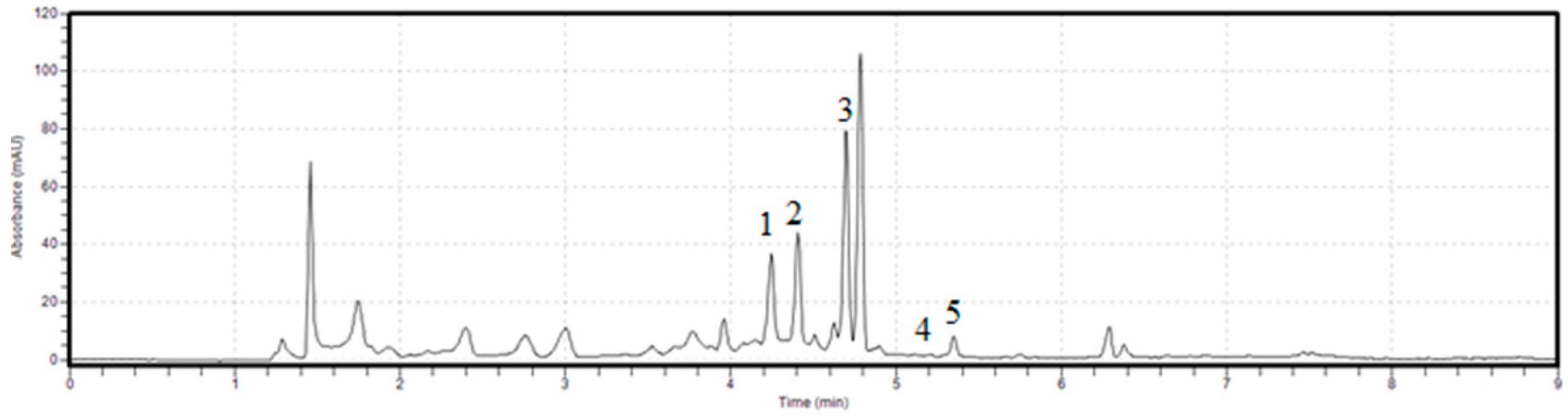
The HPLC analysis of soybean genotypes revealed distinct fingerprints of isoflavones which were influenced by genetic factors; Figure 1 shows a representative isoflavone pattern for a genotype having daidzin, glycitin and genistein as the major isoflavones.
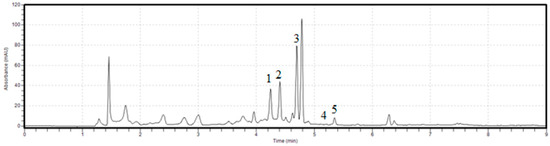
Figure 1.
Representative HPLC chromatogram of isoflavones from a soybean genotype containing high amounts of isoflavones. Peak IDs: 1—daidzin, 2—glycitin, 3—genistin, 4—daidzein, 5—glycitein.
A brief description of the obtained data statistics is presented in Table 1, revealing that daidzin and genistin are the major isoflavones from the studied genotypes; in 15% of the analyzed samples, daidzein and genistein were not detected.

Table 1.
Concentration ranges for isoflavones in the studied genotypes (mg/1000 g).
PCA was carried out on the experimental dataset using five variables (concentrations of glycitin, daidzin, genistin, glycitein and total isoflavones), leading to a model in which the first two principal components explained 90.19% of variance.
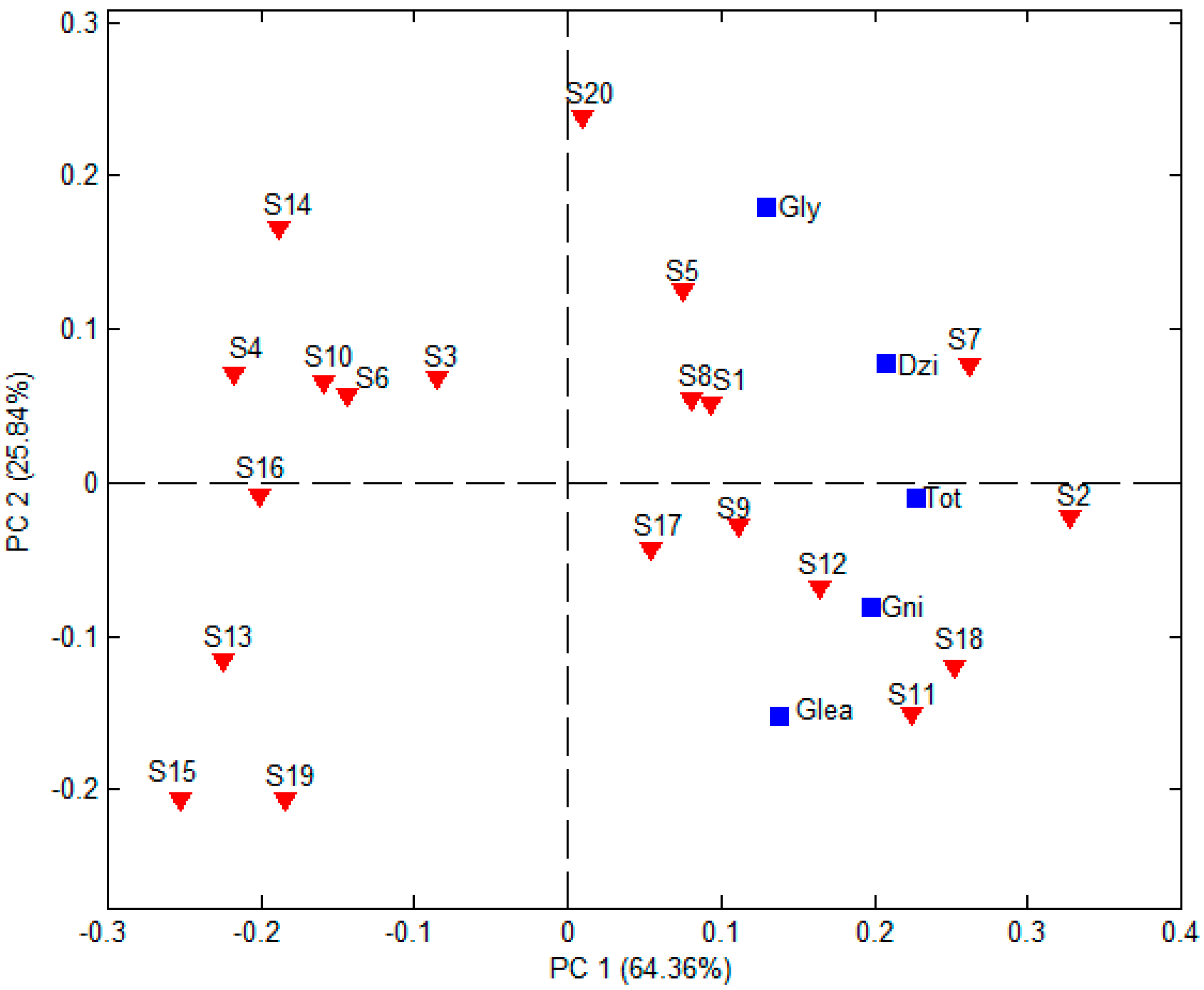
The biplot from Figure 2 emphasizes the soybean genotypes with the highest:
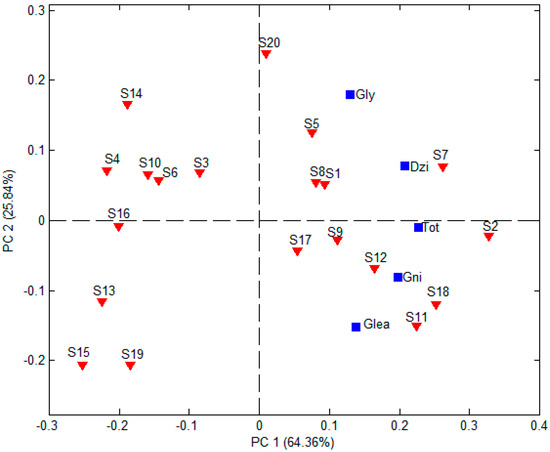
Figure 2.
Biplot diagram obtained from the principal component analysis; here, the concentration of glycitin (Gly); daidzin (Dzi); genistin (Gni); glycitein (Glea); total isoflavones—Tot.
- total content of isoflavones (S2, S7, S18);
- content of glycitin (S20);
- content of daidzin (S7);
- content of genistin (S11).
Additionally, it details genotypes with similar isoflavone profiles (S1–S8, S6–S10).Hence, the biplot can be a useful tool in assisting with the decision making for selecting a certain genotype as a raw material for the production of food supplements designed for menopausal health.
4. Conclusions
- The developed HPLC method proved to be fast (under 8 min of run-time for the separation of the targeted isoflavones), sensitive, reproductible, accurate and suitable for the analysis of soybean seeds.
- The obtained results extended the current knowledge, providing the content of isoflavones in the studied genotypes.
- The reported values can support future nutrition studies involving isoflavones from plant sources, as well as their use in different functional products.
- Overall, the proposed approach can be considered an efficient tool for both quality control assessment purposes and for assisting breeding programs targeted for developing new genotypes with the desired isoflavone profile.
Supplementary Materials
The presentation material of this work is available online at https://www.mdpi.com/article/10.3390/ECB2023-14082/s1.
Author Contributions
Conceptualization, E.M.; methodology, E.M.; field experiments, C.U. and R.R.; sampling and sample processing, C.U. and R.R.; data processing, E.M.; validation, E.M., C.U. and R.R.; investigation, E.M.; writing—original draft preparation, E.M.; writing—review and editing, E.M., C.U. and R.R. All authors have read and agreed to the published version of the manuscript.
Funding
This research received no external funding.
Institutional Review Board Statement
Not applicable.
Informed Consent Statement
Not applicable.
Data Availability Statement
Not applicable.
Conflicts of Interest
The authors declare no conflict of interest.
References
- Hartman, G.L.; West, E.D.; Herman, T.K. Crops that feed the World 2. Soybean—Worldwide production, use, and constraints caused by pathogens and pests. Food Secur. 2011, 3, 5–17. [Google Scholar] [CrossRef]
- Medic, J.; Atkinson, C.; Hurburgh, C.R. Current knowledge in soybean composition. J. Am. Oil Chem. Soc. 2014, 91, 363–384. [Google Scholar] [CrossRef]
- Rizzo, G.; Baroni, L. Soy, Soy Foods and Their Role in Vegetarian Diets. Nutrients 2018, 10, 43. [Google Scholar] [CrossRef] [PubMed]
- He, F.J.; Chen, J.Q. Consumption of soybean, soy foods, soy isoflavones and breast cancer incidence: Differences between Chinese women and women in Western countries and possible mechanisms. Food Sci. Hum. Wellness 2013, 2, 146–161. [Google Scholar] [CrossRef]
- Pabich, M.; Materska, M. Biological effect of soy isoflavones in the prevention of civilization diseases. Nutrients 2019, 11, 1660. [Google Scholar] [CrossRef] [PubMed]
- Poluzzi, E.; Piccinni, C.; Raschi, E.; Rampa, A.; Recanatini, M.; Ponti, F. Phytoestrogens in Postmenopause: The State of the Art from a Chemical, Pharmacological and Regulatory Perspective. Curr. Med. Chem. 2014, 21, 417–436. [Google Scholar] [CrossRef] [PubMed]
- Wang, Y.; Liu, L.; Ji, F.; Jiang, J.; Yu, Y.; Sheng, S.; Li, H. Soybean (Glycine max) prevents the progression of breast cancer cells by downregulating the level of histone demethylase JMJD5. J. Cancer Res. Ther. 2018, 14, 609. [Google Scholar]
Disclaimer/Publisher’s Note: The statements, opinions and data contained in all publications are solely those of the individual author(s) and contributor(s) and not of MDPI and/or the editor(s). MDPI and/or the editor(s) disclaim responsibility for any injury to people or property resulting from any ideas, methods, instructions or products referred to in the content. |
© 2023 by the authors. Licensee MDPI, Basel, Switzerland. This article is an open access article distributed under the terms and conditions of the Creative Commons Attribution (CC BY) license (https://creativecommons.org/licenses/by/4.0/).