


Abstract
Apple (Malus domestica) is a deciduous perennial tree that belongs to the family “Rosaceae”. Due to the highly suitable agro-climatic conditions for apple cultivation, it is among the widely cultivated fruits in Gilgit-Baltistan (GB). This study aims to evaluate elite apple genotypes in GB based on morphological and biochemical traits. Five- to six-year-old plants were selected for this study. The research employed a completely randomized design (CRD) with three replications, and mean differences were analyzed using the LSD test. In this study, five genotypes were assessed based on morphological (fruit weight, fruit length, fruit width, and firmness) and biochemical attributes (TSS, TA, ascorbic acid, total phenolic content, and flavonoid content). The results revealed significant variation among apple cultivars in both phytochemical and fruit quality attributes. The cultivar ‘Red Delicious’ exhibited the highest fruit weight (146.18 g), total soluble solids (TSS) (15.4 °Brix), and flavonoid content (105.75 mg 100 g−1 FW). In contrast, ‘Red Full Star’ demonstrated superior firmness (7.19 kg cm−2), along with the highest total phenolic content (TPC) (4.00 mg GAE g−1 FW) and ascorbic acid content (26.45 mg 100 g−1 FW). Although the indigenous variety ‘Nus Khushu’ exhibited lower values in commercial traits, it holds substantial potential for conservation due to its unique local adaptation. The findings indicate that the “Red Delicious” and “Red Full Star” cultivars cultivated in GB are enriched with a variety of bioactive compounds that offer notable health benefits and may be utilized for future crop enhancement and breeding initiatives.
1. Introduction
Apple (Malus domestica) is a pome fruit that belongs to the “Rosaceae” family. It is an allopolyploid with a haploid number of chromosomes (x = 17) [1]. It is a potential source of carbohydrates, minerals, fiber, and antioxidant phenolics [2]. It is a rich source of phytochemicals, including quercetin, catechin, and chlorogenic acid, and its consumption reduces the risk of different diseases, including cardiovascular disease, asthma, and diabetes. It has demonstrated potent antioxidant activity, effectively inhibiting cancer cell proliferation, reducing lipid peroxidation, and lowering cholesterol levels.
Malus species are found in the temperate climate of the northern hemisphere and are native to the Tian Shan Mountains in central Asia [3]. It is a highly popular and most widely cultivated fruit, with a global production of 93 million tons in 2022, cultivated over an area of 4.8 million hectares [4]. Pakistan ranks 17th in apple production globally. It ranks as the fourth most important crop of Pakistan, following citrus, mango, and banana. The total area under apple cultivation is estimated to be 7.27 thousand ha, with 84.41 thousand tons of production [5]. In Pakistan, apple cultivation is concentrated in the northern high-altitude regions, particularly in Gilgit-Baltistan, which offers favorable agro-climatic conditions. These conditions not only enhance fruit quality but also contribute to the development of unique apple genotypes that are well-adapted to local environmental stresses.
Gilgit-Baltistan is home to a diverse range of apple genotypes, and both indigenous and introduced varieties are cultivated in different valleys of GB. According to the Department of Statistics, the annual production of apples in Gilgit-Baltistan is about 10,000 metric tons and is cultivated on 3000 hectares [6]. Apple genotypes growing in GB exhibit considerable morphological and biochemical diversity and have significant variations in fruit shape, size, color, firmness, total soluble solids (TSS), titratable acidity (TA), total phenolic content (TPC), total flavonoid content, and ascorbic acid. This diversity not only reflects the adaptability of the genotypes to local environmental conditions but also holds great potential for crop improvement, genetic conservation, and value addition. [7,8,9]
Despite the importance of apples in the region, there is a lack of comprehensive, genotype-specific studies that evaluate physiochemical characteristics under the region’s distinct climatic conditions. The identification and selection of genotypes with superior physio-chemical profiles are essential not only for optimizing fruit quality and yield but also for enhancing the resilience of apple production systems to climatic variability. Comparative evaluation of diverse genotypes can provide valuable insights for breeding programs, postharvest handling, and value-added processing.
2. Materials and Methods
2.1. Experimental Site and Sample Collection
This experimental study was carried out in 2024 at Mountain Agricultural Research Centre, Gilgit, which is situated at 35.80861° N and 74.56° E. The average elevation of the study site is about 1500 m (4900 ft) above mean sea level. Indigenous and local cultivars “Red Chief”, “Red Delicious”, “Gala”, “Red Full Star”, and “Nus Khushu” were selected to evaluate the morphological and biochemical attributes of genotypes. At the full maturity stage, fruits of each genotype were collected and transported to the Vegetable Physiology and Precision Horticulture Laboratory, Department of Horticulture, Pir Mehar Ali Shah-Arid Agriculture University, Rawalpindi.
2.2. Morphological Analysis
For morphological quantitative analysis, fruit length and fruit width were measured using a vernier caliper and recorded in centimeters (cm). The fruit weight was determined in grams (g), using a digital weighing scale. Fruit firmness was assessed with a firmness tester, and the results were expressed in kilograms per square centimeter (kg/cm2) [10].
2.3. Biochemical Analysis
In the biochemical analysis, juice of each genotype was extracted using a juicer. The extracted juice was stored in an ultra-freezer for later analysis. The study evaluated several quality parameters, including total soluble solids (TSS), titratable acidity (TA), ascorbic acid, total phenolic content (TPC), and total flavonoid content (TFC). Total soluble solids were determined using a digital refractometer, and the readings were expressed in °Brix. Titratable acidity was determined using the procedure outlined by [11]. Total phenolic content was determined using the procedure described by [12]. Ascorbic acid was determined using the procedure described by [13].
2.4. Statistical Analysis
The study was laid out under a Completely Randomized Design (CRD) for statistical analysis. The means were compared using the Least Significant Difference (LSD) at a 5% confidence level (α = 0.05) using Statistics 8.1 software.
3. Results
3.1. Assessment of Morphological Qualitative Variation in Apple Genotypes
The quantitative morphological evaluation showed substantial differences among the selected apple genotypes, as shown in Table 1. The results indicated notable differences in fruit weight of the observed genotypes. The maximum fruit weight was recorded in “Red Delicious” (146.18 g), followed by “Red Chief” (100.29 g) and “Gala” (94.57 g), and “Red Full Star” (65.08 g). The minimum fruit weight was recorded in “Nus Khushu” (34.75 g). Fruit dimensional attributes exhibited considerable genotypic variability among the evaluated apple cultivars. The maximum fruit length was recorded in “Red Chief” (6.07 cm), followed by “Red Delicious” (6.02 cm), “Gala” (5.1 cm), and “Red Full Star” (4.34 cm). The minimum fruit length was recorded in “Nus Khushu” (3.64 cm). Regarding fruit width, the maximum fruit width was recorded in “Red Delicious” (6.89 cm), followed by “Gala” (5.96 cm), “Red Full Star” (5.59 cm), and “Red Chief” (5.6 cm), while the minimum fruit width was recorded in “Nus Khushu” (4.36 cm). Fruit firmness also varied significantly among the genotypes. The highest firmness was observed in “Red Full Star” (7.19 kg/m2), followed by “Red Delicious” (6.49 kg/m2), “Gala” (4.74 kg/m2), and “Nus Khushu” (4.19 kg/m2). However, “Red Chief” exhibited the lowest firmness (3.72 kg/m2). These findings highlight considerable diversity in the morphological traits of apple genotypes grown in Gilgit-Baltistan, underscoring their potential utility in breeding programs, commercial cultivation, and varietal selection for consumer and industrial preferences.

Table 1.
Pomological assessment of five apple genotypes growing in Gilgit-Baltistan.
3.2. Assessment of Biochemical Variation in Apple Genotypes
3.2.1. Total Soluble Solids (°Brix)
The results exhibited that there was a significant difference in total soluble solids (TSS) among the apple genotypes, as depicted in Figure 1. The highest TSS (15.4 °Brix) was observed in “Red Delicious”, followed by “Gala” (14.1 °Brix), “Red Full Star” (13.4 °Brix), and “Red Chief” (12 °Brix), while the lowest TSS (11.7 °Brix) was observed in “Nus Khushu” (Figure 1).
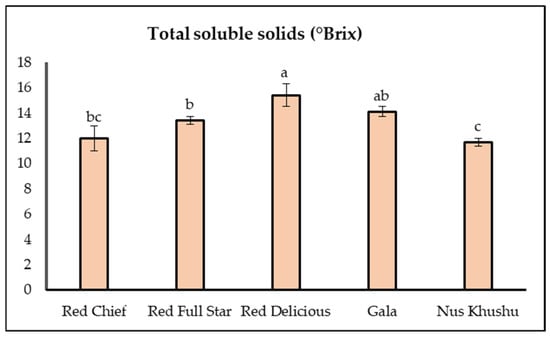
Figure 1.
Comparative analysis of total soluble solids (TSS) among apple genotypes grown in Gilgit-Baltistan.
3.2.2. Titratable Acidity (%)
The results revealed that there was a significant difference in titratable acidity (TA) among the apple genotypes, as shown in Figure 2. The maximum TA (1.408%) was recorded in the cultivar “Red Chief”, followed by “Red Delicious” (0.95%), “Red Full Star” (0.76%), and “Gala” (0.62%), while the minimum TA was recorded in the cultivar “Nus Khushu” (0.48%) (Figure 2).
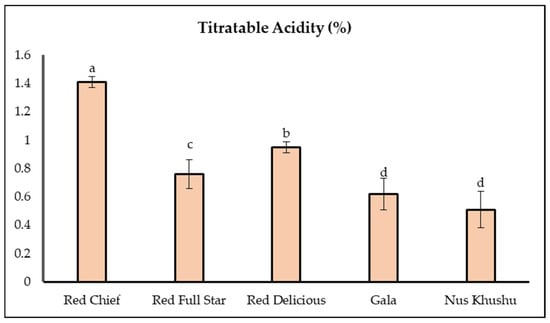
Figure 2.
Comparison of titratable acidity among apple genotypes grown in Gilgit-Baltistan.
3.2.3. Ascorbic Acid (mg/100 g FW)
The results revealed that there was a significant variation in ascorbic acid among the assessed apple genotypes, as shown in Figure 3. The highest ascorbic acid was exhibited in Red Full Star (26.45 mg/100 g FW), followed by genotypes “Red Chief” (23.10 mg/100 g FW), “Red Delicious” (21.87 mg/100 g FW), and “Gala” (17.44 mg/100 g FW), while “Nus Khushu” showed the minimum ascorbic content (13.20 mg/100 g FW).
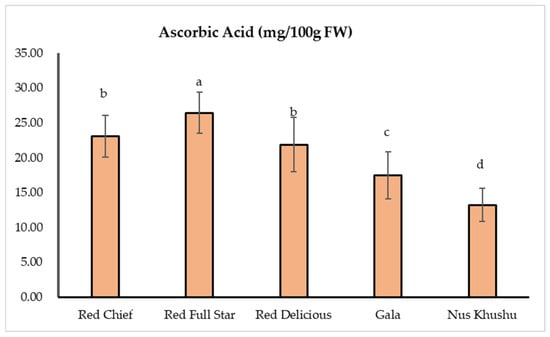
Figure 3.
Comparison of ascorbic acid among apple genotypes grown in Gilgit-Baltistan.
3.2.4. Total Phenolic Content (mg GAE/g FW)
The results revealed significant varietal diversity in total phenolic content, as illustrated in Figure 4. The maximum TPC was recorded in the cultivar “Red Full Star” (4 mg GAE/g FW), followed by “Gala” (3.81 mg GAE/g FW), “Red Chief” (3.5 mg GAE/g FW), and “Nus Khushu” (3.47 mg GAE/g FW), while the minimum TPC was observed in “Red Delicious” (3 mg GAE/g FW).
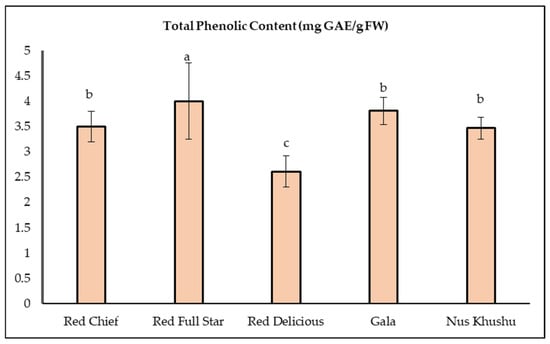
Figure 4.
Comparison of total phenolic content among apple genotypes grown in Gilgit-Baltistan.
3.2.5. Flavonoid Content (mg/100 g FW)
The results exhibit significant variation in flavonoid content among apple genotypes, as shown in Figure 5. The maximum flavonoid content was observed in “Red Delicious” (105.75 mg/100 g FW), followed by “Gala” (94.5 mg/100 g FW), “Red Full Star” (81.68 mg/100 g FW), and “Nus Khushu” (79.45 mg/100 g FW), while the minimum flavonoid content was recorded in “Red Chief” (76.75 mg/100 g FW).
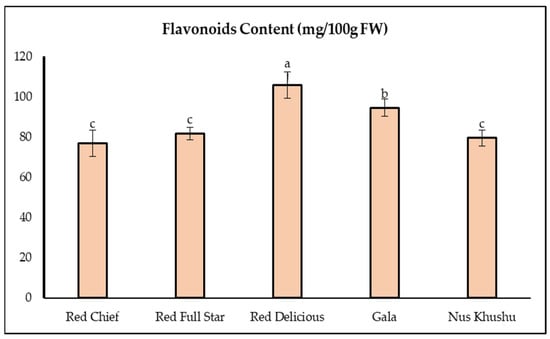
Figure 5.
Comparison of flavonoids among apple genotypes grown in Gilgit-Baltistan.
4. Discussion
4.1. Morphological Assessment of Apple Genotypes in Gilgit-Baltistan
Morphological assessment is a basic technique for evaluating genetic diversity among apple genotypes. It involves the systematic observation and measurement of phenotypic traits, which serve as visible indicators of underlying genetic variation. Morphological evaluation provides valuable information for distinguishing cultivars, aiding in the identification and classification of apple germplasm. Fruit weight is a key trait in apples and is influenced by genetic as well as environmental factors. The fruit weight in our study ranged from 146.18 g (Red Delicious) to 34.75 g (Nus Khushu). The findings of these studies were similar to [14], who observed that the fruit weight ranged from 18.46 g to 233.97 g. In our results, the maximum fruit length was recorded in “Red Chief” (6.07 cm), while the minimum fruit length was recorded in “Nus Khushu” (3.64 cm). Similarly, the maximum fruit width was recorded in “Red Delicious” (6.89 cm), while the minimum fruit width was recorded in “Nus Khushu” (4.36 cm). The results of the study are consistent with [15], which found fruit lengths between 48.85 and 74.61 mm and widths from 53.40 to 86.80 mm in apple cultivars.
Fruit firmness is considered one of the fundamental fruit quality parameters [16]. In our results, the maximum firmness was observed in “Red Full Star” (7.19 kg/m2), while the minimum firmness was recorded in “Red Chief” (3.72 kg/m2). These results were in line with [17], which found firmness in a range of 3.70 to 5.25 kg/cm2. The variations in fruit firmness were influenced by the cultivar type, the growth location, the maturation process, and the surrounding environment [18].
4.2. Biochemical Assessment of Apple Genotypes in Gilgit-Baltistan
The biochemical assessment of apples is an important trait in identifying superior genotypes, adapted to specific agro-climatic regions. Gilgit-Baltistan, with its diverse altitude and climate zones, offers a favorable environment for apple cultivation, resulting in significant variations in fruit quality traits among genotypes. In GB apple cultivars, total soluble solids (TSS), titratable acidity (TA), and ascorbic acid content are widely used to assess fruit quality and nutritional potential. Fruit taste depends on total soluble solids, which are an essential index that determines the quality of fruit. The increase in total soluble solids (TSS) was due to the breakdown of starch into sugars. The difference in these attributes was due to the climatic conditions, cultivars, and cultural practices. In our findings, the maximum TSS (15.4 °Brix) was observed in “Red Delicious”, while the minimum TSS (11.7 °Brix) was observed in “Nus Khushu”. These results are also in line with [19], who observed that the maximum and minimum TSS range for apples is between 8.5 and 17 °Brix. Titratable acidity is used as an important tool to predict the taste of the apples. In our findings, the maximum TA (1.408%) was recorded in the cultivar “Red Chief”, while the minimum TA was recorded in the cultivar “Nus Khushu” (0.48%). These results were similar to [20], who observed that the TA ranged from 0.31% to 1.98%.
Ascorbic acid plays a vital role in plasma membrane protection and also helps in the prevention of lipid oxidation. The changes in ascorbic acid may be due to the genetic variation among cultivars, environmental conditions, and the stage of fruit maturity at harvest. In our results, the maximum ascorbic acid (26.45 mg/100 g FW) was observed in “Red Full Star”, while the minimum ascorbic content (13.20 mg/100 g FW) was recorded in “Nus Khushu”. These results were similar to [21], who observed ascorbic acid ranging from 17.18 to 26.83 mg/100 g.
The variation in total phenolic content was due to genetic variability, which led to differences in the biosynthesis of phenolic secondary metabolites. In our results, the maximum TPC was recorded in the cultivar “Red Full Star” (4 mg GAE/g FW), while the minimum TPC was observed in “Red Delicious” (3 mg GAE/g FW). These results were similar to [22], which found that the total phenolic content ranged from 3.776 to 8.380 mg/g. Flavonoids are a major class of polyphenolic compounds. In our results, the maximum flavonoid content was observed in Red Delicious (105.75 mg/100 g FW), while the minimum flavonoid content was recorded in Red Chief (76.75 mg/100 g FW). These results were in harmony with [22], which found flavonoid content ranging from 63.67 to 130.39 mg/g.
5. Conclusions
The study demonstrated significant morphological and biochemical variability among the apple (Malus domestica) genotypes “Red Chief”, “Red Full Star”, “Red Delicious”, “Gala”, and “Nus Khushu”. Among the evaluated genotypes, “Red Delicious” exhibited superior performance in terms of morphological traits, whereas “Nus Khushu” recorded the lowest values. Biochemically, “Red Full Star” contained the highest concentrations of ascorbic acid and total phenolic content, while “Red Delicious” exhibited the highest levels of flavonoids and lycopene. In contrast, “Nus Khushu” consistently showed the lowest concentrations across key biochemical parameters. These findings underscore the considerable genotypic diversity present within apple cultivars and provide critical insights for targeted breeding programs aimed at improving fruit quality and nutritional value.
Author Contributions
Conceptualization, experimental design, and write-up, F.A.T. and M.T.A.; writing and editing, M.A.K. (Muhammad Azam Khan), M.A.K. (Muhammad Ahsan Khatana) and U.H.; review and editing, R.Q., M.M.K. and H.N.; data collection and funding acquisition, M.N.J. and M.H.K. All authors have read and agreed to the published version of the manuscript.
Funding
This research received no external funding.
Institutional Review Board Statement
Not applicable.
Informed Consent Statement
Not applicable.
Data Availability Statement
Data will be available on request to corresponding author.
Acknowledgments
We gratefully acknowledge PMAS-AAUR for providing research facilities.
Conflicts of Interest
The authors declare no conflicts of interest.
References
- Luby, J.J. Taxonomic classification and brief history. Apples: Botany, Production and Uses; Cabi Publishing: Oxfordshire, UK, 2003; pp. 1–14. [Google Scholar]
- Brite, E.B. The origins of the apple in central Asia. J. World Prehist. 2021, 34, 159–193. [Google Scholar] [CrossRef]
- FAO. 10 World’s Biggest Country Producers of Apple. Available online: https://www.scienceagri.com/2023/02/10-worlds-biggest-apple-producers.html?utm_ (accessed on 12 November 2024).
- MNFSR. FRUIT, VEGETABLES AND CONDIMENTS STATISTICS OF PAKISTAN 2023-24. Available online: https://mnfsr.gov.pk/SiteImage/Misc/files/Fruit%20Vegetable%20and%20Condiments%20Statistics%2023-24.pdf (accessed on 6 May 2025).
- Khudadad, N.; Ali, B.; Jan, K. Measuring the impact of low carbon technologies and products on domestic fuel consumption. Renew. Energy 2013, 49, 115–118. [Google Scholar] [CrossRef]
- Akram, M.T.; Qadri, R.; Khan, M.A.; Hafiz, I.A.; Nisar, N.; Khan, M.M.; Hussain, K. Morpho-phenological characterization of grape (Vitis vinifera L.) germplasm grown in northern zones of Punjab, Pakistan. Pak. J. Agric. Sci. 2021, 58, 1223–1236. [Google Scholar] [CrossRef]
- Akram, M.T.; Khan Qadri, R.W.; Jaskani, M.J.; Awan, F.S. Ampelographic and genetic characterization of grapes genotypes collected from Potohar region of Pakistan. Pak. J. Agric. Sci. 2019, 56, 595–605. [Google Scholar]
- Akram, M.T.; Qadri, R.W.K.; Jaskani, M.J.; Awan, F.S. Phenological and physicochemical evaluation of table grapes germplasm growing under arid subtropical climate of Pakistan. Pak. J. Bot. 2020, 52, 1011–1018. [Google Scholar] [CrossRef] [PubMed]
- Jantra, C.; Slaughter, D.C.; Roach, J.; Pathaveerat, S. Development of a handheld precision penetrometer system for fruit firmness measurement. Postharvest Biol. Technol. 2018, 144, 1–8. [Google Scholar] [CrossRef]
- Fathizadeh, Z.; Aboonajmi, M.; Hassan-Beygi, S.R. Nondestructive methods for determining the firmness of apple fruit flesh. Inf. Process. Agric. 2021, 8, 515–527. [Google Scholar] [CrossRef]
- Ainsworth, E.A.; Gillespie, K.M. Estimation of total phenolic content and other oxidation substrates in plant tissues using Folin–Ciocalteu reagent. Nat. Protoc. 2007, 2, 875–877. [Google Scholar] [CrossRef] [PubMed]
- Khan, A.S.; Ahmad, N.; Malik, A.U.; Saleem, B.A.; Rajwana, I.A. Pheno-physiological revelation of grapes germplasm grown in Faisalabad, Pakistan. Int. J. Agric. Biol. 2011, 13, 791–795. [Google Scholar]
- Najar, Z.H.; Kashtwari, M.; Zargar, S.A.; Wani, A.A. Assessment of Morphological Diversity of Apple (Malus × domestica Borkh.) Germplasm in North Kashmir, India. Vegetos 2023, 36, 651–660. [Google Scholar] [CrossRef]
- Bostan, S.Z.; Şenol, A.C.A.R. Ünye (Ordu) ve çevresinde yetiştirilen mahalli elma çeşitlerinin pomolojik özellikleri. Int. J. Agric. Nat. Sci. 2009, 2, 15–24. [Google Scholar]
- Ghafir, S.A. Physiological and anatomical comparison between four different apple cultivars under cold-storage conditions. Acta Biol. Szeged. 2009, 53, 21–26. [Google Scholar]
- Karlıdağ, H.; Eşitken, A. Determination of some pomological characteristics of local apple and pear varieties grown in upper Coruh Valley. YYU J. Agr. Sci. 2006, 16, 93–96. [Google Scholar]
- Ornelas-Paz, J.D.J.; Quintana-Gallegos, B.M.; Escalante-Minakata, P.; Reyes-Hernández, J.; Pérez-Martínez, J.D.; Rios-Velasco, C.; Ruiz-Cruz, S. Relationship between the firmness of Golden Delicious apples and the physicochemical characteristics of the fruits and their pectin during development and ripening. J. Food Sci. Technol. 2018, 55, 33–41. [Google Scholar] [CrossRef] [PubMed]
- Vieira, F.G.K.; Borges, G.D.S.C.; Copetti, C.; Amboni, R.D.D.M.C.; Denardi, F.; Fett, R. Physico-chemical and antioxidant properties of six apple cultivars (Malus domestica Borkh) grown in southern Brazil. Sci. Hortic. 2009, 122, 421–425. [Google Scholar] [CrossRef]
- Meland, M.; Frøynes, O.; Kviklys, D.; Zagorac, D.D.; Akšić, M.F. Pomological, organoleptic, and biochemical values of Norwegian heritage apple cultivars. Acta Agric. Scand. B-Soil Plant Sci. 2024, 74, 2366180. [Google Scholar] [CrossRef]
- Polat, M.; Okatan, V.; Güçlü, S.F.; Çolak, A.M. Determination of some chemical characteristics and total antioxidant capacity in apple varieties grown in Posof/Ardahan region. Int. J. Agric. Environ. Food Sci. 2018, 2, 131–134. [Google Scholar] [CrossRef]
- Gavrilă, M.F.; Vijan, L.E.; Cosmulescu, S. Biochemical Profile and Antioxidant Activity of Fresh Fruits from Apple Genotypes. Appl. Sci. 2025, 15, 2534. [Google Scholar] [CrossRef]
- Cosme, F.; Pinto, T.; Vilela, A. Phenolic compounds and antioxidant activity in grape juices: A chemical and sensory view. Beverages 2018, 4, 22. [Google Scholar] [CrossRef]
Disclaimer/Publisher’s Note: The statements, opinions and data contained in all publications are solely those of the individual author(s) and contributor(s) and not of MDPI and/or the editor(s). MDPI and/or the editor(s) disclaim responsibility for any injury to people or property resulting from any ideas, methods, instructions or products referred to in the content. |
© 2025 by the authors. Licensee MDPI, Basel, Switzerland. This article is an open access article distributed under the terms and conditions of the Creative Commons Attribution (CC BY) license (https://creativecommons.org/licenses/by/4.0/).