
Proceeding Paper

Fungicide-Free Management of Papaya Anthracnose (Colletotrichum gloeosporioides Penz.) Disease Using Combined Bio-Rationales and Bee Wax in Organic Agriculture †
by
Niveka Srikantharajah
,
Kandiah Pakeerathan
* and
Gunasingham Mikunthan
Department of Agricultural Biology, Faculty of Agriculture, University of Jaffna, Ariviyal Nagar, Kilinochchi 44000, Sri Lanka
*
Author to whom correspondence should be addressed.
Presented at the 1st International Electronic Conference on Plant Science, 1–15 December 2021; Available online: https://iecps2020.sciforum.net/.
Biol. Life Sci. Forum 2021, 4(1), 16; https://doi.org/10.3390/IECPS2020-08906

Published: 7 December 2020
(This article belongs to the Proceedings of The 1st International Electronic Conference on Plant Science)

Abstract

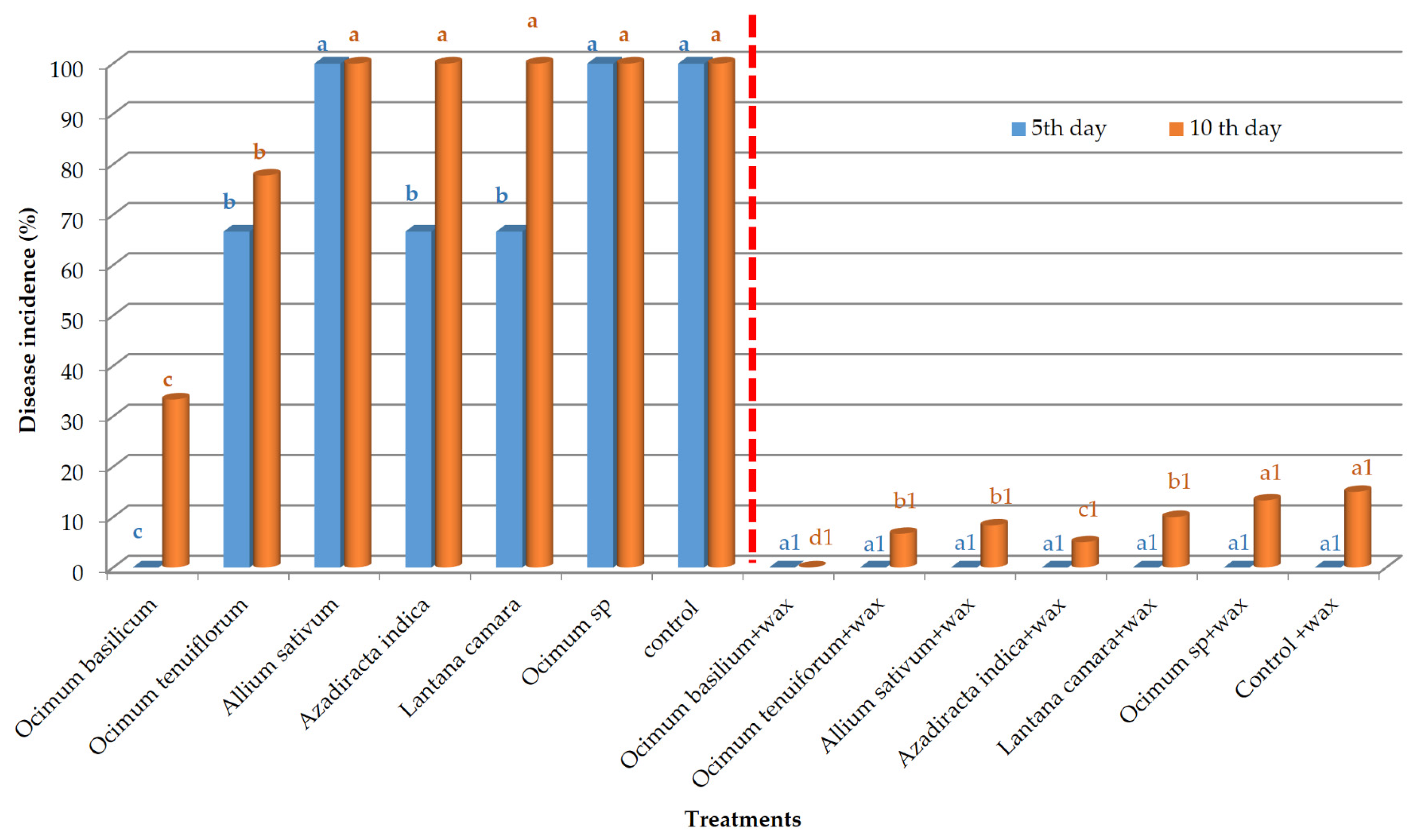
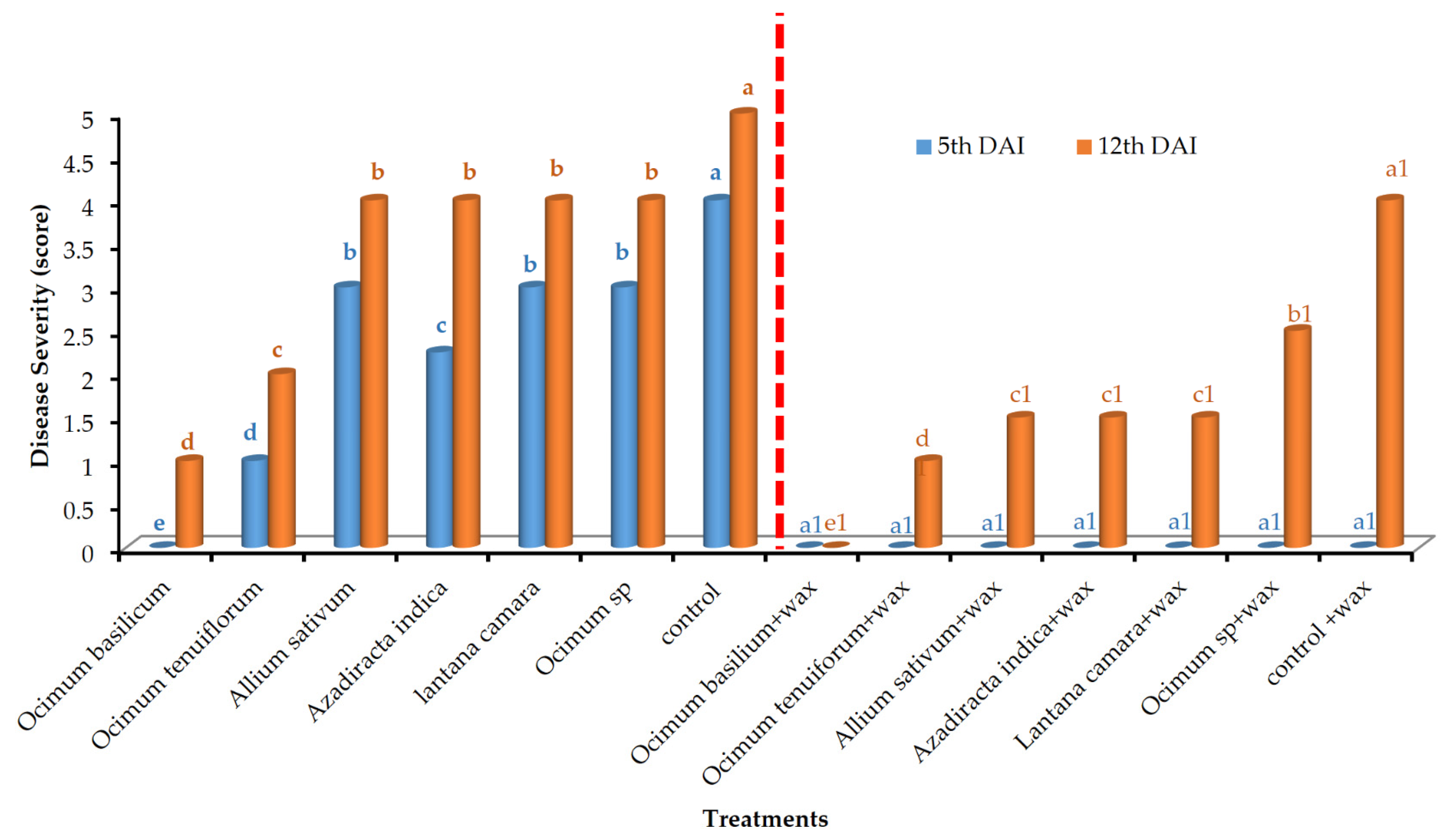
Papaya (Carica papaya L.) is an economically important orchard crop, mainly cultivated in tropical and sub-tropical countries. Due its excellent medicinal value, papaw is recommended for daily consumption by medical professionals as fresh fruit. Papaya production is being hampered by papaya Anthracnose disease, caused by Colletotrichum gloeosporioides, which is inflicting major economic losses of around 40–100% during field cultivation, transportation, and storage in organic agriculture. An investigation was planned to assess the antifungal capacity of the medicinal plants Spinacia oleracea, Limonia acidissima, Allium sativum, Achyranthes aspera, Calotropis gigantea, Ocimum basilicum, Mukia scabrella, Ficus racemose, Azadiracta indica, Ocimum tenuiflorum, Lantana camara and Ocimum cinnamon combined with bee wax coating against papaya anthracnose disease. Fifty-percent concentrations of botanical were extracted from dried leaves using a methanol-based solvent extraction method. Two sets of partially ripened non-infected marketable papaya fruits were collected and treated with 50% concentration of botanical extracts and allowed to dry. One set was coated with melted wax by spraying under cool conditions using a power sprayer, along with a non-treated control. These experimental setups were arranged in a complete randomized design with five replicates. Four hours after wax coating, both sets were inoculated with spores of C. gloeosporioides. Data on disease incidence, disease severity (0–5 scale), number of days for disease-free period, pH, and TSS were measured in both sets and ANOVA was performed using SAS software. Duncan’s Multiple Ranges Test (DMRT) was used to determine the least significant differences among the treatments at p < 0.05. The results show that disease incidence and severity in O. basilicum + bee wax treated fruits was 0% and 5%, respectively, and significant at p < 0.05 until the 10th day post-inoculation; thereafter, disease incidence and severity were slowly increased to 15% on the 14th day post-inoculation, but in other treatments and the control, disease incidence and severity varied from 60–80% and 100%, respectively, from the fifth day post-inoculation. Moreover, bee wax-coated papaya fruits showed significantly higher preserved days, to a maximum of 17.047 ± 3.86. Weight loss percentage, pH and TSS were not significantly on par among wax-coated treatments but were significant when compared with wax-free treatments. This study concludes that the combined application O. basilicum + bee wax is a promising alternative to nasty fungicides.
Keywords: papaya; bio-rationales; wax; Ocimum basilicum; Ocimum tenuiflorum papaya; bio-rationales; wax; Ocimum basilicum; Ocimum tenuiflorum