

Advances in Polyploid Breeding of Cucurbitaceae Crops: From Polyploidy Research to Triploid Seedless Hybrid Breeding



Abstract
1. Introduction
2. Seedless Watermelon Technology Development and Commercialization
3. Morphological Characteristics of Polyploid Seeds and Methods for Promoting Germination
3.1. Morphological Characteristics of Polyploid Seeds
3.2. Methods to Improve Germination in Polyploids
3.3. The Effect of Temperature on Germination of Polyploid Seeds
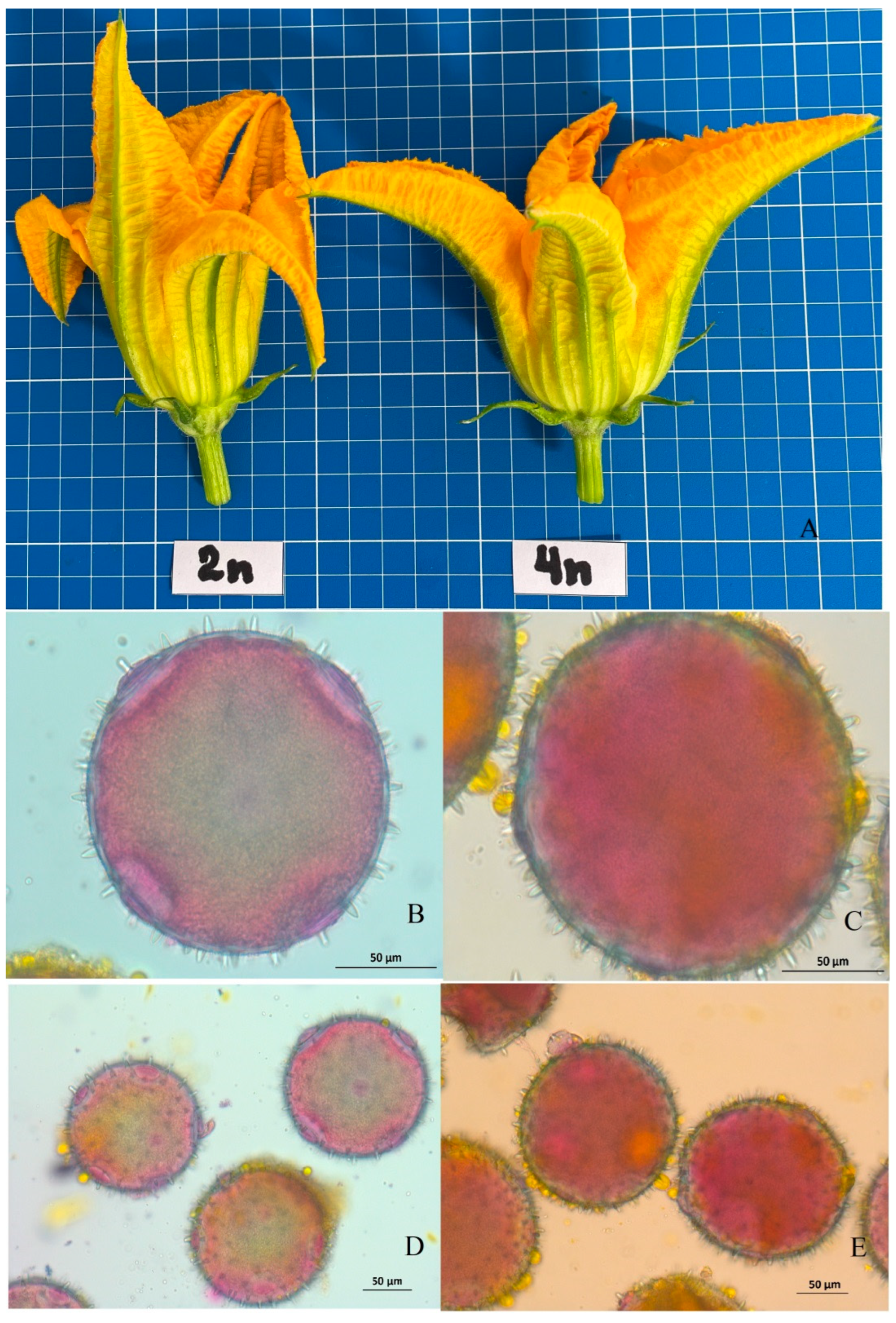
4. Growth, Development, and Pollination of Polyploid Pollen
5. Morphology of Polyploid Plants
6. Genome Organization in Polyploid Plants
7. Creation and Propagation of Polyploid Lines
7.1. Creation of Tetraploid Maternal Lines Using Antimitotic Substances

| Plant | Mitotic Inhibitor | Concentration | Part Used | Observations | References |
|---|---|---|---|---|---|
| Citrullus lanatus (Thunb.) Matsum. & Nakai | Colchicine, PEG | Colchicine (0.2%, 0.3% & 0.4%) PEG (0.5%) | plant shoots | 14.16% Colchicine 0.2% | [36] |
| colchicine | (0.0%, 0.1% & 0.2%) | seeds | - | [84] | |
| Colchicine; dinitroanaline | 0.5, 1.0, 1.5 & 2.0% colchicine; 0.5, 1.0, 1.5 & 2.0% (6-dinitroanaline) | - | Tetraploid induction 82.2% | [35] | |
| colchicine | 0.2% and 0.4% | plant shoots and seeds | 4 tetraploid plants | [85] | |
| colchicine | 0.3% colchicine | growth point | 35 tetraploid plants | [40] | |
| colchicine; dinitroanaline (ethalfluralin, oryzalin) | colchicine (100, 500, 1000, 1500 µM); dinitroanaline (5, 10, 50, 100 µM) | buds | ethalfluralin at 10 µM and dinitroaniline at 50 µM induced 50% tetraploids | [81] | |
| colchicine | 0, 0.05, 0.1, or 0.5% | seeds | polyploid induction was highest after treatment with 0.5% colchicine for 72 h | [86] | |
| colchicine | 0.2, 0.4, and 0.6% | the meristem of seedlings at true leaf emergence stage | 4–6% tetraploids | [87] | |
| colchicine | 0.2, 0.4, or 0.6% | seedlings | The recovery of tetraploids varied from 3.3 to 5.5% in various lines (to colchicine concentrations of 0.2%) | [88] | |
| colchicine | 0.1% & 0.2% | seeds; shoot apex; Inverted hypocotyl | 29.5% tetraploids (0.2% colchicine) | [76] | |
| colchicine | 0.2% | seeds | 2.7% tetraploids | [89] | |
| Dinitroaniline; colchicine | dinitroaniline solution (12, 14, or 15 mg/L); colchicine solution (300, 400, or 500 mg/L) | seedlings | 30.3 to 40.0% tetraploids (12 mg.L−1 of dinitroanaline for 24 h); 22.0 to 27.3% tetraploids (400 mg.L−1 of colchicine for 36 h) | [80] | |
| oryzalin | 50 mg/L | cotyledon | - | [41] | |
| colchicine | 0.2% | seedlings | - | [90] | |
| colchicine; oryzalin | colchicine (0.05, 0.10, 0.20, and 0.50%); oryzalin (5, 15, 30, and 60 µM) | seedlings | - | [82] | |
| Cucumis melo L. | colchicine | 0.4% | cotyledon stage | Chromosome doubling in haploid plants was achieved in 30% of the plants, 55% were mixoploids (n + 2n), and only 14% remained fully haploid | [91] |
| Momordica dioica Roxb. | colchicine | (0.01%, 0.05% & 0.1%) | sprouted tubers | 9 plants (6%) out of 150 were obtained by treatment with 0.1% colchicine solution for 10 h. | [33] |
| Cucumis melo L. | oryzalin | One-week-old seedlings were treated with 50 mg.L−1 of oryzalin; 10 µL | the shoot apex | 58 plants were identified as tetraploids | [42] |
7.2. Spontaneous Chromosome Doubling in Tissue Culture In Vitro
| Plant | Culture Medium | Identified Polyploids | References |
|---|---|---|---|
| Cucumis melo L. | MS medium with 3% sucrose, 1 mg/L 2,4 dichlorophenoxy acetic acid (2,4-D), 2 mg/L naphthalene acetic acid (NAA), and 0.1 mg/L benzylaminopurine (BAP) | The frequency of tetraploid plants from somatic embryos and adventitious shoots was 31% and 30%, respectively | [93] |
| Citrullus lanatus (Thunb.) Matsum. & Nakai | MS salts, plus (per liter) 30 g sucrose, 100 mg myo-inositol, 2 mg glycine, 0.5 mg pyridoxine HCI, 0.5 mg nicotinic acid, 0.1 mg thiamine HCI | The percentage of tetraploid regenerants varied from 5% to 20% | [94] |
| Cucumis melo L. | MS salts supplemented with B5 vitamins, 100 mg myoinositol/liter, 3% sucrose, and 5 μM benzylamino-purine (BAP) (+10 μM indole-3-acetic acid (IAA); +5 μM BAP). | >75% of the somaclonal variants were tetraploid | [95] |
| Winter squash (Cucurbita maxima Duch.) | MS medium with 30 g/L sucrose, (0.01 mg/L IAA; 0.5, 1 mg/L BAP + 0.25, 0.5, 1 mg/L TDZ) and 8 g/L agar | 4 tetraploid plants out of 122 plants | [96] |
| Honeydew melon (Cucumis melo L. inodorus) | M1 (MS basal + 1·mg L−1 BA), M2 (MS basal + 1·mg L−1 BA + 0.26·mg L−1 ABA), M3 (MS basal + 1·mg L−1 BA + 0.8·mg L−1 IAA), M4 (MS basal + 1·mg L−1 BA + 0.26·mg L−1 ABA + 0.8·mg L−1 IAA). | 17 plants (53.1%) appeared to be tetraploid or mixoploid (diploid + tetraploid or tetraploid + octoploid) | [97] |
| Melon (Cucumis melo L.) (cvs. Revigal, Topmark, and Kirkagac), and a cucumber (C. sativus L. cv. Taoz) | MS medium with 3% sucrose, MS vitamins, and 8 g·L−1 Agar | Regeneration from the cotyledons of the three melon cultivars resulted in 43% to 70% polyploid regenerants (All but one of the polyploid plants were tetraploid, the exception being an octaploid plant) | [98] |
| Winter squash (Cucurbita maxima Duch.) | MS medium supplemented with 1, 2, 5, or 10 mg/L BA. | The frequency of mixoploids increased with BA concentration in both cultivars. Of 213 adventitious shoots, 73.7% were diploid, 25.8% were mixoploid, and 0.5% were tetraploid. | [99] |
| Cucumis melo L. | MS medium containing 10 µM benzyladenine | Less than 50% of single bud-derived culture lines were mixoploid | [100] |
7.3. Spontaneous Polyploidization in Cucurbits Under Field Conditions
7.4. Ways to Produce Triploid Plants Besides Hybridization
7.5. Ploidy Determination Methods for Cucurbitaceae Crops
8. Conclusions
Author Contributions
Funding
Data Availability Statement
Conflicts of Interest
References
- Ma, L.; Wang, Q.; Zheng, Y.; Guo, J.; Yuan, S.; Fu, A.; Bai, C.; Zhao, X.; Zheng, S.; Wen, C. Cucurbitaceae Genome Evolution, Gene Function, and Molecular Breeding. Hortic. Res. 2022, 9, uhab057. [Google Scholar] [CrossRef]
- Wang, J.; Yuan, M.; Feng, Y.; Zhang, Y.; Bao, S.; Hao, Y.; Ding, Y.; Gao, X.; Yu, Z.; Xu, Q. A Common Whole-Genome Paleotetraploidization in Cucurbitales. Plant Physiol. 2022, 190, 2430–2448. [Google Scholar] [CrossRef]
- Guo, J.; Xu, W.; Hu, Y.; Huang, J.; Zhao, Y.; Zhang, L.; Huang, C.-H.; Ma, H. Phylotranscriptomics in Cucurbitaceae Reveal Multiple Whole-Genome Duplications and Key Morphological and Molecular Innovations. Mol. Plant 2020, 13, 1117–1133. [Google Scholar] [CrossRef]
- Schaffer, A.A.; Paris, H.S. Melons, Squashes, and Gourds. Ref. Module Food Sci. 2016. [Google Scholar] [CrossRef]
- Kihara, H. Triploid Watermelons. Proc. Am. Soc. Hortic. Sci. 1951, 58, 217–230. [Google Scholar]
- Verhage, L. Diploid, Triploid, Tetraploid-Chromatin Organization in Polyploid Watermelon. Plant J. 2021, 106, 586–587. [Google Scholar] [CrossRef] [PubMed]
- Garret, J.J.; Rhodes, B.B.; Zhang, X. Triploid Watermelons Resist Fruit Blotch Organism. Cucurbits Genet. Coop. Rep. 1995, 18, 56–57. [Google Scholar]
- Montalvo, A.E.; Esnard, J. Reaction of Ten Cultivars of Watermelon (Citrullus lanatus) to a Puerto Rican Population of Meloidogyne Incognita. J. Nematol. 1994, 26, 640. [Google Scholar]
- Rhodes, B.; Zhang, X. Hybrid Seed Production in Watermelon. J. New Seeds 1999, 1, 69–88. [Google Scholar] [CrossRef]
- Marr, C.W.; Gast, K.L. Reactions by Consumers in a Farmers’ Market to Prices for Seedless Watermelon and Ratings of Eating Quality. HortTechnology 1991, 1, 105–106. [Google Scholar] [CrossRef]
- Sachs, M. Priming of Watermelon Seeds for Low-Temperature Germination. J. Am. Soc. Hortic. Sci. 1977, 102, 175–178. [Google Scholar] [CrossRef]
- Huang, R.; Sukprakarn, S.; Thongket, T.; Juntakool, S. Effect of Hydropriming and Redrying on the Germination of Triploid Watermelon Seeds. Agric. Nat. Resour. 2002, 36, 219–224. [Google Scholar]
- Karst, T. Seedless Watermelon Sure to Grow. Grower 1990, 23, 61. [Google Scholar]
- Maynard, D.N.; Elmstrom, G.W. Triploid Watermelon Production Practices and Varieties. II Int. Symp. Spec. Exot. Veg. Crops 1992, 318, 169–178. [Google Scholar] [CrossRef]
- Babu, K.S.; Rajan, S. A Promising Triploid of Little Gourd. J. Trop. Agric. 2001, 39, 162–163. [Google Scholar]
- Kihara, H.; Nlshiyama, I. An Application of Sterility of Autotriploids to the Breeding of Seedless Water Melons. Seiken Ziho 1947, 3, 93–103. [Google Scholar]
- Kihara, H. Breeding of Seedless Fruits. Seiken Ziho 1958, 9, 1–7. [Google Scholar]
- Crow, J.F. Hitoshi Kihara, Japan’s Pioneer Geneticist. Genetics 1994, 137, 891. [Google Scholar] [CrossRef] [PubMed]
- Nishiyama, I. Studies on Artificial Polyploid Plants, I. Production of Tetraploids by Treatment with Colchicine. Am. J. Bot. 1939, 32, 103–106. [Google Scholar]
- Nishiyama, I.; Shimotsuma, M.; Yabuno, T. A Comparative Study of the Development of Polyploid Seed in the Water Melon. Seiken Zihô 1952, 5, 110–118. [Google Scholar]
- Nebel, B.R. Mechanism of Polyploidy through Colchicine. Nature 1937, 140, 1101. [Google Scholar] [CrossRef]
- Yu, C.-H.; Liang, N.N. The Discovery of the Breeding of Seedless Watermelon. In Discoveries in Plant Biology: Volume II; World Scientific: Singapore, 1998; pp. 349–367. [Google Scholar]
- Hassell, R.L.; Schultheis, J.R. Seedless Watermelon Transplant Production Guidelines 2004. Available online: https://scholar.google.co.uk/scholar?hl=zh-TW&as_sdt=0%2C5&q=Seedless+Watermelon+Transplant+Production+Guidelines&btnG= (accessed on 15 October 2025).
- Maynard, D.N. Watermelons: Characteristics, Production, and Marketing; ASHS Press: Alexandria, VA, USA, 2001. [Google Scholar]
- Motsenbocker, C.E.; Arancibia, R.A. In-Row Spacing Influences Triploid Watermelon Yield and Crop Value. HortTechnology 2002, 12, 437–440. [Google Scholar] [CrossRef]
- NeSmith, D.S.; Duval, J.R. Fruit Set of Triploid Watermelons as a Function of Distance from a Diploid Pollinizer. HortScience 2001, 36, 60–61. [Google Scholar] [CrossRef]
- Walters, S.A. Honey Bee Pollination Requirements for Triploid Watermelon. HortScience 2005, 40, 1268–1270. [Google Scholar] [CrossRef]
- Watermelon|Agricultural Marketing Resource Center. Available online: https://www.agmrc.org/commodities-products/fruits/watermelon (accessed on 15 October 2025).
- Liu, W.G. Review and Perspectives of Scientific Research and Production Cooperation of Seedless Watermelon in China. China Watermelon Melon 2005, 2, 19–20. [Google Scholar]
- Kaseb, M.O.; Umer, M.J.; Lu, X.; He, N.; Anees, M.; El-Remaly, E.; Yousef, A.F.; Salama, E.A.; Kalaji, H.M.; Liu, W. Comparative Physiological and Biochemical Mechanisms in Diploid, Triploid, and Tetraploid Watermelon (Citrullus lanatus L.) Grafted by Branches. Sci. Rep. 2023, 13, 4993. [Google Scholar] [CrossRef] [PubMed]
- de Groot, E.; Chiapparino, E.; Berentsen, R.B. Triploid Watermelon Plants with a Bush Growth Habit. 2020. Available online: https://patents.google.com/patent/EP2814316A1/en?oq=+EP+2814316 (accessed on 15 October 2025).
- Jaskani, M.J.; Kwon, S.W.; Kim, D.H. Comparative Study on Vegetative, Reproductive and Qualitative Traits of Seven Diploid and Tetraploid Watermelon Lines. Euphytica 2005, 145, 259–268. [Google Scholar] [CrossRef]
- Nirala, D.; Tiwari, J.K.; Sahu, N.K.; Sinha, S.K. Morphological and Physiological Changes (Variation) in Colchicine Induced Tetraploids of Spine Gourd (Momordica dioica Roxb.) in Comparison to Their Diploid Counterparts. Plant Physiol. Rep. 2023, 28, 481–489. [Google Scholar] [CrossRef]
- Adıgüzel, P.; Solmaz, İ.; Karabıyık, Ş.; Sarı, N. Comparison on Flower, Fruit and Seed Characteristics of Tetraploid and Diploid Watermelons (Citrullus Lanatus Thunb. Matsum. and Nakai). Int. J. Agric. Environ. Food Sci. 2022, 6, 704–710. [Google Scholar] [CrossRef]
- Oh, S.A.; Min, K.H.; Choi, Y.S.; Park, S.B.; Kim, Y.C.; Cho, S.M. Development of Tetraploid Watermelon Using Chromosome Doubling Reagent Treatments. Korean J. Plant Resour. 2015, 28, 656–664. [Google Scholar] [CrossRef]
- Thirveedi, V.K. Standardization of Techniques for Induction of Tetraploidy in Watermelon (Citrullu slanatus Thunb.). Master’s Thesis, Dr. Y.S.R. Horticultural University, West Godavari, India, 2013. [Google Scholar]
- Kumari, T.V.; Ashok, P.; Rao, E.S.; Sasikala, K. Studies to Improve Seed Germination in Tetraploids Watermelon (Citrullus lanatus Thunb.). Int. J. Sci. Res. Publ. 2014, 4, 341. [Google Scholar]
- Aydin, A.; Yetişir, H. A Comparative Study of Morphological Characteristics in Diploid and Tetraploid (Auto and Allotetraploids) Citrullus Genotypes. Folia Hortic. 2023, 35, 33–48. [Google Scholar] [CrossRef]
- Grange, S.L.; Leskovar, D.I.; Pike, L.M.; Cobb, B.G. Excess Moisture and Seedcoat Nicking Influence Germination of Triploid Watermelon. HortScience 2000, 35, 1355–1356. [Google Scholar] [CrossRef]
- Zhang, N.; Bao, Y.; Xie, Z.; Huang, X.; Sun, Y.; Feng, G.; Zeng, H.; Ren, J.; Li, Y.; Xiong, J.; et al. Efficient Characterization of Tetraploid Watermelon. Plants 2019, 8, 419. [Google Scholar] [CrossRef]
- Feng, Z.; Bi, Z.; Fu, D.; Feng, L.; Min, D.; Bi, C.; Huang, H. A Comparative Study of Morphology, Photosynthetic Physiology, and Proteome between Diploid and Tetraploid Watermelon (Citrullus lanatus L.). Bioengineering 2022, 9, 746. [Google Scholar] [CrossRef]
- Cho, W.-Y.; Deepo, D.M.; Islam, M.M.; Nam, S.-C.; Kim, H.-Y.; Han, J.-S.; Kim, C.-K.; Chung, M.-Y.; Lim, K.-B. Induction of Polyploidy in Cucumis melo ‘Chammel’ and Evaluation of Morphological and Cytogenetic Changes. HST 2021, 39, 625–636. [Google Scholar] [CrossRef]
- Grange, S.; Leskovar, D.I.; Pike, L.M.; Cobb, B.G. Seedcoat Structure and Oxygen-Enhanced Environments Affect Germination of Triploid Watermelon. J. Am. Soc. Hortic. Sci. 2003, 128, 253–259. [Google Scholar] [CrossRef]
- Sunarlim, N.; Zam, S.I.; Purwanto, J. Pelukaan Benih Dan Perendaman Dengan Atonik Pada Perkecambahan Benih Dan Pertumbuhan Tanaman Semangka Non Biji (Citrullus vulgaris Schard L.). J. Agroteknologi 2012, 2, 21–24. [Google Scholar]
- Pandya, J.B.; Mehta, K.J.; Patale, V.V. Germination Treatments for Watermelon Seeds. Biosci. Guard. 2012, 2, 197–200. [Google Scholar]
- Duval, J.R.; NeSmith, D.S. Treatment with Hydrogen Peroxide and Seedcoat Removal or Clipping Improve Germination of `Genesis’ Triploid Watermelon. HortScience 2000, 35, 85–86. [Google Scholar] [CrossRef]
- Nerson, H.; Paris, H.S.; Karchi, Z.; Sachs, M. Seed Treatments for Improved Germination of Tetraploid Watermelon. HortScience 1985, 20, 897–899. [Google Scholar] [CrossRef]
- Duval, J.R.; NeSmith, D.S. Emergence of ‘Genesis’ Triploid Watermelon Following Mechanical Scarification. J. -Am. Soc. Hortic. Sci. 1999, 124, 430–432. [Google Scholar] [CrossRef]
- Phat, P.; Sheikh, S.; Lim, J.H.; Kim, T.B.; Seong, M.H.; Chon, H.G.; Shin, Y.K.; Song, Y.J.; Noh, J. Enhancement of Seed Germination and Uniformity in Triploid Watermelon (Citrullus lanatus (Thunb.) Matsum. and Nakai). Hortic. Sci. Technol. 2015, 33, 932–940. [Google Scholar] [CrossRef]
- Singh, V.; Malik, A.; Dalal, P.K.; Raj, M.P. Impact of Hydropriming on Fresh and Naturally Aged Seeds of Bottle Gourd (Lagenaria siceraria (Molina) Standl). Curr. J. Appl. Sci. Technol. 2022, 41, 1–11. [Google Scholar] [CrossRef]
- Phat, P.; Ju, H.-J.; Noh, J.; Lim, J.; Seong, M.; Chon, H.; Jeong, J.; Kwon, S.; Kim, T. Effects of Hydropriming and Explant Origin on in Vitro Culture and Frequency of Tetraploids in Small Watermelons. Hortic. Environ. Biotechnol. 2017, 58, 495–502. [Google Scholar] [CrossRef]
- Harrington, J.F.; Minges, P.A. Vegetable Seed Germination. Bot. Gaz. 1954, 115, 205–225. [Google Scholar]
- Hassell, R.L.; Dufault, R.J.; Phillips, T.L. Influence of Temperature Gradients on Triploid and Diploid Watermelon Seed Germination. HortTechnology 2001, 11, 570–574. [Google Scholar] [CrossRef]
- Agarwal, P.K.; Roy, R.P.; Mishra, D.P. Artificial Triploids in Luffa Echinato Roxb. Cytologia 1979, 44, 739–743. [Google Scholar] [CrossRef]
- Susiacue;n, I.; Álvarez, J.M. Fertility and Pollen Tube Growth in Polyploid Melons (Cucumis melo L.). Euphytica 1997, 93, 369–373. [Google Scholar] [CrossRef]
- Dumas de Vaulx, R. Etude Des Possibilités d’utilisation de La Polyploidie Dans l’amélioration Du Melon (Cucumis melo L.). Ann. L’amélioration Plantes 1974, 24, 389–403. [Google Scholar]
- Lower, R.L.; Johnson, K.W. Observations on Sterility of Induced Autotetraploid Watermelons. J. Am. Soc. Hortic. Sci. 1969, 94, 367–369. [Google Scholar] [CrossRef]
- Stoner, A.K.; Johnson, K.W. Overcoming Autosterility of Autotetraploid Watermelons. Proc. Am. Soc. Hortic. Sci. 1965, 86, 621–625. [Google Scholar]
- Garcia-Lozano, M.; Natarajan, P.; Levi, A.; Katam, R.; Lopez-Ortiz, C.; Nimmakayala, P.; Reddy, U.K. Altered Chromatin Conformation and Transcriptional Regulation in Watermelon Following Genome Doubling. Plant J. 2021, 106, 588–600. [Google Scholar] [CrossRef]
- Lu, X.; He, N.; Anees, M.; Yang, D.; Kong, W.; Zhang, J.; Yuan, L.; Luo, X.; Zhu, H.; Liu, W. A Comparison of Watermelon Flesh Texture across Different Ploidy Levels Using Histology and Cell Wall Measurements. Horticulturae 2024, 10, 112. [Google Scholar] [CrossRef]
- Mutton, L.L.; Cullis, B.R.; Blakeney, A.B. The Objective Definition of Eating Quality in Rockmelons (Cucumis melo). J. Sci. Food Agric. 1981, 32, 385–391. [Google Scholar] [CrossRef]
- Moriguchi, T.; Abe, K.; Sanada, T.; Yamaki, S. Levels and Role of Sucrose Synthase, Sucrose-Phosphate Synthase, and Acid Invertase in Sucrose Accumulation in Fruit of Asian Pear. J. Am. Soc. Hortic. Sci. 1992, 117, 274–278. [Google Scholar] [CrossRef]
- Doğan, E.S.; Liu, C. Three-Dimensional Chromatin Packing and Positioning of Plant Genomes. Nat. Plants 2018, 4, 521–529. [Google Scholar] [CrossRef]
- Song, M.J.; Potter, B.I.; Doyle, J.J.; Coate, J.E. Gene Balance Predicts Transcriptional Responses Immediately Following Ploidy Change in Arabidopsis Thaliana. Plant Cell 2020, 32, 1434–1448. [Google Scholar] [CrossRef]
- Pan, Q.; Zhu, B.; Zhang, D.; Tong, C.; Ge, X.; Liu, S.; Li, Z. Gene Expression Changes during the Allo-/Deallopolyploidization Process of Brassica Napus. Front. Genet. 2019, 10, 1279. [Google Scholar] [CrossRef]
- Jackson, S.; Chen, Z.J. Genomic and Expression Plasticity of Polyploidy. Curr. Opin. Plant Biol. 2010, 13, 153–159. [Google Scholar] [CrossRef]
- Birchler, J.A.; Veitia, R.A. Gene Balance Hypothesis: Connecting Issues of Dosage Sensitivity across Biological Disciplines. Proc. Natl. Acad. Sci. USA 2012, 109, 14746–14753. [Google Scholar] [CrossRef]
- Ni, Z.; Kim, E.-D.; Ha, M.; Lackey, E.; Liu, J.; Zhang, Y.; Sun, Q.; Chen, Z.J. Altered Circadian Rhythms Regulate Growth Vigour in Hybrids and Allopolyploids. Nature 2009, 457, 327–331. [Google Scholar] [CrossRef]
- Wang, R.; Liu, H.; Liu, Z.; Zou, J.; Meng, J.; Wang, J. Genome-Wide Analysis of Alternative Splicing Divergences between Brassica Hexaploid and Its Parents. Planta 2019, 250, 603–628. [Google Scholar] [CrossRef]
- Meaburn, K.J.; Misteli, T. Chromosome Territories. Nature 2007, 445, 379–381. [Google Scholar] [CrossRef]
- Yasuda, K.; Nukaya, T.; Sudo, M.; Yahata, M.; Tominaga, A.; Mukai, H.; Kunitake, H. Effects of in Vitro Colchicine Treatment on Tetraploid Induction in Seeds of Polyembryonic Cultivars of the Genera Citrus, Fortunella, and Poncirus. Trop. Agric. Dev. 2022, 66, 51–58. [Google Scholar]
- Zhou, Q.; Wu, J.; Sang, Y.; Zhao, Z.; Zhang, P.; Liu, M. Effects of Colchicine on Populus Canescens Ectexine Structure and 2n Pollen Production. Front. Plant Sci. 2020, 11, 295. [Google Scholar] [CrossRef] [PubMed]
- Eigsti, O.J.; Dustin, P., Jr.; Gay-Winn, N. On the Discovery of the Action of Colchicine on Mitosis in 1889. Science 1949, 110, 692. [Google Scholar] [CrossRef]
- Pernice, B. Sulla Cariocinesi Delle Cellule Epiteliali e Dell’endotelio Dei Vasi Della Mucosa Dello Stomaco e Dell’intestino, Nello Studio Della Gastroenterite Sperimentale (Nell’avvelenamento per Colchico). Sicil. Med. 1889, 1, 265–279. [Google Scholar]
- Andrus, C.F. Production of Seedless Watermelons; US Department of Agriculture: Washington, DC, USA, 1971.
- Noh, J.; Sheikh, S.; Chon, H.G.; Seong, M.H.; Lim, J.H.; Lee, S.G.; Jung, G.T.; Kim, J.M.; Ju, H.-J.; Huh, Y.C. Screening Different Methods of Tetraploid Induction in Watermelon [Citrullus lanatus (Thunb.) Manst. and Nakai]. Hortic. Environ. Biotechnol. 2012, 53, 521–529. [Google Scholar] [CrossRef]
- Kurtar, E.S.; Seymen, M. Anther Culture in Cucurbita Species. In Doubled Haploid Technol.: Vol. 3: Emerg. Tools, Cucurbits, Trees, Other Species; Springer: New York, NY, USA, 2021; pp. 111–121. [Google Scholar]
- Kurtar, E.S.; Seymen, M. Gynogenesis in Cucurbita Species. In Doubled Haploid Technol.: Vol. 3: Emerg. Tools, Cucurbits, Trees, Other Species; Springer: New York, NY, USA, 2021; pp. 123–133. [Google Scholar]
- Kurtar, E.S.; Seymen, M. Induction of Parthenogenesis by Irradiated Pollen in Cucurbita Species. In Doubled Haploid Technol.: Vol. 3: Emerg. Tools, Cucurbits, Trees, Other Species; Springer: New York, NY, USA, 2021; pp. 135–145. [Google Scholar]
- Omran, S.A.; Guerra-Sanz, J.M.; Cardenas, J.G. Methodology of Tetraploid Induction and Expression of Microsatellite Alleles in Triploid Watermelon. In Proceedings of the Proceedings IXth Eucarpia meeting on genetics and breeding of Cucurbitaceae, Avignon, France, 21–24 May 2008; pp. 381–384. [Google Scholar]
- Li, Y.; Whitesides, J.F.; Rhodes, B. In Vitro Generation of Tetraploid Watermelon with Two Dinitroanilines and Colchicine. Master’s Thesis, Clemson University, Clemson, SC, USA, 1999. [Google Scholar]
- Koh, G.-C. Tetraploid Production of Moodeungsan Watermelon. J.-Korean Soc. Hortic. Sci. 2002, 43, 671–676. [Google Scholar]
- McCuistion, F.; Elmstrom, G.W. Identifying Polyploids of Various Cucurbits by Stomatal Guard Cell Chloroplast Number. Proc. Fla. State Hortic. Soc. 1993, 106, 155–157. [Google Scholar]
- Silva, C.M.D.J.; Dias, R.D.C.S.; Santos, J.S.D.; Souza, F.D.F.; Melo, N.F.D. Induction of Polyploidy in Watermelon Genotype with Powdery Mildew Resistance (Podosphaera xanthii). Rev. Caatinga 2022, 35, 505–513. [Google Scholar] [CrossRef]
- Aswat, A.; Hayati, P.D. Penampilan Morfologi Dan Sitologi Tanaman Semangka (Citrullus lanatus Thunb.) Hasil Induksi Senyawa Kolkisin. Jagur J. Agroteknologi 2025, 7, 11–17. [Google Scholar] [CrossRef]
- Khan, M.N.-E.-A.; Hassan, J.; Biswas, M.S.; Khan, H.I.; Sultana, H.; Suborna, M.N.; Rajib, M.M.R.; Akter, J.; Gomasta, J.; Anik, A.A.M. Morphological and Anatomical Characterization of Colchicine-Induced Polyploids in Watermelon. Hortic. Environ. Biotechnol. 2023, 64, 461–474. [Google Scholar] [CrossRef]
- Jaskani, M.J.; Kwon, S.W.; Kin, D.H. Flow Cytometry of DNA Contents of Colchicine Treated Watermelon as a Ploidy Screening Method at MI Stage. Pak. J. Bot. 2005, 37, 685. [Google Scholar]
- Jaskani, M.J.; Kwon SungWhan, K.S.; Koh GabCheon, K.G.; Huh YunChan, H.Y.; Ko BokRai, K.B. Induction and Characterization of Tetraploid Watermelon. J. Korean Soc. Hortic. Sci. 2004, 45, 60–65. [Google Scholar]
- Souza, F.d.F.; Queiroz, M.d.A.; Dias, R.d.C.S. Desenvolvimento de Híbridos Triplóides Experimentais de Melancia. Sitientibus Série Ciências Biológicas 2001, 1, 154–160. [Google Scholar]
- Zhu, H.; Zhao, S.; Lu, X.; He, N.; Gao, L.; Dou, J.; Bie, Z.; Liu, W. Genome Duplication Improves the Resistance of Watermelon Root to Salt Stress. Plant Physiol. Biochem. 2018, 133, 11–21. [Google Scholar] [CrossRef]
- Batra, S. Induced Tetraploidy in Muskmelons. J. Hered. 1952, 43, 141–148. [Google Scholar] [CrossRef]
- Ermolaev, A.S.; Domblides, E.A. Optimization of Steps in the Technology of Obtaining Doubled Haploids of Summer Squash (Cucurbita Pepo L.) in the Culture of Unpollinated Ovules in Vitro. Veg. Crops Russ. 2022, 5–14. [Google Scholar] [CrossRef]
- Ezura, H.; Amagai, H.; Yoshioka, K.; Oosawa, K. Highly Frequent Appearance of Tetraploidy in Regenerated Plants, a Universal Phenomenon, in Tissue Cultures of Melon (Cucumis melo L.). Plant Sci. 1992, 85, 209–213. [Google Scholar] [CrossRef]
- Compton, M.E.; Gray, D.J.; Elmstrom, G.W. Identification of Tetraploid Regenerants from Cotyledons of Diploid Watermelon Cultured in Vitro. Euphytica 1996, 87, 165–172. [Google Scholar] [CrossRef]
- Fassuliotis, G.; Nelson, B.V. Regeneration of Tetraploid Muskmelons from Cotyledons and Their Morphological Differences from Two Diploid Muskmelon Genotypes. J. Am. Soc. Hortic. Sci. 1992, 117, 863–866. [Google Scholar] [CrossRef]
- Kurtar, E.S.; Balkaya, A.; Kandemir, D. A Productive Direct Regeneration Protocol for a Wide Range of Winter Squash (Cucurbita maxima Duch.) and Pumpkin (Cucurbita moschata Duch.) Lines. Rom. Biotechnol. Lett. 2020, 25, 1348–1355. [Google Scholar] [CrossRef]
- Ren, Y.; Bang, H.; Gould, J.; Rathore, K.S.; Patil, B.S.; Crosby, K.M. Shoot Regeneration and Ploidy Variation in Tissue Culture of Honeydew Melon (Cucumis melo L. Inodorus). Vitr. Cell. Dev. Biol. -Plant 2013, 49, 223–229. [Google Scholar] [CrossRef]
- Curuk, S.; Ananthakrishnan, G.; Singer, S.; Xia, X.; Elman, C.; Nestel, D. Regeneration in Vitro from the Hypocotyl of Cucumis Species Produces Almost Exclusively Diploid Shoots, and Does Not Require Light. HortScience 2003, 38, 105–109. [Google Scholar] [CrossRef]
- Lee, Y.K.; Chung, W.I.; Ezura, H. Efficient Plant Regeneration via Organogenesis in Winter Squash (Cucurbita maxima Duch.). Plant Sci. 2003, 164, 413–418. [Google Scholar] [CrossRef]
- Adelberg, J.W.; Rhodes, B.B.; Skorupska, H.T. Generating Tetraploid Melons in Tissue Culture. In Proceedings of the II International Symposium on In Vitro Culture and Horticultural Breeding 336, Baltimore, MD, USA, 28 June–2 July 1992; pp. 373–380. [Google Scholar]
- Grimbly, P.E. Polyploidy in the Glasshouse Cucumber (Cucumis sativus L.). Euphytica 1973, 22, 479–483. [Google Scholar] [CrossRef]
- Shifriss, O. Polyploids in the Genus Cucumis. J. Hered. 1942, 33, 144–152. [Google Scholar] [CrossRef]
- Ramírez-Madera, A.O.; Miller, N.D.; Spalding, E.P.; Weng, Y.; Havey, M.J. Spontaneous Polyploidization in Cucumber. Theor. Appl. Genet. 2017, 130, 1481–1490. [Google Scholar] [CrossRef] [PubMed]
- Kim, M.-J.; Yun, S.-H.; Park, S.-M.; Jin, S.-B.; Song, K.-J. Characterization of Allotetraploids Derived from Protoplast Fusion between Navel Orange and Kumquat. Vitr. Cell. Dev. Biol.-Plant 2020, 56, 634–643. [Google Scholar] [CrossRef]
- Rokka, V.-M. Protoplast Technology in Genome Manipulation of Potato Through Somatic Cell Fusion. In Somatic Genome Manipulation; Springer: New York, NY, USA, 2015; pp. 217–235. ISBN 978-1-4939-2389-2. [Google Scholar]
- Ramakrishnan, R.; Banadka, A.; Dubey, S.; Al-Khayri, J.M.; Nagella, P. Advances in Triploid Plant Production: Techniques, Benefits, and Applications. Plant Cell Tiss. Organ Cult. 2025, 160, 70. [Google Scholar] [CrossRef]
- da Silva, N.T.; Silva, L.A.S.; Reis, A.C.; Machado, M.; de Matos, E.M.; Viccini, L.F.; Otoni, W.C.; de Carvalho, I.F.; Rocha, D.I.; da Silva, M.L. Endosperm Culture: A Facile and Efficient Biotechnological Tool to Generate Passion Fruit (Passiflora Cincinnata Mast.) Triploid Plants. Plant Cell Tiss. Organ Cult. 2020, 142, 613–624. [Google Scholar] [CrossRef]
- Wang, X.; Cheng, Z.-M.; Zhi, S.; Xu, F. Breeding Triploid Plants: A Review. Czech J. Genet. Plant Breed. 2016, 52, 41–54. [Google Scholar] [CrossRef]
- Domblides, E.; Ermolaev, A.; Belov, S.; Kan, L.; Skaptsov, M.; Domblides, A. Efficient Methods for Evaluation on Ploidy Level of Cucurbita Pepo L. Regenerant Plants Obtained in Unpollinated Ovule Culture In Vitro. Horticulturae 2022, 8, 1083. [Google Scholar] [CrossRef]
- Gilissen, L.J.W.; Van Staveren, M.J.; Creemers-Molenaar, J.; Verhoeven, H.A. Development of Polysomaty in Seedlings and Plants of Cucumis Sativus L. Plant Sci. 1993, 91, 171–179. [Google Scholar] [CrossRef]
- Ervin, C.D. A Study of Polysomaty in Cucumis Melo. Am. J. Bot. 1941, 28, 113–124. [Google Scholar] [CrossRef]


| Factors | Changes in Polyploid Plants Compared to Diploid | Reference |
|---|---|---|
| Seed productivity | Reduced seed set per fruit in tetraploids compared to diploids | [32,33,34,35,36,37] |
| Germination capacity | Decreased seed germination and number of filled seeds in tetraploids relative to diploids. | [34,38] |
| Seed size | Tetraploid seeds exhibit greater values than diploids for the following traits: thousand-seed weight, seed length, seed width, seed thickness, and seed coat thickness. | [6,32,33,34,36,38,39,40,41,42] |
| Internal structure of seeds | Polyploid seeds exhibit prominent air cavities in the endosperm region. | [36,39,43] |
| Method | The Description of the Method | Reference |
|---|---|---|
| Scarification | Cutting/scoring of the seed coat, partial removal of the seed coat, total removal of the seed coat, other mechanical damage to the seed coat | [37,39,43,44,45,46,47,48] |
| Acid scarification | Seed soaking in H2O2 | [37,43,44,45,46,49] |
| Hydropriming | Water soaking followed by controlled re-drying | [39,43,45,47,49,50,51] |
| Object of Observation | Differences Between 3n and 4n Genotypes Compared to 2n Genotypes | Reference |
|---|---|---|
| Plant | Increase in plant size, leaf surface area, stem thickness, trichome density, and size | [33,36,38,40,41,42,59] |
| Fruits | Increased rind hardness and thickness, along with enhanced flesh thickness, texture, and size | [32,33,34,40,41,60] |
| Flowers | Enlargement of staminate floral organs (pedicel, anther, ovary, stigma, petals) | [32,33] |
| Factors | Changes in Polyploid Plants Compared to Diploid | Reference |
|---|---|---|
| Gene dosage | Additively expressed genes (two times higher than for diploids) and non-additively expressed genes (more or less than two times difference in expression) are observed with different proportions in different species | [59,64,65,66,67] |
| Methylation | 1047 hypermethylated and 1688 hypomethylated sites were shown in tetraploid watermelon. Differential dimethylation (H3K4Me2), responsible for gene activation, was observed in promoters of A. thaliana allotetraploids | [59,68] |
| Acetylation | Differential acetylation (H3K9Ac) was shown in promoters of A. thaliana allotetraploids | [68] |
| Alternative splicing | The formation or loss of transcripts via alternative splicing was shown in hexaploid Brassica and tetraploid watermelon | [69] |
| Chromatin organization | Switching of some A and B compartments in tetraploid watermelon. The switch from B to A was prevalent (8%), but the A to B switch was also observed (1%) | [59] |
| Topologically associating domains (TADs) | More than 25% of TAD boundaries changed in tetraploid watermelon | [59] |
Disclaimer/Publisher’s Note: The statements, opinions and data contained in all publications are solely those of the individual author(s) and contributor(s) and not of MDPI and/or the editor(s). MDPI and/or the editor(s) disclaim responsibility for any injury to people or property resulting from any ideas, methods, instructions or products referred to in the content. |
© 2025 by the authors. Licensee MDPI, Basel, Switzerland. This article is an open access article distributed under the terms and conditions of the Creative Commons Attribution (CC BY) license.
Share and Cite
Ermolaev, A.; Fomicheva, M.; Domblides, E. Advances in Polyploid Breeding of Cucurbitaceae Crops: From Polyploidy Research to Triploid Seedless Hybrid Breeding. Crops 2026, 6, 5. https://doi.org/10.3390/crops6010005
Ermolaev A, Fomicheva M, Domblides E. Advances in Polyploid Breeding of Cucurbitaceae Crops: From Polyploidy Research to Triploid Seedless Hybrid Breeding. Crops. 2026; 6(1):5. https://doi.org/10.3390/crops6010005
Chicago/Turabian StyleErmolaev, Alexey, Maria Fomicheva, and Elena Domblides. 2026. "Advances in Polyploid Breeding of Cucurbitaceae Crops: From Polyploidy Research to Triploid Seedless Hybrid Breeding" Crops 6, no. 1: 5. https://doi.org/10.3390/crops6010005
APA StyleErmolaev, A., Fomicheva, M., & Domblides, E. (2026). Advances in Polyploid Breeding of Cucurbitaceae Crops: From Polyploidy Research to Triploid Seedless Hybrid Breeding. Crops, 6(1), 5. https://doi.org/10.3390/crops6010005