Germplasm Pools for Quinoa Improvement

 , , , , and
Abstract
1. Introduction
2. The Primary Gene Pool of C. quinoa
3. The Secondary Gene Pool of C. quinoa
3.1. The Mesoamerican ATGC Gene Pool
3.2. Crop-Weed Complexes in Colorado
3.3. Quinoa Domestication Traits
3.4. Secondary Germplasm Collection and Characterization: Looking into the Future
4. Tertiary Gene Pool of C. quinoa
4.1. The AA Diploids
4.2. The BB Diploids
4.3. Breeding Value of AA and BB Diploids
5. Discussion
6. Summary
Author Contributions
Funding
Data Availability Statement
Acknowledgments
Conflicts of Interest
Abbreviations
| AG | Avian goosefoot |
| ATGC | Allotetraploid goosefoot complex |
| FG | Figleaf goosefoot |
| FISH | Fluorescence in situ hybridization |
| GWAS | Genome-wide association study |
| HIAN | C. hians taxonomic group |
| ITS | Internal transcribed sequence (rRNA) |
| NEOM | C. neomexicanum taxonomic group |
| PG | Pitseed goosefoot |
| QTL | Quantitative trait locus |
| SMG | Smooth goosefoot |
| SWG | Swedish goosefoot |
| TMA | Trimethylamine |
References
- Sharbrough, J.; Conover, J.L.; Fernandes Gyorfy, M.; Grover, C.E.; Miller, E.R.; Wendel, J.F.; Sloan, D.B. Global patterns of subgenome evolution in organelle-targeted genes of six allotetraploid angiosperms. Mol. Biol. Evol. 2022, 39, msac074. [Google Scholar] [CrossRef] [Scilit]
- Soltis, P.S.; Soltis, D.E. The role of genetic and genomic attributes in the success of polyploids. Proc. Natl. Acad. Sci. USA 2000, 97, 7051–7057. [Google Scholar] [CrossRef] [Scilit]
- Panchy, N.; Lehti-Shiu, M.; Shiu, S.-H. Evolution of gene duplication in plants. Plant Physiol. 2016, 171, 2294–2316. [Google Scholar] [CrossRef] [Scilit]
- Coughlan, J.M.; Han, S.; Stefanović, S.; Dickinson, T.A. Widespread generalist clones are associated with range and niche expansion in allopolyploids of Pacific Northwest hawthorns (Crataegus L.). Mol. Ecol. 2017, 26, 5484–5499. [Google Scholar] [CrossRef] [Scilit]
- te Beest, M.; Le Roux, J.J.; Richardson, D.M.; Brysting, A.K.; Suda, J.; Kubešová, M.; Pyšek, P. The more the better? the role of polyploidy in facilitating plant invasions. Ann. Bot. 2012, 109, 19–45. [Google Scholar] [CrossRef] [Scilit]
- Griffiths, A.G.; Moraga, R.; Tausen, M.; Gupta, V.; Bilton, T.P.; Campbell, M.A.; Ashby, R.; Nagy, I.; Khan, A.; Larking, A.; et al. Breaking free: The genomics of allopolyploidy-facilitated niche expansion in white clover. Plant Cell 2019, 31, 1466–1487. [Google Scholar] [CrossRef] [Scilit]
- Schiavinato, M.; Bodrug-Schepers, A.; Dohm, J.C.; Himmelbauer, H. Subgenome evolution in allotetraploid plants. Plant J. 2021, 106, 672–688. [Google Scholar] [CrossRef] [Scilit]
- Maughan, P.J.; Jarvis, D.E.; de la Cruz-Torres, E.; Jaggi, K.E.; Warner, H.C.; Marcheschi, A.K.; Bertero, H.D.; Gomez-Pando, L.; Fuentes, F.; Mayta-Anco, M.E.; et al. North American pitseed goosefoot (Chenopodium berlandieri) is a genetic resource to improve Andean quinoa (C. quinoa). Sci. Rep. 2024, 14, 12345. [Google Scholar] [CrossRef] [Scilit]
- Jarvis, D.E.; Ho, Y.S.; Lightfoot, D.J.; Schmöckel, S.M.; Li, B.; Borm, T.J.A.; Ohyanagi, H.; Mineta, K.; Michell, C.T.; Saber, N.; et al. The genome of Chenopodium quinoa. Nature 2017, 542, 307–312. [Google Scholar] [CrossRef] [Scilit]
- Patiranage, D.S.; Rey, E.; Emrani, N.; Wellman, G.; Schmid, K.; Schmöckel, S.M.; Tester, M.; Jung, C. Genome-wide association study in quinoa reveals selection pattern typical for crops with a short breeding history. eLife 2022, 11, e66873. [Google Scholar] [CrossRef] [Scilit]
- Rey, E.; Maughan, P.J.; Maumus, F.; Lewis, D.; Wilson, L.; Fuller, J.; Schmöckel, S.M.; Jellen, E.N.; Tester, M.; Jarvis, D.E. A chromosome-scale assembly of the quinoa genome provides insights into the structure and dynamics of its subgenomes. Commun. Biol. 2023, 6, 1263. [Google Scholar] [CrossRef] [Scilit]
- Smith, B.D.; Yarnell, R.A. Initial formation of an indigenous crop complex in eastern North America at 3800 B.P. Proc. Natl. Acad. Sci. USA 2009, 106, 6561–6566. [Google Scholar] [CrossRef] [Scilit] [PubMed]
- Kistler, L.; Shapiro, B. Ancient DNA confirms a local origin of domesticated chenopod in eastern North America. J. Archaeol. Sci. 2011, 38, 3549–3554. [Google Scholar] [CrossRef] [Scilit]
- Wilson, H.D. Quinua and relatives (Chenopodium Sect. Chenopodium Subsect. Cellulata). Econ. Bot. 1990, 44, 92–110. [Google Scholar] [CrossRef] [Scilit]
- Young, L.A.; Maughan, P.J.; Jarvis, D.E.; Hunt, S.P.; Warner, H.C.; Durrant, K.K.; Kohlert, T.; Curti, R.N.; Bertero, D.; Filippi, G.A.; et al. A chromosome-scale reference of Chenopodium watsonii helps elucidate relationships within the North American A-genome Chenopodium species and with quinoa. Plant Genome 2023, 16, e20349. [Google Scholar] [CrossRef] [Scilit]
- Bazile, D. Global trends in the worldwide expansion of quinoa cultivation. Biol. Life Sci. Forum 2023, 25, 13. [Google Scholar] [CrossRef] [Scilit]
- Khoury, C.K.; Carver, D.; Greene, S.L.; Williams, K.A.; Achicanoy, H.A.; Schori, M.; León, B.; Wiersema, J.H.; Frances, A. Crop wild relatives of the United States require urgent conservation action. Proc. Natl. Acad. Sci. USA 2020, 117, 33351–33357. [Google Scholar] [CrossRef] [Scilit]
- Bazile, D.; Jacobsen, S.-E.; Verniau, A. The global expansion of quinoa: Trends and limits. Front. Plant Sci. 2016, 7, 622. [Google Scholar] [CrossRef] [Scilit]
- Hodková, E.; Mandák, B. An overlooked hybrid between the two diploid Chenopodium species in central Europe determined by microsatellite and morphological analysis. Plant Syst. Evol. 2018, 304, 295–312. [Google Scholar] [CrossRef] [Scilit]
- Benet-Pierce, N.; Simpson, M.G. Chenopodium littoreum (Chenopodiaceae), a new goosefoot from dunes of south-central coastal California. Madroño 2010, 57, 64–72. [Google Scholar] [CrossRef] [Scilit]
- Benet-Pierce, N.; Simpson, M.G. Taxonomic recovery of the species in the Chenopodium neomexicanum (Chenopodiaceae) complex and description of Chenopodium sonorense Sp. Nov. J. Torrey Bot. Soc. 2017, 144, 339–356. [Google Scholar] [CrossRef] [Scilit]
- Benet-Pierce, N.; Simpson, M.G. The taxonomy of Chenopodium hians, C. incognitum, and ten new taxa within the narrow-leaved Chenopodium group in western North America, with special attention to California. Madroño 2019, 66, 56–75. [Google Scholar] [CrossRef] [Scilit]
- Mosyakin, S.L.; Mandák, B. Chenopodium ucrainicum (Chenopodiaceae/Amaranthaceae sensu APG), a new diploid species: A morphological description and pictorial guide. Ukr. Bot. J. 2020, 77, 237–248. [Google Scholar] [CrossRef] [Scilit]
- Fuentes-Bazan, S.; Uotila, P.; Borsch, T. A novel phylogeny-based generic classification for Chenopodium sensu lato, and a tribal rearrangement of Chenopodioideae (Chenopodiaceae). Willdenowia 2012, 42, 5–24. [Google Scholar] [CrossRef]
- Gandarillas, H. Razas de Quinua; Bull; Instituto Boliviano de Cultivos Andinos, División de Investigaciones Agrícolas, Ministerio de Agricultura: La Paz, Bolivia, 1968. [Google Scholar]
- Tapia, M.E. Origen, Distribución Geográfica y Sistemas de Producción de La Quinua. In Proceedings of the Reunión Sobre Genética y Fitomejoramiento de la Quinua, Puno, Peru, 14–18 March 1980. [Google Scholar]
- Risi, J.C.; Galwey, N.W. The Chenopodium Grains of the Andes: Inca Crops for Modern Agriculture. In Advances in Applied Biology; Academic Press: Cambridge, MA, USA, 1984; pp. 145–215. [Google Scholar]
- Wilson, H.D. Quinua biosystematics I: Domesticated populations. Econ. Bot. 1988, 42, 461–477. [Google Scholar] [CrossRef] [Scilit]
- Mason, S.L.; Stevens, M.R.; Jellen, E.N.; Bonifacio, A.; Fairbanks, D.J.; Coleman, C.E.; McCarty, R.R.; Rasmussen, A.G.; Maughan, P.J. Development and use of microsatellite markers for germplasm characterization in quinoa (Chenopodium quinoa Willd.). Crop Sci. 2005, 45, 1618–1630. [Google Scholar] [CrossRef] [Scilit]
- Christensen, S.A.; Pratt, D.B.; Pratt, C.; Nelson, P.T.; Stevens, M.R.; Jellen, E.N.; Coleman, C.E.; Fairbanks, D.J.; Bonifacio, A.; Maughan, P.J. Assessment of genetic diversity in the USDA and CIP-FAO international nursery collections of quinoa (Chenopodium quinoa Willd.) using microsatellite markers. Plant Genet. Resour. Char. Util. 2007, 5, 82–95. [Google Scholar] [CrossRef] [Scilit]
- Fuentes, F.F.; Martinez, E.A.; Hinrichsen, P.V.; Jellen, E.N.; Maughan, P.J. Assessment of genetic diversity patterns in Chilean quinoa (Chenopodium quinoa Willd.) germplasm using multiplex fluorescent microsatellite markers. Conserv. Genet. 2009, 10, 369–377. [Google Scholar] [CrossRef] [Scilit]
- Maughan, P.J.; Smith, S.M.; Rojas-Beltrán, J.A.; Elzinga, D.; Raney, J.A.; Jellen, E.N.; Bonifacio, A.; Udall, J.A.; Fairbanks, D.J. Single nucleotide polymorphism identification, characterization, and linkage mapping in quinoa. Plant Genome 2012, 5, 114–125. [Google Scholar] [CrossRef] [Scilit]
- Mizuno, N.; Toyoshima, M.; Fujita, M.; Fukuda, S.; Kobayashi, Y.; Ueno, M.; Tanaka, K.; Tanaka, T.; Nishihara, E.; Mizukoshi, H.; et al. The genotype-dependent phenotypic landscape of quinoa in salt tolerance and key growth traits. DNA Res. 2020, 27, dsaa022. [Google Scholar] [CrossRef] [Scilit]
- Romero, M.; Mujica Sanchez, A.M.; Pineda, E.; Ccamapaza, Y.; Zavalla, N. Genetic identity based on simple sequence repeat (SSR) markers for quinoa (Chenopodium quinoa Willd.). Int. J. Agric. Nat. Resour. 2021, 46, 166–178. [Google Scholar] [CrossRef] [Scilit]
- Morillo, A.C.; Manjarres, E.H.; Reyes, W.L.; Morillo, Y. Molecular characterization of intrapopulation genetic diversity in Chenopodium quinoa (Chenopodiaceae). Genet. Mol. Res. 2020, 19, gmr18667. [Google Scholar] [CrossRef] [Scilit]
- El-Harty, E.H.; Ghazy, A.; Alateeq, T.K.; Al-Faifi, S.A.; Khan, M.A.; Afzal, M.; Alghamdi, S.S.; Migdadi, H.M. Morphological and molecular characterization of quinoa genotypes. Agriculture 2021, 11, 286. [Google Scholar] [CrossRef] [Scilit]
- Manjarres-Hernández, E.H.; Morillo-Coronado, A.C.; Morillo-Coronado, Y. Characterization of the genetic diversity of Chenopodium quinoa from the department of Boyacá-Colombia using microsatellite markers. Biodiversitas 2025, 26, 1239–1246. [Google Scholar] [CrossRef] [Scilit]
- Costa Tártara, S.M.; Manifesto, M.M.; Bramardi, S.J.; Bertero, H.D. Genetic structure in cultivated quinoa (Chenopodium quinoa Willd.), a reflection of landscape structure in Northwest Argentina. Conserv. Genet. 2012, 13, 1027–1038. [Google Scholar] [CrossRef] [Scilit]
- Rodriguez, J.; Quipildor, V.B.; Giamminola, E.M.; Bramardi, S.J.; Jarvis, D.; Maughan, J.; Xu, J.; Farooq, H.U.; Ortega-Baes, P.; Jellen, E.; et al. Climate links leaf shape variation and functional strategies in quinoa’s wild ancestor. AoB Plants 2025, 17, plaf049. [Google Scholar] [CrossRef] [Scilit]
- Winkel, T.; Aguirre, M.G.; Arizio, C.M.; Aschero, C.A.; Babot, M.d.P.; Benoit, L.; Burgarella, C.; Costa-Tártara, S.; Dubois, M.-P.; Gay, L.; et al. Discontinuities in quinoa biodiversity in the dry Andes: An 18-century perspective based on allelic genotyping. PLoS ONE 2018, 13, e0207519. [Google Scholar] [CrossRef] [Scilit]
- Bazile, D.; Martínez, E.A.; Fuentes, F. Diversity of quinoa in a biogeographical island: A review of constraints and potential from arid to temperate regions of Chile. Not. Bot. Horti. Agrobo. 2014, 42, 289–298. [Google Scholar] [CrossRef] [Scilit]
- Rey, E.; Abrouk, M.; Dufau, I.; Rodde, N.; Saber, N.; Cizkova, J.; Fiene, G.; Stanschewski, C.; Jarvis, D.E.; Jellen, E.N.; et al. Genome assembly of a diversity panel of Chenopodium quinoa. Sci. Data 2024, 11, 1366. [Google Scholar] [CrossRef] [Scilit]
- Beadle, G.W.; Sturtevant, A.H. X chromosome inversions and meiosis in Drosophila melanogaster. Proc. Natl. Acad. Sci. USA 1935, 21, 384–390. [Google Scholar] [CrossRef] [Scilit]
- Schaal, S.M.; Haller, B.C.; Lotterhos, K.E. Inversion invasions: When the genetic basis of local adaptation is concentrated within inversions in the face of gene flow. Philos. Trans. R. Soc. B Biol. Sci. 2022, 377, 20210200. [Google Scholar] [CrossRef] [Scilit]
- Aroni, J.C.; Aroni, G.; Quispe, R.; Bonifacio, A. Quinua Real: Catálogo; Fundación McKnight: Minneapolis, MN, USA; Fundación PROINPA: La Paz, Bolivia, 2003. [Google Scholar]
- Apaza, V.; Cáceres, G.; Estrada, R.; Pinedo, R. Catalogue of Commercial Varieties of Quinoa in Peru; UN-FAO: Lima, Peru; INIA: Winchester, TN, USA, 2015; p. 74. [Google Scholar]
- Yadav, R.; Gore, P.G.; Gupta, V.; Saurabh; Siddique, K.H.M. Quinoa (Chenopodium quinoa Willd.)—A smart crop for food and nutritional security. In Neglected and Underutilized Crops; Farooq, M., Siddique, K.H.M., Eds.; Academic Press: Cambridge, MA, USA, 2023; pp. 23–43. [Google Scholar]
- Quinoa Quality. Available online: https://www.quinoaquality.com (accessed on 31 October 2025).
- Ren, G. Development plan of quinoa industry in China. In Proceedings of the Fourth China Quinoa Industry Summit Forum, Zhangjiakou, China, 4 September 2019. [Google Scholar]
- Lozano-Isla, F.; Apaza, J.-D.; Mujica Sanchez, A.; Blas Sevillano, R.; Haussmann, B.I.G.; Schmid, K. Enhancing quinoa cultivation in the Andean highlands of Peru: A breeding strategy for improved yield and early maturity adaptation to climate change using traditional cultivars. Euphytica 2023, 219, 26. [Google Scholar] [CrossRef] [Scilit]
- Lozano-Isla, F.; Kienbaum, L.; Haussmann, B.I.G.; Schmid, K. A High-throughput phenotyping pipeline for quinoa (Chenopodium quinoa) panicles using image analysis with convolutional neural networks. Plant Breed. 2025. Online. [Google Scholar] [CrossRef] [Scilit]
- Gomez-Pando, L.R.; Barra, A.E. Developing genetic variability of quinoa (Chenopodium quinoa Willd.) with gamma radiation for use in breeding programs. Am. J. Plant Sci. 2013, 4, 349–355. [Google Scholar] [CrossRef]
- Heddle, J.A.; Whissell, D.; Bodycote, D.J. Changes in chromosome structure induced by radiations: A test of the two chief hypotheses. Nature 1969, 221, 1158–1160. [Google Scholar] [CrossRef] [Scilit]
- Imamura, T.; Takagi, H.; Miyazato, A.; Ohki, S.; Mizukoshi, H.; Mori, M. Isolation and characterization of the betalain biosynthesis gene involved in hypocotyl pigmentation of the allotetraploid Chenopodium quinoa. Biochem. Biophys. Res. Commun. 2018, 496, 280–286. [Google Scholar] [CrossRef] [Scilit]
- Mestanza, C.; Riegel, R.; Vásquez, S.C.; Veliz, D.; Cruz-Rosero, N.; Canchignia, H.; Silva, H. Discovery of mutations in Chenopodium quinoa Willd through EMS mutagenesis and mutation screening using pre-selection phenotypic data and next-generation sequencing. J. Agric. Sci. 2018, 156, 1196–1204. [Google Scholar] [CrossRef] [Scilit]
- Moog, M.W.; Trinh, M.D.L.; Nørrevang, A.F.; Bendtsen, A.K.; Wang, C.; Østerberg, J.T.; Shabala, S.; Hedrich, R.; Wendt, T.; Palmgren, M. The epidermal bladder cell-free mutant of the salt-tolerant quinoa challenges our understanding of halophyte crop salinity tolerance. New Phytol. 2022, 236, 1409–1421. [Google Scholar] [CrossRef] [Scilit]
- Wilson, H.D. Quinua biosystematics II: Free-living populations. Econ. Bot. 1988, 42, 478–494. [Google Scholar] [CrossRef] [Scilit]
- Mabry, M.E.; Rowan, T.N.; Pires, J.C.; Decker, J.E. Feralization: Confronting the complexity of domestication and evolution. Trends Genet. 2021, 37, 302–305. [Google Scholar] [CrossRef] [Scilit]
- Ellstrand, N.C.; Heredia, S.M.; Leak-Garcia, J.A.; Heraty, J.M.; Burger, J.C.; Yao, L.; Nohzadeh-Malakshah, S.; Ridley, C.E. Crops gone wild: Evolution of weeds and invasives from domesticated ancestors. Evol. Appl. 2010, 3, 494–504. [Google Scholar] [CrossRef] [Scilit]
- Rahman, H.; Vikram, P.; Hu, Y.; Asthana, S.; Tanaji, A.; Suryanarayanan, P.; Quadros, C.; Mehta, L.; Shahid, M.; Gkanogiannis, A.; et al. Mining genomic regions associated with agronomic and biochemical traits in quinoa through GWAS. Sci. Rep. 2024, 14, 9205. [Google Scholar] [CrossRef] [Scilit] [PubMed]
- Trinh, M.D.L.; Visintainer, D.; Günther, J.; Østerberg, J.T.; da Fonseca, R.R.; Fondevilla, S.; Moog, M.W.; Luo, G.; Nørrevang, A.F.; Crocoll, C.; et al. Site-directed genotype screening for elimination of antinutritional saponins in quinoa seeds identifies TSARL1 as a master controller of saponin biosynthesis selectively in seeds. Plant Biotechnol. J. 2024, 22, 2216–2234. [Google Scholar] [CrossRef] [Scilit]
- Fondevilla, S.; Calderón-González, A.; Rojas-Panadero, B.; Cruz, V.; Matías, J. Genome-wide association study, combined with bulk segregant analysis, identify plant receptors and defense related genes as candidate genes for downy mildew resistance in quinoa. BMC Plant Biol. 2024, 24, 594. [Google Scholar] [CrossRef] [Scilit]
- Jaggi, K.E.; Krak, K.; Storchova, H.; Mandak, B.; Marcheschi, A.; Belyayev, A.; Jellen, E.N.; Sproul, J.; Jarvis, D.E.; Maughan, P.J. A pangenome reveals LTR repeat dynamics as a major driver of genome evolution in Chenopodium. Plant Genome 2025, 18, e70010. [Google Scholar] [CrossRef] [Scilit] [PubMed]
- Maughan, P.J.; Chaney, L.; Lightfoot, D.J.; Cox, B.J.; Tester, M.; Jellen, E.N.; Jarvis, D.E. Mitochondrial and chloroplast genomes provide insights into the evolutionary origins of quinoa (Chenopodium quinoa Willd.). Sci. Rep. 2019, 9, 185. [Google Scholar] [CrossRef] [Scilit] [PubMed]
- Wilson, H.; Manhart, J. Crop/weed gene flow: Chenopodium quinoa Willd. and C. berlandieri Moq. Theor. Appl. Genet. 1993, 86, 642–648. [Google Scholar] [CrossRef] [Scilit]
- Wilson, H.D. Artificial hybridization among species of Chenopodium Sect. Chenopodium. Syst. Bot. 1980, 5, 253–263. [Google Scholar] [CrossRef] [Scilit]
- Heiser, C.B.; Nelson, D.C. On the origin of the cultivated chenopods (Chenopodium). Genetics 1974, 78, 503–505. [Google Scholar] [CrossRef] [Scilit]
- Samuels, M.E.; Lapointe, C.; Halwas, S.; Worley, A.C. Genomic sequence of Canadian Chenopodium berlandieri: A North American wild relative of quinoa. Plants 2023, 12, 467. [Google Scholar] [CrossRef] [Scilit]
- Anton, A.M.; Zuloaga, F.O. Flora Argentina: Vascular Flora of the Argentine Republic. Dicotyledonae: Caryophyllales, Ericales, Gentianales. Chenopodium L.; Flora Argentina; IBODA, CONICET: San Isidro, Argentina, 2022; Volume 19. [Google Scholar]
- Curti, R.N.; Rodriguez, J.; Ortega-Baes, P.; Bramardi, S.J.; Jellen, E.N.; Jarvis, D.E.; Maughan, P.J.; Tester, M.; Bertero, H.D. Leaf shape of quinoa’s wild ancestor Chenopodium hircinum (Amaranthaceae) in a geographic context. Bot. J. Linn. Soc. 2025, boaf040. [Google Scholar] [CrossRef] [Scilit]
- Brown, D.C.; Cepeda-Cornejo, V.; Maughan, P.J.; Jellen, E.N. Characterization of the Granule-Bound Starch Synthase I gene in Chenopodium. Plant Genome 2015, 8, plantgenome2014.09.0051. [Google Scholar] [CrossRef] [Scilit]
- Cepeda-Cornejo, V.; Brown, D.C.; Palomino, G.; de la Cruz, E.; Fogarty, M.; Maughan, P.J.; Jellen, E.N. Genetic variation of the granule-bound starch synthase I (GBSSI) genes in waxy and non-waxy accessions of Chenopodium berlandieri ssp. nuttaliae from Central Mexico. Plant Genet. Resour. Char. Utiliz. 2016, 14, 57–66. [Google Scholar] [CrossRef] [Scilit]
- Spengler, R.N.; Mueller, N.G. Grazing animals drove domestication of grain crops. Nat. Plants 2019, 5, 656–662. [Google Scholar] [CrossRef] [Scilit]
- Langlie, B.S.; Hastorf, C.A.; Bruno, M.C.; Bermann, M.; Bonzani, R.M.; Condarco, W.C. Diversity in Andean Chenopodium domestication: Describing a new morphological type from La Barca, Bolivia 1300–1250 B.C. J. Ethnobiol. 2011, 31, 72–88. [Google Scholar] [CrossRef] [Scilit]
- Mueller, N.G.; Spengler, R.N., III; Glenn, A.; Lama, K. Bison, Anthropogenic fire, and the origins of agriculture in eastern North America. Anthr. Rev. 2021, 8, 141–158. [Google Scholar] [CrossRef] [Scilit]
- Becerra-Valdivia, L. Climate influence on the early human occupation of South America during the late Pleistocene. Nature Commun. 2025, 16, 2780. [Google Scholar] [CrossRef] [Scilit]
- Pan, X.; Gao, Y.; Zeng, F.; Zheng, C.; Ge, W.; Wan, Y.; Sun, Y.; Wu, X. Evaluation of pre-harvest sprouting (PHS) resistance and screening of high-quality varieties from thirty-seven quinoa (Chenopodium quinoa Willd.) resources in Chengdu Plain. Phyton-Int. J. Exp. Bot. 2023, 92, 2921–2936. [Google Scholar] [CrossRef] [Scilit]
- Belcher, M.E.; Williams, D.; Mueller, N.G. Turning over a new leaf: Experimental investigations into the role of developmental plasticity in the domestication of goosefoot (Chenopodium berlandieri) in eastern North America. Am. Antiq. 2023, 88, 554–569. [Google Scholar] [CrossRef] [Scilit]
- Halwas, S.; Worley, A.C. Incorporating Chenopodium berlandieri into a seasonal subsistence pattern: Implications of biological traits for cultural choices. J. Ethnobiol. 2019, 39, 510–529. [Google Scholar] [CrossRef] [Scilit]
- Craine, E.B.; Davies, A.; Packer, D.; Miller, N.D.; Schmöckel, S.M.; Spalding, E.P.; Tester, M.; Murphy, K.M. A comprehensive characterization of agronomic and end-use quality phenotypes across a quinoa world core collection. Front. Plant Sci. 2023, 14, 1101547. [Google Scholar] [CrossRef] [Scilit]
- Tovar, J.C.; Quillatupa, C.; Callen, S.T.; Castillo, S.E.; Pearson, P.; Shamin, A.; Schuhl, H.; Fahlgren, N.; Gehan, M.A. Heating quinoa shoots results in yield loss by inhibiting fruit production and delaying maturity. Plant J. 2020, 102, 1058–1073. [Google Scholar] [CrossRef] [Scilit]
- Smith, B.D. The economic potential of Chenopodium berlandieri in prehistoric eastern North America. J. Ethnobiol. 1987, 7, 29–54. [Google Scholar]
- Rojas, W. Multivariate analysis of genetic diversity of Bolivian quinoa germplasm. Food Rev. Int. 2003, 19, 9–23. [Google Scholar] [CrossRef] [Scilit]
- Otterbach, S.; Wellman, G.; Schmöckel, S.M. Saponins of Quinoa: Structure, Function and Opportunities. In The Quinoa Genome; Schmöckel, S.M., Ed.; Springer International Publishing: Cham, Switzerland, 2021; pp. 119–138. ISBN 978-3-030-65237-1. [Google Scholar]
- Kollmar, M.; Böndel, K.B.; John, L.; Arold, S.; Schmid, K.; Jarvis, D.; Schmöckel, S.M.; Otterbach, S.L. Investigating the bHLH transcription factor TSARL1 as marker and regulator of saponin biosynthesis in Chenopodium quinoa. J. Sci. Food Agric. 2025, 105, 7329–7339. [Google Scholar] [CrossRef] [Scilit]
- El Hazzam, K.; Hafsa, J.; Sobeh, M.; Mhada, M.; Taourirte, M.; EL Kacimi, K.; Yasri, A. An insight into saponins from quinoa (Chenopodium quinoa Willd): A review. Molecules 2020, 25, 1059. [Google Scholar] [CrossRef] [Scilit] [PubMed]
- Bustos, K.A.G.; Muñoz, S.S.; da Silva, S.S.; Alarcon, M.A.D.F.; dos Santos, J.C.; Andrade, G.J.C.; Hilares, R.T. Saponin molecules from quinoa residues: Exploring their surfactant, emulsifying, and detergent properties. Molecules 2024, 29, 4928. [Google Scholar] [CrossRef] [Scilit]
- Gómez-Caravaca, A.M.; Iafelice, G.; Lavini, A.; Pulvento, C.; Caboni, M.F.; Marconi, E. Phenolic compounds and saponins in quinoa samples (Chenopodium quinoa Willd.) grown under different saline and nonsaline irrigation regimens. J. Agric. Food Chem. 2012, 60, 4620–4627. [Google Scholar] [CrossRef] [Scilit]
- Catalá, R.; López-Cobollo, R.; Berbís, M.Á.; Jiménez-Barbero, J.; Salinas, J. Trimethylamine N-oxide is a new plant molecule that promotes abiotic stress tolerance. Sci. Adv. 2021, 7, eabd9296. [Google Scholar] [CrossRef] [Scilit]
- Jellen, E.N.; Jarvis, D.E.; Hunt, S.P.; Mangelsen, H.H.; Maughan, P.J. New seed collections of North American pitseed goosefoot (Chenopodium berlandieri) and efforts to identify its diploid ancestors through whole-genome sequencing. Int. J. Agric. Nat. Resour. 2019, 46, 187–196. [Google Scholar] [CrossRef] [Scilit]
- Lu, G.; Edwards, C.G.; Fellman, J.K.; Mattinson, D.S.; Navazio, J. Biosynthetic origin of geosmin in red beets (Beta vulgaris L.). J. Agric. Food Chem. 2003, 51, 1026–1029. [Google Scholar] [CrossRef] [Scilit]
- Freidig, A.K.; Goldman, I.L. Geosmin (2β,6α-Dimethylbicyclo[4.4.0]Decan-1β-Ol) production associated with Beta vulgaris ssp. vulgaris is cultivar specific. J. Agric. Food Chem. 2014, 62, 2031–2036. [Google Scholar] [CrossRef] [Scilit]
- Zaroubi, L.; Ozugergin, I.; Mastronardi, K.; Imfeld, A.; Law, C.; Gélinas, Y.; Piekny, A.; Findlay, B.L. The ubiquitous soil terpene geosmin acts as a warning chemical. Appl. Environ. Microbiol. 2022, 88, e00093-22. [Google Scholar] [CrossRef] [Scilit]
- Tararina, M.A.; Allen, K.N. Bioinformatic analysis of the flavin-dependent amine oxidase superfamily: Adaptations for substrate specificity and catalytic diversity. J. Mol. Biol. 2020, 432, 3269–3288. [Google Scholar] [CrossRef] [Scilit]
- Curti, R.N.; Andrade, A.J.; Bramardi, S.; Velásquez, B.; Daniel Bertero, H. Ecogeographic structure of phenotypic diversity in cultivated populations of quinoa from Northwest Argentina. Ann. Appl. Biol. 2012, 160, 114–125. [Google Scholar] [CrossRef] [Scilit]
- Curti, R.N.; de la Vega, A.J.; Andrade, A.J.; Bramardi, S.J.; Bertero, H.D. Multi-environmental evaluation for grain yield and its physiological determinants of quinoa genotypes across Northwest Argentina. Field Crops Res. 2014, 166, 46–57. [Google Scholar] [CrossRef] [Scilit]
- Curti, R.N.; de la Vega, A.J.; Andrade, A.J.; Bramardi, S.J.; Bertero, H.D. Adaptive responses of quinoa to diverse agro-ecological environments along an altitudinal gradient in North West Argentina. Field Crops Res. 2016, 189, 10–18. [Google Scholar] [CrossRef] [Scilit]
- Domínguez-Vázquez, G.; Osuna-Vallejo, V.; Castro-López, V.; Israde-Alcántara, I.; Bischoff, J.A. Changes in vegetation structure during the Pleistocene–Holocene transition in Guanajuato, central Mexico. Veg. Hist. Archaeobotany 2019, 28, 81–91. [Google Scholar] [CrossRef] [Scilit]
- Caballero, M.; Ortega, B.; Lozano-García, S.; Montero, D.; Torres, E.; Soler, A.M. Environmental changes in central Mesoamerica in the Archaic and Formative periods. Veg. Hist. Archaeobotany 2025, 34, 669–684. [Google Scholar] [CrossRef] [Scilit]
- Štorchová, H.; Drabešová, J.; Cháb, D.; Kolář, J.; Jellen, E.N. The introns in FLOWERING LOCUS T-LIKE (FTL) genes are useful markers for tracking paternity in tetraploid Chenopodium quinoa Willd. Genet. Resour. Crop Evol. 2015, 62, 913–925. [Google Scholar] [CrossRef] [Scilit]
- Walsh, B.M.; Adhikary, D.; Maughan, P.J.; Emshwiller, E.; Jellen, E.N. Chenopodium polyploidy inferences from Salt Overly Sensitive 1 (SOS1) data. Am. J. Bot. 2015, 102, 533–543. [Google Scholar] [CrossRef] [Scilit]
- Kolano, B.; McCann, J.; Orzechowska, M.; Siwinska, D.; Temsch, E.; Weiss-Schneeweiss, H. Molecular and cytogenetic evidence for an allotetraploid origin of Chenopodium quinoa and C. berlandieri (Amaranthaceae). Mol. Phylogenet. Evol. 2016, 100, 109–123. [Google Scholar] [CrossRef] [Scilit]
- Mandák, B.; Krak, K.; Vít, P.; Lomonosova, M.N.; Belyayev, A.; Habibi, F.; Wang, L.; Douda, J.; Štorchová, H. Hybridization and polyploidization within the Chenopodium album aggregate analysed by means of cytological and molecular narkers. Mol. Phylogenet. Evol. 2018, 129, 189–201. [Google Scholar] [CrossRef] [Scilit] [PubMed]
- Rodriguez, J.P.; Bonifacio, A.; Gómez-Pando, L.R.; Mujica, A.; Sørensen, M. Cañahua (Chenopodium pallidicaule Aellen). In Neglected and Underutilized Crops; Farooq, M., Siddique, K.H.M., Eds.; Academic Press: Cambridge, MA, USA, 2023; pp. 45–93. ISBN 978-0-323-90537-4. [Google Scholar]
- Mangelson, H.; Jarvis, D.E.; Mollinedo, P.; Rollano-Penaloza, O.M.; Palma-Encinas, V.D.; Gomez-Pando, L.R.; Jellen, E.N.; Maughan, P.J. The genome of Chenopodium pallidicaule: An emerging Andean super grain. Appl. Plant Sci. 2019, 7, e11300. [Google Scholar] [CrossRef] [Scilit]
- Mandák, B.; Krak, K.; Vít, P.; Pavlíková, Z.; Lomonosova, M.N.; Habibi, F.; Wang, L.; Jellen, E.N.; Douda, J. How genome size variation is linked with evolution within Chenopodium sensu lato. Perspect. Plant Ecol. Evol. Syst. 2016, 23, 18–32. [Google Scholar] [CrossRef] [Scilit]
- Clemants, S.E.; Mosyakin, S.L. 7. Chenopodium. In Flora of North America; Oxford University Press: Oxford, UK, 2004; Volume 4, pp. 261, 265, 267, 268. Available online: http://www.efloras.org (accessed on 15 November 2025).
- Aellen, P. Illustrierte Flora von Mitteleuropa, 2nd ed.; Hanser: Munich, Germany, 1960; Volume 3. [Google Scholar]
- Ludwig, C.D.; Maughan, P.J.; Jellen, E.N.; Davis, T.M. The genome of Chenopodium ficifolium: Developing genetic resources and a diploid model system for allotetraploid quinoa. G3 2025, 15, jkaf162. [Google Scholar] [CrossRef] [Scilit]
- Subedi, M.; Neff, E.; Davis, T.M. Developing Chenopodium ficifolium as a potential B genome diploid model system for genetic characterization and improvement of allotetraploid quinoa (Chenopodium quinoa). BMC Plant Biol. 2021, 21, 490. [Google Scholar] [CrossRef] [Scilit] [PubMed]
- Habibi, F.; Mosyakin, S.L.; Shynder, O.I.; Krak, K.; Čortan, D.; Filippi, G.A.; Mandák, B. Chenopodium ucrainicum (Amaranthaceae), a new ‘BB’ genome diploid species: Karyological, cytological, and molecular evidence. Bot. J. Linn. Soc. 2023, 203, 401–410. [Google Scholar] [CrossRef] [Scilit]
- Shynder, O.I.; Pashkevych, N.A.; Kharytonova, I.P.; Holovko, O.V.; Mandák, B.; Mosyakin, S.L. The enigmatic diploid Chenopodium ucrainicum (Chenopodiaceae/Amaranthaceae s. l.): Geographical, ecological, and phytosociological patterns as clues to its origin. Ukr. Bot. J. 2024, 81, 389–407. [Google Scholar] [CrossRef] [Scilit]
- You, T.; Wang, L.; Gao, Y.; Tian, Y.; Yang, Q.; Yang, X. Rediscovering crops: DNA species identification and ethnobotanical investigation of chenopods in the eastern Himalayas. Ethnobiol. Conserv. 2025, 14, 34. [Google Scholar] [CrossRef] [Scilit]
- Jarvis, D.E.; Sproul, J.S.; Navarro-Domínguez, B.; Krak, K.; Jaggi, K.; Huang, Y.-F.; Huang, T.-Y.; Lin, T.C.; Jellen, E.N.; Maughan, P.J. Chromosome-scale genome assembly of the hexaploid Taiwanese goosefoot “djulis” (Chenopodium formosanum). Genome Biol. Evol. 2022, 14, evac120. [Google Scholar] [CrossRef] [Scilit] [PubMed]
- Mian, S.; Christenhusz, M.J.M. The genome sequence of fat-hen, Chenopodium album L. Wellcome Open Res. 2024, 9, 508. [Google Scholar] [CrossRef] [Scilit] [PubMed]





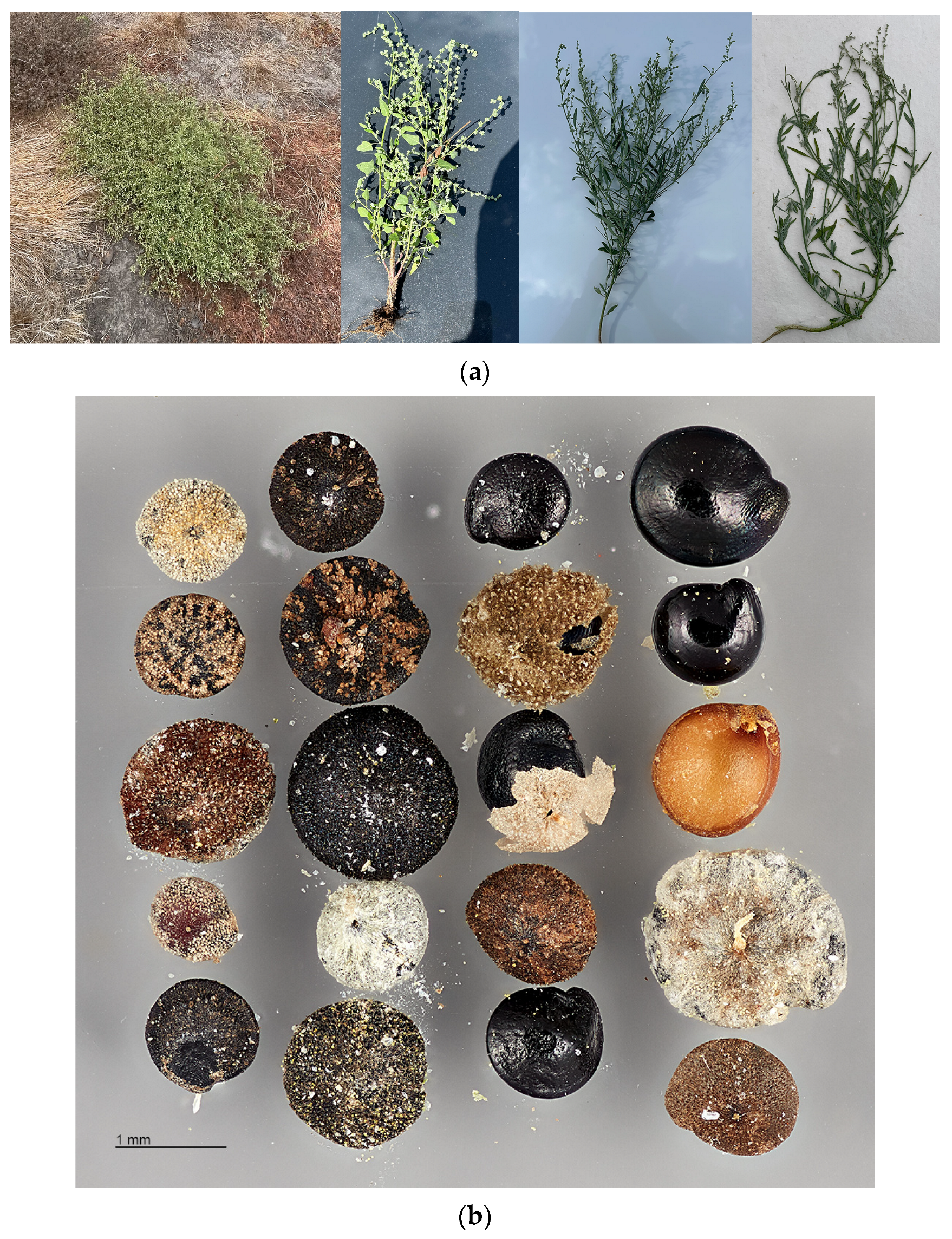
| Chenopodium Taxon | Common Name(s) | Distribution |
|---|---|---|
| berlandieri subsp. berlandieri | Pitseed goosefoot | |
| var. berlandieri | South Texas | |
| var. boscianum | Gulf of Mexico Coast | |
| var. bushianum | Eastern North America | |
| var. macrocalycium | New England Coast | |
| var. sinuatum | Mojave and Sonoran Deserts | |
| var. wilsonii 1 | Eastern Oklahoma | |
| var. zschackei | Great Basin, Rocky Mountains, western Great Plains | |
| berlandieri subsp. nuttaliae | ||
| var. nuttaliae | Huauzontle, chia | South-central Mexico |
| var. pueblense 1 | quelite | South-central Mexico |
| hircinum | Avian goosefoot | Southern South America |
| quinoa subsp. melanospermum | Ajara, ayara | Quinoa fields |
| quinoa subsp. milleanum | Ajara, ayara | Quinoa fields |
| quinoa subsp. quinoa | Quinoa, quinua, dzawe, jirwa | Andes, South-central Chile |
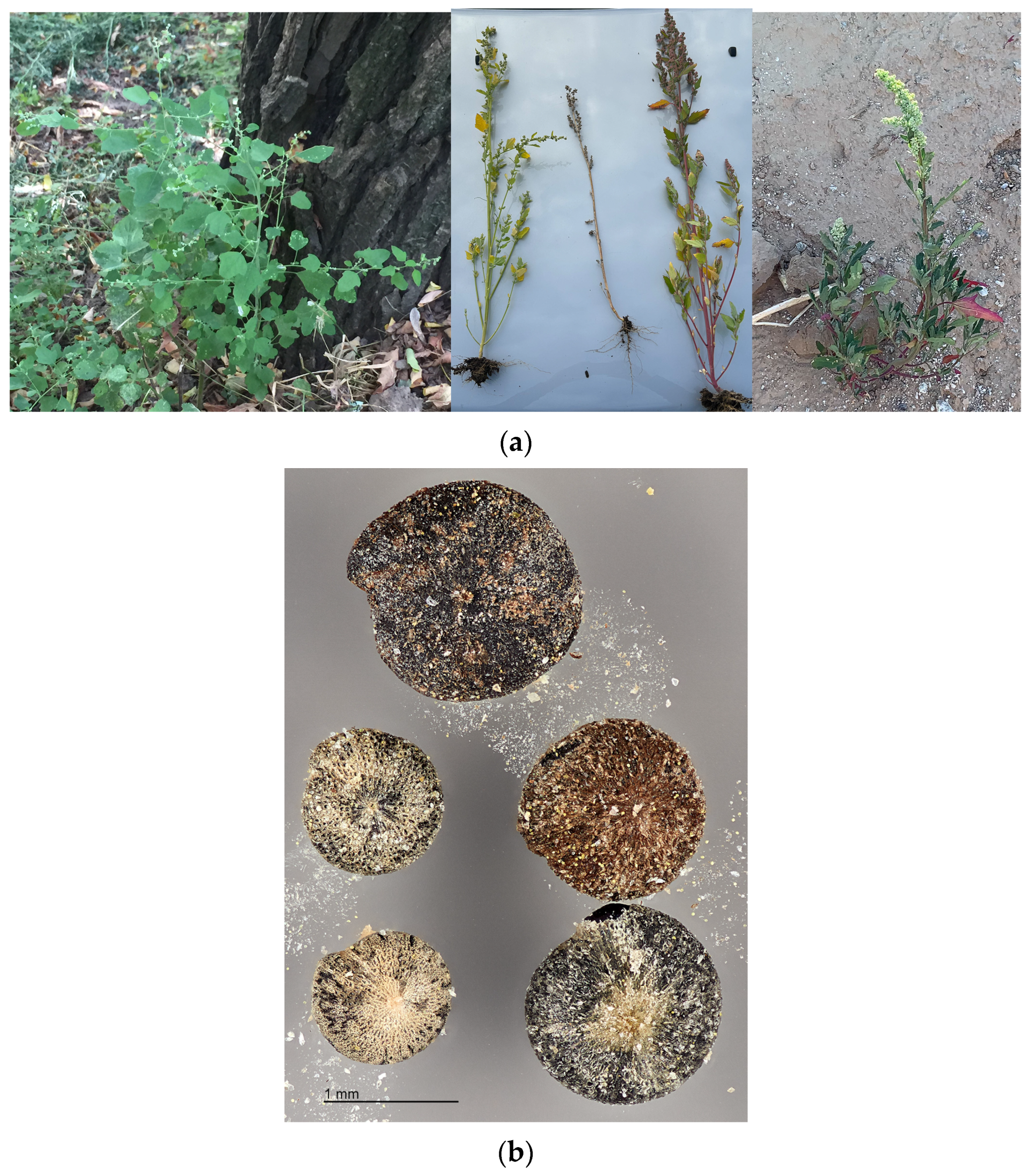
| Chenopodium Taxon | Subgroup | Distribution |
|---|---|---|
| albescens Small | Texas | |
| arizonicum Standl. | NEOM | Arizona, New Mexico |
| atrovirens Rydb. | Great Basin, Rocky Mts. | |
| aureum Benet-Pierce | HIAN | Sierra Nevada Mts. |
| brandegeeae Benet-Pierce | HIAN | S California |
| bryoniifolium | NE Asia | |
| carnosolum Moq | S Patagonia, Andes Mts. | |
| cordobense Aellen | W Argentina | |
| cycloides A. Nelson | Southern Great Plains | |
| desiccatum A. Nelson | W North America, South America | |
| eastwoodiae Benet-Pierce | HIAN | Sierra Nevada Mts. |
| ficifolium Sm. | BB | Eurasia; global weed |
| flabellifolium Standl. | NEOM | Isla San Martin (Mexico) |
| foggii Wahl | Appalachian Mts. | |
| fremontii S. Wats. | W North America | |
| hians Wahl | HIAN | W North America |
| howellii Benet-Pierce | HIAN | Sierra Nevada Mts. |
| incanum A. Heller | Great Basin, Arizona, Great Plains | |
| incognitum Wahl | HIAN | Great Basin, Rocky Mts. |
| lenticulare Aellen | NEOM | Chihuahuan Desert |
| leptophyllum (Nutt ex Moq) B.D. Jacks | W North America | |
| lineatum Benet-Pierce | HIAN | Sierra Nevada Mts. |
| littoreum Benet-Pierce & M.G. Simpson | Central California Coast | |
| luteum Benet-Pierce | HIAN | Sierra Nevada Mts. |
| neomexicanum Standl. | NEOM | Arizona, New Mexico |
| nevadense Standl. | W Great Basin | |
| nitens Benet-Pierce & M.G. Simpson | W North America | |
| obscurum Aellen | W Argentina | |
| pallescens Standl. | Great Plains | |
| pallidicaule Aellen | Andes Mts.; incl. cultigens (cañahua) | |
| palmeri Standl. | NEOM | Sonoran Desert |
| papulosum Moq | W Argentina | |
| parryi Standl. | NEOM | Sierra Madre Oriental Mts. |
| petiolare Kunth | Andes Mts., Peruvian Coast | |
| philippianum Aellen | Andes Mts. | |
| pilcomayense Aellen | N Pampas, Gran Chaco | |
| pratericola Rydb. | W North America, South America | |
| ruiz-lealii Aellen | W Argentina | |
| sandersii Benet-Pierce | HIAN | S California |
| scabricaule Speg. | Patagonia | |
| simpsonii Benet-Pierce | HIAN | S California |
| sonorense Benet-Pierce & M.G. Simpson | NEOM | Sonoran Desert |
| standleyanum Aellen | E North America | |
| subglabrum (S. Watson) A. Nelson | Great Plains, Great Basin | |
| suecicum Murr | BB | Alaska, Eurasia; global weed |
| twisselmannii Benet-Pierce | HIAN | Sierra Nevada Mts. |
| ucrainicum Mosyakin & Mandák | BB | E Europe |
| wahlii Benet-Pierce | HIAN | S California |
| watsonii A. Nelson | NEOM | Colorado Plateau, Great Plains |
Disclaimer/Publisher’s Note: The statements, opinions and data contained in all publications are solely those of the individual author(s) and contributor(s) and not of MDPI and/or the editor(s). MDPI and/or the editor(s) disclaim responsibility for any injury to people or property resulting from any ideas, methods, instructions or products referred to in the content. |
© 2025 by the authors. Licensee MDPI, Basel, Switzerland. This article is an open access article distributed under the terms and conditions of the Creative Commons Attribution (CC BY) license.
Share and Cite
Stephensen, K.B.; Costa-Tártara, S.M.; Roser, R.L.; Jarvis, D.E.; Maughan, P.J.; Jellen, E.N. Germplasm Pools for Quinoa Improvement. Crops 2026, 6, 4. https://doi.org/10.3390/crops6010004
Stephensen KB, Costa-Tártara SM, Roser RL, Jarvis DE, Maughan PJ, Jellen EN. Germplasm Pools for Quinoa Improvement. Crops. 2026; 6(1):4. https://doi.org/10.3390/crops6010004
Chicago/Turabian StyleStephensen, Kayla B., Sabrina M. Costa-Tártara, Riley L. Roser, David E. Jarvis, Peter J. Maughan, and Eric N. Jellen. 2026. "Germplasm Pools for Quinoa Improvement" Crops 6, no. 1: 4. https://doi.org/10.3390/crops6010004
APA StyleStephensen, K. B., Costa-Tártara, S. M., Roser, R. L., Jarvis, D. E., Maughan, P. J., & Jellen, E. N. (2026). Germplasm Pools for Quinoa Improvement. Crops, 6(1), 4. https://doi.org/10.3390/crops6010004