Article

Environmental Drivers of Blowfly Pre-Colonization Interval on Human Remains in Forensic Entomology

1
Department of Anthropology, University of Tennessee at Knoxville, Knoxville, TN 37996, USA
2
Department of Thoracic and Cardiovascular Surgery, Medical School, Chonnam National University, Gwangju 61186, Republic of Korea
*
Authors to whom correspondence should be addressed.
Forensic Sci. 2026, 6(2), 44; https://doi.org/10.3390/forensicsci6020044
Submission received: 1 April 2026 / Revised: 17 May 2026 / Accepted: 20 May 2026 / Published: 21 May 2026

Abstract

Background: Accurate estimation of the pre-colonization interval (pre-CI), defined as the period between body deposition and initial insect oviposition, remains a challenge in postmortem interval estimation in forensic entomology. This study quantified the effects of environmental and contextual variables on blowfly oviposition timing using human cadavers. Methods: Daily photographic records from 203 donated cadavers placed at the University of Tennessee Anthropology Research Facility (March 2011–July 2014) were used to document the first observed oviposition of blowflies. Multivariable general linear models evaluated the effects of monthly temperature, black plastic coverage, and pre-placement soft tissue damage on calendar days to oviposition (IOday) and accumulated degree days (IOADD). Results: Temperature was the dominant predictor, explaining substantial variation in pre-CI. Black plastic coverage significantly delayed oviposition and exhibited a temperature-dependent effect. Although soft tissue damage was associated with earlier oviposition in univariable analyses, it did not remain significant in multivariable models. Cold conditions were associated with prolonged and highly variable pre-CI. Conclusions: These findings demonstrate that temperature was the strongest predictor in this observational dataset, while contextual factors such as physical barriers modify colonization patterns. Together, they highlight the need to incorporate environmental and contextual variables into PMI estimation models and support more defensible interpretations of entomological evidence, particularly in cases involving delayed colonization or restricted insect access.

1. Introduction

Estimation of the postmortem interval (PMI), defined as the time elapsed since death, is fundamental to forensic investigations. Accurate PMI determination supports suspect identification, victim profiling, alibi verification, and crime scene reconstruction [1,2]. Multiple forensic disciplines contribute complementary methods across varying temporal windows.
Early postmortem changes, including algor mortis, rigor mortis, and livor mortis, can provide useful short-term information in recently deceased individuals [3]. Biochemical indicators such as vitreous chemistry have long been used in postmortem investigation, while microbial succession offers additional promise for intermediate PMI estimation [2,3]. At longer intervals, taphonomic approaches using accumulated degree days (ADD) and total body scores (TBS) quantify decomposition progression over weeks to months, with decomposition state shown to reflect thermal accumulation as well as elapsed time since death [1,4,5,6].
Forensic entomology further expands PMI estimation through analysis of carrion insect succession and developmental stages of immature insects [7,8]. Contemporary frameworks distinguish the pre-colonization interval (pre-CI), defined as the period between body deposition and first insect oviposition, from the post-colonization interval (post-CI), which is estimated from larval and pupal development following colonization (i.e., minPMI) [8]. Blowflies in the family Calliphoridae are typically among the earliest colonizers, and their arrival is influenced by environmental conditions and carcass accessibility [7,9]. Subsequent larval feeding substantially accelerates soft tissue breakdown, and physical disturbance such as scavenging or body movement can alter decomposition dynamics [10].
Failure to account for pre-CI duration can therefore introduce considerable uncertainty into PMI estimation [11]. Estimation of pre-CI, together with minPMI, remains one of the fundamental challenges in entomological PMI analysis [12,13]. Many PMI models implicitly assume immediate or near-immediate colonization following body deposition; however, empirical evidence shows that colonization may be delayed by interacting behavioral, physiological, and environmental factors [8,11]. Ambient temperature is a major influence on blowfly activity and colonization timing, and temperature extremes are associated with delayed insect access and reduced activity [9]. Physical barriers, including wrapping materials and other forms of concealment, may further impede insect access, whereas preexisting wounds can facilitate colonization by increasing access and odor release [14,15,16].
Additional extrinsic influences, including precipitation, wind, and diel activity patterns, have also been reported [11]. Together, these factors may produce pre-CI durations ranging from brief delays in warm conditions to substantially longer delays in colder environments [17,18]. Despite extensive research, important limitations persist in pre-CI studies. Many investigations are geographically heterogeneous, disproportionately biased toward summer observations, reliant on nonhuman animal proxies, or constrained by limited sample sizes that restrict robust multivariable modeling [12,13]. Even recent human cadaver studies reveal notable gaps. Owings et al. [17], analyzing 62 human cadavers, documented blowfly pre-CI patterns, but winter representation and multifactor interaction effects remained limited. Likewise, Brajković [18] highlighted unresolved challenges related to thermogenesis, species-specific succession dynamics, and estimation reliability across decomposition contexts.
The present study addresses these limitations through systematic longitudinal monitoring of 203 donated human cadavers at the University of Tennessee Anthropology Research Facility. This dataset enables quantification of blowfly pre-CI in East Tennessee across complete seasonal cycles and permits evaluation of ecologically relevant modifiers. Specifically, we examine seasonal patterns and temperature dependence of blowfly pre-CI on human cadavers, the influence of black plastic sheeting on pre-CI and potential seasonal variation in this effect, and whether cadavers exhibiting soft tissue damage, including autopsy incisions or perimortem injuries, demonstrate accelerated pre-CI relative to intact individuals. By generating region-specific pre-CI correction factors with quantified uncertainty, this study refines entomological PMI estimation and establishes a regional reference framework that may be adaptable to comparable temperate-climate settings.

2. Materials and Methods

This study was conducted at the Anthropology Research Facility (ARF; 35.956° N, 83.982° W), University of Tennessee, Knoxville (UTK). The approximately 2.5-acre outdoor research facility consists of mixed deciduous forest enclosed by 2.4 m double fencing with secured access gates. The fencing system excludes medium and large scavengers while permitting smaller scavengers such as raccoons [12]. Donated cadavers were received through the UTK Forensic Anthropology Center (FAC) and placed unclothed on vegetated ground surfaces in accordance with standardized FAC protocols. Individuals remained in situ until natural skeletonization or mummification occurred. The ARF environment, FAC Body Donation Program, and general procedures for cadaver placement and monitoring have been documented previously [13].
Hourly temperature data were obtained from the McGhee Tyson Airport weather station (KKNX), located approximately 16 km from the ARF. Previous work in the Knoxville area has shown that local weather station records provide a reliable approximation of conditions at the ARF, with good agreement between on-site and station-based temperature measurements [19]. In the present analyses, daily mean temperatures were calculated from hourly values, and monthly mean temperatures were subsequently derived from daily means.
A total of 203 donated cadavers, including 100 males and 103 females placed between March 2011 and July 2014, were included in this study. The mean ages at death were 65.2 years (SD = 14.0) for males and 63.3 years (SD = 13.9) for females. Most individuals were reported as White (196 of 203; 96.6%), with the remainder reported as Black (n = 3), Hispanic (n = 2), or of mixed White and Native American ancestry (n = 2). Each cadaver was monitored daily from placement until skeletonization or mummification, and photographic documentation was archived in the FAC Daily Photo Database (DPD).
A median interval of 7 days (interquartile range [IQR]: 3–14 days) was observed between death and placement. This interval reflected logistical and administrative factors, including processing of decedents, transportation, and scheduling constraints. In some cases, placement was intentionally delayed to accommodate concurrent research needs at the ARF. Following arrival at the FAC, cadavers were typically placed within one to two days after temporary storage under refrigerated conditions (4 °C). When longer storage was required, bodies were held in a −20 °C freezer and subsequently thawed prior to placement. Ten individuals (4.9%) underwent freezing prior to placement and consequently exhibited a substantially longer interval between death and placement (mean = 154.0 days; SD = 126.9 days).
Of the 203 cadavers, 143 (70.4%) were placed in a prone position and loosely covered with heavy-duty black plastic sheeting (1.5 mil thickness), while 60 (29.6%) were placed supine without plastic coverage. A subset of 55 individuals (27.1%) exhibited pre-placement soft tissue damage resulting from autopsy, perimortem injury, or research-related interventions. These individuals were distributed across seasons as follows: spring (n = 19), summer (n = 17), fall (n = 10), and winter (n = 9). Monthly mean temperatures and cadaver placement distributions by month and treatment condition during the 2011–2014 study period are presented in Table 1.
Initial blowfly oviposition was identified using daily photographic records from the FAC DPD. All 203 cadavers were photographed by the first author, who also determined the presence or absence of egg masses on the bodies, to ensure methodological consistency. Cadavers were monitored in situ without manipulation or repositioning in order to preserve the integrity of the decomposition process and the surrounding microenvironment. Photographic documentation followed a FAC protocol template consisting of (1) full-body views, (2) sectional views of the upper, mid-, and lower body, and (3) systematic close-up images of the head (anterior, lateral, and superior views), limbs, hands, feet, and genital region. During each visit, all exposed surfaces of the cadavers, including the body-soil interface, were carefully inspected for egg masses. Any observed eggs were documented with additional close-up photographs. Although this approach captured all visually accessible oviposition events, egg deposition directly beneath the body-soil contact surface could not be ruled out. Photographs were taken once per day throughout the study period. Since daily site visits were required over the three-year study period, photography could not always be conducted at the same time each day. Sessions were typically performed between 08:00 and 17:00, resulting in inter-observation intervals of approximately 15 to 33 h. The first author was present at the time of placement for approximately 190 cadavers and obtained initial Day 1 photographs immediately thereafter. For the remaining cadavers, FAC staff notified the first author after placement, and the initial photographs were taken within 8 to 12 h. Continuous video monitoring was not employed. Efforts were made to minimize human-mediated disturbance; however, unavoidable intervention included temporarily uncovering and re-covering black plastic sheeting during photography and other FAC-approved research activities. Pre-CI was quantified using two outcome variables: IOday, defined as the number of days from placement to the first observation of eggs, and IOADD, defined as the accumulated degree days (ADD) over the same interval. Egg masses were identified based on characteristic morphology, including clustered white or yellowish eggs approximately 1–2 mm in length, typically comprising 200–500 eggs per mass. Although the anatomical location of first observed oviposition was recorded, no egg samples were collected for species-level identification in order to preserve natural insect succession for concurrent ARF research projects. Subsequent longitudinal research at the ARF consistently identified Phormia regina, Lucilia coeruleiviridis, and Calliphora vomitoria as the predominant early colonizers at this site [17,20]. Given their established ecological dominance, these species are recognized as the primary contributors to the oviposition events documented in the present study.
Because IOday included zero values and both IOday and IOADD exhibited right-skewed distributions, log-transformations were applied to stabilize variance and approximate normality. Specifically, log(IOday + 1) and log(IOADD) were used as transformed outcomes. Based on preliminary univariable analyses, only predictors that were significantly associated with both outcomes were retained for multivariable modeling. These included monthly temperature, use of black plastic, and pre-placement soft tissue damage. Multivariable general linear models (GLMs) were constructed to assess the effects of these predictors on pre-CI. For the calendar-based outcome, log(IOday + 1) was modeled as a function of monthly temperature, black plastic use, and soft tissue damage. For the temperature-adjusted outcome, log(IOADD) was modeled using the same predictors to evaluate treatment effects while accounting for thermal accumulation. Statistical significance was set at α = 0.05. All analyses were conducted in RStudio (version 2025.5.1.513 for Windows), using standard linear modeling procedures consistent with recent entomological and decomposition studies [8,14,15].

3. Results

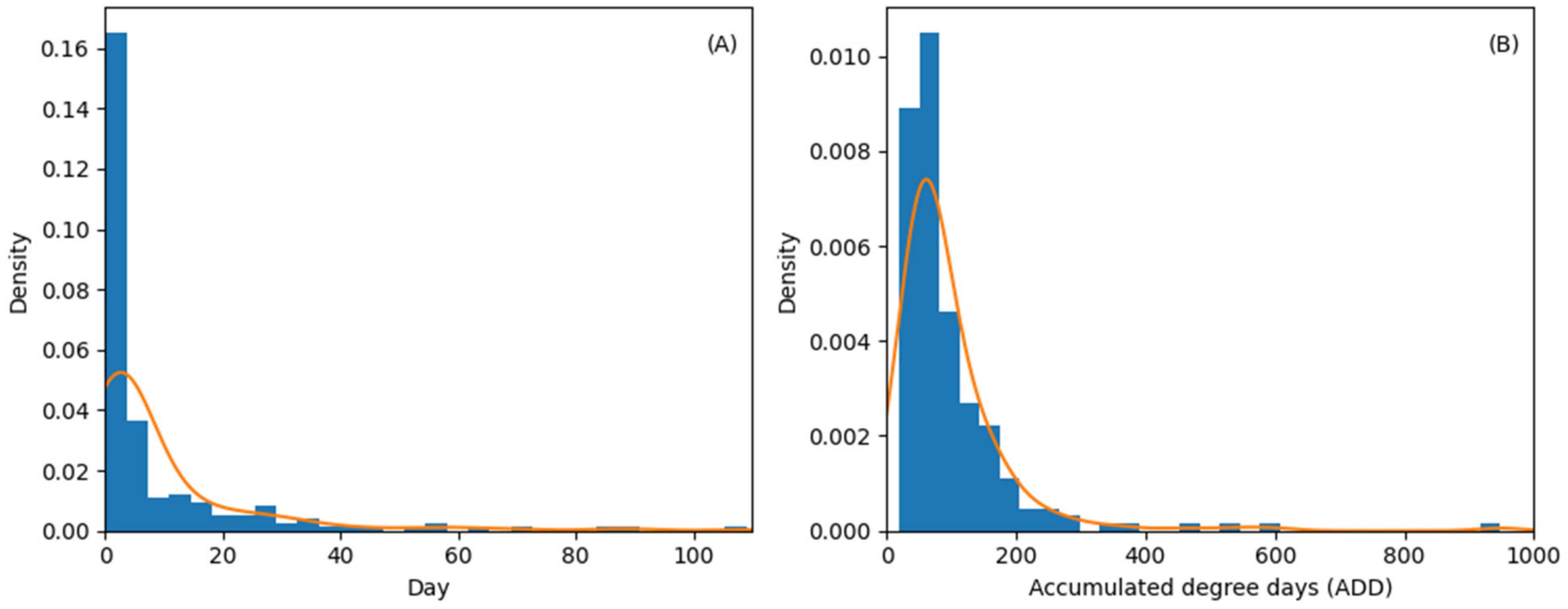
A total of 203 donated cadavers were placed in an outdoor setting between March 2011 and July 2014, and first observed oviposition patterns of blowflies were recorded. Pre-CI exhibited substantial variability and right-skewed distributions for both IOday and IOADD (Figure 1). Across all cases, first observed oviposition occurred at a median of 3 days (IQR: 1–8.5) following placement, corresponding to a median of 71.7 ADD (IQR: 48.9–113.9). IOday ranged from 0 to 109 days, and IOADD ranged from 19.4 to 947.8 ADD. These results indicate that first observed oviposition typically occurred within a relatively short period after placement, although extended delays were observed in a subset of cases.

3.1. Seasonal and Temperature Patterns

Clear seasonal differences in blowfly pre-CI were observed (Table 2). During warmer months (May–September), where mean monthly temperatures exceeded 20 °C, first observed oviposition generally occurred within 0–4 days following placement, with most observations clustering below 3 days. In contrast, colder months such as December and January (mean temperatures: 7.2 °C and 4.3 °C, respectively) exhibited substantially longer and more variable intervals, with some cases extending beyond 30 days and a maximum delay of 109 days.
Seasonal variation was also evident in the range of pre-CI, which was relatively narrow during summer (typically within 3–5 days) but considerably broader during winter. For example, January showed the widest range, with the first observed oviposition occurring between 1 and 109 days (Table 2). These patterns indicate that both the central tendency and variability of pre-CI are strongly influenced by ambient temperature.
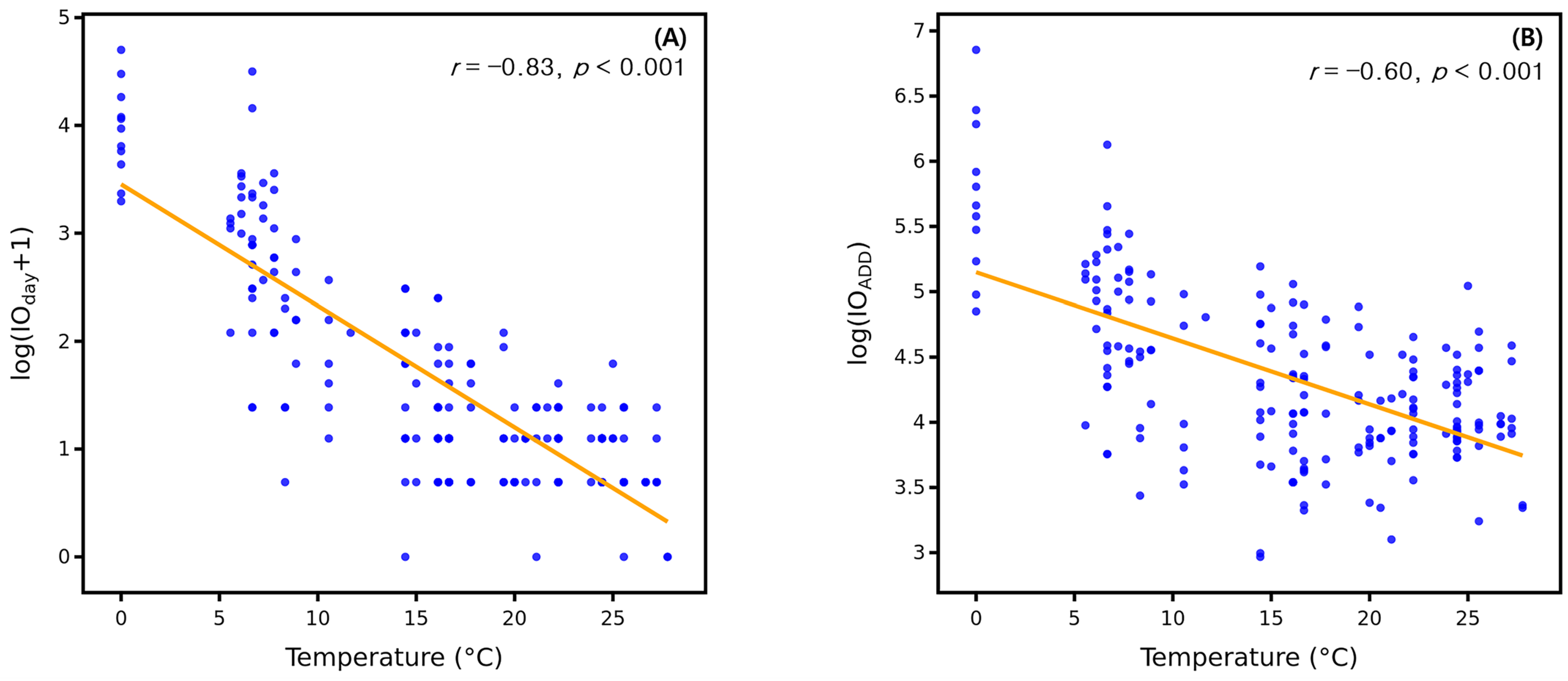
At the individual level, a strong negative relationship between temperature and pre-CI was observed (Figure 2). The relationship between temperature and log(IOday + 1) was described by the following linear model:
log ( I O d a y + 1 ) = 0.139 × T e m p e r a t u r e + 3.757
Back-transformation of the model yields the following equation for estimating IOday:
I O d a y = e ( 0.139 × T e m p e r a t u r e + 3.757 ) 1
This model demonstrated a strong negative correlation (r = −0.83, p < 0.001; R2 = 0.69), indicating that higher temperatures were associated with shorter pre-CI. A similar but weaker relationship was observed for log(IOADD) (r = −0.60, p < 0.001), suggesting that while temperature accounts for a substantial portion of the variation in pre-CI, additional factors also contribute (Figure 2).

3.2. Treatment Effects

Univariable analyses using Mann–Whitney U tests demonstrated that both black plastic use and pre-placement soft tissue damage were significantly associated with pre-CI.
The use of black plastic was associated with delayed oviposition. Cadavers covered with plastic exhibited significantly longer oviposition intervals (median IOday = 3.0 days) compared to those without plastic (median = 1.0 day; U = 3182.5, p = 0.003). A similar pattern was observed for ADD, with higher IOADD values in the plastic-covered group (median = 78.33 ADD) than in the uncovered group (median = 52.5 ADD; U = 3222.0, p = 0.005), indicating delayed colonization (Table 3).
In contrast, pre-placement soft tissue damage was associated with earlier oviposition. Cadavers with soft tissue damage exhibited significantly shorter oviposition intervals (median IOday = 2.0 days) compared to those without damage (median = 3.0 days, U = 4313.5, p < 0.001). Similarly, IOADD values were significantly lower in the damaged group (median = 51.11 ADD) than in the undamaged group (median = 77.22 ADD; U = 4364.0, p < 0.001) (Table 3).
Overall, effect sizes ranged from small to moderate (r = 0.20–0.25), with soft tissue damage showing a slightly stronger influence on pre-CI than black plastic covering. These findings indicate that physical barriers such as plastic coverings delay insect access, whereas tissue damage facilitates earlier colonization, likely by increasing tissue accessibility and enhancing the release of decomposition-related cues (Table 3).

3.3. Multivariable Model Results

A multivariable linear regression model was constructed to evaluate the combined effects of monthly temperature at placement, black plastic use, and pre-placement soft tissue damage on pre-CI. All predictors identified in univariable analyses were retained to assess their independent effects while accounting for potential confounding, and pairwise interaction terms were included following the hierarchical modeling principle.
For log(IOday + 1), the full model was statistically significant (F[3,199] = 79.27, p < 0.001) and explained a substantial proportion of the variance (R2 = 0.708). Temperature was the strongest predictor (β = −0.131, SE = 0.009, p < 0.001). The regression coefficient (β) represents the expected change in the outcome for a one-unit increase in the predictor while holding other variables constant, whereas the standard error (SE) reflects the uncertainty of that estimate. For example, the coefficient for temperature (β = −0.131) indicates that a 1 °C increase in monthly temperature is associated with a 0.131 decrease in log(IOday + 1), corresponding to shorter pre-CI. The small SE of 0.009 indicates a precise and stable estimate (Table 4).
After adjustment for temperature, the main effects of black plastic use (β = −0.319, SE = 0.198, p = 0.108) and soft tissue damage (β = −0.391, SE = 0.305, p = 0.202) were not statistically significant, indicating that their apparent effects in univariable analyses were largely explained by temperature or shared variance with other predictors (Table 4).
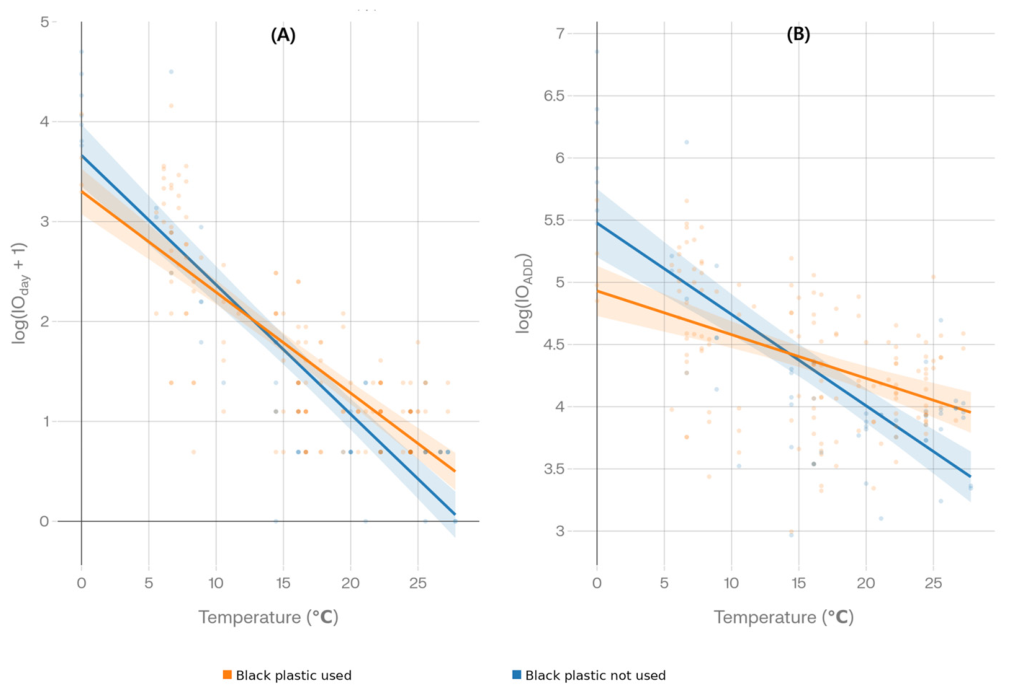
A significant interaction between temperature and black plastic use was observed (β = 0.0265, SE = 0.0111, p = 0.017), indicating that the effect of plastic covering on pre-CI varies across temperature conditions. Specifically, the positive interaction term indicates that the negative effect of temperature is attenuated in the presence of plastic, consistent with a temperature-dependent modifying effect of black plastic. In practical terms, this suggests that the delaying effect of black plastic is more pronounced at lower temperatures, whereas the difference between plastic and non-plastic conditions becomes smaller as temperature increases. This pattern is also reflected in the predicted margins plot, in which the divergence between plastic and non-plastic conditions is greater at lower temperatures and narrows as temperature increases (Figure 3). In contrast, interactions involving soft tissue damage were not statistically significant (all p > 0.05), indicating that the effect of soft tissue damage is relatively consistent across environmental conditions (Table 4).
For log(IOADD), the model was also statistically significant (F[3,199] = 25.29, p < 0.001) and explained a moderate proportion of the variance (R2 = 0.436). Temperature again showed the strongest effect (β = −0.0753, SE = 0.0078, p < 0.001). Black plastic use remained a significant predictor (β = −0.480, SE = 0.172, p = 0.006), whereas soft tissue damage did not reach statistical significance (β = −0.468, SE = 0.265, p = 0.079). The interaction between temperature and black plastic use was again significant (β = 0.0365, SE = 0.0096, p < 0.001), while other interaction terms were not statistically significant (Table 4).
The final regression equations were:
l o g ( I O d a y + 1 ) = 3.706 0.131 T 0.319 P 0.391 D + 0.0265 ( T × P ) + 0.0149 ( T × D ) + 0.0313 ( P × D )
l o g ( I O A D D ) = 5.531 0.0753 T 0.480 P 0.468 D + 0.0365 ( T × P ) + 0.0180 ( T × D ) 0.0560 ( P × D )
where T represents monthly temperature, P indicates black plastic use (0 = no, 1 = yes), and D indicates the presence of soft tissue damage (0 = no, 1 = yes). Although the main effects of black plastic use and soft tissue damage were not statistically significant in the multivariable model for log(IOday + 1), these terms were retained because they were involved in interaction terms and are required for hierarchical model specification. Thus, their coefficients should be interpreted conditionally rather than as uniform effects across all observations.

4. Discussion

This study analyzed the timing of the first observed oviposition by likely early colonizers at the ARF using longitudinal observations of 203 donated human cadavers over a 41-month period (March 2011–July 2014). Decomposition processes were documented through daily photographic records, allowing assessment of the timing and location of the first visually documented oviposition events on observable body surfaces. The term “first observed oviposition” is used deliberately, rather than “initial oviposition,” due to an inherent limitation of the study design. The body–soil interface could not always be examined with complete certainty. Therefore, the analysis was restricted to the detection of eggs on visually accessible surfaces. As a result, the possibility that oviposition occurred earlier in concealed areas directly beneath the body could not be excluded. In addition, “first observed” refers specifically to the first instance of egg deposition on a cadaver documented after placement at the ARF, rather than after body donation. This distinction is important because, in this study, the date of placement served as the reference point for all temporal variables.
This clarification is particularly relevant for the 10 individuals who had been frozen prior to placement, resulting in a discrepancy between donation date and placement date. Prior to placement, these bodies were transported in body bags and allowed to thaw at room temperature for at least one day to minimize the effects of prior freezing and to approximate ambient conditions at the time of placement. Although these cases were macroscopically consistent with the fresh stage of decomposition at placement, a residual cooling effect potentially influencing early insect access could not be fully excluded. However, frozen cases constituted a relatively small proportion of the dataset, and preliminary analyses showed that frozen status was not significantly associated with either IOday (Mann–Whitney U = 869.0, p = 0.593) or IOADD (Mann–Whitney U = 822.0, p = 0.490). Consistent with the variable-selection approach described earlier, only predictors significantly associated with both outcomes in univariable analyses were retained for multivariable modeling; accordingly, frozen status was not included in the final models.
The results suggest that temperature was the strongest predictor of pre-CI in this study, with strong negative associations observed for both IOday and IOADD (Figure 2). Black plastic was associated with delayed oviposition in univariable analyses (Table 3), but its effect was temperature-dependent in multivariable models through a significant interaction with monthly temperature (Table 4). In contrast, soft tissue damage showed a weaker association that was attenuated after adjustment for temperature. Overall, these findings suggest that oviposition timing reflects an interplay of factors, with temperature exerting the clearest influence, black plastic modifying temperature effects, and soft tissue damage contributing in a more limited way in the observed taxa.
The temperature effect observed in this study is consistent with prior forensic entomology research showing that the activity, colonization, and development of forensically relevant flies are strongly temperature-dependent [21,22]. As ectothermic organisms, blowflies rely on ambient temperature to regulate metabolic activity, flight, and oviposition behavior, with both activity and reproductive processes constrained at lower temperatures. Previous studies have reported highly variable oviposition intervals, ranging from near-immediate colonization to delays of several days or longer [11,23]. These discrepancies have often been attributed to differences in environmental conditions, particularly temperature. The present findings help contextualize this variability: warmer conditions were associated with more rapid and relatively consistent oviposition, whereas colder conditions were associated with delayed and more variable colonization (Table 2).
Importantly, most prior studies have focused on temperature-dependent development after colonization, rather than the timing of initial oviposition. Developmental studies consistently show that higher temperatures accelerate insect growth and shorten life cycle duration, but fewer studies have quantified how temperature influences the onset of colonization itself. The present results therefore extend previous work by suggesting that temperature is an important factor not only in development, but also in the timing and variability of the first observed oviposition.
The observed effect of black plastic use is broadly consistent with previous research showing that wrapping or concealment can delay insect access and colonization. Experimental studies have shown that physical barriers can reduce insect visitation and oviposition by limiting access and interfering with odor cues used for host detection [24]. However, the present study suggests that the effect of plastic is not constant but varies with temperature (Table 4). Rather than acting as a uniform delay factor, black plastic modifies the relationship between temperature and pre-CI. This suggests that the impact of wrapping depends on environmental context. A plausible explanation is that plastic alters the dispersal of volatile compounds, which are critical for blowfly attraction. Under colder conditions, insect activity and odor dispersion are already reduced, potentially diminishing the relative effect of plastic. This interpretation is consistent with the broader ecological understanding that insect behavior reflects the interaction between environmental constraints and resource detection processes.
The role of soft tissue damage in oviposition behavior has been variably reported in the literature. While it is commonly suggested that flies preferentially oviposit on exposed or damaged tissue due to increased accessibility and odor release [7], empirical evidence has not always supported a strong or consistent effect. The present results are consistent with this mixed evidence. Soft tissue damage was associated with earlier oviposition in univariable analyses (Table 3), but this effect was attenuated after adjusting for temperature and was not statistically significant in multivariable models (Table 4). In addition, no significant interaction between soft tissue damage and temperature was observed, indicating that its effect does not vary substantially across environmental conditions. These findings suggest that tissue damage may influence local accessibility or oviposition site selection but plays a secondary role relative to temperature in determining the timing of initial colonization.
Delayed colonization under low temperatures has been previously reported, particularly in case-based studies describing atypical or prolonged oviposition intervals [23]. However, the present study provides systematic evidence that colder conditions are associated not only with delay, but also with increased variability. Winter months exhibited substantially wider ranges of oviposition timing, including extreme delays of up to 109 days (Table 2). This suggests that colonization becomes less predictable under colder conditions, likely due to reduced and intermittent insect activity. This finding is particularly important because increased variability reduces the precision of forensic estimates. While developmental models assume relatively predictable temperature-dependent growth, the present results suggest that the pre-colonization interval may be inherently more variable, especially under suboptimal environmental conditions.
The weaker association between temperature and IOADD compared to IOday suggests that pre-CI is not fully explained by accumulated thermal units alone (Figure 2; Table 4). Temperature-dependent development has been extensively validated in forensic entomology and forms the basis of ADD models used in PMI estimation. However, pre-CI represents a behavioral event influenced by multiple factors beyond temperature, including insect activity, access to remains, and environmental context. These findings reinforce an important conceptual distinction: thermal models are highly effective for describing insect development after colonization but may be less suitable for predicting the timing of initial colonization. This distinction is important for forensic interpretation, as errors in the pre-CI can propagate into PMI estimates.
Several limitations should be considered when interpreting the findings of this study. First, although all exposed surfaces and the body–soil interface were carefully examined during each photographic interval, egg masses located directly beneath the body may have been overlooked because of limited visibility. In addition, because observations were conducted only once per day, colonization events occurring between observation periods could not be documented. Certain biological behaviors may also have influenced the recorded timing of insect arrival; for example, stressed Lucilia spp. may deposit live larvae rather than eggs. Consequently, the data presented here should be interpreted as estimates of observable insect activity rather than precise indicators of the onset of colonization. These limitations reflect the inherent challenges of longitudinal field-based forensic entomology studies and highlight the value of continuous monitoring approaches to improve temporal resolution in future research. Additional limitations relate to the environmental and taxonomic scope of the study. Because this study was conducted within a single geographic region, the observed patterns may not be directly generalizable to other climatic or ecological settings. Furthermore, monthly temperature was used as a pragmatic summary measure of environmental conditions based on the structure and availability of the dataset, rather than as an assumption of superior biological relevance. This approach may have obscured short-term environmental fluctuations and finer-scale biological responses. Species-level identifications were also not performed; therefore, interpretation should remain limited to the likely early colonizers observed at the ARF and should not be generalized broadly to blowflies or attributed to only a small number of species. Finally, because mean ambient temperatures may not adequately capture microenvironmental variation at the body level, future studies should incorporate finer-scale temperature measurements along with additional variables, such as carcass coverings and species-specific reproductive responses, to improve the predictive accuracy of colonization timing.


5. Conclusions

This study demonstrates that blowfly pre-CI is primarily governed by ambient temperature, while environmental and contextual factors modulate this relationship in meaningful ways. Temperature showed a strong and consistent influence on the onset of oviposition, supporting its role as the dominant driver in early colonization dynamics. In contrast, physical barriers such as black plastic coverings altered oviposition patterns in a temperature-dependent manner, indicating that access to remains interacts with thermal conditions to shape colonization behavior. The increased variability in oviposition timing observed under colder conditions further suggests that insect-based PMI estimates may be less reliable in such environments. This highlights an important limitation in forensic entomology, particularly when environmental conditions deviate from optimal ranges for insect activity. Taken together, these findings emphasize the necessity of incorporating environmental and contextual variables into PMI estimation models and forensic interpretations. By providing site-specific observational data, this study adds to the limited evidence base for pre-CI estimation in temperate-climate forensic settings.

Author Contributions

Conceptualization, Y.J. (Yangseung Jeong) and L.M.J.; methodology, Y.J. (Yochun Jung); software, Y.J. (Yochun Jung); formal analysis, Y.J. (Yangseung Jeong) and Y.J. (Yochun Jung); investigation, Y.J. (Yangseung Jeong); data curation, Y.J. (Yangseung Jeong); writing-original draft preparation, Y.J. (Yangseung Jeong); writing-review and editing, Y.J. (Yochun Jung); visualization, Y.J. (Yochun Jung); supervision, Y.J. (Yangseung Jeong) and Y.J. (Yochun Jung); project administration, Y.J. (Yangseung Jeong) and L.M.J. All authors have read and agreed to the published version of the manuscript.

Funding

This research was completely supported by the budget of Chonnam National University.

Institutional Review Board Statement

Not applicable. This study does not involve human subjects as defined under relevant federal regulations, and the data and information collected are obtained from deceased individuals rather than living persons. Relevant federal regulations refer to Subpart A of Part 46, Title 45 of the Code of Federal Regulations issued by the U.S. Department of Health and Human Services (HHS).

Informed Consent Statement

Not applicable. This study is based on a retrospective analysis of photographic records of human remains donated to the University of Tennessee’s Forensic Anthropology Center between 2011 and 2014. It does not involve living human participants, interaction or intervention with individuals, or the use of identifiable personal information. All materials analyzed were fully anonymized.

Data Availability Statement

Inquires can be directed to the corresponding author.

Acknowledgments

The authors sincerely thank the donors and their families whose generous body donations to the Forensic Anthropology Center at the University of Tennessee made this research possible. The authors also express their sincere gratitude to Ddoksoon Lee and the anonymous reviewers for their careful review of the manuscript and for their valuable comments.

Conflicts of Interest

The authors declare no conflicts of interest.

References

  1. Megyesi, M.S.; Nawrocki, S.P.; Haskell, N.H. Using accumulated degree-days to estimate the postmortem interval from decomposed human remains. J. Forensic Sci. 2005, 50, 618–626. [Google Scholar] [CrossRef]
  2. Adserias-Garriga, J.; Hernández, M.; Quijada, N.M.; Lázaro, D.R.; Steadman, D.W.; García-Gil, L.J. Daily thanatomicrobiome changes in soil as an approach of postmortem interval estimation: An ecological perspective. Forensic Sci. Int. 2017, 278, 388–395. [Google Scholar] [CrossRef]
  3. Madea, B.; Musshoff, F. Postmortem biochemistry. Forensic Sci. Int. 2007, 165, 165–171. [Google Scholar] [CrossRef] [PubMed]
  4. Simmons, T.; Adlam, R.E.; Moffatt, C. Debugging decomposition data: Comparative taphonomic studies and the influence of insects and carcass size on decomposition rate. J. Forensic Sci. 2010, 55, 8–13. [Google Scholar] [CrossRef] [PubMed]
  5. Simmons, T.; Cross, P.A.; Adlam, R.E.; Moffatt, C. The influence of insects on decomposition rate in buried and surface remains. J. Forensic Sci. 2010, 55, 889–892. [Google Scholar] [CrossRef] [PubMed]
  6. Dautartas, A.M.; Kenyhercz, M.W.; Vidoli, G.M.; Jantz, L.M.; Mundorff, A.; Steadman, D.W. Differential decomposition among pig, rabbit, and human remains. J. Forensic Sci. 2018, 63, 1673–1683. [Google Scholar] [CrossRef]
  7. Byrd, J.H.; Castner, J.L. Forensic Entomology: The Utility of Arthropods in Legal Investigations, 3rd ed.; CRC Press: Boca Raton, FL, USA, 2019. [Google Scholar]
  8. Tomberlin, J.K.; Mohr, R.M.; Benbow, M.E.; Tarone, A.M.; VanLaerhoven, S. A roadmap for bridging basic and applied research in forensic entomology. Annu. Rev. Entomol. 2011, 56, 401–421. [Google Scholar] [CrossRef]
  9. Shiravi, A.H.; Mostafavi, R.; Akbarzadeh, K.; Oshaghi, M.A. Temperature requirements of some common forensically important blow and flesh flies (Diptera) under laboratory conditions. Iran. J. Arthropod Borne Dis. 2011, 5, 54–62. [Google Scholar] [PubMed]
  10. Adlam, R.E.; Simmons, T. The effect of repeated physical disturbance on soft tissue decomposition—Are taphonomic studies an accurate reflection of decomposition? J. Forensic Sci. 2007, 52, 1007–1014. [Google Scholar] [CrossRef] [PubMed]
  11. Catts, E.P. Problems in estimating the postmortem interval in death investigations. J. Agric. Entomol. 1992, 9, 245–255. [Google Scholar]
  12. Jeong, Y.; Jantz, L.M.; Smith, J. Investigation into seasonal scavenging patterns of raccoons on human decomposition. J. Forensic Sci. 2016, 61, 467–471. [Google Scholar] [CrossRef]
  13. Shirley, N.R.; Wilson, R.J.; Jantz, L.M. Cadaver use at the University of Tennessee’s Anthropological Research Facility. Clin. Anat. 2011, 24, 372–380. [Google Scholar] [CrossRef]
  14. Matuszewski, S.; Mądra-Bielewicz, A. Validation of temperature methods for the estimation of pre-appearance interval in carrion insects. Forensic Sci. Med. Pathol. 2016, 12, 50–57. [Google Scholar] [CrossRef]
  15. Matuszewski, S.; Szafalowicz, M.; Grzywacz, A. Temperature dependent appearance of forensically useful flies on carcasses. Int. J. Leg. Med. 2013, 128, 1013–1020. [Google Scholar] [CrossRef]
  16. Cross, P.; Simmons, T. The influence of penetrative trauma on the rate of decomposition. J. Forensic Sci. 2010, 55, 295–301. [Google Scholar] [CrossRef]
  17. Owings, C.G.; McKee-Zech, H.S.; Patrick, E.A.; Steadman, D.W. A blow fly (Diptera: Calliphoridae) pre-colonization interval dataset for improving forensic entomology estimations. J. Forensic Sci. 2025, 70, 2393–2402. [Google Scholar] [CrossRef] [PubMed]
  18. Matuszewski, S. Post-Mortem Interval Estimation Based on Insect Evidence: Current challenges. Insects 2021, 12, 314. [Google Scholar] [CrossRef] [PubMed] [PubMed Central]
  19. Hauther, K.; Boyd, D.A.; Cawley, W.; Sauerwein, K.; Jeong, Y. Seasonal and spatial variation in local weather station data from Knoxville, TN. In Proceedings of the 70th Annual Meeting of the American Academy of Forensic Sciences, Seattle, WA, USA, 19–23 February 2018. [Google Scholar]
  20. Jeong, Y.; Weidner, L.M.; Pergande, S.; Gemmellaro, D.; Jennings, D.E.; Hans, K.R. Biodiversity of forensically relevant blowflies (Diptera: Calliphoridae) at the Anthropology Research Facility in Knoxville, Tennessee, USA. Insects 2022, 13, 109. [Google Scholar] [CrossRef] [PubMed]
  21. Amendt, J.; Krettek, R.; Zehner, R. Forensic entomology. Naturwissenschaften 2004, 91, 51–65. [Google Scholar] [CrossRef]
  22. Joseph, I.; Mathew, D.G.; Sathyan, P.; Vargheese, G. The use of insects in forensic investigations: An overview on the scope of forensic entomology. J. Forensic Dent. Sci. 2011, 3, 89–91. [Google Scholar] [CrossRef]
  23. Owings, C.G.; Spiegelman, C.; Tomberlin, J.K. Not by the book: Observations of delayed oviposition and re-colonization of human remains. Insects 2022, 13, 879. [Google Scholar] [CrossRef] [PubMed]
  24. Brownlow, L.; Young, S.; Fernández-Grandon, M.; Hopkins, R.J. Case closed—Wrappings and encasement delays and reduces fly presence on decomposing carcasses. Forensic Sci. Int. 2023, 342, 111542. [Google Scholar] [CrossRef] [PubMed]
Figure 1. Pre-CI measured in days (A) and accumulated degree days (B) across 203 donated cadavers placed between March 2011 and July 2014. Blue bars indicate histogram densities and orange curves represent kernel density estimates.
Forensicsci 06 00044 g001
Figure 2. Relationship between monthly temperature at placement and pre-CI. (A) log(IOday + 1) plotted against monthly temperature corresponding to the month of placement. (B) log(IOADD) plotted against monthly temperature. Blue points represent individual observations and the solid lines represent fitted linear regression models. Correlation coefficients (r) and p-values are shown in each panel.
Forensicsci 06 00044 g002
Figure 3. Predicted margins showing the relationship between monthly temperature and log(IOday + 1) (A) and log(IOADD) (B). Orange and blue dots represent observed values for cadavers with and without black plastic, respectively. Note that the delaying effect of black plastic becomes more pronounced at lower temperatures.
Forensicsci 06 00044 g003
Table 1. Monthly mean temperature and distribution of individuals by treatment conditions, 2011–2014.
MonthMonthly Temp (°C)Black Plastic UsedBlack Plastic Not UsedTotal
Soft Tissue Damage PresentSoft Tissue Damage Not PresentSoft Tissue Damage PresentSoft Tissue Damage Not Present
January4.34101621
February6.725029
March10.84110621
April16.47140526
May20.64104422
June24.7195722
July25.8662318
August25.623128
September21.7580316
October15.21121620
November9.1281011
December7.2270110
Total 401031545203
Table 2. Monthly variation in pre-CI of blowflies, including mean monthly temperature (°C), median days to the first observed oviposition, interquartile range (IQR), and range (min–max).
MonthNMean Temp (°C)Median (Days)IQR (Days)Min–Max (Days)
January214.33326.010–109
February96.71513.07–22
March2110.888.02–27
April2616.423.01–7
May2220.61.51.01–7
June2224.711.00–3
July1725.811.00–3
August825.611.01–5
September1621.721.00–3
October2015.22.54.250–11
November119.145.51–12
December107.22712.7512–89
Table 3. Effects of black plastic use and pre-placement soft tissue damage on pre-CI of blowflies.
TreatmentOutcomeWithout TreatmentWith TreatmentUZ apr b
NMedianNMedian
Black plasticIOday601.01433.03182.5−2.900.003 *0.20
IOADD6052.514378.33222.0−2.800.005 *0.20
Soft tissue damageIOday1483.0552.04313.53.38<0.001 *0.24
IOADD14877.25551.14364.03.54<0.001 *0.25
a Standardized form of the U statistic. b Effect size. * Significant at α = 0.01.
Table 4. Multivariable linear regression models of IOday and IOADD as a function of monthly temperature, black plastic use, pre-placement soft tissue damage, and interaction terms.
OutcomePredictorβSEp
log (IOday + 1)Interceptor3.7060.162<0.001 *
Monthly temperature(T)−0.1310.009<0.001 *
Black plastic use (B)−0.3190.1980.108
Soft tissue damage (D)−0.3910.3050.202
T × P0.02650.01110.017 *
T × D0.01490.01250.235
P × D0.03130.2120.883
log (IOADD)Interceptor5.5310.141<0.001 *
Monthly temperature(T)−0.07530.0078<0.001 *
Black plastic use (B)−0.4800.1720.006 *
Soft tissue damage (D)−0.4680.2650.079
T × P0.03650.0096<0.001 *
T × D0.01800.01080.099
P × D−0.05600.1840.761
* Significant at α = 0.01.
Disclaimer/Publisher’s Note: The statements, opinions and data contained in all publications are solely those of the individual author(s) and contributor(s) and not of MDPI and/or the editor(s). MDPI and/or the editor(s) disclaim responsibility for any injury to people or property resulting from any ideas, methods, instructions or products referred to in the content.