
Density-Dependent and Predator-Specific Nest Defense Strategies in Colonially Breeding Saunders’s Gulls

1
Research Center for Endangered Species, National Institute of Ecology, Yeongyang 36531, Republic of Korea
2
Bird Research Center, National Park Research Institute, Korea National Park Service, Sinan 58863, Republic of Korea
*
Author to whom correspondence should be addressed.
Birds 2025, 6(4), 61; https://doi.org/10.3390/birds6040061
Submission received: 13 October 2025
/
Revised: 1 November 2025
/
Accepted: 7 November 2025
/
Published: 11 November 2025
Simple Summary
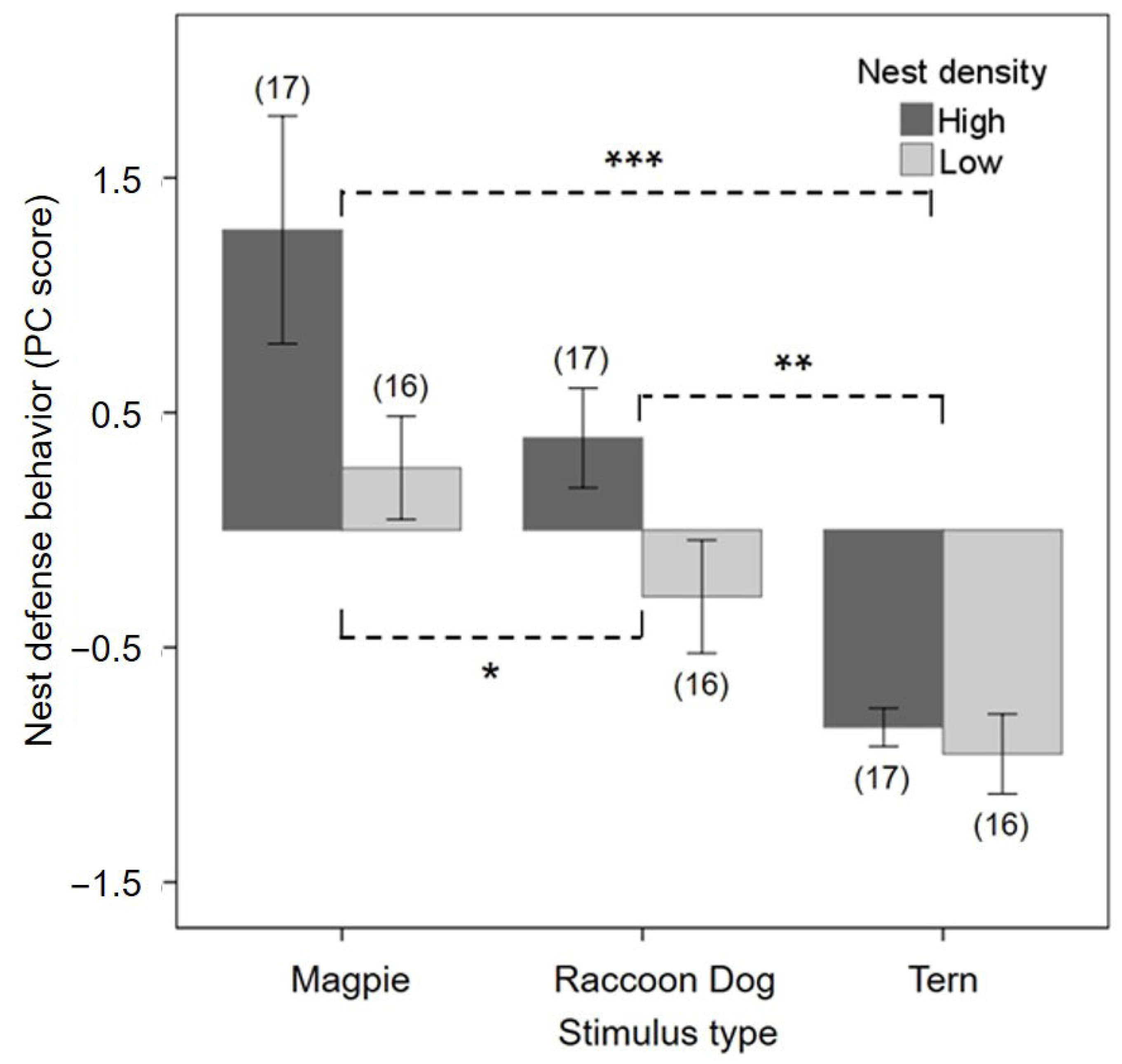
We investigated how nest defense behavior in Saunders’s Gulls varies with nest density and predator type in South Korea. Using decoy experiments with a diurnal avian predator, a nocturnal mammalian predator, and a neutral co-nester, we found that gulls responded most rapidly and aggressively to magpies, less to raccoon dogs, and least to terns. Highly dense nest sites showed stronger collective defense with more mobbing individuals. Overall, Saunders’s Gulls flexibly adjusted their defense according to predator threat and social context, demonstrating the adaptive value of density-dependent collective defense in a colonially breeding seabird.
Abstract
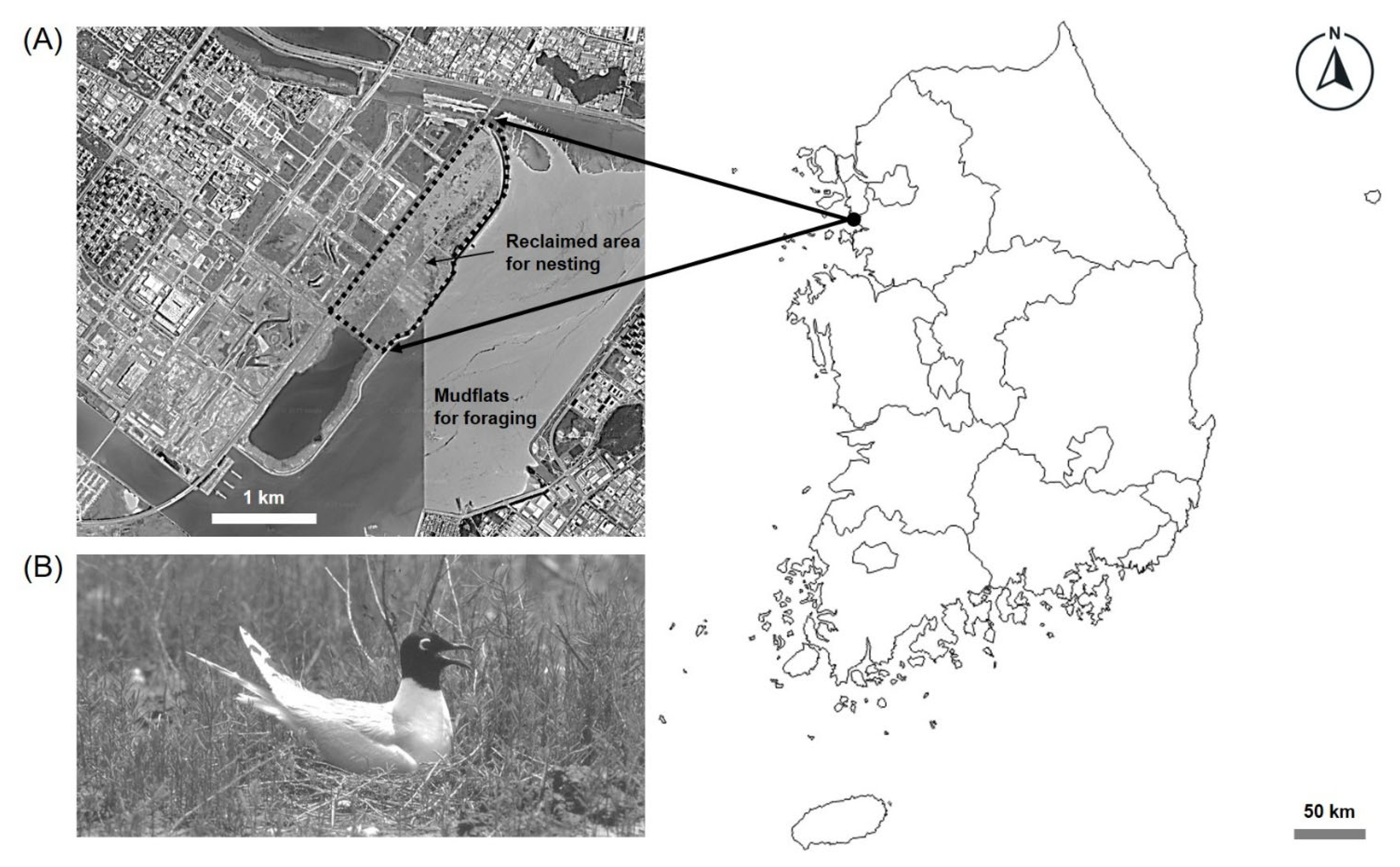
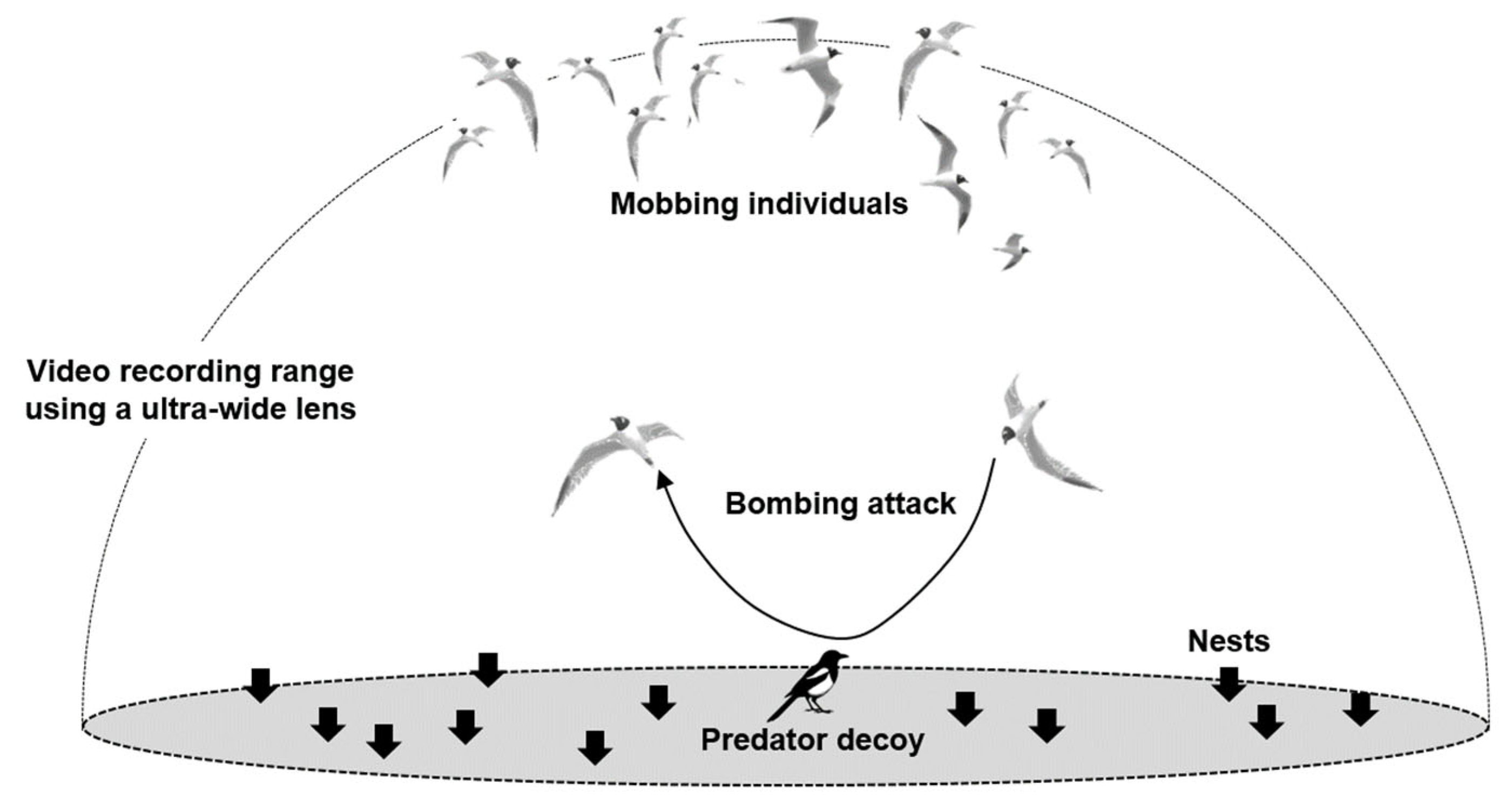
Nest defense is a key component of avian reproductive success, yet its intensity and expression often depend on ecological and social contexts. We investigated the nest defense behaviors of Saunders’s Gulls (Saundersilarus saundersi) breeding in Incheon Bay of South Korea in 2022 in relation to nest density and perceived threats. Using decoy presentations of three heterospecifics, Oriental Magpie (Pica serica; diurnal avian nest predator), common raccoon dog (Nyctereutes procyonoides; nocturnal mammalian nest predator), and Little Tern (Sternula albifrons; neutral co-nester), we quantified latency to respond, bombing attack rate, and the number of mobbing individuals at high- and low-density nesting sites within a breeding colony. Mixed models revealed that latency to respond and attack rates varied strongly with stimulus type, with diurnal predator magpies eliciting the fastest and most intense responses, followed by nocturnal predator raccoon dogs and co-nester terns. Nest density influenced the number of mobbing individuals, which was significantly greater at high-density sites. Principal Component Analysis reduced the three behavioral metrics into a composite score, which correlated negatively with latency and positively with bombing attack rate and mobbing intensity. This score varied with both nest density and stimulus type. Our findings demonstrate that Saunders’s Gulls adjust their nest defense strategies according to both the social context and predator type, highlighting the importance of density-dependent collective nest defense in colonial breeders.