1. Introduction
The spread of digital networks has changed how markets, labour and communication are organised. In the early years of the internet, digital media were often treated primarily as tools for communication, cultural exchange and networked participation. That view is not wrong, but it is no longer enough. Search engines, social networks, video services, app stores, marketplaces and cloud systems do not only move content around. They set the terms of access, pricing, visibility and data collection. In other words, they organise markets.
The older language of new media therefore has to be connected to political economy. A photograph uploaded to a feed, a comment, a click that trains a recommendation system, a streamed game, a short video or a message sent to a chatbot can each feed a wider circuit of value. Digital capitalism does not just bolt digital tools onto an unchanged economy. It changes how accumulation is organised, while keeping the old pressure towards profit, expansion and control over productive resources.
These dynamics are clearest in media business models. The move from print, broadcast or websites to platforms is not just a change in distribution. It reorganises how media value is produced, measured and captured. Platforms now shape how content reaches audiences, make attention countable, and turn engagement into revenue. Advertising, subscriptions, creator income, in-game purchases, platform commissions and data-driven targeting are therefore better understood as variants of a single arrangement than as discrete strategies. They all depend, in different ways, on the same setting: steady user activity, data collection, algorithmic gatekeeping and controlled access for advertisers or paying audiences. Platform capitalism helps explain how clicks, views, watch time and engagement become revenue in the contemporary media economy, and why the people who make the content rarely set the terms of that exchange (
van Dijck et al., 2018).
The trajectory runs from single-revenue print and broadcast models, through the advertiser-funded web of the late 1990s, to the current phase in which a handful of firms operate multiple interlocking revenue streams simultaneously. This is the evolution the article traces: not a sequence of separate innovations, but a progressive consolidation of value-extraction mechanisms under platform logic.
The question here is narrower and more precise: how do platform markets turn user activity, data and digital labour into economic value? It sits close to labour economics, industrial organisation and the political economy of markets. It also lets the article move past a general account of new media and treat platforms as market-making infrastructures.
According to the interpretation presented here, digital capitalism is a phase of capitalist accumulation, not a post-capitalist break. Exploitation and concentration have not disappeared; they have been rerouted through platforms, algorithms and data. The category of digital labour therefore needs to stretch well beyond paid platform work. This category must also encompass the unpaid or very low-paid activities of ordinary users; these activities gain value when they are converted into data and sold to advertisers. And the entire system rests on the discrepancy between the platforms’ rhetoric and their actual operations: although users are treated as free participants, the infrastructure within which they operate is owned, priced and managed by others.
This focus also sets the article apart from the accounts it builds on.
Srnicek (
2017) maps the platform as a firm type;
Zuboff (
2019) traces how behavioural prediction becomes a site of accumulation;
van Dijck et al. (
2018) analyse the platform as a social institution;
Fuchs (
2014) extends the argument about unpaid digital labour; and
Nieborg and Poell (
2018) show how cultural production becomes contingent on platform conditions. Taken together, this literature explains much of how platforms organise value extraction, but it rarely compares the revenue models themselves. Advertising, subscriptions, creator income and in-game spending tend to remain in separate conversations.
The principal theoretical contribution lies in treating the revenue model itself as an object of political–economic analysis. Advertising, subscriptions, creator revenue, in-game spending and platform commissions are not collapsed into one model; their payers and transactions plainly differ. Reading them together, however, reveals a shared arrangement in which user or worker activity is measured and monetised inside infrastructure whose rules are set by the platform. The comparison also sharpens the concept of digital capitalism. Here, digital capitalism means more than an economy that uses digital technology. It describes an order in which control over access, data and visibility becomes a durable means of extracting value.
The remainder of the article is organised as follows.
Section 2 sets out the methodology and a set of descriptive indicators.
Section 3 examines digital capitalism within the context of the political economy of technological change.
Section 4 examines platform markets, datafication and value extraction.
Section 5 addresses digital labour.
Section 6 examines advertising, games and virtual assets.
Section 7 develops the conceptual synthesis through four contradictions.
Section 8 and
Section 9 discuss the findings and conclude the article.
2. Method
This article uses a critical narrative review approach rather than a systematic review or meta-analysis, with the aim of producing a conceptual contribution to the political economy of media business models. To clarify how digital capitalism can be examined as an economic formation, it brings together studies from political economy, media economics, labour studies and platform research.
Choosing a narrative rather than a systematic review reflects the nature of the question, not the absence of a better method. In
Snyder’s (
2019) typology, reviews can be systematic, semi-systematic or integrative, and the right type depends on the question and the state of the field. Digital capitalism is a broad, fast-moving subject that cuts across economics, media studies, sociology and law, and the work on it is theoretically mixed. A strict systematic review, built for narrower and more standardised bodies of evidence, cannot capture that spread (
Grant & Booth, 2009). A semi-systematic, critical review is better suited to tracing how a contested concept has developed across disciplines and to building a conceptual synthesis from it (
Snyder, 2019). The aim is to develop theory, not to pool comparable empirical findings.
The reading drew on several connected bodies of work. Its base is the classical and contemporary political economy of capitalism, labour and value, in particular Marxian value theory and its later use in communication studies. Building on this are the theories of digital, informational and platform capitalism, drawing on Schiller, Castells, Fuchs, Srnicek, Zuboff, Couldry and Mejias, and van Dijck, Poell and de Waal. A more specific literature on the economic organisation of platforms covers advertising, datafication, network effects and algorithmic governance. Alongside it sits the work on digital labour, from paid platform work and content production to unpaid user activity and affective labour.
Sources were identified in Scopus, Web of Science and Google Scholar. Scopus and Web of Science supplied the main journal literature, while Google Scholar was used chiefly to trace citations and locate books that are not indexed consistently. Searches paired broad conceptual terms such as ‘digital capitalism’, ‘platform capitalism’ and ‘surveillance capitalism’ with terms pointing to mechanisms or sectors, including ‘digital labour’, ‘datafication’, ‘value extraction’, ‘media business model’, ‘digital advertising’, ‘platform work’ and ‘gaming revenue’. The search was iterative. Foundational texts led to later studies, and recent studies were followed back to the arguments on which they relied. The search and source check were last updated in July 2026. Most of the literature was in English, but a small number of Turkish works were retained where they directly addressed the political economy of the internet and digital capitalism.
The selection of sources followed a transparent conceptual protocol. Works were included when they met at least one of three criteria: they offered a foundational theoretical account of digital, informational or platform capitalism; they directly addressed digital labour, datafication, platform markets or media business models; or they provided recent empirical or sectoral evidence relevant to the mechanisms discussed in the article. Sources were excluded when they used the terms digital capitalism or platform economy only incidentally, focused mainly on technical design without addressing political economy or media-economic implications, or dealt with narrow sectoral cases that did not contribute to the article’s conceptual synthesis. The literature was then organised around recurring mechanisms rather than around publication counts: datafication, attention monetisation, platform intermediation, algorithmic governance, labour reorganisation and infrastructural materiality. This procedure does not claim the completeness or replicability of a systematic review, but it makes explicit how the reviewed literature was selected, bounded and connected to the article’s argument.
The review was purposive rather than exhaustive and was not organised around a predefined pool of records followed by sequential screening stages. Sources were identified and assessed iteratively as the conceptual argument developed, using the search terms, databases and inclusion principles described above. Because there was no fixed initial record set or formal screening sequence, a retrospective count of screened and excluded items would impose a level of procedural precision that the review design did not have. The final reference corpus contains 56 sources: academic books and articles supporting the conceptual analysis, together with regulatory texts and institutional or industry reports used for the policy discussion and contextual indicators. The criteria set out above define the scope and composition of that corpus.
To keep the argument anchored in evidence, the review draws on a set of publicly reported descriptive indicators. It does not test a hypothesis, and it is not meant to. Its job is to connect the conceptual discussion to figures from the named institutional, sectoral and market sources. The indicators were chosen because they speak directly to the mechanisms discussed in the article: platform reach, advertising revenue, market concentration, the platform workforce, gaming revenue, data growth and the material footprint of digital infrastructure. Because they differ in geographical scope, units of measurement and reporting status, they are treated as contextual indicators rather than directly comparable variables.
Table 1 gathers the headline figures of the platform economy, drawing on DataReportal, the Interactive Advertising Bureau (IAB) and PwC Internet Advertising Revenue Report, Newzoo, and data-volume estimates from Statista and the International Data Corporation (IDC). Later sections add indicators on market concentration, digital labour and the material footprint of digital infrastructure. The figures are descriptive. They show scale and direction, and each value is given with its source so the reader can check it.
Three criteria guided the selection. Each indicator had to come from a recognised institutional or industry source with a stated methodology, such as DataReportal, IAB and PwC, Newzoo, IDC/Statista, the ILO, the World Bank, the IEA and the UN e-waste monitor. Each also had to speak directly to one of the article’s claims, so the data sit beside the argument they illustrate rather than in a separate appendix. And where a figure existed for several years, the most recent publicly verifiable value was used, with earlier values kept only to show direction. The result is a curated set of indicators, not a random sample. Its job is to give the conceptual claims an empirical anchor and a sense of scale. Where several sources reported the same phenomenon, preference went to the source with the clearest method and the closest match to the claim. When estimates diverged, the more conservative figure was used.
The analysis was carried out in two stages. The literature across these areas was reviewed to identify the recurring mechanisms of platform-based accumulation, namely datafication, monetisation of attention, platform intermediation and algorithmic governance. These mechanisms were then examined in terms of the tensions they generate; this examination revealed the four contradictions discussed in
Section 7. The descriptive indicators were then mapped onto these mechanisms and contradictions. The concentration figures, for instance, sit with the argument about market power, and the energy and e-waste figures sit with the argument about material infrastructure. This is the analytical thread that connects the conceptual synthesis to the evidence.
Section 3,
Section 4,
Section 5 and
Section 6 mainly review and synthesise the existing literature on digital capitalism, platforms, labour and monetisation.
Section 7 makes a different move: it develops the article’s conceptual synthesis through four contradictions, and
Section 8 draws out the implications. The distinction is not absolute, but it marks where the paper shifts from organising earlier arguments to advancing its own.
A few limits should be stated plainly. The institutional, sectoral and market reports used in this review are not neutral measures of social reality. They are produced by organisations with their own definitions, methods and interests; therefore, they are treated here as indicators of scale and direction rather than as exact measures of social or economic life. The indicators are not used as neutral evidence for the legitimacy or efficiency of platform markets. They are read against the grain: as sectoral measures that reveal the scale, reach and concentration of the very markets examined critically in the article. Their role is therefore contextual and diagnostic, not evidentiary in a causal or affirmative sense.
4. Platform Markets, Datafication and Value Extraction
Platform markets are often praised for efficiency, innovation and convenience. The praise is not baseless. Platforms cut transaction costs, connect dispersed users and support new forms of entrepreneurship (
Kenney & Zysman, 2016;
Parker et al., 2016). But they also create new dependencies. Users depend on platforms for visibility, workers for access to customers, advertisers for targeting, and sellers for distribution. That dependence enables platforms to realise economic value from transactions, attention and data they do not fully produce.
This changes how a media business model should be understood. In platform environments, a business model is not simply a revenue formula; it is a broader arrangement through which mediated activity is turned into economic value. Platforms draw users, advertisers, creators and sellers into a shared infrastructure, then channel that activity into revenue through advertising markets, transaction fees, subscription systems, data services or paid placement. In this sense, the business model cannot be separated from the platform’s capacity to measure, rank and govern what happens within it.
The terms used here describe related but distinct processes. Commodification makes attention, data or access tradable; monetisation links them to a revenue stream. Value capture refers to the point at which a platform realises revenue or secures an asset from activity within its system. Value extraction is broader. It describes the unequal process by which control over infrastructure allows the platform to appropriate value generated partly by users, workers, creators and other firms. Rent extraction is one form of this, based chiefly on control over access to a market or asset. Accumulation names the wider result, as captured value is reinvested to extend that control. The sequence is not mechanically linear, but the distinctions prevent every commercial act from being treated as the same thing.
These models can be set out as variants of one logic. Advertising sells access to measured attention. Subscription charges directly for continued access. Commissions and transaction fees take a cut of the exchanges the platform intermediates. Freemium and in-game purchases convert ongoing engagement into micro-payments. Creator revenue shares split the income that visibility generates. Data-driven targeting runs underneath all of them, turning recorded activity into the asset that makes the others more valuable. The surface forms differ, but each captures value from sustained user activity whose terms the platform measures and owns. This also gives the article its historical angle. Media business models have not moved in a straight line from one form to another, but they have shifted from relatively discrete revenue models, such as advertising sales, subscriptions and content purchases, towards hybrid arrangements built around data, platform access and continuous engagement. Advertising did not disappear; it became more measurable and behaviourally targeted. Subscriptions did not simply replace advertising; they increasingly coexist with recommendation systems, payment infrastructures and data-driven retention strategies. Creator income, in-game spending and platform commissions extend this same movement by turning participation itself into a recurring source of revenue.
Datafication sits at the heart of this. It is the conversion of everyday activity, preferences and relations into digital data that can be stored, analysed, traded or used to predict behaviour. In platform capitalism, data are not a by-product. They are a strategic asset.
Sadowski (
2019) argues that data increasingly work like capital, because they can be accumulated, owned and used to generate future advantage.
Couldry and Mejias (
2019) push the point further and describe the present data order as a form of data colonialism, in which human life becomes a frontier for corporate extraction. The scale is analytically significant because value extraction in platform markets depends on capture, aggregation and processing at very large scale. Data-volume estimates based on IDC-style global datasphere measurements put the amount of data created, captured, copied and consumed worldwide in 2025 at roughly 181 zettabytes (
IDC, 2021;
Statista, 2025). The exact figure matters less than the order of magnitude, because value depends on capture at scale.
A single click is worth little. Millions of clicks, pauses, searches and watch-time signals become valuable when they train machine learning systems, sharpen audience profiles or improve ad targeting. Holding attention therefore pays directly: a user who stays longer generates more data and more advertising inventory, which explains the relentless engineering of engagement. The advertising model makes the mechanism plain. Social platforms do not sell content in the old sense. They sell access to segmented attention. Users produce content, react, reveal preferences and leave behavioural traces, and advertisers buy automated access to particular categories of users. What is sold is not only ad space but probable access to future behaviour.
Zuboff’s (
2019) concept of surveillance capitalism captures this precisely: when probable future behaviour is sold to advertisers, prediction itself becomes a mode of accumulation.
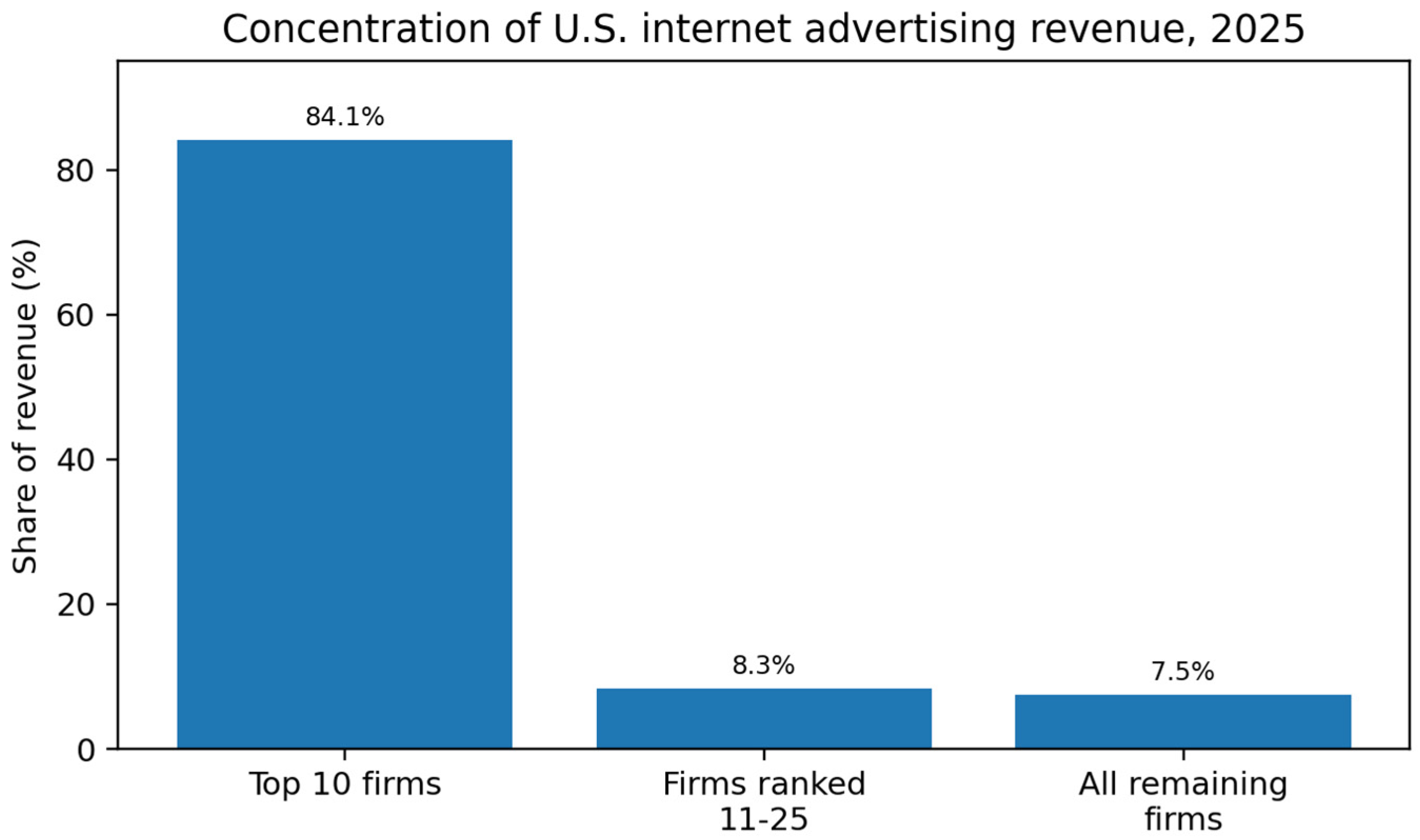
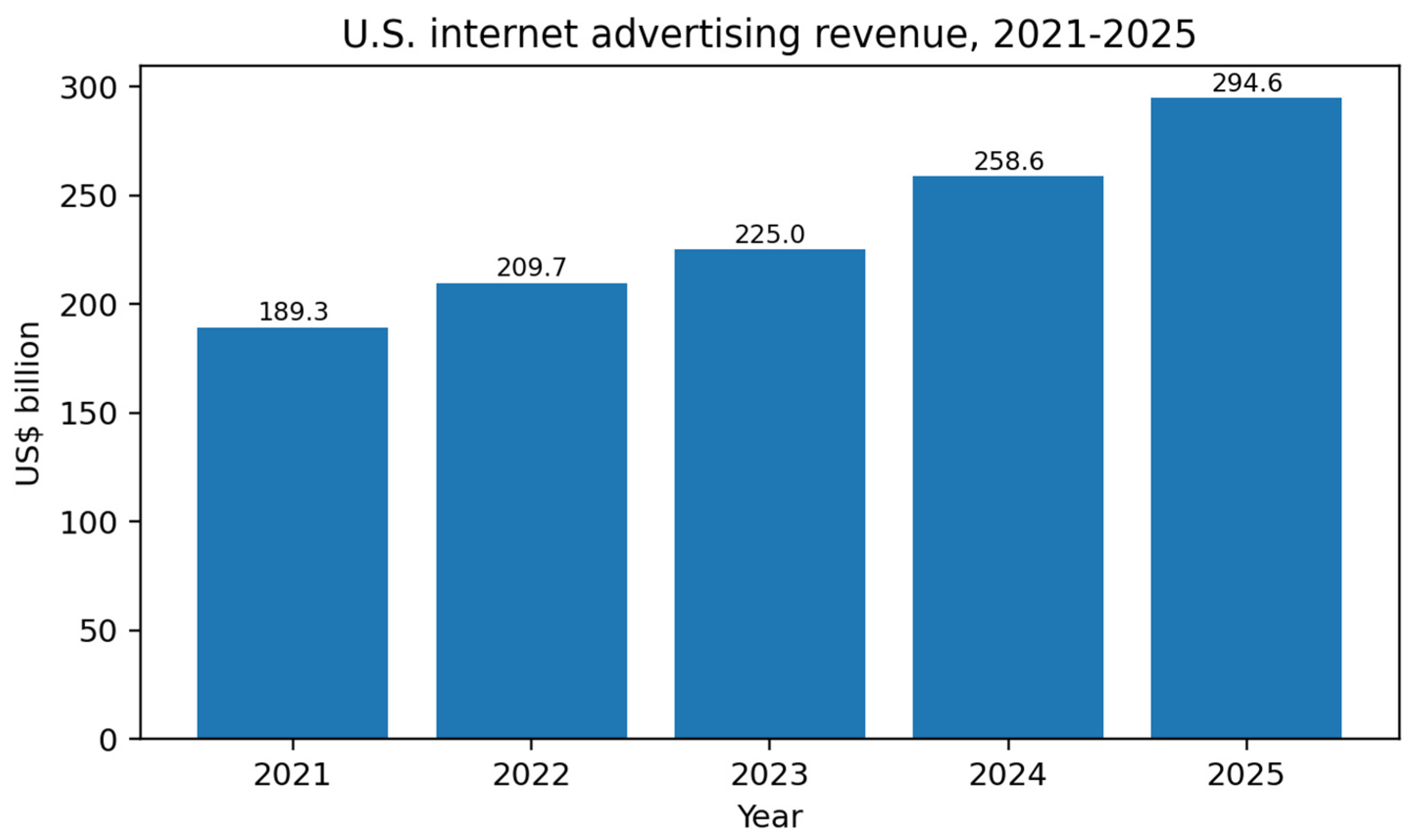
Network effects reinforce all of this. A platform becomes more valuable as more users, advertisers and developers join it, which tends to produce winner-takes-most outcomes. Concentration is not only the reward for a better product. It is also produced by data advantages, switching costs, default settings and the acquisition of would-be rivals. The pattern is visible in two layers at once. At the attention layer, the top ten companies accounted for 80.8 per cent of U.S. online advertising revenue in 2024 and 84.1 per cent in 2025 (
IAB & PwC, 2026). At the infrastructure layer, Amazon Web Services, Microsoft Azure and Google Cloud held 63 per cent of the global cloud infrastructure market in the third quarter of 2025 (
Synergy Research Group, 2025).
Table 2 summarises these concentration indicators;
Figure 1 gives the detailed 2025 advertising breakdown. From an economic perspective, this situation raises familiar questions such as market power, barriers to entry and multi-sided markets. From a political economy perspective, however, it raises a deeper question: what does it mean for a large part of the connected world that visibility, attention and access are regulated by a handful of companies?
Rentiership and the Maintenance of Market Power
Network effects help explain how a lead emerges; rentiership helps explain how it is held.
Birch and Cochrane (
2022) identify four forms of digital rent. Enclave rents grow from ecosystems that make exit costly. Expected monopoly rents rest on the anticipation of future dominance. Engagement rents monetise differences in how intensively users participate, while reflexivity rents arise from the power to rewrite fees, rankings and other rules inside an ecosystem. In platform markets these forms appear in lock-in, acquisitions made on expected dominance, the close measurement of engagement, and unilateral changes to access or revenue-sharing terms. This lens explains why concentration persists after a platform has gained a lead. Rent, in this account, is not evidence that capitalism has disappeared; it is one route through which accumulation continues.
5. Digital Labour and the Transformation of Labour Processes
Digital capitalism reshapes labour in various ways, building on
Huws’ (
2014) account of the cybertariat and the globalisation of digital work. It reorganises paid labour through platform-mediated work such as ride-hailing, delivery and gig work. It expands precarious creative labour through the creator economy, where income depends on algorithmic visibility and audience metrics. It extracts value from unpaid user activity on social media, search and gaming platforms. It also reshapes professional labour through data analytics, cloud systems and algorithmic management.
A clarification is needed here. Digital labour is used in this article as a broad political–economic category for monetised human activity within platform systems, not as a strict application of the labour theory of value. It covers distinct forms that should not be collapsed: unpaid user activity, creator labour, gig work, and the hidden data-labelling, content-moderation and evaluation work behind automated systems. These differ in how they are paid, controlled and counted, and the argument here concerns what they share, not their equivalence.
The idea that ordinary online activities can be a source of value predates current platforms.
Terranova (
2000) defined this as ‘free labour’: an unpaid and often pleasurable activity that keeps the internet running; labour offered voluntarily, without remuneration, which is both enjoyed and exploited at the same time. Underlying this line of thought is Marx’s labour theory of value. According to
Marx (
1976), the value of a commodity is determined by the socially necessary labour time expended on it. Fuchs takes that framework into the digital sphere.
Fuchs (
2014,
2015) argues that users of commercial social media perform unpaid labour, because their communicative activity produces data and content that the platform monetises. The argument is powerful, and it is also contested. Critics ask whether every kind of user activity counts as labour, especially when people take part voluntarily and get something back, such as connection or entertainment. The concept works best not as a slogan but as a tool for examining how activity outside formal employment becomes economically productive for capital.
Seen from the angle of business models, digital labour matters because it supplies inputs that rarely appear in formal accounting. User posts, ratings, searches, comments, watch time, moderation work and creator performances can all feed into a revenue model without registering as ordinary labour costs. This value is realised in different ways: through advertising, through subscriptions and commissions, or through the accumulation of data assets that strengthen the platform’s market position. The argument is not that every online action is the same kind of labour; it is that platform business models increasingly depend on activity that is only partly paid, indirectly compensated, or not paid at all.
This caution matters because the line between labour, rent and market intermediation is still unsettled. Some critics hold that voluntary user activity is not the same as classical wage labour, and that what platforms collect looks more like monopoly rent on data, interfaces and market access than surplus value in the old industrial sense. The objection is a fair one, and it stops the word exploitation from being stretched to cover everything. Pushed far enough, it turns into the techno-feudal thesis: rent has replaced profit, and capitalism has given way to something else (
Durand, 2024;
Varoufakis, 2023). That last step goes too far. Platforms still operate on a capitalist logic, even where rent now carries much of the weight (
Morozov, 2022). The economic problem does not go away either. Platforms turn user data, attention and everyday interaction into commodities, on terms of ownership and control that no single user can bargain over. The question worth asking is not what to call each click, but how organised human activity becomes an asset, and who ends up holding the value it produces.
The concept of ‘immaterial labour’ clarifies this point further.
Hardt and Negri (
2000) use this concept to refer to labour that produces information, knowledge, communication and affect rather than physical goods;
Hardt (
1999), meanwhile, had previously identified affective labour, that is, labour that produces feelings and relationships, as a distinct category. It is easy to see the emotional dimension in digital media. A successful content creator does not merely play games. This work involves performing, managing emotions, maintaining community relationships and constantly adapting to platform metrics; the resulting attention and a sense of belonging are then monetised through adverts, subscriptions and donations.
Platform labour is no longer a marginal phenomenon. As platforms share very little information, it is difficult to quantify this labour; the figures below are the best available estimates rather than precise counts. Nevertheless, the general trend is clear. According to ILO estimates, the number of platforms connecting businesses and clients to workers rose from 193 in 2010 to 1070 in 2023 (
International Labour Office, 2024). The World Bank estimates that online platforms may engage up to 435 million workers, close to one in eight of the global workforce, a figure it expects to keep rising (
World Bank, 2023). Online freelancing studies add another angle:
Kässi et al. (
2021) estimate around 163 million registered freelancer profiles on online labour platforms, while stressing that active work is much smaller than the registered supply. The creator economy shows the same expansion from another angle: in the United States alone, creator advertising spending was expected to reach about US
$37 billion in 2025 (
IAB, 2025).
Table 3 collects these indicators.
The geographical distribution of platform work also matters. The figures point to a global market in which platform-mediated work often draws labour from lower- and middle-income regions, while value capture, payment infrastructure and governance remain concentrated in a smaller number of platform firms. Online freelancing can open genuine access to income and transnational markets for workers in lower-income regions; the asymmetry lies in two questions: who sets the conditions governing pricing, ratings and deactivation, and where those decisions are made.
The creator economy also complicates the line between autonomy and exploitation. On one side, platforms have let individuals reach audiences without traditional media gatekeepers, and they have opened income for creators, educators and small businesses. On the other, creators work under precarious conditions. Their visibility depends on systems they do not control, and their income can drop overnight when a platform changes its rules. They usually carry their own costs, branding, legal risk and emotional labour. Creator work mixes entrepreneurial freedom with deep dependence on infrastructure.
Narrower platform work shows the same tension. Gig workers may value flexible hours, but algorithmic management can shift risk from the firm to the worker. Ratings, dynamic pricing and opaque deactivation can discipline workers without a conventional manager in sight.
De Stefano (
2016) called this the rise of a just-in-time workforce, and
Woodcock and Graham (
2020) show how platform work often produces new forms of control under the banner of flexibility. At stake in these arrangements is something more structural: digital infrastructure reorganises labour markets by detaching managerial control from the legal and financial responsibilities of employment.
Artificial intelligence adds yet another layer to this. Generative systems rely on large datasets, cloud computing, human feedback and a vast amount of hidden technical and supervisory labour, including data labelling, content moderation, evaluation work and model training support. This hidden labour has a name.
Gray and Suri (
2019) call this ‘ghost work’: human labour performed on demand that enables automated systems to function yet remains invisible.
Tubaro et al. (
2020) examine this issue in detail, demonstrating how platform micro-workers train, monitor and, at times, even replace the systems they help to build. Behind a model that appears autonomous, there is usually a dispersed, low-paid and largely invisible workforce. Generative systems also reshape jobs in writing, design, programming, education and customer service.
8. Discussion
Reading new media as economic infrastructure changes the kind of questions that come into view. The descriptive evidence makes the stakes concrete. When the platform environment reaches more than six billion internet users, when ten firms hold more than four-fifths of a national internet advertising market, when three firms hold most of the world’s cloud infrastructure capacity, and when the system runs on hundreds of terawatt-hours of electricity, the subject is no longer a peripheral cultural object. It is a central part of how contemporary markets, labour and infrastructure are organised. The numbers do not prove the theoretical claims on their own, but they show that the claims are about something large, concentrated and growing.
Across the cases examined, the same logic of value extraction keeps reappearing, regardless of how different the surface form looks. In advertising, value is extracted by turning attention and behavioural data into targeted inventory. In social media, the same logic turns unpaid user activity into content and data. In games, it turns play into a stream of purchases, subscriptions and engagement data. In platform work, it turns labour into an on-demand input managed by algorithm. Platforms position themselves as intermediaries, capture the data generated by the activity they host, and convert that position into revenue and market power. Platform capitalism earns its analytical weight precisely here, by naming a common structure beneath sectors that would otherwise appear unrelated.
These revenue models are not identical. Advertising, subscriptions, commissions and in-game purchases differ in who pays and how payment is made. They nevertheless rely on activity taking place within an infrastructure whose owner controls access, measurement and visibility. That shared arrangement, rather than any single revenue stream, is what the article identifies as a platform-specific form of value extraction.
For media organisations and content creators, the implication is concrete. Business model innovation is not simply a question of choosing between advertising, subscriptions or branded content; it increasingly turns on the terms that platforms are willing to offer. Newsrooms, video producers, podcasters and game publishers may all require visibility, payment infrastructure and audience access, yet these are rarely resources they control directly. The underlying logic cuts across media forms: a news article feeds into an advertising stack, a video generates behavioural data, a game becomes an ongoing retail environment. These differences in form matter less than what the models share: sustained engagement, measurable attention and revenue drawn from audience activity.
Myllylahti’s (
2020) study on the news reader revenue models demonstrates how platform-mediated attention has become central even in journalism—a field that might appear distant from gaming or streaming services.
Nieborg and Poell (
2018), drawing on a broader perspective of cultural production, reach a similar conclusion.
Nielsen and Ganter (
2022) identify the same dependency from the publishers’ perspective: news organisations rely on platforms for reach and revenue, yet they are losing control over the terms of distribution and access. Television and streaming services follow the same pattern, with the business model shifting over time from the sale of pre-produced programmes to subscription management (
Lotz, 2017). In short, the evolution of media business models is progressing not in parallel with the power of platforms and datafication, but by moving through them. Revenue diversification matters most when it also reduces dependence on a single control point. Direct subscriptions, mailing lists, first-party audience data and distribution across more than one platform can give organisations and creators some bargaining room, although none removes platform dependence altogether.
Generative artificial intelligence adds a new dimension to this dependency. It may reduce some content production costs, but it also deepens dependence on cloud infrastructure, training data, platform distribution and automated advertising systems.
This structure challenges many standard economic categories. When users produce the data and content that platforms sell, the boundary between producer and consumer becomes blurred. When scrolling through pages, sharing content and playing games create value, the boundary between labour and leisure becomes blurred. Consider an app store operator that sets access rules and fees while also offering apps that compete with those it distributes, or an online marketplace that ranks its own products alongside those of independent sellers. In each case, one firm writes the rules for a market in which it also competes, so the boundary between firm and market becomes difficult to maintain. Programmatic advertising makes another boundary visible. A bid for an advertising impression is shaped partly by the estimated likelihood that a user will click, install or buy. The behaviour has not yet occurred, but the prediction helps set the price and operates as an economic asset. Each of these boundary problems creates immediate difficulties for economic measurement and regulatory design. If user data is an input, how should it be valued, taxed or managed? If a platform is both referee and player, what constitutes fair competition? Such questions lie at the heart of current debates in the fields of industrial organisation and regulation.
A related ambiguity concerns what kind of entity a platform is. Platforms often present themselves as neutral intermediaries that carry material supplied by others, rather than as media companies that select and order content (
Gillespie, 2010). The common-carrier analogy is useful, but incomplete. A conventional carrier is expected to transmit without exercising editorial choice; platforms rank, recommend, demote and monetise content. These are curatorial decisions even when no editor commissions the material.
Napoli and Caplan (
2017) argue that the insistence on not being a media company is strategic as well as descriptive, because it may limit the obligations attached to media provision. Platforms are best understood here as hybrid actors: infrastructure for access and exchange, but also governors of visibility. The same curatorial power that supports value extraction is downplayed when regulatory responsibility is discussed.
From the perspective of labour economics, the categories need to be kept apart. Gig and on-demand workers may be legally classified as self-employed or independent contractors even when algorithmic systems allocate tasks, set prices, rate performance and deactivate access. In such cases, the platform can retain substantial managerial control while workers bear costs and income volatility without protections tied to employee status. Content creators occupy a different position. They are not ordinarily employees of the platform, but their income still depends on ranking, visibility, revenue-sharing rules and account access that they cannot negotiate. The unpaid activity of ordinary users is different again: there is no employment relationship, although the activity may produce data and advertising value. Standard measures of employment, productivity and income capture none of these arrangements particularly well.
The distribution is uneven, and this imbalance is geographically based. Market power and profits are concentrated in a small number of companies, mostly based in the U.S. and China, while a large proportion of labour and material costs are borne elsewhere. Platform workers are spread across lower-income regions, while many of the labour, manufacturing, energy and e-waste burdens that keep the system running are distributed unevenly across global supply chains. Consequently, the political economy of digital capitalism must be viewed in global terms. Platform power cannot be addressed solely as a matter of national competition, as its costs and benefits systematically transcend national borders.
This has direct implications for regulation. If digital capitalism is viewed solely as innovation, policy remains confined to growth and competitiveness. If it is viewed solely as cultural change, policy remains confined to content, representation and media literacy. Both approaches miss its structural character as a system of value generation, data control and market intermediation. Concentration figures point to competition tools such as access control, limits on the prioritisation of one’s own services, and restrictions on corporate acquisitions, of the kind currently being tested in various jurisdictions. Data and advertising figures, meanwhile, point to data governance and transparency rules. Labour figures point to employment classification and protections for platform workers. Energy and waste figures point to environmental accountability for digital infrastructure. The common thread is this: effective regulation must address not only the harms that arise subsequently, but also the conditions under which value is generated. In concrete terms, this points to a specific agenda: platform self-preferencing and app store rules, advertising and auction transparency, access to platform data, transparency of creator revenue shares, the employment classification of platform workers, algorithmic accountability, and energy and e-waste reporting for digital infrastructure.
Responsibility cannot be assigned only to the government of the country in which a platform is incorporated. Home-country authorities can act through competition, labour and tax law, while countries where the platform operates can regulate market conduct, data use and consumer rights. Regional bodies can coordinate rules across national markets. The European Union’s Digital Markets Act addresses the market side by placing ex ante duties on designated gatekeepers, including limits on self-preferencing and certain app store restrictions. The Digital Services Act works on the content and transparency side through duties concerning advertising, recommender systems and systemic risk (
European Parliament & Council of the European Union, 2022a,
2022b). International organisations have weaker enforcement powers. The ILO, for example, can develop labour standards and coordinate national approaches, but it cannot replace domestic enforcement (
International Labour Office, 2024). In practice, enforceable rules remain mainly national and regional.
The gains are real. Platforms have reduced transaction costs, opened up markets to small producers, and provided new avenues of income for content creators and workers. The efficiency argument is valid, and an honest analysis must evaluate this argument alongside its criticisms. The argument here is not that platforms produce no value, but that the value they produce is captured and distributed through structures of ownership, data control and market power that require direct examination by economics. A complete account holds both in view: what platforms enable, and how they distribute the value that results.
9. Conclusions
This article has argued that digital capitalism is best understood as a reorganisation of capitalist accumulation around platforms, data, attention and digital labour. New media are not only tools of communication. They are economic infrastructures that organise markets, structure labour, collect data, allocate visibility and monetise interaction. The spread of digital networks has not dissolved capitalism’s older contradictions. It has carried them into new parts of social life and given them new forms.
The contribution is conceptual, but it does not stand apart from the evidence. The descriptive indicators show four things at once. The platform environment now reaches most of humanity. Advertising and cloud markets are highly concentrated. Platform labour has become a global phenomenon, measured in hundreds of millions of workers and more than a thousand platforms. And the supposedly weightless digital economy rests on a large and unevenly distributed material base of energy and electronic waste. These indicators illustrate the scale and conditions of the processes examined here: digital value is produced, captured and contested through identifiable economic structures, not through a vague cultural shift.
Put differently, digital capitalism is neither a post-capitalist break nor a slide into techno-feudalism. It is a new phase in which accumulation works through datafication, platform intermediation, algorithmic governance and the commodification of everyday activity. Advertising, subscriptions, in-game spending and commissions on platform-mediated work differ in who pays and how revenue is collected. Yet each relies on activity conducted inside infrastructure whose owner controls access, measurement and visibility, and can convert that position into revenue. This phase brings real gains in access, innovation and participation. It also brings new forms of dependence, concentration and inequality. The task for economic analysis is not only to measure the growth of digital markets, but to study the arrangements through which their value is extracted, distributed and governed.
The study has clear limits. It is a conceptual review, so it does not test causal claims, and the indicators it uses are drawn from institutional and industry sources with their own definitions. It concentrates on platform-based digital capitalism and leaves the financial and technical detail of cryptocurrencies, NFTs and AI systems for separate work. AI is treated here as part of the infrastructural and labour conditions of platform capitalism, not as a separate technical object of analysis. These boundaries were chosen to keep the argument coherent, and they mark out where further research is needed.
Three directions stand out. Empirical studies could measure how value is extracted and shared in specific sectors, from advertising and games to creator economies and platform work, using firm-level and worker-level data. Comparative studies can examine how different regulatory regimes shape platform work, data governance and market concentration across countries, given that the same firms operate under very different rules. Theoretical studies, meanwhile, can continue to clarify the link between labour theory, datafication and digital assets—an area where the categories remain the least well-defined. The contradictions highlighted in this article are not virtual. They exist in real markets, real infrastructures and real working lives, and are worthy of close economic scrutiny.