


Abstract
Ubiquitous and accelerating mass loss from the Greenland Ice Sheet (GrIS) has been widely reported in recent scientific studies, implying rapid changes in the Arctic cryosphere. However, while numerous studies provide accounts of glacial mass loss and consequent sea level change, a qualitative assessment of the implications is conspicuously absent. This scoping review addresses that gap by synthesizing the recent scientific literature related to cryospheric change in Greenland and its implications for key species and ecological processes; and highlights the necessity of understanding the bigger picture of how multiple ecological processes, abiotic-biotic assemblages, and cryosphere-human interactions with the environment are rapidly changing and pushing the Arctic into a possible no-analog scenario in recent geological times. It is also argued that this situation presents a novel challenge for planetary sustainability and warrants the identification of new research priorities that can generate a holistic understanding of the complexity of the Arctic cryosphere, interactions between biotic and abiotic components, and local lifeworlds—all of which are related to the well-being of the Earth itself.
1. Introduction
Rapid and ubiquitous mass loss from the Greenland Ice Sheet since the 1990s has been widely reported in the recent scientific literature [1,2,3,4,5]. The Greenland Ice Sheet (GrIS) is massive; covering over 1.63 million km2, it contains nearly 3 million km3 of ice, and it is the second largest mass of ice on the planet after the ice sheets in Antarctica [6,7,8]. The GrIS contains ice equivalent to 7.4 m of eustatic sea level rise (SLR) [7,8], which implies that if it were to melt substantially, sweeping changes to the Earth system would occur. While interest in the extent and properties of the GrIS go back to the mid-19th century, scientific studies of the GrIS have increased markedly since the latter half of the 20th century [5]. Currently, most studies focus on the fate of the GrIS under a warming climate, and the resultant changes to the Earth system [2,9,10,11]. Notable repercussions of the rapid change in the GrIS configuration include global SLR [2]; weakening of the Atlantic Meridional Overturning Circulation and its effects on planetary climate [12,13]; changing ecosystems in the Arctic [14,15,16]; and changes in human-cryosphere interactions [17,18].
However, despite the considerable focus on the process and outcomes of the melt in the GrIS, relatively little has been explored about the complex interaction pathways between the GrIS, the ecosystems it sustains, and the implications of a rapidly changing GrIS on multiple species, ecologies, and local societies. For example, the comprehensive analysis of climate disequilibrium provided by Box et al. (2022) points out that Greenland’s terrestrial ice is highly sensitive and susceptible to localized warming trends and identifies multiple physical processes that are likely to contribute to the ice sheet disequilibrium into the future, but the conclusions converge on future SLR trends [2]. Similarly, Golledge et al.’s (2019) paper lays out an important roadmap for planetary environmental consequences of ice sheet volume reduction, but the paper’s findings concentrate on the implications for SLR and atmospheric and oceanic circulations, and ecosystem and/or biota-level change is not treated in detail [9]. The ongoing and accelerating disequilibrium of the GrIS is important not only for its SLR implications but also for its repercussions on Arctic ecologies and societies, and the scientific literature currently shows a noticeable gap in this regard. As qualitative and exploratory studies typically have a broader remit of understanding multiple processes and possibilities, they hold much promise for generating a multifaceted and holistic understanding of the changing ice sheet from multiple angles.
In other words, there is an urgent need to develop a qualitative understanding of what this rapid transition means by looking beyond the probabilistic future scenarios and the identification of threats and opportunities which in turn would facilitate the emergence of new research priorities on the Arctic as an ecological place that is undergoing unprecedented change with implications on the planetary biosphere. Keeping this in mind, this review synthesizes the key scientific literature and provides suggestions for understanding the complexity of the various abiotic-biotic assemblages, ecological processes, and human-cryosphere interactions which collectively are sustained by the GrIS, and therefore, also collectively face a major tipping point under the current and future scenarios.
The significance of this review is mainly derived from the fact that the GrIS is important not only for its sheer size but also for its ecological and sociocultural significance [19,20,21]. This, in turn, makes it imperative to understand the qualitative changes in the ecosystems and societies of the Arctic. In other words, rapid change in the GrIS has significant ramifications on both ecological and social sustainability, and this positions the current study as an essential part of sustainability science on a changing planet [11,22].
2. Materials and Methods
2.1. Methods and Materials Used for This Review
This paper adopted a ‘scoping review’ approach [23,24]. The scoping review approach particularly suits broadly defined and exploratory studies that simultaneously address several interrelated but mutually different aspects or phenomena. The main characteristic that defines scoping review, and therefore this paper as well, is an open-ended search for connections and relevant threads related to the GrIS and its recent transformation from the scientific literature. Scoping reviews typically present a range of findings/viewpoints from the relevant literature and do not necessarily provide reductive or clear-cut conclusions, instead, a major goal of conducting scoping reviews (and qualitative analysis in general) is to identify multiple future research and analysis pathways [23]. This paper will accordingly present a broad spectrum of the current scientific literature to posit the importance of qualitative studies on the GrIS and will refrain from making reductive conclusions.
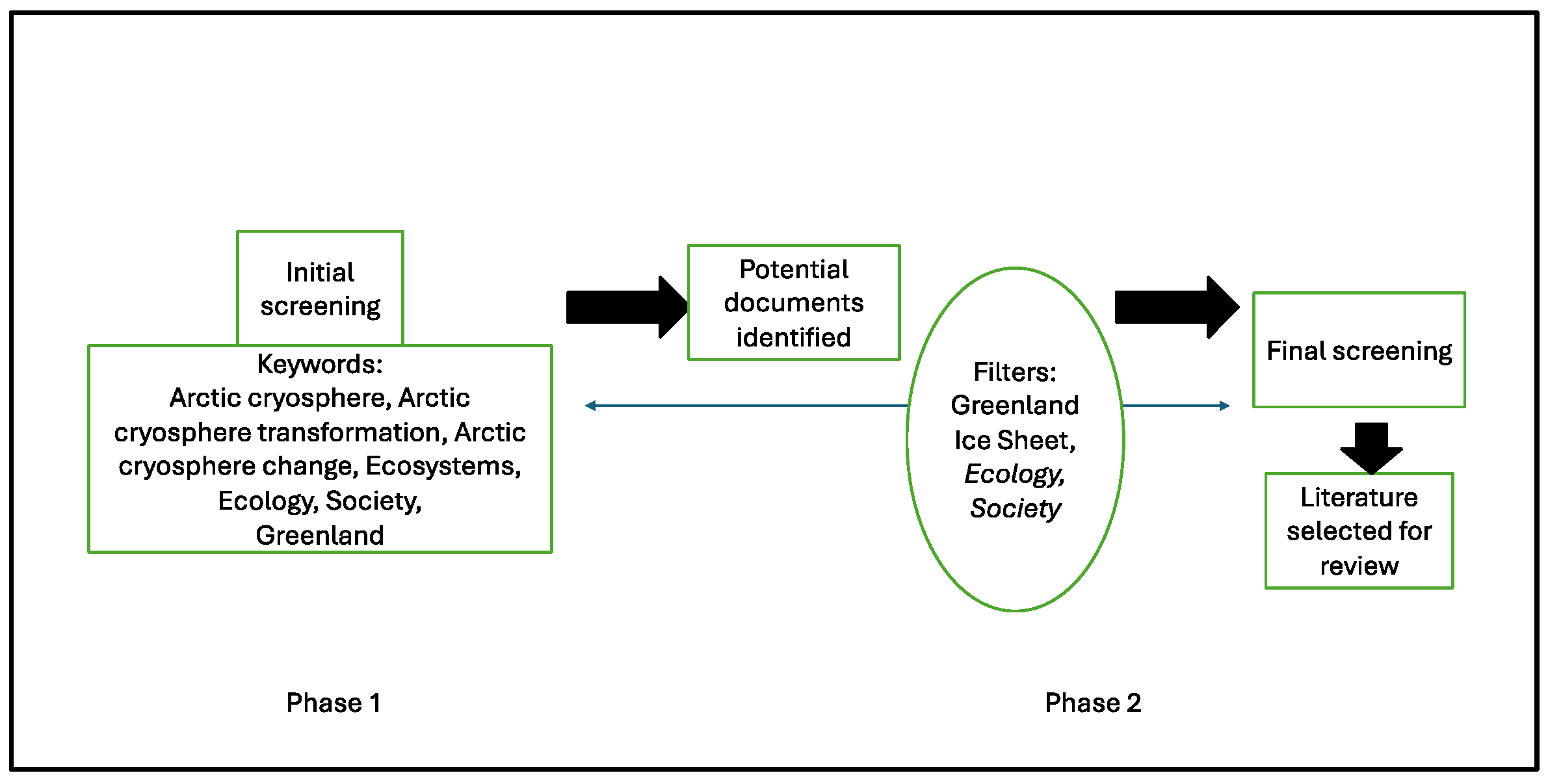
This review was conducted in two phases, with some degree of mutual overlap. In the first phase, the main objective of the search was to identify the relevant literature on ‘Arctic cryosphere’, ‘Arctic cryosphere transformation/change’, ‘Ecosystems’, ‘Ecology’, and ‘Society’ that had a strong connection with Greenland (or the GrIS). The results were subsequently pruned during the second phase to select a range of papers that best represented the issue of rapid change in the GrIS and its ecological and (to some degree) social ramifications. Both stages involved identifying additional materials from a source that was initially accessed (see Figure 1 for a simplified flow chart describing the review process).
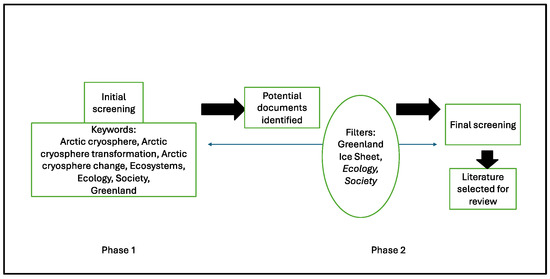
Figure 1.
A simplified flow chart of the review process.
2.2. Limitations of This Study
Mechanisms and interaction pathways involving the GrIS are complex and it is not possible to discuss every aspect in a single review paper. This review primarily focuses on the GrIS itself and its change since the 1990s. Thus, the temporal scope of this review is limited to more recent years, and this paper does not discuss the fluctuation of the GrIS in geological time. Indeed, the GrIS has oscillated in extent throughout the Quaternary, and even during the Holocene, its spatial extent and ice volume changed repeatedly [25,26,27]. The main reason behind this temporally narrow scope is that there is widespread agreement that the GrIS has entered a new phase of sustained decline since the 1990s, which is posed to change its configuration beyond the Holocene parameters at an unprecedented rate [1,9].
In addition, all reviews are inherently subjective, and this review should be understood as limited by the author’s expertise and knowledge of the GrIS to an extent. It also seeks to uphold a sense of urgency that stems directly out of the concern that ongoing change in the Arctic cryosphere and the GrIS is detrimental to local ecosystems and societies, as well as to planetary health. However, any subjectivity here should not be equated with bias, as the literature sources chosen for this review were elected without any ideological or personal preference. The literature sources featured in this review are from leading scientific journals and reputed publications. Hence, the consistency and quality of the materials have been thoroughly addressed throughout the review process.
A further possible limitation is the lack of engagement with local (Inuit) worldviews and opinions. This is both due to the author’s personal limitation of being located outside Greenland, and the relative lack of the published scientific literature that provides insight into those worldviews and perceptions. This angle could be explored by researchers in the future to identify further threads related to the issues that this paper seeks to shed light on.
3. Mass Loss Trends from the GrIS: A Synopsis
This section will provide an overview of the key patterns of change associated with the GrIS from the existing scientific literature. It is widely established that there is a clear overall trend of mass loss from the GrIS over the past three decades [1,10,28,29]. However, there are geographical patterns and complex mechanisms that make the ongoing change in the GrIS a highly complex and multifaceted phenomenon. While the implications for planetary sea level rise (SLR) are frequently highlighted, the complex factors and processes associated with the mass loss of the GrIS have significant ecological and social repercussions. Accordingly, this section will also synthesize key spatial patterns and biophysical mechanisms associated with the decline of the GrIS. While the focus here is principally on terrestrial ice, sea ice conditions in the Arctic have also changed over the years and constitute an important component of the ongoing degeneration of the Arctic cryosphere. For this reason, a brief synopsis of sea ice trends is also provided below.
3.1. Overall Trends of Mass Loss
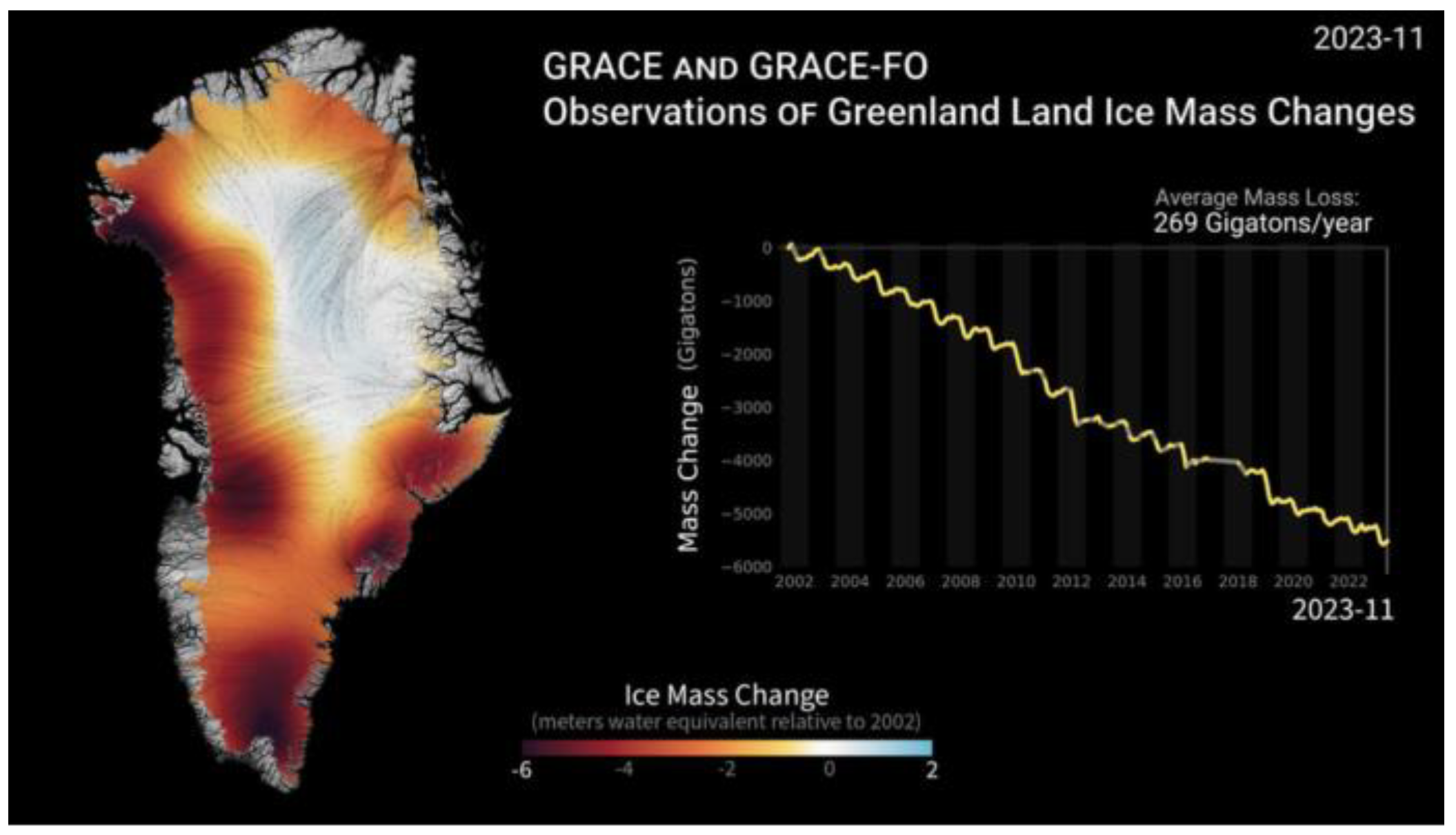
There is widespread evidence that the GrIS has lost mass at alarming rates in recent years. NASA’s Gravity Recovery and Climate Experiment (GRACE) satellites provide a broad overall trend from observations since 2002, clarifying that the GrIS has lost around 270 billion tons (Gt) of ice every year on average between 2002 and 2023 [28]. This trajectory of change over the past two decades is depicted in Figure 2, which represents the NASA dataset.
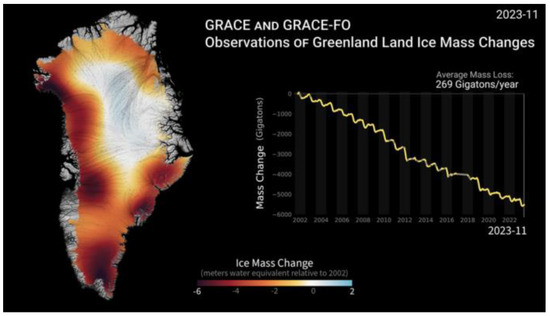
Figure 2.
The recent trend of annual mass loss from the GrIS (2002–2023) as revealed by NASA’s GRACE and GRACE-FO. Image credit: NASA and JPL/Caltech Figure courtesy NASA from https://svs.gsfc.nasa.gov/vis/a030000/a031100/a031156/gris_with_vel_i_black_2023-11_print.jpg, accessed on 15 March 2025.
IPCC’s Special Report on the Ocean and Cryosphere in a Changing Climate [29] also clearly refers to the acceleration of warming in the Arctic as a whole, with similar rates of yearly mass loss trends of the GrIS between 2006 and 2015, attributed mainly to surface melt. Figure 1 presents a graphical representation of this broad trend of mass loss from the GrIS.
In addition, the IPCC report mentioned that Arctic sea ice has shown a consistent trend of decrease in all seasons between 1979 and 2018 [29]. In an earlier publication, Rignot et al. (2008) summed up the broad temporal trend: the GrIS was losing mass between 1958 and 1970 during a short warming period, it gained mass during the subsequent colder period between 1970 and 1990, and after 1990, the mass loss rate accelerated and showed no indication of a slowdown [10]. Briner et al. (2020) presented a longer perspective and demonstrated that the GrIS had a more-or-less neutral mass balance during the 19th century, experienced episodic loss and gain during the 20th century, and is witnessing a steadily negative mass balance since the beginning of the 21st century [1]. That study further argued that if the current rate of mass loss were to remain stable, the GrIS would shed 6100 Gt of ice per century which is comparable to earlier warmer intervals during the Holocene, but with the projected planetary warming, the rate would almost certainly increase, resulting in the mass loss of the GrIS overshooting the Holocene parameters within the 21st century.
The mechanisms driving mass loss from the GrIS are manifold and complex. It has been postulated, based on the prevalent warming trends, that the Arctic is warming at a rate at least twice that of the global average via the Arctic Amplification (AA) mechanism [30,31]. AA is a mechanism involving multiple causal factors and has been in flux (i.e., oscillating between ‘warmer’ and ‘cooler’ phases) throughout the Quaternary (past 3 million years) [31,32]. Mechanisms driving the AA include the extent of sea ice that influences the ocean-atmosphere heat flux; atmospheric and oceanic heat transport; cloud cover and greenhouse gas amounts that influence longwave radiation flux on the surface; and carbon particulate (black carbon) presence on snow/ice that influences the albedo effect [32]. Serezze and Barry (2011) note that strong autumn and winter warming over the Arctic, resulting in the reduced extent in sea ice is the most prominent feature of the current warmer mode of the AA [32]. In short, the AA is a positive feedback loop that can drive up the warming effect in the Arctic with the resultant effect of thinning of the GrIS [31,33]. The effects of GrIS have been summed up in several publications; with an acceleration of Sea Level Rise (SLR) across the planet drawing particular attention [34,35,36,37,38].
3.2. Mechanisms and Spatial Patterns
Thinning mechanisms across the GrIS vary according to spatial locations. Machguth et al. (2016) observed that 50–70% of the mass loss occurs through meltwater runoff and an increase in glacier calving/iceberg production events accounts for the rest [5] (see also [39]). Wilson et al. (2017) noted that floating extensions of glaciers draining the GrIS are undergoing rapid change and are vigorously interacting with glacier mechanisms upstream, with implications at the whole ice sheet level [40]. Furthermore, this rapid change in the floating ice tongue dynamics is influenced, at least partially, by the warming of Atlantic water that drives accelerated below-surface melting of ice tongues [40,41,42]. Wekerle et al. (2024) found that a warming Atlantic has played a major role in the basal melt of protruding ice tongues from the GrIS during the past 50 years [42]. In addition, extreme melt events such as the 2012 surface melt that affected the entire GrIS have significant influences on both meltwater runoff and future melt trajectories [43,44]. Recent studies, such as Ryan et al. (2019), pointed out multiple mechanisms behind the amplification of surface melt rates—including the presence of bare ice that can drive up summer ablation significantly [45]. Supraglacial hydrofracture that delivers large amounts of meltwater to subglacial streams—often popularly referred to as moulins—is another significant mechanism. Zwally et al.’s (2002) work was among the early analyses of how surface melt and hydrofracturing of the ice allow water to join subglacial drainage, speeding up ice flow [46]. Subsequently, Chandler et al. (2013) described the presence of subglacial streams tens of kilometers upstream from the glacial margin, even where ice thickness nears 1 km [47]. Although it is not fully clear to what extent supraglacial meltwater influences subglacial drainage [48], there is evidence of enhancement of subglacial drainage during the melt season where supraglacial meltwater and hydrofracturing occur [47,49,50]. Chudley et al.’s (2025) recent study demonstrated that crevassing has increased across the GrIS between 2016 and 2021 [51]. Furthermore, Lu et al. (2021) clarified that supraglacial rivers and lakes cover more than 5% of the northeast sector of the GrIS, making them more widespread than previously believed, and exert a conspicuous influence over ice flow regimes [52].
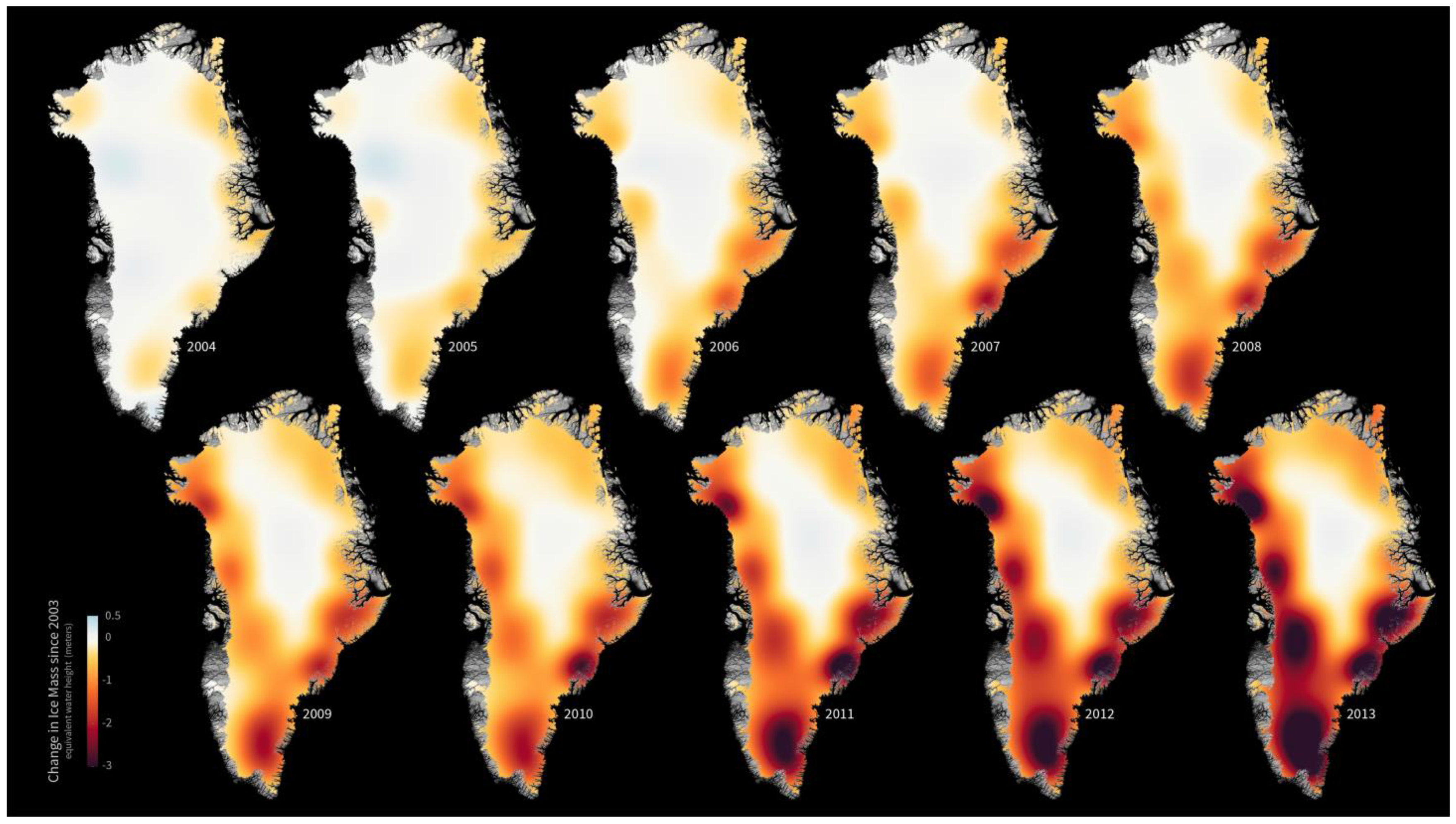
At the largest (Greenland-wide) spatial scale, there is a prominent correlation between mass loss and latitude. This is illustrated in the NASA-GRACE dataset, which shows the spatial trends of mass balance change between 2004 and 2013 in Figure 3 [53]. As the principal component of mass loss is surface melt, glacier ablation zones display a concentration of meltwater runoff [54,55,56]. Initially, meltwater discharge and mass loss were prominent in the southwest [56]. However, since then, ablation and meltwater discharge in the northern parts have intensified and are currently a major contributor to the mass loss at the entire GrIS level [57,58]. Khan et al. (2014) reported sustained mass loss in the northeast sector of the GrIS driven by regional warming [57]. Specifically, a spike in the air temperature in 2003 was observed to have been coupled with a sharp reduction in the sea ice volume between 2002 and 2004, and those mechanisms triggered the sustained mass loss trend in the northeast sector. The study also noted that the northeast sector is more prone to ocean–ice interactions, due to floating extensions of ice, unlike the southwest part of Greenland where the ice sheet margin is further inland) [57].
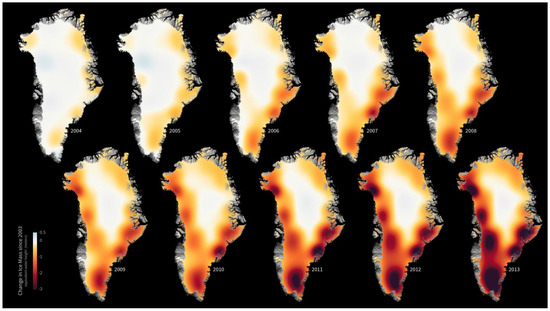
Figure 3.
A NASA GRACE dataset showing spatial patterns of mass balance change in the GrIS between 2004 and 2013. Note how the areas initially affected in the south have witnessed further intensification of mass loss, while more northern locations joined the negative mass balance trend with time. Image credit: NASA’s Goddard Space Flight Center Figure from https://svs.gsfc.nasa.gov/30478/, accessed on 28 May 2025.
With the trend of accelerated mass loss from the northwest sector of the GrIS, marine-terminating glacier dynamics have come under focus, as they provide the precursor to sheet-wide change [59]. Currently, there are only three floating glacial tongues left in Greenland, the 79 North Glacier (79 NG), the Peterman Glacier, and the Ryder Glacier, glaciers, which previously had floating ice tongues, and these have shrunk rapidly in extent since the 1990s, and most became tidewater glaciers [60]. The largest of the remaining ice tongues, belonging to the 79 NG, underwent sustained thinning from at least 2012 [61], but was relatively stable until 2022 before it began to show clear signs of destabilization [40,60]. The 79 NG is a large outlet glacier as it drains around 6.28% of the GrIS and its floating tongue is nearly 70 km long and 20 km across [60]. It has been observed that an increase in basal melt (driven largely due to excess heat in the ocean driving ice–ocean interface change) induces frequent calving events from marine-terminating glaciers such as the 79 NG [42,60].
Similar mechanisms were observed in several other glaciers in the northern part of Greenland over the years. Millan et al.’s (2023) study outlined how mass anomalies began affecting northern glaciers in general since 2000, mainly driven by basal melt and destabilization of their floating ice shelves [61]. Examples include the Peterman Glacier where the grounding line retreated by 7 km between 1992 and 2021; the rapid retreat of Zachariæ Isstrøm beginning in 2003; and the collapse of Hagen Brae in 2010 [62,63,64]. A notable case was that of Zachariæ Isstrøm, which experienced a two-stage ice shelf decay and rapid retreat of the grounding line, interspersed by a period of relative stasis [62]. Following an initial onset of retreat in 2003–2004, the ice shelf of Zachariæ Isstrøm decayed before finally collapsing in 2012. A rapid retreat of the grounding line ensued in 2012, eventually transforming it into a tidewater glacier [61,62]. In all cases, calving event frequencies and grounding line change rates accelerated markedly in the 21st century [62]. Furthermore, as Khan et al. (2022) summed up, the entire Northeast Greenland Ice Stream that drains about 12% of the GrIS is currently undergoing rapid thinning, affecting ice masses at least 200 km inland as of 2022 [58].
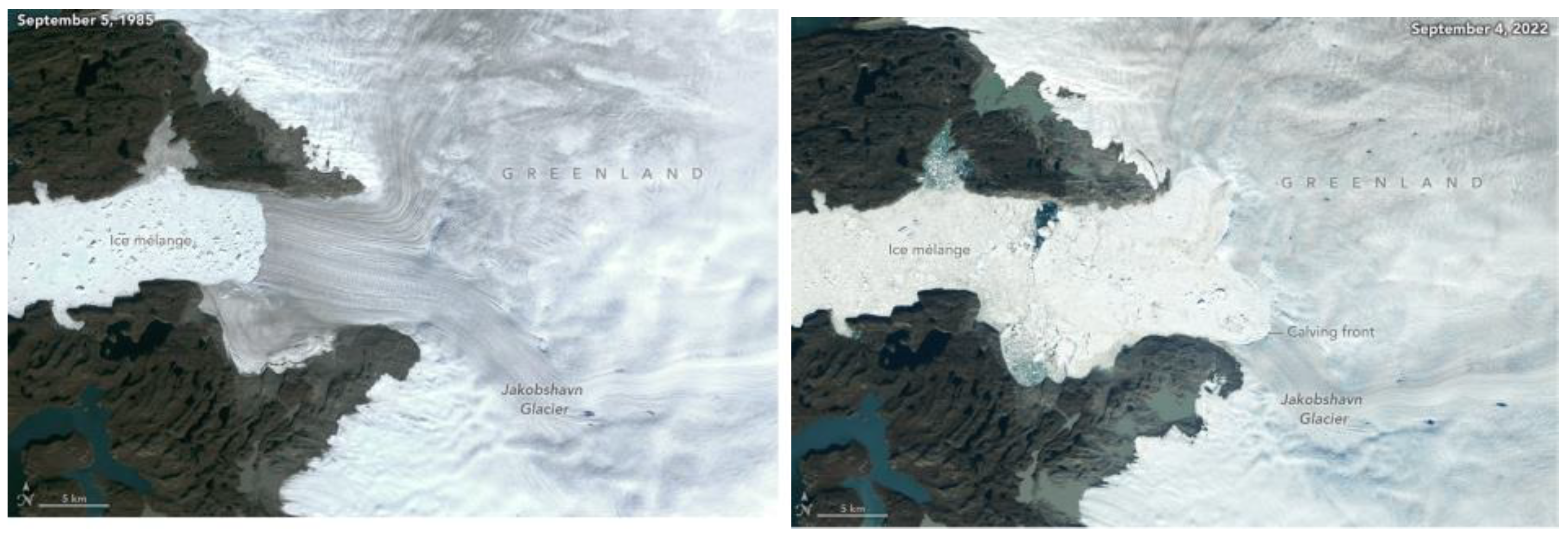
Glaciers and ice streams draining the GrIS in other locations have also experienced similar trends. Perhaps the best-known case is that of Jakobshavn Isbræ (located in the southwest), which is also the largest outlet glacier in Greenland. Previously, and as recently as at the beginning of the 21st century, it had a narrow floating tongue extending into the ocean [65]. Jakobshavn Isbræ retreated by 18 km inland from 2001 to 2015, and lost 97 Gt of ice from 1985 to 2022 [62,66]. Figure 4 shows the retreat of the glacier from the two images captured in 1985 and 2022.
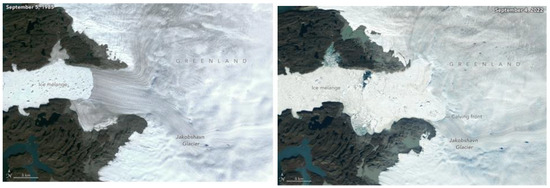
Figure 4.
A NASA image shows the configurations of the lower part of the Jakobshavn Isbræ in 1985 (left) and 2022 (right). The retreat is clearly visible from the location of the calving front and the partially detached ice melange. Image courtesy of NASA from https://d2pn8kiwq2w21t.cloudfront.net/images/PIA26117_figB.original.jpg, accessed on 16 March 2025.
Finally, mass loss from the GrIS is also influenced by anomalous melt seasons where higher temperatures may induce widespread surface melt. The 2012 melt season stands out as a year of excessive surface melt induced by the formation of a heat dome over the GrIS due to a stagnant mass of atypically warm air [44]. As observed by Culberg et al. (2021), the legacy of extreme melt events such as that of 2012 is not only limited within that season but also causes persistent structural changes at the ice sheet level that can interact with atmospheric forcing and influence surface melt for subsequent years [43]. In addition, such events may be currently anomalous, but with the projected climate warming in the 21st century, may become more common in the future.
3.3. Sea Ice: A Brief Note
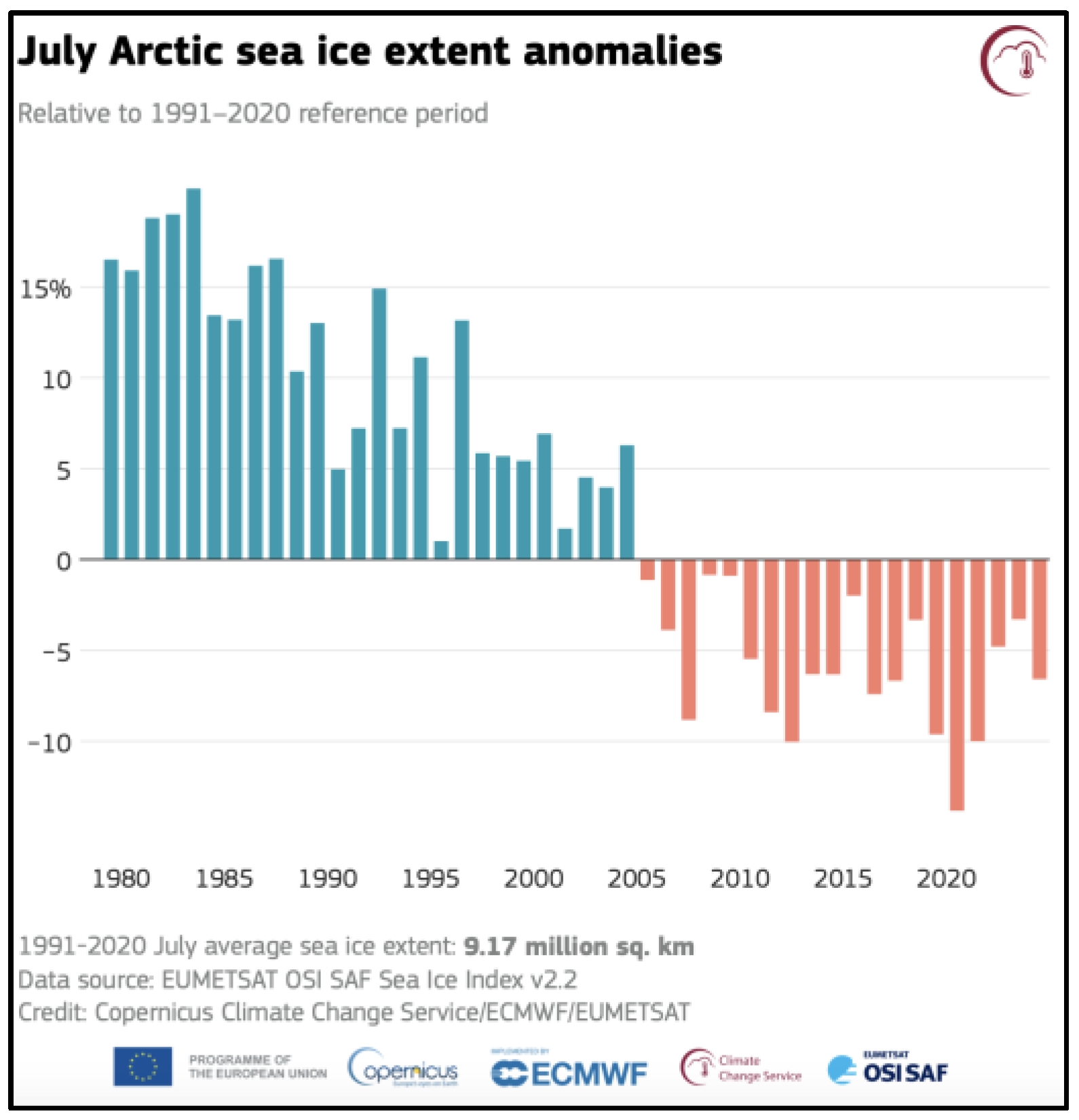
While a detailed discussion of sea ice trends falls outside the immediate focus of this paper, it must be remembered that sea ice formation in the Arctic is a direct consequence of the presence of the GrIS. In recent years, multi-year sea ice has decreased markedly [67]. The ongoing rapid retreat of Arctic sea ice and 21st-century projections are available in several studies [68,69,70,71,72,73,74]. The EU’s Copernicus Climate Change Service monitors sea ice extent in the Arctic, and the available data show that the summer sea ice extent dipped below 4 million km2 in September 2012, the lowest on record [75]. Figure 5 shows the extents of Arctic sea ice anomalies for the month of July in recent years. It has since been reported that the January 2025 Arctic Sea ice extent became the lowest as far as records go for that month [76], even though the winter season of 2024–2025 in the Northern Hemisphere was under a La Niña effect.
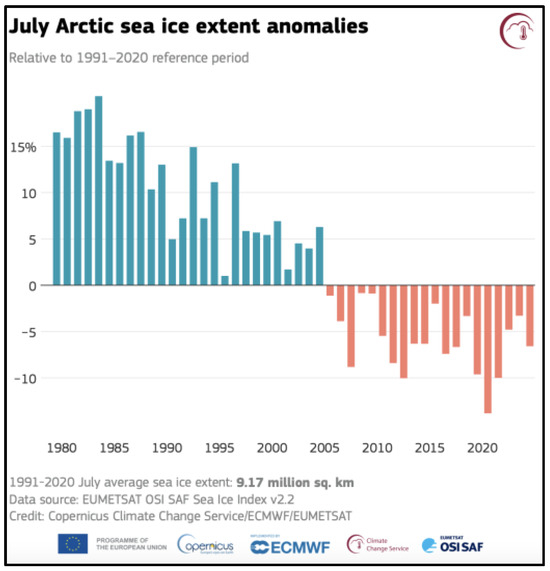
Figure 5.
Arctic sea ice anomalies in summer (July). Image courtesy of the Copernicus Climate Change Service. Image courtesy https://climate.copernicus.eu/sea-ice-cover-july-2024, accessed on 16 March 2025.
The decline in sea ice extent can also amplify coastal erosion and coastal ice depletion by exposing coastlines to wave energy and warmer ocean water [77,78]. Thus, the presence or absence of sea ice is coupled to the GrIS through a dynamic interaction process that involves multiple mechanisms spanning different timescales, with the reduction in sea ice volume exposing the coastal areas to increased oceanic forcing (wave energy and warmer water influx)—which has the potential of further thinning of outlet glaciers [79,80,81].
4. Ecological and Social Implications: Emerging Trends
4.1. Ecological Implications of Rapid Destabilization of the GrIS
It is still not sufficiently known to what extent Arctic ecosystems will be affected by the rapidly progressing degeneration of the cryosphere. Broad implications, such as the degeneration of the Arctic ecosystems as a carbon sink with climate warming, have been mentioned [14,82], and this possibility holds true in the local context of Greenland as well [83]. The most visible aspect of this transformation is the ongoing shrub growth across Greenland, with an observed twofold increase in vegetated areas over the past three decades [19,84,85,86]. Grimes et al. (2024) also identified ‘rapid and intense’ geomorphological changes such as increasing aggradation and sediment transport in rivers; drainage of permafrost lakes and expansion of glacier-fed lakes [86]. These changes will have far-reaching implications for Greenland’s ecosystems and species compositions. While there is evidence that Greenland had been covered in vegetation following widespread melting of the ice sheet in the geological past [87,88], the current rate of change is possibly unprecedented and will almost certainly take Greenland ecosystems beyond the level of change experienced during the Holocene. Abrupt and cascading changes in hydrology and landscape-level dynamics have already been observed [89]. Cold-adapted species are likely to be worst affected due to these changes because as pointed out by Robinson et al. (2012), there is a strong likelihood of a monostable (essentially ice-free) state in Greenland occurring with a 0.6–3.2 °C of warming [90]. The plight of the cold-adapted taxa was also highlighted by the study of Jørgensen et al. (2022) in the context of drastic changes to the benthic ecosystems [91].
There is also evidence that meltwater drainage from the GrIS affects lake ecologies through changes in turbidity and chemical properties of lakes [20,92]. Burpee et al.’s (2018) study clarified how lakes fed by meltwater from the ice sheet were significantly different in phosphorus concentration and turbidity from snow-and-groundwater-fed lakes, and this difference in turn is reflected in different microbial communities [20]. It has also been observed that with the progressive decay of the ice sheet, there is an ongoing proliferation of lakes at the ice sheet margin [93].
While the full extent and implications of ecosystem change are unknown, some studies have focused on site-specific changes, and they offer some key indicators. Bonsoms et al. (2024) analyzed emerging ecosystem impacts in the Disco Island area and noted that the snowpack dynamics had a strong structural influence on local ecosystems [94]. Specifically, a reduction in snowpack coverage and volume was found to favor colder soil temperatures in winter that favor certain species of plants, while snowpack reduction in summer was seen as conducive for intensive plant growth due to alteration hydrological and nutrient properties. Once a certain degree of vegetation growth is achieved, it exerts further control on soil temperature by modifying thermal conductivity, which in turn affects snowpack conditions—thereby forming a feedback loop [94]. In the Kangerlussuaq area in the west of Greenland, it was found that the melt season has become longer in duration with more vigorous runoff, aeolian processes have increased in intensity, rapid progression of anoxic niches in the ice sheet margin that causes change in the microbial communities in cryoconite holes, and ongoing changes in the soil and lake microbe communities due to geomorphic transformation in those systems [95,96]. Changes in plant-pollinator dynamics were also reported in the same area, which happens to be one of the best-studied ice-sheet margin locations on the planet [97]. There are further indications that ecosystems located in areas where glaciers are retreating rapidly are on the cusp of dynamic instability. Stuart-Lee et al. (2023) studied phytoplankton communities in glacial margins and found that cellular characteristics could determine phytoplankton types that prevail under climate stress—which is manifested through the change in glaciers from formerly marine-terminating ones to land-terminating ones [98]. Because the transition from marine to land termination in glacial systems is associated with changes in surface water temperature, water stratification, and sunlight permeability in water, the authors concluded that those changes would have far-reaching ramifications in the summer productivity of ecosystems. Meire et al.’s (2023) study complements these findings; the authors analyzed several fjord ecosystems and concluded that fjords connected to land-terminating glaciers suffered a reduction in ecological productivity and a simplification of their ecosystem services, with merely one-third of the annual productivity and half of the CO2 intake capacity compared to fjords connected with marine-terminating glaciers [99]. The emerging picture is that of the fragmentation and simplification of ecological connectivity pathways across spatial scales—whereby the transformation in the GrIS and the progressive thinning/retardation trends of its outlet glaciers will reverberate across the land and deep into the adjacent oceanic ecosystems.
Perhaps the best-known cases of ecological disturbances feature the Arctic megafauna under a changing climate [100,101,102]. While animals like the polar bear (Ursus maritimus) and the beluga (Delphinapterus leucas)—the species covered in the studies mentioned above—are subject to popular attention, there are other important and endangered megafauna such as the Greenland Shark (Somniosus microcephalus) that are still poorly documented and are especially vulnerable due to past overharvesting [103]. Gremillet and Descamps (2023) provided an overall account of how several types of marine megafauna are currently affected in the changing Arctic [104]. Elsewhere, it was found that avian species such as the little auk (Alle alle) are vulnerable to the emergence of toxins due to the destabilization of the GrIS [105]. Because megafauna species are dependent on ecosystem productivity and composition characteristics, rapid changes to primary producer and lower-level trophic dynamics will reverberate across the food chain and eventually affect those animals.
Regarding the importance of sea ice on Arctic ecosystems, Harada (2016) observed that the presence of sea ice is of fundamental importance for ecosystem structure [106]. Harada mentioned the key work by Michel et al. (2012) that identified several causal factors such as the transition from multi-year to single-year sea ice, decrease in sea ice coverage, increase in freshwater runoff, and change in water stratification patterns behind alterations in chemical and biological processes in the Arctic Ocean [107]. Michel et al. (2012) also demonstrated how the changes in one indicator species, the zooplankton Calanus glacialis that depends on the blooms of ice algae (phytoplankton), can have repercussions at higher trophic levels, including the Arctic and polar cod which in turn are key food sources of narwhals, ringed seals, belugas, and several types of seabirds [107]. It is also known that sea ice conditions affect the hunting success of polar bears, with the reduction in sea ice extent and temporal coverage affecting the species negatively [106,108]. Although a recent paper by Maier et al. (2024) has argued that some benthic fauna may benefit from a reduction in the Arctic sea ice around Greenland [109], it remains to be noted that the disruptive influence of the same on the prevalent species is still insufficiently known and that there is a high potential of heightened disturbance at the entire marine ecosystem level.
While definitive conclusions on how Arctic ecosystems will change due to the transformation of the GrIS cannot be drawn due to the many uncertainties in ecological processes, several clear patterns have emerged. And while a qualitative understanding must emphasize the inherent complexity and multifacetedness of change over time and across space, the following trends stand out from a synthesis of the literature:
- (1)
- Rapid and intensifying mass loss from the ice sheet is leading to intensive changes in the geomorphological processes that will increasingly modify rivers, lakes, and coastal environments. Freshwater environments will also witness significant changes in chemical composition and turbidity with disruptive implications for their resident biota. Cold-adapted species and ecological communities will be disproportionately affected.
- (2)
- Decline in the ice sheet volume is causing a greening of the landscape through intensified shrub growth, and vegetation response will further alter snowpack conditions and local soil properties. Plant-pollinator dynamics are being affected and will likely undergo significant changes during the coming decades.
- (3)
- There is evidence of loss of ecological productivity of land-terminating glaciers; and marine-terminating glaciers will probably also witness a similar trend due to progressive thinning of the ice. These changes, in turn, will lead to cascading effects on terrestrial and nearshore ecosystems.
- (4)
- Cascading changes to the marine ecosystems will also progress due to the loss of sea ice and warming of the ocean. There is evidence that the marine food web is undergoing significant structural and functional changes in the Arctic, and there is a strong likelihood that these changes will impoverish marine ecosystems over time.
- (5)
- The ongoing and intensifying decline of the GrIS has significant ramifications for the uniquely cold-adapted biota of the Arctic, which includes the microbiota as well as the better-known megafauna. Arctic ecosystems will likely witness structural, functional, and ecosystem service-level disruptions that may lead to changes not witnessed during the entire Holocene occurring within several decades to centuries.
Thus, summing up from the sources mentioned above, it can be observed that a rapid but still incompletely understood change is underway in the Arctic ecosystems due to the ongoing transformation of the GrIS. While there is evidence of Greenland having been significantly warmer in the geological past, current changes are rapid and possibly will outstrip those experienced during the entire Holocene. What is more, the threshold limits for runaway change in the GrIS may be narrow (in terms of temperature) and therefore, the changes currently being documented in Greenland’s ecosystems will almost certainly become more widespread and increasingly disruptive. The question of ecological sustainability that is associated with the GrIS is therefore beyond that of certain species or even certain types of ecosystems (the tundra, for example), and concerns itself with the evolutionary pathways of ice-dominated ecosystems that are faced with a rapid transition within a brief instant on the geological timescale.
4.2. Social Repercussions: A Few Pointers
As noted earlier, the GrIS is intricately related to human societies, in Greenland and beyond. However, due to the scope of this review, only a few key indicators from within Greenland will be touched upon.
The most prominent social issue that has emerged due to the ongoing destabilization of the GrIs is that of the growing uncertainty in Inuit lifeways. Baztan et al. (2017) conducted a long-term, detailed participatory analysis of such transition in the Uummannaq region of northwest Greenland [21]. The outcomes show how there is a qualitative change in ice formation, ice duration, and ice structure in the region that is keenly perceived by the Inuit communities. The thickness, solidity, and coastal extent of ice, as mentioned by the authors, are vital factors that support Inuit hunting practices and their traditional knowledge base, and all these attributes were seen as in an increasing flux that places the Inuit lifeways and practices under increased uncertainty. While Baztan et al. (2017) focus on the adaptive capacity of the community [21], Minor et al. (2023) clarified that the very traditional knowledge that provides adaptability and resilience in Inuit communities is currently in a state of flux, both due to disruptive climate change outstripping the realm of experience and the gulf of knowledge between older and younger population groups [17]. A study by Cunsolo et al. (2020) revealed that nearly 75% of the residents reported having tangible encounters with climate change, with 38% mentioning a sense of loss of grief (which the authors define as ‘ecological grief’) due to those changes [110]. Otsuki and Sugiyama (2024) reported the findings from a recent community-based socioecological project that also found heightened anxiety and concern for the effect of climate change on the commonly harvested Greenland halibut (Reinhardtius hippoglossoides) and the emergence of toxins in locally harvested mussel species in northwestern Greenland [111]. It is worth noting that the emotive connections that the Inuit have with their land, oceans, and ice are also fundamentally connected with the ecological dimensions of the same; and thus, their sense of loss and grief also directly emanates from the fragmentation/disruption of ecosystem pathways that have shaped Greenland throughout the Holocene.
Elsewhere, Hayashi and Delaney (2024) have examined socioeconomic and sociopolitical drivers behind the transition of livelihoods in northwestern Greenland in detail [112]. While those dimensions are outside the immediate focus (ecological aspects) of this review, broader sociopolitical currents are integrally attached to the ecological sustainability of the Arctic; and could be fruitfully engaged with for a more holistic understanding of the social repercussions of the ongoing destabilization of the GrIS. The most crucial relationship between Greenland’s ecologies and societies stems from the fact that the uniquely cold-adapted Arctic biota is closely linked to the GrIS, and local societies have maintained a close relationship with these ecologies. With the current disruptive change, the adaptive capacities of both the ecosystems and local human communities (which form an essentially coupled system) will likely undergo rapid transition, and the repercussions will be felt across the Arctic and beyond.
4.3. New Research Priorities for a Qualitative Assessment of a Rapidly Changing GrIS
From the preceding discussion, it is clear that the ongoing changes in the GrIS are complex and multidimensional and have a manifold influence on the ecosystems and societies in Greenland and beyond. This situation warrants an urgent focus on the ongoing change in the GrIS and complex transitions in biota and societies. But, precisely due to the complexity involved, simple reductive research goals (such as merely predicting future change scenarios or calling for adaptive solutions without fully understanding the scale/trajectories of change) are unlikely to be sufficient. New research priorities are required that can explore multiple pathways of interactions between the ice sheet, the Earth system that is changing rapidly, and local and global perceptions of those changes. While it is beyond the scope of a single paper to chart out all possible research foci, some potential new pathways are suggested below.
- (1)
- A crucial question that needs even more attention is how and to what extent the cold-adapted ecosystems that have evolved in synchrony with the GrIS would fare under the ongoing and projected warming scenarios. This would require ground-truthing based on observations at the actual ecosystem level, in addition to predictive modeling. Particular attention should be provided to the multiple connections across trophic levels and the connectivities/assemblages between biota and abiotic elements such as geomorphic processes.
- (2)
- A detailed, fuller, and more participatory research agenda should prioritize Inuit lifeworlds/traditional knowledge and the synergy between various biotic and abiotic processes and the Inuit way of life. A vital part of the Inuit lifeworld and knowledge is in danger of being lost as the degeneration of the cryosphere progresses. Rather than preaching adaptive solutions and new opportunities, we must understand what is at stake, i.e., what the human society stands to lose as these connections are fragmented and lost.
- (3)
- How would changes in the GrIS be felt across larger spatiotemporal scales—in particular, in the ecological webs that span planetary scales? Once more, this task also requires attention to multiple connections between biota and abiotic processes, including mechanisms of interaction in the planetary ocean.
- (4)
- How can the question of ecological sustainability for Greenland and the Arctic in general be addressed in the context of a rapidly changing Earth, and what could be the lessons for the sustainability of biophysical and social systems at the planetary level?
As is perhaps clear from the foregoing discussion, the research agendas outlined above could be even more fruitfully pursued if they are to be combined with similar concerns with ecosystems in rapid transition elsewhere to deliver a more holistic understanding of the challenges facing ecological sustainability in a rapidly changing Earth.
5. Conclusions
Beginning in the 1990s, the GrIS entered a phase of sustained decline in the mass and extent of ice, and it is currently marked by a phase of progressive instability. While most studies to date have focused on the wider repercussions, such as future extents of ice loss; sea level rise; and changes in oceanic circulation, those changes also have qualitative repercussions on ecosystems and social dynamics in Greenland and beyond. It was shown that while the GrIS is a complex and multidimensional entity with a multitude of connections with local biota, geomorphic processes, and local societies, current changes are increasingly subjecting it to a trajectory that disfavors the cold-adapted biota, continuity of cryospheric processes, and integrity of cold-adapted local lifeways and cultures. Because the relative stability of the GrIS throughout the Holocene sustained unique ecologies and societies in the Arctic, such rapid and disruptive change will have serious repercussions on ecological sustainability not only in Greenland but all over the planet. It is important to develop new research agendas that can provide a deep and holistic account of what Greenland itself, the Arctic in general, and the Earth as a whole stand to lose from this rapid ongoing transformation.
Funding
A part of this work was supported by JSPS KAKENHI Grant number 21K12454. The views expressed are the author’s own.
Acknowledgments
The author wishes to thank the two peer reviewers for their constructive feedback.
Conflicts of Interest
The author declares no conflicts of interest.
References
- Briner, J.P.; Cuzzone, J.K.; Badgeley, J.A.; Young, N.E.; Steig, E.J.; Morlighem, M.; Schlegel, N.-J.; Hakim, G.J.; Schaefer, J.M.; Johnson, J.V.; et al. Rate of mass loss from the Greenland Ice Sheet will exceed Holocene values this century. Nature 2020, 586, 70–74. [Google Scholar] [CrossRef]
- Box, J.E.; Hubbard, A.; Bahr, D.B.; Colgan, W.T.; Fettweis, X.; Mankoff, K.D.; Wehrlé, A.; Noël, B.; Van den Broeke, M.R.; Wouters, B.; et al. Greenland ice sheet climate disequilibrium and committed sea-level rise. Nat. Clim. Change 2022, 12, 808–813. [Google Scholar] [CrossRef]
- Bochow, N.; Poltronieri, A.; Robinson, A.; Montoya, M.; Rypdal, M.; Boers, N. Overshooting the critical threshold for the Greenland ice sheet. Nature 2023, 622, 528–536. [Google Scholar] [CrossRef]
- Van den Broeke, M.; Box, J.; Fettweis, X.; Hanna, E.; Noël, B.; Tedesco, M.; Van As, D.; Van de Berg, W.J.; Van Kampenhout, L. Greenland ice sheet surface mass loss: Recent developments in observation and modeling. Curr. Clim. Change Rep. 2017, 3, 345–356. [Google Scholar] [CrossRef]
- Machguth, H.; Thomsen, H.H.; Weidick, A.; Ahlstrøm, A.P.; Abermann, J.; Andersen, M.L.; Andersen, S.B.; Bjørk, A.A.; Box, J.E.; Braithwaite, R.J.; et al. Greenland surface mass-balance observations from the ice-sheet ablation area and local glaciers. J. Glaciol. 2016, 62, 861–887. [Google Scholar] [CrossRef]
- Paxman, G.J.G. Patterns of valley incision beneath the Greenland Ice Sheet revealed using automated mapping and classification. Geomorphology 2023, 436, 108778. [Google Scholar] [CrossRef]
- Moon, T.A.; Tedesco, M.; Box, J.E.; Cappelen, J.; Fausto, R.S.; Fettweis, X.; Korsgaard, N.J.; Loomis, B.D.; Mankoff, K.D.; Mote, T.L.; et al. Greenland Ice Sheet (Arctic Report Card 2021). 2021. Available online: https://arctic.noaa.gov/report-card/report-card-2021/greenland-ice-sheet-2/ (accessed on 15 March 2025).
- Morlighem, M.; Williams, C.N.; Rignot, E.; An, L.; Arndt, J.E.; Bamber, J.L.; Catania, G.; Chauché, N.; Dowdeswell, J.A.; Dorschel, B.; et al. BedMachine v3: Complete Bed Topography and Ocean Bathymetry Mapping of Greenland from Multibeam Echo Sounding Combined with Mass Conservation. Geophys. Res. Lett. 2017, 44, 11051–11061. [Google Scholar] [CrossRef]
- Golledge, N.R.; Keller, E.D.; Gomez, N.; Naughten, K.A.; Bernales, J.; Trusel, L.D.; Edwards, T.L. Global environmental consequences of twenty-first-century ice-sheet melt. Nature 2019, 566, 65–72. [Google Scholar] [CrossRef]
- Rignot, E.; Box, J.E.; Burgess, E.; Hanna, E. Mass balance of the Greenland ice sheet from 1958 to 2007. Geophys. Res. Lett. 2008, 35, L20501. [Google Scholar] [CrossRef]
- Bierman, P. When the Ice is Gone: What a Greenland Ice Core Reveals About Earth’s Tumultuous History and Perilous Future; W.W. Norton & Co.: New York, NY, USA, 2024. [Google Scholar]
- Boers, N. Observation-based early-warning signals for a collapse of the Atlantic Meridional Overturning Circulation. Nat. Clim. Change 2021, 11, 680–688. [Google Scholar] [CrossRef]
- Sinet, S.; Von der Heydt, A.S.; Dijkstra, H.A. AMOC Stabilization Under the Interaction with Tipping Polar Ice Sheets. Geophys. Res. Lett. 2023, 50, e2022GL100305. [Google Scholar] [CrossRef]
- Li, Z.-L.; Mu, C.-C.; Chen, X.; Wang, X.-Y.; Dong, W.-W.; Jia, L.; Mu, M.; Streletskaia, I.; Grebenets, V.; Sokratov, S.; et al. Changes in net ecosystem exchange of CO2 in Arctic and their relationships with climate change during 2002–2017. Adv. Clim. Change Res. 2021, 12, 475–481. [Google Scholar] [CrossRef]
- Wrona, F.J.; Johansson, M.; Culp, J.M.; Jenkins, A.; Mård, J.; Myers-Smith, I.H.; Prowse, T.D.; Vincent, W.F.; Wookey, P.A. Transitions in Arctic ecosystems: Ecological implications of a changing hydrological regime. JGR Biogeosci. 2016, 121, 650–674. [Google Scholar] [CrossRef]
- Hirawake, T.; Uchida, M.; Abe, H.; Alabia, I.D.; Hoshino, T.; Masumoto, S.; Mori, A.S.; Nishioka, J.; Nishizawa, B.; Ooki, A.; et al. Response of Arctic biodiversity and ecosystem to environmental changes: Findings from the ArCS project. Polar Sci. 2021, 27, 100533. [Google Scholar] [CrossRef]
- Minor, K.; Jensen, M.L.; Hamilton, L.; Bendixen, M.; Lassen, D.D.; Rosing, M.T. Experience exceeds awareness of anthropogenic climate change in Greenland. Nat. Clim. Change 2023, 13, 661–670. [Google Scholar] [CrossRef]
- Nuttall, M. Under the Great Ice: Climate, Society and Subsurface Politics in Greenland; Routledge: New York, NY, USA, 2017. [Google Scholar]
- Grimes, M.; Carrivick, J.L.; Smith, M.W. Spatial heterogeneity, terminus environment effects and acceleration in mass loss of glaciers and ice caps across Greenland. Glob. Planet. Change 2024, 239, 104505. [Google Scholar] [CrossRef]
- Burpee, B.T.; Anderson, D.; Saros, J.E. Assessing ecological effects of glacial meltwater on lakes fed by the Greenland Ice Sheet: The role of nutrient subsidies and turbidity. Arct. Antarct. Alp. Res 2018, 50, e1420953. [Google Scholar] [CrossRef]
- Baztan, J.; Cordier, M.; Huctin, J.-M.; Zhu, Z.; Vanderlinden, J.-P. Life on thin ice: Insights from Uummannaq, Greenland for connecting climate science with Arctic communities. Polar Sci. 2017, 13, 100–108. [Google Scholar] [CrossRef]
- Wang, X.; Liu, S.-W.; Zhang, J.-L. A new look at roles of the cryosphere in sustainable development. Adv. Clim. Change Res. 2019, 10, 124–131. [Google Scholar] [CrossRef]
- Arksey, H.; O’Malley, L. Scoping studies: Towards a methodological framework. Int. J. Soc. Res. Methodol. 2005, 8, 19–32. [Google Scholar] [CrossRef]
- Peters, M.D.J.; Marnie, C.; Colquhoun, H. Scoping reviews: Reinforcing and advancing the methodology and application. Syst. Rev. 2021, 10, 263. [Google Scholar] [CrossRef] [PubMed]
- Badgeley, J.; Steig, E.J.; Hakim, G.J.; Fudge, T.J. Greenland temperature and precipitation over the last 20000 years using data assimilation. Clim. Past. 2020, 16, 1325–1346. [Google Scholar] [CrossRef]
- Nielsen, L.T.; Aðalgeirsdóttir, G.; Gkinis, V.; Nuterman, R.; Hvidberg, C.S. The effect of a Holocene climatic optimum on the evolution of the Greenland ice sheet during the last 10 kyr. J. Glaciol. 2018, 64, 477–488. [Google Scholar] [CrossRef]
- Lesnek, A.J.; Briner, J.P.; Young, N.E.; Cuzzone, J.K. Maximum Southwest Greenland Ice Sheet Recession in the Early Holocene. Geophys. Res. Lett. 2020, 47, e2019GL083164. [Google Scholar] [CrossRef]
- NASA. Greenland Ice Mass Loss 2002–2023. 2024. Available online: https://svs.gsfc.nasa.gov/31156 (accessed on 15 March 2025).
- IPCC. Special Report on the Ocean and Cryosphere in a Changing Climate. 2019. Available online: https://www.ipcc.ch/srocc/ (accessed on 15 March 2025).
- Serezze, M.C.; Francis, J.A. The Arctic Amplification debate. Clim. Change 2006, 76, 241–264. [Google Scholar] [CrossRef]
- Miller, G.H.; Alley, R.B.; Brigham-Grette, J.; Fitzpatrick, J.J.; Polyak, L.; Serezze, M.C.; White, J.W.C. Arctic amplification: Can the past constrain the future? Quat. Sci. Rev. 2010, 29, 1779–1790. [Google Scholar] [CrossRef]
- Serezze, M.C.; Barry, R.G. Processes and impacts of Arctic amplification: A research synthesis. Glob. Planet. Change 2011, 77, 85–96. [Google Scholar] [CrossRef]
- Hanna, E.; Mernild, S.H.; Cappelen, J.; Steffen, K. Recent warming in Greenland in a long-term instrumental (1881–2012) climatic context: I. Evaluation of surface air temperature records. Environ. Res. Lett. 2012, 7, 045404. [Google Scholar] [CrossRef]
- Rignot, E.; Velicogna, I.; Van den Broeke, M.R.; Monaghan, A.; Lenaerts, J.T.M. Acceleration of the contribution of the Greenland and Antarctic ice sheets to sea level rise. Geophys. Res. Lett. 2011, 38, L05503. [Google Scholar] [CrossRef]
- Nick, F.M.; Vieli, A.; Andersen, M.L.; Joughin, I.; Payne, A.; Edwards, T.L.; Pattyn, F.; Van de Wal, R.S.W. Future sea-level rise from Greenland’s main outlet glaciers in a warming climate. Nature 2013, 497, 235–238. [Google Scholar] [CrossRef]
- Aschwanden, A.; Fahnestock, M.A.; Truffer, M.; Brinkerhoff, D.J.; Hock, R.; Khroulev, C.; Mottram, R.; Khan, S.A. Contribution of the Greenland Ice Sheet to sea level over the next millennium. Sci. Adv. 2019, 5, eaav9396. [Google Scholar] [CrossRef] [PubMed]
- Hofer, S.; Lang, C.; Amory, C.; Kittel, C.; Delhasse, A.; Tedstoen, A.; Fettweis, X. Greater Greenland Ice Sheet contribution to global sea level rise in CMIP6. Nat. Commun. 2020, 11, 6289. [Google Scholar] [CrossRef]
- Rantanen, M.; Karpechko, A.Y.; Lipponen, A.; Nordling, K.; Hyvärinen, O.; Ruosteenoja, K.; Vihma, T.; Laaksonen, A. The Arctic has warmed nearly four times faster than the globe since 1979. Commun. Earth Environ. 2022, 3, 168. [Google Scholar] [CrossRef]
- Meng, Y.; Lai, C.Y.; Culberg, R.; Shahin, M.G.; Stearns, L.A.; Burton, J.C.; Nissanka, K. Seasonal changes of mélange thickness coincide with Greenland calving dynamics. Nat. Commun. 2025, 16, 573. [Google Scholar] [CrossRef]
- Wilson, N.; Straneo, F.; Heimbach, P. Satellite-derived submarine melt rates and mass balance (2011–2015) for Greenland’s largest remaining ice tongues. Cryosphere 2017, 11, 2773–2782. [Google Scholar] [CrossRef]
- Wood, M.; Rignot, E.; Fenty, I.; An, L.; Bjørk, A.; Van den Broeke, M.; Cai, C.; Kane, E.; Menemenlis, D.; Millan, R.; et al. Ocean forcing drives glacier retreat in Greenland. Sci. Adv. 2021, 7, eaba7282. [Google Scholar] [CrossRef]
- Wekerle, C.; McPherson, R.; Von Appen, W.-J.; Wang, Q.; Timmermann, R.; Scholz, P.; Danilov, S.; Shu, Q.; Kanzow, T. Atlantic Water warming increases melt below Northeast Greenland’s last floating tongue. Nat. Commun. 2024, 15, 1336. [Google Scholar] [CrossRef] [PubMed]
- Culberg, R.; Schroeder, D.M.; Chu, W. Extreme melt season ice layers reduce firn permeability across Greenland. Nat. Commun. 2021, 12, 2336. [Google Scholar] [CrossRef]
- Nghiem, S.V.; Hall, D.K.; Mote, T.L.; Tedesco, M.; Albert, M.R.; Keegan, K.; Shuman, C.A.; DiGirolamo, N.E.; Neumann, G. The extreme melt across the Greenland ice sheet in 2012. Geophys. Res. Lett. 2012, 39, L20502. [Google Scholar] [CrossRef]
- Ryan, J.C.; Smith, L.C.; Van As, D.; Cooley, S.W.; Cooper, M.G.; Pitcher, L.H.; Hubbard, A. Greenland Ice Sheet surface melt amplified by snowline migration and bare ice exposure. Sci. Adv. 2019, 5, eaav3738. [Google Scholar] [CrossRef]
- Zwally, H.J.; Abdalati, W.; Herring, T.; Larson, K.; Saba, J.; Steffen, K. Surface Melt-Induced Acceleration of Greenland Ice-Sheet Flow. Science 2002, 297, 218–222. [Google Scholar] [CrossRef] [PubMed]
- Chandler, D.; Wadham, J.; Lis, G.; Cowton, T.; Sole, A.; Bartholomew, I.; Telling, J.; Nienow, P.; Bagshaw, E.B.; Mair, D.; et al. Evolution of the subglacial drainage system beneath the Greenland Ice Sheet revealed by tracers. Nat. Geosci. 2013, 6, 195–198. [Google Scholar] [CrossRef]
- Hoffman, M.; Andrews, L.; Price, S.; Catania, G.A.; Neumann, T.A.; Lüthi, M.P.; Gulley, J.; Ryser, C.; Hawley, R.L.; Morriss, B. Greenland subglacial drainage evolution regulated by weakly connected regions of the bed. Nat. Commun. 2016, 7, 13903. [Google Scholar] [CrossRef] [PubMed]
- McGrath, D.; Colgan, W.; Steffen, K.; Lauffenberger, P.; Balog, J. Assessing the summer water budget of a moulin basin in the Sermeq Avannarleq ablation region, Greenland ice sheet. J. Glaciol. 2017, 57, 954–964. [Google Scholar] [CrossRef]
- Chandler, D.M.; Hubbard, A. Widespread partial-depth hydrofractures in ice sheets driven by supraglacial streams. Nat. Geosci. 2023, 16, 605–611. [Google Scholar] [CrossRef]
- Chudley, T.R.; Howat, I.M.; King, M.D.; MacKie, E.J. Increased crevassing across accelerating Greenland Ice Sheet margins. Nat. Geosci. 2025, 18, 148–153. [Google Scholar] [CrossRef]
- Lu, Y.; Yang, K.; Lu, X.; Li, Y.; Gao, S.; Mao, W.; Li, M. Response of supraglacial rivers and lakes to ice flow and surface melt on the northeast Greenland ice sheet during the 2017 melt season. J. Hydrol. 2021, 602, 126750. [Google Scholar] [CrossRef]
- NASA. Greenland Ice Loss 2003–2013. Available online: https://svs.gsfc.nasa.gov/30478/ (accessed on 28 May 2025).
- Van de Wal, R.S.W.; Boot, W.; Van den Broeke, M.R.; Smeets, C.J.P.P.; Heijmer, C.H.; Donker, J.J.A.; Oerlemans, J. Large and Rapid Melt-Induced Velocity Changes in the Ablation Zone of the Greenland Ice Sheet. Science 2008, 321, 111–113. [Google Scholar] [CrossRef]
- Joughin, I.; Das, S.B.; King, M.A.; Smith, B.E.; Howat, I.M.; Moon, T. Seasonal Speedup Along the Western Flank of the Greenland Ice Sheet. Science 2008, 320, 781–783. [Google Scholar] [CrossRef]
- Van den Broeke, M.; Bamber, J.; Ettema, J.; Rignot, E.; Schrama, E.; Van de Berg, W.J.; Van Meijgaard, E.; Velicogna, I.; Wouters, B. Partitioning recent Greenland mass loss. Science 2009, 326, 984–986. [Google Scholar] [CrossRef]
- Khan, S.; Kjær, K.; Bevis, M.; Bamber, J.L.; Wahr, J.; Kjeldsen, K.K.; Bjørk, A.A.; Korsgaard, N.J.; Stearns, L.A.; Van den Boreke, M.R.; et al. Sustained mass loss of the northeast Greenland ice sheet triggered by regional warming. Nat. Clim. Change 2014, 4, 292–299. [Google Scholar] [CrossRef]
- Khan, S.A.; Choi, Y.; Morlighem, M.; Rignot, E.; Helm, V.; Humbert, A.; Mouginot, J.; Millan, R.; Kjær, K.H.; Bjørk, A.A. Extensive inland thinning and speed-up of Northeast Greenland Ice Stream. Nature 2022, 611, 727–732. [Google Scholar] [CrossRef] [PubMed]
- Truffer, M.; Motyka, R.J. Where glaciers meet water: Subaqueous melt and its relevance to glaciers in various settings. Rev. Geophys. 2016, 54, 220–239. [Google Scholar] [CrossRef]
- Humbert, A.; Helm, V.; Neckel, N.; Zeising, O.; Rückamp, M.; Khan, S.A.; Loebel, E.; Brauchle, J.; Stebner, K.; Gross, D.; et al. Precursor of disintegration of Greenland’s largest floating ice tongue. Cryosphere 2023, 17, 2851–2870. [Google Scholar] [CrossRef]
- Millan, R.; Jager, E.; Mouginot, J.; Wood, M.H.; Larsen, S.H.; Mathiot, P.; Jourdain, N.C.; Bjørk, A. Rapid disintegration and weakening of ice shelves in North Greenland. Nat. Commun. 2023, 14, 6914. [Google Scholar] [CrossRef]
- Mouginot, J.; Rignot, E.; Scheuchl, B.; Fenty, I.; Khazendar, A.; Morlighem, M.; Buzzi, A.; Padden, J. Fast retreat of Zachariæ Isstrøm, northeast Greenland. Science 2015, 350, 1357–1361. [Google Scholar] [CrossRef]
- Hill, E.A.; Carr, J.R.; Stokes, C.R.; Gudmundsson, G.H. Dynamic changes in outlet glaciers in northern Greenland from 1948 to 2015. Cryosphere 2018, 12, 3243–3263. [Google Scholar] [CrossRef]
- Rückamp, M.; Neckel, N.; Berger, S.; Humbert, A.; Helm, V. Calving induced speedup of Petermann Glacier. J. Geophys. Res. Earth Surf. 2019, 124, 216–228. [Google Scholar] [CrossRef]
- NASA Climate Science Investigations. The Melting of Jakobshavn Glacier. N.d. Available online: https://www.ces.fau.edu/nasa/impacts/i2-greenland/exp1-jakobshavn.php (accessed on 16 March 2025).
- NASA-JPL. Retreat of Greenland’s Jakobshavn Isbrae Glacier. 2024. Available online: https://www.jpl.nasa.gov/images/pia26117-retreat-of-greenlands-jakobshavn-isbrae-glacier/ (accessed on 16 March 2025).
- Wadhams, P. A Farewell to Ice: A Report from the Arctic; Penguin Random House: London, UK, 2017. [Google Scholar]
- Stroeve, J.C.; Serezze, M.C.; Fetterer, F.; Arbetter, T.; Meier, W.; Maslanik, J.; Knowles, K. Tracking the Arctic’s shrinking ice cover: Another extreme September minimum in 2004. Geophys. Res. Lett. 2005, 32, L04501. [Google Scholar] [CrossRef]
- Eisenman, I.; Wettlaufer, J.S. Nonlinear threshold behavior during the loss of Arctic sea ice. Proc. Natl. Acad. Sci. USA 2009, 106, 28–32. [Google Scholar] [CrossRef]
- Connolly, R.; Connolly, M.; Soon, W. Re-calibration of Arctic sea ice extent datasets using Arctic surface air temperature records. Hydrol. Sci. J. 2015, 62, 1317–1340. [Google Scholar] [CrossRef]
- Zhang, R. Mechanisms for low-frequency variability of summer Arctic sea ice extent. Proc. Natl. Acad. Sci. USA 2015, 112, 4570–4575. [Google Scholar] [CrossRef]
- Notz, D.; Stroeve, J. Observed Arctic sea-ice loss directly follows anthropogenic CO2 emission. Science 2016, 354, 747–750. [Google Scholar] [CrossRef] [PubMed]
- Boetius, A.; Albrecht, S.; Bakker, K.; Bienhold, C.; Felden, J.; Fernández-Méndez, M.; Hendricks, S.; Katlein, C.; Lalande, C.; Krumpen, T.; et al. Export of Algal Biomass from the Melting Arctic Sea Ice. Science 2013, 339, 1430–1432. [Google Scholar] [CrossRef]
- Müller, M.; Kelder, T.; Palerme, C. Decline of sea-ice in the Greenland Sea intensifies extreme precipitation over Svalbard. Weather Clim. Extrem. 2022, 36, 100437. [Google Scholar] [CrossRef]
- Copernicus Climate Change Service. Sea Ice Cover for July 2024. 2024. Available online: https://climate.copernicus.eu/sea-ice-cover-july-2024 (accessed on 16 March 2025).
- Copernicus Climate Change Service. Monthly Climate Bulletin: January 2025: Warmest January and lowest Arctic Sea Ice Extent for the Month. 2025. Available online: https://climate.copernicus.eu/january-2025-warmest-january-and-lowest-arctic-sea-ice-extent-month (accessed on 16 March 2025).
- Overeem, I.; Anderson, R.S.; Wobus, C.W.; Clow, G.D.; Urban, F.E.; Matell, N. Sea ice loss enhances wave action at the Arctic coast. Geophys. Res. Lett. 2011, 38, L17503. [Google Scholar] [CrossRef]
- Nielsen, D.M.; Pieper, P.; Barkhordarian, A.; Overduin, P.; Ilyina, T.; Brovkin, V.; Baehr, J.; Dobrynin, M. Increase in Arctic coastal erosion and its sensitivity to warming in the twenty-first century. Nat. Clim. Change 2022, 12, 263–270. [Google Scholar] [CrossRef]
- Carr, J.R.; Vieli, A.; Stokes, C. Influence of sea ice decline, atmospheric warming, and glacier width on marine-terminating outlet glacier behavior in northwest Greenland at seasonal to interannual timescales. J. Geophys. Res. Earth Surf. 2013, 118, 1210–1226. [Google Scholar] [CrossRef]
- Bunce, C.; Carr, J.R.; Nienow, P.W.; Ross, N.; Killick, R. Ice front change of marine-terminating outlet glaciers in northwest and southeast Greenland during the 21st century. J. Glaciol. 2018, 64, 523–535. [Google Scholar] [CrossRef]
- Kim, J.H.; Rignot, E.; Holland, D.; Holland, D. Seawater Intrusion at the Grounding Line of Jakobshavn Isbræ, Greenland, From Terrestrial Radar Interferometry. Geophys. Res. Lett. 2024, 51, e2023GL106181. [Google Scholar] [CrossRef]
- Vonk, J.E.; Fritz, M.; Speetjens, N.J.; Babin, M.; Bartsch, A.; Basso, L.S.; Bröder, L.; Göckede, M.; Gustaffson, Ö.; Hugelius, G.; et al. The land–ocean Arctic carbon cycle. Nat. Rev. Earth Environ. 2025, 6, 86–105. [Google Scholar] [CrossRef]
- Bradley-Cook, J.I.; Virginia, R.A. Landscape variation in soil carbon stocks and respiration in an Arctic tundra ecosystem, west Greenland. Arct. Antarct. Alp. Res. 2018, 50, e1420283. [Google Scholar] [CrossRef]
- Nielsen, S.S.; von Arx, G.; Damgaard, C.F.; Abermann, J.; Buchwal, A.; Büntgen, U.; Treier, U.A.; Barfod, A.S.; Normand, D. Xylem Anatomical Trait Variability Provides Insight on the Climate-Growth Relationship of Betula nana in Western Greenland. Arct. Antarct. Alp. Res. 2017, 49, 359–371. [Google Scholar] [CrossRef]
- Prendin, A.L.; Normand, S.; Carrer, M.; Pedersen, N.B.; Mathiesen, H.; Westergaard-Nielsen, A.; Elberling, B.; Treier, U.A.; Hollesen, J. Influences of summer warming and nutrient availability on Salix glauca L. growth in Greenland along an ice to sea gradient. Nat. Sci. Rep. 2022, 12, 3077. [Google Scholar] [CrossRef] [PubMed]
- Grimes, M.; Carrivick, J.L.; Smith, M.W.; Comber, A.J. Land cover changes across Greenland dominated by a doubling of vegetation in three decades. Nat. Sci. Rep. 2024, 14, 3120. [Google Scholar] [CrossRef] [PubMed]
- Christ, A.J.; Bierman, P.R.; Schaefer, J.M.; Dahl-Jensen, D.; Steffensen, J.P.; Corbett, L.B.; Peteet, D.M.; Thomas, E.K.; Steig, E.J.; Rittenour, T.M.; et al. A multimillion-year-old record of Greenland vegetation and glacial history preserved in sediment beneath 1.4 km of ice at Camp Century. Proc. Natl. Acad. Sci. USA 2021, 118, e2021442118. [Google Scholar] [CrossRef]
- Sommers, A.N.; Otto-Bliesner, B.L.; Lipscomb, W.H. Retreat and Regrowth of the Greenland Ice Sheet During the Last Interglacial as Simulated by the CESM2-CISM2 Coupled Climate–Ice Sheet Model. Paleoceanogr. Paleoclimatology 2021, 36, e2021PA004272. [Google Scholar] [CrossRef]
- Ahlstrøm, A.P.; Petersen, D.; Langen, P.L.; Citterio, M.; Box, J.E. Abrupt shift in the observed runoff from the southwestern Greenland ice sheet. Sci. Adv. 2017, 3, e1701169. [Google Scholar] [CrossRef]
- Robinson, A.; Calov, R.; Ganopolski, A. Multistability and critical thresholds of the Greenland ice sheet. Nat. Clim. Change 2012, 2, 429–432. [Google Scholar] [CrossRef]
- Jørgensen, L.L.; Logerwell, E.A.; Strelkova, N.; Zakharov, D.; Roy, V.; Nozères, C.; Bluhm, B.A.; Ólafsdóttir, S.H.; Burgos, J.M.; Sørensen, J.; et al. International megabenthic long-term monitoring of a changing arctic ecosystem: Baseline results. Prog. Oceanogr. 2022, 200, 102712. [Google Scholar] [CrossRef]
- Law, A.C.; Nobajas, A.; Sangozalo, R. Heterogeneous changes in the surface area of lakes in the Kangerlussuaq area of southwestern Greenland between 1995 and 2017. Arct. Antarct. Alp. Res. 2018, 50, S100027. [Google Scholar] [CrossRef]
- Harpur, C.; Carrivick, J.L.; Sutherland, J.L.; Mallalieu, J. The emerging importance of ice-marginal lakes across Greenland. Geography 2025, 110, 6–15. [Google Scholar] [CrossRef]
- Bonsoms, J.; Oliva, M.; Alonso-González, E.; Revuelto, G.; López-Moreno, J.I. Impact of climate change on snowpack dynamics in coastal Central-Western Greenland. Sci. Total Environ. 2024, 913, 169616. [Google Scholar] [CrossRef] [PubMed]
- Yde, J.C.; Anderson, N.J.; Post, E.; Saros, J.E.; Telling, J. Environmental change and impacts in the Kangerlussuaq area, West Greenland. Arct. Antarct. Alp. Res. 2018, 50, S100001. [Google Scholar] [CrossRef]
- Poniecka, E.A.; Bagshaw, E.A.; Tranter, M.; Saas, H.; Williamson, C.J.; Anesio, A.M.; Black and Bloom Team. Rapid development of anoxic niches in supraglacial ecosystems. Arct. Antarct. Alp. Res. 2018, 50, S100015. [Google Scholar] [CrossRef]
- Urbanowicz, C.; Virginia, R.A.; Irwin, R.E. Pollen limitation and reproduction of three plant species across a temperature gradient in west Greenland. Arct. Antarct. Alp. Res. 2018, 50, S100022. [Google Scholar] [CrossRef]
- Stuart-Lee, A.E.; Mortensen, J.; Juul-Pedersen, T.; Middelburg, J.J.; Soetaert, K.; Hopwood, M.J.; Engel, A.; Meire, L. Influence of glacier type on bloom phenology in two Southwest Greenland fjords. Estuar. Coast. Shelf Sci. 2023, 284, 108271. [Google Scholar] [CrossRef]
- Meire, L.; Paulsen, M.L.; Meire, P.; Rysgaard, S.; Hopwood, M.J.; Sejr, M.K.; Stuart-Lee, A.; Sabbe, K.; Stock, W.; Mortensen, J. Glacier retreat alters downstream fjord ecosystem structure and function in Greenland. Nat. Geosci. 2023, 16, 671–674. [Google Scholar] [CrossRef]
- Elvin, S.S. The large marine ecosystem approach to assessment and management of polar bears during climate change. Environ. Dev. 2014, 11, 67–83. [Google Scholar] [CrossRef]
- Seppa, H.; Seidenkrantz, M.-S.; Caissie, B.; Fauria, M.M. Polar bear’s range dynamics and survival in the Holocene. Quat. Sci. Rev. 2023, 317, 108277. [Google Scholar] [CrossRef]
- Lennert, A.E. What happens when the ice melts? Belugas, contaminants, ecosystems and human communities in the complexity of global change. Mar. Pollut. Bull. 2016, 107, 7–14. [Google Scholar] [CrossRef] [PubMed]
- MacNeill, M.A.; McMeans, B.C.; Hussey, N.E.; Vecsei, P.; Svavarsson, J.; Kovacs, K.M.; Lydersen, C.; Treble, M.A.; Skomal, G.B.; Ramsey, M.; et al. Biology of the Greenland shark Somniosus microcephalus. J. Fish Biol. 2012, 80, 991–1018. [Google Scholar] [CrossRef] [PubMed]
- Grémillet, D.; Deschamps, S. Ecological impacts of climate change on Arctic marine megafauna. Trends Ecol. Evol. 2023, 38, 773–783. [Google Scholar] [CrossRef]
- Amélineau, F.; Grémillet, D.; Harding, A.M.A.; Walkusz, W.; Choquet, R.; Fort, J. Arctic climate change and pollution impact little auk foraging and fitness across a decade. Nat. Sci. Rep. 2019, 9, 1014. [Google Scholar] [CrossRef]
- Harada, N. Review: Potential catastrophic reduction of sea ice in the western Arctic Ocean: Its impact on biogeochemical cycles and marine ecosystems. Glob. Planet. Change 2016, 136, 1–17. [Google Scholar] [CrossRef]
- Michel, C.; Bluhm, B.; Gallucci, V.; Gaston, A.J.; Gordillo, F.J.L.; Gradinger, R.; Hopcroft, R.; Jensen, N.; Mustonen, T.; Niemi, A.; et al. Biodiversity of Arctic marine ecosystems and responses to climate change. Biodiversity 2012, 13, 200–214. [Google Scholar] [CrossRef]
- Rode, K.D.; Robbins, C.T.; Nelson, L.; Amstrup, S.C. Can polar bears use terrestrial foods to offset lost ice-based hunting opportunities? Front. Ecol. Environ. 2015, 13, 138–145. [Google Scholar] [CrossRef]
- Maier, S.R.; Arboe, N.H.; Christiansen, H.; Krawczyk, D.W.; Meire, L.; Mortensen, J.; Planken, K.; Schulz, K.; Van der Kaaden, A.-S.; Vonnahme, T.R.; et al. Arctic benthos in the Anthropocene: Distribution and drivers of epifauna in West Greenland. Sci. Total Environ. 2024, 951, 175001. [Google Scholar] [CrossRef] [PubMed]
- Cunsolo, A.; Harper, S.L.; Minor, K.; Hayes, K.; Williams, K.G.; Howard, C. Ecological grief and anxiety: The start of a healthy response to climate change? Lancet Planet. Health 2020, 4, e261–e263. [Google Scholar] [CrossRef]
- Otsuki, M.; Sugiyama, S. Community perspectives inform coastal marine ecosystem research in northwestern Greenland. Polar Sci. 2024, 101112. [Google Scholar] [CrossRef]
- Hayashi, N.; Delaney, A.E. Climate change, community well-being, and consumption: Reconsidering human-environment relationships in Greenland under global change. Polar Sci. 2024, 41, 101102. [Google Scholar] [CrossRef]
Disclaimer/Publisher’s Note: The statements, opinions and data contained in all publications are solely those of the individual author(s) and contributor(s) and not of MDPI and/or the editor(s). MDPI and/or the editor(s) disclaim responsibility for any injury to people or property resulting from any ideas, methods, instructions or products referred to in the content. |
© 2025 by the author. Licensee MDPI, Basel, Switzerland. This article is an open access article distributed under the terms and conditions of the Creative Commons Attribution (CC BY) license (https://creativecommons.org/licenses/by/4.0/).