


Abstract
Lithium metal batteries are a promising replacement for lithium-ion batteries due to their ability to achieve high energy densities. However, the unsafe operation of lithium batteries due to the formation and sprouting of dendrites through the separator limits their commercial application. We obtained a gel–polymer electrolyte based on a Nafion cation-exchange membrane solvated with a ternary mixture of ethylene carbonate–dimethyl carbonate–N,N-dimethylacetamide, which has an ionic conductivity of 1.8 mS/cm at 25 °C and an electrochemical stability window of 4.1 V. The symmetrical Li/Li cell was shown to cycle stably at a current density of 0.1 mA·cm2 for >350 h.
1. Introduction
Lithium metal batteries are considered to be promising replacements for lithium-ion batteries due to the high theoretical capacity of lithium (3860 mAh·g−1) [1]. The most important problem limiting their large-scale application is dendrite growth through the separator [1], which is caused by low lithium cation transfer numbers according to space charge theory [2]. Thus, the use of single-ion conducting polymer electrolytes is one way to prevent dendrite formation [3]. A Nafion membrane can be used as a polymer electrolyte in such systems [4]. However, the solvation of these membranes with standard organic carbonates does not provide sufficient ionic conductivity [5]. Yet, the lithium conductivity of a Nafion membrane solvated with N,N-dimethylacetamide (DMAc) is much higher than that of standard carbonate solvents [5]. However, there are reports that suggest the low chemical stability of DMAc in contact with alkali metals [6], and the use of mixtures of DMAc with ethylene carbonate increases stability by creating a protective thin film that prevents the interaction of DMAc with the metal anode [7]. Thus, the purpose of this work was to obtain a polymeric electrolyte based on the Nafion membrane in Li+ form solvated with a mixture of ethylene carbonate (EC)–dimethyl carbonate (DMC)–N,N-dimethylacetamide (DMAc) and to characterize its properties for use in lithium metal batteries.
2. Materials and Methods
To obtain the gel–polymer electrolyte, dry Nafion-117 membrane was placed in the EC-DMC-DMAc solution (V:V:V = 1:1:1) for 48 h. Anhydrous solvents with purity >99% were used to prepare the solution. The degree of solvation was calculated as the ratio of the number of solvent molecules to the total number of membrane functional groups, the first of which was determined via the weight gain after soaking the membrane in solvents, assuming that the solvent composition was equal to the initial one. All work with the polymer electrolyte was performed in a dry Vilitek VBOX CHEM glovebox under argon atmosphere.
The ionic conductivity of the samples was studied with impedance spectroscopy in the temperature range 0–+50 °C under argon atmosphere using a symmetrical cell with stainless-steel electrodes (SS) in the frequency range 10 kHz–3 MHz. The value of activation energy was determined by the slope of the temperature dependence of ionic conductivity. The electrochemical stability window of the membrane was determined using linear sweep voltammetry. The membrane sample was placed between a stainless-steel electrode (as a working electrode) and a lithium electrode (as a reference electrode) and assembled in a CR2032 coin-type cell. Li plating–stripping experiments were carried out at a current density of 0.1 mA·cm−2 in a symmetrical CR2032 coin-type cell. The time per cycle was 1 h.
The differential scanning calorimetry of the solvated membrane was carried out using an NETZSCH STA 449F1 device in aluminum crucibles under helium atmosphere in the temperature range −130–+130 °C with the heating rate of 10 °C/min.
3. Results and Discussion
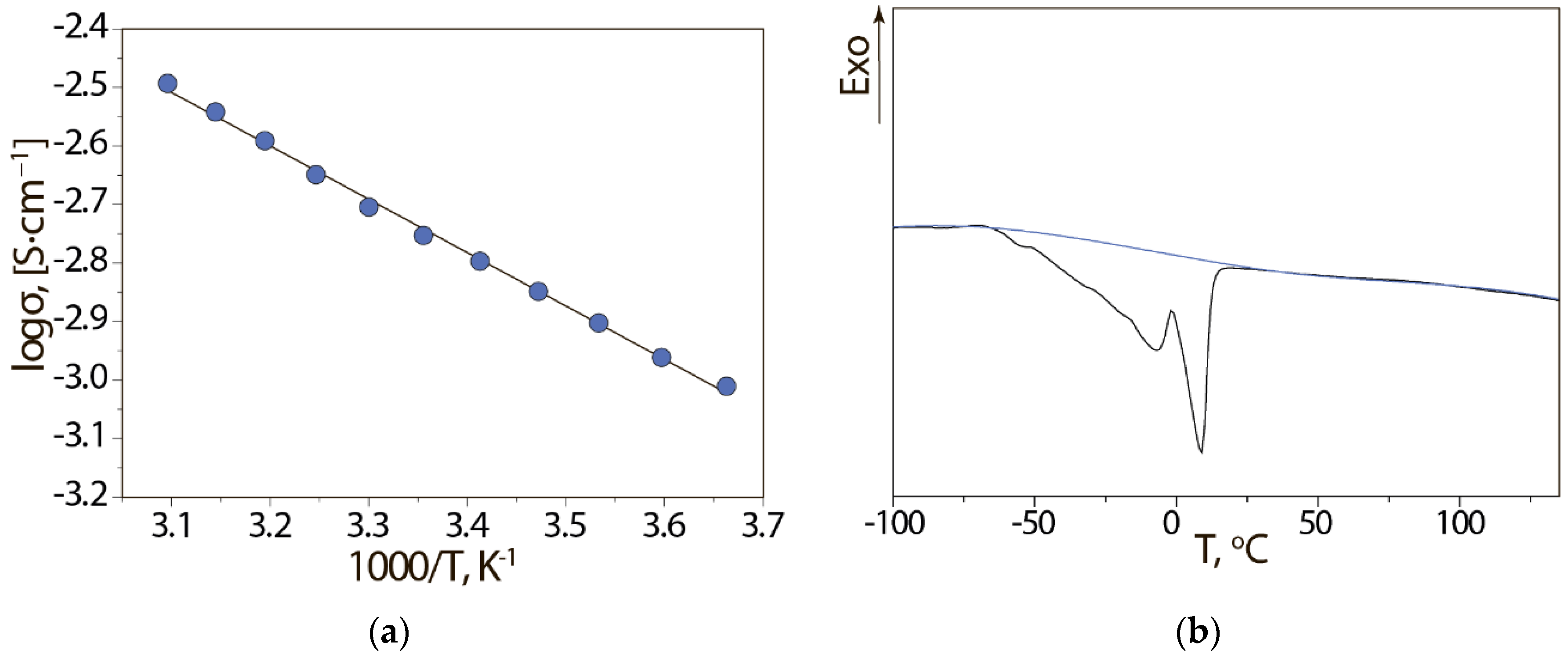
The polymer electrolyte was 154% swollen film with a thickness of ~160 μm. The degree of solvation of the obtained membrane was 19.4 solvent molecules per sulfonic group. The temperature dependency of the ionic conductivity of the studied sample obeyed the Arrhenius equation and was linearized in logs−1000/T plot (Figure 1a). At room temperature, the ionic conductivity was 1.8 mSm·cm−1, which exceeded the values typical for most polymer electrolytes and met the requirements for electrolytes in lithium metal batteries [8]. The value of the activation energy of conductivity calculated from the slope of the straight line was 17.5 ± 0.3 kJ·mol−1. The DSC curve of the solvated membrane showed two endothermic peaks beginning at −57 °C and −5 °C (Figure 1b), which corresponded to the glass transition and complete melting temperatures of the solvent mixture.
Figure 1.
(a) Temperature dependence of ionic conductivity and (b) DSC curve of the obtained polymer electrolyte.
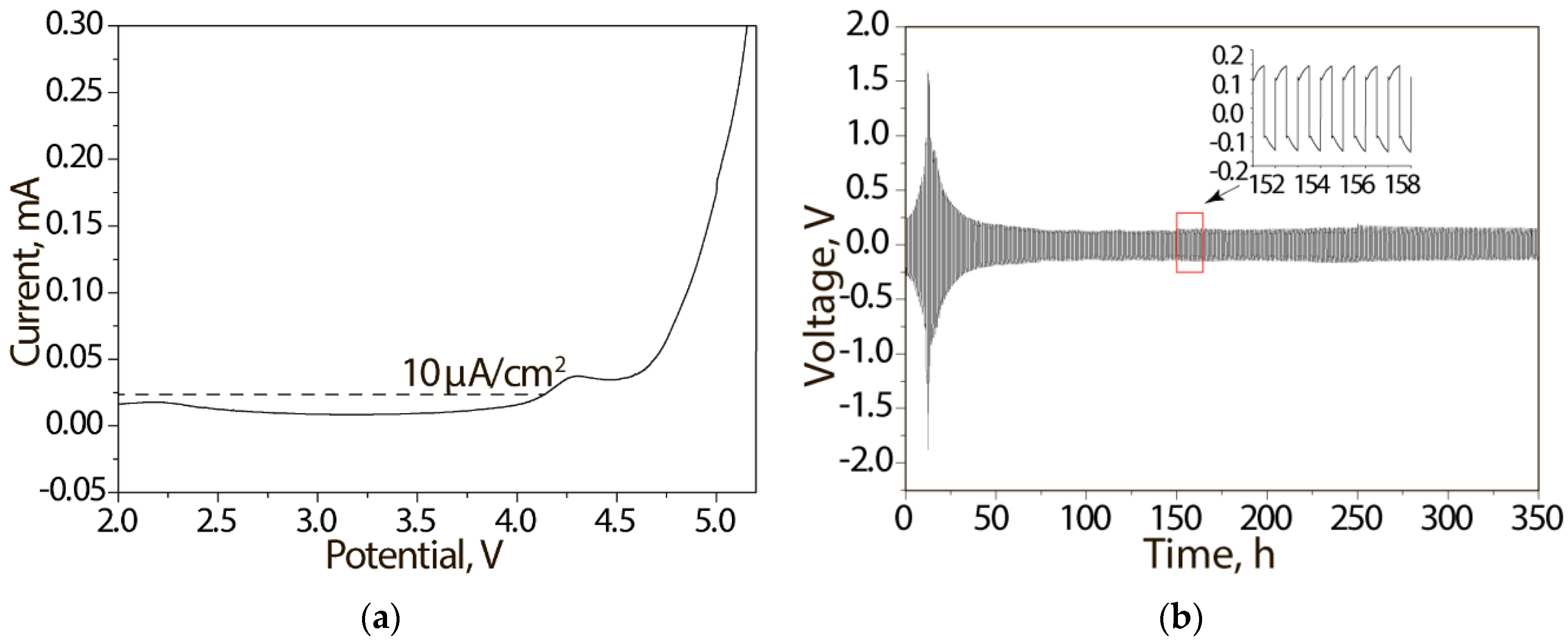
The electrochemical stability window of the obtained gel–polymer electrolyte was determined using linear sweep voltammetry (Figure 2a). No anodic peaks were observed on the curve, and a sharp increase in the current density corresponding to the electrolyte reduction [9] was only detected above 4.1 V vs. Li/Li+. To further evaluate the stability of the resulting electrolyte with respect to the lithium electrodes, a symmetrical Li/Li cell was assembled and tested using Li plating–stripping experiments at a current density of 0.1 mA·cm−2 (Figure 2b). During the first cycle, the voltage increased with a maximum of ~±1.5 V, which corresponded to electrolyte reduction with the formation of an SEI (solid electrolyte interphase) layer at the interface of the electrode, after which, the voltage uniformly decreased and reached stable values of ~±140 mV at cycle 38, which remained stable for >300 h. This behavior of the cell during the initial cycles was associated with a partial reduction in the solvent due to its interaction with lithium metal.
Figure 2.
(a) Voltammetry of a SS/Li cell and (b) galvanostatic cycling of a symmetrical Li/Li cell at a current density of 0.1 mA·cm−2 for 350 h and selective cycles for about 150 h.
Supplementary Materials
The following supporting information can be downloaded at: https://www.mdpi.com/article/10.3390/ECP2022-12667/s1.
Author Contributions
Conceptualization, methodology, investigation, writing—original draft preparation D.V.; writing—review and editing, supervision, A.Y. All authors have read and agreed to the published version of the manuscript.
Funding
This research was funded by the Russian Science Foundation, grant number 21-73-20229.
Institutional Review Board Statement
Not applicable.
Informed Consent Statement
Not applicable.
Data Availability Statement
Not applicable.
Conflicts of Interest
The authors declare no conflict of interest.
References
- Li, H.; Xu, Z.; Yang, J.; Wang, J.; Hirano, S. Polymer electrolytes for rechargeable lithium metal batteries. Sustain. Energy Fuels 2020, 4, 5469. [Google Scholar] [CrossRef] [Scilit]
- Rao, X.; Lou, Y.; Zhong, S.; Wang, L.; Li, B.; Xiao, Y.; Peng, W.; Zhong, X.; Huang, J. Strategies for Dendrite-Free lithium metal Anodes: A Mini-review. J. Electroanal. Chem. 2021, 897, 115499. [Google Scholar] [CrossRef] [Scilit]
- Tu, Z.; Choudhury, S.; Zachman, M.J.; Wei, S.; Zhang, K.; Kourkoutis, L.F.; Archer, L.A. Designing Artificial Solid-Electrolyte Interphases for Single-Ion and High-Efficiency Transport in Batteries. Joule 2017, 1, 394. [Google Scholar] [CrossRef] [Scilit]
- Istomina, A.S.; Yaroslavtseva, T.V.; Reznitskikh, O.G.; Kayumov, R.R.; Shmygleva, L.V.; Sanginov, E.A.; Dobrovolsky, Y.A.; Bushkova, O.V. Li-Nafion Membrane Plasticised with Ethylene Carbonate/Sulfolane: Influence of Mixing Temperature on the Physicochemical Properties. Polymers 2021, 13, 1150. [Google Scholar] [CrossRef] [Scilit] [PubMed]
- Doyle, M.; Lewittes, M.E.; Roelofs, M.G.; Perusich, S.A.; Lowrey, R.E. Relationship between ionic conductivity of perfluorinated ionomeric membranes and nonaqueous solvent properties. J. Memb. Sci. 2001, 184, 257. [Google Scholar] [CrossRef] [Scilit]
- Kulova, T.; Skundin, A.; Chekannikov, A.; Novikova, S.; Voropaeva, D.; Yaroslavtsev, A. Sodium rechargeable batteries with electrolytes based on Nafion membranes intercalated by mixtures of organic solvents. Batteries 2018, 4, 61. [Google Scholar] [CrossRef] [Scilit]
- Walker, W.; Giordani, V.; Uddin, J.; Bryantsev, V.S.; Chase, G.V.; Addison, D. A Rechargeable Li–O2 Battery Using a Lithium Nitrate/N,N-Dimethylacetamide Electrolyte. J. Am. Chem. Soc. 2013, 135, 2076. [Google Scholar] [CrossRef] [Scilit] [PubMed]
- Voropaeva, D.Y.; Novikova, S.A.; Yaroslavtsev, A.B. Polymer electrolytes for metal-ion batteries. Russ. Chem. Rev. 2020, 89, 1132. [Google Scholar] [CrossRef] [Scilit]
- Li, H.; Shen, X.; Hua, H.; Gao, J.; Wen, Z.; Wang, X.; Peng, L.; Wu, D.; Zhang, P.; Zhao, J. A novel single-ion conductor gel polymer electrolyte prepared by co-irradiation grafting and electrospinning process. Solid State Ion. 2020, 347, 115246. [Google Scholar] [CrossRef] [Scilit]
Publisher’s Note: MDPI stays neutral with regard to jurisdictional claims in published maps and institutional affiliations. |
© 2022 by the authors. Licensee MDPI, Basel, Switzerland. This article is an open access article distributed under the terms and conditions of the Creative Commons Attribution (CC BY) license (https://creativecommons.org/licenses/by/4.0/).