Proceeding Paper

A Holistic Approach to Wildfire Suppression Aircraft Fleet Design Using Operational Considerations and Evaluation Metrics †
1
School of Aeronautics and Astronautics, Purdue University, West Lafayette, IN 47907, USA
2
Institute of System Architectures in Aeronautics, German Aerospace Center (DLR), 21129 Hamburg, Germany
*
Author to whom correspondence should be addressed.
Presented at the 15th EASN International Conference, Madrid, Spain, 14–17 October 2025.
Eng. Proc. 2026, 133(1), 132; https://doi.org/10.3390/engproc2026133132
Published: 14 May 2026

Abstract

Wildfires are increasing in frequency, intensity, and duration, driving up suppression and damage costs and motivating a more coordinated use of aerial firefighting assets. Within this context, we extend the COLOSSUS Project’s X-Challenge System-of-Systems (SoS) simulation toolkit with an integrated aircraft sizing and fleet assessment methodology that links conceptual aircraft design with tactic selection. Two platforms are sized under 2035 technology assumptions—a 2000 kg payload electric Vertical Takeoff Landing (eVTOL) and a 3000 kg payload Single Engine Air Tanker (SEAT) using physics-based performance and parametric cost models. A Design of Experiments (DoE) workflow coupled with the SoS toolkit evaluates mixed fleets and tactic assignments in three representative regions. Effectiveness is quantified via a weighted, normalized Measure of Effectiveness that aggregates burnt area, emissions, and cost metrics into a single scalar. Results show that acquisition cost dominates overall effectiveness and that location-specific fleet compositions can outperform a single fixed fleet without degrading suppression outcomes, motivating future work on adaptive, region-specific fleet design and sensitivity analyses.

1. Introduction

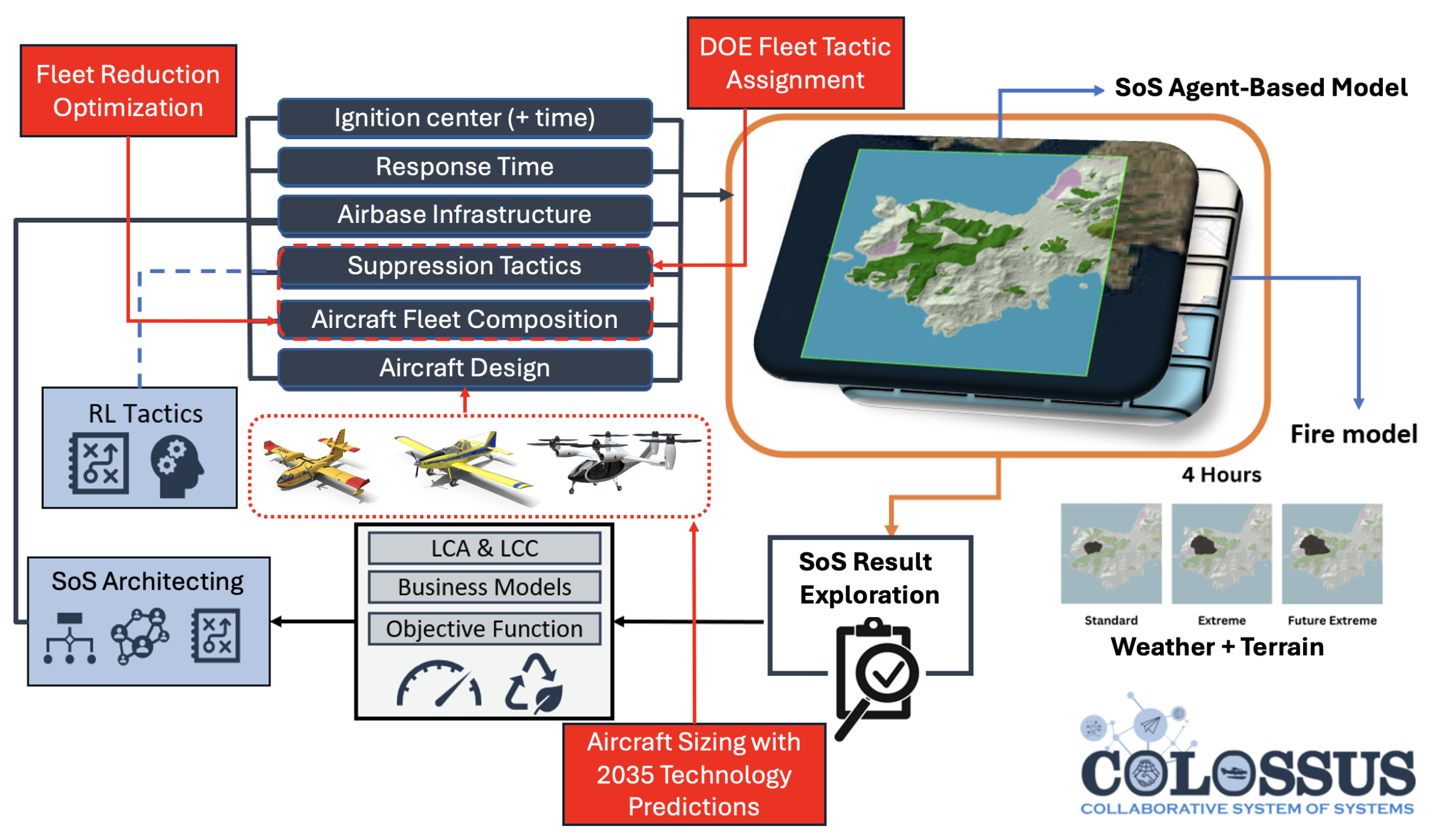
Wildfire seasons are becoming longer, more frequent, and more severe, leading to increased damage costs and suppression expenditures in the United States (U.S.) and globally [1,2,3]. In this study, we propose a System-of-Systems (SoS)-oriented analysis of wildfire suppression that couples conceptual aircraft design with the evaluation and improvement of coordinated fleets and tactics at the operational scale. This work was part of a six month international student competition, the COLOSSUS Project’s X-Challenge, in which teams were tasked with developing innovative aircraft designs and expanding the COLOSSUS framework. The methods, analyses and use cases used in this paper follow the X-Challenge’s objectives, constraints and tools and are demonstrated on three representative scenarios: Salamis, Greece; Pyrenees, France; and Pacific Palisades, U.S. [4]. We leveraged the aerial wildfire fighting agent-based model (ABM) SoSID toolkit (X-Challenge toolkit, German Aerospace Center (DLR), Institute of System Architectures in Aeronautics, Hamburg, Germany) for this study [5]. The toolkit simulates wildfire response using ignition locations, aircraft performance parameters, and atmospheric conditions. Figure 1 visualizes the parts of this framework that are specific to our contribution (shown in red boxes) which include the aircraft sizing with 2035 technology assumptions, the Design of Experiments (DoE) workflow for fleet level tactic assignment, the fleet reduction process to determine near optimal fleet size, and the post-processing of simulation outputs into the Measure of Effectiveness (MoE) used to compare alternative fleet-tactic configurations. The aircraft sizing and evaluation processes operate within a predefined 2035 technology portfolio and the operational, performance, and cost assumptions embedded in the SoSID toolkit. A complete description of the overall COLOSSUS framework can be found in [4].

System-of-Systems Perspective of the Aerial Wildfire Fighting Operation

Wildfire fighting can be classified as an SoS in which complexity depends on the scenario and location doctrines. Following a Resource–Operation–Policy–Economics (ROPE) perspective [6], we decompose the problem into α -level and β -level as shown in Table 1: at the α -level, we improve aircraft design and suppression tactics across ROPE; at the β -level, we assess how these changes propagate to system performance via fleet coordination and response. This hierarchy makes inter-dependencies explicit, enables principled trade-offs through scenario-based analysis of tactics, fleet composition, and roles, and provides a scalable framework for varied wildfire conditions.

2. Aircraft Design Methodology

This study presents the conceptual design of three firefighting aircraft intended for mountainous and fire-prone regions (Palisades, Pyrenees, Salamis), considering electric Vertical Takeoff and Landing (eVTOL), Single Engine Air Tanker (SEAT), and Twin-Engine Conventional Takeoff and Landing (CTOL) platforms under 2035 technology assumptions. Performance, fuel consumption, and mission suitability were assessed. We selected three architectures because our fleet survey revealed three dominant categories, with nearly all aircraft fitting into one of them (VTOL assets are represented by an eVTOL analogue). Taking a broad initial approach allowed us to examine the full design space prior to converging on the most promising options.

2.1. Mission Environment and Configuration

Operational requirements were derived from regional topography and infrastructure. CTOL aircraft were favored due to available runways and superior payload, fuel efficiency, and cruise speed. VTOL drawbacks (hover penalties, limited payload, lower cruise speed) are compensated with eVTOLs using distributed electric propulsion, reducing operational costs and enhancing safety. All aircraft are assumed to perform cyclical drop missions. The eVTOL carries 2000 kg from vertipads, cruises to drop-zone, releases payload, and returns for battery recharge. SEAT (3000 kg) and CTOL (7000+ kg) aircraft operate from airfields or water surfaces with amphibious capability, enabling rapid refills and higher mission efficiency.

2.2. Conceptual Design Methodology of eVTOL Aircraft

The conceptual design follows the methodology in [7], using a 2000 kg payload configuration for early-stage trade-offs and designed for firefighting missions with a range of 80 km and a cruise speed of 240 km/h. The model integrates aerodynamic modeling, battery and weight estimation, performance constraints, and utilization requirements. Key assumptions include single-pilot operation, uniform rotor loading across eight prop-rotors, and a 2035 battery energy density of 600 Wh/kg [8].
A MATLAB (R2025a, MathWorks, Natick, MA, USA)-based Blade Element Momentum Theory (BEMT) solver was used to size the rotors and evaluate power requirements across the mission profile [9,10], with lift and drag coefficients modeled via XFOIL (6.99, Massachusetts Institute of Technology, Cambridge, MA, USA) and selecting NACA 64-series sections for favorable pitching-moment and drag characteristics. Rotor optimization minimized hover and cruise power while satisfying radius and loading constraints. Battery sizing accounted for all mission segments, including hover, climb, cruise, and contingency reserves and is computed by f b a t t = E r e q ρ E · η p a c k , where E r e q is the energy required for the mission segment, ρ E is the battery density, and η p a c k is the battery packing efficiency. Empty weight was estimated using a regression model based on published eVTOL data, and parasitic drag was computed using component drag build-up [11].
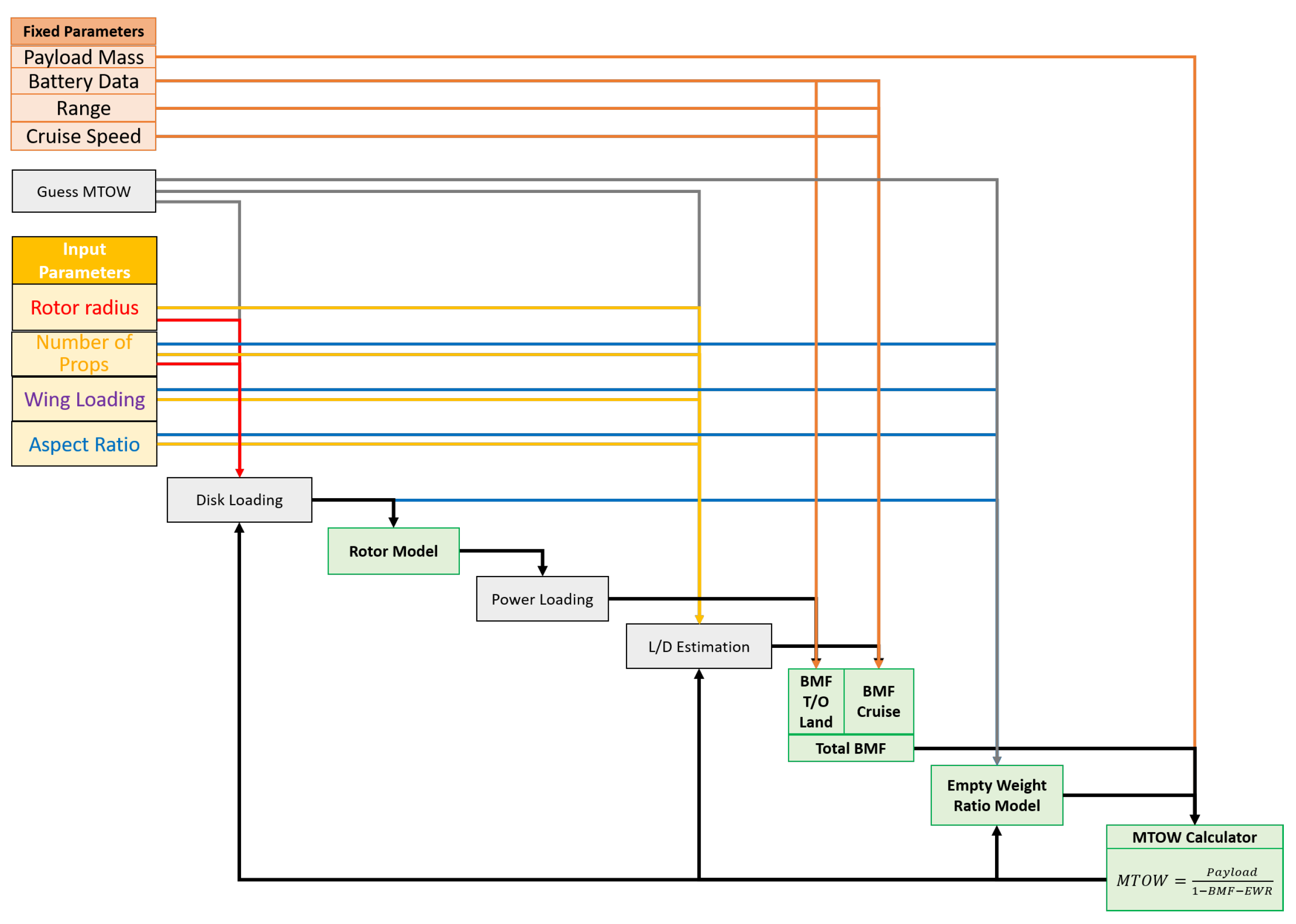
The design space was explored over rotor radius, disk loading, wing area, and number of prop-rotors. Performance, stall margins, and battery discharge rates were evaluated, with sensitivity analyses performed around key weight fractions. The resulting configuration meets required payload, cruise speed, and power demands while maintaining feasible margins under ±20% variation in weight and L/D terms. The sizing framework is visualized in Figure A1 of Appendix A. The final eVTOL characteristics are summarized in Table 2.

2.3. Conventional Aircraft Design

Two conventional fixed-wing aircraft were modeled for comparison: a large CTOL air tanker and a Single Engine Air Tanker (SEAT). Both were sized using Raymer’s empty weight regression model [11], where the empty weight ratio is given by E W R = A · W 0 c , where A ,   c are empirical regression constants and W 0 is the takeoff weight. For the CTOL air tanker, with W 0 = 25,000   kg (prescribed as a limit in the original problem statement [4]), this yields an empty weight of 15,787 kg and a payload of 7829 kg. The SEAT aircraft, designed for an 80 km cruise with a 10-min loiter and return, converged to an MTOW of 10,656 kg and an empty weight ratio of 0.659, corresponding to a payload of 3000 kg.
Aerodynamic and propulsion characteristics for both aircraft are based on projected 2035 turboprop performance, with lift-to-drag ratios, specific fuel consumption, and propeller efficiency obtained from the literature [11,12]. Cruise and loiter fuel consumption were estimated using Breguet equations, while takeoff and climb segments were modeled with a physics-based, power-limited approach, where the climb power is P c l i m b = W · V η p r o p · sin γ and the fuel mass flow is m ˙ fuel = S F C · P , with W the aircraft weight, V the airspeed, η p r o p the propeller efficiency, γ the climb angle, S F C the specific fuel consumption, and P the shaft power. Key aerodynamic, propulsion, and mission parameters for the CTOL air tanker and SEAT are summarized in Table 3.

3. Aircraft Acquisition and Operational Cost Estimation

3.1. Acquisition Costs

3.1.1. eVTOL Aircraft

To account for wide variability in costing models, we combine approaches from Refs. [13,14,15] to obtain a conservative estimate for eVTOL airframe acquisition cost. The airframe cost is taken as $2265 per kilogram of empty weight based on a modern aircraft (Cessna Citation M2) Ref. [14], updated to 2025 USD, with an added fixed $0.1 M per aircraft for avionics to reflect increased automation and autonomy requirements. Battery life is assumed to be at 800 cycles [13], at $400 per kWh [15]; assuming 400 flight hours per year for 10 years with a 0.8 h block time [16], the aircraft accumulates about 5503 battery cyles, requiring seven battery packs over its lifetime. The total eVTOL acquisition cost is then C A c q , e V T O L = C A i r f r a m e + C A v i o n i c s + N · C B a t t e r y P a c k , where C is the cost for each corersponding component and N is the number of battery packs required for each eVTOL.

3.1.2. CTOL and SEAT via DAPCA IV Model

A MATLAB script implementing the DAPCA IV model [17] is used to estimate the Research, Development, Test, and Evaluation (RDT&E) and production costs for the two conventional aircraft. The script takes as input empty weight, cruise speed, production quantity, engine and flight-test article counts, composite fudge factor and outputs labor, material, engine, and avionics costs adjusted to current USD. Assuming conservative production runs of 20 CTOL units and 150 SEATs, with 2 and 5 flight-test aircraft respectively [11], and an engine cost of $0.9 M (2012 USD) based on PW-123 turboprop engine pricing plus a 5% buffer [18], the resulting unit acquisition costs are approximately $30 M for the CTOL and $6.8 M for the SEAT in 2025 USD.

3.2. Operational Costs

Operational costs per flight-hour includes maintenance, fuel/energy, pilot compensation, landing fees, and ground handling charges. Retardant is assumed to be free as water is primarily used. Maintenance cost per flight-hour is taken from the literature for conventional turboprops and reduced for the eVTOL to reflect simpler powertrain and lower scheduled maintenance needs [14,19]. Fuel and electricity expenses are derived from the sized mission profiles combined with assumed unit prices for jet fuel and grid electricity for the eVTOL case. Pilot cost per flight-hour is obtained by combining an estimated daily pay range for aerial firefighting pilots with an assumed fire-season length and annual flight hours [16,20]. Landing and handling fees are taken from representative medium-to-large airports such as Los Angeles International Airport (LAX) and Tarbes–Lourdes–Pyrénées Airport (LDE) [21,22]. These per-flight-hour cost components for each aircraft are compiled in Table 4. Although the CTOL air tanker performs well in payload and range, its high acquisition and operating costs lead to a poor cost-per-payload metric compared with the SEAT and eVTOL. SEATs provide more cost-effective payload capability, while eVTOLs offer VTOL flexibility and lower operating costs. For this reason, the CTOL is retained as a reference case only and is excluded from the fleet and tactic studies.

4. Fleet-Level Tactic Assignment

From an SoS perspective, the clustering of smaller systems leads to a more capable system. Within the SoSID toolkit, each aircraft can be assigned a collection of three actions:
  • select_poi: chooses the next target according to a prioritization rule (e.g., water, VIP, vegetation, topography, indirect);
  • track_poi: defines how the agent moves toward or updates the target (direct to original point, follow the fastest-spreading edge, or align to an indirect fire line);
  • suppress: specifies how drops are applied at the target (direct suppression, indirect fire line construction).

4.1. Design of Experiments for Fleet-Level Tactic Assignment

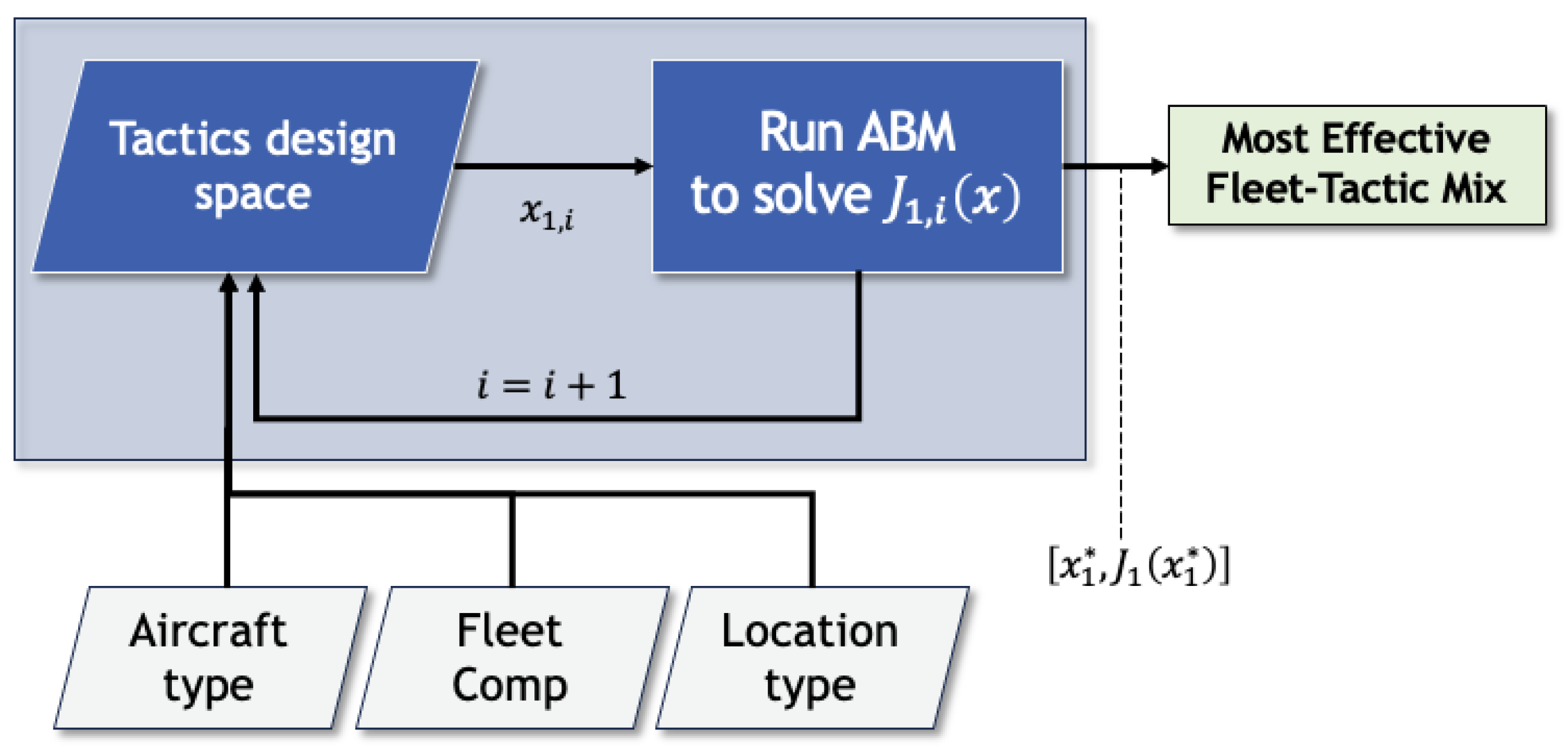
Manual assignment of these tactics by the user can lead to poor suppression and the suitability of tactics also depend on aircraft capability and location/terrain type. We therefore implement a three-step DoE-based fleet-level tactic assignment. The DoE framework for fleet-tactic assignment is visualized in Figure A2 of Appendix A. First, tactics that are incompatible with a given aircraft type or location are filtered out. Second, Latin Hypercube Sampling (LHS) generates candidate fleet-level tactic mixes. Third, each combination is simulated in the SoSID toolkit, and the tactic mix with the highest MoE is selected. This DoE-based fleet-level tactic assignment module is one of the key contributions of this work and represents a new extension of the COLOSSUS SoSID toolkit beyond manually defined tactic sets.

4.2. Fleet-Reduction Process to Assess Fleet-Related Expense

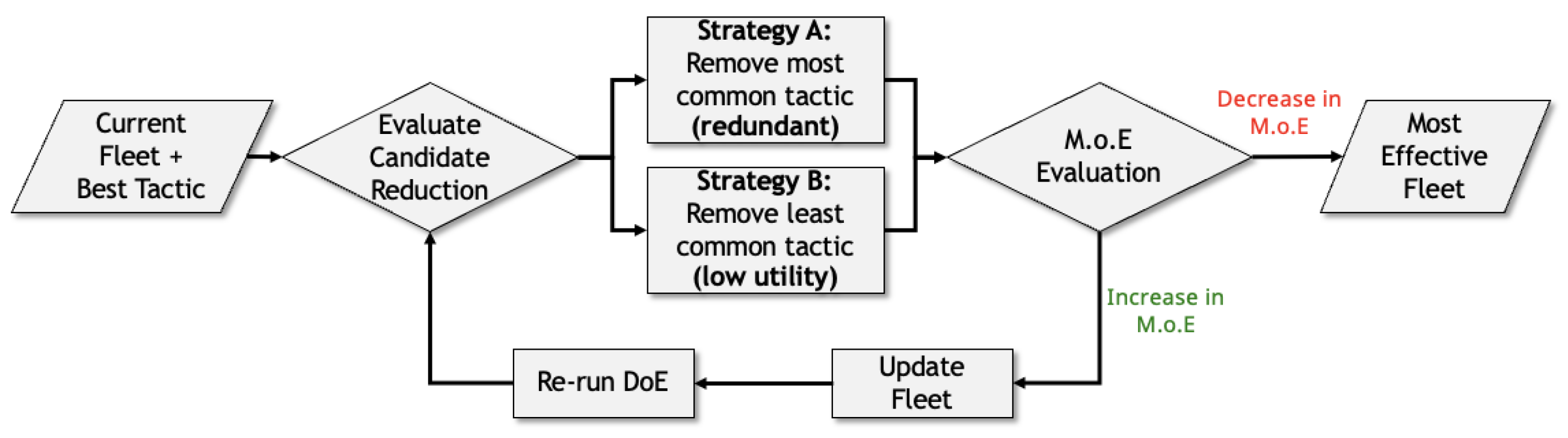
The DoE is simulated with a baseline fleet consisting of 5 eVTOL aircraft and 5 SEATs, chosen out of engineering judgment as a capable configuration for all three locations. To assess the impact of fleet size on performance and cost, we conduct a fleet-reduction analysis, noting that fleet costs account for 40% of the MoE defined in [4] and visualized in Figure A3 of Appendix A. The analysis uses a simple heuristic: at each step, candidate reductions in fleet size are evaluated in the SoSID simulations, and the change that yields the best MoE is adopted. This process terminates when no further reduction in fleet size improves the MoE, yielding a more cost-effective fleet under realistic constraints.

5. Results

5.1. Baseline Fleet Analysis

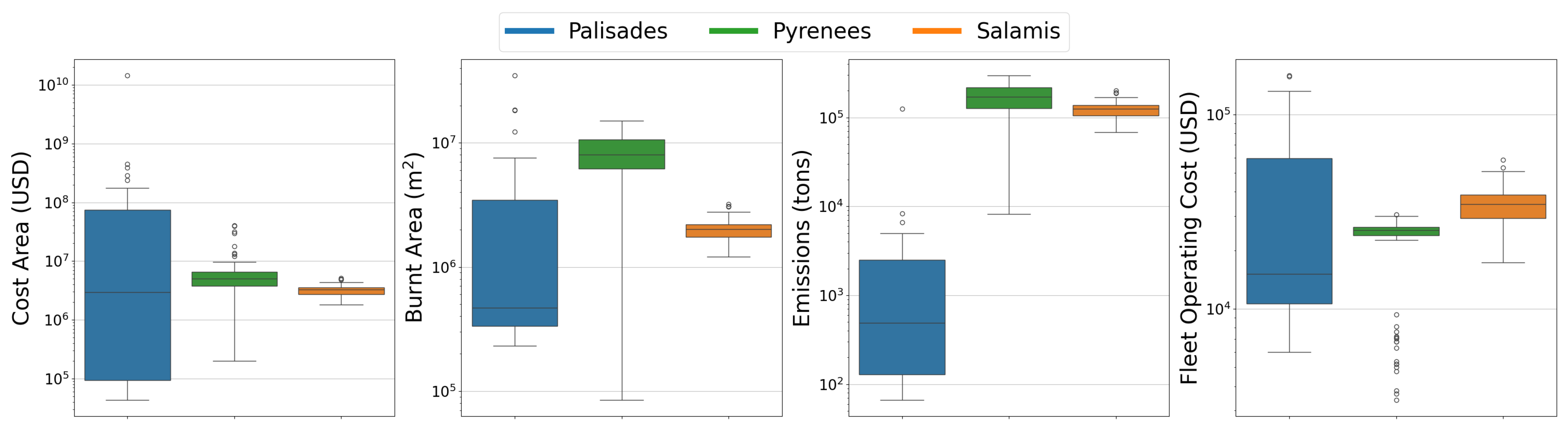
Across 100 LHS runs, baseline results show clear urban–rural contrasts (Figure 2). Pyrenees posts the highest mean emissions (≈159,436 t CO 2 ) and burnt area (≈759.7 ha), consistent with larger, vegetation-driven fires. Palisades has the lowest emissions (≈2644.3 t CO 2 ) but the highest cost area (≈€170.83 M), reflecting its urban setting; Salamis and Pyrenees (rural) exhibit higher emissions than Palisades. Palisades also shows the widest spread across metrics, indicating greater sensitivity to tactic choices, whereas Salamis and Pyrenees display tighter distributions. The overall MoE (weighted, normalized over five metrics) remains relatively high and consistent across sites (≈0.76–0.79).
Table 5 summarizes the results obtained using the most effective fleet suppression tactics. Among five of the normalized metrics, fleet acquisition cost dominates the MoE value, while the remaining metrics are nearly zero even before weighting, which suggests negligible impact after applying weights.

5.2. Impact of Fleet Reduction on Measure of Effectiveness

To satisfy a single fixed fleet across sites, we terminate our fleet reduction process after arriving at a fleet composition of 5 eVTOL + 4 SEATs. More specifically, this fleet composition maximizes the MoE obtained for the Salamis region; any further fleet reductions depress the MoE for Salamis. Relative to the baseline fleet, the reduced fleet increases the MoE in Palisades from 0.8133 to 0.8313, mainly due to lower operating and acquisition costs; in Pyrenees from 0.8134 to 0.8300, where cost savings outweigh slight increases in burnt area and emissions; and in Salamis from 0.7854 to 0.8047, demonstrating modest improvements across metrics. Salamis remains the bottleneck for further fleet cuts; in contrast, location-specific fleets could score higher (e.g., a Palisades MoE of 0.8669 with 2 eVTOL aircraft and 4 SEATs, and a Pyrenees MoE 0.8708 with 2 eVTOL aircraft and 5 SEATs). However, although location-specific fleets could achieve higher MoE, we do not model them further in this study and do not propose them as a robust operational solution. Table 6 summarizes the change in normalized fleet operating cost, fleet acquisition cost, and MoE between the baseline (5 eVTOL + 5 SEATs) and reduced (5 eVTOL + 4 SEATs) fleets.

6. Conclusions

Wildfire intensification motivates more cost-effective and ecologically aware use of aerial firefighting fleets. As part of the expansion of the COLOSSUS SoSID toolkit, this work introduces an integrated aircraft sizing and fleet-level evaluation method that couples 2035-technology platform sizing with a DoE-based tactic assignment process and a normalized MoE to compare alternative fleet-tactic configurations. Applied to the Palisades, Pyrenees, and Salamis scenarios, the method identified a common fleet of 4 eVTOLs and 5 SEATs driven primarily by acquisition and operating costs, while location-specific fleets achieved slightly higher MoEs. Future work will extend this framework with broader sensitivity studies and adaptive, location-dependent fleet acquisition and reduction strategies to further strengthen SoS-level decision support. Overall, the proposed SoS-driven framework enhances wildfire-fighting capability by enabling integrated fleet sizing and tactic allocation at the system level, improving adaptability, cost- and mission-effectiveness, and robustness.

Author Contributions

Conceptualization, S.D.B., J.G. and E.I.; methodology, J.G. and S.D.B.; validation, A.E. and S.D.B.; formal analysis S.D.B., J.G. and A.E.; investigation, S.D.B. and J.G.; data curation, E.I.; writing—original draft preparation, S.D.B., J.G., A.E. and E.I.; writing—review and editing, J.G., S.D.B., A.E. and E.I.; visualization, J.G.; supervision, N.K., N.N. and P.S.P.; project administration, N.K., N.N. and P.S.P.; funding acquisition, P.S.P.; toolkit and framework architecting, P.S.P. All authors have read and agreed to the published version of the manuscript.

Funding

The research presented in this paper has been performed in the framework of the COLOSSUS project (Collaborative System of Systems Exploration of Aviation Products, Services and Business Models) and has received funding from the European Union Horizon Europe program under grant agreement No. 101097120. The Swiss participation in the COLOSSUS project is supported by the Swiss State Secretariat for Education, Research and Innovation (SERI) under contract number 22.00609.

Institutional Review Board Statement

Not applicable.

Informed Consent Statement

Not applicable.

Data Availability Statement

Data is contained within the article.

Conflicts of Interest

The authors declare no conflicts of interest.

Appendix A. Framework Diagrams

Figure A1. N2 diagram presenting an overview of the eVTOL sizing framework.
Engproc 133 00132 g0a1
Figure A2. Computational framework for Design of Experiments (DoE) to select suppression tactics.
Engproc 133 00132 g0a2
Figure A3. Fleet-reduction process framework.
Engproc 133 00132 g0a3

References

  1. Westerling, A.L. Increasing Western US Forest Wildfire Activity: Sensitivity to Changes in the Timing of Spring. Philos. Trans. R. Soc. B Biol. Sci. 2016, 371, 20150178. [Google Scholar] [CrossRef] [Scilit] [PubMed]
  2. National Oceanic and Atmospheric Administration. U.S. Billion-Dollar Weather and Climate Disasters; Technical Report; NOAA National Centers for Environmental Information: Asheville, NC, USA, 2025. [CrossRef]
  3. National Interagency Fire Center. Historical Wildland Fire Information: Federal Firefighting Costs (Suppression Only); Technical Report; National Interagency Fire Center: Boise, ID, USA, 2022.
  4. Kalliatakis, N.; Naeem, N.; Prakasha, P.S. COLOSSUS X-Challenge Student Competition: Exploring Solutions to Wildfire Fighting Using System-of-Systems Analysis. In Proceedings of the 15th EASN Conference, Madrid, Spain, 14–17 October 2025. [Google Scholar]
  5. Prakasha, P.S.; Naeem, N. Establishing a Collaborative Open Source Agent Based Simulation Environment for System of Systems Aviation Problems. CEAS Aeronaut. J. 2026; Submitted.
  6. DeLaurentis, D.A. Understanding Transportation as a System-of-Systems Design Problem. In Proceedings of the 43rd AIAA Aerospace Sciences Meeting and Exhibit, Reno, NV, USA, 10–13 January 2005; pp. 15083–15096. [Google Scholar] [CrossRef] [Scilit]
  7. Das Biswas, S. Conceptual Design of Large Electric Vertical Take-off and Landing Aircraft for Urban Air Mobility Operations. Master’s Thesis, Purdue University Graduate School, West Lafayette, IN, USA, 2025. [Google Scholar]
  8. Walter, D.; Bond, K.; Butler-Sloss, S.; Speelman, L.; Numata, Y.; Atkinson, W. X-Change: Batteries, the Battery Domino Effect; Technical Report; Rocky Mountain Institute: Basalt, CO, USA, 2023. [Google Scholar]
  9. Archer Aviation. Archer Completes Midnight’s Transition Flight. 2024. Available online: https://investors.archer.com/news/news-details/2024/Archer-Completes-Midnights-Transition-Flight/default.aspx (accessed on 14 June 2024).
  10. Archer Aviation. Archer’s Midnight eVTOL Aircraft Transition Flight—Uncut Footage. 2024. Available online: https://www.youtube.com/watch?v=EKG-6rxXAXE (accessed on 16 March 2025).
  11. Raymer, D. Aircraft Design: A Conceptual Approach; American Institute of Aeronautics and Astronautics: Reston, VA, USA, 2012. [Google Scholar]
  12. Janes All the World’s Aircraft. Pratt & Whitney Canada PW100 Series; Technical Report, Specifications Summary for the PW100 Turboprop Engine Family; Janes Information Services: Croydon, UK, 2010. [Google Scholar]
  13. Howard, R.J.; Wright, E.; Mudumba, S.V.; Gunady, N.I.; Sells, B.E.; Maheshwari, A. Assessing the Suitability of Urban Air Mobility Vehicles for a Specific Aerodrome Network. In Proceedings of the AIAA AVIATION 2021 Forum, Virtual Event, 2–6 August 2021; p. 3208. [Google Scholar] [CrossRef] [Scilit]
  14. Brown, A.; Harris, W.L. Vehicle Design and Optimization Model for Urban Air Mobility. J. Aircr. 2020, 57, 1003–1013. [Google Scholar] [CrossRef] [Scilit]
  15. Kohlman, L.W.; Patterson, M.D.; Raabe, B.E. Urban Air Mobility Network and Vehicle Type-Modeling and Assessment; Technical Report ARC-E-DAA-TN64561, Document ID: 20190001282; NASA Ames Research Center: Moffett Field, CA, USA, 2019.
  16. Keating, E.G.; Morral, A.R.; Price, C.C.; Woods, D.; Norton, D.M.; Panis, C.; Saltzman, E.; Sanchez, R. Air Attack Against Wildfires: Understanding U.S. Forest Service Requirements for Large Aircraft; MG-1234-USDAFS; RAND Corporation: Santa Monica, CA, USA, 2012. [Google Scholar] [CrossRef] [Scilit]
  17. Boren, H.E.J. DAPCA: A Computer Program for Determining Aircraft Development and Production Costs; Memorandum RM-5221-PR, Prepared for the United States Air Force under Project RAND, Contract No. F44620-67-C-0045; RAND Corporation: Santa Monica, CA, USA, 1967. [Google Scholar]
  18. Forecast International. The Market for Aviation Turboprop Engines; Special Focused Market Segment Analysis Product Code F641, Market Analysis for Aviation Turboprop Engines 2010–2019; Forecast International: Sandy Hook, CT, USA, 2010. [Google Scholar]
  19. Wyndham, D. What Does It Cost to Operate a Turboprop? Operating Cost Breakdowns Based on Conklin & de Decker Data; AvBuyer: Thames Ditton, UK, 2020. [Google Scholar]
  20. The Professional Pilot Network. The Value of Aerial Firefighting and the Compensation You Could Earn; Overview of Aerial Firefighting Roles, Risks, and Pay Structures; The Professional Pilot Network: Alexandria, VA, USA, 2025. [Google Scholar]
  21. Los Angeles World Airports. Landing Fees at LAX (Fiscal Year 2024–25); Technical Report, Board-Adopted Landing Fees and Charges at LAX; Los Angeles World Airports: Los Angeles, CA, USA, 2024. [Google Scholar]
  22. Aéroport Tarbes Lourdes Pyrénées. Guide Tarifaire Spécial AG 2024: Handling & Charges—Aviation Générale et d’Affaires; Technical Report, Handling Rates and Airport Charges Applicable from 1 July 2024; Aéroport Tarbes Lourdes Pyrénées: Juillan, France, 2024. [Google Scholar]
Figure 1. COLOSSUS SoS framework adapted from [4]. Red boxes indicate components added or modified by the present work, and red arrows denote the corresponding areas of impact within the base framework.
Engproc 133 00132 g001
Figure 2. Distribution of fire response metrics across three locations based on LHS-driven baseline (5 eVTOL and 5 SEAT aircraft) fleet simulations.
Engproc 133 00132 g002
Table 1. The wildfire response SoS decomposed into entities within the Resource, Operation, Policy, and Economics sectors.
LevelResourceOperationPolicyEconomics
α CTOL & eVTOL aircraftIndividual suppression tacticFlight operationsPer-vehicle acquisition and operating cost
β Fleet of aircraftFleet-level tacticsFleet management systemsFleet-level economics
Table 2. eVTOL aircraft design parameters.
ParameterValueParameterValue
MTOW [kg]5722Aspect Ratio [-]12
L/D [-]11.43Wing Loading [kg/m2]170.9
Payload [kg]2000Stall Velocity [m/s]46.77
Battery [kWh]502.14Propellers [-]8
Empty Weight [kg]2785Peak C-rate [-]7.83
Cruise Speed [m/s]67.06Range [km]120
Table 3. Conventional aircraft fuel and performance metrics.
ParameterTwin-Engine CTOLSEAT
MTOW [kg]25,00010,656
L/D [-]1210
Payload [kg]78293000
Cruise Power [kW]21601680
Takeoff Power [kW]33302370
SFCBHP [kg/kW·h]0.480.48
Propeller Efficiency ( η prop ) [-]0.850.85
Fuel Estimation [-]HybridHybrid
Table 4. Summary of operational costs ($/h) of the three different aircraft under consideration.
Cost ($/h)eVTOLSEATCTOL Air Tanker
Maintenance59.80129.57299.01
Fuel/Energy83.72442.54867.14
Pilot518.32518.28984.41
Landing Fees106.58105.65203.33
Ground Handling199.34199.34398.68
Total967.761395.382752.57
Table 5. Unweighted normalized simulation results with baseline fleet composition (5 eVTOL aircraft and 5 SEATs) and the most effective fleet tactics after DoE runs.
Normalized MetricsPalisadesSalamisPyrenees
Cost Area< 10 4 < 10 3 < 10 4
Burnt Area0.00260.02910.0009
Emissions0.00050.09290.0035
Fleet Operating Cost0.02070.05560.0175
Fleet Acquisition Cost0.61340.61340.6134
Measure of Effectiveness0.81330.78540.8134
Table 6. Effect of fleet reduction (5 eVTOL + 5 SEATs → 5 eVTOL + 4 SEATs) on normalized fleet costs and MoE. Each cell provides baseline → reduced ( Δ = reduced − baseline).
Normalized MetricPalisadesSalamisPyrenees
Fleet Operating Cost 0.0207 0.0165 ( Δ = 0.0042 ) 0.0556 0.0507 ( Δ = 0.0049 ) 0.0175 0.0248 ( Δ = + 0.0073 )
Fleet Acquisition Cost 0.6134 0.5549 ( Δ = 0.0585 ) 0.6134 0.5549 ( Δ = 0.0585 ) 0.6134 0.5549 ( Δ = 0.0585 )
Measure of Effectiveness 0.8133 0.8313 ( Δ = + 0.0180 ) 0.7854 0.8047 ( Δ = + 0.0193 ) 0.8134 0.8300 ( Δ = + 0.0166 )
Disclaimer/Publisher’s Note: The statements, opinions and data contained in all publications are solely those of the individual author(s) and contributor(s) and not of MDPI and/or the editor(s). MDPI and/or the editor(s) disclaim responsibility for any injury to people or property resulting from any ideas, methods, instructions or products referred to in the content.