System-of-Systems Guided Agent Communication and Collaboration in Aerial Wildfire Fighting †

Abstract
1. Introduction
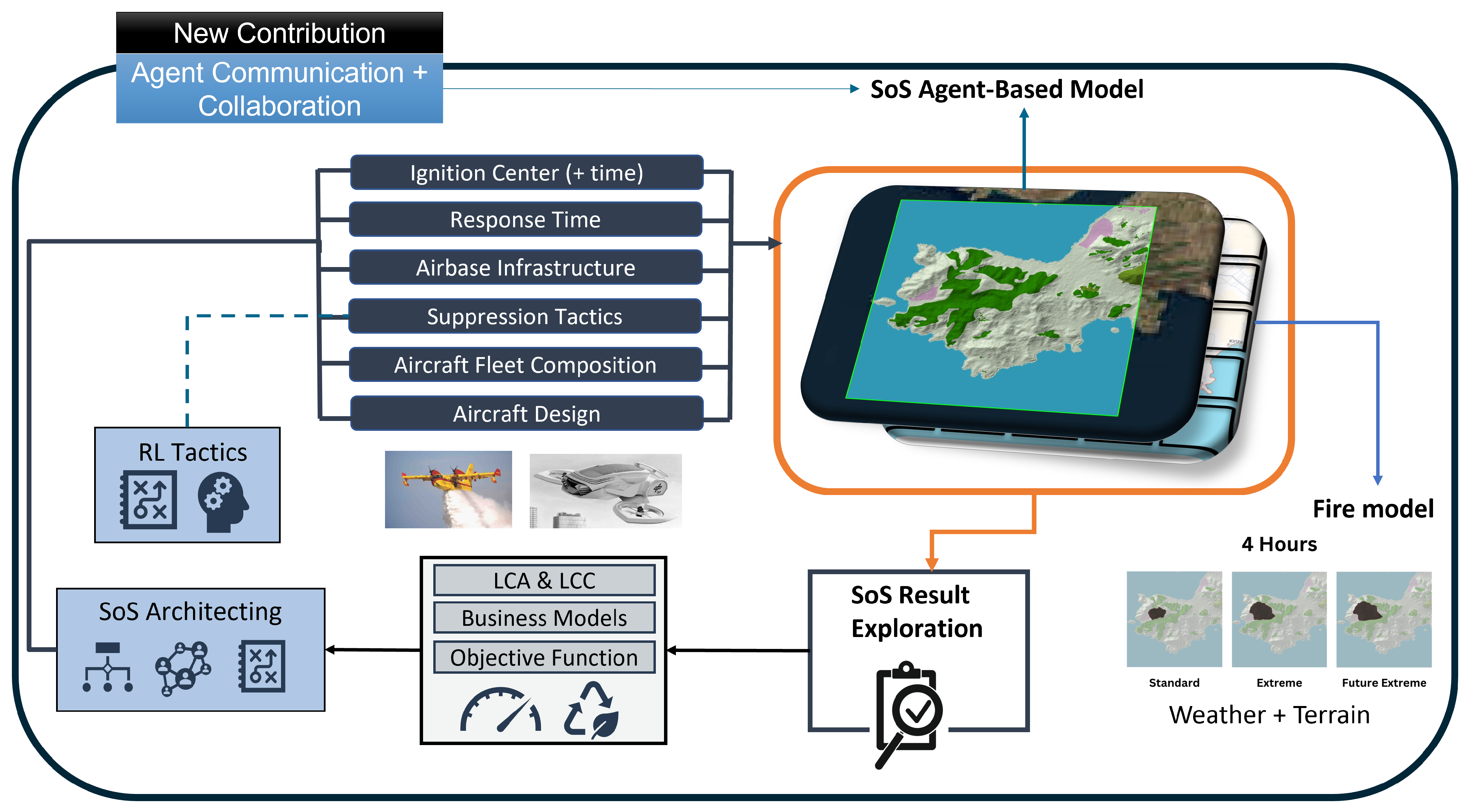
2. Methodology
2.1. Fire Discovery
2.2. Fire Tracking
- Distance between fire front(s) and agent. Priority is updating fire fronts that require least effort to travel to.
- Distance between fire front(s) and other monitoring agents. Priority is updating fire fronts that other monitoring agents are not actively tracking.
- Distance between fire front(s) and suppression points. Priority is updating fire fronts that suppression agents are looking to suppress.
- Fire edges. Priority is to fully capture the fire front; edges may indicate incomplete knowledge base.
- Time since last updates at fire front(s). Priority is to update fire fronts that have not been updated for a while.
2.3. Communication
- 1.
- Update frequency: All agents share their knowledge bases with one another, updating burning areas and extinguished areas. This represents network updates in the case of autonomy or potentially communication intervals in human-based operations.
- 2.
- Proximity based communication: Monitoring agents share their knowledge base with any agent within a certain radius. This represents communication band limitations or low-fidelity antenna gain constraints.
- 3.
- Arrival at airbase: Upon landing for refuel, agents will upload and receive fire front knowledge, similar to the upload of data to a central storage network.
2.4. Scenario Definition
2.5. Assumptions and Limitations
- The Cellular Automata fire model works best for larger-scale fires, as typical cell sizes used in prior validations are those of 30 m [10]. Smaller cell size accuracies have not been extensively tested.
- Communication between agents is flawless—there are no data delays in sharing, and data loss is not considered.
- Surveillance equipment tracks and monitors fires accurately and instantaneously—no processing time or errors are considered, and area coverage is constant (no sweeps required).
- Aircraft suppressions are precise and definitive—the number of suppressions to suppress a fire front does not vary on fire/terrain conditions.
- Suppression aircraft (when functioning with monitoring agents) are unable to see the fire and make independent observations.
3. Results
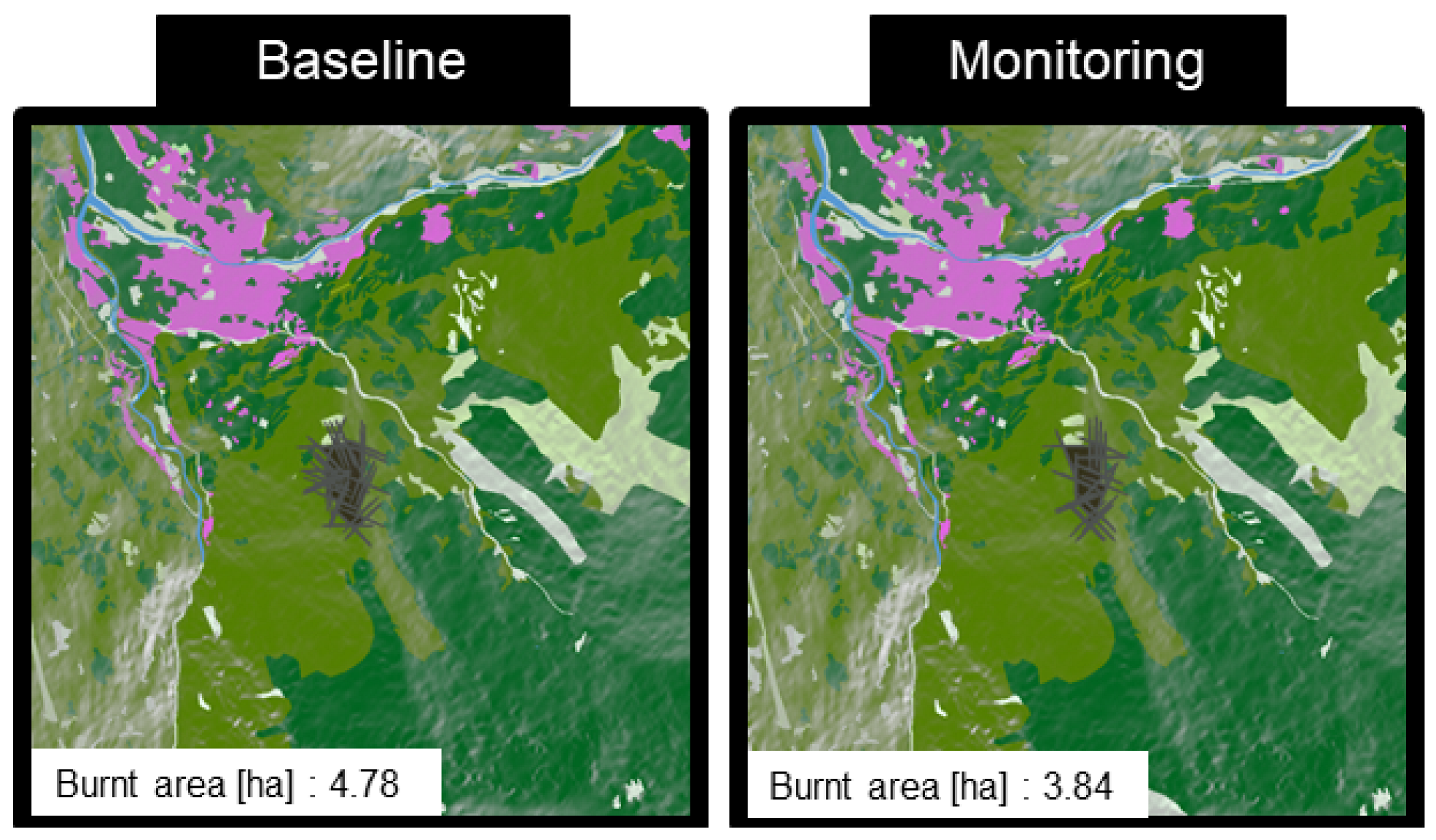
3.1. Baseline and Monitoring Verification
3.2. Monitoring Agent Design Effects
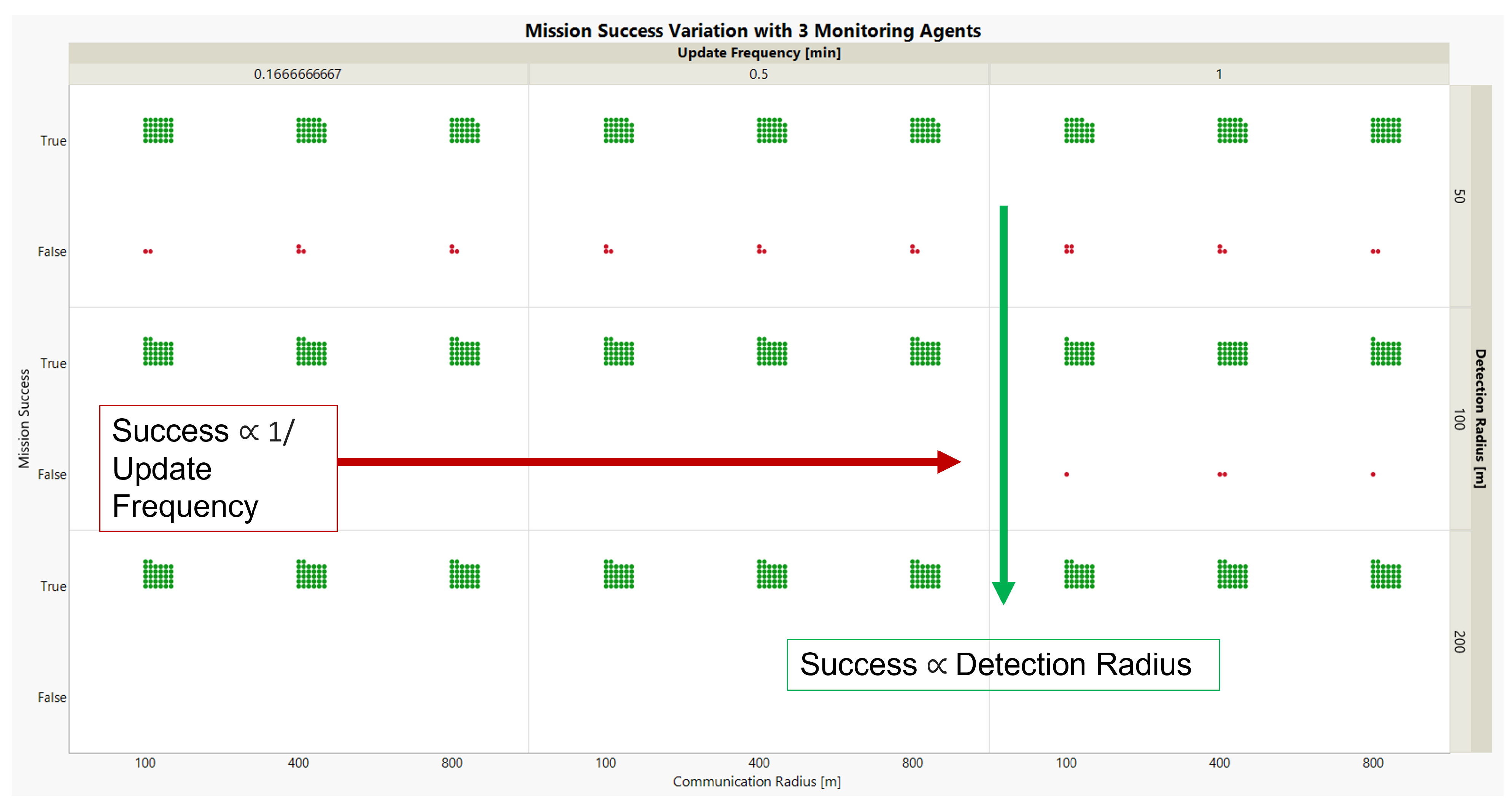
- High area coverage with their surveillance equipment is necessary as it allows zoning between UAVs, reducing the need to constantly track and follow fire fronts—investing into a larger payload design to accommodate a better technology is worthwhile.
- In absence of high area coverage equipment, designing the network with frequent communication exchanges is crucial (ensuring stable communication relays and policies) as this can lead to a similar performance to better surveillance technology.
- If fewer UAVs are employed, the importance of frequent communication is more detrimental to an efficient operation than higher swath radii. This effect dwindles as more UAVs are employed, as then a stable network is maintained due to the higher fire coverage. As such, consideration of the fleet size and operations relative to investment on aircraft design level is essential.
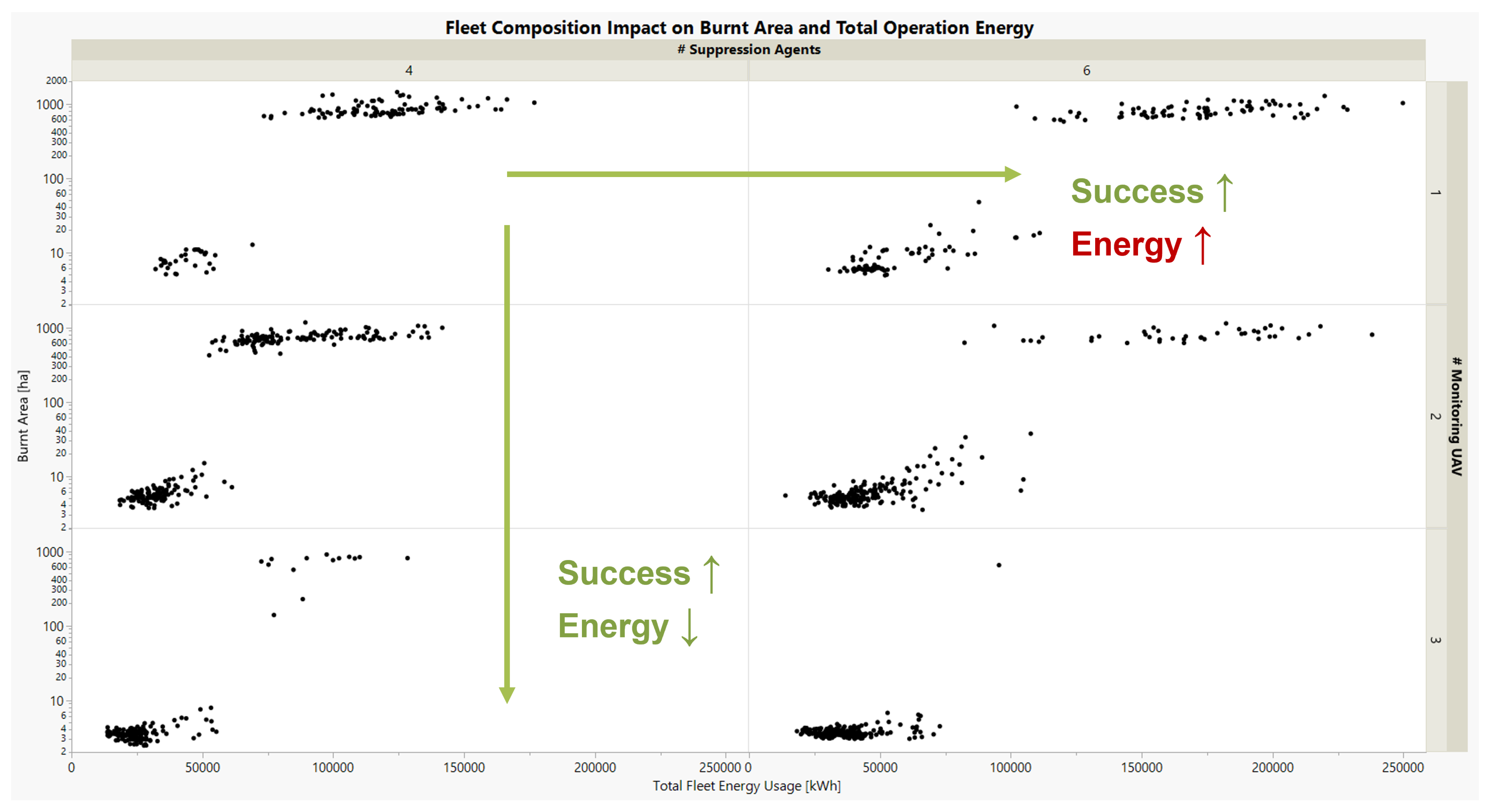
3.3. Fleet Composition Considerations
4. Conclusions
Author Contributions
Funding
Institutional Review Board Statement
Informed Consent Statement
Data Availability Statement
Conflicts of Interest
Abbreviations
| SoS | System-of-systems |
| ABM | Agent-based modeling |
| UAV | Unmanned aerial vehicle |
| SoSID | System-of-Systems Inverse Design (Toolkit) |
| IoT | Internet of Things |
| DoE | Design of experiments |
References
- Shahparvari, S.; Bodaghi, B.; Roozbeh, I.; Mohammadi, M.; Soleimani, H.; Chhetri, P. A cooperative (or coordinated) multi-agency response to enhance the effectiveness of aerial bushfire suppression operations. Int. J. Disaster Risk Reduct. 2021, 61, 102352. [Google Scholar] [CrossRef] [Scilit]
- Prakasha, P.S.; Naeem, N.; Amadori, K.; Donelli, G.; Akbari, J.; Nicolosi, F.; Franzén, L.K.; Ruocco, M.; Lefebvre, T.; Nagel, B. COLOSSUS EU Project–Collaborative SoS Exploration of Aviation Products, Services and Business Models: Overview and Approach. In Proceedings of the ICAS Congress 2024, Florence, Italy, 9–13 September 2024. [Google Scholar]
- Prakasha, P.S.; Naeem, N. Establishing a Collaborative Open Source Agent Based Simulation Environment for System of Systems Aviation Problems. CEAS Aeronaut. J. 2025; submitted.
- Kilkis, S.; Prakasha, P.S.; Naeem, N.; Nagel, B. A Python Modelling and Simulation Toolkit for Rapid Development of System of Systems Inverse Design (SoSID) Case Studies. In Proceedings of the AIAA AVIATION 2021 FORUM, Online, 2–6 August 2021. [Google Scholar] [CrossRef] [Scilit]
- Boroujeni, S.P.H.; Razi, A.; Khoshdel, S.; Afghah, F.; Coen, J.L.; O’Neill, L.; Fule, P.; Watts, A.; Kokolakis, N.M.T.; Vamvoudakis, K.G. A comprehensive survey of research towards AI-enabled unmanned aerial systems in pre-, active-, and post-wildfire management. Inf. Fusion 2024, 108, 102369. [Google Scholar] [CrossRef] [Scilit]
- Zadeh, R.B.; Elmi, A.; Moghaddam, V.; MahmoudZadeh, S. A Conceptual High Level Multiagent System for Wildfire Management. IEEE Trans. Geosci. Remote Sens. 2025, 63, 5911415. [Google Scholar] [CrossRef] [Scilit]
- Wu, X.; Fu, Y.; Qiao, L.; Dong, H.; Qin, Q.; Dilfanian, E.; Taherzadeh, A.; Zhang, Y.; Benzerrouk, H.; Guiddir, H. An Intelligent Algorithm for Determining Optimal Wildfire Suppression Zone Using UAV. In Proceedings of the 2025 IEEE 19th International Conference on Control and Automation (ICCA), Tallinn, Estonia, 30 June–3 July 2025. [Google Scholar] [CrossRef] [Scilit]
- Julian, K.D.; Kochenderfer, M.J. Distributed wildfire surveillance with autonomous aircraft using Deep Reinforcement Learning. J. Guid. Control Dyn. 2019, 42, 1768–1778. [Google Scholar] [CrossRef] [Scilit]
- Al-Husseini, M.; Wray, K.H.; Kochenderfer, M.J. Hierarchical framework for optimizing wildfire surveillance and suppression using human-autonomous teaming. J. Aerosp. Inf. Syst. 2024, 21, 790–811. [Google Scholar] [CrossRef] [Scilit]
- Rui, X.; Hui, S.; Yu, X.; Zhang, G.; Wu, B. Forest fire spread simulation algorithm based on cellular automata. Nat. Hazards 2017, 91, 309–319. [Google Scholar] [CrossRef] [Scilit]
- Kalliatakis, N.; Naeem, N.; Shiva Prakasha, P.; Nagel, B. Improving aerial wildfire fighting effectiveness using future climate sensitivities and novel aircraft concepts. In Proceedings of the Research and Education in Aircraft Design 2024, Warsaw, Poland, 6–8 November 2024. [Google Scholar]
- Prakasha, P.S.; Naeem, N.; Kalliatakis, N.; Nagel, B. Evaluation of Current and Next-Gen Aircraft in a European Wildfire Scenario. In Proceedings of the EASN Conference 2024, Thessaloniki, Greece, 8–11 October 2024. [Google Scholar]


Disclaimer/Publisher’s Note: The statements, opinions and data contained in all publications are solely those of the individual author(s) and contributor(s) and not of MDPI and/or the editor(s). MDPI and/or the editor(s) disclaim responsibility for any injury to people or property resulting from any ideas, methods, instructions or products referred to in the content. |
© 2026 by the authors. Licensee MDPI, Basel, Switzerland. This article is an open access article distributed under the terms and conditions of the Creative Commons Attribution (CC BY) license.
Share and Cite
Kalliatakis, N.; Naeem, N.; Prakasha, P.S. System-of-Systems Guided Agent Communication and Collaboration in Aerial Wildfire Fighting. Eng. Proc. 2026, 133, 121. https://doi.org/10.3390/engproc2026133121
Kalliatakis N, Naeem N, Prakasha PS. System-of-Systems Guided Agent Communication and Collaboration in Aerial Wildfire Fighting. Engineering Proceedings. 2026; 133(1):121. https://doi.org/10.3390/engproc2026133121
Chicago/Turabian StyleKalliatakis, Nikolaos, Nabih Naeem, and Prajwal Shiva Prakasha. 2026. "System-of-Systems Guided Agent Communication and Collaboration in Aerial Wildfire Fighting" Engineering Proceedings 133, no. 1: 121. https://doi.org/10.3390/engproc2026133121
APA StyleKalliatakis, N., Naeem, N., & Prakasha, P. S. (2026). System-of-Systems Guided Agent Communication and Collaboration in Aerial Wildfire Fighting. Engineering Proceedings, 133(1), 121. https://doi.org/10.3390/engproc2026133121