


Abstract
Through the reaction of fullerenylazide with terminal acetylenes, previously undescribed 1-butyl-2-triazolylfullerenes, in which the heterocyclic fragment was directly attached to the fullerene backbone, were synthesized for the first time. Water-soluble complexes of the synthesized adducts of fullerene with polyvinylpyrrolidone showed a high cytotoxic activity towards tumor cells of the Jurkat, K562, and U937 lines.
1. Introduction
N-containing heterocycles such as triazoles and tetrazoles are known pharmacophores and are widely used in drug development. Thus, it is known that 1,2,3-triazoles have a wide spectrum of biological action [1,2] and exhibit a high antitumor, antiviral, antibacterial, antifungal and other activity. An increase in the biological activity of organic compounds after the introduction of tri- and tetrazole fragments into them is associated with a moderate dipole character of the heterocycle, the possibility of additional hydrogen bonds formation, resistance to redox reactions, and acid or alkaline hydrolysis [3].
Fullerenes and their derivatives are of particular practical interest from a medical point of view. The biological activity of fullerenes is based on three properties: electron deficiency, lipophilicity, and the ability to react with free radicals. Currently, there is a great number of published papers describing various fullerene derivatives with various activities [4,5,6,7,8,9]. Despite this, there is practically no information in the literature on the synthesis of biologically active fullerenes containing triazole fragments. For example, it is known [10] that the conjugate of fullerene with doxorubicin (DOX) exhibits an antiproliferative effect in comparison with unconjugated DOX, upon incubation with MCF-7 cancer cells. In this case, hybrid fullerene molecules with biologically active diene acids containing triazole fragments in their structure exhibit a higher selectivity of action with respect to a wide range of tumor cells [11]. In turn, hexamethanofullerene with six triazole cycles was found to have a high antiviral activity in an infectious model against the Ebola pseudovirus [12]. All of the above examples of triazole-containing fullerenes are characterized by a significant removal of the heterocyclic fragment from the fullerene framework, and, therefore, their mutual influence on each other is leveled.
In this work, we discuss the synthesis of new triazole-containing fullerenes, in which the heterocyclic substituent is directly bonded to the core of the carbon molecule, and provide preliminary data on their cytotoxic activity.
2. Results and Discussion
The synthesis of the previously undescribed fullerenyltriazoles 2-4 was carried out under the conditions of the alkyne-azide method. Fullerenylazide 1, which was previously synthesized for the first time in our laboratory [13], and a number of terminal acetylenes containing cyclopropyl, cyclohexyl, and isoindoldione substituents, which are part of a large number of drugs, were used as precursors (Scheme 1).
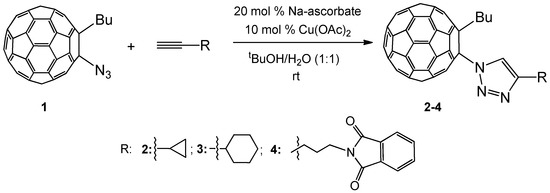
Scheme 1.
Synthesis of 1-butyl-2-triazolyl-dihydrofullerenes 2–4.
The structure of the synthesized compounds was reliably determined by applying modern physicochemical methods of analysis such as NMR and MALDITOF/TOF mass spectrometry.
We carried out preliminary experiments on the in vitroantitumor effect of an aqueous solution of the polyvinylpyrrolidonecomplex of synthesized fullerene adduct 2–4 containing triazole fragments, using K562, U937, Jurkat cell lines, including the determination of IC50 using flow cytofluorimetry (Table 1).

Table 1.
Cytotoxic activities in vitro of compounds 2–4 measured on tumor cell cultures (Jurkat, K562, U937) (µM).
The experimental data prove that the synthesized novel fullerene adducts 2–4 exhibit a cytotoxic effect with respect to the selected tumor cell lines in the range of IC50 = 0.02–0.19 µM, the most active being triazolylcontaining fullerene 4.
Currently, the Laboratory of Molecular Design and Biological Screening of Candidate Substances for the Pharmaceutical Industry at the Institute of Petrochemistry and Catalysis of RAS is conducting more detailed studies of the antitumor activity of synthesized new fullerene derivatives, using a wide range of cancer cells as examples.
3. Materials and Methods
All reactions were performed under an argon atmosphere and in anhydrous solvent. The solvents and reagents were dried or refined according to the literature procedures. The reaction products were analyzed on an HPLC chromatograph Shimadzu SPD-20A (Japan) equipped with a UV detector at 313 or 340 nm. The mixtures were separated on a preparative column Cosmosil Buckyprep Waters (Nacalai Tesque, Inc., Kyoto, Japan) (250 × 10 mm) at ~20 °C. Toluene was used as the eluent, and the flow rate was 3.0 mL·min−1. The 1H and 13C NMR spectra were run on a Bruker Avance-500 spectrometer. The mass spectra were obtained on an UltraFlex III TOF/TOF (Bruker Daltonik GmbH, Bremen, Germany) operating in linear (TOF) and reflection (TOF/TOF) positive and negative ion modes. S8 and DCTB (trans-2-[3-(4-tert-butylphenyl)-2-methyl-2-propenyliden]malononitrile) were used as the matrix.
Procedure for the synthesis of triazolyl-containing fullerenes 2–4.
Triazolyl-containing fullerenes were obtained by alkyne-azide addition in the presence of a copper(I) catalyst Cu(OAc)2 using the «click» reaction method. In a two-necked flask, 1-azido-2-butyl(C60-Ih)[5,6]fullerene (1) (0.05 g, 0.061 mmol) was dissolved in chlorobenzene (10 mL) with vigorous stirring, acetylene (0.061 mmol) was added in the presence of Cu(OAc)2 (0.005 mmol) and Na ascorbate (0.009 mmol), and then tert-butanol and water were added in a 1:1 ratio. The reaction mixture was stirred for 12 h at room temperature. A total of 50 mL of water was added to the reaction mass, the organic layer was separated and passed through a Schott filter, and an individual compound was isolated using high performance liquid chromatography. The yields of the synthesized compounds ranged from 75% to 81%.
The spectral characteristics of compounds 2 and 3 are identical to the literature data; in this regard, I add the following link to the list of references: [14]. 1-Butyl-2-(4′-isoindol-1,3-dione-1H-1′,2′,3′-triazol-1′-yl)(C60-Ih)[5,6]fullerene 4. Additional information on the spectral data of compound 4 is available in the Supplementary Materials.
Brown powder; yield 78%.IR (KBr, neat, cm−1): 3417, 2951, 2852, 1712, 1385, 1033, 720, 526. UV-Vis (CHCl3), λmax, nm: 257, 327. 1H NMR (500 MHz, CDCl3:CS2 1:5) δ 0.98 (t, J 7 Hz, 3H, CH3), 1.28 (s, 2H, CH2), 1.44–1.50 (m, 2H, CH2), 1.98–2.03 (m, 2H, CH2), 2.30–2.38 (m, 2H, CH2), 2.80–2.88 (m, 2H, CH2), 3.00 (t, 2H, CH2, J = 7.0 Hz), 3.90 (t, 2H, CH2, J = 7.0 Hz), 7.7–7.82 (m, 2H, 2CH), 7.90–7.94 (m, 2H, 2CH), 8.62 (s, 1H, CH). 13C NMR (125 MHz, CDCl3:CS2 1:5) δ 14.1, 23.3, 28.6, 31.3, 37.2, 38.2, 56.4, 66.0, 81.3, 123.3, 124.8, 132.2, 134.0, 137.8, 139.5, 139.9, 141.8, 141.9, 142.4, 142.5, 142.8, 143.1, 143.2, 144.9, 145.4, 145.7, 145.9, 146.2, 146.4, 146.6, 146.8, 147.8, 148.4, 155.6, 168.02. HRMS (MALDI TOF/TOF), m/z: calcd. for C77H20N4O2 1032.1841; found 1032.1846.
4. Conclusions
For the first time, we synthesized fullerenyltriazolesvia the reaction of azidofullerene with terminal acetylenes, in which the heterocyclic fragment was directly attached to the fullerene core. Furthermore, it was demonstrated that the synthesized fullerene adducts exhibited a high antitumor potential in relation to K562, U937, and Jurkat tumor cells.
Supplementary Materials
The following supporting information can be downloaded at: https://www.mdpi.com/article/10.3390/ecsoc-25-11659/s1, Figure S1: Copy of 1H NMR spectra of compound 4; Figure S2: Copy of 13C NMR spectra of compound 4; Figure S3: Copy of HRMS spectra of compound 4; Figure S4: Copy of IR spectra of compound 4; Figure S5: Copy of UV spectra of compound 4.
Author Contributions
Conceptualization, Data curation, Synthetic investigation, Writing-original draft, review and editing, Z.R.S., A.R.A., L.U.D., V.A.D. and A.T.; Supervision: U.D. All authors have read and agreed to the published version of the manuscript.
Funding
This work was supported by the Ministry of Science and Higher Education within the State assignment Institute of Petrochemistry and Catalysis of RAS State Registration FMRS-2022-0074.
Institutional Review Board Statement
Not applicable.
Informed Consent Statement
Not applicable.
Data Availability Statement
Data available on request.
Conflicts of Interest
The authors declare no conflict of interest.
References
- Wamhoff, H. 1,2,3-Triazoles and Their Benzo Derivatives Comprehensive Heterocyclic Chemistry; Pergamon Press: Oxford, UK, 1984; Volume 5, pp. 670–732. [Google Scholar]
- Bonandi, E.; Christodoulou, M.S.; Fumagalli, G.; Perdicchia, D.; Rastelli, G.; Passarella, D. The 1,2,3-triazole ring as a bioisostere in medicinal chemistry. Drug Discov. Today 2017, 22, 1572–1581. [Google Scholar] [CrossRef] [PubMed]
- Senger, G.D.; Da Silva, M.R.; de Ferreira, F.C.; Silva, V.F.; Paes, F. 1-Phenyl-1H- and 2-phenyl-2H-1,2,3-triazol derivatives: Design, synthesis and inhibitory effect on alpha-glycosidases. Eur. J. Med.Chem. 2014, 74, 461–476. [Google Scholar]
- Castro, E.; Garcia, A.H.; Zavala, G.; Echegoyen, L. Fullerenes in Biology and Medicine. J. Mater. Chem. B Mater. Biol. Med. 2017, 5, 6523–6535. [Google Scholar] [CrossRef] [PubMed]
- Bakry, R.; Vallant, R.M.; Najam-ul-Haq, M.; Rainer, M.; Szabo, Z.; Huck Ch, W.; Bonn, G.K. Medicinal applications of fullerenes. Int. J. Nanomed. 2007, 2, 639–649. [Google Scholar]
- Bogdanović, G.; Djordjević, A. Carbon nanomaterials: Biologically active fullerene derivatives. Srp. Arh. Celok. Lek. 2016, 144, 222–231. [Google Scholar] [CrossRef] [PubMed]
- Lin, C.M.; Lu, T.Y. C60 fullerene derivatized nanoparticles and their application to therapeutics. Recent Pat. Nanotechnol. 2012, 6, 105–113. [Google Scholar] [PubMed]
- Anilkumar, P.; Lu, F.; Cao, L.; Luo, P.G.; Liu, J.H.; Sahu, S.; Tackett, K.N.; Wang, Y.; Sun, Y.P. Fullerenes for applications in biology and medicine. Curr. Med. Chem. 2011, 18, 2045–2059. [Google Scholar] [CrossRef] [PubMed]
- Yang, X.; Ebrahimi, A.; Li, J.; Cui, Q. Fullerene-biomolecule conjugates and their biomedicinal applications. Int. J. Nanomed. 2014, 9, 77–92. [Google Scholar] [CrossRef] [PubMed]
- Magoulas, G.E.; Bantzi, M.; Messari, D.; Voulgari, E.; Gialeli, C.; Barbouri, D.; Giannis, A.; Karamanos, N.K.; Papaioannou, D.; Avgoustakis, K. Synthesis and Εvaluation of Anticancer Activity in Cells of Novel Stoichiometric Pegylated Fullerene-Doxorubicin Conjugates. Pharm. Res. 2015, 32, 1676–1693. [Google Scholar] [CrossRef] [PubMed]
- Tuktarov, A.R.; Khuzina, L.L.; Akhmetov, A.A.; Tuktarova, R.A.; Ishmukhametova, S.R.; Dzhemileva, L.U.; D’yakonov, V.A.; Dzhemilev, U.M. Hybrid Molecules Based on Fullerene C60 and 5Z,9Z-dienoic Acids:Synthesis and Cytotoxic Activity. Bioorg. Med. Chem. Lett. 2020, 30, 127289. [Google Scholar] [CrossRef] [PubMed]
- Nierengarten, J.-F.; Schneider, J.P.; Trinh, T.M.N.; Joosten, A.; Holler, M.; Lepage, M.L.; Bodlenner, A.; García-Moreno, M.I.; Mellet, C.O.; Compain, P. Giant Glycosidase Inhibitors: First- and Second-Generation Fullerodendrimers with a Dense Iminosugar Shell. Chem. A Eur. J. 2018, 24, 2483–2492. [Google Scholar] [CrossRef] [PubMed]
- Akhmetov, A.R.; Yarullin, I.R.; Tuktarov, A.R.; Dzhemilev, U.M. Reactions of fullerene C60 with organometallic azides. Tetrahedron Lett. 2014, 55, 3747. [Google Scholar] [CrossRef]
- Sadretdinova, Z.R.; Akhmetov, A.R.; Tulyabaev, A.R.; Budnikova, Y.H.; Dudkina, Y.B.; Tuktarov, A.R.; Dzhemilev, U.M. Synthesis of fullerenyl-1,2,3-triazoles by reaction of fullerenylazide with terminal acetylenes. Org. Biomol. Chem. 2021, 19, 9299. [Google Scholar] [CrossRef] [PubMed]
Publisher’s Note: MDPI stays neutral with regard to jurisdictional claims in published maps and institutional affiliations. |
© 2021 by the authors. Licensee MDPI, Basel, Switzerland. This article is an open access article distributed under the terms and conditions of the Creative Commons Attribution (CC BY) license (https://creativecommons.org/licenses/by/4.0/).