
Stable Anionic σ-Complexes of Highly Electrophilic Aromatics and C-Nucleophiles: Synthesis and Oxidation †



Abstract
:1. Introduction
2. Results and Discussion
3. Experimental Procedures
4. Conclusions
Author Contributions
Funding
Institutional Review Board Statement
Informed Consent Statement
Conflicts of Interest
References
- Terrier, F.; Kizilian, E.; Halle, J.C.; Buncel, E. 4,6-Dinitrobenzofuroxan: A stronger electrophile than the p-nitrobenzenediazonium cation and proton. J. Am. Chem. Soc. 1992, 114, 1740–1742. [Google Scholar] [CrossRef]
- Remennikov, G.Y.; Kempf, B.; Ofial, A.R.; Polborn, K.; Mayr, H. 5-Methoxyfuroxano[3,4-d]pyrimidine: A highly reactive neutral electrophile. J. Phys. Org. Chem. 2003, 16, 431–437. [Google Scholar] [CrossRef]
- Remennikov, G.Y.; Pirozhenko, V.V.; Vdovenko, S.I.; Kravchenko, S.A. σ-Complexes in the pyrimidine series. 13. Reaction of 7- and 5-methoxyfuroxano[3,4-d]pyrimidines with some C-nucleophiles. Chem. Heterocycl. Compd. 1998, 34, 104–110. [Google Scholar] [CrossRef]
- Starosotnikov, A.M.; Shkaev, D.V.; Bastrakov, M.A.; Fedyanin, I.V.; Shevelev, S.A.; Dalinger, I.L. Nucleophilic dearomatization of 4-aza-6-nitrobenzofuroxan by CH-acids in the synthesis of pharmacology-oriented compounds. Beilstein J. Org. Chem. 2017, 13, 2854–2861. [Google Scholar] [CrossRef] [PubMed]
- Starosotnikov, A.M.; Shkaev, D.V.; Bastrakov, M.A.; Fedyanin, I.V.; Shevelev, S.A.; Dalinger, I.L. Dearomatization of oxa- or selenadiazolopyridines with neutral nucleophiles as an efficient approach to pharmacologically relevant nitrogen compounds. Mendeleev Commun. 2018, 28, 638–640. [Google Scholar] [CrossRef]
- Starosotnikov, A.M.; Ilkov, K.V.; Bastrakov, M.A.; Fedyanin, I.V.; Kokorekin, V.A. Mild and efficient addition of carbon nucleophiles to condensed pyridines: Influence of structure and limits of applicability. Chem. Heterocycl. Compd. 2020, 56, 92–100. [Google Scholar] [CrossRef]
- Pesin, V.G.; Khaletskii, A.M.; Sergeev, V.A. Studies in field of 2,1,3-thiodiazoles. 22. niitration of derivatives of benz-2,1,3-thiodiazoles. J. Gen. Chem. USSR 1963, 33, 1714–1719. [Google Scholar]
- Elvidge, J.A.; Newbold, G.T.; Percival, A.; Senciall, I.R. 3-Nitro-o-phenylenediamines: A new route. J. Chem. Soc. 1965, 5119–5120. [Google Scholar] [CrossRef]
- Starosotnikov, A.M.; Nikol’skiy, V.V.; Borodulya, A.N.; Kachala, V.V.; Bastrakov, M.A.; Solkan, V.N.; Shevelev, S.A. Synthesis and functionalization of 5,7-dinitroquinoline and its N-oxide. Asian J. Org. Chem. 2016, 5, 685–690. [Google Scholar] [CrossRef]
- Renfrow, R.A.; Strauss, M.J.; Terrier, F. Stability of carbon-bonded anionic sigma-complexes. 3. Decomposition in aqueous acidic media. J. Org. Chem. 1980, 45, 471–475. [Google Scholar] [CrossRef]
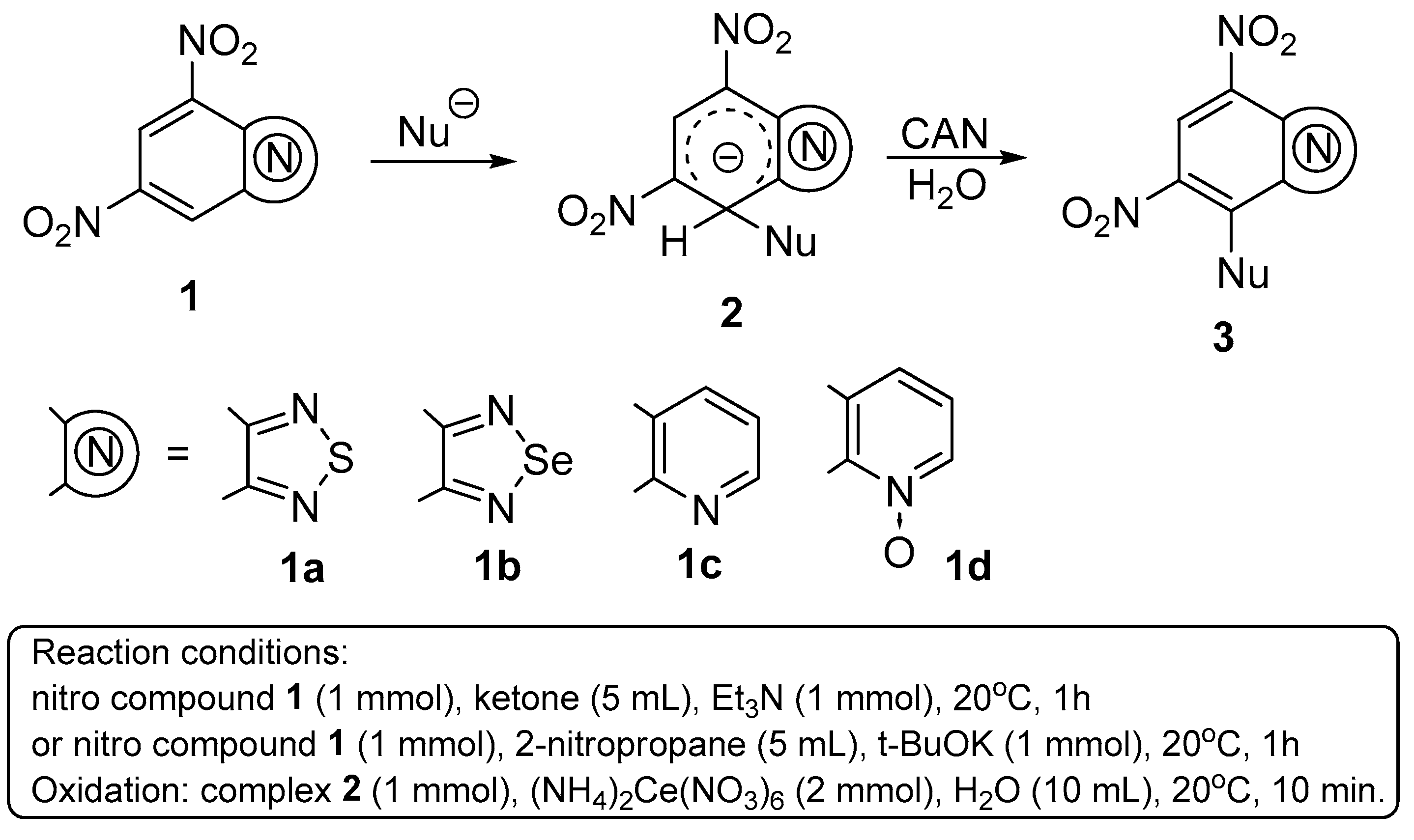


| Entry | Compound 1 | NuH | Compound 2, Yield (%) | Compound 3, Yield (%) |
|---|---|---|---|---|
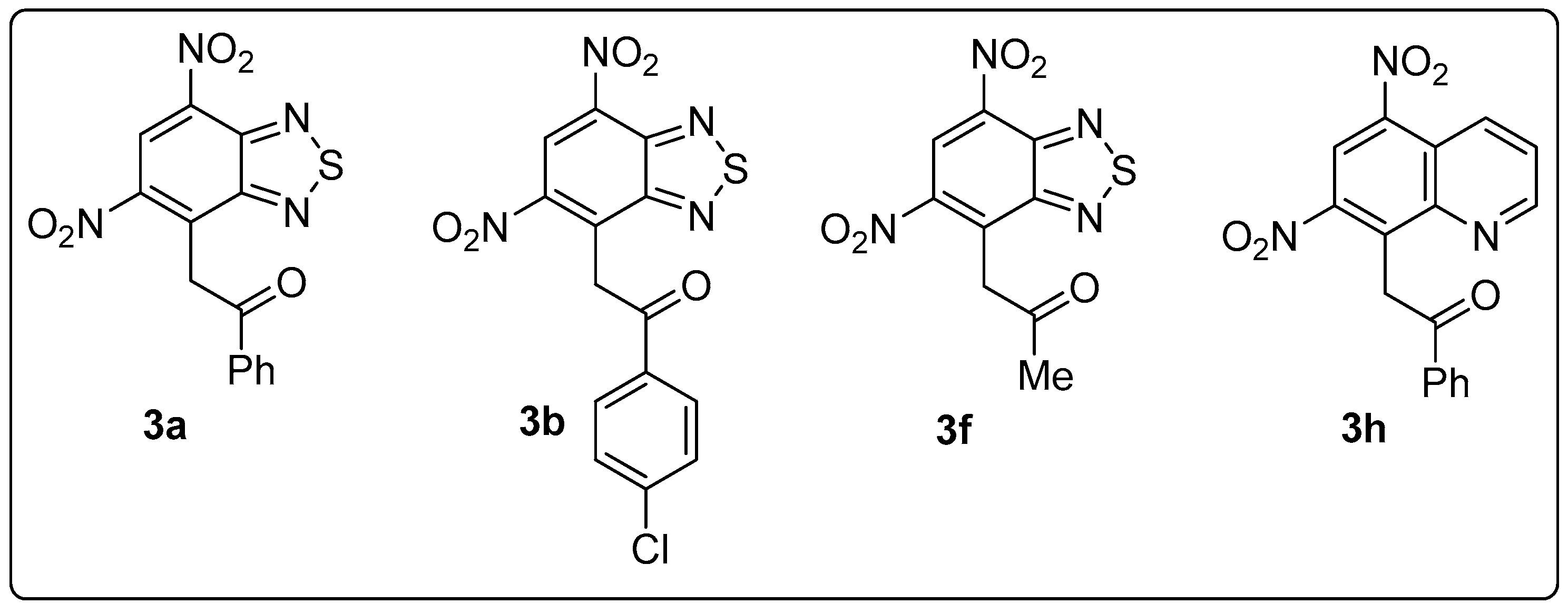
| 1 | 1a | PhCOMe | 2a, 88 | 3a, 47 |
| 2 | 1a | 4-Cl-C6H4COMe | 2b, 84 | 3b, 36 |
| 3 | 1a | Me2CHNO2 | 2c, 64 | - 2 |
| 4 | 1a | Cyclohexanone | 2d, 67 | - 3 |
| 5 | 1a | MeCOCH2COMe | 2e, 87 | - 3 |
| 6 | 1a | Acetone | 2f, 82 | 3f, 46 |
| 7 | 1b | Me2CHNO2 | 2g, 92 | - 3 |
| 8 | 1c | PhCOMe | 2h, - 1 | 3h, 28 |
| 9 | 1c | Me2CHNO2 | 2i, 98 | - 4 |
| 10 | 1d | PhCOMe | 2j, 77 | - 3 |
| 11 | 1d | Me2CHNO2 | 2k, 24 | - 3 |
Publisher’s Note: MDPI stays neutral with regard to jurisdictional claims in published maps and institutional affiliations. |
© 2020 by the authors. Licensee MDPI, Basel, Switzerland. This article is an open access article distributed under the terms and conditions of the Creative Commons Attribution (CC BY) license (https://creativecommons.org/licenses/by/4.0/).
Share and Cite
Starosotnikov, A.; Bastrakov, M.; Kokorekin, V. Stable Anionic σ-Complexes of Highly Electrophilic Aromatics and C-Nucleophiles: Synthesis and Oxidation. Chem. Proc. 2021, 3, 35. https://doi.org/10.3390/ecsoc-24-08437
Starosotnikov A, Bastrakov M, Kokorekin V. Stable Anionic σ-Complexes of Highly Electrophilic Aromatics and C-Nucleophiles: Synthesis and Oxidation. Chemistry Proceedings. 2021; 3(1):35. https://doi.org/10.3390/ecsoc-24-08437
Chicago/Turabian StyleStarosotnikov, Alexey, Maxim Bastrakov, and Vladimir Kokorekin. 2021. "Stable Anionic σ-Complexes of Highly Electrophilic Aromatics and C-Nucleophiles: Synthesis and Oxidation" Chemistry Proceedings 3, no. 1: 35. https://doi.org/10.3390/ecsoc-24-08437
APA StyleStarosotnikov, A., Bastrakov, M., & Kokorekin, V. (2021). Stable Anionic σ-Complexes of Highly Electrophilic Aromatics and C-Nucleophiles: Synthesis and Oxidation. Chemistry Proceedings, 3(1), 35. https://doi.org/10.3390/ecsoc-24-08437