

Article

Multi-Criteria Evaluation of Hydrogen Storage Technologies Using AHP and TOPSIS Methodologies

1
Centro Universitario de la Defensa en la Escuela Naval Militar, 36920 Pontevedra, Spain
2
Spanish Naval Academy, Plaza de España s/n, Marín, 36920 Pontevedra, Spain
*
Authors to whom correspondence should be addressed.
Hydrogen 2025, 6(4), 111; https://doi.org/10.3390/hydrogen6040111
Submission received: 21 October 2025 / Revised: 10 November 2025 / Accepted: 20 November 2025 / Published: 1 December 2025

Abstract

As hydrogen emerges as a key vector in the shift toward cleaner energy systems, the evaluation of storage technologies becomes essential to support its integration across diverse applications. This work provides a comparative analysis of four hydrogen storage methods, compressed gas, metal hydrides, metal–organic frameworks (MOFs), and carbon-based materials, using a structured multi-criteria decision-making (MCDM) approach, specifically the Analytic Hierarchy Process (AHP) and Technique for Order Preference by Similarity to Ideal Solution (TOPSIS). The evaluation is based on a comprehensive set of technical, economic, and environmental criteria, including safety, storage capacity, efficiency, cycle durability, technological maturity, environmental impact, cost, and scalability. The analysis adopts a technology-oriented perspective, focusing on the intrinsic performance and feasibility of hydrogen storage systems rather than on a detailed techno-economic optimization. The results show that metal hydrides offer the most balanced performance, driven by high volumetric capacity and solid-phase stability, followed closely by compressed hydrogen, which stands out for its technological maturity and well-established infrastructure, despite facing significant challenges related to safety and space efficiency due to high-pressure storage requirements. Carbon-based materials and MOFs, although promising in specific aspects such as safety, storage density, or material sustainability, are hindered by technological immaturity and operational limitations.

Graphical Abstract

1. Introduction

The transition toward a sustainable and decarbonized energy model has placed hydrogen at the forefront as a versatile and clean energy carrier. Due to its high specific energy and its ability to be produced from renewable sources via processes such as electrolysis, hydrogen represents a promising alternative to fossil fuels, particularly in sectors with high energy demands and strict decarbonization requirements [1]. Nevertheless, several technical and economic barriers persist, especially regarding hydrogen storage, which remains a critical challenge due to its low volumetric density and the need for complex containment systems.
The low density of hydrogen in both gaseous and liquid states, combined with its extremely light molecular weight, poses significant storage challenges. These characteristics have driven the development of diverse storage strategies tailored to specific industrial and technological scenarios. While hydrogen exhibits a high energy content per unit of mass, its low volumetric energy density makes its storage particularly complex, prompting intense research efforts focused on advanced materials and innovative storage systems [2].
Hydrogen can be stored using various technologies, including physical methods (e.g., high-pressure gas compression and cryogenic liquefaction) and material-based approaches (e.g., chemical carriers, metal hydrides, porous solids, and nanostructured adsorbents [3]. Among these, systems such as compressed gaseous hydrogen, liquid hydrogen, metal hydrides, carbon-based materials, and metal–organic frameworks (MOFs) have gained particular attention due to their distinct advantages in terms of storage capacity, safety, and energy efficiency. Each storage method presents unique advantages and limitations depending on criteria such as energy efficiency, safety, environmental impact, scalability, and system cost [4].
Compressed hydrogen is widely used due to its technological maturity and rapid fueling capability, yet it poses challenges due to low volumetric energy density and the need for high-pressure containment [5]. Liquid hydrogen, with its superior volumetric energy density, is suitable for large-scale and mobility applications but suffers from high energy consumption and evaporation losses associated with cryogenic storage [6]. MOFs and carbon-based materials enable physisorption at moderate conditions, offering safety and reversibility, although their effective storage capacities tend to drop significantly at ambient temperatures [7]. Metal hydrides provide high volumetric storage through chemisorption and are promising for stationary systems, but their desorption typically requires high temperatures and long activation times [8].
Given the diversity of hydrogen storage technologies and the complexity of their evaluation, choosing the most appropriate option requires structured approaches capable of integrating multiple and often conflicting criteria. Multi-Criteria Decision-Making (MCDM) methods have been widely used in engineering to support complex decision processes, allowing not only quantitative but also subjective and qualitative factors to be systematically analyzed [9]. Among these, the Analytic Hierarchy Process (AHP) stands out for its ability to incorporate expert judgment through pairwise comparisons and ensure consistency in preferences. This method is particularly well-suited for the evaluation of hydrogen storage systems, as these technologies often require balancing conflicting criteria such as safety, cost, energy efficiency, and environmental sustainability [10,11]. In parallel, the Technique for Order Preference by Similarity to Ideal Solution (TOPSIS) complements AHP by ranking alternatives based on their geometric proximity to an ideal solution and distance from the worst-case scenario, offering a quantitative validation of the results [12].
Several recent studies have successfully applied the Analytic Hierarchy Process (AHP) and the Technique for Order Preference by Similarity to Ideal Solution (TOPSIS) to the evaluation of hydrogen storage technologies and related energy systems. For example, Gim and Kim [13] used fuzzy AHP to rank five hydrogen storage systems for automotive applications in Korea, incorporating criteria such as weight and volume efficiency, system cost, energy efficiency, safety, and infrastructure. Their results identified compressed hydrogen at 350 bar as the most balanced option under current conditions. Similarly, Qie et al. [14] proposed a hybrid MCDM framework using AHP and a fuzzy extension of TOPSIS to evaluate nine storage technologies based on technological, economic, environmental, and social criteria. The study demonstrated how combining these methods enhances decision consistency and allows for sensitivity analysis across different storage requirement scenarios. Rizeiqi et al. [10] further applied AHP to assess large-scale hydrogen storage options in Oman, comparing compressed hydrogen, liquid hydrogen, and ammonia based on economic, technical, environmental, and infrastructure-related factors. In addition to AHP and TOPSIS, other MCDM methods have been employed in similar studies. For instance, the VlseKriterijumska Optimizacija I Kompromisno Resenje (VIKOR, “multiple criteria optimization and compromise solutions”) method has been used to evaluate green hydrogen carriers, considering criteria like storage energy density, technical readiness, and environmental impact. In a study by Oner and Khalilpour [9], AHP-VIKOR was applied to assess eleven hydrogen carriers across different application scenarios, demonstrating the method’s effectiveness in handling conflicting criteria.
While several fuzzy and hybrid MCDM approaches have been recently proposed for hydrogen storage technology selection [15,16,17], these studies primarily focus on developing or testing fuzzy and intuitionistic extensions of classical methods. In contrast, the present work adopts a transparent and conventional AHP–TOPSIS framework, enabling direct and reproducible comparison among four representative hydrogen storage technologies (compressed hydrogen, metal hydrides, metal–organic frameworks (MOFs), and carbon-based materials) under a unified set of technical, economic, environmental, and operational criteria.
In this study, AHP and TOPSIS are applied in a complementary way to cross-validate the results and enhance decision reliability through distinct weighting and normalization strategies. The ultimate goal is to provide a practical and consistent decision-support tool that balances performance, feasibility, and sustainability, contributing to the selection of the most suitable hydrogen storage option for future energy systems.
By integrating classical MCDM techniques in a transparent and quantitative framework and validating their robustness through sensitivity analysis, this work offers a novel and reproducible perspective that complements previous fuzzy-based approaches and strengthens the methodological basis for comparative assessment of hydrogen storage technologies.

2. Selection of Alternatives

Hydrogen can be stored using a variety of physical and chemical methods, each with specific advantages and limitations depending on the intended application, operating conditions, and system constraints. This study focuses on four representative hydrogen storage technologies that encompass both conventional and emerging approaches: compressed gaseous hydrogen, metal hydrides, metal–organic frameworks (MOFs), and carbon-based materials. These alternatives were selected based on their relevance in the current literature [3], their technological maturity, and their potential for optimization in storage density, safety, and energy efficiency.

2.1. Compressed Gaseous Hydrogen

Compressed hydrogen is the most commonly used method for storing hydrogen, particularly in the transportation sector. It involves compressing hydrogen gas at pressures typically ranging from 350 to 700 bar [18]. Its main advantages include technological maturity, simplicity, and relatively low energy losses during storage and extraction. However, it presents significant challenges in terms of volumetric density and requires robust and heavy pressure vessels, which impact safety and space efficiency. Despite these limitations, it remains a reference technology due to its rapid refueling capabilities and established infrastructure, especially in the automotive and transport industries.

2.2. Metal Hydrides

Metal hydrides store hydrogen through reversible chemical absorption into a solid metal or alloy. This method offers high volumetric densities and operates at relatively low pressures, enhancing safety [19]. However, hydrogen desorption often requires elevated temperatures, and the weight of the storage medium is considerably high. Common hydrides include magnesium-based and rare-earth alloys, which vary in performance, cost, and cycle durability. Metal hydrides are well-suited for stationary or low-mobility systems where weight and dynamic response are less critical [20,21], but their high cost and scalability challenges remain obstacles for broader deployment.

2.3. Metal–Organic Frameworks (MOFs)

MOFs are porous crystalline materials composed of metal ions coordinated to organic ligands, forming networks with a large surface area suitable for hydrogen physisorption. These materials exhibit excellent storage capacities at cryogenic temperatures and moderate pressures, making them highly promising for compact and safe storage systems. However, current MOF systems often face limitations at ambient conditions, and their high synthesis cost and long-term stability issues remain key challenges. While MOFs are at the forefront of material innovation in hydrogen storage, their commercial viability is still limited by these technological hurdles [22].

2.4. Carbon-Based Materials

Carbon-based materials, such as activated carbon, carbon nanotubes, and graphene, rely on physical adsorption to retain hydrogen within their porous structure. Their storage performance can be enhanced through heteroatom doping or surface functionalization, as demonstrated in several recent studies [23]. These materials are lightweight, chemically stable, and can be produced from renewable or waste sources, offering environmental advantages. Their hydrogen uptake is generally limited at room temperature and pressure, often requiring low-temperature operation for optimal performance. Despite these constraints, their low cost, scalability, and versatility make them attractive candidates for integration into hybrid or next-generation storage systems, particularly in applications where cost and environmental sustainability are important [24,25].

3. Selection of Criteria

The selection of appropriate evaluation criteria is an important step in any multi-criteria decision-making (MCDM) process, as it directly affects the relevance and reliability of the results. In the context of hydrogen storage systems, multiple factors must be considered to assess performance, feasibility, and sustainability. All the data describing the technical, economic, and environmental performance of the selected hydrogen storage technologies were obtained from published literature sources [2,19,24,26]. Based on this comprehensive literature review, the following criteria were selected for this analysis: storage capacity, cycle durability, safety, technological maturity, environmental impact, economic cost, cycle efficiency and scalability.

3.1. Storage Capacity

Storage capacity refers to the ability of a system to store and deliver usable hydrogen in terms of both gravimetric (kg H2/kg system) and volumetric density (kg H2/m3). This criterion plays a key role, particularly in mobile applications such as transportation, where space and weight constraints are significant. High storage capacity contributes to greater autonomy and reduces the need for oversized tanks or complex auxiliary structures. Its selection is justified by the fact that one of the major challenges of hydrogen as a fuel is its low volumetric energy density compared to conventional hydrocarbons [27].
Among the technologies analyzed, compressed hydrogen offers high gravimetric capacity due to its purity and direct storage in gaseous form. However, the need to store it at very high pressures (typically 350–700 bar) results in relatively low volumetric efficiency and demands heavy, reinforced tanks, which limit its applicability in space-constrained environments [28]. Metal hydrides excel in volumetric density. Hydrogen is absorbed into the solid matrix of the material, allowing for dense storage in a compact form. Despite their relatively low gravimetric capacity—due to the mass of the metal alloy—they are particularly advantageous in stationary or semi-mobile applications where weight is less critical and compactness is prioritized [29]. Metal–organic frameworks (MOFs) demonstrate promising gravimetric storage capacity thanks to their exceptionally high surface area and porosity. However, their practical implementation is still limited by technological immaturity and challenges in real-world integration. As such, their overall performance in storage capacity is not yet fully realized compared to more established systems [27]. Finally, carbon-based materials show the lowest performance in terms of storage capacity. Hydrogen is retained via weak physical adsorption mechanisms, which result in limited uptake per unit volume and mass. Although they offer advantages in terms of material availability and stability, their limited storage potential restricts their suitability in applications where capacity is a primary concern [30].

3.2. Cycle Durability

Cycle durability refers to the ability of a hydrogen storage technology to maintain its performance over a large number of charging and discharging cycles. This criterion is especially relevant in systems subject to frequent operation, where the degradation of storage materials or components can significantly affect reliability, safety, and long-term cost-effectiveness [31,32].
Metal hydrides are generally considered to exhibit good durability, as they allow for reversible hydrogen absorption and desorption over many cycles. However, they are sensitive to external factors such as moisture, which can lead to irreversible loss of storage capacity. Additionally, repeated cycling may induce mechanical fatigue in the material structure, requiring proper management and system design to preserve long-term stability [33]. MOFs offer rapid physisorption/desorption kinetics and high surface area, but their structural integrity can degrade over time. Chemical decomposition or pore collapse may occur after repeated hydrogen cycling, especially if the MOF is not stabilized through advanced synthesis techniques. This limits their durability in practical applications unless continuous conditioning and stabilization methods are implemented [29]. In contrast, carbon-based materials exhibit excellent chemical and mechanical stability, making them highly durable over many operational cycles. Their resilience to degradation renders them suitable for long-term storage. Nevertheless, performance may gradually decline due to impurity accumulation or surface blocking, which can reduce adsorption efficiency over time [34]. Compressed hydrogen storage does not involve chemical interactions between the gas and the storage medium, which eliminates degradation of the hydrogen itself. However, the structural integrity of the storage vessels is a limiting factor. High-pressure cycling can induce mechanical fatigue in tank materials, potentially compromising safety and requiring regular inspection and maintenance [29].

3.3. Safety

Safety evaluates the risks associated with the storage technology, including flammability, pressure hazards, thermal management, chemical reactivity and structural stability. Hydrogen is highly flammable, and certain storage methods involve high-pressure vessels or cryogenic temperatures. Technologies that operate under ambient conditions or involve solid-phase storage are generally considered safer. Safety is universally recognized in both industrial and regulatory contexts as a prerequisite for hydrogen infrastructure, which underscores its central importance in this evaluation [35].
Compressed hydrogen poses the highest safety risks among the considered technologies. Storage typically occurs at pressures up to 700–800 bar [36], which increases the probability of explosive leaks and structural failures if containment is compromised. These systems require robust tank designs, redundant safety mechanisms and continuous monitoring to ensure safe operation. Metal hydrides, while involving solid-phase storage at relatively low pressures, which inherently enhances safety, carry specific hazards due to their chemical reactivity. Certain hydrides can react violently with moisture or oxygen, potentially releasing hydrogen uncontrollably if not properly sealed or handled [37]. Nonetheless, when appropriately encapsulated and maintained in dry, inert environments, they represent a safer alternative than compressed gas systems. Metal–organic frameworks (MOFs) operate under moderate pressure and temperature conditions, which reduces the risk of failure. However, due to the rapid release of hydrogen at low temperatures, they can present challenges in flow control and thermal regulation during discharge [38]. Proper system design is required to manage the release rate and avoid unintended accumulation of hydrogen in enclosed spaces. Carbon-based materials are considered among the safest options for hydrogen storage. Their high chemical and mechanical stability, coupled with their inert behavior in the presence of hydrogen, make them highly resistant to environmental degradation and thermal runaway. These materials pose minimal risk of accidental hydrogen release or reactive behavior under standard operating conditions [39].

3.4. Technological Maturity

This criterion assesses the degree of development and practical implementation of each technology. It considers whether the system is at the research stage, pilot scale, or commercially available. Mature technologies are generally associated with lower investment risks, established supply chains, and more predictable performance metrics [40].
Among the alternatives considered, compressed hydrogen is clearly the most mature technology. It has been widely adopted in both mobile and stationary applications, with extensive industrial experience, international safety standards, and a broad market presence. Its commercial availability, coupled with well-developed infrastructure, positions it as the benchmark for technological readiness in the hydrogen storage sector [26]. Carbon-based materials, such as activated carbon and carbon nanotubes, are at an intermediate level of development. These materials have been studied extensively and demonstrate promising properties for hydrogen adsorption [7]. However, their application in practical systems still faces technical challenges related to low storage density and optimization of operating conditions, which must be addressed before full-scale deployment can be realized. Metal–organic frameworks (MOFs) remain at an experimental stage. Although they offer high theoretical storage capacities and tunable structural properties, current research continues to focus on improving their thermal and chemical stability, manufacturing scalability and operational efficiency [41]. As such, they represent the least mature option among the technologies evaluated, with commercial use not yet viable in most applications.

3.5. Environmental Impact

Environmental impact encompasses the emissions, resource consumption, and end-of-life considerations associated with each hydrogen storage technology. This criterion evaluates both the direct and indirect environmental effects of material production, system operation, and disposal or recycling. Technologies that utilize abundant, low-toxicity materials, have low energy requirements during fabrication, or can be efficiently recycled are generally preferred from a sustainability perspective [42].
Metal hydrides typically exhibit a moderate to high environmental impact [21]. The extraction and processing of the metallic elements used—often rare earths or magnesium-based alloys—can involve significant energy consumption and produce hazardous byproducts [43]. Additionally, improper disposal may introduce toxic residues into the environment, emphasizing the need for well-managed recovery systems. MOFs also present notable environmental challenges. Their synthesis often involves multi-step chemical reactions, organic solvents, and metal precursors, leading to the generation of potentially harmful waste products. Although research is progressing toward greener synthesis routes, current production methods remain resource- and energy-intensive, limiting their environmental viability at scale [41]. Carbon-based materials, on the other hand, are generally considered to have a lower environmental footprint. Many of these materials can be derived from abundant or renewable sources, and in some cases, from recycled feedstocks. Nevertheless, certain production pathways rely on catalysts containing heavy metals and some forms, such as carbon nanotubes and specific graphene derivatives, raise concerns regarding environmental persistence and recyclability [44]. The environmental impact of compressed hydrogen depends strongly on the source of the hydrogen itself. When hydrogen is generated via electrolysis powered by renewable energy sources—commonly referred to as green hydrogen—the associated environmental footprint is minimal, as the process emits no greenhouse gases during production. In contrast, hydrogen obtained from fossil fuel-based methods such as steam methane reforming (SMR) is typically linked to significant carbon dioxide emissions, unless coupled with effective carbon capture and storage (CCS) technologies. As a result, the overall sustainability of compressed hydrogen storage is highly dependent on the upstream production pathway [18]. Recent industry trends and regulatory efforts are increasingly focused on decarbonizing hydrogen production, thereby improving the environmental profile of compressed hydrogen storage systems [45].

3.6. Economic Cost

This criterion includes both capital and operational expenditures. Capital costs refer to equipment, materials, and installation, while operational costs cover maintenance, energy use and system management. Cost is a decisive factor in determining the economic feasibility of large-scale adoption of any storage technology [46].
Metal hydrides generally involve high costs due to the use of specialized materials and complex fabrication processes. The synthesis of suitable hydride alloys and the requirement for thermal management systems contribute significantly to both initial investment and ongoing operational expenses [47]. MOFs are also associated with elevated costs. Their synthesis typically requires advanced laboratory processes, expensive precursors, and often chemical stabilizers to ensure structural integrity under operational conditions [48]. These factors limit their affordability and scalability for commercial deployment in the short term. Carbon-based materials, despite the natural abundance of carbon, remain costly due to the highly specialized processing methods required to produce functional materials such as activated carbon, graphene, or carbon nanotubes [49]. Additionally, tailoring these materials for hydrogen adsorption under specific conditions adds to production complexity and cost. Compressed hydrogen storage systems also entail considerable economic investment. The need for high-pressure tanks, reinforced structural components and compression infrastructure makes the upfront capital cost substantial. However, the high technological maturity of this option, along with well-established industrial supply chains, has driven market competition and helped reduce overall costs compared to less developed technologies [50].

3.7. Cycle Efficiency

Cycle efficiency refers to the ability of a hydrogen storage technology to store and release hydrogen with minimal energy loss during each charging and discharging cycle [17]. This criterion is particularly relevant for systems subjected to frequent operation, where overall energy balance and efficiency are key to performance and economic viability.
Metal hydrides demonstrate relatively high cycle efficiency. Their ability to absorb and release hydrogen in a controlled manner allows for low energy losses throughout the cycle. Nevertheless, they require thermal input for the desorption phase, which can impact efficiency depending on the availability and management of heat within the system [51]. Compressed hydrogen offers moderate efficiency. The gas can be recovered with minimal loss, and there is no degradation of the storage medium. However, the energy required for gas compression and decompression is considerable and in many applications constitutes a significant portion of the total system energy demand [52]. MOFs also exhibit moderate cycle efficiency. These materials store hydrogen through physical adsorption within their porous structures, enabling fast charge and discharge cycles. However, effective operation typically demands low temperatures and moderate pressures. During desorption, adjustments in pressure or temperature are necessary, which may lead to additional energy consumption and reduced overall efficiency [53]. Carbon-based materials generally show low cycle efficiency. The weak Van der Waals forces that bind hydrogen to their surface can result in significant losses during charging and discharging. Furthermore, their low gravimetric and volumetric storage capacities mean that more material is needed to store equivalent amounts of hydrogen, reducing the system’s energy efficiency relative to other alternatives [30].

3.8. Scalability

Scalability reflects the ability of a hydrogen storage technology to be implemented across a wide range of applications and scales, from small portable systems to large industrial installations. It considers aspects such as modularity, production complexity, system adaptability and infrastructure requirements for deployment [54]. Highly scalable systems support broader integration into diverse hydrogen value chains.
Metal hydrides face limitations in scalability due to their technical complexity and specific operational requirements. The need for controlled thermal conditions and pressure regulation during hydrogen desorption makes it difficult to adapt these systems flexibly across different scales without incurring substantial design and control costs [3].
MOFs, while promising in laboratory settings, remain under development and lack established manufacturing processes suitable for industrial-scale production. The absence of economically viable synthesis methods and uncertainty regarding long-term performance hinder their scalability in current commercial contexts [55]. Carbon-based materials, despite the abundance of carbon as a base element, are also challenging to scale. The production of high-performance variants such as graphene or carbon nanotubes involves specialized and costly processes [56]. As a result, the large-scale deployment of these materials in hydrogen storage applications remains limited. Compressed hydrogen storage offers moderate scalability. Although the technology is mature and widely adopted, its large-scale expansion is constrained by the need for robust high-pressure infrastructure, including tanks, pipelines, and refueling stations. These requirements entail high capital investment and pose engineering challenges, especially in decentralized or remote locations [57].
Table 1 presents a qualitative summary of the performance of the four hydrogen storage technologies evaluated in this study across the eight selected criteria (C1–C8). This comparison highlights the multi-dimensional nature of the decision problem and underscores the trade-offs inherent to each alternative. Metal hydrides (A1) excel in storage capacity and cycle efficiency, though their economic and scalability limitations reduce their overall applicability. MOFs (A2) show promising performance in several areas but remain hindered by their low durability, high cost, and limited scalability. Carbon-based materials (A3) are notably safe and durable, but their low storage capacity and efficiency limit their viability in applications requiring high energy density. Compressed hydrogen (A4) stands out for its high technological maturity and moderate-to-good performance across most criteria, but faces significant safety and infrastructure challenges.

3.9. Multi-Criteria Decision-Making Methodologies

Multi-Criteria Decision-Making (MCDM) methods are designed to address problems involving multiple alternatives evaluated across several attributes or criteria, where the relative importance of each attribute is often derived from subjective user preferences [9]. Consequently, MCDM approaches have been extensively applied in the field of sustainable energy systems due to their ability to manage complex, multi-dimensional decision environments [58,59,60]. In this study, the Analytic Hierarchy Process (AHP) and the Technique for Order Preference by Similarity to Ideal Solution (TOPSIS) were selected due to their transparency, ease of implementation, and wide acceptance in the energy decision-analysis literature [61,62]. These methods allow combining quantitative and qualitative indicators under limited data availability while preserving interpretability for policy and engineering audiences.

3.9.1. Analytic Hierarchy Process (AHP)

The Analytic Hierarchy Process (AHP) was introduced by Saaty [63] and is a structured methodology for multi-criteria decision making that facilitates the evaluation of complex alternatives based on both qualitative and quantitative factors. The approach is based on decomposing a decision problem into a hierarchy consisting of three levels: the overall goal at the top, the evaluation criteria at intermediate levels and the decision alternatives at the bottom. The method relies on pairwise comparisons to determine the relative importance of the elements at each level with respect to the level immediately above.
The relative importance between each pair is expressed using Saaty’s fundamental scale [64], ranging from 1 (equal importance) to 9 (extreme importance of one element over another), with intermediate even numbers (2, 4, 6, 8) used to indicate compromise levels. These comparisons are used to construct a reciprocal square matrix A, where each entry aij quantifies the relative preference of element i over element j. The diagonal elements aii are always equal to 1. The matrix is presented as follows:
A = 1 a 12 a 1 n 1 a 12 1 a 2 n 1 a 1 n 1 a 2 n 1
From the comparison matrix, the priority vector wi, which represents the relative weights of the elements, is obtained by normalizing the matrix A (Equation (2) and averaging the rows (Equation (3)):
c i j = a i j k = 1 n a k j
w i = 1 n j = 1 n c i j
This resulting vector provides an estimate of the relative importance of each criterion with respect to the goal.
To evaluate the consistency of the judgments, the Consistency Index (CI) is obtained as follows:
C I = λ m á x n n 1
where λmax is the maximum eigenvalue of the matrix A, and n is the number of compared elements.
The consistency ratio (CR) is then computed to assess the degree of consistency relative to a randomly generated matrix:
C R = C I R I
where RI is the random consistency index, whose value depends on the number of elements in the matrix (0.9 for 4 × 4 matrix) [63]. A consistency ratio below 0.10 is typically considered acceptable. Higher values suggest the need to re-evaluate the pairwise judgments to improve reliability.
Finally, the overall score of each alternative is obtained by multiplying the global weight vector of criteria by the matrix of local priorities of alternatives with respect to each criterion. This operation yields a single scalar score for each alternative, reflecting its overall performance with respect to all criteria and enabling a final ranking.
A one-way sensitivity analysis was also conducted to assess the robustness of the AHP results against variations in the weighting matrix. Each criterion weight (wk) was independently varied by ±10% while maintaining the total sum equal to one. The adjusted weights were recalculated as follows:
w i = w i   1 + 0.1                   i f   i = k
w i = w i   [ 1 w k 1 + 0.1 ]     1 w k       i f   i k

3.9.2. Technique for Order Preference by Similarity to Ideal Solution (TOPSIS)

The Technique for Order Preference by Similarity to Ideal Solution (TOPSIS) was proposed by Hwang and Yoon [65] and has since been widely adopted across disciplines for ranking and selecting alternatives based on their geometric proximity to the ideal solution and distance from the worst-case scenario. The model assumes that the best alternative is the one closest to the hypothetical positive ideal solution (PIS) and farthest from the negative ideal solution (NIS). This methodology has been successfully applied in a variety of domains, including sustainable energy systems and technology selection [66,67,68].
The application of TOPSIS begins with the construction of a decision matrix X (Equation (6)), where each element xij represents the performance value of alternative Ai with respect to criterion Cj.
X = x 11 x 12 x 1 n x 21 x 22 x 2 n x m 1 x m 2 x m n
where m is the number of alternatives and n is the number of criteria.
The matrix X is then normalized using vector normalization (Equation (7)), which converts all values into a dimensionless scale while preserving the relative proportions.
r i j = x i j i = 1 m ( x i j ) 2
The weighted normalized decision matrix (Equation (8)) is computed by multiplying the normalized values by the corresponding weights of the criteria (previously obtained via AHP):
v i j = w i   ×   r i j
The positive ideal solution (PIS) and negative ideal solution (NIS) are then identified as the best and worst values of each criterion across all alternatives. The Euclidean distance of each alternative from the PIS and NIS is calculated (Equations (11) and (12)).
A + = v 1 + , v 2 + , , v n + = ( m a x i   v i j ,   j   ϵ   J b ) ( m i n i   v i j ,   j   ϵ J c
A = v 1 , v 2 , , v n = ( m i n i   v i j ,   j   ϵ   J b ) ( m a x i   v i j ,   j   ϵ J c )
where Jb and Jc represent the sets of benefit and cost criteria, respectively.
D i + = j = 1 n v i j v j + 2
D i = j = 1 n ( v i j v j ) 2
Finally, the closeness coefficient Ci for each alternative is obtained by evaluating the ratio between its distance to the NIS and the total distance to both ideal solutions. The alternative with the highest closeness coefficient is considered the most suitable option.
C i = D i D i + D i +
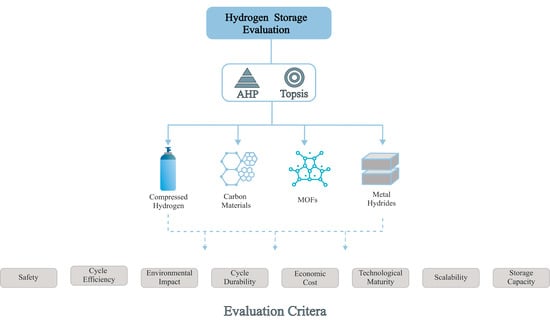
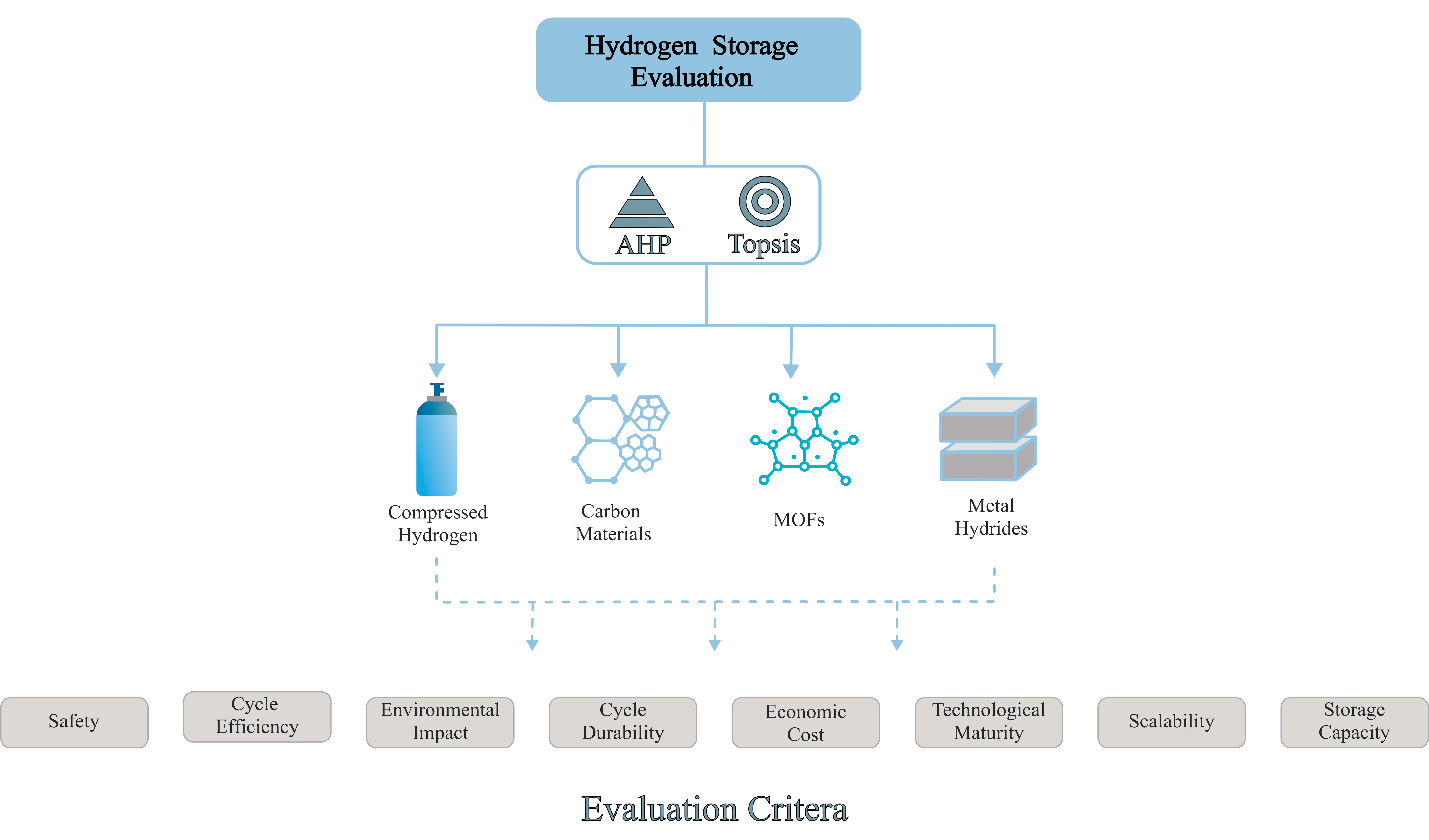
The hierarchy of criteria of this research is shown in Figure 1.

4. Results and Discussion

This section presents and analyzes the results obtained from the application of the Analytic Hierarchy Process (AHP) and the Technique for Order Preference by Similarity to Ideal Solution (TOPSIS) to evaluate four hydrogen storage technologies.

4.1. AHP

The weights assigned to the evaluation criteria through AHP reflect the relative importance of each factor in the decision-making process. As shown in Table 2, safety and cycle efficiency were the most influential criteria, with weights of 0.22 and 0.19, respectively, emphasizing the importance of minimizing risks and optimizing hydrogen storage density, especially in scenarios where safety and performance are critical. Storage capacity (0.17) and environmental impact (0.14) also received significant weight, reflecting the increasing importance of sustainability and efficiency in hydrogen infrastructure. The remaining criteria, including economic cost (0.06), scalability (0.03), cycle durability (0.14), and technological maturity (0.11), were assigned lower but still relevant weights. Together, these criteria ensure a comprehensive evaluation of each technology’s performance, feasibility, and long-term viability.
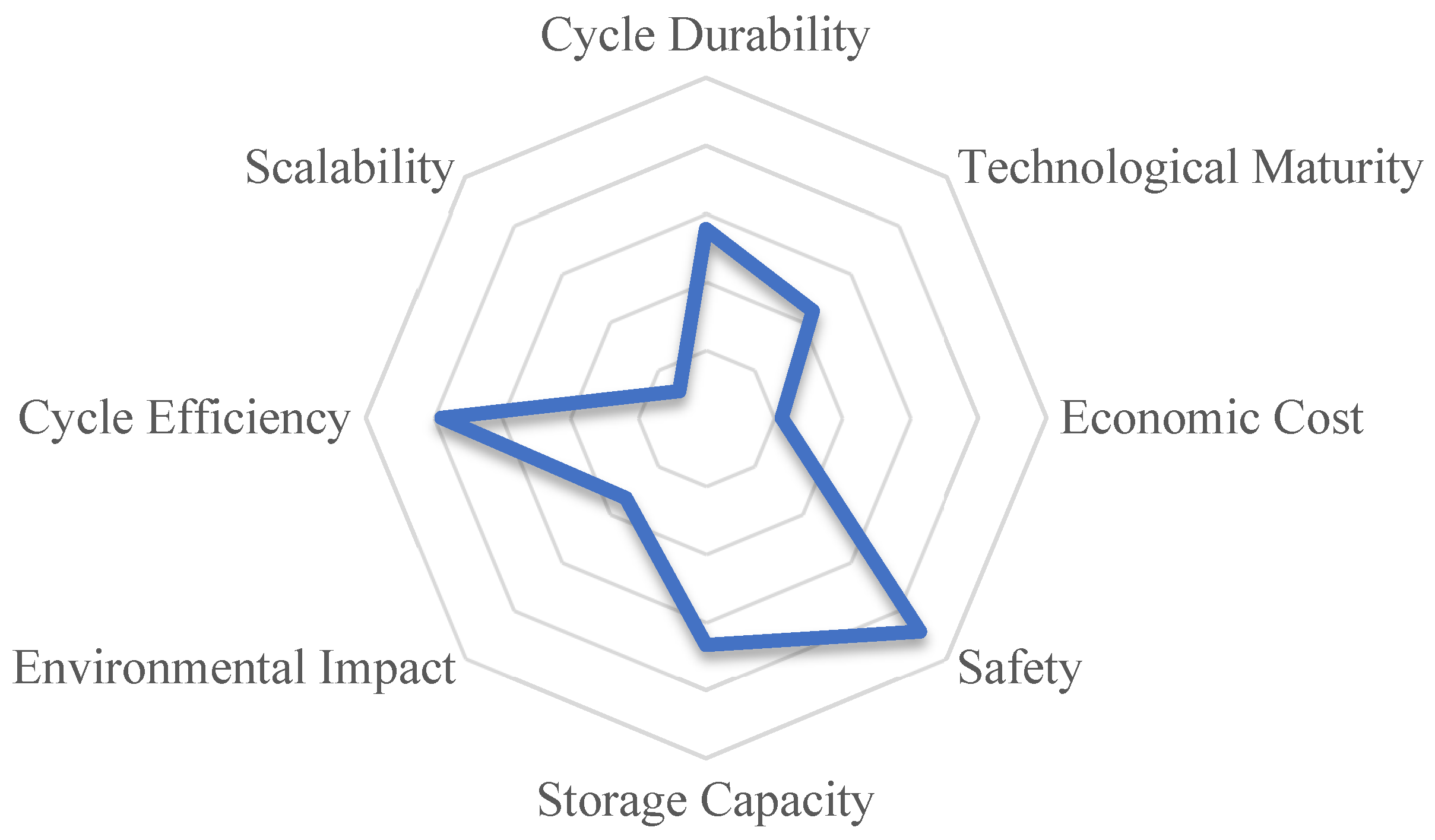
Figure 2 presents a radar chart illustrating the relative importance assigned to each evaluation criterion within the AHP framework. The plot provides a visual summary of how the eight criteria influence the overall decision-making process. As observed, safety, storage efficiency, and cycle efficiency occupy prominent positions, reflecting their strong weighting in the evaluation of hydrogen storage technologies. These criteria are particularly relevant for operational reliability and energy density, which are critical in both mobile and stationary applications. Conversely, criteria such as environmental impact and economic cost received comparatively lower weights, although they remain essential for long-term sustainability and commercial viability. Technological maturity and scalability occupy intermediate positions, indicating their role in determining the feasibility of deployment but with less influence than the top-priority criteria.
To evaluate the performance of each alternative against the established criteria, pairwise comparison matrices were constructed for the four hydrogen storage alternatives under each criterion. These matrices were based on the relative importance of each alternative with respect to the criteria, using Saaty’s fundamental scale of 1 to 9 for the comparisons [64]. The results of these comparisons are presented in Table 3, which summarizes the relative priorities of the alternatives for each criterion, the derived priority vector for each hydrogen storage alternative and the consistency index.
The results derived from the pairwise comparison matrices and AHP weights reflect the distinct advantages and disadvantages of each hydrogen storage technology across the evaluated criteria. Metal hydrides (A1) generally show the best performance in terms of storage capacity (0.575) and cycle efficiency (0.565), although their scalability and cost may limit broader application. MOFs (A2) show significant potential, especially in gravimetric storage capacity (0.575), but their technological maturity (0.042) and scalability (0.084) remain major limitations. Carbon-based materials (A3), despite their high safety (0.617) and cycle durability (0.389), are limited by their low storage capacity and cycle efficiency. Compressed hydrogen (A4) provides a robust solution with high scalability (0.546), but its safety and infrastructure requirements remain significant challenges.
Finally, the global weight vector derived from AHP (Table 4) ranked the alternatives. Metal hydrides emerged as the most favorable alternative. This result reflects their high performance in key criteria such as volumetric storage capacity, cycle efficiency, and acceptable safety under controlled conditions. Compressed hydrogen ranked second, primarily due to its high technological maturity and broad scalability, despite its lower safety rating. Carbon-based materials were positioned third, with excellent chemical stability and safety, but penalized by their low storage density and energy efficiency. Metal–organic frameworks (MOFs) were ranked fourth, due to their low durability, high cost, and current early-stage development status.

Sensitivity Analysis

To validate the robustness of the AHP model and assess the influence of weighting uncertainty on the final results, a one-way sensitivity analysis was performed. Each criterion weight was independently varied by ±10%, while the remaining weights were proportionally adjusted to maintain normalization (Σwi = 1).
The analysis was applied to the four hydrogen storage technologies, metal hydrides (A1), compressed hydrogen (A4), carbon-based materials (A3), and MOFs (A2), using the AHP-derived priorities obtained in the base scenario.
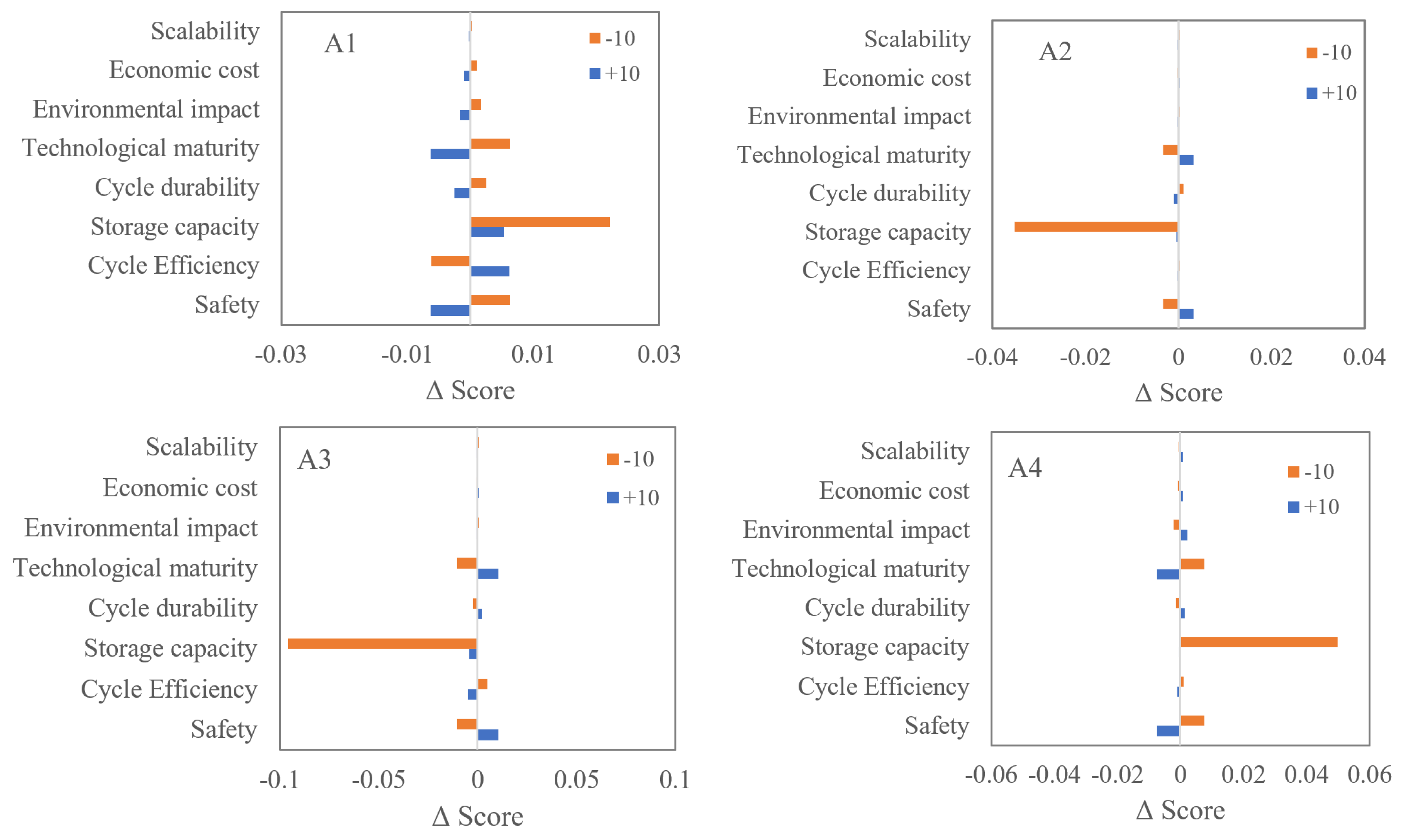
The results, presented in Figure 3, show the variation in total AHP scores (ΔScore) for each alternative as a function of the changes in individual criteria weights. In all cases, the overall ranking order (A1 > A4 > A3 > A2) remained unchanged under ±10% perturbations, confirming the stability and reliability of the AHP-based decision model. It can be observed that the score deviations were generally small, typically within ±0.05, indicating that moderate fluctuations in the weighting matrix have only a limited effect on the final ranking. Slightly larger variations were observed for carbon-based materials due to their strong dependence on the storage capacity criterion, although these did not alter the overall ranking order.
Among the evaluated criteria, storage capacity showed the highest sensitivity across all technologies, particularly for carbon-based materials (A3) and compressed hydrogen (A4), where a 10% reduction in its weight produced a noticeable decrease in the total score. Technological maturity also exhibited moderate influence, especially for compressed hydrogen, reflecting its advantage due to well-established infrastructure. In contrast, economic cost, environmental impact, cycle durability, and scalability caused negligible changes (<0.01), confirming their lower influence on the overall AHP outcome.
The individual tornado plots show that metal hydrides (A1) maintain the highest total score under all tested conditions, supported by their balanced performance in safety, efficiency, and volumetric capacity. Compressed hydrogen (A4) remains stable in second position, while carbon-based materials (A3) and MOFs (A2) show larger numerical deviations but without altering their relative ranking. Even for the most sensitive criteria, such as storage capacity and technological maturity, the magnitude of the score changes is insufficient to alter the relative position of the alternatives, confirming the robustness and stability of the AHP evaluation.

4.2. TOPSIS

To complement the AHP analysis and assess the closeness of each alternative to the ideal solution, the Technique for Order Preference by Similarity to Ideal Solution (TOPSIS) was applied. This method calculates the distances of each alternative from both the ideal solution (PIS) and the negative ideal solution (NIS) for each criterion. The ideal solutions represent the best and worst possible performance values for each criterion, respectively.
The process involves using the normalized performance matrix and the weights derived from AHP (Table 3). By comparing each alternative to the PIS and NIS, the Euclidean distances to the PIS (D+) and NIS (D) are calculated. The closeness coefficient (Ci) for each alternative is then determined as the ratio between its distance to the NIS and the total distance to both the PIS and NIS. The results of this analysis, including the final rankings, are summarized in Table 5 and Table 6.
According to the TOPSIS method, metal hydrides obtained the highest closeness coefficient, confirming their leading position under the selected criteria (Table 6).
These results align closely with those obtained through AHP, confirming metal hydrides as the most favorable hydrogen storage option among the four technologies analyzed. Their strong performance is due primarily to their high volumetric storage capacity, good cycle efficiency, and acceptable safety under controlled conditions. Despite limitations in scalability and cost, their overall proximity to the ideal solution indicates a strong balance across the prioritized criteria.
Compressed hydrogen ranks second. It benefits from high technological maturity and balanced performance across most dimensions, including scalability and ease of implementation. However, its low safety score and the infrastructure challenges associated with high-pressure storage lower its overall standing in the decision matrix. Nonetheless, its relatively high closeness coefficient reflects its competitiveness, particularly in mature infrastructure scenarios.
Carbon-based materials occupy the third position: while notable for safety and durability, their performance is poor in cycle efficiency and storage. Their distance to the negative ideal solution (D) is relatively small, which suggests that their low cycle efficiency and storage capacity, compared to the other technologies, heavily impact their overall performance in the TOPSIS evaluation.
MOFs occupy the fourth position, with the lowest closeness coefficient. While they exhibit a high theoretical gravimetric storage capacity, their practical application is constrained by low cycle durability, high costs, and ongoing challenges related to technological maturity. Their distance to the ideal positive solution (D+) is higher than other technologies, which further underlines their weaker standing compared to alternatives like metal hydrides and compressed hydrogen.
The high level of agreement between AHP and TOPSIS supports the robustness of the multi-criteria evaluation framework used in this study. Both methods identify metal hydrides as the most balanced and effective solution under the criteria considered. This conclusion is supported by several previous studies using similar approaches. For instance, in a study by Haktanır and Kahraman [16], AHP and TOPSIS were combined with intuitionistic Z-numbers to select hydrogen storage technologies, highlighting metal hydrides as the most favorable option. Similarly, the Ccatamayo-Barrios et al. [69] also recognized metal hydrides as one of the most promising technologies for hydrogen storage, particularly due to their high volumetric capacity and cycle efficiency. In addition, while other authors such as Sharaf [15] and Acar et al. [17] have applied fuzzy or hybrid MCDM approaches to similar systems, the ranking trends remain consistent, with metal hydrides outperforming emerging materials such as MOFs and carbon-based sorbents. This convergence across different methodological frameworks highlights the robustness of the conclusion that metal hydrides currently offer the best balance between capacity, safety, and technological readiness.
Both methods also consistently rank MOFs as the least suitable technology, emphasizing the challenges they face in durability, cost, and technological maturity. This evaluation aligns with the review by Zhang et al. [70], who highlighted the limitations of MOFs for practical applications due to their structural instability and demanding operational requirements. The slight variation in the positioning of carbon materials and compressed hydrogen between AHP and TOPSIS reflects the different computational logic of the methods: AHP emphasizes the weighted structure of preferences, while TOPSIS accounts for the geometric proximity to the ideal solution [69]. This methodological difference is discussed by Haktanır and Kahraman [16], who noted that, although both methods provide similar rankings, the normalization and weighting techniques applied can influence the final results.
Overall, the results highlight evident trade-offs between cost, safety, and energy efficiency across the evaluated technologies. Metal hydrides provide the best compromise, combining high safety and storage density with acceptable cost. Compressed hydrogen achieves low cost and maturity but at the expense of safety. In contrast, carbon-based materials and MOFs exhibit favorable safety profiles but limited storage efficiency and higher costs, illustrating the typical balance between operational performance and economic feasibility in hydrogen storage systems.

5. Conclusions

This study applied two complementary multi-criteria decision-making (MCDM) methodologies—Analytic Hierarchy Process (AHP) and Technique for Order Preference by Similarity to Ideal Solution (TOPSIS)—to evaluate four hydrogen storage technologies: compressed hydrogen, metal hydrides, metal–organic frameworks (MOFs) and carbon-based materials. Using a comprehensive set of technical, economic, and environmental criteria, the analysis provided a clear comparison of the strengths and limitations of each technology, offering valuable insights for the future development of hydrogen storage infrastructure.
The results revealed that metal hydrides achieved the highest overall score, excelling in volumetric storage density and safety profile, despite challenges with scalability and cost. Their strong performance in cycle efficiency further underscores their potential as a balanced solution, particularly for stationary or low-mobility applications.
Compressed hydrogen ranked second, benefiting from its technological maturity and established infrastructure. Its rapid refueling capacity makes it highly applicable, particularly in the transportation sector. However, the safety risks associated with high-pressure storage and its relatively low volumetric capacity limit its competitiveness compared to more advanced technologies.
Carbon-based materials ranked third, noted for their high safety, durability and low operational costs. However, their limited storage capacity and cycle efficiency hinder their suitability for applications where energy density is crucial.
Finally, metal–organic frameworks (MOFs), while promising in terms of gravimetric storage capacity, face significant technological, durability, and cost challenges that hinder their widespread adoption in the near term. Despite their theoretical potential, MOFs remain limited by issues related to scalability and long-term performance.
The application of AHP and TOPSIS yielded consistent results, highlighting the robustness of the proposed approach for evaluating emerging technologies. The minor differences between the two methods reflect the distinct computational logic of each: AHP emphasizes the hierarchical structuring of preferences through expert judgment, while TOPSIS assesses alternatives based on their geometric proximity to the ideal solution. The combination of AHP and TOPSIS offers a comprehensive tool for selecting technologies that balance performance, economic feasibility, and environmental sustainability—key considerations for the large-scale deployment of hydrogen infrastructure in the future.

Author Contributions

Conceptualization, R.M.; methodology, A.L.-G.; validation, V.A.; formal analysis, R.M. and J.F.; investigation, A.L.-G.; writing—original draft preparation, R.M.; writing—review and editing, L.P.-R. and J.F.; visualization, V.A.; supervision, R.M. All authors have read and agreed to the published version of the manuscript.

Funding

This research received no external funding.

Data Availability Statement

The original contributions presented in this study are included in the article. Further inquiries can be directed to the authors.

Acknowledgments

This study was developed within the framework of the PICUD-2024-01 project at the Centro Universitario de la Defensa.

Conflicts of Interest

The authors declare no conflicts of interest.

References

  1. Zainal, B.S.; Ker, P.J.; Mohamed, H.; Ong, H.C.; Fattah, I.M.R.; Rahman, S.M.A.; Nghiem, L.D.; Mahlia, T.M.I. Recent advancement and assessment of green hydrogen production technologies. Renew. Sustain. Energy Rev. 2024, 189, 113941. [Google Scholar] [CrossRef]
  2. Aguado Molina, R.; Casteleiro Roca, J.L.; Jove Pérez, E.; Zayas Gato, F.; Quintián Pardo, H.; Calvo Rolle, J.L. Hidrógeno y su Almacenamiento: El Futuro de la Energía Eléctrica; Universidade da Coruña: A Coruña, Spain, 2021. [Google Scholar] [CrossRef]
  3. Mulky, L.; Srivastava, S.; Lakshmi, T.; Sandadi, E.R.; Gour, S.; Thomas, N.A.; Shanmuga Priya, S.; Sudhakar, K. An overview of hydrogen storage technologies—Key challenges and opportunities. Mater. Chem. Phys. 2024, 325, 129710. [Google Scholar] [CrossRef]
  4. Padmanabhan, N.T.; Clarizia, L.; Ganguly, P. Advancing hydrogen storage: Critical insights to potentials, challenges, and pathways to sustainability. Curr. Opin. Chem. Eng. 2025, 48, 101135. [Google Scholar] [CrossRef]
  5. Calise, F.; D’Accadia, M.D.; Santarelli, M.; Lanzini, A.; Ferrero, D. Solar Hydrogen Production: Processes, Systems and Technologies; Elsevier: Amsterdam, The Netherlands, 2019. [Google Scholar] [CrossRef]
  6. Qiu, Y.; Yang, H.; Tong, L.; Wang, L. Research progress of cryogenic materials for storage and transportation of liquid hydrogen. Metals 2021, 11, 1101. [Google Scholar] [CrossRef]
  7. Osman, A.I.; Nasr, M.; Eltaweil, A.S.; Hosny, M.; Farghali, M.; Al-Fatesh, A.S.; Rooney, D.W.; Abd El-Monaem, E.M. Advances in hydrogen storage materials: Harnessing innovative technology, from machine learning to computational chemistry, for energy storage solutions. Int. J. Hydrogen Energy 2024, 67, 1270–1294. [Google Scholar] [CrossRef]
  8. Malleswararao, K.; Dutta, P.; Murthy, S.S. Applications of metal hydride based thermal systems: A review. Appl. Therm. Eng. 2022, 215, 118816. [Google Scholar] [CrossRef]
  9. Oner, O.; Khalilpour, K. Evaluation of green hydrogen carriers: A multi-criteria decision analysis tool. Renew. Sustain. Energy Rev. 2022, 168, 112764. [Google Scholar] [CrossRef]
  10. Al Rizeiqi, N.; Azzouz, A.; Liew, P.Y. Multi-Criteria Evaluation of Large-Scale Hydrogen Storage Technologies in Oman using the Analytic Hierarchy Process. Chem. Eng. Trans. 2023, 106, 1117–1122. [Google Scholar] [CrossRef]
  11. Pilavachi, P.A.; Chatzipanagi, A.I.; Spyropoulou, A.I. Evaluation of hydrogen production methods using the Analytic Hierarchy Process. Int. J. Hydrogen Energy 2009, 34, 5294–5303. [Google Scholar] [CrossRef]
  12. Uzun, B.; Taiwo, M.; Syidanova, A.; Uzun Ozsahin, D. The Technique for Order of Preference by Similarity to Ideal Solution (TOPSIS). In Application of Multi-Criteria Decision Analysis in Environmental and Civil Engineering; Professional Practice in Earth Sciences; Springer: Cham, Switzerland, 2021. [Google Scholar] [CrossRef]
  13. Gim, B.; Kim, J.W. Multi-criteria evaluation of hydrogen storage systems for automobiles in Korea using the fuzzy analytic hierarchy process. Int. J. Hydrogen Energy 2014, 39, 7852–7858. [Google Scholar] [CrossRef]
  14. Qie, X.; Zhang, R.; Hu, Y.; Sun, X.; Chen, X. A multi-criteria decision-making approach for energy storage technology selection based on demand. Energies 2021, 14, 6592. [Google Scholar] [CrossRef]
  15. Sharaf, I.M. A new approach for spherical fuzzy TOPSIS and spherical fuzzy VIKOR applied to the evaluation of hydrogen storage systems. Soft Comput. 2023, 27, 4403–4423. [Google Scholar] [CrossRef]
  16. Haktanır, E.; Kahraman, C. Integrated AHP & TOPSIS methodology using intuitionistic Z-numbers: An application on hydrogen storage technology selection. Expert. Syst. Appl. 2024, 239, 122382. [Google Scholar] [CrossRef]
  17. Acar, C.; Haktanır, E.; Tekin Temur, G.; Beskese, A. Sustainable stationary hydrogen storage application selection with interval-valued intuitionistic fuzzy AHP. Int. J. Hydrogen Energy 2024, 49, 619–634. [Google Scholar] [CrossRef]
  18. Inal, O.B.; Dere, C.; Deniz, C. Onboard Hydrogen Storage for Ships: An Overview. In Proceedings of the 5th International Hydrogen Technologies Congress, Niğde, Turkey, 26–28 May 2021. [Google Scholar]
  19. Alobaid, A.; Kamil, M.; Abdelrazek Khalil, K. Metal hydrides for solid hydrogen storage: Experimental insights, suitability evaluation, and innovative technical considerations for stationary and mobile applications. Int. J. Hydrogen Energy 2025, 128, 432–456. [Google Scholar] [CrossRef]
  20. Talagañis, B.A.; Meyer, G.O.; Aguirre, P.A. Modeling and simulation of absorption-desorption cyclic processes for hydrogen storage-compression using metal hydrides. Int. J. Hydrogen Energy 2011, 36, 13621–13631. [Google Scholar] [CrossRef]
  21. Klopčič, N.; Grimmer, I.; Winkler, F.; Sartory, M.; Trattner, A. A review on metal hydride materials for hydrogen storage. J. Energy Storage 2023, 72, 108456. [Google Scholar] [CrossRef]
  22. Osman, A.I.; Ayati, A.; Farrokhi, M.; Khadempir, S.; Rajabzadeh, A.R.; Farghali, M.; Krivoshapkin, P.; Tanhaei, B.; Rooney, D.W.; Yap, P.S. Innovations in hydrogen storage materials: Synthesis, applications, and prospects. J. Energy Storage 2024, 95, 112376. [Google Scholar] [CrossRef]
  23. Ariharan, A.; Viswanathan, B.; Nandhakumar, V. Nitrogen-incorporated carbon nanotube derived from polystyrene and polypyrrole as hydrogen storage material. Int. J. Hydrogen Energy 2018, 43, 5077–5088. [Google Scholar] [CrossRef]
  24. Sdanghi, G.; Canevesi, R.L.S.; Celzard, A.; Thommes, M.; Fierro, V. Characterization of Carbon Materials for Hydrogen Storage and Compression. C 2020, 6, 46. [Google Scholar] [CrossRef]
  25. Miskan, S.N.; Abdulkadir, B.A.; Setiabudi, H.D. Materials on the frontier: A review on groundbreaking solutions for hydrogen storage applications. Chem. Phys. Impact 2025, 10, 100862. [Google Scholar] [CrossRef]
  26. Li, J.C.; Xu, H.; Zhou, K.; Li, J.Q. A review on the research progress and application of compressed hydrogen in the marine hydrogen fuel cell power system. Heliyon 2024, 10, e25304. [Google Scholar] [CrossRef] [PubMed]
  27. Mekonnin, A.S.; Wacławiak, K.; Humayun, M.; Zhang, S.; Ullah, H. Hydrogen Storage Technology, and Its Challenges: A Review. Catalysts 2025, 15, 260. [Google Scholar] [CrossRef]
  28. Elberry, A.M.; Thakur, J.; Santasalo-Aarnio, A.; Larmi, M. Large-scale compressed hydrogen storage as part of renewable electricity storage systems. Int. J. Hydrogen Energy 2021, 46, 15671–15690. [Google Scholar] [CrossRef]
  29. Hardy, B.J.; Gamble, S.N. Material analysis of metal hydrides for bulk hydrogen storage. Int. J. Hydrogen Energy 2024, 62, 148–161. [Google Scholar] [CrossRef]
  30. Mahmoud, L.A.M.; Rowlandson, J.L.; Fermin, D.J.; Ting, V.P.; Nayak, S. Porous carbons: A class of nanomaterials for efficient adsorption-based hydrogen storage. RSC Appl. Interfaces 2025, 2, 25–55. [Google Scholar] [CrossRef]
  31. Enasel, E.; Dumitrascu, G. Storage solutions for renewable energy: A review. Energy Nexus 2025, 17, 100391. [Google Scholar] [CrossRef]
  32. Yan, X.; Li, J.; Zhao, P.; Liu, N.; Wang, L.; Yue, B.; Liu, Y. Review on reliability assessment of energy storage systems. IET Smart Grid 2024, 7, 695–715. [Google Scholar] [CrossRef]
  33. Züttel, A. Materials for hydrogen storage. Mater. Today 2003, 6, 24–33. [Google Scholar] [CrossRef]
  34. Memetova, A.; Tyagi, I.; Karri, R.R.; Kumar, V.; Tyagi, K.; Suhas; Memetov, N.; Zelenin, A.; Pasko, T.; Gerasimova, A.; et al. Porous carbon-based material as a sustainable alternative for the storage of natural gas (methane) and biogas (biomethane): A review. Chem. Eng. J. 2022, 446, 137373. [Google Scholar] [CrossRef]
  35. Nnabuife, S.G.; Oko, E.; Kuang, B.; Bello, A.; Onwualu, A.P.; Oyagha, S.; Whidborne, J. The prospects of hydrogen in achieving net zero emissions by 2050: A critical review. Sustain. Chem. Clim. Action 2023, 2, 100024. [Google Scholar] [CrossRef]
  36. Xie, Z.; Jin, Q.; Su, G.; Lu, W. A Review of Hydrogen Storage and Transportation: Progresses and Challenges. Energies 2024, 17, 4070. [Google Scholar] [CrossRef]
  37. Bannenberg, L.J.; Heere, M.; Benzidi, H.; Montero, J.; Dematteis, E.M.; Suwarno, S.; Jaroń, T.; Winny, M.; Orłowski, P.A.; Wegner, W.; et al. Metal (boro-) hydrides for high energy density storage and relevant emerging technologies. Int. J. Hydrogen Energy 2020, 45, 33687–33730. [Google Scholar] [CrossRef]
  38. Sutton, A.L.; Mardel, J.I.; Hill, M.R. Metal-Organic Frameworks (MOFs) as Hydrogen Storage Materials at Near-Ambient Temperature. Chem.—A Eur. J. 2024, 30, e202400717. [Google Scholar] [CrossRef]
  39. Xu, Y.; Zhou, Y.; Li, Y.; Liu, Y.; Ding, Z. Advanced Carbon Architectures for Hydrogen Storage: From Synthesis to Performance Enhancement. J. Environ. Chem. Eng. 2024, 12, 114497. [Google Scholar] [CrossRef]
  40. Gavankar, S.; Suh, S.; Keller, A.A. The Role of Scale and Technology Maturity in Life Cycle Assessment of Emerging Technologies: A Case Study on Carbon Nanotubes. J. Ind. Ecol. 2015, 19, 51–60. [Google Scholar] [CrossRef]
  41. Zohra Zeggai, F.; Ait-Touchente, Z.; Bachari, K.; Elaissari, A. Investigation of Metal-Organic Frameworks (MOFs): Synthesis, Properties, and Applications—An In-Depth Review. Chem. Phys. Impact 2025, 10, 100864. [Google Scholar] [CrossRef]
  42. Diakoulaki, D.; Karangelis, F. Multi-criteria decision analysis and cost–benefit analysis of alternative scenarios for the power generation sector in Greece. Renew. Sustain. Energy Rev. 2007, 11, 716–727. [Google Scholar] [CrossRef]
  43. Xu, Y.; Yang, X.; Li, Y.; Zhao, Y.; Shu, X.; Zhang, G.; Yang, T.; Liu, Y.; Wu, P.; Ding, Z. Rare-Earth Metal-Based Materials for Hydrogen Storage: Progress, Challenges, and Future Perspectives. Nanomaterials 2024, 14, 1671. [Google Scholar] [CrossRef]
  44. Gopinath, K.P.; Vo, D.V.N.; Gnana Prakash, D.; Adithya Joseph, A.; Viswanathan, S.; Arun, J. Environmental applications of carbon-based materials: A review. Environ. Chem. Lett. 2021, 19, 557–582. [Google Scholar] [CrossRef]
  45. Madadi Avargani, V.; Zendehboudi, S.; Duan, X.; Abdlla Maarof, H. Advancements in non-renewable and hybrid hydrogen production: Technological innovations for efficiency and carbon reduction. Fuel 2025, 395, 135065. [Google Scholar] [CrossRef]
  46. Cavallaro, F.; Ciraolo, L. A multicriteria approach to evaluate wind energy plants on an Italian island. Energy Policy 2005, 33, 235–244. [Google Scholar] [CrossRef]
  47. Shafiee, S.; McCay, M.H. Different reactor and heat exchanger configurations for metal hydride hydrogen storage systems—A review. Int. J. Hydrogen Energy 2016, 41, 9462–9470. [Google Scholar] [CrossRef]
  48. Chakraborty, D.; Yurdusen, A.; Mouchaham, G.; Nouar, F.; Serre, C. Large-Scale Production of Metal–Organic Frameworks. Adv. Funct. Mater. 2023, 34, 2309089. [Google Scholar] [CrossRef]
  49. Soni, K.; Panwar, N.L.; Lanjekar, P.R. Emergence of carbonaceous material for hydrogen storage: An overview. Clean. Energy 2024, 8, 147–168. [Google Scholar] [CrossRef]
  50. Li, J.Q.; Li, J.C.; Park, K.; Jang, S.J.; Kwon, J.T. An analysis on the compressed hydrogen storage system for the fast-filling process of hydrogen gas at the pressure of 82 mpa. Energies 2021, 14, 2635. [Google Scholar] [CrossRef]
  51. Kukkapalli, V.K.; Kim, S.; Thomas, S.A. Thermal Management Techniques in Metal Hydrides for Hydrogen Storage Applications: A Review. Energies 2023, 16, 3444. [Google Scholar] [CrossRef]
  52. Franco, A.; Giovannini, C. Hydrogen Gas Compression for Efficient Storage: Balancing Energy and Increasing Density. Hydrogen 2024, 5, 293–311. [Google Scholar] [CrossRef]
  53. Sandhu, Z.A.; Raza, M.A.; Awwad, N.S.; Ibrahium, H.A.; Farwa, U.; Ashraf, S.; Dildar, A.; Fatima, E.; Ashraf, S.; Ali, F. Metal-organic frameworks for next-generation energy storage devices; a systematic review. Mater. Adv. 2023, 5, 30–50. [Google Scholar] [CrossRef]
  54. Amir, M.; Deshmukh, R.G.; Khalid, H.M.; Said, Z.; Raza, A.; Muyeen, S.M.; Nizami, A.S.; Elavarasan, R.M.; Saidur, R.; Sopian, K. Energy storage technologies: An integrated survey of developments, global economical/environmental effects, optimal scheduling model, and sustainable adaption policies. J. Energy Storage 2023, 72, 108694. [Google Scholar] [CrossRef]
  55. Dhumal, P.; Bhadane, P.; Ibrahim, B.; Chakraborty, S. Evaluating the path to sustainability: SWOT analysis of safe and sustainable by design approaches for metal–organic frameworks. Green. Chem. 2025, 27, 3815–3850. [Google Scholar] [CrossRef]
  56. Tawiah, B.; Ofori, E.A.; Chen, D.; Ming, Y.; Hou, Y.; Jia, H.; Fei, B. Carbon-Based Thermal Management Solutions and Innovations for Improved Battery Safety: A Review. Batteries 2025, 11, 144. [Google Scholar] [CrossRef]
  57. Nyangon, J.; Darekar, A. Advancements in hydrogen energy systems: A review of levelized costs, financial incentives and technological innovations. Innov. Green. Dev. 2024, 3, 100149. [Google Scholar] [CrossRef]
  58. Sahoo, S.K.; Pamucar, D.; Goswami, S.S. A Review of Multi-Criteria Decision-Making Applications to Solve Energy Management Problems From 2010-2025: Current State and Future Research. Spectr. Decis. Mak. Appl. 2025, 2, 219–241. [Google Scholar] [CrossRef]
  59. Taha Aljburi, M.; Albahri, A.S.; Albahri, O.S.; Alamoodi, A.H.; Mahdi Mohammed, S.; Deveci, M.; Tomášková, H. Exploring decision-making techniques for evaluation and benchmarking of energy system integration frameworks for achieving a sustainable energy future. Energy Strategy Rev. 2024, 51, 101251. [Google Scholar] [CrossRef]
  60. Hosouli, S.; Hassani, R.A. Application of multi-criteria decision making (MCDM) model for solar plant location selection. Results Eng. 2024, 24, 103162. [Google Scholar] [CrossRef]
  61. Pohekar, S.D.; Ramachandran, M. Application of multi-criteria decision making to sustainable energy planning—A review. Renew. Sustain. Energy Rev. 2004, 8, 365–381. [Google Scholar] [CrossRef]
  62. Liu, J.; Yang, F.; Wu, Z.; Zhang, Z. A review of thermal coupling system of fuel cell-metal hydride tank: Classification, control strategies, and prospect in distributed energy system. Int. J. Hydrogen Energy 2024, 51, 274–289. [Google Scholar] [CrossRef]
  63. Saaty, R.W. The Analytic Hierarchy Process: Planning, Priority Setting, Resource Allocation (Decision Making Series). In Mathematical Modelling; McGraw-Hill International Book Co.: London, UK, 1980. [Google Scholar]
  64. Nantes, E.A. El método Analytic Hierarchy Process par la toma de decisiones. Repaso de la metodología y aplicaciones. In Investigación Operativa; Universidad Nacional del Sur: Bahía Blanca, Argentina, 2019; Volume 27. [Google Scholar]
  65. Hwang, C.-L.; Yoon, K. Multiple Attributes Decision Making Methods and Applications, Multiple Attribute Decision Making; Springer: Berlin, Germany, 1981. [Google Scholar] [CrossRef]
  66. Ebrahimi, E.; Fathi, M.R.; Sobhani, S.M. A Modification of Technique for Order Preference by Similarity to Ideal Solution (TOPSIS) through Fuzzy Similarity Method (A Numerical Example of the Personnel Selection). J. Appl. Res. Ind. Eng. 2023, 10, 203–217. [Google Scholar] [CrossRef]
  67. Zhu, S.; Liu, J.; Tang, G.; Sun, T.; Jia, H.; Zhao, H.; Zhang, Y.; Lin, L.; Xu, W. Evaluating the Application Potential of Acid-Modified Cotton Straw Biochars in Alkaline Soils Based on Entropy Weight TOPSIS. Agronomy 2023, 13, 2807. [Google Scholar] [CrossRef]
  68. Ulewicz, R.; Siwiec, D.; Pacana, A. Sustainable Vehicle Design Considering Quality Level and Life Cycle Environmental Assessment (LCA). Energies 2023, 16, 8122. [Google Scholar] [CrossRef]
  69. Ccatamayo-Barrios, J.H.; Huamán-Romaní, Y.L.; Seminario-Morales, M.V.; Flores-Castillo, M.M.; Gutiérrez-Gómez, E.; Carrillo-De la Cruz, L.K.; de la Cruz-Girón, K.A. Comparative Analysis of AHP and TOPSIS Multi-Criteria Decision-Making Methods for Mining Method Selection. Math. Model. Eng. Probl. 2023, 10, 1665–1674. [Google Scholar] [CrossRef]
  70. Zhang, Z.; Wang, Y.; Wang, H.; Xue, X.; Lin, Q. Metal-Organic Frameworks Promoted Hydrogen Storage Properties of Magnesium Hydride for In-Situ Resource Utilization (ISRU) on Mars. Front. Mater. 2021, 8, 766288. [Google Scholar] [CrossRef]
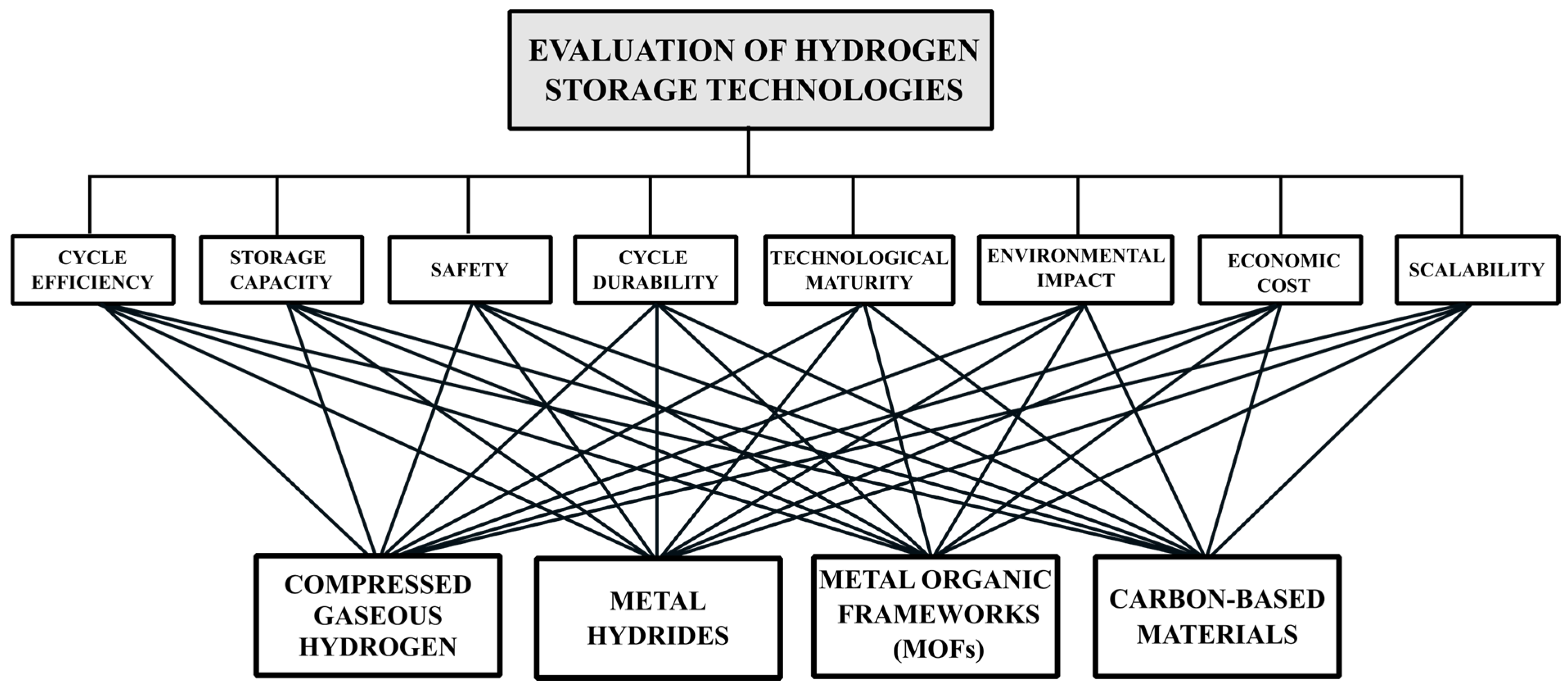
Figure 1. Hierarchy tree structure for the evaluation of hydrogen storage technologies.
Hydrogen 06 00111 g001
Figure 2. Graphical representation of the relative importance (weights) assigned to the eight evaluation criteria using the Analytic Hierarchy Process (AHP).
Hydrogen 06 00111 g002
Figure 3. One-way sensitivity analysis (±10%) of the AHP scores for the four hydrogen storage technologies: metal hydrides (A1), metal–organic frameworks (A2), carbon-based materials (A3), and compressed hydrogen (A4).
Hydrogen 06 00111 g003
Table 1. Summary of Evaluation Criteria for Hydrogen Storage Technologies.
CriteriaCompressed HydrogenMetal HydridesMOFsCarbon-Based Materials
C1SafetyLMMH
C2Cycle EfficiencyMHML
C3Storage CapacityMHML
C4Cycle DurabilityMMLH
C5Technological MaturityHMLM
C6Environmental ImpactDM-HHM
C7Economic CostMHHH
C8ScalabilityMLLL
Note: H—High, M—Moderate, L—Low, D—Depends on production.
Table 2. Weight distribution assigned to each criterion through AHP.
CriterionWeight
C1Safety0.222
C2Cycle Efficiency0.194
C3Storage Capacity0.167
C4Cycle Durability0.139
C5Technological Maturity0.110
C6Environmental Impact0.083
C7Economic Cost0.056
C8Scalability 0.028
Table 3. Pairwise comparison matrices for each evaluation criterion (C1–C8) and the derived priority vector for each hydrogen storage alternative (A1–A4).
CriteriaAcijwiCRRI (%)
C1 1 1 / 3 3 1 1 / 6 1 / 4 1 / 4 5 6 4 1 / 3 1 / 5 1 8 1 / 8 1 0.096 0.104 0.219 0.2157 0.117 0.102 0.240 0.239 0.637 0.626 0.048 0.055 0.591 0.614 0.053 0.046 0.105 0.228 0.617 0.050 0.0495.5
C2 1 5 1 / 5 1 7 3 3 1 / 3 1 / 7 1 / 3 1 / 3 3 1 1 / 5 5 1 0.545 0.582 0.128 0.109 0.561 0.571 0.116 0.118 0.057 0.054 0.270 0.255 0.051 0.059 0.272 0.252 0.565 0.118 0.055 0.262 0.0394.3
C3 1 6 1 / 6 1 9 3 4 1 / 4 1 / 9 1 / 4 1 / 3 4 1 1 / 7 7 1 0.549 0.600 0.118 0.091 0.566 0.584 0.101 0.105 0.043 0.040 0.289 0.269 0.036 0.045 0.297 0.266 0.575 0.104 0.041 0.280 0.0606.7
C4 1 3 1 / 3 1 1 / 3 1 / 3 1 / 5 1 / 5 3 5 3 5 1 1 1 1 0.147 0.152 0.069 0.065 0.155 0.155 0.069 0.069 0.392 0.391 0.392 0.391 0.388 0.388 0.388 0.388 0.152 0.068 0.389 0.389 0.0141.6
C5 1 8 1 / 8 1 6 1 / 2 1 / 3 1 / 9 1 / 6 3 2 9 1 1 / 7 7 1 0.339 0.363 0.045 0.038 0.340 0.353 0.041 0.043 0.084 0.081 0.533 0.518 0.075 0.091 0.544 0.514 0.349 0.042 0.083 0.527 0.0424.7
C6 1 1 1 1 1 / 2 1 / 4 1 / 2 1 / 4 2 2 4 4 1 1 / 3 3 1 0.120 0.120 0.120 0.120 0.122 0.122 0.122 0.122 0.220 0.220 0.540 0.540 0.216 0.222 0.541 0.533 0.121 0.121 0.220 0.539 0.070.8
C7 1 1 1 1 1 / 2 1 / 3 1 / 2 1 / 3 2 2 3 3 1 1 / 2 2 1 0.141 0.141 0.141 0.141 0.141 0.142 0.141 0.142 0.263 0.263 0.456 0.456 0.261 0.264 0.457 0.453 0.141 0.141 0.263 0.456 0.0030.4
C8 1 3 1 / 3 1 2 1 / 3 1 / 2 1 / 5 1 / 2 2 3 5 1 1 / 4 4 1 0.227 0.236 0.086 0.081 0.229 0.237 0.083 0.085 0.137 0.137 0.550 0.546 0.134 0.143 0.554 0.535 0.232 0.084 0.138 0.546 0.0171.9
Table 4. Final AHP scores and ranking of hydrogen storage alternatives.
AlternativeFinal AHP ScoreRanking
A1Metal hydrides0.3131
A2Metal–organic frameworks0.1254
A3Carbon materials0.2553
A4Compressed hydrogen0.3072
Table 5. Weighted normalized decision matrix for TOPSIS and ideal values for each criterion.
C1C2C3C4C5C6C7C8
A10.0760.1490.1240.0600.0710.0320.0220.014
A20.1140.0640.0550.0360.0090.0320.0220.007
A30.1710.0210.0140.0850.0270.0410.0290.010
A40.0380.1060.0960.0850.0800.0570.0360.021
PIS0.1710.1490.1240.0850.0800.0570.0360.021
NIS0.0380.0210.0140.0360.0090.0320.0220.007
Table 6. Final TOPSIS scores and ranking of hydrogen storage alternatives.
Alternative D i + D i CiRanking
A1Metal Hydrides0.1030.1850.6431
A2Metal–organic frameworks0.1540.0960.3854
A3Carbon Materials0.1780.1430.4463
A4Compressed Hydrogen0.1420.1500.5132
Disclaimer/Publisher’s Note: The statements, opinions and data contained in all publications are solely those of the individual author(s) and contributor(s) and not of MDPI and/or the editor(s). MDPI and/or the editor(s) disclaim responsibility for any injury to people or property resulting from any ideas, methods, instructions or products referred to in the content.