
The Effect of and Case Research on High-Prestressed Active Support in Large-Section Tunnels

Abstract
1. Introduction
2. High-Prestressed Active Support Effectiveness Analysis
2.1. Active Support Simulation Scheme
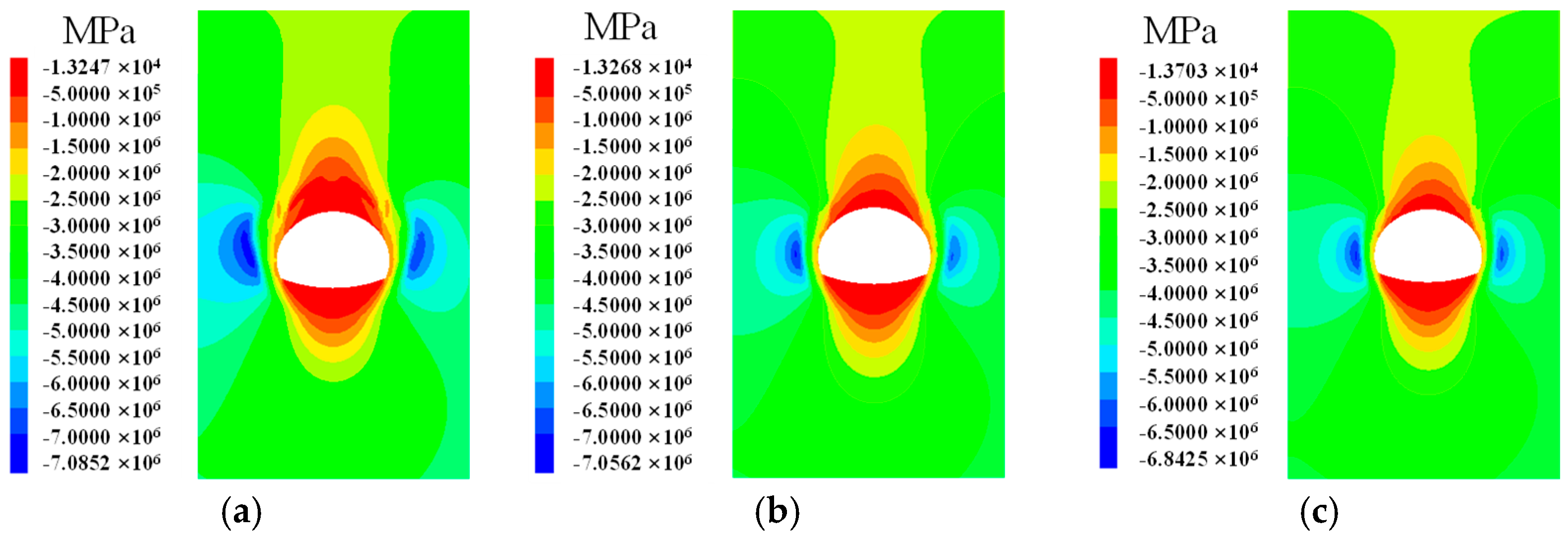
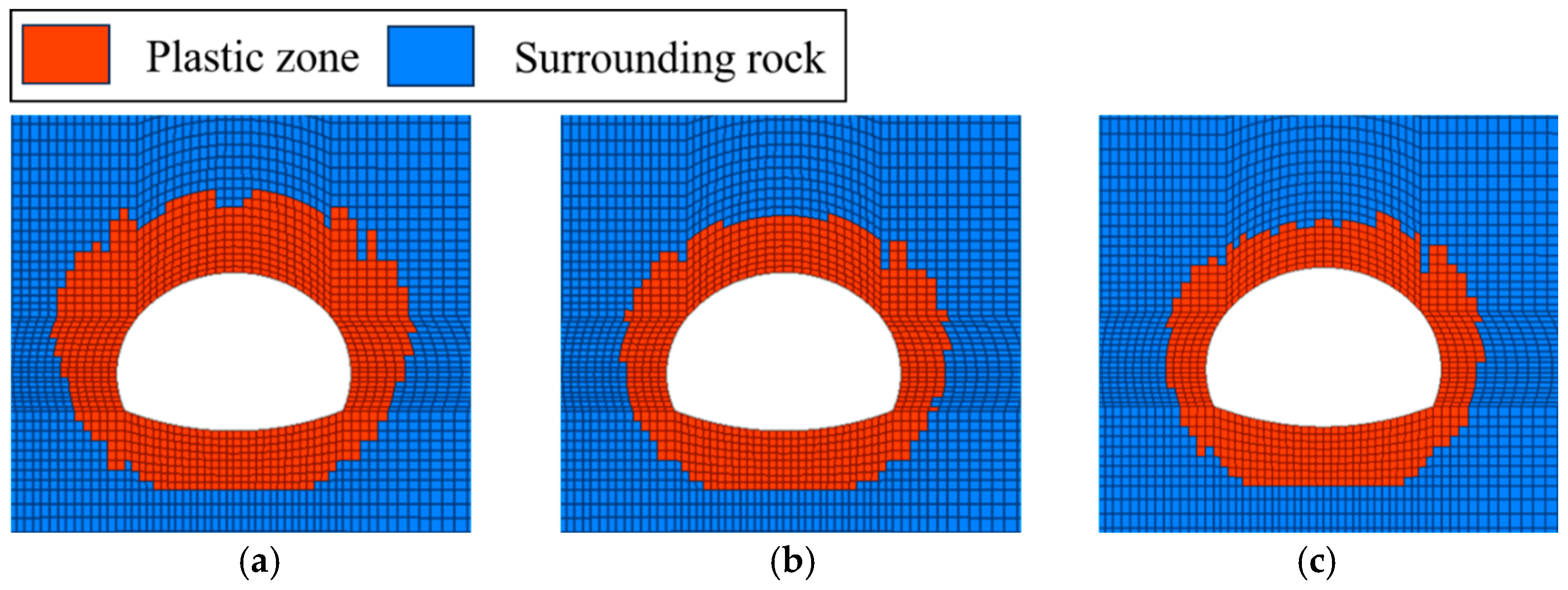
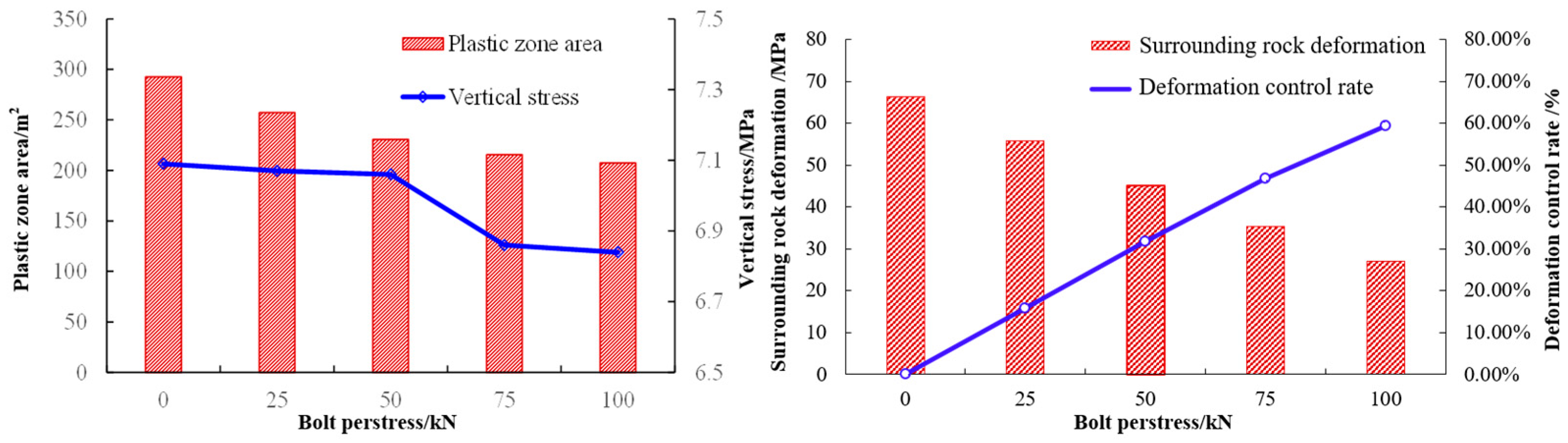
2.2. Analysis of Active Support Effectiveness
3. Prestress Conversion Test
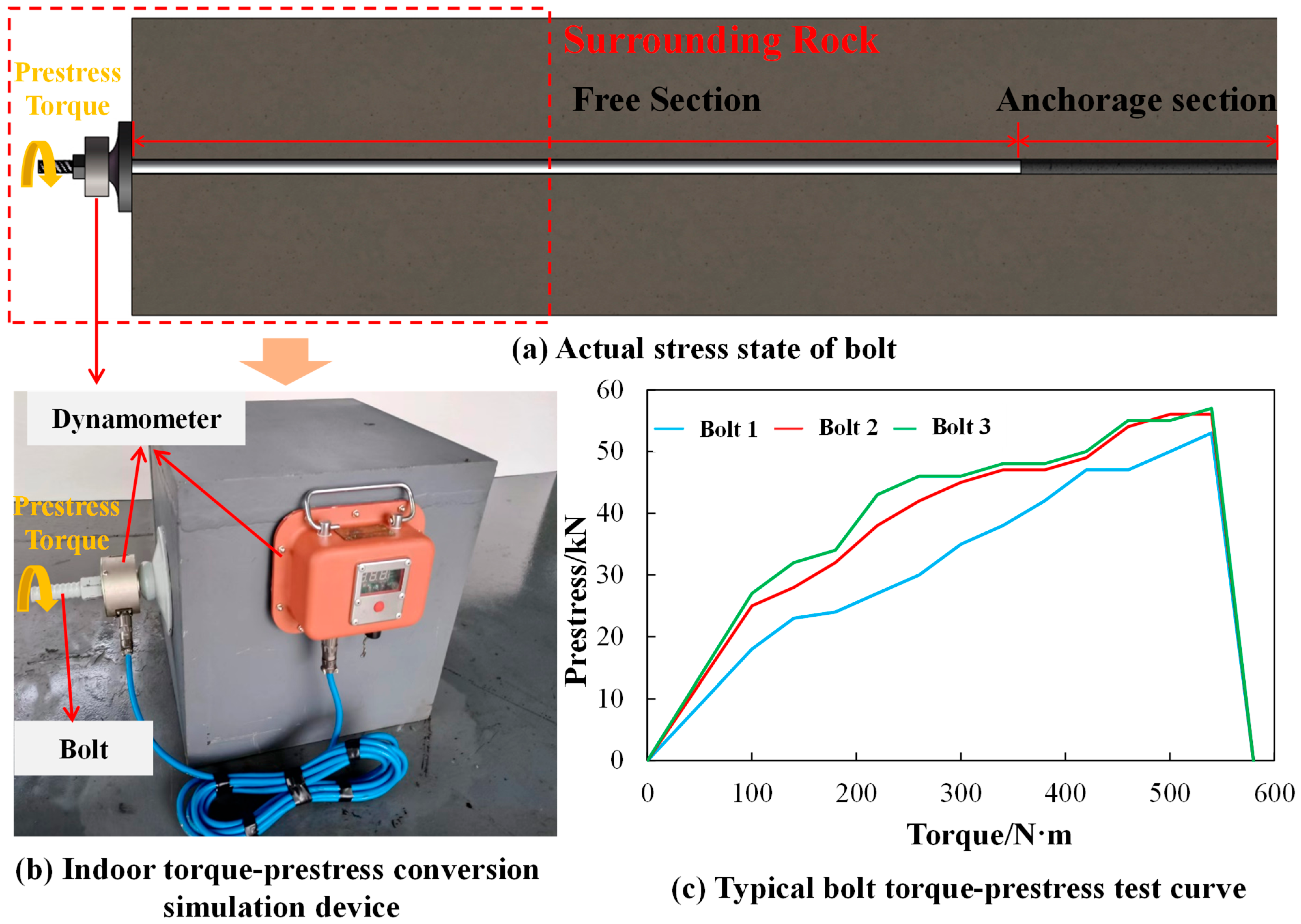
3.1. Torque–Prestress Conversion Test
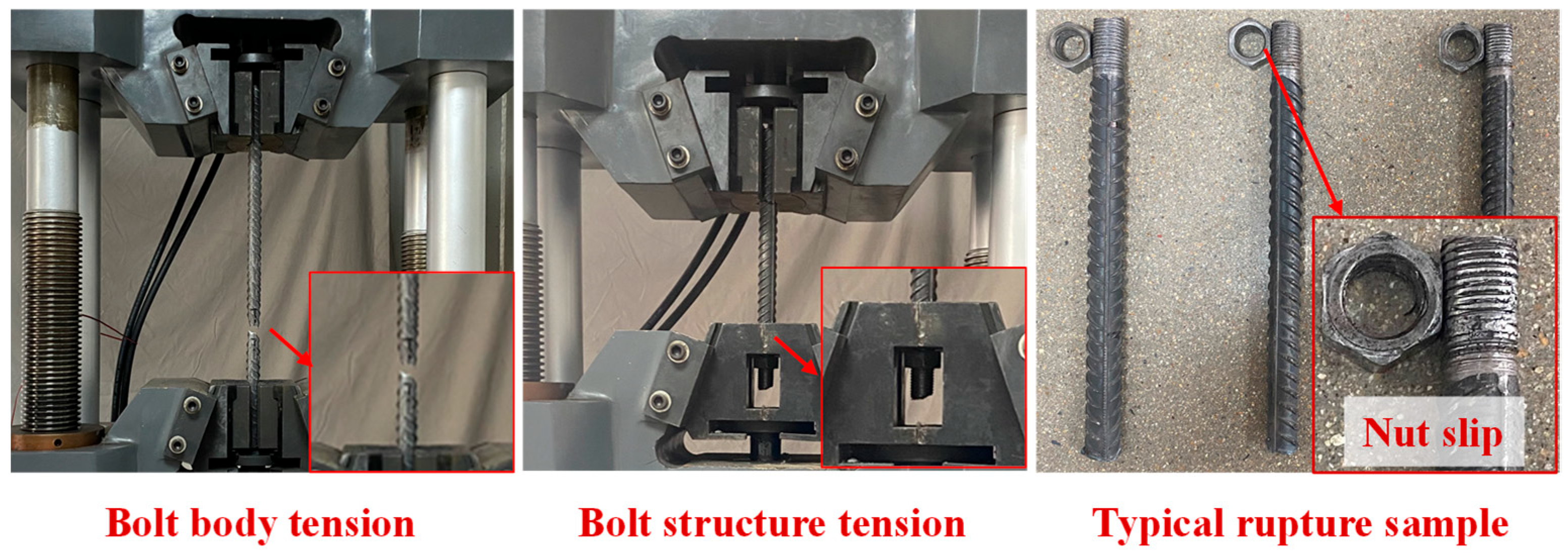
3.2. Tensile Test of Bolt–Nut Combination Structure
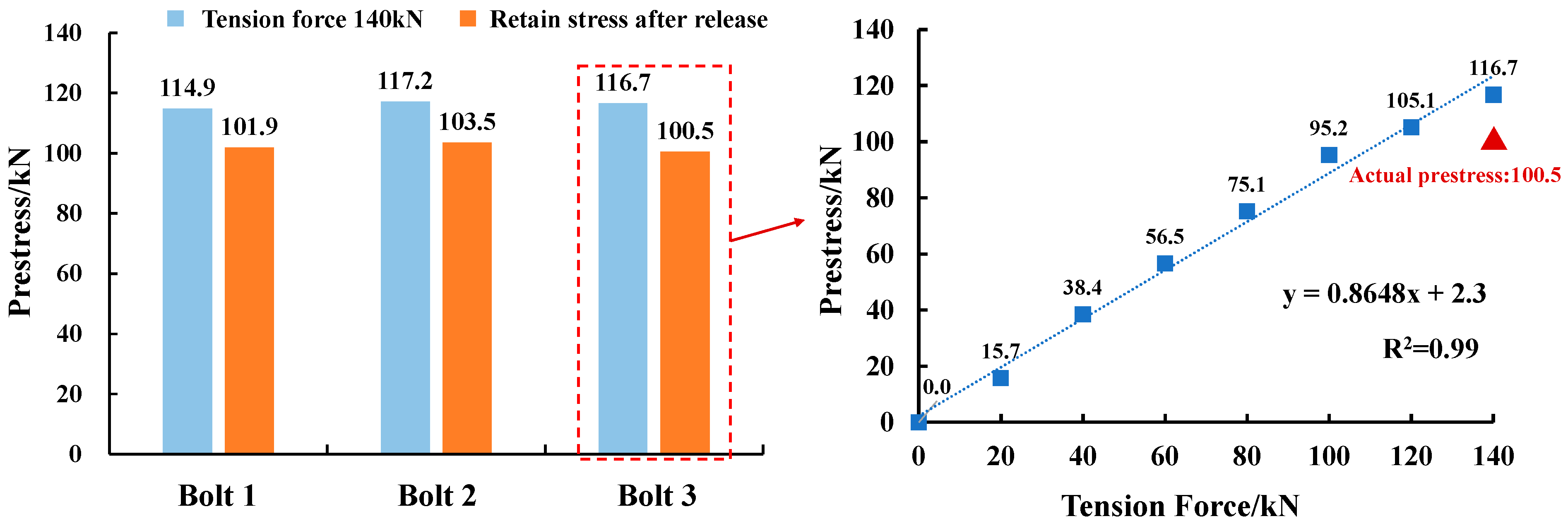
3.3. Tension–Prestress Conversion Test
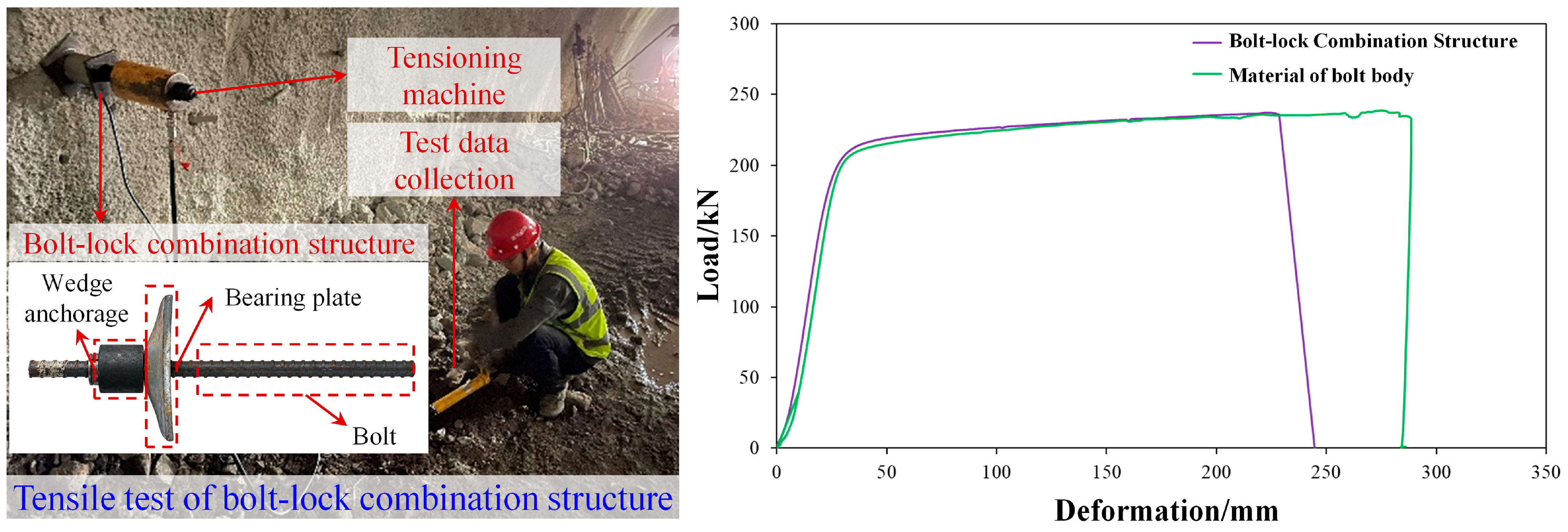
3.4. Tensile Test of Bolt–Wedge Anchorage Combination Structure
3.5. Summary
- Using the torque method, the bolt can apply a maximum prestress of 57 kN, after which the threads fail, preventing further prestress application. The threads of the bolt are the weak point of the entire structure, limiting the load-bearing capacity of the bolt.
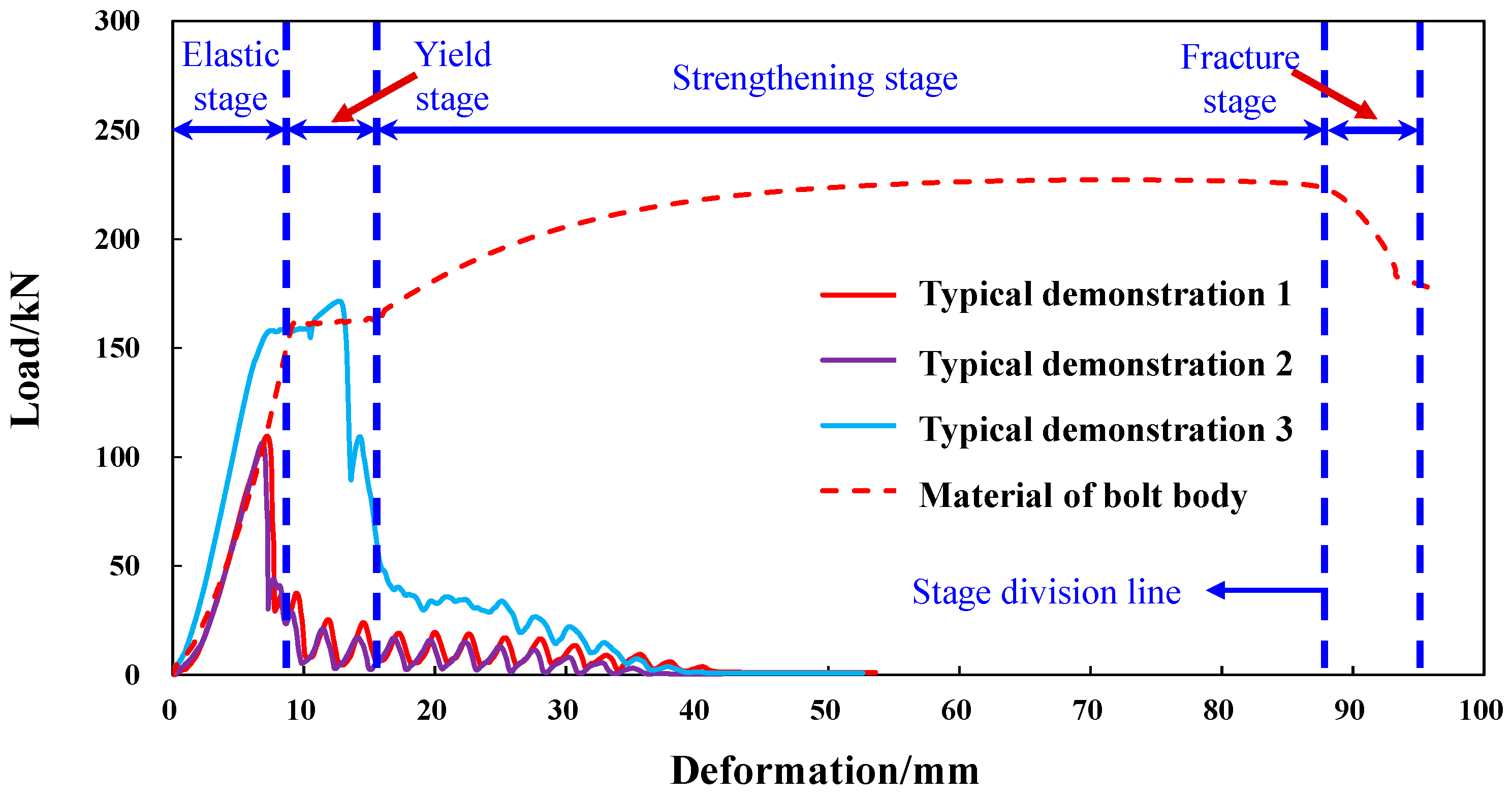
- When applying prestress to the bolt–wedge anchorage combination structure using the tension method, it can stably apply prestress exceeding 100 kN without affecting the load-bearing capacity of the bolt. After tensioning and unloading, the bolt will experience a loss of prestress within 15%, with a minor impact on the effectiveness of prestress application.
- The uncertainty of this research mainly comes from individual differences in bolts, thread contact friction, loading operations, and testing errors. Comparing the prestressing effects of the torque method and the tensioning method, the tensioning method can apply higher prestress. The locking device structure has minimal impact on the load-bearing capacity of the bolt, enabling the full utilization of the bolt’s load-bearing performance. This satisfies the demand for high-prestressed active support in on-site engineering.
4. Active Support Field Test
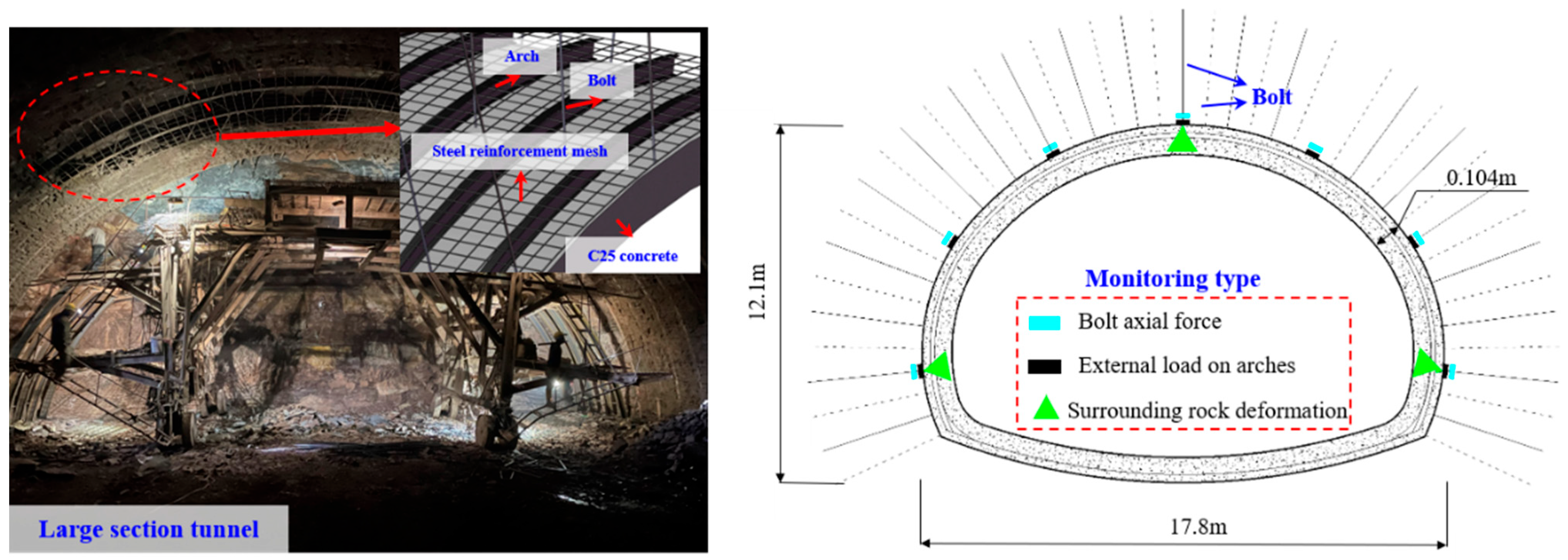
4.1. Prestressing Support Scheme
4.2. Analysis of Monitoring Results
4.2.1. Analysis of Support Forces
- Analysis of bolt axial force
- 2.
- Analysis of arch external load
4.2.2. Analysis of Surrounding Rock Deformation
4.3. Summary
- (1)
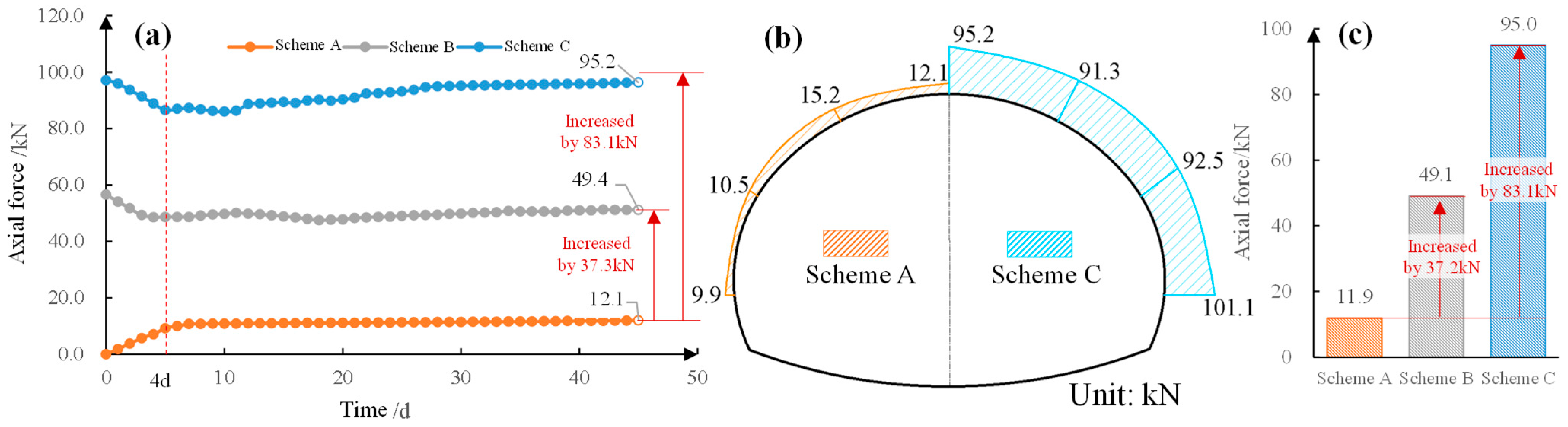
- In terms of the stress on the arch bolt, the application of prestress significantly improves the strength utilization rate of the bolt support, which can increase the strength utilization rate of the bolt by 35.29%, thereby improving the overall load-bearing performance of the support system.
- (2)
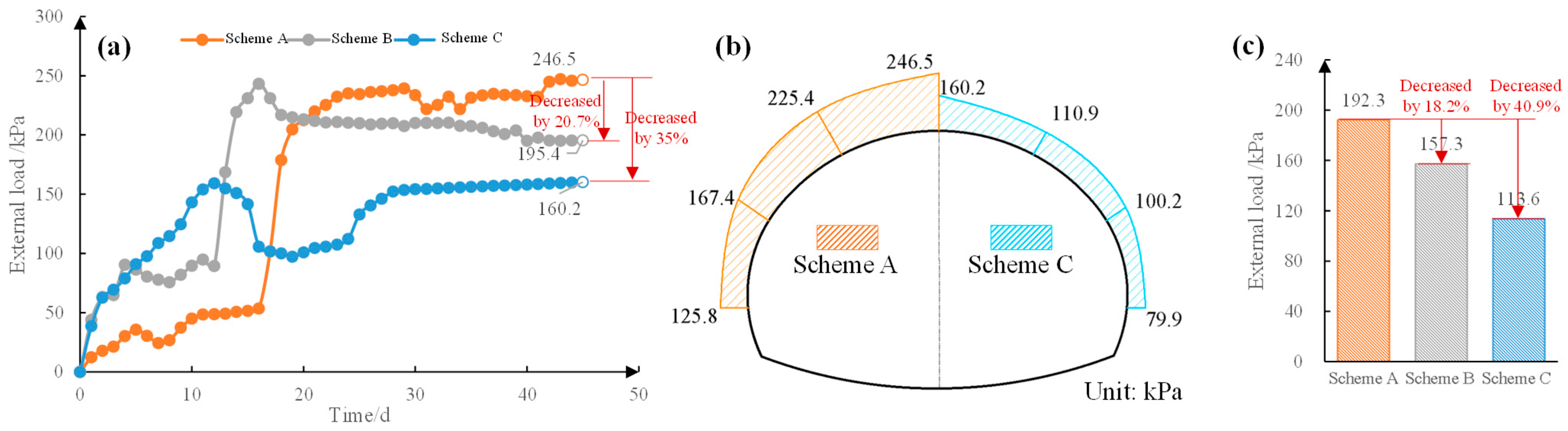
- In terms of the stress on the arch crown, the higher the applied prestress, the more effective the self-bearing capacity of the surrounding rock. The external load on the arch is reduced by 40.9%. During the secondary excavation of the step method, the influence of external load on the stress redistribution of the arch will be reduced.
- (3)
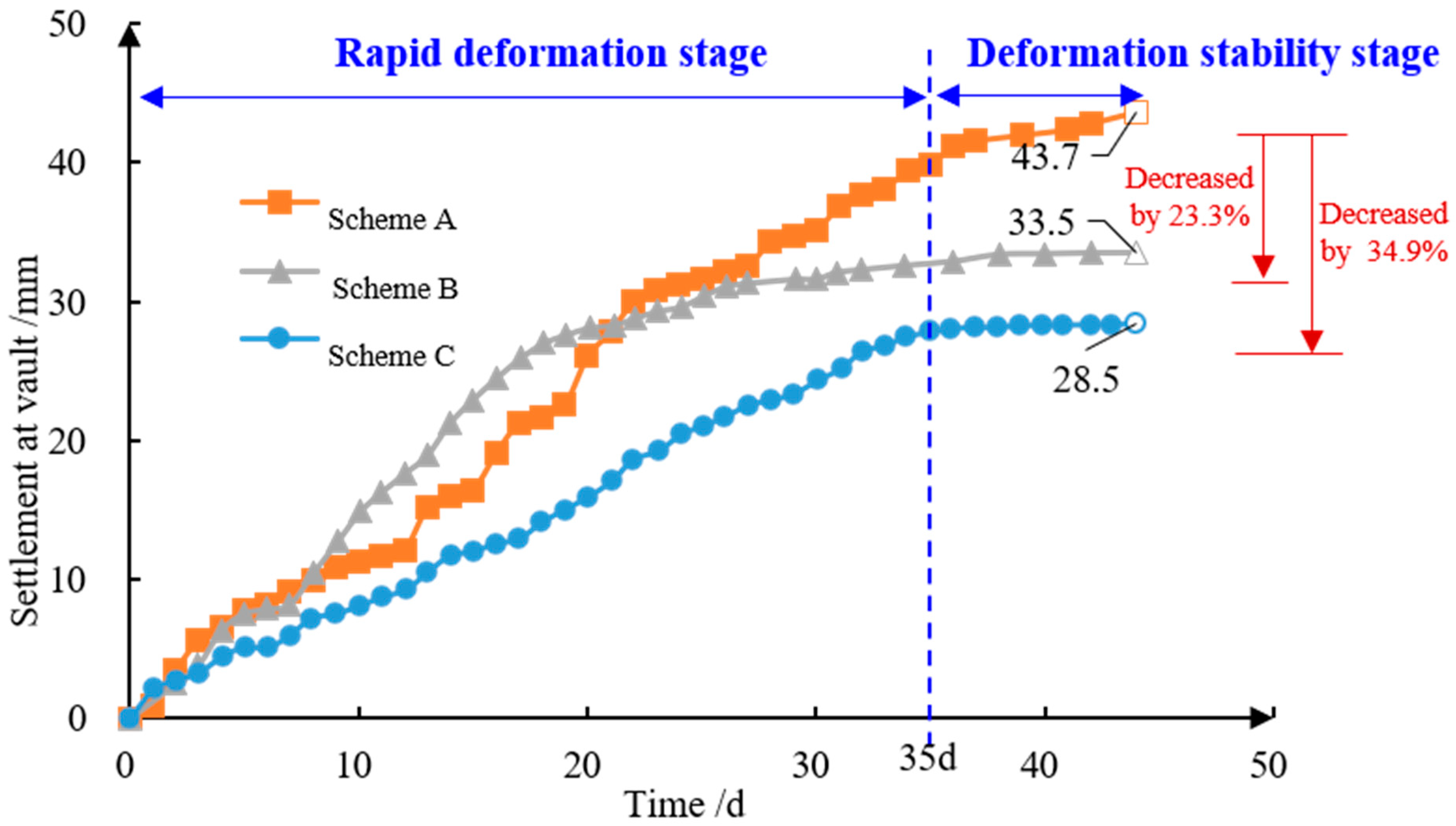
- In terms of the deformation of surrounding rock, on-site monitoring results show that the higher the prestress applied to the bolt, the better the control effect of the surrounding rock deformation in the support system, and the arch crown settlement is reduced by 34.9%, verifying the control effect of prestressed support.
4.4. Discussion
- (1)
- Through a numerical simulation analysis of the deformation, plastic zone evolution, and stress changes of surrounding rock under different prestressing conditions, a prestressing range that meets the active support requirements of large-section tunnel surrounding rock was determined, providing a basis for the design of high-prestressed bolt support parameters.
- (2)
- Through prestress application and conversion tests, the stress and deformation characteristics of the bolt–wedge anchorage structure under high-prestress conditions were clarified, and it was verified that the structure can achieve stable application and maintenance of high prestress. It was also proved that the use of the tension method and a bolt–wedge anchorage structure can meet the requirements of high-prestress application in tunnel engineering sites.
- (3)
- Conducting active support tests on large-section tunnels, the axial force of bolts, support stress, and the deformation evolution of surrounding rock under the combined action of high-prestressed bolt active support and passive support, such as steel arches, were revealed. This indicates that active and passive support can exert the self-bearing capacity of surrounding rock through collaborative regulation, improve the overall stability of the support system, and provide an on-site basis for the design and construction parameter optimization of large-section tunnel support.
5. Conclusions
- Numerical experiments were conducted on large-section tunnels under different prestressing conditions to clarify the influence mechanism of prestressing on surrounding rock stress, plastic zone distribution, and surrounding rock deformation. As the prestress increases from 0 kN to 100 kN, the maximum vertical compressive stress of the surrounding rock decreases by 0.25 MPa, the plastic zone area decreases by 85.1 m2, and the maximum deformation decreases by 59.33%. This indicates that high-prestressed anchor rods can effectively reduce the vertical stress and plastic zone area of surrounding rock, greatly improving the deformation control effect of surrounding rock.
- Two types of pretensioning methods, torque and tension, were tested for prestressing conversion efficiency. The prestress conversion efficiency applied by the torque method was 10.6 N·m/kN, and the maximum prestress applied was within 57 kN. The prestress applied by the tensioning method can reach 103.5 kN. Compared with the prestress applied by the torque wrench, the prestress applied by the tensioning method is higher, which can effectively utilize the bearing performance of the anchor bolt and better meet the requirements of actual engineering prestress application.
- Active support field tests were conducted using different prestress methods, revealing the control mechanism of prestress on the stress and deformation of the support structure and surrounding rock. The results show that compared with the no-prestress anchor bolt support scheme, applying high prestress can improve the utilization rate of anchor bolt strength by 35.29%, reduce the external load on the arch by 40.9%, and reduce the settlement of the arch crown by 34.9%. High prestress can fully utilize the mechanical properties of anchor bolts, improve the safety reserve of passive support, control the stability of surrounding rock, and provide reference for the safety support design of large-section tunnels under complex conditions.
- Based on the above research, it is concluded that high prestress can effectively improve the stability of tunnel surrounding rock. At the same time, the use of the tensioning method and a bolt–wedge anchorage combination structure can stably apply a prestress of more than 100 kN, meeting the active support requirements of high prestress for large-section tunnels. Therefore, in large-section tunnels with weak surrounding rock, large excavation spans, and difficulty in controlling surrounding rock deformation, it is recommended to use the tension method and a bolt–wedge anchorage combination structure to apply high prestress, which can fully exert the active support effect of anchor bolts and reduce the influence of surrounding rock load on passive support components, such as arches. This provides methods and technical support for optimizing the design of surrounding-rock active and passive support, ensuring the safe control of surrounding rock, and reducing construction costs.
Author Contributions
Funding
Institutional Review Board Statement
Informed Consent Statement
Data Availability Statement
Conflicts of Interest
References
- He, M.C.; Wang, Q. Excavation compensation method and key technology for surrounding rock control. Eng. Geol. 2022, 307, 106784. [Google Scholar] [CrossRef] [Scilit]
- Qu, C.Q.; Xue, Y.G.; Qiu, D.H.; Zhang, G.D.; Liu, H.T. Research on General Model of Railway Route Selection in CSM Areas Using the Sichuan–Tibet Railway and Other Typical Mountain Railways as Case Studies. J. Transp. Eng. Part A Syst. 2023, 149, 04023054. [Google Scholar] [CrossRef] [Scilit]
- Tian, X.X.; Song, Z.P.; Wang, H.Z.; Zhang, Y.W.; Wang, J.B. Evolution characteristics of the surrounding rock pressure and construction techniques: A case study from Taoshuping tunnel. Tunn. Undergr. Space Technol. 2022, 125, 104522. [Google Scholar] [CrossRef] [Scilit]
- Wang, Q.; Xin, Z.X.; Jiang, B.; Zhang, H.B.; Xiao, Y.C.; Bian, W.H.; Li, L.N. Comparative experimental study on mechanical mechanism of combined arches in large section tunnels. Tunn. Undergr. Space Technol. 2020, 99, 103386. [Google Scholar] [CrossRef] [Scilit]
- Yu, X.Z.; Mou, R.F. System modeling and risk analysis of the Sichuan–Tibet Railway project. J. Transp. Eng. Part A Syst. 2021, 147, 04021094. [Google Scholar] [CrossRef] [Scilit]
- Jiang, B.; Xin, Z.X.; Zhang, X.F.; Deng, Y.S.; Wang, M.Z.; Li, S.D.; Ren, W.T. Mechanical properties and influence mechanism of confined concrete arches in high-stress tunnels. Int. J. Min. Sci. Technol. 2023, 33, 829–841. [Google Scholar] [CrossRef] [Scilit]
- Zhang, D.L.; Sun, Z.Y.; Fang, Q. Scientific problems and research proposals for Sichuan–Tibet railway tunnel construction. Undergr. Space 2022, 7, 419–439. [Google Scholar] [CrossRef] [Scilit]
- Huang, Y.B.; Wang, Q.; Gao, H.K.; Jiang, Z.H.; Li, K.; Chen, K. Failure mechanism and construction process optimization of deep soft rock chamber group. J. China Univ. Min. Technol. 2021, 50, 69–78. [Google Scholar] [CrossRef]
- Zhang, D.L.; Xu, T.; Fang, H.C. Analytical modeling of complex contact behavior between rock mass and lining structure. J. Rock Mech. Geotech. Eng. 2022, 14, 813–824. [Google Scholar] [CrossRef] [Scilit]
- Jiang, K.; Liu, Z.; Wang, Y.; Tian, Y.; Zhang, C.; Zhang, T. Effects of different friction coefficients on input torque distribution in the bolt tightening process based on the energy method. J. Tribol. 2022, 144, 071203. [Google Scholar] [CrossRef] [Scilit]
- Sun, Z.Y.; Zhang, D.L.; Fang, Q.; Huangfu, N.Q.; Chu, Z.F. Convergence-confinement analysis for tunnels with combined bolt–cable system considering the effects of intermediate principal stress. Acta Geotech. 2023, 18, 3323–3348. [Google Scholar] [CrossRef] [Scilit]
- Lu, W.; Meng, L.X.; Li, S.C.; Xu, Y.D.; Wang, L.; Zhang, P.; Dou, S.T.; Sun, H.B. Study on progressive failure behavior and mechanical properties of tunnel arch support structures. Tunn. Undergr. Space Technol. 2023, 140, 105285. [Google Scholar] [CrossRef] [Scilit]
- Li, L.P.; Shang, C.S.; Chu, K.W.; Zhou, Z.Q.; Song, S.G.; Liu, Z.H.; Chen, Y.H. Large-scale geo-mechanical model tests for stability assessment of super-large cross-section tunnel. Tunn. Undergr. Space Technol. 2021, 109, 103756. [Google Scholar] [CrossRef] [Scilit]
- Li, G.; Hu, Y.; Tian, S.M. Analysis of deformation control mechanism of prestressed anchor on jointed soft rock in large cross-section tunnel. Bull. Eng. Geol. Environ. 2021, 80, 9089–9103. [Google Scholar] [CrossRef] [Scilit]
- Wang, Q.; Wu, W.R.; Wang, Y.T.; He, M.C.; Xue, H.J.; Wei, H.Y. Evolution and control mechanism of rockburst in rock anchored by new energy-absorbing material. Rock Mech. Rock Eng. 2023, 56, 4569–4582. [Google Scholar] [CrossRef] [Scilit]
- Yuan, H.; Shan, R.; Su, X. Deformation characteristics and stability control of a gateroad in fully mechanized mining with large mining height. Arab. J. Geosci. 2018, 11, 767. [Google Scholar] [CrossRef] [Scilit]
- Li, A.; Dai, F.; Wu, W.; Liu, Y.; Liu, K.; Wang, K. Deformation characteristics of sidewall and anchorage mechanisms of prestressed cables in layered rock strata dipping steeply into the inner space of underground powerhouse cavern. Int. J. Rock Mech. Min. Sci. 2022, 159, 105234. [Google Scholar] [CrossRef] [Scilit]
- Wang, Q.; Xu, S.; Xin, Z.X.; He, M.C.; Wei, H.Y.; Jiang, B. Mechanical properties and field application of constant resistance energy-absorbing anchor cable. Tunn. Undergr. Space Technol. 2022, 125, 104526. [Google Scholar] [CrossRef] [Scilit]
- He, M.C.; Wang, Q.; Wu, Q. Innovation and future of mining rock mechanics. J. Rock Mech. Geotech. Eng. 2021, 13, 1–21. [Google Scholar] [CrossRef] [Scilit]
- Cao, J.; Zhang, N.; Wang, S.; Qian, D.; Xie, Z. Physical model test study on support of super pre-stressed anchor in the mining engineering. Eng. Fail. Anal. 2020, 118, 104833. [Google Scholar] [CrossRef] [Scilit]
- Jiang, B.; Ma, F.L.; Wang, Q.; Gao, H.K.; Zhai, D.H.; Deng, Y.S.; Xu, C.J.; Yao, L.D. Drilling-based measuring method for the c-φ parameter of rock and its field application. Int. J. Min. Sci. Technol. 2024, 34, 65–76. [Google Scholar] [CrossRef] [Scilit]
- Lv, C.; Liu, A.; Liu, D.; Zhang, F.; Yang, W. Study on the load conversion of bolt-nut fasteners between tightening and service conditions. Exp. Tech. 2021, 45, 721–734. [Google Scholar] [CrossRef] [Scilit]
- Meng, X.Z. Laboratory studies of the mechanical properties of bolt thread connection. Adv. Mater. Res. 2013, 724–725, 1740–1744. [Google Scholar] [CrossRef] [Scilit]
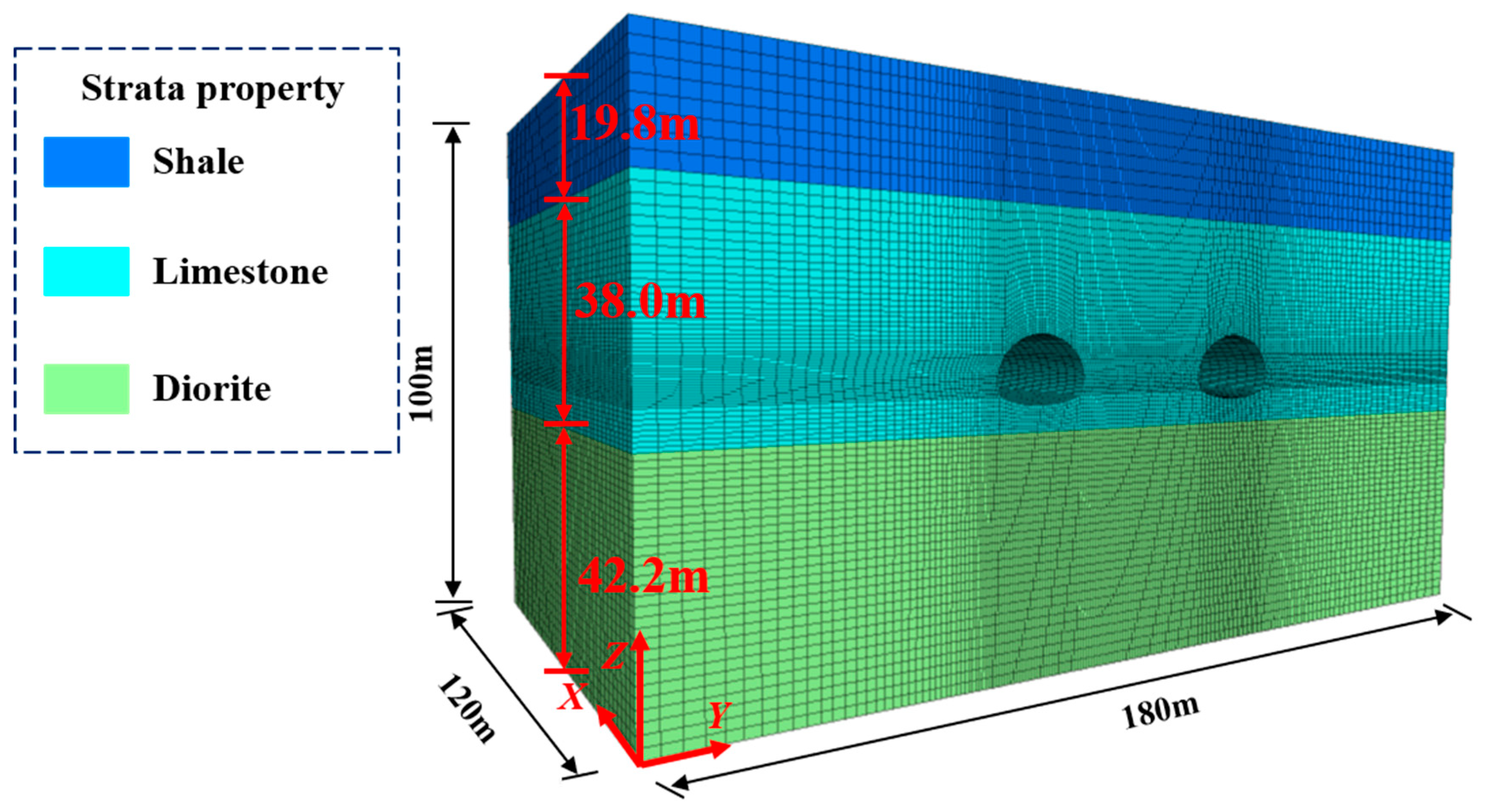





| Rock Layer | Shear Modulus /(GPa) | Poisson’s Ratio | Cohesion /(MPa) | Friction Angle /(°) | Density /(kg/m3) |
|---|---|---|---|---|---|
| Shale | 3.8 | 0.31 | 2.1 | 14.4 | 2610 |
| Limestone | 3.3 | 0.32 | 1.7 | 42.0 | 2090 |
| Diorite | 2.2 | 0.29 | 1.2 | 50.0 | 2740 |
| Bolt Elastic Modulus/GPa | Cross-Sectional Area of Bolt/mm2 | Tensile Load of Bolt/kN·m−1 | Anchor Agent Cohesive Force/kN·m−1 | Anchor Agent Internal Friction Angle/° | Anchor Agent Shear Stiffness/MPa | Anchor Agent Outer Circumference/mm |
|---|---|---|---|---|---|---|
| 200 | 379.9 | 235.5 | 100 | 32 | 100 | 125.6 |
| Study Content | Experimental Scheme | Variables |
|---|---|---|
| Different prestress forces | A1 | 0 kN |
| A2 | 25 kN | |
| A3 | 50 kN | |
| A4 | 75 kN | |
| A5 | 100 kN |
| Number | Torque (N·m) | Prestress (kN) | ||
|---|---|---|---|---|
| Bolt 1 | Bolt 2 | Bolt 3 | ||
| 1 | 0 | 0 | 0 | 0 |
| 2 | 100 | 18 | 25 | 27 |
| 3 | 140 | 23 | 28 | 32 |
| 4 | 180 | 24 | 32 | 34 |
| 5 | 220 | 27 | 38 | 43 |
| 6 | 260 | 30 | 42 | 46 |
| 7 | 300 | 35 | 45 | 46 |
| 8 | 340 | 38 | 47 | 48 |
| 9 | 380 | 42 | 47 | 48 |
| 10 | 420 | 47 | 49 | 50 |
| 11 | 460 | 47 | 54 | 55 |
| 12 | 500 | 50 | 56 | 55 |
| 13 | 540 | 53 | 56 | 57 |
| 14 | 580 | Failure | Failure | Failure |
Disclaimer/Publisher’s Note: The statements, opinions and data contained in all publications are solely those of the individual author(s) and contributor(s) and not of MDPI and/or the editor(s). MDPI and/or the editor(s) disclaim responsibility for any injury to people or property resulting from any ideas, methods, instructions or products referred to in the content. |
© 2026 by the authors. Licensee MDPI, Basel, Switzerland. This article is an open access article distributed under the terms and conditions of the Creative Commons Attribution (CC BY) license.
Share and Cite
Wang, M.; Gao, H.; Guo, G.; Bian, Z.; Xu, C.; Yang, Z.; Man, X. The Effect of and Case Research on High-Prestressed Active Support in Large-Section Tunnels. Eng 2026, 7, 486. https://doi.org/10.3390/eng7090486
Wang M, Gao H, Guo G, Bian Z, Xu C, Yang Z, Man X. The Effect of and Case Research on High-Prestressed Active Support in Large-Section Tunnels. Eng. 2026; 7(9):486. https://doi.org/10.3390/eng7090486
Chicago/Turabian StyleWang, Mingfa, Hongke Gao, Guangming Guo, Zhenguo Bian, Changjing Xu, Zixiong Yang, and Xinjie Man. 2026. "The Effect of and Case Research on High-Prestressed Active Support in Large-Section Tunnels" Eng 7, no. 9: 486. https://doi.org/10.3390/eng7090486
APA StyleWang, M., Gao, H., Guo, G., Bian, Z., Xu, C., Yang, Z., & Man, X. (2026). The Effect of and Case Research on High-Prestressed Active Support in Large-Section Tunnels. Eng, 7(9), 486. https://doi.org/10.3390/eng7090486