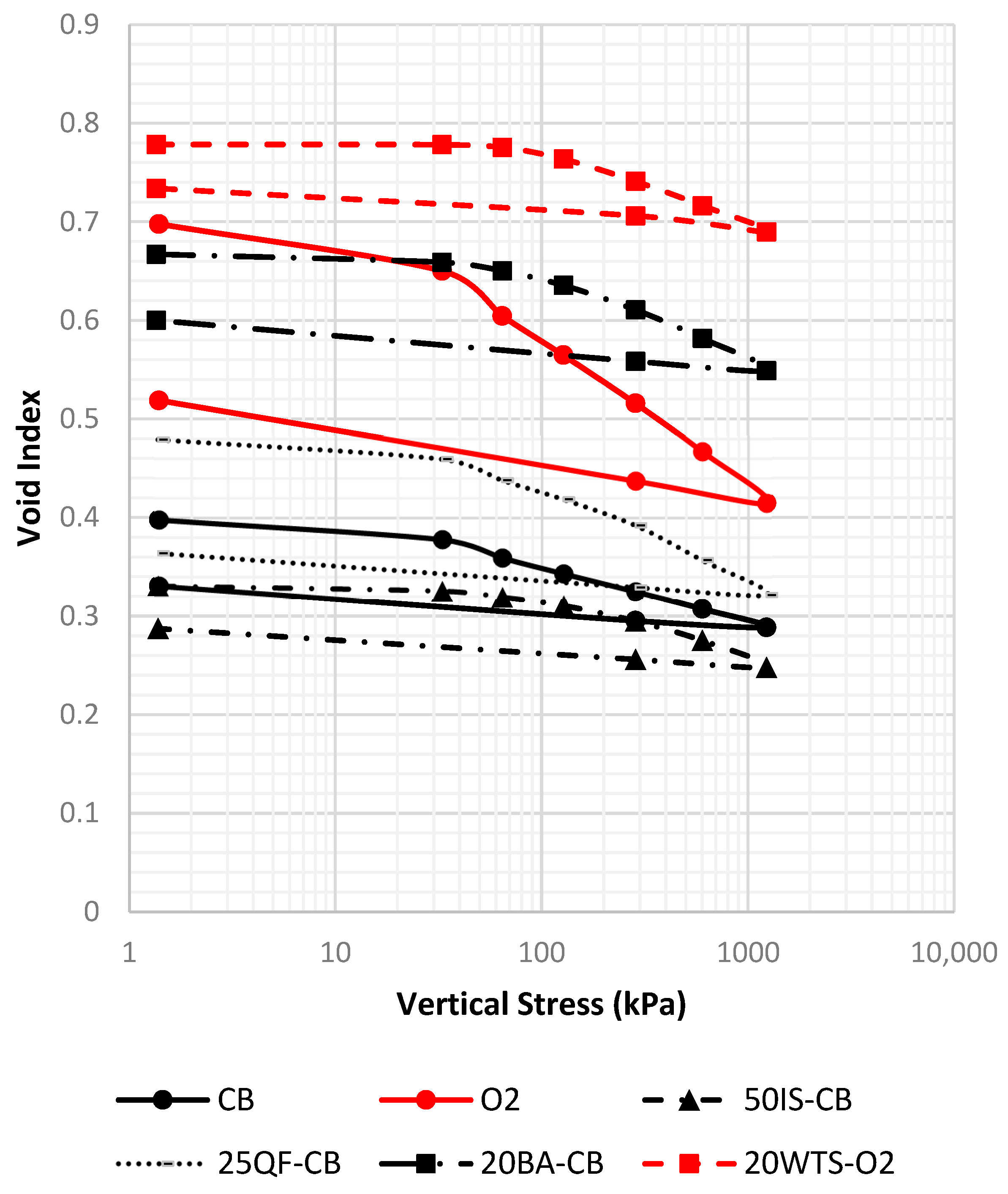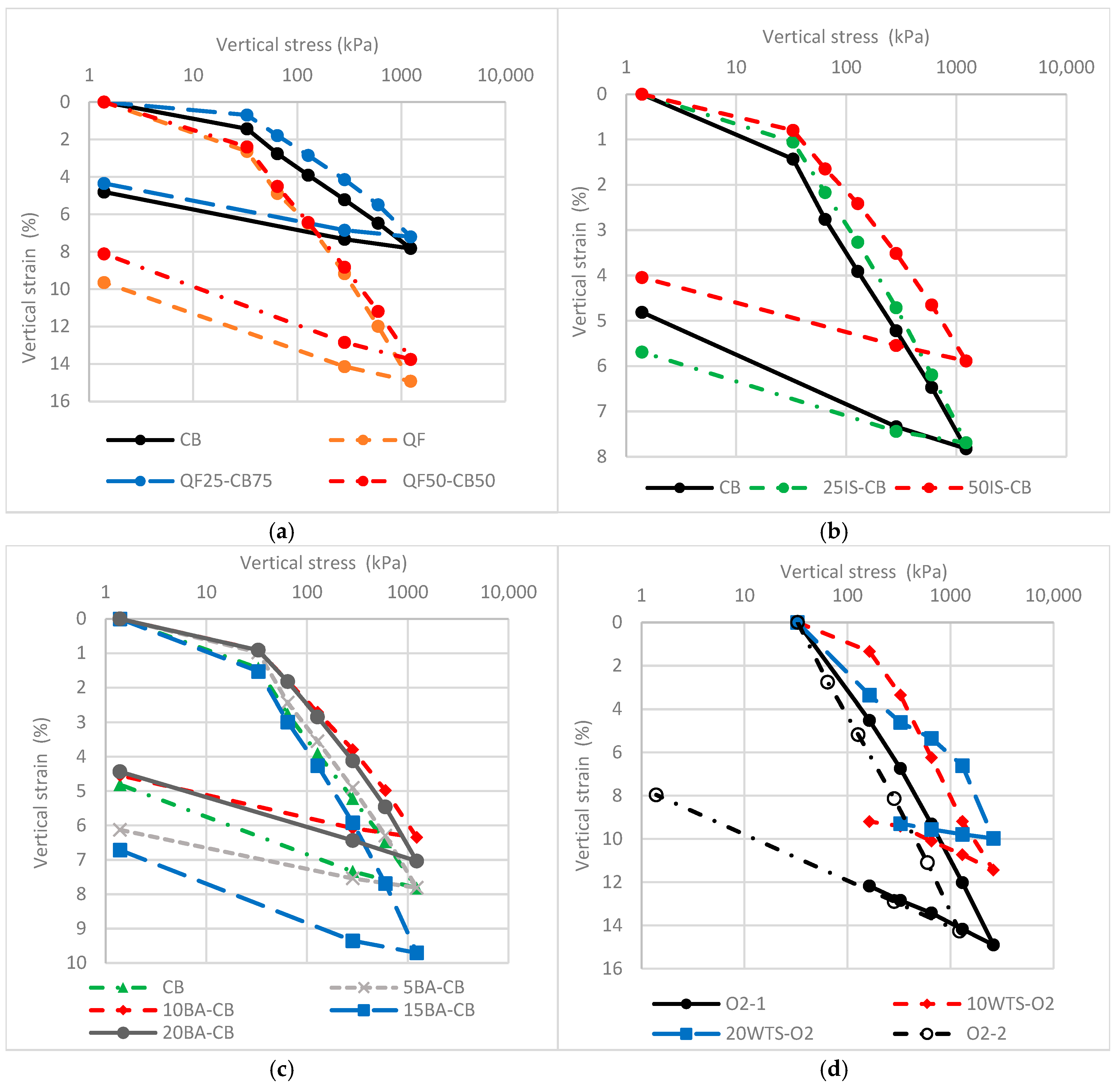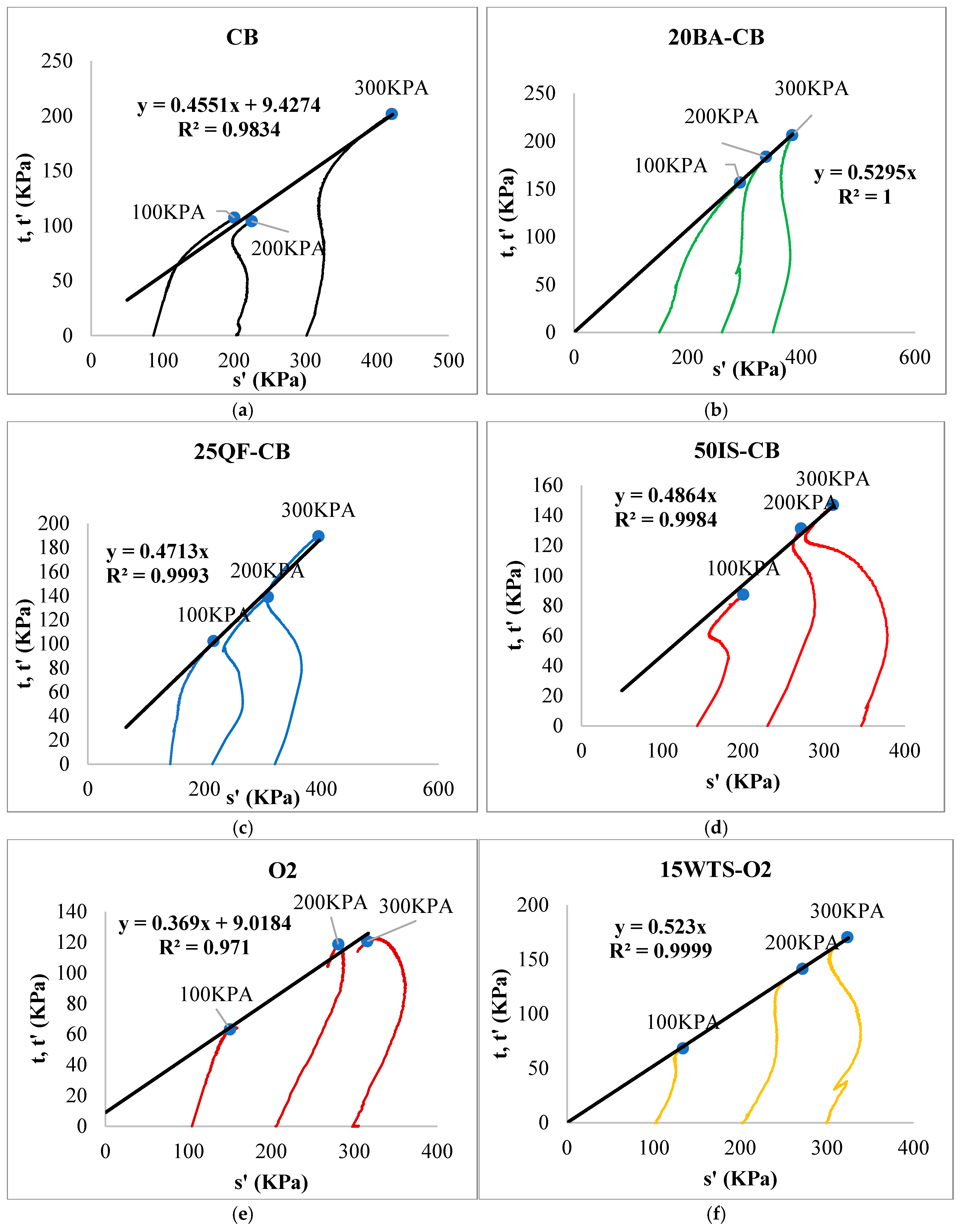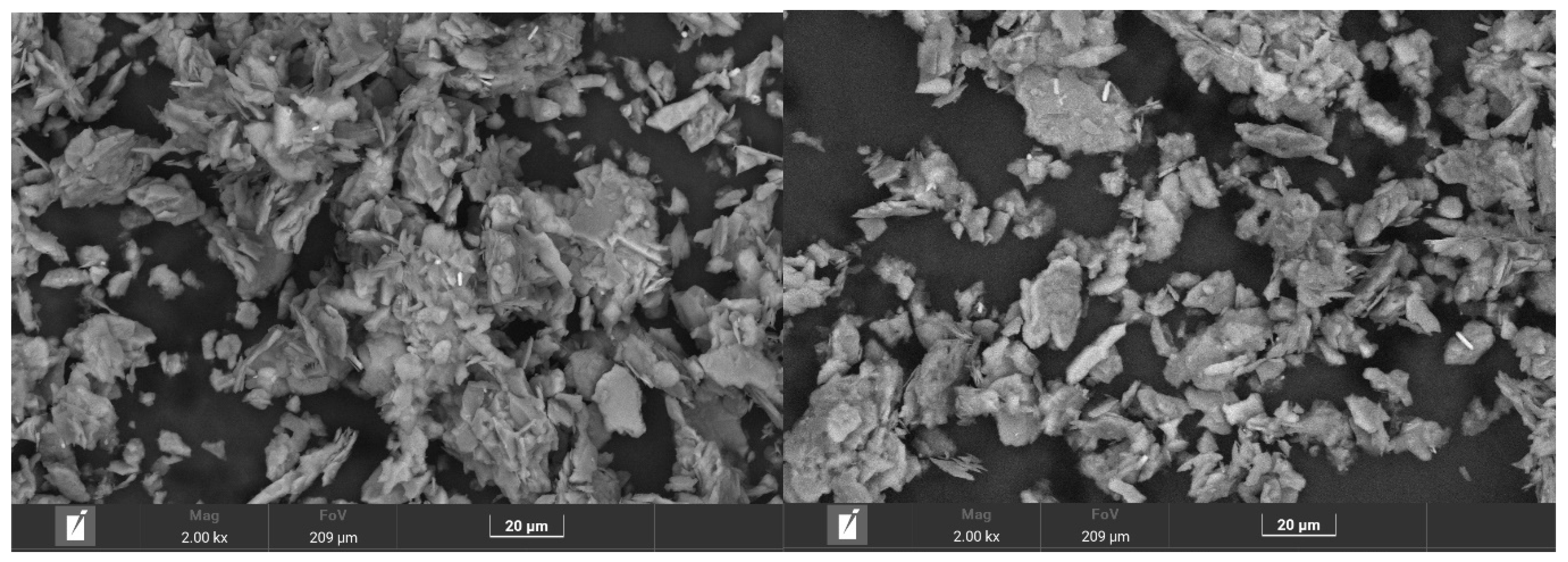

Sustainable Use of Industrial Wastes for Soil Stabilization




Abstract
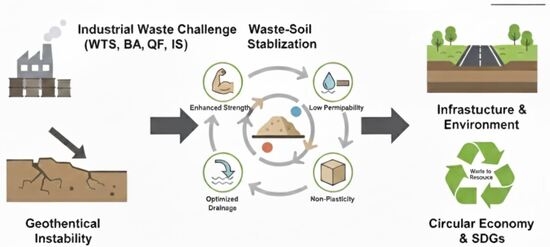
1. Introduction
2. Materials and Methods
- SS: specific surface (cm2/kg)
- Vi: relative volume by particle size class di (cm2)
- Gs: density of the material (kg/cm3).
- D50: mean diameter of particle distribution (mm).
3. Results and Discussion
3.1. Identification and Physical Characteristics
3.2. Permeability Analysis
3.3. Mechanical Analysis
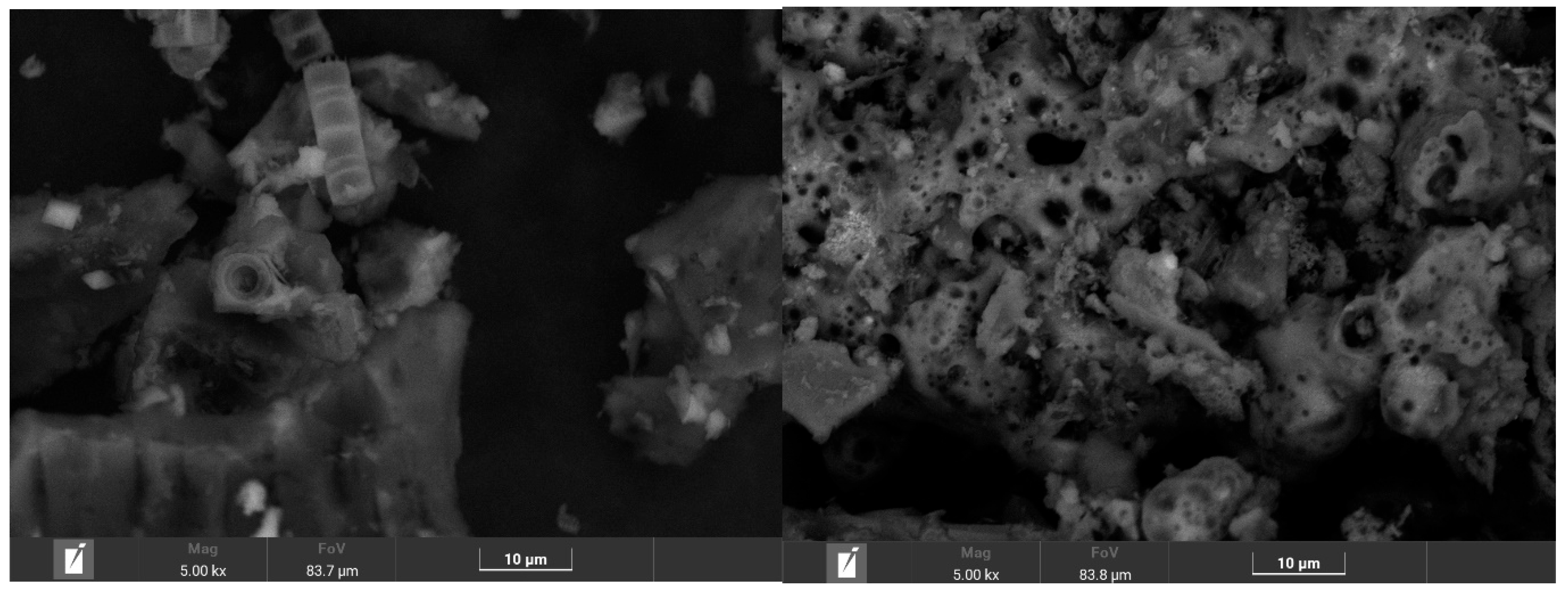
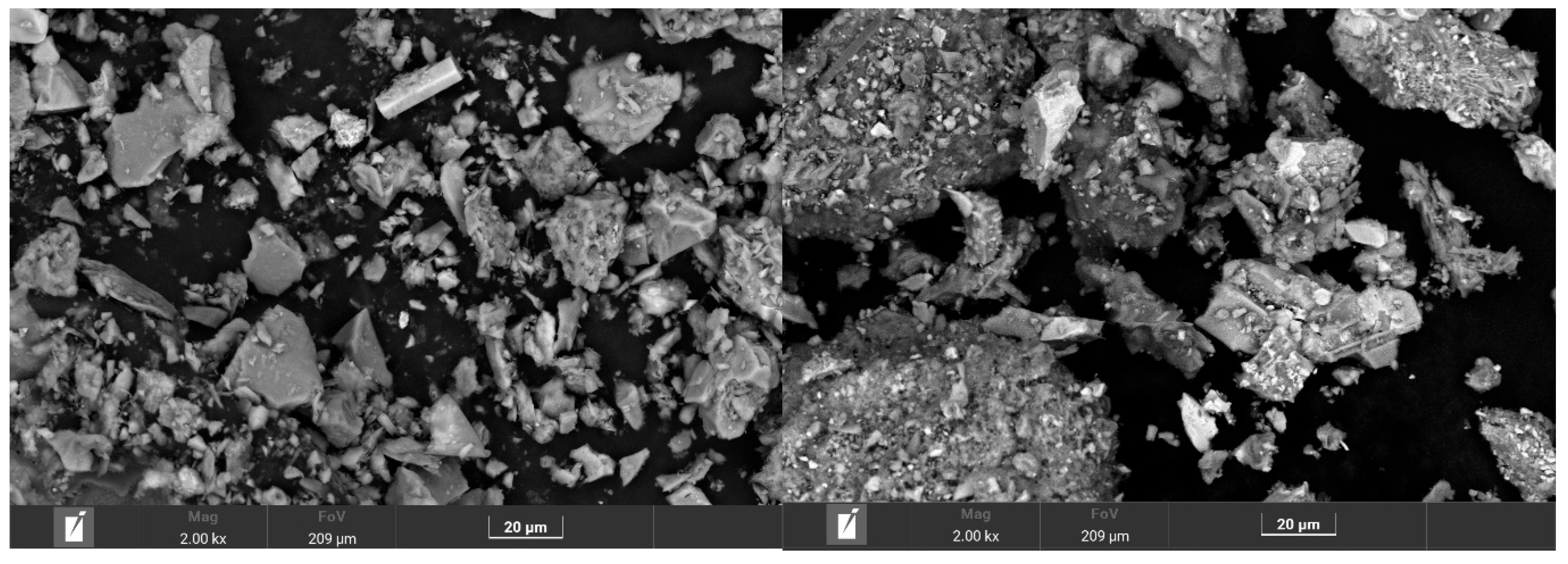
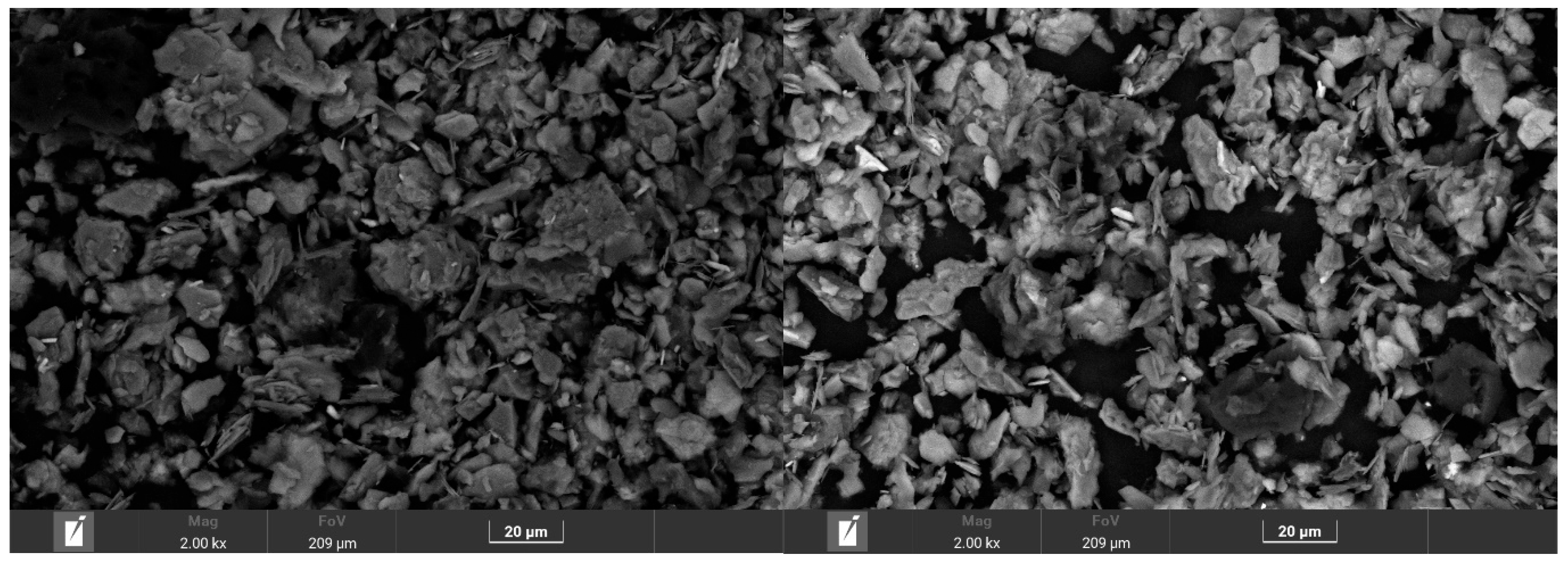
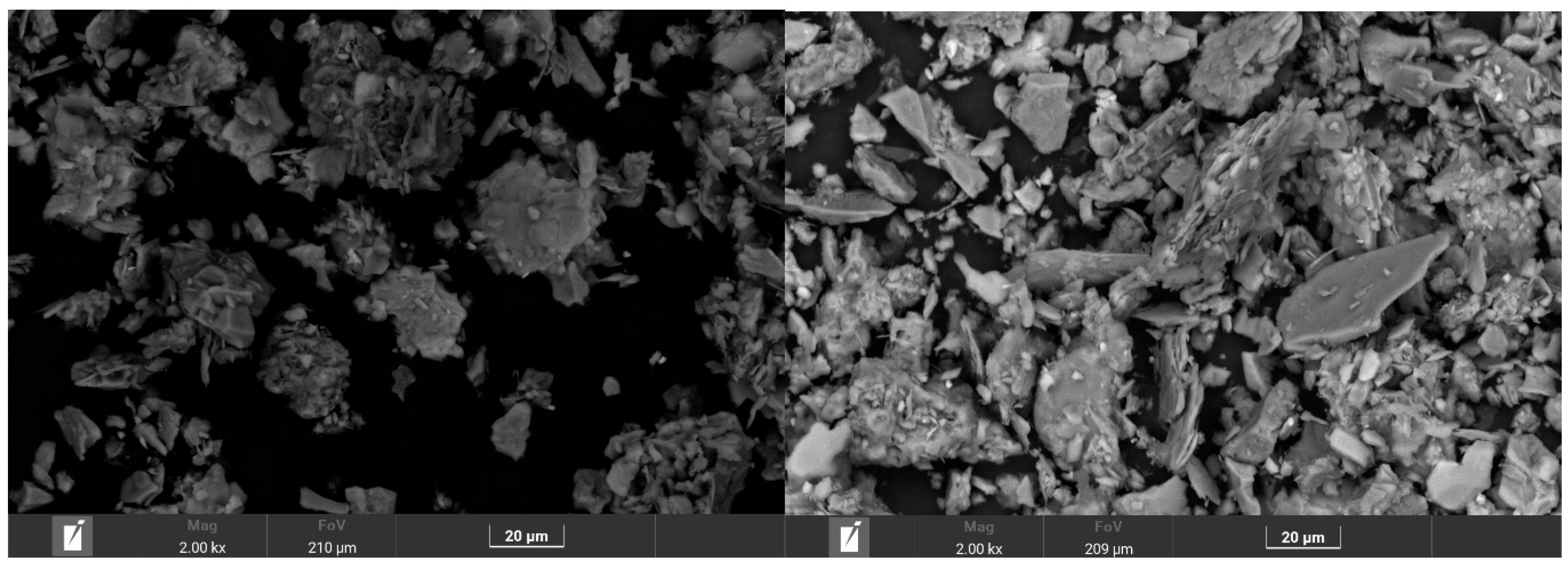
3.4. Microscopy Images Analysis
4. Conclusions
Author Contributions
Funding
Institutional Review Board Statement
Informed Consent Statement
Data Availability Statement
Acknowledgments
Conflicts of Interest
References
- Sato, T.; Qadir, M.; Yamamoto, S.; Endo, T.; Zahoor, A. Global, regional, and country level need for data on wastewater generation, treatment, and use. Agric. Water Manag. 2013, 130, 1–13. [Google Scholar] [CrossRef]
- Yeheyis, M.; Hewage, K.; Alam, M.S.; Eskicioglu, C.; Sadiq, R. An overview of construction and demolition waste management in Canada: A lifecycle analysis approach to sustainability. Clean Technol. Environ. Policy 2013, 15, 81–91. [Google Scholar] [CrossRef]
- Benachio, G.; Freitas, M.; Tavares, S. Circular economy in the construction industry: A systematic literature review. J. Clean. Prod. 2020, 260, 121046. [Google Scholar] [CrossRef]
- Polańska, B.; Rainer, J. Rigid inclusion ground improvements as an alternative to pile foundation. IOP Conf. Ser. Mater. Sci. Eng. 2020, 869, 052080. [Google Scholar] [CrossRef]
- Scalize, P.; Albuquerque, A.; Di Bernardo, L. Impact of Alum Water Treatment Residues on the Methanogenic Activity in the Digestion of Primary Domestic Wastewater Sludge. Sustainability 2021, 13, 8783. [Google Scholar] [CrossRef]
- Marchiori, L.; Studart, A.; Albuquerque, A.; Pais, L.A.; Boscov, M.E.; Cavaleiro, V. Mechanical and Chemical Behaviour of Water Treatment Sludge and Soft Soil Mixtures for Liner Production. Open Civ. Eng. J. 2022, 16, e187414952211101. [Google Scholar] [CrossRef]
- Scalize, P.; Souza, L.; Albuquerque, A. Reuse of alum sludge for reducing flocculant addition in water treatment plants. Environ. Prot. Eng. 2019, 45, 57–70. [Google Scholar] [CrossRef]
- Montalvan, E. Geotechnical Properties of Mixtures of Water Treatment Sludge and Residual Lateritic Soils from the State of São Paulo. Ph.D. Thesis, University of São Paulo, São Paulo, Brazil, 2020. Available online: https://www.teses.usp.br/teses/disponiveis/3/3145/tde-08032021-094316/publico/EdyLeninTejedaMontalvanCorr21.pdf (accessed on 25 July 2025).
- Roque, A.; Carvalho, M. Possibility of using the drinking water sludge as geotechnical material. In Proceedings of the 5th ICEG Environmental Geotechnics, Cardiff, UK, 26–30 June 2006; pp. 1535–1542. [Google Scholar]
- Shah, S.; Mahmood, Z.; Nisar, A.; Aamir, M.; Farid, A.; Waseem, M. Compaction performance analysis of alum sludge waste modified soil. Constr. Build. Mater. 2020, 230, 116953. [Google Scholar] [CrossRef]
- Vassilev, S.; Baxter, D.; Andersen, L.; Vassilev, C. An overview of the chemical composition of biomass. Fuel 2010, 89, 913–933. [Google Scholar] [CrossRef]
- Loo, S.; Koppejan, J. The Handbook of Biomass Combustion and Co-Firing. Earthscan; Routledge: London, UK, 2008. [Google Scholar]
- Studart, A.; Marchiori, L.; Vitoria, M.; Albuquerque, A.; Almeida, P.; Cavaleiro, V. Chemical and Mineralogical Characterization of Biomass Ashes for Soil Reinforcement and Liner Material. KnE Mater. Sci. 2022, 212–218. [Google Scholar] [CrossRef]
- Studart, A.; Marchiori, L.; Albuquerque, A.; Cavaleiro, V.; Pais, L.; Boscov, M.; Strozberg, I. Residue’s physical identification for soil-waste materials. In Proceedings of the XVIII European Conference on Soil Mechanics and Geotechnical Engineering (XVIII ECSMGE 2024), Lisbon, Portugal, 26–30 August 2024; ISBN 978-1-032-54816-6. 6p. [Google Scholar] [CrossRef]
- Amadi, A.; Eberemu, A.; Osinubi, K. Strength Consideration in the Use of Lateritic Soil Stabilized with Fly Ash As Liners and Covers in Waste Landfills. In Proceedings of the GeoCongress 2012, Oakland, CA, USA, 25–29 March 2012; ASCE. pp. 3835–3844. [Google Scholar] [CrossRef]
- Marchiori, L.; Studart, A.; Morais, M.; Alburquerque, A.; Cavaleiro, V. Geotechnical characterization of vegetal biomass ashes based materials for liner production. In RILEM Bookseries, Proceedings of the 3rd Conference on Testing and Experimentation in Civil Engineering (TEST&E 2022), Caparica, Portugal, 21–23 June 2022; Springer: Cham, Switzerland, 2022; Volume 41, pp. 67–82. ISBN 978-3-031-29191-3. [Google Scholar] [CrossRef]
- Almeida, J.; Ribeiro, A.; Silva, A.; Faria, P. Overview of mining residues incorporation in construction materials and barriers for full-scale application. J. Build. Eng. 2020, 29, 101215. [Google Scholar] [CrossRef]
- Starý, J.; Jirásek, J.; Pticen, F.; Zahradník, J.; Sivek, M. Review of production, reserves, and processing of clays (including bentonite) in the Czech Republic. Appl. Clay Sci. 2021, 205, 106049. [Google Scholar] [CrossRef]
- Amrani, M.; Taha, Y.; Kchikach, A.; Benzaazoua, M.; Hakkou, R. Valorization of Phosphate Mine Waste Rocks as Materials for Road Construction. Minerals 2019, 9, 237. [Google Scholar] [CrossRef]
- Hu, L.; Wu, H.; Zhang, L.; Zhang, P.; Wen, Q. Geotechnical Properties of Mine Tailings. J. Mater. Civ. Eng. 2016, 29, 04016220. [Google Scholar] [CrossRef]
- Vekli, M.; Çadır, C.; Şahinkaya, F. Effects of iron and chrome slag on the index compaction and strength parameters of clayey soils. Environ. Earth Sci. 2016, 75, 425. [Google Scholar] [CrossRef]
- Brand, A.; Fanijo, E. A Review of the Influence of Steel Furnace Slag Type on the Properties of Cementitious Composites. Appl. Sci. 2020, 10, 8210. [Google Scholar] [CrossRef]
- Piatak, N.; Seal, R.R., II; Hoppe, D.; Green, C.; Buszka, P. Geochemical Characterization of Iron and Steel Slag and Its Potential to Remove Phosphate and Neutralize Acid. Minerals 2019, 9, 468. [Google Scholar] [CrossRef]
- Mymrin, V.; Ponte, H.; Ponte, M.; Maul, A. Structure formation of slag-soil construction materials. Mater. Struct. 2005, 38, 107–113. [Google Scholar] [CrossRef]
- Shalabi, F.; Asi, I.; Qasrawi, H. Effect of by-product steel slag on the engineering properties of clay soils. J. King Saud Univ. -Eng. Sci. 2017, 29, 394–399. [Google Scholar] [CrossRef]
- Terzaghi, K.; Peck, R.; Mesri, G. Soil Mechanics in Engineering Practice; John Wiley & Sons: London, UK, 1996; p. 664. [Google Scholar]
- Pennell, K. Specific Surface Area. In Methods of Soil Analysis, Part 4: Physical Methods; Dane, J.H., Topp, G.C., Eds.; SSSA Book Series; John Wiley & Sons: Hoboken, NJ, USA, 2018; pp. 295–315. [Google Scholar] [CrossRef]
- Takei, T. Specific Surface Area. In Powder Technology Handbook, 4th ed.; CRC Press: Boca Raton, FL, USA, 2019; pp. 179–183. [Google Scholar] [CrossRef]
- Fastelli, M.; Cambi, C.; Zucchini, A.; Sassi, P.; Pandolfi Balbi, E.; Pioppi, L.; Cotana, F.; Cavalaglio, G.; Comodi, P. Use of Biomass Ash in Reinforced Clayey Soil: A Multiscale Analysis of Solid-State Reactions. Recycling 2022, 8, 5. [Google Scholar] [CrossRef]
- Baǧrıaçık, B.; Güner, E. An Experimental Investigation of Reinforcement Thickness of Improved Clay Soil with Drinking Water Treatment Sludge as an Additive. KSCE J. Civ. Eng. 2020, 24, 3619–3627. [Google Scholar] [CrossRef]
- Barros, R.; Oliveira, D.; Varum, H.; Alves, C.; Camões, A. Experimental characterization of physical and mechanical properties of schist from Portugal. Constr. Build. Mater. 2014, 50, 617–630. [Google Scholar] [CrossRef]
- Cunha, P. Evolução Tertiary Tectono-Sedimentary of the Sarzedas Region (Portugal). Comun. Dos Serviços Geológicos De Port. 1987, 73, 67–84. (In Portuguese) [Google Scholar]
- Studart, A.; Albuquerque, A.; Cavaleiro, V.; Boscov, M.; Rocha, F.; Silva, E. Geotechnical comparison of water treatment sludge and biomass ashes for soft soils’ application: A greener approach analysis. In Proceedings of the 9th International Congress on Environmental Geotechnics (9ICEG), Chania, Greece, 25–28 June 2023; pp. 196–205. [Google Scholar] [CrossRef]
- ISO 17892; Part 1: Geotechnical Investigation and Testing—Laboratory Testing of Soil—Determination of Water Content. International Organization for Standardization: Geneve, Switzerland, 2014; 10p.
- ISO 17892; Part 2: Geotechnical Investigation and Testing—Laboratory Testing of Soil—Determination of Bulk Density. International Organization for Standardization: Geneve, Switzerland, 2014; 14p.
- ISO 17892; Part 4: Geotechnical Investigation and Testing—Laboratory Testing of Soil—Determination of Particle Size Distribution. International Organization for Standardization: Geneve, Switzerland, 2016; 31p.
- ISO 17892; Part 12: Geotechnical Investigation and Testing—Laboratory Testing of Soil—Determination of Liquid and Plastic Limits. International Organization for Standardization: Geneve, Switzerland, 2018; 27p.
- ISO 17892; Part 11: Geotechnical Investigation and Testing—Laboratory Testing of Soil—Permeability Tests. International Organization for Standardization: Geneve, Switzerland, 2019; 20p.
- ASTM D4829; Standard Test Method for Expansion Index of Soils. American Society for Testing and Material: West Conshohocken, PA, USA, 2021; 7p.
- Gómez-Tena, M.; Gilabert, J.; Machí, C.; Zumaquero, E.; Toledo, J. Relationship between the specific surface area parameters determined using different analytical techniques. In Proceedings of the XIV Foro Global Del Recubrimiento Cerámico (Qualicer 2014), Castellón, Spain, 17–18 February 2014; pp. 1–10. [Google Scholar]
- Gautam, P.; Kalla, P.; Nagar, R.; Agrawal, R.; Jethoo, A. Laboratory investigations on hot mix asphalt containing mining waste as aggregates. Constr. Build. Mater. 2018, 168, 143–152. [Google Scholar] [CrossRef]
- Pinto, C. Curso Básico de Mecânica dos Solos, 2nd ed.; Oficina de Textos: São Paulo, Brazil, 2000; 247p, ISBN 85-86238-12-0. (In Portuguese) [Google Scholar]
- Carter, M.; Bentley, S. Correlations of Soil Properties; Pentech Press: London, UK, 1991; 135p. [Google Scholar]
- Liu, F.; Qi, J.; Guo, H.; Wang, Y.; Guo, K.; Zang, X. Experimental study on consolidation characteristics of deep clayey soil in a typical subsidence area of the North China Plain. Front. Environ. Sci. 2022, 10, 1084286. [Google Scholar] [CrossRef]
- Altum, S.; Goktepe, B.; Sezer, A. Relationships between Shape Characteristics and Shear Strength of Sands. Soils Found. 2011, 51, 857–871. [Google Scholar] [CrossRef]
- Schouwenaars, R.; Zamora, R. Microscopic Analysis of Iron and Steel Slag Used as a Source of Cationic Precipitation Agents in Water Treatment. In Proceedings of the Second International Conference on Materials Chemistry and Environmental Protection, Sanya, China, 23–25 November 2018; pp. 297–300. [Google Scholar] [CrossRef]
- Cruz, P.T. 100 Barragens Brasileiras: Casos Históricos, Materiais de Construção, Projetos; Oficina de Textos: São Paulo, Brazil, 1996; 648p. [Google Scholar]
- Boscov, M.; Soares, V.; Vasconcelos, F.; Ferrari, A. Geotechnical properties of a silt-bentonite mixture for liner construction. In Proceedings of the 17 ICSMGE—XVII International Conference on Soil Mechanics and Geotechnical Engineering, Alexandria, Egypt, 5–9 October 2009; Volume 1, pp. 217–220. [Google Scholar]
- Braga, R.; Boscov, M.; Costa, M. Collapse potential of a lateritic clay liner by contact with the liquid phase of red mud. In Proceedings of the 6ICEG—6th International Congress on Environmental Geotechnics, New Delhi, India, 8–12 November 2010; Volume 1, pp. 368–373. [Google Scholar]



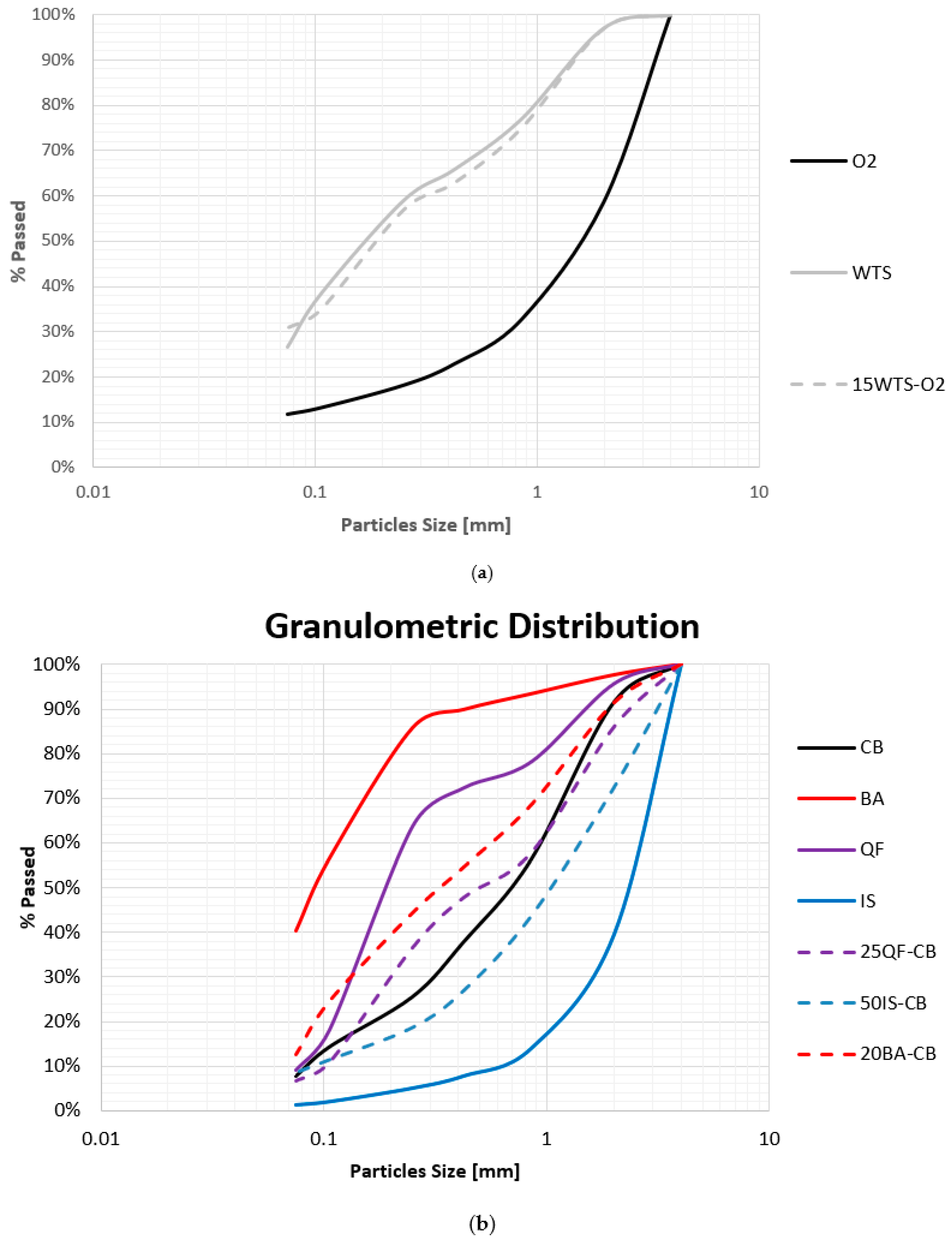
| Mixture | Soil O2 | Soil CB | WTS | BA | QF | IS |
|---|---|---|---|---|---|---|
| 5WTS-O2 | 95% | 5% | ||||
| 10WTS-O2 | 90% | 10% | ||||
| 15WTS-O2 | 85% | 15% | ||||
| 20WTS-O2 | 80% | 20% | ||||
| 5BA-CB | 95% | 5% | ||||
| 10BA-CB | 90% | 10% | ||||
| 15BA-CB | 85% | 15% | ||||
| 20BA-CB | 80% | 20% | ||||
| 25QF-CB | 75% | 25% | ||||
| 50QF-CB | 50% | 50% | ||||
| 25IS-CB | 75% | 25% | ||||
| 50IS-CB | 50% | 50% |
| Material | GS | D10 (mm) | D50 (mm) | D90 (mm) | SS (m2/kg) | USCS | K (m/s) i = 50 | K (m/s) i = 100 |
|---|---|---|---|---|---|---|---|---|
| CB | 2.70 | 0.083 | 0.70 | 1.80 | 3.175 | SW-SC | 4 × 10⁻¹⁰ | 3 × 10⁻¹⁰ |
| O2 | 2.77 | 0.055 | 0.90 | 1.23 | 2.407 | SP-SM | 5 × 10⁻¹⁰ | 5 × 10⁻¹⁰ |
| WTS | 1.95 | 0.050 | 0.17 | 1.40 | 18.100 | SW-SM | 6 × 10⁻¹⁰ | 6 × 10⁻¹⁰ |
| 5WTS-O2 | 2.73 | 0.090 | 0.75 | 1.84 | 3.140 | SW-SM | 3 × 10⁻¹⁰ | 3 × 10⁻¹⁰ |
| 10WTS-O2 | 2.68 | 0.017 | 0.66 | 1.73 | 3.731 | SW-SM | 1 × 10⁻¹⁰ | 1 × 10⁻¹⁰ |
| 15WTS-O2 | 2.62 | 0.070 | 0.45 | 1.73 | 4.580 | SW-SM | 1 × 10⁻¹⁰ | 1 × 10⁻¹⁰ |
| 20WTS-O2 | 2.56 | 0.048 | 0.54 | 1.67 | 4.687 | SW-SM | 1 × 10⁻¹⁰ | 1 × 10⁻¹⁰ |
| BA | 2.32 | 0.038 | 0.09 | 0.70 | 28.700 | SM | - | - |
| 5BA-CB | 2.72 | 0.120 | 0.58 | 2.30 | 3.803 | SW-SC | 3 × 10⁻⁹ | 3 × 10⁻⁹ |
| 10BA-CB | 2.67 | 0.110 | 0.47 | 2.10 | 5.107 | SW | 5 × 10⁻⁹ | 6 × 10⁻⁹ |
| 15BA-CB | 2.63 | 0.078 | 0.43 | 1.80 | 5.305 | SW-SM | 1 × 10⁻⁸ | 2 × 10⁻⁸ |
| 20BA-CB | 2.61 | 0.075 | 0.32 | 1.90 | 7.183 | SM | 1 × 10⁻⁸ | 1 × 10⁻⁸ |
| QF | 2.64 | 0.076 | 0.19 | 1.50 | 11.961 | SP-SC | 6 × 10⁻¹⁰ | 6 × 10⁻¹⁰ |
| 25QF-CB | 2.60 | 0.110 | 0.50 | 2.30 | 4.615 | SW-SM | 5 × 10⁻¹⁰ | 5 × 10⁻¹⁰ |
| 50QF-CB | 2.64 | 0.085 | 0.38 | 1.80 | 5.980 | SW-SM | 5 × 10⁻¹⁰ | 4 × 10⁻¹⁰ |
| IS | 3.56 | 0.610 | 2.27 | 3.60 | 0.742 | SP | - | - |
| 25IS-CB | 2.86 | 0.087 | 0.83 | 2.15 | 2.527 | SW-SM | 8 × 10⁻¹⁰ | 9 × 10⁻¹⁰ |
| 50IS-CB | 2.98 | 0.090 | 1.10 | 3.10 | 1.830 | SW-SM | 2 × 10⁻⁹ | 2 × 10⁻⁹ |
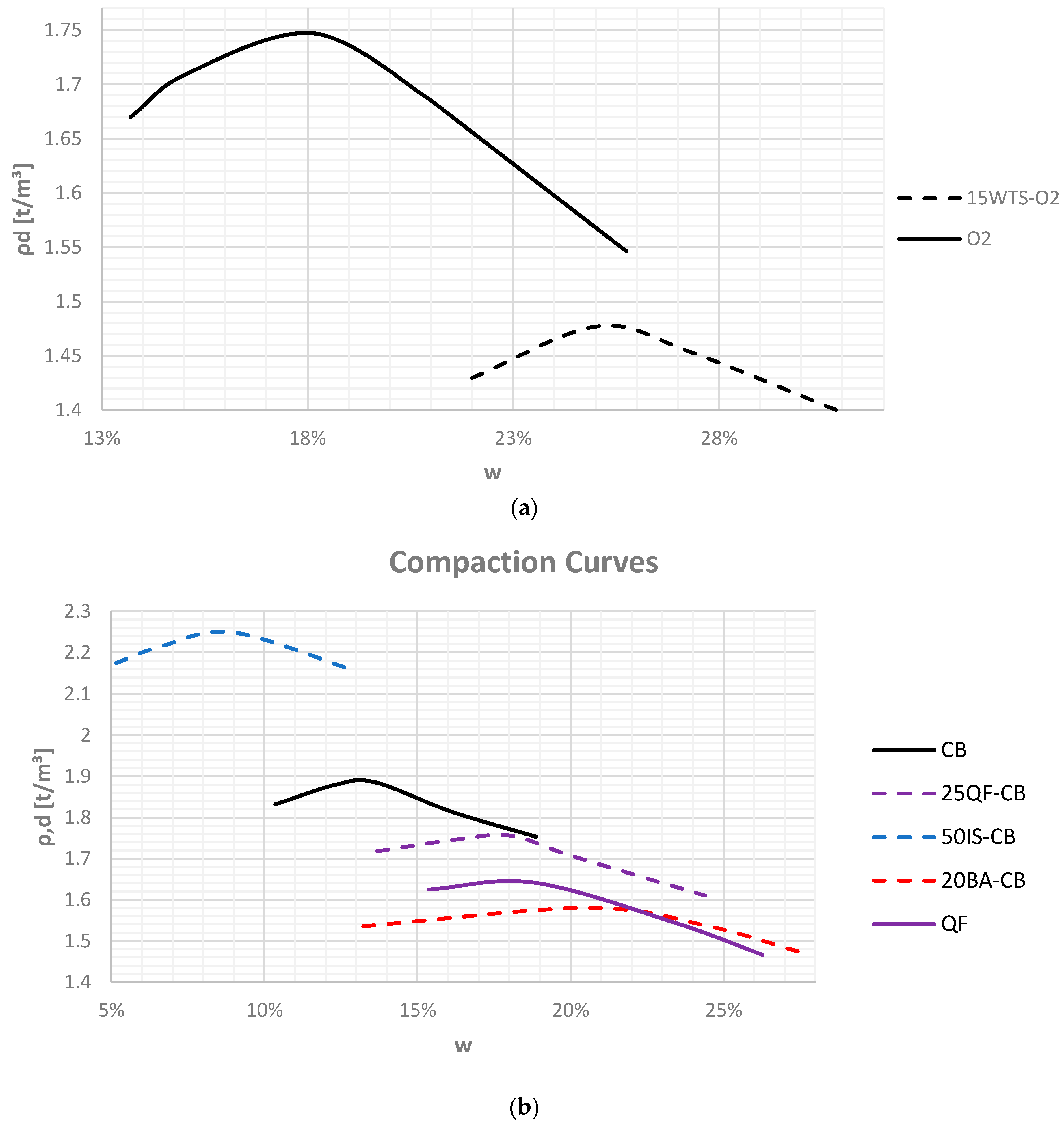
| Material | wL (%) | wP (%) | PI (%) | wopt (%) | ρd,max (g/cm3) | e |
|---|---|---|---|---|---|---|
| CB | 30 | 22 | 8 | 13.00 | 1.89 | 0.43 |
| O2 | 35 | 29 | 6 | 18.00 | 1.75 | 0.58 |
| WTS | - | - | - | 80.00 | 0.70 | |
| 5WTS-O2 | 38 | 33 | 7 | 17.00 | 1.68 | 0.63 |
| 10WTS-O2 | 40 | 36 | 4 | 21.00 | 1.58 | 0.70 |
| 15WTS-O2 | 43 | 40 | 3 | 25.00 | 1.48 | 0.77 |
| 20WTS-O2 | 53 | 52 | 1 | 25.00 | 1.44 | 0.78 |
| BA | - | NP | NP | - | - | |
| 5BA-CB | 41 | 28 | 13 | 17.00 | 1.72 | 0.58 |
| 10BA-CB | 42 | NP | NP | 16.00 | 1.78 | 0.50 |
| 15BA-CB | 45 | NP | NP | 19.00 | 1.65 | 0.59 |
| 20BA-CB | 46 | NP | NP | 20.50 | 1.58 | 0.65 |
| QF | 37 | 25 | 12 | 18.00 | 1.66 | |
| 25QF-CB | 37 | 26 | 11 | 17.50 | 1.76 | 0.48 |
| 50QF-CB | 37 | 24 | 13 | 17.00 | 1.74 | 0.52 |
| IS | - | - | - | - | - | |
| 25IS-CB | 32 | 27 | 5 | 11.00 | 2.03 | 0.41 |
| 50IS-CB | 30 | - | - | 8.50 | 2.26 | 0.32 |
| Material | c′ (kPa) | φ′ (°) | EI (%) | σ′vm (kPa) | Cc (-) | Cr (-) | Ce (-) |
|---|---|---|---|---|---|---|---|
| CB | 11 | 27 | 13 | 35 | 0.08 | 0.02 | 0.03 |
| O2 | 10 | 22 | 19 | 30 | 0.10 | 0.03 | 0.03 |
| WTS | - | - | 15 | 30 | 0.10 | 0.08 | 0.03 |
| WTS5:95% | 21 | 8 | 14 | 30 | 0.09 | 0.01 | 0.02 |
| WTS10:90% | 25 | 7 | 13 | 40 | 0.12 | 0.02 | 0.10 |
| WTS15:85% | 0 | 27 | 12 | 45 | 0.07 | 0.01 | 0.01 |
| WTS20:80% | 0 | 25 | 10 | 30 | 0.05 | 0.01 | 0.01 |
| VBA | - | - | - | - | - | - | - |
| VBA5:95% | 0.5 | 27 | 14 | 30 | 0.06 | 0.01 | 0.01 |
| VBA10:90% | 0 | 27 | 17 | 30 | 0.06 | 0.01 | 0.01 |
| VBA15:85% | 0 | 27 | 18 | 35 | 0.08 | 0.02 | 0.02 |
| VBA20:80% | 0 | 32 | 15 | 45 | 0.08 | 0.01 | 0.02 |
| QF | 4 | 28 | 17 | 40 | 0.14 | 0.03 | 0.03 |
| QF25:75% | 2 | 28 | 15 | 40 | 0.11 | 0.01 | 0.01 |
| QF50:50% | 5 | 26 | 13 | 40 | 0.10 | 0.02 | 0.03 |
| IS | - | - | - | - | - | - | - |
| IS25:75% | 0 | 29 | 5 | 35 | 0.06 | 0.02 | 0.01 |
| IS50:50% | 0 | 29 | 0 | 40 | 0.05 | 0.02 | 0.01 |
Disclaimer/Publisher’s Note: The statements, opinions and data contained in all publications are solely those of the individual author(s) and contributor(s) and not of MDPI and/or the editor(s). MDPI and/or the editor(s) disclaim responsibility for any injury to people or property resulting from any ideas, methods, instructions or products referred to in the content. |
© 2025 by the authors. Licensee MDPI, Basel, Switzerland. This article is an open access article distributed under the terms and conditions of the Creative Commons Attribution (CC BY) license (https://creativecommons.org/licenses/by/4.0/).
Share and Cite
Studart, A.; Boscov, M.E.; Cavaleiro, V.; Albuquerque, A. Sustainable Use of Industrial Wastes for Soil Stabilization. Eng 2026, 7, 4. https://doi.org/10.3390/eng7010004
Studart A, Boscov ME, Cavaleiro V, Albuquerque A. Sustainable Use of Industrial Wastes for Soil Stabilization. Eng. 2026; 7(1):4. https://doi.org/10.3390/eng7010004
Chicago/Turabian StyleStudart, André, Maria Eugenia Boscov, Victor Cavaleiro, and Antonio Albuquerque. 2026. "Sustainable Use of Industrial Wastes for Soil Stabilization" Eng 7, no. 1: 4. https://doi.org/10.3390/eng7010004
APA StyleStudart, A., Boscov, M. E., Cavaleiro, V., & Albuquerque, A. (2026). Sustainable Use of Industrial Wastes for Soil Stabilization. Eng, 7(1), 4. https://doi.org/10.3390/eng7010004