


Use of Antioxidants to Reduce Chromium (VI) Formation during the Leather Tanning Process


 ,
,  ,
,  and
and Abstract
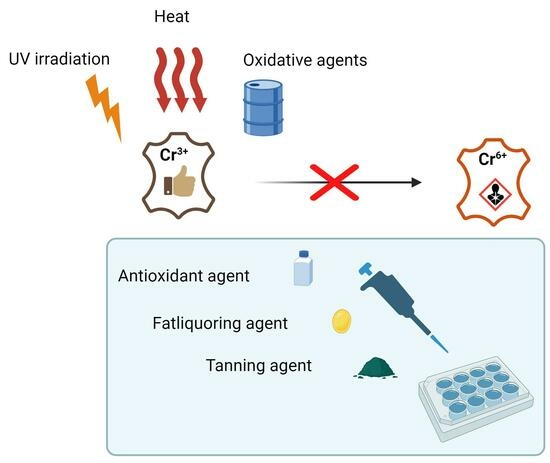
Share and Cite
Salmi, O.; Molinelli, A.; Gelosa, S.; Sacchetti, A.; Rossi, F.; Masi, M. Use of Antioxidants to Reduce Chromium (VI) Formation during the Leather Tanning Process. Sustain. Chem. 2024, 5, 244-257. https://doi.org/10.3390/suschem5030016
Salmi O, Molinelli A, Gelosa S, Sacchetti A, Rossi F, Masi M. Use of Antioxidants to Reduce Chromium (VI) Formation during the Leather Tanning Process. Sustainable Chemistry. 2024; 5(3):244-257. https://doi.org/10.3390/suschem5030016
Chicago/Turabian StyleSalmi, Omar, Alessandro Molinelli, Simone Gelosa, Alessandro Sacchetti, Filippo Rossi, and Maurizio Masi. 2024. "Use of Antioxidants to Reduce Chromium (VI) Formation during the Leather Tanning Process" Sustainable Chemistry 5, no. 3: 244-257. https://doi.org/10.3390/suschem5030016
APA StyleSalmi, O., Molinelli, A., Gelosa, S., Sacchetti, A., Rossi, F., & Masi, M. (2024). Use of Antioxidants to Reduce Chromium (VI) Formation during the Leather Tanning Process. Sustainable Chemistry, 5(3), 244-257. https://doi.org/10.3390/suschem5030016



