Abstract
The latest results of Higgs boson searches beyond the Standard Model from the ATLAS and CMS experiments are reviewed. This includes searches for additional neutral, charged, and double charged Higgs-like bosons, searches for dark matter produced in association with a Higgs boson, and searches for new physics in Higgs boson production and decay processes. Interpretations are given within the hMSSM, a special parameterization of the Minimal Supersymmetric extension of the Standard Model, in which the mass of the lightest Higgs boson is set to the value of 125 GeV measured at the LHC.
1. Introduction
Since the discovery of the Higgs boson with the properties of the Standard Model in 2012 [1,2], a number searches for Higgs bosons beyond the Standard Model have been made. These searches can be organized according to different proposed extensions of the Higgs sector [3]. Two-Higgs-Doublet Models (2HDMs) introduce five Higgs bosons: two scalar (), a pseudoscalar (A) neutral, and two () charged particles. The Minimal Supersymmetric extension of the SM (MSSM) is a 2HDM that can contain additional particles within reach of the Large Hadron Collider (LHC), namely the superpartners of SM particles. The 2HDMs with an extra light singlet (a) bring new phenomena through the opening of the decay . Three-HDMs (3HDMs) enlarge the Higgs boson sector, having three charge-parity -even and two -odd neutral Higgs bosons, as well as two charged Higgs bosons. In models with an additional U(1)D gauge symmetry, a pseudoscalar (A) and charged Higgs bosons (H±) are predicted. In Type-II seesaw models, left–right symmetric models (LRSMs), the Zee–Babu neutrino mass model, 3-3-1 models, and the Georgi–Machacek model, doubly charged Higgs (H++) are predicted.
A previous review of the SM Higgs boson research was given at the 2019 International Conference on Precision Physics and Fundamental Physical Constants, FFK2019 [4].
This review is structured as follows. Section 2 describes Higgs boson decays. Section 3 is devoted to the enhanced production modes. Section 4 describes Higgs boson resonance production searches. Section 5 reports on the additional neutral Higgs boson production. Section 6 reports on the Higgs boson dark matter production. Section 7 reports on the charged Higgs boson production searches. Interpretations and outlook are given in Section 8.
1.1. LHC, Experiments, and Data Taking
The data from proton–proton collisions at the LHC at CERN have been recorded with the ATLAS and CMS experiments in three data taking periods:
- LHC Run-1: 2010–2012, discovery of the Higgs boson [1,2];
- LHC Run-2: 2015–2018, results presented here;
- LHC Run-3: 2022–2025, ongoing data taking.
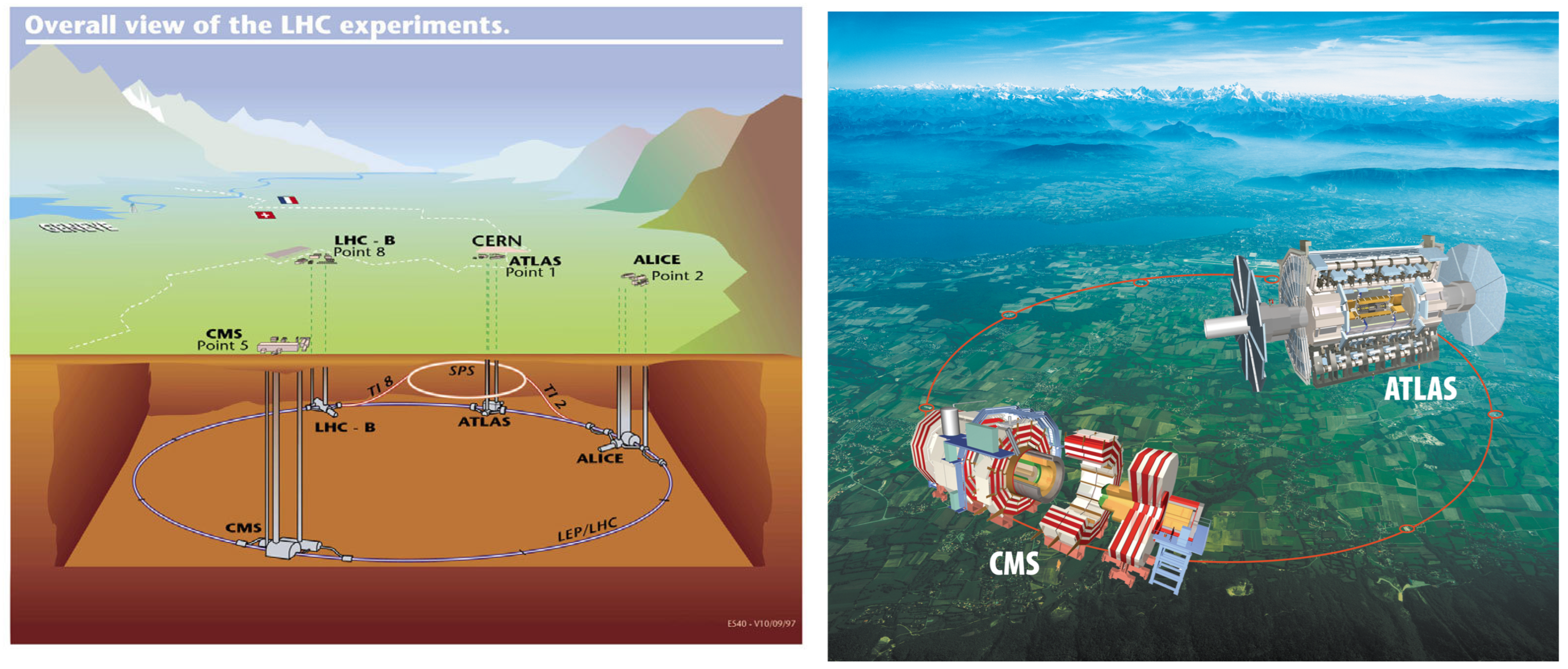
Figure 1 illustrates the layout of the LHC (Figure 1, left) and of the ATLAS and CMS experiments (Figure 1, right). The LHC location of the underground area is shown, as well as the terrain.
Figure 1.
Left: LHC underground and terrain areas with four experiments. Right: ATLAS and CMS experiments.
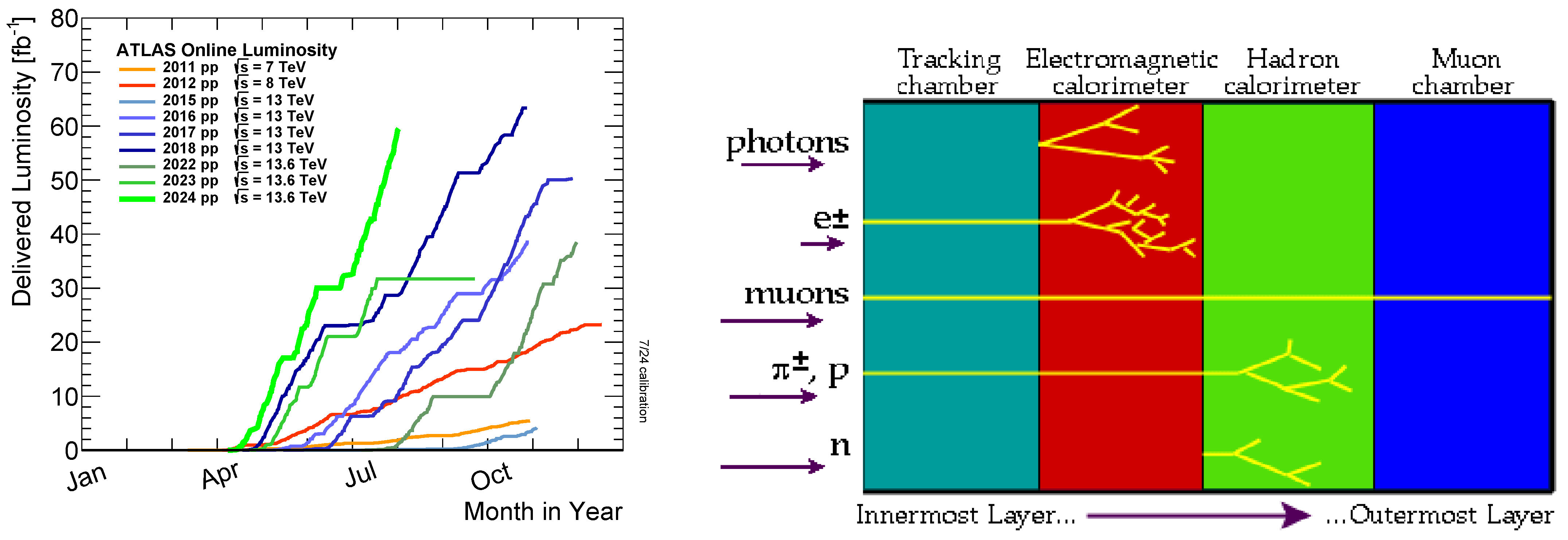
Figure 2, left, shows the luminosity delivered to the ATLAS experiment from proton–proton collisions, while Figure 2, right, shows a schematic view of particle identification in the ATLAS or CMS detectors.
Figure 2.
Left: delivered luminosity at the ATLAS experiment [5]. Reproduced under the CC-BY-4.0 license. Right: particle identification schema by different subsystems.
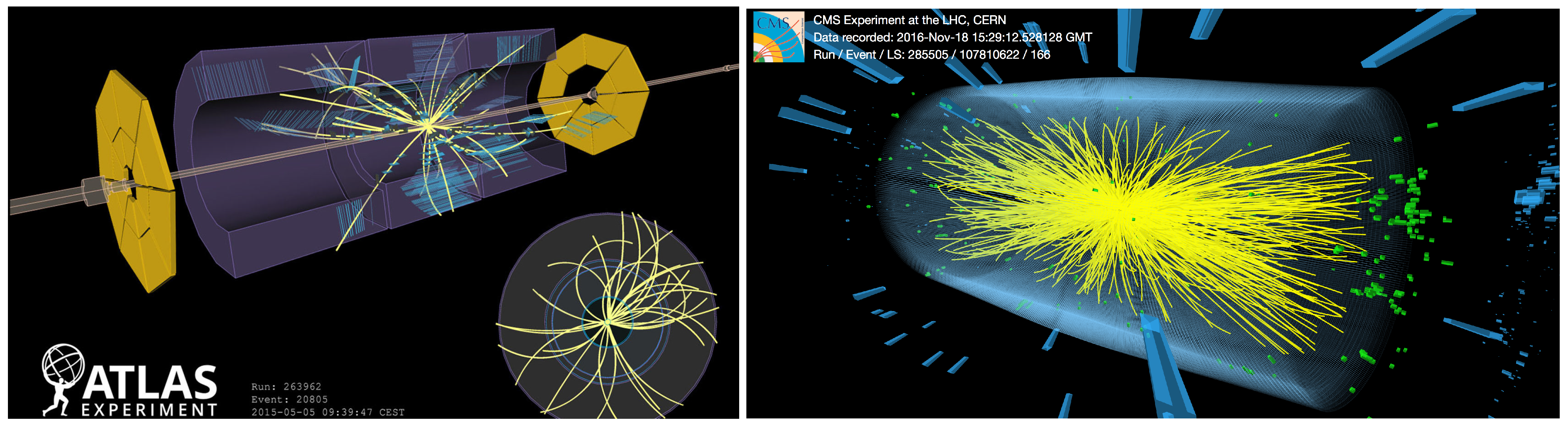
Event displays of typical recorded proton–proton collisions are shown in Figure 3. The proton–proton collisions in the center of the detectors lead to different reactions, including the production of the SM Higgs boson and potentially the production of the Higgs boson predicted in extended models.
Figure 3.
Event displays from the (left) ATLAS [6]. and (right) CMS [7] experiments. Reproduced under the CC-BY-4.0 license.
1.2. Production Modes
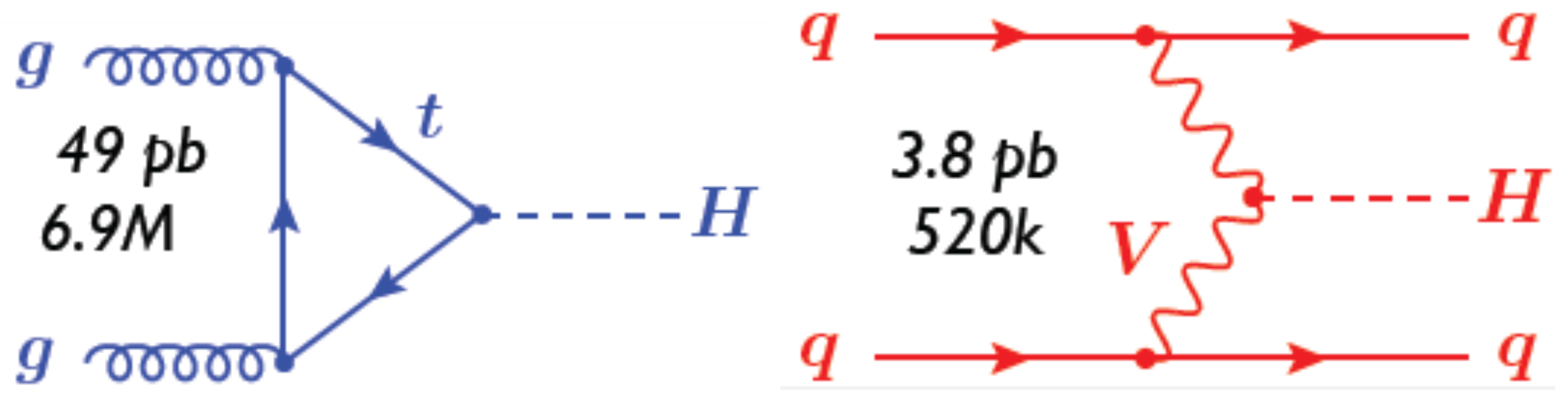
The analyses presented here are mostly based on the full LHC Run-2 dataset. The evolution of the integrated luminosity recorded by the CMS experiment as a function of time is shown in Figure 4 along with the number of expected SM Higgs boson events in the production modes , , , , , and in Table 1 where g denotes gluon, denotes vector boson fusion, and t denotes the top quark. The corresponding Feynman diagrams are shown in Figure 5, Figure 6 and Figure 7 along with the production cross-sections for 13 TeV center-of-mass energy [8] and the resulting expected rates for 140 fb−1 integrated luminosity [9]. The expected rates can vary in different extensions of the SM.
Figure 4.
LHC Run-2 integrated luminosity [10]. Reproduced under the CC-BY-4.0 license.
Table 1.
Expected numbers of Higgs boson events. See text for details.
Figure 5.
Feynman diagrams for (left) and (right) Higgs boson production modes (see text for details). The production cross-sections (in pb) are given for 13 TeV center-of-mass energy [8] and the expected rates (“M” stands for “” and “k” stands for “”) are given for 140 fb−1 integrated luminosity [9].
Figure 6.
Feynman diagrams for (left) and (right) Higgs boson production modes (see text for details). The production cross-sections (in pb) are given for 13 TeV center-of-mass energy [8] and the expected rates (“k” stands for ) are given for 140 fb−1 integrated luminosity [9].
Figure 7.
Feynman diagrams for (left) and (right) Higgs boson production modes (see text for details). The production cross-sections (in pb) are given for 13 TeV center-of-mass energy [8] and the expected rates (“k” stands for ) are given for 140 fb−1 integrated luminosity [9].
1.3. Decay Branching Ratios
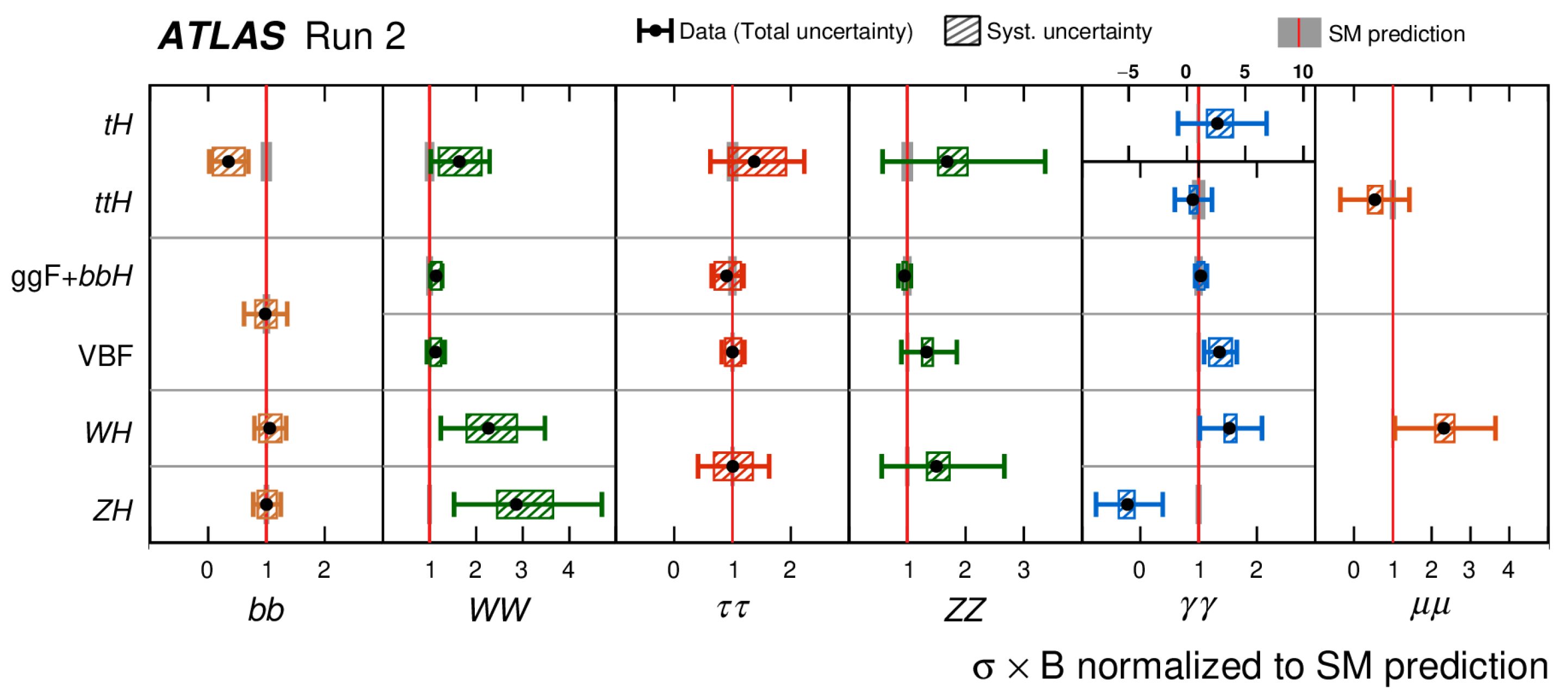
SM predictions for the Higgs boson branching ratios and precision measurements for several Higgs boson decay modes are summarized in Table 2 [8] and Figure 8 [11], respectively. Physics beyond the SM (BSM) may change these ratios. After establishing the main decay channels and striving to precisely characterize them, the experimental focus is now on the measurements of the rare decay modes that can be enhanced in extended models.
Table 2.
Theoretical predictions of Higgs boson decay branching ratios in the SM [8]. Reproduced under the CC-BY-4.0 license.
Figure 8.
Cross-section times branching ratio measurements [11]. Reproduced under the copyright permission from Springer Nature.
1.4. Relation of Coupling to Fermion/Vector Boson Mass
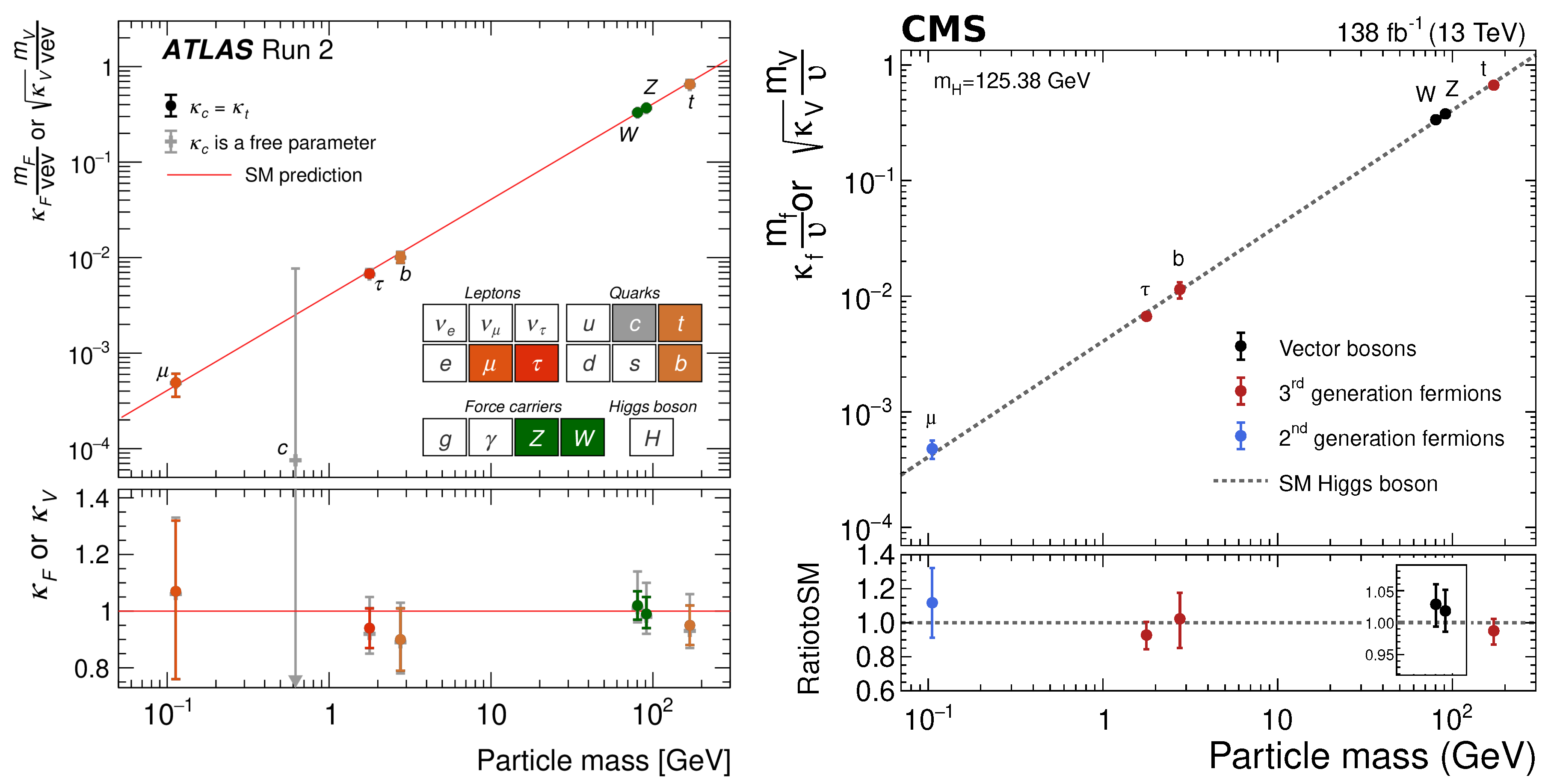
The relationships between couplings and fermions and vector bosons as a function of the particle masses measured by ATLAS and CMS experiments [11,12] are shown in Figure 9. The SM expectation and the measurements are in remarkable agreement within the uncertainties (the smallest of which is about 3% for boson couplings).
Figure 9.
Relationships between couplings and fermion/vector boson masses by (left) ATLAS [11] and (right) CMS [12] experiments. Reproduced under the copyright permission from Springer Nature.
1.5. Higgs Boson Width
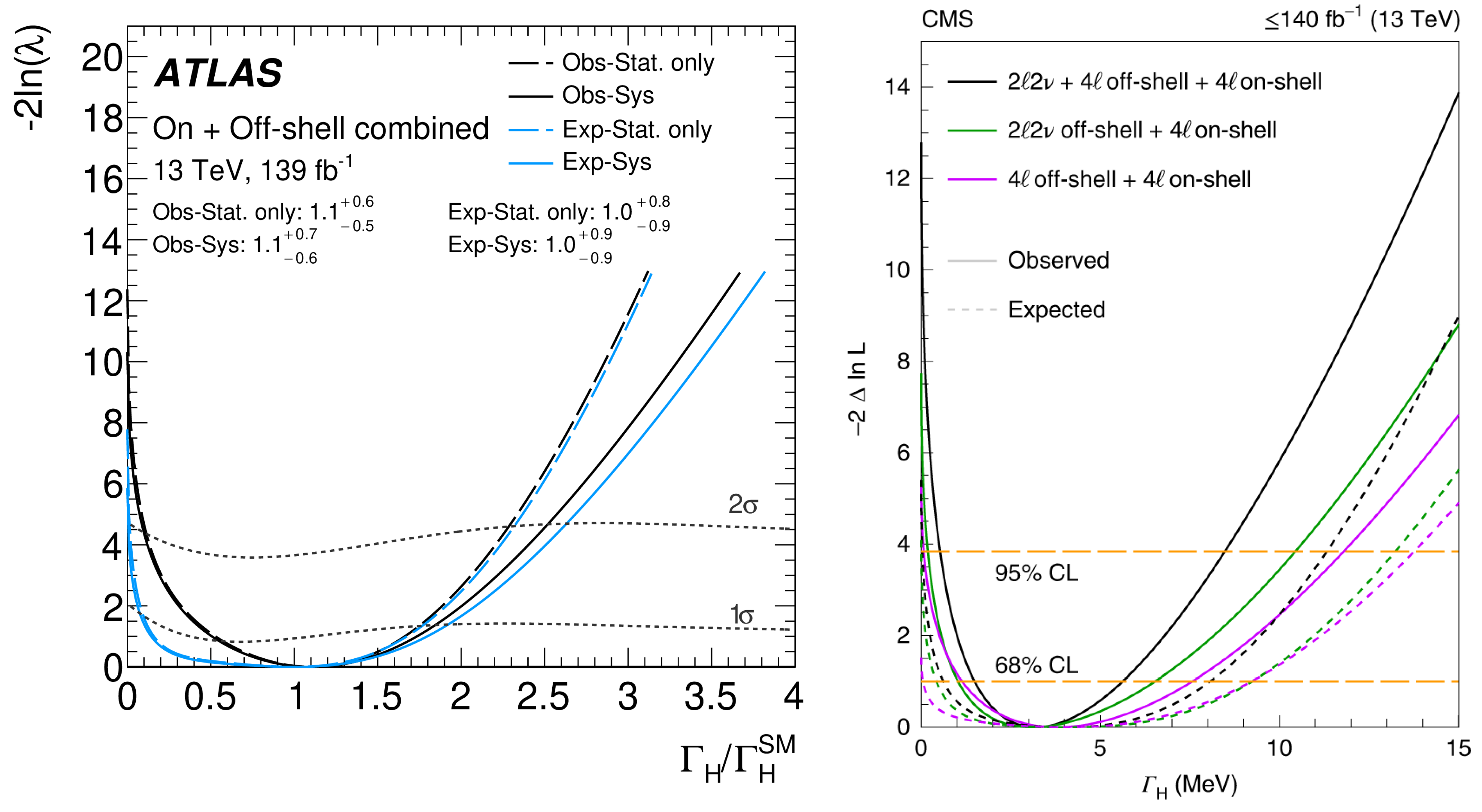
The width of the Higgs boson can be measured using the production mode and subsequent decay, including virtual Higgs boson contributions and its interference [13]. The two sensitive processes are and , with or . Figure 10 shows Feynman diagrams of () production and the simulated differential cross-section as a function of the four-lepton invariant mass [13]. The contribution of the Higgs boson allows determing the Higgs boson width. The ATLAS experiment indirect limit on the width measurement is MeV, with an observed upper limit of 10.5 MeV, for an expected value of 10.9 MeV at 95% CL [14] and MeV for the CMS [13] experiment. Both measurements are in good agreement with the SM prediction MeV [8]. The corresponding likelihood is shown in Figure 11 [13,14], assuming no new particles enter in the production of the virtual Higgs boson.
Figure 10.
Left and Middle: Feynman diagrams of production. Right: simulated differential production cross-section as a function of the four-lepton invariant mass [13]. Reproduced under the copyright permission from Springer Nature.
Figure 11.
Likelihood for Higgs boson width measurements by (left) ATLAS [14] and (right) CMS [13] experiments. Reproduced under the copyright permission from Elsevier (left) and Springer Nature (right).
1.6. Higgs Boson Properties
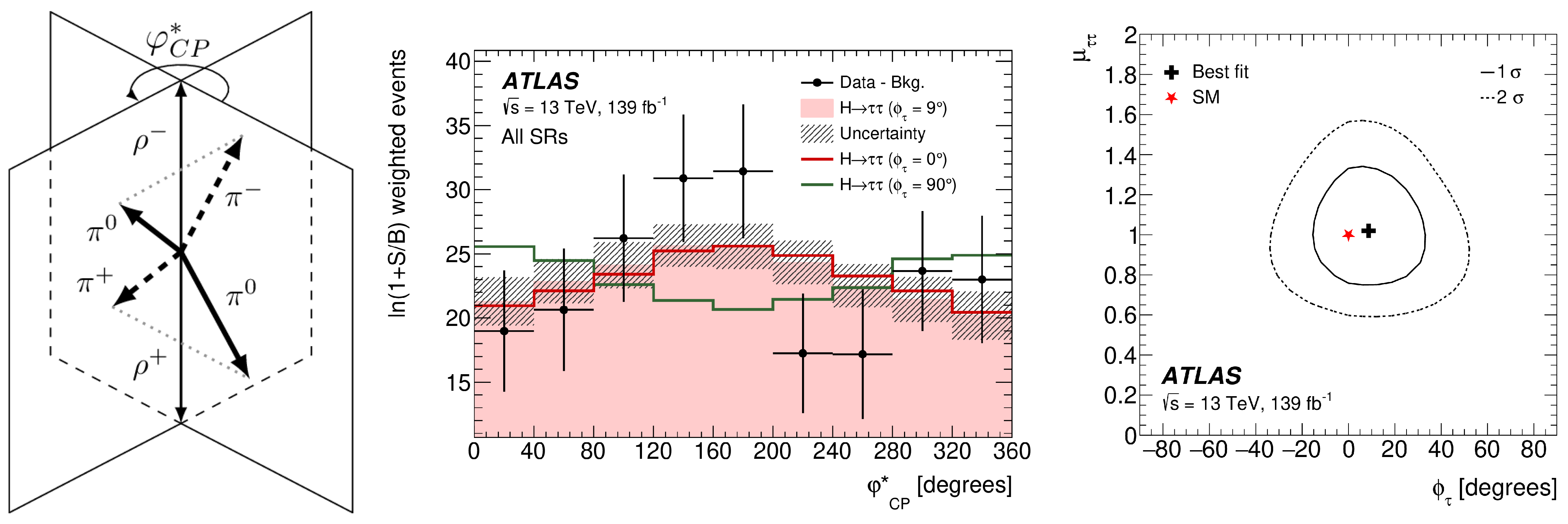
A study of the properties of the interaction between the Higgs boson and tau-leptons (s) was performed, based on the reconstruction of the planes of tau decay products. The results of the observed signal strength versus the -mixing angle are shown in Figure 12, right [15]. No indication of a non-SM contribution is observed. To clarify, Figure 12, left, presents the definition of the angle and Figure 12, middle, shows the data and simulation distribution. The Lagrangian defining and reads [15], and is the ratio of the signal strength to the SM expectation.
Figure 12.
Left: definition of the angle between -decay products. Middle: measured and simulated angle distributions between -decay products [15]. Right: observed and expected signal strength, , versus the -mixing angle [15]. Reproduced under the copyright permission from Springer.
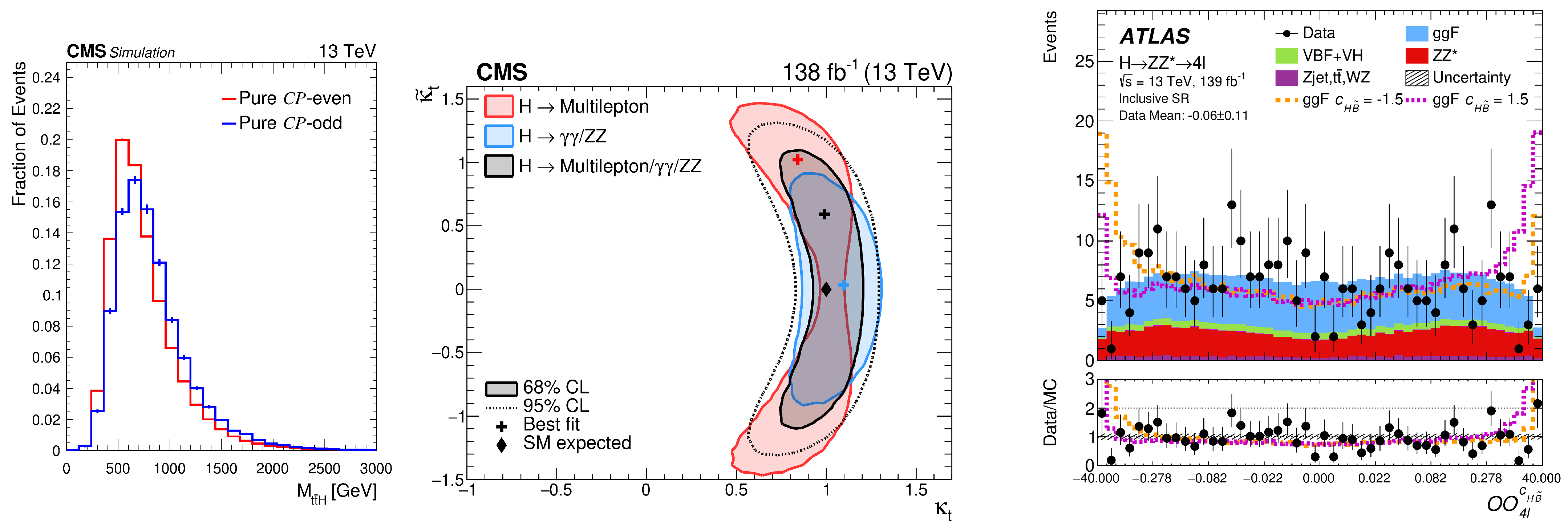
The structure of the Higgs boson top quark Yukawa coupling was also measured in and production [16]. The parameters (-even) and (-odd) are used, and other parameters are fixed to their SM values. Figure 13, left, compares the distributions of the invariant mass for the pure -even and -odd assumptions and Figure 13, middle, and Table 3 show the results of the measured and values [16].
Figure 13.
Left: comparison of the distributions of the invariant mass for the pure -even and -odd assumptions [16]. Middle: observed and SM expected and values [16]. Right: decay level observable for -invariance in production for [17]. See text for details. Reproduced under the copyright permission from Springer.
Table 3.
Limits on measured and values [16]. See text for details. Reproduced under the copyright permission from Springer.
The properties in and production for have been studied in Ref. [17]. Matrix element-based optimal observables were used to constrain -odd couplings beyond the SM in the framework of SM effective field theory [18]. The tested -invariance of Higgs boson interactions with () were performed. Results are compatible with the SM expectation, and no hint of BSM physics was observed. Figure 13, right, compares data and simulation for [17].
2. Higgs Boson Decay
Higgs boson couplings beyond the already observed , , , , , and couplings are discussed here.
2.1.
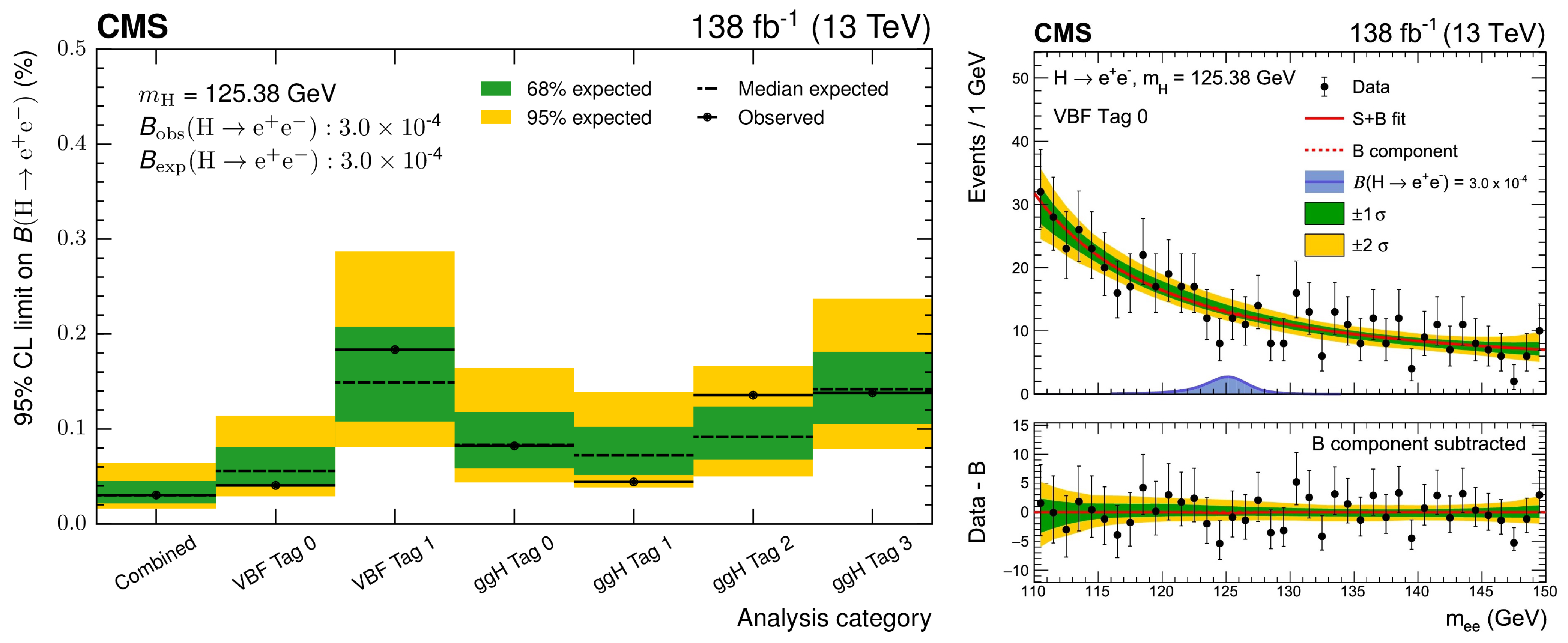
Higgs boson decays into a pair of electrons having a quite small branching fraction in the SM BR. The branching fraction could be enhanced in the 2HDM, and experimental limits are set to BR at 95% CL [19] when the various measurements are combined, as shown in Figure 14, left. The reconstructed di-electron mass distribution does not yet show a visible signal due to the expected low rate; see Figure 14, right.
Figure 14.
Left: upper limits on the branching ratio in various search channels and those combined [19]. Right: reconstructed di-electron mass distributon [19]. Reproduced under the copyright permission from Elsevier.
2.2.
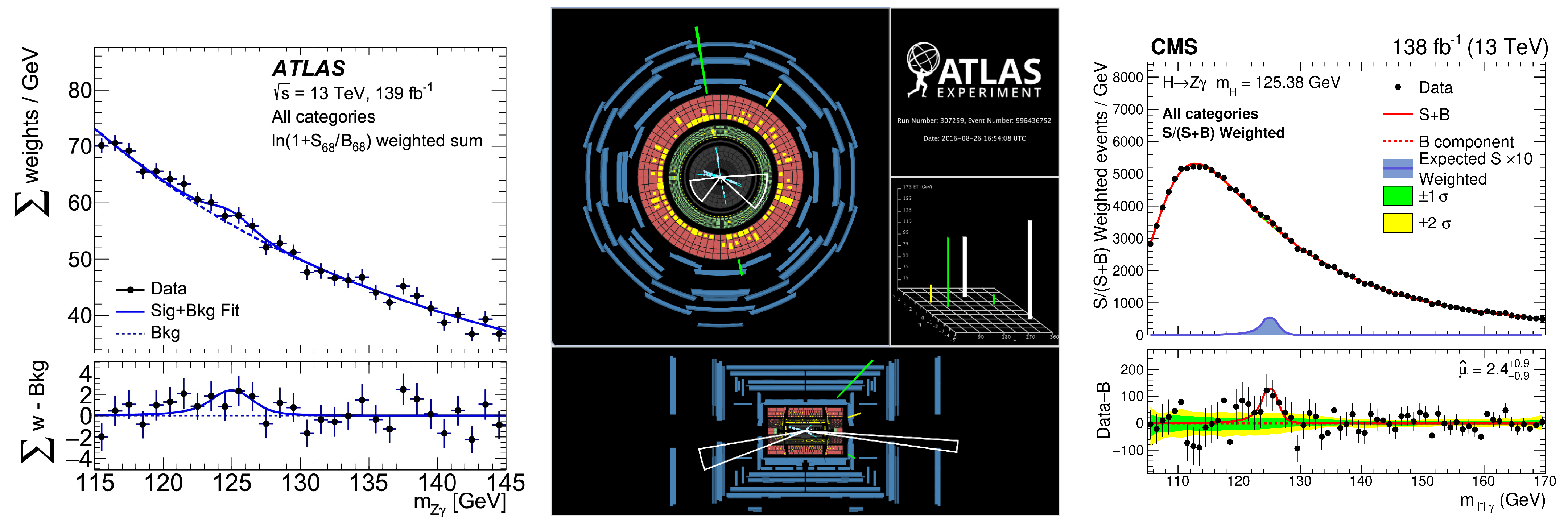
The SM Higgs boson decay modes are within experimental reach. The ATLAS Collaboration obtains a significance of 2.2 (1.2 exp.) standard deviation (s.d.), and the best-fit value for the signal yield normalized to the SM prediction is [20], while the CMS Collaboration obtains a significance of 2.7 (1.2 exp.) s.d. and [21], where the statistical component of the uncertainty is dominant. Figure 15 shows the distribution from ATLAS [20] (Figure 15, left) and CMS [21] (Figure 15, right) experiments, as well as an event display of an ATLAS experiment candidate event (Figure 15, middle). A combination of the data from the ATLAS and CMS Collaborations leads to a 3.4 (1.6 exp.) s.d. evidence with [22] (Figure 16, left).
Figure 15.
Left: ATLAS experiment invariant-mass distribution [20]. Middle: ATLAS experiment candidate event display [20]. Right: CMS experiment invariant-mass distribution [21]. Reproduced under the copyright permission from Elsevier (left, middle) and Springer (right).
Figure 16.
Left: negative profile log-likelihood test statistic as a function of the signal strength [22], where denotes standard deviation. Right: ATLAS and CMS experiments invariant mass distribution [22]. Reproduced under the copyright permission from the American Physical Society.
2.3.
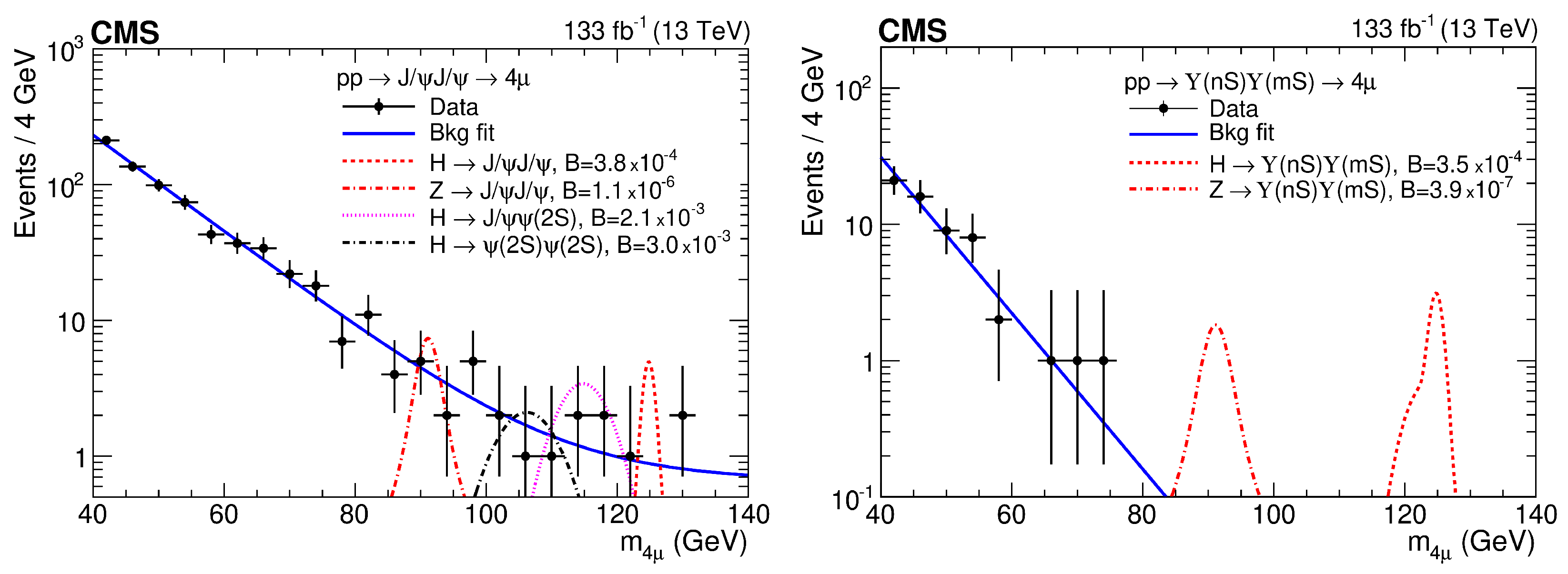
Further rare Higgs boson decays lead to four-muon final states. Experimentally, this has a clean signature owing to considerably small SM background. The expected sensitivity for the branching fractions is several orders of magnitude below the current experimental sensitivity. The observation of such decays indicates physics beyond the SM. Limits obtained are at 95% CL [23], as shown in Figure 17. Observed and expected limits are in quite a good agreement (Table 4).
Figure 17.
Left: four-muon invariant mass for searches. The limits are given for different assumptions on the polarization of the intermediate particles. The signal distributions are shown for branching ratios at the observed limit [23]. Right: four-muon invariant mass for searches [23]. Reproduced under the copyright permission from Elsevier.
Table 4.
Observed and expected limits on Higgs boson branching ratios.
2.4.
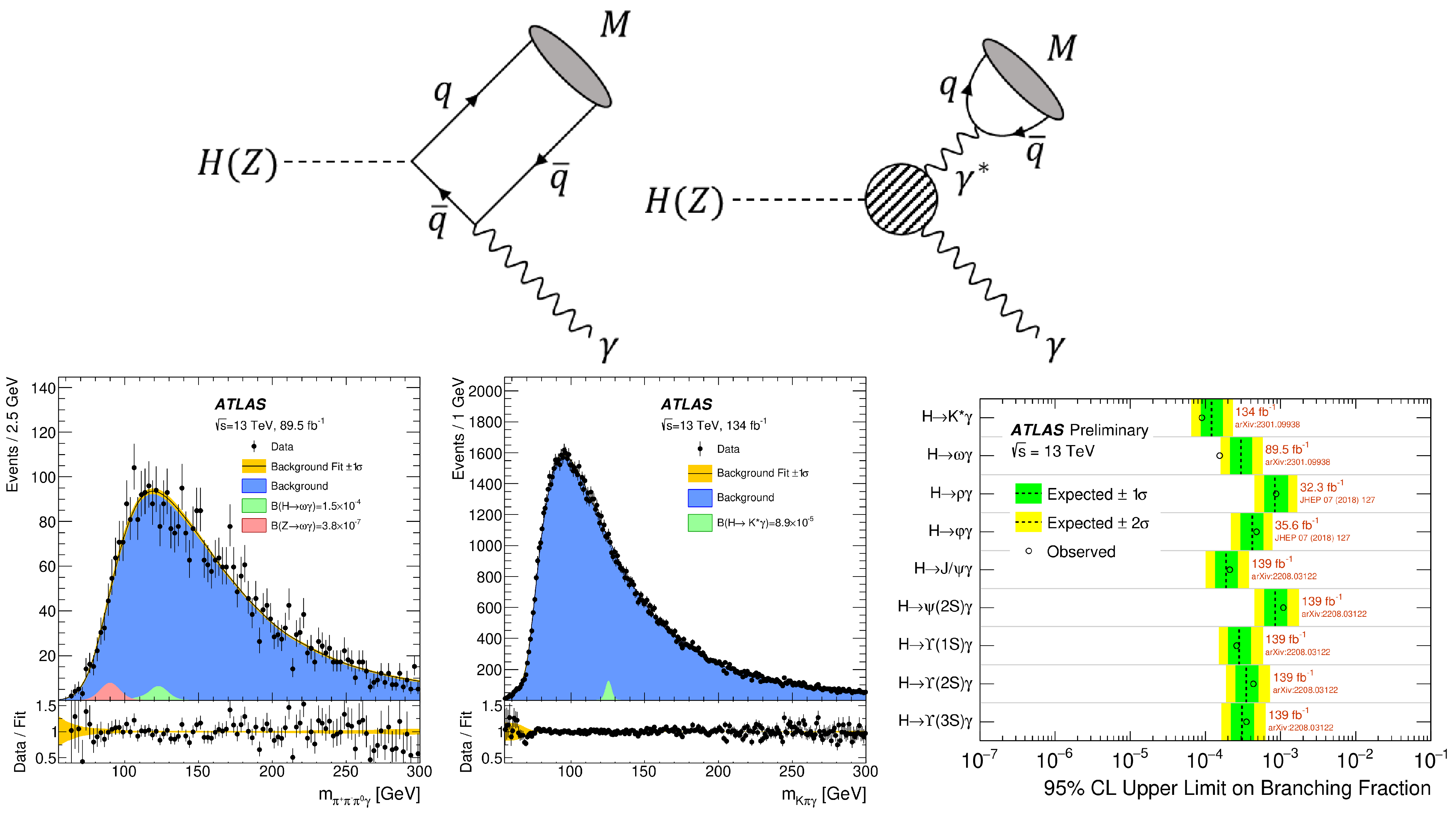
Searches for Higgs boson decay to probe flavor-conserving and flavor-violating Higgs boson couplings to light quarks [24,25]. Figure 18, upper left, middle and right shows relevant Feynman diagrams and Figure 18, lower left and middle, shows invariant mass distributions, observed and expected limits. No excess of branching ratio is observed (see Table 5).
Figure 18.
Upper: Feynman diagrams for the associated production of a meson and a photon in Higgs boson decays [24]. Lower: invariant masses of mesons and photons (left and middle) [24] and ATLAS public summary of the limits (right) [25]. Reproduced under the copyright permission from Elsevier (upper, lower left and middle) and under the CC-BY-4.0 license (lower right).
Table 5.
Observed and expected limits: [24].
2.5. Lepton Flavor Violation (LFV)
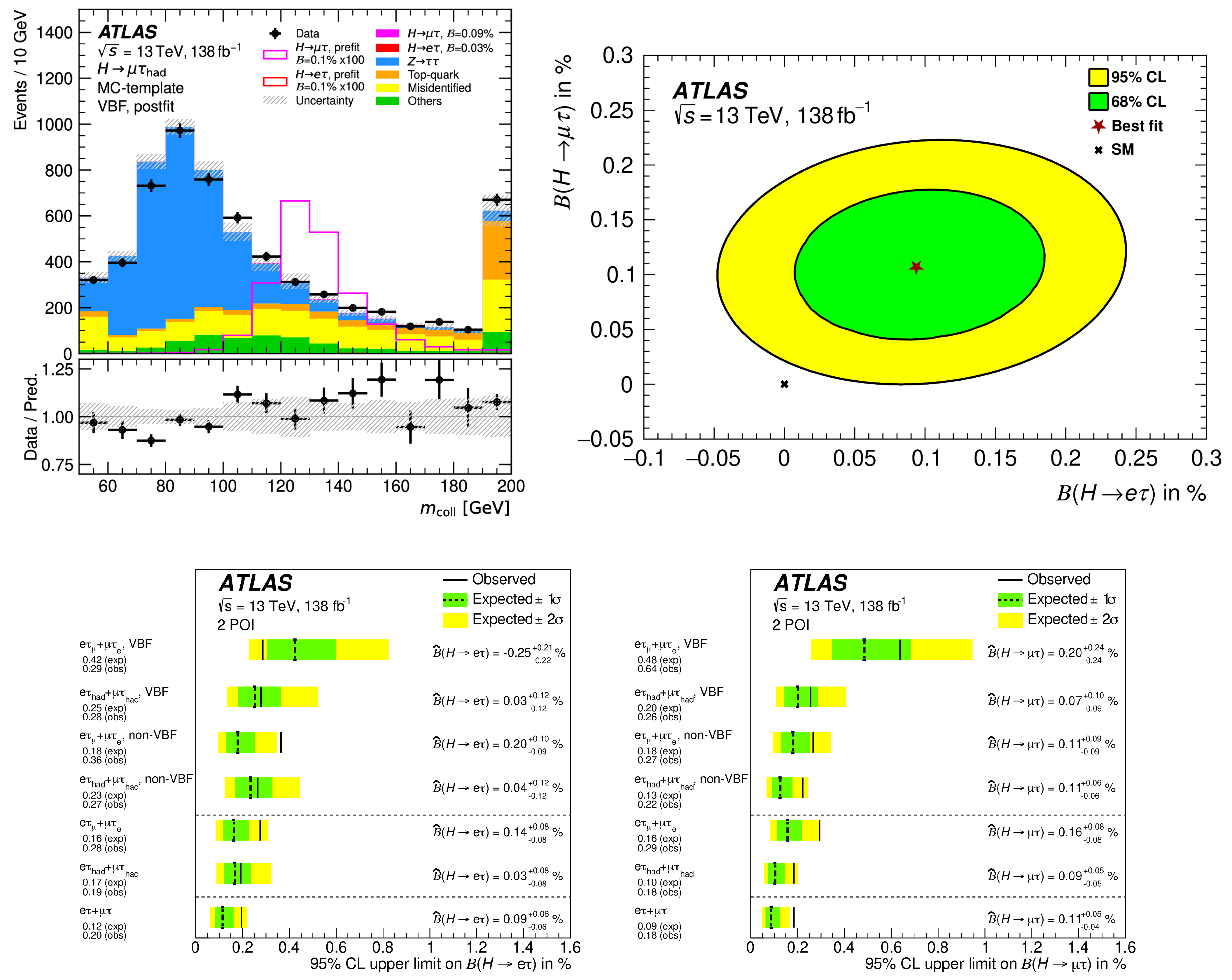
Searches for LFV processes led to limits on the Higgs boson branching fractions BR exp.) and BR exp.) at 95% CL. No measurement is compatible with LFV. Figure 19, upper left, shows an observed invariant-mass distribution along with the simulated BR and BR signals, which were observed and, in the SM, expected to be BR and BR results (Figure 19, upper right). Figure 19, lower, shows limits on these branching ratios set at 95% CL [26]. CMS experiment searches for LFV processes led to branching ratio limits 4.4 (4.7 exp.) × 10−5 at 95% CL [27]. An excess of events over the expected background is observed at an electron–muon invariant mass of approximately 146 GeV with a global (local) significance of 2.8 (3.8) s.d. Figure 20, left, shows the -invariant-mass distribution and Figure 20, middle, shows the resulting limits on the Higgs boson branching fractions at 95% CL [27]. The ATLAS Collaboration observed no significant signal, in agreement with the SM expectation (Figure 20, right) [28].
Figure 19.
Upper left: invariant-mass distribution along with simulated BR and BR signals [26]. Upper right: observed and, in the SM, expected BR and BR results [26]. Lower: limits on BR and BR at 95% CL [26]. Reproduced under the copyright permission from Springer.
Figure 20.
Left: CMS-experiment-observed -invariant-mass distribution [27]. Middle: CMS-experiment-measured limits BR at 95% CL [27]. Right: ATLAS-experiment-observed -invariant-mass distribution [28]. Reproduced under the copyright permission from the American Physical Society (left, middle) and Elsevier (right).
2.6. Invisible Decays
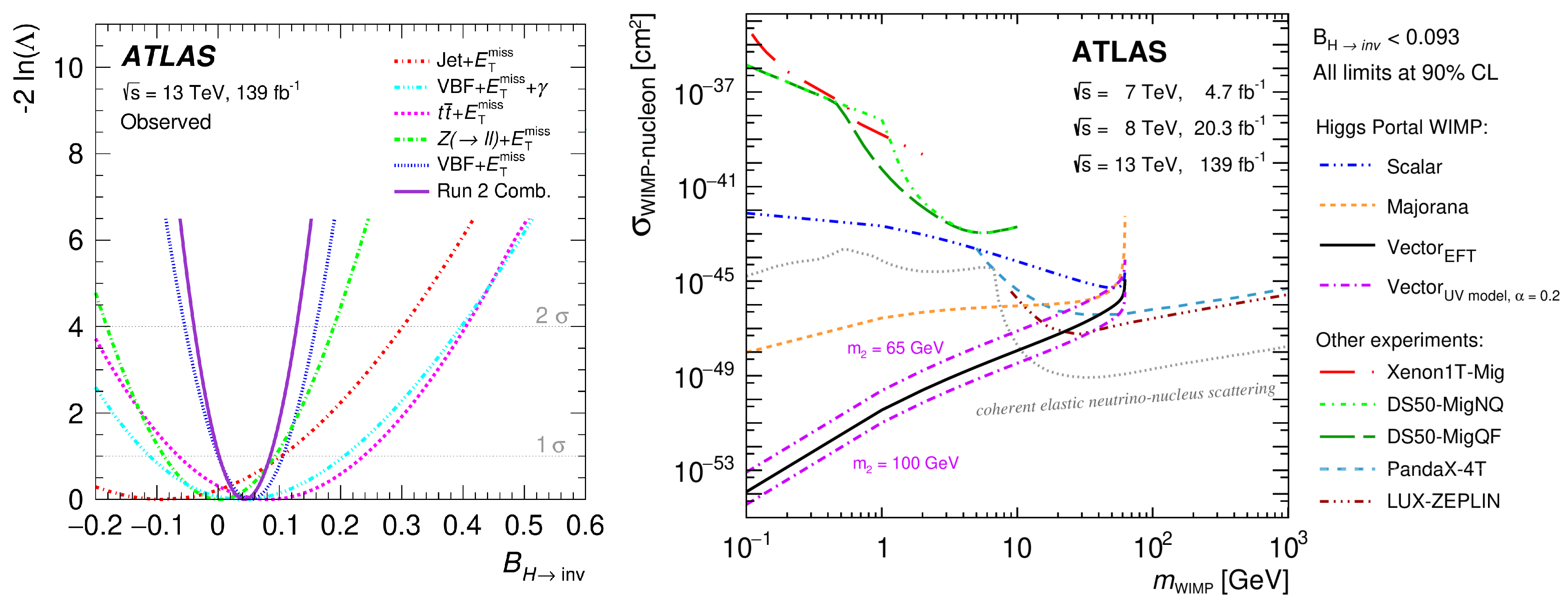
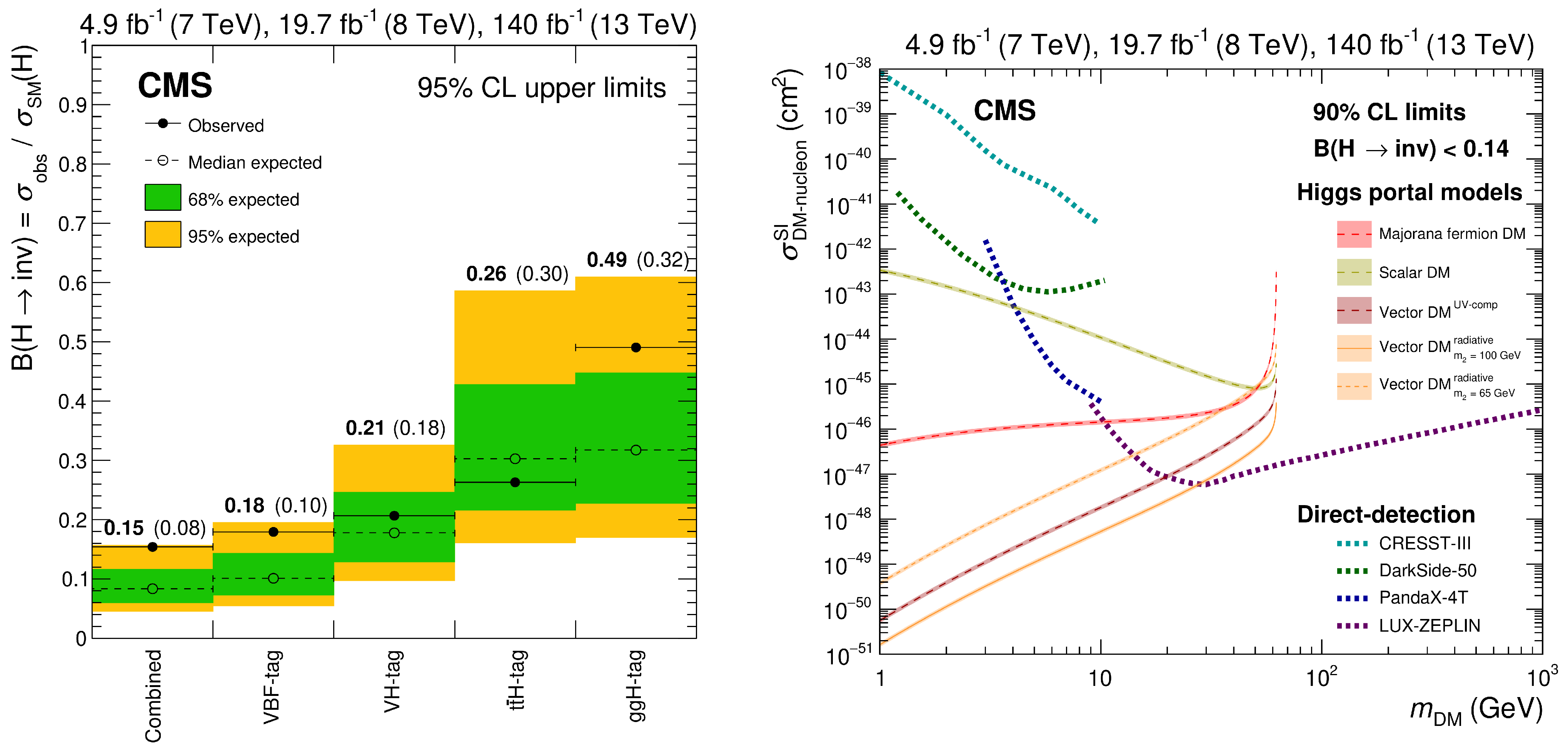
A strong motivation for the search for invisible Higgs boson decays is that this search can give insight into the hidden sectors of the Higgs field [29]. Direct searches were made by the ATLAS Collaboration for Higgs bosons that decay into invisible particles (leading to missing energy) [30]. Signatures could be jet+, ++photon, +, )+, and + final states. is the missing transverse momentum. The photon could arise from ISR QED radiation and jets from QCD radiation. No indication of a signal has been found, and a limit is set on the BR exp.) at 95% CL, assuming a SM production cross-section [30] (Figure 21, left); here “inv” denotes the above listed final states of invisible particles. Figure 21, right, shows details of the limit setting and an interpretation as limits on a weakly interacting massive particle (WIMP) [30]. Results by the CMS Collaboration were obtained in the search BR at 95% CL, and in the combined , , , and analyses at 95% CL [31] (Figure 22, right). Details on the limit setting and an interpretation as limits on a WIMP are shown in Figure 22, right [31]. For light mass, dark matter (DM) candidates in the range of 0.1 GeV and (Higgs mass) model-dependent exclusion limits are found to complement direct-detection experiments.
Figure 21.
Left: twice the negative logarithmic profile likelihood ratio as a function of BR decays into invisible particles [30]. Right: upper limits on the interaction cross-section of WIMP dark matter candidates with nucleons [30]. Reproduced under the copyright permission from Elsevier.
Figure 22.
Left: upper limits and Higgs boson decay branching ratios into invisible particles [31]. Right: upper limits on interaction cross-sections of dark matter (DM) candidates [31]. Reproduced under the copyright permission from Springer.
2.7. Dark Photons
There is strong astrophysical evidence suggesting the existence of DM [32]. The dark and visible physics sectors may interact through a portal, offering a potential experimental signature [33], including massive dark photons with energy in the Higgs center-of-mass. Figure 23, left, shows the Feynman production diagram and Figure 23, right, shows the obtained upper limits on the Higgs boson decay branching ratios to [34], where the subscript “D” indicates the DM photon.
Figure 23.
Left: dark photon production Feynman diagram. Right: upper limits on the Higgs boson decay branching ratios to [34]. Reproduced under the copyright permission from Springer.
2.8. Exotic Scalar Particles
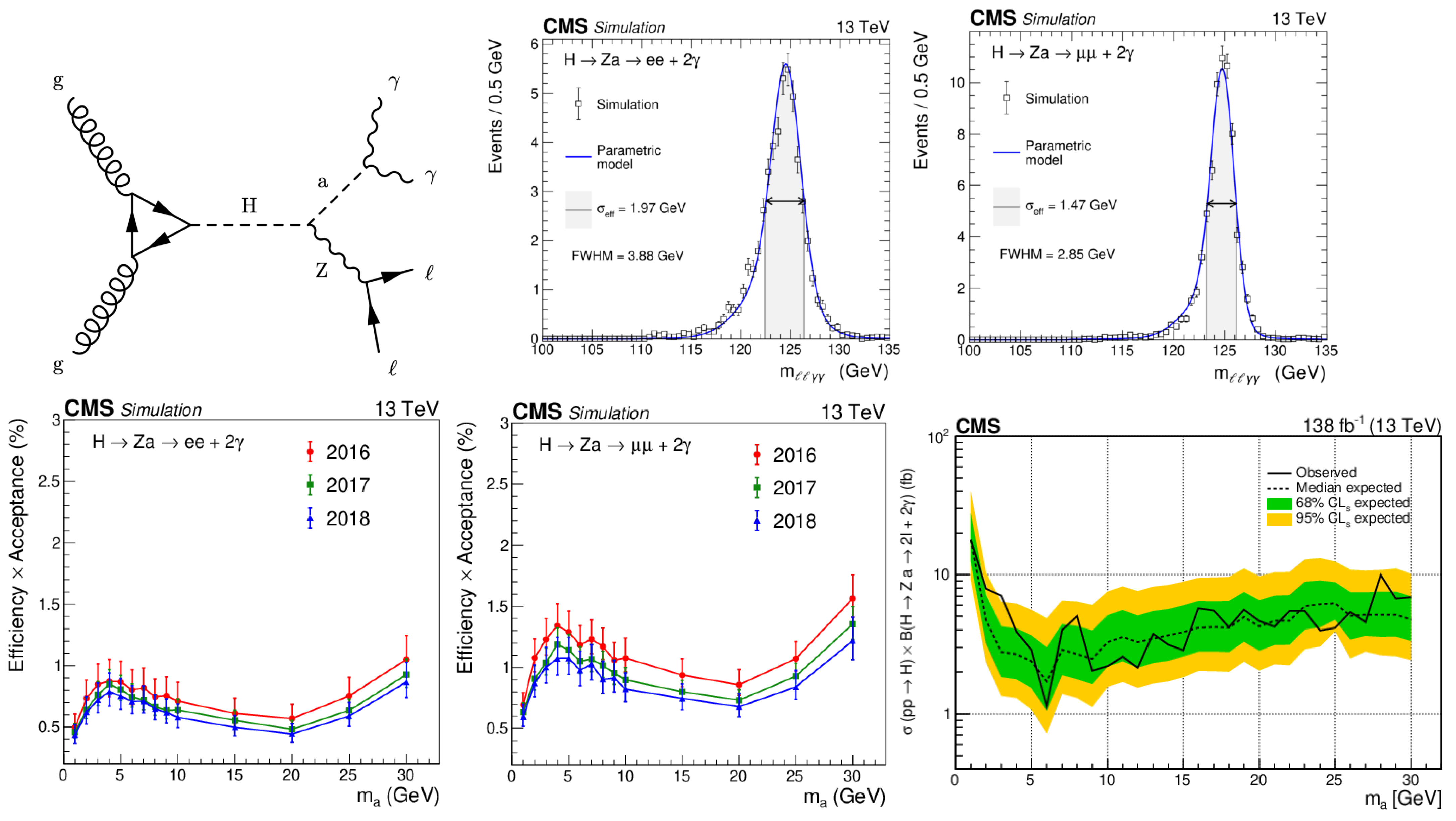
An elegant solution to the strong problem by Roberto Peccei and Helen Quinn [35] is the introduction of a spontaneously broken U(1) symmetry leading to new light pseudoscalar particles—the axions—that couple very weakly to photons. At LHC, a search for the production of axion-like pseudoscalar particles in the decay with , where and , is reported. Figure 24 shows simulated and signals (Figure 24, upper middle and upper right), efficiency times acceptance (Figure 24, lower left and lower middle), and limits on the Higgs boson decay branching fraction (Figure 24, lower right). Limits on models involving axion-like particles, formulated as an effective field theory, were also reported in Ref. [36].
Figure 24.
Upper left: Feynman diagram for with , where and . Upper middle and right: simulated and signals [36]. Lower: efficiency times acceptance (left and middle) and limits on the Higgs boson decay branching fraction (right) [36]. Reproduced under the copyright permission from Elsevier.
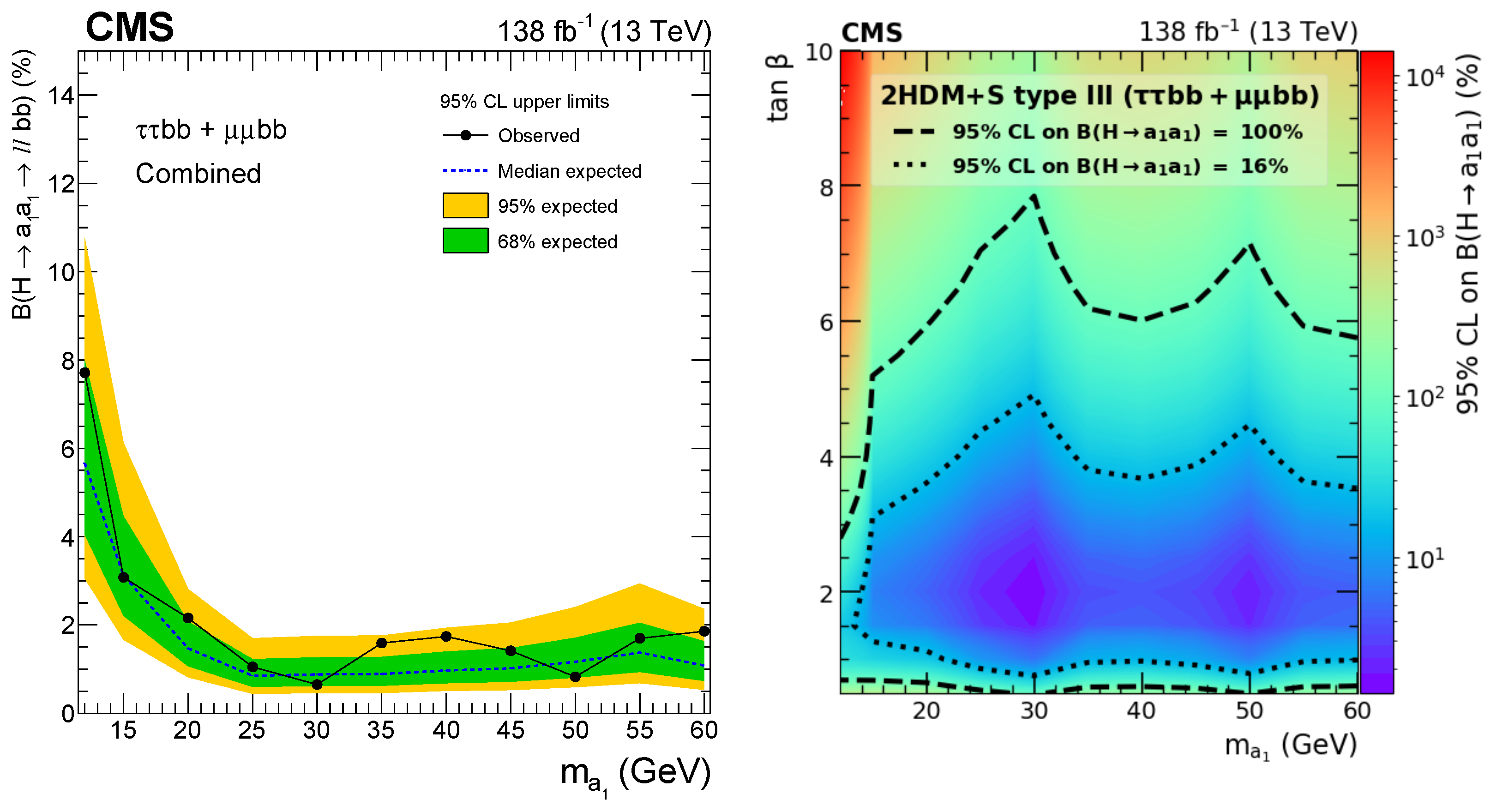
In models with two Higgs doublets extended with a scalar singlet (2HDM+S), the decay and may exist. Figure 25, left, shows limits on the Higgs boson decay branching ratio and Figure 25, right, the limits in the parameter space [37].
Figure 25.
Left: limits on the Higgs boson decay branching ratio [37]. Right: limits in the parameter space [37]. Reproduced under the copyright permission from Springer.
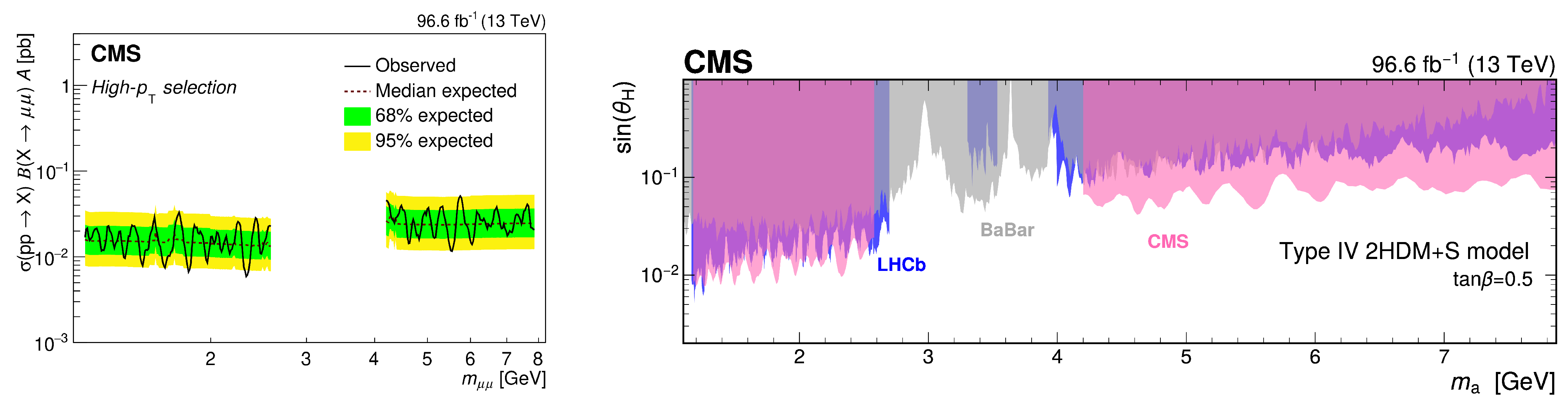
In the 2HDM+S framework, low-mass di-muons are predicted . For setting limits, is assumed, and , where ), with acceptance A. No significant excess of events above the expectation from the SM background was observed [38], and the resulting limits are compared to previous limits from LHCb [39] and BaBar [40] experiments. Figure 26, left, compares the observed and the expected limits on the production cross-section times branching ratio times acceptance and Figure 26, right, shows the limit on the mixing angle [38].
Figure 26.
Left: observed versus expected limits at 95% CL on the production cross-section times branching ratio times acceptance [38]. Right: limits at 90% CL on the mixing angle [38] compared to previous limits from LHCb [39] and BaBar [40] experiments. Reproduced under the copyright permission from Springer.
Low-mass spin-0 particles can decay promptly to a closely separated photon pair that is reconstructed as a single photon-like object, . Figure 27, left, compares the number of events for data, the simulated signal and background and Figure 27, right, represents the resulting limits on the branching ratio BR [41].
Figure 27.
Left: number of events for data versus the simulated signal and background [41]. Right: limits on the Higgs boson decay branching ratio BR [41]. Reproduced under the copyright permission from the American Physical Society.
3. Enhanced Production Modes
BSM physics may enhance (or decrease) the production rates of Higgs bosons. This may lead to the observation of a SM reaction, where the SM predicts a rate below the sensitivity reach. Here, the measurements of () and signals are discussed.
3.1. Single Top Higgs
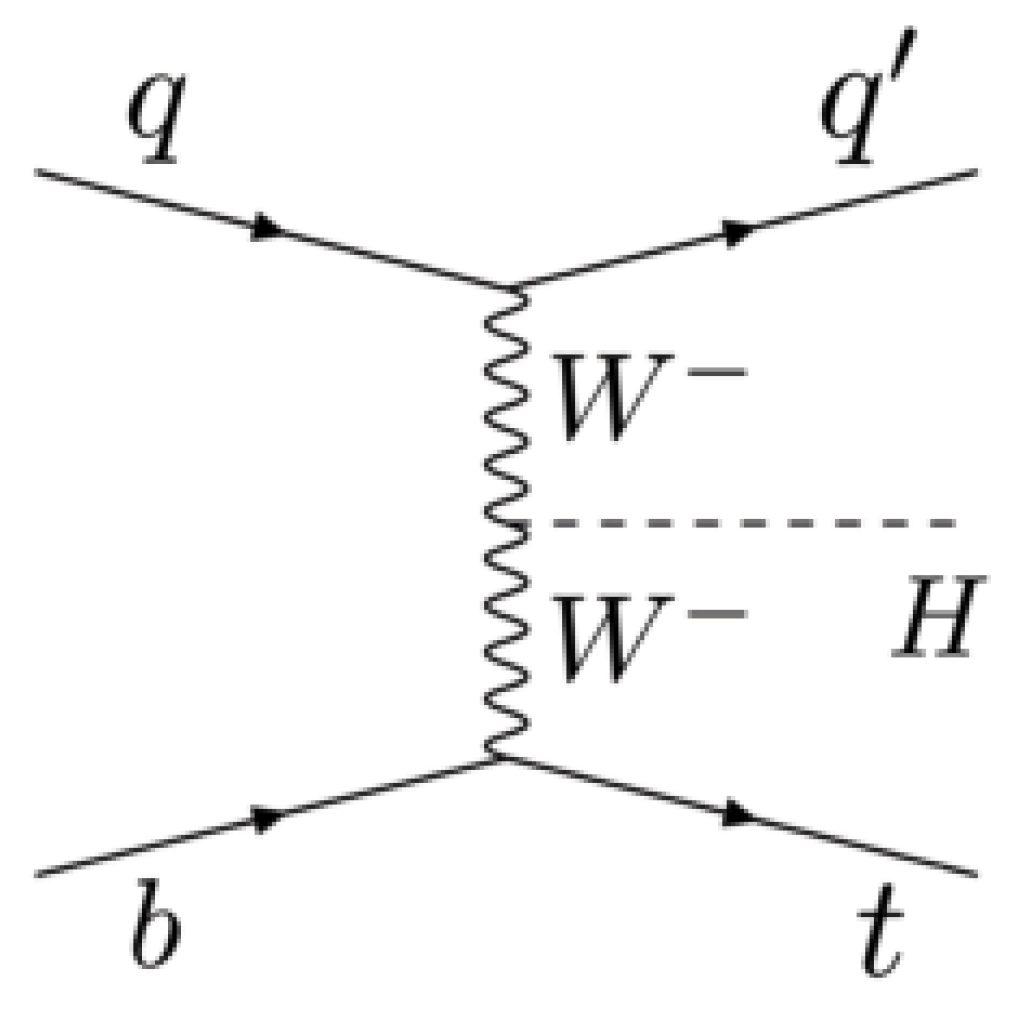
The expected production rate of and events with is different for -even and -odd and signals and, in particular, for the enhancement in the production BSM for the -odd case. Figure 28 shows a production Feynman diagram and Table 6 gives the expected number of and events for -even and -odd signals. The measured mixing angle between -even and -odd couplings is compatible with zero: degrees [42].
Figure 28.
production Feynman diagram.
Table 6.
ATLAS expected number of and events for -even () and -odd () signals. The signals are given for unity coupling strength and post-fit coupling strength 0.84 [42].
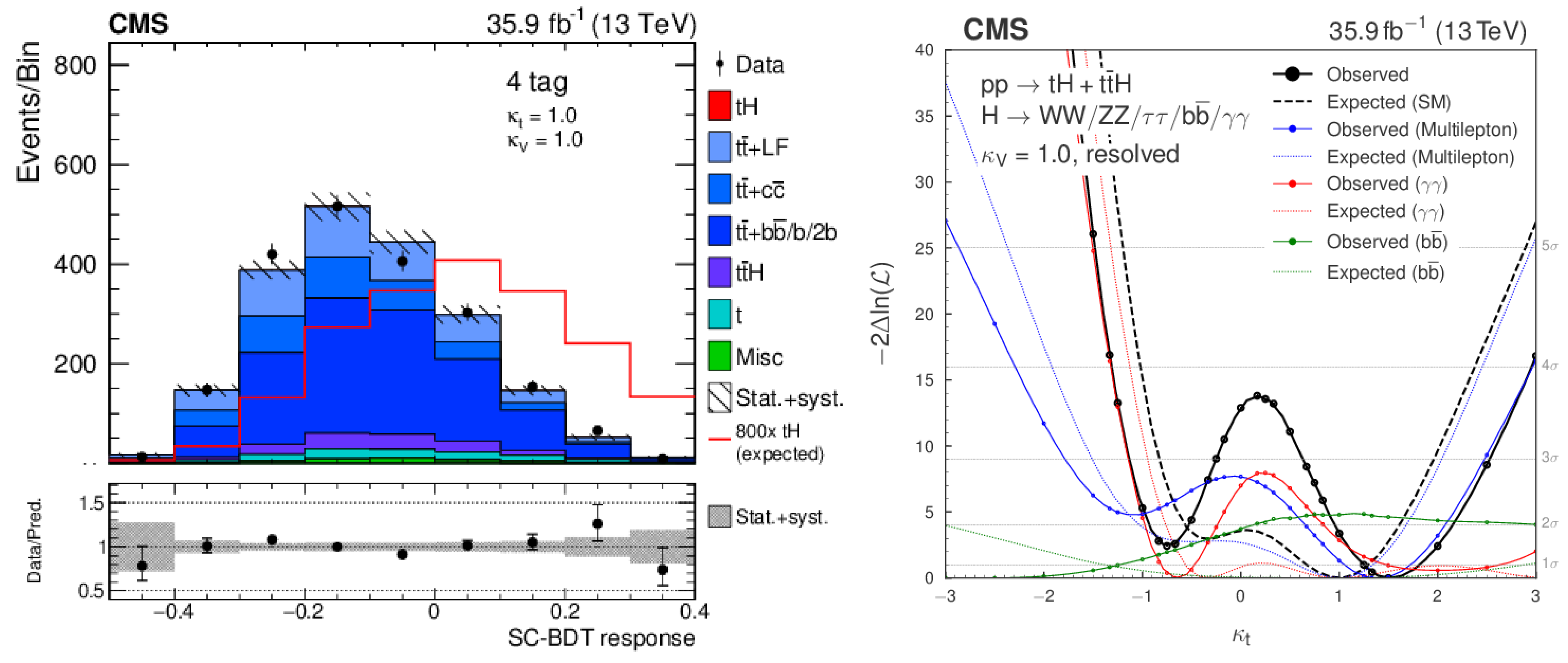
The single top and Higgs boson production: , where and , is combined with the production [43]. Since the production is sensitive to the absolute values of the top quark Yukawa coupling, the Higgs boson coupling to vector bosons, , and, uniquely, their relative sign, are studied. The data favor over for the coupling modifier by more than 1.5 s.d. Figure 29, left, shows a distribution of data along with the simulated background and signal, for and , in addition to the measured likelihood as a function of (Figure 29, right).
Figure 29.
Left: signal classification BDT (SC-BDT) for data, simulated background, and signal for [43]. Right: measured likelihood as a function of [43]. Reproduced under the copyright permission from the American Physical Society.
The single top and Higgs boson production has also been analyzed with combined decays. The normalization is kept fixed in the fit to the SM expectation, while the signal strength is allowed to float. Discrepancies between observed and expected limits at are caused by the predicted vanishing while the data favor even larger than expected yields for production. Figure 30, left, compares the measured and couplings with those from the SM expectations and Figure 30, right, shows the measured likelihood as a function of [44]. An upper limit at 95% CL on the production rate of 14.6 times the SM expectation is observed, with an expectation of [44].
Figure 30.
Left: measured and signal strengths compared to the SM expectations [44]. Right: measured likelihood as a function of . The SM value is outside the two standard deviation confidence interval [44]. Reproduced under the CC-BY-4.0 license.
3.2. Di-Higgs, ,
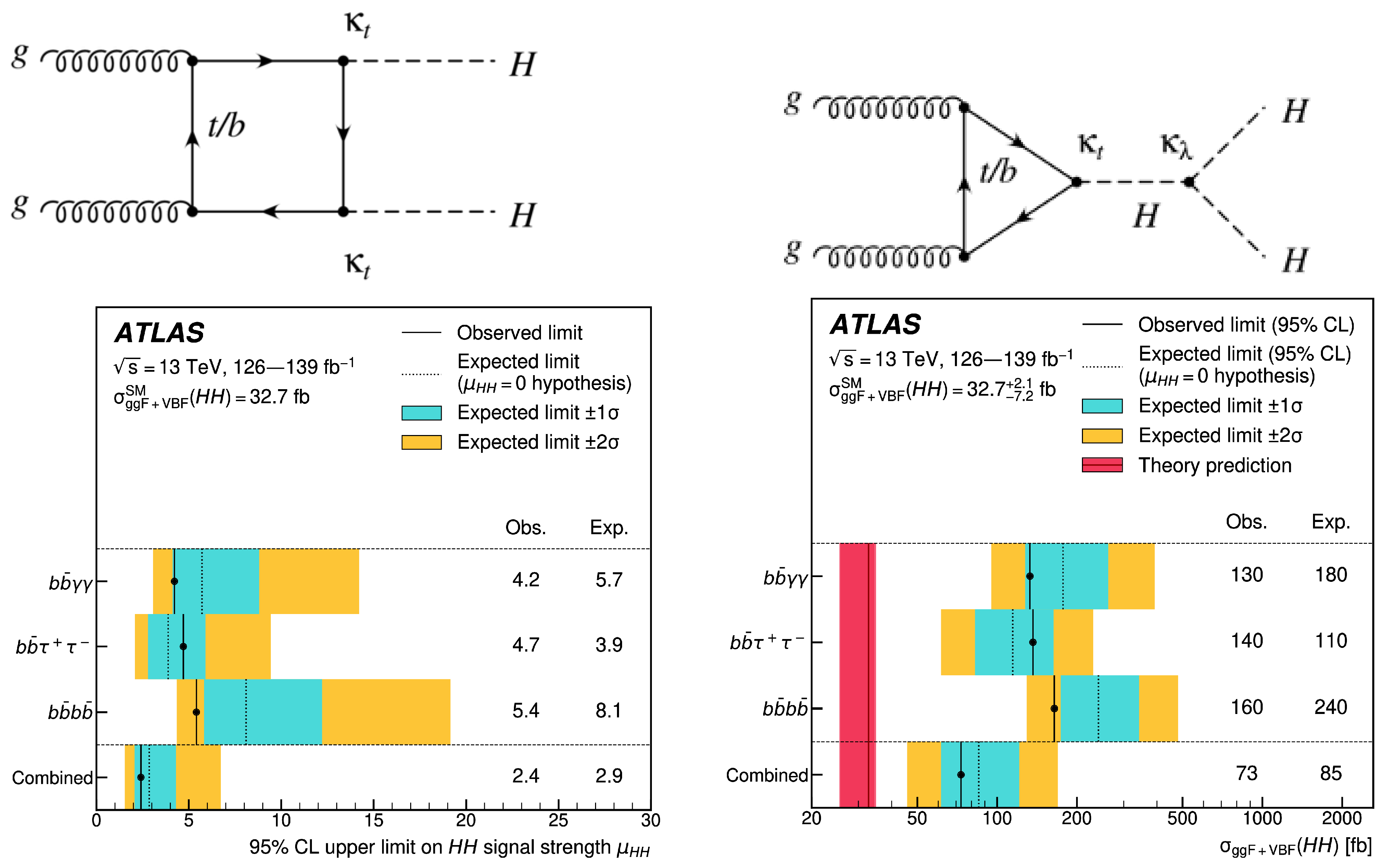
The parameter is the trilinear coupling modifier. Its value is left free in the fit to the recorded data, and in the SM, . Upper limits are set on the production signal strength, including the data from several final states at 2.4 (2.9 exp.) and on the coupling modifier at 95% CL [45,46]. Figure 31, upper, shows the dominant Feynman diagrams of production, while Figure 31, lower left, shows the upper limits on the signal strength with respect to the SM + induced production, and Figure 31, lower right, the upper limits on the cross-section of the and productions of [45].
Figure 31.
Upper: Feynman diagrams of production. Lower: upper limits (left) on the signal strength with respect to the SM + induced production and (right) on the cross-section of the and productions of [45]. Reproduced under the copyright permission from Elsevier.
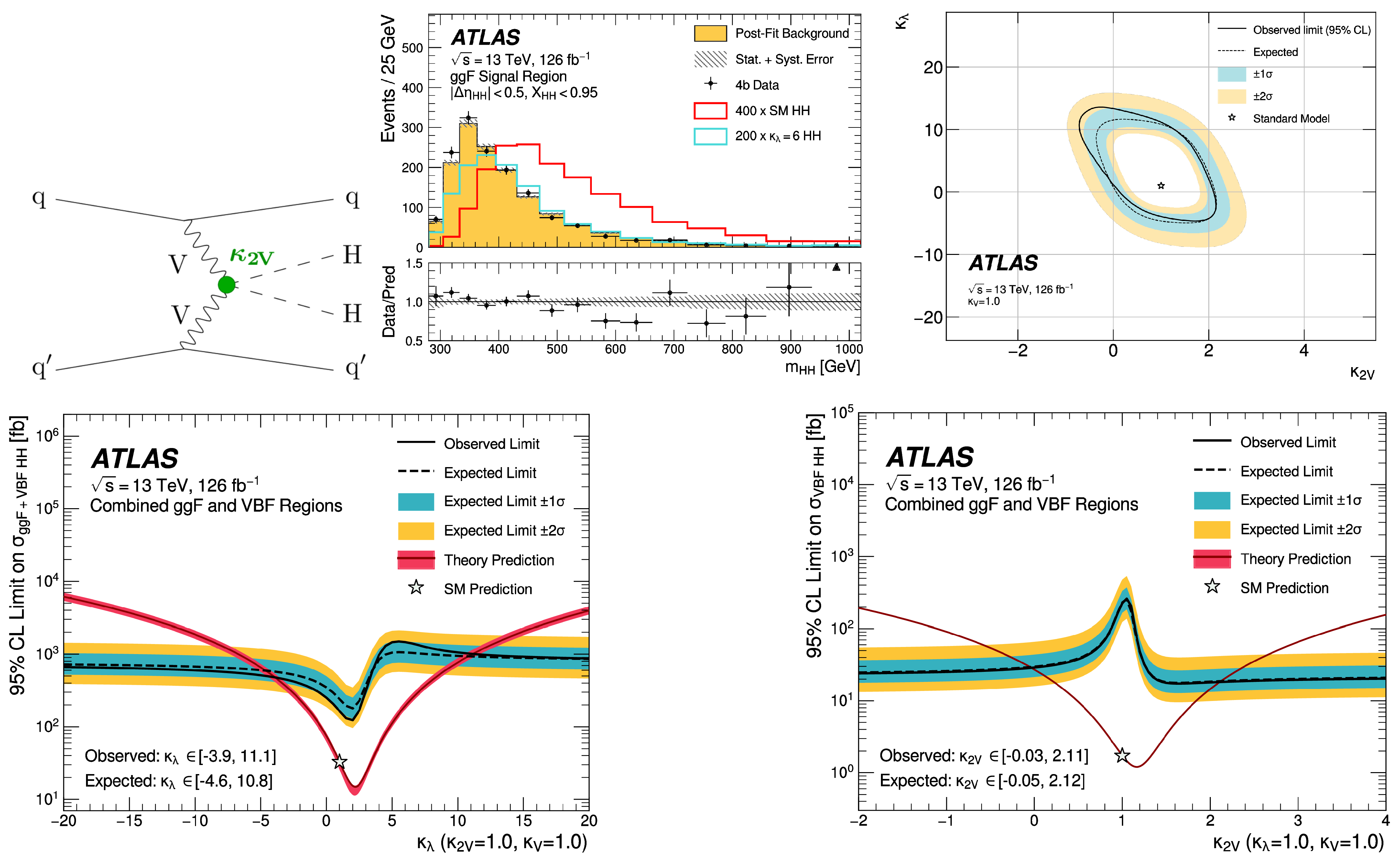
Observed and expected limits on the coupling modifier are set at 95% CL based on only the final state and considering both in [−3.5, 11.3] ([−5.4, 11.4] exp.) and in [−0.0, 2.1] ([−0.1, 2.1] exp.) intervals. Limits are also set on the production cross-section in seven Higgs effective field theory benchmark scenarios [47]. Figure 32, upper left, shows a Feynman diagram for scattering. Figure 32, upper middle and upper right, shows the data compared to simulated background and signal and the limits on the and plane, respectively. Figure 32, lower left and right, shows the limits on the + production cross-sections as a function of and , respectively. The SM predictions and are in the measured ranges.
Figure 32.
Upper left: Feynman diagram for scattering. Upper middle: data, simulated background, and signal [47]. Upper right: limits on the and plane [47]. Lower: limits on the and + production cross-sections as a function of (left) and (right) [47]. See text for details. Reproduced under the copyright permission from the American Physical Society.
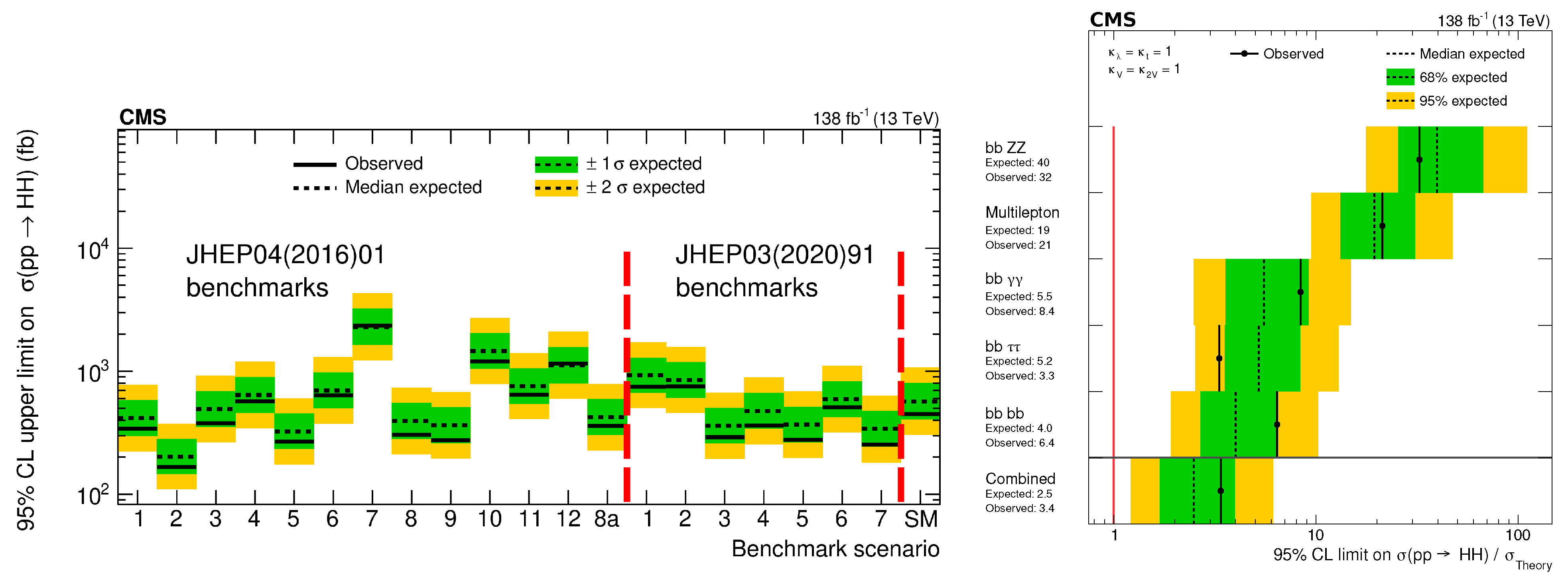
The production of is constrained to be less than 14 (18 exp.) times the SM expectation at 95% CL [48]. In the Higgs effective field theory (HEFT) parameterization, limits are set for benchmark scenarios. In addition, the production , is constrained at 3.4 (2.5 exp.) times the SM expectation at 95% CL [12]. Figure 33, left, shows limits on the production cross-section for benchmark scenarios [48], in agreement with the expectations, along with the combined limits on the production cross-section compared to the SM expectation in Figure 33, right [12].
Figure 33.
Left: limits on the production cross-section for benchmark JEHP03, JHEP04 and SM scenarios [48]. Right: individual and combined limits on the production cross-section compared to the SM expectation [12]. Reproduced under the copyright permission from Springer (left) and Springer Nature (right).
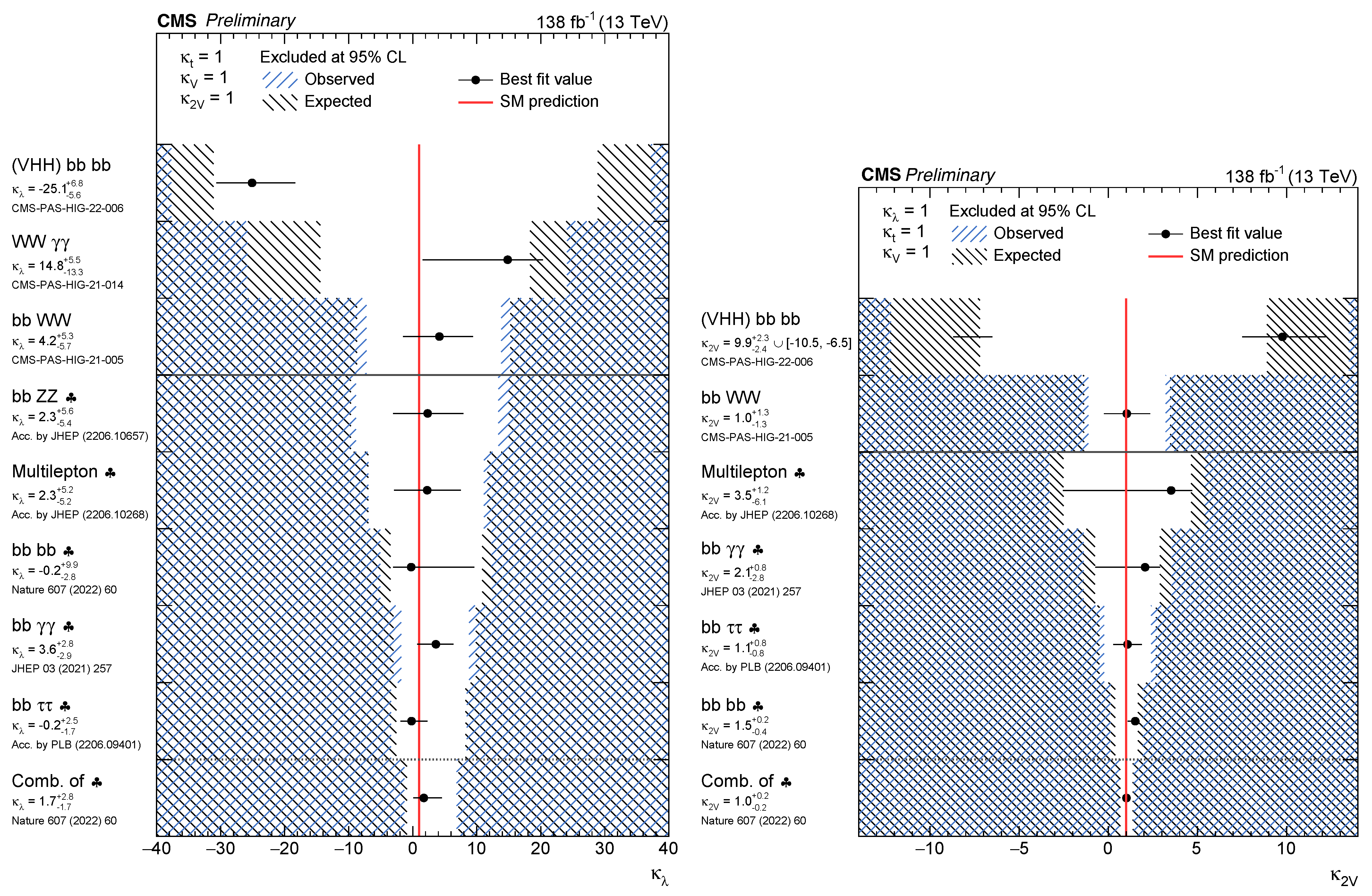
An overview of the and measurements is given in Figure 34 [49], left and right, respectively. is excluded with 6.6 s.d., and this establishes the existence of the quartic coupling VVHH, assuming . Values of outside the interval are excluded at 95% CL [50].
Figure 34.
(left) and (right) measurements [49] (CMS public results). Reproduced under the CC-BY-4.0 license.
4. Higgs Boson Resonances
4.1.
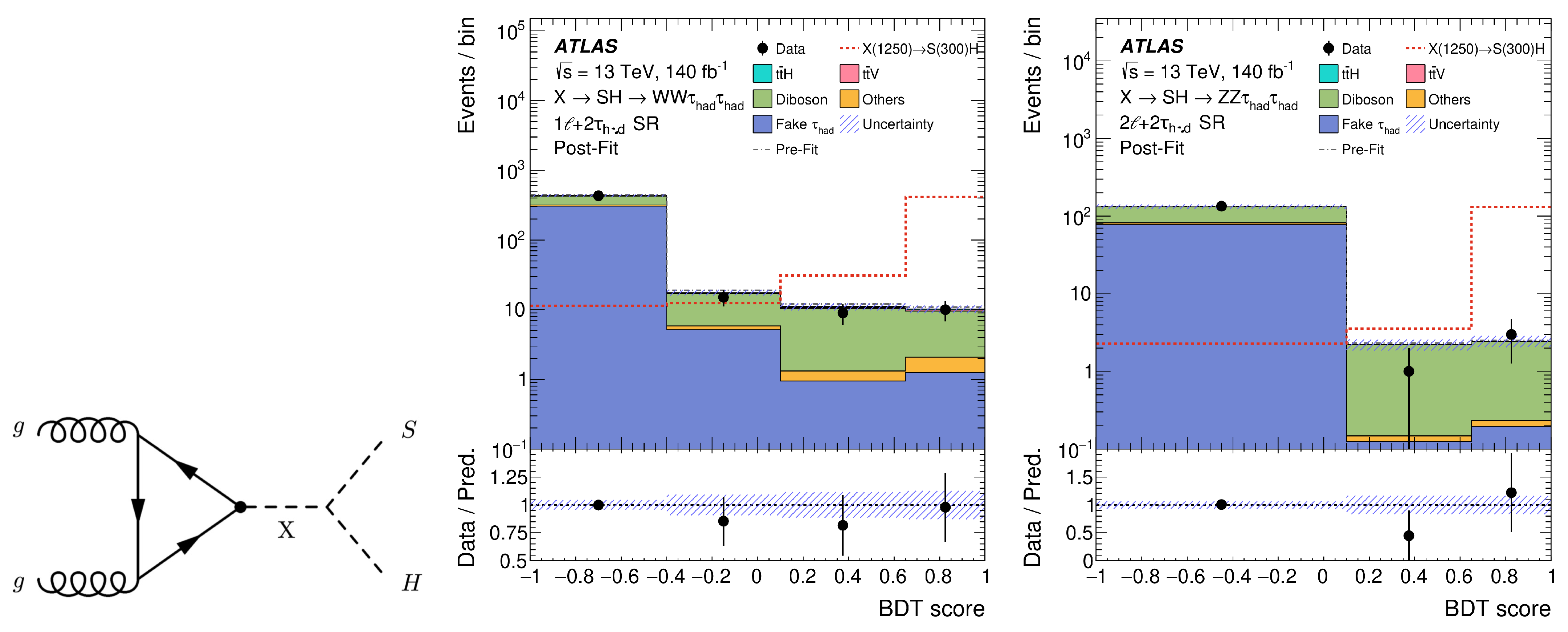
A search for a new heavy scalar X decaying into a Higgs boson and a new scalar singlet S, , was performed in the mass range 500 GeV–1500 GeV for X and in the mass range 200 GeV–500 GeV for S. The Higgs boson decays into a pair of leptons, and the S decays into pairs and , which subsequently decay into light leptons. No signal has been observed [51]. Figure 35, left, shows a Feynman diagram for the SH production, while Figure 35, middle and right, shows simulated background plus signal as a function of the BDT score for and , respectively.
Figure 35.
Feynman diagram for the production (left); data, simulated background, and signal as a function of the BDT score for (middle) and (right) [51]. Reproduced under the copyright permission from Springer.
4.2.
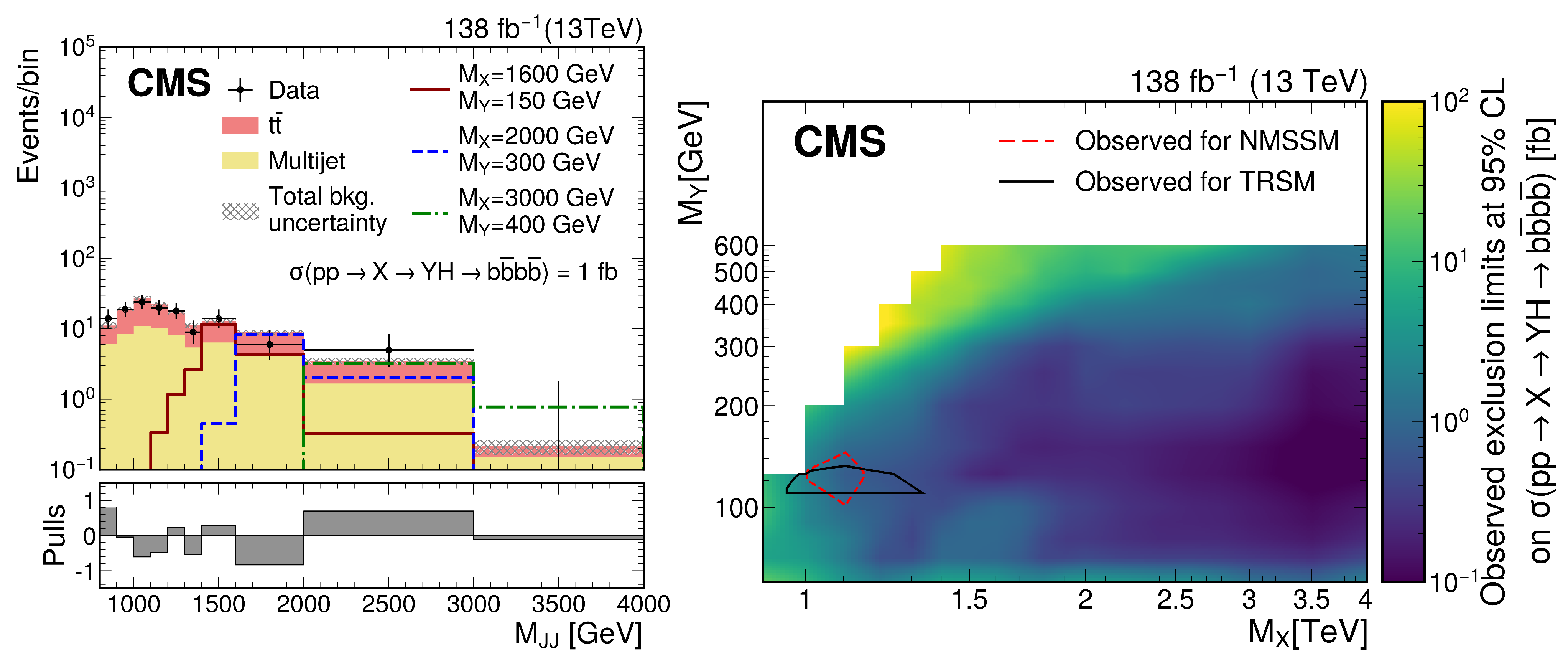
The search for the process has been performed for the mass ranges 0.9 TeV–4.0 TeV for X and 60 GeV–600 GeV for Y scalars [52]. For the interpretations, there are the two-real-scalar-singlet extension of the SM (TRSM) and the next-to-minimal model (NMSSM). Figure 36 [52] shows the invariant mass, , the distribution of the two leading- jets in the event for the data, the simulated background and signals (Figure 36, left), and the observed exclusion limits in the mass parameter space and at 95% CL (Figure 36, right). Both Y and H are reconstructed as Lorentz-boosted single large-area substructure jets J.
Figure 36.
Left: data, simulated background, and signals [52]. Both Y and H are reconstructed as Lorentz-boosted single large-area substructure jets J. Right: observed exclusion limits in the mass parameter space and at 95% CL [52]. Reproduced under the copyright permission from Elsevier.
4.3.
A summary of resonance searches and resulting limits are given in Figure 37 [53,54]. The ATLAS experiment sets upper limits on the production cross-section of a heavy scalar resonance decaying to two SM Higgs bosons at 95% CL between 0.96 and 600 fb (1.2 and 390 fb) in observation (expectation) [53], while CMS experiment sets the limit between 0.1 and 150 fb, depending on the X mass [54].
Figure 37.
Summary of resonance searches and resulting limits by the (left) ATLAS [53] and (right) CMS [54] experiments. Reproduced under the copyright permission from the American Physical Society (left) and under the CC-BY-4.0 license (CMS public results; right).
5. Additional Neutral Higgs Bosons
5.1. SM-like Higgs Boson in the 70 GeV to 110 GeV Mass Range Decay
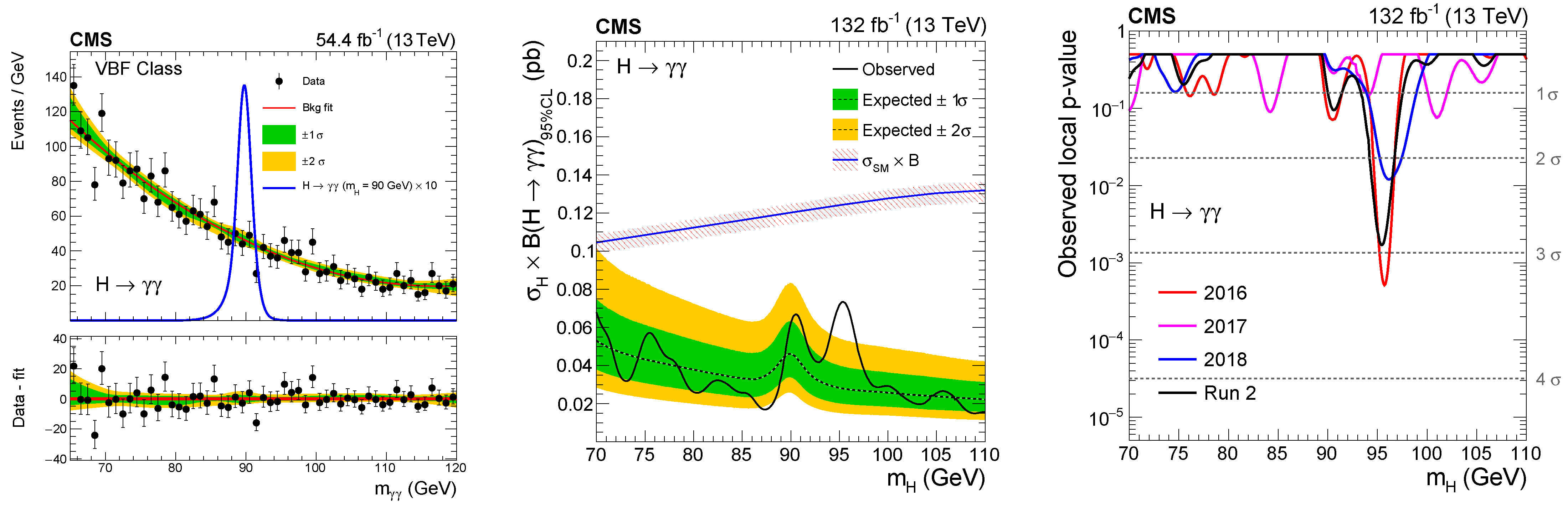
The search for a SM-like Higgs boson in the 70 GeV to 110 GeV mass range was performed in 36.3 fb−1, 41.5 fb−1 and 54.4 fb−1 data from 2016, 2017, and 2018 data samples, respectively. The observed upper limit for the combined dataset ranged from 73 fb to 15 fb [55]. An excess with s.d. local ( s.d. global) significance was observed for a mass hypothesis of 95.4 GeV. Figure 38 shows the di-photon invariant mass distribution (Figure 38, left), resulting limits on the SM Higgs boson production times decay branching ratio into di-photons (Figure 38, middle), and local probability p-values as a function of the Higgs boson mass (Figure 38, right) [55]. No significant excess was observed by the ATLAS Collaboration [56] with 1.7 s.d. at 95.4 GeV. Earlier, an excess in combined LEP data was noted in the mass range of 90 GeV–100 GeV [57] of 2.3 s.d.; such an excess may be accommodated in a MSSM parameter scan [58].
Figure 38.
Left: di-photon invariant mass distribution [55]. Middle: limits on the SM Higgs boson production times decay branching ratio into di-photons [55]. Right: local probability p-values as a function of the Higgs boson mass [55]. Reproduced under the CC-BY-4.0 license.
5.2. Heavy Higgs Bosons in
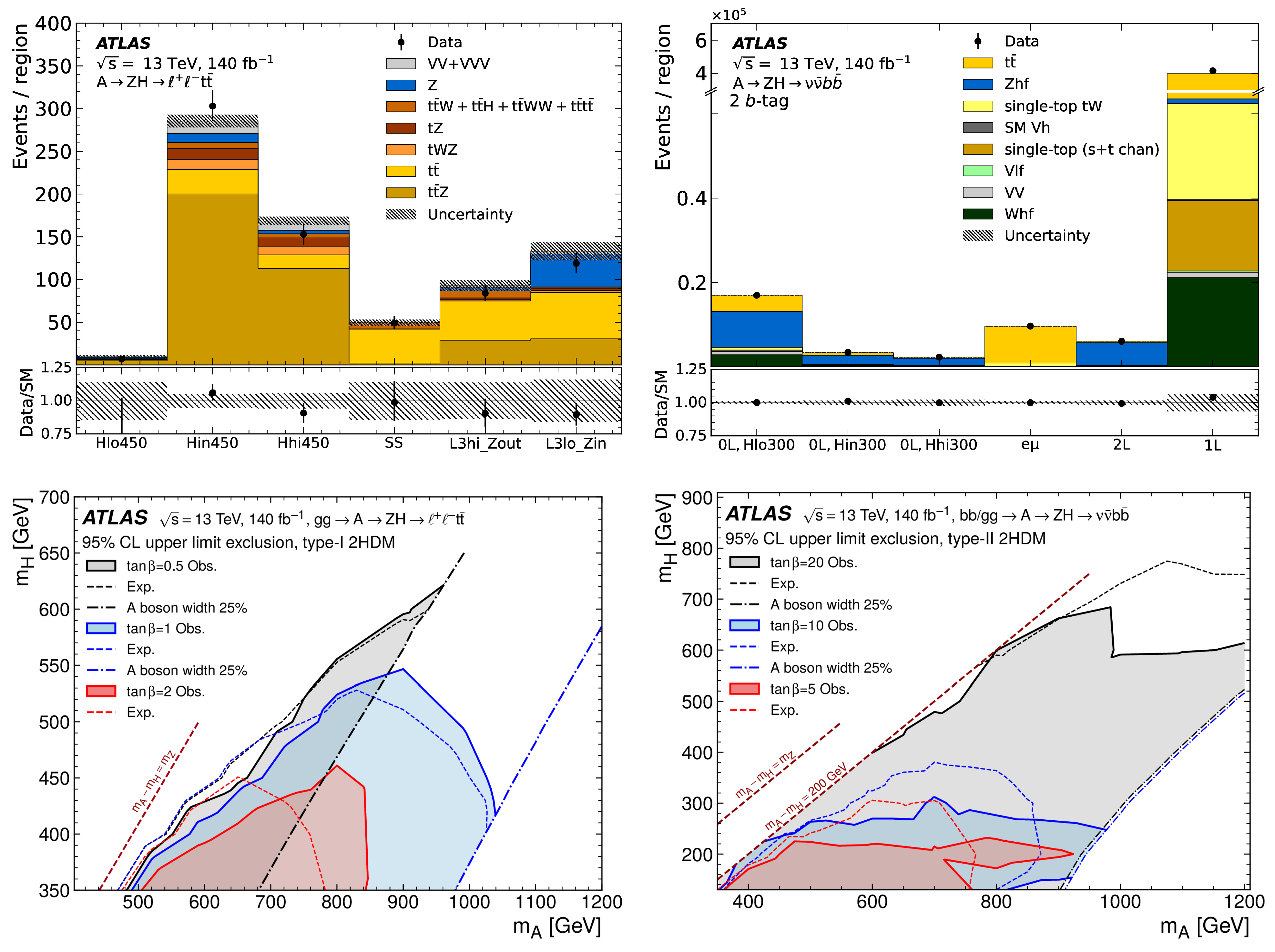
In the 2HDM, as well as the mass ranges GeV, GeV have been investigated [59]. The search final states are and . Figure 39, upper left and right, shows the data, as well as the simulated background and signal distributions, for and final states, respectively, and Figure 39, lower, the resulting limits at 95% CL in the mass parameter space [59].
Figure 39.
Upper: data, simulated background and signal distributions for (left) and (right) final states space [59]. Lower: Resulting limits at 95% CL in the parameter space [59]. Reproduced under the copyright permission from Springer.
5.3. Heavy Higgs Bosons in
A search for and was performed at LHC. This resulted in limits at 95% CL on and [60]. Figure 40, left, shows a Feynman diagram for the and production, and a simulated signal, and limits on the production cross-section are shown in Figure 40, middle and right, respectively.
Figure 40.
Left: Feynman diagram for the and production. Middle: simulated signal [60]. Right: limits on the production cross-section [60]. Reproduced under the CC-BY-4.0 license.
5.4. Heavy Higgs Bosons in
A search for , was performed, where the vector boson decays , with . Interpretations have been given in the 2HDM with free parameters , , the ratio of the vacuum expectation values of the two Higgs doublets , and the Higgs boson coupling factor [61]. Figure 41 shows the Feynman diagram for the , production (Figure 41, upper left) along with the limits in the parameter space and on the production cross-sections and times branching ratio of (Figure 41, upper right, lower left and right, correspondingly) [61].
Figure 41.
Feynman diagram for the , production (upper left) and the limits [61]. in the parameter space (see text for details) (upper right) and on the production cross-sections (lower left) and (lower right) times branching ratio of . Reproduced under the copyright permission from Springer.
5.5. Heavy Higgs Bosons in
The search for a heavy Higgs boson in was performed in same-sign two-lepton final states (SS2l). Events with two leptons (electrons or muons) of the same electric charge and missing transverse momentum, as well as jets, are selected. The results are interpreted in models with higher-dimensional operators in an effective field theory [62,63]. Figure 42, upper left, shows a Feynman diagram for the heavy Higgs boson production, with in same-sign two-lepton final states, while Figure 42, upper middle and right, shows the data, simulated background and signals for lepton transverse momentum and the three-lepton invariant mass distribution, respectively, along with the limits on the production cross-section and in the parameter plane ) in Figure 42, lower left and right, respectively, where and are anomalous couplings to the W field.
Figure 42.
Upper: Feynman diagram for heavy Higgs boson production, with in same-sign two-lepton final states (left), data, simulated background, and signals [63] for lepton transverse momentum (middle) and for three-lepton invariant mass distribution (right). Lower: limits on the production cross-section (left) and in the parameter plane (right) [63]. See text for details. Reproduced under the copyright permission from Springer.
5.6. Heavy Higgs Bosons in : Multi-Lepton Final States
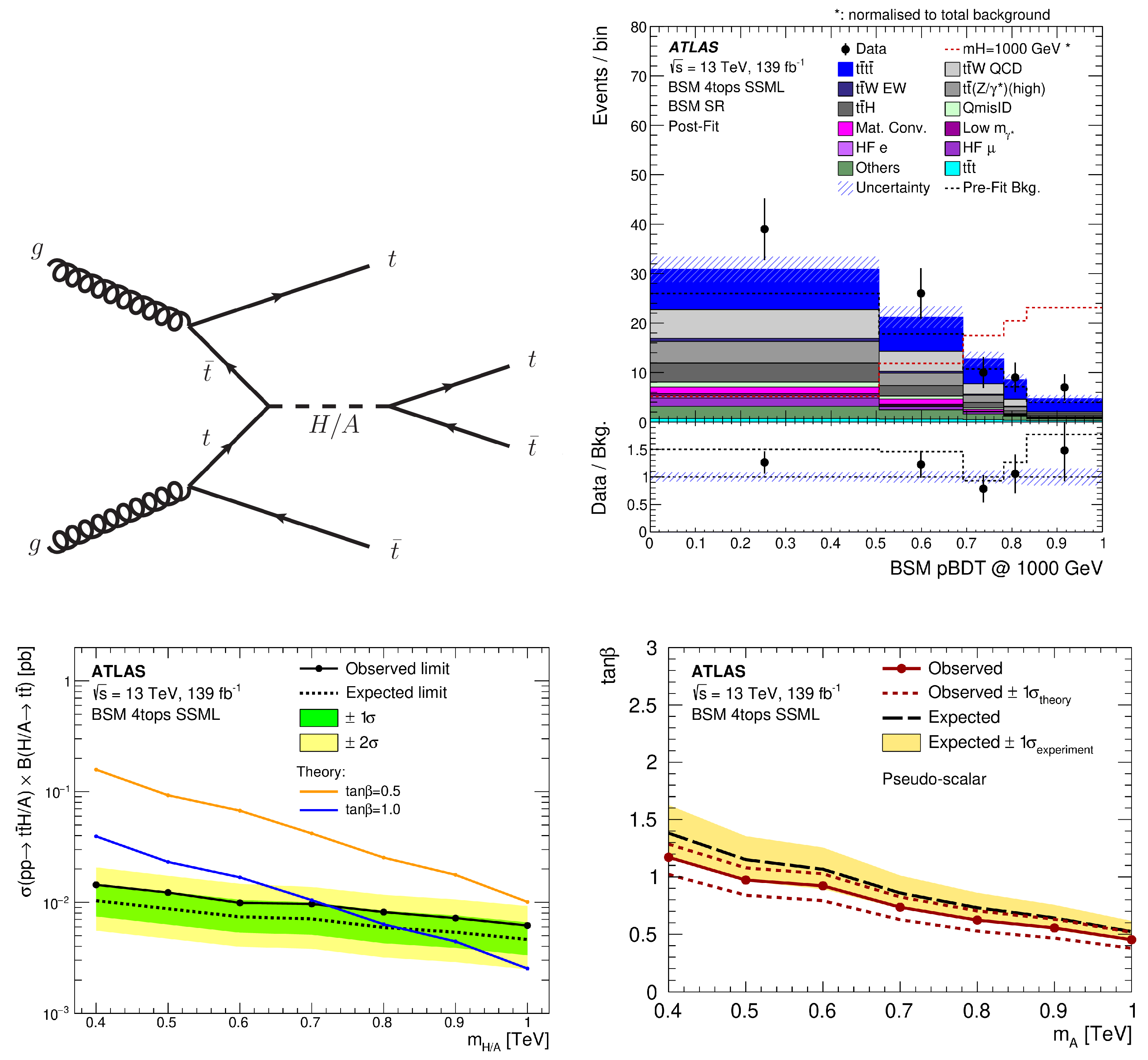
In the search for multi-lepton final states, exactly two leptons with same-sign electric charges or at least three leptons are required [64]. In the 2HDM (Type-2), are excluded for Higgs boson mass 400 (1000) GeV. Figure 43, upper left, shows a Feynman diagram for the production, while the data, simulated background, and a signal as a function of the BDT score, along with the limits on the production cross-section times the branching ratio and in the () are shown in Figure 43, upper right, lower left and lower right, respectively.
Figure 43.
Feynman diagram for the production (upper left); data, simulated background and a signal (upper right) along with limits on the production cross-section times the branching ratio (lower left) and exclusion limits in the parameter planes (lower right) [64]. Reproduced under the copyright permission from Springer.
5.7. Heavy Higgs Bosons in
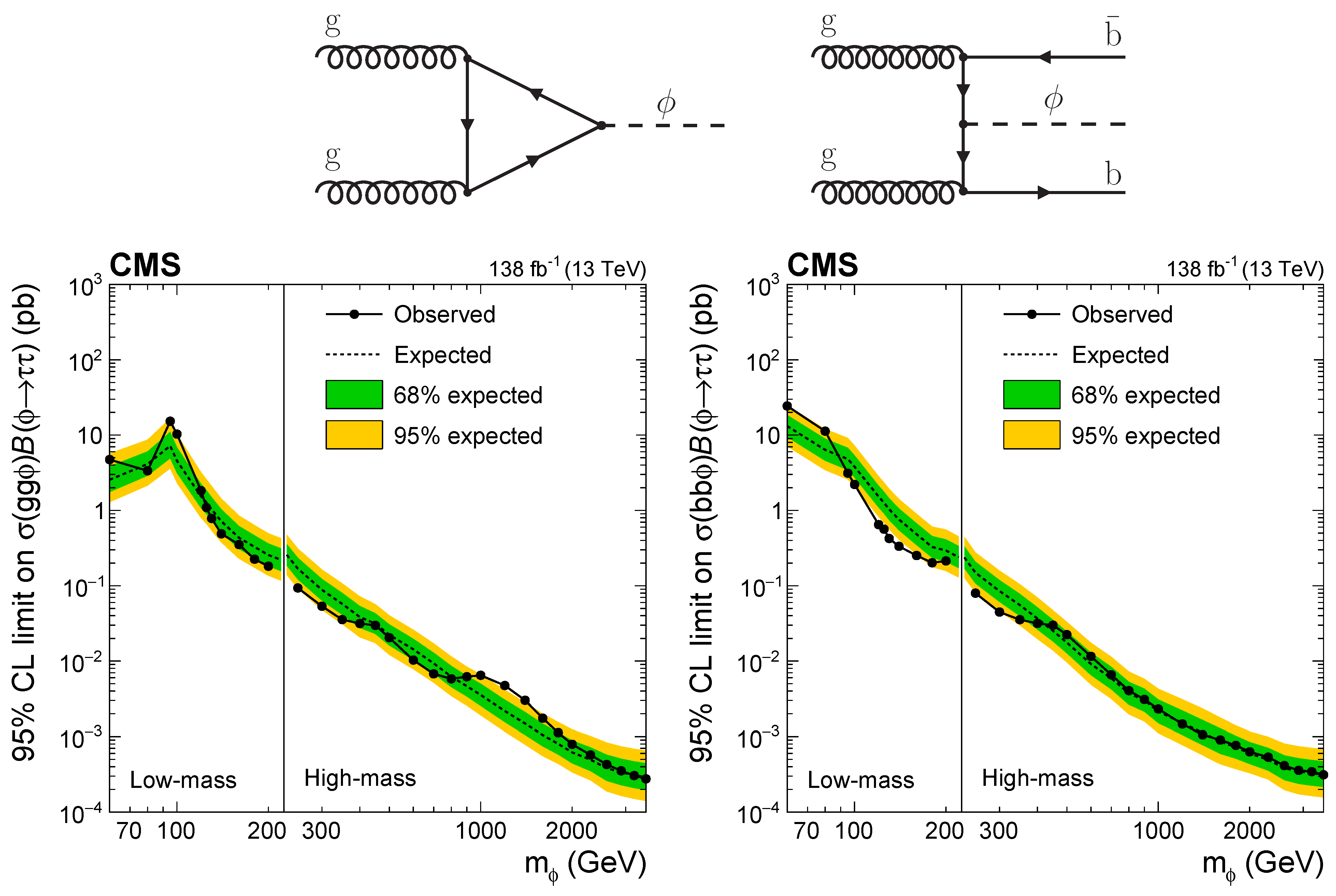
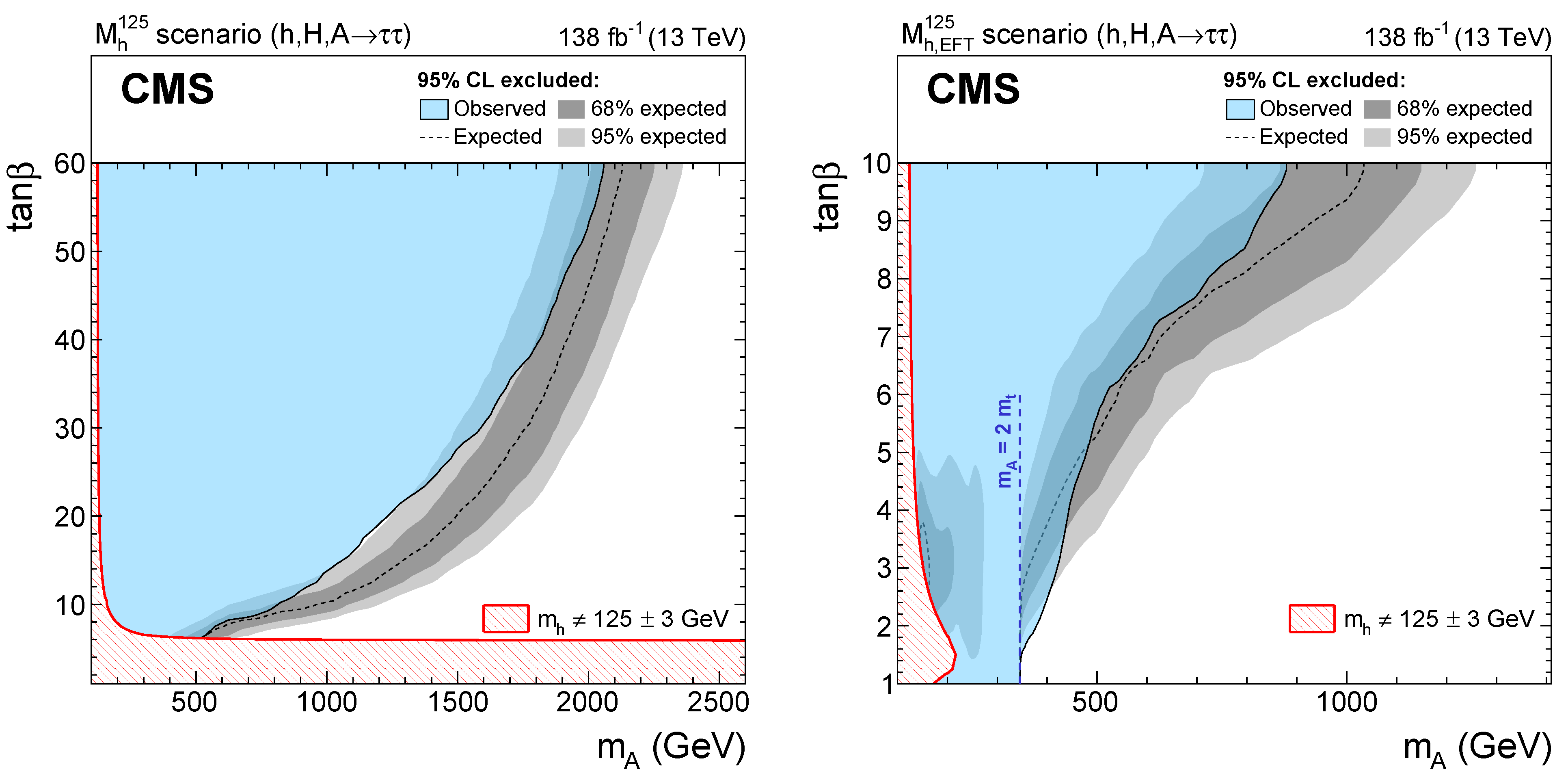
The search for a heavy neutral Higgs boson with was performed in final states [65]. Upper limits at 95% CL are set on the products of the branching fraction for the decay into tau leptons and the cross-sections for the production of a new boson , in addition to the H(125) boson, ranging from (10 pb) for a mass of 60 GeV to 0.3 fb for a mass of 3.5 TeV. Figure 44 shows Feynman diagrams for the (Figure 44, upper left) and (Figure 44, upper right) production, the limits on the cross-section of and production times branching ratio for (Figure 44, lower left and right, respectively) [65], along with the limits on benchmark scenarios of the MSSM that rely on the signal from three neutral Higgs bosons, one of which is associated with H(125). Expected and observed 95% CL exclusion contours are also set in the MSSM M125 and M125(EFT) scenarios, as shown in Figure 45 [65]. The data reveal two excesses, with local p-values equivalent to about three standard deviations at 0.1 and 1.2 TeV mass.
Figure 44.
Upper: Feynman diagrams for the (left) and (right) production. Lower: limits on the cross-section for (left) and (right) production times branching ratios of production [65]. Reproduced under the copyright permission from Springer.
Figure 45.
Expected and observed 95% CL exclusion contours for (left) MSSM M125 and (right) effective field theory M125(EFT) [65]. Reproduced under the copyright permission from Springer.
6. Higgs Bosons and Dark Matter
6.1. Dark Matter Produced in Association with a Higgs Boson Decaying into Taus
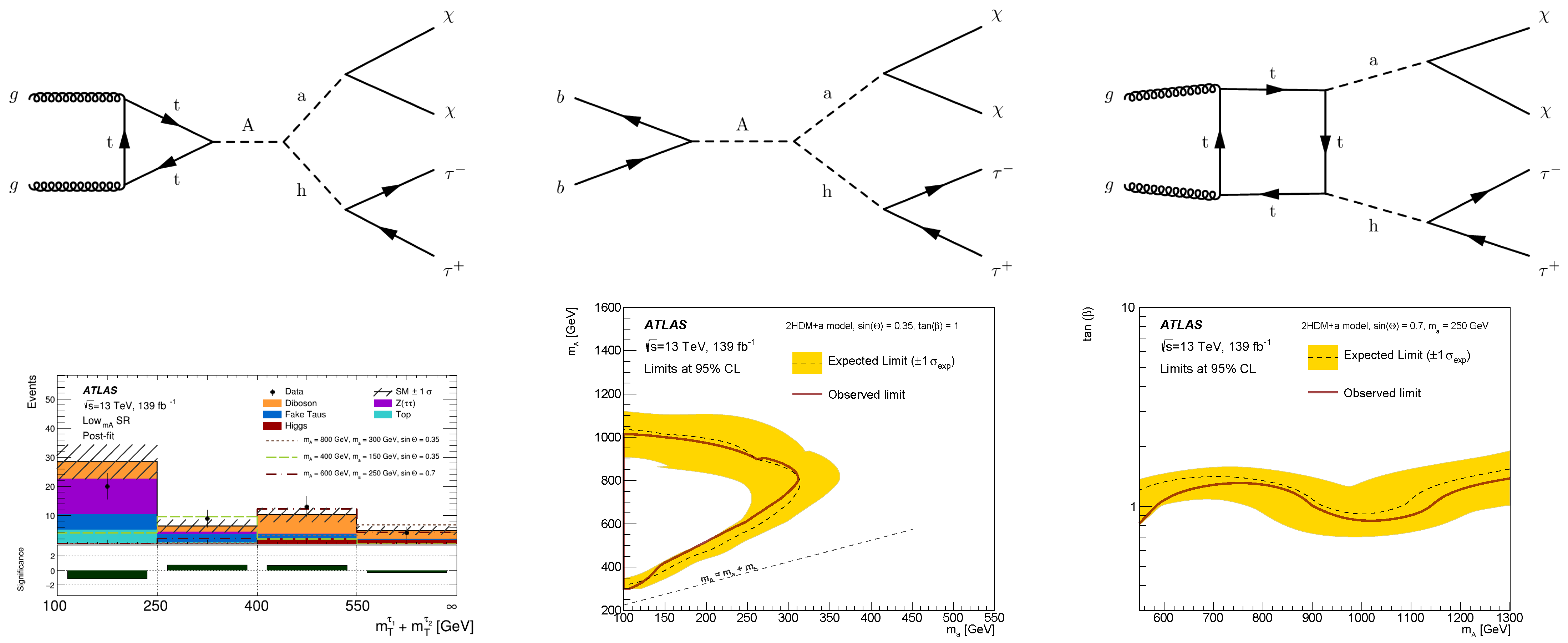
The search for DM considered to be produced in association with a Higgs boson decaying into s was performed with the final state of two hadronically decaying tau leptons and MET, . For the interpretation, the 2HDM+a was used [66]. Figure 46, upper, shows three production Feynman diagrams leading to DM and a pair of s and Figure 46, lower left, middle and right, shows the data, simulated background, and a DM plus s signal, along with the exclusion limits in the and parameter planes, respectively.
Figure 46.
Upper: production Feynman diagrams leading to DM and a pair of s. Lower: data, simulated background and a DM plus s signal (left), exclusion limits in the parameter plane (middle), and in the parameter planes (right) [66]. Reproduced under the copyright permission from Springer.
6.2. Dark Higgs Boson
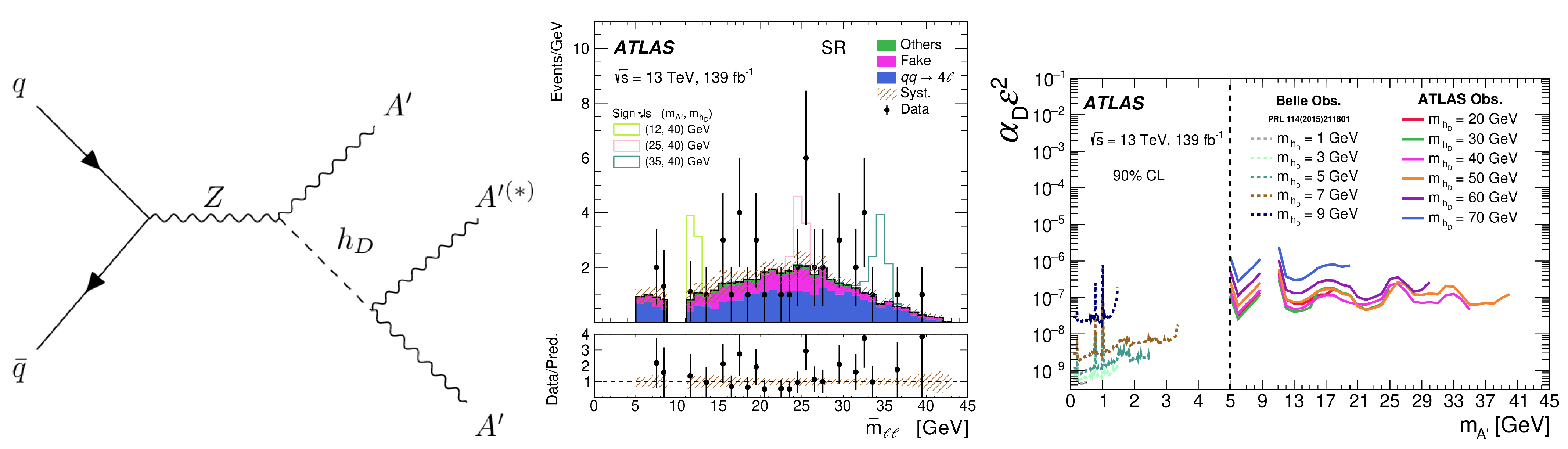
In the Dark Abelian Higgs model, an additional U(1)D gauge symmetry can lead to a dark photon, , that mediates the dark sector interactions with the SM. The U(1)D symmetry group is spontaneously broken by a Higgs mechanism, leading to A’, which acquires a mass by adding a dark Higgs boson, . The search for the process was performed, where two on-shell with were required. The new results [67] were compared with results from the Belle experiment [68]. Figure 47 shows a Feynman diagram of the signal (Figure 47, left), data and simulated background, and , where two on-shell , with a signal (Figure 47, middle) and the limits on the coupling as a function of [67] (Figure 47, right).
Figure 47.
Left: Feynman diagram of the production. Middle: data and simulated background as well as the signal, where two on-shell , with a signal [67]. Right: limits on the coupling as a function of [67]. Reproduced under the copyright permission from the American Physical Society.
6.3. Combination of Searches in the 2HDM and Dark Matter Searches
A combination of 2HDM and DM searches was performed at LHC. The most sensitive searches were plus leptonically decaying Z bosons, plus , and charged Higgs bosons with top and b-quarks decays [69]. Figure 48 shows the combined results as exclusion contours in the parameter space.
Figure 48.
Results from combination of searches in the 2HDM and dark matter searches [69]. Reproduced under the copyright permission from Elsevier.
7. Additional Charged Higgs Bosons
7.1. with , Where
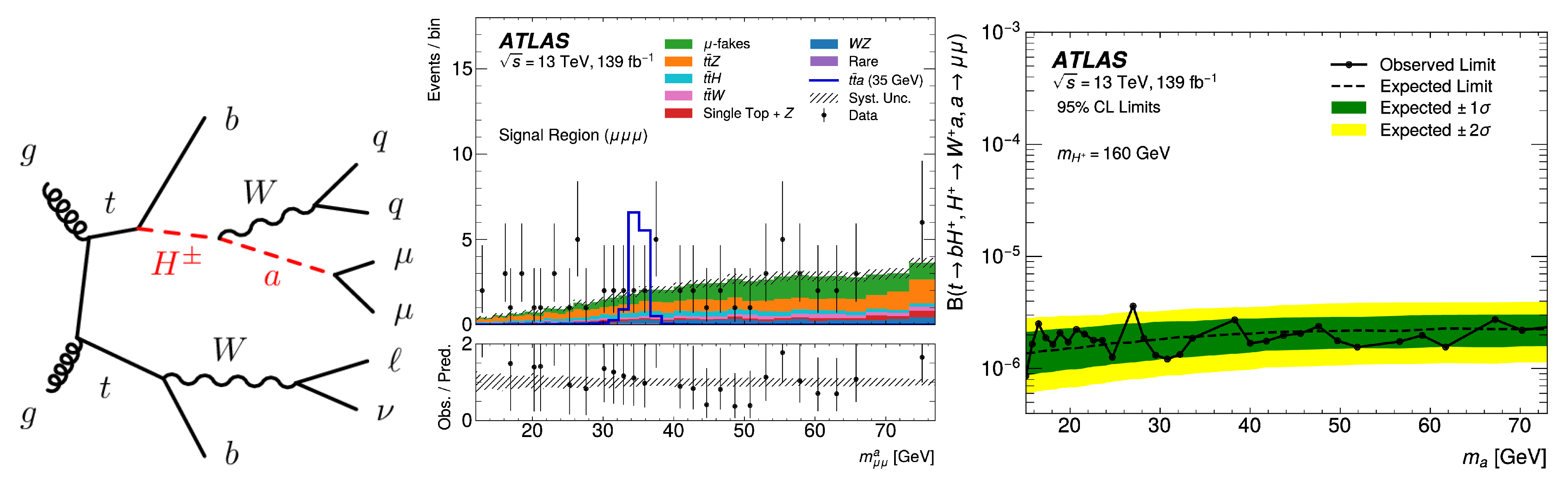
The search for the process with , where has been performed in the mass region GeV and GeV [70]. Figure 49 shows a Feynman diagram for the charged Higgs boson production (Figure 49, left) along with the data, simulated background, and signal for the di-muon invariant mass (Figure 49, middle), and limits on the top into charged Higgs boson b-quark decay branching ratio at 95% CL (Figure 49, right). No significant excess is observed, and the smallest local p-value is 0.008 at GeV, corresponding to a local significance of about 2.4 s.d. The slight excess was observed at GeV in both the e and channels [70].
Figure 49.
Left: Feynman diagram for the charged Higgs boson production. Middle: data, simulated background and a signal for the di-muon invariant mass [70]. Right: limits on the top into charged Higgs boson and b-quark decay branching ratio at 95% CL [70]. Reproduced under the copyright permission from the American Physical Society.
7.2.
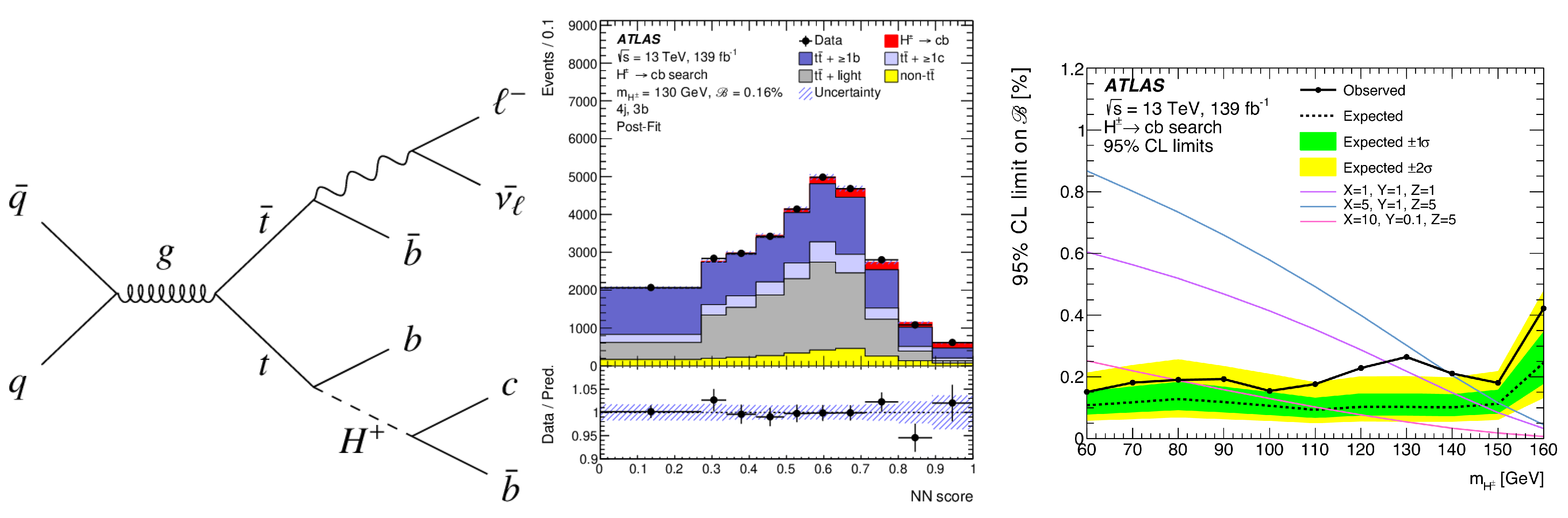
The search for is based on an isolated electron or muon and at least four jets and three b-tags in 3HDM [71,72]. The top quark can decay into a lighter charged Higgs boson. The couplings X, Y, and Z are the Yukawa interactions of the lighter charged Higgs boson. Those are functions of the Higgs-doublet vacuum expectation values and the mixing angle between the charged Higgs bosons [73]. Figure 50 shows a Feynman diagram of the production (Figure 50, left), data, simulated background, and a signal (Figure 50, middle), and the limits on the branching ratio as a function of the charged Higgs boson mass (Figure 50, right). The observed exclusion limits are consistently weaker than the expectation [73]. The largest excess in data has a local significance of about 3 s.d. for GeV.
Figure 50.
Left: Feynman diagram of the production. Middle: data, simulated background, and a signal [73] Reproduced under the CC-BY-4.0 license. Right: limits on the branching ratio as a function of the charged Higgs boson mass [73]. Reproduced under the copyright permission from Springer.
7.3.
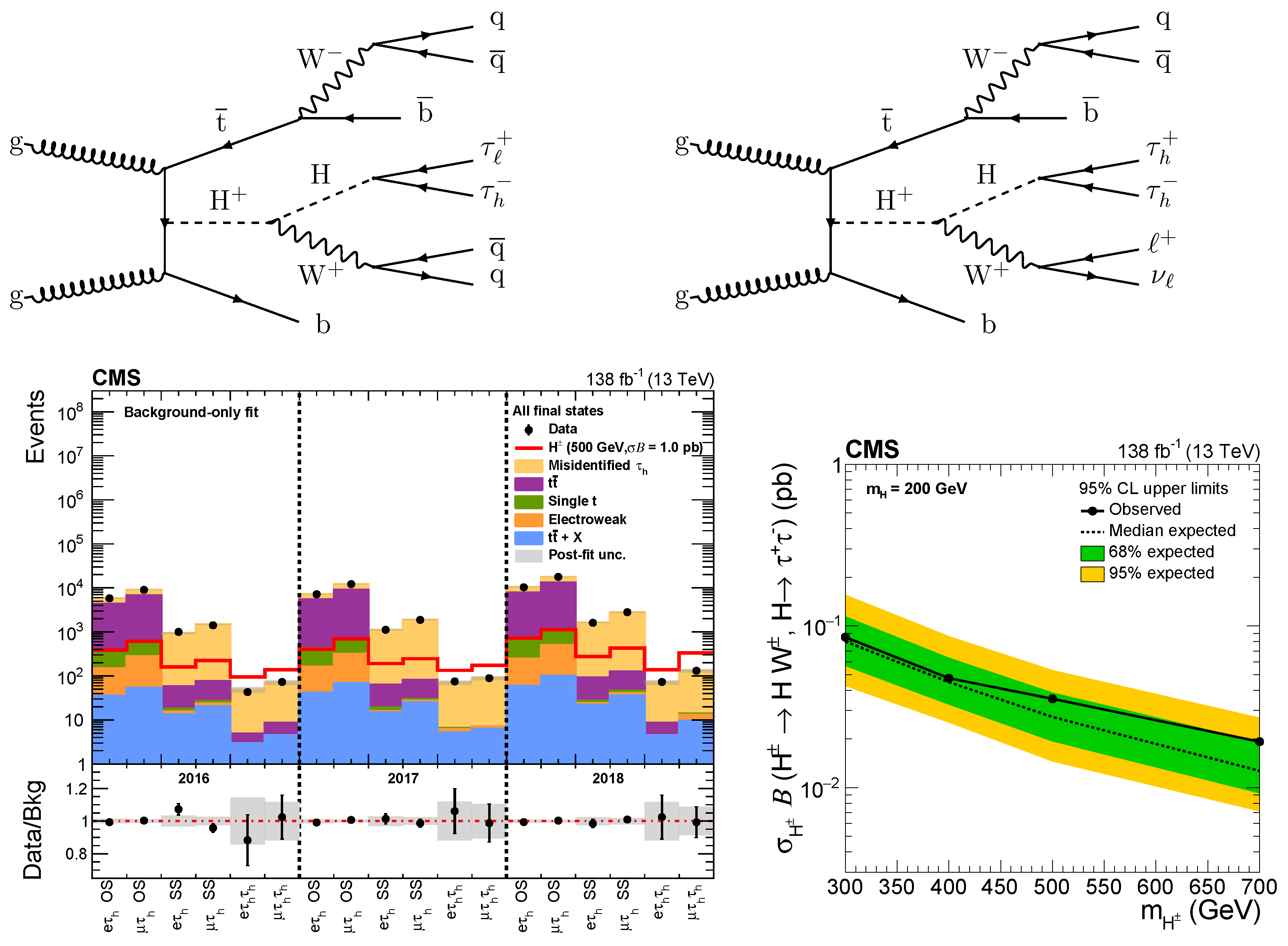
A search for a charged Higgs boson decaying into a heavy neutral Higgs boson and a W boson was performed [74]. Signal processes were generated with four mass hypotheses , 400, 500, and 700 GeV, under the assumption that GeV and GeV. Upper limits on the production cross-section times branching ratio were set in the range 0.085–0.019 pb for the charged Higgs bosons mass of 300–700 GeV. Figure 51, upper, shows Feynman diagrams for the process . Figure 51, lower left and right, shows the data, simulated background along with the signal in eighteen categories (grouped into datasets represented by the vertical dashed lines) and the limits on the production cross-section times branching ratio, respectively.
Figure 51.
Upper: Feynman diagrams for the process Lower left: data, simulated background and a signal in eighteen categories grouped into datasets represented by vertical dashed lines [74]. Lower right: limits on production cross-section times and branching ratios [74]. Reproduced under the copyright permission from Springer.
7.4. Double-Charged Higgs Bosons
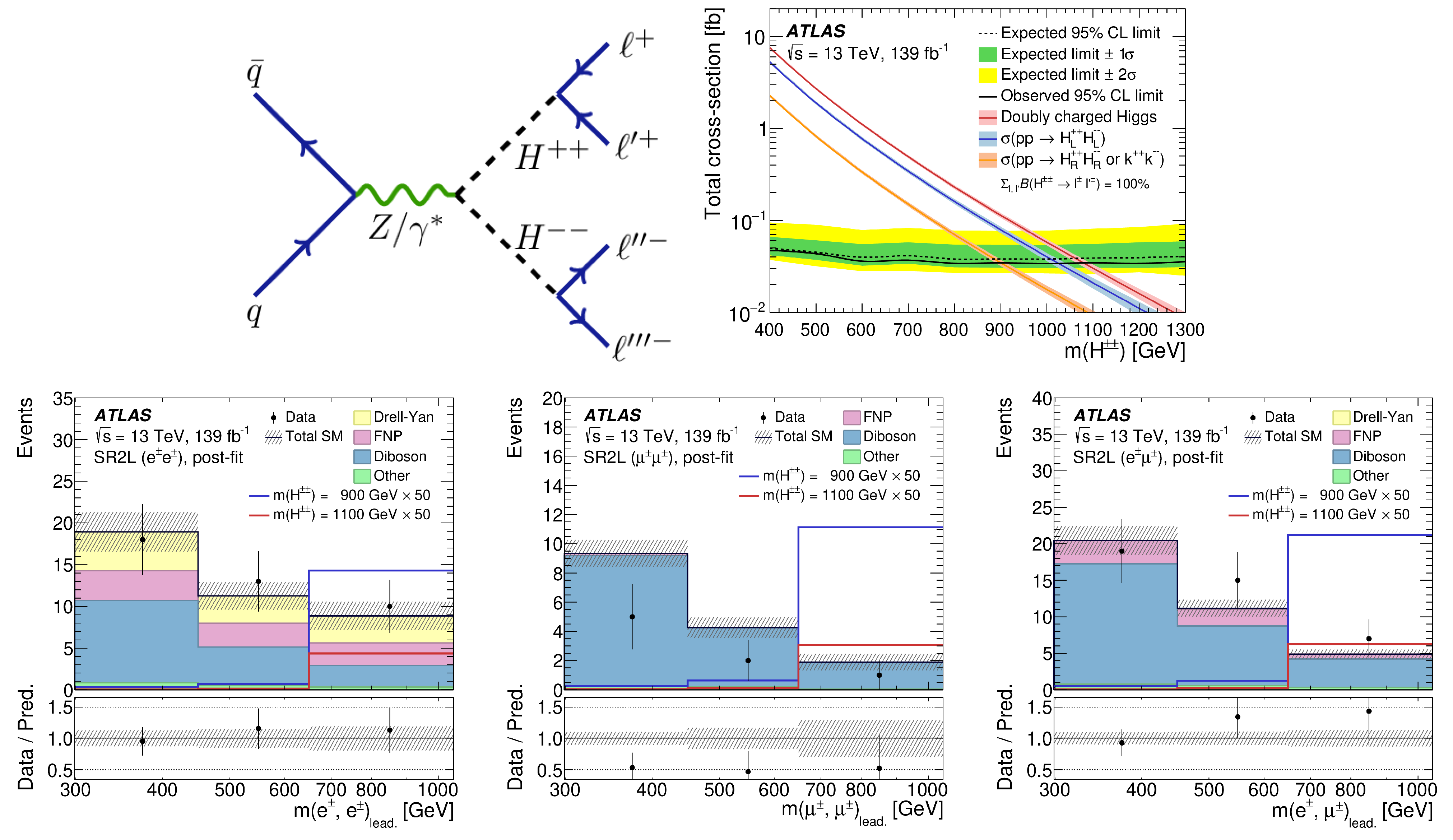
The search for double-charged Higgs bosons, , has been performed in the four-lepton final state (electrons and muons). Limits on the mass of doubly charged Higgs bosons were set at 1080 GeV at 95% CL within the left–right symmetric Type-II seesaw model [75]. Figure 52, upper left, shows a Feynman diagram of the double-charged Higgs boson pair production with decay into four leptons, the data, simulated background, and signals (Figure 52, lower), along with the limits on the production cross-section as a function of the mass (Figure 52, upper right).
Figure 52.
Upper left: Feynman diagram of the double-charged Higgs boson pair production with decay into four leptons. Upper right: limits on the production cross-section as a function of the mass [75]. Lower: data, simulated background, and signals [75]. Reproduced under the copyright permission from Springer.
8. Interpretations and Outlook
8.1. Interpretations of Searches in 2HDM+S
In the 2HDM+S Type-1 and Type-4, searches for with different final states [76] are summarized in Figure 53, left and middle.
Figure 53.
Left: limits on the branching ratio in the 2HDM+S Type-1 [76]. Middle: Limits on the branching ratio in the 2HDM+S Type-4 [76]. Right: limits in the parameter plane in the Georgi–Machacek model [77]. CMS (left, middle) and ATLAS (right) public results, reprinted under the CC-BY-4.0 license.
8.2. Interpretations of Heavy Higgs Boson Searches in the Georgi–Machacek Model
Interpretations of heavy Higgs boson searches are given in the Georgi–Machacek model [78,79]. Figure 53, right, summarizes the limits in the parameter plane [77], thus excluding regions of the H5 plane benchmark [8].
8.3. hMSSM Overview
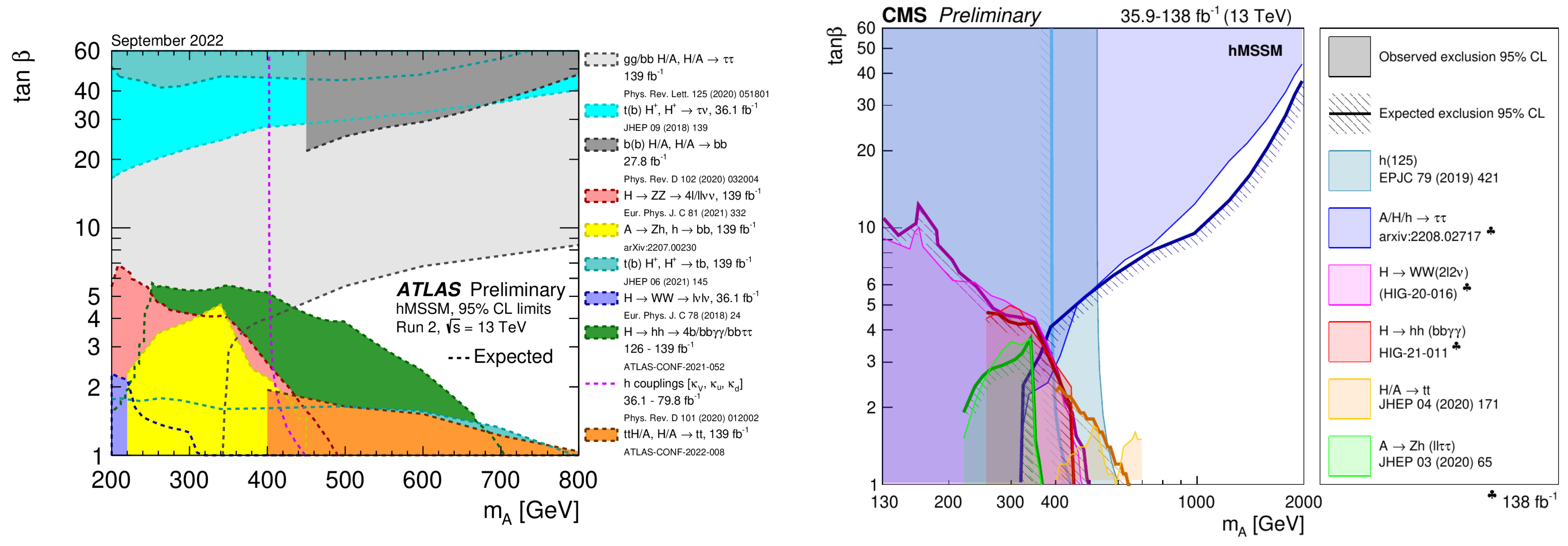
Figure 54 shows an overview of the excluded regions from the ATLAS and CMS Collaborations in the MSSM with a Higgs boson at 125 GeV [80,81].
Figure 54.
hMSSM summary of excluded parameter regions by ATLAS [80] (left) and CMS [81] (right) Collaborations (public results). Reprinted under the CC-BY-4.0 license.
8.4. LHC Operation, Past, Present and Future
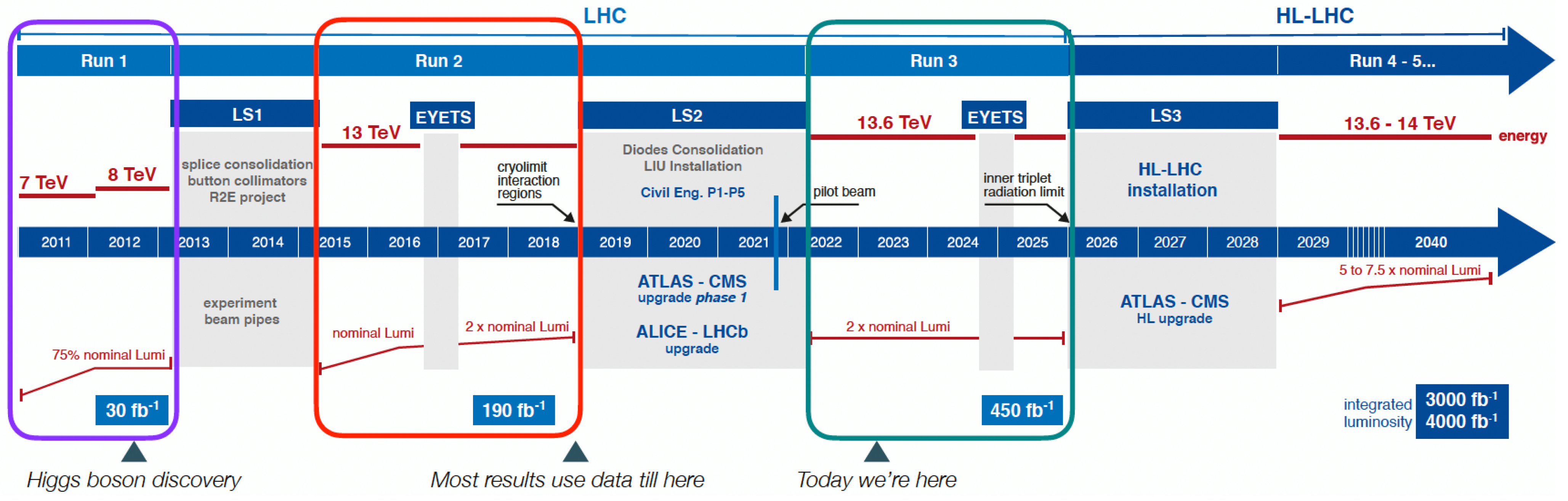
While the results presented in this Section are mostly based on the complete LHC Run-2 dataset, currently, LHC Run-3 operation is ongoing. A detailed overview of the LHC operations expectations from 2011 up to about 2040 [82] are given in Figure 55 [83].
Figure 55.
Overview of LHC operation in the past, present, and future [83]. Reprinted under the CC-BY-4.0 license.
9. Conclusions
The LHC operation has been highly successful. Over 160 fb−1 (Run-1 and Run-2 combined) luminosity was collected by each of the LHC experiments, namely, by the ATLAS and CMS experiments. Several precision measurements of Higgs boson decay branching fractions and the Higgs boson total width were performed. The relation of Higgs boson coupling to mass is impressively linear, as predicted by the Brout–Englert–Higgs mechanism. Experimental data indicate -invariance. In searches for rare decays, LFV, dark photons, and exotics, no indication of BSM physics was observed. In modified production modes for associated production of single top and Higgs, self-coupling , and di-Higgs production, no deviation from SM expectations were observed. Limits on new Higgs bosons and unexpected decays for additional Higgs bosons decaying into taus and photons were set, as well as for heavy Higgs bosons in and production. Furthermore, limits are set to single and doubly charged Higgs boson production. As an immediate outlook of the analysis of already recorded data, a combination of the results from the ATLAS and CMS experiments doubles statistics and thus considerably reduces the statistical uncertainties. In the current LHC Run-3 data taking period, up to 200–300 fb−1 luminosity data is expected to be added (years 2022 to 2025). These data will be used to draw conclusions about several observed minor excesses in Higgs boson production beyond the SM. From the year 2029, HL-LHC is aiming for 3000 fb−1, starting a new era of precision measurements. There is a highly-established and well-justified LHC program until about 2040.
Funding
The project is supported by the Ministry of Education, Youth, and Sports of the Czech Republic under project number LM2023040.
Data Availability Statement
The research data are publicly shared by the ATLAS and CMS Collaboration on https://www.hepdata.net.
Acknowledgments
The author would like to thank the ATLAS and CMS Collaborations for discussions and reviews of the presented results as well as the organizers of the FFK2023 Conference for their hospitality.
Conflicts of Interest
The author declares no conflicts of interest.
Abbreviations
| ATLAS | A Toroidal LHC ApparatuS |
| BaBar | B meson and B meson antiresonance experiment |
| BDT | Boosted Decision Tree |
| BR | Branching Ratio |
| BSM | Beyond SM |
| CC-BY-4.0 | Creative Commons Attribution 4.0 International |
| CERN | Conseil Européen pour la Recherche Nucléaire (European Organization for Nuclear Research) |
| CMS | Compact Muon Solenoid |
| CL | Confidence Level |
| Charge-Parity | |
| DM | Dark Matter |
| EFT | Effective Field Theory |
| exp. | expectation(s) |
| FFK | Conference on Precision Physics and Fundamental Physical Constants |
| H | Higgs boson |
| HDM | Higgs-Doublet Model |
| HEFT | Higgs EFT |
| HL | High-Luminosity |
| H5 | |
| hMSSM | (LHC measured Higgs mass) MSSM |
| ISR | Initial State Radiation |
| LEP | Large Electron–Positron (collider) |
| LHC | Large Hadron Collider |
| LHCb | LHC beauty |
| LRSM | Left–Righ Symmetric Model |
| LFV | Lepton Flavor Violation |
| MET | Missing Energy Transverse |
| MSSM | Minimal Supersymmetry extension of the Standard Model |
| M125 | mass of SM Higgs boson 125 GeV |
| NMSSM | Next-to-MSSM |
| pp | proton–proton |
| QCD | Quantum Chromodynamics |
| QED | Quantum Electrodynamics |
| S | Singlet |
| SC | Signal Classification |
| SM | Standard Model |
| SS2l | Same-Sign two-lepton |
| s.d. | standard deviation(s) |
| TRSM | Two-Real-scalar-singlet extension of the SM |
| Vector Boson Fusion | |
| WIMP | Weakly Interacting Massive Particle |
| V | Vector boson |
| 2/3HDM | Two/Three-HDM |
References
- ATLAS Collaboration. Observation of a new particle in the search for the Standard Model Higgs boson with the ATLAS detector at the LHC. Phys. Lett. B 2012, 716, 1–29. [Google Scholar] [CrossRef]
- CMS Collaboration. Observation of a new boson at a mass of 125 GeV with the CMS experiment at the LHC. Phys. Lett. B 2012, 716, 30–61. [Google Scholar] [CrossRef]
- Gunion, J.; Haber, H.; Kane, G.; Dawson, S. The Higgs Hunter’s Guide; CRC Press/Taylor & Francis Group: Boca Raton, FL, USA, 1990. [Google Scholar] [CrossRef]
- Sopczak, A. Precision measurements in the Higgs sector at ATLAS and CMS. PoS 2020, 353, 006. [Google Scholar] [CrossRef]
- ATLAS Experiment. Public ATLAS Luminosity Results for Run-3 of the LHC.Online Luminosity Summary Plots for Run-3. Multi-Year Summary Plots. Available online: https://twiki.cern.ch/twiki/bin/view/AtlasPublic/LuminosityPublicResultsRun3 (accessed on 30 May 2024).
- ATLAS Experiment. Event Displays from Collision Data. 900 GeV Collisions. Available online: https://twiki.cern.ch/twiki/bin/view/AtlasPublic/EventDisplayRun2Collisions#900_GeV_Collisions (accessed on 30 May 2024).
- CMS Collaboration. Events Recorded by the CMS Detector During the Proton-Lead Collision Run of 2016; Report CMS-PHO-EVENTS-2016-009; CERN: Geneva, Switzerland, 2016; Available online: https://cds.cern.ch/record/2235235 (accessed on 30 May 2023).
- de Florian, D. et al. [LHC HiggsWorking Group] Handbook of LHC Higgs Cross Sections: 4. Deciphering the Nature of the Higgs Sector; CERN Yellow Report CERN-2017-002-M; CERN: Geneva, Switzerland, 2017. [Google Scholar] [CrossRef]
- ATLAS Collaboration. Luminosity determination in pp collisions at = 13 TeV using the ATLAS detector at the LHC. Eur. Phys. J. C 2023, 83, 982. [Google Scholar] [CrossRef]
- CMS Collaboration. Public CMS Luminosity Information. Full Summary: Proton–Proton Collisions Since 2010 (Run 1 + Run 2 + Run 3). Available online: https://twiki.cern.ch/twiki/bin/view/CMSPublic/LumiPublicResults (accessed on 30 May 2024).
- The ATLAS Collaboration. A detailed map of Higgs boson interactions by the ATLAS experiment ten years after the discovery. Nature 2022, 607, 52–59. [Google Scholar] [CrossRef]
- The CMS Collaboration. A portrait of the Higgs boson by the CMS experiment ten years after the discovery. Nature 2022, 607, 60–68. [Google Scholar] [CrossRef] [PubMed]
- The CMS Collaboration. Measurement of the Higgs boson width and evidence of its off-shell contributions to ZZ production. First evidence for off-shell production of the Higgs boson and measurement of its width. Nat. Phys. 2022, 18, 1329–1334. [Google Scholar] [CrossRef]
- The ATLAS Collaboration. Evidence of off-shell Higgs boson production from ZZ leptonic decay channels and constraints on its total width with the ATLAS detector. Phys. Lett. B 2023, 846, 138223. [Google Scholar] [CrossRef]
- ATLAS Collaboration. Measurement of the CP properties of Higgs boson interactions with τ-leptons with the ATLAS detector. Eur. Phys. J. C 2023, 83, 563. [Google Scholar] [CrossRef]
- The CMS Collaboration. Search for CP violation in ttH and tH production in multilepton channels in proton–proton collisions at = 13 TeV. J. High Energy Phys. 2023, 2023, 92. [Google Scholar] [CrossRef]
- The ATLAS Collaboration. Test of CP-invariance of the Higgs boson in vector-boson fusion production and its decay into four leptons J. High Energy Phys. 2024, 2024, 105. [CrossRef]
- Brivio, I.; Trott, M. The Standard Model as an effective field theory. Phys. Rep. 2019, 793, 1–98. [Google Scholar] [CrossRef]
- The CMS Collaboration. Search for the Higgs boson decay to a pair of electrons in proton–proton collisions at = 13 TeV. Phys. Lett. B 2023, 846, 137783. [Google Scholar] [CrossRef]
- The ATLAS Collaboration. A search for the Zγ decay mode of the Higgs boson in pp collisions at = 13 TeV with the ATLAS detector. Phys. Lett. B 2020, 809, 135754. [Google Scholar] [CrossRef]
- The CMS Collaboration. Search for Higgs boson decays to a Z boson and a photon in proton–proton collisions at = 13 TeV. J. High Energy Phys. 2023, 2023, 233. [Google Scholar] [CrossRef]
- Aad, G. et al. [ATLAS and CMS Collaborations] Evidence for the Higgs boson decay to a Z boson and a photon at the LHC. Phys. Rev. Lett. 2024, 132, 0211803. [Google Scholar] [CrossRef]
- The CMS Collaboration. Search for Higgs boson decays into Z and J/ψ and for Higgs and Z boson decays into J/ψ or Y pairs in pp collisions at = 13 TeV. Phys. Lett. B 2023, 842, 137534. [Google Scholar] [CrossRef]
- The ATLAS Collaboration. Search for exclusive Higgs and Z boson decays to ωγ and Higgs boson decays to K*γ with the ATLAS detector. Phys. Lett. B 2023, 847, 138292. [Google Scholar] [CrossRef]
- The ATLAS Collaboration. Summary of ATLAS Searches for Higgs and Z Boson Decays to a Meson and a Photon; Report ATL-PHYS-PUB-2023-004; CERN: Geneva, Switzerland, 2023; Available online: https://cds.cern.ch/record/2851888 (accessed on 30 May 2024).
- The ATLAS Collaboration. Searches for lepton-flavour-violating decays of the Higgs boson into eτ and μτ in = 13 TeV pp collisions with the ATLAS detector. J. High Energy Phys. 2023, 2023, 166. [Google Scholar] [CrossRef]
- Hayrapetyan, A. et al. [CMS Collaboration] Search for the lepton-flavor violating decay of the Higgs boson and additional Higgs bosons in the eμ final state in proton–proton collisions at = 13 TeV. Phys. Rev. D 2023, 108, 072004. [Google Scholar] [CrossRef]
- The ATLAS Collaboration. Search for the Higgs boson decays H→ee and H→eμ in pp collisions at = 13 TeV with the ATLAS detector. Phys. Lett. B 2020, 801, 135148. [Google Scholar] [CrossRef]
- Patt, B.; Wilczek, F. Higgs-field portal into hidden sectors. arXiv 2006, arXiv:hep-ph/0605188. [Google Scholar] [CrossRef]
- The ATLAS Collaboration. Combination of searches for invisible decays of the Higgs boson using 139 fb−1 of proton–proton collision data at = 13 TeV collected with the ATLAS experiment. Phys. Lett. B 2023, 842, 137963. [Google Scholar] [CrossRef]
- CMS Collaboration. A search for decays of the Higgs boson to invisible particles in events with a top-antitop quark pair or a vector boson in proton–proton collisions at = 13 TeV. Eur. Phys. J. C 2023, 83, 933. [Google Scholar] [CrossRef] [PubMed]
- Clowe, D.; Bradac, M.; Gonzalez, A.H.; Markevitch, M.; Randall, S.W.; Jones, C.; Zaritsky, D. A direct empirical proof of the existence of dark matter. Astrophys. J. Lett. 2006, 648, L109–L113. [Google Scholar] [CrossRef]
- Fabbrichesi, M.; Gabrielli, E.; Lanfranchi, G. The Dark Photon. A Primer; Springer Nature Switzerland AG: Cham, Switzerland, 2021. [Google Scholar] [CrossRef]
- The ATLAS Collaboration. Search for dark photons from Higgs boson decays via ZH production with a photon plus missing transverse momentum signature from pp collisions at = 13 TeV with the ATLAS detector. J. High Energy Phys. 2023, 2023, 133. [Google Scholar] [CrossRef]
- Peccei, R.D.; Quinn, H.R. Constraints imposed by CP conservation in the presence of pseudoparticles. Phys. Rev. D 1977, 16, 1791–1797. [Google Scholar] [CrossRef]
- The CMS Collaboration. Search for an exotic decay of the Higgs boson into a Z boson and a pseudoscalar particle in proton–proton collisions at = 13 TeV. Phys. Lett. B 2023, 852, 138582. [Google Scholar] [CrossRef]
- CMS Collaboration. Search for exotic decays of the Higgs boson to a pair of pseudoscalars in the μμbb and ττbb final states. Eur. Phys. J. C 2024, 84, 493. [Google Scholar] [CrossRef]
- The CMS Collaboration. Search for direct production of GeV-scale resonances decaying to a pair of muons in proton–proton collisions at = 13 TeV. J. High Energy Phys. 2023, 2023, 70. [Google Scholar] [CrossRef]
- The LHCb Collaboration. Searches for low-mass dimuon resonances. J. High Energy Phys. 2020, 2020, 156. [Google Scholar] [CrossRef]
- Lees, J.P. et al. [BaBar Collaboration] Search for a dark photon in e+e− collisions at BaBar. Phys. Rev. Lett. 2014, 113, 201801. [Google Scholar] [CrossRef] [PubMed]
- Tumasyan, A. et al. [CMS Collaboration] Search for exotic Higgs boson decays H→AA→4γ with events containing two merged diphotons in proton–proton collisions at = 13 TeV. Phys. Rev. Lett. 2023, 131, 101801. [Google Scholar] [CrossRef] [PubMed]
- The ATLAS Collaboration. Probing the CP nature of the top–Higgs Yukawa coupling in tH and tH events with H→b decays using the ATLAS detector at the LHC. Phys. Lett. B 2023, 849, 138469. [Google Scholar] [CrossRef]
- Sirunyan, A.M. et al. [CMS Collaboration] Search for associated production of a Higgs boson and a single top quark in proton–proton collisions at = 13 TeV. Phys. Rev. D 2019, 99, 092005. [Google Scholar] [CrossRef]
- The CMS Collaboration. Measurement of the tH and tH production rates in the H→b decay channel using proton–proton collision data at = 13 TeV. arXiv 2024, arXiv:2407.10896. [CrossRef]
- The ATLAS Collaboration. Constraints on the Higgs boson self-coupling from single- and double-Higgs production with the ATLAS detector using pp collisions at = 13 TeV. Phys. Lett. B 2023, 843, 137745. [Google Scholar] [CrossRef]
- The ATLAS Collaboration. Search for resonant and non-resonant Higgs boson pair production in the bτ+τ− decay channel using 13 TeV pp collision data from the ATLAS detector. J. High Energy Phys. 2023, 2023, 40. [Google Scholar] [CrossRef]
- Aad, G. et al. [ATLAS Collaboration] Search for nonresonant pair production of Higgs bosons in the bb final state in pp collisions at = 13 TeV with the ATLAS detector. Phys. Rev. D 2023, 108, 052003. [Google Scholar] [CrossRef]
- The CMS Collaboration. Search for Higgs production in the b W+W− decay mode in proton-proton collisions at = 13 TeV. J. High Energy Phys. 2024, 2024, 293. [Google Scholar] [CrossRef]
- CMS Collaboration. Higgs PAG Summary Plots. Summary of Run-2 κλ and κ2V measurements from HH production. Available online: https://twiki.cern.ch/twiki/bin/view/CMSPublic/SummaryResultsHIG (accessed on 30 May 2024).
- The CMS Collaboration. Constraints on the Higgs boson self-coupling from the combination of single and double Higgs boson production in proton–proton collisions at = 13 TeV. arXiv 2024, arXiv:2407.13554. [CrossRef]
- The ATLAS Collaboration. Search for a new heavy scalar particle decaying into a Higgs boson and a new scalar singlet in final states with one or two light leptons and a pair of τ-leptons with the ATLAS detector. J. High Energy Phys. 2023, 2023, 9. [Google Scholar] [CrossRef]
- The CMS Collaboration. Search for a massive scalar resonance decaying to a light scalar and a Higgs boson in the four b quarks final state with boosted topology. Phys. Lett. B 2023, 842, 137392. [Google Scholar] [CrossRef]
- Aad, G. et al. [ATLAS Collaboration] Combination of searches for resonant Higgs boson pair production using pp collisions at = 13 TeV with the ATLAS detector. Phys. Rev. Lett. 2024, 132, 231801. [Google Scholar] [CrossRef] [PubMed]
- CMS Collaboration. CMS Beyond SM Particles Decaying 2(to) Higgs, top and Gauge Bosons (B2G) Public Physics Results. Summary of Public Di-Boson Results (August 2023 and March 2024). Available online: https://twiki.cern.ch/twiki/bin/view/CMSPublic/PhysicsResultsB2G (accessed on 30 May 2024).
- The CMS Collaboration. Search for a standard model-like Higgs boson in the mass range between 70 and 110 GeV in the diphoton final state in proton–proton collisions at = 13 TeV. arXiv 2024, arXiv:2405.18149. [CrossRef]
- The ATLAS Collaboration. Search for diphoton resonances in the 66 to 110 GeV mass range using 140 fb−1 of 13 TeV pp collisions collected with the ATLAS detector. arXiv 2024, arXiv:2407.07546. [CrossRef]
- Sopczak, A. Searches for Higgs bosons beyond the Standard Model. In Proceedings of the XII International Workshop on Deep Inelastic Scattering (DIS 2004), Štrbské Pleso, Slovakia, 14–18 April 2004; Bruncko, D., Ferencei, J., Strízenec, P., Eds.; Institute of Experimental Physics SAS: Košice, Slovak Republic, 2004; pp. 1017–1022. [Google Scholar] [CrossRef]
- Sopczak, A. A general MSSM parameter scan. Int. J. Mod. Phys. A 2001, 816–818. [Google Scholar] [CrossRef]
- The ATLAS Collaboration. Search for a CP-odd Higgs Boson decaying into a heavy CP-even Higgs boson and a Z boson in the ℓ+ℓ−t and νb final states using 140 fb−1 of data collected with the ATLAS detector. J. High Energy Phys. 2024, 2024, 197. [Google Scholar] [CrossRef]
- The CMS Collaboration. Search for Higgs boson pair production with one associated vector boson in proton–proton collisions at = 13 TeV. arXiv 2024, arXiv:2404.08462. [Google Scholar] [CrossRef]
- ATLAS Collaboration. Search for Higgs boson pair production in association with a vector boson in pp collisions at = 13 TeV with the ATLAS detector. Eur. Phys. J. C 2023, 83, 519. [Google Scholar] [CrossRef]
- Kuang, Y.-P.; Ren, H.-Y.; Xia, L.-H. Model-independent probe of anomalous heavy neutral Higgs bosons at the LHC. Phys. Rev. D 2014, 90, 115002. [Google Scholar] [CrossRef]
- The ATLAS Collaboration. A search for heavy Higgs bosons decaying into vector bosons in same-sign two-lepton final states in pp collisions at = 13 TeV with the ATLAS detector. J. High Energy Phys. 2023, 2023, 200. [Google Scholar] [CrossRef]
- The ATLAS Collaboration. Search for tH/A→tt production in the multilepton final state in proton–proton collisions at = 13 TeV with the ATLAS detector. J. High Energy Phys. 2023, 2023, 203. [Google Scholar] [CrossRef]
- The CMS Collaboration. Searches for additional Higgs bosons and for vector leptoquarks in ττ final states in proton–proton collisions at = 13 TeV. J. High Energy Phys. 2023, 2023, 73. [Google Scholar] [CrossRef]
- The ATLAS Collaboration. Search for dark matter produced in association with a Higgs boson decaying to tau leptons at = 13 TeV with the ATLAS detector. J. High Energy Phys. 2023, 2023, 189. [Google Scholar] [CrossRef]
- Aad, G. et al. [ATLAS Collaboration] Search for dark photons in rare Z boson decays with the ATLAS detector. Phys. Rev. Lett. 2023, 131, 251801. [Google Scholar] [CrossRef]
- Jaegle, I. et al. [Belle Collboration] Search for the dark photon and the dark Higgs boson at Belle. Phys. Rev. Lett. 2015, 114, 211801. [Google Scholar] [CrossRef]
- The ATLAS Collaboration. Combination and summary of ATLAS dark matter searches interpreted in a 2HDM with a pseudo-scalar mediator using 139 fb−1 of = 13 TeV pp collision data. Sci. Bull. 2024; in press. [Google Scholar] [CrossRef]
- Aad, G. et al. [ATLAS Collaboration] Search for a new pseudoscalar decaying into a pair of muons in events with a top-quark pair at = 13 TeV with the ATLAS detector. Phys. Rev. D 2023, 108, 092007. [Google Scholar] [CrossRef]
- Akeroyd, A.G.; Moretti, S.; Yagyu, K.; Yildirim, E. Light charged Higgs boson scenario in 3-Higgs doublet models. Int. J. Mod. Phys. A 2017, 32, 1750145. [Google Scholar] [CrossRef]
- Akeroyd, A.G.; Moretti, S.; Song, M. Light charged Higgs boson with dominant decay to quarks and its search at the LHC and future colliders. Phys. Rev. D 2018, 98, 115024. [Google Scholar] [CrossRef]
- The ATLAS Collaboration. Search for a light charged Higgs boson in t→H±b decays, with H±→cb, in the lepton+jets final state in proton–proton collisions at = 13 TeV with the ATLAS detector. J. High Energy Phys. 2023, 2023, 4. [Google Scholar] [CrossRef]
- The CMS Collaboration. Search for a charged Higgs boson decaying into a heavy neutral Higgs boson and a W boson in proton–proton collisions at = 13 TeV. J. High Energy Phys. 2023, 2023, 32. [Google Scholar] [CrossRef]
- ATLAS Collaboration. Search for doubly charged Higgs boson production in multi-lepton final states using 139 fb−1 of proton–proton collisions at = 13 TeV with the ATLAS detector. Eur. Phys. J. C 2023, 83, 605. [Google Scholar] [CrossRef]
- CMS Collaboration. Summary of 2HDM+S searches at 13 TeV (Run 2). Available online: https://twiki.cern.ch/twiki/bin/view/CMSPublic/Summary2HDMSRun2 (accessed on 30 May 2024).
- The ATLAS Collaboration. Interpretation of Heavy Higgs Boson Searches in the ATLAS Experiment in the Georgi–Machacek model. Report ATL-PHYS-PUB-2022-008; CERN: Geneva, Switzerland, 2022; Available online: https://cds.cern.ch/record/2803996 (accessed on 30 May 2024).
- Georgi, H.; Machacek, M. Doubly charged Higgs bosons. Nucl. Phys. B 1985, 262, 463–477. [Google Scholar] [CrossRef]
- Chanowitz, M.S.; Golden, M. Higgs boson triplets with MW=MZcosθW. Phys. Lett. B 1985, 165, 105–108. [Google Scholar] [CrossRef]
- The ATLAS Collaboration. Summary Plots for Beyond Standard Model Higgs Boson Benchmarks for Direct and Indirect Searches. Report ATL-PHYS-PUB-2022-043; CERN: Geneva, Switzerland, 2022; Available online: https://cds.cern.ch/record/2827098 (accessed on 30 May 2024).
- CMS Collaboration. Higgs PAG Summary Plots. Summary of MSSM Higgs Boson Searches at 13 TeV (Run 2). Available online: https://twiki.cern.ch/twiki/bin/view/CMSPublic/SummaryResultsHIG (accessed on 30 May 2024).
- Longer Term LHC Schedule. Available online: https://lhc-commissioning.web.cern.ch/schedule/LHC-long-term.htm (accessed on 30 May 2024).
- Zerlauth, M.; Brüning, O. Status and prospects of the HL-LHC project. PoS 2024, 449, 615. [Google Scholar] [CrossRef]
Disclaimer/Publisher’s Note: The statements, opinions and data contained in all publications are solely those of the individual author(s) and contributor(s) and not of MDPI and/or the editor(s). MDPI and/or the editor(s) disclaim responsibility for any injury to people or property resulting from any ideas, methods, instructions or products referred to in the content. |
© 2024 by the author. Licensee MDPI, Basel, Switzerland. This article is an open access article distributed under the terms and conditions of the Creative Commons Attribution (CC BY) license (https://creativecommons.org/licenses/by/4.0/).