


Abstract
Earthfill dams located in seismic regions are highly vulnerable to earthquake-induced deformations, particularly when founded on soft alluvial soils. This study presents a comparative numerical investigation of earthfill dams with asphalt and clay cores subjected to seismic loading. A 20 m-high zoned embankment dam founded on soft alluvial deposits was modeled in PLAXIS2D and subjected to four earthquake records. The dynamic responses at the crest and downstream slope were evaluated in terms of acceleration, settlement, and lateral displacement. The results indicate that while lateral displacements are nearly identical for both core types, dams with clay cores experience significantly higher seismic settlements, reaching up to 35% more than those with asphalt cores under strong earthquake loading. Overall, the asphalt core demonstrated enhanced resilience, exhibiting reduced settlement due to its higher stiffness, viscoelastic behavior, and inherent capacity for self-healing following seismic loading.
1. Introduction
One of the oldest known embankment dams is the Sadd El-Kafara Dam in Egypt, constructed around 2600 BC [1]. Since then, earthfill dams have been widely used worldwide for water storage, irrigation, hydropower generation, and flood control due to their adaptability to diverse geological conditions and cost-effectiveness.
Many existing earthfill dams are located in seismic regions, where their performance is strongly influenced by both material properties and foundation conditions [2]. Even under static conditions, inadequate design may lead to excessive settlement and pore water pressure development [3,4]. Under seismic loading, additional hazards arise, including excess pore pressure generation, stiffness degradation, and loss of stability, which may result in significant deformation or failure [5,6,7,8,9,10]. These effects are particularly critical for embankment dams founded on soft alluvial soils.
Previous studies have demonstrated that the core material plays a key role in the seismic behavior of earthfill dams [11,12,13]. Comparative investigations have shown that asphalt cores may provide improved deformation resistance compared to traditional clay cores under certain loading conditions [14]. However, the seismic response of asphalt-core and clay-core earthfill dams founded on soft alluvial deposits remains insufficiently explored, especially when subjected to different earthquake records.
This study presents a comparative numerical investigation into the influence of core material properties on the seismic performance of earthfill dams. Two geometrically identical embankment dams founded on soft alluvial soil—one incorporating an asphalt core and the other a clay core—are analyzed using PLAXIS2D (version 2023.2). The models are subjected to four earthquake records: Kobe, Kocaeli, Loma Prieta, and Northridge. The selected set of earthquake records was chosen to capture the effects of moderate to strong seismic events on the dynamic response of the model. The seismic response is evaluated in terms of crest horizontal acceleration and settlement, as well as lateral displacement of the downstream slope. The primary objective is to assess the effect of core material variability on dam behavior and to evaluate the feasibility of asphalt cores as a reliable alternative to traditional clay cores in seismically active regions.
2. Materials and Methods
2.1. Geometry of the Model
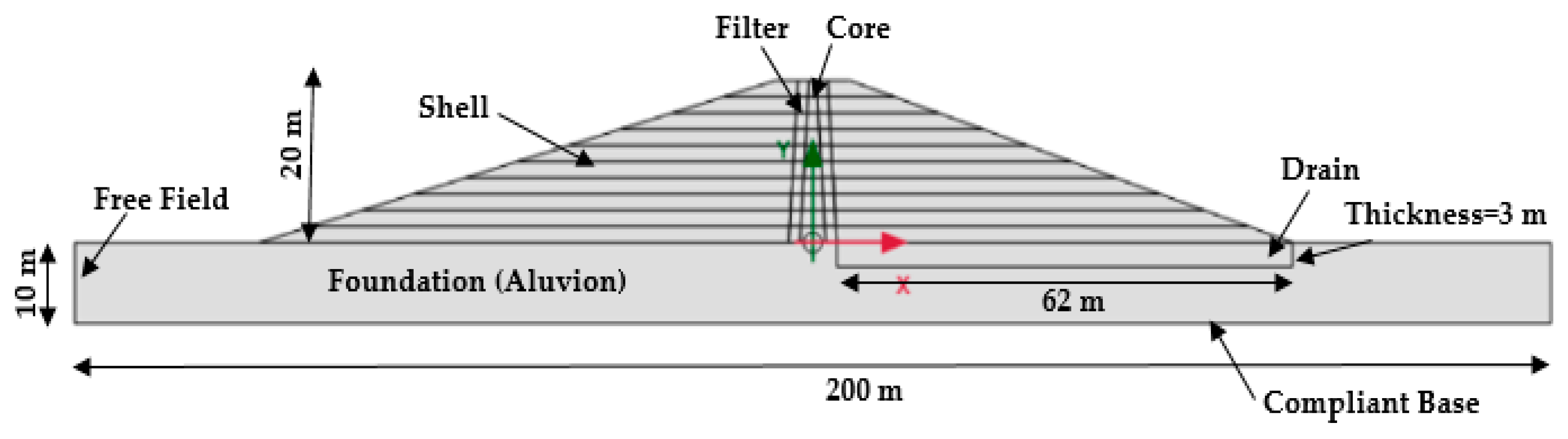
The numerical model of the earthfill dam consists of several layers, including the foundation, shell, filter, core, and drain. The core layer has a width of 1 m at the crest and 4 m at the base, while the filter layer has a uniform width of 1.5 m. As mentioned earlier, two main models were developed. All layers are identical in both models, with the only difference being the core material, which is modeled as clay in one case and asphalt in the other.
2.2. Boundaries and Dynamic Conditions
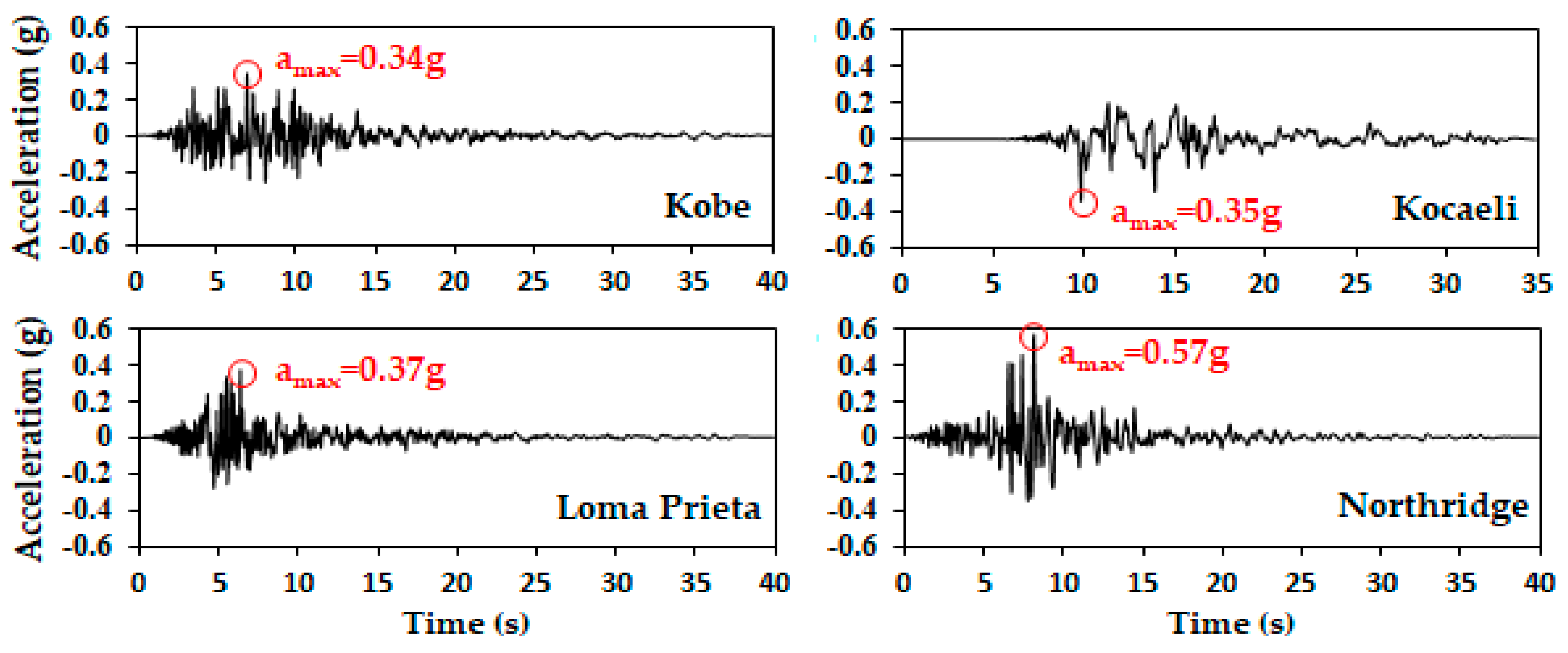
The numerical analyses in this study were carried out in two stages: static and dynamic. In the static analysis, equal degrees of freedom (DOF) were assigned to the lateral boundaries to ensure uniform deformation along the model sides. In the dynamic analysis, free-field boundary conditions representing drained soil behavior were employed to simulate far-field response, in accordance with recommendations from the literature [15,16,17]. To minimize the artificial reflection of seismic waves from the base of the model, a compliant base was considered. It was also fixed in both horizontal and vertical directions to prevent rigid-body motion. The lateral boundaries were restrained only in the horizontal direction, allowing vertical displacement. All the geometrical details of the numerical model are shown in Figure 1. The horizontal components of the selected earthquake records were applied at the model base as input motions. The time history as well as the maximum acceleration, amax, of each earthquake is shown in Figure 2. Also, Table 1 presents the characteristics of the selected earthquakes (Arias Intensity and Predominant Period).
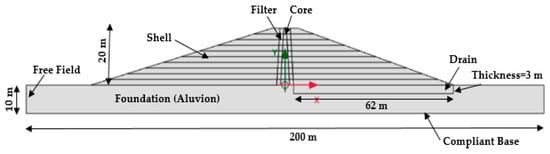
Figure 1.
The model geometry.
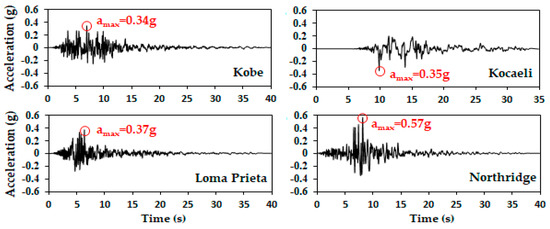
Figure 2.
Time history of the records applied at the base of the model.

Table 1.
The characteristics of the selected records.
The earthfill dam model was set to plane strain, and the elements were set to 15-noded. The generated finite element mesh consisted of 21,960 elements and 41,739 nodes, and a fine mesh density was adopted for the analyses.
2.3. Asphalt Core vs. Clay Core
As mentioned earlier, to evaluate the influence of core material properties on the seismic behavior of earthfill dams, two numerical models were developed: one incorporating a clay core and the other an asphalt core. The clay core performs like a stress-dependent material in which stiffness and excess pore pressure generation significantly influence the response, while the asphalt core exhibits comparatively higher stiffness with time- and temperature-dependent viscoelastic characteristics. It should also be noted that clay may display viscoelastic behavior at low strain levels; therefore, the distinction between the two materials primarily lies in their stiffness and drainage-dependent response rather than a purely plastic versus viscoelastic classification.
2.4. Constitutive Soil Models
To model the different soil layers in PLAXIS 2D, the HS small constitutive model [18] was adopted. This model is widely used in geotechnical engineering to represent soil behavior under various loading conditions in numerical analyses. By incorporating both elastic and plastic responses, the HS small model enables accurate simulation of soil deformations, particularly at small strain levels. The model is defined by a set of stiffness, strength, and small-strain parameters. The definitions of these parameters and the values adopted in this study are summarized in Table 2.
Table 2.
Material properties following HS Small as a soil model.
3. Results and Discussion
In this section, the results of the parametric analyses are presented graphically and discussed in detail. The results include horizontal accelerations calculated on the crest and downstream slope, lateral displacement on the downstream slope, and settlement on the crest.
3.1. Horizontal Acceleration Recorded on the Crest
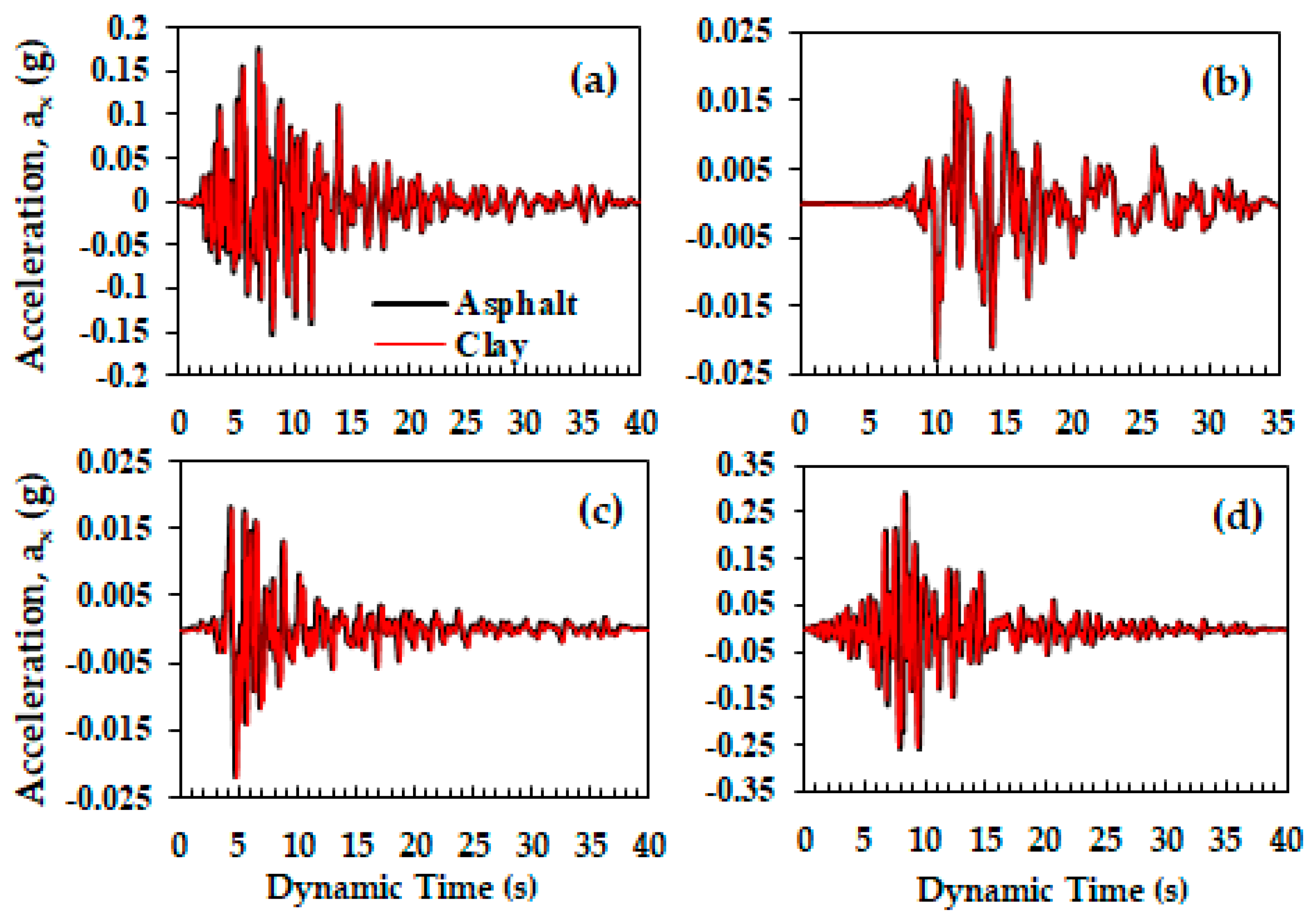
Following the dynamic analyses of two earthfill dam models with clay and asphalt cores subjected to four earthquakes with different amplitudes, the results are plotted and presented in Figure 3. As shown in the figure, the maximum crest acceleration is 0.29 g for the Northridge earthquake, which has the highest input amplitude. The corresponding crest accelerations are 0.17 g, 0.02 g, and 0.022 g for the Kobe, Kocaeli, and Loma Prieta earthquakes, respectively. The results indicate that the models with clay and asphalt cores exhibit nearly identical crest acceleration responses. This confirms that variation in core material has a negligible influence on the transmission of acceleration from the foundation to the crest, as the global dynamic response is primarily governed by the dam geometry and the stiffness and damping characteristics of the shell and foundation materials rather than the core.
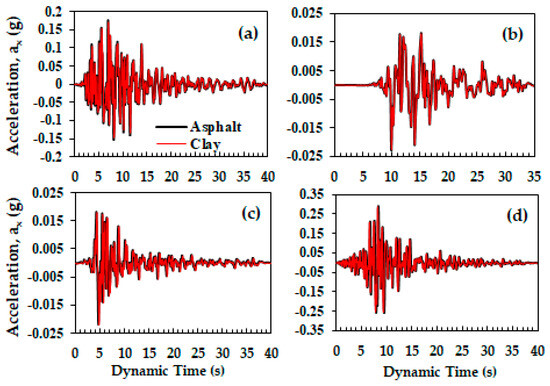
Figure 3.
Acceleration time-history responses at the crest for different core materials under various earthquake records: (a) Kobe, (b) Kocaeli, (c) Loma Prieta, and (d) Northridge.
3.2. Horizontal Acceleration Recorded on the Downstream Slope
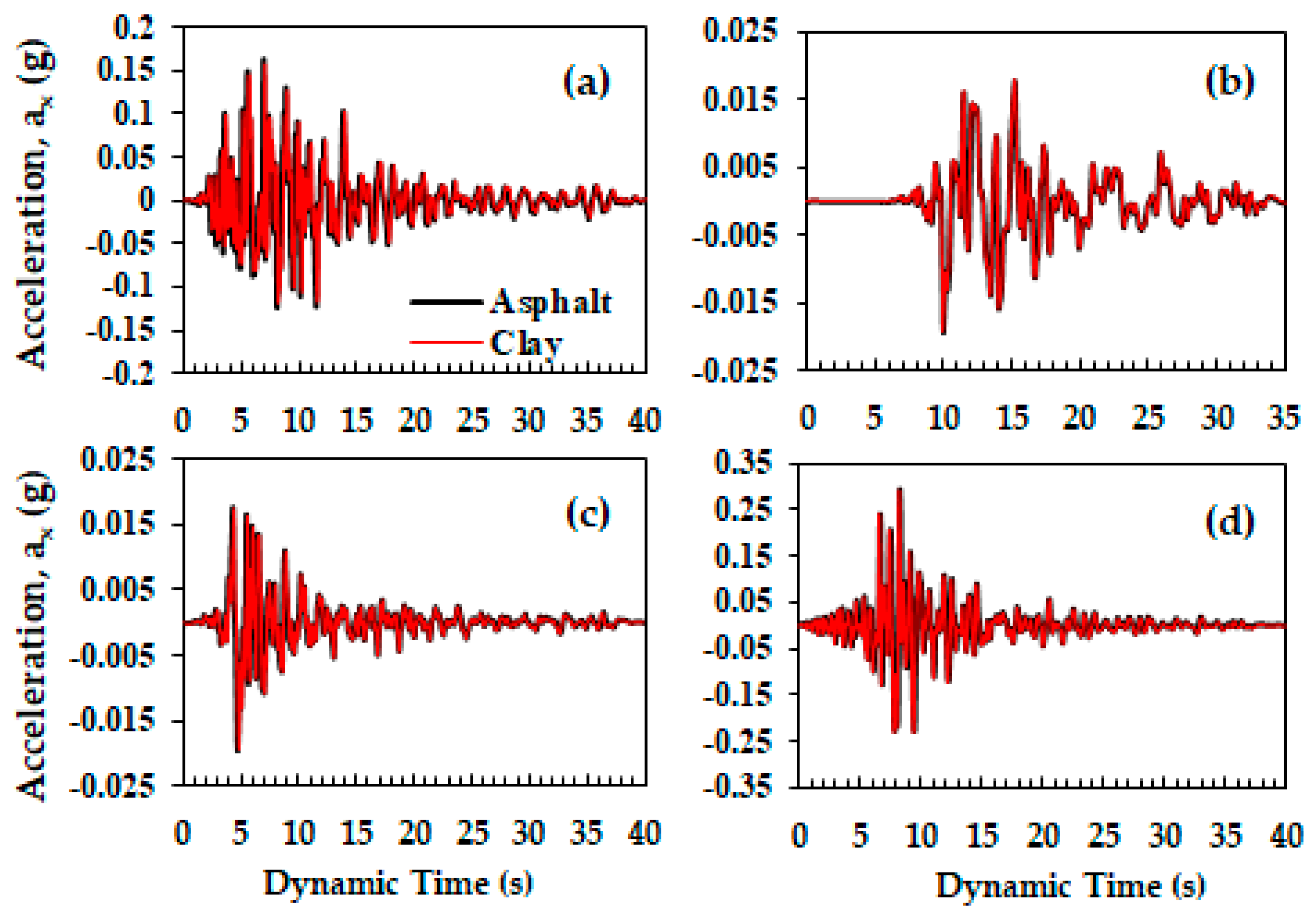
Figure 4 presents the horizontal acceleration time histories recorded at the downstream slope. As shown, the maximum acceleration reaches 0.29 g for the Northridge earthquake, which has the highest input amplitude. The corresponding accelerations are 0.15 g, 0.019 g, and 0.02 g for the Kobe, Kocaeli, and Loma Prieta earthquakes, respectively. The results indicate that the accelerations transmitted to the downstream slope are slightly lower and occur more gradually than those at the crest. This behavior can be attributed to the higher potential for lateral deformation of the downstream slope, which allows part of the seismic energy to be dissipated through slope movement, thereby reducing dynamic amplification and limiting the transferred acceleration. Again, the results indicate that the models with clay and asphalt cores show similar crest acceleration responses.
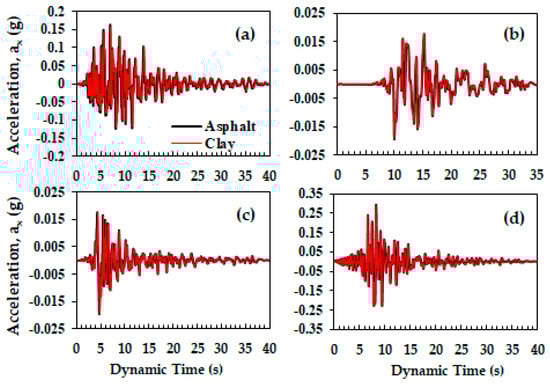
Figure 4.
Acceleration time-history responses on the downstream slope for different core materials under various earthquake records: (a) Kobe, (b) Kocaeli, (c) Loma Prieta, and (d) Northridge.
3.3. Settlement Recorded on the Crest
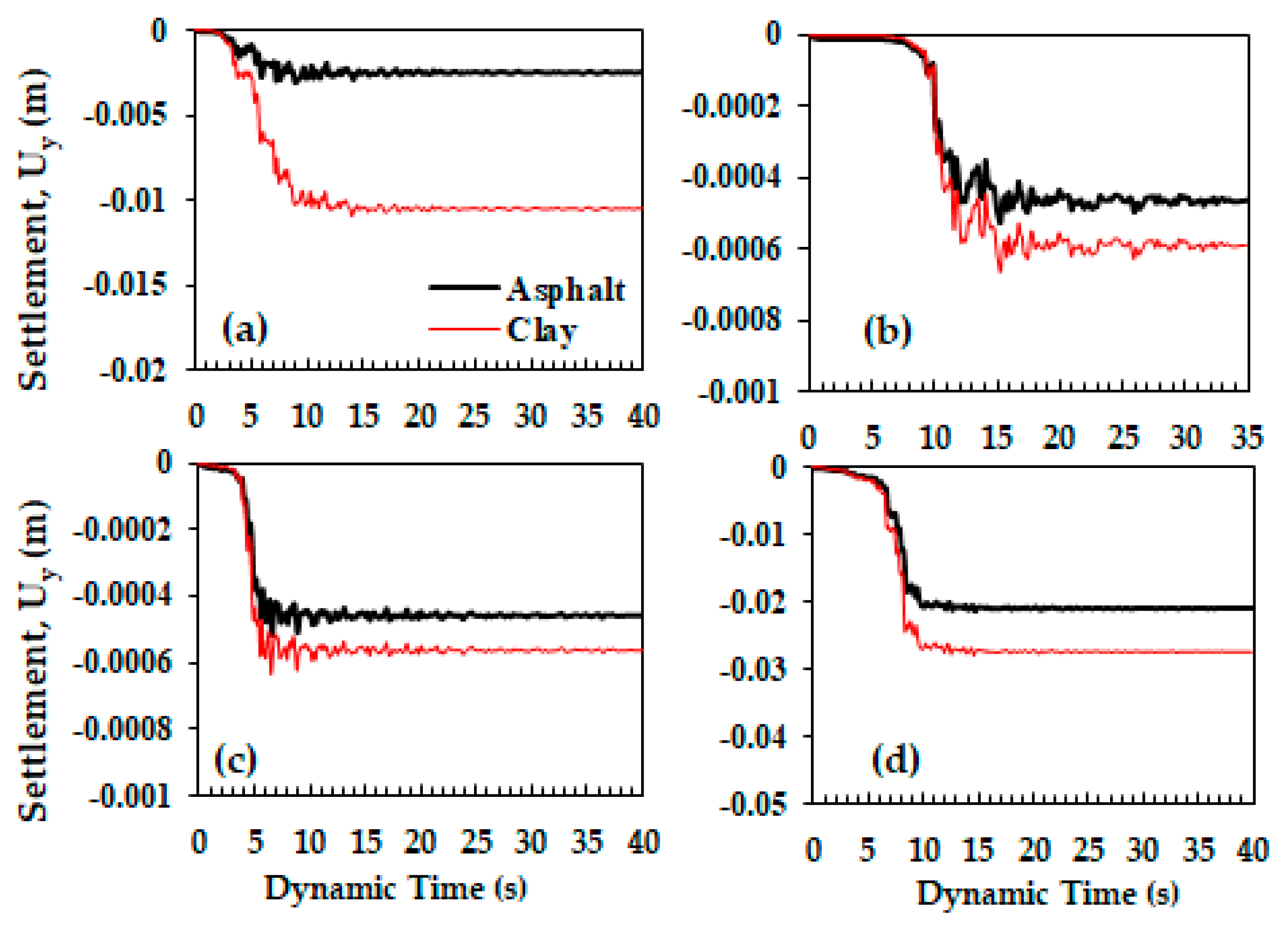
Figure 5 illustrates the crest settlement for different seismic scenarios. It is evident that the models with a clay core exhibit noticeably greater crest settlement than those with an asphalt core. This behavior is primarily attributed to the lower stiffness and higher compressibility of the clay core, which allows larger cyclic strains and volumetric contraction under seismic loading, whereas the asphalt core, due to its higher stiffness and viscoelastic behavior, provides greater resistance to deformation.
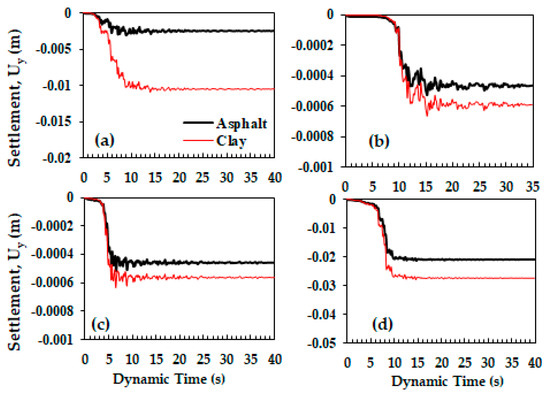
Figure 5.
Settlement time history responses calculated at the crest for different core materials under various earthquake records: (a) Kobe, (b) Kocaeli, (c) Loma Prieta, and (d) Northridge.
For the Kobe earthquake, the maximum crest settlement is 0.002 m and 0.01 m for the asphalt and clay cores, respectively. For the Kocaeli earthquake, the corresponding settlements are 0.0004 m and 0.0006 m, respectively. Similar values are observed for the Loma Prieta earthquake, with maximum settlements of 0.0004 m and 0.0006 m for the asphalt and clay cores, respectively. For the Northridge earthquake, the maximum crest settlement reaches 0.02 m for the asphalt core and 0.028 m for the clay core.
3.4. Lateral Displacement Recorded on the Downstream Slope
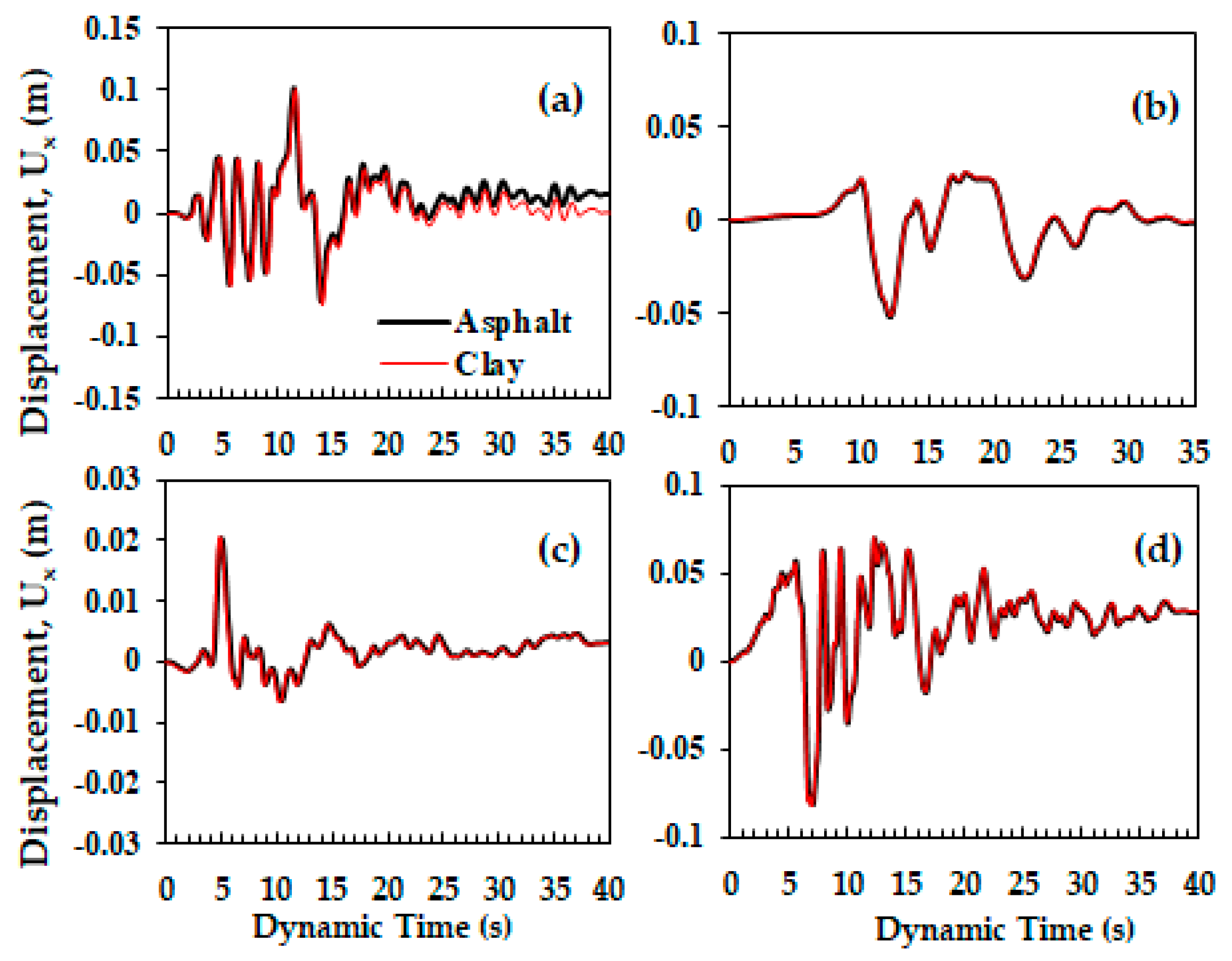
With respect to the lateral displacement of the downstream slope, Figure 6 again shows that variations in core material properties have no significant influence on the seismic response of the earthfill dam. This is because the lateral deformation of the downstream slope is mainly governed by the dynamic behavior of the shell materials and overall dam geometry, while the core primarily controls seepage rather than slope deformation under seismic loading. The maximum lateral displacement, equal to 0.097 m, is observed for the Kobe earthquake, whereas the minimum value of 0.02 m occurs under the Loma Prieta earthquake.
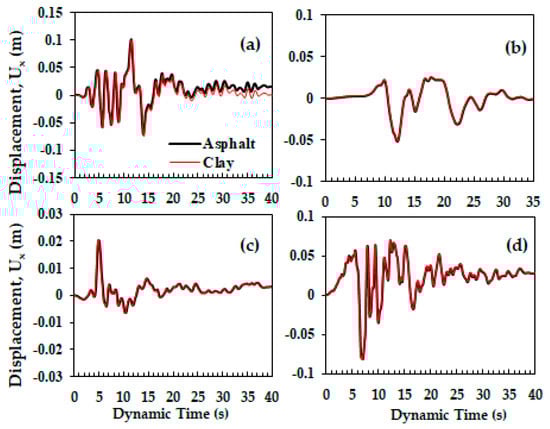
Figure 6.
Lateral displacement time histories calculated on the downstream slope for different core materials under various earthquake records: (a) Kobe, (b) Kocaeli, (c) Loma Prieta, and (d) Northridge.
4. Conclusions
- The parametric dynamic analyses of earthfill dams with clay and asphalt cores indicate that the dam with a clay core experiences greater crest settlement under cyclic loading compared to the dam with an asphalt core. This behavior is primarily attributed to the elastoplastic nature of the clay core, which, due to its lower stiffness and higher compressibility, undergoes larger deformations during seismic loading.
- In earthfill dams founded on alluvial soils, cyclic shear loading generates excess pore water pressure and reduces effective stress, leading to permanent deformations. Under these conditions, the clay core—because of its lower stiffness and higher compressibility—shows larger cyclic strains and volumetric contraction, resulting in greater crest settlement. In contrast, the asphalt core, with higher stiffness and viscoelastic damping, limits strain accumulation and redistributes stresses more effectively, thereby reducing the development of permanent settlement of the crest during seismic events.
- The similar lateral displacements observed for both core types are primarily governed by the response of the alluvial foundation. Alluvial soils are inherently susceptible to lateral deformation under cyclic loading [20], and their influence is manifested through two main mechanisms. First, their low stiffness: the deformation modulus of the alluvial foundation is considerably lower than that of the embankment and core materials, leading to increased dam displacements and a higher potential for sliding during seismic excitation [21]. Second, seismic amplification: soft alluvial soils amplify the input ground motion, thereby increasing the dynamic demand transmitted to the dam body [22].
- It was observed that the highest accelerations at both the crest and downstream slope occurred for the model subjected to the Northridge earthquake, as it has the strongest input motion with the highest peak ground acceleration and energy content among the considered records.
- It was observed that the maximum crest settlement occurred for the model subjected to the Northridge earthquake, as its higher intensity and energy content induced larger cyclic strains and permanent deformations within the dam body.
- It was also observed that the Kobe earthquake induced larger lateral displacements than the Northridge earthquake, despite having lower peak accelerations, due to its longer effective duration and frequency content being closer to the fundamental period of the dam–foundation system, which promoted greater cumulative deformation.
- Under extreme conditions, such as regions with high seismic activity, heavy rainfall, and short construction seasons, asphalt cores are more suitable due to their ease of implementation and more efficient compaction compared to clay cores.
Author Contributions
Conceptualization and methodology, S.S.; software, N.D.G.; validation, M.S. and N.D.G.; formal analysis, N.D.G.; investigation, M.S. and N.D.G.; resources, S.S.; data curation, M.S. and N.D.G.; writing—original draft preparation, M.S. and N.D.G.; writing—review and editing, M.S.; visualization, M.S. and N.D.G.; supervision, M.S.; All authors have read and agreed to the published version of the manuscript.
Funding
This research received no external funding.
Data Availability Statement
The original contributions presented in this study are included in the article. Further inquiries can be directed to the corresponding author.
Acknowledgments
During the preparation of this manuscript, the authors used Generative AI tools for language editing and clarity improvement. The authors have reviewed and edited the output and take full responsibility for the content of this publication.
Conflicts of Interest
The authors declare no conflicts of interest.
References
- Gleick, P.H.; Heberger, M.; Donnelly, K. Zombie water projects. In The World’s Water: The Biennial Report on Freshwater Resources; Island Press/Center for Resource Economics: Washington, DC, USA, 2014; pp. 123–146. [Google Scholar]
- Tani, S. Behavior of large fill dams during earthquake and earthquake damage. Soil Dyn. Earthq. Eng. 2000, 20, 223–229. [Google Scholar] [CrossRef]
- Zewdu, A. Modeling the slope of embankment dam during static and dynamic stability analysis: A case study of Koga dam, Ethiopia. Model. Earth Syst. Environ. 2020, 6, 1963–1979. [Google Scholar] [CrossRef]
- Talukdar, P.; Dey, A. Hydraulic failures of earthen dams and embankments. Innov. Infrastruct. Solut. 2019, 4, 42. [Google Scholar] [CrossRef]
- Ozkan, M.Y. A review of considerations on seismic safety of embankments and earth and rock-fill dams. Soil Dyn. Earthq. Eng. 1988, 17, 439–458. [Google Scholar] [CrossRef]
- Durmaz, S.; Ülgen, D. Prediction of earthquake-induced permanent deformations for concrete-faced rockfill dams. Nat. Hazards 2021, 105, 587–610. [Google Scholar] [CrossRef]
- Adamo, N.; Al-Ansari, N.; Sissakian, V.; Laue, J.; Knutsson, S. Dam safety and earthquakes. J. Earth Sci. Geotech. Eng. 2020, 10, 79–132. [Google Scholar]
- Fattah, M.Y.; Alwash, H.H.; Hadi, S.A. Earthfill Dams Response to Earthquake Excitation-Khassa Chai Dam as a Case Study. Al-Nahrain J. Eng. Sci. 2017, 20, 405–418. [Google Scholar]
- Hinks, J. (Ed.) Earthquake Engineering for Dams and Reservoirs; Emerald Publishing Limited: Leeds, UK, 2023. [Google Scholar]
- Seed, H.B.; Makdisi, F.I.; De Alba, P. Performance of earth dams during earthquakes. J. Geotech. Eng. Div. 1978, 104, 967–994. [Google Scholar] [CrossRef]
- Shafiee, A. Effect of core composition on seismic stability of earth dams. Proc. Inst. Civ. Eng. Geotech. Eng. 2008, 161, 283–290. [Google Scholar] [CrossRef]
- Smesnik, M.; Krstic, S.; Guven, S.; Verdianz, M. Asphalt core embankment dams in turkey–dam design, core material and construction. In Proceedings of the ICOLD–European Club Symposium, Crete, Greece, 2–4 October 2019; pp. 2–4. [Google Scholar]
- Kim, M.K.; Lee, S.H.; Choo, Y.W.; Kim, D.S. Seismic behaviors of earth-core and concrete-faced rock-fill dams by dynamic centrifuge tests. Soil Dyn. Earthq. Eng. 2011, 31, 1579–1593. [Google Scholar] [CrossRef]
- Rewtragulapaibul, C.; Jaritngam, S.; Wannawong, T.; Somchainuek, O. Comparison of embankment properties with clay core and asphaltic concrete core. Appl. Sci. 2024, 14, 6555. [Google Scholar] [CrossRef]
- Khan, M.S.A.; Seyedi, M. Dynamic responses of embankment dams, constituted from varied soil types, to seismic activity. Acadlore Trans. Geosci. 2023, 2, 177–187. [Google Scholar] [CrossRef]
- Jasim Khammas Issa, M.; Abdelsalam, M.; Hashim Khudhair, L.; Seyedi, M.; Khan, M.S.A. Liquefaction Behavior of Suction Bucket Foundations for Wind Turbines Under Soil Variability. Geotech. Geol. Eng. 2025, 43, 177. [Google Scholar] [CrossRef]
- Duraid Abdullah Al-Khateeb, S.; Jasim Khammas Issa, M.; Seyedi, M. A numerical assessment of the efficiency of partial saturation as a countermeasure against liquefaction-induced uplift of tunnels. J. Earthq. Eng. 2024, 29, 547–570. [Google Scholar] [CrossRef]
- Schanz, T.; Vermeer, P.A.; Bonnier, P.G. The hardening soil model: Formulation and verification. In Beyond 2000 in Computational Geotechnics; Routledge: Abingdon, UK, 1999; pp. 281–296. [Google Scholar]
- Saedi, S.; Nadada, A.U. Laboratory Investigation and Numerical Modelling Effect of Carbon Nanotubes on Hot Mix Asphalt Permanent Displacement. J. Sustain. Constr. Mater. Technol. 2025, 10, 9. [Google Scholar] [CrossRef]
- Fell, R.; Fry, J.J. (Eds.) Internal Erosion of Dams and Their Foundations: Selected and Reviewed Papers from the Workshop on Internal Erosion and Piping of Dams and Their Foundations, Aussois, France, 25–27 April 2005; CRC Press: Boca Raton, FL, USA, 2007. [Google Scholar]
- Makdisi, F.K.; Seed, H.B. Simplified procedure for estimating dam and embankment earthquake-induced deformations. J. Geotech. Eng. 1978, 104, 849–867. [Google Scholar] [CrossRef]
- Seed, B.; Idriss, I. Soil Moduli and Damping Factors for Dynamic Response Analyses; Report EERC 70-10; University of California, Berkeley, Earthquake Engineering Research Center: Berkeley, CA, USA, 1970. [Google Scholar]
Disclaimer/Publisher’s Note: The statements, opinions and data contained in all publications are solely those of the individual author(s) and contributor(s) and not of MDPI and/or the editor(s). MDPI and/or the editor(s) disclaim responsibility for any injury to people or property resulting from any ideas, methods, instructions or products referred to in the content. |
© 2026 by the authors. Licensee MDPI, Basel, Switzerland. This article is an open access article distributed under the terms and conditions of the Creative Commons Attribution (CC BY) license.