A Bibliographic Analysis of Multi-Risk Assessment Methodologies for Natural Disaster Prevention


Abstract
1. Introduction
2. Materials and Methods
3. Corpus Analysis and Results
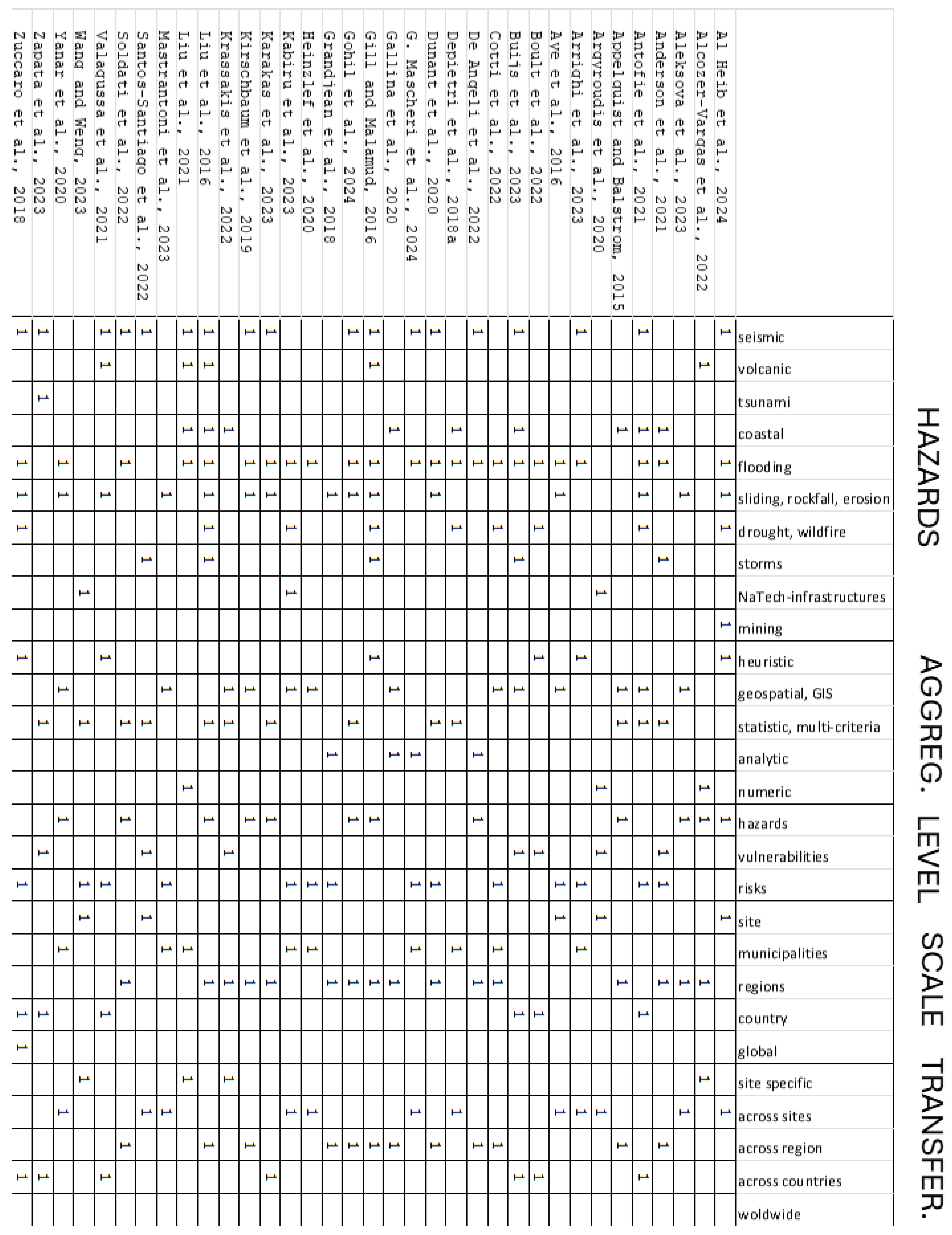
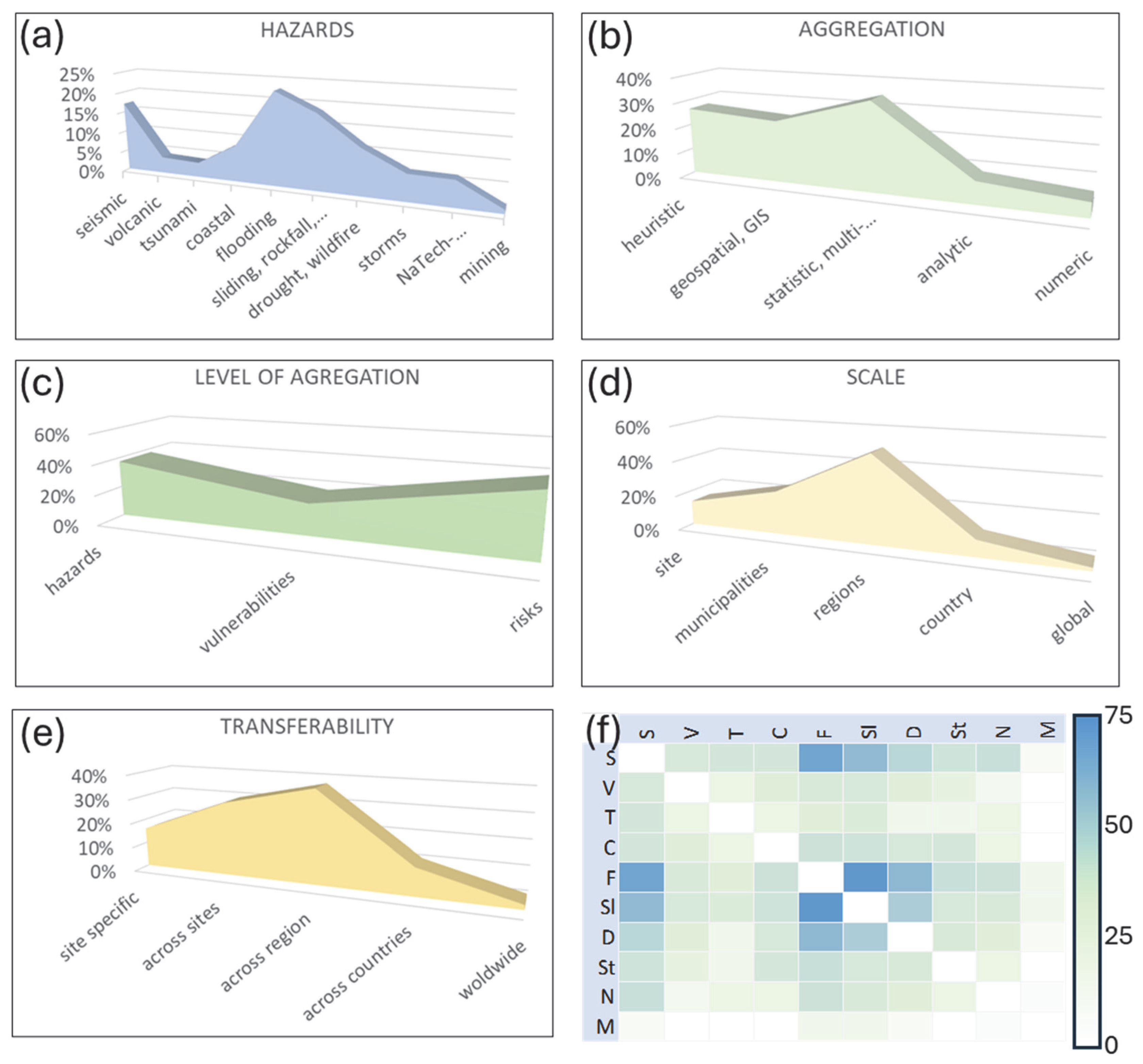
- HAZARDS (Figure 4a): undoubtedly, natural phenomena due to climate events are the most studied, particularly those related to flooding (more than 20%). Coastal hazards (i.e., coastal submersion and erosion) as well as all landsliding ones (i.e., mudslides, landslides, rockfall, debris-flows, etc.) and droughts/wildfires are also well represented. Then, there come seismic hazards with less interest in the tsunami disasters. Topics less represented in the corpus are NaTech and mining hazards.
- AGGREGATION (Figure 4b): Aggregating single-hazard information to obtain a multi-hazard diagnosis is not straightforward. Depending on the quantity and quality of input data, the desired level of uncertainties in the results, the allocated computing resources, etc., the proposed methodologies can vary with the authors’ computing capacities or test site characteristics. Figure 4b shows a quite homogeneous distribution between the different aggregation techniques, even if we can see a higher usage of statistical or GIS approaches (more than 30%) and a lower usage of high computing numerical simulations.
- LEVEL OF AGGREGATION (Figure 4c): The way of aggregating information at the level of hazards, vulnerabilities, or risks may also depend on the context of the study. Globally, the corpus is quite homogeneous on this question, with less emphasis on multi-vulnerability issues.
- SCALE (Figure 4d): The spatial scale of study sites also varies greatly, from small objects (house, dam, etc.) or larger spaces (slope, coastline, city, etc.), to national, continental, or global scales. It appears that municipalities or regional scales are the most represented in our corpus (more than 40%)
- TRANSFERABILITY (Figure 4e): like for the LCP “scale”, most of the studies able to transfer the methodology from one case to another are carried out at the municipality or regional scale (more than 35%)
- MULTIHAZARDS COMBINATION (Figure 4f): The colored cells shown on this figure are all the bluer as the hazard pairs were found in the corpus. At the top of the list, we have the combinations of floods and landslides (more than 75 cases), then floods and seismic, floods and drought, and finally seismic and landslides. Of course, other combinations are also represented, but to a lesser extent.
4. Discussion
4.1. The Type of Hazard Addressed
4.2. The Methods for Aggregating Information
- Heuristic methods: such methods have been intensively used for decades since they do not require important numerical resources. They are thus easy to implement as soon as local experts have the capabilities to evaluate the importance of risky situations. For example, ref. [44] use a matrix method to weight each of these situations and compile at the end the total level of risk in the context of post-mining risk management. Ref. [45] also uses weighting methods to map erosion and sliding areas with a GIS; ref. [46] propose a weighting wheel to evaluate the impacts of a series of hazards in coastal domains. On the other hand, ref. [47] use a decision tree approach to identify cascading events and evaluate their impacts on exposed assets in the space and time dimensions. Graph methods are also used by ref. [43] to model the interactions and triggering of perils of different types. When exhaustive databases are available, probabilistic indicators [48] or Analytical Hierarchy Process methods [49] are widely used to conduct multi-criteria analyses in multi-risk contexts.
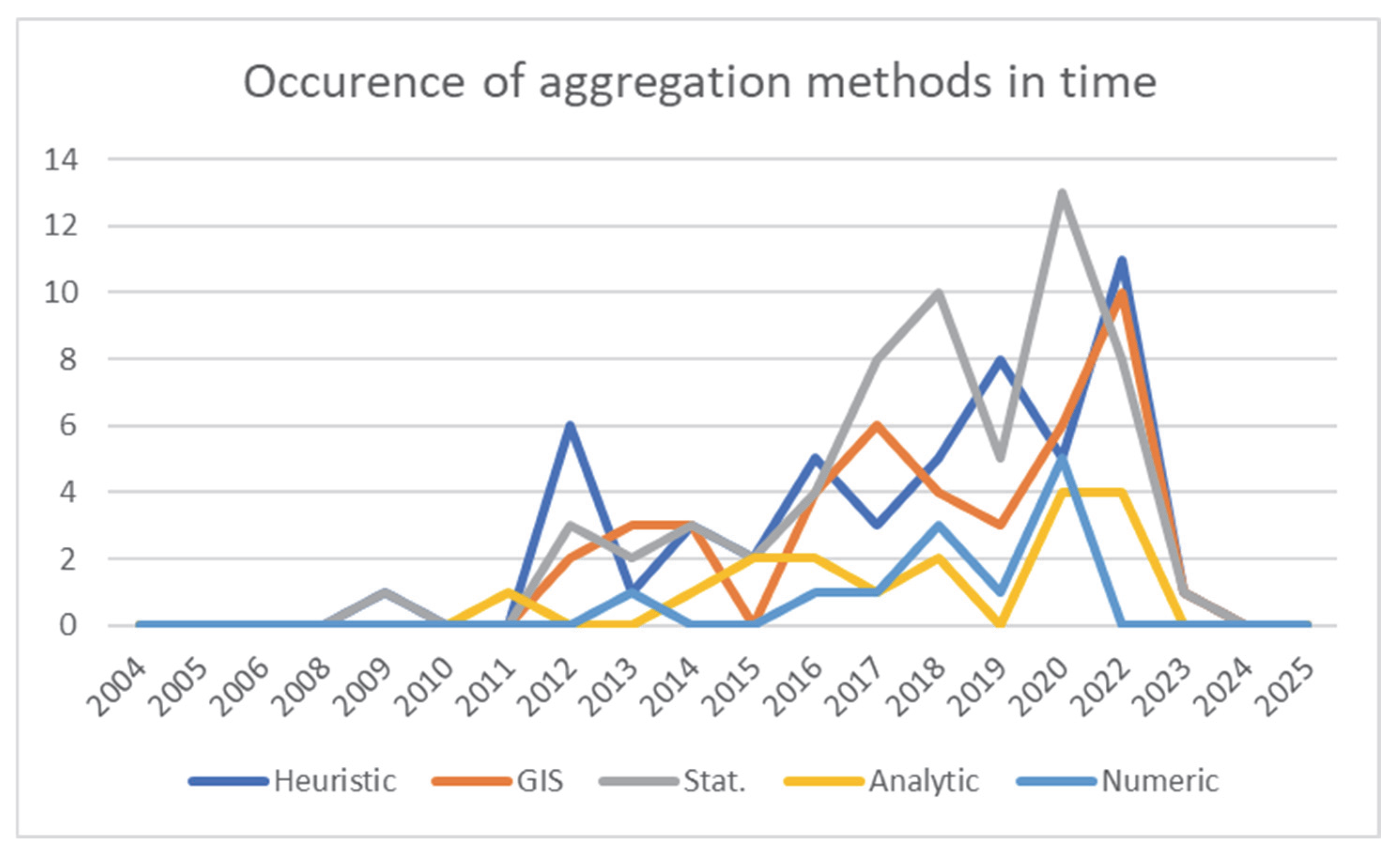
- GIS and statistical methods: Statistical methods, often coupled with GIS, show the greatest progress in multi-risk assessments in recent years. Undoubtedly, the democratization of artificial intelligence algorithms has made it possible to test new avenues of research exploiting environmental databases [50] and massive Earth observations for decision making [51]. Fuzzy logic is implemented by refs. [39,52,53] or ref. [54] to take into account the uncertainties related to the definition of a hazardous criterion, allowing the quantitative mapping of multiple hazard sources. Refs. [55,56] explore the contribution of artificial intelligence for complex cases of multi-hazards and risk analysis.
- Analytic approaches are less represented in the corpus, probably because complex and cascading phenomena are more difficult to represent by physical equations. However, ref. [37] formalize hazard occurrences and related impacts by various equations able to elaborate risk scenarios. In the same way, ref. [57] propose to implement mechanistic models in a numerical platform to assess sliding hazards and risks in mountainous areas.
- Numeric techniques: as already mentioned, numerical methods are used in particular cases where the size of the studied zone and the complexity of physical processes can be numerically integrated into simulation solvers. Ref. [29] demonstrate the usability of such models in the Tokyo Bay to assess multi-hazards due to coastal events. Ref. [58] apply a physically based stability model to map rainfall impacts over mountainous regions.
4.3. Level of Assessment, Dimension of Studied Areas, Scale, and Transferability
5. Conclusions
Funding
Data Availability Statement
Conflicts of Interest
References
- Annunziato, A.; Fonio, C.; Proietti, C. Collaboration Between Disaster Managers and Scientists; Publications Office of the European Union: Brussels, Belgium, 2020. [Google Scholar] [CrossRef]
- Fuchs, S.; Thaler, T. Tipping Points in Natural Hazard Risk Management: How Societal Transformation can Provoke Policy Strategies in Mitigation. J. Extrem. Events 2017, 4, 1750006. [Google Scholar] [CrossRef] [Scilit]
- Schneider, T.; Lochard, J. Supporting societal and economic dynamics of recovery: Lessons from Chernobyl and Fukushima. Ann. ICRP 2021, 50, 68–73. [Google Scholar] [CrossRef] [Scilit]
- Curt, C. Multirisk: What trends in recent works?—A bibliometric analysis. Sci. Total Environ. 2021, 763, 142951. [Google Scholar] [CrossRef] [Scilit]
- Owolabi, T.A.; Sajjad, M. A global outlook on multi-hazard risk analysis: A systematic and scientometric review. Int. J. Disaster Risk Reduct. 2023, 92, 103727. [Google Scholar] [CrossRef] [Scilit]
- Schlumberger, J.; Šakić Trogrlić, R.; Aerts, J.C.J.H.; Hyun, J.-H.; Hochrainer-Stigler, S.; de Ruiter, M.; Haasnoot, M. A Pathways Analysis Dashboard prototype for multi-risk systems. EGUsphere 2024. preprint. [Google Scholar] [CrossRef] [Scilit]
- Tilloy, A.; Malamud, B.D.; Winter, H.; Joly-Laugel, A. A review of quantification methodologies for multi-hazard interrelationships. Earth-Sci. Rev. 2019, 196, 102881. [Google Scholar] [CrossRef] [Scilit]
- Gallina, V.; Torresan, S.; Critto, A.; Sperotto, A.; Glade, T.; Marcomini, A. A review of multi-risk methodologies for natural hazards: Consequences and challenges for a climate change impact assessment. J. Environ. Manag. 2016, 168, 123–132. [Google Scholar] [CrossRef] [Scilit]
- Kappes, M.S.; Keiler, M.; von Elverfeldt, K.; Glade, T. Challenges of analyzing multi-hazard risk: A review. Nat. Hazards 2012, 64, 1925–1958. [Google Scholar] [CrossRef] [Scilit]
- Arosio, M.; White, C.; Adnan, M.; Martina, M.; Kennedy, C. A framework for multi-hazard risk indicators. In Proceedings of the EGU General Assembly 2024, Vienna, Austria, 14–19 April 2024. [Google Scholar] [CrossRef] [Scilit]
- White, C.J.; Adnan, M.S.G.; Arosio, M.; Buller, S.; Cha, Y.; Ciurean, R.; Crummy, J.M.; Duncan, M.; Gill, J.; Kennedy, C.; et al. Review article: Towards multi-hazard and multi-risk indicators—A review and recommendations for development and implementation. Nat. Hazards Earth Syst. Sci. 2024. preprint. [Google Scholar] [CrossRef] [Scilit]
- Corotis, R.; Hammel, E. Multi-attribute aspects for risk assessment of natural hazards. International. J. Risk Assess. Manag. 2010, 14, 437. [Google Scholar] [CrossRef] [Scilit]
- Sopery, K.A.M.; Muhammad, N.S.; Abdullah, J.; Bin Mohd, M.S.F.; Desa, S.b.M. Emerging Trends in Flood and Landslide Research: Single Vs Multi-Hazard Disaster Analysis Using GIS. J. Kejuruter. 2022, 34, 999–1015. [Google Scholar] [CrossRef] [Scilit]
- Drakes, O.; Tate, E. Social vulnerability in a multi-hazard context: A systematic review. Environ. Res. Lett. 2022, 17, 033001. [Google Scholar] [CrossRef] [Scilit]
- Mohammadi, S.; De Angeli, S.; Boni, G.; Pirlone, F.; Cattari, S. Review article: Current approaches and critical issues in multi-risk recovery planning of urban areas exposed to natural hazards. EGUsphere 2023. preprint. [Google Scholar] [CrossRef] [Scilit]
- Fekete, A.; Subramanian, S. Multi-risks attributed to climate change and urbanization in East Africa: A bibliometric analysis of a science gap. Afr. Geogr. Rev. 2023, 43, 735–757. [Google Scholar] [CrossRef] [Scilit]
- Julia, P.B.; Ferreira, T.M. From single- to multi-hazard vulnerability and risk in Historic Urban Areas: A literature review. Nat. Hazards 2021, 108, 93–128. [Google Scholar] [CrossRef] [Scilit]
- Al Hudaib, H.T.; Ray, R.P. The Methodologies and Main Challenges of Assessment the Multi-Hazard Interaction and Risk Management Associated with Roads Infrastructures and Dam Safety: A Review. Int. J. Integr. Eng. 2023, 15, 174–188. [Google Scholar] [CrossRef] [Scilit]
- Mesa-Gómez, A.; Casal, J.; Muñoz, F. Risk analysis in Natech events: State of the art. J. Loss Prev. Process Ind. 2020, 64, 104071. [Google Scholar] [CrossRef] [Scilit]
- López-Saavedra, M.; Martí, J. Reviewing the multi-hazard concept. Application to volcanic islands. Earth-Sci. Rev. 2022, 236, 104286. [Google Scholar] [CrossRef] [Scilit]
- Terzi, S.; Torresan, S.; Schneiderbauer, S.; Critto, A.; Zebisch, M.; Marcomini, A. Multi-risk assessment in mountain regions: A review of modelling approaches for climate change adaptation. J. Environ. Manag. 2018, 232, 759–771. [Google Scholar] [CrossRef] [Scilit]
- Kumasaki, M.; King, M.; Arai, M.; Yang, L. Anatomy of cascading natural disasters in Japan: Main modes and linkages. Nat. Hazards 2015, 80, 1425–1441. [Google Scholar] [CrossRef] [Scilit]
- Ward, P.; Blauhut, V.; Bloemendaal, N.; Daniell, J.; de Ruiter, M.; Duncan, M.; Emberson, R.; Jenkins, S.; Kirschbaum, D.; Kunz, M.; et al. Review article: Natural hazard risk assessments at the global scale. Nat. Hazards Earth Syst. Sci. 2020, 20, 1069–1096. [Google Scholar] [CrossRef] [Scilit]
- Kreibich, H.; Bubeck, P.; Kunz, M.; Mahlke, H.; Parolai, S.; Khazai, B.; Daniell, J.; Lakes, T.; Schroeter, K. A review of multiple natural hazards and risks in Germany. Nat. Hazards 2014, 74, 2279–2304. [Google Scholar] [CrossRef] [Scilit]
- Page, M.J.; McKenzie, J.E.; Bossuyt, P.M.; Boutron, I.; Hoffmann, T.C.; Mulrow, C.D.; Shamseer, L.; Tetzlaff, J.M.; Akl, E.A.; Brennan, S.E.; et al. The PRISMA 2020 statement: An updated guideline for reporting systematic reviews. BMJ 2021, 372, n71. [Google Scholar] [CrossRef] [Scilit] [PubMed]
- EM-DAT; CRED/UCLouvain. With Major Processing by Our World in Data. “Number of Recorded Natural DISASTER events–EM-DAT” [Dataset]. EM-DAT, CRED/UCLouvain. Natural Disasters 2024, [Original Data]. Retrieved 19 March 2025. Available online: https://ourworldindata.org/grapher/number-of-natural-disaster-events (accessed on 24 June 2025).
- Cotti, D.; Harb, M.; Hadri, A.; Aboufirass, M.; Chaham, K.; Libertino, A.; Campo, L.; Trasforini, E.; Krätzschmar, E.; Bellert, F.; et al. An Integrated Multi-Risk Assessment for Floods and Drought in the Marrakech-Safi Region (Morocco). Front. Water 2022, 4, 886648. [Google Scholar] [CrossRef] [Scilit]
- Boult, V.L.L.; Black, E.; Abdillahi, H.S.; Bailey, M.; Harris, C.; Kilavi, M.; Kniveton, D.; MacLeod, D.; Mwangi, E.; Otieno, G.; et al. Towards drought impact-based forecasting in a multi-hazard context. Clim. Risk Manag. 2022, 35, 100402. [Google Scholar] [CrossRef] [Scilit]
- Liu, F.; Chen, J.; Wang, Y. Numerical Assessment of Coastal Multi-hazard Vulnerability in Tokyo Bay. Res. Sq. 2021, 114, 3597–3625. [Google Scholar] [CrossRef] [Scilit]
- Anderson, C.C.; Renaud, F.G.; Hagenlocher, M.; Day, J.W. Assessing Multi-Hazard Vulnerability and Dynamic Coastal Flood Risk in the Mississippi Delta: The Global Delta Risk Index as a Social-Ecological Systems Approach. Water 2021, 13, 577. [Google Scholar] [CrossRef] [Scilit]
- Alcozer-Vargas, N.; Reyes-Hardy, M.-P.; Esquivel, A.; Aguilera, F. A GIS-based multi-hazard assessment at the San Pedro volcano, Central Andes, northern Chile. Front. Earth Sci. 2022, 10, 897315. [Google Scholar] [CrossRef] [Scilit]
- Soldati, A.; Chiozzi, A.; Nikolić, Ž.; Vaccaro, C.; Benvenuti, E. A PROMETHEE Multiple-Criteria Approach to Combined Seismic and Flood Risk Assessment at the Regional Scale. Appl. Sci. 2022, 12, 1527. [Google Scholar] [CrossRef] [Scilit]
- Zapata, J.C.G.; Pittore, M.; Brinckmann, N.; Lizarazo-Marriaga, J.; Medina, S.; Tarque, N.; Cotton, F. Scenario-based multi-risk assessment from existing single-hazard vulnerability models. An application to consecutive earthquakes and tsunamis in Lima, Peru. Nat. Hazards Earth Syst. Sci. 2023, 23, 2203–2228. [Google Scholar] [CrossRef] [Scilit]
- Santos-Santiago, M.A.; Ruiz, S.E.; Cruz-Reyes, L. Optimal design of buildings under wind and earthquake, considering cumulative damage. J. Build. Eng. 2022, 56, 104760. [Google Scholar] [CrossRef] [Scilit]
- Argyroudis, S.; Mitoulis, S.; Hofer, L.; Zanini, M.; Tubaldi, E.; Frangopol, D. Resilience assessment framework for critical infrastructure in a multi-hazard environment: Case study on transport assets. Sci. Total Environ. 2020, 714, 136854. [Google Scholar] [CrossRef] [Scilit]
- Wang, J.; Weng, W. Methodology for Natech coupling risk assessment using correlative multi-criteria decision-making method. J. Loss Prev. Process Ind. 2023, 83, 105060. [Google Scholar] [CrossRef] [Scilit]
- Mascheri, G.; Chieffo, N.; Arrighi, C.; Del Gaudio, C.; Lourénço, P. A Framework for Multi-Hazard Assessment in a Historical Area of Lisbon. Int. J. Disaster Risk Reduct. 2024, 108, 104508. [Google Scholar] [CrossRef] [Scilit]
- Gill, J.; Malamud, B. Hazard interactions and interaction networks (cascades) within multi-hazard methodologies. Earth Syst. Dyn. 2016, 7, 659–679. [Google Scholar] [CrossRef] [Scilit]
- Gallina, V.; Torresan, S.; Zabeo, A.; Critto, A.; Glade, T.; Marcomini, A. A Multi-Risk Methodology for the Assessment of Climate Change Impacts in Coastal Zones. Sustainability 2020, 12, 3697. [Google Scholar] [CrossRef] [Scilit]
- De Angeli, S.; Malamud, B.; Rossi, L.; Taylor, F.; Trasforini, E.; Rudari, R. A multi-hazard framework for spatial-temporal impact analysis. Int. J. Disaster Risk Reduct. 2022, 73, 102829. [Google Scholar] [CrossRef] [Scilit]
- Depietri, Y.; Dahal, K.; McPhearson, T. Multi-hazard risks in New York City. Nat. Hazards Earth Syst. Sci. 2018, 18, 3363–3381. [Google Scholar] [CrossRef] [Scilit]
- Thompson, H.E.; Gill, J.C.; Šakić Trogrlić, R.; Taylor, F.E.; Malamud, B.D. A methodology to compile multi-hazard interrelationships in a data-scarce setting: An application to the Kathmandu Valley, Nepal. Nat. Hazards Earth Syst. Sci. 2025, 25, 353–381. [Google Scholar] [CrossRef] [Scilit]
- Dunant, A.; Bebbington, M.; Davies, T. Probabilistic cascading multi-hazard risk assessment methodology using graph theory, a New Zealand trial. International. J. Disaster Risk Reduct. 2020, 54, 102018. [Google Scholar] [CrossRef] [Scilit]
- Al Heib, M.; Franck, C.; Djizanne, H.; Degas, M. Post-Mining Multi-Hazard Assessment for Sustainable Development. Sustainability 2024, 15, 8139. [Google Scholar] [CrossRef] [Scilit]
- Aleksova, B.; Lukic, T.; Milevski, I.; Spalevic, V.; Markovic, S.B. Modelling Water Erosion and Mass Movements (Wet) by Using GIS-Based Multi-Hazard Susceptibility Assessment Approaches: A Case Study-Kratovska Reka Catchment (North Macedonia). Atmosphere 2023, 14, 1139. [Google Scholar] [CrossRef] [Scilit]
- Appelquist, L.R.; Balstrom, T. Application of a new methodology for coastal multi-hazard-assessment & management on the state of Karnataka, India. J. Environ. Manag. 2015, 152, 1–10. [Google Scholar] [CrossRef] [Scilit]
- Zuccaro, G.; De Gregorio, D.; Leone, M. Theoretical model for cascading effects analyses. Int. J. Disaster Risk Reduct. 2018, 30, 199–215. [Google Scholar] [CrossRef] [Scilit]
- Liu, B.; Siu, Y.L.; Mitchell, G. Hazard interaction analysis for multi-hazard risk assessment: A systematic classification based on hazard-forming environment. Nat. Hazards Earth Syst. Sci. 2016, 16, 629–642. [Google Scholar] [CrossRef] [Scilit]
- Krassakis, P.; Karavias, A.; Nomikou, P.; Karantzalos, K.; Koukouzas, N.; Athinelis, I.; Kazana, S.; Parcharidis, I. Multi-Hazard Susceptibility Assessment Using the Analytical Hierarchy Process in Coastal Regions of South Aegean Volcanic Arc Islands. Geohazards 2023, 4, 77–106. [Google Scholar] [CrossRef] [Scilit]
- Antofie, T.-E.; Stefano, L.; Marin-Ferrer, M.; Patrascu, F.; Eklund, G.; Lindl, F.; Santini, M.; Brian, D. Identifying multi-hazard potential impact at the pan-European level: The DRMKC Risk Data Hub methodology. In Proceedings of the EGU General Assembly 2021, Online, 19–30 April 2021. [Google Scholar] [CrossRef] [Scilit]
- Heinzlef, C.; Becue, V.; Serre, D. A spatial decision support system for enhancing resilience to floods: Bridging resilience modelling and geovisualization techniques. Nat. Hazards Earth Syst. Sci. 2020, 20, 1049–1068. [Google Scholar] [CrossRef] [Scilit]
- Gohil, M.; Mehta, D.; Shaikh, M. An integration of geospatial and fuzzy-logic techniques for multi-hazard mapping. Results Eng. 2024, 21, 101758. [Google Scholar] [CrossRef] [Scilit]
- Karakas, G.; Kocaman, S.; Gokceoglu, C. A Hybrid Multi-Hazard Susceptibility Assessment Model for a Basin in Elazig Province, Turkiye. Int. J. Disaster Risk Sci. 2023, 14, 326–341. [Google Scholar] [CrossRef] [Scilit]
- Yanar, T.; Kocaman, S.; Gökçeoğlu, C. Use of Mamdani Fuzzy Algorithm for Multi-Hazard Susceptibility Assessment in a Developing Urban Settlement (Mamak, Ankara, Turkey). ISPRS Int. J. Geo-Inf. 2020, 9, 114. [Google Scholar] [CrossRef] [Scilit]
- Guikema, S. Artificial Intelligence for Natural Hazards Risk Analysis: Potential, Challenges, and Research Needs. Risk Anal. 2020, 40, 1117–1123. [Google Scholar] [CrossRef] [Scilit] [PubMed]
- Kabiru, P.; Kuffer, M.; Sliuzas, R.V.; Vanhuysse, S. The relationship between multiple hazards and deprivation using open geospatial data and machine learning. Nat. Hazards 2023, 119, 907–941. [Google Scholar] [CrossRef] [Scilit]
- Grandjean, G.; Thomas, L.; Bernardie, S.; The SAMCO Team. A Novel Multi-Risk Assessment Web-Tool for Evaluating Future Impacts of Global Change in Mountainous Areas. Climate 2018, 6, 92. [Google Scholar] [CrossRef] [Scilit]
- Chen, H.; Zhang, S.; Peng, M.; Zhang, L. A physically-based multi-hazard risk assessment platform for regional rainfall-induced slope failures and debris flows. Eng. Geol. 2015, 203, 15–29. [Google Scholar] [CrossRef] [Scilit]
- Nguyen, H.D.; Dang, D.-K.; Bui, Q.-T.; Petrisor, A.-I. Multi-hazard assessment using machine learning and remote sensing in the North Central region of Vietnam. Trans. GIS 2023, 27, 1614–1640. [Google Scholar] [CrossRef] [Scilit]
- Arrighi, C.; Tanganelli, M.; Cristofaro, M.T.; Cardinali, V.; Marra, A.; Castelli, F.; De Stefano, M. Multi-risk assessment in a historical city. Nat. Hazards 2023, 119, 1041–1072. [Google Scholar] [CrossRef] [Scilit]
- Mastrantoni, G.; Masciulli, C.; Marini, R.; Esposito, C.; Mugnozza, G.; Mazzanti, P. A novel model for multi-risk ranking of buildings at city level based on open data: The test site of Rome, Italy. Geomat. Nat. Hazards Risk 2023, 14, 1. [Google Scholar] [CrossRef] [Scilit]
- Aye, Z.C.; Jaboyedoff, M.; Derron, M.H.; van Westen, C.J.; Hussin, H.Y.; Ciurean, R.L.; Frigerio, S.; Pasuto, A. An interactive web-GIS tool for risk analysis: A case study in the Fella River basin, Italy. Nat. Hazards Earth Syst. Sci. 2016, 16, 85–101. [Google Scholar] [CrossRef] [Scilit]
- Kirschbaum, D.; Watson, C.S.; Rounce, D.R.; Shugar, D.H.; Kargel, J.S.; Haritashya, U.K.; Amatya, P.; Shean, D.; Anderson, E.R.; Jo, M. The State of Remote Sensing Capabilities of Cascading Hazards Over High Mountain Asia. Front. Earth Sci. 2019, 7, 197. [Google Scholar] [CrossRef] [Scilit] [PubMed]
- Buijs, S.; de Ruiter, M.; Ward, P. A continental-scale multi-hazard analysis of economic recovery using nighttime light satellite data. In Proceedings of the EGU General Assembly 2023, Vienna, Austria, 24–28 April 2023. [Google Scholar] [CrossRef] [Scilit]
- Valagussa, A.; Frattini, P.; Crosta, G.; Spizzichino, D.; Leoni, G.; Margottini, C. Multi-risk analysis on European cultural and natural UNESCO heritage sites. Nat. Hazards 2021, 105, 2659–2676. [Google Scholar] [CrossRef] [Scilit]
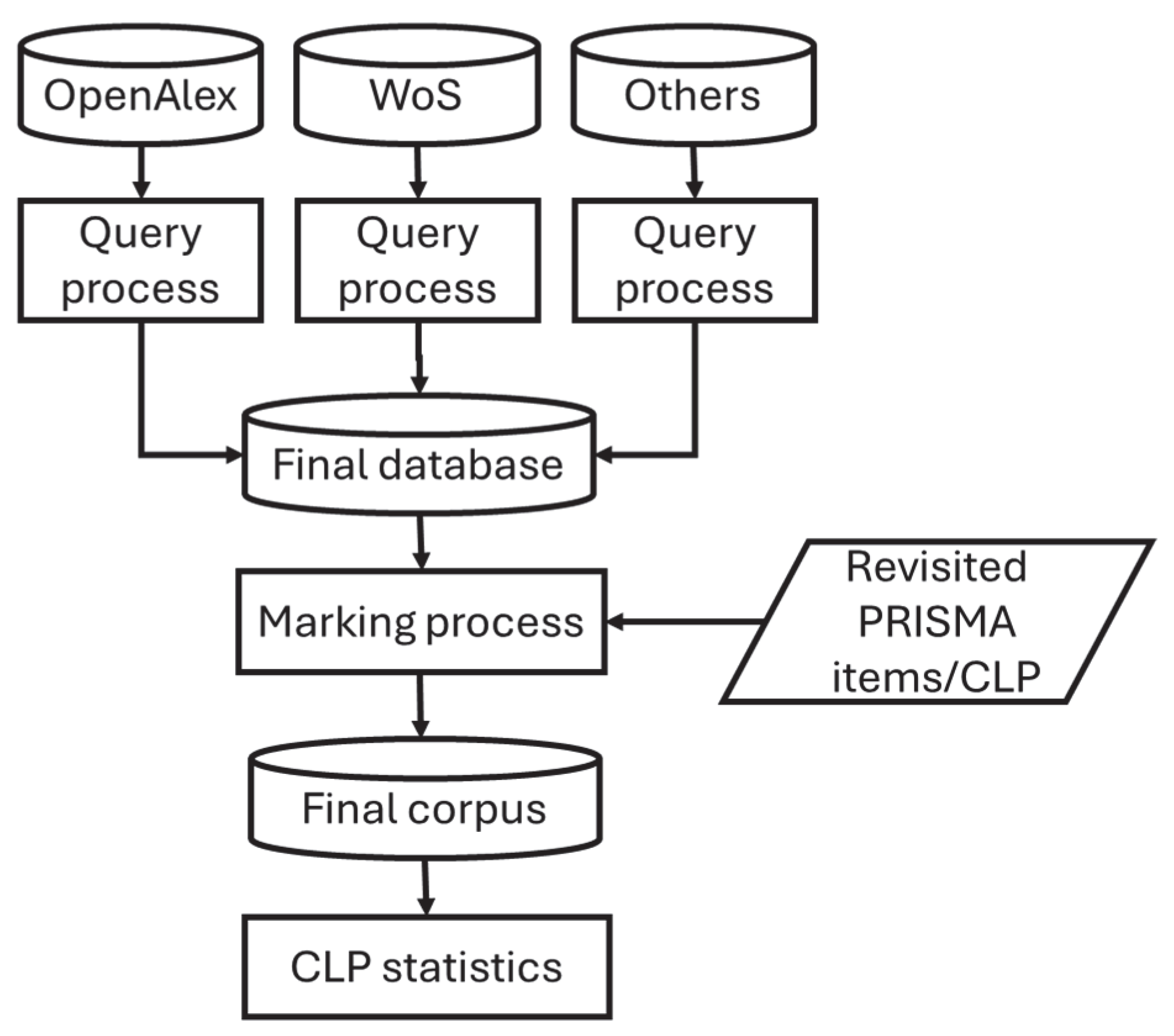


| Item | Checklist Points (CLP) |
|---|---|
| 1—Title and abstract | 1—Is about multi-risks, multi-hazards, natural disaster |
| 2—Introduction | 2—Presents rationale and clear objectives |
| 3—Material and method | 3—HAZARDS: addresses several kinds of hazards and/or risks among Seismic, Volcanic, Tsunami, Coastal, Flooding, Landsliding (incl. rockfall, erosion), Wildfire, Storms, NaTech and Mining. 4—AGGREGATION: proposes a method for aggregating several hazards and/or risks: Heuristic, Geospatial and GIS, Statistic and multi-criteria, Analytic, Numeric. 5—LEVEL OF AGGREGATION: shows if the study focuses on multi-hazards, multi-vulnerabilities or multi-risks, depending on the fusion of information is on Hazards, Vulnerabilities or Risks. |
| 4—Results | 6—SCALE: tests the method on a specific scale: Sites, Municipalities, Regions, Countries and Global. |
| 5—Discussion | 7—TRANSFERABILITY: discusses about the transferability of the method to other scales: Site specific, scalable across Sites, Regions, Countries. |
Disclaimer/Publisher’s Note: The statements, opinions and data contained in all publications are solely those of the individual author(s) and contributor(s) and not of MDPI and/or the editor(s). MDPI and/or the editor(s) disclaim responsibility for any injury to people or property resulting from any ideas, methods, instructions or products referred to in the content. |
© 2025 by the author. Licensee MDPI, Basel, Switzerland. This article is an open access article distributed under the terms and conditions of the Creative Commons Attribution (CC BY) license (https://creativecommons.org/licenses/by/4.0/).
Share and Cite
Grandjean, G. A Bibliographic Analysis of Multi-Risk Assessment Methodologies for Natural Disaster Prevention. GeoHazards 2025, 6, 41. https://doi.org/10.3390/geohazards6030041
Grandjean G. A Bibliographic Analysis of Multi-Risk Assessment Methodologies for Natural Disaster Prevention. GeoHazards. 2025; 6(3):41. https://doi.org/10.3390/geohazards6030041
Chicago/Turabian StyleGrandjean, Gilles. 2025. "A Bibliographic Analysis of Multi-Risk Assessment Methodologies for Natural Disaster Prevention" GeoHazards 6, no. 3: 41. https://doi.org/10.3390/geohazards6030041
APA StyleGrandjean, G. (2025). A Bibliographic Analysis of Multi-Risk Assessment Methodologies for Natural Disaster Prevention. GeoHazards, 6(3), 41. https://doi.org/10.3390/geohazards6030041