

Ontology-Enhanced Deep Learning for Early Detection of Date Palm Diseases in Smart Farming Systems

Abstract
1. Introduction
2. Related Works
2.1. Recent AI Techniques for Plant Disease Detection
2.2. Multimodal Deep Learning in Agriculture
2.3. Ontology-Guided or Knowledge-Driven AI in Agriculture
2.4. Ontology-Integrated Approaches in Agricultural Disease Detection
2.5. Limitations in Existing Models
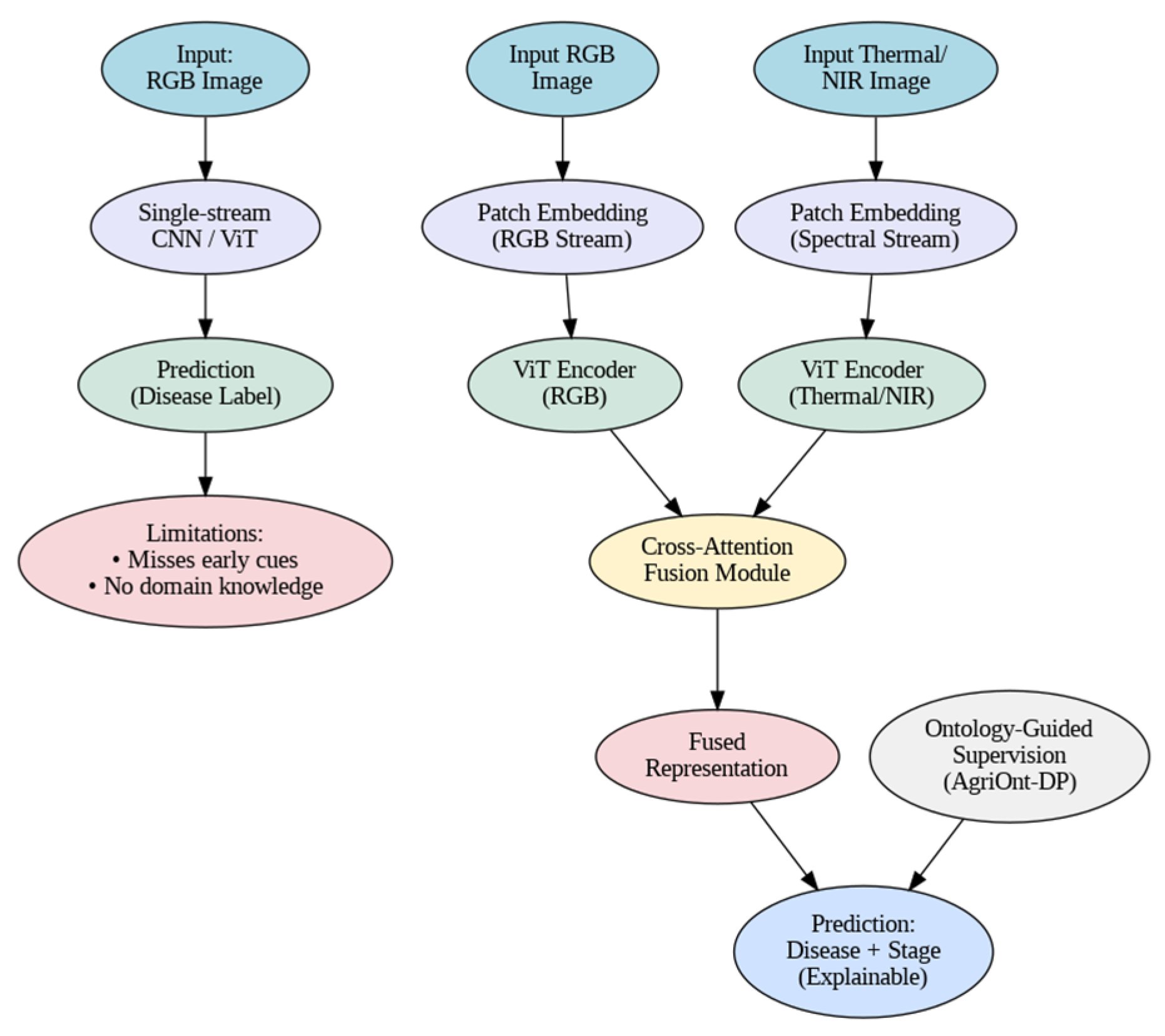
3. Proposed Methodology: DoST-DPD Framework
3.1. Modality-Specific Feature Extraction
3.2. Multimodal Feature Fusion
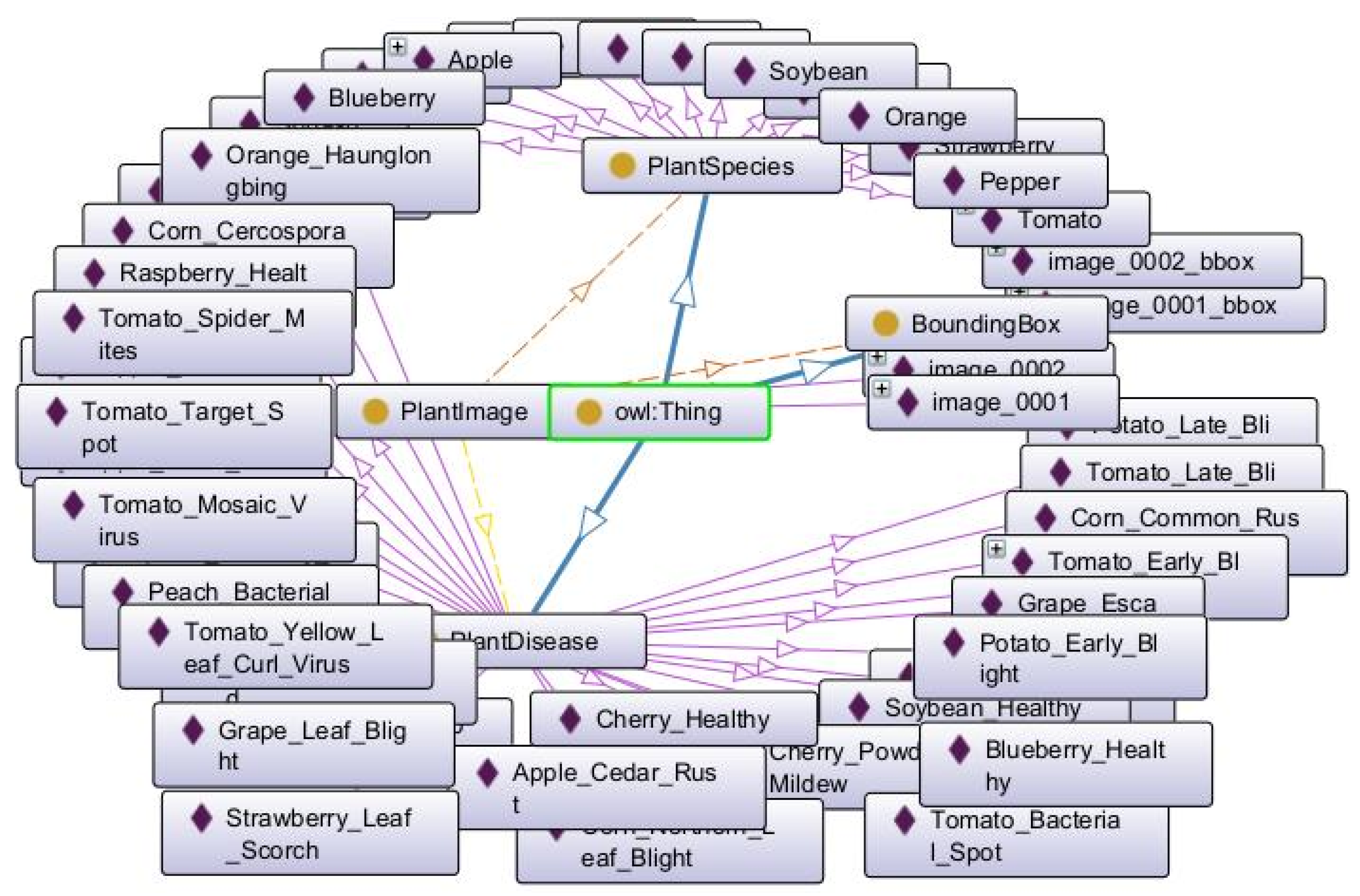
3.3. Ontology-Guided Semantic Supervision
3.4. Final Classification Head
3.5. Joint Optimization
4. Experimental Setup
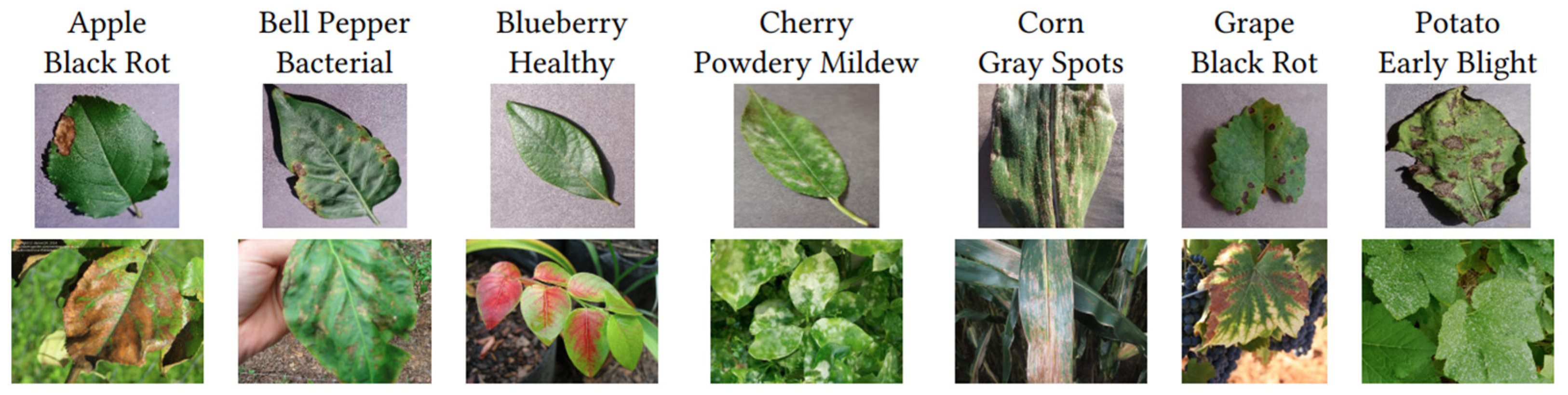
4.1. Datasets and Modalities
4.2. Training Protocol and Environment
4.3. Ablation Study Protocol
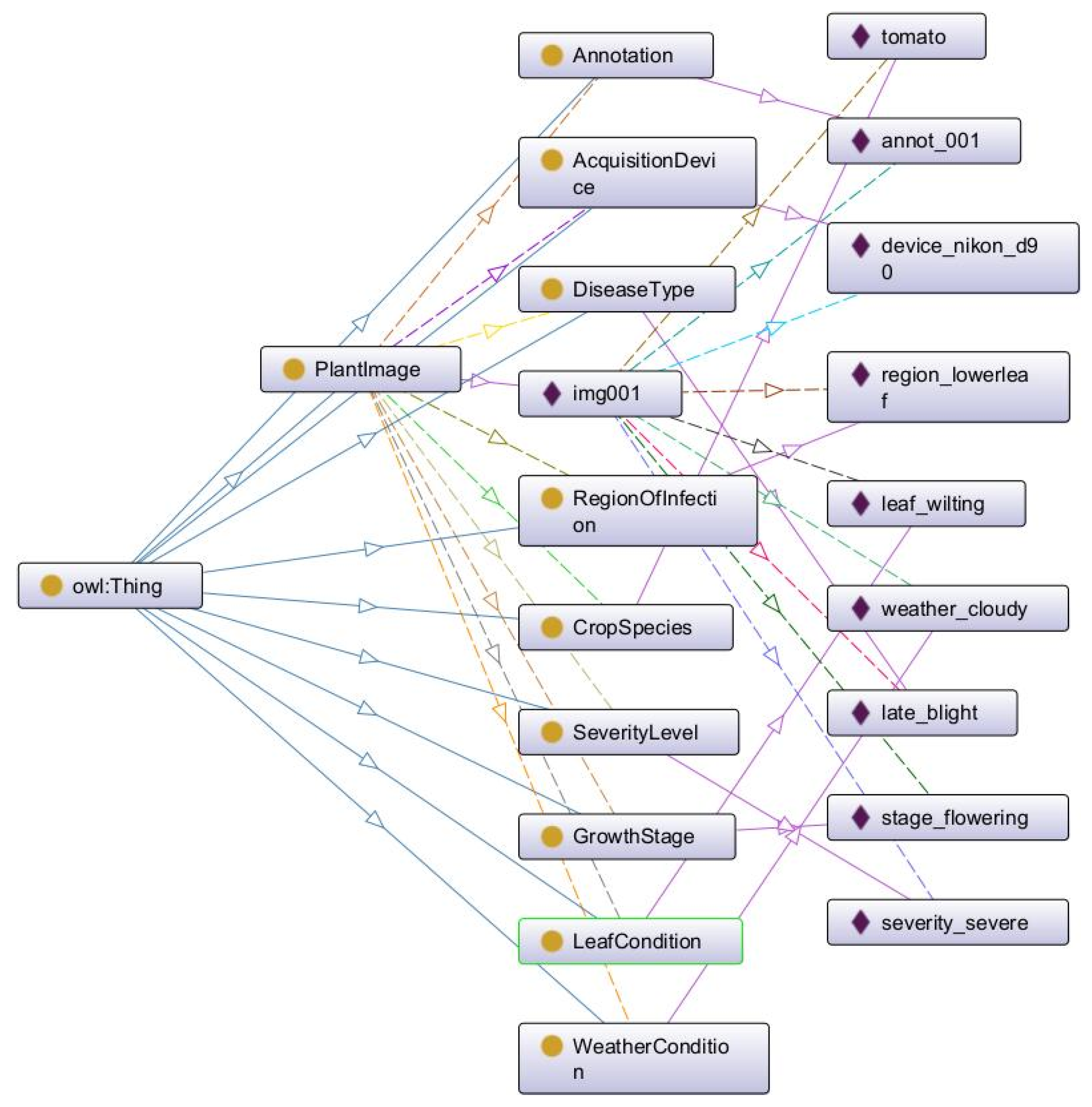
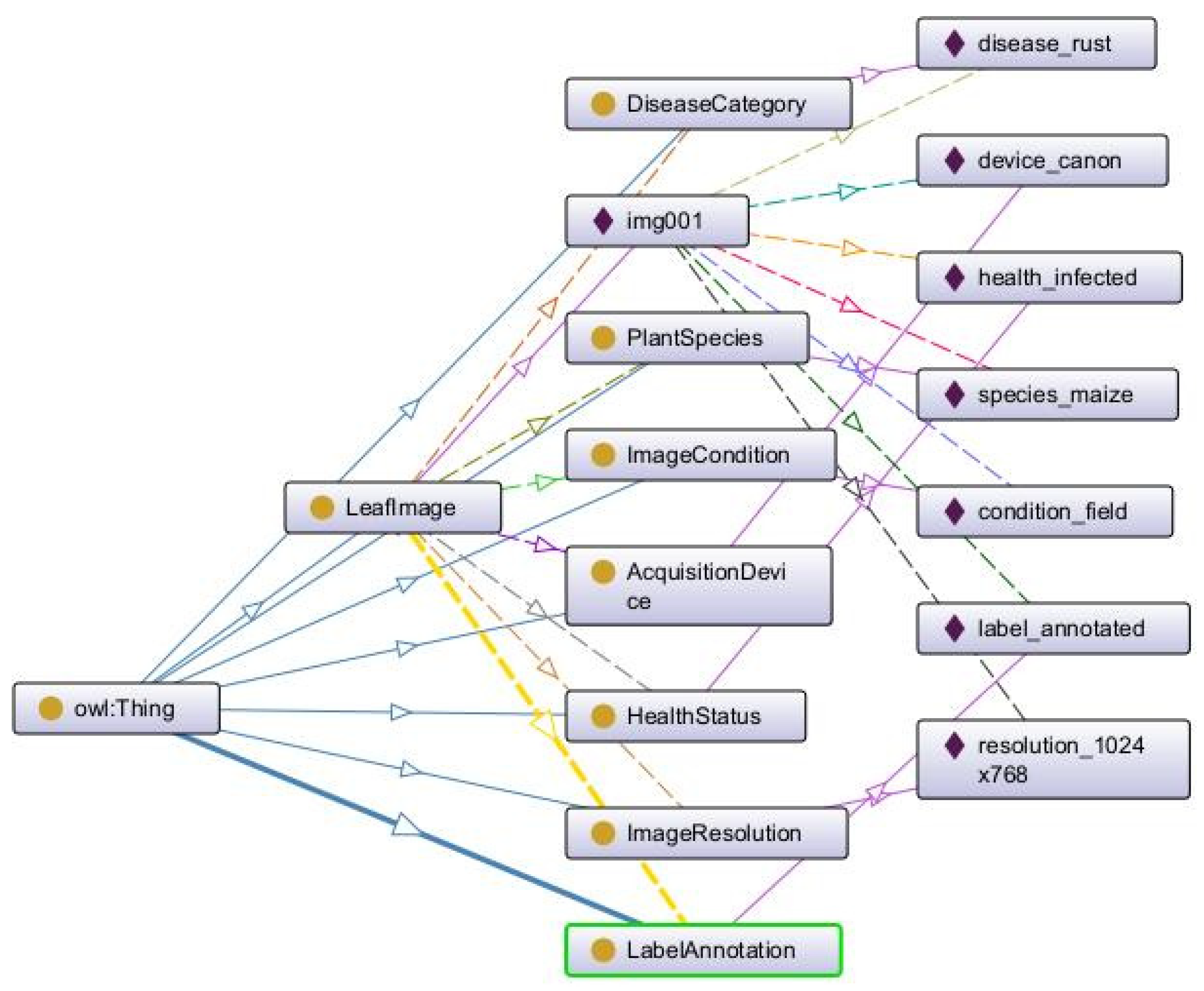
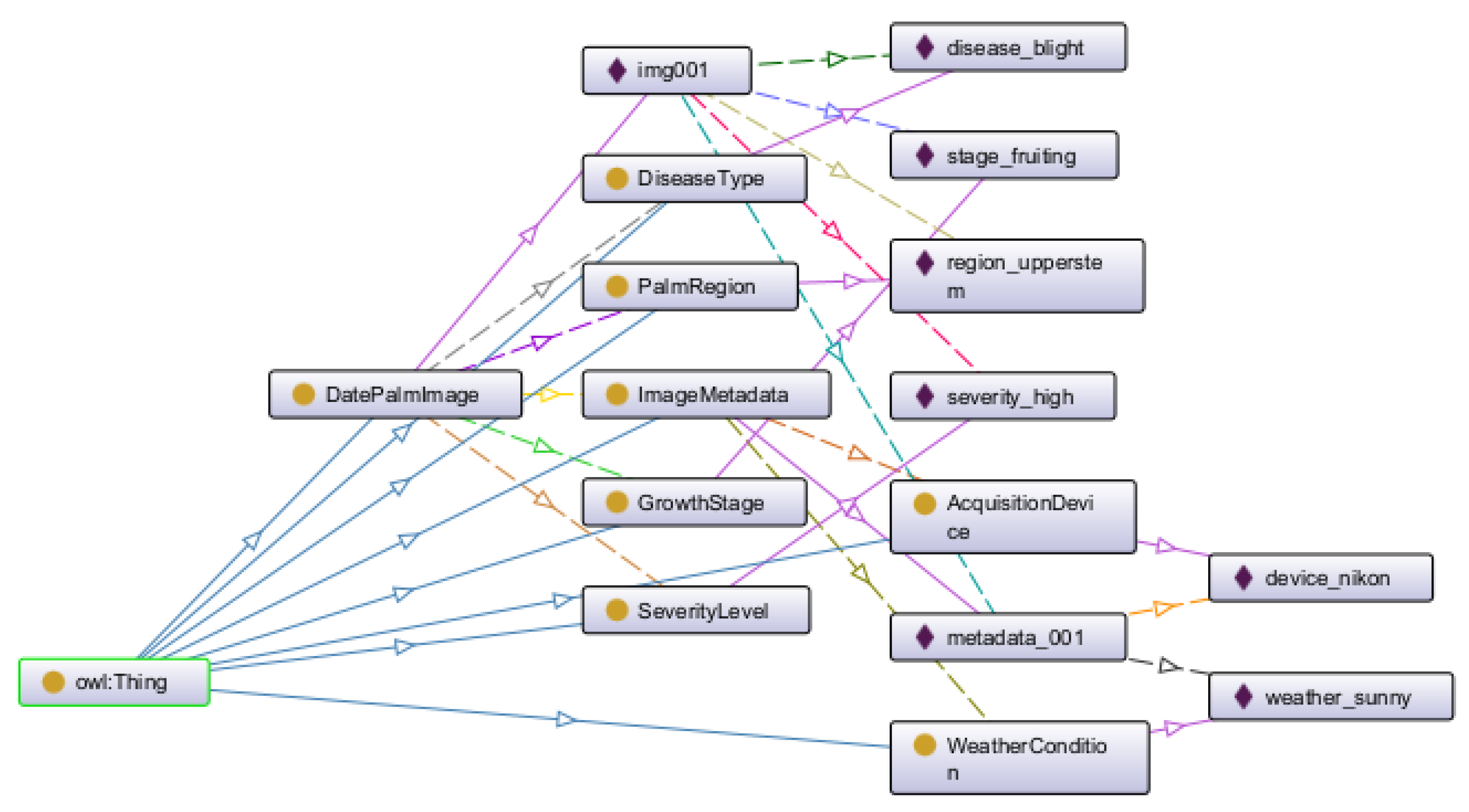
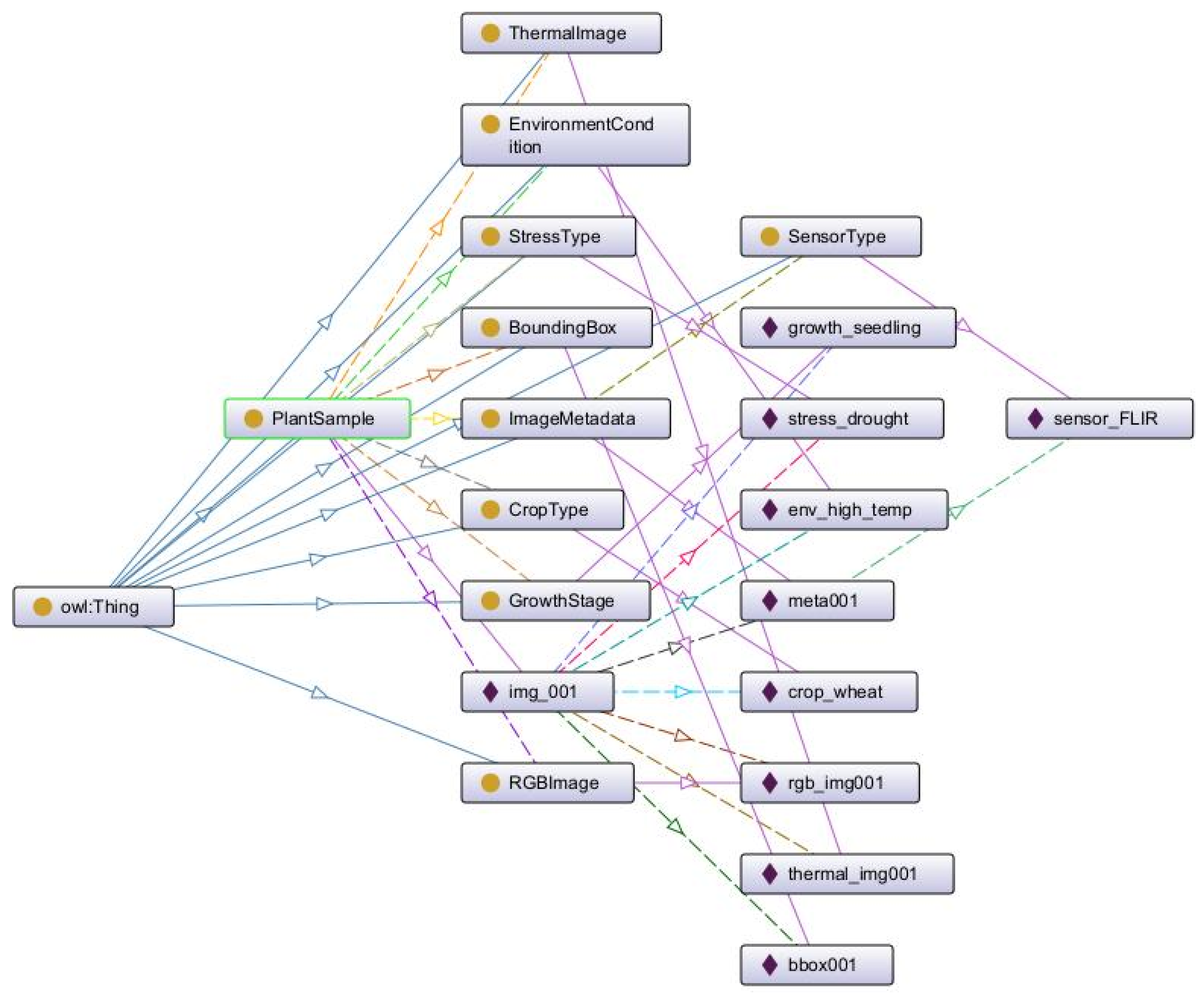
4.4. Ontology-Driven Semantic Integration and Supervision
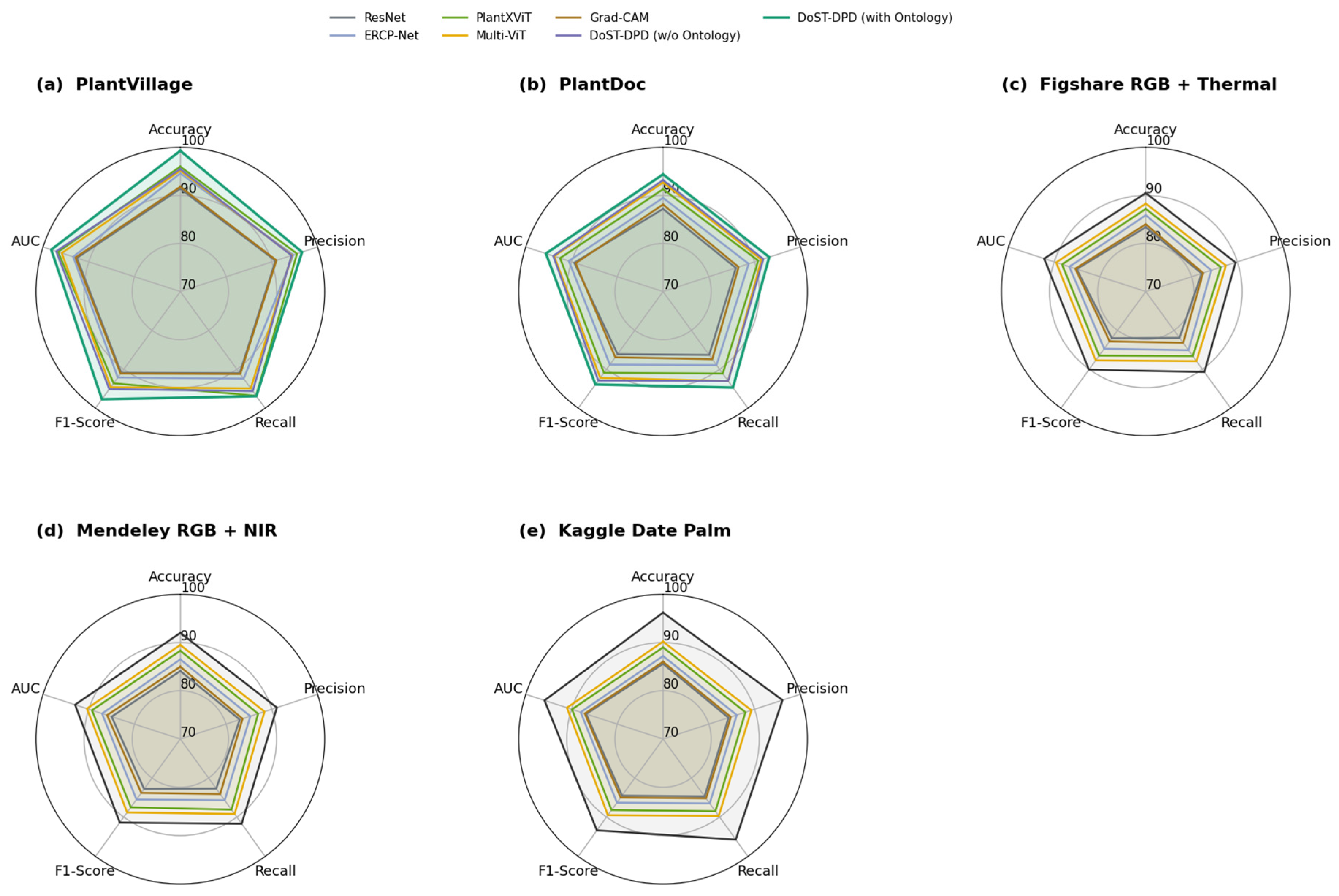
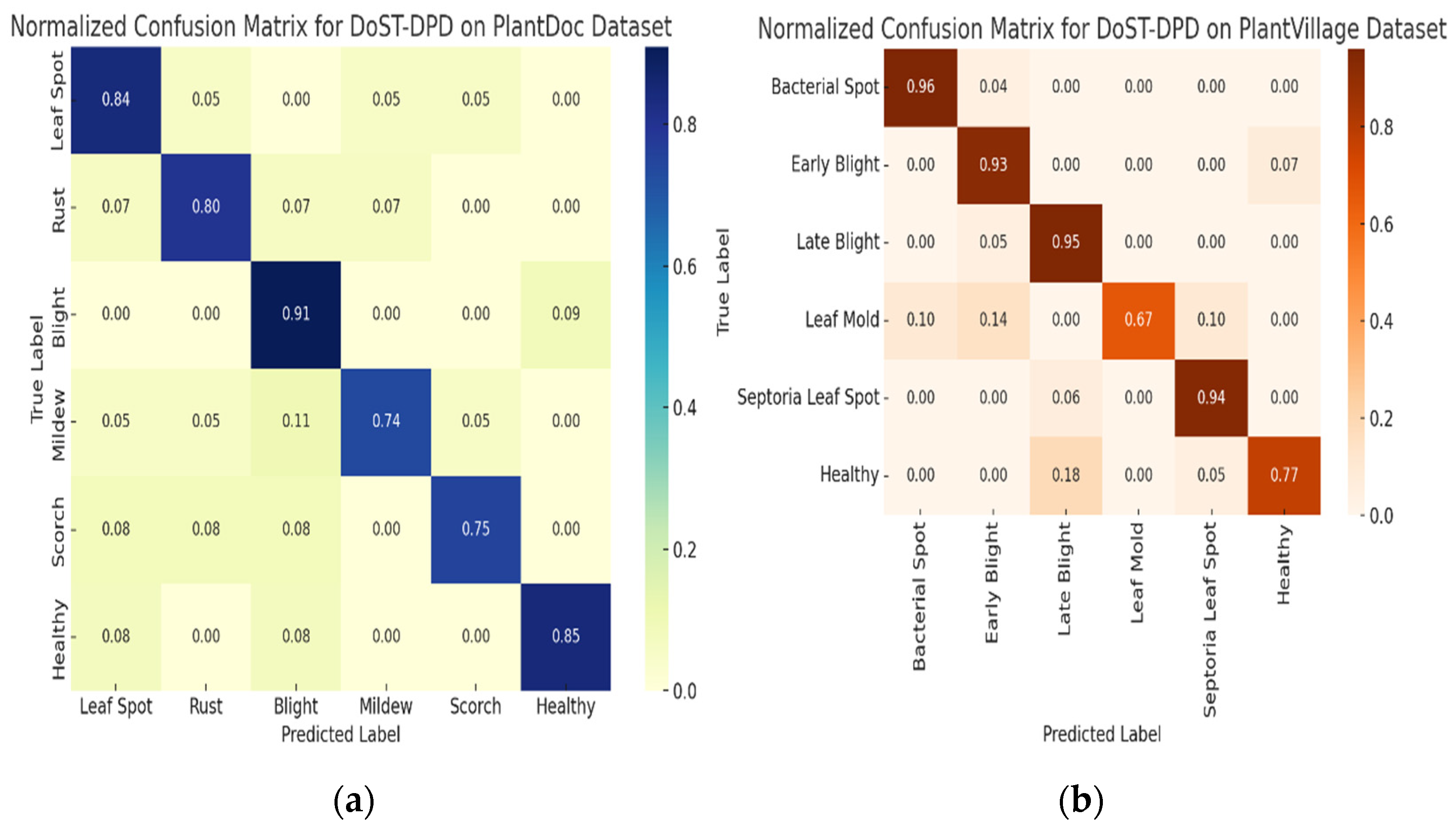
5. Experimental Results and Discussion
6. Conclusions
Author Contributions
Funding
Institutional Review Board Statement
Informed Consent Statement
Data Availability Statement
Acknowledgments
Conflicts of Interest
References
- El-Mously, H.I. Date Palm Plantations: A Future Sustainable Support to Forests. Int. J. Fam. Stud. Food Sci. Nutr. Health 2022, 3, 153–164. [Google Scholar] [CrossRef] [Scilit]
- Ahmed, M.; Elkaoud, N.; Arif, E.; ElSharabasy, S. Study the Physical and Mechanical Properties Affecting on Date Palm Tree Mechanical Serves. J. Soil Sci. Agric. Eng. 2021, 12, 357–362. [Google Scholar] [CrossRef] [Scilit]
- Magsi, A.; Mahar, J.A.; Maitlo, A.; Ahmad, M.; Razzaq, M.A.; Bhuiyan, M.A.S.; Yew, T.J. A New Hybrid Algorithm for Intelligent Detection of Sudden Decline Syndrome of Date Palm Disease. Sci. Rep. 2023, 13, 15381. [Google Scholar] [CrossRef] [Scilit]
- Liu, J.; Wang, X. Plant Diseases and Pests Detection Based on Deep Learning: A Review. Plant Methods 2021, 17, 22. [Google Scholar] [CrossRef] [Scilit]
- Li, G.; Wang, Y.; Zhao, Q.; Yuan, P.; Chang, B. PMVT: A Lightweight Vision Transformer for Plant Disease Identification on Mobile Devices. Front. Plant Sci. 2023, 14, 1256773. [Google Scholar] [CrossRef] [Scilit]
- Mahareek, E.A.; Cifci, M.A.; Desuky, A.S. Integrating Convolutional, Transformer, and Graph Neural Networks for Precision Agriculture and Food Security. AgriEngineering 2025, 7, 353. [Google Scholar] [CrossRef] [Scilit]
- Thakur, P.S.; Khanna, P.; Sheorey, T.; Ojha, A. Explainable Vision Transformer Enabled Convolutional Neural Network for Plant Disease Identification: PlantXViT. arXiv 2022, arXiv:2207.07919. [Google Scholar] [CrossRef] [Scilit]
- Baek, E.-T. Attention Score-Based Multi-Vision Transformer Technique for Plant Disease Classification. Sensors 2025, 25, 270. [Google Scholar] [CrossRef] [Scilit]
- Thangaraj, R.; Anandamurugan, S.; Kaliappan, V.K. Automated Tomato Leaf Disease Classification Using Transfer Learning-Based Deep Convolution Neural Network. J. Plant Dis. Prot. 2021, 128, 73–86. [Google Scholar] [CrossRef] [Scilit]
- Rippa, M.; Pasqualini, A.; Curcio, R.; Mormile, P.; Pane, C. Active vs. Passive Thermal Imaging for Helping the Early Detection of Soil-Borne Rot Diseases on Wild Rocket [Diplotaxis tenuifolia (L.) D.C.]. Plants 2023, 12, 1615. [Google Scholar] [CrossRef] [Scilit]
- Chhetri, T.R.; Hohenegger, A.; Fensel, A.; Kasali, M.A.; Adekunle, A.A. Towards Improving Prediction Accuracy and User-Level Explainability Using Deep Learning and Knowledge Graphs: A Study on Cassava Disease. Expert Syst. Appl. 2023, 233, 120955. [Google Scholar] [CrossRef] [Scilit]
- He, K.; Zhang, X.; Ren, S.; Sun, J. Deep Residual Learning for Image Recognition. In Proceedings of the 2016 IEEE Conference on Computer Vision and Pattern Recognition (CVPR), Las Vegas, NV, USA, 26–30 June 2016; IEEE: Piscataway, NJ, USA, 2016; pp. 770–778. [Google Scholar] [CrossRef] [Scilit]
- Singh, D.; Jain, N.; Jain, P.; Kayal, P.; Kumawat, S.; Batra, N. PlantDoc: A Dataset for Visual Plant Disease Detection. In Proceedings of the 7th ACM IKDD CoDS and 25th COMAD, Hyderabad, India, 5–7 January 2020; ACM: New York, NY, USA, 2020; pp. 249–253. [Google Scholar] [CrossRef] [Scilit]
- Mehmood, A.; Nadeem, A.; Ashraf, M.; Rizwan, K. A Dataset of Date Palm Trees’ Thermal and RGB Images for Pest Management; figshare Dataset; Figshare: London, UK, 2024. [Google Scholar]
- Al-Mahmood, A.M.; Shahadi, H.I.; Hasoon Khayeat, A.R. Image Dataset of Infected Date Palm Leaves by Dubas Insects. Data Brief 2023, 49, 109371. [Google Scholar] [CrossRef] [Scilit]
- Namoun, A.; Alkhodre, A.B.; Sen, A.A.A.; Alsaawy, Y.; Almoamari, H. Dataset of Infected Date Palm Leaves for Palm Tree Disease Detection and Classification. Data Brief 2024, 57, 110933. [Google Scholar] [CrossRef] [Scilit]
- Ma, X.; Chen, W.; Xu, Y. ERCP-Net: A Channel Extension Residual Structure and Adaptive Channel Attention Mechanism for Plant Leaf Disease Classification Network. Sci. Rep. 2024, 14, 4221. [Google Scholar] [CrossRef] [Scilit]
- Hemalatha, S.; Jayachandran, J.J.B. A Multitask Learning-Based Vision Transformer for Plant Disease Localization and Classification. Int. J. Comput. Intell. Syst. 2024, 17, 188. [Google Scholar] [CrossRef] [Scilit]
- Thakur, P.S.; Chaturvedi, S.; Khanna, P.; Sheorey, T.; Ojha, A. Vision Transformer Meets Convolutional Neural Network for Plant Disease Classification. Ecol. Inform. 2023, 77, 102245. [Google Scholar] [CrossRef] [Scilit]
- Thai, H.-T.; Le, K.-H.; Nguyen, N.L.-T. FormerLeaf: An Efficient Vision Transformer for Cassava Leaf Disease Detection. Comput. Electron. Agric. 2023, 204, 107518. [Google Scholar] [CrossRef] [Scilit]
- Zhu, D.; Tan, J.; Wu, C.; Yung, K.; Ip, A.W.H. Crop Disease Identification by Fusing Multiscale Convolution and Vision Transformer. Sensors 2023, 23, 6015. [Google Scholar] [CrossRef] [Scilit]
- Li, X.; Li, S. Transformer Help CNN See Better: A Lightweight Hybrid Apple Disease Identification Model Based on Transformers. Agriculture 2022, 12, 884. [Google Scholar] [CrossRef] [Scilit]
- Ferentinos, K.P. Deep Learning Models for Plant Disease Detection and Diagnosis. Comput. Electron. Agric. 2018, 145, 311–318. [Google Scholar] [CrossRef] [Scilit]
- De Silva, M.; Brown, D. Multispectral Plant Disease Detection with Vision Transformer–Convolutional Neural Network Hybrid Approaches. Sensors 2023, 23, 8531. [Google Scholar] [CrossRef] [Scilit]
- Dey, B.; Ahmed, R. A comprehensive review of AI-driven plant stress monitoring and embedded sensor technology: Agriculture 5.0. J. Ind. Inf. Integr. 2025, 47, 100931. [Google Scholar] [CrossRef] [Scilit]
- Jearanaiwongkul, W.; Anutariya, C.; Racharak, T.; Andres, F. An Ontology-Based Expert System for Rice Disease Identification and Control Recommendation. Appl. Sci. 2021, 11, 10450. [Google Scholar] [CrossRef] [Scilit]
- Amara, J.; Samuel, S.; König-Ries, B. Integrating Domain Knowledge for Enhanced Concept Model Explainability in Plant Disease Classification. In Lecture Notes in Computer Science; Springer: Cham, Switzerland, 2024; pp. 289–306. [Google Scholar] [CrossRef] [Scilit]
- Liu, Y. DKG-PIPD: A Novel Method About Building Deep Knowledge Graph. IEEE Access 2021, 9, 137295–137308. [Google Scholar] [CrossRef] [Scilit]
- Zhang, A.; Liu, W. Plant Disease Detection Using an Innovative Swin-Axial Transformer. IEEE Access 2025, 13, 111938–111952. [Google Scholar] [CrossRef] [Scilit]
- Song, H.; Gao, Y. Plant Diseases Recognition on Digital Images Using Swin Transformer. In Proceedings of the 2022 11th International Conference on Computing and Pattern Recognition, New York, NY, USA, 4–6 November 2022; ACM: New York, NY, USA, 2022; pp. 219–223. [Google Scholar] [CrossRef] [Scilit]
- Alharbi, A.F.; Aslam, M.A.; Asiry, K.A.; Aljohani, N.R.; Glikman, Y. An ontology-based agriculture decision-support system with an evidence-based explanation model. Smart Agric. Technol. 2024, 9, 100659. [Google Scholar] [CrossRef] [Scilit]
- Ahmed, I.; Yadav, P.K. Ontology-Based Classification Method Using Statistical and Symbolic Approaches for Plant Diseases Detection in Agriculture; SSRN: Rochester, NY, USA, 2023. [Google Scholar] [CrossRef] [Scilit]
- Nagarathna, P.; Lateef Haroon, P.S.A.; Srinivasalu, G.; Venkata, A.K.P. Intelligent Plant Disease Detection and Classification using HV-GNN with Ontology-Driven Knowledge Embedding. ITM Web Conf. 2025, 79, 01047. [Google Scholar] [CrossRef] [Scilit]
- Kurhe, P.; Dashore, P. Design of an Improved Model Using Neuro-Symbolic Encoding and Federated Meta-Adaptation for Plant Disease Detection and Explanation Process. EPJ Web Conf. 2025, 328, 01073. [Google Scholar] [CrossRef] [Scilit]
- Hernández, I.; Gutiérrez, S.; Tardaguila, J. Image Analysis with Deep Learning for Early Detection of Downy Mildew in Grapevine. Sci. Hortic. 2024, 331, 113155. [Google Scholar] [CrossRef] [Scilit]
- Moupojou, E.; Tagne, A.; Retraint, F.; Tadonkemwa, A.; Wilfried, D.; Tapamo, H.; Nkenlifack, M. FieldPlant: A Dataset of Field Plant Images for Plant Disease Detection and Classification with Deep Learning. IEEE Access 2023, 11, 35398–35410. [Google Scholar] [CrossRef] [Scilit]
- Al Hassan, A.N.; Ashraf, M.; Mehmood, A.; Rizwan, K.; Siddiqui, M.S. Dataset of Date Palm Tree Thermal Images and Their Classification Based on Red Palm Weevil Infestation. Front. Agron. 2025, 7, 1604188. [Google Scholar] [CrossRef] [Scilit]





| Model | Modality Used | Attention Mechanism | Explainability | Generalization (Cross-Dataset) |
|---|---|---|---|---|
| ResNet | RGB images | – (none) | – (post hoc only) | – |
| ERCP-Net | RGB images | ✓ Channel attention (adaptive) | – | – (tested on single benchmark) |
| PlantXViT | RGB images | ✓ Hybrid CNN–ViT (self-attention) | ✓ (Grad-CAM used) | ✓ (evaluated on multiple datasets) |
| Multi-ViT | RGB images (multiple views) | ✓ Transformer ensemble | – | ✓ (robust across different crops) |
| Swin Transformer | RGB images, optionally multimodal | ✓ Hierarchical shifted-window self-attention | ✓ (attention maps available) | ✓ (tested across diverse field conditions) |
| Symbol | Description |
|---|---|
| Input RGB, thermal, and NIR images | |
| Feature embeddings from ViTs | |
| Cross-attention-based fused embedding | |
| True and predicted disease class labels | |
| Ontology labels and predictions | |
| Classification and ontology loss | |
| Loss balancing hyperparameter | |
| Predicted ontology concept vector |
| Dataset | #Images | #Classes | Modalities | Capture Environment | Annotation Type | Source |
|---|---|---|---|---|---|---|
| PlantVillage | 54,305 | 38 (14 crops × 26 diseases + healthy classes) | RGB | Lab | Image-level (per crop/disease) | Kaggle |
| PlantDoc | 2598 | 29 (including Healthy + 28 crop diseases) | RGB | Field | Image-level + some bounding boxes | GitHub |
| Figshare RGB + Thermal | 832 | 4 (Healthy, Infected, Severely Infested, Dead) | RGB + Thermal | Field | Tree-level categories | Figshare |
| Mendeley RGB+NIR | 3089 | 9 (8 diseases + Healthy) | RGB + NIR | Field (augmented) | Image-level labels | Mendeley |
| Kaggle Date Palm | 2631 | 3 (Healthy, Brown Spot, White Scale) | RGB | Lab | Folder-based image-level | Kaggle |
| Model | Accuracy (%) | Precision (%) | Recall (%) | F1-Score (%) | AUC (%) |
|---|---|---|---|---|---|
| ResNet | 91.4 | 90.8 | 91.0 | 90.9 | 92.6 |
| ERCP-Net | 94.6 | 94.7 | 92.4 | 92.1 | 93.4 |
| PlantXViT | 96.0 | 95.5 | 96.8 | 93.6 | 96.7 |
| Multi-ViT | 95.2 | 94.4 | 94.9 | 94.6 | 95.9 |
| Grad-CAM | 91.8 | 91.0 | 91.2 | 91.1 | 92.9 |
| DoST-DPD (without ontology) | 95.5 | 94.3 | 95.6 | 95.1 | 97.1 |
| DoST-DPD (with ontology) | 99.3 | 96.6 | 96.9 | 97.7 | 98.2 |
| Model | Accuracy (%) | Precision (%) | Recall (%) | F1-Score (%) | AUC (%) |
|---|---|---|---|---|---|
| ResNet | 87.2 | 85.9 | 86.3 | 86.1 | 89.4 |
| ERCP-Net | 89.5 | 88.7 | 88.9 | 88.8 | 90.6 |
| PlantXViT | 91.3 | 90.8 | 91.1 | 90.9 | 92.5 |
| Multi-ViT | 92.7 | 91.5 | 93.0 | 92.2 | 93.8 |
| Grad-CAM | 88.1 | 86.5 | 87.4 | 86.9 | 89.1 |
| DoST-DPD (without ontology) | 93.2 | 91.9 | 93.0 | 92.9 | 94.0 |
| DoST-DPD (with ontology) | 94.4 | 93.2 | 94.7 | 93.9 | 95.6 |
| Model | Accuracy (%) | Precision (%) | Recall (%) | F1-Score (%) | AUC (%) |
|---|---|---|---|---|---|
| ResNet | 83.4 | 82.2 | 81.9 | 82.0 | 85.1 |
| PlantXViT | 87.2 | 86.4 | 86.6 | 86.5 | 88.3 |
| Grad-CAM | 84.0 | 82.5 | 83.2 | 82.8 | 85.4 |
| Multi-ViT | 88.3 | 87.5 | 87.9 | 87.7 | 89.6 |
| ERCP-Net | 85.9 | 84.3 | 85.1 | 84.7 | 86.7 |
| DoST-DPD (with Ontology) | 90.5 | 89.6 | 90.7 | 90.1 | 92.2 |
| Model | Accuracy (%) | Precision (%) | Recall (%) | F1-Score (%) | AUC (%) |
|---|---|---|---|---|---|
| ResNet | 84.1 | 83.0 | 82.7 | 82.8 | 85.0 |
| ERCP-Net | 86.5 | 85.3 | 85.7 | 85.5 | 87.1 |
| PlantXViT | 88.3 | 87.0 | 88.1 | 87.5 | 89.3 |
| Multi-ViT | 89.5 | 88.4 | 89.2 | 88.8 | 90.4 |
| Grad-CAM | 85.0 | 83.6 | 84.1 | 83.8 | 86.0 |
| DoST-DPD (with Ontology) | 92.0 | 91.1 | 91.7 | 91.4 | 93.0 |
| Model | Accuracy (%) | Precision (%) | Recall (%) | F1-Score (%) | AUC (%) |
|---|---|---|---|---|---|
| ResNet | 85.6 | 84.3 | 84.7 | 84.5 | 86.8 |
| ERCP-Net | 87.2 | 86.1 | 86.5 | 86.3 | 88.0 |
| PlantXViT | 89.0 | 88.0 | 88.5 | 88.2 | 89.9 |
| Multi-ViT | 90.2 | 89.3 | 89.7 | 89.5 | 91.0 |
| Grad-CAM | 86.0 | 84.8 | 85.2 | 85.0 | 87.1 |
| DoST-DPD (with Ontology) | 96.2 | 96.1 | 95.7 | 93.4 | 95.9 |
Disclaimer/Publisher’s Note: The statements, opinions and data contained in all publications are solely those of the individual author(s) and contributor(s) and not of MDPI and/or the editor(s). MDPI and/or the editor(s) disclaim responsibility for any injury to people or property resulting from any ideas, methods, instructions or products referred to in the content. |
© 2026 by the authors. Licensee MDPI, Basel, Switzerland. This article is an open access article distributed under the terms and conditions of the Creative Commons Attribution (CC BY) license.
Share and Cite
Ghannam, N.E.; Mancy, H.; Fathy, A.M.; Mahareek, E.A. Ontology-Enhanced Deep Learning for Early Detection of Date Palm Diseases in Smart Farming Systems. AgriEngineering 2026, 8, 29. https://doi.org/10.3390/agriengineering8010029
Ghannam NE, Mancy H, Fathy AM, Mahareek EA. Ontology-Enhanced Deep Learning for Early Detection of Date Palm Diseases in Smart Farming Systems. AgriEngineering. 2026; 8(1):29. https://doi.org/10.3390/agriengineering8010029
Chicago/Turabian StyleGhannam, Naglaa E., H. Mancy, Asmaa Mohamed Fathy, and Esraa A. Mahareek. 2026. "Ontology-Enhanced Deep Learning for Early Detection of Date Palm Diseases in Smart Farming Systems" AgriEngineering 8, no. 1: 29. https://doi.org/10.3390/agriengineering8010029
APA StyleGhannam, N. E., Mancy, H., Fathy, A. M., & Mahareek, E. A. (2026). Ontology-Enhanced Deep Learning for Early Detection of Date Palm Diseases in Smart Farming Systems. AgriEngineering, 8(1), 29. https://doi.org/10.3390/agriengineering8010029