


Innovations in Shared Mobility—Review of Scientific Works


Abstract
1. Introduction
- Unbalanced demand—a situation when the number of vehicles rented from a location may not equal the number of vehicles returned to this location [5];
- An improperly selected fleet of vehicles [8];
- An inappropriate business model [9];
- A closed approach to the willingness to share data, due to the lack of participation in mobility accelerators [10];
2. Innovations—Basic Knowledge and Its Relation to Shared Mobility and Smart Cities
- Creation of a new product/service;
- Use of new technology or production methods;
- Creation of a new sales market;
- Acquisition of previously unknown raw materials;
- Reorganizations of a specific branch of the economy.
3. Research Methodology
- Indication of the research objective of the literature review.
- Performing a complete search, acquisition, and download of literature items.
- Extraction and evaluation of acquired literature items.
- Synthesis and detailed analysis of the results obtained.
- Presentation and sharing of results, comparison with business practices, and conclusions.
4. Results
- (1)
- Business model analysis;
- (2)
- Analyzes policies concerning sustainable development;
- (3)
- The situation during or after the COVID-19 pandemic;
- (4)
- Adjusting services to the needs of users or examining the level of their acceptance by society;
- (5)
- Studies of good practices and the transition from classic forms of transport to shared mobility.
- Package services;
- Possibility of long-term rental;
- Vehicle delivery services directly to the user;
- Awards for responsible drivers, including those who follow the rules of eco-driving;
- Access to premium vehicles for experienced customers;
- Modernization of the fleet;
- Increasing the autonomy of systems by increasingly reducing the need to contact customer service offices, creating mobility hubs;
- Development of heat maps of service availability;
- Developing offers for companies to use shared mobility vehicles as an alternative to business fleets;
- Provision of additional vehicle equipment;
- Discounts and rebates for carrying out touch services, e.g., refueling or washing the vehicle by the user;
- Additional sanitary restrictions related to the desire to control the spread of viruses;
- The possibility of renting vehicles through applications that are generators of travel and joint mobility with other forms of transport.
5. Conclusions
Author Contributions
Funding
Data Availability Statement
Conflicts of Interest
References
- Zhang, X.; Shao, C.; Wang, B.; Huang, S.; Mi, X.; Zhuang, Y. Exploring the Role of Shared Mobility in Alleviating Private Car Dependence and On-Road Carbon Emissions in the Context of COVID-19. Front. Environ. Sci. 2022, 10, 931763. [Google Scholar] [CrossRef]
- Guyader, H.; Friman, M.; Olsson, L.E. Shared Mobility: Evolving Practices for Sustainability. Sustainability 2021, 13, 12148. [Google Scholar] [CrossRef]
- Statista Potal. Shared Mobility Worldwide. Available online: https://www.statista.com/outlook/mmo/shared-mobility/worldwide (accessed on 15 April 2023).
- Boutueil, V.; Nemett, L.; Quillerier, T. Trends in Competition among Digital Platforms for Shared Mobility: Insights from a Worldwide Census and Prospects for Research. Transp. Res. Rec. 2022, 2676, 69–82. [Google Scholar] [CrossRef]
- Martin, L. Rebalancing in Shared Mobility Systems–Competition, Feature-Based Mode Selection and Technology Choice. In Operations Research Proceedings 2021; Trautmann, N., Gnägi, M., Eds.; Lecture Notes in Operations Research; Springer International Publishing: Cham, Switzerland, 2022; pp. 33–38. [Google Scholar] [CrossRef]
- Martin, G.; Donain, M.; Fromont, E.; Guns, T.; Roze, L.; Termier, A. Prediction-Based Fleet Relocation for Free Floating Car Sharing Services. In Proceedings of the 2021 IEEE 33rd International Conference on Tools with Artificial Intelligence (ICTAI), Washington, DC, USA, 1–3 November 2021; IEEE: Washington, DC, USA, 2021; pp. 1187–1191. [Google Scholar] [CrossRef]
- Lu, M.; Chen, Z.; Shen, S. Optimizing the Profitability and Quality of Service in Carshare Systems Under Demand Uncertainty. Manuf. Serv. Oper. Manag. 2018, 20, 162–180. [Google Scholar] [CrossRef]
- Turoń, K.; Kubik, A.; Chen, F. What Car for Car-Sharing? Conventional, Electric, Hybrid or Hydrogen Fleet? Analysis of the Vehicle Selection Criteria for Car-Sharing Systems. Energies 2022, 15, 4344. [Google Scholar] [CrossRef]
- Hahn, R.; Ostertag, F.; Lehr, A.; Büttgen, M.; Benoit, S. “I like It, but I Don’t Use It”: Impact of Carsharing Business Models on Usage Intentions in the Sharing Economy. Bus. Strategy Environ. 2020, 29, 1404–1418. [Google Scholar] [CrossRef]
- Turoń, K.; Kubik, A. Open Innovation in the Shared Mobility Market. JOItmC 2021, 7, 212. [Google Scholar] [CrossRef]
- Aguilera-García, Á.; Gomez, J.; Antoniou, C.; Vassallo, J.M. Behavioral Factors Impacting Adoption and Frequency of Use of Carsharing: A Tale of Two European Cities. Transp. Policy 2022, 123, 55–72. [Google Scholar] [CrossRef]
- Aguilera-García, Á.; Gomez, J.; Sobrino, N.; Vinagre Díaz, J.J. Moped Scooter Sharing: Citizens’ Perceptions, Users’ Behavior, and Implications for Urban Mobility. Sustainability 2021, 13, 6886. [Google Scholar] [CrossRef]
- Carrese, S.; D’Andreagiovanni, F.; Giacchetti, T.; Nardin, A.; Zamberlan, L. A Beautiful Fleet: Optimal Repositioning in E-Scooter Sharing Systems for Urban Decorum. Transp. Res. Procedia 2021, 52, 581–588. [Google Scholar] [CrossRef]
- Chang, S.; Song, R.; He, S.; Qiu, G. Innovative Bike-Sharing in China: Solving Faulty Bike-Sharing Recycling Problem. J. Adv. Transp. 2018, 2018, 1–10. [Google Scholar] [CrossRef]
- Long, T.B.; van Waes, A. When Bike Sharing Business Models Go Bad: Incorporating Responsibility into Business Model Innovation. J. Clean. Prod. 2021, 297, 126679. [Google Scholar] [CrossRef]
- Félix, R.; Orozco-Fontalvo, M.; Moura, F. Socio-Economic Assessment of Shared e-Scooters: Do the Benefits Overcome the Externalities? Transp. Res. Part D Transp. Environ. 2023, 118, 103714. [Google Scholar] [CrossRef]
- Abouelela, M.; Chaniotakis, E.; Antoniou, C. Understanding the Landscape of Shared-e-Scooters in North America; Spatiotemporal Analysis and Policy Insights. Transp. Res. Part A Policy Pract. 2023, 169, 103602. [Google Scholar] [CrossRef]
- Istudor, N.; Ignat, R.; Petrescu, I.-E.; Constantin, M.; Chiripuci, B.C. Exploring Consumer Preferences for Shared Mobility Services in the Big Cities of Europe. Socio-Economic and Sustainability Concerns in the Era of COVID-19. Int. J. Transp. Econ. 2022, 49, 173–205. [Google Scholar]
- Haddad, H.; Bouyahia, Z.; Horchani, L. On the Sustainability of Shared Mobility Since COVID-19: From Socially Structured to Social Bubble Vanpooling. Sustainability 2022, 14, 15764. [Google Scholar] [CrossRef]
- Shokouhyar, S.; Shokoohyar, S.; Sobhani, A.; Gorizi, A.J. Shared Mobility in Post-COVID Era: New Challenges and Opportunities. Sustain. Cities Soc. 2021, 67, 102714. [Google Scholar] [CrossRef]
- Chesbrough, H. Managing Open Innovation. Res.-Technol. Manag. 2004, 47, 23–26. [Google Scholar] [CrossRef]
- Schumpeter, J.A. The theory of economic development. In An Inquiry into Profits, Capital, Credit, Interest, and the Business Cycle; Harvard University Press: Cambridge, MA, USA, 1934. [Google Scholar]
- Lee, S.M.; Trimi, S. Innovation for Creating a Smart Future. J. Innov. Knowl. 2018, 3, 1–8. [Google Scholar] [CrossRef]
- Felin, T.; Zenger, T.R. Closed or Open Innovation? Problem Solving and the Governance Choice. Res. Policy 2014, 43, 914–925. [Google Scholar] [CrossRef]
- Chesbrough, H.W. Open Innovation: The New Imperative for Creating and Profiting from Technology; Harvard Business School Press: Boston, MA, USA, 2011. [Google Scholar]
- Harrison, C.; Eckman, B.; Hamilton, R.; Hartswick, P.; Kalagnanam, J.; Paraszczak, J.; Williams, P. Foundations for Smarter Cities. IBM J. Res. Dev. 2010, 54, 1–16. [Google Scholar] [CrossRef]
- Attour, A.; Dominguez-Péry, C.; Bendavid, Y. Information Technologies, Knowledge and Innovation in Smart Cities: Current and Future Trends for Management Research. Systèmes D’information Manag. 2022, 26, 3–18. [Google Scholar] [CrossRef]
- Gupta, A.; Panagiotopoulos, P.; Bowen, F. An Orchestration Approach to Smart City Data Ecosystems. Technol. Forecast. Soc. Chang. 2020, 153, 119929. [Google Scholar] [CrossRef]
- Guo, Y.-M.; Huang, Z.-L.; Guo, J.; Li, H.; Guo, X.-R.; Nkeli, M.J. Bibliometric Analysis on Smart Cities Research. Sustainability 2019, 11, 3606. [Google Scholar] [CrossRef]
- Griffinger, R. Smart Cities. Ranking of European Medium-Sized Cities. Available online: https://www.smart-cities.eu/download/smart_cities_final_report.pdf (accessed on 15 April 2023).
- Battarra, R.; Gargiulo, C.; Pappalardo, G.; Boiano, D.A.; Oliva, J.S. Planning in the era of Information and Communication Technologies. Discussing the “label: Smart” in South-European cities with environmental and socio-economic challenges. Cities 2016, 59, 1–7. [Google Scholar] [CrossRef]
- Burlacu, M.; Boboc, R.G.; Butilă, E.V. Smart Cities and Transportation: Reviewing the Scientific Character of the Theories. Sustainability 2022, 14, 8109. [Google Scholar] [CrossRef]
- Kamargianni, M.; Li, W.; Matyas, M.; Schäfer, A. A Critical Review of New Mobility Services for Urban Transport. Transp. Res. Procedia 2016, 14, 3294–3303. [Google Scholar] [CrossRef]
- Butler, L.; Yigitcanlar, T.; Paz, A. How Can Smart Mobility Innovations Alleviate Transportation Disadvantage? Assembling a Conceptual Framework through a Systematic Review. Appl. Sci. 2020, 10, 6306. [Google Scholar] [CrossRef]
- Booth, A.; Sutton, A.; Papaioannou, D. Systematic Approaches to a Successful Literature Review; SAGE Publications: London, UK, 2012. [Google Scholar]
- Pranckutė, R. Web of Science (WoS) and Scopus: The Titans of Bibliographic Information in Today’s Academic World. Publications 2021, 9, 12. [Google Scholar] [CrossRef]
- Li, K.; Rollins, J.; Yan, E. Web of Science Use in Published Research and Review Papers 1997–2017: A Selective, Dynamic, Cross-Domain, Content-Based Analysis. Scientometrics 2018, 115, 1–20. [Google Scholar] [CrossRef]
- Baas, J.; Schotten, M.; Plume, A.; Côté, G.; Karimi, R. Scopus as a Curated, High-Quality Bibliometric Data Source for Academic Research in Quantitative Science Studies. Quant. Sci. Stud. 2020, 1, 377–386. [Google Scholar] [CrossRef]
- Cronin, P.; Ryan, F.; Coughlan, M. Undertaking a Literature Review: A Step-by-Step Approach. Br. J. Nurs. 2008, 17, 38–43. [Google Scholar] [CrossRef]
- Rodríguez-Rad, C.J.; Revilla-Camacho, M.-Á.; Sánchez-del-Río-Vázquez, M.-E. Exploring the Intention to Adopt Sustainable Mobility Modes of Transport among Young University Students. IJERPH 2023, 20, 3196. [Google Scholar] [CrossRef] [PubMed]
- Shaheen, S.; Wong, S. The Future of Public Transit and Shared Mobility: Policy Actions and Research Options for COVID-19 Recovery. In Pandemic in the Metropolis; Loukaitou-Sideris, A., Bayen, A.M., Circella, G., Jayakrishnan, R., Eds.; Springer Tracts on Transportation and Traffic; Springer International Publishing: Cham, Switzerland, 2023; Volume 20, pp. 313–331. [Google Scholar] [CrossRef]
- Turoń, K.; Kubik, A.; Ševčovič, M.; Tóth, J.; Lakatos, A. Visual Communication in Shared Mobility Systems as an Opportunity for Recognition and Competitiveness in Smart Cities. Smart Cities 2022, 5, 802–818. [Google Scholar] [CrossRef]
- Cantelmo, G.; Amini, R.E.; Monteiro, M.M.; Frenkel, A.; Lerner, O.; Tavory, S.S.; Galtzur, A.; Kamargianni, M.; Shiftan, Y.; Behrischi, C.; et al. Aligning Users’ and Stakeholders’ Needs: How Incentives Can Reshape the Carsharing Market. Transp. Policy 2022, 126, 306–326. [Google Scholar] [CrossRef]
- Li, H.; Yuan, Z.; Novack, T.; Huang, W.; Zipf, A. Understanding Spatiotemporal Trip Purposes of Urban Micro-Mobility from the Lens of Dockless e-Scooter Sharing. Comput. Environ. Urban Syst. 2022, 96, 101848. [Google Scholar] [CrossRef]
- Gerdsri, N.; Sivara, K.; Chatunawarat, C.; Jaroonjitsathian, S.; Tundulyasaree, K. Roadmap for Future Mobility Development Supporting Bangkok Urban Living in 2030. Sustainability 2022, 14, 9296. [Google Scholar] [CrossRef]
- Turoń, K.; Kubik, A. Open Innovation—Opportunities or Nightmares for the Shared Transport Services Sector? JOItmC 2022, 8, 101. [Google Scholar] [CrossRef]
- Tsvetkova, A.; Kulkov, I.; Busquet, C.; Kao, P.-J.; Kamargianni, M. Implications of COVID-19 Pandemic on the Governance of Passenger Mobility Innovations in Europe. Transp. Res. Interdiscip. Perspect. 2022, 14, 100581. [Google Scholar] [CrossRef]
- Long, Z.; Axsen, J. Who Will Use New Mobility Technologies? Exploring Demand for Shared, Electric, and Automated Vehicles in Three Canadian Metropolitan Regions. Energy Res. Soc. Sci. 2022, 88, 102506. [Google Scholar] [CrossRef]
- Burghard, U.; Scherrer, A. Sharing Vehicles or Sharing Rides-Psychological Factors Influencing the Acceptance of Carsharing and Ridepooling in Germany. Energy Policy 2022, 164, 112874. [Google Scholar] [CrossRef]
- Turoń, K. Open Innovation Business Model as an Opportunity to Enhance the Development of Sustainable Shared Mobility Industry. JOItmC 2022, 8, 37. [Google Scholar] [CrossRef]
- Chaudhuri, R.; Chatterjee, S.; Ghosh, A.; Vrontis, D.; Thrassou, A. Sustainable Innovation for Shared Mobility: Contextual and Consumer Factors of an Indian Car Subscription Business Model. IJEBR, 2022; ahead-of-print. [Google Scholar] [CrossRef]
- Carvalho, C.; Pessoa, R.; José, R. Cycling Analytics for Urban Environments: From Vertical Models to Horizontal Innovation. In Intelligent Transport Systems; Martins, A.L., Ferreira, J.C., Kocian, A., Eds.; Lecture Notes of the Institute for Computer Sciences, Social Informatics and Telecommunications Engineering; Springer International Publishing: Cham, Switzerland, 2022; Volume 426, pp. 135–148. [Google Scholar] [CrossRef]
- Sovacool, B.K.; Daniels, C.; AbdulRafiu, A. Transitioning to Electrified, Automated and Shared Mobility in an African Context: A Comparative Review of Johannesburg, Kigali, Lagos and Nairobi. J. Transp. Geogr. 2022, 98, 103256. [Google Scholar] [CrossRef]
- Sulskyte, D. Mobility-As-A-Service: Concepts and Theoretical Approach. In Proceedings of the 2021 IEEE International Conference on Technology and Entrepreneurship (ICTE), Virtual, 24–27 August 2021; IEEE: Kaunas, Lithuania, 2021; pp. 1–6. [Google Scholar] [CrossRef]
- Kim, S.; Lee, H.; Son, S.-W. Emerging Diffusion Barriers of Shared Mobility Services in Korea. Sustainability 2021, 13, 7707. [Google Scholar] [CrossRef]
- Terrien, C.; Maniak, R.; Chen, B.; Shaheen, S. Good Practices for Advancing Urban Mobility Innovation: A Case Study of One-Way Carsharing. Res. Transp. Bus. Manag. 2016, 20, 20–32. [Google Scholar] [CrossRef]
- Wiprächtiger, D.; Narayanamurthy, G.; Moser, R.; Sengupta, T. Access-Based Business Model Innovation in Frontier Markets: Case Study of Shared Mobility in Timor-Leste. Technol. Forecast. Soc. Chang. 2019, 143, 224–238. [Google Scholar] [CrossRef]
- Coenegrachts, E.; Beckers, J.; Vanelslander, T.; Verhetsel, A. Business Model Blueprints for the Shared Mobility Hub Network. Sustainability 2021, 13, 6939. [Google Scholar] [CrossRef]
- Nemoto, E.H.; Issaoui, R.; Korbee, D.; Jaroudi, I.; Fournier, G. How to Measure the Impacts of Shared Automated Electric Vehicles on Urban Mobility. Transp. Res. Part D Transp. Environ. 2021, 93, 102766. [Google Scholar] [CrossRef]
- Haapalainen, P.; Kantola, J. Taxonomy of Knowledge Management in Open Innovations. Procedia Manuf. 2015, 3, 688–695. [Google Scholar] [CrossRef]
- Jelonek, D. The Role of Open Innovations in the Development of E-Entrepreneurship. Procedia Comput. Sci. 2015, 65, 1013–1022. [Google Scholar] [CrossRef]
- Narayanan, S.; Antoniou, C. Shared Mobility Services towards Mobility as a Service (MaaS): What, Who and When? Transp. Res. Part A Policy Pract. 2023, 168, 103581. [Google Scholar] [CrossRef]
- Smith, G.; Hensher, D.A. Towards a Framework for Mobility-as-a-Service Policies. Transp. Policy 2020, 89, 54–65. [Google Scholar] [CrossRef]
- Le Vine, S.; Polak, J. Introduction to Special Issue: New Directions in Shared-Mobility Research. Transportation 2015, 42, 407–411. [Google Scholar] [CrossRef]
- Yanocha, D.; Mason, J.; Hagen, J. Using Data and Technology to Integrate Mobility Modes in Low-Income Cities. Transp. Rev. 2021, 41, 262–284. [Google Scholar] [CrossRef]
- Knoke, B.; Eschenbaecher, J. KPIs to Manage Innovation Processes in VEEs–Initial Thoughts and Results. Available online: https://ceur-ws.org/Vol-864/paper_3.pdf (accessed on 15 April 2023).
- Ariza, C.; Rugeles, L.; Saavedra, D.; Guaitero, B. Measuring Innovation in Agricultural Firms: A Methodological Approach. Electron. J. Knowl. Manag. 2013, 11, 185–198. [Google Scholar]
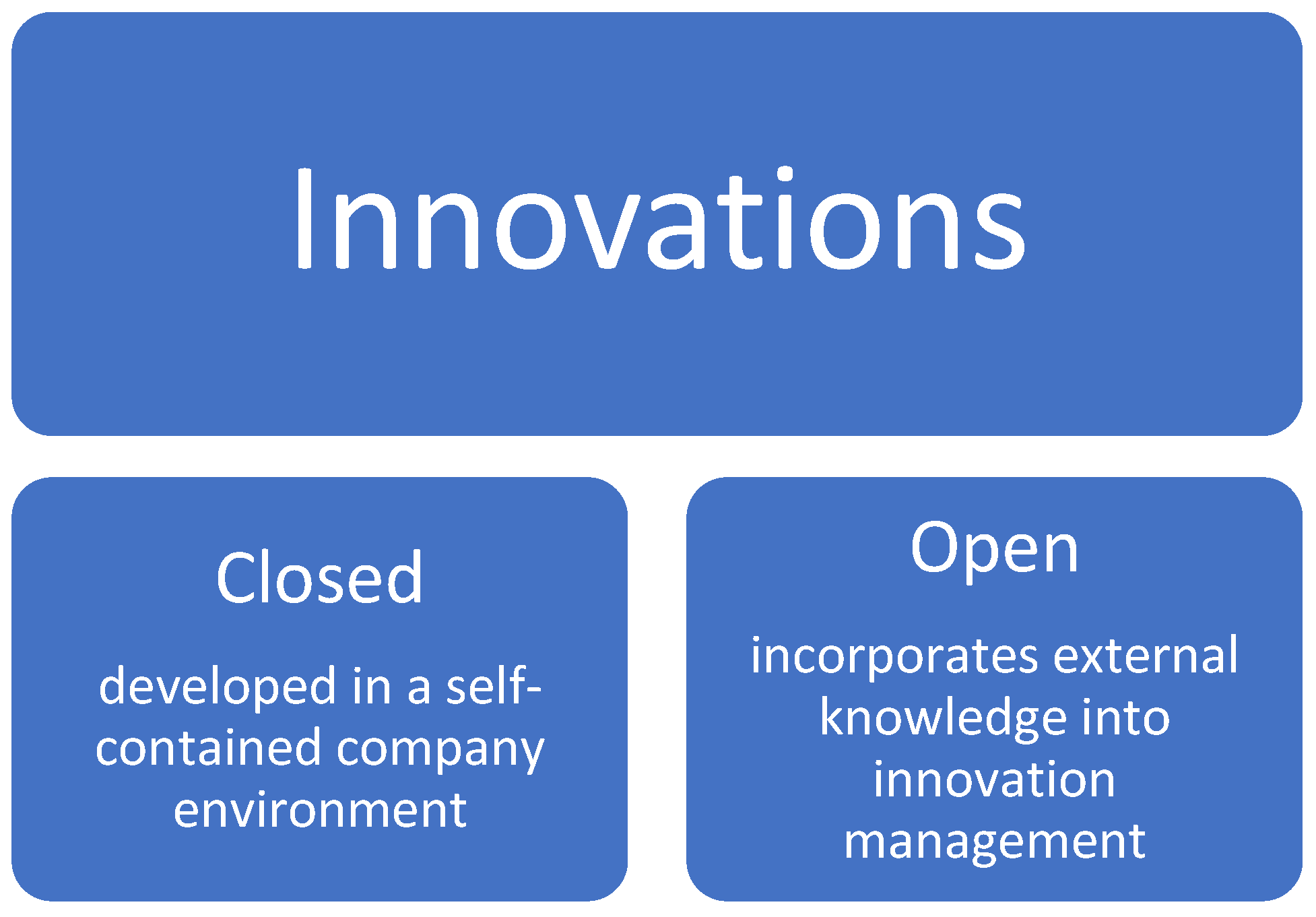

| Feature | Closed Innovation | Open Innovation |
|---|---|---|
| The ideology of the company | Selection of innovations from the company’s internal resources. | Conscious acquisition and export of knowledge to create, accelerate and improve innovation. |
| The role of customers | Passive recipients of the company’s internal ideas. | Changemakers. Participants in the process of open exchange of ideas beyond the company’s borders. |
| Venture capital | Slight importance. | Significant importance. |
| Competition | The desire to be the best on the market and the first when implementing a given innovation. | Developing a business model to improve products or services beyond being a market leader. |
| Ref. | Research Topic/Goal | Is the Work Strictly Dedicated to Innovation? | Innovation | Have Issues Related to the Development of Innovation Been Indicated? | What Issues Related to Innovation Development Have Been Addressed? | Open Innovation | Closed Innovation |
|---|---|---|---|---|---|---|---|
| [40] | Exploring the intention to adopt sustainable mobility modes of transport among young university students | NO | Shared mobility services as an innovation | YES | Economic issues or environmental concerns of citizens. | N/A | N/A |
| [41] | The future of public transit and shared mobility: policy actions and research options for COVID-19 recovery | NO | Shared mobility services after the COVID-19 pandemic | YES | Innovative management at the policy level. | N/A | N/A |
| [42] | Visual communication in shared mobility systems as an opportunity for recognition and competitiveness in smart cities | NO | Labeling of shared mobility vehicles and their perception by the public | YES | Tips on choosing the right branding and how to interact with customers in terms of visual communication. | YES | NO |
| [43] | Aligning users’ and stakeholders’ needs: How incentives can reshape the carsharing market | NO | Technological innovations that influenced the development of car-sharing | YES | Advances in mobile technology, increased range of electric cars), and the establishment of new business models helped brand carsharing as a sustainable yet flexible and personalized mobility alternative. | N/A | N/A |
| [44] | Understanding spatiotemporal trip purposes of urban micro-mobility from the lens of dockless e-scooter sharing | NO | E-scooter sharing as an innovation | YES | Insights for city authorities and dockless e-scooter companies into more sustainable urban transportation planning and more efficient vehicle fleet reallocation. | N/A | N/A |
| [45] | Roadmap for future mobility development supporting Bangkok urban living in 2030 | NO | Scenarios for the development of shared mobility services as an innovation | YES | Approaching the law, infrastructure, and operational issues of systems to create innovative services. | N/A | N/A |
| [46] | Open innovation—opportunities or nightmares for the shared transport services sector? | YES | Perception of open innovations by shared mobility operators | YES | To increase the dynamics of the development of open innovation in the shared transport industry, there is a need for education in the field of open innovation, especially in the era of the development of digitization of urban transport systems and the pursuit of sustainable transport. | YES | YES |
| [47] | Implications of COVID-19 pandemic on the governance of passenger mobility innovations in Europe | YES | Governance of disruptive mobility innovations before and after the pandemic | NO | More collaborative, adaptive, and performance-based governance is needed; an inclusive and proactive regulatory approach is mandatory when creating innovative services. | N/A | N/A |
| [48] | Who will use new mobility technologies? Exploring demand for shared, electric, and automated vehicles in three Canadian metropolitan regions | NO | Shared mobility as an innovation | NO | Travel patterns, demographics, values, lifestyles, and environmental concern as main triggers of innovation. | N/A | N/A |
| [49] | Sharing vehicles or sharing rides—psychological factors influencing the acceptance of carsharing and ridepooling in Germany | NO | Shared mobility as an innovation | YES | Perceived compatibility with daily life is the most important factor related to the acceptance of carsharing. | N/A | N/A |
| [50] | Open innovation business model as an opportunity to enhance the development of sustainable shared mobility industry | YES | Open business model as an innovation | YES | Development of the concept of an open business model based on the idea of open innovation and issues such as data sharing, access to customer opinions, and public–private partnership. | YES | YES |
| [51] | Sustainable innovation for shared mobility: contextual and consumer factors of an Indian car subscription business model | YES | Subscription business model as an innovation | YES | Willingness, financial affordability, location, and experience were identified as the key factors that should be related to carsharing innovations. | N/A | N/A |
| [52] | Cycling analytics for urban environments: from vertical models to horizontal innovation | YES | Bike sharing as an innovation | YES | Set of key design principles for the development of a digital platform strategy for cycling analytics. | YES | N/A |
| [53] | Transitioning to electrified, automated, and shared mobility in an African context: a comparative review of Johannesburg | YES | Shared mobility as an innovation | YES | Main factors that may influence the development of shared mobility in the African market, taking into account its culture and spatial issues. | N/A | N/A |
| [10] | Open innovation in the shared mobility market | YES | To analyze the factors influencing the limitations in the development of open innovations in the form of Mobility as a Service (MaaS) services | YES | Four groups of factors that are barriers to open innovation implementation. | YES | YES |
| [54] | Mobility-as-a-service: concepts and theoretical approach | NO | MaaS barriers of development | YES | Barriers of innovations development: deficiency of cooperation, digital illiteracy, and unfavorable government policies. | N/A | N/A |
| [55] | Emerging diffusion barriers of shared mobility services in Korea | YES | Barriers of shared mobility | YES | Not only technical efforts, but also discussions with various stakeholders and efforts to minimize industrial and legal resistance, are required to effectively spread innovative services | N/A | N/A |
| [56] | Good practices for advancing urban mobility innovation: a case study of one-way carsharing | YES | Systematic and balanced public–private approach to foster transportation innovation management | YES | Framework to help governments and companies collaborate (organizational structures, project management processes, and profitability assessment tools). First, public and private players should have specific organizations, separated from the core business. Second, they should comanage innovation, since pilot projects lack certainty and require risk management. Third, a new approach to value emphasizing the role of project learning and capability building is necessary. | N/A | N/A |
| [57] | Access-based business model innovation in frontier markets: case study of shared mobility in Timor-Leste | YES | Comprehensive framework for access-based business model innovation in frontier markets | YES | Factors such as the institutional environment, industry dynamics, and infrastructural development will guide decision-makers to improve services. | N/A | N/A |
| [58] | Business model blueprints for the shared mobility hub network | YES | Shared electric mobility as an innovation | YES | Closed mobility hub networks are an innovative solution for shared mobility and supporting interoperability, sustainable land use, and ensured access to shared (electric) travel modes. However, which kind of network the local key stakeholders need to commit to depends on local policy goals and regulatory context. | N/A | N/A |
| [59] | How to measure the impacts of shared automated electric vehicles on urban mobility | YES | Shared automated electric vehicles as innovation | YES | Intermodality, system interoperability, and services integration are factors that should be considered when creating innovative services. | N/A | N/A |
Disclaimer/Publisher’s Note: The statements, opinions and data contained in all publications are solely those of the individual author(s) and contributor(s) and not of MDPI and/or the editor(s). MDPI and/or the editor(s) disclaim responsibility for any injury to people or property resulting from any ideas, methods, instructions or products referred to in the content. |
© 2023 by the authors. Licensee MDPI, Basel, Switzerland. This article is an open access article distributed under the terms and conditions of the Creative Commons Attribution (CC BY) license (https://creativecommons.org/licenses/by/4.0/).
Share and Cite
Turoń, K.; Tóth, J. Innovations in Shared Mobility—Review of Scientific Works. Smart Cities 2023, 6, 1545-1559. https://doi.org/10.3390/smartcities6030073
Turoń K, Tóth J. Innovations in Shared Mobility—Review of Scientific Works. Smart Cities. 2023; 6(3):1545-1559. https://doi.org/10.3390/smartcities6030073
Chicago/Turabian StyleTuroń, Katarzyna, and János Tóth. 2023. "Innovations in Shared Mobility—Review of Scientific Works" Smart Cities 6, no. 3: 1545-1559. https://doi.org/10.3390/smartcities6030073
APA StyleTuroń, K., & Tóth, J. (2023). Innovations in Shared Mobility—Review of Scientific Works. Smart Cities, 6(3), 1545-1559. https://doi.org/10.3390/smartcities6030073

