Abstract
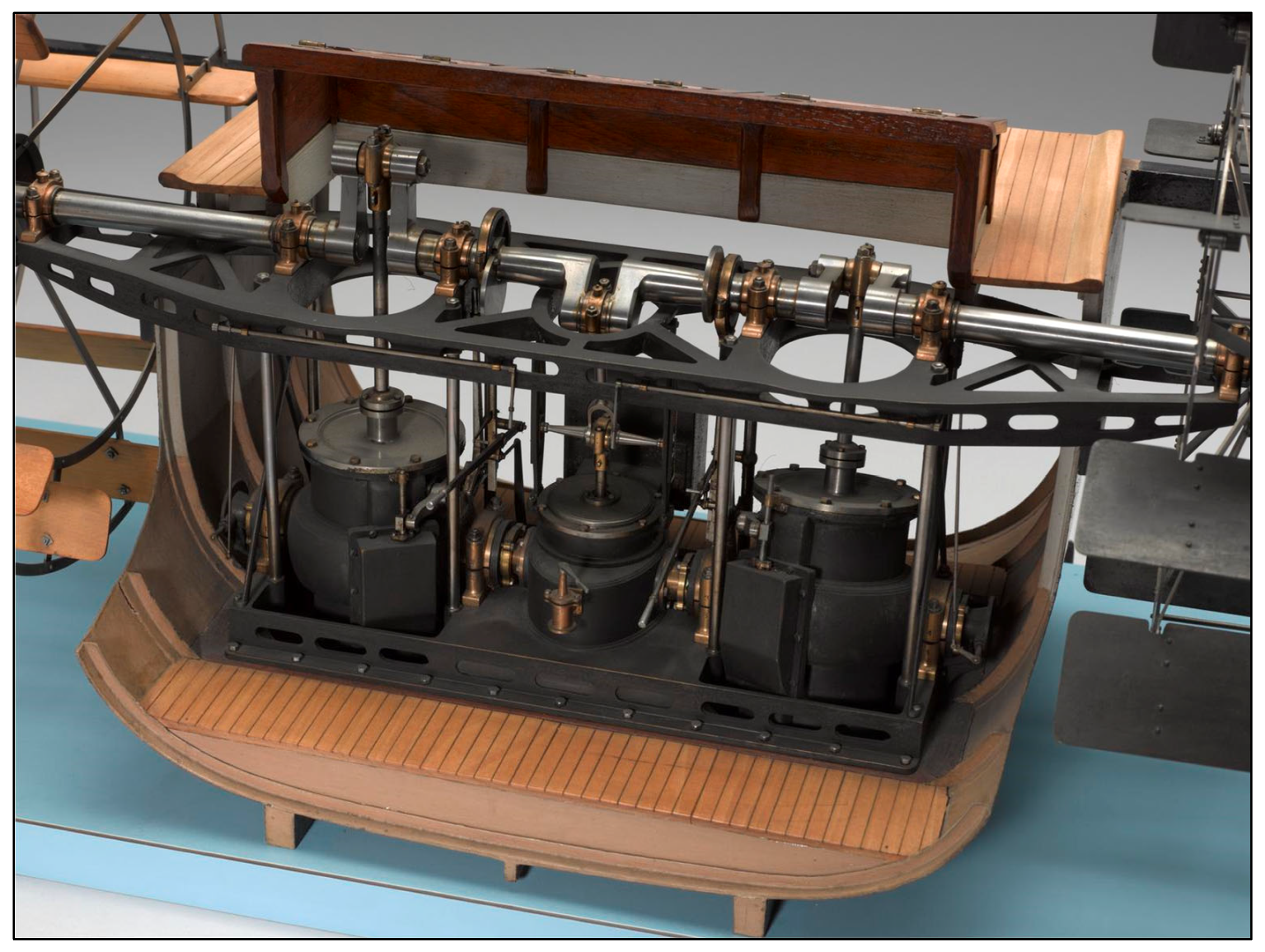
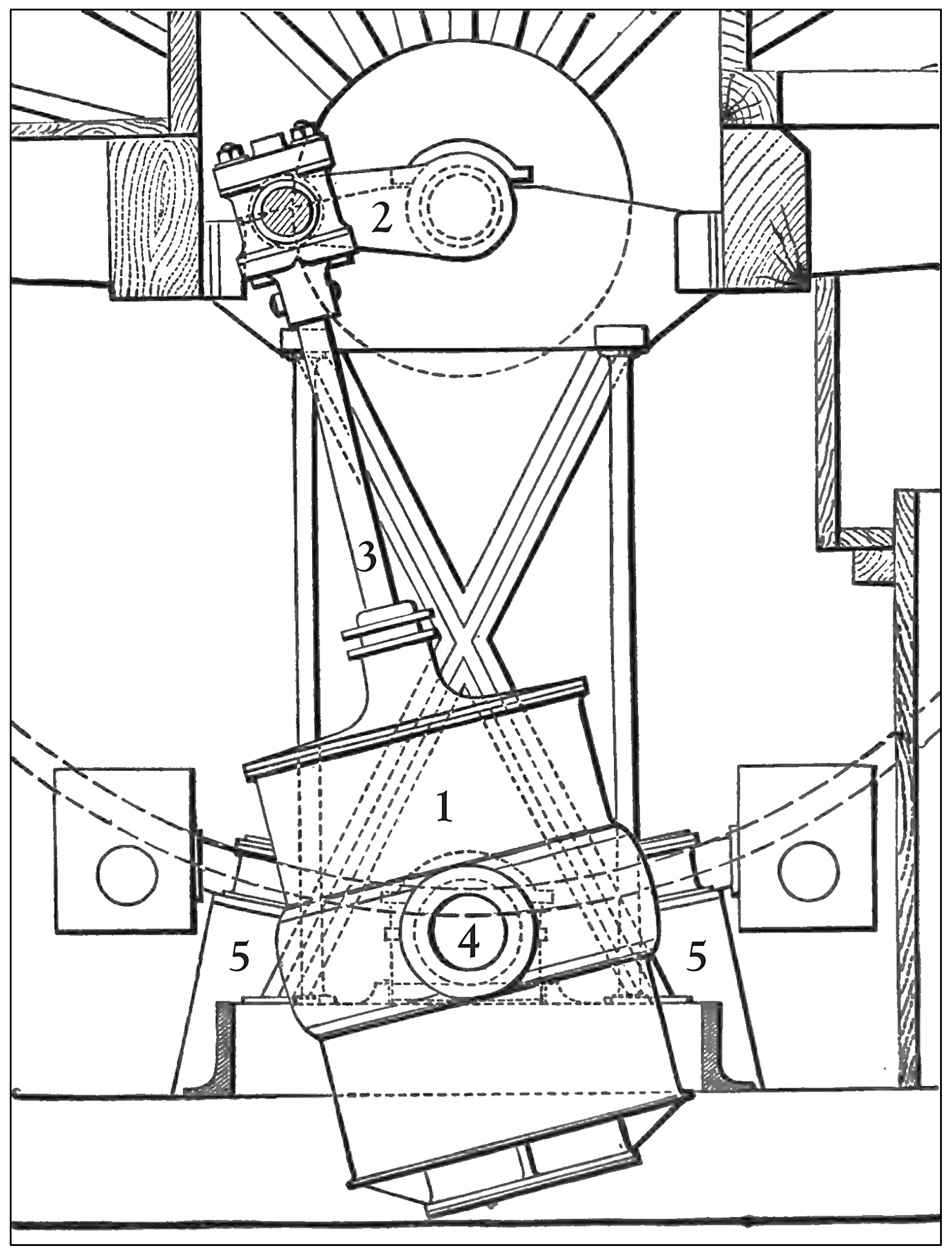
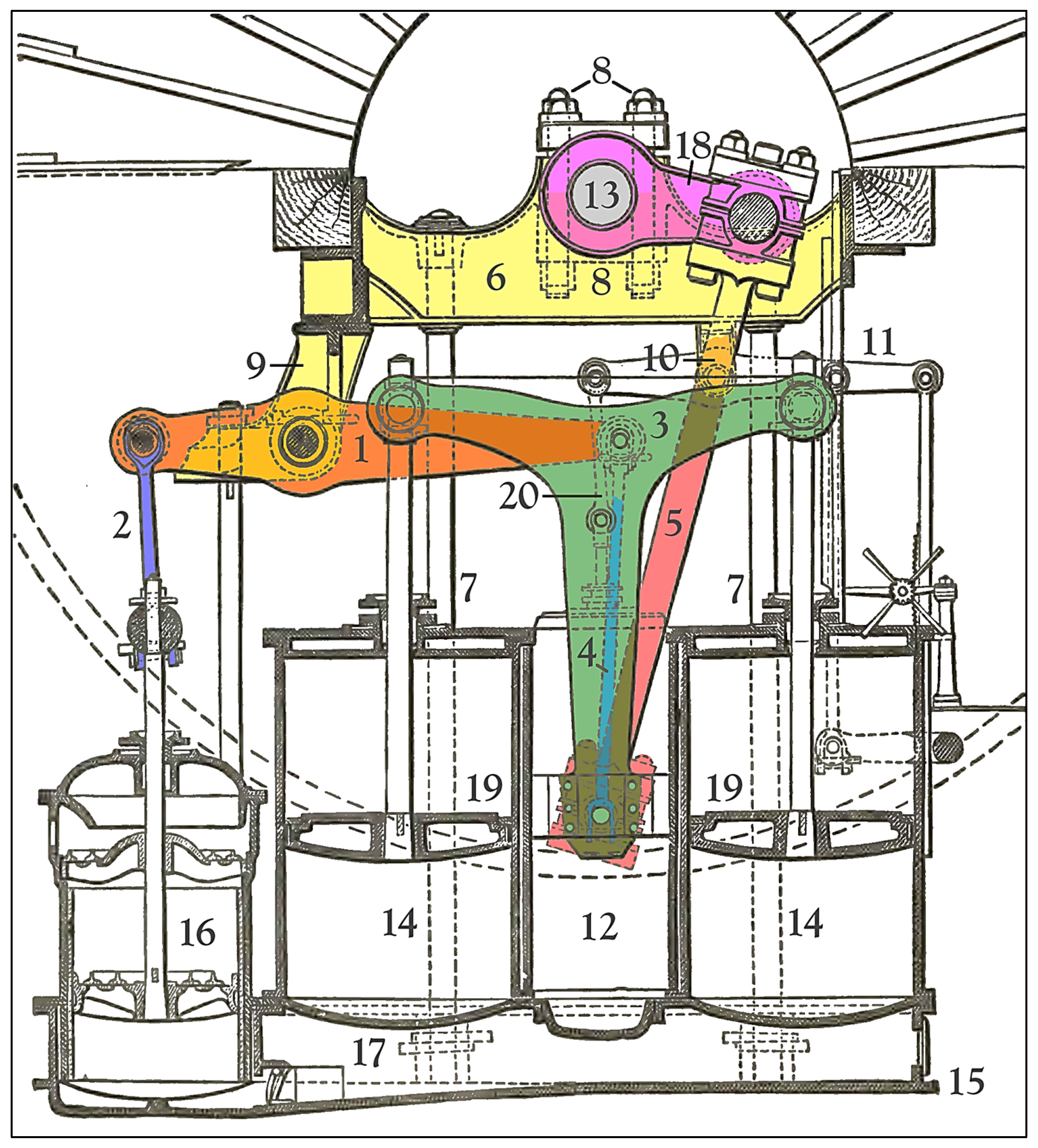
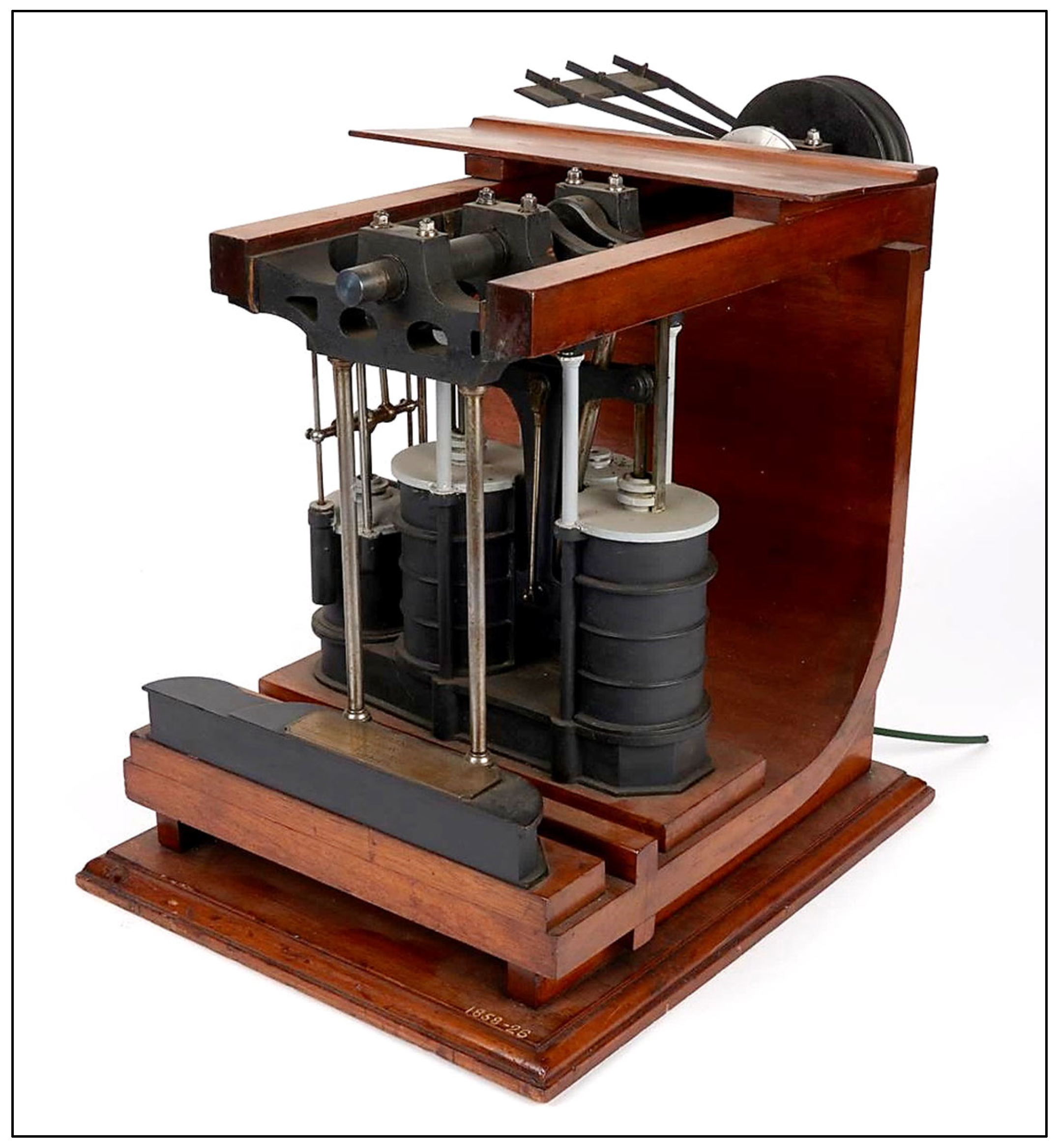
This study investigates the archaeological significance and preservation state of the Lombardo, a XIX century paddle steamer closely associated with Garibaldi’s Mille Expedition and now resting off the Tremiti Islands. The research aims to contextualize the vessel’s historical role and to reconstruct its steam engine, paddle wheel and shipwreck dynamics, providing the first comprehensive three-dimensional documentation of the site. Underwater photogrammetry was carried out using high-resolution imaging, a dedicated geodetic network of coded markers, and Structure-from-Motion workflows to generate a scaled 3D model of the wreck. Historical and technical sources were also examined to identify the original configuration of the steam engine and paddle wheel. The results show a highly fragmented site distributed between 9 and 22 m depth, where the surviving remains corroborate historical accounts of post-wreck salvage operations and subsequent natural collapse processes. Analysis of the wreck reveals that the ship’s steam engine was a Maudslay Siamese double-cylinder type, driving radial paddle wheels. The distribution of the remains also suggests that the vessel originally settled on its port side, oriented along a north–south axis. The conclusions demonstrate how integrated archaeological, geomatic, and archival methods could clarify the technical characteristics of the Lombardo and improve understanding of its post-depositional transformation, providing a robust basis for future conservation and dissemination activities.
1. Introduction
The wreck of the steamship Lombardo constitutes one of the most significant material testimonies of the Italian Risorgimento, considering the significant role it played during the Expedition of the Thousand—an event that endowed the vessel with great symbolic value even in the eyes of its contemporaries. The Expedition of the Thousand (May–October 1860) was a military campaign led by Giuseppe Garibaldi aimed at achieving the unification of Italy. Approximately one thousand volunteers departed from Quarto (Genoa) and landed in Sicily, where they defeated the Bourbon troops of the Kingdom of the Two Sicilies. The expedition resulted in the conquest of southern Italy and its subsequent annexation to the Kingdom of Sardinia, paving the way for the proclamation of the Kingdom of Italy in 1861. Giuseppe Garibaldi (1807–1882) was an Italian general, patriot, and statesman, and a key figure of the Risorgimento. A man of republican and libertarian ideals, he fought for Italy’s unification and freedom, also taking part in independence struggles in South America. For this reason, he is remembered as the “Hero of the Two Worlds” [1,2,3]. It was Garibaldi himself who wished that the Lombardo and the Piemonte, the other steamship that played a leading role in the expedition, be preserved as national monuments in memory of the decisive contribution they made to the unification of the country. Despite this recognition, the subsequent historical trajectory of the Lombardo and its wrecking near the Tremiti Islands in 1864 led to its oblivion, until the rediscovery of the wreck only in recent times.
The article presents the first archaeological analysis of the wreck of the Lombardo. This goal has been pursued by integrating data derived from 3D photogrammetric survey with an in-depth review of the technical literature on naval steam engines and paddle wheel propulsion in the mid XIX century. Following a historical contextualization of the steamship and its use during the Garibaldian expedition, this study presents a detailed description of the submerged area, followed by an illustration of the photogrammetric survey methodologies and the interpretative criteria adopted. The correlation between archival documentation and material evidence acquired through optical survey led to an updated interpretation of the engine and the paddle wheel remains. This methodological approach, which also finds confirmation in other case studies reported in the literature [4,5,6,7,8,9,10], has allowed for clarification of certain aspects related to the post-depositional transformations that affected the wreck following its sinking.
The three-dimensional reconstruction also represents a fundamental tool for the enhancement of the site, recognized as underwater cultural heritage of national significance. The 3D model of the wreck not only supports future conservation and monitoring activities, but also enables the creation of virtual access pathways capable of restoring to the public the historical and identity-related significance of the Lombardo, symbolically bridging the gap between the memory of the Expedition of the Thousand and the material traces that have survived in the waters of the Tremiti Islands.
2. Materials
2.1. The History of the Steamship Lombardo
2.1.1. Construction, Launch, and Early Years of Service (1841–1845)
The construction of the steamship Lombardo was commissioned by the Società Privilegiata per la Navigazione a Vapore del Regno Lombardo-Veneto, which, originally founded in Milan in 1825, was reconstituted under this corporate name in 1829 by Duke Carlo Visconti di Mondrone, Count Vitaliano Borromeo, the lawyer Francesco Rovida, and the hydraulic engineer Carlo Parea. The company benefited from tax exemptions and exclusive privileges for the operation of steam navigation on the River Po and on the waters of the Kingdom of Lombardy–Venetia, concessions granted by the Austrian government in order to promote the development and dissemination of this new propulsion technology within the territory of the kingdom [11] (p. 274, note 88) [12]. From 1840 onwards, the company’s administrators decided to expand its activities, which until then had been limited to riverine and lacustrine navigation, to include maritime transport services. The construction of a large paddle steamer was therefore commissioned—the Lombardo—so named in honour of the company itself and conceived to meet the requirements of luxury passenger transport. The vessel, designed by engineer Luigi Mancini, was built and registered in Livorno, which, in contrast to the generally underdeveloped industrial landscape of the Italian peninsula, benefited from an economic regime favourable to shipbuilding; indeed, the first major Italian steamships had been constructed in the Tuscan city [13] (p. 128) [14] (p. 161) [15] (p. 31) [16] (p. 37).
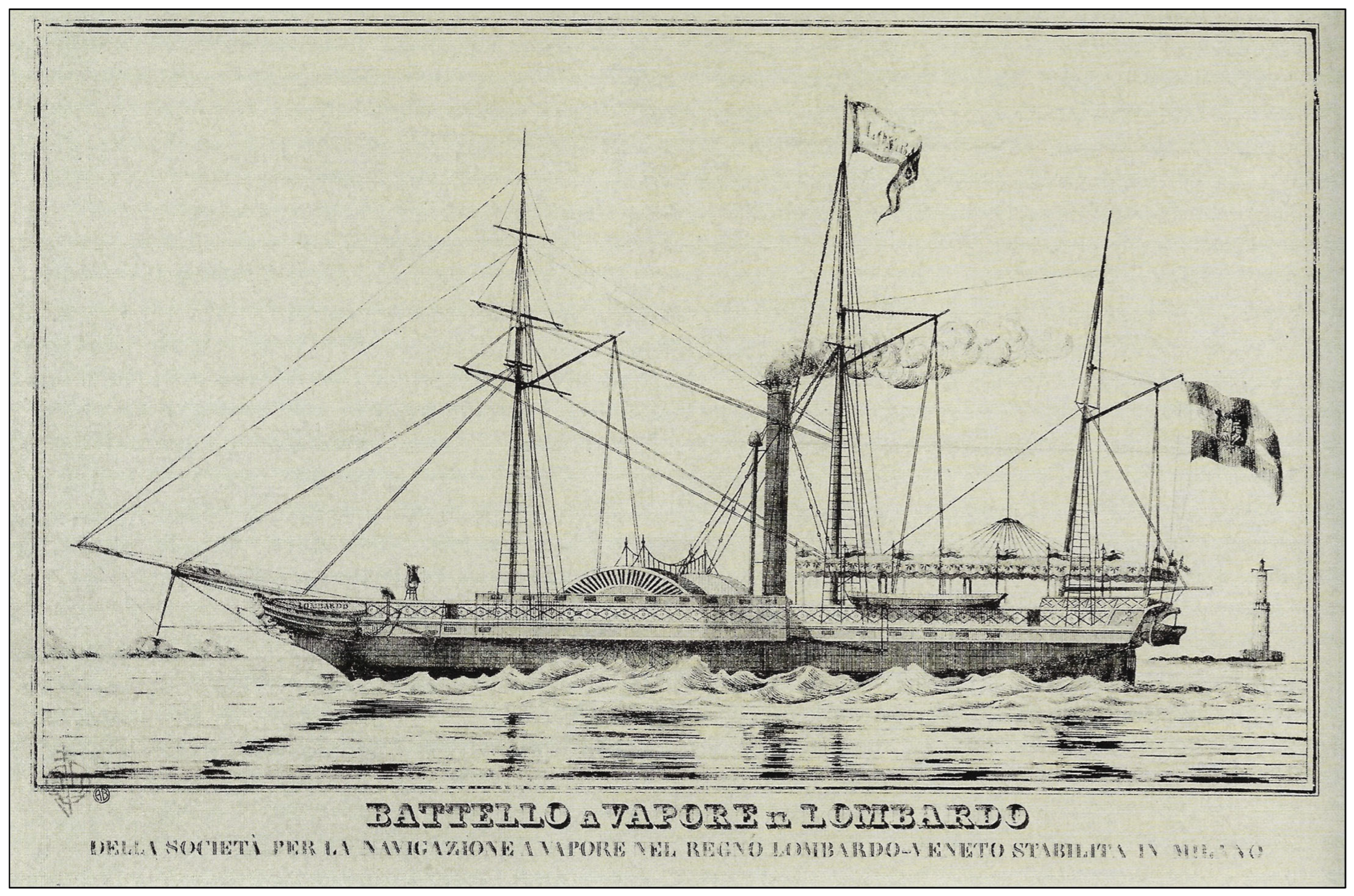
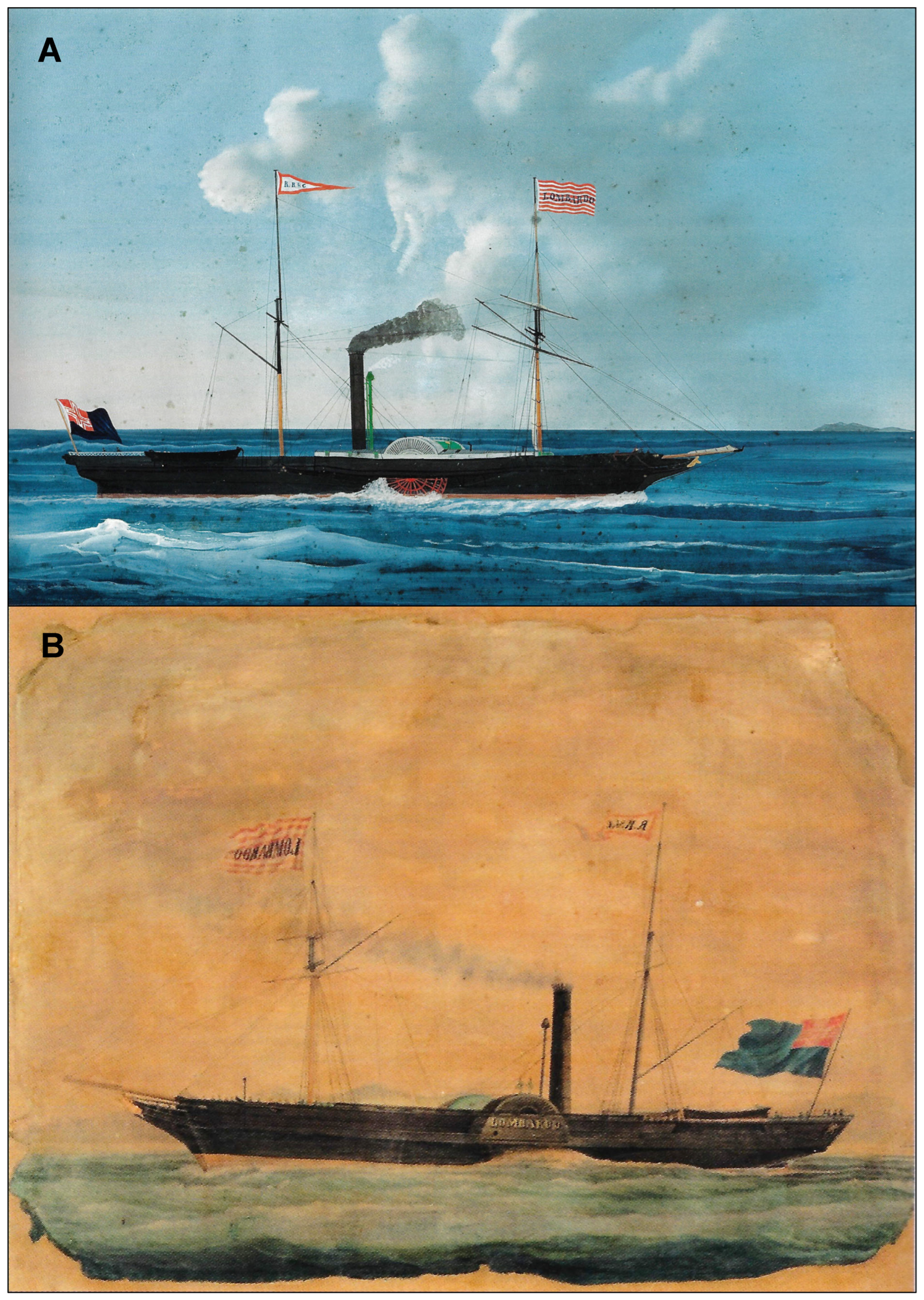
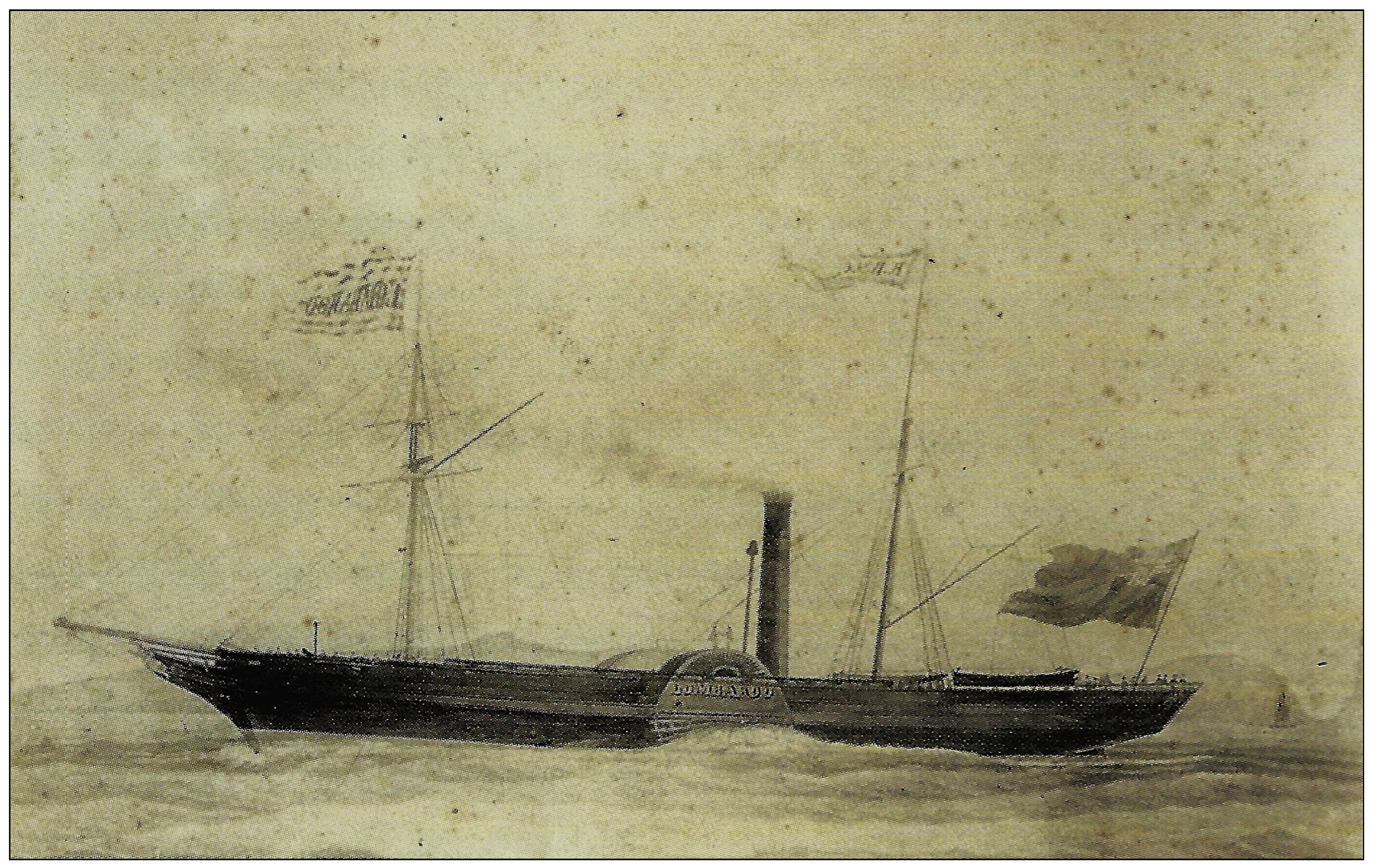
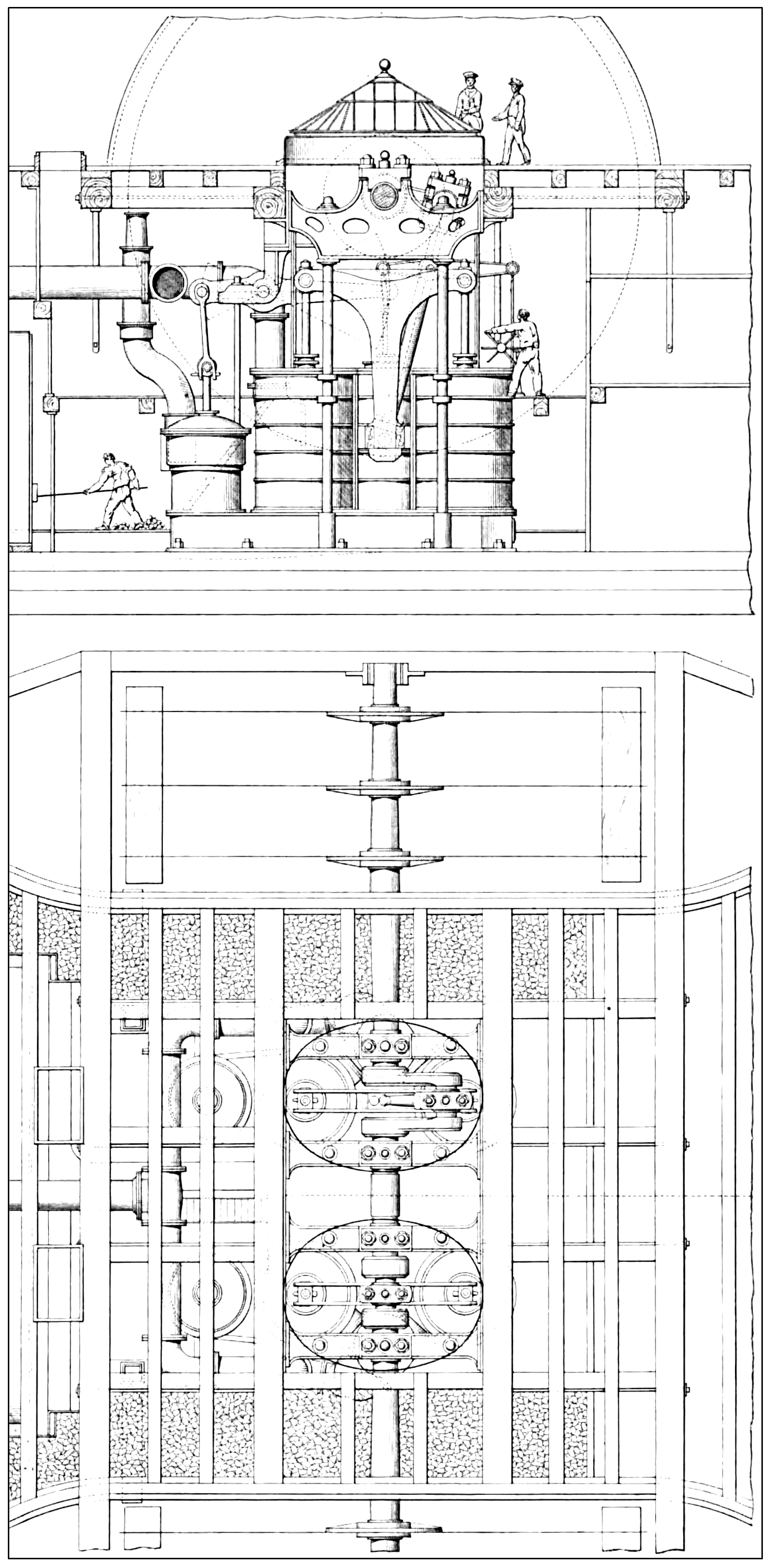
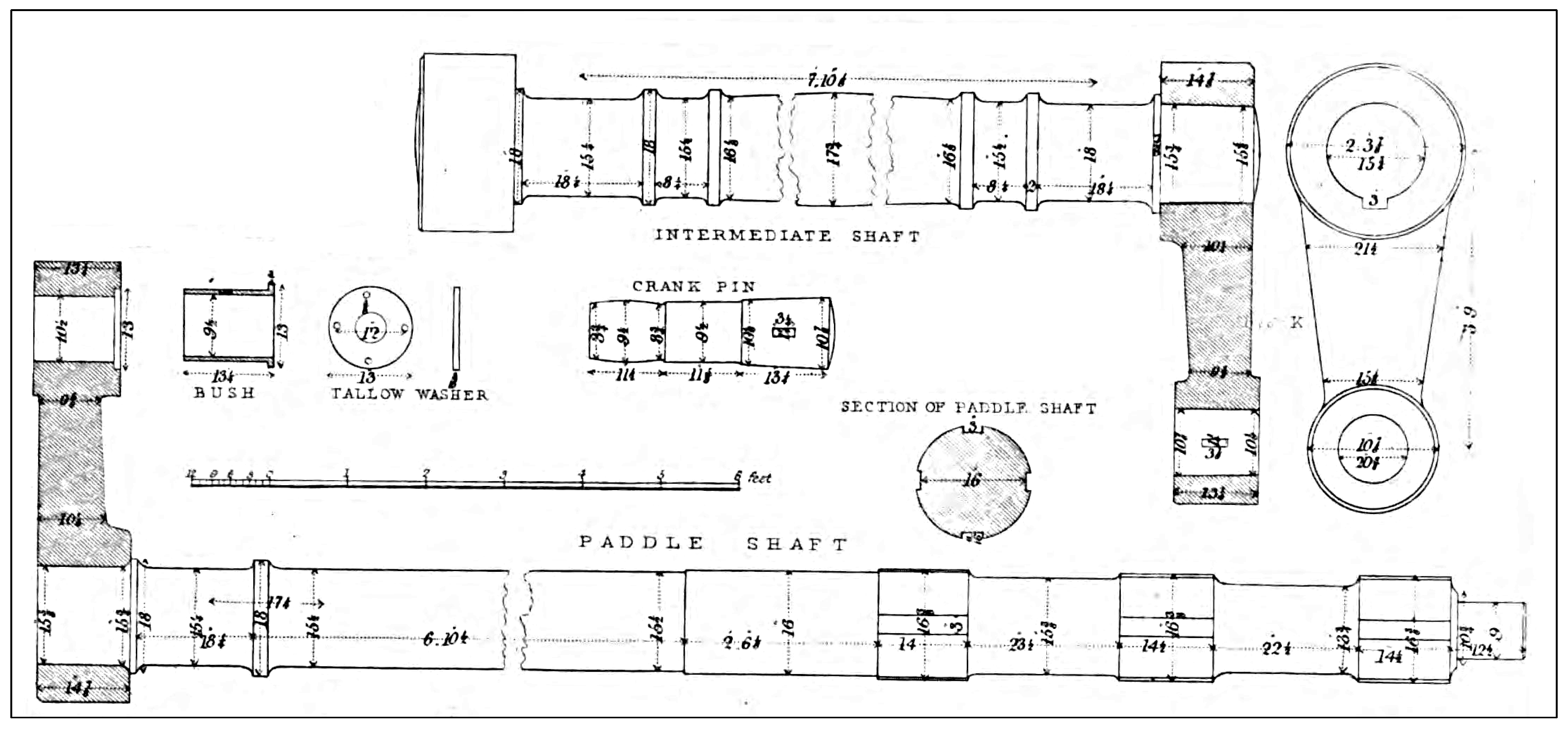
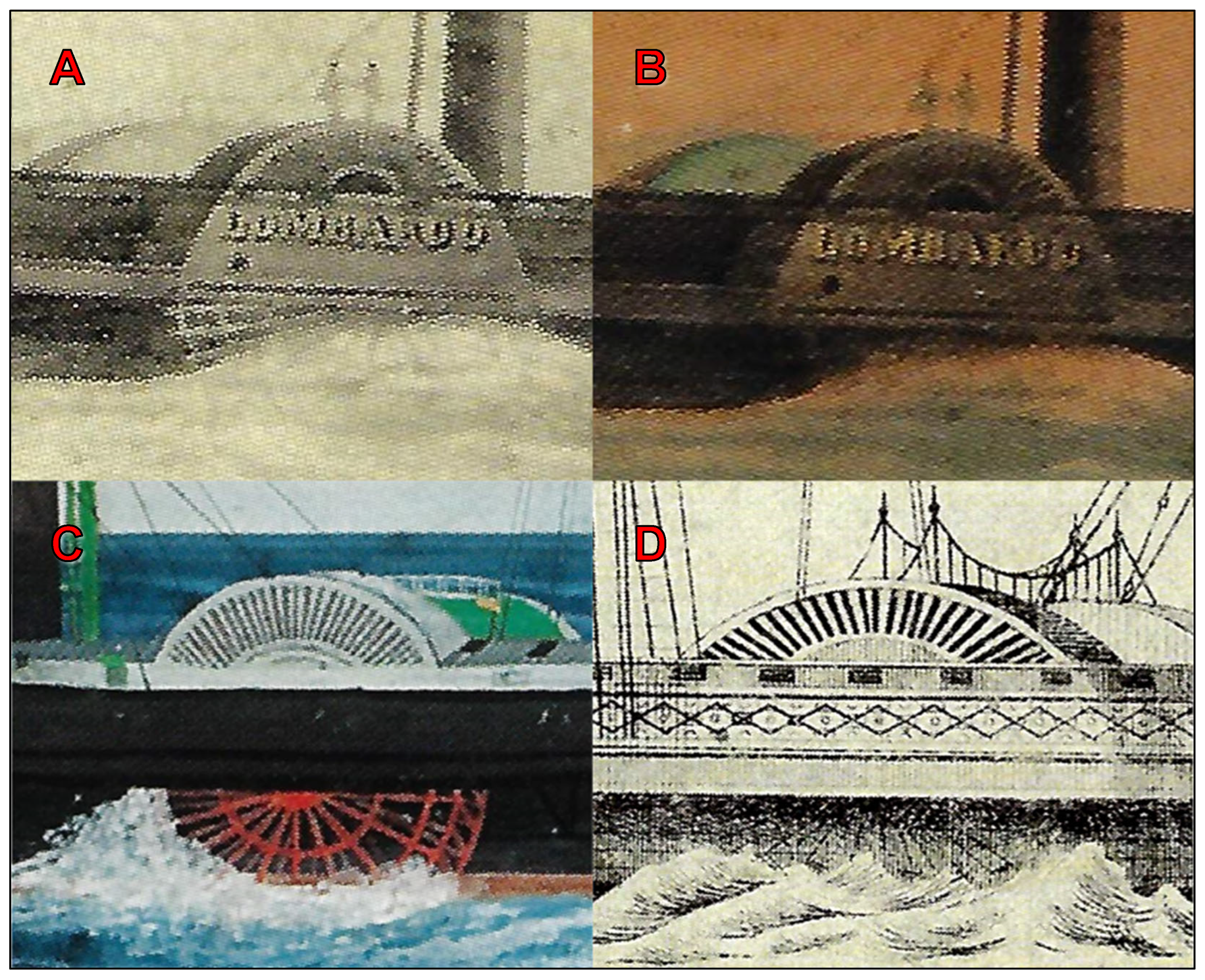
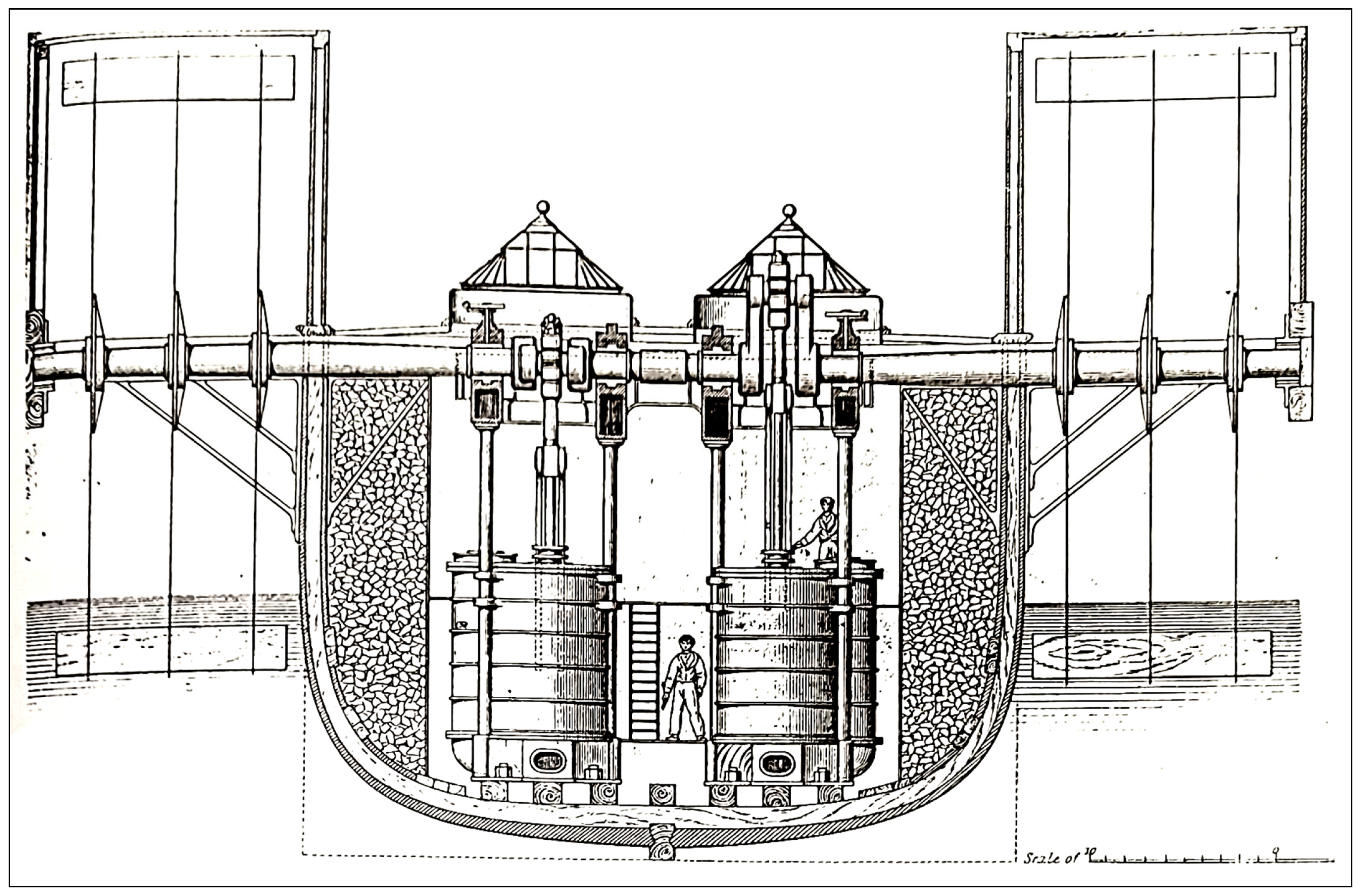
The Lombardo, with a gross tonnage of 398.27 tons (239 net tons) and a total displacement of 729 tons, was characterized by a wooden hull with a square stern and was partially sheathed in copper plates. The hull measured 51.24 m in length (48.35 m overall length), had a beam of 7.40 m, and a midship hold depth of 4.23 m [14] (p. 161) [15] (pp. 82, 87–88) [16] (p. 37) [17] (p. 27) [18] (p. 92) [19] (p. 37). Like all steamships of the first half of the XIX century, the vessel was equipped with still hybrid propulsion technology, consisting of a combination of steam propulsion, which was the primary system, and a sail, which remained essential in the event of engine failure and could also contribute, albeit to a lesser extent, to overall thrust. The sailing rig comprised a foremast with square sails, a mainmast rigged with fore-and-aft sails, and a bowsprit, resulting in a brigantine–schooner configuration. Primary propulsion was provided by a single-funnel engine rated at 208 nominal horsepower, manufactured by Maudslay Sons & Field of London, which drove two paddle wheels housed amidships on either side of the hull [13] (p. 129) [14] (pp. 157, 161) [15] (pp. 35, 82, 88) [17] (p. 27) [20] (p. 285). The Lombard Company spared no expense, as Maudslay steam engines were considered the finest available on the market. The firm Henry Maudslay & Co. had in fact been founded in 1798 in the Lambeth district of London by Henry Maudslay (1771–1831), one of the leading figures of the English Industrial Revolution and an inventor of machine tools and precision engineering, who was joined between 1813 and 1820 by Joshua Field, an expert in the design of marine steam engines. Following H. Maudslay’s death, his sons Thomas, Henry, and Joseph took over the business, and in 1833 the firm adopted its definitive name, Maudslay Sons & Field [21,22]1. In order to fulfil its role as a luxury passenger vessel, the design of the steamship’s decorative scheme was entrusted to the Milanese architect Gioachino Crivelli (1796–1830), a second-generation exponent of Lombard Neoclassicism and already the designer of several palaces for the Milanese aristocracy [23]. He designed the external mouldings and oversaw the layout and furnishing of the first-class cabins, equipping them with faux-marquetry panelling and works by Milanese artists. Regarding the decorative composition of the Lombardo, a contemporary chronicle reports that “[…] all agree in describing it as tasteful and magnificent” [24]. The faux-marquetry finishes were indeed executed by the Caspani brothers, renowned master cabinetmakers, who also produced the mouldings of the first-class common saloon using the same technique, inspired by illustrations by the painter Napoleone Mellini depicting subjects drawn from Alessandro Manzoni’s novel “I Promessi Sposi” [25]. Regarding the arrangement and distribution of accommodation, the Lombardo displayed a configuration typical of steamships of the period. Crew quarters were located at the extreme bow of the vessel, while the deck housed the officers’ accommodations, the galley, the pantry, and passenger latrines. Second-class accommodation comprised forty-eight berths, twelve of which were reserved for women. An architectural innovation of the Lombardo consisted of eight cabins (three double, two quadruple, and three six-berth cabins) reserved for families and arranged along the ship’s sides near the paddle wheel housings. The first-class saloon was in the stern deckhouse, representing the true focal point of the passenger area. This space was characterized by four male cabins arranged along the port side and four female cabins, flanked by a dressing room and a dedicated latrine, opening onto the saloon on the opposite side, a layout that allowed for a total of thirty berths. Finally, in the extreme stern area, referred to as the “rotunda” because of the progressive narrowing of the hull, four lateral bunks were arranged [15] (pp. 36, 84–88). Several images of the Lombardo have survived, depicting the steamship with varying degrees of accuracy. The Crivelli may be the author of the 1841 lithograph preserved in Milan that depicts the Lombardo with an unusual decorative scheme covering the external planking, a tent-like pavilion sheltering the aft deck, and a curious cable-stayed bridge connecting the housings of the two paddle wheels. This configuration appears better suited to navigation in calm lacustrine waters rather than on the open sea and is most likely attributable to a phase prior to the completion of the vessel, here depicted with three masts instead of two (Figure 1). The other extant images, preserved in Genoa, convey a more conventional and probably more realistic appearance of the steamship: a watercolour and a typographic ink drawing (Figure 2), both by anonymous authors, and a photograph depicting a drawing previously described as “a watercolour on paper of unknown location” [26] (caption, p. 138) (Figure 3) which, on the basis of comparison, may in fact correspond to the aforementioned typographic ink drawing (Figure 2B).
Figure 1.
The steamship Lombardo. Lithograph of 1841, Civica Raccolta delle Stampe Achille Bertarelli, Milan [13] (p.124) [15] (p. 32–33).
Figure 2.
The steamship Lombardo (A). Watercolor and typographic ink drawing (B), both anonymous. Istituto Mazziniano—Museo del Risorgimento, Genoa. [13] (pp. 125, 128) [15] (pp. 38–39, 68–69).
Figure 3.
The steamship Lombardo. Vintage photograph of a paper reproduction, Piccione Collectio, n. [26] (p. 138).
As recalled by the contemporary newspaper Eco della Borsa, the Lombardo was launched on 10 May 1841 in the right dock of the port of Livorno:
“The launching, which took place yesterday morning at 9, of the steam vessel to be named Lombardo, because it belongs to the Privileged Society of Steamships of the Lombardy–Venetia State, was a celebration for the whole of Livorno […]. This superb vessel, whose construction was entrusted from the outset to Messrs. Mancini, father and son, will be equipped with two low-pressure engines from the Maudslay & Son factory of Londo, n. These names are equivalent to any praise.”[27] (p. 1)
On 15 September 1841, the steamship undertook its first voyage along the Marseille–Genoa–Livorno–Civitavecchia–Naple’s route under the command of Captain Luigi Sforzini, arriving in the Neapolitan city on the 20th of the same month. However, only a month later, during the night of 14–15 October 1841, the vessel was involved in a collision with the French steamship Charlemagne, owned by the Marseille-based company Bazin & Perier, in the Piombino Channel; the Lombardo sustained only minor damage. Nevertheless, as the most luxurious ship in service in the Tyrrhenian Sea at the time, in April 1842 Queen Maria Cristina of Savoy even requested the steamship to undertake a cruise visiting her nephew Ferdinand II in Naples, together with the Savoy court. Moreover, in the following months, the Steam Navigation Administration of the Kingdom of the Two Sicilies repeatedly chartered the vessel.
Between October and November of the same year, however, following a public auction with a starting bid of 50,000 francs that went unsold, the Lombardo entered a troubled period. As a result of the legal dispute arising from the collision with the Charlemagne, on 31 March 1844 the ship was placed under judicial seizure in the port of Marseille and laid up until June of the following year. The court of Civitavecchia, the port where Captain Sforzini had filed a formal complaint regarding the incident, ruled that it did not have the authority to proceed against the captain of the French steamship, as he was not resident in Civitavecchia, and that the dispute therefore had to be resolved in the place of the accused’s domicile [28].
2.1.2. The Transfer to the Rubattino & Co. Navigation Company (1845–1855)
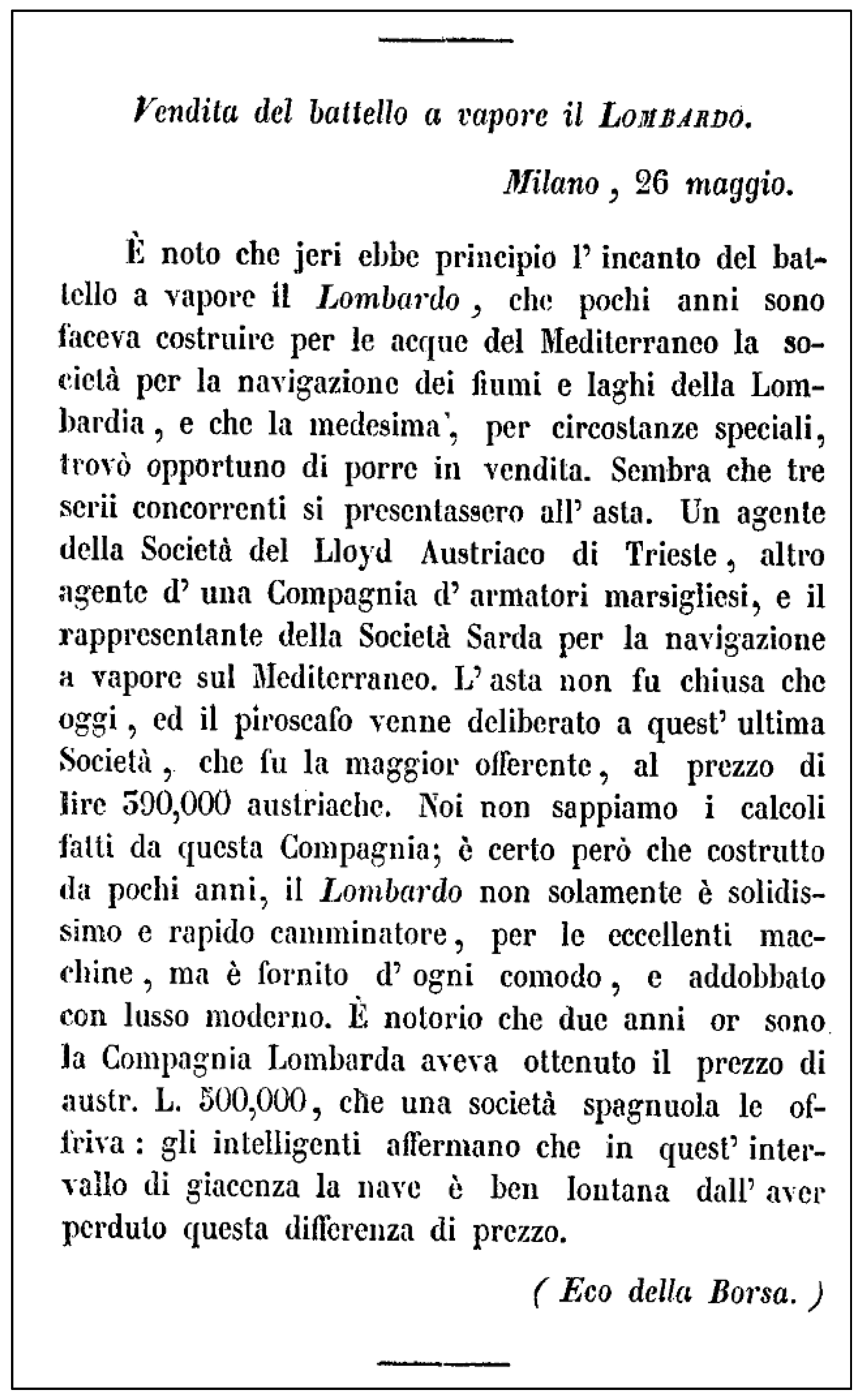
On 30 October 1845, the ship struck the flag of the Grand Duchy of Tuscany to assume the Austrian flag and proceeded to Trieste, where on 26 February 1846, it was put up for auction again and subsequently purchased on 25 May of the same year by the Sardinian Company for Steam Navigation in the Mediterranean, managed by the Genoese shipowner Raffaele Rubattino [13] (p. 129) [14] (p. 161) [15] (p. 36). The news of the sale was reported the following day by the newspaper Eco della Borsa, later reproduced by the Giornale della provincia di Bergamo (Figure 4):
“It is known that yesterday the auction of the steamship Lombardo began. A few years ago, it had been built for Mediterranean waters by the Society for the Navigation of the Rivers and Lakes of Lombardy, which, due to special circumstances, found it appropriate to put it up for sale. It seems that three serious competitors attended the auction: an agent of the Austrian Lloyd Company of Trieste, another agent of a Marseille-based shipowners’ company, and the representative of the Sardinian Company for Steam Navigation in the Mediterranea, n. The auction was not concluded until today, and the steamship was awarded to the latter company, which was the highest bidder at the price of 390,000 Austrian lire. […]”[29] (p. 532)
Figure 4.
Giornale della provincia di Bergamo, Tuesday, 9 June 1846. The Lombardo is sold at auction and purchased by the Sardinian Company for Steam Navigation in the Mediterranean [29] (p. 532).
Figure 4.
Giornale della provincia di Bergamo, Tuesday, 9 June 1846. The Lombardo is sold at auction and purchased by the Sardinian Company for Steam Navigation in the Mediterranean [29] (p. 532).

The Lombardo thus circumnavigated the Italian peninsula to return to the Tyrrhenian Sea and reach the port of Genoa, where it joined the fleet of R. Rubattino, who in the meantime had founded his navigation company: the R. Rubattino & Co. Steam Navigation Company. On 1 July 1846, the steamship resumed service along the so-called “Linea d’Italia,” an important and profitable communication route running from Marseille to Naples, which, in the absence of railway connections, enabled links between France and the pre-unification states of the peninsula, allowing for various stops along the Ligurian and Tyrrhenian coasts [30] (p. 4) [31] (p. 4) [32] (p. 345). On 9 August 1847, departing from Civitavecchia, the Lombardo hosted on board Count Pietro Ferretti, counsellor of the Papal Secretary of State and a fervent advocate for the secularization of administrative offices within the Papal States [33] (p. 111).
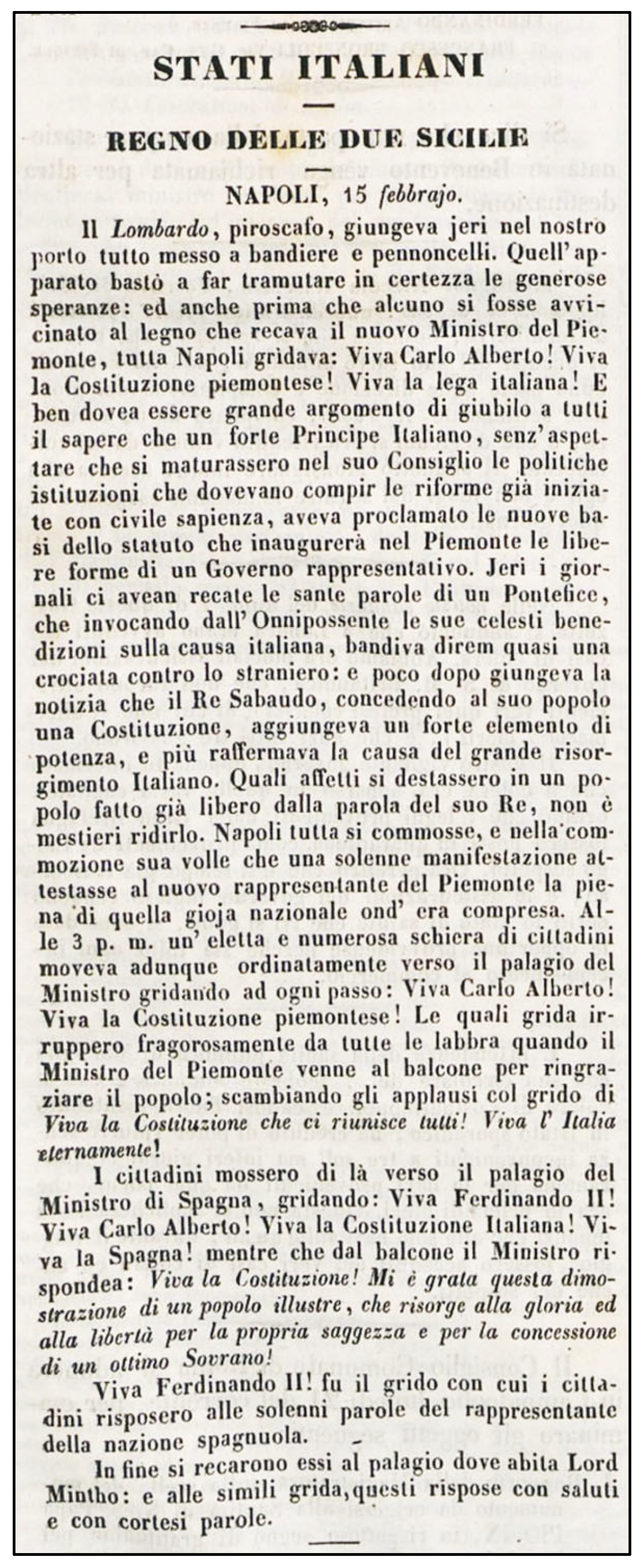
On 15 February 1848, the steamship arrived in Naples carrying the future Prime Minister of the Piedmontese Parliament, Cesare Balbo, who announced the imminent proclamation of the Statuto Albertino. This news aroused widespread sympathy for the Savoyard government and a strong sense of Italian patriotism among the assembled crowd (Figure 5). The Gazzetta di Roma reports the following:
“The steamship Lombardo arrived yesterday in our port fully adorned with flags and pennants. That display was enough to turn generous hopes into certainty, and even before anyone had approached the vessel carrying the new minister of Piedmont, all of Naples was shouting: Long live Carlo Alberto! Long live the Piedmontese constitution! Long live the Italian league! […]”[34] (p. 98)
Figure 5.
Gazzetta di Roma, Saturday, 19 February 1848. News of the arrival of the Lombardo in Naples, carrying the future Prime Minister of the Piedmontese Parliament, Cesare Balbo, who was warmly received by the crowd [34] (p. 98).
Figure 5.
Gazzetta di Roma, Saturday, 19 February 1848. News of the arrival of the Lombardo in Naples, carrying the future Prime Minister of the Piedmontese Parliament, Cesare Balbo, who was warmly received by the crowd [34] (p. 98).

The following year, in July 1849, the Lombardo was used by survivors of the failed attempt to restore the Roman Republic to reach Genoa [35,36,37]. During the stopover in Livorno, some of the fugitives were identified and prevented from disembarking. The episode is described in the periodical Il Costituzionale Romano:
“[…] On the 8th, the steamship Lombardo arrived from Naples and Civitavecchia: it carried about 100 refugees from Rome, all with English or American passports. About twenty, destined for here, were turned back; it seems that the same will happen to the others bound for Genoa, and they will have no refuge other than Malta […] Mazzini and the other Triumvirs, carrying English passports, were embarked on the English steamship Bulldog to be transported to Malta.Another report on 10 July […] From the Maria Antonietta, which arrived this morning from Genoa, we learned that, as previously expected, disembarkation was prohibited for the Roman fugitives aboard the Lombardo, and it is added that two attempted to escape by jumping into the sea at night”[38] (p. 216)
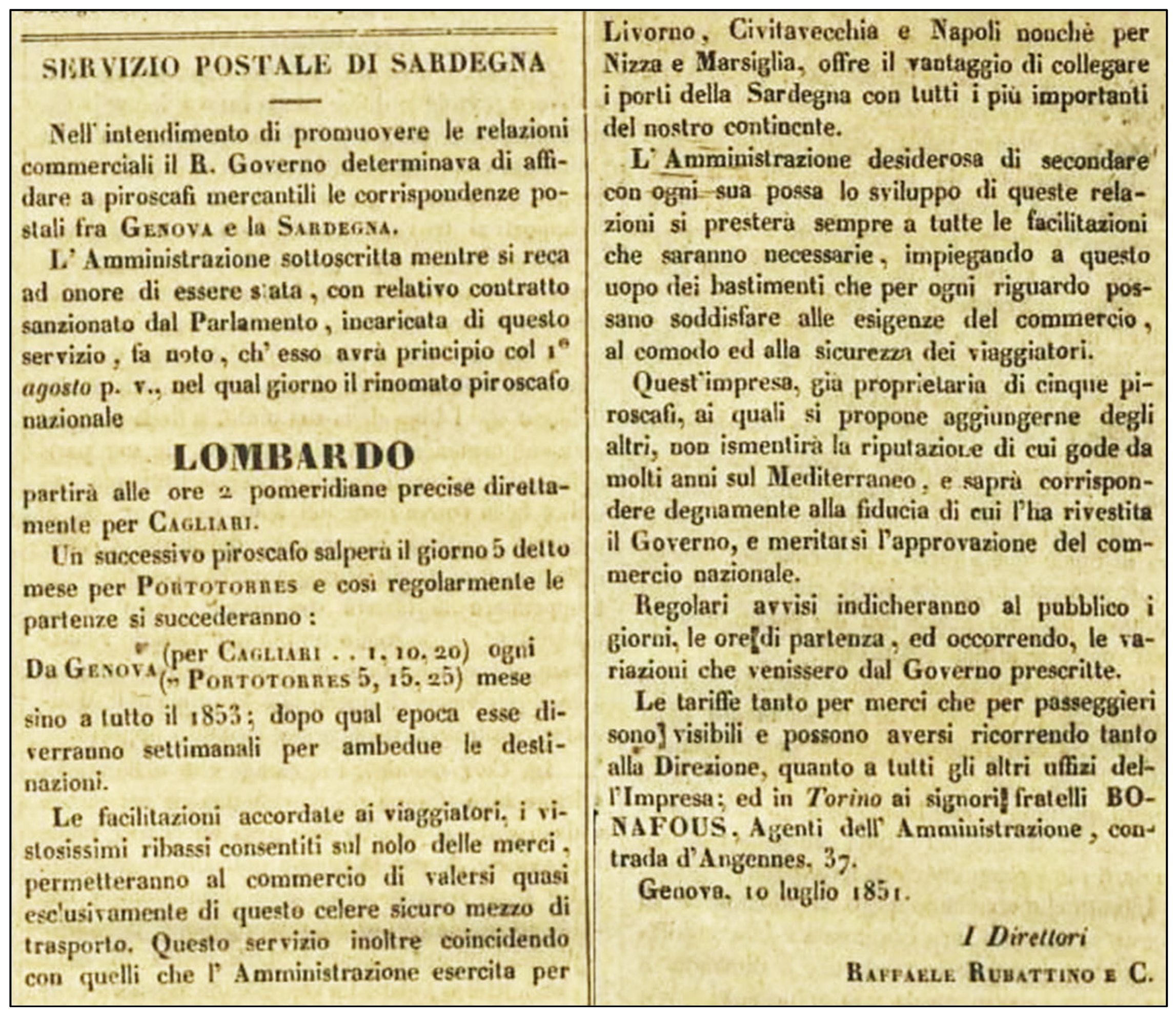
On 1 August 1853, the “[…] renowned national steamship LOMBARDO […]” [39] (p. 4) was employed by Rubattino to inaugurate the subsidized Postal Service line along the Genoa–Cagliari route, which was later extended to Tunis [15] (p. 37) [16] (p. 37) [19] (p. 45) (Figure 6). The following year, on 24 February 1854, the Savoyard royal family requested the vessel to attend a regatta in Genoa together with the entire court.
Figure 6.
L’Opinione, Tuesday, 15 July 1851. Announcement of the inauguration of the postal service to Sardinia with the steamship Lombardo by R. Rubattino & Co. [39] (p. 4).
The event is described by the newspaper L’Opinione, which reports that, at the conclusion of the competition, various prizes were given consisting of “[…] monetary rewards and a magnificent flag […] distributed aboard the Lombardo to the winners, to whom His Majesty then expressed his special appreciation.” [40] (p. 4). The following day, carrying more than six hundred people, the ship was also used to make “[…] a five- or six-hour excursion along the nearby beaches of the two rivieras.” [40] (p. 4).
2.1.3. From the Crimean War to the Expedition of the Thousand (1855–1860)
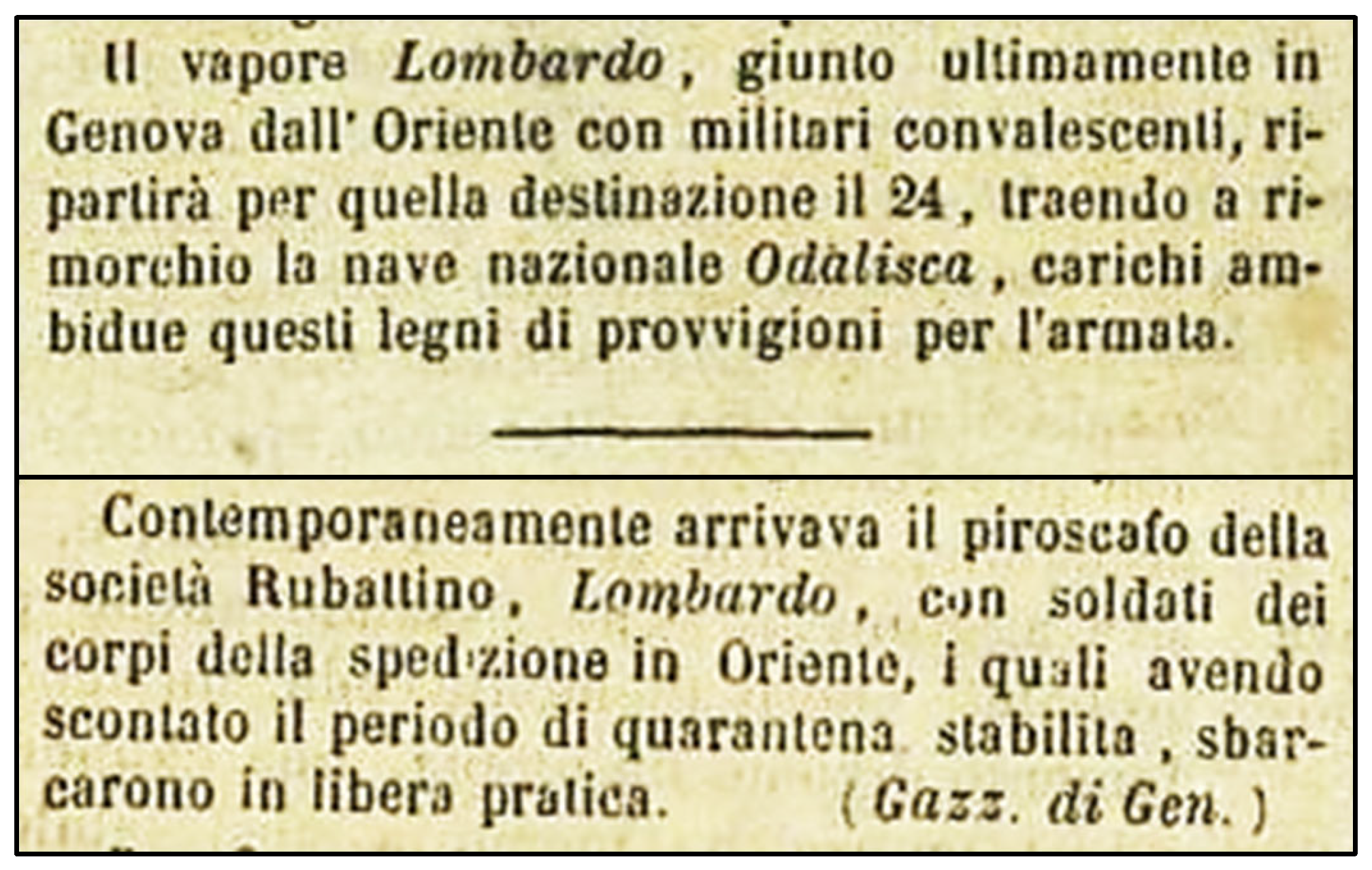
From 1855 to 1856, the steamship was chartered by the Ministry of the Navy for a very different purpose, namely the transport of troops during the Crimean War [14] (pp. 161–162) [19] (p. 38) [20] (p. 285). In this regard, the newspaper L’Opinione (Figure 7), in its issue of 28 September 1855, reported as follows:
“[…] The steamship Lombardo, which recently arrived in Genoa from the East carrying convalescent soldiers, will depart again for that destination on the 24th, towing the national vessel Odalisca, both ships being loaded with provisions for the army.”[41] (p. 2)
The same newspaper, the following year, citing the Gazzetta di Genova, wrote the following:
“[…] At the same time, the Rubattino Company’s steamship Lombardo arrived with soldiers from the expeditionary corps in the East, who, having completed the prescribed quarantine period, disembarked with free pratique.”[42] (p. 2)
Figure 7.
L’Opinione. Above: Friday, 28 September 1855 [41] (p. 2); below: Thursday, 17 April 1856 [42] (p. 2). Reports on the use of the steamship Lombardo as troop transport during military operations in the Crimean War.
Figure 7.
L’Opinione. Above: Friday, 28 September 1855 [41] (p. 2); below: Thursday, 17 April 1856 [42] (p. 2). Reports on the use of the steamship Lombardo as troop transport during military operations in the Crimean War.

A few years later, on the night of 5 May 1860, the Lombardo would enter the pages of history, becoming, together with the Piemonte, one of the steamships used to conduct the “Expedition of the Thousand”. This historic event represents the culmination of the revolutionary movements that unfolded from the mid-XIX century onwards and is linked to one of these episodes: the “Gancia Uprising”. Breaking out in Palermo on 4 April 1860, this insurrection, despite its rapid suppression, not only contributed to triggering further revolts in the Palermo area and the Sicilian hinterland, but also proved fundamental in ensuring the success of the “Expedition of the Thousand”, preparing the ground for the arrival of Garibaldi and his volunteers [43,44] (pp. 23–25). Since the reports reaching Turin regarding the course of the uprising were contradictory, Cavour, who initially intended to support it, instead adopted a strategy of cautious waiting in order to avoid any diplomatic complications, relying on Garibaldi’s expedition. Indeed, the undertaking that the general was organizing together with his associates, gathered within the Provisional Committee, was specifically intended not to directly compromise the Savoyard government in the affair [26] (p. 133). In this regard, it is now well established that the theft of the Lombardo and the Piemonte was staged, as it was orchestrated on a prior agreement between Garibaldi and the director of Rubattino & Co., Giovanni Battista Fauché, who consented to the transfer of the two vessels. However, it remains unclear whether Rubattino himself was unaware of the arrangement or whether the agreement took place with his tacit complicity [13] (pp. 123–128) [15] (pp. 45–65). In the weeks preceding the expedition, the two steamships continued to sail along the usual routes served by R. Rubattino & Co., so that, according to Fauché’s plans, they would both be in Genoa on the eve of the expedition [45] (pp. 16–18).
On the evening of 5 May 1860, the two vessels were seized by a group of about forty Garibaldian volunteers led by Nino Bixio and Salvatore Castiglia. The revolutionaries, who had concealed themselves aboard the San Giuseppe, one of the laid-up vessels used by Rubattino’s company as storage hulks for goods and coal [46] (pp. 167–173), encountered no resistance from the reduced crews of the steamships, most of whom were stationed ashore. Command of the Lombardo was assumed by Bixio himself [47] (p. 269), assisted as second-in-command by the captain Augusto Elia [20] (p. 285) with Giuseppe Orlando serving as chief engineer. The steamship, whose boilers were taking too long to reach the pressure required to get under way, was initially towed by the Piemonte, which, in the middle of the night at 2:15 a.m., departed from the old port of Genoa. The crews of the two steamships then completed the transfer of men and equipment from the boats waiting near the Foce district, before proceeding to meet Garibaldi, who, impatient, had in the meantime decided to reach Genoa by rowing [48] (p. 87). The convoy reached Quarto, where the embarkation of the remaining volunteers of the expedition took place over the rest of the night [49] (pp. 16–19). On the morning of 6 May 1860, at 7:30 a.m., when the Lombardo’s boilers finally reached operating pressure, Garibaldi, aboard the Piemonte, at last gave the order to put to sea [15] (p. 9) [26] (pp. 133–135).
Although the participants in the expedition have gone down in history as the “Thousand,” their actual number was slightly higher and, according to the list published in the Gazzetta Ufficiale del Regno d’Italia of 12 November 1878, amounted to a total of 1088 men plus one woman (Rosalia Montmasson, the wife of Francesco Crispi) [50]. A similar number (approximately 1070) is also reported by N. Bixio himself. We know, however, that these numbers fall short by at least one hundred men who were dismissed by Garibaldi during the stopover at Talamone. While the exact number of Garibaldian volunteers at departure remains undefined, it is certain that the Lombardo embarked more men than the Piemonte due to its greater tonnage; in any case, both steamships were overloaded, with many men forced to camp on their respective decks. The departure, already marked by numerous unforeseen events, was further hampered by the failure to carry out the planned resupply of arms and ammunition at Bogliasco and Sori [51] (pp. 36–39). Despite the shortage of provisions and equipment, Garibaldi nevertheless decided to depart, setting a south-easterly course. On 6 May, rough seas caused discomfort among the men, many of whom were Lombards unaccustomed to navigation; the following day, on the advice of Giuseppe Bandi, a native of the Maremma, it was decided to put in at Talamone [49] (pp. 22–23). Here, Garibaldi obtained provisions and weapons, allowed the volunteers to rest, and organized them into eight companies [46] (p. 172) [48] (p. 95) [49] (pp. 24, 26–28). On 8 May, it was therefore possible to embark nine quintals of lead, 28,000 rifle cartridges, three artillery pieces, 200 cannonballs, ten and a half quintals of gunpowder, 300 rifles, and provisions in abundance [47] (p. 278). On the morning of 9 May, the two steamships then set sail for Porto Santo Stefano to carry out the final resupply stop before definitively resuming navigation toward Sicily. Aboard the Piemonte were Garibaldi and his General Staff, joined by two companies of volunteers; the remaining six companies, the medical detachment, and the command’s Intendance, directed by the poet Ippolito Nievo (who would perish in the wreck of the steamship Ercole during the return voyage), embarked on the Lombardo [15] (pp. 11–15). The total number of volunteers who actually departed after the stop at Talamone, taking into account the various changes that occurred [52] (pp. 13–14), must have amounted to about 1027 men [53] (p. 118) [49] (p. 27), of whom 627 [54] (pp. 574–576) [17] (p. 27) were embarked on the Lombardo, while the remaining 400 were aboard the Piemonte. At Porto Santo Stefano, coal and water were therefore loaded on in quantities sufficient to ensure the operation of the steam engines of both vessels for the remainder of the voyage [47] (p. 286).
In the early afternoon of 9 May, the two vessels, now adequately outfitted, set sail for the lower Tyrrhenian Sea. After rounding the Argentario promontory, the Piemonte headed toward Sicily, followed within sight by the Lombardo, with which contact was maintained through agreed-upon signals; several men were also posted as lookouts to identify any Bourbon naval units [49] (p. 36). During the night between 10 and 11 May, however, the ships became separated due to their different speeds and because of the recovery of a man who had fallen overboard from the Lombardo [49] (p. 33). The reunion of the two steamships occurred in a dramatic manner: Bixio, having mistaken the Piemonte for an enemy vessel, ordered it to be boarded, but Garibaldi, hearing the agitated shouts of his comrade, made himself known and thus avoided the incident [15] (pp. 11–15) [49] (pp. 36–38) [54] (pp. 574–576). From that moment onward, it was agreed that it was necessary to sail in company, following a wide course by steering toward the Egadi Islands. Despite these precautions, on 11 May, between Favignana and Marettimo, the two steamships were sighted by the Bourbon lookout stationed at Punta della Provvidenza, who signalled their presence to several Bourbon naval units. However, owing to the considerable distance—about 20 miles—the latter were unable to reach the Thousand and subsequently prevent the landing [49] (p. 40). Informed by the crew of a British schooner of the absence of Bourbon ships at Marsala, Garibaldi gave up the idea of landing at Castellammare del Golfo or Porto Palo [55] (p. 40). Antonio Strazzera, a local fisherman who was taken aboard the Piemonte, then guided the two vessels, which in the meantime had hoisted the Savoyard flag, into the harbour of Marsala [56] (pp. 204–205) [19] (p. 60) at around 1:30 p.m. on 11 May 1860. The Piemonte managed to berth at the quay, whereas the Lombardo ran aground on a shoal in the middle of the harbour roadstead [57] (p. 496), an event that made it necessary to transfer the men and the material ashore by means of the ship’s boats and the craft already present locally. The hypothesis advanced by some historians that the grounding of the Lombardo was a deliberate act by Nino Bixio appears unlikely. The steamship in fact had a greater light draft than the Piemonte, which was further increased by the great cargo, heavier than that of the other steamer. The grounding must therefore be regarded as an unforeseen event that could have seriously compromised the outcome of the operations when compared with a normal berthing at the quay [58] (p. 11). The landing operations continued throughout the morning, and upon their completion, while some of the Garibaldian volunteers began to make their way into the city streets, the two steamships were saboted by opening their valves in order to prevent them from falling into enemy hands [15] (p. 18).
When the tense and frenetic disembarkation of the revolutionaries was nearing completion, three Bourbon naval units arrived. The first was the corvette Stromboli, commanded by Captain Guglielmo Acton, followed by the armed steamer Capri, towing the large frigate Partenope armed with sixty guns [56] (p. 233). The delay of the Bourbon navy stemmed from confused orders received from the kingdom’s high command and from Acton’s decision to stop over in order to load additional guns [53] (p. 162) [56] (p. 203) [58] (p. 23). Acton also hesitated to open fire on the last Garibaldian volunteers who were withdrawing into the city because of the presence of the British steam frigates Argus and Intrepid. The British navy, in fact, requested that the Neapolitan units delay the onset of hostilities due to the presence of some of its sailors on the quay, and subsequently interrupted the bombardment to threaten repercussions in the event of damage to the British wine warehouses overlooking the harbour [56] (p. 204) [47] (p. 162). The gunfire therefore began with a significant delay and proved ineffective, striking only the empty steamships, while the Garibaldian volunteers had already found shelter among the streets and buildings of Marsala [54] (pp. 574–576) [57] (p. 496).
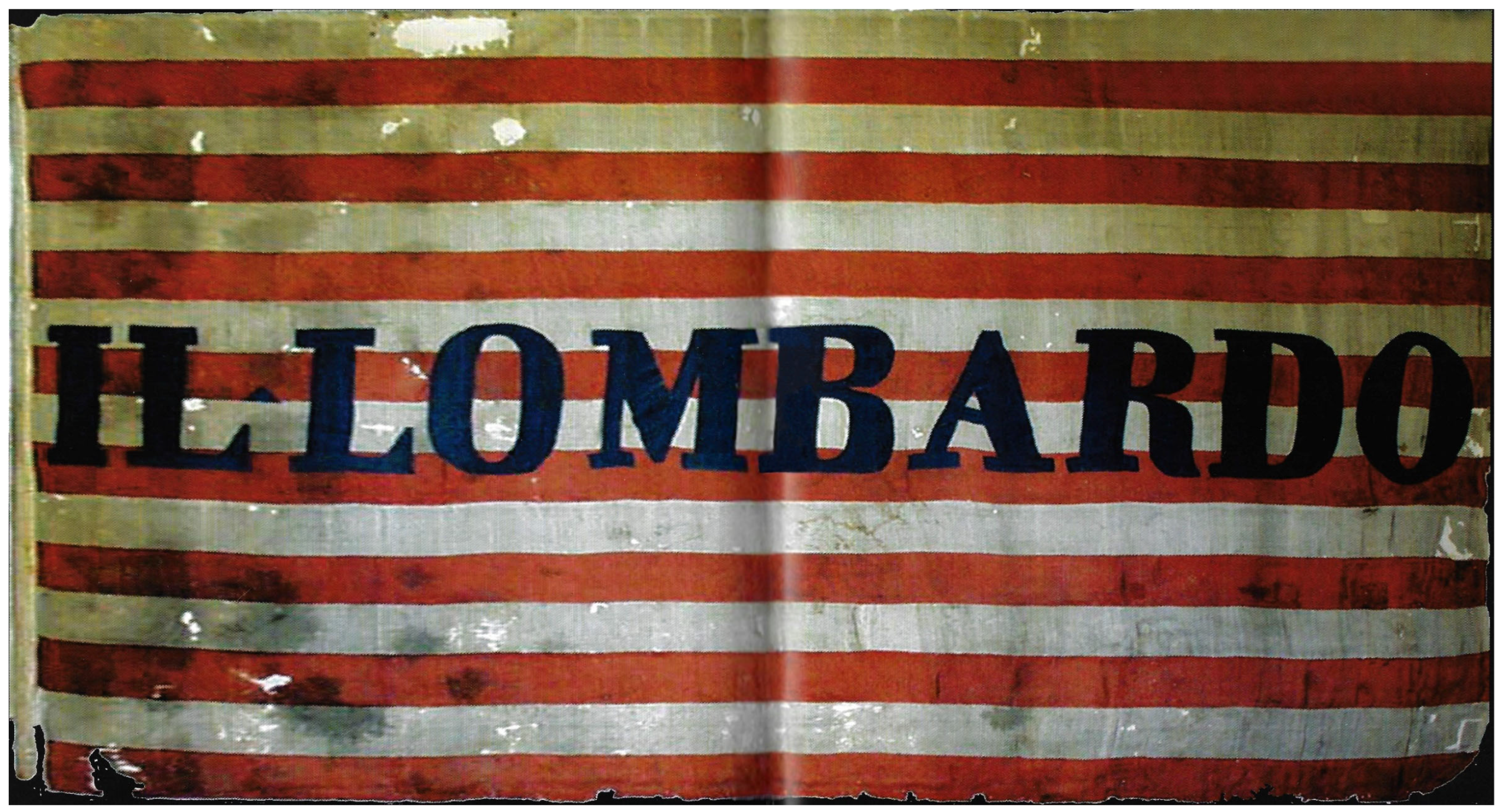
At the conclusion of the hostilities at Marsala, the Piemonte, which, having an iron hull, probably sustained serious damage only to its masts and rigging, was captured and towed by the Stromboli to the port of Naples, where it remained laid up even after the establishment of the Kingdom of Italy. On 17 May 1861, it was formally entered into the national navy as a second-class paddle transport, only to be sold at auction as scrap for demolition a few years later, on 16 October 1865 [59] (pp. 589–560). The Bourbon forces, by contrast, were unable to refloat the Lombardo from the sandbank on which it had run aground; consequently, deemed irrecoverable, it was left in the waters of the port of Marsala, where it was plundered by the local inhabitants. Among the various provisions and furnishings removed from the steamship are the few relics of the Lombardo that have survived over time and reached the present day, namely two flags and two serving dishes. One of the flags is the so-called “distinction” flag that was hoisted on the yardarm of the foremast, as shown in the two known depictions of the steamship (Figure 2), and was characterized by the inscription “IL LOMBARDO” in blue capital letters on a background of horizontal white and red stripes (Figure 8).
Figure 8.
Distinction flag of steamship Lombardo. Inscription in blue capital letters embroidered on field of horizontal white and red stripes. Dimensions: 340 × 644 cm. [15] (pp. 60–61) (Museo Interdisciplinare Regionale conte Agostino Pepoli, Trapani).
The flag was recovered by the Garibaldian volunteer from Trapani, Gaspare Burgarella Ajola, to whom it was subsequently formally granted by Garibaldi himself. Francesco Marrone, Burgarella’s son-in-law, later sold the banner to Count Agostino Pepoli, who in 1909 donated it to the regional museum of Trapani. The other flag is the national tricolour that flew at the stern of the steamship and was recovered by Gaspare Virzì, commander of the sailing vessel Alessandrina, who was present in the port of Marsala on the morning of 11 May. The banner was later transferred by Virzì to the English wine industrialist and owner of the Alessandrina, Benjamin Ingham, who kept it in the head office of the firm Ingham Whitaker & C. in Marsala until 1929, when Joseph Isaac Spadafora Whitaker donated it to the foundation Società Siciliana di Storia Patria in Palermo, where it is still preserved.
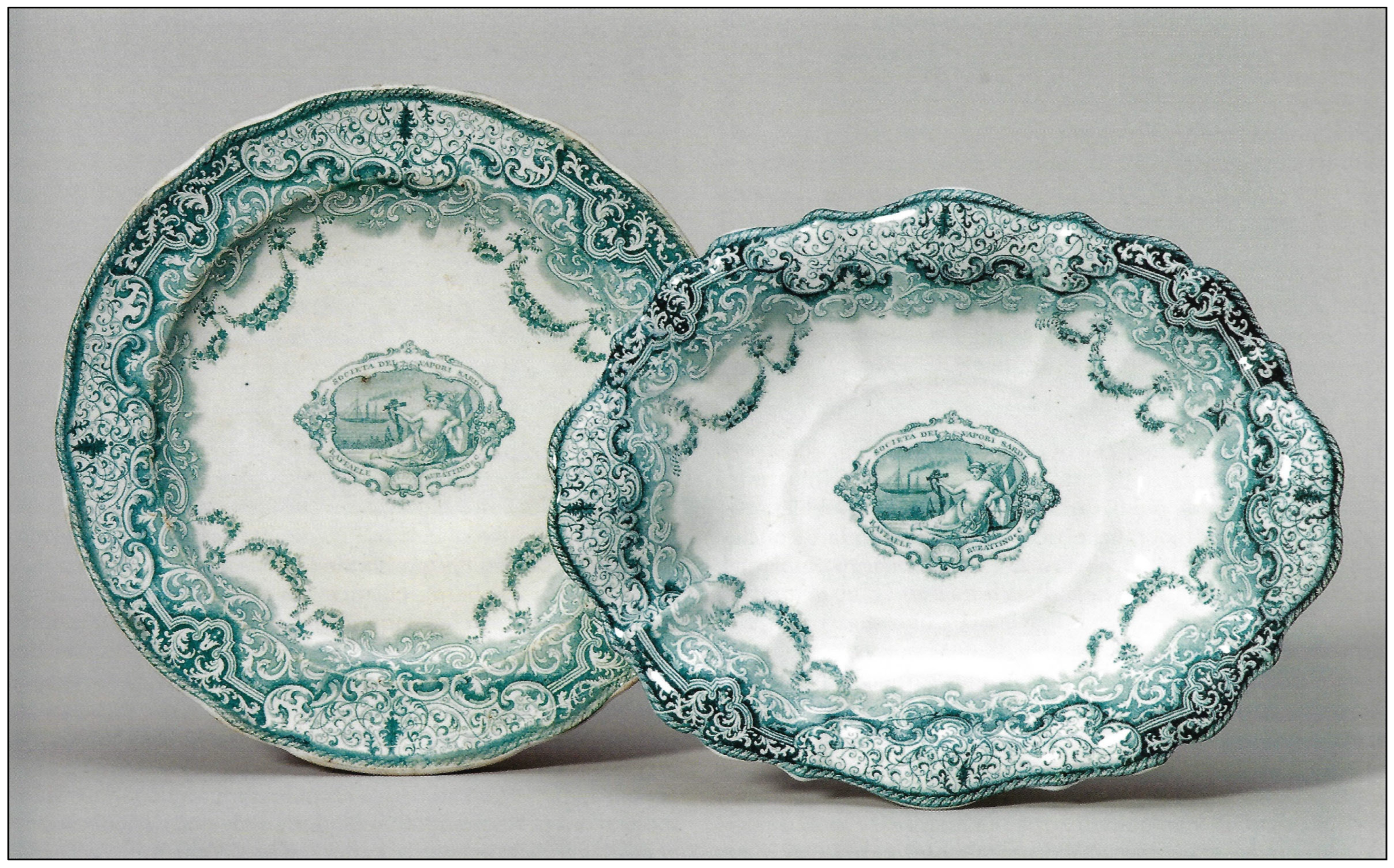
Virzì also recovered from the Lombardo two plates and a mug; the latter was subsequently lost. The two plates, one of which is an oval serving dish, were produced in English earthenware by the Spode Copeland manufactory of Stoke-on-Trent and bear the production date of 2 January 1844. Both pieces are characterized by an elaborate green floral decoration along the rim and by a central panel depicting an allegory of Commerce embodied by the god Hermes, shown in a reclining pose while holding an anchor in his right hand and the caduceus in his left. This latter attribute also functions as a staff for the Savoyard flag, while a steamship under way is visible in the background. The figurative panel is in turn framed by a cartouche bearing the inscription “Società dei Vapori Sardi Raffaele Rubattino & C.” (Figure 9).
Figure 9.
Plates from the onboard service of the Società Raffaele Rubattino & C. Vapori Sardi, 1844. English earthenware with a green vegetal motif along the rim and an allegory of Commerce at the center. Spode Copeland manufactory (private collection) [13] (p. 127) [15] (pp. 72–73).
On 8 July 1860, with Sicily now free from the Bourbon regime, Giuseppe Piola Caselli, a former officer of the Sardinian navy who had become Secretary of State of the Sicilian Dictatorial Navy, finally brought the situation of the Lombardo to the attention of Admiral Carlo Pellion:
“[…] the steamship Lombardo, grounded at Marsala, is in a very critical position, especially with westerly winds. Up to now every effort has been made to salvage this vessel, which, once repaired, could still be put to use, but it has not been possible to overcome the flooding, as some of the engine cocks are ope, n. The assistance of a Royal vessel would suffice to achieve the objective; if that were not feasible, at least it is requested that the squadron diver, equipped with the apparatus, be placed at our disposal […]”[60,61] (p. 23)
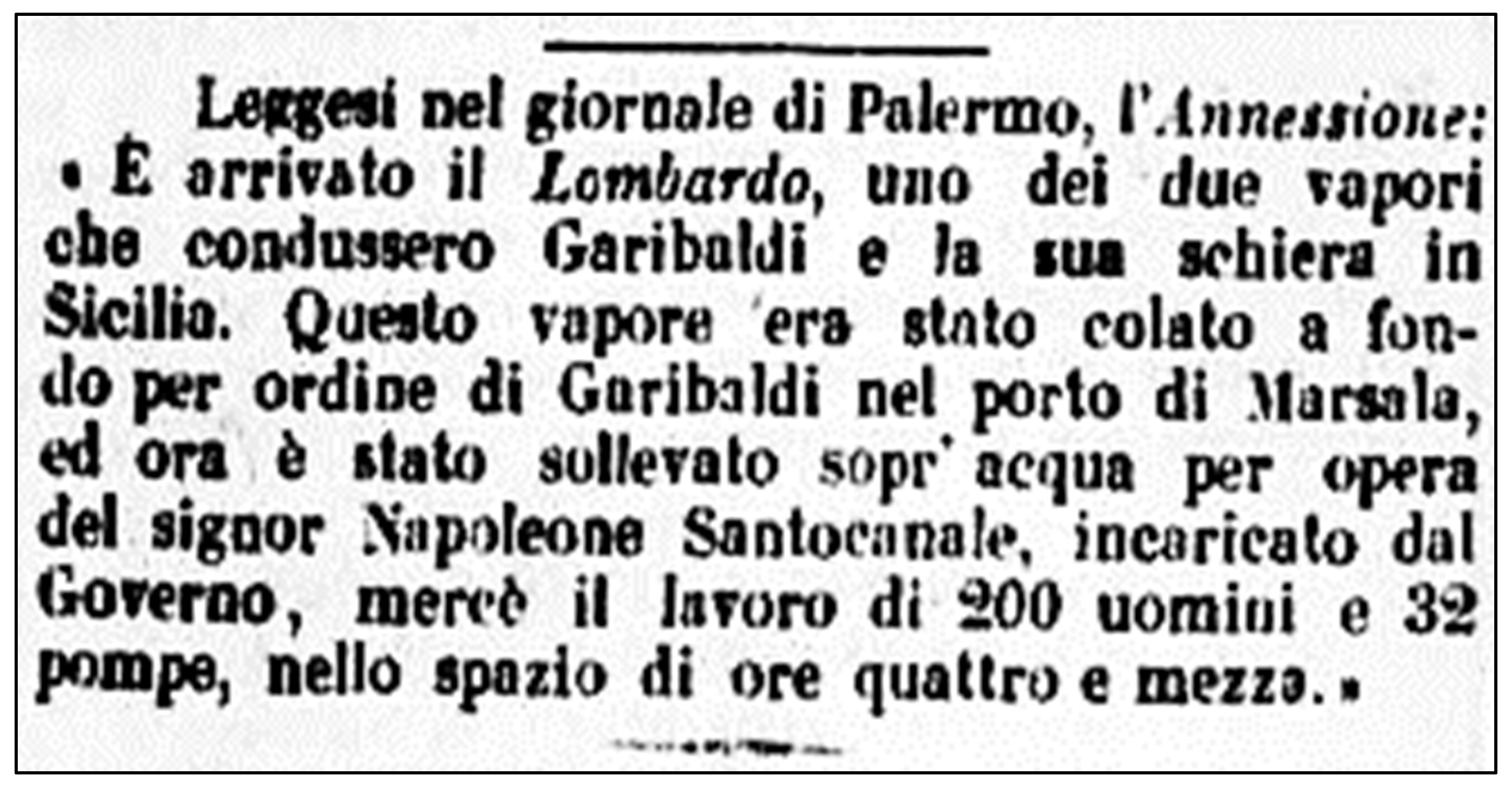
Within the same month, the “constructing engineer” of the Sicilian Navy, Napoleone Santocanale—who after Unification became a partner in the Florio shipping company—undertook the recovery of the vessel, employing two hundred men and no fewer than thirty-two pumps to empty the flooded sections of the hull, which had previously been lightened by the removal of the boilers and the Maudslay steam engine [62] (p. 85). The news was also reported by the Gazzetta Uffiziale di Venezia of 19 July, which in turn reprinted the Palermo newspaper L’Annessione (Figure 10):
“[…] The Lombardo has arrived, one of the two steamers that carried Garibaldi and his band to Sicily. This steamer had been scuttled by order of Garibaldi in the port of Marsala and has now been raised above water through the efforts of Mr. Napoleone Santocanale, commissioned by the Government, by means of the labour of 200 men and 32 pumps, in the space of four and a half hours.”[63] (p. 652)
Figure 10.
Gazzetta Uffiziale di Venezia, Thursday, 19 July 1860. The Lombardo arrives in Palermo after being salvaged in the port of Marsala [63] (p. 652).
Figure 10.
Gazzetta Uffiziale di Venezia, Thursday, 19 July 1860. The Lombardo arrives in Palermo after being salvaged in the port of Marsala [63] (p. 652).

The Lombardo was then towed by the steamship Franklin to the Palermo arsenal, where it underwent repair and refitting works at the Orlando shipyard [26] (note 4, p. 135). Frigate captain Baldisserotto, Director of the Royal Vessels of the Sicilian Administration, reported on the state of the works to Admiral Pellion in a letter dated 23 October 1860:
“[…] this vessel, whose hull is in good condition, was removed from Marsala, where it had remained grounded after Garibaldi’s landing, and transported to Palermo; it is under repair and is being made fit to be armed with four 32-pounder guns and two 60-pounder guns, insofar as the works currently being carried out permit.”[15,64] (p. 70)
On 17 November 1860, the Lombardo entered service with the Sicilian Dictatorial Navy; meanwhile, the steam engine was overhauled at the workshops of the Oretea Foundry, the mechanical plant owned by Vincenzo Florio, which also undertook the construction of new boilers for the steamship [15] (p. 70). Florio himself, in a statistical appendix to a report on the condition of Palermo’s industries between 1860 and 1863 submitted by the Palermo Chamber of Commerce and Arts to the Government, wrote the following under the heading “Foundries”:
“The only one that has importance and deserves to be taken into account in this survey is the iron foundry known as the Oretea Foundry. […] There, are built land-based steam engines, boilers for steam vessels, and as soon as possible work will be undertaken on marine engines for steamships.”[65,66] (p. 29) [67] (p. 277)
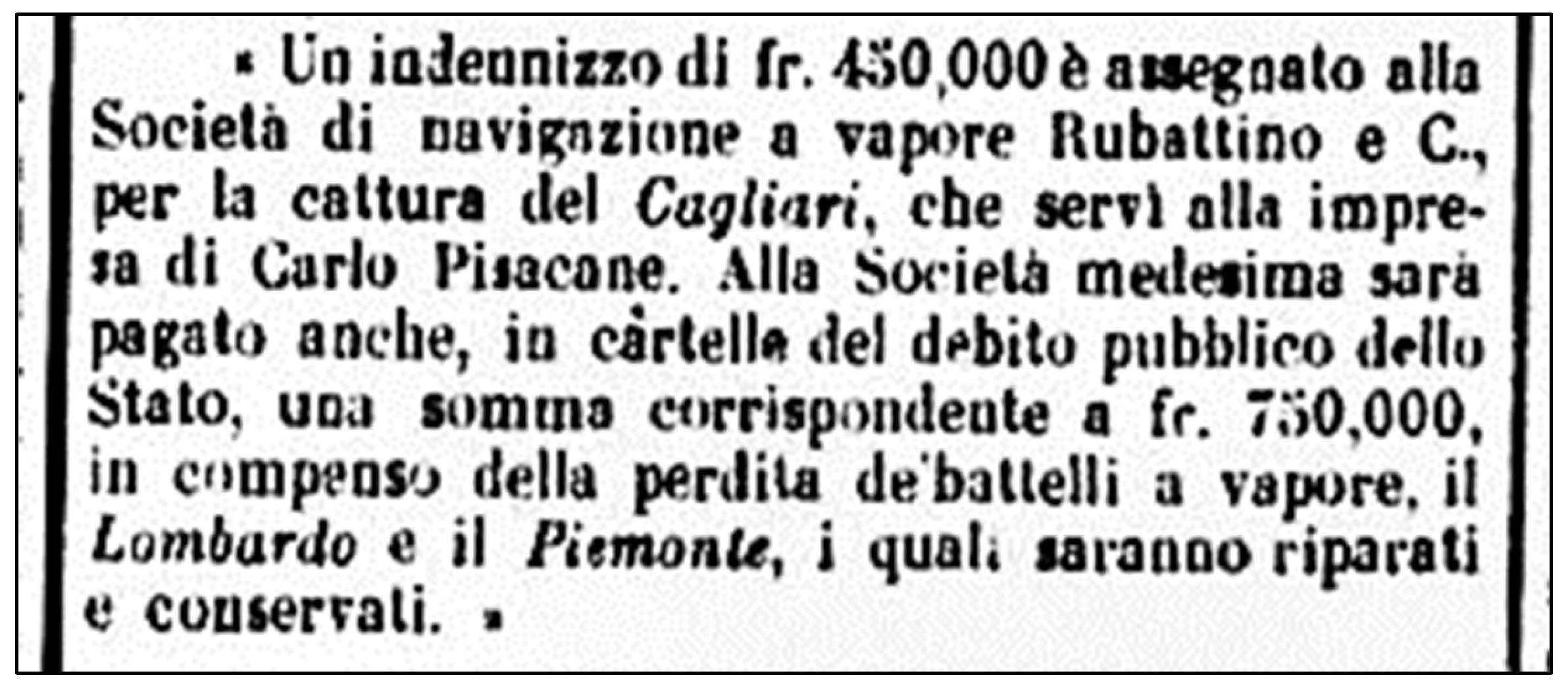
The refitting works on the Lombardo were completed in August 1861, and instead of being returned to the Rubattino’s company, the vessel was entered, on 17 March of that year, into the Royal Italian Navy with the classification of paddle transport [14] (p. 162) [17] (p. 26) [26] (p. 135). As promised by Garibaldi, “feeling that the Nation must fairly proportion its rewards to those who suffered for the cause of liberty […]” [68] (p. 233), R. Rubattino & Co. was nonetheless compensated for the losses arising from the seizure of the two steamships with 510,000 lire of the time. This sum, paid in state public debt bonds, was determined by a special commission established by A. Bertani and approved by dictatorial decree on 30 September 1860. The calculation of the compensation included the estimated value of the two steamships and their respective onboard equipment, the personal effects of the original captains and crews, and an assessment of the company’s lost profits resulting from the unavailability of the vessels. In order to ensure “[…] the settlement of any and all claims or demands by either the Rubattino firm or the crews” [69] (p. 265), this already substantial amount for the period was increased to 640,000 lire; it was later further raised to a total of 750,000 lire in order also to compensate for the seizure of the steamship Cagliari by the Bourbon navy, which had occurred during the failed Pisacane expedition of 1857 (Figure 11) [13] (p. 129) [15] (p. 67)) [67] (pp. 233–234) [69] (pp. 260–266) [70] (p. 952).
Figure 11.
Gazzetta Uffiziale di Venezia, Wednesday, 17 October 1860. Notice of the compensation granted in favour of the Rubattino & Co. Steam Navigation Company [70] (p. 952).
2.1.4. Final Years of Service
On 28 July 1862, the Lombardo returned to Genoa from Palermo to transport troops, a journey it repeated several times over the following year. From that point onward, beyond troop transfers, the steamship was employed solely for routine services, including towing dredgers and transporting materials and prisoners between ports along the peninsula. It was during one of these assignments that, in March 1864, the Lombardo set out on what would tragically prove to be its final voyage.
Although Garibaldi, by a decree issued on 30 September, had stipulated that the Lombardo and the Piemonte were to be preserved as monuments “in memory of the initiative of the Italian people in the war of independence and unification in 1860” [69] (p. 266), the two vessels met, as noted, very different fates. Garibaldi himself lamented the loss of the two steamships in his memoirs on the Expedition of the Thousand:
“Where are the steamships that picked you up at Villa Spinola and carried you safely across the Tyrrhenian to the small port of Marsala? Where? Are they perhaps new Argos, jealously preserved, marked for the admiration of foreigners and posterity, emblems of the greatest and most honorable of Italian enterprises? Far from it; they have disappeared. The envy and incompetence of those who govern Italy have destroyed these witnesses of their shame. Some say: They were lost in deliberate shipwrecks. Others suppose them rotting in the remotest corner of a naval arsenal, and others sold to Jews for a pittance, like tattered garments. Row, however, row fearless Piemonte and Lombardo, noble vessels of a most noble band; history will remember your illustrious names, despite envy and calumny.”[71] (p. 3)
2.2. The Lombardo’s Final Voyage and Shipwreck
On 10 February 1864, Lieutenant of the Vessel Giuseppe Deista, originally from Ancona, succeeded Frigate Captain Matteo Luigi Civita in command of the Lombardo [72] (p. 3). Starting the following month, the steamship, together with the Dora, Tanaro, and Plebiscito, was assigned to transport military personnel between the ports of Ancona and Manfredonia [73] (p. 2). Around noon on 10 March, the Lombardo, having departed from Manfredonia with two battalions of the Pinerolo Brigade on board, arrived at the port of Ancona [74] (p. 3).
The vessel set sail again on 12 March to undertake the return journey to Manfredonia, carrying five companies under the command of General Bossolo, intended to replace the troops transported during the previous trip. In addition, several prisoners were embarked on the Lombardo for transfer to the Penal Colony of the Tremiti Islands; this operation was to take place during an intermediate stop [59] (pp. 581–582).
Around 2 a.m. on the fateful night between 12 and 13 March 1864, the Lombardo, while navigating along the northwestern coast of San Domino Island, struck a shoal near “Cala degli Inglesi”. The violent impact caused multiple breaches in the hull, leading to the rapid sinking of the vessel, which came to rest semi-submerged and oriented perpendicular to the shore on the shallow seabed in front of “Punta del Vapore”. The toponym, highly evocative, appears to derive directly from this episode. The Lombardo’s shipwreck evidently left a deep mark on the collective memory of the islanders; over time, the recollection of a “vapore” (the Italian term commonly used at the time for a steamship) became indelibly associated with the promontory where the incident occurred. No casualties were recorded among the crew or passengers, thanks to the prompt intervention of local boats from various Tremiti locations, which immediately responded to the wreck and helped unload all recoverable equipment and materials in the following days. Additional assistance was provided by the steamships Dora, Confienza, and Indostan, dispatched following the SOS telegraph received by the command in Ancona.
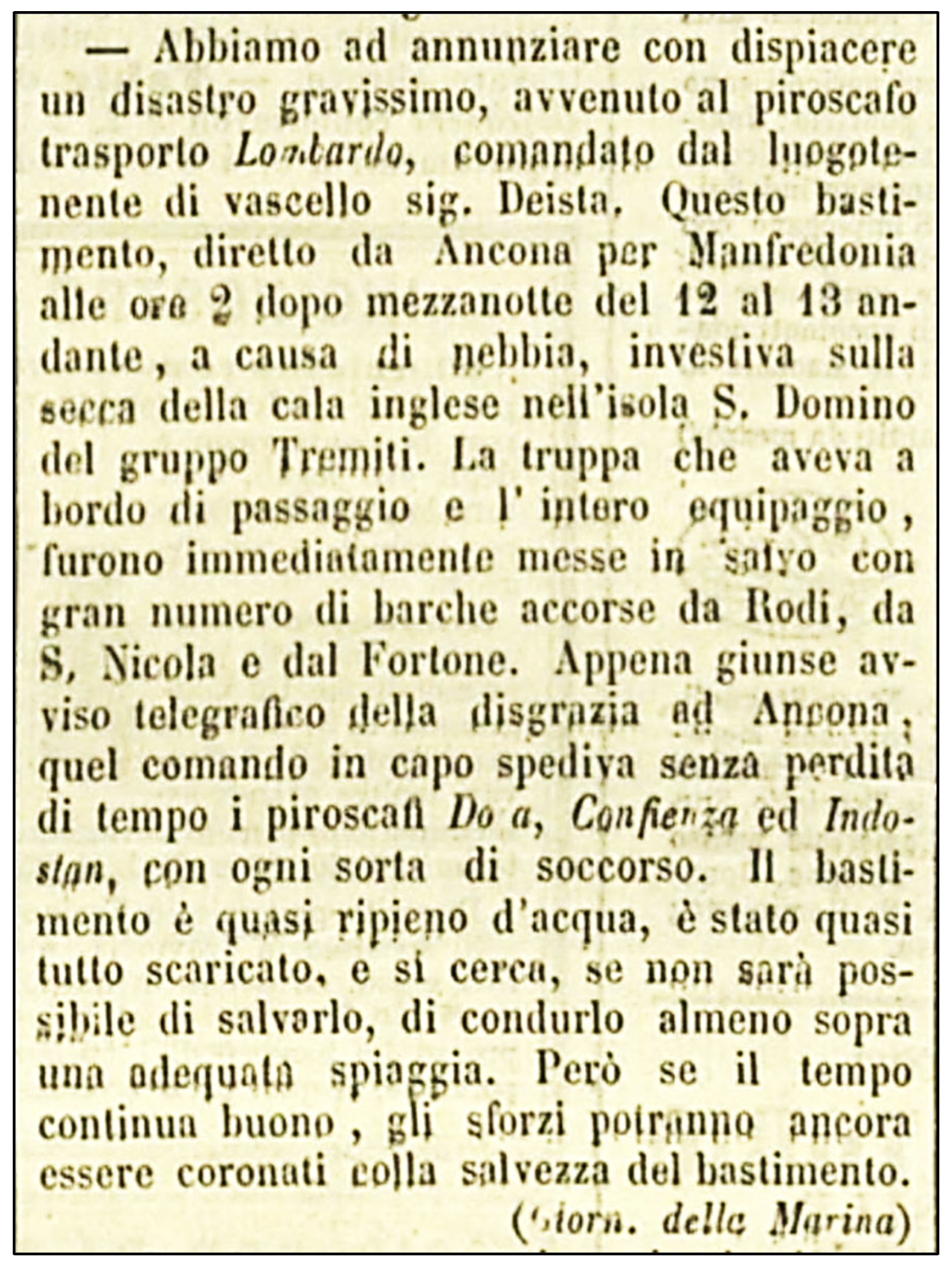
The 18 March edition of the newspaper L’Opinione reported the incident, citing accounts published the previous day by the military weekly Il Soldato Italiano [75] (p. 173) and Giornale della Marina (Figure 12):
“TURIN, 17 March. […] We regret to announce a very serious disaster involving the transport steamship Lombardo, commanded by Lieutenant of the Vessel Mr. Deista. This vessel, in route from Ancona to Manfredonia, at 2 a.m. on the night of 12–13 March, due to fog, ran aground on the shoal of Cala Inglese on San Domino Island in the Tremiti group. […] The vessel is nearly full of water, has been almost entirely unloaded, and efforts are being made, if it cannot be saved, to at least bring it onto a suitable beach. However, if the weather remains good, these efforts may yet succeed in saving the vessel.”[76] (p. 3)
Figure 12.
L’Opinione, Friday, 18 March 1864. Report on the shipwreck of the steamship Lombardo [76] (p. 3).
Figure 12.
L’Opinione, Friday, 18 March 1864. Report on the shipwreck of the steamship Lombardo [76] (p. 3).

The causes of the collision with the shoal were likely due to the dense fog, combined with the darkness of night and the limited coastal lighting along San Domino at the time, which tragically led the steamship off course. Commander Deista was subsequently tried by the military tribunal of the Royal Navy but was acquitted of all direct responsibility [77] (p. 34).
2.3. The Recovery of the Boilers and Part of the Steam Engine
The newspaper L’Opinione, reporting the incident, also commented on the condition of the steamship, expressing hope for its rapid recovery [76] (p. 3). These hopes were, however, dashed by worsening weather conditions, which on the night of 17–18 March rendered all salvage attempts futile, as the hull was destroyed by the fury of the waves. The recovery effort, which initially appeared promising thanks to the use of a waterproof canvas and several pumps, is described in Gazzetta Ufficiale di Venezia of 26 March (Figure 13), which in turn cites Corriere delle Marche:
“The Corriere delle Marche, from Ancona, 22 [March], reports: The steamship of the Royal Navy, Plebiscito, sent to aid the Lombardo, which had run aground on the Tremiti Islands, returned yesterday to our port, bringing the unfortunate news of the continued loss of that vessel. As we had anticipated, the storm on the night of 17–18 March, with the violence of its waves, caused the disintegration of the ship’s parts and reduced the hull to pieces. It should be noted that the salvage operations had gone very well: they consisted of covering the vessel with a strong canvas to resist the ingress of water through the various breaches, thus allowing the pumps to extract it, lightening the ship, and enabling it to float again and be removed from its positio, n. All on-board materials and whatever could be removed were saved; the engine and boilers lie submerged at shallow depth, so there is almost certainty of their recovery. If this occurs, the loss would be limited to the hull, which is reported to be reduced to very limited proportions.”[78] (p. 277)
Figure 13.
Gazzetta Uffiziale di Venezia, Saturday, 26 March 1864. Report on the attempted salvage of the steamship Lombardo [78] (p. 277).
Figure 13.
Gazzetta Uffiziale di Venezia, Saturday, 26 March 1864. Report on the attempted salvage of the steamship Lombardo [78] (p. 277).

Despite the considerable efforts undertaken—which evidently allowed the steamship to be raised at least long enough to complete the recovery of what remained on board—on 19 March 1864, the Lombardo, now irretrievable, was declared a “total loss” [14] (p. 162) [15] (p. 70) [17] (pp. 26–27) [20] (p. 285) [26] (p. 142) [54] (pp. 574–576). This designation applied at least to the hull and the possibility of returning the vessel to service. In view of this loss, however, the recovery of the valuable components of the steam engine—made of precious copper alloys such as bronze and brass—and the cast-iron boilers was already planned, as these could potentially be reused. The loss of these metal parts would have represented the true economic damage, beyond the destruction of the hull, which was already obsolete after 23 years of service. The operation, quite complex for the time, was carried out by the Royal Navy under Admiral Ceva, with considerable expenditure of resources and time in the months following the wreck. The overall salvage effort, however, ultimately proved counterproductive.
The start of the recovery operations on 31 March was reported once again by L’Opinione, citing Il Corriere delle Marche (Figure 14):
“ANCONA, 8 April. […] The Royal Navy steamship Plebiscito, having departed from our port on 31 March […] with a load of tools and other equipment for the recovery of the Lombardo’s engine and boilers, has conducted […] the unloading on the Tremiti Islands of the materials required on the day following its departure […]”[79] (p. 3)
Figure 14.
L’Opinione, Sunday, 10 April 1864. On 31 March, the steamship Plebiscito transported equipment and materials to the wreck site to begin recovery of the Lombardo’s steam engine components and boilers [79] (p. 3).
Figure 14.
L’Opinione, Sunday, 10 April 1864. On 31 March, the steamship Plebiscito transported equipment and materials to the wreck site to begin recovery of the Lombardo’s steam engine components and boilers [79] (p. 3).

The salvage operations of the mechanical components continued successfully throughout the following month, although an accident that occurred shortly before 29 April forced a temporary halt to the work, which was reported to be nearly complete (Figure 15):
“ANCONA, 29 April. […] The operations for the recovery of the engines and boilers of the Royal Navy steamer Lombardo, which sank at the Tremiti Islands, have progressed to the point where there can be no doubt of their successful outcome. An incident occurred that has required waiting a few more days for completio, n. (Corr. delle Marche).”[80] (p. 3)
Figure 15.
L’Opinione, Sunday, 1 May 1864. Recovery operations continue despite an accident [80] (p. 3).
Figure 15.
L’Opinione, Sunday, 1 May 1864. Recovery operations continue despite an accident [80] (p. 3).

However, it was necessary to wait until 3 August—four months after the start of the operations—before the steamer Dora returned to Ancona carrying the components recently recovered from the engine, together with all the materials and equipment salvaged from the vessel in the first days following the wreck [81] (p. 3). Shortly thereafter, the two boilers were also recovered. The completion of the salvage operations was reported by Monitore delle Marche, as cited in L’Opinione on 12 August (Figure 16):
“Engine recovered. In the Monitore delle Marche it is reported: Our readers will recall the wreck of the steamer Lombardo near the Tremiti Islands. After nearly all of the engine was recovered, the boilers were also salvaged, brought to Ancona, and, being in good condition, can be immediately put back into service”[82] (p. 3)
Figure 16.
L’Opinione, Friday, 12 August 1864. News of the recovery of the boilers and part of the steam engine of the steamer Lombardo [82] (p. 3).
Figure 16.
L’Opinione, Friday, 12 August 1864. News of the recovery of the boilers and part of the steam engine of the steamer Lombardo [82] (p. 3).

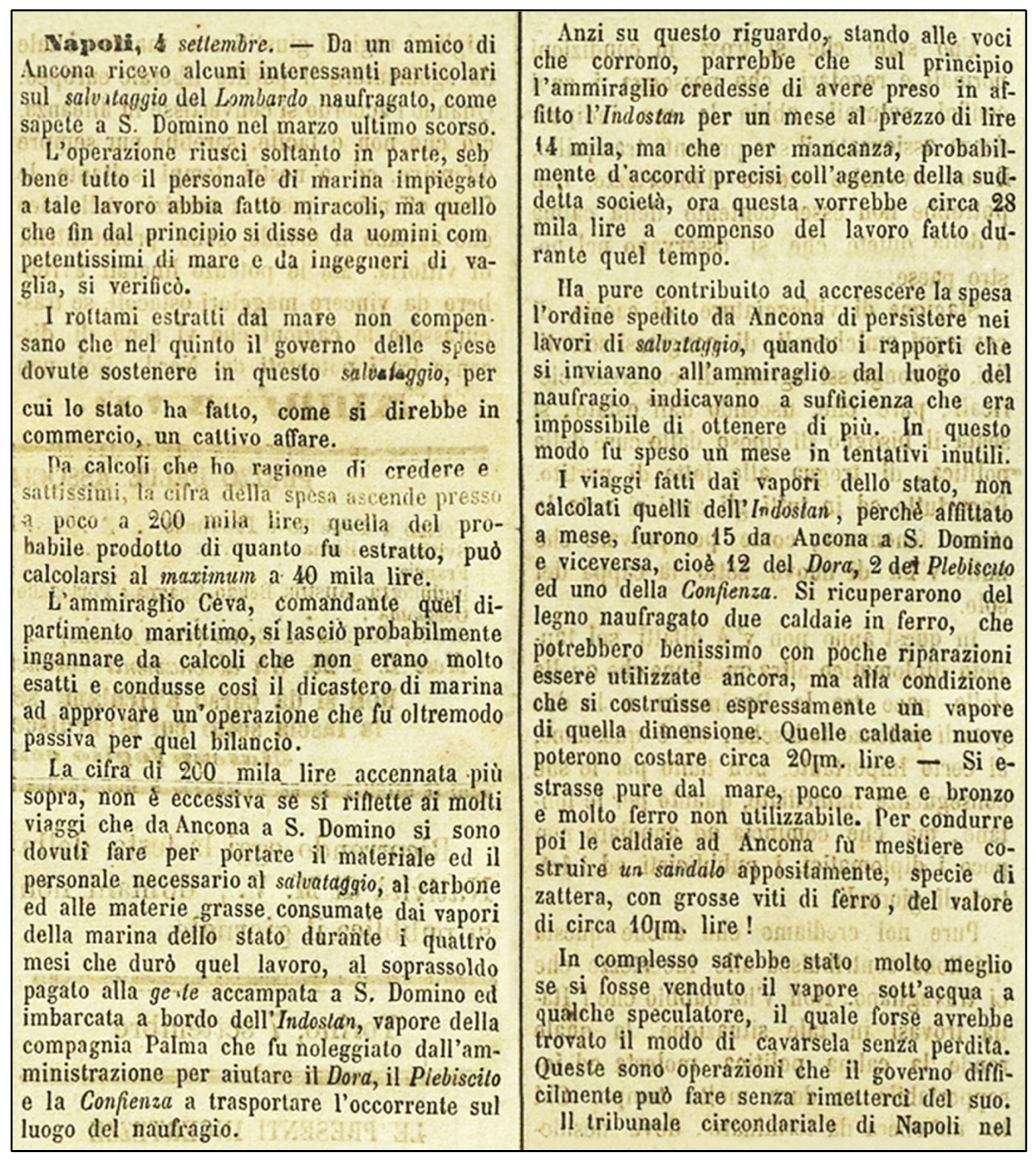
While the operation was a success from a strictly technical standpoint, it proved far less so in economic and logistical terms. An article (Figure 17) published in the 8 September edition of the newspaper L’Opinione reports the following:
“Naples, 4 September—From a friend in Ancona I have received some interesting details regarding the salvage of the Lombardo […]. The operation was only partially successful, despite the extraordinary efforts of all naval personnel involved. However, what had been anticipated from the outset by the most competent seamen and skilled engineers did indeed occur. The wreckage recovered from the sea accounts for only one fifth of the costs incurred for this salvage, such that, in commercial terms, the state has made a poor investment.”[83] (p. 2)
Figure 17.
L’Opinione, Thursday, 8 September 1864. The article provides a critical commentary on the economic and logistical management of the Lombardo’s metal components salvage [83] (p. 2).
Figure 17.
L’Opinione, Thursday, 8 September 1864. The article provides a critical commentary on the economic and logistical management of the Lombardo’s metal components salvage [83] (p. 2).

The article continues with a critical assessment of the negative balance of the entire operation, noting that to cover the total cost of the recovery, the Royal Navy expended 200,000 lire of the period (approximately EUR 1.5 million). Among the most significant expenses were fifteen voyages between Ancona and the island of San Domino undertaken by the steamers Dora, Plebiscito, and Confienza, including the associated consumption of coal and lubricants necessary to transport personnel and equipment for the salvage operations. To support these naval vessels, the steamer Indostan of the Palma Company was also employed, with additional costs incurred for crew wages during the one-month rental period. Finally, for the transport of the boilers to Ancona,
“It was necessary to construct a specially designed “sandal”, a kind of raft, with large iron screws, valued at approximately 10,000 lire!”[83] (p. 2)
Additional costs arose both from misunderstandings between the Royal Navy and the Palma Company—which demanded twice the originally agreed payment for the Indostan’s monthly hire (approximately 28,000 lire)—and from Admiral Ceva’s insistence on continuing the recovery operations even when reports reaching Ancona indicated that no further valuable materials could be retrieved from the wreck. This directive added a full month of fruitless expenditure to the operation’s overall cost.
In contrast, the total value of the materials recovered through the dismantling and retrieval of the Lombardo’s boilers and steam machinery was estimated at only 40,000 lire of the period (approximately EUR 300,000). The article concludes as follows:
“Two iron boilers were recovered from the sunken steamer, which, with minor repairs, could still be used, but only on the condition that a vessel of the same dimensions was specifically constructed. New boilers of this type would have cost approximately 20,000 lire. A small quantity of copper and bronze was also extracted from the sea, along with a large amount of unusable iro, n. […] Overall, it would have been far preferable to sell the sunken vessel to a speculator, who might have found a way to salvage it without loss. These are operations that the government can scarcely undertake without incurring a financial detriment.”[83] (p. 2)
In conclusion, in the final chapter of its existence, the steamer Lombardo, now reduced to a wreck, was ultimately forgotten, despite its role in several pivotal events of the Italian Risorgimento.
Between the 1960s and 1970s, recreational divers—unaware of the wreck’s identity— began exploring the site of the sinking, scavenging the few remaining valuable components, such as brass fastenings and copper hull plates. The first historical investigations into the Lombardo date back approximately forty years, when Pasquale Trizio, a naval historian from Puglia and president of the Associazione Marinara Puglia, located the site of the wreck at Punta del Vapore [26] (note 40, p. 143). However, the official recognition of the wreck is attributed to journalist and underwater historian Pietro Faggioli, who, together with divers Adelmo Sorci and Andrea Ghisotti, made the confirmed discovery on 20 June 2004. The identification of the submerged remains as those of the Lombardo was corroborated by diving units from the Italian Navy and the Carabinieri, who participated in the exploration dives. The vessel was identified primarily by its large paddle wheel and other distinctive features, which render it unmistakable when compared with the extensive literature on the events of the Expedition of the Thousand [13,14,17,26].
3. Methods
3.1. Site Description
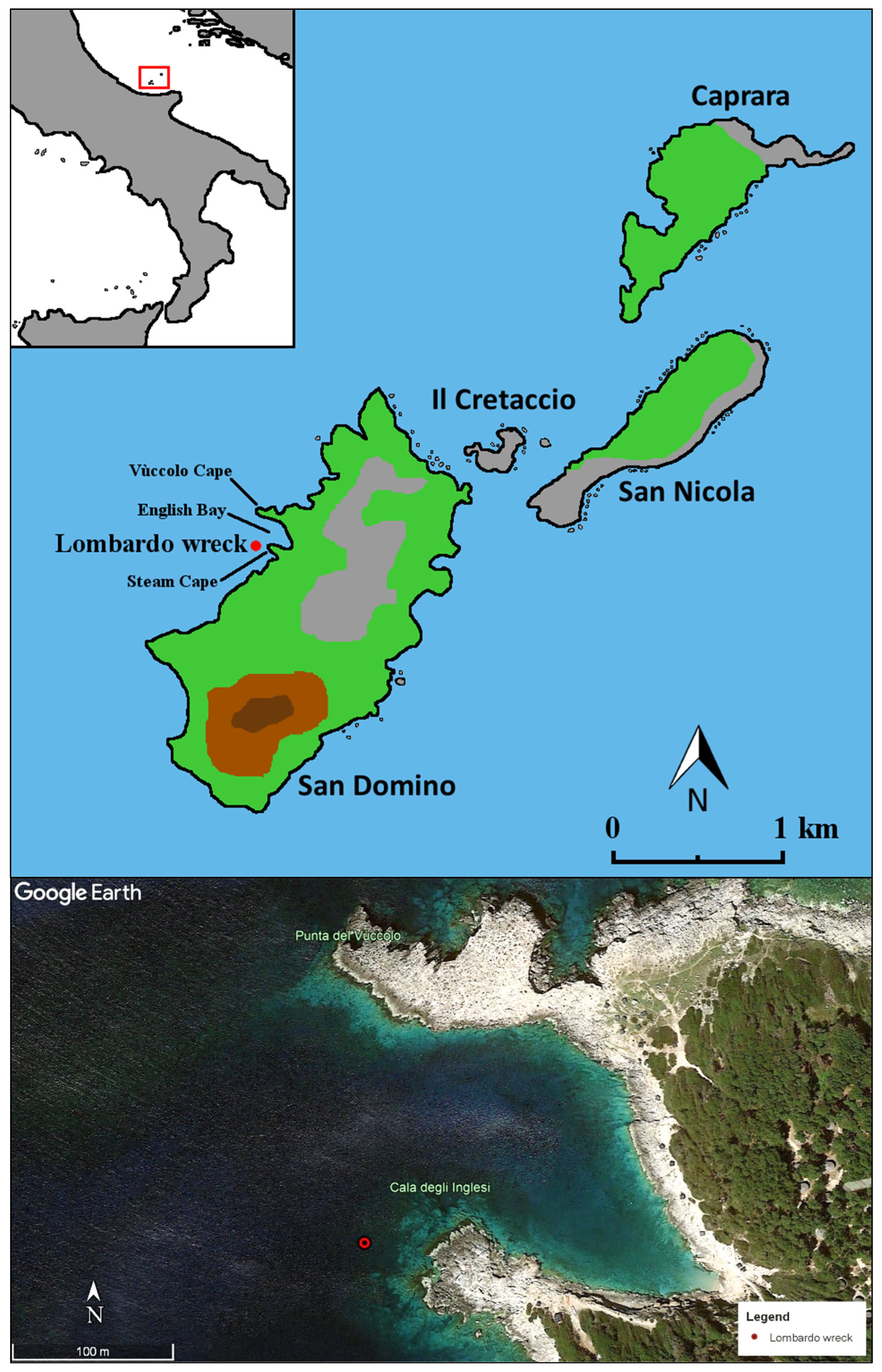
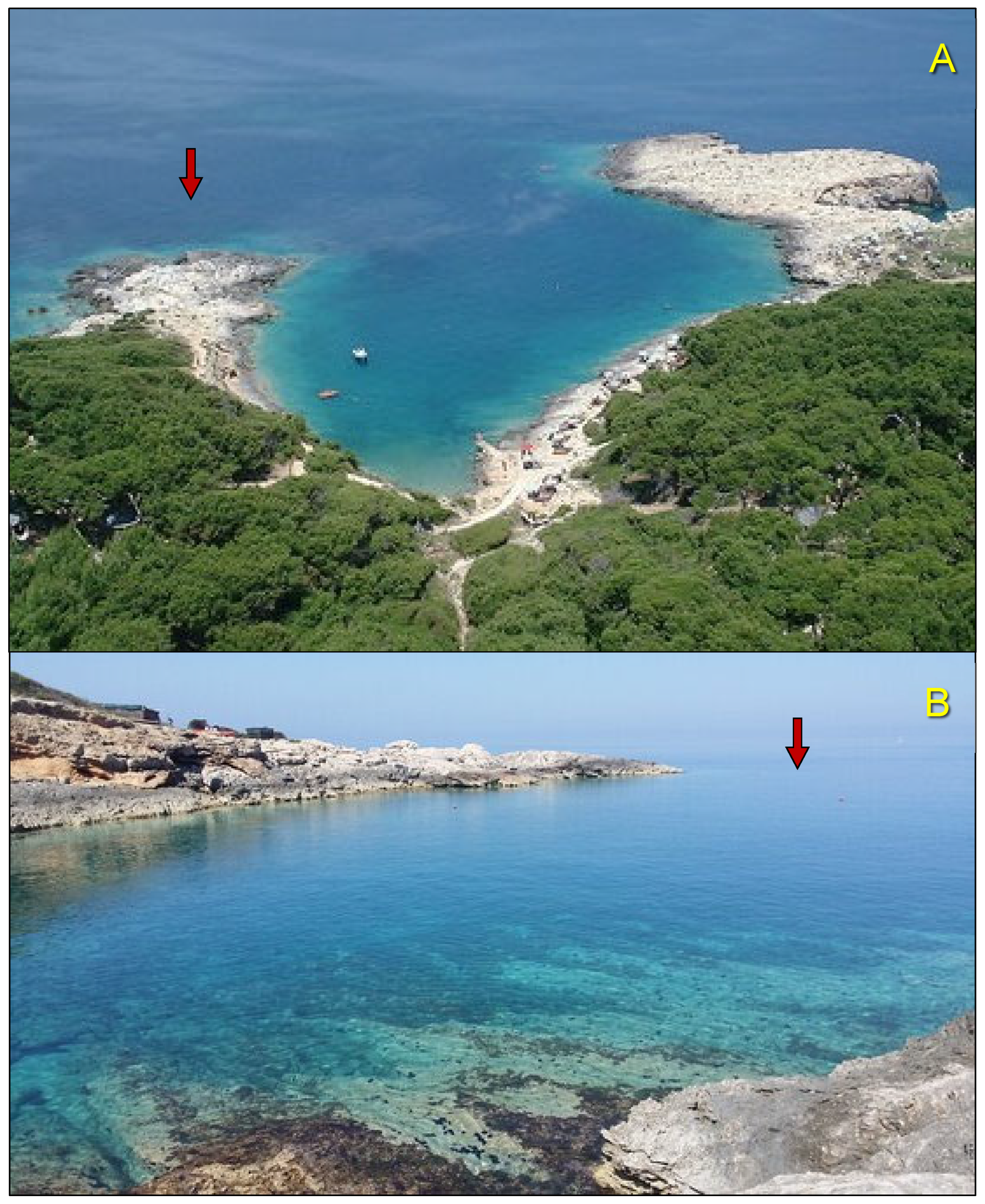
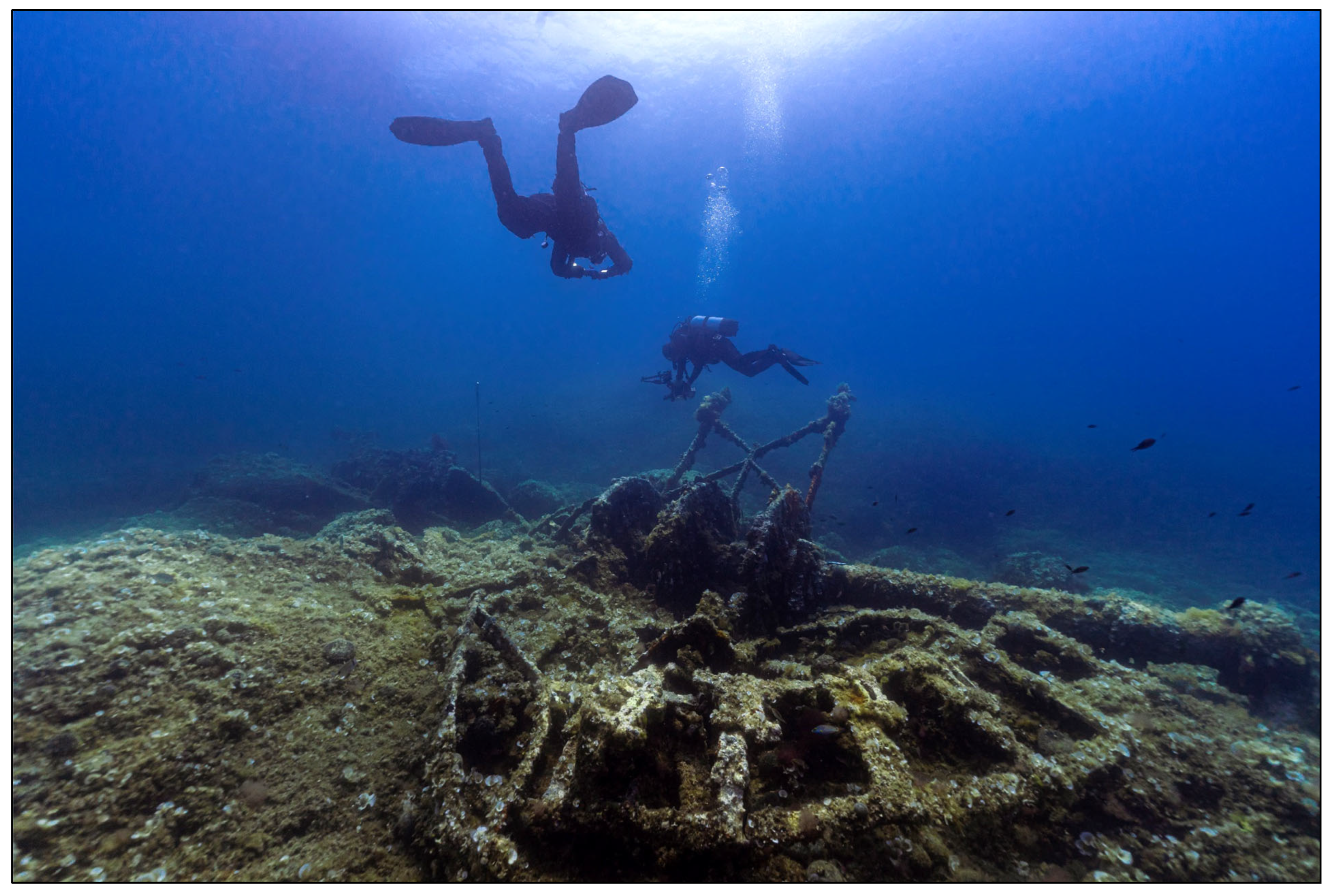
The wreck of Lombardo lies at depths between 9 and 22 m off Punta del Vapore, near Cala degli Inglesi, along the north-western coastline of San Domino Island in the Tremiti Archipelago (Figure 18 and Figure 19). The remains of the steamer lie inside a broad rocky channel which, following the east–west orientation of Punta del Vapore, slopes gradually from a depth of approximately 10 m down to a sandy terrace located at about 25 m. The interpretation of the wreck is complicated by the chaotic arrangement of the surviving elements, resulting from the dismantling and salvage operations carried out by the Italian Royal Navy immediately after the wrecking event and, to a lesser extent, from looting activities conducted during the 1960s and 1970s by recreational divers.
Figure 18.
The location of the wreck of the Lombardo off Punta del Vapore and Cala degli Inglesi along the northern coast of the island of San Domino in the Tremiti Archipelago (elab. A., N.).
Figure 19.
Red arrows indicate the position of the wreck. (A) An aerial view of Cala degli Inglesi from the east; Punta Vùccolo to the right (north) and Punta del Vapore to the left (south). (B) A view of Cala degli Inglesi from Punta Vùccolo (north), with Punta del Vapore in the background [84].
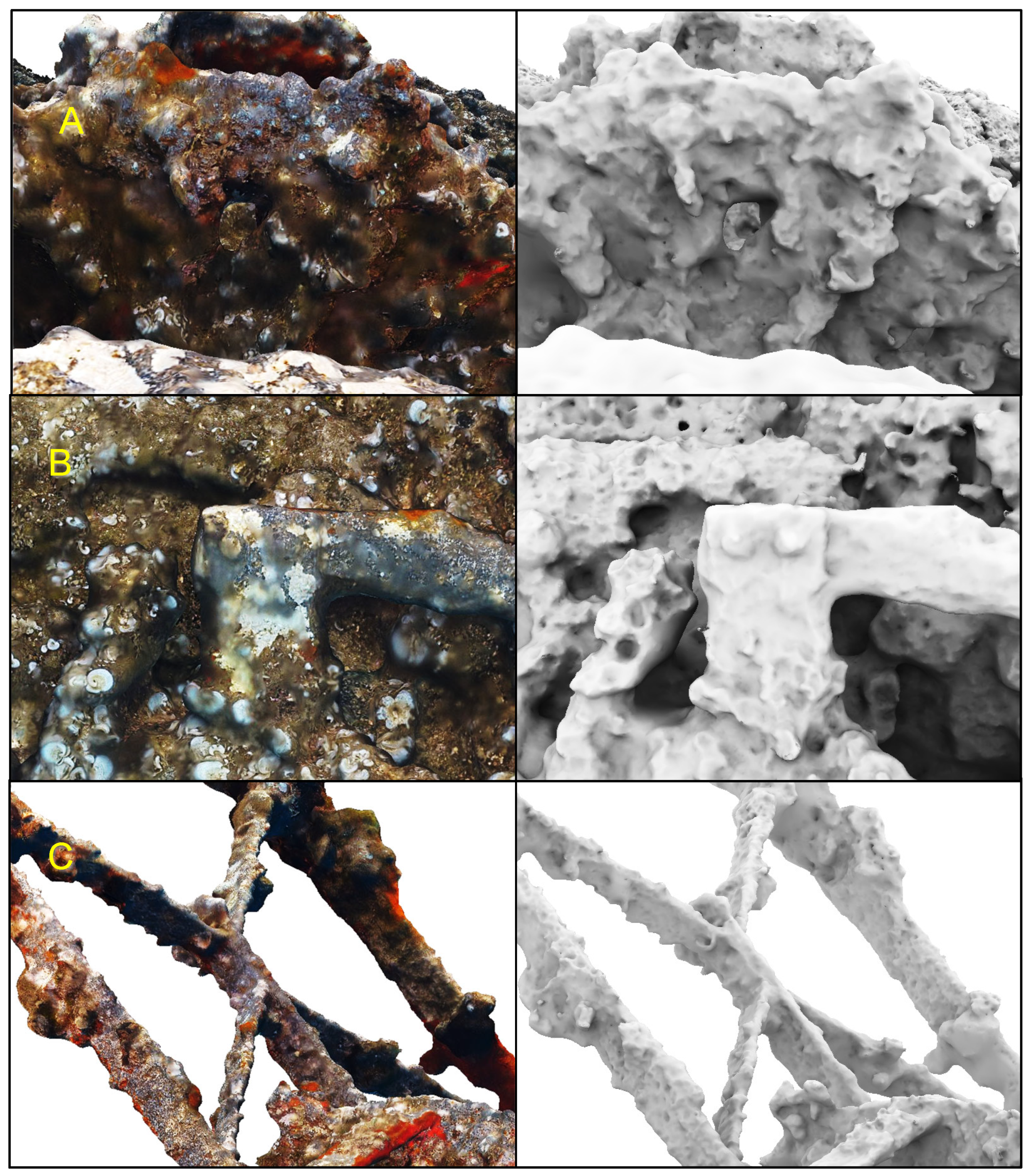
Beyond anthropogenic activity, the advanced state of degradation of the wreck is also attributable to natural processes related to the depositional conditions of the site, which is characterized by a shallow, rocky seabed. The limited depth allows for the penetration of sunlight, which in turn provides favourable conditions for the development and growth of benthic life, comprising marine fauna and flora (e.g., sponges, photophilic algae) as well as bacteria. These organisms have driven continuous bioturbation of the wreck, progressively colonizing the remains and forming a thick layer of concretions. The shallow depth also exposes the wreck to mechanical degradation caused by surface wave action which, during winter storms generated by north-westerly winds, can be particularly severe along this stretch of coastline [85] (pp. 151–186) [86,87]. The predominantly rocky geomorphological context of the seabed—characterized by dolomitic limestones and marly limestone formations dating to the Paleocene and Middle Pliocene [88] (pp. 225–230) [89] (pp. 4, 8–9) [90] (pp. 34–37)—has further prevented the burial of the wreck, leaving it exposed for more than a century and a half to the aforementioned biological, chemical, and mechanical agents of degradation. These conditions have resulted in the near-total decomposition of the wooden hull [91,92] and the oxidation of the metal components [93], consisting primarily of the remains of the steam engine and the vessel’s propulsion system.
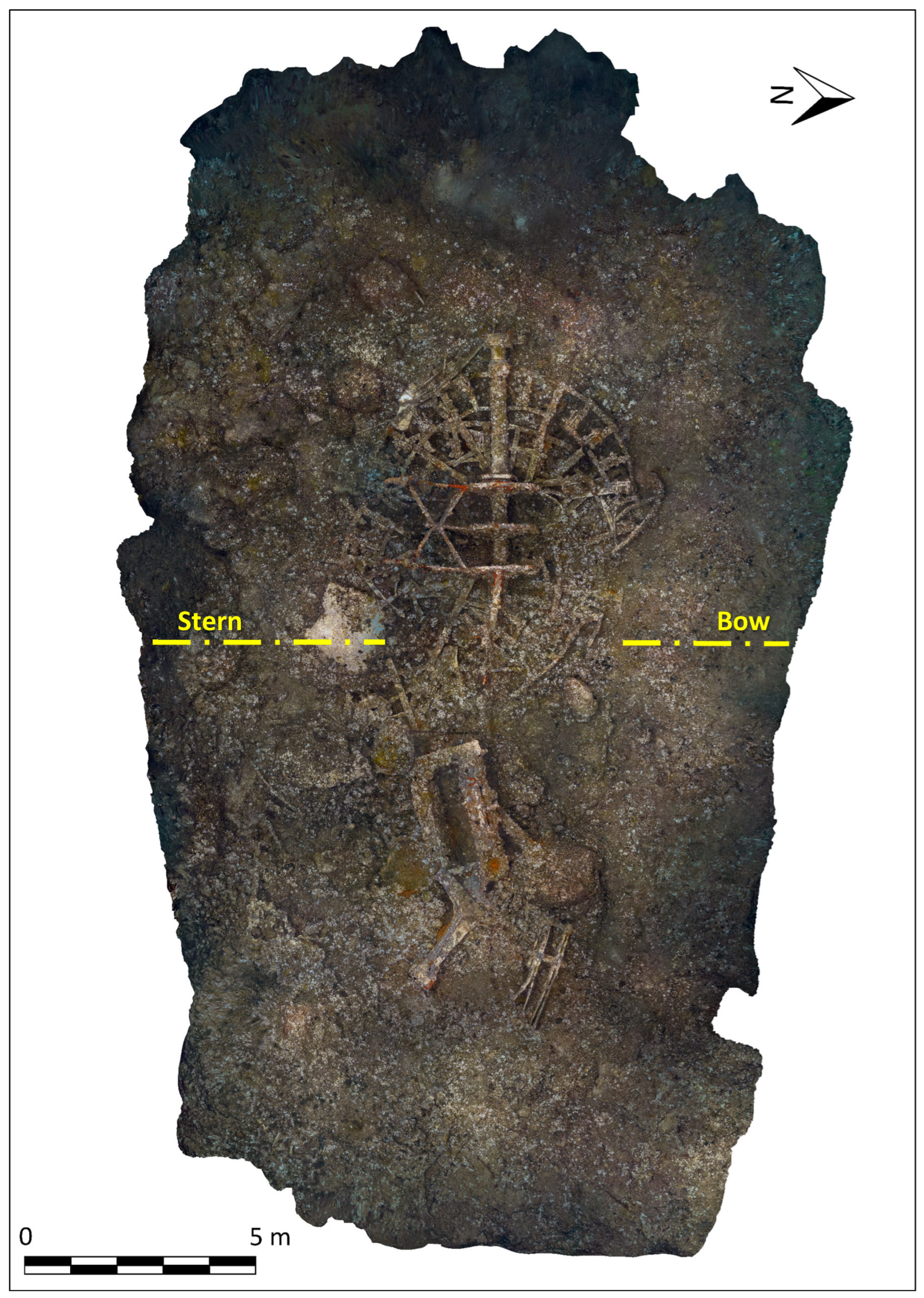
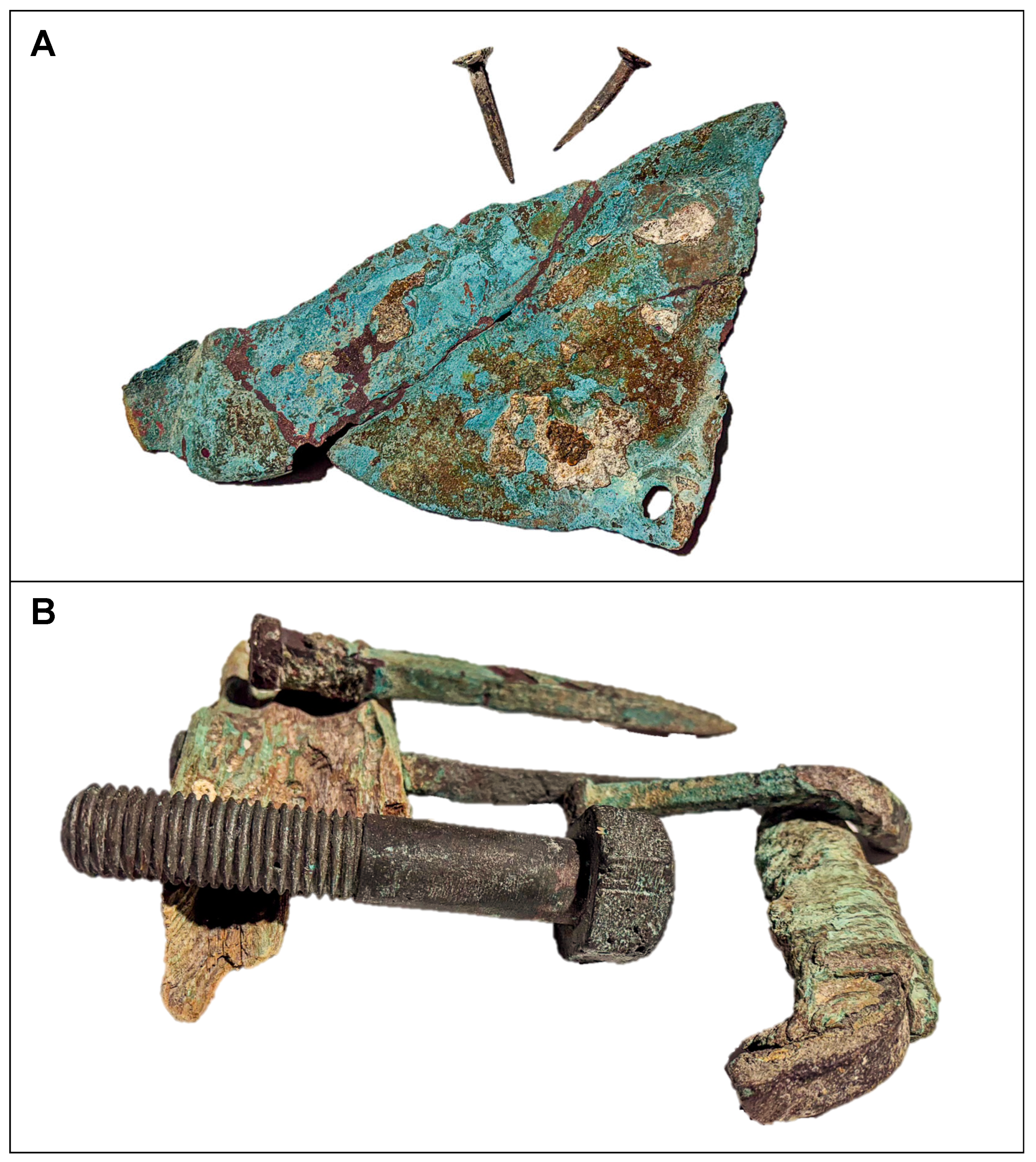
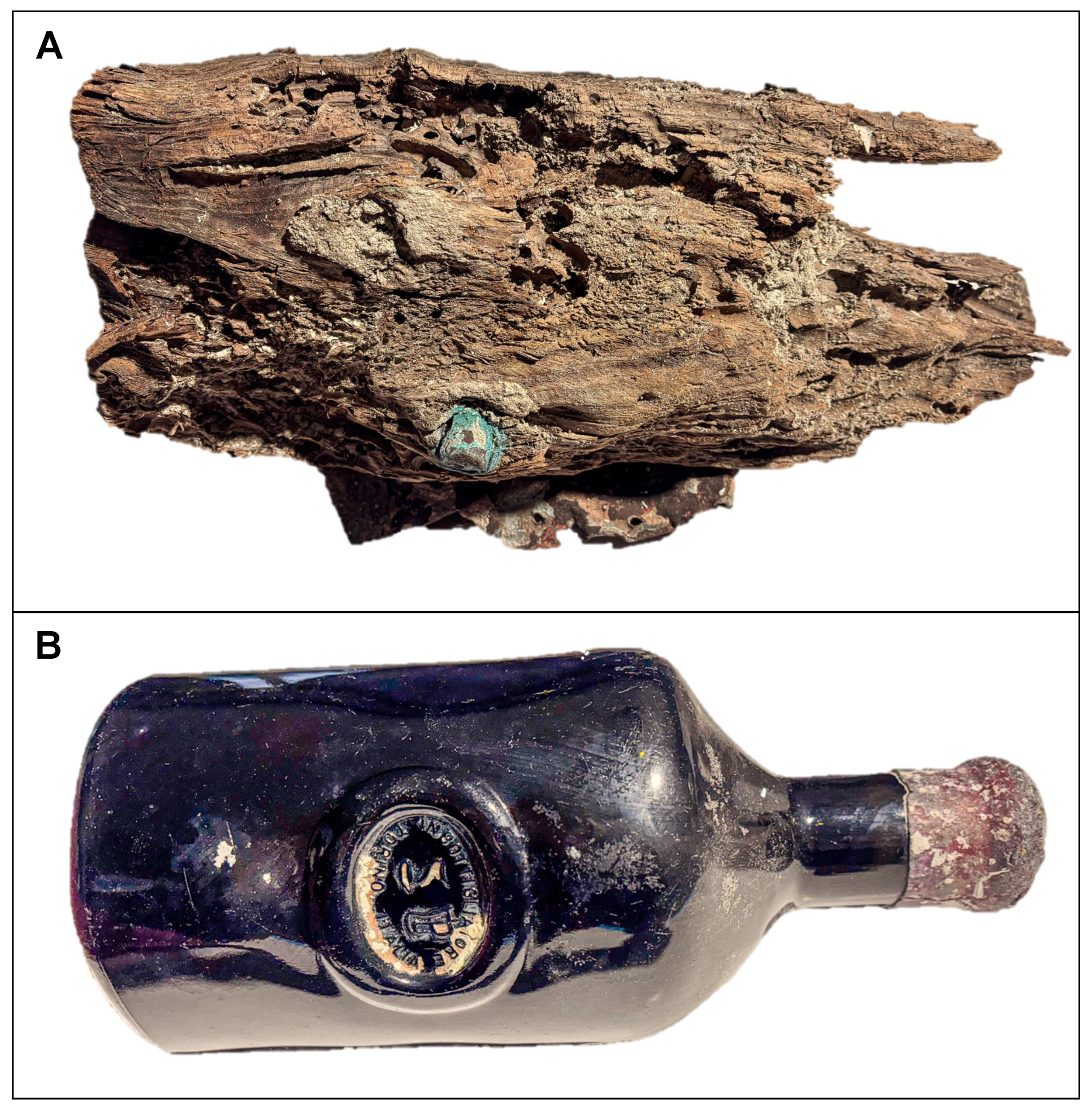
The debris, concentrated within an area of approximately 120 m2 at depths between 9 and 11 m, although heavily encrusted, constitutes the main and best preserved portion of the wreck. Beginning from the eastern and shallower side of the site (Figure 20), several components of the steam engine can still be observed, together with one of the paddle wheel shafts and, beneath it, the remains of the corresponding wheel. Proceeding westward along the slope, at depths between approximately 17 and 20 m, several copper sheets that originally sheathed the ship’s hull are also visible (Figure 21A). As documented by the activities of the MarlinTremiti diving club between 2006 and 2010, small connecting elements such as brass bolts and nails (Figure 21B)—associated, respectively, with the paddle wheel components and the fastening of the copper sheathing to the hull—are scattered across the entire site area beneath a thin layer of mobile sediment. Finally, poorly defined portions of the wooden hull were identified during the same period at a depth of approximately 22 m, beneath a thin sediment layer along the slope. On that occasion, a sample of the hull planking (Figure 22A), together with a still-sealed wine bottle (Figure 22B), was recovered with authorization from the competent Superintendency at the time.
Figure 20.
Orthophoto derived from the 3D model of the wreck of the steamer Lombardo (elab. by A., N.). The dashed yellow line indicates the probable position and orientation of the vessel at the time of the wrecking event.
Figure 21.
Artifacts recovered from the Lombardo. (A) Copper hull sheathing plate with nails, recovered in 2008 at a depth of −20 m along the slope (20 × 16 × 12 cm). (B) Bolt (13.5 × 1.8 cm) and nails used to fasten the copper sheathing plates (17 × 1.8 cm), recovered in 2006, respectively, at −9 m near the paddle wheel and at approximately −20 m along the slope. Photographs courtesy of Adelmo Sorci, Diving Club MarlinTremiti: Laboratorio del Mare, San Domino Island, Tremiti, Italy.
Figure 22.
Artifacts recovered from the Lombardo. (A) Fragment of hull planking with copper sheathing sheet (40 × 16 cm), recovered at a depth of −22 m in 2010. (B) Still-sealed wine bottle (21 × 9.5 cm) bearing a stamp with the inscription “IMBOTTIGLIATORE [S L B?] TORINO ITALIA”, recovered at −22 m in 2008. Photographs courtesy of Adelmo Sorci, Diving Club MarlinTremiti: Laboratorio del Mare, San Domino Island, Tremiti, Italy.
3.2. Photogrammetric Survey of the Lombardo Wreck
3.2.1. The Survey
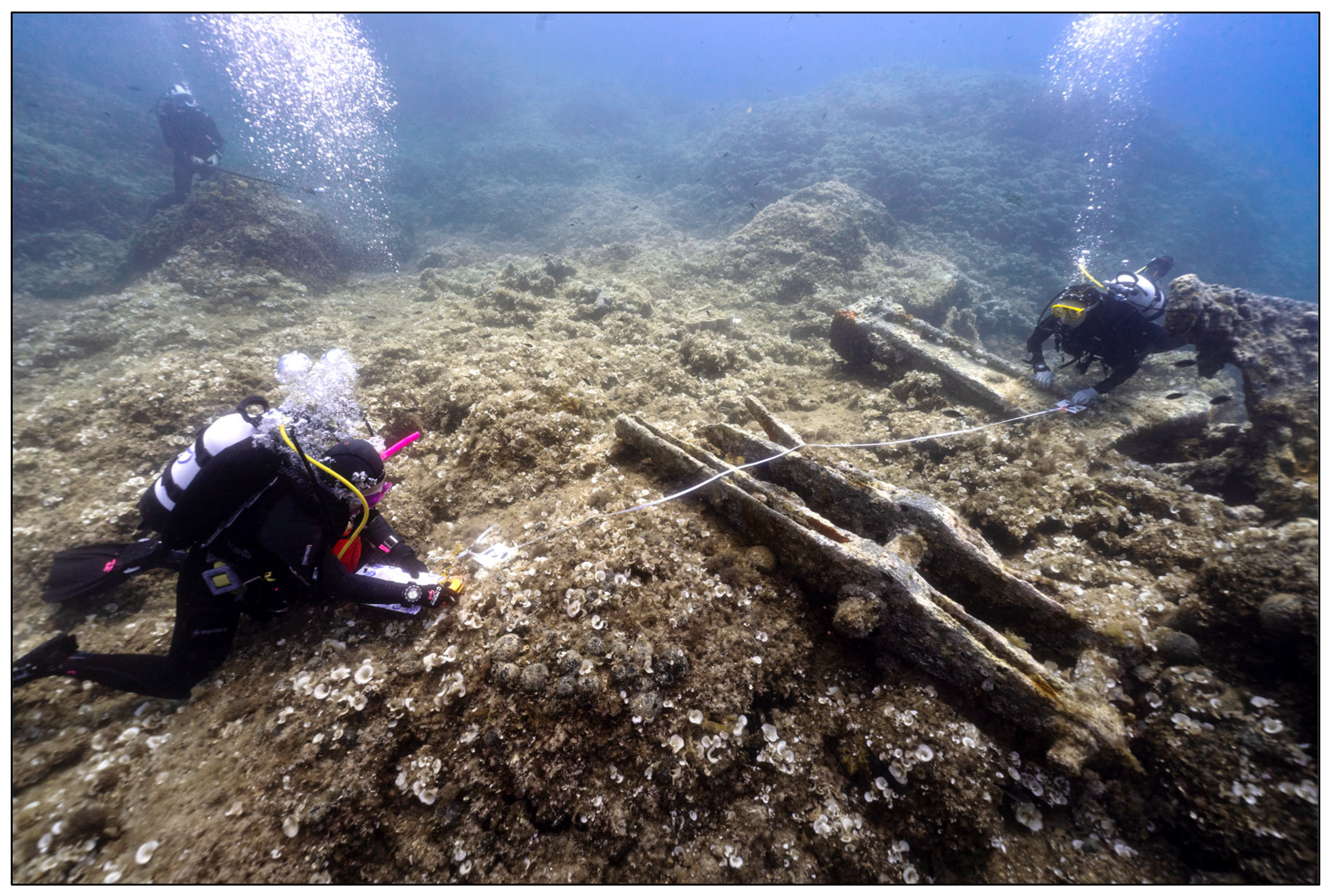
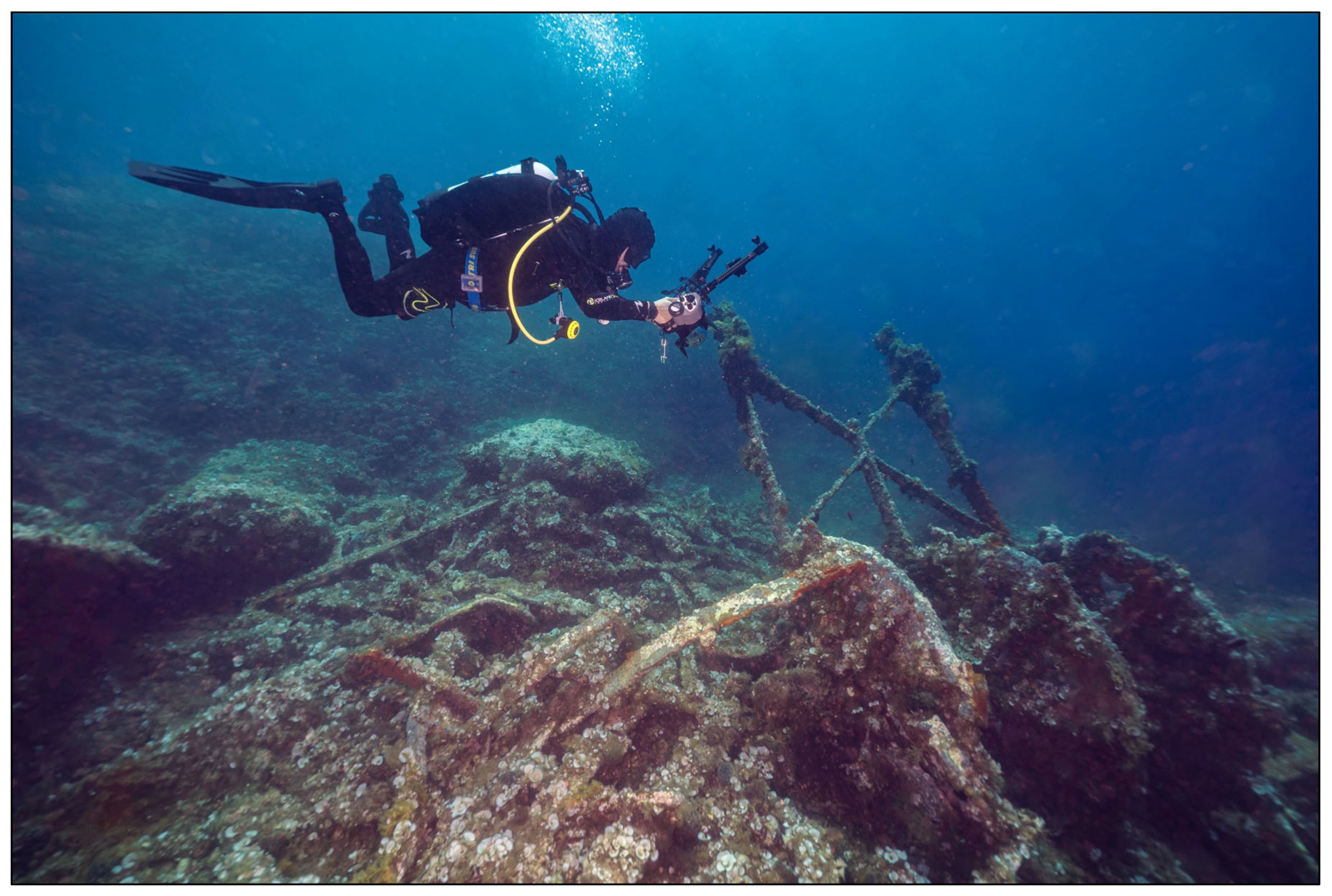
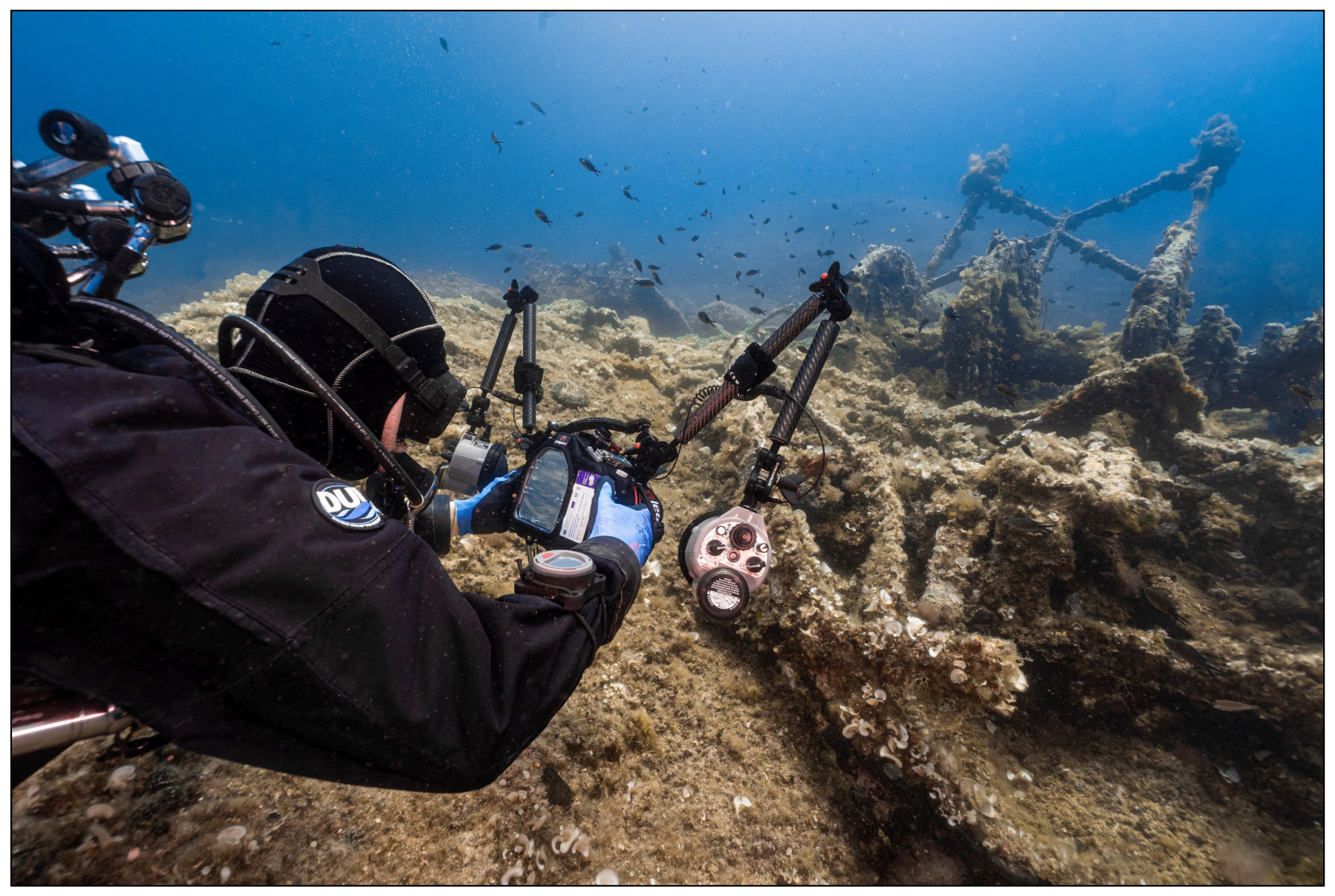
The underwater photogrammetric survey of the Lombardo steamship wreck was conducted in June 2023 as part of a training session within the framework of the CREAMARE project and represented a crucial initial step in the process of three-dimensional site replication. The project, coordinated by 3D Research s.r.l., a spin-off of the University of Calabria, involves the participation of the National Superintendency for Underwater Cultural Heritage, the University of Cádiz, the companies Novena (Zagreb), Atlantis Consulting and Pragma IoT (Thessaloniki), and the artistic hub Pro Progressione in Budapest. The project’s objective is to develop and test a new model for the co-production of interactive multimedia products aimed at the enhancement and dissemination of underwater cultural heritage [94]. This goal is pursued through training activities designed to disseminate specialized skills in digital technologies, which, in the case of the Lombardo site, concerned underwater photogrammetric surveying techniques (Figure 23). The creation of the 3D model of the wreck was carried out concurrently with the Amphitrite project (Underwater Archaeology for All in Digital Marine Parks). This initiative, under the responsibility of the National Superintendency for Underwater Cultural Heritage in Taranto (SN-SUB), focuses on the monitoring, protection, and enhancement of submerged and semi-submerged archaeological sites within five Italian Marine Protected Areas. Among the project’s various objectives is the implementation of underwater archaeological tourism through new technologies, creating both real and virtual itineraries in submerged and semi-submerged environments accessible to a wide range of users, including individuals with disabilities [95].
Figure 23.
The wreck of the Lombardo: survey operations (photo A. L.).
The photographic equipment employed for the survey consisted of a Sony Alpha ILCE-7MIII mirrorless camera, featuring a 24.3 MP full-frame sensor, paired with a Sony FE 14 mm f/1.8 GM lens2, which provided the wide-angle field of view necessary for capturing the extensive underwater environment. This setup was housed in an EasyDive LeoIII Wi3 underwater casing with a 160 mm spherical dome, ensuring waterproofing and correcting diffraction effects. Illumination was supplied by a pair of Inon Z-330 GN 33 flashes4, delivering 220 lm each with a 110° coverage angle. The survey equipment was further supplemented by metric tapes and eight 12-bit coded optical markers for spatial referencing.
The photogrammetric acquisition was first preceded by a systematic visual survey of the submerged area, focusing on the structural remains of the wreck, which was subsequently delineated using buoys and mooring weights. Eight optical markers were then strategically placed throughout the site, and their bathymetric elevations and inter-marker distances were meticulously measured (Table 1) to establish a geodetic network using the Direct Survey Method (DSM) [96] (Figure 24). Once this preparatory phase was completed, the actual optical acquisitions were carried out according to standard principles of aerial photogrammetry, with sequences of images captured along mutually perpendicular transects. In this instance, the camera was primarily oriented to nadir (vertically downward), although additional oblique images were acquired to ensure comprehensive coverage of sub-horizontal features (Figure 25).
Table 1.
Bathymetric elevations and relative contiguous distances between markers.
Figure 24.
Measurement of bathymetric elevations and linear distances between markers (photo A.L.).
Figure 25.
The survey phase conducted according to an “aerial” layout (photo A., N.).
The optical survey then continued with lateral coverage of the most vertically prominent structures, such as the massive frame of the steam engine and the paddle wheel shaft. In this phase, a “spin-around” layout was employed—a technique that involves capturing a sequence of images from converging angles by rotating in a spiral around the subject (Figure 26).
Figure 26.
Survey phase carried out using “spin-around” layout (photo A.L.).
The images were acquired with a longitudinal overlap of 70–80% and a lateral overlap of 50%, thereby ensuring uniform coverage and consistent resolution throughout. Furthermore, the acquisition layouts, executed at an approximate distance of 2 m from the surfaces under survey, allowed for an average Ground Sample Distance (GSD) of approximately 0.75 mm/pixel, enabling the precise documentation of even the finest structural details.
3.2.2. Processing of the 3D Model
Over the past two decades, Structure-from-Motion (SfM) photogrammetry has emerged as one of the most versatile and accessible techniques for the three-dimensional documentation of underwater and maritime archaeological sites. This approach allows for the generation of highly accurate 3D models from digital images, reducing both time and cost compared to traditional survey methods while ensuring a high level of fidelity [97]. Methodological developments in the discipline have been guided by academic bodies and international institutions, including ICOMOS-ISCUCH (International Scientific Committee on Underwater Cultural Heritage) and ISPRS, which recognize SfM as a method compliant with established guidelines for the documentation of underwater cultural heritage [98]. Current best practices recommend a pipeline based on redundant image acquisition, metric control through scale targets, and the integration of SfM with sonar or topographic surveys to guarantee the metric accuracy of the resulting models [99,100]. The adoption of integrated systems [101] and the use of AI for automatic colour correction [102] represent the most recent advances in the field. Overall, SfM photogrammetry not only enhances the scientific quality of underwater archaeological documentation but also supports digital preservation and public accessibility of submerged heritage, in alignment with international maritime archaeology standards [103].
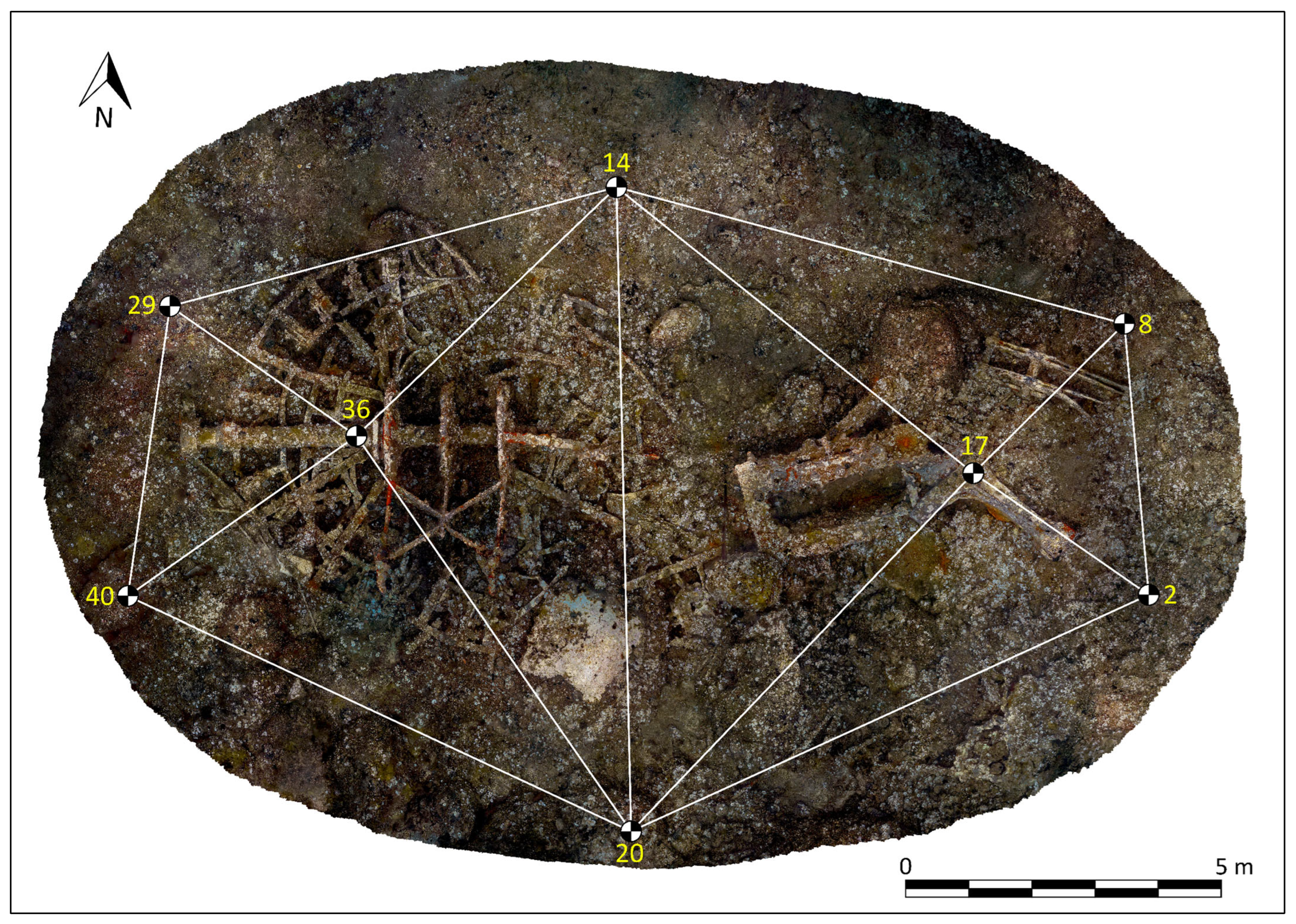
Given the elevated level of detail required for the analysis of the Lombardo wreck components, all images were captured in RAW format to enable the application of post-processing image enhancement techniques. Specifically, parameters such as brightness, contrast, and sharpness were optimized, while white balance and colour grading were adjusted. The reconstruction of camera positions using the SfM algorithm was a critical step for the subsequent photogrammetric processing of the acquired dataset. Both procedures were conducted using Agisoft Metashape Pro™5. In this phase, the geodetic network proved doubly useful, facilitating the alignment of 98% of the 498 images in the photographic dataset and enabling the scaling of the sparse point cloud (Tie Point) with sub-centimetre accuracy.
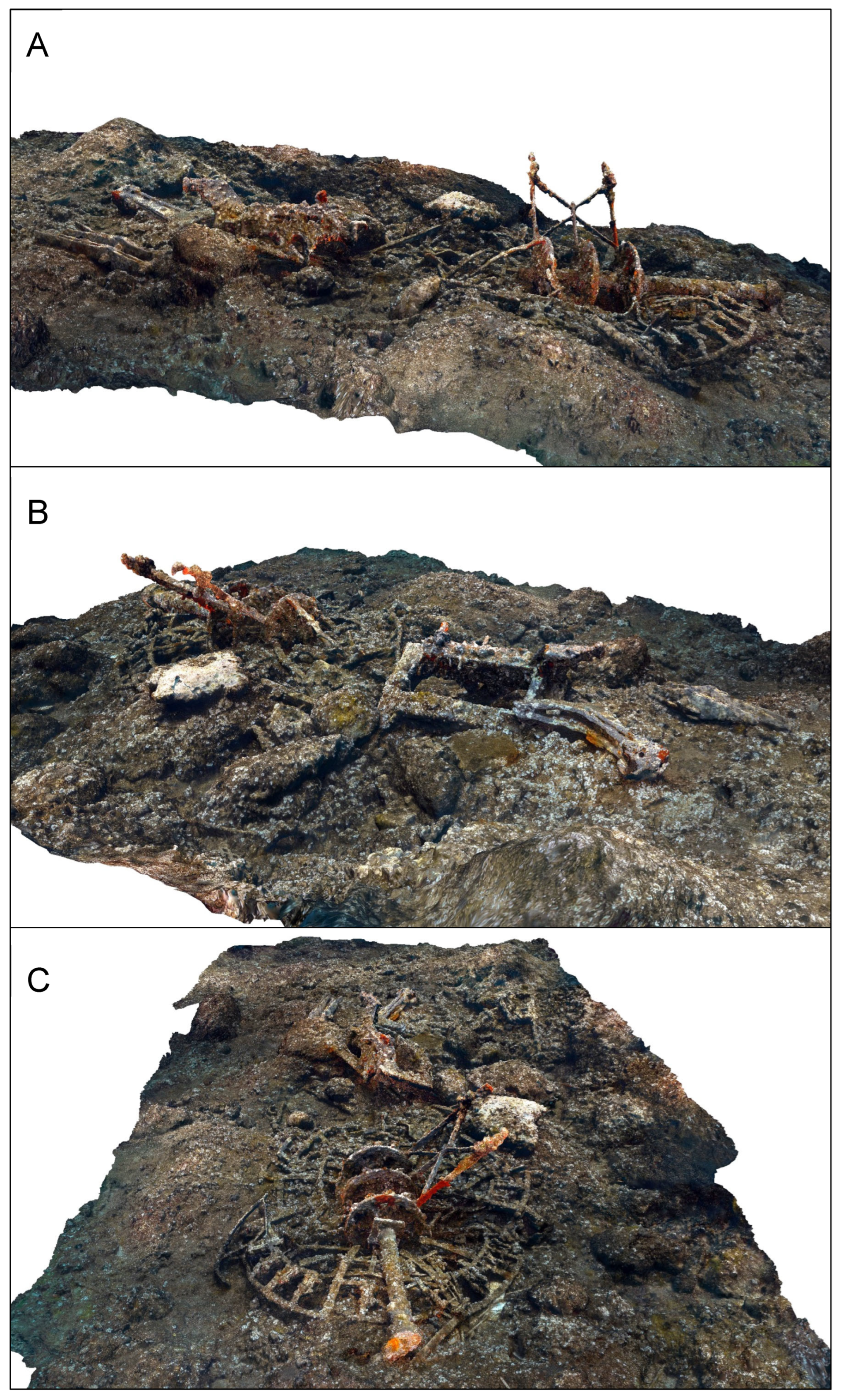
In this network, each marker placed on the site corresponds to a Ground Control Point (GCP) defined within a local metric coordinate system, which was developed using a DSM algorithm based on in situ measurements (Table 1, Figure 27). The importation of GCP coordinates into the 3D environment was facilitated by the 12-bit encoding of the optical markers, which, being readable by the software, allowed for their automatic placement within the model. A nonlinear optimization process was further applied to adjust the camera positions and their internal orientation parameters in order to increase the accuracy of the 3D model while minimizing errors at the GCPs. The final 3D model of the wreck, generated through meshing and texturing processes, consists of 19,404,343 polygons, with a multi-resolution texture computed at 8192 × 8 pixels, covering a total acquired area of approximately 594 m2 (Figure 20 and Figure 28).
Figure 27.
The geodetic network composed of control points (GCPs). The white lines represent the distances measured between each marker, whose identification numbers are in yellow (elab. A., N.).
Figure 28.
Perspective views of the 3D model of the wreck of Lombardo. (A) A view from the north; (B) a view from the southeast; (C) a view from the west (elab. A., N.).
3.3. Technical–Archaeological Investigation
An in-depth analysis of historical and archival sources was conducted to assess the evidence supporting and corroborating the data collected through archaeological investigations. The sources include technical manuals on naval engineering as well as several treatises on steam engines dating back to the 19th century [104,105,106,107,108,109,110,111,112,113].
The analysis of Lombardo wreck was conducted based on 3D model of the site, using an occlusion map generated within Metashape™ by a dedicated tool, in order to better perceive the morphological characteristics of the surviving parts of the steam engine and propulsion system. To facilitate the plan view identification of the various components, an orthophoto of the occlusion map was also produced. This was obtained by exporting the occlusion map and reapplying it as primary texture on the 3D model, from which the orthophoto was then generated.
4. Results
4.1. The Components of the Steam Engine
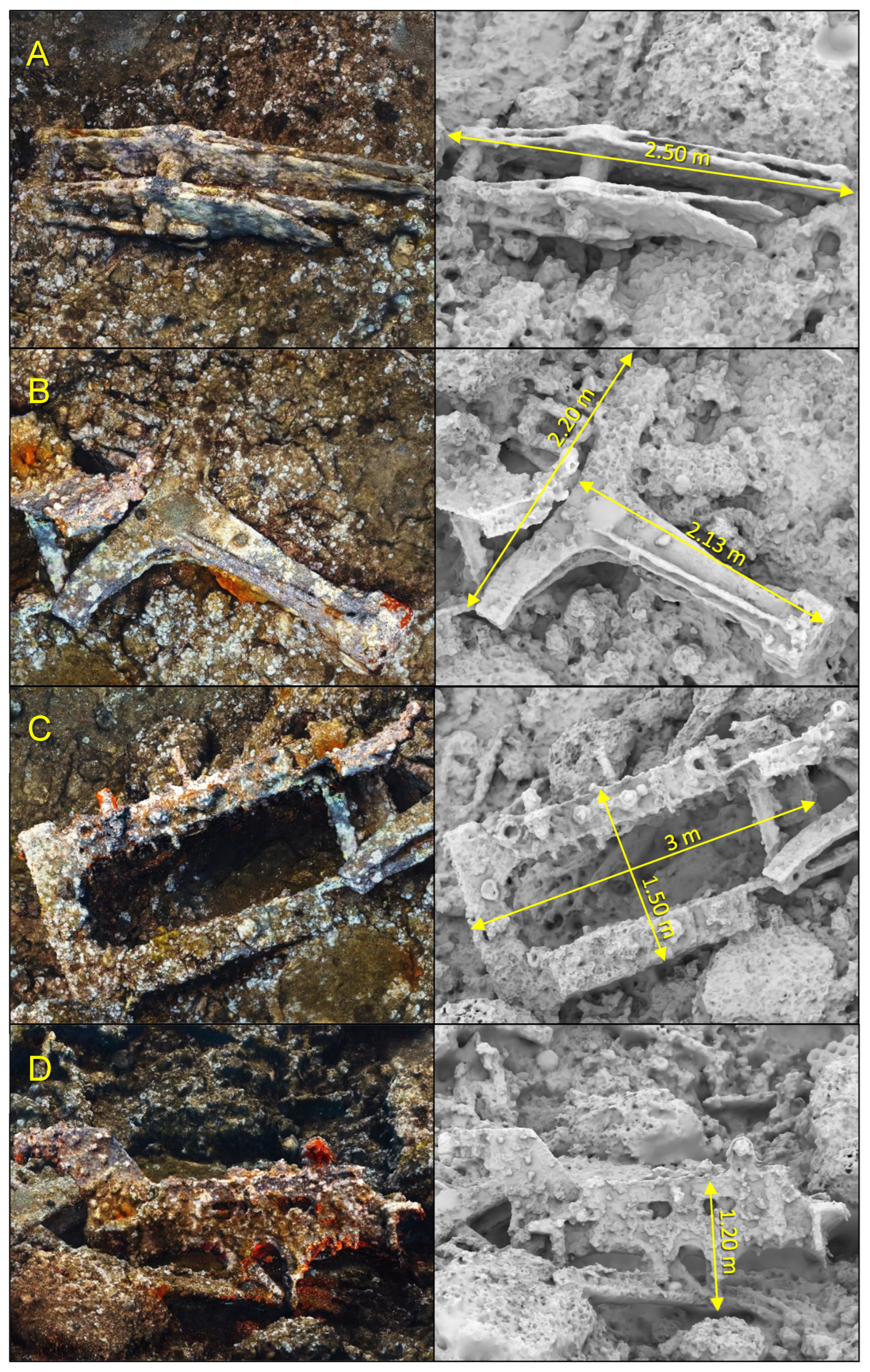
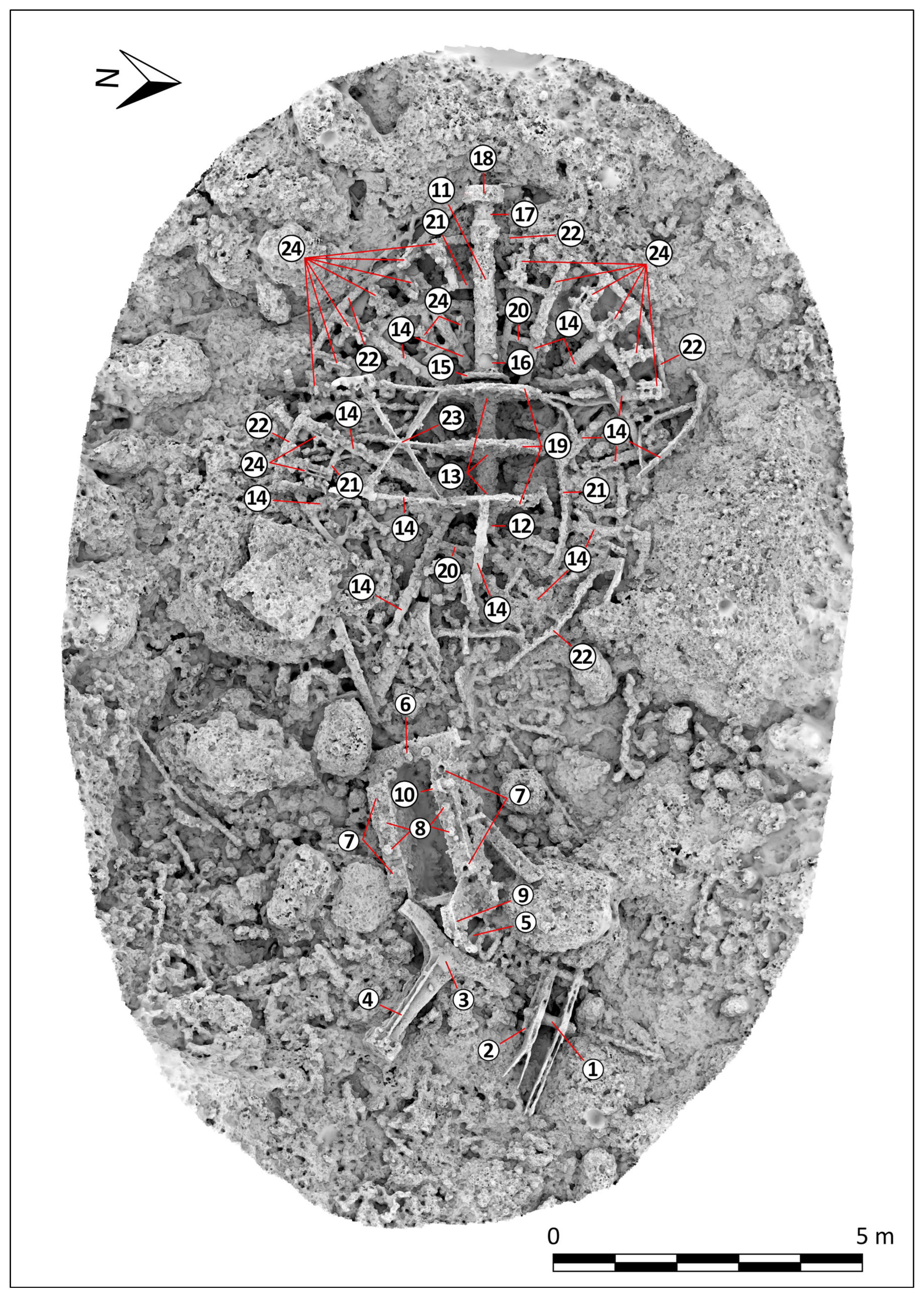
Starting the analysis of the wreck from the eastern part of the site, the first recognizable component of the Lombardo’s steam engine is a long asymmetrical side lever. The piece, measuring 2.50 × 0.90 × 0.42 m, rests on the rocky seabed with an orientation of W/NW–E/SE (Figure 29A; Figure 30, n. 1). The eastern end, corresponding to the longer arm of the lever, is damaged, with the plates forming the external thickness twisted and splayed. The opposite end of the lever, corresponding to the shorter arm, is intact and still retains the lever pin to which a rod is connected. This rod is currently folded along the side of the lever, reaching downward with its forked termination to touch the projection of the lever gudgeon (Figure 29; Figure 30, n. 2).
Figure 29.
On the left, normal texture; on the right, occlusion map visualization. Measurements taken from 3D model. (A) Asymmetrical side lever with rod; (B) T-crosshead with rod and connecting rod. (C) Frame, top view. (D) Frame, NW view (elab. A., N.).
Figure 30.
Orthomosaic of the wreck generated from the occlusion map of the 3D model. The numbered elements correspond to the recognizable parts of the wreck: 1. asymmetrical side lever; 2. air pump rod; 3. T-crosshead; 4. drive rod of the asymmetrical side lever; 5. connecting rod; 6. frame or “entablature”; 7. columns attachment joints; 8. engine shaft bearing cap bolts; 9. large flange; 10. small flange; 11. paddle wheel shaft; 12. outer end of the shaft; 13. wheel hubs; 14. spokes; 15. anti-roll plate; 16. stuffing box journal; 17. paddle wheel shaft main journal; 18. paddle shaft crank web; 19. first inner ring; 20. second inner ring; 21. third inner ring; 22. outer ring; 23. wheel inner frame; 24. paddle clamps. Elab. A., N.
Immediately south of the lever lies a large T-shaped crosshead. The piece, measuring 2.13 m × 2.20 m × 0.30 m, rests on the seabed oriented NW–SE (Figure 29B; Figure 30, n. 3). The crosshead, composed of two plates joined at three ends, shows no missing or damaged parts and, in fact, still retains additional steam engine components in their original positions. Along the upper surface of the T-crosshead shaft, a rod with a forked end remains connected to the outer journal at the base of the crosshead, while the upper end is damaged (Figure 29B; Figure 30, n. 4). Inside the T-crosshead, a long connecting rod is also visible; its upper end appears damaged or obscured by a large rock located slightly northwest, whereas the lower end is securely housed around the base journal of the crosshead (Figure 29B; Figure 30, n. 5). Finally, at the southwestern end of the crosshead, a circular cavity is present on the eastern side (Figure 29B).
Immediately to the west, in contact with the T-crosshead, there is another component of the steam engine with a distinctive shape, in which the structure of a massive quadrangular frame can be recognized. This frame measures approximately 3 × 1.50 × 1.20 m and is oriented NE–SW (Figure 29C, D; Figure 30, n. 6). Observing the upper surface of the frame, the mutilated remains of two circular elements are visible along the northern edge (Figure 29C; Figure 30, n. 7), between which two large hexagonal nuts can also be discerned (Figure 29C; Figure 30, n. 8) A similar configuration is observable along the southern upper edge of the frame, although here the circular elements are less preserved and the spacing between them is smaller than on the opposite side. Viewing the frame from the northwest side reveals several distinctive features of this component (Figure 29D). Along the SW and NE sides, pronounced angular profiles are present, while at the centre there are two ovoidal holes. At the lower part, a semicircular recess is visible, its edge bent against a long bar located beneath the frame, against which it seems to have been impacted with considerable force. Two protrusions also remain along the upper edge, extending from the main body of the frame. The larger of these, with an “L” shaped profile, is located on the northeastern side of the frame (Figure 29D; Figure 30, n. 9), while the smaller, which still retains a pin, projects from the opposite side and has a “D” shaped form (Figure 29D; Figure 30, n. 10).
4.2. The Shaft and the Remains of the Paddle Wheel
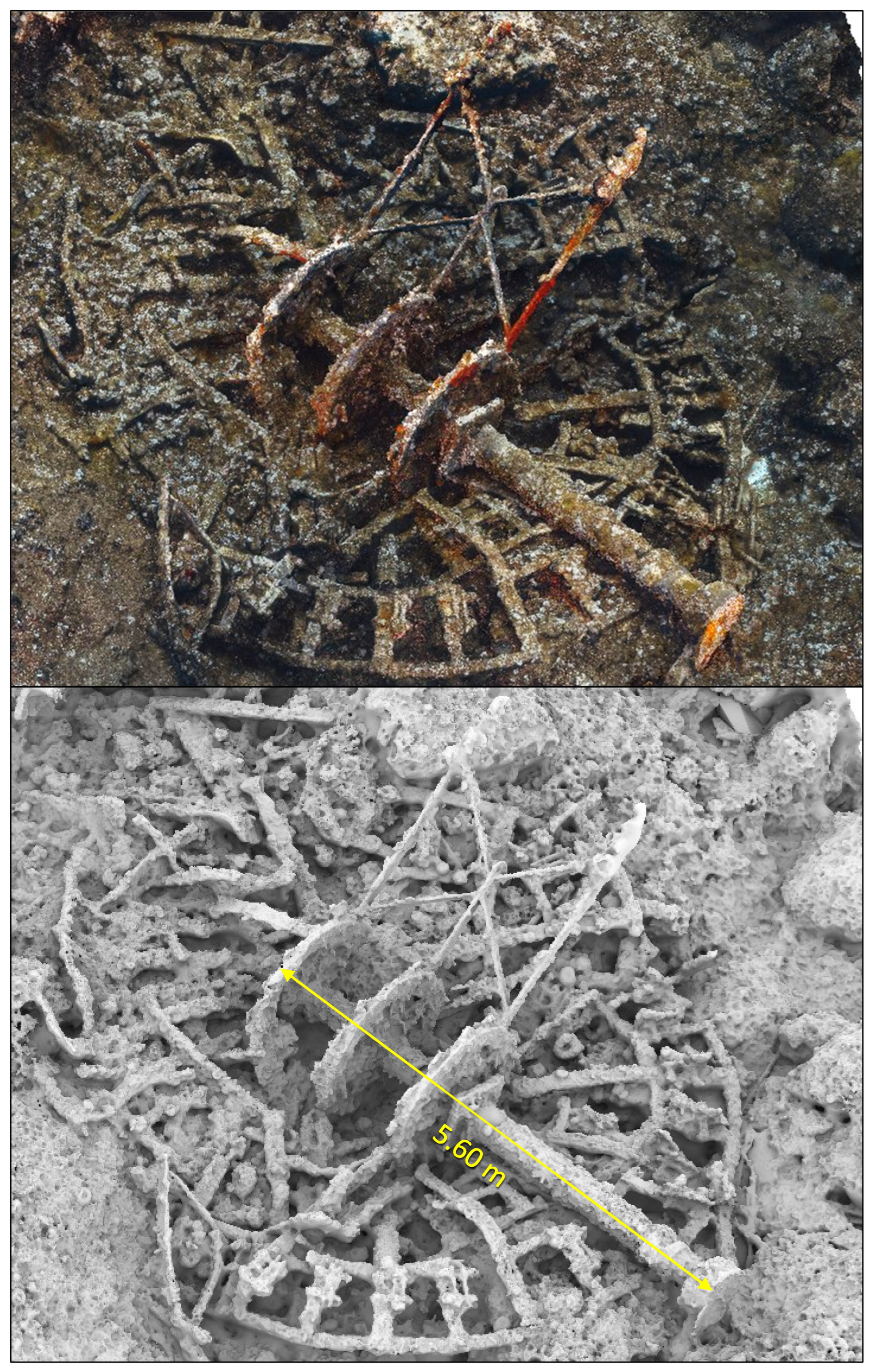
Approximately 1.50 m west of the frame there are the remains of one of the two paddle wheels of the steamship, along with its shaft. The shaft, measuring 5.60 m in length and approximately 0.35 m in diameter, is intact and partially rests, oriented NE–SW, over the wheel structure (Figure 30, n. 11; Figure 31). At the eastern end of the shaft is its outer head (paddle shaft end) (Figure 30, n. 12) immediately followed to the W by three hubs (Figure 30, n. 13; Figure 31) from which the wheel spokes radiate (Figure 30, n. 14; Figure 31). Adjacent to the western hub lies a thick square plate approximately 0.65 m per side (Figure 30, n. 15; Figure 31). Next to the plate, a reduction in the shaft diameter corresponds to a journal, i.e., a portion of the shaft surface precisely bored for mechanical fitting (Figure 30, n. 16; Figure 31). Continuing westward for about 2 m, another journal is visible near the western end of the shaft (Figure 30, n. 17; Figure 31). The shaft terminates with an ovoidal head, identifiable as a crank web (Figure 30, n. 18; Figure 31).
Figure 31.
The paddle wheel shaft with the three hubs and the surrounding remains of the framework (elab. A., N.).
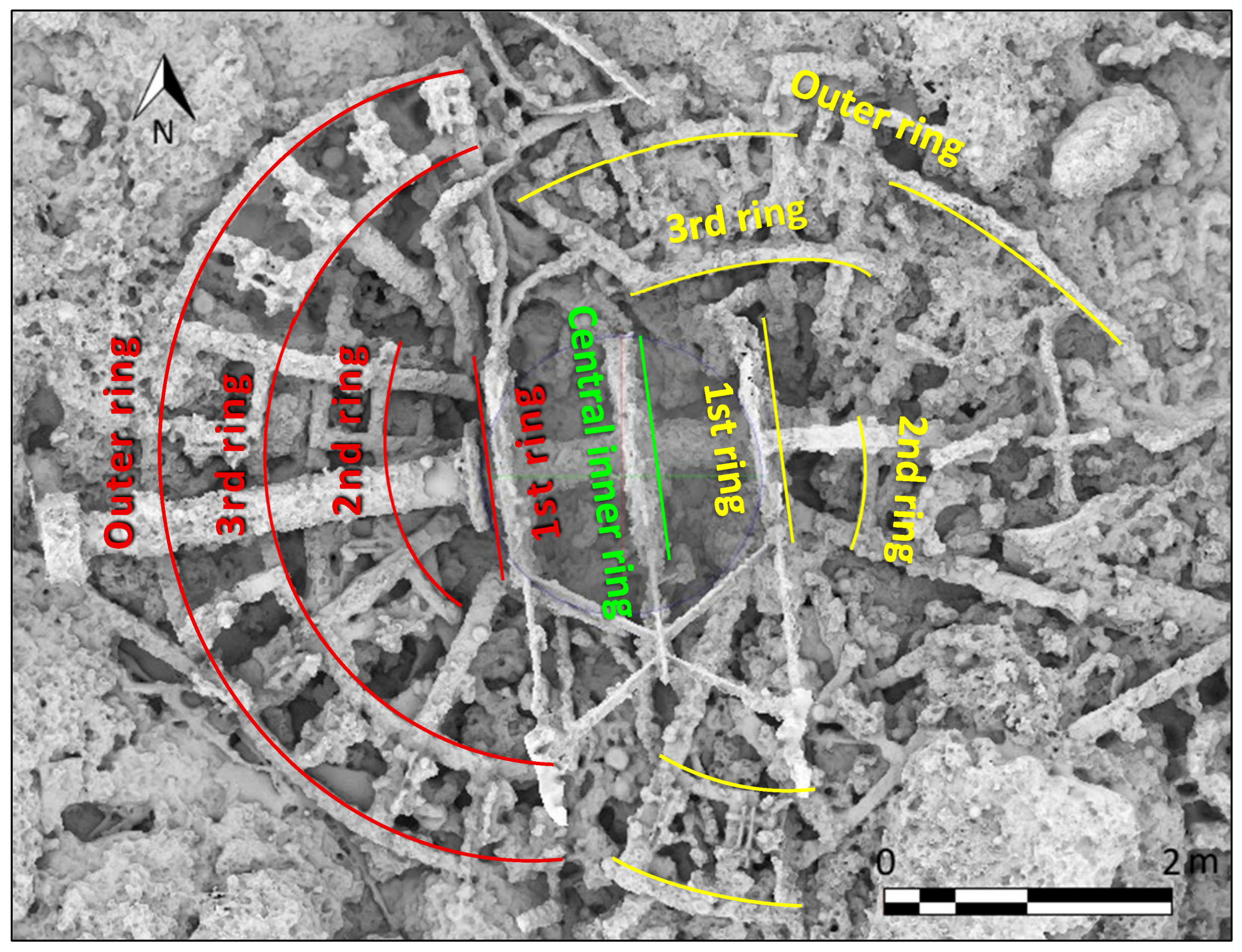
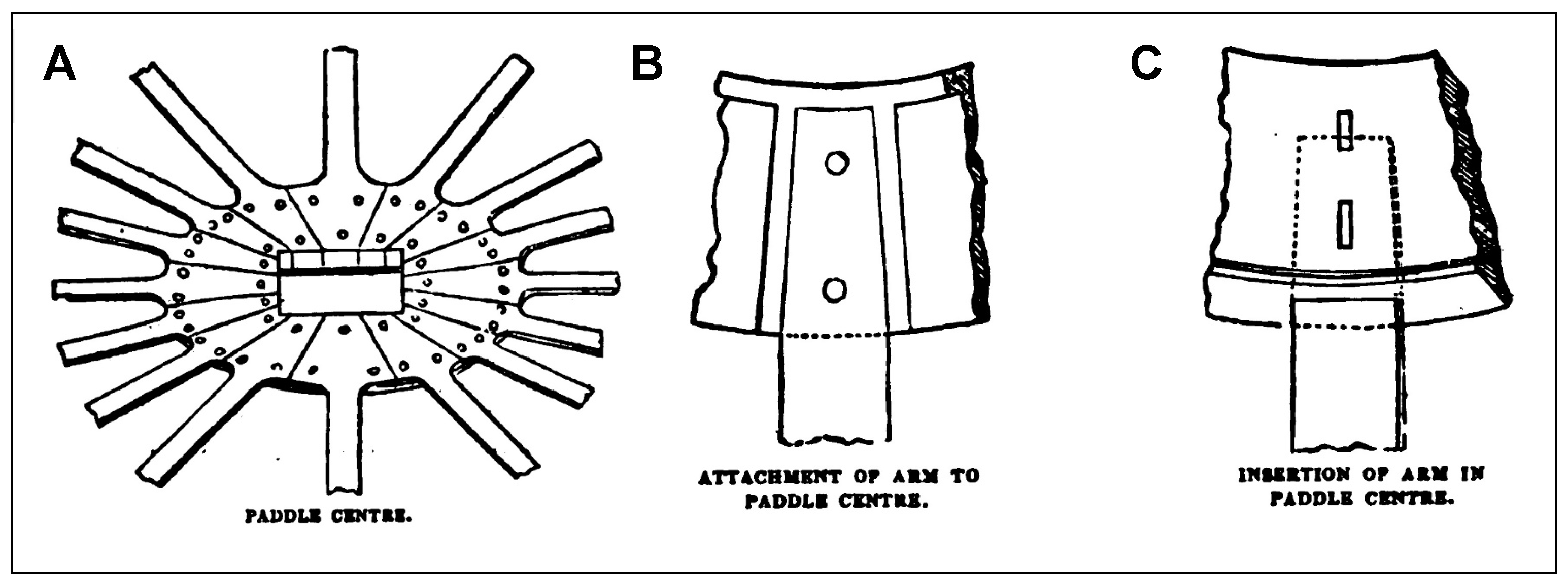
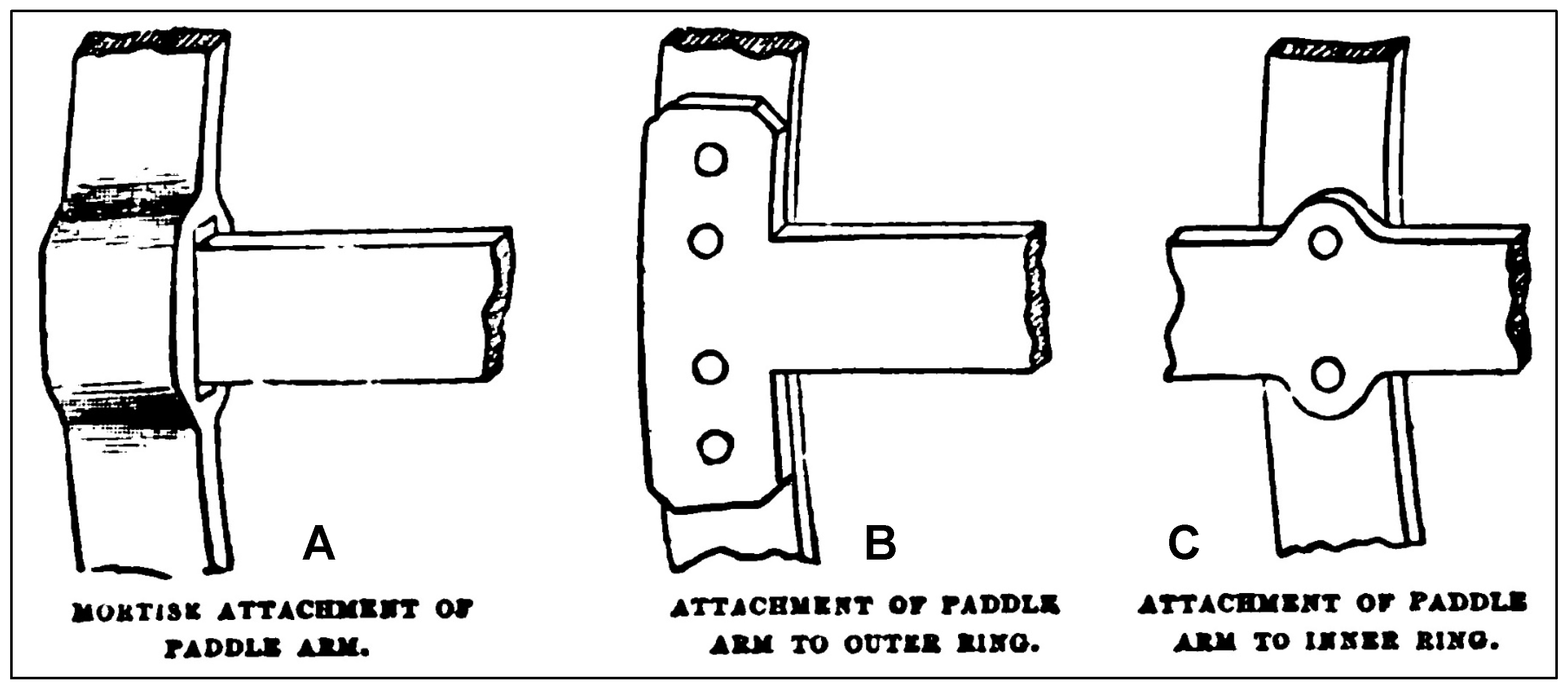
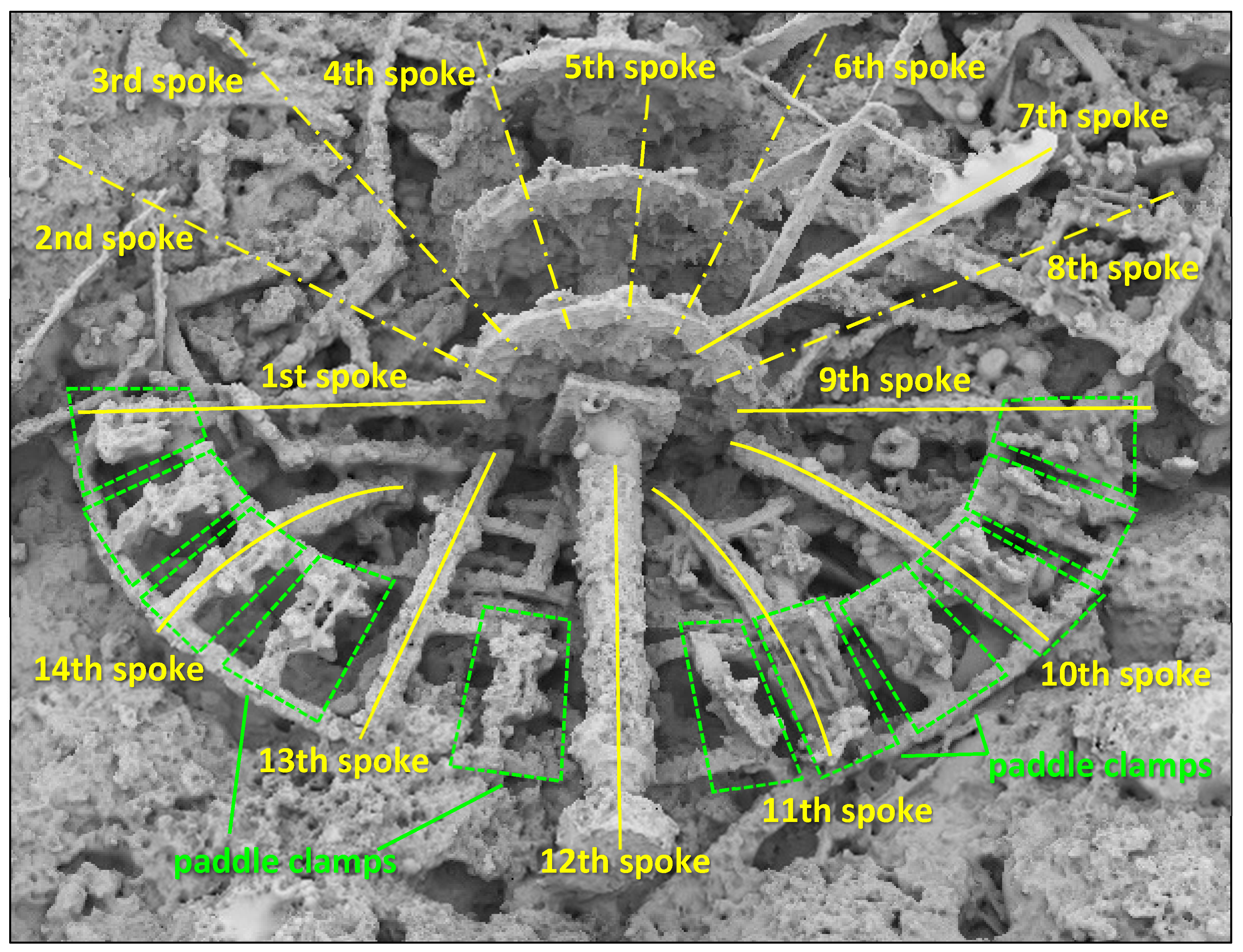
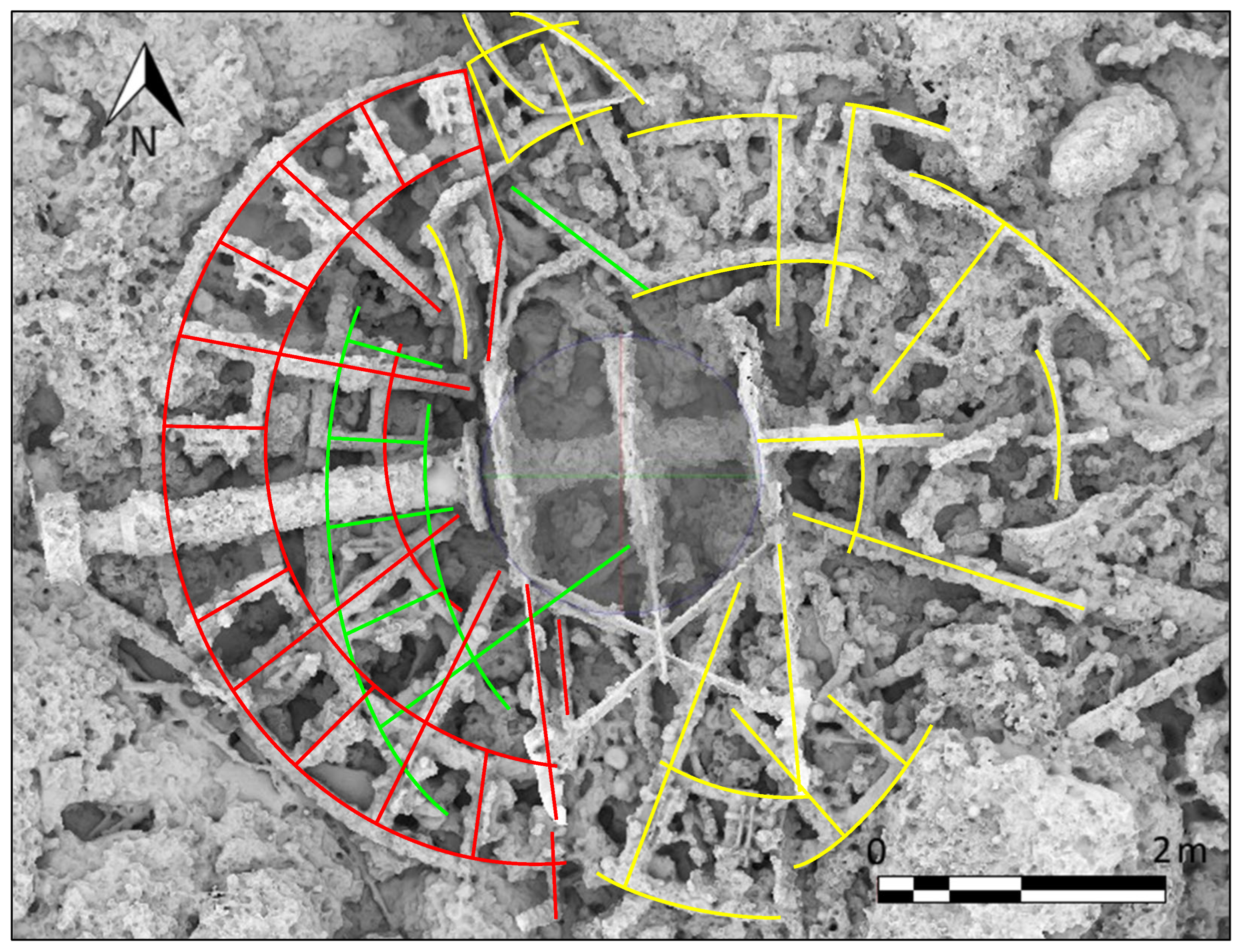
The wheel framework, partially located beneath the shaft, is almost entirely collapsed on the seabed and currently radiates around the shaft hubs within a sub-elliptical area of approximately 6 × 7.20 m. Regarding the general state of preservation, a distinction can be made between the eastern half of the wheel debris field, where the connections between structural components are less discernible, and the western portion, where the continuity between the spokes and other parts of the framework is significantly clearer (Figure 30, n. 14; Figure 31 and Figure 32). Almost all spokes projecting from what is now the upper part of the wheel are damaged, with the exception of four: a pair remain in situ, rising above the wheel at an inclination of 45° towards the south; the third lies on the seabed and extends northward from the western hub, while the fourth, although still connected, is collapsed onto the seabed in an E–W orientation (Figure 31 and Figure 32). Analysis of the surviving spokes and the western portion of the paddle wheel allows for the reconstruction of the original structure. The spokes, originating from the shaft hubs, extended towards the outer circumference, intersecting a series of nine reinforcement rings: four on each side of the wheel plus one around the central hub, parallel to the first two lateral rings. The first three inner rings, with a diameter of approximately 1.60 m, are still well preserved around the hubs and exhibit, along the upper edge, the stubs of spokes that have detached over time (Figure 30, n. 19; Figure 31 and Figure 32).
Figure 32.
An orthorectified view of the shaft and the debris field of the wheel with the reinforcement rings highlighted. Red indicates that the portions were still well preserved in the western half; yellow marks those located in the eastern portion; green highlights the first inner ring at the level of the central hub (elab. A., N.).
In contrast, the second inner ring has been almost entirely lost on both sides of the wheel and is visible only in two short sections on the seabed, both in the eastern and western halves of the debris field, as well as at the corresponding attachment points still preserved on the three surviving spokes (Figure 30, n. 20; Figure 20 and Figure 32). The third inner ring and the outer ring of the wheel, located approximately 0.60 m apart, are preserved primarily in the western half of the debris field, where their continuity and intersection with the spokes can be seen in plain view within an almost perfect semicircle. Several segments of these two rings are also visible in the eastern portion, although with a much lower degree of preservation of structural continuity (Figure 30, n. 21–22; Figure 32). Each pair of spokes on the two sides of the wheel was also internally connected by a framework whose function was to provide rigidity to the entire structure; this framework is still preserved between the two spokes that rise above the first three inner rings (Figure 30, n. 23). Between the last inner ring and the outer ring of the wheel, fifteen clamps are also preserved, to which the wooden paddles were originally attached (Figure 30, n. 24).
5. Discussion
5.1. The Steam Engine
The scholarly literature produced to date on the Lombardo agrees in stating that the steam engine of the steamship consisted of 208 nominal horsepower, single-funnel apparatus manufactured by Maudslay, Sons & Field of London. In particular, Joseph Maudslay, the fourth son of H. Maudslay, contributed significantly to the company’s prestige in the field of naval engineering by filing, between 1827 and 1858, twenty-two patents, largely relating to newly conceived marine engines [22] (p. 168).
Some of these engines, known as “direct-acting” engines, were intended as more advanced and lightweight alternatives to the first steam engine applied to marine propulsion, namely the so-called “side lever engine”. This system was introduced by Boulton & Watt in the 1820s as an adaptation of J. Watt’s classic beam engine; however, despite being considered reliable, it suffered from the drawback of excessive weight and bulk in relation to the dimensions of contemporary steamships [105] (pp. 303–304) [106] (pp. 55–60) [107] (pp. 1–4).
Among the principal types of direct-acting engines devised by J. Maudslay were the oscillating cylinder engine, patented in 1827 and first installed in the steamship Endeavour, which was launched the following year [107] (p. 4), and the twin-cylinder or “double-cylinder” engine, also known as the “Siamese” engine, patented and developed between 1839 [108] and 1844 [104] (p. 180) [105] (p. 304) together with J. Field.
Despite its early introduction, the oscillating cylinder engine featured a mechanical arrangement that was both simple and technologically advanced when compared to the Siamese engine. Nevertheless, the oscillating system was not appreciated and its application to maritime navigation remained sporadic and limited. It was later significantly re-evaluated and, once refined by John Penn, became a standard for paddle steamers built from the 1850s onwards [104] (p. 305) [105] (p. 181) [107] (p. 4). In the marine oscillating cylinder engine, all side levers, lateral rods, crossheads, and connecting rods are eliminated. Each cylinder (Figure 33 and Figure 34, n. 1) is positioned beneath the main shaft at the level of the cranks (Figure 34, n. 2), to whose pins the piston rods (Figure 34, n. 3) are directly connected. These rods are free to accommodate the eccentric motion of the crank, as the respective cylinders are mounted on two external trunnions that allow them to oscillate, hence the name of the engine (Figure 34, n. 4). These pivots, generally located midway up the sides of the cylinder, are hollow and allow for the passage of steam: through one, steam expands into the cylinder from the boiler, while through the other it is discharged towards the condenser. The two air pumps, inclined with respect to the keel (Figure 34, n. 5), are driven by a single crank mounted on the intermediate shaft, while their rods are maintained in position by guides [104] (pp. 181–182) [105] (Figure 170 p. 183) [105] (pp. 305–310) [106] (pp. 60–61) [107] (p. 4). In some examples, a single larger pump was installed between the cylinders in a vertical position and operated in the same manner (Figure 33).
Figure 33.
A model of an oscillating engine for a Thames steamer (1:12 scale) crafted, between 1842 and 1850, by an unknown artisan at John Penn and Sons in Greenwich (Science Museum Group 1019 Collection. The Board of Trustees of the Science Museum).
Figure 34.
A technical diagram of the oscillating cylinder engine. 1. Cylinder; 2. crank; 3. piston rod; 4. hollow cylinder pivot (trunnion); 5. air pumps. Modified from [107] (Figure 3, p. 5).
The other direct-acting engine patented by J. Maudslay, the twin-cylinder Siamese engine, was conceived not only to compact the system and save space within the vessel, but also to solve the problem of short connecting rods in other direct-acting engines, such as the Gorgon, which placed excessive stress on the cylinders. However, only a few years after its introduction, the twin-cylinder system revealed a number of technical drawbacks, including increased steam losses, greater friction due to the high number of moving components, and significant heat dissipation by radiation resulting from the doubled surface area of the two cylinders. The integration of the condenser into the bedplate could also hinder the proper functioning of the air pump. Moreover, the goal of achieving a reduction in occupied space was only partially fulfilled [104] (p. 180) [105] (p. 304). For these reasons, the twin-cylinder engine was abandoned in favour of the oscillating cylinder system.
The analysis conducted on the Lombardo indicates that the three large components identified in the eastern part of the site can be attributed, based on their distinctive mechanical and morphological characteristics, to a Siamese twin-cylinder engine. As the name implies, the twin-cylinder engine comprises two identical cylinders (Figure 35, n. 14) aligned perpendicularly beneath the crank shaft (Figure 35, n. 13). The piston rods (Figure 35, n. 19) are connected to the horizontal arms of a T-shaped crosshead, which is almost identical to that observed on the Lombardo wreck and whose function was to receive and combine the vertical motion of the two cylinders and transmit it, by sliding between them, to all the other moving components of the engine (hence the term “Siamese”) (Figure 29B; Figure 30 and Figure 35, n. 3). This configuration explains the hole at the end of the SW arm of the crosshead observed on the site, which evidently served as the housing for the piston rod (Figure 29B). In this type of engine, the connecting rod is housed within the T-crosshead (Figure 29B; Figure 30 and Figure 35, n. 5), with its upper and lower ends pivoted, respectively, to the crank of the crankshaft (Figure 30, Figure 31; Figure 35, n. 18) and to the journal located at the base of the crosshead itself—an assembly scheme that, as previously illustrated, is also reflected in the wreck remains.
Figure 35.
A technical diagram of the double-cylinder Siamese engine. The surviving machine components of the Lombardo are shown in corresponding colours. 1. Larger asymmetrical side lever (orange); 2. rod operating the air pump (blue); 3. T-crosshead (green); 4. rod operating the side lever of the air pump (light blue); 5. connecting rod (red); 6. frame or “entablature” (yellow); 7. columns; 8. bolts of the shaft bearing; 9. larger flange; 10. smaller flange; 11. smaller asymmetrical side lever; 12. feed pump; 13. paddle shaft (grey); 14. cylinders; 15. engine bedplate; 16. air pump; 17. condenser; 18. crank (purple); 19. pistons; 20. rod operating the feed pump. Adapted from [107] (Figure 2, p. 5).
The vertical movement of the crosshead thus drives the eccentric motion of the articulation formed by the connecting rod and crank, which in turn sets the paddle wheel shaft in rotation. The crosshead also transmits motion, by means of a long rod (Figure 29B; Figure 30 and Figure 35, n. 4) connected to its base journal—partially preserved on the wreck—to a large side lever that actuates the air pump (Figure 35, n. 16). This mechanical component performs a fundamental function, as it creates a low-pressure vacuum within the system, which is essential for the proper expansion of steam within the cylinders and for the removal of moisture from the condenser (Figure 35, n. 17). This side lever corresponds to the large asymmetrical side lever located at the eastern end of the site (Figure 29A; Figure 30 and Figure 35, n. 1) which indeed still preserves the rod with a forked termination originally connected to the head of the pump plunger (Figure 29A; Figure 30 and Figure 35, n. 2). The smaller lever (Figure 35, n. 11), operated manually, acts through a dedicated rod (Figure 35, n. 20), to drive the feed pump supplying water to the boiler and is positioned alongside the cylinders (Figure 35, n. 12).
The shaft and the crank are housed within a massive frame (Figure 29C,D; Figure 30 and Figure 35, n. 6), set between the beams of the main deck and supported by four columns that transfer its weight onto the engine bedplate, which in turn was bolted to the ship’s bottom deck (Figure 35, n. 15) [104] (pp. 179–180) [105] (p. 304) [106] (pp. 55–60) [107] (p. 4) [109] (p. 89) [110] (p. 62). Although it now lies overturned on the seabed, the massive quadrangular frame present on site is entirely comparable to that of a Siamese engine and is readily identifiable thanks to its distinctive structure, which combined functional features with stylized architectural mouldings. This component, as noted, was supported above the cylinders by four slender columns and was therefore also referred to as the “entablature.” The terms “entablature” and “columns” derive from the widespread practice—especially in terrestrial steam engines—of decorating these static components with Greek architectural orders or Gothic mouldings. Although such decorative elements progressively disappeared in marine engines, which were more compact and generally concealed from view, the terminology used to designate the corresponding components, by then highly stylized, was nevertheless retained [104] (Figure 243, p. 207) [105] (tav. XII-XVI, pp. 274–275; Figure 269, p. 276; tav. XIX, p. 303) [111] (Figures 41–50 pp. 71–80 and Figure 162, p. 179). The four circular projections visible along the upper side of the entablature therefore appear to correspond to the truncated remains of the joints of the four supporting columns (Figure 29C, Figure 30 and Figure 35, n. 7). These seem to continue into dedicated through-sockets within the entablature, with external bulges visible on the lateral surface of the frame. It is noteworthy that the centre-to-centre distance separating the two junctions along the northern edge of the frame is greater than that of the corresponding pair along the southern edge. This indicates that the present northern side of the frame was the one that, at its base, housed the water pump and therefore required greater space for its insertion between the supporting columns (Figure 29C and Figure 35, n. 7, 12). Moreover, the two pairs of large hexagonal nuts visible between the column junction points most probably belonged to the through-bolts that clamped the covers of the two plummer blocks located on the opposite side of the frame (Figure 29C; Figure 30 and Figure 35, n. 8). The lower half of one of these bearings, integral with the entablature, corresponds to the semicircular-profile seat visible on the north-western side of the frame, now crushed against a bar, in which the main journal of the paddle shaft was housed. The angular profiles that characterize the south-western and north-eastern sides of the entablature were intended to accommodate the ship’s main deck beams, while the two central ovoid openings served to lighten the structure of the frame (Figure 29D and Figure 35, n. 6).
The frame also served as a support for the lateral pump levers, whose pins were fitted into dedicated flanges projecting from the lower part of the framing. These correspond to the two projections visible along the upper profile of the frame. The larger one, with an L-shaped profile and located on the north-eastern side of the frame, is currently mutilated but originally supported the large lever of the air pump described above (Figure 29D; Figure 30; Figure 35, n. 9). The small D-shaped flange projecting from the opposite side served as seat for the smaller lever and still preserves its fulcrum pivot (Figure 29D; Figure 30 and Figure 35, n. 10).
With regard to the constituent metal of the remains of the Lombardo’s steam engine, it can be stated that during the first half of the XIX century, the choice of metal alloys for the construction of both land-based and marine steam engines inevitably fell upon wrought iron and cast iron. Modern steel, in fact, characterized by excellent mechanical properties, was introduced only from the second half of the XIX century with the development of specific steelmaking processes such as the Bessemer and Siemens–Martin methods [112] (pp. 12–14) [113] (pp. 218–222). Wrought iron, owing to its self-welding properties and its ductility and toughness, was used in the manufacture of all the engine’s moving components, such as shafts, connecting rods, rods, side levers, fasteners, and other parts subject to bending or tensile stresses. Cast iron, by contrast, which is strong in compression and easily cast, was employed for the manufacture of massive static components, such as the bedplate and cylinders, as well as for load-bearing structures such as the frame and columns. High alloys such as bronze and brass were then used to produce bushings, valves, and other components subject to friction or oxidation [104] (pp. 227–228) [107] (pp. 450–458) [114] (pp. 32–36) [115] (pp. 145–150). The majority of the steam engine remains of the Lombardo are probably made of wrought iron; an exception is the massive frame block, which was likely manufactured from cast iron.
The Siamese-type steam engine was designed to accommodate two units for each paddle wheel shaft, coupled at the centre by an intermediate shaft. This configuration appears compatible with the maximum beam of the Lombardo, measuring 7.40 m, allowing for a total footprint of the two engines of approximately 3 m in width, given the frame on-site measures around 1.50 m in breadth. A plausible representation of how the Lombardo’s engines would have appeared is provided by comparison with the engine arrangement plan of the paddle frigate HMS Retribution, launched in 1844 at Chatham [110] (p. 62), which was fitted with two 800 HP Siamese double-cylinder engines built by Maudslay Sons & Field, of which a scale model also exists (Figure 36, Figure 37 and Figure 38). A more detailed reproduction of these plans is also found in a watercolour dated 1842 [110] (p. 62) [116], just one year after the launch of the Lombardo. Taking duly into account the substantial differences in use, design, and power between the two vessels, it is reasonable to hypothesize that HMS Retribution was fitted with a version of the Siamese engine very similar, if not identical, to that installed on the Lombardo, albeit of larger cylinder capacity. From this perspective, it is plausible that the 208 HP version of the steamer may have served as a prototype for the subsequent construction of the Retribution’s steam engine.
Figure 36.
A model of the twin-cylinder paddle wheel engines of HMS Retribution (1:32 scale), Maudslay & Field patent (Science Museum Group. The Board of Trustees of the Science Museum).
Figure 37.
Longitudinal section of engine room and general arrangement plan of steam frigate HMS Retribution, 1844 [105] (tav. XXI, p. 304 (7)).
Figure 38.
Transverse section of engine room of steam frigate HMS Retribution, 1844 [105] (tav. XXI, p. 304 (7)).
The evidence presented thus far therefore seems to contradict the attribution of an oscillating-cylinder system to the Lombardo’s engine [13] (p. 129) [14] (pp. 157 and 161) [15] (pp. 35, 82 and 88). Supporting this, it is noteworthy that the mechanical components identified, particularly the moving parts, are not even present in an oscillating-cylinder engine. Considering these findings, further confirmation can also be obtained by re-examining the sparse contemporary sources reporting on the Lombardo’s steam engine. An article in the newspaper l’Eco della Borsa, reporting the launch of the steamer, refers to “[…] two low-pressure engines from the Maudslay Sons & Field factory of London” [15] (p. 35) [27] (p. 1) which can now be interpreted as the two engines of the Siamese system rather than the individual cylinders of an oscillating setup.
This interpretation is further supported by the usage, in Italian of the period, of the term “macchina” to designate each individual cylinder; in this context, the journalist could well have been referring to the dual-cylinder nature of the Siamese engine. The same reading can be applied to the note in the Lombardo’s inventory, drawn up on 23 June 1857 for the assessment of its mortgage value, which states “Low-pressure engine. Two engines [macchine] of 100 horsepower each” [15] (p. 88). Here, it becomes even clearer that the term “macchine” refers to the entire machinery assembly rather than the individual cylinder. Given that the vessel’s maximum nominal power was 208 HP, it follows that each cylinder of the Lombardo’s two Siamese-type engines could develop roughly 50 to 52 HP.
However, a second possibility exists, namely that the original steam engine of the Lombardo was indeed of the oscillating-cylinder type and was replaced at some point in the steamer’s operational life with a twin-cylinder engine. According to the historical sources on the Lombardo, such a replacement could plausibly have occurred only at a specific location and within a defined time, namely at the Oretea Foundry workshops in Palermo between July 1860 and August 1861. Following the landing of the Mille at Marsala on 11 May 1860, the Lombardo ran aground in the harbor and remained there until the Sicilian dictatorial government ordered its recovery in July of the same year. To lighten the steamer and facilitate its lifting, the engines were dismantled and subsequently transferred to the Florio-owned Oretea Foundry. There, according to historiography, they were refurbished, and new boilers were also assembled [15] (p. 70). It is reasonable to assume that the Lombardo’s engines had suffered damage, partly from Bourbon artillery fire and partly from months of exposure to seawater. One may hypothesize that the extent of this damage was so severe that repair was not feasible, forcing the Oretea technicians to replace the entire propulsion system. In theory, this operation was well within the workshop’s capabilities, which in 1846 had built Sicily’s first steam engine [15] (p. 70) and, as V. Florio himself wrote in those years, undertook the construction of: “[…] land-based steam engines, boilers for steam vessels, and as soon as possible […] marine engines for steamships” [65,66] (p. 29) [67] (p. 277). Even if such a replacement had indeed occurred, the fact remains that the engines installed were two examples of a Siamese double-cylinder engine, produced exclusively by Maudslay Sons & Field in a limited number of units over a brief period. By 1860, the Siamese engine had long been mechanically obsolete and out of production; it is therefore unlikely that it could have been ordered new from England. The alternative—that second-hand twin-cylinder engines were salvaged from another decommissioned steamer—is both highly improbable and illogical. The likelihood that a donor steamer with a recoverable Siamese engine passed through Palermo at that precise time is extremely low; moreover, it would have made more sense to replace the damaged oscillating-cylinder engine with another of the same type or of higher quality, rather than adopt a technological regression. Such an approach would also have avoided additional work adapting the deck to the frames of the new engine.
In conclusion, the convergence of the material evidence from the wreck analysis with the limited historical sources available strongly indicates that the Lombardo’s steam engines consisted of two Siamese double-cylinder engines installed on the vessel from the time of its launch.
5.2. The Paddle Wheel
Regarding the structure of both the shaft and the paddle wheel, several technical and construction-related observations can be made.
It is reasonable to assume that the paddle shaft end, originally oriented toward the sea, was housed in a bearing integrated into the outer wall of the wheel housing (sponson). This structure, visible both in the few representations of the Lombardo and in the plans of the Retribution, was present in nearly all paddle steamers and served to protect the wheel’s frame and the paddles (Figure 30, n. 12; Figure 31 and Figure 38). It is also likely that the square plate located adjacent to the western hub was attached to the outer planking to absorb the axial thrust forces generated on the shaft by the ship’s rolling motion—a solution commonly adopted by naval steam engine builders of the period [104] (p. 220) [105] (p. 328) [106] (p. 243) (Figure 30, n. 15 and Figure 31). The journal located just W of the plate rotated within the “stuffing box” positioned inside the ship’s hull, which functioned to create a watertight seal and prevent seawater raised by the wheel from entering the vessel (Figure 30, n. 16; Figure 31 and Figure 38). The journal located near the western end of the shaft corresponds to the paddle shaft main journal. As noted earlier, this journal rotated within the plummer block situated at the centre of the engine’s upper frame (Figure 39).
Figure 39.
Examples of profiles and cross-sections of paddle shaft, intermediate shaft, and crank pin [105] (tav. XXXVI, p. 304 (5)).
The difference in diameter between the main journal and the rest of the shaft is accentuated by very large fillets, corresponding to raised thrust collars. These mouldings served a function similar to that of the square plate, mitigating the transverse forces caused by the ship’s rolling and thereby preventing the shaft from coming out of its bearing housings. This solution is also documented by John Bourne as a distinctive shaft feature specific to the Maudslay firm [104] (p. 220) [105] (p. 328) [106] (p. 243) [107] (p. 314) (Figure 30, n. 17; Figure 31 and Figure 39). The ovoid termination at the western end of the shaft corresponds to a crank web, also called the “cheek”, which was keyed onto the shaft with a large key. The paddle wheel shaft cheek joined with its counterpart at the end of the intermediate shaft via the crankpin, which fitted into the holes at the ends of the cheeks. In this way, the crank throw of the engine shaft was formed (Figure 39). Bourne describes several systems that allowed for the disengagement of the paddle wheel shaft cheeks from those of the intermediate shaft. Such a mechanism was useful when the wind was sufficient to drive the vessel at a proper speed or during harbour manoeuvres, as operating only one of the two wheels allowed for very tight turns. Among these methods, he mentions a disengagement mechanism, specifically used in the Maudslay workshops, which permitted one of the two shafts to slide longitudinally until the crankpin exited its seat [104] (p. 220). It is therefore reasonable to hypothesize that such a system—or a similar one—was installed on the crankshaft of the Lombardo’s engines.
Regarding the structure of the paddle wheel, a heavy concretion covering the hubs (Figure 31) complicates the determination of their shape and method of attachment to the shaft. Bourne describes three main methods for fixing the hubs of a paddle wheel to its shaft. The first method is precisely a technique used by Maudslay, which involved boring out the circular hub opening and turning a corresponding seating on the shaft, into which a single key was inserted to secure the two parts together. The second method was similar to the first, except that the circular hub was fixed to the shaft using four keys instead of one. Bourne considers these systems unreliable but notes the advantage that they did not require special machining to adapt the shaft section to the hub.
The third method, considered more reliable in terms of holding power, involved the use of hubs with square eyes keyed to the shaft and eight keys inserted into dedicated slots machined on each side between the hubs and the shaft. In this case, the shaft was shaped with corresponding square sections at the points where the hubs were mounted [104] (p. 219) [105] (pp. 327–328) [106] (pp. 241–242). Since the Lombardo’s engine was produced by Maudslay, and it is likely that the various components of the propulsion system were as well, it is probable that the hubs of the shaft preserved in the wreck were attached according to the first method. However, considering the comparison between the shaft under study and the diagram in Figure 39, the variant with four keys cannot be entirely ruled out.
From the visual analysis of the wreck, it is also unclear—again due to the heavy layer of concretion—how the heads of the spokes were joined to the three hubs. Bourne reports three systems for this connection. The first, considered the best but also the most complex, involved using the inner ends of the spokes themselves to form the individual hubs. These ends were first shaped by forging and filing, then riveted to a plate in which a square opening was made at the centre to accommodate the shaft and the customary keys. In this case as well, a shaft with square sections was used (Figure 40A). The second method consisted of fastening the spoke heads to the hub flange with a pair of bolts; the flange was equipped with raised lateral guides to hold the heads in place and prevent lateral movement. Bourne indicates this as the common practice among London engineers, although he considered it less durable (Figure 40B). The third method, used in the Clyde shipyards in Scotland, involved inserting the head of each arm into a socket machined on the back of the hub flange and securing it with a wedge [104] (p. 219) [105] (p. 328) (Figure 40C). In the case of the Lombardo, considering the London origin of the engine manufacturer, it is likely that the spoke heads were joined to the hubs according to the first method.
Figure 40.
Methods of connecting the inner spoke heads to the paddle wheel hub. (A) Spokes joined together to form the hub. (B) Connection by means of bolts. (C) Connection through insertion into a mortise [104] (Figures 303–305, p. 219).
Regarding the assembly of the spokes with the rings, Bourne again describes the most employed techniques. To connect the arms to the outer wheel rim, London builders and engineers preferred the use of bolts; Bourne, however, discouraged this method because the nuts tended to loosen over time. Another system involved cutting a mortise into the underside of the outer rim, into which the spoke ends were inserted and secured with wedges driven in from both sides (Figure 41A). According to Bourne, the best method was that used in the Clyde shipyards, where the spoke heads were shaped like a “T” to fit the profile of the outer rim and attached with small rivets to avoid weakening the ring (Figure 41B). The junctions between individual spokes and the inner rings were achieved by shaping the end of each arm into a lug, which was then riveted to the rings [104] (pp. 219–220) [105] (p. 328) [106] (p. 242) (Figure 41C).
Figure 41.
Methods of connecting the inner spoke heads to the paddle wheel hub. (A) Connection of the spokes to the rims by means of mortises and wedges. (B) Connection to the outer rim using rivets and “T”-shaped spoke heads. (C) Connection to the inner rings using “lugs” and rivets [105] (Figures 405–407, p. 328).
In the case of the Lombardo’s wheel, a combination of the Londoner method and use of rivets can be identified. Each of the three innermost rings of the wheel consists of two circular bands paired and fixed to the sides of each spoke by a large bolt, whose square head is still visible in some points (Figure 42A). In all other discernible junctions between spoke and ring, a rivet appears to have been used, which is doubled only in the connection between the spoke ends and the outer ring; this solution, together with the flared shape of the spoke heads, evidently served to provide greater strength to this crucial junction (Figure 42B). The internal frame connecting the pair of spokes still in place is composed of two trapezoidal profiles, whose bases are attached to the lateral spokes, while the short ends meet at the head of a short arm originating from the central hub. Rivets also appear to have been used for all these connections (Figure 42C).
Figure 42.
Techniques for joining the spokes to the reinforcing rings employed in the Lombardo paddle wheel. (A) Bolts used on the inner spokes. (B) Rivets on the outer ring. (C) Rivets used to connect the two halves of the internal frame structure to the central half-spoke (elab. A., N.).
The wheel’s framework is completed by the paddle clamps, which consist of a pair of rectangular plates, approximately 0.40 × 0.20 m, between which one of the short edges of the paddle was inserted. The assembly was then firmly secured by tightening a pair of large through-bolts of the “hook” type, which not only clamped the wooden paddle but also fixed the clamp to the wheel’s structure. The clamps are installed between the two outermost rings at the terminal sections of each spoke, and on shorter bars placed along the bisector of the angle formed by a spoke and the next one (Figure 43).
Figure 43.
Count of the original number of spokes and paddle clamps in the western half of the wheel (elab. A., N.).
The hook bolts, when loosened, allowed the distance of the clamps—and thus of the paddles—from the centre of the wheel to be adjusted. This operation, commonly called “reefing” of the wheels, proved useful in response to changes in the ship’s draft. When draft increased, generally because of full-load stowage, immersion of the paddles would become excessive; this exponentially increased water resistance, which in turn placed greater strain on the engines, reducing vessel’s speed and increasing fuel consumption. By decreasing the distance of the paddles from the centre before setting sail, the correct paddle immersion level was restored, thus avoiding this problem. Conversely, when the ship’s draft decreased, the opposite adjustment was made [107] (p. 310).
Thanks to metric data obtainable from the 3D model of the wreck, combined with design parameters and formulas found in technical manuals of the period, it is possible to propose a reconstructive hypothesis regarding original dimensions of the wheel and its paddles. The distance between outermost hub of the wheel, to E, and the innermost hub, to W, along shaft axis, is exactly 1.80 m, representing the original breadth of the structure. The distance between the two opposite extremities of the outer ring on western half of the wheel—along the line perpendicular to shaft axis passing through the inner hub—is 5.89 m. Given the good state of preservation of wheel’s western half, this measurement likely approximates original diameter. Supporting this, Bourne reports that the diameter of wheels on a medium-sized vessel, equipped with engines of a total maximum power of 200 HP—about the same as that of the Lombardo—is typically 19.33 ft, equivalent to 5.89 m [105] (p. 383) [106] (p. 281). Bourne also explains, with regard to paddle sizing, that dividing the total power of a steamer’s engines by the diameter of its wheel in feet yields the correct area of a single paddle in square feet [105] (p. 384) [106] (pp. 283–284). Applying this formula to the case of the Lombardo gives the following:
At this point, it is possible to obtain the longitudinal breadth of a paddle in feet by multiplying the area just calculated by design coefficients. Bourne reports two such coefficients depending on the vessel’s proportions: 0.6 is the coefficient normally used for sizing paddles on vessels with standard proportions, while 0.7 is adopted for ships with particularly narrow, therefore with more hydrodynamic hulls, for which the paddle area is usually about one-quarter smaller than standard proportion [105] (p. 384) [106] (pp. 283–284). Applying both coefficients to the case of the Lombardo yields the following:
The value of 1.97 m appears most compatible with the Lombardo’s wheel, considering the 1.80 m width of the wheel’s frame and the mere 0.17 m distance between the inner hub and the ship’s anti-roll plate. A paddle of this breadth would extend only 8.5 cm beyond each side of the wheel. Moreover, this dimension falls within the proportions indicated by Sennett & Oram for steamships intended for maritime navigation, where the paddle width generally does not exceed one-third of the vessel’s beam [107] (p. 309). The alternative measurement of 2.30 m, extending 0.25 m on both sides, would be too wide to suit the proportions of the shaft and the framework preserved on-site. At this point, it is straightforward to determine the short side of a single paddle by dividing its area by the width, yielding a value of 0.51 m.
J. Bourne also reports that the paddles of steamships intended for maritime navigation were generally made of elm or pine, with thicknesses of 2.5 in (6.35 cm) and 3 in (7.62 cm), respectively [104] (p. 220) [105] (p. 328). The average thickness measured in the gaps between the support plates still preserved on eight of the fifteen surviving clamps is 5.68 cm (2.23 in). Considering the reduction in spacing caused by the growth of marine concretion, this value appears compatible with those indicated by Bourne; at the same time, however, it seems premature to hypothesize which wood species the Lombardo’s wheel paddles might have belonged to.
In contrast, the original number of spokes and paddles of the Lombardo’s wheel can be determined thanks to the good state of preservation of the western half of the remains. Most clamps are still in place, and the continuity of spokes alternation is still legible, aided by upper profile of the inner ring, which preserves the stubs of lost spokes. This fortunate combination of elements shows that the wheel originally had fourteen spokes and, therefore, twenty-eight paddles. (Figure 43). This number seems to consistently reflect the proportions reported by both Bourne and Sennett & Oram, who indicate a number of blades equal to the feet of the wheel’s diameter, corresponding to a pitch of about 3 ft (91.4 cm). In faster boats, however, the pitch between the blades can be reduced to between 2 and 2.5 ft (61–76.2 cm) or even less [105] (p. 384) [106] (p. 283) [107] (p. 310). The average pitch measured between the support bars of the clamps on the Lombardo’s wheel is in fact about 62 cm (2 ft); which explains the greater number of blades relative to the wheel’s diameter in feet.
Similarly to what has been observed for the mechanical components of the engine remains, the alloys used in the construction of the Lombardo’s paddle wheel were most probably wrought iron for the framing elements and possibly cast iron for the three hubs.
On the basis of the evidence presented thus far, it is therefore possible to state that the Lombardo’s wheels belonged to the so-called “radial” or “common” paddle wheel type (Figure 44B). This is demonstrated first and foremost by the presence of clamps with hook bolts that allowed for paddle “reefing,” a technical feature characteristic of radial paddle wheels. Moreover, the formulas, coefficients, and references used for sizing the wheel, drawn from contemporary technical manuals, all pertain to this type of wheel. The presence of “feathering paddle wheels” on the Lombardo can therefore be ruled out [14] (p. 157) [15] (p. 35) [17] (p. 27). This type of paddle wheel for steamers was developed by the English inventor and naval engineer William Morgan and was characterized by peripheral paddles whose inclination was regulated by a complex system of articulated rods and levers, in turn connected to an eccentric gear driven by rotation of the wheel itself. This arrangement allowed paddles to maintain an almost vertical attitude throughout the period in which they were immersed in water. As a result, thrust was up to 10% greater than that of a radial paddle wheel of equal size and with a larger number of paddles, since it avoided the energy loss that, in radial wheels, occurred when a paddle nearing the end of its immersed rotation pushed water upward rather than backward, thus acting against the vessel’s forward motion [14] (p. 157) [15] (p. 35) [105] (pp. 382–384) [106] (pp. 278–284) [107] (pp. 309–314) (Figure 44A and Figure 45). The hypothesis that the Lombardo was equipped with feathering paddle wheels also appears to be refuted by the absence, in the wreck, of any trace of a paddle articulation mechanism. In contrast, comparison with HMS Retribution—albeit with due caution, given the different operational roles of the two vessels—seems to be confirmed for the wheel remains as well. Although depicted in a rather stylized manner, the Retribution’s wheels unmistakably recall the three-hub shaft documented in the wreck of Lombardo (Figure 38). The same applies to the few surviving images of the steamer, in which the depiction of the ring-and-spoke framework, at least in one case (Figure 46C), fully agrees with the evidence derived from the analysis of the paddle wheel remains preserved in the wreck.
Figure 44.
Paddle wheel models (1:12 in scale), see Figure 33. (A) Feathering paddle wheel. (B). Radial paddle wheel (Science Museum Group Collection. The Board of Trustees of the Science Museum).
Figure 45.
Some examples of articulated paddle wheels. Photos: feathering paddle wheel of the steamer Patris, recovered from the wreck in 2006 and restored in 2013 [117] (Figures 7 and 8). Plate: side view and cross-section of feathering paddle wheels [107] (Figures 284–285, p. 311).
Figure 46.
Detail of the Lombardo’s wheel in various known representations. (A) A photograph of a paper reproduction, Piccione Collection [26] (p. 138); (B) a typographic ink drawing and (C) watercolour, both anonymous, Istituto Mazziniano—Museo del Risorgimento, Genoa [13] (pp. 125, 128) [15] (pp. 38–39, 68–69). (D) A lithograph from 1841, Civica Raccolta delle Stampe Achille Bertarelli, Milan [13] (p. 124) [15] (pp. 32–33).
5.3. Dynamics of the Shipwreck and Wreck Orientation
Contemporary accounts indicate that between 11 and 17 March 1864, following the wreck of the Lombardo, an attempt was made to salvage the steamer using a waterproof canvas and several pumps. This operation allowed the hull to be raised and all recoverable equipment and materials to be removed. This information clearly indicates that, in the initial phase, the steamer must still have been lying semi-submerged in a normal upright, seagoing attitude. Had the vessel been lying on its side or overturned, the lifting operation using pumps and a waterproof canvas would not have been feasible or would at least have required a much longer time. However, with the storm that occurred during the night between 17 and 18 May, any further hope of recovering the hull was definitively abandoned due to its destruction, which caused the engines and boilers to sink [78] (p. 277).
Considering the type of engine and its configuration, together with the distribution and arrangement of the wreck remains and the collapse dynamics of the paddle wheel, it is possible to state that the wreck subsequently came to rest on its port side, along a line located between the wheel area and that of the engine components, with the bow facing north and the stern south. The N–S orientation and the approximate position of the ship’s longitudinal axis can be inferred from the relative arrangement of the wheel and the engine remains, which most likely still reflects the alignment of the shaft with the engine along the vessel’s transverse axis. It follows that the ship’s longitudinal axis was approximately perpendicular to this transverse axis, which roughly corresponds to the E–W distribution of the wreck remains (Figure 20). The hypothesis is also supported by analysis of the remains and from the sequence of events that ultimately led to the collapse of the wheel. Indeed, a close examination of the entablature supporting the transmission shafts, as shown in the sectional drawings of the HMS Retribution engine plans, reveals that the side characterized by the lever-support flanges is positioned, symmetrically on both engines, toward the ship’s sides (Figure 36, Figure 37 and Figure 38). This means that the frame of the port engine had its flanges on the port side, while that of the starboard engine had them on the starboard side. Moreover, the larger flange, on which the large asymmetric air pump lever was pivoted, is in both frames consistently oriented toward the boilers aft, and thus toward the stern. It follows that the frame documented at the wreck site belonged to the Lombardo’s port engine, as likely did the adjacent engine components and the corresponding paddle wheel.
Following the definitive loss of the hull, the newly established Regia Marina Italiana initiated a salvage operation to recover these parts of the vessel. Contemporary accounts report that the operation proceeded rapidly until shortly before 29 April, when an “incident” forced a halt to the work [80] (p. 3); the salvage activities were resumed and concluded only three months later, on 3 August [81] (p. 3). The presence on the wreck of only the residual components of the port engine and its associated paddle wheel, however, indicates that their recovery was ultimately abandoned due to objective difficulties encountered by naval engineers and divers in reaching and operating in that specific area of the steamer. This difficulty was most likely caused by the vessel’s position, which, as hypothesized, lay on its port side. Access to the engine and wheel on that side would therefore have been hindered by greater depth and by the obstruction posed by still-intact portions of the hull, whose removal must have been considerably more challenging than that of the components located nearer the surface and thus belonging to the starboard side of the ship. Had the Lombardo been resting on the seabed in an upright, seagoing attitude, the components of both engines, as well as the paddle wheels, would have been in their natural equilibrium position and therefore more easily accessible and dismantled with greater speed. In that case, it is very likely that no macroscopic components would remain at the wreck site today. Being forced to proceed from top to bottom, the Navy engineering corps was nevertheless able—despite the difficult operating conditions—to recover the entire starboard paddle wheel and engine, the intermediate shaft, and almost all of the port engine, including the bedplate, the four supporting columns of the frame, the piston cylinders, and the auxiliary pumps. The only exception was the frame itself, which was abandoned because the port paddle wheel shaft was probably still firmly seated in its lower side. As a result, the T-shaped crosshead and the long connecting rod were trapped within it, in turn preventing access to the air pump side lever located beneath.
It may be hypothesized that the rotation of the wreck onto its port side occurred during the incident of 29 April, perhaps caused by a sudden shift in the steamer’s centre of gravity resulting from an unbalanced dismantling process. Another hypothesis, probably more plausible, is that the storm of 17 May caused the vessel to settle onto its port side. In any case, the scenario outlined here is consistent with contemporary accounts, which report that the Regia Marina, acting through Admiral Ceva, ordered that salvage operations be pursued even when reports reaching the Ancona command from the wreck site indicated that it was no longer possible to recover any further valuable material from the wreck. [83] (p. 2). This directive weighed heavily on the overall cost of the operation, resulting in a month of largely unsuccessful attempts, given that the Lombardo’s steam engine had been “almost completely recovered” [82] (p. 3). The reports evidently referred to those components of the port engine located within and beneath the wreck, which were dismantled as far as possible but ultimately partly abandoned and are today visible at the wreck site. It follows that the orientation of the Lombardo’s bow and stern at time of the wrecking event is indicated by the presence of the port engine frame which, assuming the hypothesis that the vessel lay resting on its port side, shows the flange of the air pump lever oriented toward S, that is, toward stern; consequently, the bow was facing N.
This scenario is further confirmed by the collapse dynamics of the paddle wheel, which can be inferred from the stratigraphic relationships between the wheel’s structural components. Examining the western sector of the debris field, it is visible that the shaft lies above the large semicircle formed by the wheel’s frame and is clearly resting on it. Beneath this first layer, however, the curved profile of two additional outer rings can be observed, themselves intersected by several spokes that still retain the lateral paddle clamps. This corresponds to the opposite half of the wheel, which, although mirroring the concavity of the better preserved side above it, does not align with it in plain view and is displaced approximately 1 m to the east.
It is evident that the only dynamic capable of producing such an overlap—considering the current position and orientation of the shaft, the plan displacement of the two halves of the wheel, and the stratigraphic sequence in which the lower side was deposited first, followed by the large semicircular frame and finally the shaft itself—is a 90° rotation of the paddle wheel shaft toward the W. In this movement, the shaft collapsed from its original vertical position to a horizontal one, coming to rest atop the western half of the wheel structure.
Despite the enormous weight of the shaft, the wheel did not break where it fell but collapsed along with the shaft, and thanks to its lattice structure, it deformed only at points of intense mechanical stress. These deformations are particularly visible on two lateral spokes belonging to the upper face of the wheel (i.e., the side supporting the shaft), which can be identified as the side originally facing the ship’s hull. When the wheel collapsed westward, two opposing spokes, which at that moment were parallel to the seabed, worked as rotation fulcrums and experienced a torsional moment. The flat bar of spoke extending northward from inner hub along seabed shows a perfect 90° twist between the segment connected to first ring, whose profile remains vertical, and the tip connected to the two outer rings, which is now horizontal. Spoke on opposite side of the hub did not withstand the stress and broke at its connections to first and third rings. Another point of contact with seabed, which functioned as a pivot during collapse, is the lower edge of first inner ring of eastern hub, whose profile is now bent toward W. From this side of inner ring, spokes of wheel’s face originally oriented seaward extended. Some of these spokes remain visible on seabed to N and S of the three hubs, inclined at 45° to W relative to the shaft axis—a direction imparted to them by collapse.
At this point, it also becomes clear that the plain-view offset observed between the two faces is proportional to wheel’s original thickness—that is, the distance between western hub, from which spokes of upper face extended, and eastern hub, from which those of lower face radiated. The collapse of the wheel thus “pushed” the upper half further W, while keeping the lower half in place or perhaps even slightly dragging it eastward, as an effect of opposing leverage; this lower half corresponds to the side of the wheel originally facing seaward. This collapse dynamic also explains the difference in preservation between western and eastern sectors of the wheel debris field. The collapse of the wheel over its western half was a localized and rapid event that laid the upper and lower frameworks flat on the seabed, allowing them to remain stable. In contrast, 90° rotation caused by the collapse lifted eastern half of the wheel into a vertical position; its framework then gradually disintegrated over time, settling more chaotically on seabed around the hubs (Figure 47).
Figure 47.
An orthorectified view of the shaft and wheel remains with highlighted framework. In red: the framework of upper side (ship side) of western half. In green: the framework of lower side (seaside) of western half. In yellow: the framework of eastern side of the wheel (elab. A., N.).
This dynamic therefore supports the hypothesis that the Lombardo rested on its port side, since the wheel began from a vertical orientation. The crank web of shaft was thus facing upward and housed within frame of port engine, with wheel structure—presumably still intact—acting as a base on seabed. It can be assumed that, once the recovery of engine components and boilers was completed, the wheel and the remains of port engine remained in place, still supported by fragments of the wooden hull. Subsequently, due to natural post-depositional processes that disintegrated the hull, wheel structure collapsed westward according to the described dynamics, while the abandoned engine components settled toward the east.
6. Conclusions
The investigation of the Lombardo wreck represents the first systematic archaeological study dedicated to one of the most significant steamships of the Italian Risorgimento, as well as the first complete digital documentation of the site. Coordinated application of advanced geomatic methodologies and analysis of historical and naval–technical sources allowed for a coherent reconstruction of both original configuration of the vessel’s propulsion and powerplant system and subsequent phases of post-depositional transformation of the wreck.
Photogrammetric surveying enabled the identification, with an elevated level of detail, of the surviving components of propulsion system, which was revealed to be a Maudslay Siamese-type twin-cylinder steam engine. The interdisciplinary archaeological investigation, through the recognition of numerous components dispersed across the wreck site, also made it possible to clarify the original structure of the paddle wheel present on the site and to determine its classification as a radial-type wheel. The spatial analysis of the distribution of remains, combined with information from nineteenth-century sources, further suggests that following the recovery operations conducted immediately after the wreck, the ship came to rest on its port side, maintaining a N-S orientation, before undergoing progressive slumping and collapse that account for anomalous positions of certain elements, such as the paddle wheel shaft.
The integration of three-dimensional archaeological evidence and historical documentation has enabled an updated interpretation of the wrecking process and post-depositional dynamics, providing new insights into the technical structure of the steamship and the recovery operations carried out in the years following its sinking. This interdisciplinary approach therefore proves essential for the understanding of complex historical wrecks such as the Lombardo. Finally, the results achieved constitute a fundamental contribution to valorisation of the site as an underwater cultural heritage asset. The 3D model not only provides a solid basis for future monitoring and conservation activities but also offers innovative tools for public engagement, allowing material memory of a steamship emblematic of the Italian national history to be effectively conveyed. This work thus lays foundation for further research and development of outreach and museum initiatives capable of integrating scientific knowledge, historical memory, and cultural accessibility.
Author Contributions
Conceptualisation, A.N. and S.M.; methodology, A.N., S.M., F.B. and A.L.; software, A.N., F.B. and A.L.; investigation, A.N. and S.M.; formal analysis, B.D.P. and A.M.R.; study, A.N. and S.M.; supervision, S.M., B.D.P. and A.M.R.; writing (Author of the paragraph), Section 1 (Introduction): A.M.R.; Section 2 (Materials): Section 2.1.1, S.M.; Section 2.1.2, B.D.P.; Section 2.1.3, S.M.; Section 2.1.4, B.D.P.; Section 2.2, S.M.; Section 2.3, A., N.; Section 3 (Methods): Section 3.1, A.M.R.; Section 3.2.1, A.L.; Section 3.2.2, F.B.; Section 3.3 A.N.; Section 4 (Results): A.N.; Section 5 (Discussion): A.N.; Section 6 (Conclusion): A.N., S.M. and F.B. All authors have read and agreed to the published version of the manuscript.
Funding
The underwater surveying activities were supported by Fabio Bruno, Antonio Lagudi, Alberto Nicolè, Salvatore Medaglia, Giovanna Bucci e Alessandra dell’Anna as part of the CREAMARE Project (“Linking creativity, culture and media technologies in the transnational co-production of digital interactive products for the communication of maritime and underwater cultural heritage”). The CREAMARE Project has been co-funded by the European Union, n. 101056117. CREA-CULT-2021-COOP managed by the European Education and Culture Executive Agency (EACEA). https://creamare.eu/project/ (accessed on 24 November 2025). The digital modeling activities were conducted as part of the “Amphitrite project. Underwater Archaeology for All in Digital Marine Parks”. Amphitrite Project has received funding from 2021–2024 extraordinary programming of Italian Ministry of Culture, assigned to the National Superintendency for Underwater Cultural Heritage of Taranto, and it was designed and directed by Barbara Davidde Petriaggi, https://patrimoniosubacqueo.cultura.gov.it/il-progetto-amphitrite/ (accessed on 24 November 2025). Alberto Nicolè PhD is funded by the Next Generation EU—Italian NRRP, Mission 4, Component 2, Investment 1.5, call for the creation and strengthening of Innovation Ecosystems, building Territorial R&D Leaders (Directorial Decree n. 2021/3277)—project Tech4You—Technologies for climate change adaptation and quality of life improvement, CUP H23C22000370006, n. ECS0000009.
Data Availability Statement
Data are contained within the article.
Acknowledgments
We would like to express our gratitude to the Superintendent of the Soprintendenza ABAP per le Province di BAT e Foggia (arch. Anita Guarnieri) and to Adelmo Sorci of the “Laboratorio del Mare” for his logistical support during the survey operations, as well as for providing the photographs of the materials previously recovered from the Lombardo wreck and now preserved at the MarlinTremiti diving center.
Conflicts of Interest
The authors declare no conflict of interest.
Notes
| 1 | |
| 2 | Sony Corporation, Minato, Tokyo, Japan. |
| 3 | EasyDive s.r.l., Via dell’Industria 13, int.6, 48015 Montaletto di Cervia (RA), Italy. |
| 4 | INON Inc., 2 Chome-18-9 Dai, Kamakura, Kanagawa 247-0061, Japan. |
| 5 | Version 1.8.2. https://www.agisoft.com/ |
References
- Trevelyan, G.M. Garibaldi and the Making of Italy; Longmans, Green and Company: London, UK, 1911. [Google Scholar]
- Riall, L. The Italian Risorgimento: State, Society, and National Unification; Routledge: Abingdon-on-Thames, UK, 1994. [Google Scholar]
- Banti, A.M. Il Risorgimento Italiano; Editori Laterza: Rome, Italy, 2013. [Google Scholar]
- Staniforth, M. Steamship Archaeology: Industrial Heritage Beneath the Sea. Int. J. Naut. Archaeol. 1997, 26, 187–199. [Google Scholar]
- Lenihan, D. Submerged Cultural Resources Study: The Paddle Steamer Bertrand; U.S. National Park Service Report; Southwest Cultural Resources Center Professional Papers: Santa Fe, NM, USA, 2002. [Google Scholar]
- Rönnby, J.; Adams, J.; Linderoth, C. The Archaeology of Steamship Technology: The Case of the Paddle Steamer Eric Nordevall. Int. J. Naut. Archaeol. 2015, 44, 345–362. [Google Scholar]
- Adams, J.; Rönnby, J.; Gustafsson, P. 3D Reconstruction of Early Steamship Machinery: Integrating Archaeological Data and Industrial Drawings. J. Marit. Archaeol. 2018, 13, 153–171. [Google Scholar]
- Truscott, J.; Westerdahl, C. Documenting Industrial Maritime Heritage: The Paddle Steamers of the Göta Canal. Int. J. Naut. Archaeol. 2018, 47, 250–269. [Google Scholar]
- Davis, J.K. Maritime Industrial Archaeology and the Challenges of Recording Complex Machinery Underwater. Hist. Archaeol. 2019, 53, 688–703. [Google Scholar]
- Nilsson, P.; Blidberg, E. High-Resolution Underwater Photogrammetry for Industrial Heritage: The Case of Paddle Steamers in Lake Vättern. Int. Arch. Photogramm. Remote Sens. Spat. Inf. Sci. (ISPRS) 2020, XLIII-B2, 121–128. [Google Scholar]
- Gazzetta Piemontese, 7 April 1829, n° 42, pp. 269–274. Available online: https://books.google.it/books?redir_esc=y&hl=it&id=-_8vAAAAYAAJ&q=n°+42#v=onepage&q=VErbano&f=false (accessed on 5 February 2026).
- Romano, M. Alle Origini dell’Industria Lombarda: Manifatture, Tecnologie e Cultura Economica Nell’età della Restaurazione; FrancoAngeli: Milano, Italy, 2012. [Google Scholar]
- Piccione, P. I piroscafi Piemonte e Lombardo e la spedizione dei Mille. In Raffaele Rubattino. Un Armatore Genovese e l’Unità d’Italia; a cura di Paolo Piccione; Silvana Editoriale Spa: Milano, Italy, 2010; pp. 123–132. [Google Scholar]
- Piccione, P. (Ed.) La flotta di Raffaele Rubattino. In Raffaele Rubattino. Un Armatore Genovese e l’Unità d’Italia; Silvana Editoriale Spa: Milano, Italy, 2010; pp. 157–184. [Google Scholar]
- Piccione, P. Le Navi di Garibaldi. I Piroscafi Piemonte e Lombardo e la Spedizione dei Mille; Sagep Editori: Genova, Italy, 2011. [Google Scholar]
- Fabrini, R. Storia della Marina Militare Italiana; Lulu Press: Morisville, NC, USA, 2018. [Google Scholar]
- Del Ricco, L.; Gallinaro, G.; Galmarini, A.; Megna, A.; Megna, F.; Vatteroni, P. Il relitto del piroscafo Lombardo. In Marinai d’Italia; IGER srl: Roma, Italy, 2010; pp. 26–27. [Google Scholar]
- Lenormand, L. Nuovo Dizionario Universale Tecnologico o di Arti e Mestieri e Della Economia Industriale e Commerciante; Tomo XLII, I.; R. privileg. stabilimento nazionale di Giuseppe Antonelli Venezia, Italy, 1847; Forgotten Books: London, UK, 2018. [Google Scholar]
- Gropallo, T. Navi a Vapore ed Armamenti Italiani dal 1818 ai Giorni Nostri; Istituto Grafico Bertello: Cuneo, Italy, 1958. [Google Scholar]
- Gallizioli, A. Cronistoria del Naviglio Nazionale da Guerra (1860–1906); Officina Poligrafica Italiana: Roma, Italy, 1907. [Google Scholar]
- Phyllis, D. The First Industrial Revolution; Cambridge University Press: Cambridge, UK, 1965. [Google Scholar]
- Ince, L. Maudslay Sons & Field, 1831–1904. In Henry Maudslay and the pioneers of the Machine Age; Cantrell, J., Cookson, G., Eds.; Tempus Publishing: London, UK, 2002; pp. 166–184. [Google Scholar]
- Martelli, G. Appunti su Gioachino Crivelli (1777–1850), uno degli architetti della seconda generazione del neoclassicismo lombardo. Boll. D’arte Minist. Per I Beni Cult. Ambientali. 1984, 27, 95–109. [Google Scholar]
- G., I. Navigazione a Vapore in Lombardia e fuori. In Bollettino di Notizie Italiane e Straniere e Delle Più Importanti Invenzioni e Scoperte; I semester; Società degli Editori degli Annali Universali delle Scienze e dell’Industria: Milan, Italy, 1842; pp. 96–97. [Google Scholar]
- Anonymous. Nuovi battelli che si stanno attivando dalla Società Lombarda per la navigazione a vapore. In Annali Universali di Statistica Economia Pubblica, Storia, Viaggi e Commercio; Serie 1, File 204; Società degli Editori degli Annali Universali delle Scienze e dell’Industria: Milan, Italy, 1841; Volume 68, pp. 394–395. [Google Scholar]
- Rastelli, A. La navigazione a vapore nelle imprese risorgimentali. La flotta di Garibaldi nelle carte dell’Archivio Bertani In Raffaele Rubattino. Un Armatore Genovese e l’Unità d’Italia; Piccione, P., Ed.; Silvana Editoriale Spa: Milano, Italy, 2010; pp. 133–144. [Google Scholar]
- Eco della Borsa, 12 May 1841. Available online: https://www.lombardiabeniculturali.it/pereco/schede/311/?view=testate&hid=E (accessed on 5 February 2026).
- Lamporecchi, R. Consultazione a Favore del Signor Ferdinando Caffiero Capitano e dell’Amministrazione della Navigazione a Vapore nel Regno delle Due Sicilie Proprietaria del Bastimento a Vapore detto Il Mongibello Contro il Signor Carlo Lazzuolo Capitano Contro l’Amministrazione dei Battelli a Vapore Sardi Proprietaria del Bastimento detto Il Polluce, Firenze; IV sala, 5-IV-2, Napoli; Bonducciana: Florence, Italy, 1843; pp. 60–63. [Google Scholar]
- Giornale della Provincia di Bergamo, 9 June 1846, n° 46. Available online: https://www.bdl.servizirl.it/bdl/bookreader/index.html?path=fe&cdOggetto=3348#page/332/mode/2up (accessed on 5 February 2026).
- L’Alba, 4 August 1847, year I, n° 23. Available online: https://www.internetculturale.it/jmms/iccuviewer/iccu.jsp?id=oai%3Awww.internetculturale.sbn.it%2FTeca%3A20%3ANT0000%3AIT%5C%5CICCU%5C%5CTO00114250_73685&teca=MagTeca%20-%20ICCU&mode=all&q=Lombardo&fulltext=1 (accessed on 5 February 2026).
- Il Contemporaneo, 14 August 1847, n° 33. Available online: https://www.internetculturale.it/jmms/iccuviewer/iccu.jsp?id=oai%3Awww.internetculturale.sbn.it%2FTeca%3A20%3ANT0000%3ARML0027679_51917&teca=MagTeca%20-%20ICCU&mode=all&q=&fulltext=1 (accessed on 5 February 2026).
- Galanti, G.M. Nuova Guida per Napoli, e Suoi Contorni; Presso I Principali Librai: Napoli, Italy, 1845. [Google Scholar]
- L’Alba, 16 August 1847, year I, n° 28. Available online: https://www.internetculturale.it/jmms/iccuviewer/iccu.jsp?id=oai%3Awww.internetculturale.sbn.it%2FTeca%3A20%3ANT0000%3AIT%5C%5CICCU%5C%5CTO00114250_73690&teca=MagTeca%20-%20ICCU&mode=all&q=&fulltext=1 (accessed on 5 February 2026).
- La Gazzetta di Roma, 19 February 1848, n° 25. Available online: https://archive.org/details/gazzetta-di-roma-1848-02/page/n53/mode/2up?q=Lombardo (accessed on 5 February 2026).
- Severini, M. La Repubblica romana del 1849; Marsilio: Venezia, Italy, 2011. [Google Scholar]
- Monsagrati, G. Roma senza il papa. In La Repubblica romana del 1849; Laterza Editore: Bari, Italy, 2014. [Google Scholar]
- Carocci, R. La Repubblica Romana. 1849, prove di Democrazia e Socialismo nel Risorgimento; Odradek: Rome, Italy, 2017. [Google Scholar]
- Il Costituzionale Romano, 13 July 1849, year II, n° 54. Available online: https://archive.org/details/costituzionale-romano-il-1849-07/page/n15/mode/2up?q=Lombardo (accessed on 5 February 2026).
- L’Opinione, 12 July 1851, year IV, n° 189. Available online: https://archive.org/details/opinione-1851-05-09/page/n269/mode/2up?q=Lombardo (accessed on 5 February 2026).
- L’Opinione, 25 February 1854, year VII, n° 56. Available online: https://archive.org/details/opinione-1854-01-04/page/n203/mode/2up?q=Lombardo (accessed on 5 February 2026).
- L’Opinione, 28 September 1855, year VIII, n° 266. Available online: https://archive.org/details/opinione-1855-09-12/page/n105/mode/2up?q=Lombardo (accessed on 5 February 2026).
- L’Opinione, 17 April 1856, year IX, n° 107. Available online: https://archive.org/details/opinione-1856-01-04/page/n415/mode/2up?q=Lombardo (accessed on 5 February 2026).
- Ingrassia, M. La rivolta della Gancia. In Il Racconto della Insurrezione Palermitana del 4 Aprile 1860; L’Epos: Palermo, Italy, 2006. [Google Scholar]
- Buttà, G. Un Viaggio da Boccadifalco a Gaeta; Edizioni Trabant: Brindisi, Italy, 2009. [Google Scholar]
- Depoli, A. Il Piemonte e il Lombardo nella Spedizione Garibaldina; Genova, Italy, 1960. [Google Scholar]
- Crispi, F. Crispi per un Antico Parlamentare col suo Diario della Spedizione dei Mille; Edoardo Perino Editore-Tipografo: Roma, Italy, 1890. [Google Scholar]
- Trevelyan, G.M. Garibaldi e i Mille, Italian ed.; Dobelli, E.B., Ed.; Nicola Zanichelli: Bologna, Italy, 1910. [Google Scholar]
- Donaver, F. La Spedizione dei Mille; Libreria Nuova di F. Chiesa: Genova, Italy, 1910. [Google Scholar]
- Abba, G.C. Da Quarto al Volturno: Noterelle d’uno dei Mille; Zanichelli: Bologna, Italy, 1880. [Google Scholar]
- Gazzetta Ufficiale del Regno d’Italia, 12 November 1878, addendum to n° 266. Available online: https://archive.org/details/18781112_266_SO_266/mode/2up (accessed on 5 February 2026).
- Abba, G.C. Storia dei Mille; R. Bemporad & Figlio Librai Editori: Firenze, Italy, 1910. [Google Scholar]
- Menghini, M. La Spedizione Garibaldina di Sicilia e Napoli; Società Tipografico Editrice Nazionale: Torino, Italy, 1907. [Google Scholar]
- Agrati, C. I Mille nella Storia e nella Leggenda; Arnoldo Mondadori Editore: Milano, Italy, 1933. [Google Scholar]
- Zimolo, G. Lombardo (Nave). In Dizionario del Risorgimento nazionale. Dalle origini a Roma Capitale; Casa Editrice Dottor Francesco Vallardi: Milano, Italy, 1931; Volume I. [Google Scholar]
- Battaglia, A. Il Risorgimento sul Mare. La Campagna Navale del 1860–1861; Edizioni Nuova Cultura: Roma, Italy, 2012. [Google Scholar]
- De Cesare, R. Capitolo IX. In La Fine di un Regno; Scipione Lapi: Città di Castello, Italy, 1900; Volume 2. [Google Scholar]
- Acton, H. Gli Ultimi Borboni di Napoli (1825–1861); Giunti Editore: Firenze, Italy, 1997. [Google Scholar]
- Saladino, A. L’Estrema Difesa del Regno delle Due Sicilie (Aprile–Settembre, 1860); Società Napoletana di Storia Patria: Napoli, Italy, 1960. [Google Scholar]
- Radogna, L. Pirotrasporto Lombardo. In Cronistoria delle Unità da Guerra delle Marine Preunitarie; Radogna, L., Ed.; Ufficio Storico della Marina Militare: Roma, Italy, 1991. [Google Scholar]
- Archivio Centrale dello Stato, Roma, Marina Militare, busta 81, fascicolo luglio (Archival source). Available online: https://acs.cultura.gov.it/ (accessed on 5 February 2026).
- Gabriele, M. Sicilia 1860 da Marsala allo Stretto; Ufficio Storico della Marina Militare: Roma, Italy, 1991. [Google Scholar]
- Gabriele, M. Da Marsala allo Stretto: Aspetti navali della compagna di Sicilia; A. Giuffrè: Milan, Italy, 1961. [Google Scholar]
- Gazzetta Uffiziale di Venezia, 19 July 1860, n° 163. Available online: https://archive.org/details/GUV1860-07/page/n71/mode/2up?q=Piroscafo+Lombardo (accessed on 5 February 2026).
- Archivio Centrale dello Stato, Roma, Ministero Marina-Marina Militare, busta 81, fasc. ottobre (Archival source). Available online: https://acs.cultura.gov.it/ (accessed on 5 February 2026).
- Maggiore Perni, F. Sulle Condizioni Economiche della Provincia di Palermo dal 1860 al 1863; Prospetto statistico presentato al governo dalla Camera di Commercio ed Arti di Palermo; Virzì: Palermo, Italy, 1864. [Google Scholar]
- Lentini, R. La Fonderia Oretea di Ignazio e Vincenzo Florio. Nuovi Quad. Meridione 1997, 60, 23–44. [Google Scholar]
- Smiles, S. Chi Si Aiuta Dio L’Aiuta, Ovvero Storia Degli Uomini Che dal Nulla Seppero Innalzarsi Ai Più Alti Gradi in Tutti i Rami della Umana Attività; Donati, C., Translator; Treves Editore: Milano, Italy, 1871. [Google Scholar]
- La Bandiera Italiana, 9 October 1860, n° 59. Available online: https://archive.org/details/bandiera-italiana-la-1860-10/page/232/mode/2up?q=Piroscafo+Lombardo (accessed on 5 February 2026).
- Palamenghi Crispi, T. Le navi dei Mille. Decreti della Dittatura per le navi Piemonte, Lombardo e Torino. In Il Risorgimento Italiano; Societa nazionale per la storia del Risorgimento italiano: Rome, Italy, 1914; “March-April”, anno VII, fasc. 2; pp. 260–267. [Google Scholar]
- Gazzetta Uffiziale di Venezia, 17 October 1860, n° 238. Available online: https://archive.org/details/GUV1860-10/page/n67/mode/2up?q=Piroscafo+Lombardo (accessed on 5 February 2026).
- Garibaldi, G. I Mille; Camilla e Bartolero: Torino, Italy, 1874. [Google Scholar]
- Gazzetta della Marina, 13 February 1864, in L’Opinione, 14 February 1864, n° 45. Available online: https://archive.org/details/TO00190429_1864_00045/page/n1/mode/2up?q=Lombardo (accessed on 5 February 2026).
- Giornale della Marina, 6 March 1864, in L’Opinione, 7 May 1864, n° 67. Available online: https://archive.org/details/TO00190429_1864_00067/page/n1/mode/2up?q=Lombardo (accessed on 5 February 2026).
- Corriere delle Marche, 11 March 1864, in L’Opinione, 13 March 1864, n° 73. Available online: https://archive.org/details/TO00190429_1864_00073/page/n1/mode/2up?q=Lombardo (accessed on 5 February 2026).
- Il Soldato Italiano, 17 March 1864, year II, n° 11. Available online: https://www.google.it/books/edition/Il_Soldato_italiano/j8UXAAAAYAAJ?hl=it&gbpv=1 (accessed on 5 February 2026).
- Giornale della Marina, 17 March 1864, in L’Opinione, 18 March 1864, n° 78. Available online: https://archive.org/details/TO00190429_1864_00078/page/n1/mode/2up?q=Lombardo (accessed on 5 February 2026).
- Il Giornale Illustrato, 2–8 July 1864, n° 5. Available online: https://archive.org/details/ilgiornaleillust02cava/page/34/mode/2up?q=Lombardo (accessed on 5 February 2026).
- Corriere delle Marche, 22 March 1864, in Gazzetta Uffiziale di Venezia, 26 March 1864, n° 70. Available online: https://archive.org/details/GUV1864-03/page/n85/mode/2up?q=lombardo (accessed on 5 February 2026).
- Corriere delle Marche, 8 April 1864, in L’Opinione, 10 April 1864, n° 100. Available online: https://archive.org/details/TO00190429_1864_00100/page/n1/mode/2up?q=Lombardo (accessed on 5 February 2026).
- Corriere delle Marche, 29 April 1864, in L’Opinione, 1° May 1864, n° 121. Available online: https://archive.org/details/TO00190429_1864_00121/page/n1/mode/2up?q=Lombardo (accessed on 5 February 2026).
- Giornale della Marina, 7 August 1864, in L’Opinione, 8 August 1864, n° 218. Available online: https://archive.org/details/TO00190429_1864_00218/page/n1/mode/2up?q=Lombardo (accessed on 5 February 2026).
- Monitore delle Marche, in L’Opinione, 12 August 1864, n° 222. Available online: https://archive.org/details/TO00190429_1864_00222/mode/2up?q=Lombardo (accessed on 5 February 2026).
- L’Opinione, 8 September 1864, n° 249. Available online: https://archive.org/details/TO00190429_1864_00249/page/n1/mode/2up?q=Lombardo (accessed on 5 February 2026).
- Tripadvisor. Available online: https://www.tripadvisor.it/LocationPhotoDirectLink-g1413090-d1899086-i106951915-Villaggio_Touring_Tremiti-San_Domino_Tremiti_Islands_Province_of_Foggia.html (accessed on 26 November 2025).
- Muckelroy, K. Maritime Archaeology; Cambridge University Press: Cambridge, UK, 1978. [Google Scholar]
- Caple, C. Environmental processes and the preservation of underwater archaeological materials. J. Archaeol. Sci. 2021, 134, 105433. [Google Scholar]
- Adams, J. A maritime archaeological approach to site formation processes. World Archaeol. 2013, 45, 295–312. [Google Scholar]
- Miccadei, E.; Mascioli, F.; Orrù, P.E.; Puliga, G. Late Quaternary paleolandscape of submerged inner continental shelf areas of Tremiti Islands archipelago (northern Puglia). Geogr. Fis. Din. Quat. 2011, 34, 223–234. [Google Scholar]
- Miccadei, E.; Mascioli, F.; Piacentini, T. Quaternary geomorphological evolution of Tremiti Islands (Puglia, Italy). Quat. Int. 2011, 233, 3–15. [Google Scholar] [CrossRef]
- Miccadei, E.; Mascioli, F.; Piacentini, T. Quaternary geomorphological evolution of Tremiti Islands (northern Apulia): The contribution of underwater geomorphology. In Proceedings of the Contributi al Meeting Marino del Progetto CARG, Cartografia Geologica delle Aree Marine, Roma, Italy, 25–26 October 2012. [Google Scholar]
- Jensen, P.; Gregory, D. Monitoring the deterioration of shipwreck wood. Int. Biodeterior. Biodegrad. 2006, 57, 200–210. [Google Scholar]
- Pournou, A. Biodeterioration of underwater archaeological wood: A synthesis. Herit. Sci. 2020, 8, 112. [Google Scholar]
- North, N.A.; MacLeod, I.D. Corrosion of metals. In The Conservation of Marine Archaeological Objects; Pearson, C., Ed.; Butterworths: London, UK, 1987; pp. 68–98. [Google Scholar]
- CREAMARE Project. Available online: https://creamare.eu/ (accessed on 15 November 2025).
- AMPHITRITE Project. Available online: https://patrimoniosubacqueo.cultura.gov.it/il-progetto-amphitrite/ (accessed on 15 November 2025).
- Rule, N. The Direct Survey Method (DSM) of underwater survey, and its application underwater. Int. J. Naut. Archaeol. 1989, 18, 157–162. [Google Scholar] [CrossRef]
- Drap, P. Underwater Photogrammetry for Archaeology. In Special Applications of Photogrammetry; IntechOpen: London, UK, 2012; pp. 111–136. [Google Scholar]
- Dang, A.; Li, A.; Hou, M.; He, Y.; Yan, H.T. Progress and prospects of research and practice of digital cultural heritage, Int. Arch. Photogramm. Remote Sens. Spatial Inf. Sci., XLVI-M-1-2021 965–969. In Proceedings of the ICOMOS/ISPRS International Scientific Committee on Heritage Documentation (CIPA) 28th CIPA Symposium “Great Learning & Digital Emotion”, Beijing, China, 28 August–1 September 2021. [Google Scholar]
- McCarthy, J.; Benjamin, J. Multi-image photogrammetry for underwater archaeological site recording: An accessible, accurate and cost-effective approach. J. Archaeol. Sci. 2014, 52, 12–24. [Google Scholar]
- Menna, F.; Nocerino, E.; Remondino, F. Improving underwater accuracy by combining photogrammetry and topographic data. ISPRS J. Photogramm. Remote Sens. 2018, 142, 256–269. [Google Scholar]
- Tanduo, B.; Borgogno, E. Underwater heritage documentation using photogrammetry: The CRAB system. Int. Arch. Photogramm. Remote Sens. Spat. Inf. Sci. 2025, 48, 295–304. [Google Scholar] [CrossRef]
- Vlachos, M.; Skarlatos, D. The impact of a deep learning self-adaptive colour restoration pipeline for deep underwater images in 3D reconstruction. Int. Arch. Photogramm. Remote Sens. Spat. Inf. Sci. 2025, 48, 309–318. [Google Scholar] [CrossRef]
- Drap, P.; Merad, D.; Seinturier, J.; Long, L.; Chemisky, B.; Seguin, E.; Peloso, D. Underwater photogrammetry for archaeology and marine research: Methods, tools, and applications. Digit. Appl. Archaeol. Cult. Herit. 2015, 2, 55–69. [Google Scholar]
- Bourne, J.C.E. (Ed.) Treatise on the Steam Engine in Its Application to Mines, Mills, Steam Navigation, and Railway, by the Artizan Club; New Edition; Longman, Brown, Green, and Longmans, Paternoster-Row: London, UK, 1851. [Google Scholar]
- Bourne, J.C.E. A Treatise on the Steam—Engine in its Various Applications ο Mines, Mills, Steam Navigation, Railways, and Agriculture, 5th ed.; Longman, Green, Longman, and Roberts: London, UK, 1861. [Google Scholar]
- Bourne, J.C.E. A Catechism of the Steam Engine in Its Various Applications ο Mines, Mills, Steam Navigation, Railways, and Agriculture with Practical Instruction for the Manufacture and Management of Engines of Every Class; c. e. new and revised edition by John Bourne; D. Appleton & Co.: New York, NY, USA, 1864. [Google Scholar]
- Sennet, K.; Oram, H.J. The Marine Steam Engine: A Treatise for Engineering Students Young Engineers, and Officers of the Royal Navy and Mercantile Marine, 11th ed.; Longmans, Green, and Company: London, UK, 1913. [Google Scholar]
- Science Museum Group. Printed Specification of the Patent of Joseph Maudslay and Joshua Field for a Double-Cylinder Engine. 1830–1839. A Description of the Engine in Simple Language, Probably Intended for Advertising Purposes. With a Lithograph Showing Three Views of the Engine. Three Pages on a Single Sheet and a Separate Sheet. Inventory Code N°1994-8/1/44. (museal source). Available online: https://collection.sciencemuseumgroup.org.uk/objects/co8051469/printed-specification-of-joseph-maudslay-joshua-fields-patent-double-cylinder-engine?utm_source=chatgpt.com (accessed on 5 February 2026).
- Evers, H. Steam and the Steam Engine: Land, Marine and Locomotive; William Collins, Sons & Co.: London, UK; Glasgow, UK, 1873. [Google Scholar]
- Trinder, B.S. Britain’s Industrial Revolution: The Making of a Manufacturing People, 1700–1870; Carnegie Publishing: Lancaster, UK, 2013. [Google Scholar]
- Burn, R.S. The Steam Engine; Its History and Mechanism: Being Descriptions and Illustrations of the Stationary, Locomotive, and Marine Engine; For the use of schools and students; Publisher H. Ingram: London, UK, 1854. [Google Scholar]
- Rankine, W.J.M. A Manual of the Steam Engine and Other Prime Movers; Charles Griffin & Co.: London, UK, 1859. [Google Scholar]
- Reynolds, T.S. Stronger than a Hundred Men: A History of the Vertical Water Wheel; Johns Hopkins University Press: Baltimore, MD, USA, 1983. [Google Scholar]
- Clark, D.K. A Manual of Rules, Tables, and Data for Mechanical Engineers; Blackie & Son: London, UK, 1890. [Google Scholar]
- Rolt, L.T.C. James Watt and the Steam Revolution; Longmans: London, UK, 1962. [Google Scholar]
- 800 HP double cylinder engines fitted to HMS “Retribution”, 1842; Images NN. 10307084 and 10313843, Maudraw Collection, Science Museum/Science & Society Picture Library (museal source). Available online: https://www.scienceandsociety.co.uk/preview.asp?item=10307084 (accessed on 5 February 2026).
- Argyropoulos, V.; Batis, G. Saving a Marine Iron Paddle Wheel Removed from the 1868 Steam Engine Shipwreck ‘Patris’ During an Economic Crisis in Greece; Zenodo: Geneva, Switzerland, 2013. [Google Scholar]
Disclaimer/Publisher’s Note: The statements, opinions and data contained in all publications are solely those of the individual author(s) and contributor(s) and not of MDPI and/or the editor(s). MDPI and/or the editor(s) disclaim responsibility for any injury to people or property resulting from any ideas, methods, instructions or products referred to in the content. |
© 2026 by the authors. Licensee MDPI, Basel, Switzerland. This article is an open access article distributed under the terms and conditions of the Creative Commons Attribution (CC BY) license.