


Abstract
The presence of distinctive imprinted signs on old forestry tools reflects a little-documented tradition practiced by artisanal blacksmiths in the Alpine region until the early 20th century. These marks, hammered onto tools such as axes and pickaroons, carried meanings that intertwined craftsmanship, ownership, and local identity. This element of material culture is rarely mentioned in the literature. This study examined imprinted signs on 331 tools from 88 locations across the Alpine regions of Italy, from Friuli-Venezia Giulia to Valle d’Aosta, with supplementary observations in other countries. The objectives were to record the geographic distribution of imprints, interpret their potential meanings, and preserve evidence of a disappearing tradition. The spatial distribution of the markings corresponded to the Alpine territory and overlapped with a shared cultural region inhabited by three ethnic groups, although similar signs were recorded as far as the Carpathian regions. The meanings of certain imprints, such as religious symbols or representations of the tree of life, are recognizable, whereas those of other common signs remain unknown. The findings suggest that the imprints may reflect a distinct cultural practice and a symbolic language whose full significance has yet to be understood and would require further ethnographic investigations.
1. Introduction
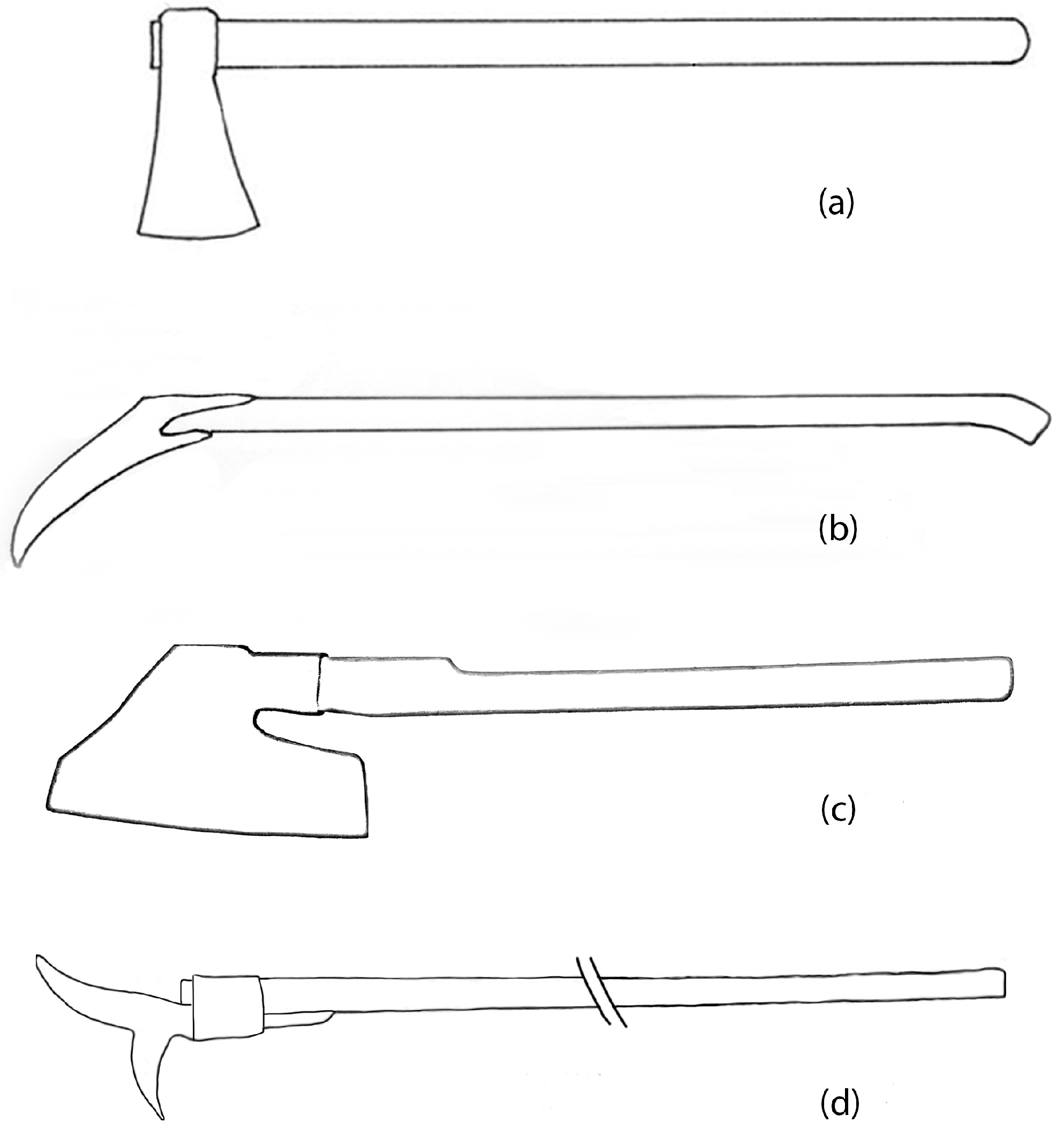
Until the 1950s, in Italy tree felling and the initial processing of logs obtained from the stems was performed manually by men using axes, saws, and pickaroons (Figure 1). Other tools, such as barking irons, billhooks, wedges, and hooks, were also employed for specific operations or to aid workers’ movements, as in the case of crampons. The axe has an uninterrupted history going back to the Neolithic, whereas the use of the saw for felling trees was introduced in the eastern Alps, with a strong resistance to its adoption by workers, at the beginning of the 18th century [1]. We are poorly informed about the use of the pickaroon: in Bavaria and Tyrol its use is reported since the beginning of the 18th century, and in the Adige and Piave valleys perhaps a century earlier [2]. In the Swiss Jura mountains, the pickaroon was apparently unknown until the end of the 19th century. Axes and pickaroons employed nowadays are frequently industrial products and can be distinguished by the imprinted name and/or logo of the manufacturer, and sometimes by the imprinted weight of the tool or by other technical information such as the DIN (Deutsches Institut fuer Normung/Norms on Industrial Production) appearing on the metal part of the tool.
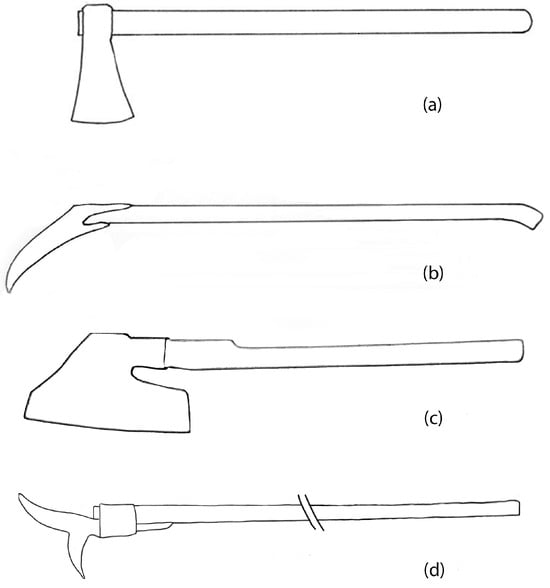
Figure 1.
Drawings of (a) an axe, (b) a pickaroon, (c) a broad axe, and (d) a pike pole.
In Italy, since the 1960s, forestry mechanization has progressively made old forestry tools superfluous. Nevertheless, axes and pickaroons can be necessary in certain situations and are still brought to the work site or can be seen in family or company warehouses and in museums. On the metal parts of these older tools produced by village smiths it is possible to see imprinted signs made by punches, sometimes including letters of the alphabet. While the letters are usually the initials of the name and surname of the smiths, other signs can be described as ornamental drawings or symbols.
Precise information regarding the meaning attributed to the imprinted signs (e.g., religious belief, auspicious function, ownership, etc.) is lacking. Some motifs feature figures that have been employed for millennia across geographically distant cultures and remain apparently valid and in use in the modern and contemporary age. It is uncertain whether the meaning ascribed to these motifs by the blacksmiths who produced the pieces was still consciously recognized, or whether the use of common signs reflected merely a customary practice specific to certain blacksmiths or local tradition.
Evidence relating to the practice of adding hammered signs on tools is rare in the literature, often indirectly presented in publications that are not investigating this aspect [3,4]. The only specific documentation of imprints on forestry tools is a publication by Reinthaler [5] describing 378 specimens of forestry tools with hammered signs selected from the author’s personal collection, most of them axes, hatchets, and pickaroons. He called the imprints “hammered symbols”. The provenance is not mentioned for every piece, but the majority were collected, and presumably produced, in Austria; a few specimens were from Slovenia, Romania, and Hungary, all countries that, until World War I, were included, at least partially, in the Austro-Hungarian Empire. Reinthaler wrote that “in the past, in former times, blacksmiths in the Alps used to decorate tools, especially axes, with symbols and signs of blessings. In order to make these markings, individual decorating hammers and chisels were made. Specific shapes are obtained by a single punch whereas others derive by the repeated use of the same punch or by different punches. Some punches were designed to make small star-like shapes”.
Especially in the Alpine region, superstitions, beliefs, and magical practices have been described as surviving every attempt at evangelization for centuries, preserved thanks to the stability of oral tradition [6]. We cannot say whether the imprinted signs are an expression of magical thinking [7,8], but Reinthaler has been able to relate many of the markings recorded in his catalogue to well-known traditional symbols: the tree of life [9]; the heart; circles or half circles (sun); crosses; five-, six-, or eight-pointed stars; runes; and some other forms. The oldest tools described by Reinthaler go back to the 16th century.
An important motivation for this study was to preserve records of the imprinted signs; their distribution; and, when unknown, their meaning. The concern is that the future of forestry tools, now increasingly unnecessary for forestry work, may be one of complete neglect, disposal as scrap, or ornamental use devoid of connection to their original function and meaning, resulting in a potential loss for the understanding of rural Alpine material culture.
The specific objectives were to (1) document the occurrence of imprints on forestry tools, with a particular focus on the Italian side of the Alps; (2) determine the geographic boundaries of their occurrence; (3) interpret, if possible, their meaning; and (4) maintain a record of this practice, which in Italy has not been examined so closely before. Furthermore, while Reinthaler’s work focused mainly on axes and broad axes, a large collection of pickaroons was characterized through this research.
2. Geographic Area
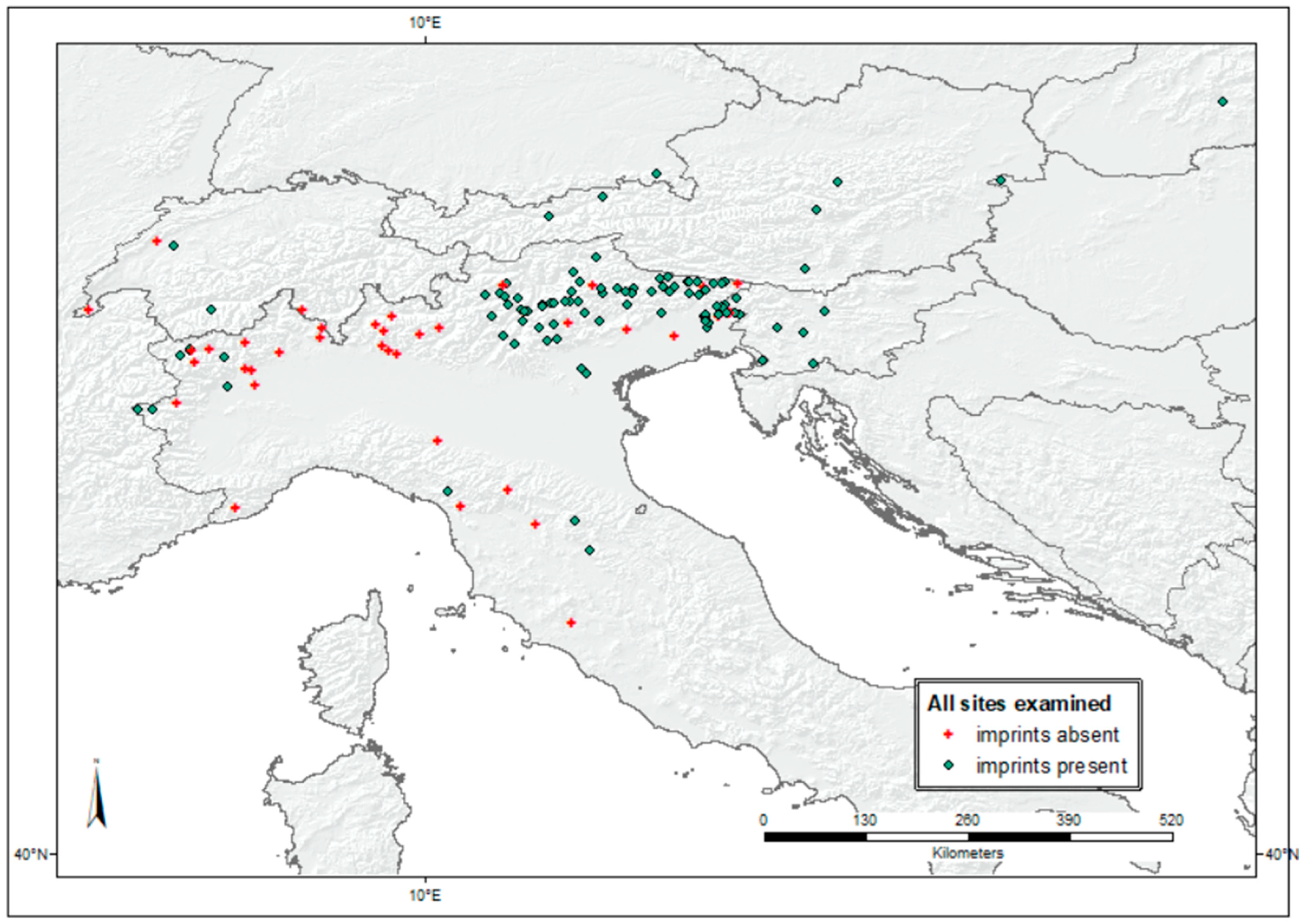
The study aimed to determine the geographic occurrence of historically imprinted signs, focusing initially on the northeastern part of Italy, in the Friuli-Venezia Giulia Region, where a large number of old forestry tools were found, then extending observations to Trentino-Alto Adige, where imprinted tools are still used in logging activities or preserved in warehouses, as well as in museums. The research was subsequently expanded to the other Alpine regions in Italy—Veneto, Trentino-Alto Adige, Valle d’Aosta, Lombardy, and Piedmont—and less systematically to other countries, such as Austria, Germany, and Slovenia, where only tools exhibited in museums were considered (Figure 2). Research on the French side of the Alps and in Switzerland was constrained by the difficulty in identifying relevant collections to be targeted and to obtain information. Additional specimens from the Slovak Republic and Hungary were supplied by informants. Finally, some observations were conducted in localities of the northern Apennines (Tuscany).
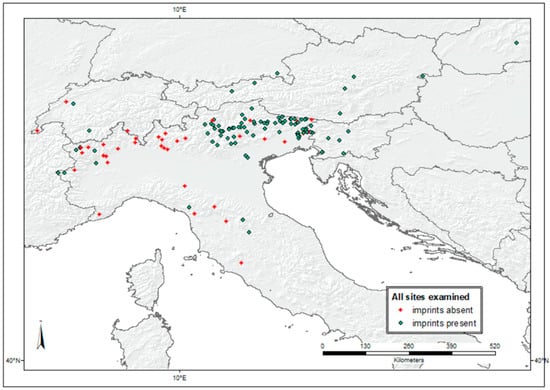
Figure 2.
Map with 137 localities where forestry tools were found and assessed to detect the presence and absence of imprints, composed by initials alone or combined with imprinted patterns. The countries included in the study were Italy (120), Austria (5), Germany (1), Slovenia (6), Slovakia (1), Switzerland (6), and Hungary (1). The absence of imprints on the metal parts of forestry tools is indicated with a red cross. All other collections presented at least one item with imprints; these could consist of (a) initials, (b) initials in combination with decorative patterns, or (c) decorative patterns alone without initials.
3. Materials and Methods
3.1. Tool Types and Terminology
Besides collecting images of tools used for forestry work, we characterized carpentry tools (broad axes), which appeared to be rich with imprinted signs, and we carried out observations on crampons. We excluded from this study “hammers” used to mark trees to be felled because they are used by public administration officers or freelance professionals, each hammer having an imprinted sign referring to the person who is entitled to use it, so there the meaning of the marks is clear; axes and hatchets supplied to military forces and recycled in the rural economy, as well as firefighters’ hatchets were not included; we also excluded tools shown in antiques catalogs available on the internet or to be found in occasional markets (with a few exceptions for items with particular imprinted signs), since their geographic origin was unknown or dubious. Tools showing producer’s signs (initials of the blacksmith) but without additional imprinted signs were not considered in this study. Occasionally, we recorded agricultural and domestic tools found in country houses and museums (e.g., sickles, scythes, anvils for sharping scythes, etc.) to check if imprints on these tools differed from those found on forestry tools.
Regarding the typical set of tools used for woodworking, an interesting drawing from the mid-nineteenth century [10] describes a woodcutter’s equipment, which included seven types of cutting tools, including different axes to fell trees and to split wood, and broad axes used to square up logs and lop [11,12]. Terms used locally to indicate a specific tool can vary across locations, as these terms often belonged to a local idiom or workers’ slang [13]. Their translation in English could be ambiguous, but photographs and drawings should clarify their shape and use.
An axe is a tool used to fell trees and limb them on the ground (Figure 1a,c) and to conduct other operations on felled stems, while the broad axe is used in carpentry to obtain beams. Broad axes were typically used by carpenters and wheelwrights; they have more varied shapes and sizes also because, in the past, they were used as weapons, when necessary [14,15]. The pickaroon, a tool used to stack, drag, and rearrange logs, is an iron bar 25–35 cm long, ending on one side with a hook and connected on the other side to a long wooden handle (Figure 1b). The shape of the iron is relatively uniform, while the angle between the handle and the iron varies according to the type of work or the size of the logs to be handled, but it is always greater than 90°. The pike pole was used to shift floating timber. The iron is fixed on top of a 2–3 m long pole and is provided with two iron tips, one shaped for pushing and the other one shaped as a hook for pulling floating timber (Figure 1d). Today, fuelwood and timber transportation by floating in streams is no longer practiced.
3.2. Material Found and Examined
We inventoried both individual tools, still used or stored by workers, and specimens belonging to museum collections. Every tool selected for our analysis was photographed. Information dealing with items conserved in museums or private collections was provided by the owners of collections or by museum curators.
The inventory of images included the following materials: (1) photographs taken by the authors; (2) photographs taken by collaborators who were mobilized, due to their known interest on the theme of this research, and who shared their photographic material; (3) images shared by curators of museum collections or by collaborators who could have access to museum collections in remote locations; (4) images taken from collections and other resources made accessible online by different institutions (e.g., the Regional Information System of the Cultural Heritage of Friuli-Venezia Giulia/Sistema Informativo Regionale del Patrimonio Culturale del Friuli Venezia Giulia-SIRPAC).
A list of localities was compiled, indicating places where the tools inventoried were still in use, were discovered during field exploration, or were located within private collections, originated based on instructions reported in museum collections and informants who supplied georeferenced images of relevant specimens. After georeferencing all records, a list of 137 localities was compiled (Table A1) and a map representing the spread of the overall sampling was produced (Figure 2). Additional maps were produced showing the distribution of individual types of recurrent imprints.
Despite a search for old blacksmiths and craftsmen, it was not possible to find direct testimonies of the practice of imprinting signs on forestry tools, so our review was integrated with scanty information from the literature and rare oral testimonies regarding blacksmiths’ practices. Further information was provided by the curators of the museums visited.
4. Results
4.1. Description of Common Imprints Found on Iron Tools
A total of 561 individual forestry tools consisting of axes, broad axes, pickaroons, and pike poles were examined (Table A1, Figure 2); 481 pieces had imprints of different kinds: alphabet letters, alone or combined with apparently ornamental patterns, and ornamental patterns without letters (Figure 3 and Figure 4). The spatial distribution of individual types of tools with imprints was mapped separately (see Figures S1–S3 in the Supplementary Materials). After excluding the tools showing only alphabet letters, a further sub-set of 331 tools with a variety of imprinted patterns, found across 88 different locations, was considered for a closer analysis (see Table A1, records marked with asterisk). In terms of the abundance of specimens, the sub-set of pieces examined was mainly constituted by pickaroons and axes (46.8% and 29.9%, respectively), followed by broad axes (22.7%) and pike poles (0.6%). In addition, 12 crampons were found across 11 locations; 8 of them presented imprinted signs in the middle of the lower side; of these, 5 showed an imprinted cross.
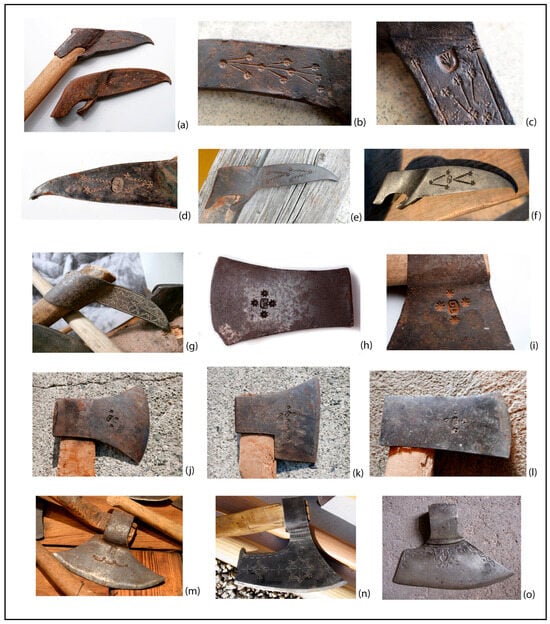
Figure 3.
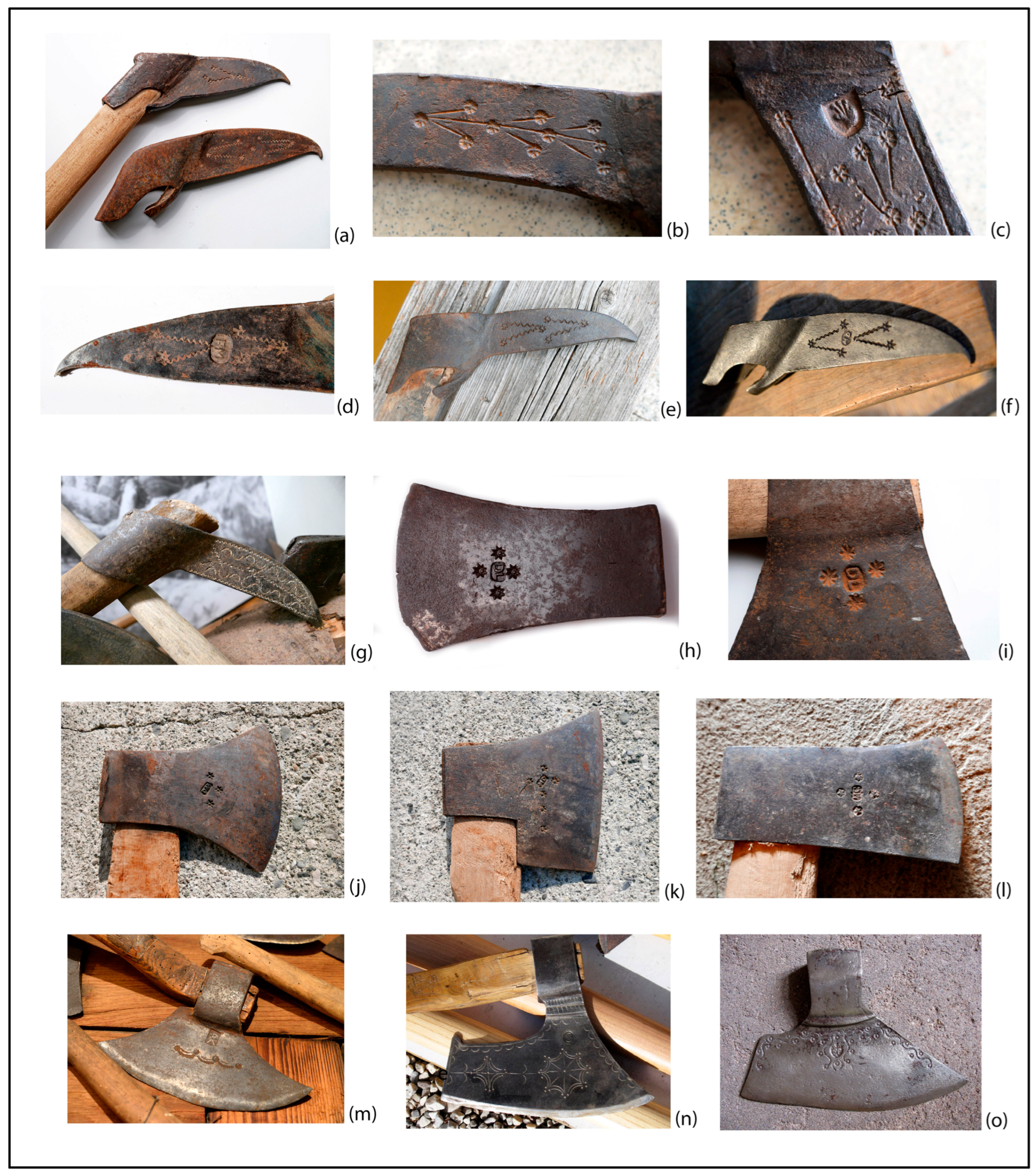
Selected images of tools with symbols on “zappini” (pickaroons) (a–g), axes (h–l), and broad axes for carpentry (m–o). The tools were found at the following sites: (a–c) Museo degli Zattieri (Codissago di Castellavazzo, Belluno), (d) Paularo (Udine), (e) Malborghetto (Udine), (f) Grimacco (Udine), (g) Serravella (Cesiomaggiore, Belluno), (h,i) Paularo (Udine), (j–l) Sauris (Udine), (m) Grimacco (Udine), (n) Tricesimo (Udine), and (o) Val di Sole (Museo etnografico trentino San Michele, San Michele all’Adige, Trento).
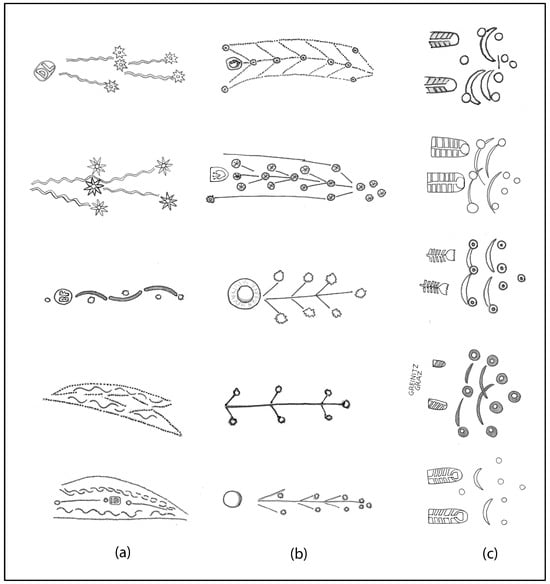
Figure 4.
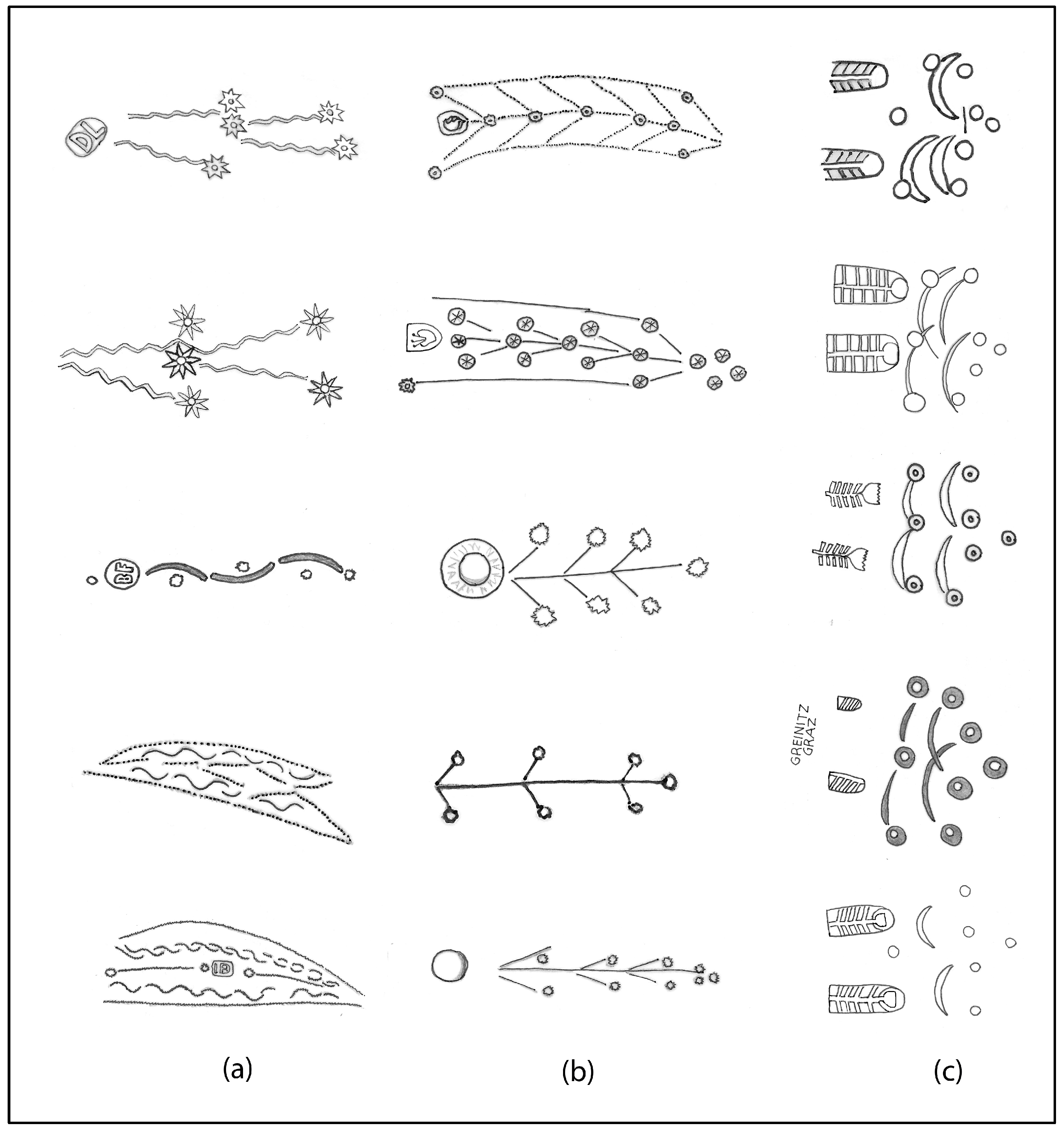
Recurrent symbols on tools of very different origin: pickaroons (a,b) and axes or broad axes (c).
The imprints usually occupied the faces of the blade of axes and pickaroons, sometimes appearing on both sides of the iron but more often only on the straight face; very rarely were they found around the eye of the tool. The imprints were often formed of a variable combination of elementary, straight, and curved shapes; sometimes alphabetic letters (Figure 4); and occasionally numbers or more recognizable symbolic and/or ornamental elements.
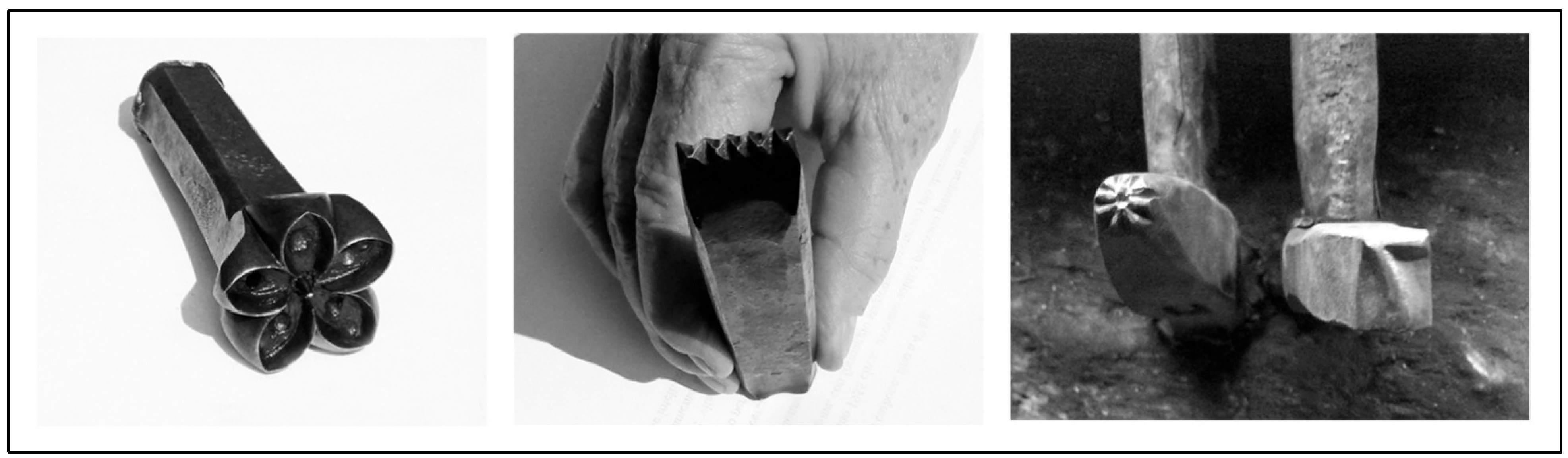
These forms were sometimes located without a clear pattern, sometimes following rectilinear or curvilinear patterns, in such a way as to determine variably elaborated shapes (crosses, circles, etc.). When found on both sides of the iron, imprinted signs could present the same motifs or different ones. These signs were impressed by individual punches with distinct shapes (Figure 5). Examples of punches have been observed in old forges (no longer active), in museums, and as loose pieces in some localities visited (i.e., Moggio, Premana, Maniago, and Aosta).
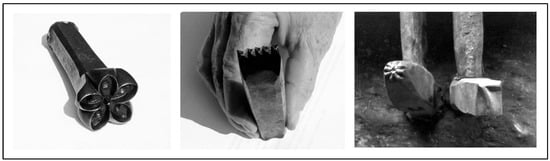
Figure 5.
Examples of punches of different shapes.
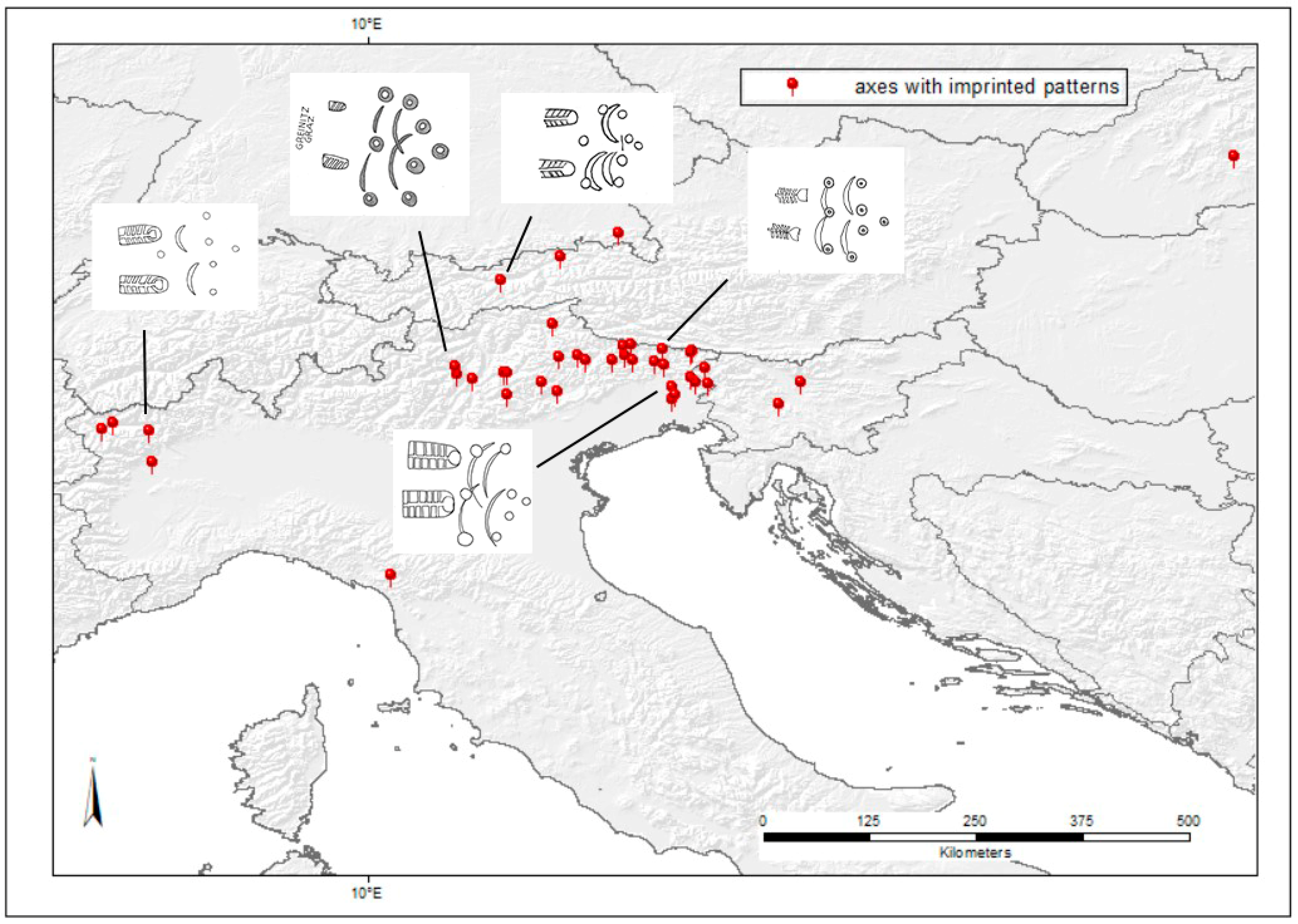
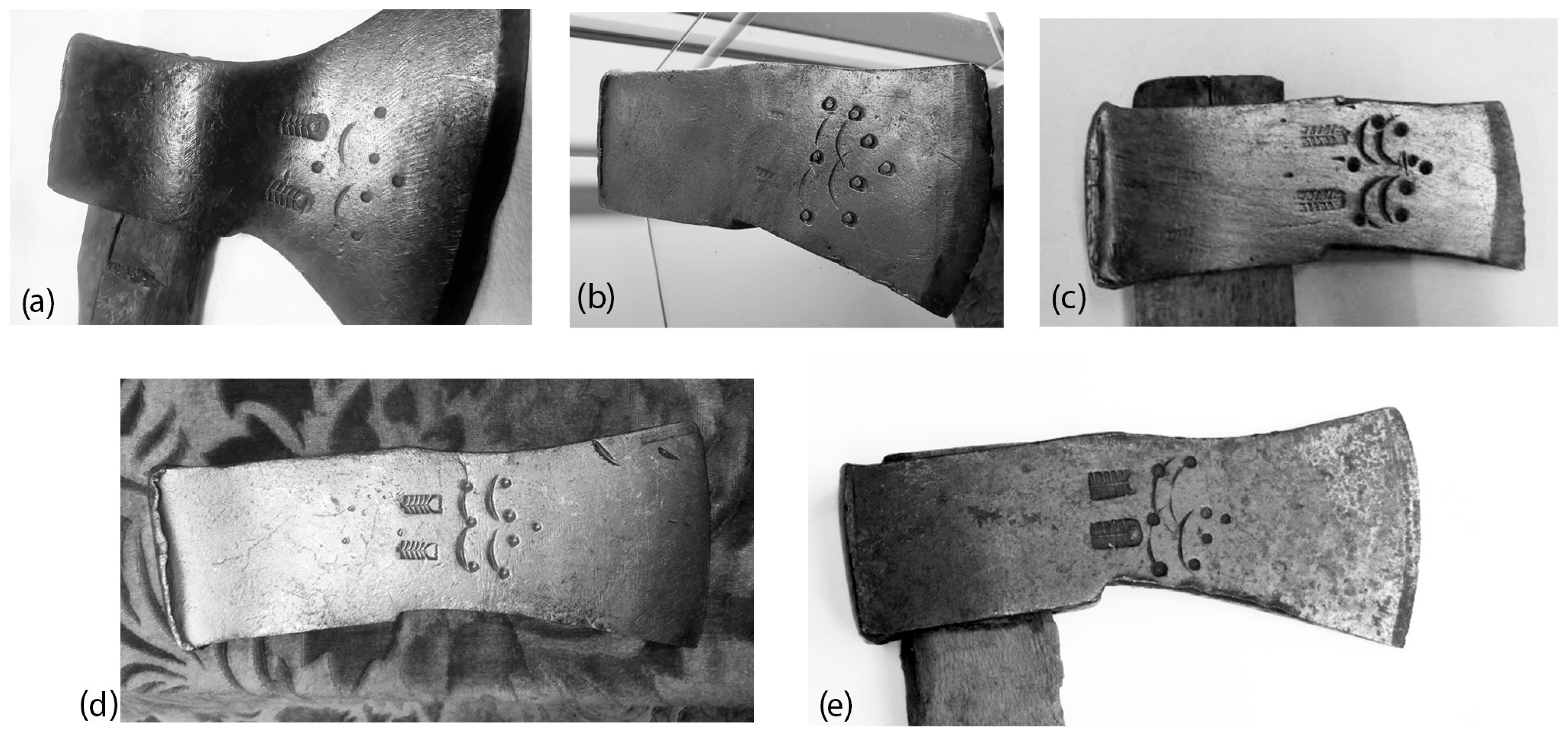
The abundance and richness of imprints varied according to the type of tool. The markings were usually simple on axes and hatchets and more complex on broad axes. A few specimens presented similar complex signs combining arches, dots, and small punches resembling a “tree of life", always a couple of them side by side. These specimens were found across very distant locations (see Figure 6 and Figure 7). On pickaroons, the most common imprinted sign is represented by two lines converging, but not joining, to form a ticked “V”, combined with imprints that resemble stars or small “rosettes” (Figure 3f and Figure 4a). On pickaroons, different imprinted signs remind one of the shape of a tree (Figure 4b).
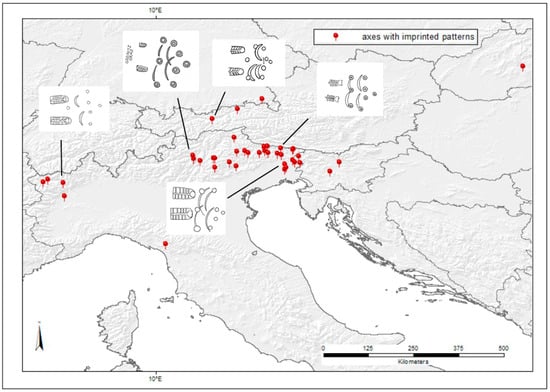
Figure 6.
The map shows where five unique axes presenting complex imprinted patterns with similar structures were found in very distant locations across the Alpine regions, namely (moving from west to east), Verres (Aosta), Val di Sole (Museo etnografico trentino San Michele, San Michele all’Adige, Trento), Tyrolean State Museums/Museum of Tyrolean Regional Heritage, Innsbruck (Austria), Laglesie-San Leopoldo (Pontebba, Udine), and Tavagnacco (Udine). The red dots represent the overall distribution of all axes with imprinted signs found in this research (after excluding those showing only alphabet letters). The five inset images reproduce the motifs if the imprinted signs on the five axes.
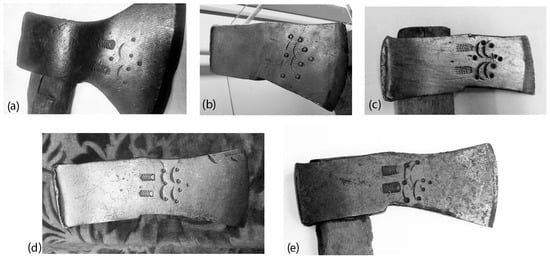
Figure 7.
Images of axes with similar, complex imprinted patterns. The tools were found in very distant locations across the Alpine regions, namely (moving from west to east), (a) Verres (Aosta), (b) Val di Sole (collection of the Museo etnografico trentino San Michele, San Michele all’Adige, Trento), (c) Innsbruck (collection of the Tyrolean State Museums/Museum of Tyrolean Regional Heritage; item presumably from Pfunders/Fundres), (d) Laglesie-San Leopoldo (Pontebba, Udine), and (e) Tavagnacco (Udine).
From our screening of museum collections, it turned out that imprints representing religious symbols and the “tree of life” appeared on both forestry tools and other agricultural and domestic tools, while the “rosettes” and ticked “V” shape were found only on forestry tools.
4.2. Geographic Spread of Imprints
About 70% of the pieces documented come from the Friuli-Venezia Giulia Region. Tool collections and individual pieces with signs were also found across the mountain areas of Veneto, Trentino-Alto Adige, and Valle d’Aosta. Notably, no imprinted tools were found in Lombardy, and only one item with imprints was identified in each of Piedmont and Tuscany. The few items with imprints found in Valle d’Aosta (inclusive of both axes and other types of tools) were part of a private collection. Beyond the Italian border, the practice was found in various countries, from Bavaria in Germany to the Slovak Republic, Austria, and Slovenia, and to a very limited extent in Switzerland (Figure 4). As explained earlier, the investigations in Switzerland and particularly in the French Alps were limited.
Regarding the spatial distribution of individual common signs on pickaroons, the “tree of life” motif appeared to be relatively widespread in our sample, occurring on pickaroons from Veneto, Trentino-Alto Adige, Friuli-Venezia Giulia, and Austria (Figure S4a, Supplementary Materials). By contrast, the ticked “V” and the curvilinear elements show complementary spatial distributions (Figure S4b,c; Supplementary Materials): the ticked “V” displays a more easterly pattern, occurring more in samples from Friuli-Venezia Giulia, whereas curvilinear elements are more common on pickaroons from areas west of Friuli, in Veneto and Trentino-Alto Adige (Italy).
4.3. Hammered Tools from Carnia (Friuli)
Most of the tools with hammered signs were recorded in Carnia, the northwestern part of Friuli-Venezia Giulia, where the investigations started and where more documentation was available. Accessing local informants, it was possible to attribute the initials found on forestry tools to known small-scale blacksmiths and to reconstruct the locations of all their artisanal forgeries; these operated not far from each other, in the same valley or in neighboring locations (Figure 8, Table 1), and ceased their activity approximately in the late 1940s.
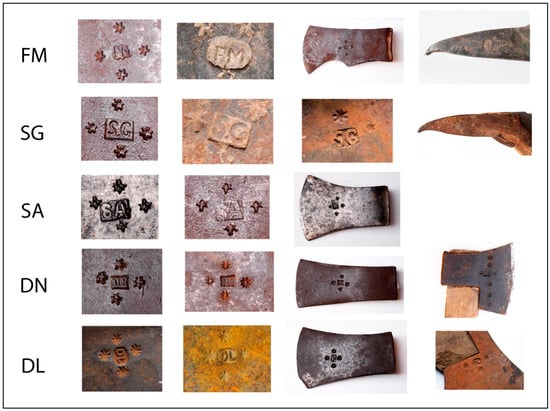
Figure 8.
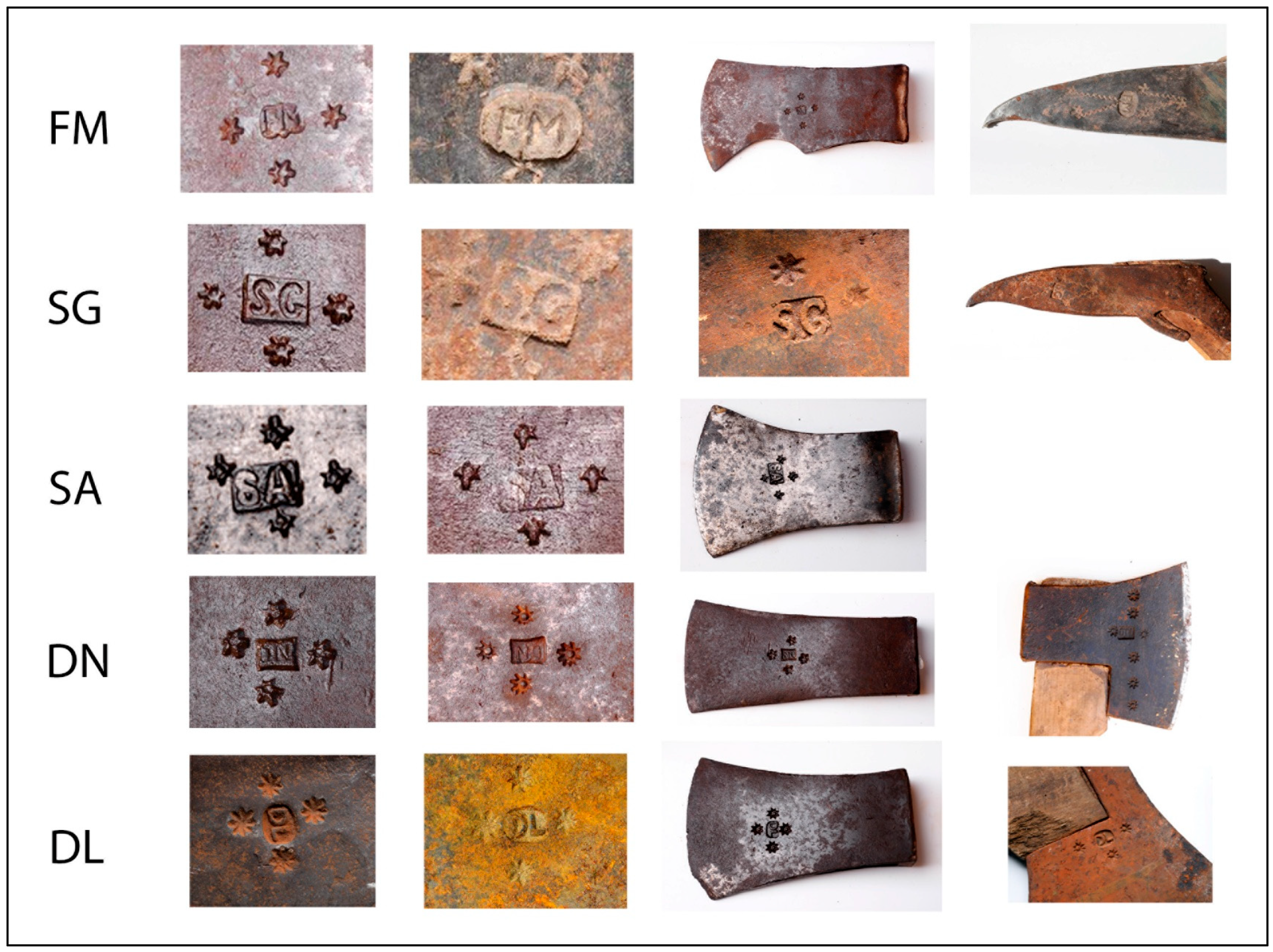
Initials of the blacksmiths active in Carnia (Friuli, Italy) and forestry tools from their production sites, with hammered initials combined with other motifs, presented in their variants. All tools in the table are part of the collection of the museum “Menaus” in Paularo (Udine).

Table 1.
Blacksmiths active in Carnia (Friuli, Italy) (from the end of the 19th century to the mid-20th century) and their initials hammered on forestry tools from their production sites.
The letters of the alphabet representing the initials of different blacksmiths were associated with the same type of imprinted signs representing “rosettes”. These were positioned in such a way as to outline a cross around the imprinted initials of the blacksmith’s name, positioned at the center (Figure 8). The “rosette” signs used by various blacksmiths were applied using different punches, with a variable number of petals. The slightly different punches used for common imprints may have been due to the need by blacksmiths to differentiate their products while adopting a common style across a broad area. Similarly to axes presenting variants of the “rosettes”, different blacksmiths used recurrent motifs on pickaroons, impressed next to the initials of various blacksmiths in Carnia (Figure S5, Supplementary Materials).
5. Discussion
5.1. Distribution of Hammered Signs
Woodworking tools have been central to human technological development since prehistory, evolving in form and material alongside changes in production systems and craft organization [15,16]. From early stone and metal tools used for felling and shaping timber, woodworking implements became increasingly specialized during antiquity and the Middle Ages, reflecting the diversification of crafts such as carpentry and joinery [15,17]. Despite these developments, many tool forms remained stable over long periods, limiting the potential for precise chronological attribution based on typology alone [16].
The beginning of the practice of imprinting signs on tools is not easy to define; cutting tools with hammered imprinted symbols can be found since classical antiquity [18,19]. Medieval weapons, including battle axes, were frequently adorned with complex imprints with an aesthetic purpose to add prestige; weaponry also carried craftsman’s marks [20]. Craft marks on woodworking tools, including maker’s marks, ownership marks, and use-related traces, provide valuable insights into production, circulation, and use practices [15,21]. The growth of guild systems in Medieval and Early Modern Europe encouraged the use of identifiable marks for economic and legal purposes, while increasing commercialization later led to more standardized maker’s marks [17]. Together, tool typology, marks, and wear patterns contribute to understanding woodworking technologies and their broader social and economic contexts [16].
According to Reinthaler [5], blacksmith marks came into use after the foundation of the guilds, worker associations born in the Italian, German, and British worlds at the beginning of the 13th century. However, we know that in Italy craft guilds have existed since the 10th century [22], and earlier reference to professional guilds can be found in Roman times (called corpora and collegia) [23]. In the late 19th–early 20th c., widespread decline in craft-based production systems and local artisanal trade, including farm-based woodworking and forge-based craft, took place in multiple Alpine regions (Italy, Switzerland, Austria, and Slovenia) as a result of mechanization, deskilling, division of labor, and migration [24]. As for other manufactured products, the industrial production of forestry tools started long before the end of the activity of village craftsmen; for example, the well-known factory Rinaldo (Bergamo) claims two centuries of activity (see https://www.br-rinaldi.it/). The imprinted signs traced and catalogued in this study were likely impressed on forestry tools during the 19th and the first half of the 20th centuries.
Mapping the occurrence of imprinted signs on forestry tools through this research revealed a distribution range potentially coinciding with historical socio-cultural boundaries. Italy’s political borders have shifted over the last century; following World War I, the border with Austria changed, and after World War II, adjustments were made along the frontiers with the former Yugoslavia (now Slovenia) and France. In contrast, the ethnic boundaries between Italian, German, and Slavic populations have remained comparatively stable. The northeastern part of Friuli-Venezia Giulia, where most forestry tools were catalogued, has its borders with countries with populations ethnically German and Slavic. Based on evidence from Reinthaler [5], the practice of imprinting signs on tools was common also in Hungary and Romania; in both these countries, once partially included in the Habsburg Empire, large settlements of German populations existed. Examples of elaborate decorations imprinted on carpenters’ axes have also been found in contexts far from Europe (e.g., in Japan), but the stylistic canons and socio-cultural background are very different [25].
Some of the tools examined, particularly broad axes, were uncommon in regions where high forests were scarce, like the northern Apennines, where beech stands predominated. These woodlands were primarily exploited for fuelwood and charcoal production or for obtaining wood used in crafting household items. However, in the Northern Apennines, where a few large conifer stands established by religious orders still exist today (for example, the fir forests of Camaldoli and Vallombrosa), pickaroons were apparently introduced at the beginning of the 20th century [26]. Looking at rare specimens with imprinted signs found outside the Alpine region, we can hypothesize that the forestry tools were carried by migrant workers.
For instance, a pickaroon bearing an imprinted mark found in the Stia collection (Tuscany, Apennines) likely reflects a specific historical episode: before and during World War I, a Milan-based private company carried out large-scale forest utilization, employing Alpine-trained forest workers who brought their own tools and equipment [26].
The custom of imprinting signs on forestry tools appears to be absent in relatively small areas of the Italian Alps; this fact could reflect a true absence of imprinted signs, possibly related to the fact that, in some localities, wood exploitation may not have required the kind of tools investigated in this study. Some uncertainties remain about whether the tools with imprinted signs were all artisanal, although particular care was taken to exclude all tools that appeared industrially produced, which were often easy to separate. Another constraint in reconstructing the distribution of imprinted signs is the fact that some forestry tools catalogued in private and museum collections could originate from distant locations, not always precisely recorded.
5.2. Attempts to Interpret the Meaning of Imprinted Signs
It is hard to reconstruct how many signs were traditionally preserved in the culture of rural populations and the practice of artisanal blacksmiths. Based on the large available literature [27,28], and by analogy with agricultural and household tools, the hammered signs found on forestry tools sometimes presented recognizable elements, such as the “tree of life”, the six–eight-spoked wheel (a symbol of sun and life), or motifs typical of the Christian faith (e.g., the cross, the heart with nails of the crucifixion, and the anchor).
Sometimes village smiths produced tools, especially axes, according to specific personal requests, considering, for instance, the body size and strength of the customer; it is not clear, however, whether specific hammered symbols were chosen on the initiative of the blacksmith or at the request of the buyer. Based on an informant interviewed by Reinthaler [5], special symbols were imprinted upon the request of customers, for an additional charge. The foundry assigned the task to a specialist in the forge, and the imprinting had to be carried out while the piece was still hot, before tempering. Customers could choose the desired decorative patterns from a hand-drawn sample book. It is not clear if the information reported by Reinthaler refers to a common practice or a single case.
It seems significant that a similar system of representing certain values with imprinted motifs was shared by people belonging to different linguistic and cultural areas (Italy, Austria, and Slovenia), although the interpretation of the hammered signs sometimes escapes us due to the lack of direct evidence to draw on. Traditional blacksmiths’ forges have closed or have adopted modern technologies. This circumstance reduced drastically the possibility of meeting blacksmiths who still produce forestry tools with traditional techniques; direct information about the practice of adding imprints on metal tools from manufacturers and about the meaning of different imprinted signs and the reasons for imprinting one or another sign was therefore not accessible. Some forest workers, encountered and interviewed during the research, are still using old tools, likely inherited from family members, while remaining unaware of the meaning of the imprinted signs.
We can ask ourselves whether these signs were associated or not with the rituals that accompanied the use of the tools on which they were placed. For example, a video filmed around the 1980s records the activity of log displacement by gravity on snow and shows a worker who, while putting on his crampons, makes the sign of the cross on them (Friuli-Venezia Giulia Autonomous Region. Television Production Centre). So, the imprinted signs could perhaps be interpreted as a means of ensuring protection from possible accidents during dangerous work in the wood, or to ask for “divine” assistance to perform the job well [7]. The effective blow of the axe, which occurs in a fraction of a second, concludes a series of operations that have required hours of effort to approach the tree and to prepare the space in which to operate (removing any stones, shrubs, dry branches, etc.).
5.3. Types of Imprints on Different Tools
For each type of forestry tool examined, imprinted marks were present only on some specimens, not on all examples found. The proportion of tools bearing such imprints remains unknown, as museums and private collections tend to showcase the most remarkable or visually attractive pieces.
The types of imprinted marks vary depending on the tools on which they appear. On axes, the simpler patterns may have served a decorative purpose, but more often they functioned as a maker’s mark, a form of branding that acted as both a guarantee of quality and an element of advertisement. Axes generally had a shorter lifespan than many other tools, as they wore down and were easily damaged with use. For this reason, it was advantageous for users to know which blacksmith to return to for repairs.
Similar intricate patterns were found across various regions of the Alps (Figure 7 and Figure 8). The presence of almost identical motifs in distant locations may be linked to the seasonal migrations of workers. From the 19th century until the 1970s, forest workers from the Italian Alpine regions traveled to different parts of Europe, bringing their tools with them. At the end of the work season, these tools might have been left behind, lost, stolen, or sold in the host countries if no longer needed.
We do not know how forestry tools were moved by workers migrating in various parts of Western Europe now included in Serbia, Ukraine, Hungary, and Romania. According to Zanini [29], forest workers employed abroad frequently used to take along tools produced by a large forgery, Morocutti, active in Pontebba, a town situated along the main road from the Italian side of the Alps to the Eastern European countries. This migration path was commonly followed by migrant workers during the 19th century and the beginning of the 20th century. The name Morocutti was also adopted in Austria to indicate a specific type of pickaroon [30]. In some cases, a highly reputed blacksmith granted permission for other smiths to use his seal on their products. It is also possible that a certain degree of imitation, common across many crafts, occurred as well.
Archival documents reveal that in the forest of Paneveggio (Trentino-Alto Adige), large work crews employed by timber merchants were supplied with all the necessary tools by their employers (State Archives of Trento/AST_Amministrazione delle Foreste Demaniali di Cavalese e Primiero/AFDCT). In such cases, tool production was likely standardized.
Decorative patterns were largely created from a limited group of basic signs that resemble “rosettes” (or stars) with small variations, simple or zigzagging elements, and point-like elements. One possible reason why the range of motifs of imprinted signs remains relatively limited (like in the case of hammered tools from Carnia) may lie in the design constraints of the punches used to create them. Commonly, these had a limited range of shapes, ranging from straight to curvilinear forms, and included variations of the “rosette” motif, distinguished by differing numbers of petals. The variety of imprinted designs was likely limited by the number of punches available in a smith’s forge. Another factor limiting the diversity of imprinted signs may have been the size of the available metal surface (larger on broad axes) and the specific shape of the tool, as in the case of pickaroons.
5.4. Limitations of the Study
This study faced some limitations. Unfortunately, it was not possible to extend the research in the French side of the Alps, and observations from Switzerland were also limited. This was due to difficulties identifying relevant collections of forestry tools and the difficulty in obtaining information from a distance. In addition, some small museums were open only for very short periods of the year and others were temporarily closed due to renovations. The same is true for the Apennines (Italy), where we conducted few observations, because, except for Tuscany, the northern Apennines (closer to the Alpine region of interest) have not been characterized by extensive high forests of conifers, whose management would have required the types of forestry tools examined in this study. To gain a better understanding of the spread of the practice of imprinting signs on forestry tools, future investigations should prioritize addressing these geographic gaps. This would provide further elements to support or reject the hypothesis that the diffusion area of the practice of imprinting signs on forestry tools overlaps with the past borders of the Austro-Hungarian forest economy. Broader investigations could also be directed to other regions with logging and woodworking traditions (e.g., Scandinavian countries) for further comparisons.
Another limitation of the study was caused by the difficulty in dating the tools examined. As a result, what we have identified as artisanal production could not be supported by precise dating of the metal parts of the forestry tools examined. Further research on this topic could be directed toward tracing older samples and archaeological specimens to investigate the origins of the practice described, although accessing adequate finds could be difficult.
Furthermore, in terms of interpreting the meaning of the signs, particularly in cases where recurrent motifs were reproduced by different blacksmiths, this study was limited by a lack of direct testimonies from the toolmakers themselves, as the practice dates back too far to access firsthand accounts. Lastly, the exact origin of some of the tools inventoried remains uncertain, especially for a few items found in museum collections. Despite the limitations described, this research constitutes a first attempt to present a detailed account of a “lexicon”, only partially “deciphered”, used in the forest workers’ community in the Italian context and its links with similar communities in other countries.
6. Conclusions
In this study, the practice of marking forestry tools with hammered signs, as carried out by artisanal blacksmith workshops up until the first half of the 20th century, was documented and characterized for the first time in the Italian Alpine region.
Some of these signs reflect a distinct cultural practice and a symbolic language whose meaning is not yet fully understood, although certain motifs, such as religious icons or the tree of life, are more clearly interpreted.
Beginning with the eastern Alpine region, where a large number of forestry tools bearing such marks were discovered, the study was later extended to other Alpine areas to determine whether the practice was more widespread. Evidence shows that this tradition also extended into Austria and Germany (particularly Bavaria). While the focus of the research was the Alpine region, some marked forestry tools were also found as far away as the Carpathians, opening new questions on the actual extent of this practice.
The geographic distribution of the hammered symbols appears to correspond both to the broad Alpine forested zone and to a shared cultural area encompassing three ethnic groups (Italian, Austrian, and Slovenian). However, the geographic distribution of forestry tools with imprinted signs may also reflect more recent patterns of human movement and tool trade.
Due to practical constraints and limited resources, the research could not be extended further. Nevertheless, this collection of images connected with forestry tools with hammered signs deserves to be preserved. We hope that ethnographers will build on this inventory to gain deeper insights into their cultural significance.
Supplementary Materials
The following supporting information can be downloaded at: https://www.mdpi.com/article/10.3390/heritage9020049/s1, Figure S1. Locations where axes with imprinted patterns were found. Tools with simple initials were excluded and their location is not visualized; Figure S2. Locations where broad axes with imprinted patterns were found. Tools with simple initials were excluded and their location is not visualized; Figure S3. Locations where pickaroons with imprinted patterns were found. Tools with simple initials were excluded and their location is not visualized; Figure S4. Spatial distribution of different imprinted signs on pickaroons: (a) signs with > shape (Δ), (b) curvilinear signs (Ө), (c) tree of life (X); Figure S5. Location of blacksmiths from Carnia, whose initials are listed in Table 1 of the article.
Author Contributions
Conceptualization, P.P. and B.V., Methodology, P.P. and B.V.; Validation, O.Z.; Formal Analysis, B.V.; Investigation, P.P., O.Z., and B.V.; Resources, P.P., O.Z., and B.V.; Data Curation, B.V.; Writing—Original Draft Preparation, P.P. and B.V.; Writing—Review and Editing, P.P. and B.V.; Visualization, B.V.; Supervision, P.P.; Project Administration, P.P. and B.V.; Funding Acquisition, P.P. and B.V. All authors have read and agreed to the published version of the manuscript.
Funding
This research received no external funding.
Data Availability Statement
The raw data supporting the conclusions of this article will be made available by the authors on request.
Acknowledgments
Many individuals contributed to this study, including foresters, forest researchers, and museum collection curators. While it would be difficult to name everyone who provided input, we would like to acknowledge those collaborators who were more directly involved and supported the research in various ways, from sharing essential information to providing additional forestry tools bearing imprinted signs which have been added to this inventory. In particular, we thank the contributions of Tiziana Ribezzi (former curator of the Museo Etnografico del Friuli, Udine), Corrado Letey, Daniela Brovadan (Museo Ladino di Fassa, San Giovanni di Fassa/Sen Jan, Trento) Daniela Perco (former curator of the Museo Etnografico Dolomiti, Cesiomaggiore, Belluno), Andrea Sgarbossa, Raffaele Cavalli, Novella and Fausto Del Fabbro, Luca Faoro (Museo etnografico trentino San Michele, San Michele all’Adige, Trento), Marco Reputin, Richard Beer, Karl C. Berger and Verena Pfaff from the Tyrolean State Museums/Museum of Tyrolean Regional Heritage (Innsbruck), Lucia Protto (Centro Etnografico S'Haus van der Zahre, Sauris di Sopra, Udine), and the Museo Etnografico Ruttar (Grimacco, Udine).
Conflicts of Interest
The authors declare no conflicts of interest.
Appendix A
Table A1.
All 137 localities where forestry tools were found and examined closely. Forestry tools with imprinted signs showing different patterns without alphabetic characters were found in 88 localities (marked with an asterisk). Grey shading and italics differentiate the types of collections explored: forestry tools were found in (a) museums or regional online catalogues (records marked with light grey); (b) private collections consisting of one or multiple objects, sometimes still in use; or (c) antique markets (records marked in italics).
Table A1.
All 137 localities where forestry tools were found and examined closely. Forestry tools with imprinted signs showing different patterns without alphabetic characters were found in 88 localities (marked with an asterisk). Grey shading and italics differentiate the types of collections explored: forestry tools were found in (a) museums or regional online catalogues (records marked with light grey); (b) private collections consisting of one or multiple objects, sometimes still in use; or (c) antique markets (records marked in italics).
| Localities Where Forestry Tools with Imprinted Signs Have Been Found | Type of Collection | Province | Region | Country | |
|---|---|---|---|---|---|
| 1 | Alleghe * | Private collection | Belluno | Veneto | Italy |
| 2 | Almenno S. Bartolomeo | Museo del falegname Tino Sana | Bergamo | Lombardia | Italy |
| 3 | Alpe di Siusi * | Private collection | Bolzano | Trentino-Alto Adige | Italy |
| 4 | Ampezzo * | Private collection | Udine | Friuli-Venezia Giulia | Italy |
| 5 | Angerberg * | Museum of Tyrolean Farms | Austria | ||
| 6 | Arco * | Museo etnografico trentino San Michele | Trento | Trentino-Alto Adige | Italy |
| 7 | Ardesio | MEtA-Museo Etnografico dell’Alta Valle Seriana | Bergamo | Lombardia | Italy |
| 8 | Arezzo * | Antique market | Arezzo | Toscana | Italy |
| 9 | Arpuilles * | Private collection | Aosta | Valle d’Aosta | Italy |
| 10 | Asiago * | Private collection | Vicenza | Veneto | Italy |
| 11 | Bardonecchia | Museo Etnografico | Torino | Piemonte | Italy |
| 12 | Basovizza * | Centro didattico naturalistico | Trieste | Friuli-Venezia Giulia | Italy |
| 13 | Bellamonte * | Museo Etnografico di Nonno Gustavo | Trento | Trentino-Alto Adige | Italy |
| 14 | Bergamo | Private collection | Bergamo | Lombardia | Italy |
| 15 | Bergogna | Private collection | Slovenia | ||
| 16 | Bistra * | Technical Museum of Slovenia | Slovenia | ||
| 17 | Borgo d’Ale | Private collection | Vercelli | Piemonte | Italy |
| 18 | Brinzio | Museo della Cultura Rurale Prealpina | Varese | Lombardia | Italy |
| 19 | Calalzo di Cadore * | Private collection | Belluno | Veneto | Italy |
| 20 | Canavese * | Private collection | Torino | Piemonte | Italy |
| 21 | Capriana * | Museo etnografico trentino San Michele | Trento | Trentino-Alto Adige | Italy |
| 22 | Capugnano | Ecomuseo Camugnanese | Bologna | Emilia Romagna | Italy |
| 23 | Carnia * | Private collection | Udine | Friuli-Venezia Giulia | Italy |
| 24 | Maria Saal | Kartner Freilichtmuseum | Carinzia | Austria | |
| 25 | Castellavazzo * | Museo Zattieri | Belluno | Veneto | Italy |
| 26 | Castello di Molina di Fiemme * | Museo etnografico trentino San Michele | Trento | Trentino-Alto Adige | Italy |
| 27 | Castello Tesino | Museo degli Attrezzi del Bosco di Castello Tesino | Trento | Trentino-Alto Adige | Italy |
| 28 | Cavalese * | Museo etnografico trentino San Michele | Trento | Trentino-Alto Adige | Italy |
| 29 | Val di Fiemme * | Museo degli Attrezzi del Bosco di Castello Tesino | Trento | Trentino-Alto Adige | Italy |
| 30 | Cavalese * | Private collection | Trento | Trentino-Alto Adige | Italy |
| 31 | Cercivento * | Private collection | Udine | Friuli-Venezia Giulia | Italy |
| 32 | Cogne | Museo Etnografico | Aosta | Valle d’Aosta | Italy |
| 33 | Dazio | Museo Etnografico | Switzerland | ||
| 34 | Excenex * | Private collection | Aosta | Valle d’Aosta | Italy |
| 35 | Faedo * | Museo etnografico trentino San Michele | Trento | Trentino-Alto Adige | Italy |
| 36 | Fiera di Primiero * | Private collection | Trento | Trentino-Alto Adige | Italy |
| 37 | Firenze | Antique market | Firenze | Toscana | Italy |
| 38 | Fontanabona | Catalogue of SIRPAC | Udine | Friuli-Venezia Giulia | Italy |
| 39 | Forni Avoltri * | Private collection | Udine | Friuli-Venezia Giulia | Italy |
| 40 | Forni di Sopra * | Museo etnografico | Udine | Friuli-Venezia Giulia | Italy |
| 41 | Frattis, Studena, Pontebba | Private collection | Udine | Friuli-Venezia Giulia | Italy |
| 42 | Funes * | Private collection | Bolzano | Trentino-Alto Adige | Italy |
| 43 | Geneva | Catalogue of Musée d’ethnographie de Genève | Ginevra | Switzerland | |
| 44 | Goregnavas (Stupizza) | Private collection | Udine | Friuli-Venezia Giulia | Italy |
| 45 | Gorfignano * | Museo dell’Identità dell’Alta Garfagnana | Lucca | Toscana | Italy |
| 46 | Grimacco * | Private collection | Udine | Friuli-Venezia Giulia | Italy |
| 47 | Grossreifling * | Forstmuseum Silvanum | Austria | ||
| 48 | Idrija * | Idrija Mine Museum | Slovenia | ||
| 49 | Imperia | Antique market | Imperia | Liguria | Italy |
| 50 | Innsbruck * | Tyrolean State Museums/Museum of Tyrolean Regional Heritage | Austria | ||
| 51 | Introd * | Private collection | Aosta | Valle d’Aosta | Italy |
| 52 | Levico * | Museo etnografico trentino San Michele | Trento | Trentino-Alto Adige | Italy |
| 53 | Limena * | Private collection | Padova | Veneto | Italy |
| 54 | Livinallongo | Museo etnografico Ladino | Belluno | Veneto | Italy |
| 55 | Malborghetto * | Museo etnografico | Udine | Friuli-Venezia Giulia | Italy |
| 56 | Malé * | Museo etnografico trentino San Michele | Trento | Trentino-Alto Adige | Italy |
| 57 | Maniago * | Museo dell’Arte Fabbrile e delle Coltellerie + collezione privata | Pordenone | Friuli-Venezia Giulia | Italy |
| 58 | Masseris * | Muzej Varha Matajura | Udine | Friuli-Venezia Giulia | Italy |
| 59 | Mezzolombardo * | Museo etnografico trentino San Michele | Trento | Trentino-Alto Adige | Italy |
| 60 | Moggio Udinese | Private collection | Udine | Friuli-Venezia Giulia | Italy |
| 61 | Mongrando | Ecomuseo della lavorazione del ferro-fucina Morino | Biella | Piemonte | Italy |
| 62 | Monte Nevoso | Private collection | Slovenia | ||
| 63 | Montefosca | Private collection | Udine | Friuli-Venezia Giulia | Italy |
| 64 | Morat, Vully | Catalogue of Musée d’ethnographie de Genève | Switzerland | ||
| 65 | Nazarje * | Muzej Vrbovec | Slovenia | ||
| 66 | Netro | Centro di Documentazione sulla Lavorazione del Ferro (Ex Officine Rubino) | Biella | Piemonte | Italy |
| 67 | Neuchâtel | Catalogue of Musée d’ethnographie de Genève | Switzerland | ||
| 68 | Olle * | Museo etnografico trentino San Michele | Trento | Trentino-Alto Adige | Italy |
| 69 | Ovaro * | Private collection | Udine | Friuli-Venezia Giulia | Italy |
| 70 | Ozzano Taro di Collecchio | Museo Guatelli | Parma | Emilia Romagna | Italy |
| 71 | Paneveggio * | Private collection | Trento | Trentino-Alto Adige | Italy |
| 72 | Paularo * | Ecomuseo “I mistirs” | Udine | Friuli-Venezia Giulia | Italy |
| 73 | Pejo * | Museo etnografico trentino San Michele | Trento | Trentino-Alto Adige | Italy |
| 74 | Perarolo di Cadore (borgata Sacco)* | Private collection | Belluno | Veneto | Italy |
| 75 | Piazzola sul Brenta * | Private collection | Padova | Veneto | Italy |
| 76 | Pie’ Lucese, Valpedogna | Antica ferriera Galgani | Lucca | Toscana | Italy |
| 77 | Pitigliano | Private collection | Grosseto | Toscana | Italy |
| 78 | Platischis * | Private collection | Udine | Friuli-Venezia Giulia | Italy |
| 79 | Pradis, Val Aupa * | Private collection | Udine | Friuli-Venezia Giulia | Italy |
| 80 | Predazzo * | Museo etnografico trentino San Michele | Trento | Trentino-Alto Adige | Italy |
| 81 | Premana | Museo Etnografico | Lecco | Lombardia | Italy |
| 82 | Prossenicco * | Museum | Udine | Friuli-Venezia Giulia | Italy |
| 83 | Pulfero | Private collection | Udine | Friuli-Venezia Giulia | Italy |
| 84 | Rabbi * | Museo etnografico trentino San Michele | Trento | Trentino-Alto Adige | Italy |
| 85 | Raschiacco | Private collection | Udine | Friuli-Venezia Giulia | Italy |
| 86 | Rotzo | Private collection | Vicenza | Veneto | Italy |
| 87 | Ruhpolding * | Holzknechtmuseum Ruhpolding | Germany | ||
| 88 | S. Vito al Tagliamento | Catalogue of SIRPAC | Pordenone | Friuli-Venezia Giulia | Italy |
| 89 | S. Vito di Cadore * | Museo etnografico di S. Vito in Cadore (privato) | Belluno | Veneto | Italy |
| 90 | Salbertrand | Ecomuseo Colombano Romean | Torino | Piemonte | Italy |
| 91 | San Michele all’Adige * | Museo etnografico trentino San Michele | Trento | Trentino-Alto Adige | Italy |
| 92 | Santa Caterina, Malborghetto * | Private collection | Udine | Friuli-Venezia Giulia | Italy |
| 93 | Sappada * | Museo tnografico Giuseppe Fontana | Udine | Friuli-Venezia Giulia | Italy |
| 94 | Sauris * | Centro Etnografico ‘s Haus van der Zahre | Udine | Friuli-Venezia Giulia | Italy |
| 95 | Schilpario | Museo Etnografico | Bergamo | Lombardia | Italy |
| 96 | Senta de Col, Colle S. Lucia * | Istitut Cultural Ladin “Cesa de Jan” | Belluno | Veneto | Italy |
| 97 | Seravella, Cesiomaggiore * | Museo Etnografico Dolomiti | Belluno | Veneto | Italy |
| 98 | Serravalle All’adige * | Private collection | Trento | Trentino-Alto Adige | Italy |
| 99 | Sessa e Monteggio | Piccolo museo Sessa Monteggio | Ticino | Switzerland | |
| 100 | Sopron | Forestry Museum | Hungary | ||
| 101 | Stia * | Museo del Bosco e della Montagna | Arezzo | Toscana | Italy |
| 102 | Stiria * | Private collection | Stiria | Austria | |
| 103 | Stremiz * | Private collection | Udine | Friuli-Venezia Giulia | Italy |
| 104 | Taipana * | Private collection | Udine | Friuli-Venezia Giulia | Italy |
| 105 | Talamona | Museo del Boscaiolo | Sondrio | Lombardia | Italy |
| 106 | Tavagnacco * | Antique market | Udine | Friuli-Venezia Giulia | Italy |
| 107 | Teodone * | Museo Etnografico | Bolzano | Trentino-Alto Adige | Italy |
| 108 | Terenzano * | Private collection | Udine | Friuli-Venezia Giulia | Italy |
| 109 | Timau * | Museum | Udine | Friuli-Venezia Giulia | Italy |
| 110 | Tolmezzo * | Museo Carnico delle arti popolari ‘Michele Gortani’ + private collection | Udine | Friuli-Venezia Giulia | Italy |
| 111 | Trento * | Museo etnografico trentino San Michele | Trento | Trentino-Alto Adige | Italy |
| 112 | Tricesimo * | Private collection | Udine | Friuli-Venezia Giulia | Italy |
| 113 | Tuenno * | Private collection | Trento | Trentino-Alto Adige | Italy |
| 114 | Udine * | Museo Etnografico del Friuli | Udine | Friuli-Venezia Giulia | Italy |
| 115 | Val Bartolo, Tarvisio | Private collection | Udine | Friuli-Venezia Giulia | Italy |
| 116 | Val di Fassa * | Museo Ladin de Fascia | Trento | Trentino-Alto Adige | Italy |
| 117 | Val di Non * | Museo etnografico trentino San Michele | Trento | Trentino-Alto Adige | Italy |
| 118 | Val di Sole * | Museo etnografico trentino San Michele | Trento | Trentino-Alto Adige | Italy |
| 119 | Val di Susa | Private collection | Torino | Piemonte | Italy |
| 120 | Valais * | Catalogue of Musée d’ethnographie de Genève | Valais | Switzerland | |
| 121 | Ultental, Val d’Ultimo * | Museo della Val d’Ultimo | Bolzano | Trentino-Alto Adige | Italy |
| 122 | Santa Geltrude, Val d’Ultimo | Private collection | Bolzano | Trentino-Alto Adige | Italy |
| 123 | Val Raccolana * | Private collection | Udine | Friuli-Venezia Giulia | Italy |
| 124 | Val Rendena * | Private collection | Trento | Trentino-Alto Adige | Italy |
| 125 | Val Trenta * | Private collection | Slovenia | ||
| 126 | Valle Imagna | Museo Valdimagnino | Bergamo | Lombardia | Italy |
| 127 | Valduggia | Private collection | Vicenza | Veneto | Italy |
| 128 | Valfloriana * | Museo etnografico trentino San Michele | Trento | Trentino-Alto Adige | Italy |
| 129 | Valle d’Aosta | Private collection | Aosta | Valle d’Aosta | Italy |
| 130 | Valsesia | Museo Walser | Vercelli | Piemonte | Italy |
| 131 | Valtorta, Val Brembana | Museo Etnografico Alta Valle Brembana | Bergamo | Lombardia | Italy |
| 132 | Verrayes | Private collection | Aosta | Valle d’Aosta | Italy |
| 133 | Venas di Cadore * | Private collection | Belluno | Veneto | Italy |
| 134 | Verrès * | Private collection | Aosta | Valle d’Aosta | Italy |
| 135 | Vittorio Veneto | Private collection | Treviso | Veneto | Italy |
| 136 | Zapatocco * | Private collection | Udine | Friuli-Venezia Giulia | Italy |
| 137 | Zvolen * | Forestry Museum | Slovakia |
References
- Killian, H. Una innovazione selvicolturale: L’introduzione della sega nell’Europa centro-settentrionale (XV–XIX secolo). Quad. Stor. 1982, 17, 59–70. [Google Scholar]
- Occhi, K. Boschi e mercanti: Traffici di legname tra la contea di Tirolo e la Repubblica di Venezia (secoli XVI–XVII). Renaiss. Q. 2007, 60, 153–155. [Google Scholar]
- Šebesta, G. Scritti Etnografici; Museo degli usi e costumi della gente trentina: S. Michele all’Adige, Italy, 1991; 102p. [Google Scholar]
- Ashe, R.; Bettega, G.; Pistoia, U. Un Fiume di Legno. Fluitazione del Legname dal Trentino a Venezia; Quaderni di cultura alpina; Priuli & Verlucca: Scarmagno, Italy, 2010; 128p. [Google Scholar]
- Reinthaler, G. Hammered Symbols on Axes and Other Forged Products; Frogmore Associates: Battle, UK, 2003; 150p. (In English) [Google Scholar]
- Ginzburg, C. Nuove devozioni e letteratura religiosa. In Storia d’Italia; I caratteri originali; I. Einaudi: Milan, Italy, 1986; pp. 619–629. [Google Scholar]
- Frazer, J.G. Il Ramo d’oro. Studio Sulla Magia e la Religione, 2nd ed.; Boringhieri: Torino, Italia, 1973; Volume 1. [Google Scholar]
- Harjula, J. Runic Inscriptions on Stave Vessels in Turku: Materializations of Language, Education, Magic, and Domestic Religion. In Objects, Environment, and Everyday Life in Medieval Europe; Jervis, B., Broderick, L.G., Sologestoa, I.G., Eds.; Brepols: Turnhout, Belgium, 2016; pp. 213–234. [Google Scholar]
- Bockhorn, O. Wundergeschichten von “Lebensbaum”. In Mehr als Worte, Zeichen, Simbole, Sinnbilder; Berger, K., Horner, A., Eds.; Tiroler Landesmuseum: Innsbruck, Austria, 2015; pp. 59–76. [Google Scholar]
- Ast, H. “Schliaβnhackn”. Die traditionelle Kantholzerzeugung der Waldbauern im niederösterreichischen Schneedberggebiet. In Sammeln und Sichten: Beiträge zur Sachvolkskunde. Festschrift für Franz Maresch; Martischnig, M., Ed.; Verband der Wissenschaftlichen Gesellschaften Österreichs: Vienna, Austria, 1979; pp. 27–44. (In German) [Google Scholar]
- Sloane, E. A Museum of Early American Tools; Funk & Wagnalls: New York, NY, USA, 1964; 108p. [Google Scholar]
- SAF (Society of American Foresters). Terminology of Forest Science, Technology, Practice and Products, 2nd ed.; English-language version, with Addendum; SAF (Society of American Foresters): Washington, DC, USA, 1983. [Google Scholar]
- Rosa Fauzza, P. La Tecnologia del Fabbro; Associazione per il Museo dell’arte Fabbrile e Delle Coltellerie: Maniago, Italy, 1994. [Google Scholar]
- Feller, P.; Tourret, F. Werkzeuge aud Alter Zeit; Belser Verlag: Stuttgart, Germany, 1980. [Google Scholar]
- Salaman, R.A. Dictionary of Tools Used in Woodworking and Allied Trades c. 1700–1970; Scribner: New York, NY, USA, 1975; 545p. [Google Scholar]
- Goodman, W.L. The History of Woodworking Tools; G. Bell & Sons: London, UK, 1964. [Google Scholar]
- Blair, J.; Ramsey, N. English Medieval Industries; Hambledon Press: London, UK, 1991. [Google Scholar]
- Buora, M. Sulla lavorazione del ferro in Friuli. Antich. Altoadriatiche 2008, 65, 305–326. [Google Scholar]
- Humphreys, O.J. Craft, Industry and Agriculture in a Roman City: The Iron Tools from London. Ph.D. Thesis, University of Reading, Reading, UK, 2018. [Google Scholar]
- Michalak, A. Terra incognita? Not only on the arms and armour production in the borderland of Silesia, Brandenburg, Greater Poland and Lusatia in the late Middle Ages. Kwart. Hist. Kult. Mater. 2020, 68, 439–461. [Google Scholar] [CrossRef]
- Ottaway, P. Anglo-Scandinavian Ironwork from Coppergate; York Archaeological Trust: York, UK, 1992. [Google Scholar]
- Romano, R. La produzione di beni non agricoli. In Storia d’Italia; I caratteri originali; I. Einaudi: Milan, Italy, 1986; pp. 278–286. [Google Scholar]
- Ulrich, R. Roman Woodworking; Yale University Press: New Haven, CT, USA; London, UK, 2013; 376p. [Google Scholar]
- Mathieu, J. The Alps: An Environmental History; Hadshar, R., Translator; Polity Press: Cambridge, UK, 2019. [Google Scholar]
- Takenaka Carpentry Tools Museum. Permanent Exhibition Catalog; Takenaka Carpentry Tools Museum: Kobe, Japan, 2014; Available online: https://en.dougukan.jp/publishment (accessed on 23 January 2026).
- Chiari, G. La Foresta Casentinese nel Periodo di Proprietà Privata dal 1900 al 1914; Tipografia Il Bandino srl: Firenze, Italy, 2014. [Google Scholar]
- von Zaborsky-Wahlstätten, O. Urväter Erbe in Deutscher Volkskunst; Hase und Koehler: Leipzig, Germany, 1936. [Google Scholar]
- Jakob, S.; Donatus, P.; Leicher, M. Schrift + Symbol in Stein Holz und Metall; Callwey: Munich, Germany, 1977; 328p. [Google Scholar]
- Zanini, L. Friuli Migrante; La Panarie: Udine, Italy, 1937. [Google Scholar]
- Lamp, I. Neuzeitliche Waldarbeiterwerkzeuge; Franz Zimmer: Wien, Austria, 1952. [Google Scholar]

Disclaimer/Publisher’s Note: The statements, opinions and data contained in all publications are solely those of the individual author(s) and contributor(s) and not of MDPI and/or the editor(s). MDPI and/or the editor(s) disclaim responsibility for any injury to people or property resulting from any ideas, methods, instructions or products referred to in the content. |
© 2026 by the authors. Licensee MDPI, Basel, Switzerland. This article is an open access article distributed under the terms and conditions of the Creative Commons Attribution (CC BY) license.