Abstract
Building materials’ fire properties directly affect the fire risk of buildings. Ignition, the initiating event of any building fire, occurs when a heat source ignites surrounding combustible materials. Although several parameters—such as the Thermal Response Parameter (TRP), thermal inertia, ignition temperature, ignition time, critical heat flux (CHF), and heat of combustion—have been used to characterize ignition behavior, a unified metric capable of representing overall ignitability under diverse and often unknown and unintended heat source (UHS) patterns is generally lacking. To address this gap, we propose a new method to evaluate material ignitability by generalizing UHS patterns and linking them to known or readily obtainable material properties, including ignition temperature and thermal inertia. The UHS patterns are represented using lognormal distributions for both exposure duration and incident heat flux (IHF), reflecting conditions that may occur in real buildings. Monte Carlo simulations are employed to generate a large number of heat exposure events from these UHS patterns, enabling statistical determination of material ignitability. The method applies to both thermally thick and thermally thin materials, with a simple expression provided to determine the critical thickness separating these behaviors. Sensitivity analysis demonstrates that the ignitability metric is robust with respect to variations in the lognormal distribution parameters. The proposed ignitability metric provides a general measure of a material’s susceptibility to ignition under typical building fire scenarios and enables relative comparison of fire risk for buildings differing only in the materials adopted.
1. Introduction
Building fire risk largely depends on the fire behavior of building materials or components. Considerable research has been conducted to characterize the fire behavior of building materials, and various material properties and ignition-related parameters have been used in the literature to characterize ignition behavior of solids, including thermal response parameter (TRP), thermal inertia, ignition temperature, critical heat flux (CHF), and ignition energy [1].
Regarding the ease of ignition of building materials, however, a single parameter or property to generally characterize it is currently absent. The difficulties mainly come from the diversity in the patterns of the ignition sources [2,3,4], or more specifically, the Unintended Heat Sources (UHSs), which could generate and impose quite different heat flux strengths and time durations on building materials and lead to very different ignition times. While ignition temperature may vary to some extent with changes in incident heat flux and exposure duration, it is idealized as constant in this research. UHSs commonly found in buildings include electrical arcs, hot spots or surfaces, ignited cigarettes, candles, etc., which could impose a heat flux from several kW/m2 to about 100 kW/m2 on the material’s surface [5], and a duration time ranging from several seconds to several minutes, or in some extreme cases, tens of minutes.
Existing ignition metrics, such as ignition temperature, CHF, and TRP, are typically defined under prescribed exposure conditions and are primarily deterministic in nature. While these parameters describe material response under specific incident heat fluxes, they do not provide an integrated measure of ignition propensity under the diverse and uncertain heat source conditions encountered in buildings. In practice, UHSs exhibit variability in both heat flux intensity and exposure duration, making it difficult to assess ignition likelihood using deterministic metrics alone. To address this limitation, a new property of building material, termed ignitability, is proposed in this paper to represent the overall ease of ignition of a building material (product or element). It is defined as a statistical average measure of ignition response when the material is subjected to a large number of UHSs generated through Monte Carlo sampling of lognormal distributions assumed to represent UHSs commonly found in buildings. Physically, the proposed ignitability index integrates the intrinsic thermal response properties of the material (e.g., ignition temperature, thermal inertia) with the stochastic variability of potential ignition sources. Unlike traditional parameters such as CHF or TRP, which are defined under prescribed heat exposure conditions, the proposed index reflects ignition propensity under uncertain and variable real-building ignition scenarios.
The organization of this paper is as follows: Section 2 discusses and generalizes the different UHSs commonly found in residential and commercial buildings. Section 3 presents the theoretical framework and experimental methods used to determine the ignition time of building solid materials. Section 4 integrates the ignition time with the generalized UHSs to calculate the ignitability of building solid materials. Section 5 discusses potential application scenarios of the proposed ignitability metric, outlines future research directions, and concludes the paper.
2. Generalization of Common Unintended Heat Sources (UHSs)
2.1. Research Status of UHSs
Ignition can be defined as the process by which a rapid exothermic reaction is initiated, which propagates, or is self-sustaining, and causes the material involved to undergo change, reaching temperatures greatly in excess of ambient [6]. An ignition source is a heat source releasing sufficient energy capable of transferring that energy to an adjacent fuel long enough to raise the fuel to its ignition temperature. Therefore, a heat source may or may not result in an ignition depending on the exposure time duration and the IHF received by the material surface, as well as other thermal properties of the materials involved. In the context of this paper, a fire incident is defined as “an unintended/undesired event”, and thus an object that releases heat energy capable of initiating a fire is defined as an “Unintended Heat Source”, or UHS.
Since an ignition source is a necessary condition for a fire to occur for typical combustible building materials (excluding the self-ignition scenarios which involve photovoltaic materials and other building materials containing flammable components, the cause of an unintended fire always implies the presence of a UHS. Abundant statistical data on fire causes has been published or is available. According to NFPA [7], most home fires and fire casualties resulted from one of five causes: cooking, heating equipment, electrical distribution and lighting equipment, accidental fire setting, and smoking materials, which are all UHSs except the accidental fire setting. A BRANZ report [8] suggested several UHSs under the name of ignition causes for residential structures from 1986 to 2005, including careless disposal of cigarettes or ashes, electrical failure, unattended kitchen fire, etc. Among these, unattended kitchen fires were the most common, followed by electrical failures. In Canada, most home fires happen when an open flame (e.g., burning candles) or heat source (e.g., hot stove) is left unsupervised [9], which constitutes a UHS. Statistical data about fire causes in Norway from 2016 to 2017 lists smoking, carelessness with open fire and equipment overheating/radiation as the top fire causes [10].
While a substantial body of literature addresses fire causes and ignition mechanisms, comparatively little research has focused on characterizing the thermal exposure profiles of UHS, particularly in terms of their heat release intensity and exposure duration. While repeatable heat release events with specific strength can be generated under a lab environment, it is challenging to evaluate the patterns of UHSs in reality. Fire investigation can identify the minimum conditions for a UHS to cause a fire, although there may be numerous possible scenarios involving various combinations of IHF and duration time. Additionally, many UHSs that have not resulted in actual fire incidents may be excluded from consideration.
Real fire scenarios in buildings, such as room corner fires, flashover conditions with developed ceiling hot smoke layers, and window flames impinging on façades, can generate significant thermal exposures to materials. Standardized fire test methods (e.g., ISO 9705 [11], NFPA 285 [12]) reproduce such exposure conditions in a controlled manner to assess material performance. For example, heat fluxes on the order of 20 kW/m2 may occur at floor level during flashover conditions [13], while façade test exposures in NFPA 285 are calibrated to approximately 34–40 kW/m2 [12]. In ISO 9705, incident heat fluxes of 35–50 kW/m2 have been reported for corner materials exposed to a 100–300 kW ignition burner [14]. These reference values illustrate the magnitude of thermal exposures that building materials may experience in developed fire scenarios.
In engineering statistics and reliability analysis, when empirical data are limited, it is common practice to assume parametric distributions such as the normal or lognormal to characterize uncertain continuous variables, provided the choice is consistent with physical constraints and observed skewness [15,16]. The lognormal distribution is particularly appropriate for strictly positive variables that exhibit right-skewed behavior and arise from multiplicative effects (If a variable results from the product of several independent positive factors, its logarithm tends toward a normal, producing lognormal behavior in the original variable [17]). In reliability engineering, the lognormal distribution is widely used to model failure times, maintenance durations, and other positive lifetime variables [18,19]. Because both the incident heat flux and the duration of unintended heat sources are strictly positive quantities influenced by compounded uncertainties, the lognormal distribution provides a physically consistent and statistically established modeling choice for screening-level risk assessment. In fire safety engineering, lognormal PDFs have been successfully used to represent probabilistic fire behavior metrics. For example, residential fire analysis has shown that maximum heat release rate and fire growth rate can be approximated by lognormal distributions for probabilistic fire scenario characterization [20]. Recent probabilistic fire spread modeling also adopted a lognormal distribution to model energy fluence (integrated heat flux) due to its physical basis and empirical performance [21].
The proposed framework in this study should be interpreted as a generalized probabilistic structure within which empirical UHS distributions may be incorporated when available. Based on the lognormal assumption, the ignitability of building materials when subjected to these UHSs is evaluated. For completeness, ignitability under constant duration time and/or IHF from UHSs is also briefly addressed in Section 4.
2.2. Common Strengths and Durations of UHSs
For ignition, as discussed in Section 3.2, the incident heat flux from a UHS should be sufficiently larger than the critical heat flux/heat losses occurring at the boundary of a material exposed to the UHS. For many materials, the critical heat flux is approximately 10 kW/m2 [5]. Common ignition sources/UHSs could impose an incident heat flux range from 10 kW/m2 to 100 kW/m2 on the material’s surface. We assume both the duration time and the IHF related to UHSs have a lognormal distribution, as shown below:
where μ is the location parameter and σ is the scale parameter of the distribution.
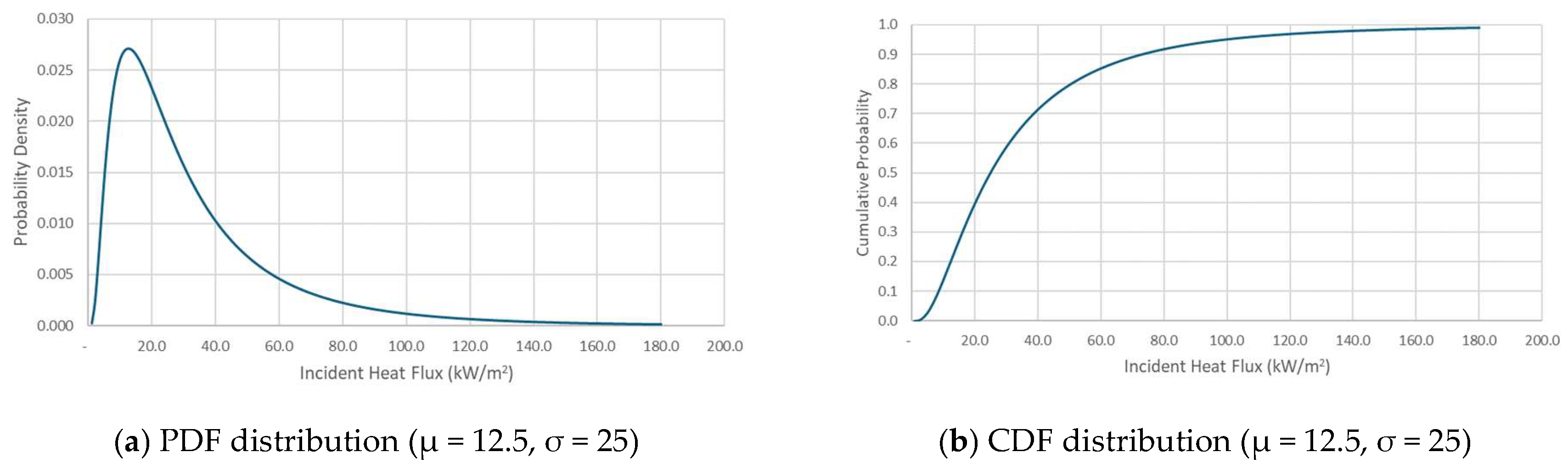
A lognormal distribution with a mode of 12.5 kW/m2 and a median of 25 kW/m2 (i.e., 50% of cases have IHF below 25 kW/m2) was adopted for the incident heat flux (IHF) from UHSs. The modal value was selected to represent a moderate unintended heat exposure level in the absence of comprehensive statistical data. Figure 1 illustrates the corresponding probability density function (PDF) and cumulative distribution function (CDF) of the assumed IHF distribution.
Figure 1.
Patterns of incident heat flux from unintended heat sources.
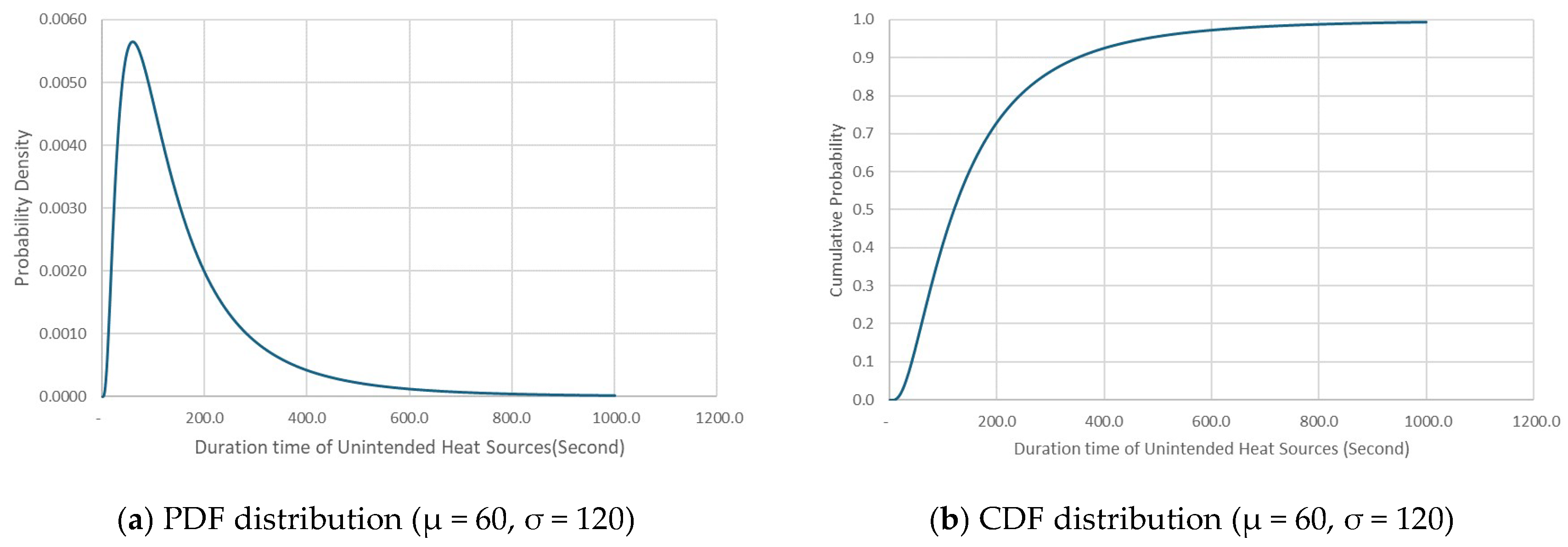
For the duration of a random UHS, it could likely range from a few seconds to a few minutes. We assume it follows a lognormal distribution with a mode of 60 s, medium of 120 s, as shown below (Figure 2).
Figure 2.
Patterns of duration time of unintended heat sources.
In Section 4, the Monte-Carlo method will be adopted to generate a large number of UHSs and the corresponding duration times. The ignition time from each of the sprawled UHSs is calculated using the theoretical framework described in Section 3. If the ignition time of a material under a UHS is longer than the duration time of the same UHS, then ignition will not happen; otherwise, an ignition event will occur. Overall ignitability is then calculated as the ratio of ignition events to the total number of UHS events:
Physically, in our research context, ignitability represents the mean ignition probability of a material subjected to a random UHS, whose detailed duration and IHF are unknown but whose statistical parameters are available or can be reasonably assumed.
3. Theory Basis About Determination of Ignition Time
3.1. Ignition Criterion
Indicators for the onset of ignition on material surfaces, also referred to as ignition criteria, have been extensively examined in previous research and are primarily categorized as follows [22]:
- Ignition temperature (critical surface temperature)
- Critical average solid temperature
- Critical pyrolysis mass flux
- Critical char depth
- Critical local gas temperature increase rate
- Critical total reaction rate in the boundary layer
Among these, the ignition temperature is the most widely used indicator and is adopted as the criterion in this paper.
3.2. Calculation of Ignition Time
When a building material is subjected to a UHS, the heating process begins as radiative heat from the UHS is transferred to the material surface. During this period, volatile compounds within the material may be released and begin to mix with the surrounding air, forming a combustible mixture. As the incident heat flux becomes sufficiently intense and sustained, the surface temperature increases, promoting the generation of pyrolysis gases. Ignition of these flammable vapors depends on additional factors, such as the presence of an ignition source (e.g., pilot flame, spark, or hot surface) and appropriate local fuel–air mixture conditions. If these criteria are satisfied, flaming combustion can be initiated. Factors such as the material’s thermal inertia, surface properties, and environmental conditions (e.g., ventilation and humidity) significantly influence the rate of heat absorption and, consequently, the likelihood and timing of ignition.
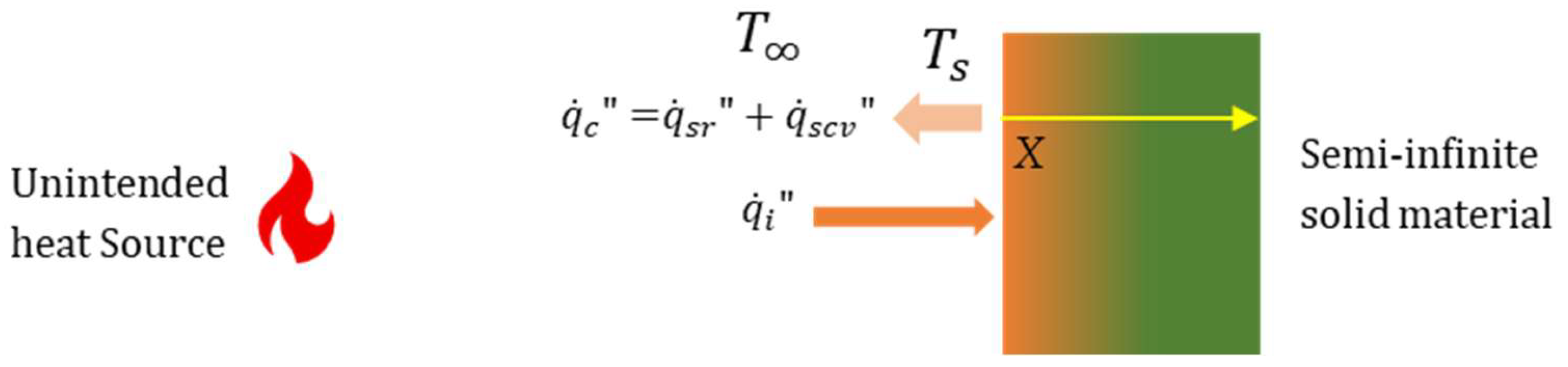
Understanding this ignition mechanism is fundamental to evaluating fire risk and developing strategies for material selection and fire safety in buildings. Many researchers have developed generalized models of the ignition process by simplifying it to a one-dimensional frame of reference for a semi-infinite solid material [23], as shown in Figure 3. The surface temperature of the material gradually increases until it reaches a critical threshold known as the ignition temperature, as it absorbs heat. Equation (3) shows the generalized surface temperature model, derived under several simplifying assumptions (e.g., constant thermal properties, one-dimensional heat conduction, and semi-infinite solid behavior) [23]. Therefore, the model does not account for material decomposition, surface regression, charring, melting, or time-varying thermal properties during heating.
where = Surface temperature, K,
= initial temperature, K,
k = thermal conductivity, kW/ (m·K),
= density, kg/m3,
= specific heat capacity, kJ/(kg·K),
erfc = complementary error function,
t = time (s),
= incident heat flux (kW/m2),
indicating the total effective heat transfer coefficient, , indicating the effective radiation heat transfer coefficient, and is the convecvie heat transfer coefficient.
As analyzed in [23], the surface temperature at the boundary not only depends on the material properties but also on boundary conditions, including radiative and convective heat losses. To establish a critical ignition condition, the incident heat flux, (which is dependent on the intensity of the source, and the targets’ configuration factor) should be larger than the heat losses at the surface boundary. The minimum heat flux required to reach ignition temperature and initiate flaming is called the critical heat flux (CHF) for ignition, .
Figure 3.
Heat transfer on the surface of a semi-infinite solid material exposed to an unintended heat source (UHS): = incident heat flux at the surface, = Radiation from the surface to the environment, = Convective losses from the surfaces, and critical heat flux, .
Figure 3.
Heat transfer on the surface of a semi-infinite solid material exposed to an unintended heat source (UHS): = incident heat flux at the surface, = Radiation from the surface to the environment, = Convective losses from the surfaces, and critical heat flux, .

Based on the concept of a fixed ignition temperature of a material, an expression can be derived for the time to ignition [23] from Equation (3):
If the material is thermally thick, and
If the material is thermally thin.
Where
k = thermal conductivity, kW/(m·K),
= the material’s thickness, m,
= the density of the material, kg/m3,
= the specific heat of the material, kJ/(kg·K),
= ignition temperature, K,
= Environmental temperature, K,
=
The CHF may vary according to both the material and the specific test conditions [24]. However, in the cases where reradiation heat losses dominate the heating process, the following equation can be adopted to approximate the critical heat flux [25]:
where = the Stefan-Boltzmann constant which is 5.76 × 10⁻¹¹ kW/ (m2·K4).
The combined term, , has often been named as the so-called thermal inertia, (kW)2·s/(m4·K).
The assumptions here include:
- The solid is inert and homogeneous
- Thermal properties are constant
- Material’s surface emissivity and absorptivity are both unity
- The reradiation dominates the surface heat loss
The present formulation follows a conventional thermal-criterion approach, treating ignition temperature and thermophysical properties as effective descriptors of material response.
3.3. Thermal Thick or Thermal Thin
It has been reported that if a building material/product/element panel is thicker than 2 mm, it can generally be considered thermally thick for most fire safety engineering cases [5]. However, in reality, due to the wide range of building materials being used, this assumption may not always be true. Therefore, it may be necessary to decide if a building material with a specific thickness behaves thermally thick or thin. One of the methods is to conduct several material ignition tests under different incident heat fluxes, and then plot the results to see if the incident heat flux can be linearly fitted with or , which corresponds to thermally thin and thermally thick, respectively.
Another method to determine the critical thickness to classify if a material is thermally thick or thin is to solve the thickness by making Equation (1) equal to (2):
Thus, the critical thickness increases with material properties (the ignition temperature and the thermal conductivity) and decreases with the environmental factors (ambient temperature and the net heat flux).
This criterion for distinguishing thermally thick and thermally thin behavior is derived under the assumptions of one-dimensional heat conduction in a homogeneous, isotropic material with constant thermophysical properties. The derivation assumes uniform thermal contact at the exposed surface. For layered or composite construction products, applicability depends on the thermal resistance distribution. In multilayer systems, ignition is often governed by the outermost combustible layer, and the proposed critical thickness may be applied using its effective thermophysical properties. For porous or fibrous materials, effective thermal conductivity and density should represent bulk thermal inertia. For anisotropic materials, through-thickness thermal conductivity governs ignition behavior. Therefore, the criterion is most directly applicable to homogeneous materials or systems approximated using effective properties, while its application to highly heterogeneous or delaminating materials requires caution and may need experimental validation.
4. Determination of Building Materials’ Ignitability
4.1. Monte-Carlo (MC) Simulation Framework
Monte Carlo methods are numerical simulations that rely on repeated random sampling and statistical analysis to compute results of problems that may be difficult to solve deterministically [26]. In this study, the Monte Carlo method is used to propagate uncertainties in UHS characteristics through the deterministic ignition model described by Equations (4) and (5).
The deterministic model provides the ignition time for a given set of input parameters. Lognormal distributions are adopted for both the duration time and IHF of UHSs, as these variables are strictly positive and may exhibit right-skewed variability. A large number of random input vectors are generated according to the prescribed distributions and used as inputs to the deterministic model.
For each realization, the ignition criterion is evaluated based on the predicted surface temperature and ignition time. After collecting the simulated results, statistical analysis is conducted to determine the ignitability of a material under the prescribed UHS patterns.
4.2. UHSs with Constant IHF and Constant Duration Time
In this case, according to Equation (2), the Ignitability collapses into a binary value:
where is the constant duration time not varying with test sample , and
where is the constant IHF.
4.3. UHSs with Constant IHF and Lognormal Distribution of Duration Time
In this case, since the IHF is constant, from Equation (9) the ignition time is also constant. Therefore, the Ignitability collapses into the ratio of the number of events with duration time greater than or equal to the constant ignition to the total number of UHSs:
4.4. UHSs with Constant Duration Time and Lognormal Distribution of IHF
In this case, the ignition times vary with the IHF. Therefore, the Ignitability equals the ratio of the number of events with ignition time less than or equal to the constant duration time to the total number of UHSs:
4.5. UHSs with Lognormal Distributions of Both IHF and Duration Time
4.5.1. Calculation of Ignitability Based on N Times of MC Sampling of UHS IHF and Duration Distribution
In applying the MC method, the deterministic model is the ignition model for thermally thick and thin materials. Both the IHF and duration time of UHSs are assumed to follow lognormal distributions (Figure 1 and Figure 2). N random numbers between 0 and 1 are generated to create random values for the IHF and the duration time using the respective CDFs.
For the sampling, let be the sampled IHF generated from the UHS, and be the corresponding duration time. Then the binary value indicating whether a building material will be ignited under this sampling event, , can be determined as:
The material ignitability, , is then calculated as below:
4.5.2. Sensitivity Analysis Related to the Sampling Number N
Theoretically, as N becomes infinity, converges to the exact value. In practice, a reasonable number of samples is chosen such that the difference between N and N + P is less than a threshold (e.g., 0.5%). In this study, p = 5000.
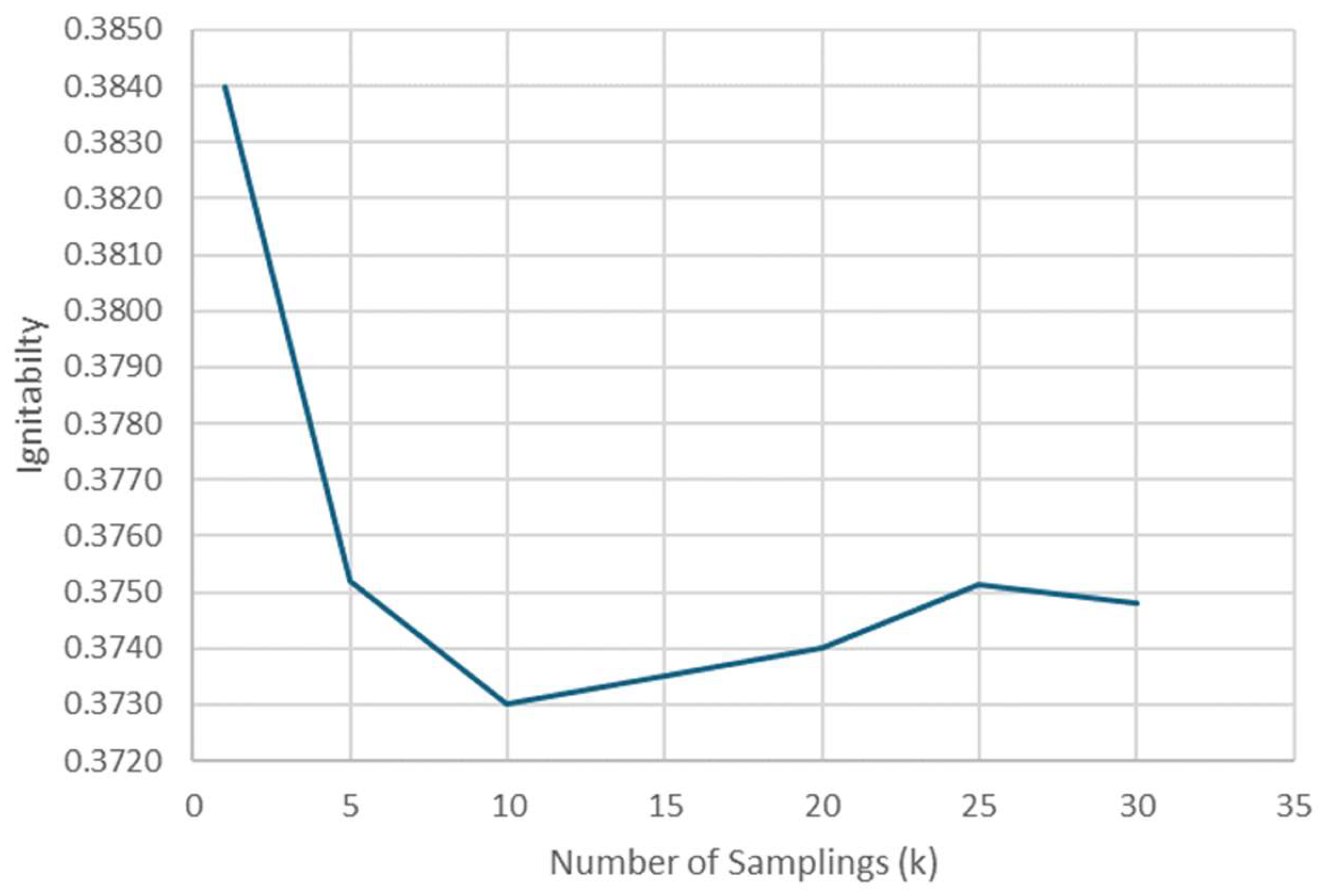
Figure 4 illustrates for thermally thick PMMA as N increases from 1 k to 30 k. The ignitability stabilizes between 0.3745 and 0.3755, within 0.5% of the final value. Therefore, 30 k samples are sufficient for this case study.
Figure 4.
Changing of Ignitability for Thermally Thick PMMA Material when the sampling number varies. (Material properties: Ignition Temperature = 380 °C, Environment Temperature = 20 °C, Thermal Conductivity = 0.2 W/(m·K), Density = 1190 kg/m3, Specific Heat = 2.5 kJ/(kg·K), Thermal Inertia = 0.5950 (kW)2·s/(m4·K)).
4.5.3. Effect of Ignition Temperature on Ignitability
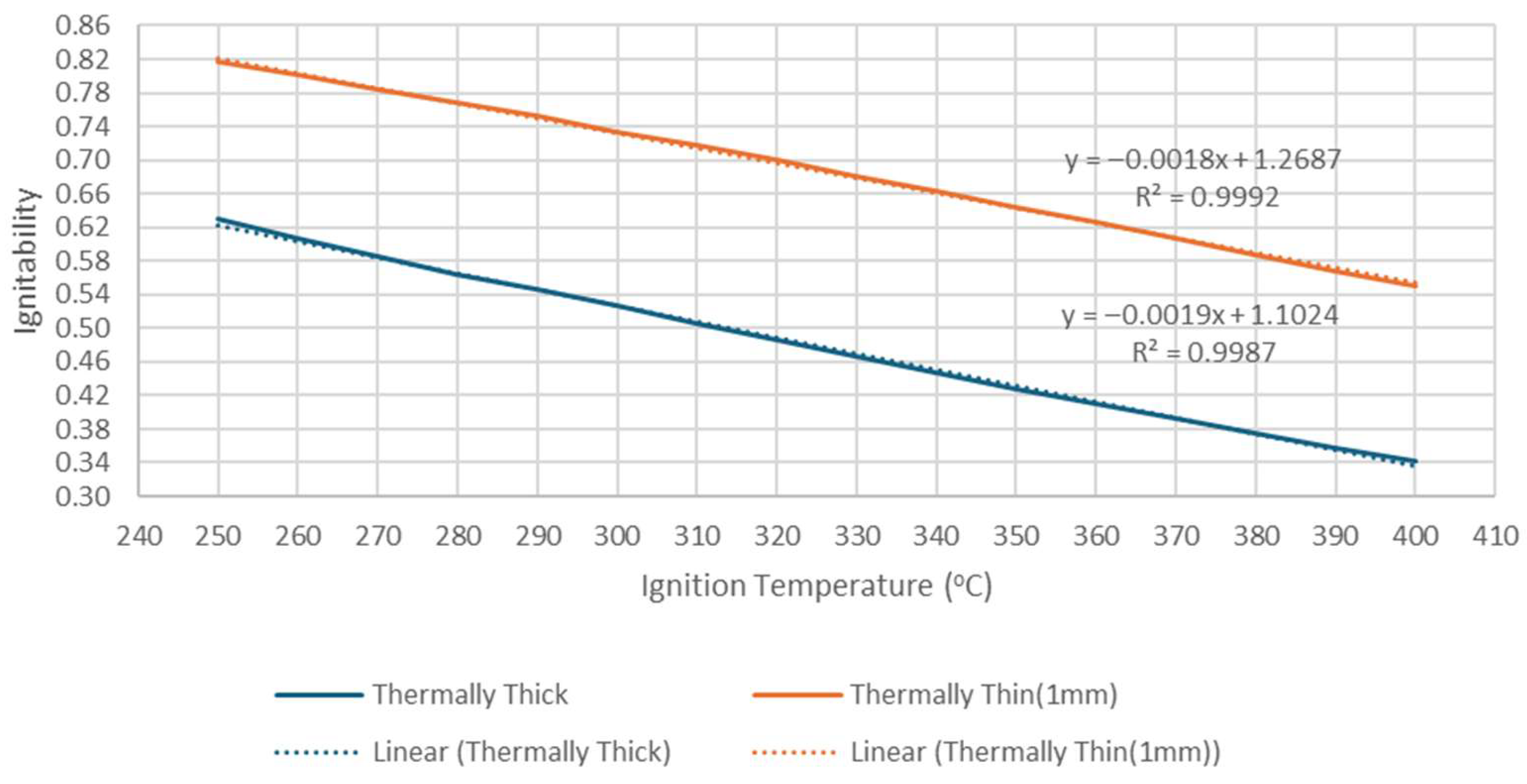
For PMMA, ignition temperature varies from ~250 °C to <400 °C [5,23,27]. Figure 5 shows the nearly linear relationship between ignitability and ignition temperature for both thermally thick and thin materials.
Figure 5.
Ignitability changes with Ignition Temperature.
4.5.4. Effect of Thermal Inertia (Through Specific Heat) on Ignitability
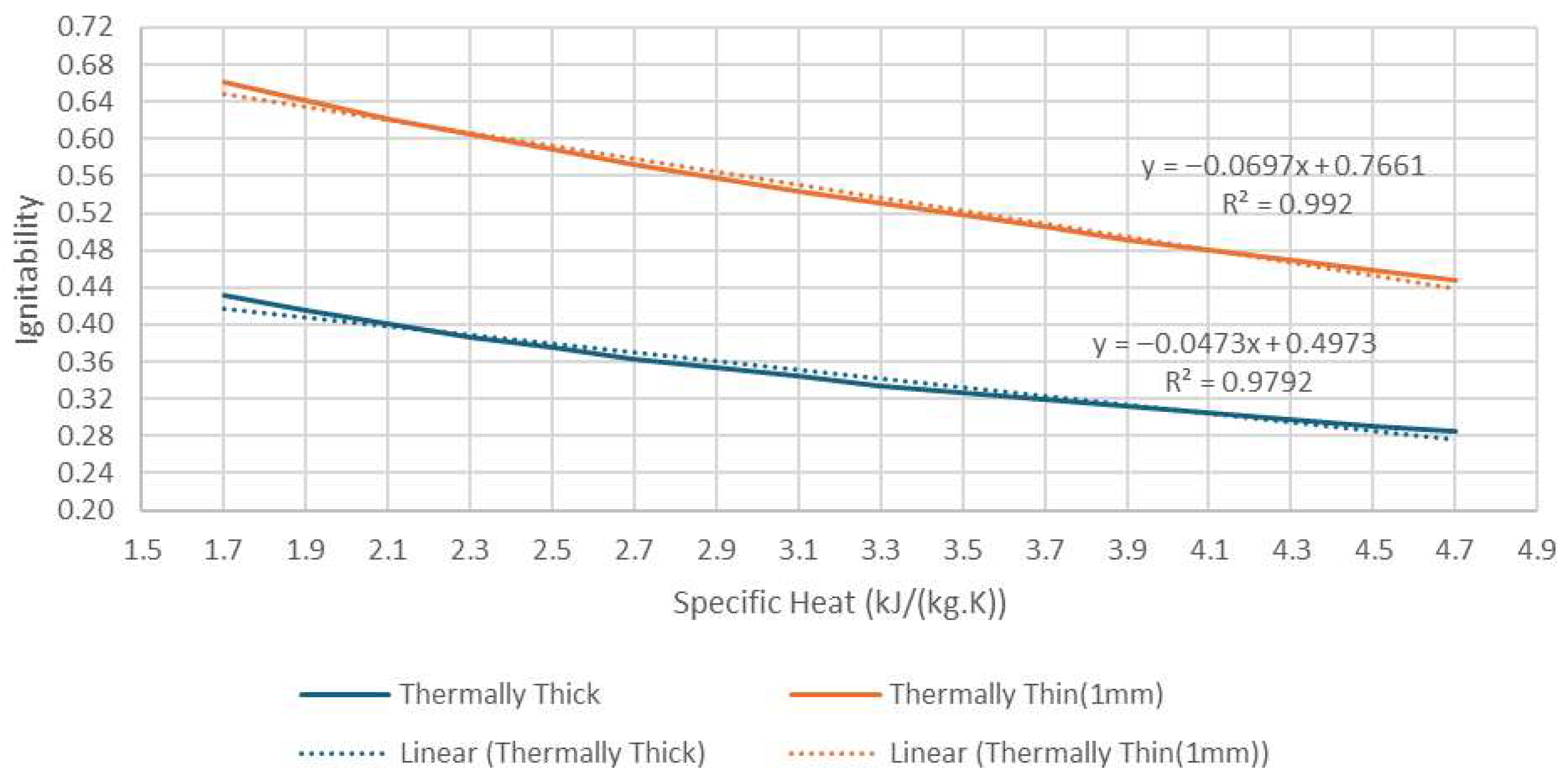
For PMMA, density and thermal conductivity are relatively constant, but temperature-dependent specific heat ranges from 1 to 10 kJ/(kg·K) [28], causing an order-of-magnitude variation in thermal inertia. Figure 6 shows that ignitability varies almost linearly with specific heat. Notably, thermally thin materials are more sensitive to changes in specific heat than thermally thick materials.
Figure 6.
Ignitability changes with material-specific heat.
4.5.5. Ignitability of Some Common Materials Under Different UHS Patterns Compared with TRP
Various building materials are analyzed (Table 1), spanning a wide range of thermophysical properties [14]. The ignition temperature ranges from 195 °C (acrylic) to 515 °C (gypsum board), while thermal inertia spans by more than two orders of magnitude (0.03 to 4.02 (kW)2·s/(m4·K)). The dataset includes wood-based products, polymeric materials, foam insulation, fire-retardant-treated materials, and surface finishes.
Table 1.
Ignitability of some common materials (thermally thick) under Different UHS Patterns.
This range was intentionally selected to evaluate the robustness of the proposed ignitability framework across materials with substantially different ignition thresholds and heat transfer characteristics. The objective was to demonstrate the general applicability of the methodology within the selected parameter space, rather than to establish an exhaustive material property database.
Three UHS patterns (all lognormal with different parameters) were applied to calculate material ignitability. Meanwhile, TRP has been proposed as a means of assessing the ignition resistance of materials, which is calculated as [6]:
The TRP values of these materials are also calculated in Table 1 to evaluate their correlation with the ignitability rank obtained from our proposed method.
It can be seen from Table 1 that the ignitability ranks are slightly different between different UHS patterns. Since the relative likelihood of each UHS pattern is unknown, we take the average ignitibility and the corresponding ranks as a comparative index within the examined UHS parameter space, and in the last row of this table, calculate the root mean square error (RMSE) of ignitability ranks between the benchmark ranks and the ranks from the three UHS patterns as well as the TRP.
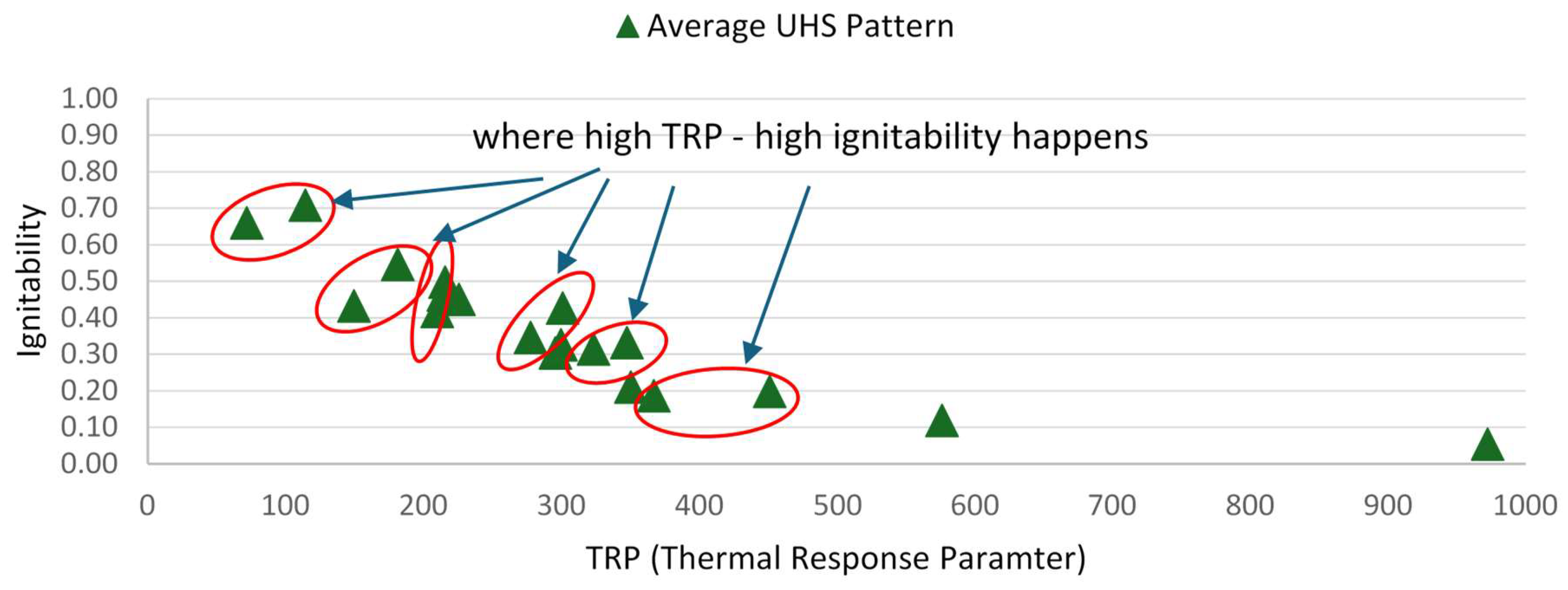
On one hand, the first three RMSE values reveal the similarity of ignitability ranks between the three UHS patterns. Materials with different ignitability ranks from the average UHS pattern show very close ignitability, like acrylic vs. FR Plywood, and Expanded PS40 vs. Asphalt Shingle. On the other hand, the much larger RMSE from TRP ranks and Figure 7 suggest that although in general the ignitability decreases with the increase in the TRP, there are some local cases where materials with higher TRP exhibit higher ignitability within the selected UHS assumptions. For example, as shown in Figure 7, there are some materials that have both higher TRP and higher ignitability, which deviates from the common interpretation that a higher TRP implies lower ignitability. The reason for this mismatch partly arises from the neglect of surface heat losses in the simplified TRP expression, since when the ignition temperature of a material is high, surface heat loss (especially through reradiation) becomes more significant. This can be confirmed by comparing the material of rigid foam plastic and Extrued PS40 in Table 1: the former one has a lower TRP (71.8801) than the latter (113.7540), but its ignition temperature (435 °C) is much higher than that of Extruded PS40 (275 °C), which leads to a higher surface heat loss and thus a lower ignitability under the UHS-based evaluation.
Figure 7.
Ignitability calculated from UHS method changes with TRP.
4.6. Uncertainty Considerations
The main sources of uncertainty in the framework arise from (i) variability in measured material properties such as ignition temperature and thermal inertia, (ii) assumptions regarding the statistical distributions of UHS duration and IHF, (iii) model simplifications including one-dimensional heat transfer and neglect of moisture or complex pyrolysis kinetics, and (iv) Monte Carlo sampling variability. However, while absolute ignition probabilities may vary with parameter assumptions, relative material ranking is generally more robust.
5. Discussion and Conclusions
For a long time, it has been a challenge to assess the fire risk of buildings with new or green materials due to the lack of fire frequency data. Conversely, fundamental thermal properties of these newly adopted materials, like ignition temperature, thermal inertia, critical heat flux, etc., are either available or relatively easy to obtain by conducting small-scale lab tests. A natural question is whether it is possible to estimate the relative fire risk of buildings incorporating new or green materials based on these basic thermal properties. This is challenging due to the diversity of ignition sources or the underlying UHSs.
In this paper, we present a probabilistic method to compare the ignitability (i.e., ignition susceptibility) of different materials by explicitly linking their thermal properties with assumed statistical UHS patterns. This approach supports the general understanding that materials with lower ignition temperature or lower thermal inertia generally exhibit higher ignitability under a defined exposure scenario. Beyond this, the proposed approach incorporates surface heat loss and exposure distribution effects, which are not explicitly reflected in simplified parameters such as TRP. The comparisons conducted highlight systematic differences in material ranking within the examined UHS parameter space.
The proposed method evaluates building material ignitability by generalizing UHS patterns and linking them to known thermal properties such as ignition temperature and thermal inertia. Assuming lognormal distributions for UHS duration and IHF, Monte Carlo simulations are employed to estimate ignition probability and corresponding ignitability indices. Within the selected UHS distributions, the investigated materials demonstrate reasonable consistency of ignitability ranks. While materials with similar ignitability under one UHS pattern may exhibit slight rank shifts under another, the overall stability of rankings across scenarios supports the internal consistency and robustness of the framework.
The ignitability index introduced in this study should not be interpreted as a deterministic ignition threshold or a universally established material property. Rather, it represents a probabilistic metric defined within an assumed exposure distribution. Its primary value lies in providing a structured methodology to couple material thermal properties with stochastic heat exposure scenarios. Within a defined UHS parameter space, the index enables comparative material selection, screening-level ranking among design alternatives, and relative estimation of ignition susceptibility for buildings differing primarily in material choice. Its practical applicability depends on the availability or reasonable estimation of representative UHS patterns.
It should be emphasized that the proposed ignitability index alone cannot determine absolute fire frequency, as overall fire occurrence also depends on the total number of annual UHS events and building-specific operational factors. The present study focuses on relative ignition susceptibility under identical assumed UHS patterns. Further work is needed to characterize realistic UHS distribution patterns associated with specific building uses, which remains an important subject for future research.
Additionally, this study is primarily based on theoretical modeling and Monte Carlo simulations, without direct experimental validation of the ignitability framework. Future validation could be achieved through controlled ignition experiments, in which IHF and exposure duration are systematically varied to generate empirical ignition probability distributions. For instance, cone calorimeter or radiant panel tests with programmable heat exposure histories could emulate stochastic UHS patterns. Predicted ignition likelihoods and material rankings could then be compared with experimentally observed ignition frequencies under equivalent statistical exposure conditions. Therefore, the framework should currently be interpreted as a probabilistic screening tool, with further experimental validation required for quantitative predictive applications.
Finally, the establishment of a database of material ignitability under realistic or standard UHS patterns could further enhance the practical value of this framework and contribute to fire safety engineering practice.
Author Contributions
Methodology, H.W.; Validation, H.W.; Formal analysis, H.W.; Investigation, H.W. and Y.K.; Data curation, H.W.; Writing—original draft, H.W.; Writing—review and editing, Y.K.; Supervision, Y.K.; Funding acquisition, Y.K. All authors have read and agreed to the published version of the manuscript.
Funding
This research received no external funding.
Institutional Review Board Statement
Not applicable.
Informed Consent Statement
Not applicable.
Data Availability Statement
The raw data supporting the conclusions of this article will be made available by the authors on request.
Conflicts of Interest
The authors declare no conflict of interest.
References
- Hurley, M.J. SFPE Handbook of Fire Protection Engineering; Springer: New York, NY, USA, 2016. [Google Scholar]
- Babrauskas, V. Minimum Values of Voltage, Current, or Power for the Ignition of Fire. Fire 2022, 5, 201. [Google Scholar] [CrossRef]
- Zhang, C. Review of Structural Fire Hazards, Challenges, and Prevention Strategies. Fire 2023, 6, 137. [Google Scholar] [CrossRef]
- Clark, F.R.S. Control of Ignition in Building Materials; Division of Building Research; National Research Council Canada: Ottawa, ON, Canada, 1988. [Google Scholar]
- Quintiere, J.G. Principles of Fire Behavior, 2nd ed.; CRC Press Taylor & Francis Group: Milton Park, UK, 2017; ISBN 978-1-4987-3562-9. [Google Scholar]
- Drysdale, D. An Introduction to Fire Dynamics; John Wiley & Sons: Hoboken, NJ, USA, 2011; ISBN 978-0-470-31903-1. [Google Scholar]
- Hall, S.; McGree, T. Home Structure Fires; NFPA: Quincy, MA, USA, 2025; p. 16. [Google Scholar]
- Robbins, A.P.; Wade, C.A. SR223 Residential New Zealand Fire Statistics: Part 2—Two-Level Event Tree Analysis; BRANZ: Porirua, New Zealand, 2010. [Google Scholar]
- Canadian Centre for Justice Statistics. Fire Statistics in Canada; Statistics Canada: Ottawa, ON, Canada, 2017; p. 82. [Google Scholar]
- Ruiter, M.; Domrose, J. Fatal Residential Fires in Europe; Fire Service Academy: Kowloon, Hong Kong, 2018; p. 85. [Google Scholar]
- ISO 9705-1:2016; Reaction to fire tests—Room corner test for wall and ceiling lining products—Part 1: Test method for a small room configuration. ISO: Geneva, Switzerland, 2016.
- NFPA 285-2023; Standard Fire Test Method for Evaluation of Fire Propagation Characteristics of Exterior Wall Assemblies Containing Combustible Components. NFPA: Quincy, MA, USA, 2023.
- Yuen, W.W.; Han, S.; Chow, W.K. The Effect of Thermal Radiation on the Dynamics of Flashover in a Compartment Fire. JSME Int. J. Ser. B 2003, 46, 528–538. [Google Scholar] [CrossRef]
- Dillon, S.E. Analysis of the ISO 9705 Room/Corner Test: Simulations, Correlations and Heat Flux Measurements; National Institute of Standards and Technology: Gaithersburg, MD, USA, 1998. [Google Scholar]
- Montgomery, D.C.; Runger, G.C. Applied Statistics and Probability for Engineers, 7th ed.; Wiley: Hoboken, NJ, USA, 2018; ISBN 978-1-119-40036-3. [Google Scholar]
- Ang, A.H.-S.; Tang, W.H. Probability Concepts in Engineering: Emphasis on Applications to Civil and Environmental Engineering, 2nd ed.; John Wiley & Sons: Hoboken, NJ, USA, 2007; ISBN 978-0-471-72064-5. [Google Scholar]
- Telser, L.G. The Lognormal Distribution, J. Aitchison and J. A. C.; Brown, Cambridge, England: Cambridge University Press, 1957, Pp. Xviii, 176. $6.50. Am. J. Agric. Econ. 1959, 41, 161–162. [Google Scholar] [CrossRef]
- Kapur, K.C.; Lamberson, L.R. Reliability in Engineering Design; John Wiley & Sons: New York, NY, USA, 1991; ISBN 978-0-471-51191-5. [Google Scholar]
- Nelson, W. Applied Life Data Analysis; Wiley: Hoboken, NJ, USA, 2004; ISBN 0-471-64462-5. [Google Scholar]
- Hopkin, C.; Spearpoint, M.; Wang, Y.; Hopkin, D. Design Fire Characteristics for Probabilistic Assessments of Dwellings in England. Fire Technol. 2020, 56, 1179–1196. [Google Scholar] [CrossRef]
- Hedayati, F.; Gorham, D.; Monroy, X.; Marandi, M.; Sluder, E.; Gollner, M.; Cui, W.; Merhi, A. Wind-Driven Building-to-Building Fire Spread: Experimental Results and Probabilistic Modeling. Fire Technol. 2026, 62, 32. [Google Scholar] [CrossRef]
- Jiang, Y. Decomposition, Ignition and Flame Spread on Furnishing Materials; Victoria University: Melbourne, Australia, 2006. [Google Scholar]
- Quintiere, J. Fundamentals of Fire Phenomena; Wiley: Chichester, UK, 2006; ISBN 978-0-470-09113-5. [Google Scholar]
- Torero, J. Flaming Ignition of Solid Fuels. In SFPE Handbook of Fire Protection Engineering; Hurley, M.J., Gottuk, D., Hall, J.R., Harada, K., Kuligowski, E., Puchovsky, M., Torero, J., Watts, J.M., Wieczorek, C., Eds.; Springer: New York, NY, USA, 2016; pp. 633–661. ISBN 978-1-4939-2564-3. [Google Scholar]
- Khan, M.M.; Tewarson, A.; Chaos, M. Combustion Characteristics of Materials and Generation of Fire Products. In SFPE Handbook of Fire Protection Engineering; Hurley, M.J., Gottuk, D., Hall, J.R., Harada, K., Kuligowski, E., Puchovsky, M., Torero, J., Watts, J.M., Wieczorek, C., Eds.; Springer: New York, NY, USA, 2016; pp. 1143–1232. ISBN 978-1-4939-2565-0. [Google Scholar]
- Walter, J.-C.; Barkema, G.T. An Introduction to Monte Carlo Methods. Phys. Stat. Mech. Its Appl. 2015, 418, 78–87. [Google Scholar] [CrossRef]
- Rhodes, B.T.; Quintiere, J.G. Burning Rate and Flame Heat Flux for PMMA in a Cone Calorimeter. Fire Saf. J. 1996, 26, 221–240. [Google Scholar] [CrossRef]
- Material Properties of Polystyrene and Poly (Methyl Methacrylate) (PMMA) Microspheres. Available online: https://bangslabs.com/technical-library/material-properties-of-polystyrene-and-polymethyl-methacrylate-pmma-microspheres/ (accessed on 25 February 2025).
Disclaimer/Publisher’s Note: The statements, opinions and data contained in all publications are solely those of the individual author(s) and contributor(s) and not of MDPI and/or the editor(s). MDPI and/or the editor(s) disclaim responsibility for any injury to people or property resulting from any ideas, methods, instructions or products referred to in the content. |
© 2026 by the authors. Licensee MDPI, Basel, Switzerland. This article is an open access article distributed under the terms and conditions of the Creative Commons Attribution (CC BY) license.