
Abstract
This research constitutes a novel experimental approach to valorizing an industrial by-product: the ‘brick’. Studies put emphasis on the importance of detailed structural characterization of brickminerals and their chemical evolution upon heating, contributing rationally to the design and development of new glass–ceramic forms that would be suitable for efficiently encapsulating radio-nuclides. The brick used is a complex material composed of metakaolinite, illite, sand and impurities such as rutile and iron oxides/hydroxides. Raw brick was first activated with a range of sodium hydroxide concentrations, and, second, cured at different temperatures from 90 °C to 1200 °C. Alkali-brick frameworks gradually decomposed during the firing, and turned into crystalline ceramic phases (analcime and leucite) embedded inside an amorphous silica-rich phase. After each heating stage, the cured-brick sample was exhaustively characterized by using a variety of advanced analytical techniques, including powder X-ray diffraction, ESEM/EDS microscopy and 29Si-27Al-MAS-NMR spectroscopy. Ultra-high magnetic field NMR (28.2 T) was used to distinguish and quantify Al(IV), Al(V) and Al(VI) configurations, and to better follow distinctive changes in 27Al environments of brickminerals under thermal effects. Glass-ceramized brick exhibited high specific density (~2.6 g·cm−3), high compactness and good corrosion resistance under static, mild and aggressive conditions, attesting to its high solidification and chemical durability.
1. Introduction
The energy production in nuclear power plants can lead to accidental leakages of nuclear wastewater. Thus, the nuclear accident at the Fukushima power plant aroused great concerns among governments and people worldwide. As Fukushima nuclear wastewaters were discharged into the Pacific Ocean, they seriously endangered the lives and health of the local population, and as a consequence, caused negative consequences for international Asian trades and the Asian fishing industry [1,2]. It is worth it to mention that discharged liquids contain hazardous elements with high decay heat and long half-life periods, such as 90Sr (t1/2 = 28.7 years) and 137Cs (t1/2 = 30.17 years) [3,4,5]. It then becomes crucial to treat these nuclear wastes with the aim of avoiding radio-active contamination of immediate ecosystems, and with time, negative effects on human health. For that, several implementation steps have to be considered: (i) removal of radio-nuclides from nuclear wastewaters; (ii) stabilization in a durable solid matrix; (iii) placement into disposal containers; and, finally, (iv) burial within geologically stable deep underground environments.
Among the various strategies proposed for removing radio-nuclides from nuclear wastewaters, adsorption methods have received considerable attention in the past years [6,7,8,9,10]. Particularly, the framework structures of clays and their minerals have been considered as good candidates for adsorbing radio-nuclides [11]. They indeed possess negatively charged surface sites on which radio-active cations can be bonded through an aqueous ion-exchange reaction with extra-framework ions, such as Na+ and/or K+. Among the miscellaneous aluminosilicate compounds, geo-polymers were proposed as candidates for adsorbing heavy metals and radio-nuclides [12,13,14,15,16,17,18]. However, although geo-polymeric gels showed potential applications in cation adsorption, their adsorptive properties were still lower than those observed for crystalline aluminosilicate structures due to their limited porosity. Nevertheless, under particular operational conditions, geo-polymers could be converted into geopolymer–zeolite composites. Regarding the own crystalline structures of zeolites, they are composed of [SiO4] and [AlO4] tetrahedra connected together by oxygen atoms, creating negative charges. (Negative charges are balanced by extra-framework cations such as: Na+, K+, Ca2+ or Mg2+). Charged three-dimensional frameworks allow zeolites to be employed as ion-exchangers. Owing to this property, along with elevated micro-porosity and large surface area characteristics, zeolites were previously proposed as adsorbents for entrapping of Cs and Sr from nuclear power plant wastewaters [19,20,21]. During wastewater treatments, zeolitic frameworks interacted with the aqueous phase, implicating inter-connected/charged channels and cavities into which water molecules could be inserted and radio-active ions could be attracted electrostatically. In comparison with pure crystalline structures of zeolites, geo-polymer–zeolite composites instead present the advantage of possessing ‘hierarchical’ ‘micro-/meso-/macro-’porous structures leading to higher surface area/porosity [22,23,24]. Hierarchical porosity indeed permits us to increase the number of active pores and thereby interfacial reactivity via a better diffusion of foreign ions inside cavities/channels, resulting in an enhancement of adsorption performances. This should explain why geopolymer–zeolite composites were found to be more useful for removing radio-nuclides such as cesium and strontium from aqueous solutions [25,26]. Unfortunately, the powdered forms of such geo-polymers-derived zeolites presented some disadvantages and difficulties in practical/industrial applications. Indeed, their preparation is often relatively costly and time-consuming, and, further, their powdered aspect is inconvenient for carrying out large-scale water treatment or for separating powdered particles from the liquid phase. In order to solve this problem, it is important to elaborate materials that have not only high adsorption capacity, but also allow both low operating pressure and high permeability flux under dynamic adsorption conditions.
Water problems encountered in poor/rural communities of developing countries have necessitated the development of proven and locally more adapted water-treatment procedures at low costs. In our preliminary works, crushed brick was found to be an interesting cheap material made by craftspeople in the Bangui region (Central African Republic) for removing dissolved iron(II) from local groundwater wells [27]. Although the mineralogical composition of the raw brick used in our study was not intentionally designed, previous experiments in the lab and directly in the Bangui region (by elaborating large-scale water-purification systems) demonstrated clearly significant improvements in the sorption capacity of crushed brick when its surface was coated with iron oxy-hydroxide [28]. This had spurred us to modify more considerably crushed brick in its chemical nature, crystalline structures, surface properties and preparation processes in the aim to enhance its ability to eliminate other toxic-metal contaminants from wastewaters. For that, it had been necessary for us to find a way to produce better green, economical and hierarchically porous materials, with the following aims: (i) facilitating the accessibility of more active surface sites for radio-nuclides through more inter-connected meso- and micro-porous channels (and thereby of increasing adsorption performances); and (ii) obtaining satisfactory characteristics of granularity and mechanical strength. We then elaborated in the lab a novel resource-saving strategy for synthesizing geopolymer–zeolite composites via alkali activation from metakaolinite present in the brick [29,30,31,32]. In order to perform laboratory experiments relative to radio-active wastewater treatments, the brick was employed in the form of aggregates. As these aggregates contain metakaolinite, illite and sand, we considered that this material was interesting for the fabrication of geo-polymer–zeolite composites for the following reason pointed out in our recent works [28,33]. First, brick alkalination led to the production of low-silica zeolites having controlled morphology/granularity, and high framework aluminum amounts. Second, large Al proportions in brick composites gave rise to a large number of negative framework charges, and thereby, of reactive sites on which cationic species could be attracted electrostatically. Third, the occurrence of inter-connected micro-porous/meso-porous/macro-porous structures allowed us to obtain a better accessibility of cationic species towards negatively charged sites, and then enhanced the utilization efficiency of the brick. Fourth, the presence of sand at high proportions (60–65 w%) in the studied brick was found to be beneficial as a chemically stable mineral for both supporting geo-polymeric–zeolitic deposits and facilitating flowing/filtration operations in columns. And fifth, after radio-nuclides adsorption onto alkali-brick, resulting materials were transformed under firing into glass–ceramics with stable crystalline aluminosilicates (containing radio-nuclides); and at the same time, the melting of sand facilitated the encapsulation of these crystallites and improved chemical durability.
In the lab, geopolymer–zeolite composites synthesized from the brick had been successfully employed for extracting radio-nuclides (UO22+, Cs+, Rb+, Sr2+ and Co2+) from liquid media through ion-exchange reactions [33]. During the adsorption process, radio-active cations were bound to negatively charged brick sites in the form of outer-sphere complexes. After that, doped materials had been either regenerated for further use (allowing the recovery of radio-active elements) [33] or cured into a stable matrix for radio-element immobilization and long-term disposal [30,31,32]. In the first case, the unstable character of outer-sphere complexes formed during adsorption enabled the regeneration of the adsorbent by employing an eluent such as NaCl solution [28], and in the second case, outer-sphere complexes could be thermally consolidated into more stable aluminosilicate frameworks in the aim to ensure high chemical resistance to leaching, and mechanical strength to maintain integrity [30,32].
On the other hand, owing to the presence of durable host phases composed of micro-crystals embedded and dispersed inside glass ceramics, these materials are now considered to be potentially very useful for stabilizing chemically and thermally radio-nuclide fission products [34,35,36,37]. Among the various candidate materials proposed for preparing glass–ceramics, certain solid wastes derived from the industry had been found to be interesting precursors owing to their ability to fix/solidify toxic elements, e.g., asbestos tailings and coal fly ash [37]; uranium tailings [38]; copper tailing, coal slag and red mud [39]; ferrochrome slag and fluorite tailings [40]; coal fly ash [41]; and miscellaneous industrial hazardous solidwastes [42]. Also, it was noticed that some of the industrial waste-derived glass–ceramics possessed high encapsulation efficiency towards radio-nuclides owing to strong solidification properties, high mechanical strength and good acid/alkali-resistance [34,35,36,37,38,41]. Likewise, owing to the particular chemical/mineralogical composition of studied alkali-brick aggregates, we believed that such industrial waste-derived composites could be employed efficiently for adsorbing fission elements, such as Cs+ and Sr2+, and, subsequently, for thermally immobilizing these radio-nuclides through a glass-ceramization process. Indeed, it was demonstrated in our lab that after exposure to high temperatures, brick composites underwent several features: (i) the chemical decomposition of illite followed by that of zeolites; (ii) subsequently, the gradual formation of more compact and denser structures, comprising crystalline phases (analcime, ‘ANA’; leucite, ‘LEU’; mullite; and crystobalite) accompanied with the formation of silica-glassy phases [32]. The appearance of such additional silica glasses in the cured alkali-brick was found to be due to the eutectic melting of quartz in the presence of fluxing agents [32]. (Note that fluxing agents were provided by the thermal degradation of both sodic-zeolites (Na-A and Na-P) and illite [32]). As an excess of silica generated inside the material enabled the entire coating of (structurally stable) aluminosilicate ceramics (i.e., analcime, leucite and their ANA/LEU solid solutions), the formed silica coating behaved like a physical barrier for protecting chemically (well-embedded) crystalline particles.
By using X-ray diffraction (XRD), the first objective of this research was to acquire comprehensive insights, first, into the crystalline/mineralogical properties of raw-brick after alkaline treatments with sodium hydroxide at different concentrations, and, second, into the structural evolutions of alkali-activated brick upon heating at different temperature stages.
By using an environmental scanning electron microscope (ESEM) equipped with an Energy Dispersive X-Ray Spectrometer (EDS), the second objective of this research was to investigate the effect of heat treatment temperature on the micro-structure of alkali-activated brick by producing micrographs and elemental mappings of brick matrices. The ESEM technique was employed, first, for following textural and morphological changes in alkali-brick during illitic and zeolitic degradations, and, second, at more elevated temperatures, for highlighting progressive brick amorphization and micro-crystallites appearance. As for the ESEM/EDS technique, it was used here for analyzing main elements over the surface matrix, and for evidencing elemental-distribution positions indicative of the phase regions of the ESEM image in which crystallites were abundantly embedded inside silicaglass. By EDS, attempts had also been made to identify inserted aluminosilicate specimens and to estimate their proportion inside the glass-ceramized matrix.
By conducting 29Si and 27Al MAS NMR analysis, the third objective of this research was to examine changes in Si and Al environments in brick minerals after thermal treatment at different calcination temperatures. Because 27Al is a quadrupolar nucleus (with I = 5/2), it had been necessary in this work to operate at an ultra-high magnetic field (28.2 T). By applying this technique, information obtained from27Al sites should offer a powerful way of analyzing the complex spectra of the different cured-brick samples. Indeed, this technique significantly improved spectral resolution, mostly enabling clear separation of the peakscorresponding to distinct penta-coordinated 27Alsites and from those corresponding to tetrahedral and octahedral 27Alsites. Thus, recently, the ultra-high field solid-state NMR technique hasbeen employed successfully in the catalysis area for quantitatively studying the nature of the distinct five-coordinated Al in γ-Al2O3 and towardunderstanding 27Alsites in the different crystalline forms of Al2O3 [43,44,45]. Furthermore, in the zeolitic-materials area, it had been shown that (i) for zeolite merlinoite, high magnetic field 27Al MAS NMR was capable of probing the non-random aluminum distribution in zeolitic structure and resolving distinct tetrahedral environments for framework Al atoms [46]; and, (ii) for fully hydrated HBEA zeolite, the effect of second-order quadrupole interaction on tetrahedral Al atoms could be ignored, enabling quantitative spectral analysis by directly fitting high magnetic field 27Al MAS NMR spectra [47]. In this view, in the case of the studied brick, we had decided to use ultra-high field MAS NMR for differentiating mainly zeolitic/geo-polymeric Al(IV) from illitic Al(IV) and Al(V) and surveying semi-quantitatively their thermal evolution during firing. In this part, the scientific novelty can be represented by the following points: (i) the significantly improved sensitivity and resolution of the ultra-high magnetic field, allowing us to gain more specific information about illitic and zeolitic amorphizations before glass-ceramization; (ii) the identification/differentiation of Si and Al environments in a very complex mineralogical system such as the brick; and, finally, (iii) the step-by-step analysis of NMR spectral changes linked to the phenomena of degradation, amorphization and/or smelting of brickminerals (taken individually) upon calcination at different temperature stages.
In the fourth objective of this research, densitometry, micro-porosity and corrosion-resistance measurements were performed on cured-brick samples withthe aim to compare the characteristics of our material with those produced by an advanced technique like Spark Plasma Sintering (SPS).
2. Materials and Methods
2.1. Brick-Materials Preparation and Acid-Attack Experiments
Origin and making of raw brick: In this work, the brick employed as raw material originated from the Bangui region (in the Central African Republic). This material was locally prepared by craftspeople as follows. Extracted (kaolinite-rich) soils were mixed with water. The obtained mud was shaped manually and then molded into the form of a brick. Mudbricks were preliminarily air-dried for 48 h, and subsequently placed in efficient stackings with air flows. Such a construction is commonly employed in the Central African Republic as an artisanal (built-on-ground) oven for curing air-dried bricks with charcoal. The curing procedure lasted about three days at temperatures ranging from 500 °C to 700 °C, and, finally, cured bricks were cooled progressively up to attain ambient temperature for two/three days.
In order to carry out experiments, some pieces of raw brick were broken manually into fine pellets by using a hammer. The obtained pellets were sieved with a mechanical sieve, and the particulate fraction with sizes ranging from 0.7 to 1.0 mm was selected. This fraction was washed with de-ionized water and then decanted. After settling, brick pellets were collected and dried at 105 °C for 24 h.
Alkaline Activation of the Brick: Raw-brick pellets (10 g) were suspended in a volume of 40 mL of sodium hydroxide (0.6 mol·L−1). The reaction was carried out at ambient temperature for 24 h under slow shaking at a speed of 120 rpm. Afterwards, the mixture was heated at 90 °C for 6 days. By employing the same preparation method, raw-brick pellets were also treated under other alkaline conditions ([NaOH] = 0.1, 1.0 and 1.5 mol·L−1).
Attack-Acid Experiments: Acid attack was carried out on unheated and heated alkali-brick samples at ambient temperature by using a hydrochloric acid solution at a concentration of 1 mol·L−1. For that, 500 mg of pellets were suspended in a reagent volume of 50 mL for 4 h. By employing the same experimental procedure, other acid attacks were conducted on brick materials in different HCl solutions with suspension-pH valuesranging from 4.8 to 1.3. After the attack, each suspension was vacuum filtered through a 0.45 µm membrane filter. Recovered solid materials were afterwards analyzed either by X-ray diffraction or by 27Al MAS NMR.
2.2. Chemicals
All chemicals employed in the experiments were analytical grades. Sodium hydroxide and hydrochloric acid were supplied by DISLAB (Paris, France).
2.3. X-Ray Diffraction (XRD)
Transformations of phase assemblages in alkali-brick samples before and after heating at different temperatures were characterized by means of the Bruker D8Endeavor diffractometer (Evry, France), with the Ni-filtered CuKα radiation (average wavelength of 1.5418 Å), an acceleration voltage of 40 kV, a current of 40 mA and the LynxEye_XE_T detector. X-ray diffractograms were recorded under the following operational conditions: a scanning step of 0.01°; a counting time of 0.5 s per step; and a 2θ-scanning range of 5–60°. Crystalline brickphases were identified on the basis of ‘2θCuKα’ reflection angles and ‘hkl’ Miller indices (‘hkl’ indices are given in parentheses).
2.4. Electron Microscopy Analysis (ESEM/EDS)
Micrographs of representative brickspecimens before and after thermal treatments were recorded by means of an environmental scanning electron microscope (ESEM) equipped with an Energy Dispersive X-Ray Spectrometer (EDS) (EDS X flash 3001, ThermoFisher Scientific, Courtaboeuf, France). EDS measurements were performed at 20 kV at low vacuum (1.00 Torr), and the maximum pulse throughput was 20 kcps. Different surface areas ranging from 0.12 to 0.50 mm2 were targeted on brick particles and analyzed by ESEM/EDS. For that, a narrow beam scanned selected areas of brick pellets for chemical analysis. Atomic quantifications and mathematical treatments were undertaken using QUANTA-400 software with the aim of evaluating element contents on particle surfaces at pixel scale, and to elaborate artificial mapping images. The objective of the ESEM/EDS study was to evidence visually chemical/mineralogical/morphological changes in alkali-brick at different heating stages.
The elemental ESEM/EDS analysis of the cured-brick sample (after heating at 1150 °C for 24 h) permitted us to evaluate the atomic percentages of the different elements present at surfaces, i.e., O, Na, Mg, Al, Si, K and Fe. For each spot, analysis was performed three times. And for each of the detected elements, the uncertainty of the measurements was assessed and reported in the Supplementary Materials section (sigma mean expressed in atomic percent, at.%).
2.5. MAS NMR Analysis
29Si MAS-NMR experiments were acquired at 79.5 MHz on a Bruker 9.4 T spectrometer (Palaiseau, France) equipped with a Bruker 7.0 mm MAS probe operating at a spinning frequency (νrot) of 5 kHz. 29Si MAS-NMR spectra were recorded with a pulse length of 5 µs (π/2 flip angle), 256 transients and a recycle delay (rd) of 30 s. This short rd value was possible owing to the presence of paramagnetic species (mostly iron(III) in mineral frameworks and as Fe oxides/hydroxides), which were homogeneously distributed within the brick matrix. 27Al MAS NMR spectra were recorded at 208.5 MHz on a Bruker 18.8 T spectrometer equipped with a Bruker 3.2 mm CP-MAS probe operating at a spinning frequency (νrot) of 20 kHz. The 27Al (I = 5/2) MAS-NMR spectra were obtained with a pulse length of 1 s (~π/10 flip angle), 1024 transients and a recycle delay of 2 s. Note that 27Al MAS NMR spectra were also recorded at 312.8 MHz on a Bruker 28.2 T spectrometer equipped with a 1.3 mm probe operating at a spinning frequency (νrot) of 40 kHz. By using the 1.2 GHz NMR spectrometer, the 27Al (I = 5/2) MAS NMR spectra were obtained with a pulse length of 0.7 µs (~π/10 flip angle), 4096 transients, and a recycle delay of 1 s. Both 29Si and 27Al MAS NMR spectra were referenced as 0 ppm to TMS, and Al(NO3)3 solution (1 mol·L−1), respectively. It is worth noting that, in order to compare the peak intensities on the different NMR spectra, analyses were carried out by taking the same sample mass (40 mg).
De-convolution of 1D spectra in NMR spectroscopy is a key step when elucidating complex 1D MAS NMR spectra of mixed compounds. Although the de-convolution analysis of nuclear magnetic resonance (NMR) spectra (to detect NMR peaks and characterize their parameters) still remains a relevant challenge for scientists [48,49], in this study, spectral MAS NMR de-convolution hadbeen an essential step for the elucidation/verification and semi-quantification of the different 29Si and 27Al sites present in brick minerals and their thermally generated forms. We used the classical method, consisting of evaluating the number of NMR peaks and their corresponding positions. For that, one needed to add relevant information relative to the nature of compounds involved and their intrinsic magnetic changes upon heating. Thus, at the various curing steps, we identified crystalline forms by XRD and amorphous forms by ESEM/EDS in heated-brick samples. And for each of these forms, we attempted either to determine their magnetic properties (NMR-peak positions and NMR parameters) or to obtain NMR information from the literature. This approach helped us to prevent, at best, overfitting and promote transferability to experimental spectra. However, creating perfectly realistic synthetic data had indeed been very difficult, often resulting in slight discrepancies between the original and reconstructed spectrum, as pointed out previously [48,49]. By processing the experimental spectra to match the training spectra, we nevertheless limited global residual spectral-de-convolution errors to ≤2%.
2.6. Nitrogen Adsorption–Desorption Isotherms
The textural characterization of heated-brick samples was determined from the N2 adsorption–desorption isotherm at 77 K using the Micrometrics model Tristar II 3820 (Paris, France). Before analysis, the brick material was heated at 373 K and degassed for 2 h under primary vacuum conditions (pressure: 10 Pa). The specific superficial area was assessed using the Brunauer–Emmet–Teller (BET) method. The pore volume was estimated using the α-plot method. The total pore volume was evaluated from the desorption isotherm branch at P/Po = 0.98, assuming complete pore saturation. Pore-size distribution was calculated using non-local density functional theory (NLDFT) and the Berrett–Joyner–Halenda (BJH) method.
2.7. Chemical-Stability Analysis of Calcined Brick
Leaching rates of framework elements in glass-ceramized brick were assessed under static conditions in de-ionized water and acid solution (HCl 1 mol·L−1), by respecting international regulations. The leachates from the vessels were collected at time intervals ranging from 0.33 days to 32.7 days. The concentrations of counter-ions (Na+, K+, Cs+, Mg2+) and matrix elements (Si, Al) leached out in the recovered solutions were determined by means of the ICP-OES technique for Na, K, Mg, Si and Al and by ICP-MS for Cs. The normalized leach rate (g·cm−2·day−1) of element i from the calcined brick was estimated using the following equation:
where Ci is the concentration of element i (g·L−1); fi represents the mass fraction of element i (unitless); SA is the surface area of brick grains, which are immersed in the vessel (cm2); V is the leachant volume (L); and t is the duration of leaching (days). The surface area of leached brick grains (SA) was obtained by means of the BET surface area analyzer.
3. Results
3.1. Structural and Morphological Changes in Fired Brick Materials
3.1.1. X-Ray Diffraction (XRD)Analysis
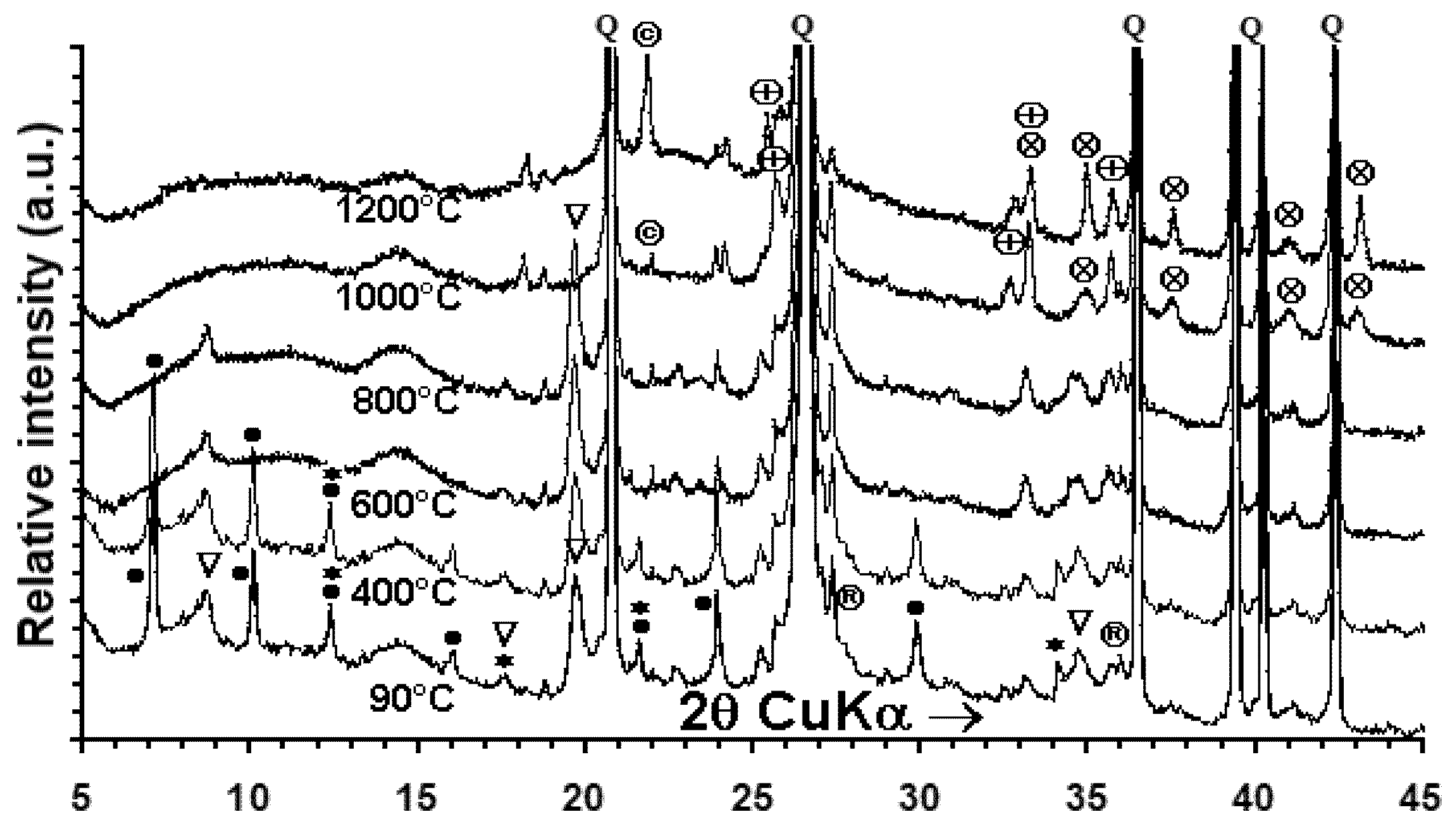
Figure 1 shows the XRD patterns of alkali-activated brick and its thermal transformation products before and after heating from 90 °C to 1200 °C.
Figure 1.
XRD patterns of alkali-activated brick heated at different temperatures for 24 h. Crystalline minerals initially present in the raw brick: quartz (Q); illite (∇); rutile (®). Crystalline minerals generated through alkaline activation: zeolite NaA (●); zeolite NaP (*). Compounds formed during firing process: crystobalite (©); analcime/leucite (⊕); mullite (⊗).
Before calcination, most of the intense reflections appearing in the XRD diffractogram of the alkali-brick sample (dried at 90 °C) were indexed to quartz. Its main characteristic peaks were: 2θCuKα = 20.9° (100), 26.6° (011) 26.6° (011), 36.5° (110), 39.5° (102), 40.3° (111), 42.4° (200), 45.8° (201) and 50.1° (112) [ICSD Collection Code: 89276]. Additional reflections were also detected in the XRD diffractogram. They were identified as those of illite, rutile and zeolites Na-A and Na-P. Their characteristic peaks were as follows: for illite, at 2θCuKα = 8.8° (001), 17.9° (004), 19.8° (021) and 34.3° (034) [ICDD (International Centre for Diffraction Data): 00-009-0343)]; for rutile, at 2θCuKα = 27.4° (110) and 36.1° (101) [ICSD Collection Code: 168140]; for zeolite Na-A, at 2θCuKα = 7.2° (200), 10.2° (220), 12.5° (222), 16.1 (420), 21.7° (600, 442), 24.0° (622) and 30.0° (644, 820) [50]; and for zeolite Na-P, at 2θCuKα = 12.5° (101, 110), 17.7° (200, 002), 21.7° (211, 112, 121) and 33.4° (132, 123, 231, 213, 312, 321) [50]. (Note that quartz, illite and rutile were crystalline phases constituting partly the raw brick, while zeolites Na-A and Na-P were generated through the alkaline decomposition of metakaolinite initially present in the untreated material). At 400 °C, the intensities of the XRD peaks ascribed to zeolites Na-A and Na-P decreased dramatically, indicating that brick dehydration contributed to significant modifications of zeolitic surfaces; and at heating temperatures ≥ 600 °C, zeolitic peaks disappeared thoroughly. At calcination temperatures ≥ 1000 °C, illite became unstable, and its reflections then disappeared. Furthermore, additional reflections appeared in the XRD diffractogram. These reflections were ascribed to newlygenerated crystalline forms: (i) cristobalite (SiO2) at 2θCuKα = 22° (101) [RRUFF ID: R060648; R061064]; (ii) analcime (NaAlSi2O6)/leucite (KAlSi2O6) at 2θCuKα = 25.9° (004, 400), 33.3° (431, 413, 314), 35.8° (521, 215) [RRUFF ID: R060023 for analcime, and RRUFF ID: R040107, R060300 for leucite]; and (iii) mullite {(Al2(A12+2xSi2-2x)O10-x), where x ranges between 0.17 and 0.57} at 2θCuKα = 33.3° (220), 35.4° (111), 37.1–37.6° (130, 310), 41° (121), 43° (230, 320) [RRUFF ID: R141101; R141103]. In the XRD diffractograms of alkali-brick calcined at 1000 °C and 1200 °C, the observation of a broad hump between 17° and 33° confirmed the amorphization of the material at this heating-temperature range.
3.1.2. Microscopic (ESEM/EDS)Analysis
In order to explore changes at microscopic levels in alkali-activated brick during thermal treatments, heated-brick samples were analyzed by using ESEM/EDS. This technique allowed us to determine the distribution of major elements on specimen surfaces and to follow the morphology of particles after the different heating steps.
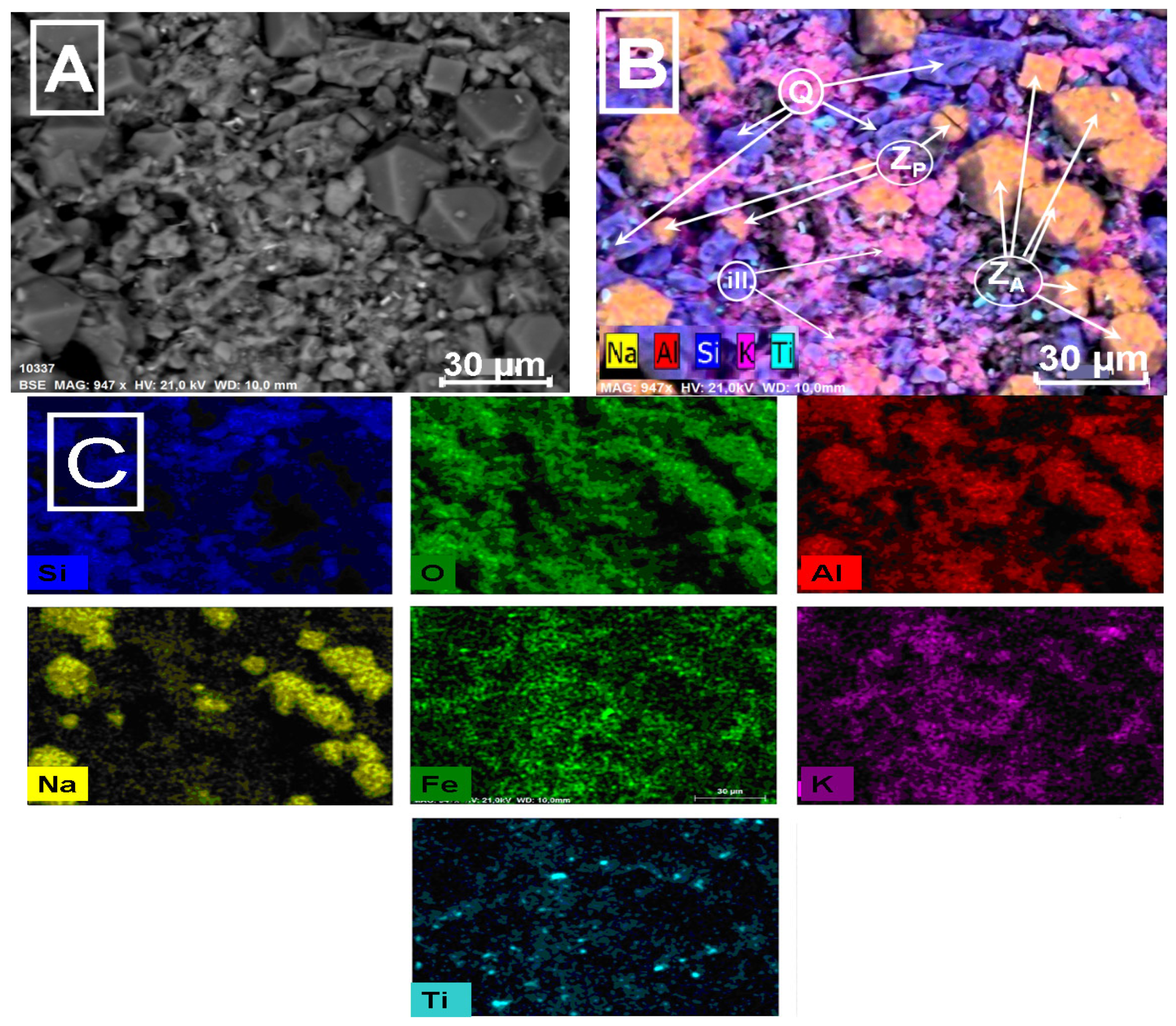
Before heating, the elemental (ESEM/EDS) analysis of alkali-brick revealed the presence of (i) silicon (Si), aluminum (Al), oxygen (O), iron (Fe), potassium (K), sodium (Na) and titanium (Ti), which are considered as the main elements constituting brick minerals globally. The spatial distribution of these elements is displayed in Figure 2.
Figure 2.
ESEM image of alkali-activated brick aggregates (A); reconstituted ESEM/EDS mapping image (B); spatial distribution of the framework elements: Si, O, Al, Na, Fe, K and Ti (C).
Some of the selected elements were distributed across brick surfaces with apparent localization. Thus, element distribution images shown in Figure 2C allowed us to evidence mainly three positive correlations: (i) between Si and O indicative of quartz crystals; (ii) between Al, Si, O and Na indicative of sodic zeolites (as Na-A specimens with cubic shapes, Na-A specimens as polyhedrons-like crystallites, and Na-P specimens with spherical shapes); and (iii) between Al, Si, O, K and Fe indicative of illitic specimens (Note that dispersed micro-specimens of TiO2 were further detected in the ESEM micrograph, in agreement with XRD data confirming the presence of rutile crystals in the brick; see Figure 1). Reconstituted ESEM/EDS mapping image shown in Figure 2B permitted to highlight the principal minerals constituting surfaces of alkali-activated brick aggregates, i.e., quartz (Q, in blue zones); zeolites Na-A and Na-P (ZA and ZP, in yellow-orange zones); and illitic specimens (ill., in violet zones).
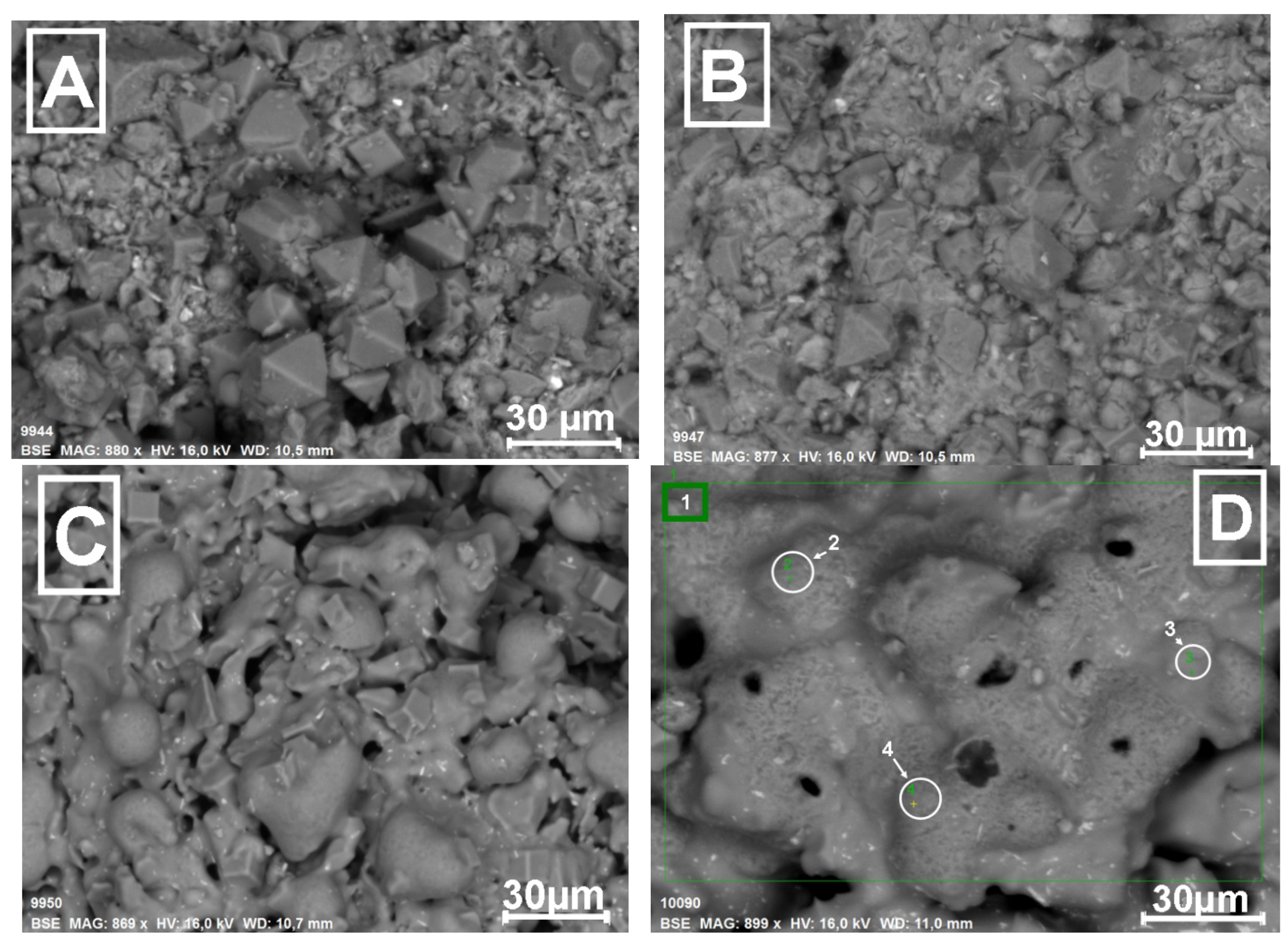
After curing, morphological changes in alkali-brick heated at different temperatures were exhibited through ESEM micrographs in Figure 3.
Figure 3.
ESEM micrographs of alkali-brick pellets analyzed after treating them for 24 h at the following firing temperatures: 600 °C (A); 800 °C (B); 1000 °C (C); 1150 °C (D).
The detailed examination of these micrographs revealed, as expected, the progressive degradation of brick specimens with increasing firingtemperature. The reason forthis observation was the collapse of illitic and zeolitic components during the firing process, as indicated previously by ATG/DSC [32]. Upon heating at 600 °C for 24 h, the agglomeration of brickparticles started to lump together (see micrograph B in Figure 3), contributing to the reduction in specific surface area (BET diminishing from 19.32 m2/g to 14.42 m2/g before and after heat treatment, respectively) [32]. As the calcination temperatures increased (at 1000 °C and 1150 °C for a reaction time of 24 h), the agglomeration of brickparticles accompanied with surface compactness and smoothness became more significant, as shown in ESEM micrographs C and D in Figure 3, thus explaining the dramatic depletion in specific surface area (BET = 0.80 m2/g at 1000 °C and 0.002 m2/g at 1150 °C [32]). In this case, the morphology of calcined brick changed significantly into a frozen liquid-like appearance, suggesting the generation of glass ceramics during the firing process [32]. The detailed ESEM micrograph of glass ceramics made upon heating at 1150 °C for 24 h consisted predominantly of an amorphous translucent phase in which numerous crystallites seemed to be inserted and encapsulated. To gain more information about the heterogeneous surface compositions of the brick material, we decided to target four zones (indicated in Figure 3) representative of glassy and ceramic states, and analyzed them by EDS. In our calculations (see Table S1 in the Supplementary Materials), we considered ‘silicon’ as the reference element. First, by using the EDS technique, we targeted the global ESEM image (limited by the ‘green-rectangular’ line shown in Figure 3D), then determined the atomic proportion of the predominant elements (i.e., O, Si, Al, Na, K, Mg and Fe), and, finally, referenced them to that of silicon (see Table S1). By taking these elements in the form of oxides, we established the following stoichiometry: 1.000SiO2 0.296Al2O3 0.079Na2O 0.030K2O 0.011MgO 0.032FeO. By taking into consideration XRD findings evidencing the existence of both analcime-leucite solid solutions [(Na+, K+)2Al2Si4O12] and mullite (3Al2O3·2SiO2) in calcined brick, one could propose a stoichiometric expression revealing the existence of leucitic, analcimic and mullitic crystallites in a silica-richmaterial containing about 72% of silica, 18% of leucite/analcime solid solutions and 10% of mullite (the % values expressed in molecular percentage). In the surface zone where crystallites seemed to be barely observable (i.e., in cycle 3 shown in Figure 3D), there was a predominant proportion of Si and O, and to a much lesser extent, Al, Na, K, Mg and Fe. By using the same calculation procedure as that described above, we obtained the following stoichiometry: 1.000SiO2 0.048Al2O3 0.024Na2O 0.012K2O 0.004MgO 0.008FeO. This chemical composition corresponds to a silica-rich material containing about: 95% of silica, 4% of leucite/analcime solid solutions and 0.5% of mullite (the % values expressed in molecular percentage). As for the two targeted regions in which crystallites were very abundant (i.e., cycles 2 and 4 shown in Figure 3D), there was a predominant proportion of Si, Al and O (see Table S1). From the elemental composition determined on each zone, one could evaluate the stoichiometric formula where each element was given in its oxidized form; see Table S1. One could then propose the stoichiometric expressions given in Table S1. As indicated in this Table, the chemical formulae calculated on zones 2 and 4 corresponded to targeted aluminosilicates-rich solids containing high levels of leucite, analcime and mullite encapsulated inside silica glass. In these micro-surfaces, averaged calculations led to the following percentage ranges: silica, 64.0–69.3%; analcime/leucite, 16.8–21.9%; and mullite, 13.9–14.2% (in molecular percentage).
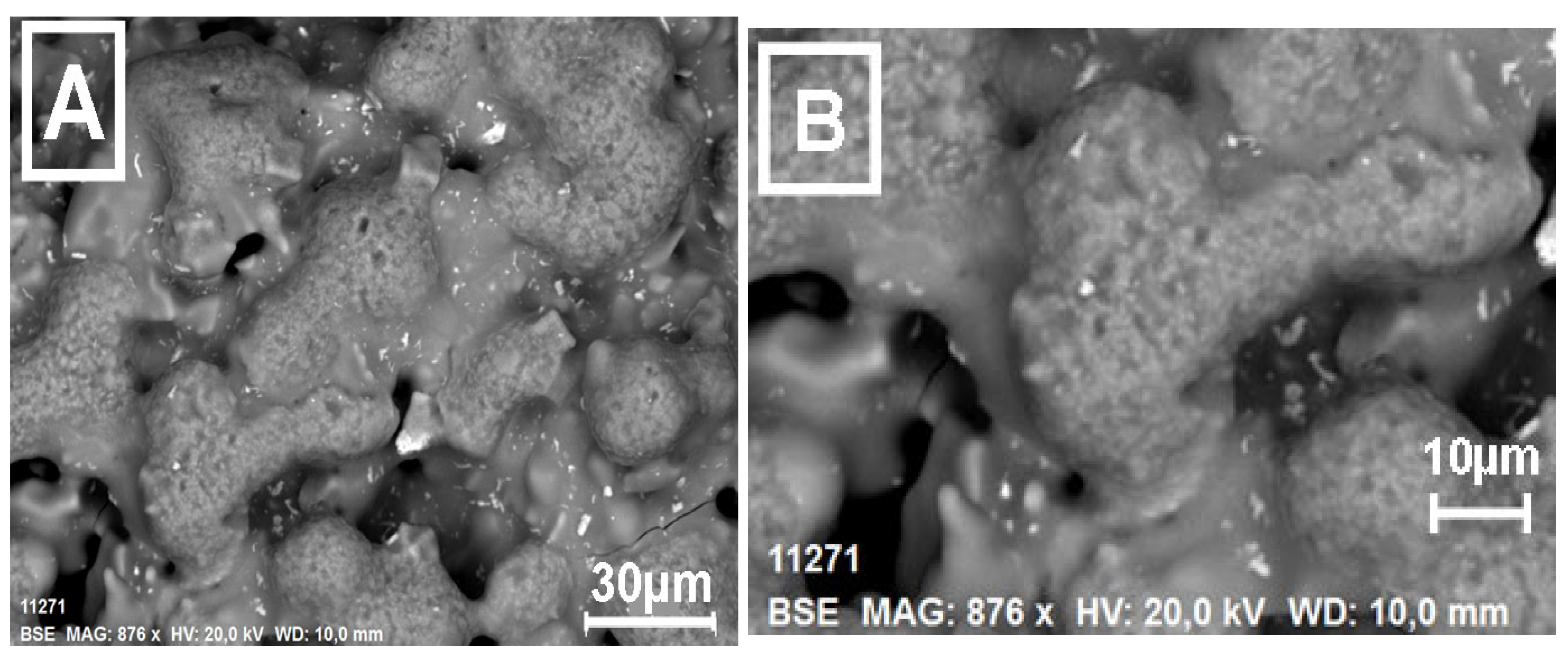
Moreover, by using ESEM/EDS, we also surveyed micro-structural and morphological changes in alkali-brick after a longer temperature exposure (1150 °C for 35 h); see Figure 4.
Figure 4.
ESEM micrograph of alkali-activated brick aggregates showing micro-structural and morphological changes after a longer temperature exposure: 1150 °C for 35 h (A); and the corresponding ‘magnified’ ESM micrograph (B).
As seen in Figure 4A, the treated brick seemed to be well glass-ceramized with a smooth surface and compact aspect. In this figure, the Si element exhibits a predominant presence in darker regions, indicating silica-rich zones. Whereas the elements Al, Na and K, in addition to Si, are primarily concentrated in light regions containing well visible ceramic particles. Indeed, the magnified ESM image illustrated in Figure 4B gave evidence ofa large number of 0.5–4 µm-sized ‘white’ grains entrapped inside the silica-rich glass (in grey). These observations seemed to suggest that the glass-ceramization of alkali-brick under thermal effects would be slow, and needed kinetically more time to be achieved.
3.2. NMR Studies of 29Si and 27Al Environments Under Thermal Effects
3.2.1. 29Si MAS NMR Study
Identification of 29Si Sites in Alkali-Brick
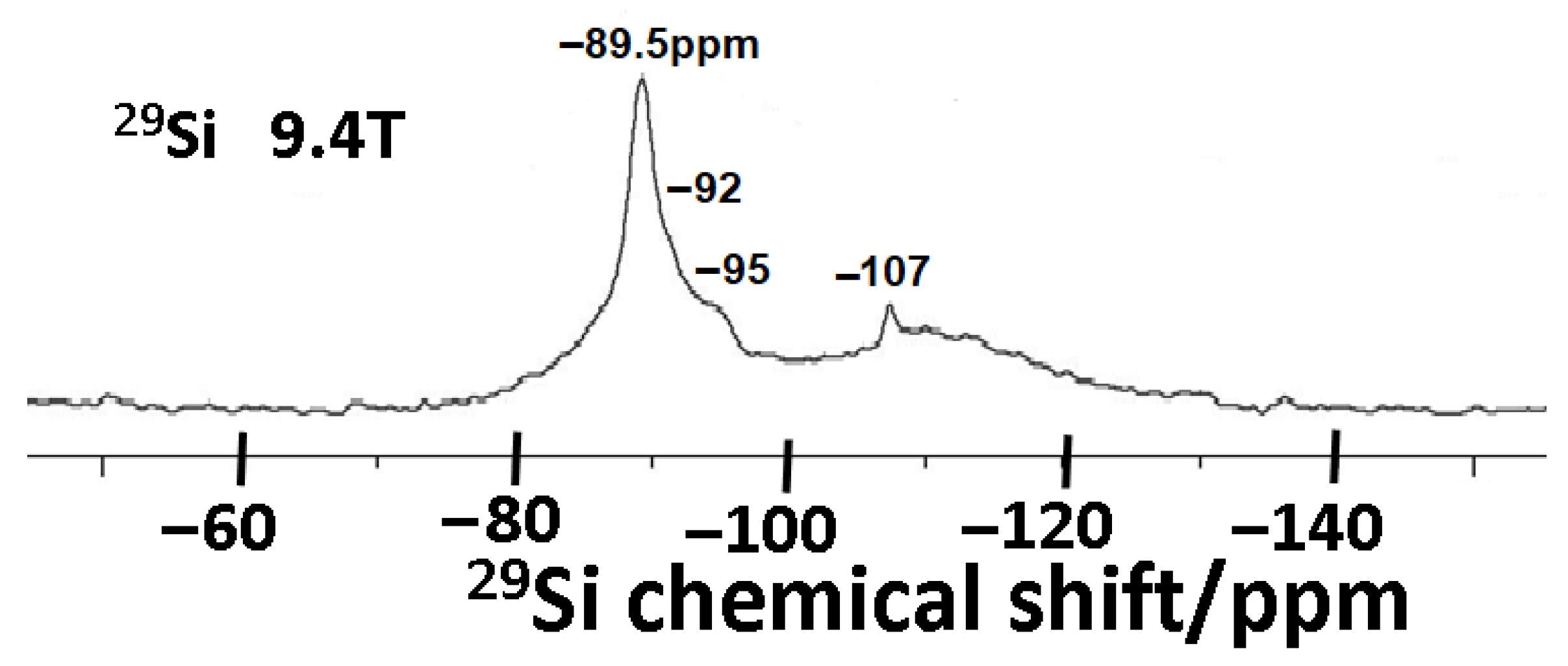
As mentioned previously [30], the 29Si MAS NMR spectrum of alkali-activated brick revealed the presence of different 29Si sites, namely: (i) zeolitic Q4(4Al) sites ascribed to Na-A and Na-P zeolites (at −89.5 ppm); (ii) possibly Q4(4Al), Q4(3Al), Q4(2Al) and Q4(1Al) units attributed to alumino-silicate (geo-polymeric) gels, contributing to the observed peaks at around −85, −89, −92 and−95 ppm; (iii) Q4(0Al) signal corresponding to the quartz mineral (at −107 ppm); and (iv) various Q4(0Al) sites (from −100 to −120 ppm) (see Figure 5).
Figure 5.
29Si MAS NMR spectrum of alkali-activated brick upon heating at 90 °C for 24 h.
These latter sites led to a broad signal attributed to highly polymerized amorphous silica structures generated through the condensation of silicate tetrahedraduring metakaolinitegeo-polymerization [30]. It is worth noting that the raw brick studied here was found to contain higher amounts of illite (~10 w%) than those present in brick samples previously collected, 4–5 w% [30]. This explained why additional NMRsappeared with higher intensities in the 29Si NMR spectrum, namely: (i) a peak at around −92 ppm; (ii) a line broadening spreading from −80 ppm to −85 ppm hinting the occurrence of a badly resolved low signal centered at −82.5 ppm; and (iii) an asymmetric signal (at −89.5 ppm) as pointed out above, hinting the existence of another signal having a lower chemical shift at around (−86)–(−87) ppm. Although the intensities of these peaks were relatively weak, their positions seemed nevertheless to be consistent with those previously observed for illite [51].
In order to examine the thermal evolution of alkali-brick frameworks, the material employed in the form of aggregates (average diameters ranging from 0.7 mm to 1.0 mm) was heated to different temperatures from 400 °C to 1150 °C prior to performing 29Si MAS NMR analysis.
StructuralEvolution of 29Si Brick-Sites Under Thermal Effects
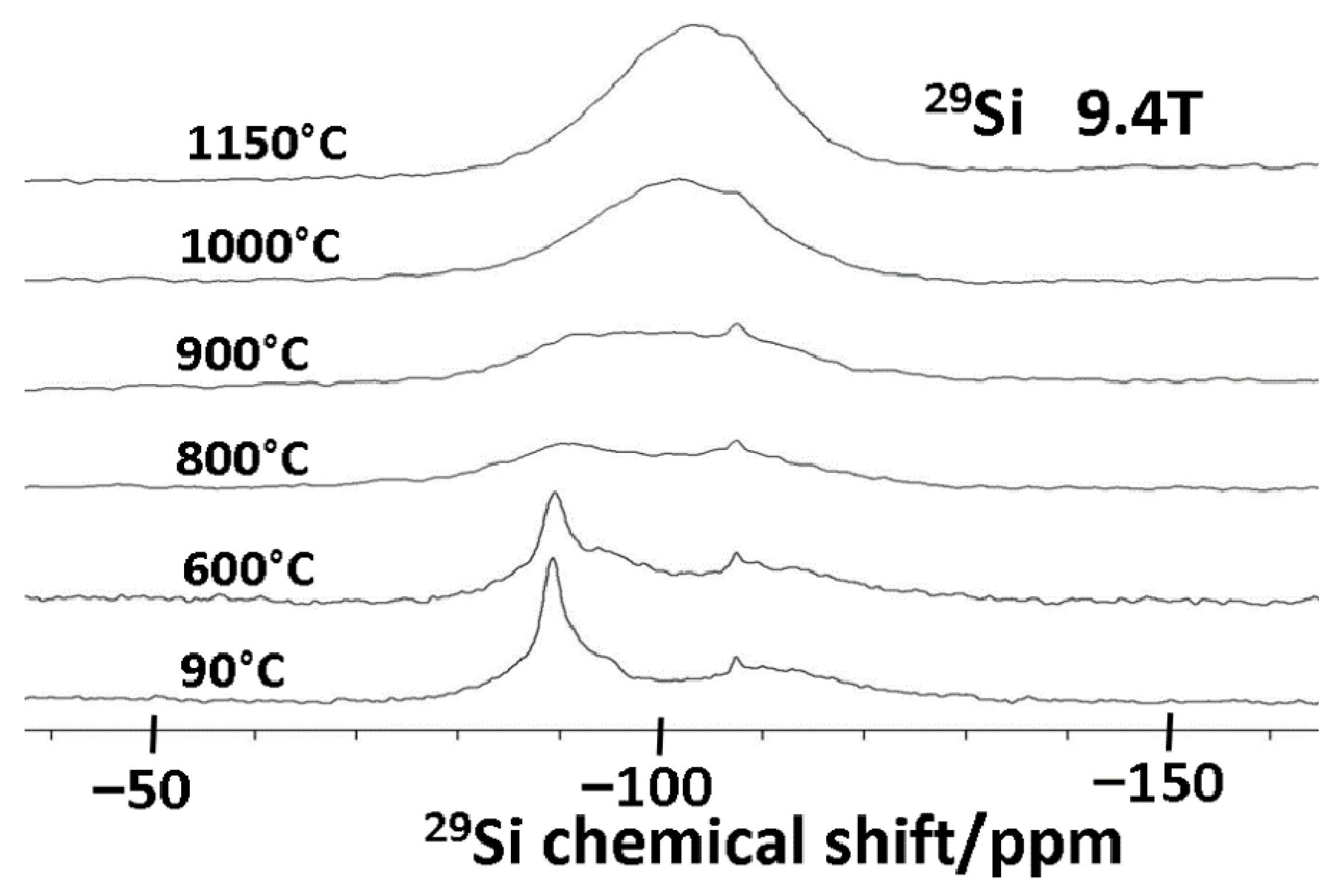
Upon heating at different temperature stages (90–600 °C) for 24 h, the 29Si NMR spectra of heated samples (recorded at room temperature) revealed mainly the gradual disappearance of the sharp peak at around −89.5 ppm at 300 °C, and at higher temperatures (400 °C and 600 °C), the appearance of a new resonance at around −90 ppm (Figure 6 and Figure S1). Note, however, that upon heating at 800 °C, the resonance at −90 ppm disappeared, while both a decrease and broadening of resonance(s) ranging from −80 ppm to −100 ppm occurred. These magnetic changes would be mostly linked to the thermal degradations of the crystalline forms present in the brick (i.e., illite and zeolites Na-A and Na-P).
Figure 6.
29Si NMR spectra of alkali-activated brick upon heating at different calcination temperatures for 24 h.
Upon calcination at 800 °C and 900 °C for 24 h, a very broad signal was detected as thermal degradation processes became more important. This broad signal was centered approximately at −100 ppm and spread from ~−80 ppm to ~−120 ppm (Figure 6). The spectral broadening indicated a beginning of brick amorphization arising from the progressive collapses of crystalline forms that were initially present in alkali-brick, i.e.,illite and zeolites (Na-A and Na-P). In addition, the broad resonance at around −110 ppm (which was well detected at calcination temperatures ≤ 600 °C) shifted to lower fields, merging into the very much broader signal centered at around −101 ppm (Figure 6).
Finally, at more elevated calcination temperatures (1000 °C and 1150 °C for 24 h), only a very broad signal better centered at −105 ppm was observed in the 29Si MAS NMR spectrum; see Figure 6. This observation suggested that the thermal decompositions of zeolitic and illitic frameworks into amorphous aluminosilicate materials were completely achieved. Moreover, the 29Si MAS NMR analysis of alkali-brick samples calcined at 1000 °C and 1150 °C revealed abnormal increases in resonance(s) intensity. This phenomenon would be explained by the partial melting of sand grains induced by the action of fluxing agents, which were generated during brick curing. This suggestion will be developed and discussed in the sections below.
In order to better understand chemical and structural changes in alkali-brick composites via heating, it is important to achieve a quantification of resonance components. For that, 29Si MAS NMR spectra were de-convoluted using the Dmfit free software (version 1.0) in the aim to undertake spectral simulations.
29Si NMRSpectral Simulation
The de-convolution of each 29Si MAS NMR spectrum of heated alkali-brick was performed by employing a mixed Gaussian–Lorentzian fitting function and the minimum possible number of component peaks to reproduce the spectrum accurately. The Gaussian–Lorentzian lines, which were considered here for decomposing at best the 29Si NMR spectrum, were defined by their de-convolution areas (in %), the peak position (chemical shift, δCS), and the full width at half maximum (FWHM).
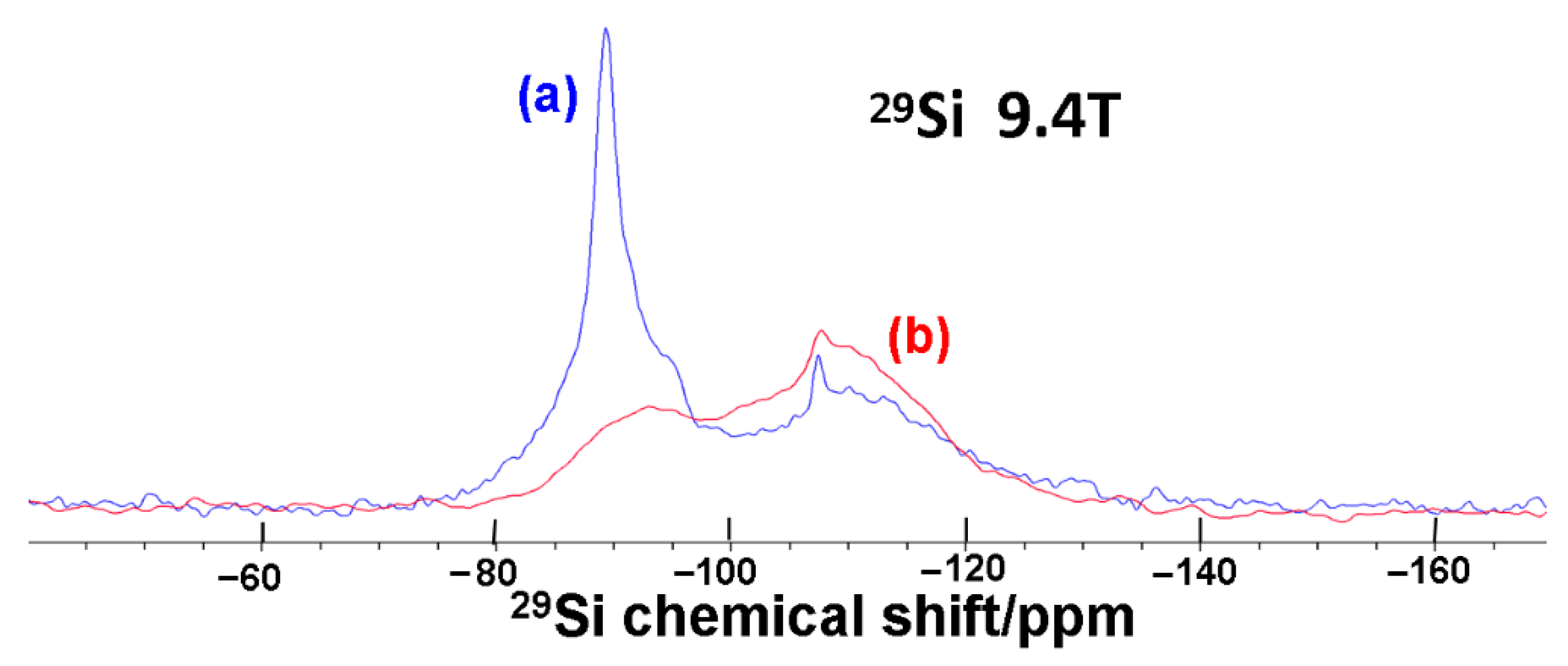
Alkali-Brick Dried at 90 °C: De-convolution analysis showed at least six components within the −70 ppm to −135 ppm range; see Table S2 and Figure S2. The sharp peak at −89.3 ppm with a relatively low FWHM value (2.0 ppm) was assigned to Q4(4Al) sites within zeolitic and geo-polymeric networks, whilethe very broad peak at−110.8 ppm with a high FWHM value (18.9 ppm) resulted from the magnetic characteristics of 29Si atoms in polymerized amorphous (alumino-)silica possessing Q4(1Al) and/or Q4(0Al) sites. The three lowest peaks at −82 ppm, −86 ppm and −92 ppm corresponded closely in position to those observed in the 29Si NMR spectrum of illite [51]. As for the low contribution at −107.6 ppm with a very low FWHM value of 0.2 ppm (and thereby indicative of a silicon resonance in a well-crystallized structure), it was ascribed to Q4 sites in the quartz framework. Moreover, one could further observe in the de-convoluted spectrum a broad component having a FWHM value of 10.6 ppm and centered at −90.3 ppm. In order to know the origin of this contribution, we decided to perform an acid treatment on alkali-brick aggregates with hydrochloric acid (1 mol·L−1) at ambient temperature for 4 h. After the reaction, brick particles were recovered and analyzed by 29Si MAS NMR. The spectrum exhibited roughly two broad resonances centered at about −90 ppm and –110 ppm; see Figure 7.
Figure 7.
29Si spectrum of alkali-brick aggregates before (a) and after acid treatment (b) with hydrochloric acid (1 mol·L−1) at ambient temperature for 4 h.
The first one resembled that observed for metakaolinite present in the raw brick [52], and the second one was attributed to 29Si atoms in amorphous aluminosilicates, as also shown in Figure 5. These findings would suggest that, during the alkaline treatment of the raw brick, metakaolinite was not entirely transformed into zeolitic/geo-polymeric aluminosilicates. And hence, the broad contribution at −90.3 ppm shown in the de-convoluted spectrum of alkali-brick dried at 90 °C (see Figure S2) might be due to the still existence of remnant ‘un-reacted’ metakaolinite. (This suggestion will be supported by 27Al NMR findings; see Section 3.2.2).
Calcined Alkali-Brick: The detailed examination of de-convoluted 29Si NMR spectra of alkali-brick samples heated at various heating stages up to 600 °C revealed mainly the progressive disappearance of the peak at 89.4 ± 1 ppm (Figure S2). Upon heating at 800 °C for 24 h, more reactivity was observed in the spectral NMRprofiles of cured-brick samples (Figure S2), arising from structural re-organization/disorder in brick frameworks. These structural modifications would be specifically linked to the thermal degradation of illite and zeolites. Indeed, first the component located at −89.3 ppm and attributed to 29Si atoms in zeolitic/geo-polymeric structures disappeared thoroughly at 800 °C, while the resonance at around −90 ppm broadened noticeably with FWHM increasing to 14.9 ppm at 800 °C from 10.6 ppm at 90 °C (see Table S2). And, second, as for the three 29Si resonances hardly observed in the alkali-brick spectrum and assigned as Q3(0Al), Q3(1Al) and Q3(2Al) to the illite peaks at −92.0, −86.8 and −82.9 ppm (these peaks being still observable at 600 °C; see Figure S2), they seemed to be strongly affected at a heating temperature of 800 °C. These magnetic changes in illitic peaks thus confirmed the de-hydroxylation and structural breakdown of this mineral at the temperature range of 600–900 °C, in agreement with XRD observations (see Figure 1) and TGA/DSC analysis data [32]. It followed that the three bands indicative of crystalline illite underwent line broadening as a consequence of illite amorphization. Accordingly, from performed spectral de-convolution analysis one could state that the appearance of a new broad component centered at −90.4 ppm (in the case of the brick sample calcined at 800 °C; see Table S2) ought to result from several contributions: (i) Q3/Q4 coordination from degraded illite and zeolites/geo-polymers; and, (ii) additionally, Q4 contributions from residual metakaolinite [53,54].
To summarize, the study on alkali-brick cured at 800 °C permitted to show clearly significant structural re-organization/disorder in brick frameworks that were mostly linked to the thermal degradation of specific minerals (i.e., illite, zeolites). The increase in NMR line-widths observed further confirmed the beginning of the brick amorphization.
At higher calcination temperatures (900 °C, 1000 °C and 1150 °C for 24 h), amorphization continued to increase dramatically with a remarkable evolution of 29Si-peak positions, lineshapes and component areas (see Table S2 and Figures S1 and S2). Concerning the de-convolution study on the 29Si MAS NMR spectrum of alkali-brick after its curing at 1150 °C, the simulated spectrum revealed mainly two broad components, reflecting amorphous glassy properties of the material. The first one, which was representative of Al-rich structural units, shifted from −90.4 ppm at 800 °C to −94.3 ppm at 1150 °C (see Figure S2 and Table S2). This shifting evidenced interaction and intermixing of Al-rich structural units with Si-rich structural units, contributing to increasing the proportions of Si atoms in different environments of type Qn(mAl) (i.e., to diminish the ‘averaged m’ number of aluminum atom neighbors). The second one, which was representative of Si-rich structural units, shifted significantly from −112.6 ppm to −104.9 (see Figure S2 and Table S2). This component rose strongly due to an important input of silica derived from the melting of brick sand at the studied curing temperature [32]. One could therefore ascertain that during calcination, partial intermixings of Si-richQ4 groups and Al-richQ4 groups took place inside calcined-brick networks, hence, enabling the incorporation of Al atoms into (silicate) glassy frameworks.
In order to well understand all these intermixing phenomena under heating effects, it was necessary for us to bring information about the aluminum environments of the brick and their thermal evolutions by performing 27Al MAS NMR analysis on the investigated samples.
3.2.2. 27Al MAS NMR
Identification of 27Al Sites in Alkali-Activated Brick
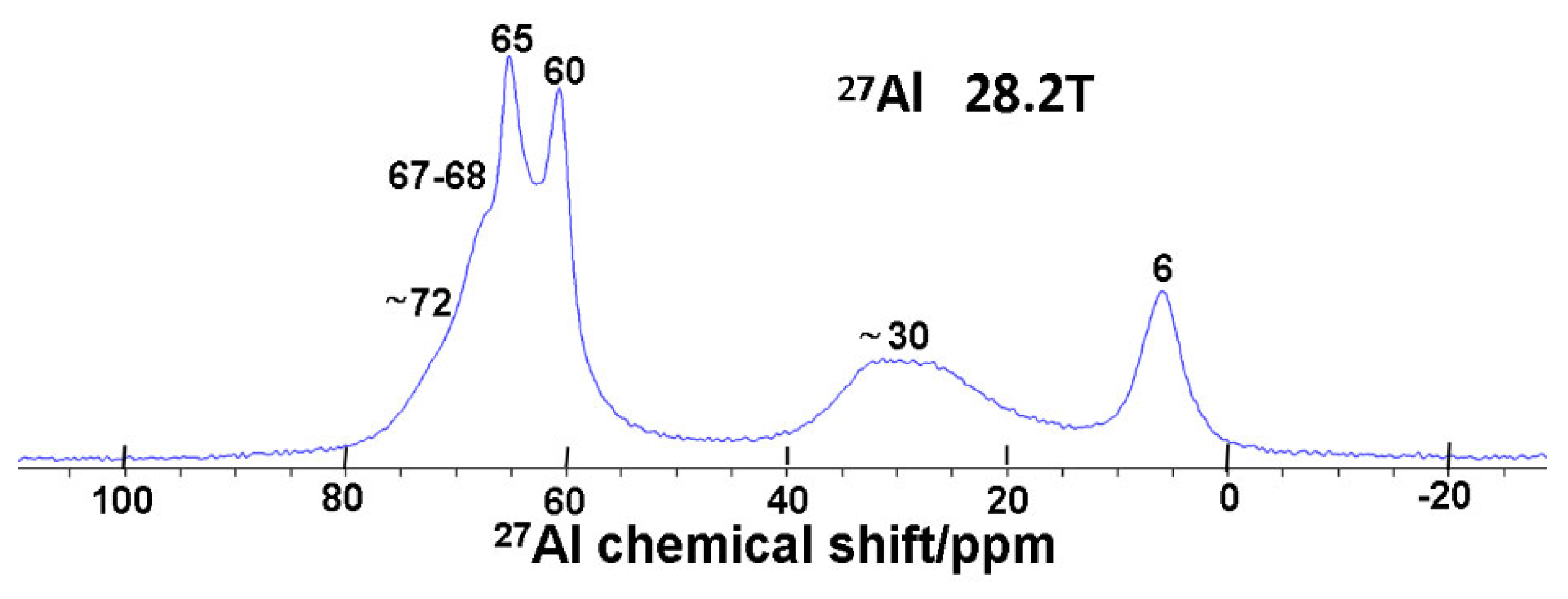
The 27Al MAS NMR spectrum of alkali-activated brick displayed several peaks ascribed to a variety of aluminum environments (Figure 8).
Figure 8.
27Al MAS NMR spectrum of alkali-activated brick upon heating at 90 °C for 24 h.
All the 27Al nuclei detected in the 50 ppm to 80 ppm region corresponded to tetrahedrally coordinated aluminum (AlIV) [27Al atom bound via oxygen to four 29Si atoms to give Al(OSi)4 units]. Observed Al(IV) environments resulted roughly in four 27Al MAS NMR signals [30]. The sharp NMR detected in the chemical shift at 60 ppm was attributed to the tetrahedrally coordinated aluminum of both Na-A and Na-P zeolites [55,56,57,58]. The very sharp 27Al NMR peak observed at around 65 ppm was ascribed to tetrahedrally coordinated aluminum in ‘remnant’ geo-polymeric gels (i.e., gels not yet transformed into zeolites) [59]. And close to the geo-polymeric signal at 65 ppm, a shoulder appeared at around 67–68 ppm, which was identified as a part of the broad 27Al resonance of remnant untreated metakaolinite. (Note that the still occurrence of metakaolinite was also evidenced by 29Si MAS NMR analysis; see Section 3.2.1). The weak signal detected at lower fields (~72 ppm) was assigned to illitic 27Al atoms in AlO4 configurations, and the peak at 6 ppm was dominantly assigned to illitic 27Al atoms in AlO6 configuration [51]. Note also a low signal at 30 ppm corresponding to an Al(V) configuration that would be due to the magnetic characteristics of remnant ‘untreated’ metakaolinite [53,60,61,62]. In order to sustain this assignment and explain the origin of Al(V) configuration, we decided to undertake a series of acidic and alkaline treatments on the alkali-activated brick, and, subsequently, to analyze recovered solids by 27Al MAS NMR.
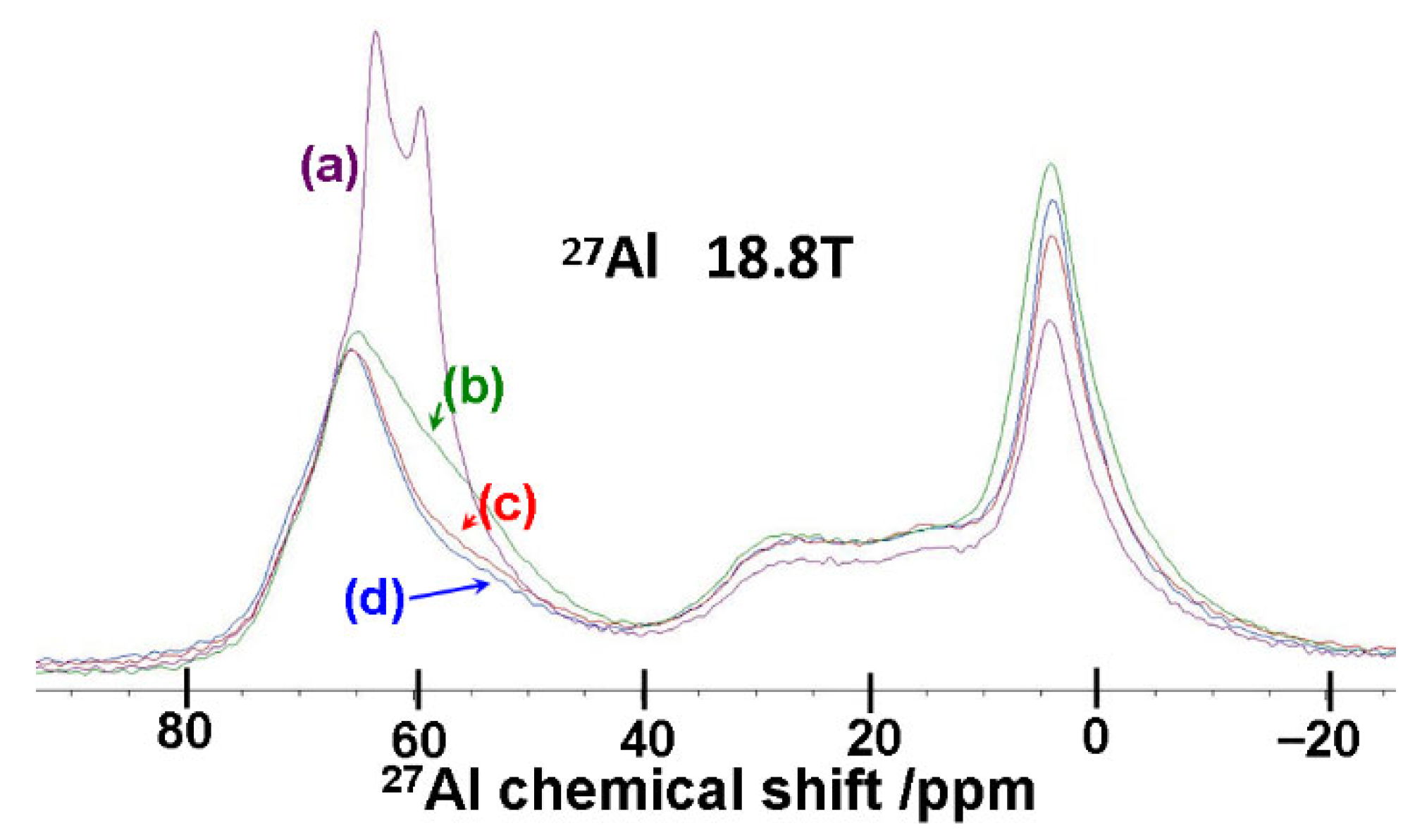
Acidification of Alkali-Brick: The principal objectives of this study were (i) to assess the acidity effects on the aqueous structural stability of alkali-brickat different pH values; (ii) to identify unstable compounds during the course of the acidification process; and (iii) to analyze the still-present (not degraded) solid materials by using 27Al MAS NMR. For that, a series of leaching tests wasconducted in hydrochloric-acid solutions at different suspension-pH values (pH = 4.8, 2.5, 1.7 and 1.3) for an attack time of 4 h. The 27Al MAS NMR analysis of recovered solids revealed globally significant decreases in Al(IV) units with increasing acidity (Figure 9).
Figure 9.
27Al MAS NMR spectra of alkali-brick aggregates before (a) and after acid treatments at different suspension-pH values (pH = 4.8, 2.5, 1.7 and 1.3) for an attack time of 4 h. pH 4.8 (a); pH 2.5 (b); pH 1.7 (c); pH 1.3 (d).
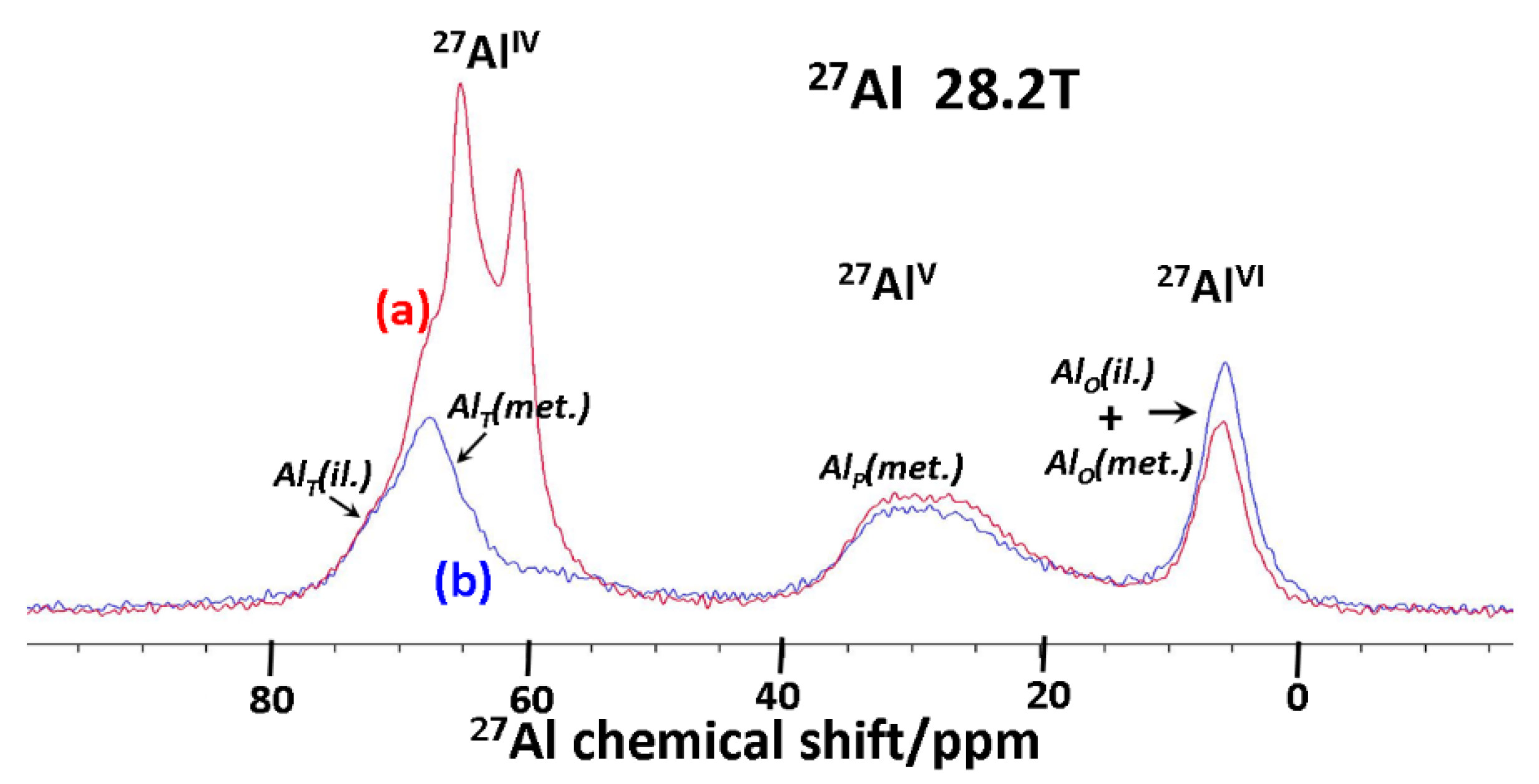
Such spectral changes in the Al(IV)-NMR region would be due to the gradual acid degradation of zeolitic and geo-polymeric frameworks. Note, however, that a part of Al(IV) configuration and most of Al(V) and Al(VI) configurations were still present in the recorded spectra, and this, even after an acid attack of alkali-brick at a more elevated concentration of hydrochloric acid (i.e., 1 mol·L−1; see Figure 10).
Figure 10.
27Al MAS NMR spectra (at ultra-high magnetic field) of alkali-brick aggregates before (a) and after acid treatment (b) with hydrochloric acid at a concentration of 1 mol·L−1 for an attack time of 4 h.
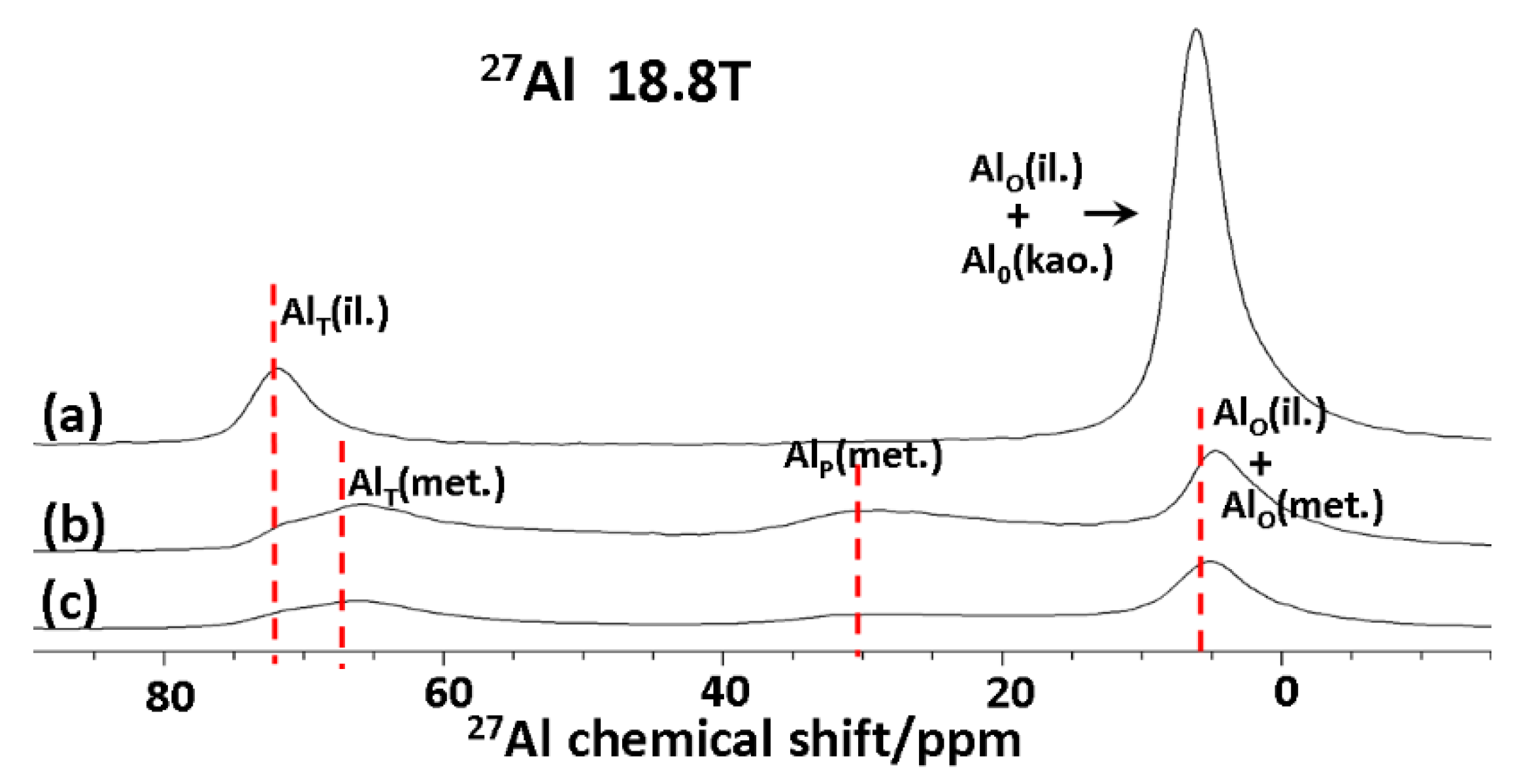
Indeed, in this latter case, one could still notice the involvement of three major signals centered at ~70 ppm, ~35 ppm and ~7 ppm corresponding to four(IV)-, five(V)- and six(VI)-coordinated Al, respectively (abbreviated here as AlT, AlP and AlO). Moreover, according to the XRD results (Figure S3), the zeolites Na-A and Na-P were entirely degraded under high acid conditions, and, in contrast, crystalline illitic specimens and quartz crystals predominated in the acidified material. As such, the feature 27Al NMRs detected before acid treatment at 72 ppm and partly at 6 ppm could be assigned to the tetrahedral and octahedral aluminum sites, AlT(il.) and AlO(il.), of the brick–illite structure. This assignment was consistent with that obtained for Hungarian white illite by Carroll and his co-workers [51]. (Note that, as illite was a mineral initially present in the soil employed for making the brick, its 27Al resonances were also detected in the 27Al NMR spectrum of the soil in addition to that of kaolinite at around 6 ppm; see Figure 11 (a)).
Figure 11.
27Al MAS NMR spectra of kaolinite-rich soil before (a) and after heating at 500 °C for 24 h (b), and untreated brick (c). ‘il.’, ‘met.’ and ‘kao.’ are the abbreviations of illite, metakaolinite and kaolinite, respectively.
As for the other 27Al NMRs, which were centered at ~67 ppm [AlT(met.)], ~30 ppm [(AlP(met.)] and ~5–6 ppm [partly AlO(met.)], they were found(i) to be close to those observed in the past for metakaolinite [53,60,61,62], and to possess signal shapes, peak positions (chemical shift: CS) and full width at half-height (FWHM) relatively well, consistent with those observed by our research group in the 27Al NMR spectrum of metakaolinite present in either untreated brick or in kaolin-rich soil after heating it at 500 °C, as shown in Figure 11b,c. The broad line-width of the residual peaks still observed for acidified brick reflected well the amorphous character of the metakaolinite (a mineral preliminarily generated thermally through soil-kaolin de-hydroxylation during brick making). One could therefore assume that brick-metakaolinite was not completely consumed under our (alkaline) operational conditions. To support this finding and highlight the importance of alkalinity on the reactivity of brick-metakaolinite, we decided to further conduct a series of experiments directly on the untreated brick by suspending raw-brick grains in NaOH solutions with increasing concentrations.
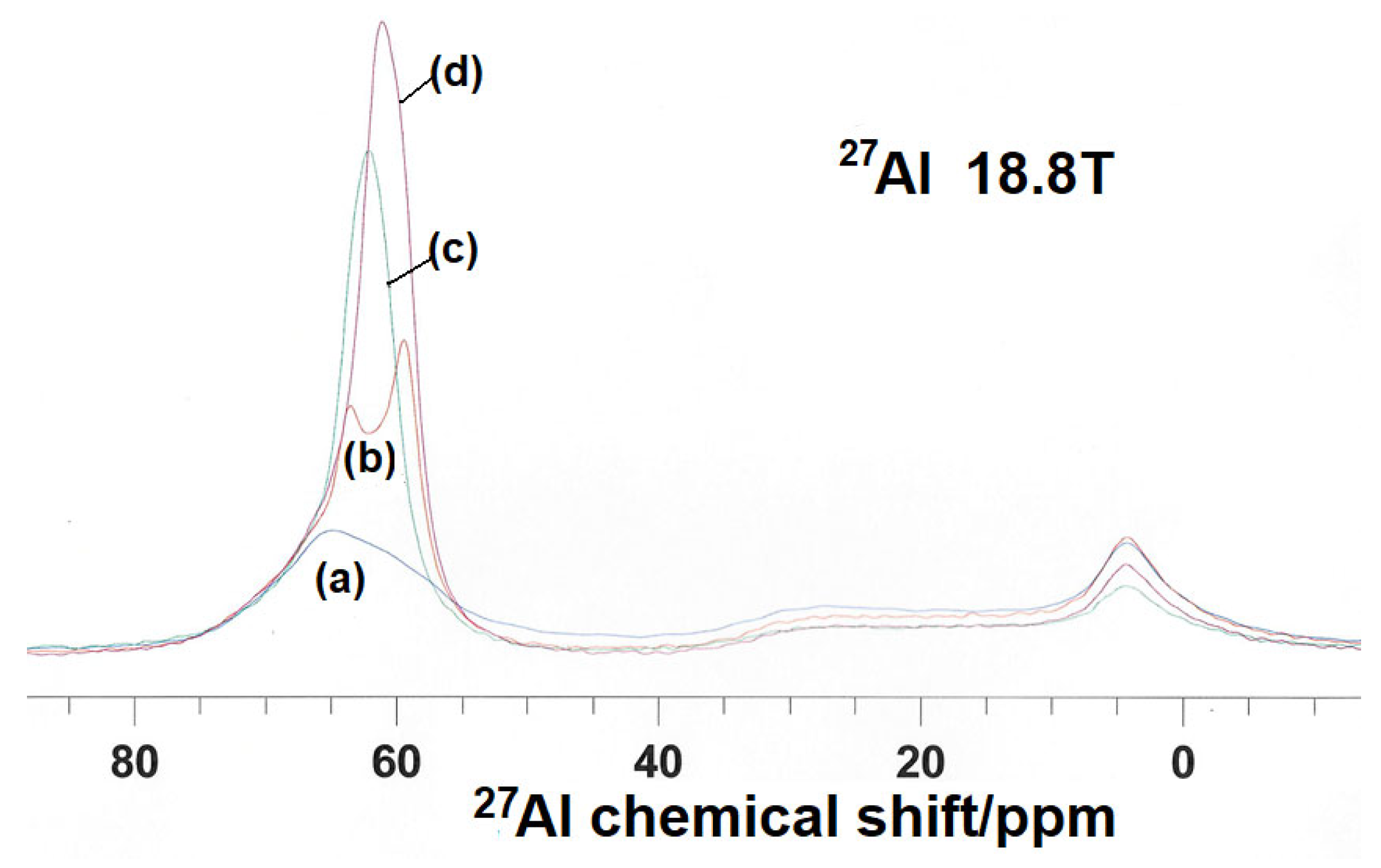
Effect of Increasing Alkalinity on Brick-Metakaolinite: Raw-brick samples were treated with sodium hydroxide at the following concentrations: [NaOH] = 0.1, 0.6, 1.0 and 1.5 mol·L−1, according to the synthesis procedure described in the Section 2. After alkaline treatments, brick grains were recovered and analyzed by 27Al MAS NMR (Figure 12).
Figure 12.
27Al MAS NMR spectra of raw brick after alkaline treatments (at room temperature for 24 h) with sodium hydroxide at the following concentrations: [NaOH] = 0.10 (a); 0.6 (b); 1.0 (c); and 1.5 mol·L−1 (d).
Obtained NMR data on recovered products indicatedboth (i) the increasing intensity of Al(IV) resonances, suggesting higher magnetic contribution of 27Al atoms belonging to zeolitic/geo-polymeric aluminosilicates, and (ii) the decreasing intensities of Al(V) and Al(VI) signals indicative of the consumption of brick-metakaolinite.
However, based on the above 27Al NMR analysis, there was still a lack of information concerning the implication of Al(IV), Al(V) and/or Al(VI) configurations of each brick mineral on the thermal transformation process. For that purpose, it had been necessary for us to undertake the de-convolution of 27Al MAS NMR spectra of some representative cured-brick samples in the aim to evidence the different Al-based structural units initially present in brick frameworks, and those appearing at each calcination stage.
27Al NMRSpectral Simulation
Owing to the significantly improved sensitivity and resolution of the ultra-high magnetic field used (28.2T), 27Al NMR experiments permitted us to distinguish and quantify the Al(IV), Al(V) and Al(VI) configurations present in heated brick (see Figure S4). In addition, Figures S5 and S6 present some selected 27Al MAS NMR spectra (recorded at ambient temperature) and de-convolution results for alkali-brick samples that were previously heated prior to analysis at the following temperatures: 90 °C, 300 °C, 400 °C, 600 °C, 800 °C and 1150 °C. As can be seen in this figure, simulated spectra exhibit variable 4-, 5- and 6-fold coordination structures, highlighting the thermal impact of high-temperature curing on the relative stability of minerals present in the brick composite. Obtained components were defined by their de-convolution areas (in %), peak position (chemical shift, δCS), and full width at half maximum (FWHM); see Table S3.
De-Convolution Analysis of Alkali-Brick Dried at 90 °C: In the de-convoluted spectrum (see Figure S6 and Tables S3 and S4), the prominent resonances in the 50–80 ppm region corresponded globally to 27Al nuclei in tetrahedral coordination (Total AlT = 59.93 at.%), while those in the 20–40 ppmand 0–20 ppm regions represented 27Al nuclei in pentahedral coordination (AlP = 23.94 at.%) and octahedral coordination (AlO = 16.14 at.%), respectively. By examining in detail the de-convoluted spectra, one could identify at least eight Al-based structural units. The two components at 60.69 ppm and 63.15 ppm were assigned to Q4(mAl) units (1 ≤ m ≤ 4) present in zeolitic and geo-polymeric networks, respectively [30]. The components observed in the chemical-shift (CS) range from 72.03 ppm to 65.13 ppm were assigned to the resonances of AlT nuclei in illite and metakaolinite, respectively [51]. The AlP component at 28.71 ppm was located close to those observed for illite [51] and metakaolinite [53,60,61,62]. As for the AlO component at 6.04 ppm, it was found to be close enough to that observed by Carroll and his co-workers for Hungarian white illite [51].
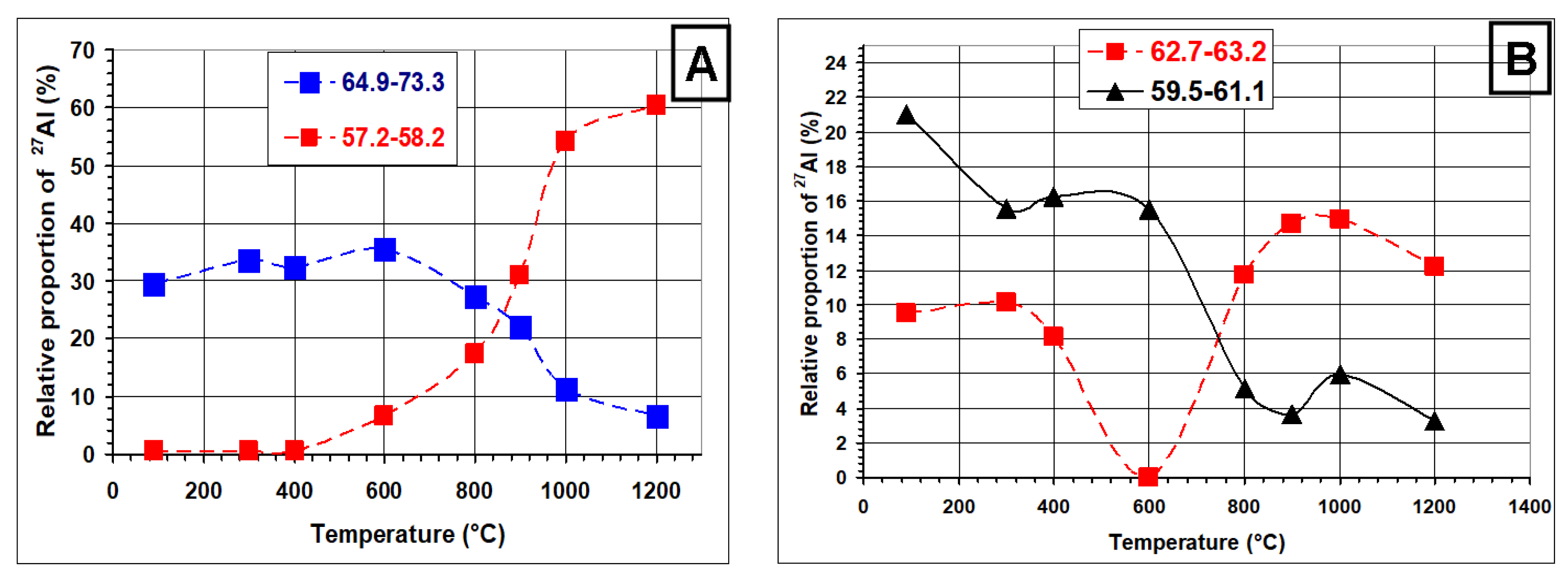
Evolution of Al(IV)Components Under Thermal Effects: Regarding the CS range of 64.90–73.30 ppm representative of 27AlT sites of illite and metakaolinite (see Figure S6 and Table S4), it was found that the 27Al-atomic percentages remained relatively stable upon heating up to 600 °C, while they decreased progressively upon calcination at more elevated temperatures, as shown in Figure 13A, drawn from 27Al-NMR data listed in Tables S3 and S4. This finding evidenced the gradual decompositions of illite and remnant untreated metakaolinite.
Figure 13.
Variation in the mole fraction (obtained by spectral de-convolution) of 27AlT sites representative of minerals constituting alkali-activated brick during curing process. Spectral variations observed in the CS ranges of 64.9–73.3 ppm and 57.2–58.2 ppm (A); and in the CS ranges of 62.7–63.2 ppm and 59.5–61.1 ppm (B).
Regarding the CS ranges of 59.50–61.10 ppm indicative of Al-based structural units present in zeolitic frameworks (see Figure S6 and Table S4), it was found that the 27Al-atomic percentages decreased progressively up to the temperature of 600 °C, while they diminished sharply from 600 °C up to 900 °C, as shown in Figure 13B, thus evidencing the thermal decomposition of zeolites (in agreement with ATG/DSC results [32]). As for the CS range of 62.7–63.2 ppm, indicative of Al-based structural units present in geo-polymeric frameworks (see Figure S6 and Table S4), de-convolution results indicated that geo-polymers began to modify from 400 °C and seemed to be thoroughly transformed from ~600 °C, as shown in Figure 13B, whereas at temperatures > 600 °C, a novel component appeared in the same CS range (62.7–63.2 ppm), and rose significantly up to 1000 °C (Figure 13B). Its chemical shift was found to be in the CS zone assigned to leucitic/analcimic27AlT units [63,64]. (The lineshapes of 27Al sites of leucite and analcime present as solid solutions inside the ceramized brick would be overlapped, and hence, the resulting signal should appear at resonance positions around 62–63 ppm, as previously pointed out for novel leucite glass–ceramics [65]). By having reference to the curve profiles illustrated in Figure 13B, one could ascertain that the depleted fractions of 27AlT units in the regions 59.5–61.1 ppm (representative of zeolitic 27Al) and 62.7–63.2 ppm (representative of geo-polymeric 27Al) largely contributed to the formation of leucite/analcime networks under curing effect. Note, however, that even though the NMR technique seemed to state the existence of leucite and analcime, these minerals were nevertheless hardly detected separately by XRD because of the predominance of leucite/analcime solid solutions badly crystallized in the cured brick (see Figure 1) [32].
Concerning the CS range of 56.70–58.20 ppm (see Figure S6 and Table S4), de-convolution analysis revealed that at calcination temperatures ≤ 400 °C, the magnitude of this component remained negligible up to 400 °C, while at higher temperatures, this component increased strongly up to attain 27Al-atomic percentages of about 60% at 1200 °C (see Figure 13A). This risewith augmenting calcination temperature, leading to a high FWHM value (10.2–11.0 ppm), confirmed the gradual amorphization state of the brick with newly generated 27AlT units inside amorphous aluminosilicate frameworks.
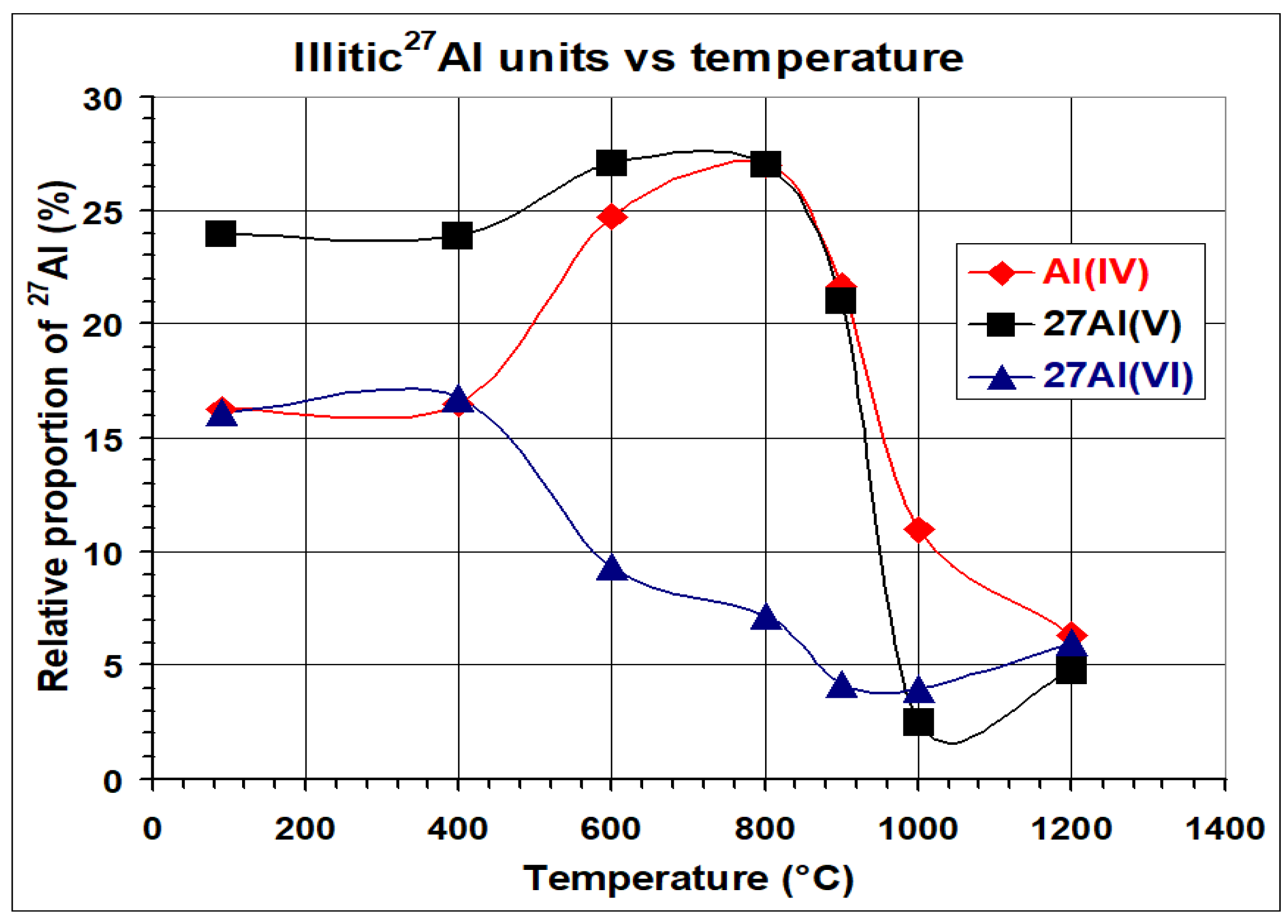
Changes Inillitic 27Al Configurations Under Thermal Effects: Figure 14, drawn from 27Al-NMR data listed in Table S3, exhibits the variation in the mole fraction (obtained by spectral de-convolution) of the different Al-based structural units assumed to belong predominantly to illitic frameworks. The 27Al atomic fractions of these minerals were determined in the following chemical-shift zones: (i) 66.7–73.3ppm, exhibiting high-frequency resonances assigned to tetrahedral 27Al atoms in illite and metakaolinite structures; (ii) 27.66–29.11 ppm, showing medium-frequency resonances corresponding to pentahedral 27Al atoms in illite/metakaolinite frameworks; and (iii) 4.32–6.17 ppm, revealing low-frequency resonances ascribed to octahedral 27Al atoms mostly in illite. Upon heating up to 400 °C, the 27Al environments in these chemical-shift regions did not undergo noticeable changes in the relative contents of AlT, AlP and AlO atoms (see Figure 14).
Figure 14.
Changes in 27Al configurations of brick–illite (obtained by spectral de-convolution) under curing process.
Upon heating at temperatures > 400 °C, one could notice that the fractions of AlT and AlP units rose strongly up to the curing temperature of 800 °C, while, at the same time, the fraction of AlO units diminished significantly. One could thus conclude that the increase in the relative content of Al(IV) + Al(V) nuclei was at the expense of the decrease in Al(VI) nuclei. Such resonance feature changes in 27Al brick sites could be explained by illite de-hydroxylation occurring under thermal effects, resulting in the transformation of illitic Al(VI) environments into Al(IV) and Al(V) ones, as pointed out previously [66]. However, the additional fractions of Al(IV) + Al(V) nuclei generated through brick calcination at 800 °C (i.e., 6.04 + 3.15 = 9.19 at.%) differed somewhat from that corresponding to the loss of 27Al(VI) nuclei (i.e., 9.63 at.%), suggesting that brick-metakaolinite should also be implicated in this calculation. (Note that specific 27Al and 29Si NMR contributions of metakaolinite to thermal changes in alkali-brick were not addressed here). Upon heating at temperatures > 800 °C (see Figure 14), the mole fractions of Al(IV) and Al(V) sites in the chemical-shift ranges 66.7–73.3 ppm and 27.6–29.1 ppm depleted significantly due to the decomposition of illite into amorphous aluminosilicate materials. Indeed, thermal illite degradation led to the formation of Al(IV) units that were detected in the chemical-shift range: 57.2–58.2 ppm.
3.3. Micro-Porosity/Density Changes and Chemical Resistance Under Thermal Effect
Although the Spark Plasma Sintering (SPS) is a promising powder consolidation method employed for the production of dense ceramic and glass–ceramic matrices [67,68,69,70], SPS is nevertheless considered a high-tech solution for the reliable immobilization of radio-active radio-nuclides. Hence, in developing countries, the SPS technology can hardly be applied to the resolution of radio-active contamination problems like those raised, e.g., by uranium exploitation in the Central African Republic. Despite that, we nevertheless attempted to demonstrate in what follows the relative competitiveness of our methodological approach by determining densitometric characteristics, micro-porosity and chemical resistance of cured-brick samples, andby comparing them to those of glass–ceramics produced by SPS.
The densities of brick samples were obtained based on Archimedes’ principle. Upon heating alkali-activated brick up to 1000 °C, the density value increased from 1.814 g·cm−3 to 2.583 g·cm−3, indicating a significant compactness of the material under thermal effect.
The micro-porosity analysis of heated-brick samples revealed significant changes in the porous properties of the material under firing processes. Thus, upon rising temperature from 90 °C to 900 °C the BJH adsorption cumulative volume of pores depleted from 0.0363 cm3·g−1 to 0.0028 cm3·g−1, while the BJH adsorption average pore diameters increased from 12.71 nm at 90 °C to 27.52 nm at 900 °C, and at the same temperature increase, the BET surface area decreased from 19.319 m2·g−1 to 0.801 m2·g−1, and the single point adsorption total pore volume of pores (∅ < 313.549 nm at P/Po ≤ 0.9942) decreased from 0.0397 cm3·g−1 to 0.0031 cm3·g−1 (at P/Po ≤ 0.2716). Upon heating alkali-brick at 1000 °C for 24 h, the resulting calcined sample became non-porous: 0.002(6) m2·g−1 BET surface area (SBET), and 0.0017 cm3·g−1 (at P/Po ≤ 0.2716) single-point adsorption total pore volume of pores (∅ < 313.549 nm at P/Po ≤ 0.9942). All these findings showed clearly that higher curing temperatures promoted the formation of amorphous structures, ultimately resulting in higher density and compactness/smoothness, as also evidenced morphologically by ESEM.
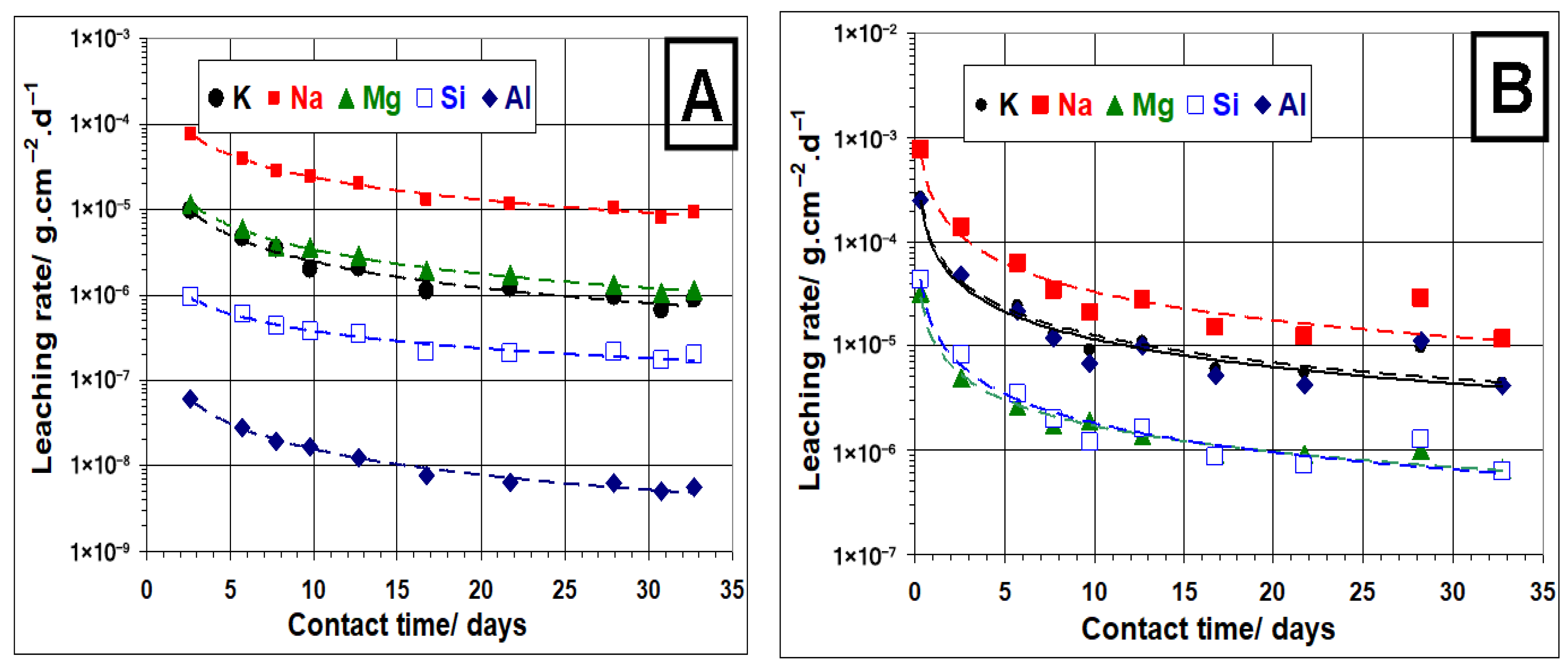
The hydrolytic stability of alkali-brick samples obtained after heating at 1000 °C for 24 h was examined in de-ionized water at room temperature and various contact times. The rates of leaching of elements constituting the glass-ceramized brick (i.e., Si, Al, Na, K and Mg) were determined. As seen in Figure 15A, under prolonged aqueous exposure conditions (30 days) low leaching rates were measured for counter-ions (Na+, K+, Mg2+) and framework elements (Si, Al): 8.1 × 10⁻⁶g·cm−2·day−1for Na; 6.6 × 10⁻⁷ g·cm−2·day−1 for K; 1.1 × 10⁻⁶ g·cm−2·day−1 for Mg; 1.7 × 10⁻⁷ g·cm−2·day−1 for Si; and 5.0 × 10⁻⁹ g·cm−2·day−1 for Al. These leaching data proved the good chemical resistance of the material in water.
Figure 15.
Leaching rates of K, Na, Mg, Si and Al from glass-ceramized brick produced at a curing temperature of 1000 °C. Leach experiments performed in de-ionized water (A); in hydrochloric acid solution 1 mol·L−1 (B).
The hydrolytic stability of alkali-brick samples obtained after heating at 1000 °C for 24 h was also examined in hydrochloric acid solution (1 mol·L−1) at room temperature and various contact times. As seen in Figure 15B, under prolonged acid exposure conditions (30 days), the leaching rates of studied elements were found to be still very low: 7.0 × 10⁻⁶, 1.1 × 10⁻⁵, and 8.2 × 10⁻⁷ g·cm−2·day−1 for the counter-ions K+, Na+ and Mg2+, respectively; and 9.6 × 10⁻⁷ and 7.7 × 10⁻⁶ g·cm−2·day−1 for thematrix elements Si and Al, respectively.
As for experiments on thermal transformations of alkali-activated brick doped with radio-nuclides (Sr2+, Co2+, Cs+), they are still underway in the laboratory. However, our preliminary investigations on radio-nuclides-doped alkali-brick samples after heating them at the temperature range of 800–1000 °C evidenced the formation of glass–ceramic matrices containing Sr-feldspar, Co-aluminate and pollucite [Boughriet et al., unpublished works]. In the case of cesium, our studies permitted us to further confirm the absence of Cs-volatilization during the curing process owing to the formation of stable CsAlSiO4-ANA polymorphs from temperatures ≥800 °C, as previously evidenced in the system Cs2O-Al2O3-SiO2 [71]. The glass–ceramic samples obtained after heating at 900–1000 °C for 24 h were also characterized by high hydrolytic stability. Thus, after a prolonged contact time of 30 days in de-ionized water at room temperature, the rate of cesium leaching was within the range of 1.4 × 10⁻⁷–3.4 × 10⁻⁷ g·cm−2·day−1. These values were close enough to those measured for cesium entrapped in ceramics produced by the SPS technique [67,68,69,70].
To summarize, the obtained glass–ceramic samples exhibited high values of specific density (~2.6 g·cm−3), high compactness and good corrosion resistance under static, mild and aggressive conditions, attesting to their high solidification and chemical durability.
4. Conclusions
In the present work, glass–ceramics were prepared by using alkali-activated brick as the main material. A 29Si and 27Al MAS NMR spectroscopy, X-ray diffraction and ESEM/EDS microscopy were used to comprehensively describe the mineralogical, structural and crystalline evolution of the brick at different heating stages. NMR investigations offered new insights into resonance feature changes in frameworks of brick minerals at different curing temperatures. With increasing temperatures, it was noticed that augmented line broadenings of 27Al and 29Si NMRs and rising intensity magnitudes of 29Si peaks corresponded to silicate-rich environments. These observations were a direct consequence of the considerably increased amorphization of brick structures, arising not only from the thermal degradation of illite and zeolites, but also from the melting of sand induced by thermallygenerated fluxing agents (Na2O and K2O). 27Al NMR spectra recorded at high magnetic field and fitted by using the DMFIT program provided better identification/resolution of aluminum sites in tetra-, penta-, and octahedral coordinations, and enabled more accurate attribution of 27Al components to specific brick-mineral frameworks. Improved spectral resolution allowed convenient de-convolution and quantification of different types of detected 27Al and 29Si sites for exploring thermal evolutions in Al and/or Si environments of illite, zeolites, geo-polymers and sand, and for assessing their implication in the global structural transformation of the brick into glass ceramics. NMR studies of cured samples showed the gradual amorphization state of the brick, and particularly evidenced newly generated27AlT units indicative of the appearance of analcimic/leucitic structures inside amorphous aluminosilicate frameworks, in agreement with XRD analysis data. The use of the ESEM technique permitted us to reveal the following: first, the development of glass phase structures with smooth surfaces in the high-temperature products of alkali-brick; and, second, the formation of analcimic and leucitic specimens (in addition to mullitic ones), being progressively embedded into sand-derived glassy silica.
It was also shown that an increase in the curing temperature led to a decrease in porosity and an increase in density and compactness.
Synthesized glass-ceramized brick was characterized by low leaching rates ofcounter-ions (Na+, K+, Mg2+) and matrix elements (Si, Al) in de-ionized water and hydrochloric acid solution (1 mol·L−1), demonstrating high structural durability and corrosion resistance. Furthermore, preliminary studies revealed that cured-brick matrices enabled the immobilization of radio-nuclides (Sr, Co, Cs). The leaching rates of cesium in de-ionized water under long-duration conditions were found to be similar enough to those of analogous materials produced by the SPS technique.
5. Future Prospects
One of the primary goals of our research was to evaluate the effectiveness of employing chemically activated brick as an adsorbent and potential solid matrix for immobilizing radio-nuclides from simulated nuclear waste solutions. Indeed, the advantage of performing alkaline treatment on the investigated brick was the formation of low-silica zeolites, which enabled us to efficiently extract radio-active ions from liquid media through ion exchange. Radio-nuclides can then be regenerated for further use, or can be reliably entrapped inside a glass–ceramic matrix by calcination. In this latter case, to optimize curing regimes, it had been proposed to first accomplish adsorption saturation of radio-active ions such as Cs+, Rb+, Sr2+and Co2+, and, second, to transform the saturated brick material into solid matrices.
In future research, one of our objectives would be to know whether the utilization of thermal treatment of radio-elements-doped aggregates would lead to attractive glass-ceramized materials with efficient resistance to leaching for ensuring reliable radio-nuclides immobilization, mostly in the case of the highly radio-active fission elements: 137Cs and 90Sr. A relevant emphasis of our future work would be on the characterization of intermediate radio-nuclides-bearing ceramic phases within the glass-ceramized brick with increasing curing temperature. The combined use of X-ray powder diffraction, scanning electron microscopy and solid-state nuclear magnetic resonance spectrometry (133Cs, 87Rb, 87Sr, 59Co, 23Na, 39K, 29Si and 27Al; quadrupolar nuclei will be studied at ultra-high magnetic fields, 28.2 T) should permit to investigate the multiphase nature ofcured alkali-brick and to follow crystalline/chemical changes during firing process at macroscopic and microscopic levels. The evaluation of the hydrolytic stability of heated brick aggregates would also be conducted by calculating the leaching rates of simulated radio-active ions from generated matrices in both de-ionized water and HCl solutions during prolonged contacts (up to 33 days) under static, mild and aggressive conditions. Another important parameter describing the diffusive transport of the adsorbate within the solid volume, ‘the effective diffusion coefficient’, ought to be assessed. Note that the leaching depth of the glass-ceramized brick, indicative of the barrier behavior of the material, would further be estimated. The obtained leaching parameters would afterwards be compared with those reported in the literature for other glass matrices used for immobilizing radio-nuclides. In these projects, conducting leach experiments should be useful for attesting to the quality and stability of investigated matrices, and above all, for knowing whether calculated parameters would fully satisfy international regulatory requirements.
Moreover, experiments regarding the adsorption capability of alkali-activated brick towards soluble uranium species in natural waters collected near either abandoned or operating uranium mines in the Central African Republic are underway in the laboratory. Further, because of important ’artisanal’ gold-mining activities in this country, mercury is abundantly present in the immediate aquatic environments. This leads our research group to develop dynamic water-treatment systems containing alkali-brick as an adsorbent, which should be capable of producing easily and at low cost potable water for the local population.
Supplementary Materials
The following supporting information can be downloaded at: https://www.mdpi.com/article/10.3390/ceramics8040149/s1, Figure S1 (1): 29Si MAS NMR spectra of alkali-activated brick upon heating at curing temperatures ranging from 90 °C to 900 °C for 24 h; Figure S1 (2): 29Si MAS NMR spectra of alkali-activated brick upon heating at curing temperatures ranging from 900 °C to 1150 °C for 24 h; Figure S2: 29Si MAS NMR spectra (recorded at room temperature) and their de-convoluted results for alkali-brick upon heating at selected temperatures; Figure S3: XRD diffractograms of unheated alkali-brick before (a) and after acid treatment in a HCl solution (1mol·L−1) at room temperature for 4 h (b); zeolite Na-A (●); zeolite Na-P (*); Figure S4: 27Al MAS NMR spectra of alkali-activated brick recorded at different magnetic fields; Figure S5 (1): 27Al MAS NMR spectra of alkali-activated brick upon heating at curing temperatures ranging from 90 °C to 900 °C for 24 h; Figure S5 (2): 27Al MAS NMR spectra of alkali-activated brick upon heating at curing temperatures ranging from 900 °C to 1200 °C for 24 h; Figure S6 (1): 27Al MAS NMR spectra of alkali-brick upon heating at curing temperatures ranging from 90 °C to 600 °C for 24 h, and de-convoluted results; Figure S6 (2): 27Al MAS NMR spectra of alkali-brick upon heating at curing temperatures ranging from 800 °C to 1200 °C for 24 h, and de-convoluted results; Table S1: elemental composition of targeted surfaces of calcined alkali-brick (at 1150 °C for 24 h) determined by EDS. In our calculations, silicon was taken as the reference element, and noted ⟨Si⟩; Table S2: de-convolution data obtained for the 29Si MAS NMR spectra of alkali-brick samples after thermal treatment at different calcination temperatures for 24 h; Table S3: de-convolution data obtained for the 27Al (ultra-high magnetic field, 28.2T) MAS NMR spectra of alkali-brick samples after thermal treatment at different calcination temperatures for 24 h; Table S4: relative proportions of components determined in different CS ranges obtained by de-convolution of 27AlMAS NMR spectra of alkali-brick samples after thermal treatment at different heating temperatures for 24 h.
Author Contributions
Conceptualization: A.B., G.T., B.R., V.B.-R. and M.W.; methodology: A.B., G.T., B.R., V.B.-R., S.V. and M.W.; formal analysis: A.B., G.T., B.R., V.B.-R., S.V. and M.W.; investigation: A.B., G.T., B.R., V.B.-R., S.V. and M.W.; resources: A.B. and M.W.; data curation: A.B., G.T., B.R. and M.W.; writing—original draft preparation: A.B.; writing—review and editing: A.B.; supervision: A.B. and M.W.; project administration: A.B., G.T., B.R. and M.W.; funding acquisition: G.T. and M.W. All authors have read and agreed to the published version of the manuscript.
Funding
This research received no external funding.
Institutional Review Board Statement
Not applicable.
Informed Consent Statement
Not applicable.
Data Availability Statement
The authors confirm that the data supporting the findings of this study are available within the article.
Acknowledgments
Financial support from the IR INFRANALYTICS FR2054 for conducting the research is gratefully acknowledged. The Region “Hauts de France” and the French government are warmly acknowledged for the co-funding of group-research apparatus (on the basis of Regional and State Plan Contracts: CPER and ECRIN). Spectroscopic analyses (ICP-OES, ICP-MS and NMR) were performed at the Institut of Michel-Eugène Chevreul (University of Lille, France). The authors are thankful to the members of this institute for their help and cooperation. X-ray diffraction studies were undertaken in the laboratory UMR LOG 8187 at the Department of Earth Sciences (Villeneuve d’Ascq 59655, France). The authors would like to thank Marion Delattre (Geochemical Technician) for carrying out careful XRD analyses.
Conflicts of Interest
The authors declare no conflicts of interest.
References
- Guo, J.; Liu, Y.; Wu, X.; Chen, J. Assessment of the impact of Fukushima nuclear wastewater discharge on the global economy based on GTAP. Ocean. Coast. Manag. 2022, 228, 106296. [Google Scholar] [CrossRef]
- Yuan, Y.; Xie, T.; Dong, X.; Liu, J. Analysis of the influence of Japan’s nuclear waste water release on South Korean fishery people from the perspective of news reports. Mar. Policy 2024, 163, 106125. [Google Scholar] [CrossRef]
- Unterweger, M.P. Half-life measurements at the National Institute of Standards and Technology. Appl. Radiat. Isot. 2002, 56, 125–130. [Google Scholar] [CrossRef]
- Paller, M.H.; Jannik, G.T.; Baker, R.A. Effective Half-Life of Caesium-137 in Various Environmental Media at the Savannah River Site. J. Environ. Radioact. 2014, 131, 81–88. [Google Scholar] [CrossRef]
- US EPA. Health Effects Support Document for Strontium. U.S. Environmental Protection Agency Office of Water (4304T). Health and Ecological Criteria Division Washington, DC 20460. EPA Document Number: 820-P-14-001, 2014, p. 150. Available online: https://downloads.regulations.gov (accessed on 4 November 2025).
- Ivanetsa, A.; Shashkovaa, I.; Kitikovaa, N.; Dzikayaa, A.; Nekrasovab, N.; Milyutinb, V.; Baigenzhenovc, O.; Zaruba-Venhlinskayad, K.; Radkevich, A. Composite metal phosphates for selective adsorption and immobilization of cesium, strontium, and cobalt radionuclides in ceramic matrices. J. Clean. Prod. 2022, 376, 134104. [Google Scholar] [CrossRef]
- Nezami, S.; Ghaemi, A.; Yousefi, T. Application of titanium carbide/nitride (MXene)-based NPs in adsorption of radionuclides and heavy metal ions for wastewater remediation: A review. Case Stud. Chem. Environ. Eng. 2023, 7, 100326. [Google Scholar] [CrossRef]
- Xie, Y.; Wang, X.; Men, J.; Zhu, M.; Liang, C.; Bao, P. Research progress on the removal of key radionuclides from radioactive wastewater by metal phosphate adsorbents. J. Water Process Eng. 2025, 71, 107266. [Google Scholar] [CrossRef]
- Vijayakumar, G.; Thangavel, E.; Murad, A.A.; Alshamsi, D.; Sherif, M.; Murad, A.A.; Sangaraju, S. A critical review on the prospective role of nanomaterials in the effectual removal of radio-nuclides from wastewater—State of the art and future challenges. Environ. Technol. Innov. 2025, 38, 104129. [Google Scholar] [CrossRef]
- Bingying, N.; Thummavichai, K.; Zhu, Y.; Wang, N. Advancements in radionuclide adsorption for wastewater treatment using metal-organic frameworks and cellulose composites. J. Environ. Chem. Eng. 2025, 13, 115185. [Google Scholar] [CrossRef]
- Novikau, R.; Lujaniene, G. Adsorption behaviour of pollutants: Heavy metals, radionuclides, organic pollutants, on clays and their minerals (raw, modified and treated): A review. J. Environ. Manag. 2022, 309, 114685. [Google Scholar] [CrossRef]
- Li, Q.; Sun, Z.; Tao, D.; Xu, Y.; Li, P.; Cui, H.; Zhai, J. Immobilization of simulated radionuclide 133Cs+ by fly ash-based geopolymer. J. Hazard. Mater. 2013, 262, 325–331. [Google Scholar] [CrossRef]
- Siyal, A.A.; Shamsuddin, M.R.; Irfan Khan, M.; Ekmi Rabat, N.; Zulfiqar, M.; Man, Z.; Siame, J.; Azizli, K.A. A review on geopolymers as emerging materials for the adsorption of heavy metals and dyes. J. Environ. Manag. 2018, 224, 327–339. [Google Scholar] [CrossRef] [PubMed]
- Quanzhi Tian, Q.; Nakama, S.; Sasaki, K. Immobilization of cesium in fly ash-silica fume based geopolymers with different Si/Al molar ratios. Sci. Total Environ. 2019, 687, 1127–1137. [Google Scholar] [CrossRef]
- Pan, Y.; Bai, Y.; Chen, C.; Yao, S.; Tian, Q.; Zhang, H. Effect of calcination temperature on geopolymer for the adsorption of cesium. Mater. Lett. 2023, 330, 133355. [Google Scholar] [CrossRef]
- Sreenivasan, S.; Kandasubramanian, B. Novel geomaterials for the remediation of toxic pollutants: A review. Hybrid Adv. 2023, 3, 100057. [Google Scholar] [CrossRef]
- Bai, C.; Zheng, K.; Sun, F.; Wang, X.; Zhang, L.; Zheng, T.; Colombo, P.; Wang, B. A review on metakaolin-based porous geopolymers. Appl. Clay Sci. 2024, 258, 107490. [Google Scholar] [CrossRef]
- Lin, H.; Zhang, J.; Wang, R.; Zhang, W.; Ye, J. Adsorption properties and mechanisms of geopolymers and their composites in different water environments: A comprehensive review. J. Water Process Eng. 2024, 62, 105393. [Google Scholar] [CrossRef]
- Liguori, B.; Ferone, C.; Anaclerio, S.; Colella, C. Monoclinic Sr-celsian by thermal treatment of Sr-exchanged zeolite A, LTA-type framework. Solid State Ion. 2008, 179, 2358–2364. [Google Scholar] [CrossRef]
- Ferone, C.; Liguori, B.; Marocco, A.; Anaclerio, S.; Pansini, M.; Colella, C. Monoclinic (Ba, Sr)-celsian by thermal treatment of (Ba, Sr)-exchanged zeolite A. Microporous Mesoporous Mater. 2010, 134, 65–71. [Google Scholar] [CrossRef]
- Liguori, B.; Caputo, D.; Iucolano, F.; Aprea, P.; de Gennaro, B. Entrapping of Cs and Sr in heat-treated zeolite matrices. J. Nucl. Mater. 2013, 435, 196–201. [Google Scholar] [CrossRef]
- Papa, E.; Medri, V.; Amari, S.; Manaud, J.; Benito, P.; Vaccari, A.; Landi, E. Zeolite-geopolymer composite materials: Production and characterization. J. Clean. Prod. 2018, 171, 76–84. [Google Scholar] [CrossRef]
- Papa, E.; Minelli, M.; Chiara Marchioni, M.; Landi, E.; Miccio, F.; Murri, A.N.; Benito, P.; Vaccari, A.; Medri, V. Metakaolin-based geopolymer—Zeolite NaA composites as CO2 adsorbents. Appl. Clay Sci. 2023, 237, 106900. [Google Scholar] [CrossRef]
- Wang, Y.; Chen, L.; Li, S.; Zhang, Z. Synthesis of geopolymer-zeolite composite from municipal solid waste incineration fly ash and their performance for CO2 adsorption. Sep. Purication Technol. 2025, 354, 129114. [Google Scholar] [CrossRef]
- Proust, V.; Gossard, A.; Schaeperkoetter, J.; Vannier, S.; David, T.; Barré, Y.; Misture, S.; Grandjean, A.; zur Loye, H.C. Design and characterization of hierarchical aluminosilicate composite materials for Cs entrapment: Adsorption efficiency tied to microstructure. J. Water Process Eng. 2023, 51, 103381. [Google Scholar] [CrossRef]
- Vannier, S.; Gossard, A.; Magnier, L.; Proust, V.; David, T.; Grand-jean, A. Effects of adding zeolite particles on the hierarchical microstructure of zeolite-geopolymer composites and their Sr2+ adsorption properties. Mater. Des. 2024, 244, 113233. [Google Scholar] [CrossRef]
- Dehou, S.C.; Wartel, M.; Recourt, P.; Revel, B.; Mabingui, J.; Montiel, A.; Boughriet, A. Physicochemical, crystalline and morphological characteristics of bricks used for ground waters purification in Bangui region (Central African Republic). Appl. Clay Sci. 2012, 59, 69–75. [Google Scholar] [CrossRef]
- Allahdin, O. Elimination (par Adsorption sur la Brique Activée) de PolluantsMétalliques dans les eaux de la RépubliqueCentrafricaine et les Pays en Voie de Développement: Aspects Texturaux, Physicochimiques, (Electro)-Cinétiques et Thermodynamiques. Ph.D. Thesis, University of Lille, Lille, France, 2014; p. 177. Available online: https://ori.univ-lille1.fr/thematicsearch.html?menuKey=these&id=allahdin (accessed on 4 November 2025).
- Boughriet, A.; Allahdin, O.; Poumaye, N.; Tricot, G.; Revel, B.; Lesven, L.; Wartel, M. Micro-analytical study of a zeolites/geo-Polymers/quartz Composite, dielectric behaviour and contribution to Brønsted sites affinity. Ceramics 2022, 5, 908–927. [Google Scholar] [CrossRef]
- Boughriet, A.; Allahdin, O.; Poumaye, N.; Doyemet, G.; Tricot, G.; Revel, B.; Ouddane, B.; Wartel, M. Alkali-activated brick aggregates as industrial valorized wastes: Synthesis and properties. Ceramics 2023, 6, 1765–1787. [Google Scholar] [CrossRef]
- Boughriet, A.; Doyemet, G.; Poumaye, N.; Allahdin, O.; Wartel, M. Insight into adsorption kinetics of Cs+, Rb+, Co2+, and Sr2+ on a zeolites-based composite: Comprehensive diffusional explanation and modelling. Appl. Sci. 2024, 14, 3511. [Google Scholar] [CrossRef]
- Boughriet, A.; Doyemet, G.; Poumaye, N.; Alaimo, V.; Ventalou, S.; Bout-Roumazeilles, V.; Wartel, M. Evidence of the formation of crystalline aluminosilicate phases in glass-ceramics by calcination of alkali-brick aggregates, enabling Cs+, Rb+, Co2+ and Sr2+ encapsulation. Appl. Sci. 2025, 15, 1379. [Google Scholar] [CrossRef]
- Poumaye, N.M. Transformation Chimique et Structurale d’un Constituant de Brique enZéolite: Application à L’élimination des Contaminants Métalliques dans le Traitement des eaux. Ph.D. Thesis, University of Lille, Lille, France, 2020; p. 177. Available online: https://www.theses.fr/253318424 (accessed on 15 July 2020).
- Yang, Y.; Cao, X.; Shi, L.; Zhang, Z.; Wang, P.; Li, J.; Sun, Y.; Chen, S.; Wang, T.; Ma, L.; et al. Thermal evolution effects on the properties of converting Cs-polluted soil into pollucite-base glass-ceramics for radioactive cesium immobilization. J. Mater. 2021, 7, 1335–1343. [Google Scholar] [CrossRef]
- Kumari Pilania, R.; Pathak, N.; Saini, M.; Parambil Sooraj, K.; Ranjan, M.; Lata Dube, C. Synthesis of the chemically durable glass-ceramic matrix for radioactive waste immobilisation. Ceram. Int. 2023, 49, 15931–15938. [Google Scholar] [CrossRef]
- Han, W.; Zhang, Y.; Liu, R.; Sun, Y.; Li, M. Solidification of glass-ceramics of simulated fission products RE3+, Sr2+, Ba2+ in chlorine-containing waste molten salt. Ceram. Int. 2023, 49, 15133–15144. [Google Scholar] [CrossRef]
- Chen, S.; Luo, L.; Sun, H.; Peng, T.; Lei, J.; Yang, J.; Xian, Z. Preparation of silicate glass-ceramics nuclide solidified body using asbestos tailings and coal fly ash and solidification mechanism. Ceram. Int. 2025, 51, 6468–6480. [Google Scholar] [CrossRef]
- Chen, M.; Li, J.; Xie, Y.; Shi, K.; Zhu, A.; Chen, G.; Li, X.; Liu, Y. A novel Sr2Nd8(SiO4)6O2 glass-ceramics for rapid immobilization of FP and An3+ co-doped uranium tailings by microwave sintering: Mechanism and performance. J. Nucl. Mater. 2022, 563, 153640. [Google Scholar] [CrossRef]
- Pan, Z.; Wang, Q.; Wang, H.; Yang, L.; Zhu, X.; Lin, S.; Lv, Y.; Zheng, J.; Duan, W.; Liu, J. Crystallization, structure-property evolution, and solidification of heavy metals of glass-ceramics based on copper tailing/coal slag/red mud. J. Non-Cryst. Solids 2024, 646, 123263. [Google Scholar] [CrossRef]
- Huang, X.; Sun, Z.; Fang, J.; Deng, S.; Zhao, W.; Li, P.; Yan, B.; Guo, H.; Song, Q. Effect of sintering behavior and phase evolution on glass-ceramics entirely derived from ferrochrome slag and fluorite tailings. Ceram. Int. 2024, 50, 48724–48735. [Google Scholar] [CrossRef]
- Zhou, Y.; Shi, K.; Liu, Y.; Yang, Y.; Xie, Y. Phase evolution and chemical durability of Ca2Nd8(SiO4)6O2 glass-ceramics derived from CFA via microwave heating designed to immobilize trivalent actinides. Ceram. Int. 2024, in press. [Google Scholar] [CrossRef]
- Li, Q.; Liu, B.; Liu, J.; Zhang, Q.; An, C.; Sun, Z.; Pulatov, B.; Wei, S.; Fan, J. Review of glass-ceramics: Solidification of toxic elements and durability. Waste Manag. 2025, 200, 114764. [Google Scholar] [CrossRef] [PubMed]
- Hun Kwak, J.; Hu, J.; Lukaski, A.; Kim, D.H.; Szanyi, J.; Peden, C.H.F. Role of penta-coordinated Al3+ ions in the high temperature phase transformation of γ-Al2O3. J. Phys. Chem. C 2008, 112, 9486–9492. [Google Scholar] [CrossRef]
- Xu, S.; Jaegers, N.R.; Hu, W.; Hun Kwak, J.; Bao, X.; Sun, J.; Wang, Y.; Zhi Hu, J. High-field one—Dimensional and two—Dimensional 27Al magic—Angle spinning nuclear magnetic resonance study of θ-, δ-, and γ-Al2O3 dominated aluminum oxides: Toward understanding the Al Sites in γ-Al2O3. ACS Omega 2021, 6, 4090–4099. [Google Scholar] [CrossRef] [PubMed]
- Zhao, Z.; Xiao, D.; Chen, K.; Wang, R.; Liang, L.; Liu, Z.; Hung, I.; Gan, Z.; Hou, G. Nature of five—Coordinated Al in γ-Al2O3 revealed by ultra-high Field solid—State NMR. ACS Cent. Sci. 2022, 8, 795–803. [Google Scholar] [CrossRef]
- Kennedy, G.J.; Afeworki, M.; Bong Hong, S. Probing the non-random aluminum distribution in zeolite merlinoite with ultra-high-field (18.8 T) 27Al and 29Si MAS NMR. Microporous Mesoporous Mater. 2002, 52, 55–59. [Google Scholar] [CrossRef]
- Zhi Hu, J.; Wan, C.; Camaioni, D.M.; Vjunov, A.; Wang, M.; Zhao, Z.; Hu, M.Y.; Lercher, J.A. 27Al MAS NMR studies of HBEA zeolite at low to high magnetic fields. J. Phys. Chem. 2017, 121, 12849–12854. [Google Scholar] [CrossRef]
- Schmid, N.; Bruderer, S.; Paruzzo, F.; Fischetti, G.; Toscano, G.; Graf, D.; Fey, M.; Henrici, A.; Ziebart, V.; Heitmann, B.; et al. De-convolution of 1D NMR spectra: A deep learning-based approach. J. Magn. Reson. 2023, 347, 107357. [Google Scholar] [CrossRef]
- Brinks Sørensen, M.; Riis Andersen, M.; Siewertsen, M.M.; Bro, R.; Lenz Strube, M.; Held Gotfredsen, C. NMR-Onion—A transparent multi-model based 1D NMR deconvolution algorithm. Heliyon 2024, 10, e36998. [Google Scholar] [CrossRef]
- Treacy, M.M.J.; Higgins, J.B. Collection of Simulated XRD Powder Patterns for Zeolites, 5th ed.; Elsevier: New York, NY, USA, 2007. [Google Scholar] [CrossRef]
- Carroll, D.L.; Kemp, T.F.; Bastow, T.J.; Smith, M.E. Solid-state NMR characterisation of the thermal transformation of a Hungarian white illite. Solid State Nucl. Magn. Reson. 2005, 28, 31–43. [Google Scholar] [CrossRef]
- Poumaye, N.; Allahdin, O.; Tricot, G.; Revel, B.; Billon, G.; Recourt, P.; Wartel, M.; Boughriet, A. MAS NMR investigations on a metakaolinite-rich brick after zeolitization by alkaline treatments. Microporous Mesoporous Mater. 2019, 277, 1–9. [Google Scholar] [CrossRef]
- Rocha, J.; Klinowski, J. 29Si and 27A1 magic-angle-spinning NMR studies of the transformation of kaolinite. Phys. Chem. Miner. 1990, 17, 179–186. [Google Scholar] [CrossRef]
- Manosa, J.; Gomez-Carrera, A.M.; Svobodova-Sedlackova, A.; Maldonado-Alameda, A.; Fernandez-Jimenez, A.; Chimenos, J.M. Potential reactivity assessment of mechanically activated kaolin as alternative cement precursor. Appl. Clay Sci. 2022, 228, 106648. [Google Scholar] [CrossRef]
- Albert, B.R.; Cheetham, A.K.; Stuart, J.A.; Adams, C.J. Investigations on P zeolites: Synthesis, characterisation, and structure of highly crystalline low-silica NaP. Microporous Mesoporous Mater. 1998, 21, 133–142. [Google Scholar] [CrossRef]
- Nery, J.G.; Mascarenhas, Y.P.; Cheetham, A.K. A study of the highly crystalline, lowsilica, fully hydrated zeolite P ion exchanged with (Mn2+, Cd2+, Pb2+, Sr2+, Ba2+) cations. Microporous Mesoporous Mater. 2003, 57, 229–248. [Google Scholar] [CrossRef]
- Zubowa, H.-L.; Kosslick, H.; Müller, D.; Richter, M.; Wilde, L.; Fricke, R. Crystallization of phase-pure zeolite NaP from MCM-22-type gel compositions under microwave radiation. Microporous Mesoporous Mater. 2008, 109, 542–548. [Google Scholar] [CrossRef]
- Meftah, M.; Oueslati, W.; Chorfi, N.; Ben Haj Amara, A. Effect of the raw material type and the reaction time on the synthesis of halloysite based Zeolite Na-P1. Results Phys. 2017, 7, 1475–1484. [Google Scholar] [CrossRef]
- Fletcher, R.A.; MacKenzie, K.J.D.; Nicholson, C.L.; Shimada, S. The composition range of aluminosilicate geopolymers. J. Eur. Ceram. Soc. 2005, 25, 1471–1477. [Google Scholar] [CrossRef]
- Massiot, D.; Dion, P.; Alcover, J.F.; Bergaya, F. 27Al and 29Si MAS NMR study of kaolinite thermal decomposition by controlled rate thermal analysis. J. Am. Ceram. Soc. 1995, 78, 2940–2944. [Google Scholar] [CrossRef]
- Dion, P.; Alcover, J.F.; Bergaya, F.; Ortega, A.; Llewellyn, P.L.; Rouquerol, F. Kinetic study by CRTA of the dehydroxylation of kaolinite. Clay Miner. 1998, 33, 269–276. [Google Scholar] [CrossRef]
- He, H.P.; Guo, J.G.; Xhu, J.X.; Hu, C. 29Si and 27Al MAS NMR study of the thermal transformations of kaolinite from North China. Clay Miner. 2003, 38, 551–559. [Google Scholar] [CrossRef]
- Brian, L.P.; Kirkpatrick, R.J.; Putnis, A. Si, Al ordering in leucite by high-resolution 27A1 MAS NMR spectroscopy. Phys. Chem. Miner. 1989, 16, 591–598. [Google Scholar] [CrossRef]
- Brian, L.P.; Kirkpatrick, R.J. Short-range Si-Al order in leucite and analcime: Determination of the configurational entropy from 27Al and variable-temperature 29Si NMR spectroscopy of leucite, its Cs and Rb-exchanged derivatives, and analcime. Am. Mineral. 1994, 79, 1025–1031. [Google Scholar]
- Cattell, M.J.; Patzig, C.; Bissasu, S.; Tsoutsos, A.; Karpukhina, N. Nucleation efficacy and flexural strength of novel leucite glass-ceramics. Dent. Mater. 2020, 36, 592–602. [Google Scholar] [CrossRef]
- Garg, N.; Skibsted, J. Pozzolanic reactivity of a calcined interstratified illite/smectite (70/30) clay. Cem. Concr. Res. 2016, 79, 101–111. [Google Scholar] [CrossRef]
- Papynov, E.K.; Shichalin, O.O.; Mayorov, V.Y.; Kuryavyi, V.G.; Kaidalova, T.A.; Teplukhina, L.V.; Portnyagin, A.S.; Slobodyuk, A.B.; Belov, A.A.; Tananaev, I.G.; et al. SPS technique for ionizing radiation source fabrication based on dense cesium-containing core. J. Hazard. Mater. 2019, 369, 25–30. [Google Scholar] [CrossRef] [PubMed]
- Papynov, E.K.; Shichalin, O.O.; Belov, A.A.; Pechnikov, V.S.; Ognev, A.V.; Shkuratov, A.L.; Buravlev, I.Y.; Dvornik, M.I.; Chigrin, P.G.; Vlasova, N.M.; et al. Solidification of cesium containing magnetic zeolite sorbent by spark plasma sintering. Mater. Chem. Phys. 2023, 302, 127648. [Google Scholar] [CrossRef]
- Papynov, E.K.; Shichalin, O.O.; Buravlev, I.Y.; Belov, A.A.; Fedorets, A.N.; Ivanets, A.I.; Tananaev, I.G. Preparation of pollucite ceramic matrices as 137Cs ionizing radiation source by spark plasma sintering. Ceram. Int. 2024, 50, 2759–2771. [Google Scholar] [CrossRef]
- Shichalin, O.O.; Vereshchagina, T.A.; Buravlev, I.Y.; Kutikhina, E.A.; Anshits, A.G.; Belov, A.A. Spark plasma sintering of cenosphere-derived Cs/Sr-aluminosilicates for 137Cs and 90Sr immobilization in mineral-like ceramics. Environ. Chem. Eng. 2024, 12, 113893. [Google Scholar] [CrossRef]
- Dimitrijevic, R.; Dondur, V.; Petranovic, N. The high temperature polymorph synthesis of CsAlSiO4-ANA, in the system CsO2-Al2O3-SiO2. J. Solid State Chem. 1991, 95, 335–345. [Google Scholar] [CrossRef]
Disclaimer/Publisher’s Note: The statements, opinions and data contained in all publications are solely those of the individual author(s) and contributor(s) and not of MDPI and/or the editor(s). MDPI and/or the editor(s) disclaim responsibility for any injury to people or property resulting from any ideas, methods, instructions or products referred to in the content. |
© 2025 by the authors. Licensee MDPI, Basel, Switzerland. This article is an open access article distributed under the terms and conditions of the Creative Commons Attribution (CC BY) license (https://creativecommons.org/licenses/by/4.0/).