
Review

Additive Manufacturing with Clay and Ceramics: Materials, Modeling, and Applications
by
Rafael G. Duque-Castro
1,
Diana Isabel Berrocal
1,
Melany Nicole Medina Pérez
1,
Luis Ernesto Castillero-Ortega
1,
Antonio Alberto Jaén-Ortega
1,2,
Juan Blandón Rodríguez
1 and
Maria De Los Angeles Ortega-Del-Rosario
1,3,4,*
1
Research Group in Design, Manufacturing and Materials (DM + M), School of Mechanical Engineering, Universidad Tecnológica de Panamá, Panama City 0819, Panama
2
Polymer Chemistry and Biomaterials Group, Centre of Macromolecular Chemistry, Department of Organic and Macromolecular Chemistry, Ghent University, Krijgslaan 281 S4, 9000 Gent, Belgium
3
Sistema Nacional de Investigación (SNI), Clayton City of Knowledge Edf. 205, Panama City 0819, Panama
4
Centro de Estudios Multidisciplinarios en Ciencia, Ingeniería, y Tecnologia (CEMCIT-AIP), Panama City 0819, Panama
*
Author to whom correspondence should be addressed.
Ceramics 2025, 8(4), 148; https://doi.org/10.3390/ceramics8040148
Submission received: 22 August 2025 / Revised: 10 November 2025 / Accepted: 1 December 2025 / Published: 4 December 2025

Abstract

Additive manufacturing (AM) with clay and ceramic-based materials is gaining momentum as a sustainable alternative in construction, yet its advancement depends on bridging experimental practice with predictive modeling. This review synthesizes advances in mathematical formulations and numerical tools applied to clay, geopolymers, alumina, and related extrusion-based pastes. Classical rheological models, including the Bingham and Herschel–Bulkley formulations, remain central for characterizing yield stress, structuration, and flow stability. Meanwhile, finite element (FEM) and computational fluid dynamics (CFD) approaches are increasingly supporting predictions of deformation, shrinkage, drying, and sintering. Despite these advances, their application to natural clay systems remains limited due to heterogeneity, moisture sensitivity, and the lack of standardized constitutive parameters. Recent studies emphasize that validation is essential: rheometry, layer stability tests, in situ monitoring, and prototyping provide necessary calibration for reliable simulation. In parallel, parametric and generative design workflows, particularly through Rhino and Grasshopper ecosystems, illustrate how digital methods can link geometric logic, fabrication constraints, and performance criteria. Overall, the literature demonstrates a transition from isolated modeling efforts toward integrated, iterative frameworks where rheology, numerical simulation, and experimental validation converge to improve predictability, reduce trial-and-error, and advance scalable and sustainable clay- and ceramic-based AM.

1. Introduction

The global architecture, engineering, and construction (AEC) industry is under increasing pressure to reduce its environmental impact, particularly regarding the carbon footprint associated with cement- and concrete-based technologies [1,2,3]. This sector is a major contributor to global energy consumption, accounting for approximately 30% of final energy demand through activities such as space heating and cooling, water heating, lighting, and cooking. When accounting for the embodied energy required to produce construction materials, this figure may rise to around 34%. Additionally, the sector is responsible for 37% of energy-related carbon dioxide (CO2) emissions, 25% of water use, 30% of raw material consumption, 30% of global landfill waste, and approximately 21% of total greenhouse gas emissions worldwide [4,5,6]. Concrete alone accounts for over 7% of global CO2 emissions, prompting an urgent search for alternative construction materials that can maintain structural performance while offering greater environmental sustainability [7]. In this context, earth-based and ceramic materials, such as clay, geopolymers, and alumina-based pastes, among others, have gained renewed interest due to their abundance, low embodied energy, and favorable thermal and mechanical properties [8,9,10,11,12,13,14,15].
Recent developments in additive manufacturing (AM) have opened new avenues for exploiting these materials more efficiently. AM techniques, such as extrusion-based 3D printing, enable the fabrication of geometrically complex structures that would be difficult or impossible to realize with conventional casting or forming processes [16,17,18]. These digitally driven methods enable material optimization, internal structural grading, and precise deposition strategies, enhancing performance and resource efficiency [18,19,20,21,22,23,24].
However, the literature shows that realizing the full potential of ceramic and clay-based AM requires more than experimental know-how. There is a growing consensus that computational and mathematical modeling is essential for predicting the behavior of these materials, and others currently used for AM, throughout the design and fabrication process [12,17,25,26,27,28,29]. Modeling approaches help simulate material flow during extrusion, assess buildability and drying-induced deformations, and optimize structural performance through topological or parametric strategies [7,30,31,32,33,34,35,36].
Although promising efforts have been made, these models still show limited integration between materials science, digital design, and process control. Despite advances in AM and clay- and ceramic-based processes, existing methodologies have yet to produce accurate and predictive models that can capture the complexities of these multiphase and heterogeneous systems, which exhibit limited integration between experimental characterization, computational modeling, and design-driven fabrication. This gap constrains predictive control and scalability, leading to a trial-and-error approach that limits both reproducibility and performance.
Moreover, while several reviews have discussed ceramic additive manufacturing from a material or process-specific perspective [7,16,37,38,39,40,41], few have addressed the integration between experimental characterization, numerical modeling, and parametric design. Accordingly, this review asks: How can mathematical and computational modeling approaches be effectively integrated with experimental analysis and parametric design to improve the predictive accuracy and scalability of clay- and ceramic-based additive manufacturing?
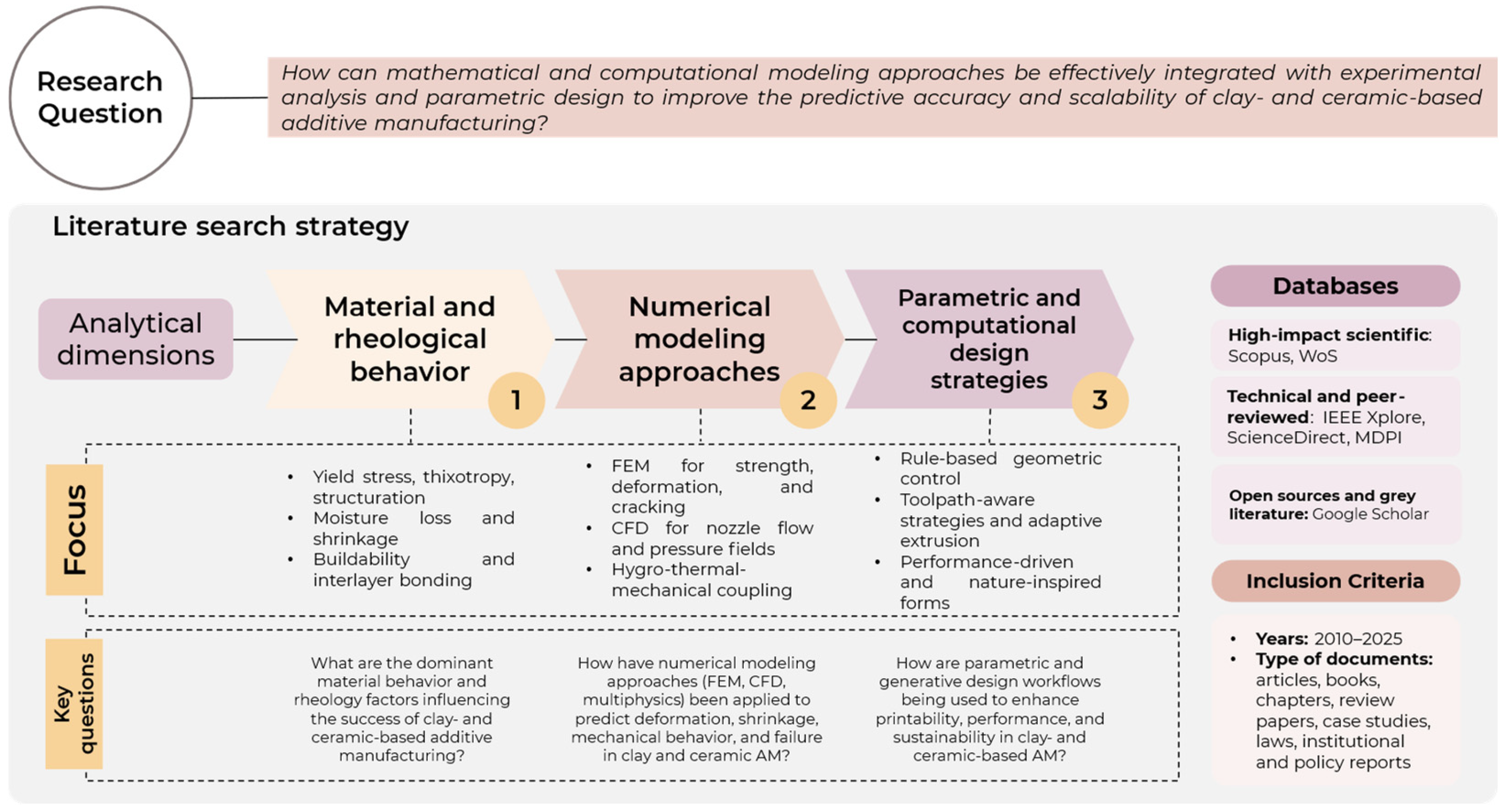
To address this question, the paper adopts a process-oriented approach that mirrors the additive manufacturing workflow, from material formulation and rheological characterization to numerical modeling and parametric design. To structure synthesis and comparison, the review adopted a three-layer analytical dimensions strategy aligned with the AM pipeline (Figure 1):
(i)
Material and rheological behavior: including subjects such as fresh-state rheology, structuration, shrinkage, and interlayer bonding, among others.
(ii)
Numerical modeling approaches: including finite element methods (FEM) for strength and deformation, computational fluid dynamics (CFD) for flow and pressure fields, and multiphysics coupling.
(iii)
Parametric and computational design strategies: rule-based modeling, toolpath-aware logic, performance-driven, and nature-inspired structures.
This review employs a structured, cross-domain methodology that connects material behavior, numerical modeling, and computational design in clay- and ceramic-based additive manufacturing. The literature was collected from major scientific databases (Scopus, Web of Science, ScienceDirect, IEEE Xplore, and Google Scholar), including peer-reviewed journals, conference articles, book chapters, and technical reports. Searches were performed using combinations of keywords such as “additive manufacturing”, “clay-based materials”, “ceramic”, “geopolymers”, “rheological model*”, “finite element”, “computational fluid dynamics”, “numerical model*”, and “parametric design”.
The search primarily focused on literature published between 2010 and 2025, with emphasis on the most recent contributions from the last five years. Exclusion criteria included works published in languages other than English and papers that did not explicitly address additive manufacturing processes or modeling approaches relevant to clay and ceramic-based systems. References were selected to represent both experimental and computational perspectives, ensuring a balanced overview of materials, processes, and simulation frameworks. This methodological approach provided a comprehensive foundation for identifying key research trends and gaps across materials, modeling techniques, and design applications in clay- and ceramic-based additive manufacturing.
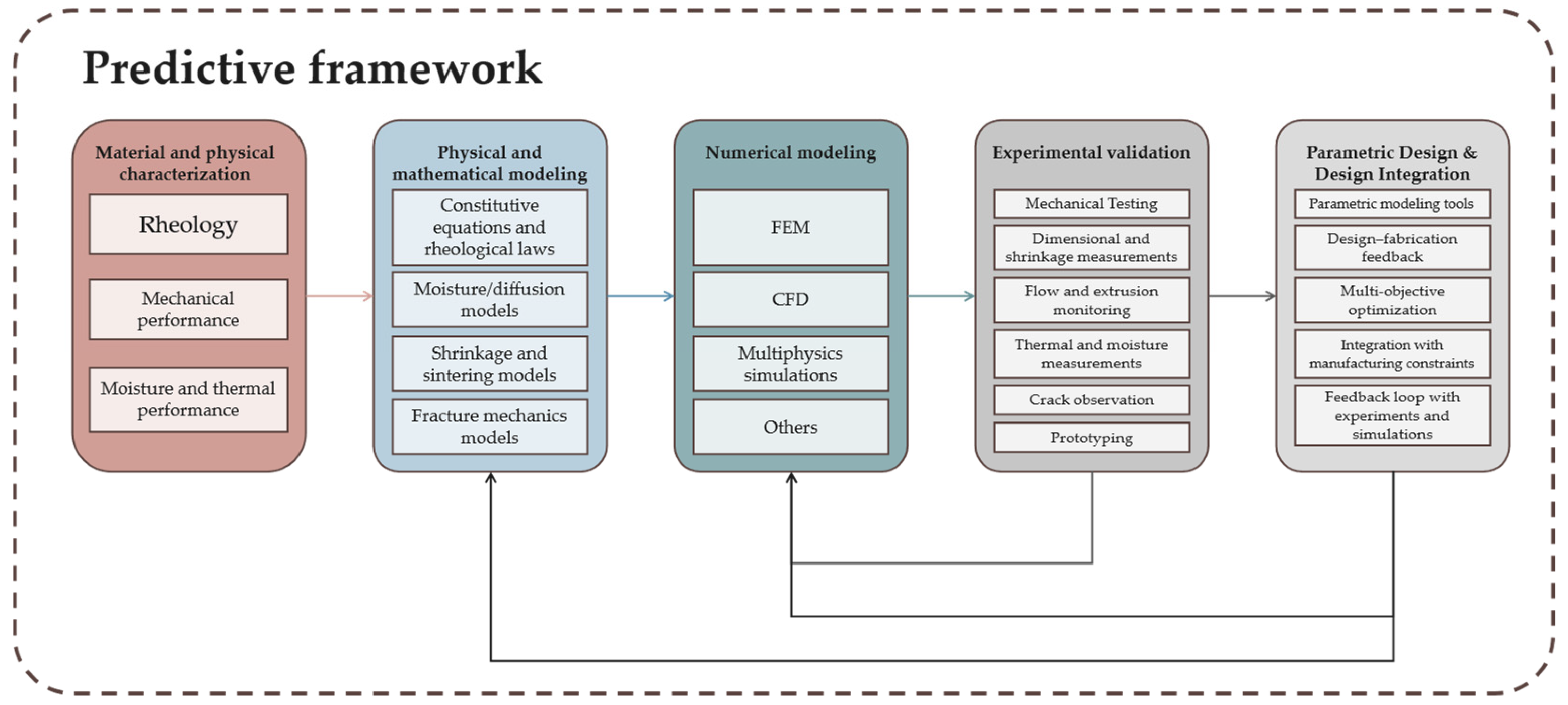
Therefore, the review is organized to follow the progression from foundational material considerations to advanced computational tools for clay- and ceramic-based AM. Section 2 introduces clay and ceramic material systems and their relevance for additive manufacturing, while Section 3 outlines the key AM technologies used for paste-based fabrication. Section 4 and Section 5 examine mathematical and computational modeling approaches, respectively, including rheological formulations, constitutive laws, FEM, CFD, and time-dependent deformation models. Section 6 synthesizes these insights into an emerging predictive framework, highlighting opportunities for integrating experimental data, parametric design, and multiphysics simulation. Finally, Section 7 presents the conclusions and future research directions.

2. Clay and Ceramic-Based Materials for Additive Manufacturing

Clay- and ceramic-based materials processed as pastes, slurries, or suspensions have been adopted across multiple additive manufacturing technologies. These systems rely on water-mediated structuring, viscoplastic flow, and solidification mechanisms such as drying, geopolymerization, or sintering. Their processing behavior, governed by particle–water interactions, colloidal stability, plasticity, and time-dependent stiffening, requires tailored rheological control and fabrication strategies distinct from those used in polymer or metal AM. As a result, understanding the material foundations of clay and ceramics is essential for developing robust printing workflows, predictive models, and structurally reliable components. The following sections examine clay and ceramic systems as precursors for AM, beginning with natural clays and their multi-functional role in digital fabrication.

2.1. Clay Materials and Their Role in AM

Clay is one of the oldest and most widely available construction materials. It is naturally present in soil and widely accessible in many regions worldwide. Since the dawn of civilization, clay has played a significant role in human development, serving essential functions in modern society [37,42,43,44,45]. Their versatility has led to widespread applications across multiple industries, including construction [45,46,47,48], oil drilling [49,50,51], ceramics, and masonry [52,53,54,55,56], packaging [57], pharmaceuticals [58,59,60], agriculture, and environmental applications [43,61].
Clay is composed primarily of fine-grained hydrated aluminosilicates with varying silicon-to-aluminum ratios in their crystal structures, which impart plasticity over a moderate to wide range of water content and allow solidification upon drying [62]. Its high water retention capacity enhances workability and cohesion in the fresh state, due to a combination of high specific surface area and lamellar microstructure that promotes interparticle adhesion [63,64]. Clay also exhibits very low permeability, primarily due to dense particle packing and cohesive forces between particles [62,65]. These characteristics are influenced by particle size, shape, and distribution, along with the strong attraction of water to clay particle surfaces [63,64]. Its plasticity depends on water content, which acts as a lubricant between its platelet-like particles, enabling shear-thinning or thixotropic behavior [66,67,68,69]. Additionally, clays with high water absorption, especially those containing swelling minerals such as montmorillonite, exhibit enhanced moldability and dimensional stability during the drying and setting phases [70]. When combined with additive manufacturing, clay offers advantages such as reusability, low thermal conductivity, and compatibility with digital fabrication due to its cohesive and shear-thinning behavior [7,64,66,69,71].

2.2. Geopolymers and Ceramic Pastes

Beyond natural clay systems, AM increasingly incorporates chemically engineered pastes with enhanced mechanical or thermal performance. Besides natural clay, ceramic materials such as alumina and silica-rich pastes are increasingly adapted for AM, particularly when higher mechanical strength or thermal resistance is required compared to clay-based systems.
Geopolymer mortars, although not ceramics in the strict sense, are often discussed as ceramic-like systems due to their processing and structural behavior [9,39,69,72,73,74,75,76]. Additionally, hybrid formulations, such as soil–cement composites and earth stabilized with lime or natural fibers, are employed to enhance dimensional stability and printability at construction scales, where issues like shrinkage and structural collapse during printing must be controlled [26,77]. These systems broaden the compositional space of paste-based AM and enable applications where structural strength, heat resistance, or accelerated hardening are required, while introducing additional modeling and processing challenges.

2.3. Material Parameters Governing Fresh-State and Early-Age Behavior

In clay- and ceramic-based additive manufacturing, fresh-state and early-age responses determine deposition quality, geometric stability, and defect formation. The coupled effects of rheology, moisture management, particle interactions, and microstructural evolution control these responses. These mechanisms are driven by rheological behavior, water transport, and particle interactions, which strongly influence deposition quality and structural performance.
Workability and extrudability are primarily governed by water content, grain size distribution, and, in some cases, the presence of fibers or additives that enhance cohesion and flow stability [67,68,78]. The rheological behavior of these materials often exhibits shear-thinning or thixotropic characteristics. It is typically modeled using Herschel–Bulkley or Bingham frameworks to ensure sufficient yield stress for shape retention post-extrusion [68,79,80]. Shrinkage and cracking during drying are critical challenges, strongly influenced by moisture loss rates and particle cohesion, which, in turn, depend on the material’s microstructure and surface tension dynamics [68,81]. Furthermore, mechanical strength, both in fresh and hardened states, varies with formulation, curing conditions, and geometrical factors, and is essential for load-bearing capacity and dimensional stability [79]. Other factors, such as permeability [64,65], surface roughness [81,82,83], layer thickness [68,79], flow rate [84,85,86], and nozzle geometry [79,81,87,88,89] also play significant roles in the success of additive manufacturing processes. These parameters influence not only the structural integrity and surface finish of printed components but also operational efficiency and cost. As evidenced in recent studies, a systematic understanding of these interdependencies is crucial for optimizing printability, minimizing defects such as delamination or warping, and tailoring material properties for specific architectural or functional applications.

2.4. Current Uses and Practical Challenges in Paste-Based AM

The current use of these materials in AM spans from small-scale components and bricks to full-scale walls and architectural prototypes [14,71,90,91,92,93,94,95,96]. While clay is favored for its ecological advantages and material circularity, materials such as alumina and geopolymers are gaining ground in contexts that require greater precision or heat resistance [8,9,39,73,74,75]. Compared to concrete, ceramic and earth-based materials offer reductions in embodied carbon and enable designs optimized for material efficiency and thermal comfort [40,70,97,98,99,100,101]. For instance, some works have reviewed the integration of alternative, low-carbon materials into additive manufacturing, with a strong emphasis on earthen materials [7,102,103,104]. Although they highlight that while raw earth offers environmental advantages and hygrothermal benefits, its adaptation to 3D printing requires overcoming challenges, like shrinkage, limited structural build-up, and water sensitivity.
Additionally, it is discussed how the digitalization of vernacular techniques, such as cob and rammed earth, through extrusion and discrete deposition, highlights the role of stabilizers and process design in enhancing printability and structural performance. They also underline the trade-off between printing resolution and environmental impact, emphasizing the need for local material use and minimal additives to preserve the sustainability of earthen construction. However, limitations in mechanical performance, long curing times, and sensitivity to environmental conditions remain challenges that demand further study and modeling support.
Overall, clay- and ceramic-based systems demonstrate strong potential for sustainable and locally adaptable manufacturing, including a variety of materials (Table 1). However, their successful implementation depends not only on material formulation but also on the processing routes employed to deposit and consolidate them. Therefore, the following section reviews the additive manufacturing techniques most used for earthen and ceramic pastes, with an emphasis on their principles, capabilities, and limitations.

3. AM Technologies for Clay and Ceramic Systems

The processing of clay- and ceramic-based formulations in AM requires equipment and strategies capable of handling high-viscosity, particle-rich pastes and controlling deposition stability, drying behavior, and structural build-up. Unlike polymer- or metal-based AM, where feedstock chemistries and commercial systems are highly standardized, paste-based ceramic printing remains strongly dependent on rheology tuning, nozzle geometry, and mechanics, and moisture-driven deformation.
Extrusion-based systems dominate this field due to their compatibility with viscoplastic materials. Within this category, Direct Ink Writing (DIW), also referred to as robocasting in ceramic processing, is the most widely adopted modality. However, other AM strategies, including binder-based processes, vat-assisted ceramic suspensions, and emerging hybrid approaches, have also been adapted to address specific performance or resolution requirements. This section reviews the primary AM techniques adapted for clay and ceramic systems, highlighting their operational principles, rheological requirements, and current application domains.

3.1. Extrusion-Based AM for Clay and Ceramics

Extrusion-based additive manufacturing is the predominant approach for shaping clay and ceramic pastes, due to its ability to process high-viscosity, particle-rich suspensions and harness their shear-thinning properties. These processes rely on continuous material flow through a nozzle, where buildability, extrusion pressure, and moisture control determine layer stability and final geometry. Variants range from laboratory-scale syringe systems to large robotic deposition platforms for architectural applications. Within this family of methods, Direct Ink Writing (DIW), often referred to as robocasting in the ceramic community, has emerged as the reference technique for research and practice. DIW provides fine control over deposition and enables the processing of high-solid-content formulations, making it the primary route explored in the literature for clay- and ceramic-based AM.

3.1.1. Direct Ink Writing (DIW)

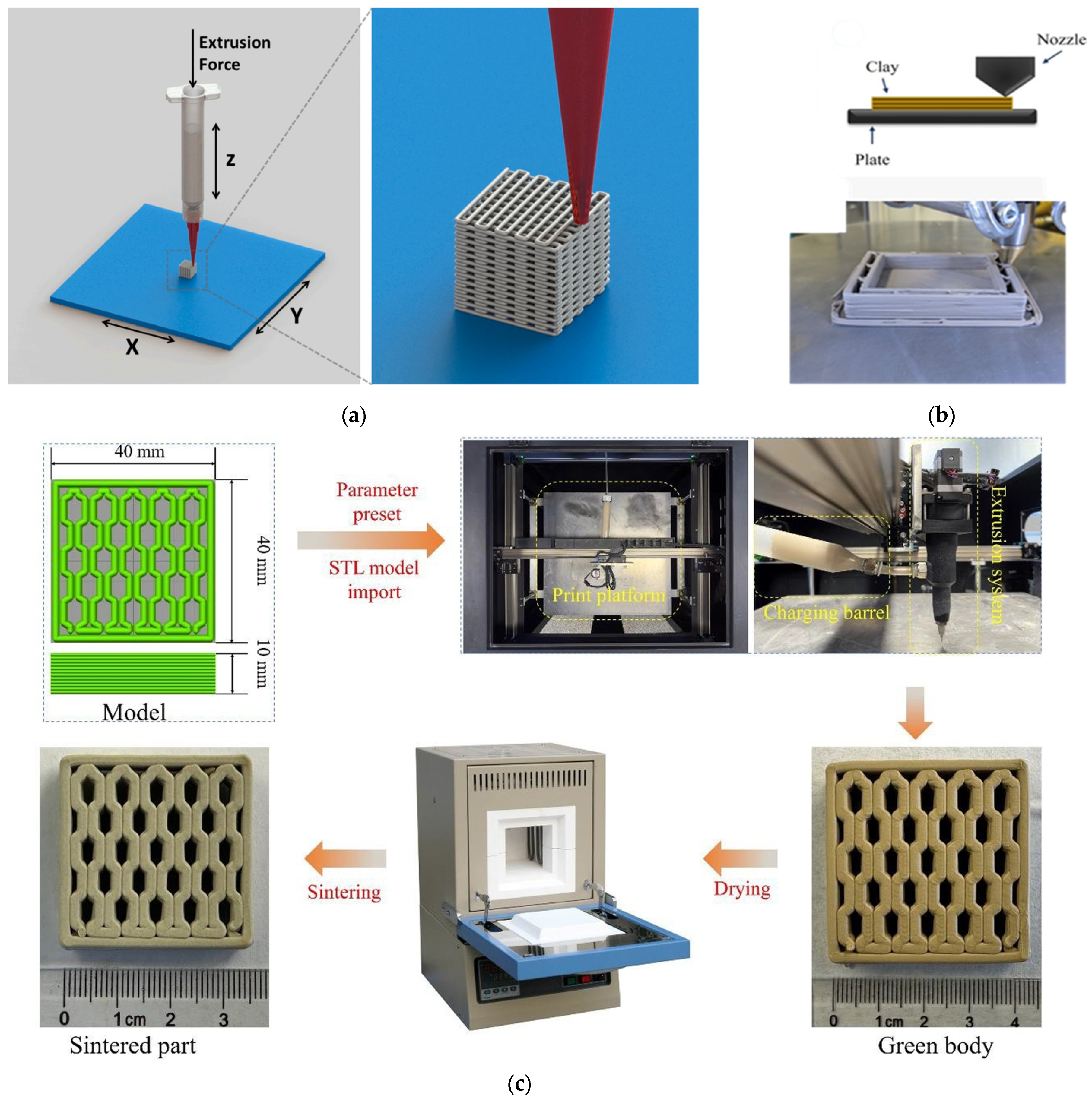
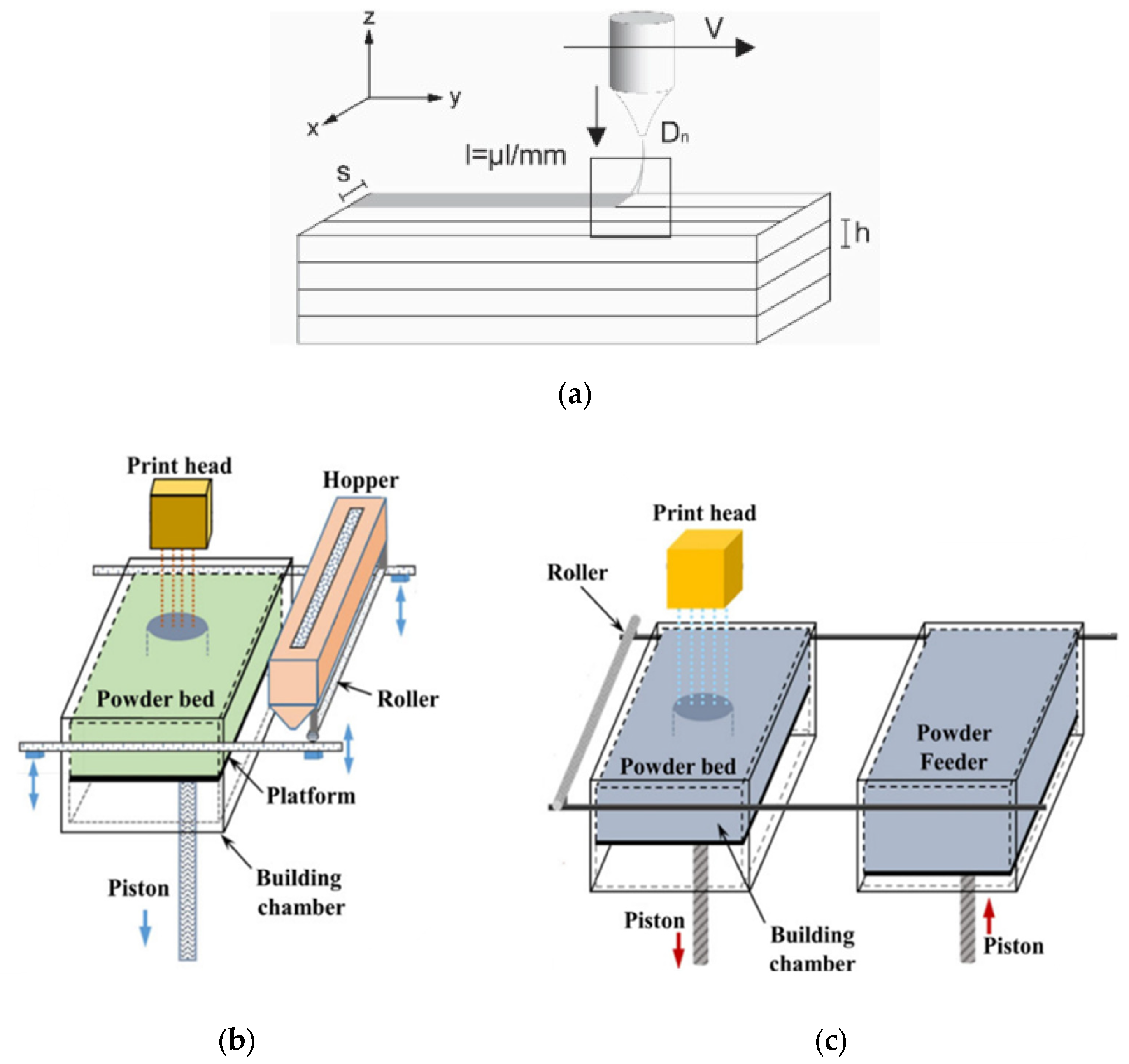
Direct Ink Writing (DIW), referred to as robocasting when applied to ceramics, is a widely used technique for 3D printing ceramics and clay. It involves extruding viscoplastic materials through a nozzle under constant pressure (Figure 2). The method is ideal for high-solid-content pastes with shear-thinning behavior. DIW allows precise control, but suffers from limited throughput, making it more suitable for small- to medium-sized components [114,115,116,117,118].
Recent studies have therefore focused on defining the rheological criteria that ensure reliable printing performance. For instance, Revelo and Colorado [114] conducted a base study using kaolinite-based pastes in DIW and demonstrated that the interplay between solid content governs the optimal printability window, approximately 44 vol%, and thixotropic recovery. Their work highlighted that intermediate viscosity and stable shear-thinning behavior allowed for continuous and stable extrusion, ensuring layer integrity without slumping. Similarly, Ordoñez et al. [116] explored DIW using traditional ceramic formulations including feldspar, kaolinite, and silica. They demonstrated that minor adjustments in dispersant concentration, such as sodium silicate and polyacrylate, had a significant impact on the viscoelastic structure of the mix. As the solid volume fraction increased from 50% to 53%, the material transitioned from pseudoplastic to dilatant behavior, drastically affecting extrudability and final surface quality.
Complementary to formulation-focused studies, Sun et al. [118] employed DIW to fabricate ceramic cavities for electronic components using kaolin suspensions. Their study applied a Herschel–Bulkley model to correlate flow behavior with extrusion performance, finding that a combination of high yield stress and low high-shear viscosity enhanced post-deposition shape retention. Gyawali et al. [7] provided further rheological insights by systematically reviewing the rheology of DIW inks using three-interval thixotropy tests (3ITT), oscillatory shear tests, and flow sweep hysteresis tests. They emphasized the importance of rapid recovery in viscosity post-shear to maintain structural fidelity. In their framework, printable inks were classified as “solid-like,” “gel-like,” or “fluid” based on the storage-to-loss modulus ratio (G’/G”), which informed their ability to hold shape upon deposition. Their findings highlight the lack of a systematic approach to establishing printability criteria for AM-based clay composites used in different building and construction applications.
At the process level, Afriat et al. [81] compared standard DIW with vibration-assisted printing (VAP), which shows that VAP enables the extrusion of higher-viscosity pastes at faster print speeds (up to 6000 mm/min) and improves resolution in sharp corners. However, they also reported that unsupported spans experienced more deformation under VAP than conventional DIW, indicating a trade-off between speed and structural accuracy.
Overall, DIW continues to evolve as a promising pathway for ceramic and clay-based additive manufacturing, especially where precise control over material deposition and fine resolution are critical. Yet, its applicability to large-scale construction remains limited due to relatively low throughput and sensitivity to rheological fluctuations.

3.1.2. Large-Scale Robotic Extrusion

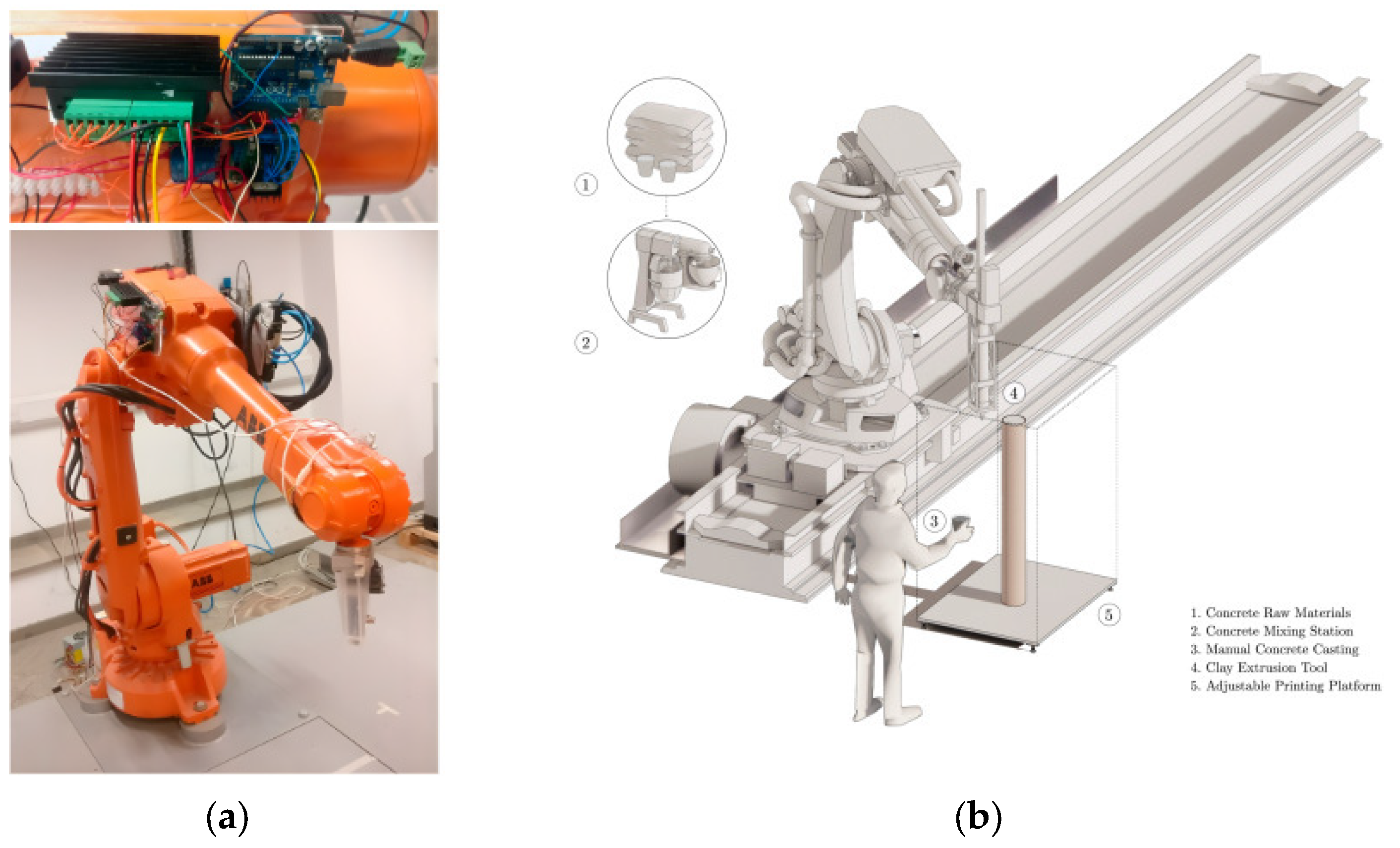
Extrusion-based additive manufacturing has become the dominant technique for large-scale architectural applications involving clay and other earth-based materials, as seen in Figure 3. This method enables the deposition of high-viscosity pastes with minimal formwork, making it well-suited for complex, freeform construction. Unlike DIW, which is better suited for fine resolution, extrusion-based systems typically employ screw extruders, piston-driven systems, or pressurized tanks for continuous material flow. In these systems, rheology, nozzle geometry, and the toolpath strategy have a significant influence on print quality and buildability.
Regarding this type of large-scale systems, Kontovourkis and Tryfonos [121] implemented a robotic extrusion setup using a WASP LDM extruder mounted on an ABB 600-20/1.65 arm with an IRC5 controller (Figure 3a). Their parametric algorithm, built in Grasshopper, generated toolpaths and controlled the synchronization of nozzle activation with robotic motion using HAL software (version 1). Their calibration tests demonstrated the importance of tuning robotic speed, nozzle height, and layer width to prevent under- or over-extrusion, laying the groundwork for integrating parametric design with robotic clay deposition.
Nozzle geometry also directly influences print quality. Perrot et al. [16] investigated raw earth 3D printing by optimizing material rheology through the incorporation of alginate biopolymer. Using fine, clay-rich soil with a yield stress of 1.5 kPa, the formulation ensured adequate pumpability and layer stability. The study compared circular and rectangular nozzles, finding that rectangular nozzles produced more compact layers and improved compressive strength, reaching a maximum of 1.77 MPa. Additionally, alginate accelerated the development of green strength, allowing for the fabrication of 3 m high walls in a single day without the need for formwork. These findings underscore the potential of integrating traditional earthen materials with digital fabrication to achieve sustainable construction outcomes.
Beyond nozzle geometry, the design of extrusion hardware also plays a crucial role. Pitayachaval and Baothong [82] focused on screw-based extrusion mechanisms and developed a clay printer with a circular nozzle. Through controlled experiments, they showed that nozzle diameter and screw pitch were the most influential parameters in determining filament quality, while the velocity of the screw had a limited impact. Their modeling approach offers practical insights into how mechanical components can optimize extrusion stability for architectural-scale clay elements. Complementary to this, Anton and Abdelmahgoub [123] explored clay printing on curved semi-cylindrical molds, investigating geometric deformation and shrinkage patterns during drying and sintering. Their study emphasizes that tolerances and moisture gradients must be carefully managed in non-planar printing to prevent warping and cracks.
Other studies have focused on integrating control software and hardware. Mozaffari et al. [122] described a hybrid robotic fabrication environment using a 6-axis robot with a ball-screw-driven piston extruder. They aimed to develop clay-based formwork for the deposition of concrete. Their system optimized extrusion rates based on actuator feedback and payload constraints, enabling precise deposition of semi-solid clay mixtures. They found that servo-driven pistons, instead of pneumatic ones, offer improved flow consistency and scalability for construction-scale elements. Similarly, Dielemans et al. [124] developed a design-to-fabrication workflow to repair existing building components in place. Their research employs a mobile robotic system designed for in-place repair of existing brick wall structures, utilizing clay-based extrusion as a simulation for concrete mortar. Their workflow integrated a stereo depth camera and a high-resolution laser profile sensor mounted on a 6-degree-of-freedom (6 DOF) manipulator to digitally reconstruct missing volumes and generate accurate print trajectories. The research demonstrated the successful on-site 3D printing of missing wall segments, highlighting the potential of combining mobile robotics, additive manufacturing, and environmental sensing for building restoration. Sauter et al. [125] developed a mobile extrusion platform using a screw-based syringe extruder mounted on a wheeled robot. Their statistical analysis of over 300 printed samples revealed that printing speed, layer height, and paste concentration had a significant impact on dimensional accuracy. Their platform demonstrated potential for decentralized site-adaptable additive construction.
Multiple articles emphasized the need to co-optimize extrudability, stiffness, and layer stability. For instance, Maierdan et al. [126] examined the role of sodium alginate in improving the rheological behavior and 3D printability of kaolinite-based earth pastes. Systematic rheological tests and printability evaluations demonstrated that alginate enhances electrostatic repulsion between particles, reducing sedimentation and yield stress while expanding the linear viscoelastic range. This stabilization shifted the printability window toward higher clay-to-water ratios, enabling extrusion of stiffer pastes with improved buildability. Their results highlight the dual function of alginate as both a stabilizer and superplasticizer in earth-based additive manufacturing.
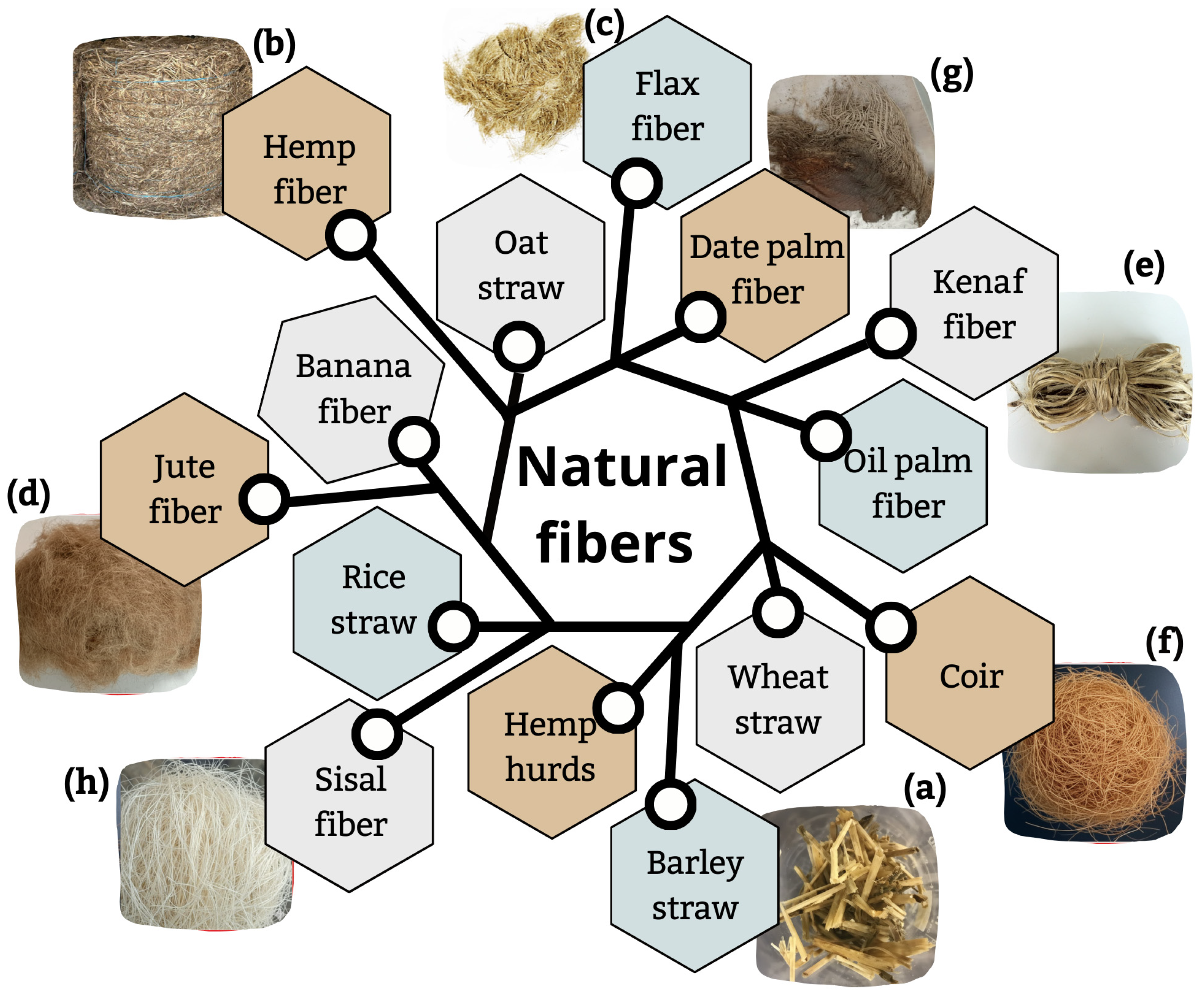
Beyond biopolymer stabilization, material reinforcement through natural fibers has also shown promise. Akeman and Ben-Alon [127] developed a workflow to evaluate fiber-rich earth mixtures for digital fabrication. Their study combined natural soils with high contents of vegetable fibers such as straw and hemp and biopolymers like alginate, locust bean gum, and cellulose. Through manual and machine-based extrusion tests, they demonstrated that mixtures with up to 13% fiber content could achieve successful extrudability and buildability if the provided fibers were sufficiently processed. Microstructural imaging confirmed the effective integration of paste and fiber, while 3D printing trials validated the mechanical and geometric viability of the printed elements. This work extends the material palette for 3D-printed earth by incorporating carbon-storing, insulating fibers, and reinforces the importance of tailoring biopolymer-fiber-clay interactions to optimize print quality. Some of the fibers suitable for 3D printed earth construction are shown in Figure 4.
In contrast to fiber-modified systems, Akhrif et al. [134] focused on optimizing a natural clay from Fez, Morocco, for extrusion-based additive manufacturing, highlighting that successful 3D printing depends on achieving a fine balance between rheological parameters and process inputs. Using statistical models, rheological tests, and image-based evaluation, they identified a water-to-clay ratio of approximately 36% as providing an optimal compromise between extrudability and buildability. The study also highlights the importance of thixotropic behavior, grain size distribution, and natural mineralogy (including kaolinite, illite, quartz, and calcite) in determining print quality. Advanced assessments, including 3D scanning and lack-of-plumb analysis, enabled the quantitative evaluation of shrinkage, buckling, and geometrical fidelity. This demonstrates that even unamended natural clays can achieve viable print outcomes with precise composition and control of process conditions.
Furthermore, Bhusal et al. [135] addressed the challenges of printing local earthen materials with high clay content, focusing on printability, shrinkage, and mechanical strength. Their selected soil, composed of 49% kaolinite, 15% nontronite, and 36% illite, showed excellent strength and print quality in its pure form, but suffered from severe shrinkage and cracking due to the swelling behavior of nontronite and adding natural fibers significantly reduced shrinkage, down to 2.6%, and limited crack width, though at the cost of compressive strength. Rheological tests confirmed the influence of additives on yield stress, plastic viscosity, and thixotropy, with pozzolana-fiber combinations exhibiting slow structural recovery after shear. While lime and pozzolana did not improve strength or dimensional stability, the addition of fiber enhanced shape retention and reduced volumetric instability.
Moreover, clay rheology remains a central challenge. As Chan et al. [88] highlighted, extrudable formulations must strike a balance between static and dynamic yield stress to ensure buildability without slumping or clogging. Their rheology maps help delineate the limits of printable compositions across a range of solid contents.

3.2. Binder Jetting

Binder jetting is an additive manufacturing process that selectively deposits a liquid binding agent onto a powder bed, layer by layer, to consolidate the material (Figure 5). Unlike extrusion-based techniques, which rely on the rheological properties of pastes, binder jetting is particularly suitable for dry or semi-dry ceramic powders, offering distinct advantages such as high resolution and scalability. However, its application to construction-grade materials, such as clay and unfired earth, remains limited due to challenges in cohesion, powder flowability, and post-processing requirements.
In conventional ceramics, binder jetting has been widely applied using alumina, silica, and zirconia powders, where the particle size distribution, binder saturation, and layer thickness are tightly controlled to achieve dense, sinterable green parts [39,138,139,140,141]. These capabilities enable high surface quality and intricate geometries, making the method attractive for architectural ornamentation, façade components, and mold fabrication.
When applied to clay and soil-based materials, the primary limitation in binder jetting is the lack of structural integrity before sintering or drying, which can result in fragility during depowdering and post-processing. Moreover, natural clays are hygroscopic and exhibit strong capillary interactions, complicating the uniform infiltration of binders. Although efforts have been made to modify clay powders or incorporate synthetic binders to enhance green strength, large-scale applications are still rare. Despite these constraints, binder jetting holds potential in hybrid workflows, where printed ceramic components are integrated into larger structures, or as a tool for formwork production, allowing for precise molds that can be reused or recycled. Its use in architectural ceramic panels and fine lattice structures also demonstrates its potential in non-structural applications.
To overcome current barriers, material development efforts focus on tuning powder properties, such as particle shape, moisture content, and flowability, as well as developing bio-based or reactive binders that are compatible with construction environments. Early studies in computational modeling of capillary transport, binder saturation, and drying shrinkage offer promising avenues, although these tools remain less mature than simulation frameworks developed for extrusion-based systems [142].

4. Mathematical Modeling of Clay and Ceramic-Based Additive Manufacturing

Mathematical modeling plays a vital role in understanding and optimizing additive manufacturing processes. This is also extended to AM involving clay and ceramic-based materials. Due to the complex rheological behavior of these viscoplastic materials and the multi-physics interactions during extrusion, drying, and sintering, predictive models are essential for improving print quality, mechanical performance, and process efficiency.

4.1. Rheological Foundations for Clay and Ceramic AM

Most AM techniques for clay and ceramics employ pressure-driven extrusion systems, such as DIW or extrusion-based AM, which use conduits like syringes or screw extruders to force viscoplastic materials through nozzles under controlled pressure. According to the Buckingham–Reiner model, two primary material properties govern this pressure drop: yield stress and viscosity [143,144,145]. This relationship is expressed as:
P = 2 L τ y R + 4 L μ Q π R 4
where L is the conduit length, R is the radius, and Q is the volumetric flow rate. This equation emphasizes minimizing pressure loss, and thus improving extrusion efficiency, which requires balancing yield stress and viscosity, both of which influence the flowability and post-extrusion shape retention of clay-based pastes.
A low dynamic yield stress allows the material to begin flowing under minimal applied pressure, while low viscosity ensures reduced resistance during steady-state flow. Together, these properties determine how easily the material moves through the extrusion system, influencing not only energy efficiency but also the uniformity and continuity of the deposited filament. Hence, optimizing both yield stress and viscosity is essential for minimizing pressure losses and achieving stable, high-quality prints [86].

4.2. Constitutive Models for Clay and Ceramic Pastes in AM

Clay-based materials exhibit non-Newtonian, viscoplastic behavior, meaning their viscosity is not constant but depends on the applied shear rate. Unlike Newtonian fluids, such as water, whose flow behavior follows a linear relationship between shear stress and shear rate, clay suspensions exhibit shear-thinning behavior, meaning their apparent viscosity decreases with increasing shear rate. This property is critical for extrusion-based AM, as it allows the material to flow under pressure during extrusion and then regain rigidity to retain the printed shape.
The Bingham plastic model is one of the most widely used rheological models for describing the flow behavior of clay and ceramic-based materials in AM. It provides a simplified, yet effective, two-parameter framework where materials behave as a solid until a certain yield stress is exceeded, after which they flow with a linear relationship between shear stress and shear rate, expressed mathematically as follows:
τ   =   τ 0   +   η p γ ·
where τ is the applied shear stress, τ 0 is the yield stress, η p is the plastic viscosity, and γ · is the shear rate [146]. This model is particularly suitable for viscoplastic materials used in extrusion-based AM, as it captures the essential requirement for materials to flow through a nozzle under pressure and retain their shape upon deposition [86].
In practical applications, the Bingham model has been employed to evaluate the performance of ceramic pastes and clay-based mixtures, both in terms of flow through the pumping system and stability post-extrusion. For example, Dou et al. [147] demonstrated that a ceramic paste formulated for DLP printing in microgravity exhibited Bingham pseudoplastic behavior, allowing precise control over extrusion and shape retention. Their work highlighted that achieving the desired rheology through additives such as cellulose derivatives and carbomers transformed the ceramic slurry into a paste exhibiting Bingham characteristics.
Similarly, Maierdan et al. [126] applied the Bingham model to rheological measurements of clay-based pastes using a vane-in-cup rheometer. They obtained flow curves through controlled shear rate sweeps and extracted key parameters like dynamic yield stress and plastic viscosity, which indicate the resistance to flow, and the energy required for extrusion. They also differentiated between static yield stress (onset of flow) and dynamic yield stress (stress required to sustain flow), both of which are essential for understanding material behavior in AM processes.
Furthermore, Asaf et al. [86] emphasized that in the AM context, the material must balance two conflicting requirements: low yield stress and viscosity for ease of pumping, and sufficient rigidity post-deposition for layer stability. They noted that in high-viscosity materials, plug flow behavior can cause significant pressure losses in conduits, needing careful control of rheological parameters to optimize energy efficiency and print quality. According to the previous studies mentioned, the Bingham model has proven useful and with ease of application in predicting flow behavior, identifying optimal formulations, and understanding the performance of printable pastes under process-relevant conditions. In many clay formulations, this behavior is further complicated by thixotropy, a time-dependent rheological response wherein the material’s internal structure temporarily breaks down under shear but rebuilds once the shear is removed. Thixotropic behavior enables the material to transition from a fluid-like state during extrusion to a more solid-like state upon deposition, ensuring shape stability and layer adhesion.
To model this complex rheological behavior, the Herschel–Bulkley model [148] has been widely used [7,149,150,151,152]. It extends the simpler Bingham model by introducing a non-linear term to account for shear-thinning or shear-thickening effects:
τ = τ y + K γ ˙ n
where τ is the applied shear stress, τ y is the yield stress (minimum stress required for flow), K is the consistency index (related to fluid viscosity), γ is the shear rate, and n is the flow behavior index (with n   <   1 for s hear-thinning materials). This model characterizes shear-thinning behavior across a wide range of shear rates.
In many practical scenarios, particularly at low shear rates, the second term of the model becomes negligible compared to the yield stress, meaning that the material’s response is dominated by the yield stress. This is crucial during extrusion, where flow initiates only when applied stresses exceed τ y . The Bingham number ( B n ) is often used to evaluate this dominance, expressing the ratio of yield stress to the viscous stress, i.e., the velocity-dependent term, and thereby indicating whether flow is primarily governed by yield or viscous effects [153].
Furthermore, to address the transition between unyielded and yielded states more smoothly, Papanastasiou developed a modified Herschel–Bulkley model, also known as the Herschel–Bulkley–Papanastasiou (HBP) model [154]. This model incorporates an exponential regularization term to represent the continuous transition of stress near the yield point, which avoids discontinuities in simulations. The HBP model is especially useful in computational modeling of clay and ceramic slurries, and it expresses the shear stress as:
τ = K γ ˙ n 1 + τ 0 γ ˙ 1 e m γ ˙ γ ˙
where m is the stress growth factor controlling the transition near yielding. This model captures shear-thinning behavior at low shear rates while also smoothing the stress response, which is particularly advantageous in numerical simulations of extrusion-based AM processes [149].

4.3. Thixotropic and Time-Dependent Modeling Approaches

While constitutive models, such as the Bingham and Herschel–Bulkley models, capture the instantaneous relationship between stress and shear rate, they do not account for structural changes that occur over time. In extrusion-based clay AM, flow regimes vary spatially and temporally, and the material may remain in its solid regime for significant portions of the process until fully deposited and immobilized. This makes it challenging to define a characteristic shear or elongational rate across all regions of the flow. Consequently, yield stress emerges as the primary rheological parameter determining the behavior of clay during deposition, especially in geometrically complex or variable flow conditions [153].
To address this, the Windhab model has been introduced as a generalized framework that incorporates a restructuration parameter, allowing for the modeling of shear-induced microstructural changes in clay pastes [134,155]. It can be described as follows:
τ = τ 0 + τ 1 τ 0 1 e γ ˙ γ ˙ + η γ ˙ n
This model provides better predictive accuracy across elastic, viscoplastic, and thixotropic regimes, and allows estimation of critical parameters through non-linear regression, enhancing control over extrusion consistency and print quality. To characterize the rheological behavior of shear-thinning materials used in additive manufacturing, key parameters are extracted from the analysis of flow curves. The yield point ( τ 0 ) represents the minimum stress required to initiate flow, marking the transition from solid-like to fluid-like behavior. The critical shear stress ( τ 1 ) corresponds to the stress at which the material undergoes its maximum shear-induced structural change, typically identified at the crossover point of tangents fitted to the high shear region of the flow curve. The shear rate at which this transition occurs, denoted γ · * can be calculated from τ 0 and τ 1 using an exponential relationship. Furthermore, the steady-state viscosity ( η ) is estimated as the slope of the flow curve in the high shear rate regime, reflecting the material’s resistance to flow once fully sheared. These parameters are essential for evaluating the thixotropic behavior of clay and ceramic pastes, enabling better control of their flow during extrusion and shape retention after deposition [134].

4.4. Multiphysics Modeling in Clay-Based AM

While rheological models such as Bingham, Herschel–Bulkley, and their derivatives are essential for understanding flow behavior during extrusion, they do not capture the evolution of mechanical properties post-deposition, such as shape retention, and particularly, drying kinetics, which occur during a critical phase in clay-based AM that governs dimensional stability and structural integrity.
To address these complex interactions, multi-physics models combining moisture transport, capillary stress development, and mechanical stiffening have been proposed for clay-based materials. For instance, predictive models describe how drying kinetics vary with wall thickness and environmental conditions, providing quantitative relationships for evaporation rates, drying times, and moisture contents. These models enable designers to predict non-uniform shrinkage or warping, particularly in thicker geometries where moisture gradients are more pronounced.
Furthermore, Hu et al. [156] developed an integrated model that combines extrusion flow dynamics with in situ drying control. The flow rate through a nozzle can be described using a modified Hagen-Poiseuille equation adapted for viscoplastic materials, predicting the relationship between applied pressure, nozzle geometry, and paste rheology. This enables the estimation of extrusion rates and the mitigation of swelling or deformation.
Moreover, empirical formulations derived from geotechnical tests enable the estimation of the structural build-up rate, a key factor in buildability assessment. Notably, analytical expressions combining material properties and printing parameters have been developed to define thresholds for layer stability, highlighting the interplay between yield stress, deposition speed, and gravitational stress. These models have proven effective in predicting failure modes, such as collapse or delamination, during layer-by-layer construction.
In addition to rheological formulations, mathematical descriptions of flow behavior provide the foundation for computational fluid dynamics (CFD). By coupling constitutive equations, such as the Bingham or Herschel–Bulkley model, with the Navier–Stokes framework, CFD enables the prediction of velocity fields, shear stress distributions, and pressure drops within extrusion nozzles. These formulations extend mathematical modeling beyond static rheology, supporting the numerical simulations discussed in the following section, where computational approaches are applied to optimize printability and minimize defects in clay- and ceramic-based additive manufacturing.

5. Computational Modeling for Clay-Based Additive Manufacturing

Computational modeling has become a key tool for predicting and optimizing the behavior of materials during AM. These models support decision-making throughout the design and fabrication workflow, from geometry generation to process control and structural performance. Thus, it is essential in the advancement of AM, particularly for predicting and optimizing the behavior of materials. These tools not only enhance design flexibility but also enable accurate prediction and optimization of key fabrication outcomes such as dimensional stability, mechanical performance, and defect mitigation.
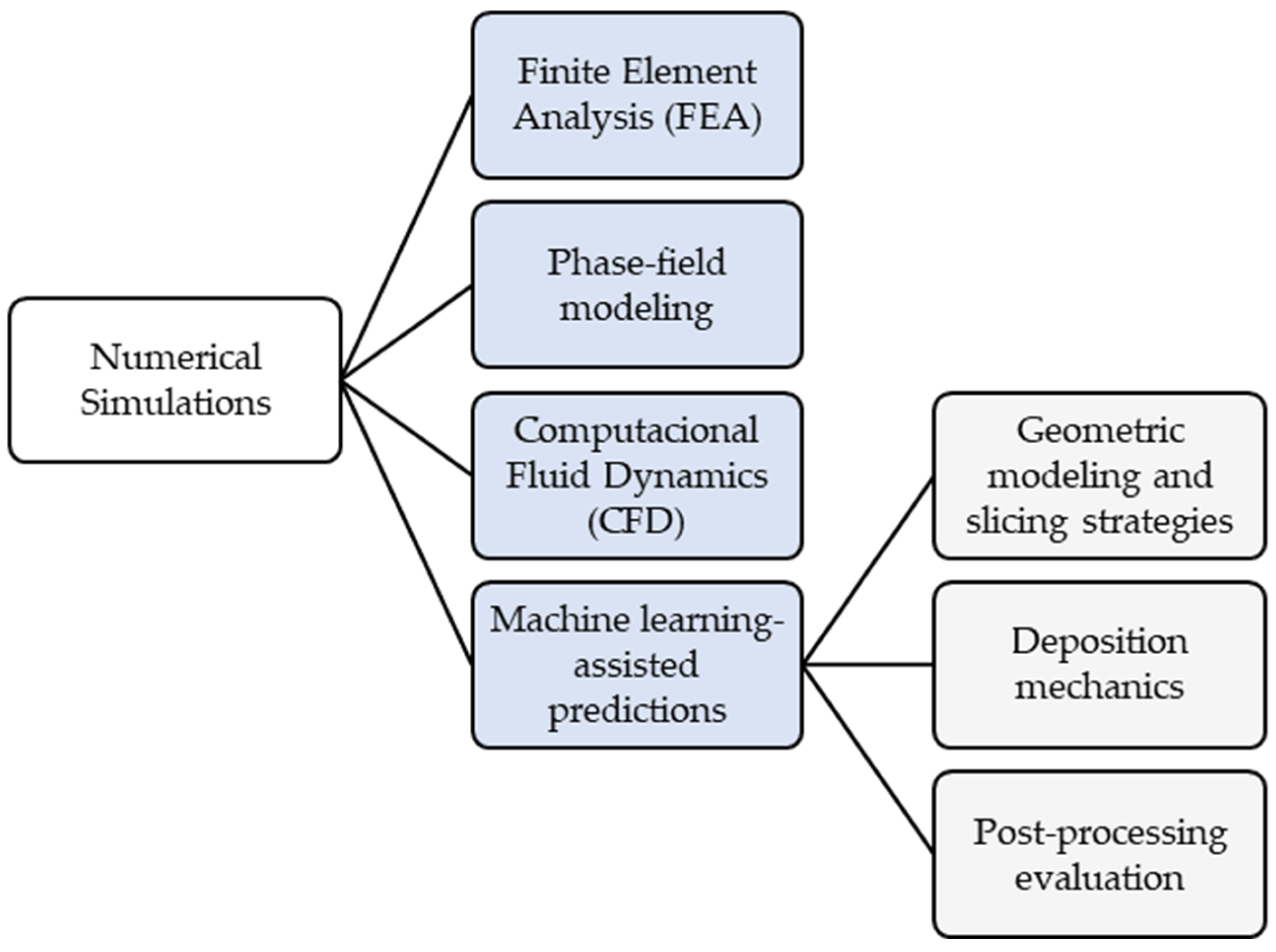
The implementation of numerical simulations, ranges from finite element analysis (FEA) [24,157,158,159,160], phase-field modeling [161], computational fluid dynamics (CFD) [162,163,164,165] to machine learning-assisted predictions [22,24], which spans multiple stages of the AM workflow, including geometric modeling and slicing strategies [18,164,165,166,167,168,169], deposition mechanics [157,163,168,170,171], and post-processing evaluation [167], as is appreciated in Figure 6.

5.1. Finite Element Analysis (FEA): From Fresh-State to Structural Behavior

5.1.1. Background and the Role of FEM

The Finite Element Method (FEM) is a numerical technique widely used to simulate structural analysis, deformation, natural frequencies, heat transfer, and other physical phenomena on a given model. FEM is grounded in Lagrange’s principle, which states that a system is in equilibrium when the total potential energy of deformation is minimized. Its principle relies on the discretization of a continuous domain into a finite number of elements, where parameters such as stress, strain, and temperature are evaluated at individual nodal points.
Traditionally, FEM has been widely applied in aerospace, automotive, biomedical, and structural engineering to assess component integrity and identify critical stress locations. In additive manufacturing, FEM plays an equally central role. As AM introduces geometric freedom but also complex thermal and mechanical gradients, FEM supports failure prediction, lightweight design, and optimization of material usage and printing parameters. When integrated into optimization workflows and slicing software, FEM reduces trial-and-error, accelerates development cycles, and improves performance and reliability of printed components.
FEA, the computational implementation of FEM, has become one of the most widely used techniques to analyze the mechanical behavior of AM-produced structures, particularly under complex geometric and loading conditions. Beyond structural validation, FEA enables design-driven optimization, including topology optimization strategies [172,173], to reduce material consumption and improve performance. Historically applied to identify critical stress regions and validate component integrity, FEA now plays a key role in AM workflows by predicting deformation, layer interaction, and failure mechanisms prior to fabrication.
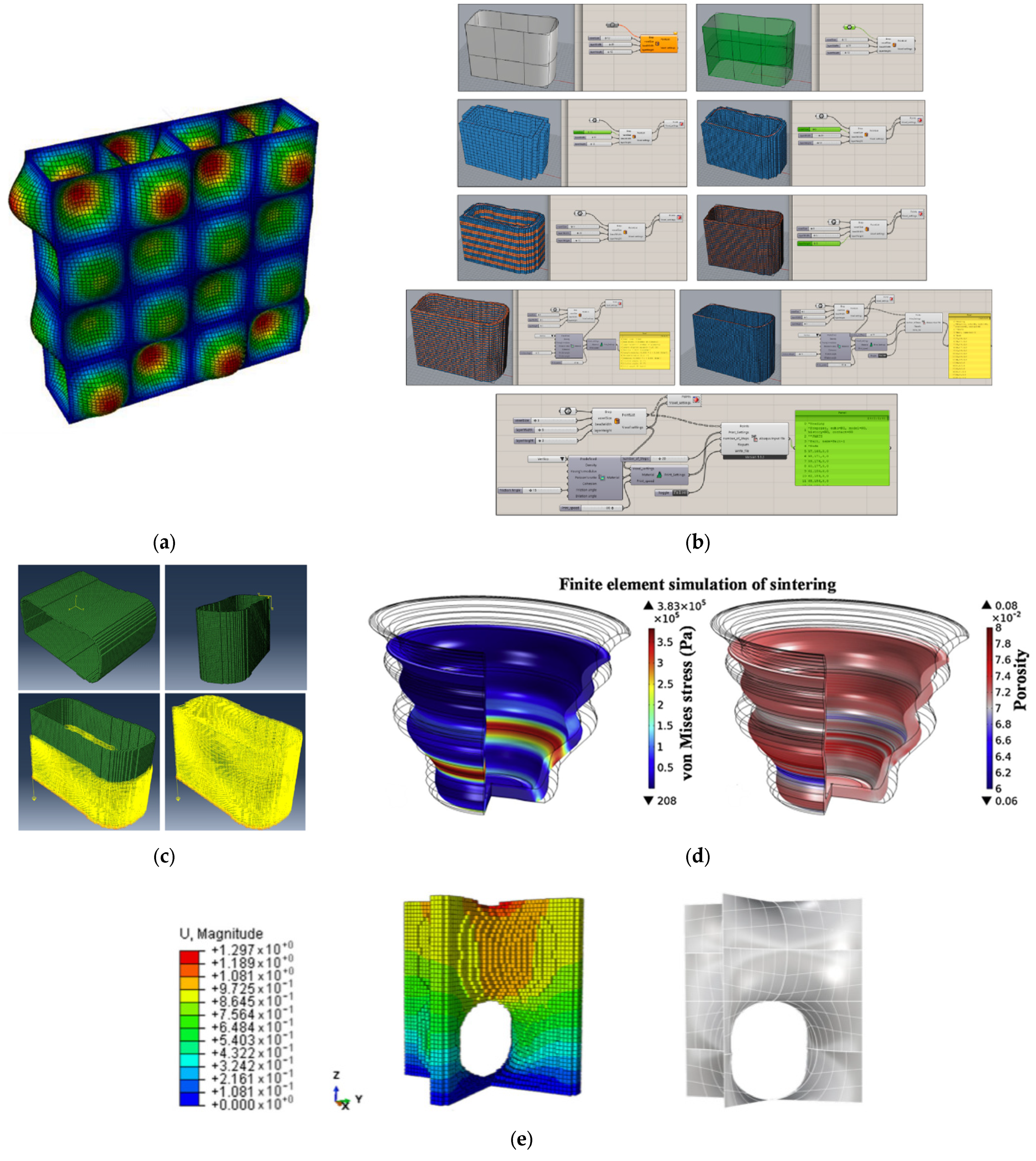
FEA remains the most widely used approach for simulating structural behavior during and after deposition, as seen in Figure 7. Its versatility has been extensively demonstrated across a range of AM technologies. For instance, Jayswal et al. [159] investigated the creep behavior of FFF-printed PLA/TPU/PEG composites by coupling long-term tensile testing with a finite-element framework based on the Generalized Voigt–Kelvin solid model. A three-term Prony series, obtained through Laplace transformation, enabled the accurate simulation of time-dependent deformation under a constant load. The model predicted creep with an error of approximately 6%, illustrating how relatively simple viscoelastic constitutive laws can reliably support lifetime predictions in printed polymer systems.
While FEA has been extensively applied in technologies like powder bed fusion [177,178], wire arc additive manufacturing, selective laser melting [179], and even material extrusion in several other materials such as polymers and polymer-based composites [180,181,182,183,184,185,186], and cementitious materials [187,188,189,190,191,192,193], its integration into ceramic and clay-based AM is still growing due to the unique challenges posed by these materials.
In parallel, extensive research in cement-based extrusion has advanced FEA frameworks to capture the mechanics of fresh states, buildability, and printing-induced failure modes. Although cementitious and clay materials follow different constitutive laws and hardening mechanisms, the computational strategies developed in concrete AM offer transferable concepts for modeling layer stability and structural evolution in clay systems.
Wolfs et al. [193] demonstrated how finite element analysis can be leveraged to understand the structural stability of printed elements during the build process. They implemented a time-dependent Mohr–Coulomb material model in ABAQUS, calibrated with uniaxial compression and direct shear tests, to capture the evolving stiffness and strength of early-age printed concrete. By simulating the sequential deposition of layers in a cylindrical wall, the FEA reproduced key deformation patterns and failure mechanisms such as buckling and shear collapse, while also revealing the sensitivity of maximum build height to material parameters and layer deposition time. Although the model slightly overpredicted the experimental failure height, it provided valuable insights into the interplay between material evolution and structural response, illustrating the crucial role of FEM in guiding the design of printable mixes and deposition strategies for large-scale concrete AM.
Building on these developments, recent contributions in clay-based additive manufacturing have begun to implement FEA to capture viscoplastic flow, deposition-induced deformation, and structural stability during printing and drying.

5.1.2. Advances and Challenges in FEM for Clay and Ceramic Extrusion-Based AM

Finite-element strategies for clay and ceramic AM have begun to evolve beyond traditional structural verification toward coupled process–structure simulations that capture sintering dynamics, fresh-state stability, and geometry-driven failure.
Manière et al. [175] developed a finite element framework for porcelain robocasting in which material parameters identified from dilatometry experiments were incorporated into the continuum theory of sintering. The approach accounted for the sintering stress ( P l ), viscosity–temperature dependence, and the pore gas pressure ( P s ) that opposes densification during the final stage. These elements were implemented in the finite element model through the constitutive relation:
σ = 2 η ϕ ε +   ψ   1 3 ϕ e ˙ i + P l P s i
which captures the combined effects of viscous flow, elastic contributions, and the competition between capillary driving forces and trapped gas pressure. Using this formulation, the simulation accurately reproduced the evolution of porosity, stress localization, and shrinkage in a printed cup geometry, with negligible porosity gradients and stresses concentrated at the mid-height due to gravity. The model achieved dimensional deviations of less than 6% compared to experiments, validating FEA as a predictive tool for optimizing sintering schedules and anticipating distortion risks in complex ceramic AM components.
For extruded clay systems, Sangiorgio et al. [176] integrated parametric design with FEM simulations to evaluate the printability of 3D-printed clay bricks incorporating complex internal geometries based on periodic minimal surfaces. By linking Grasshopper parametric models with Abaqus through the VoxelPrint plugin, the study assessed potential collapse, partial collapse, or successful printing of different cell configurations prior to fabrication. The FEM predictions were subsequently validated through a prototyping campaign, which confirmed most of the simulated outcomes, including failures in geometries with excessive density or spanning. This approach demonstrated the utility of FEM not only for structural performance evaluation but also as a predictive tool to identify printability limits in extrusion-based clay printing, providing guidelines for geometry design and minimizing trial-and-error in experimental fabrication.
Further evidence of FEM applications in clay-based additive manufacturing is provided by Gomaa et al. [194], who investigated the feasibility of 3D-printed cob walls for low-rise construction. The workflow integrated Grasshopper for parametric design of wall patterns with ABAQUS finite element simulations and laboratory compression tests on printed cob cylinders. The FEM analysis captured material crushing and local buckling failure modes, enabling the optimization of wall cross-sections for structural adequacy while minimizing material consumption. Results showed that 3DP cob exhibits comparable compressive strength to conventional cob, and that hollow printed patterns can offer improved efficiency relative to solid sections. Although the analysis was limited to gravity loads and small-scale tests, the integration of parametric modeling, FEM, and experimental validation represents a significant step toward establishing engineering guidelines for structural applications of clay-based AM.
Across these studies, FEM has proven critical for anticipating deformation, local failure, and sintering-induced shrinkage in clay and ceramic AM. However, current models remain constrained by simplified rheology, limited coupling with moisture-transport and aging mechanisms, and a lack of standardized material parameters, underscoring the need for fully coupled chemo-thermo-mechanical frameworks that can capture the evolving fresh-state behavior in earthen extrusion systems.

5.2. Computational Fluid Dynamics (CFD)

5.2.1. Role of CFD in Extrusion-Based AM

Computational Fluid Dynamics (CFD) is a key tool for understanding and optimizing flow behavior in paste-based additive manufacturing systems. In extrusion-based processes with ceramic and clay materials, CFD provides insights into the complex rheological phenomena that govern print stability, including shear-thinning behavior, yield-stress-controlled flow, and the risk of phase separation under pressure-driven conditions. These materials exhibit non-Newtonian behavior and high viscosity, making accurate flow modeling essential to avoid defects such as clogging, die-swell, and strand deformation.
At the material scale, CFD simulations enable the visualization of non-Newtonian flow within extrusion nozzles, allowing for predictions of shear stress, velocity fields, and temperature gradients that are critical to preventing defects such as clogging or strand deformation. These models are particularly relevant when printing high viscosity pastes or slurries, such as clay or ceramic suspensions, where the flow behavior deviates significantly from Newtonian assumptions. Additionally, CFD can help optimize process parameters, such as fluid viscosity and layer thickness, to enhance the stability and accuracy of additive manufacturing processes [195]. These simulations could help achieve practical results by minimizing fluctuations in fluid interfaces during printing.
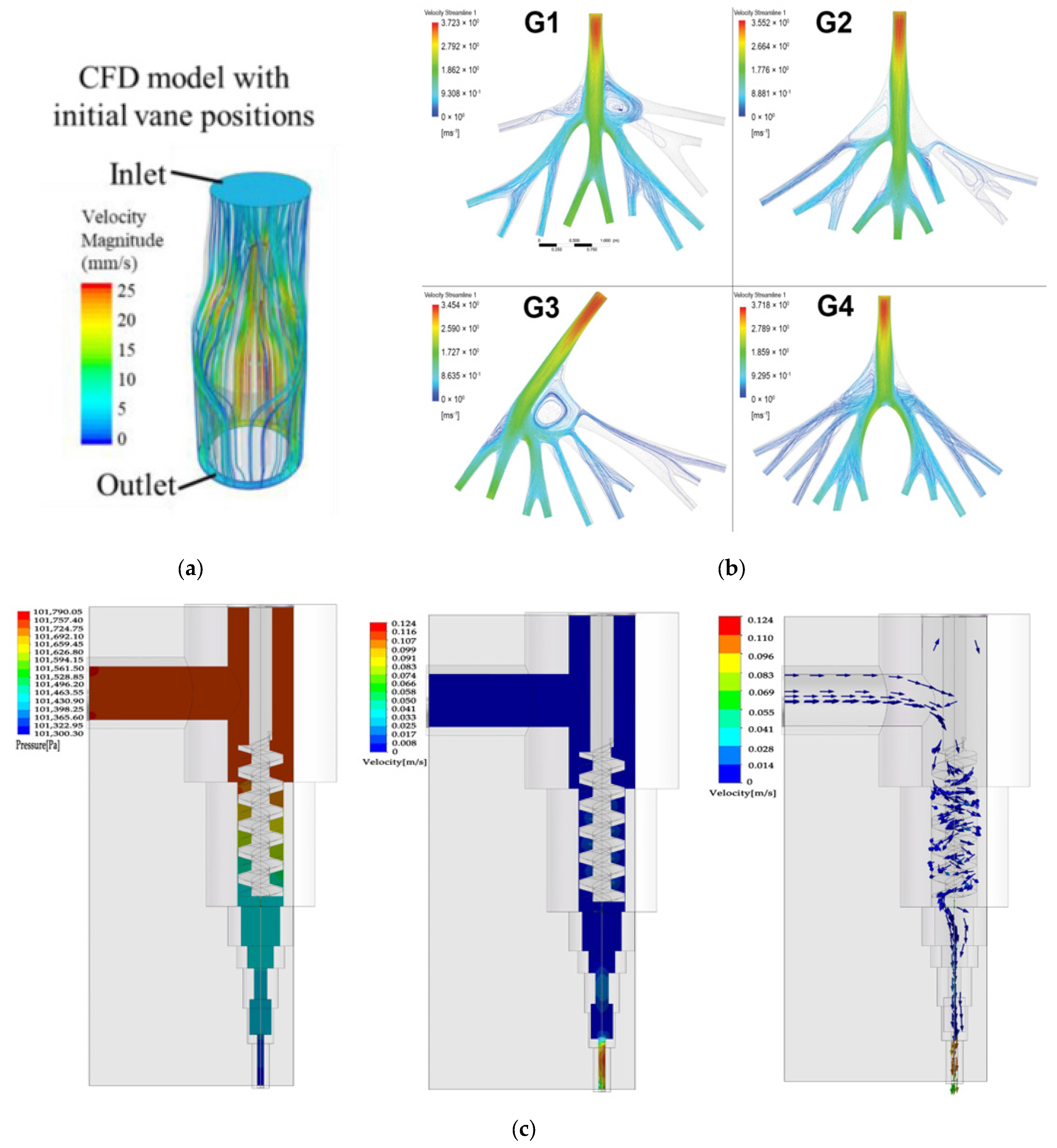
Although CFD is widely used to study nozzle flow, extrusion stability, and binder infiltration, relatively few studies currently focus on its application in clay- and ceramic-based AM. Figure 8 illustrates representative CFD implementations for clay-driven design and flow modeling. Despite this limited adoption, CFD remains fundamental for advancing predictive process control and virtual prototyping in paste-based material extrusion.

5.2.2. Current Applications in Clay and Ceramic AM

Although the use of CFD in clay- and ceramic-based AM is still emerging, recent studies have demonstrated its value in analyzing flow behavior, optimizing nozzle performance, and supporting geometry-driven design. Current applications primarily fall into two categories: (i) nozzle-scale simulations aimed at understanding pressure distribution and paste flow stability, and (ii) architecture-oriented CFD studies that leverage clay’s environmental properties for ventilation, cooling, or moisture management.
Despite these advances, CFD has rarely been applied to simulate the full material deposition process in clay systems. Most reported work employs CFD as a design-evaluation tool, informing component morphology for improved structural or environmental performance, rather than as an integrated process-physics model for extrusion and layer formation.
For instance, CFD was employed by Taher et al. [84] as an integral part of a design-to-fabrication workflow aimed at enhancing indoor environmental performance through AM with clay. Specifically, CFD simulations were used to optimize a displacement ventilation system integrated within a multifunctional façade wall, enabling the better dispersion of ventilation air across a wider surface area while minimizing pressure losses. The CFD analysis informed the morphology of the integrated ventilation channels, ensuring that their geometry aligned with both the functional airflow requirements and the fabrication constraints imposed by the clay-based AM process. This approach demonstrates how CFD can inform the design of performance-driven architectural components by integrating airflow dynamics with digital modeling and robotic extrusion of complex clay geometries. The authors emphasize the significance of computational tools in reevaluating traditional HVAC infrastructure by integrating climate control features directly into architectural elements, thereby reducing reliance on separate mechanical systems and promoting material-efficient design strategies.
El-Mahdy et al. [162] employed CFD simulations to assess the passive cooling potential of clay modules with integrated aerodynamic openings. The study employed airflow modeling to test various opening configurations and evaluate their impact on natural ventilation and internal air movement, aiming to improve thermal comfort without relying on active HVAC systems. Together, these studies demonstrate how CFD can guide geometry development in AM for environmental performance, bridging design, analysis, and fabrication within an integrated architectural workflow.

5.2.3. Insights from Other Extrusion Systems

As CFD techniques in concrete extrusion have matured, several studies have leveraged flow simulations to evaluate slip boundary conditions, extrusion pressure, die-swell, and layer stability [197]. These works demonstrate the capability of CFD to capture rheology–process interactions in dense pastes. However, equivalent implementations in clay- and ceramic-based AM remain limited. While concrete-derived models offer transferable strategies for nozzle design and process optimization, adapting them to clay requires accounting for its distinct particle morphology, plasticity, and water-retention behavior.
Although food-based pastes differ significantly in composition and moisture transport behavior, insights from analogous viscoplastic systems help frame clay-specific challenges. For example, Oyinloye and Yoon [198] investigated the extrusion of rice paste, demonstrating that smaller nozzle diameters increase shear stress and deformation. In contrast, controlled thermal conditions enhance shape retention, demonstrating how viscoelastic behavior, such as relaxation time and residual stress, contributes to vertical deformation during printing.
Mollah et al. [199] modeled viscoplastic cementitious pastes. They demonstrated the importance of yield stress buildup between layers in maintaining print fidelity during multilayer deposition, particularly when working with tall or thin-walled geometries. Lin et al. [85] conducted CFD simulations to investigate the velocity field of ceramic clay flowing through an extrusion nozzle, taking into account material properties, nozzle geometry, and process parameters. The results demonstrated that both inlet velocity and screw speed significantly influenced the clay flow rate and the pressure distribution inside the nozzle. Specifically, higher screw speeds or inlet velocities increased the flow rate and internal pressure, while smaller nozzle diameters reduced the flow but increased the internal pressure. The simulations also showed that outlet velocity was positively correlated with inlet velocity, with a proportional coefficient of approximately 700, whereas screw speed had only a limited effect on outlet velocity due to modeling simplifications. These findings provide a theoretical framework for optimizing nozzle dimensions and process parameters in clay-based additive manufacturing, ultimately improving printing stability and shaping quality.

5.2.4. Coupling CFD with Rheology and Drying Physics

When adapting these models to clay-based additive manufacturing, specific material behaviors must be reconsidered. Unlike mortar or food pastes, clay, earth, and other ceramic-based materials exhibit strong thixotropy and drying shrinkage, making it sensitive not only to shear but also to time and environmental conditions [150,200,201]. Its lack of a natural lubricating layer at the nozzle wall suggests that partial-slip or experimentally calibrated boundary conditions may be more appropriate than the full-slip assumptions used in mortar modeling. Additionally, because clay undergoes significant geometric changes due to moisture loss, CFD models must integrate both extrusion dynamics and post-deposition drying behavior. Therefore, although these methodologies offer valuable insights, the simulation of clay extrusion requires rheological models that can capture moisture-dependent plasticity, time-evolving viscosity, and capillary-driven shrinkage, all of which are critical to achieving printable and dimensionally stable clay structures.
Integrating CFD with rheological constitutive models, such as Bingham or Herschel–Bulkley formulations, allows researchers to more accurately replicate the yield stress and thixotropic response of these materials under deposition conditions. This coupling enables the virtual tuning of paste formulations prior to physical trials. Beyond nozzle dynamics, CFD has also proven useful in evaluating environmental interactions of AM structures. In architectural applications, CFD has been applied to simulate airflow through porous or biomimetic clay-based geometries [71,202]. When validated through empirical techniques such as force measurements, strand dimension analysis, or thermographic imaging, CFD simulations demonstrate a strong predictive capacity. This alignment reinforces the use of CFD not only for defect mitigation and toolpath planning but also as a generative tool for functionally enhanced structures tailored to both material flow constraints and environmental performance goals.
Beyond conventional numerical approaches, machine learning (ML) is increasingly applied in additive manufacturing to accelerate process optimization and material design [24,203,204,205]. Although current applications focus mainly on polymers, metals, and biomaterials, ML could provide a complementary framework for clay- and ceramic-based AM by integrating rheological data, FEM/CFD simulations, and experimental results. This remains an open research opportunity with significant potential to reduce trial-and-error in extrusion processes and to guide the design of sustainable, locally sourced pastes.

5.3. Geometric and Parametric Modeling

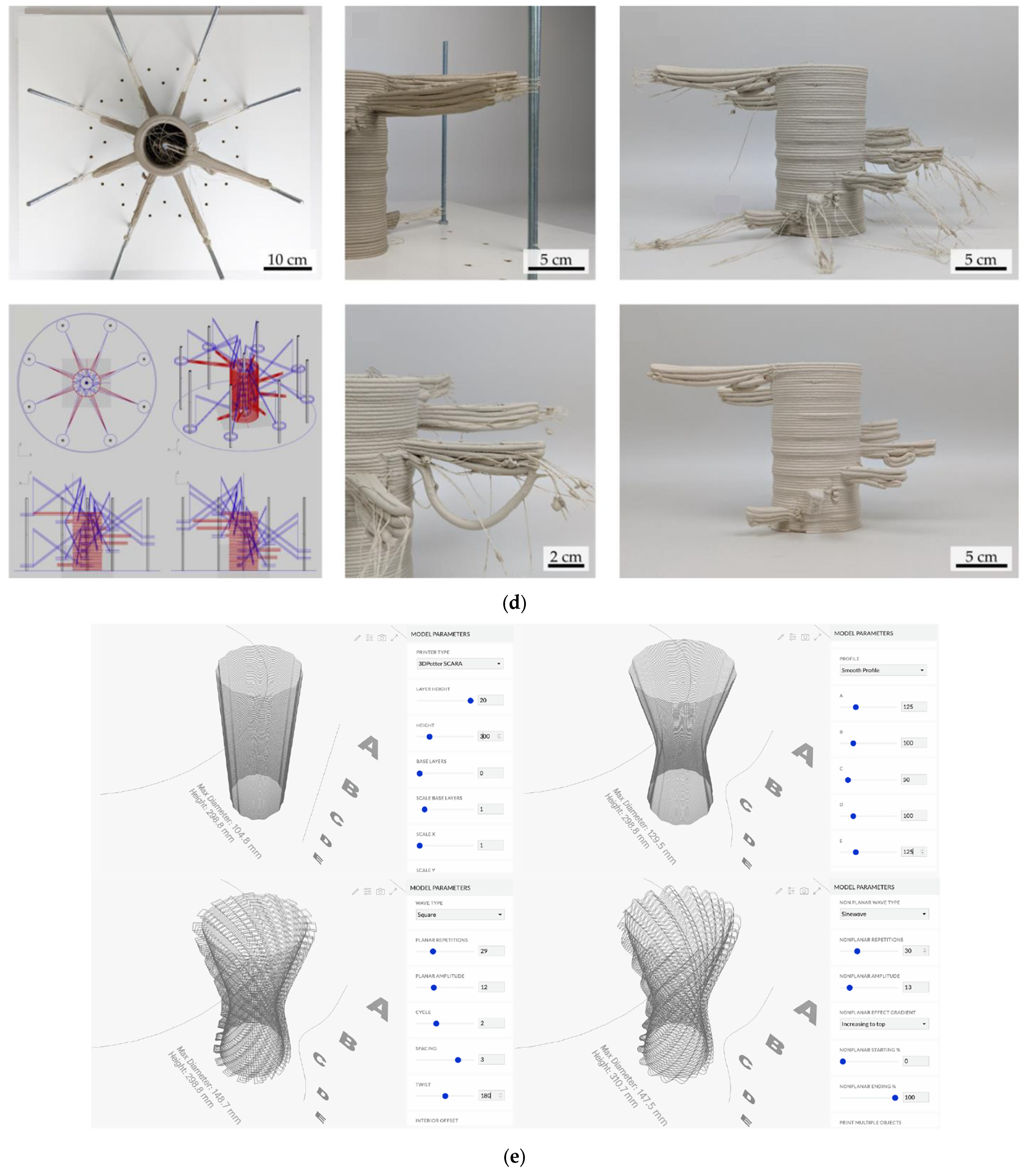
Geometric and parametric modeling play a crucial role in AM with clay and ceramic materials, particularly given the importance of designing structures that account for material-specific behaviors, such as shrinkage, plastic deformation, and gravitational settling, during deposition [26]. These modeling strategies enable designers to create complex, material-efficient geometries while embedding fabrication constraints directly into the design process. Some examples of this geometric and parametric modeling are shown in Figure 9.

5.3.1. Rule-Based and Parametric Workflows

Grasshopper® for Rhino has become the dominant platform for parametric clay and some ceramic AM, enabling rule-based modeling tied to fabrication logic and environmental parameters. Plugins such as Galapagos, Wallacei, Biomorpher, Kangaroo, and Karamba3D allow users to integrate optimization strategies, basic structural feedback, and environmental criteria into the design workflow. These toolchains support adaptive geometries informed by humidity, temperature, nozzle orientation, toolpath curvature, and printing speed.
These parametric tools have been instrumental in enabling rule-based, adaptable modeling workflows that incorporate not only geometric constraints but also fabrication and environmental data. Beyond basic parametric control, advanced generative design techniques are increasingly used in clay-based AM. Algorithms such as Galapagos (genetic optimization) and Wallacei (multi-objective optimization), as well as biomimetic pattern generators like those found in the Biomorpher plugin, enable the exploration of a wide design space while considering fabrication constraints and desired performance criteria. Millipede and Karamba3D are often used in tandem to integrate basic structural simulations and stress visualizations during the design phase, providing insights into deformation patterns and potential failure points under fresh-state loading or during drying.

5.3.2. Material-Driven and Bioinspired Design

Recent advances in clay-based additive manufacturing have led to a shift toward material-driven and behavior-informed design, where the intrinsic properties of clay, such as capillarity, moisture transport, shrinkage, and plastic deformation, actively guide the geometric generation process. Instead of treating clay as a passive medium, these approaches incorporate material intelligence into computational workflows, allowing form to emerge from hydric, mechanical, and environmental responses. This direction aligns with broader trends in digital fabrication toward bioinspired and performance-coupled design.
For instance, Estévez and Abdallah [167] introduced the concept of 3D-printed biodigital clay bricks, where geometry is generated through biomimetic algorithms such as reaction–diffusion and shortest path models, directly derived from the hydrophilic behavior of clay. The resulting families of designs (V1, V2, V3) were experimentally tested, showing that the geometric configuration can enhance both compressive strength and elasticity, in some cases surpassing that of conventional industrial bricks. Notably, the V3 linear model displayed significant post-cracking elasticity, suggesting its potential in earthquake-resistant applications. This study highlights how parametric and biomimetic modeling can leverage material behavior to create structurally efficient, sustainable clay-based AM components.
Similarly, Gentile et al. [206] applied parametric design to clay-based AM to optimize moisture buffering in indoor components. The authors used Kangaroo and Anemone, two Grasshopper algorithms, to generate porous geometries with high surface-to-volume ratios, directly translated into G-code for LDM printing. Their results showed a threefold increase in Moisture Buffering Value (MBV) compared to solid clay blocks, demonstrating how parametric modeling can directly enhance functional performance. Moreover, stabilization strategies revealed that chemical treatment with Ca(OH)2 better preserved hygroscopic properties than high-temperature firing, highlighting the interplay between geometry, material treatment, and functional outcomes in clay AM.

5.3.3. Process-Aware and Toolpath-Driven Design

Beyond geometric parametrization, recent research has shifted toward design approaches that directly integrate fabrication physics, layer-by-layer evolution, and toolpath constraints. In these methods, toolpaths are not post-processing artifacts but primary design drivers, allowing geometry, material deposition, and stability behavior to co-evolve. Such workflows bridge digital intent with fresh-state realities, capturing deformation, collapse risk, and extrusion variability during printing.
Xing et al. [17] exemplify this shift by coupling a lightweight, layer-by-layer stability solver with local shell thickening directly on toolpaths, reinforcing weak regions without altering the external form. Together, these approaches outline a hierarchical pipeline, parametric design for global intent and constraints, followed by toolpath-aware optimization for printability, bridging early-stage performance targets with the realities of fresh-state behavior in extrusion-based clay and ceramic AM.
Zhong et al. [207] advanced parametric modeling for ceramic AM by introducing an interactive sweeping surface framework that embeds fabrication constraints directly into the design stage. Their approach generates a single continuous toolpath and adaptively modulates extrusion amounts to ensure self-support and collision-free deposition, thereby bridging user intent with manufacturable outcomes. This method exemplifies how customized parametric tools, beyond conventional CAD environments such as Grasshopper, can directly couple geometry generation with process-specific constraints, effectively expanding the range of printable ceramic forms.
At the architectural scale, Kontovourkis and Tryfonos [121] extended parametric design to robotic clay printing. Working in Grasshopper, they developed an integrated toolpath algorithm that embeds key 3DP parameters, such as layer height, wall thickness, infill density, extrusion velocity, and nozzle diameter, into the design stage, directly linking geometry generation with robotic control. Using porcelain and various clay-based mixtures, the study fabricated non-conventional prefabricated wall components, demonstrating how parametric strategies can optimize geometric conformity and printing time. Their results also highlighted the role of hexagonal infill patterns in supporting overhanging geometries, reinforcing the potential of parametric-integrated approaches for scalable, sustainable construction with clay.
Yang et al. [208] expanded the scope of clay AM by introducing automated fiber insertion during LDM, governed through a parametric Grasshopper workflow. The Fiber Insertion Module (FIM) enabled the synchronized placement of hemp threads within the extruded clay, where parameters such as fiber density, trajectory, and insertion frequency were directly linked to the digital model. This integration enhanced the structural stability of fresh prints, particularly in overhangs and freeform geometries, while preserving the mechanical integrity of the sintered ceramic body despite fiber pyrolysis. Beyond reinforcement, the parametric control of fiber paths allowed novel design possibilities such as thread-guided overhangs, vertical strand stabilization, and subtractive cutting of fresh clay, positioning hybrid digital–material strategies as a promising direction in ceramic AM.
These studies demonstrate a shift from geometry-centric workflows to fabrication-integrated design, where stability, deposition physics, and reinforcement strategies are encoded directly into toolpaths. This integration marks a critical step toward scalable clay and ceramic AM.

5.3.4. Performance- and Sustainability-Oriented Parametric Workflows
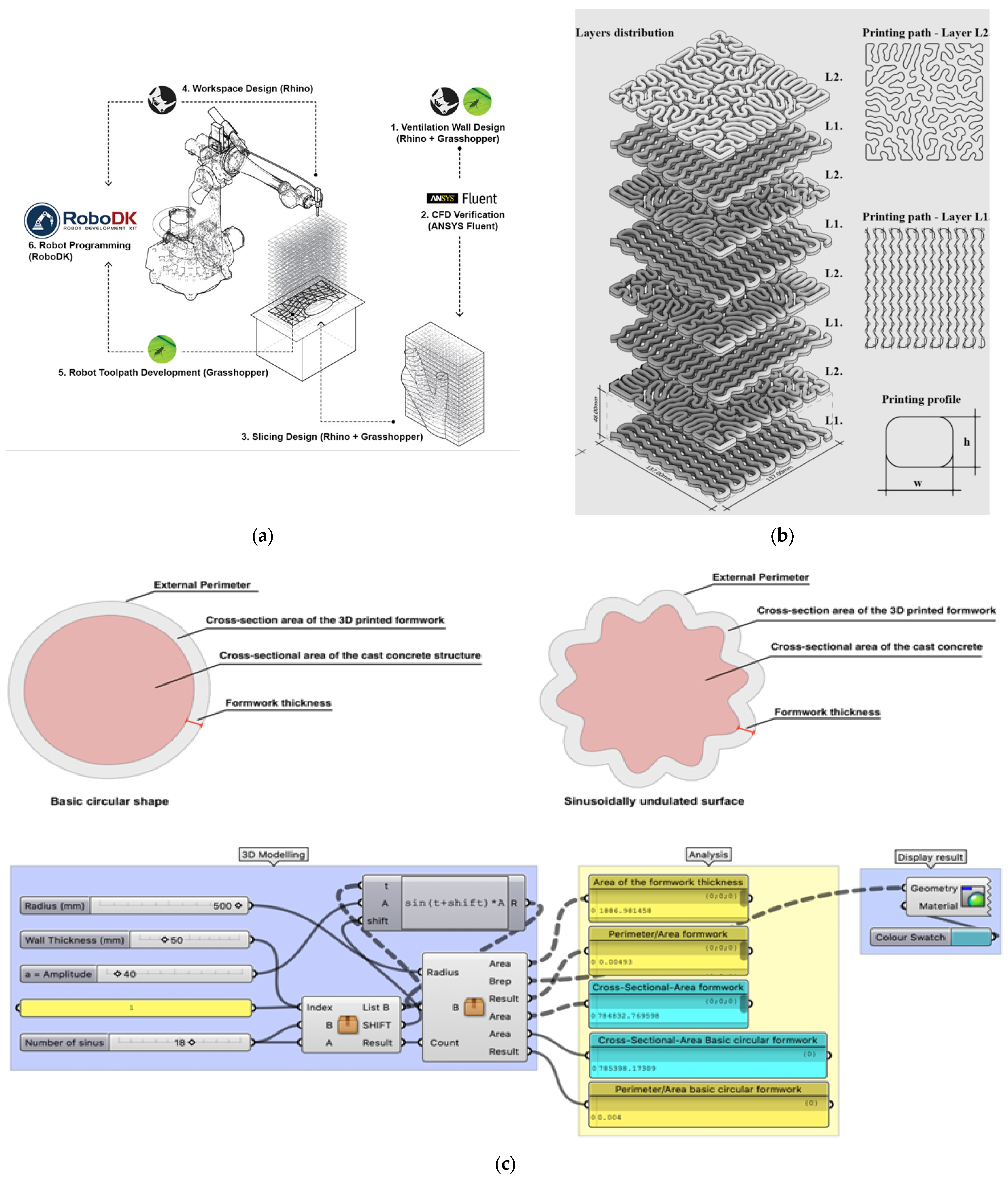
As clay-based AM matures, parametric modeling has expanded beyond geometry and printability to incorporate structural performance and environmental assessment. These approaches couple computational design with engineering simulation and life-cycle metrics, positioning clay AM not only as an aesthetic or experimental medium but as a technically and environmentally optimized construction strategy. In parallel, efforts toward accessible parametric interfaces aim to democratize these methods, enabling broader adoption of clay AM across scales and user groups.
Sangiorgio et al. [176] combined parametric modeling and FEM simulation to explore the printability of clay bricks with complex internal geometries. The authors used Grasshopper to generate minimal surface-based designs, including the gyroid, Schwarz P, and diamond. The models were voxelized and directly linked to Abaqus via the VoxelPrint plugin, enabling non-linear FEM analyses adapted to clay extrusion. Among 18 parametric brick models, FEM predicted outcomes ranging from full collapse to stable printability, later confirmed through prototyping on a Delta WASP 40 100 printer. Notably, diamond and gyroid structures exhibited high printability, while batwing geometries consistently failed. The study not only validated FEM as a predictive tool for clay AM but also identified critical error categories, such as the ’too dense’ error, highlighting the interplay between digital design resolution, material rheology, and fabrication limits.
Building on the integration of design-to-fabrication, Sangiorgio et al. [209] further expanded the scope of parametric modeling by coupling Grasshopper-based generative workflows with life cycle metrics in the design of 3D-printed formworks. Their framework parametrized wall thickness, sinusoidal undulations, and cross-sectional geometries, while automatically linking these variations to Life Cycle Assessment (LCA) and Life Cycle Costing (LCC). Although the case study focused on concrete formworks, the comparative analysis of materials emphasized clay and geopolymers as low-carbon alternatives for additive manufacturing. This integration demonstrates how parametric modeling can serve as both a design and sustainability assessment tool, positioning clay not only as a viable construction material but also as a strategic pathway toward environmentally aligned additive manufacturing.
While Grasshopper and its ecosystem of plugins enable expert users to integrate optimization algorithms and structural feedback into clay-based AM workflows, alternative parametric platforms have also emerged to broaden accessibility. San Fratello and Rael [210], for instance, developed Potterware, a cloud-based tool that replaces complex CAD interfaces with intuitive slider controls, directly generating G-code for 3D printing with soils and clay mixtures. Approaches like this one could highlight how parametric modeling can be adapted for advanced performance-driven design and for democratizing digital fabrication, empowering non-specialists to engage with material-specific AM processes.
Parametric modeling has become one of the most prevalent computational strategies in clay-based additive manufacturing, not only for generating complex geometries but also for incorporating fabrication constraints, predicting failure, and expanding the feasible design space to accommodate larger structures. What distinguishes parametrization from other modeling approaches is its dual role: it serves as a generative tool for exploring form and as an integrative framework that connects digital design to process parameters, toolpath control, and even sustainability metrics.
The flexibility of platforms like Grasshopper has enabled researchers to directly link geometry with extrusion dynamics, mechanical simulations, and environmental performance, thereby reducing trial-and-error in fabrication while allowing for more ambitious scales. Yet, this comes with trade-offs: higher geometric complexity often demands greater computational resources, longer print times, and finer resolution, while material adjustments, such as increasing water content for printability, may compromise shrinkage behavior or structural reliability. Despite these limitations, parametric workflows remain the most widely used and versatile computational method in clay AM, laying the foundation for a progressive shift from prototype-scale experiments to structurally and environmentally informed architectural components.
Figure 9. (a) Integrated digital workflow with your main phases and the software proposed by Taher et al. [84] for a Multifunctional building component using Grasshopper (CC BY 4.0); (b) geometries for a moisture buffering structures proposed by Gentile et al. [206] (© 2024 Elsevier Ltd. All rights reserved.); (c) The visual scripts created by Sangiorgio et al. [176] for use in Abaqus simulation, presenting different components such as: BerpToVoxel, Material, PrintSetting, VoxelPreview and VoxelToAb (CC by 4.0); (d) Thread-assisted clay printing of overhanging elements supported by a tensioning system by [208] (CC BY 4.0.); (e) Custom software, Potterware, proposed by [210] (© 2020 Elsevier Ltd. All rights reserved).
Ceramics 08 00148 g009aCeramics 08 00148 g009b

6. Numerical Modeling in Clay-Based Additive Manufacturing: Toward Predictive Frameworks

Computational modeling is increasingly recognized as a critical complement to experimental research in clay- and ceramic-based additive manufacturing. While experimental studies have provided valuable insights into rheology, shrinkage, cracking, and structural behavior, numerical approaches have progressed more slowly relative to experimental research. The following subsections critically examine the current scope of FEA, CFD, and multiphysics simulations in this field. Particular attention is given to the limited coupling between modeling and systematic material characterization. This challenge is amplified by the moisture-sensitive and heterogeneous nature of clay pastes, and by the scarcity of validation datasets. By discussing both advances and gaps across different modeling strategies, this section highlights the opportunities for simulation to move beyond academic demonstrations and become a predictive design tool for large-scale and reliable clay AM.

6.1. Mechanical Behavior Simulations

Mechanical FEA has been increasingly applied to investigate the mechanical behavior of clay- and ceramic-based, as well as some geopolymers, in additive manufacturing. These models are used to study stress distribution, anisotropy caused by layer deposition, and the overall load-bearing capacity of printed components. In particular, studies on clay bricks, cob structures, and geopolymer-like mortars have shown how computational simulations can capture the influence of interlayer bonding and geometry on structural performance, offering guidance for optimizing design and fabrication strategies [121,176,194]. Although structural performance has been widely studied experimentally, only a limited number of works integrate these insights into predictive FEM frameworks [26,211,212,213,214]. Only a small number of works have combined mechanical testing with finite element simulations, underscoring a gap between empirical characterization and predictive computational frameworks. This highlights the need to bridge experimental insights with FEM-based analysis to advance clay AM toward scalable, structurally reliable applications.
The scarcity of FEM studies can be partly explained by the complexity of clay as a material. Unlike metals or polymers, clay is moisture-dependent and heterogeneous, with no universal constitutive model, which complicates numerical parameterization. The variability of clay mixtures across laboratories further limits the transferability of simulation data, while the characterization of fresh-state mechanical properties, essential for reliable modeling, remains underdeveloped. Additionally, large-scale non-linear FEM simulations are computationally demanding, and much of the research in clay AM originates from architectural contexts that privilege prototyping and experimental validation over numerical analysis. Together, these factors help explain why, despite the abundance of experimental studies on structural performance, FEM applications remain scarce.

6.2. Predicting Deformation and Shrinkage

Deformation and shrinkage are among the most critical challenges in clay additive manufacturing, as freshly extruded material can slump under its own weight, while drying and sintering processes lead to dimensional changes that distort the final geometry. Computational modeling has begun to address these issues, with finite element methods applied to predict sintering shrinkage and collapse behavior, and CFD approaches used to simulate flow through extrusion nozzles. Yet most contributions remain experimental, documenting shrinkage and warping without embedding these results into predictive numerical tools. The scarcity of FEM-based approaches reflects both the complexity of capturing time-dependent rheology and the limited availability of calibrated material parameters for clay systems. As a result, shrinkage compensation strategies are still predominantly empirical, highlighting the need for more systematic integration of numerical models with experimental characterization [26,85,139,175,176].
Several factors can explain the limited diffusion of FEM and CFD in this area. Clay pastes are highly heterogeneous and moisture-sensitive, making it difficult to parameterize constitutive behavior, especially under evolving boundary conditions such as wall slip and free-surface deformation. Moreover, the different scales of the problem, ranging from millimeter-scale CFD of nozzle flow to part-scale FEM of drying and sintering, are rarely coupled, leaving gaps between localized predictions and overall structural outcomes. These models are also computationally demanding, particularly when attempting to simulate large-scale or time-dependent non-linear behaviors. Furthermore, validation datasets remain scarce, as few studies provide in situ measurements of velocity, pressure, moisture content, and deformation that are necessary to calibrate simulations. The heterogeneity of clay mixtures, local additives, and customized extrusion systems further complicates the replication and transferability of numerical models.
Although clay presents the most prominent case due to its sensitivity to moisture and high shrinkage during drying and firing, similar issues have been observed in other ceramic systems, including porcelain, alumina, and zirconia, where thermo-mechanical simulations are equally needed to anticipate deformation during sintering. Overall, FEM and CFD have the potential to predict deformation and shrinkage in clay- and ceramic-based AM, based on their application to other materials; however, their adoption remains limited compared to experimental approaches. Progress in this field will require standardized material characterization, multiscale modeling frameworks that connect nozzle flow to drying and sintering behavior, and systematic validation protocols. Such integration would enable a transition from empirical compensation strategies toward reproducible, predictive control of dimensional accuracy in ceramic additive manufacturing.

6.3. Modeling Cracking and Failure

Cracking is a recurrent problem in both clay- and ceramic-based additive manufacturing, arising during drying, sintering, or under mechanical loading. In clay pastes, cracks often initiate along weak interlayer bonds or at stress concentration zones during shrinkage. In contrast, in engineering ceramics, they can result from thermal gradients during firing. Most studies in this area remain experimental, documenting failure modes such as layer delamination, through-thickness cracking, or brittle fracture of fired components. Computational approaches have been introduced more recently, with finite element analyses used to classify collapse modes in printed geometries and advanced formulations such as cohesive zone or phase-field models being explored in the broader AM literature to capture crack initiation and propagation. these models are valuable as they enable failure prediction during the design stage, identifying vulnerable regions before fabrication.
Nevertheless, the application of fracture modeling to clay AM remains scarce. The lack of standardized fracture parameters for fresh and partially dried clay makes it difficult to calibrate damage models, while the strong anisotropy introduced by layer deposition complicates the definition of constitutive laws. In addition, cracks often result from coupled mechanisms, drying shrinkage, thermal stress, and weak adhesion, which are rarely modeled together. As a result, numerical simulations of cracking in this field remain primarily methodological demonstrations, rather than tools broadly adopted by practitioners. Closing this gap will require systematic experimental–numerical frameworks, in which fracture mechanics tests on clay and ceramic pastes are integrated with computational models to yield transferable parameters. Such integration would enable designers to move from documenting cracks after fabrication to predicting and mitigating them at the design stage [161,209].

6.4. Drying and Curing Simulations (Time-Dependent Behavior)

Drying and curing processes strongly influence the dimensional stability and structural integrity of clay- and ceramic-based AM components. As water evaporates, clay pastes stiffen but also shrink, often leading to internal stress gradients and surface cracking. Several studies have experimentally characterized these mechanisms. Drying rate, ambient conditions, and porosity distribution strongly influence whether a printed part maintains its geometry or undergoes warping and cracking. Computational approaches have begun to address this stage through hygro-mechanical simulations, where moisture diffusion is coupled with stress development, and through CFD models applied to drying clay bricks. These approaches allow prediction of non-uniform drying, identification of regions where tensile stresses concentrate, and estimation of optimal curing strategies.
However, as in previous cases, numerical simulations of drying and curing in clay AM are still limited compared to experimental work. The rheology of fresh clay changes rapidly during water loss, making it challenging to define time-dependent constitutive parameters, while the interplay between drying kinetics, geometry, and environmental control is often overlooked in models. As a result, drying strategies remain largely empirical rather than simulation-driven. To move beyond empirical approaches, it will be necessary to develop hygro-mechanical models calibrated with real-time moisture and deformation data from clay prints, like the frameworks already explored in ceramic processing. Such integration would enable more reliable prediction of shrinkage, cracking, and curing times, bridging experimental knowledge with computational design of process conditions [26,139,206].
In contrast, the ceramic engineering literature has developed more advanced hygro-thermal models for materials such as alumina, zirconia, and porcelain, where drying shrinkage, moisture diffusion, and thermal stresses have been coupled and calibrated with experimental data. Finite element and multiphysics simulations have been used to predict non-uniform drying and stress development, while thermo-mechanical FEM has been applied to porcelain sintering, and CFD approaches have modeled airflow and evaporation in ceramic drying processes [100,175]. Thus, predictive drying and curing models could be feasible when constitutive parameters are well defined, offering a methodological benchmark for clay AM. Transferring such frameworks to clay requires systematic material characterization and real-time monitoring of moisture and deformation, which would enable more reliable prediction of shrinkage, cracking, and curing times. Bridging these approaches could allow clay AM to progress from empirically guided protocols to simulation-driven process design.

6.5. Thermo-Mechanical Sintering Simulations

After drying, many ceramic prints are sintered (fired) at high temperatures to attain full strength and durability. Sintering represents a critical stage in ceramic additive manufacturing, where thermal densification induces substantial shrinkage and stress development that can cause distortion or fracture of parts. In clay-based AM, these effects are generally acknowledged but remain treated empirically, with firing shrinkage and warping reported as common limitations for dimensional accuracy. Numerical modeling of sintering in clay is still scarce, reflecting both the heterogeneity of clay compositions and the lack of calibrated thermo-mechanical parameters across drying-to-firing transitions.
By contrast, thermo-mechanical simulations are more advanced in engineered ceramics, where well-characterized material properties and sintering kinetics have enabled the use of predictive models. Finite element analyses have been employed to simulate densification and the evolution of thermal stress in porcelain [175]. Alongside these modeling efforts, experimental research on ceramic sintering [215,216], including studies of regolith-based composites, highlights the relevance of shrinkage and warping as challenges, even if not always addressed computationally. Together, these contributions demonstrate that thermo-mechanical modeling frameworks are feasible and valuable; however, their systematic application to clay AM remains pending. Such integration would reduce reliance on empirical trial and error during firing and enable the more reliable fabrication of large-scale components with controlled dimensional accuracy.

6.6. Multiphysics Modeling

Because clay AM involves simultaneous phenomena, such as structural loading, moisture movement, and heat transfer, thus, multiphysics simulations are often required. In multiphysics FEA, several physical fields are solved simultaneously to capture their interactions, for example, how moisture loss causes shrinkage strain or how temperature changes induce stress. A key example is coupling moisture transport with stress analysis, which is essentially a poromechanical approach. As water content gradients develop in a drying clay print, the FEA model calculates the resulting uneven shrinkage and stress that can cause the part to crack. Similarly, coupling thermal and mechanical fields is crucial during sintering, as discussed above, making sure thermal contraction translates to mechanical deformation in the model. Tools like COMSOL Multiphysics are well-suited for these problems, as they can simultaneously solve diffusion equations and structural mechanics. For instance, a multiphysics FEA can simulate the drying of clay bricks in ambient air: the moisture diffusion equation may indicate faster drying at the surface, and the structural part of the model then shows tensile stresses developing at the surface due to shrinkage restraint. This combined approach helps in designing process protocols, e.g., whether to cover the print with plastic to slow drying in the first 24 h, or how to orient parts in the furnace to heat evenly. Another multiphysics aspect in functional ceramics is coupling structural and fluid or thermal performance. For example, El-Mahdy et al. [162] not only analyzed the structural soundness of a 3D-printed earthen wall, but also performed CFD simulations to assess its airflow cooling performance. By integrating these, one ensures that adding cooling openings does not compromise structural integrity, and vice versa. In summary, multiphysics FEA enables the holistic simulation of clay AM parts under real-world conditions, such as mechanical loads, drying environments, and thermal cycles, providing deeper insight than single-physics models.
Across the literature, simulations in clay- and ceramic-based AM have been implemented using both parametric modeling environments and multiphysics analysis software. Rhinoceros 3D with its Grasshopper plugin, has become central for geometric and parametric control, enabling rule-based design and generative exploration tailored to clay’s material behavior. On the numerical side, commercial FEA platforms such as Abaqus FEA, ANSYS CFX, and COMSOL MULTUPHYSICS are widely used to address structural, thermal, and fluid interactions, occasionally complemented by custom codes to capture specific rheological or fracture responses. Together, these tools enable coupling design flexibility with predictive analysis, supporting workflows that bridge the gap between architectural intent and engineering validation.
Yet, the predictive value of such simulations depends critically on experimental validation. Regardless of the modeling strategy, whether FEM for structural behavior, CFD for flow prediction, or multiphysics for drying and sintering, numerical approaches in clay and ceramic AM must be validated experimentally. For natural materials like clay, where heterogeneity and moisture sensitivity strongly influence performance, numerical predictions must be calibrated against real-world data. Recent case studies illustrate how this integration is being achieved: El-Mahdy et al. [162] validated coupled CFD–FEA analyses of a 3D-printed earthen cooling wall through prototype testing; Aguilar et al. [112] developed variable-density photocatalytic ceramic slats using parametric modeling and simulation tools, and validated their performance with both small-scale and full-scale prototypes; and Taher et al. [84] created a multifunctional acoustic clay panel by linking parametric modeling with structural and acoustic simulations, subsequently validated by load and sound absorption tests. These examples show that simulations are moving beyond isolated mechanical predictions to support multifunctional design workflows, if validation mechanisms remain consistently in place.
The proposed framework (Figure 10) illustrates how predictive modeling in clay and ceramic additive manufacturing requires the integration of multiple layers: material and physical characterization, mathematical formulations, numerical simulations, experimental validation, and parametric design workflows. Material data provides the constitutive basis for mathematical models, which are then solved numerically through FEM, CFD, or multiphysics approaches. Experimental validation remains essential to calibrate and confirm these models, while parametric design tools such as Rhino/Grasshopper enable their translation into architectural and functional applications. Rather than isolated efforts, this workflow underscores the importance of iterative feedback loops, where insights from characterization and validation continually refine simulations and design strategies. By consolidating these stages into a predictive framework, clay AM, and, moreover, ceramic-based AM can progress from empirical prototyping toward simulation-driven design and process optimization, ultimately enabling more reliable, scalable, and multifunctional applications.

7. Conclusions

Additive manufacturing with clay and ceramic materials has undergone rapid evolution in recent years, driven by advances in extrusion systems, rheological control, parametric design, and emerging numerical modeling frameworks. However, unlike polymer- and metal-based AM, clay and ceramic systems require simultaneous control of water content, thixotropic behavior, capillarity, shrinkage, and interlayer adhesion, making their physics process inherently coupled and sensitive to environmental and fabrication conditions.
This review directly addresses the research question by demonstrating that predictive and scalable clay- and ceramic-based AM requires the coordinated integration of (i) experimental rheological and mechanical characterization, (ii) computational modeling through FEM, CFD, and multiphysics approaches, and (iii) computational design frameworks capable of incorporating material behavior and fabrication constraints. The synthesis presented shows that only by coupling these domains can the field transition from empirical trial-and-error toward predictive, data-informed, and scalable AM workflows. Therefore, the study highlights that the path toward reliable clay and ceramic AM lies in the unification of experimental data, numerical simulation, and design logic, establishing the basis for predictive accuracy, scalability, and process control.
This review consolidates the state of knowledge across material formulation, rheology, printing behavior, computational techniques, and architectural and functional applications. A key contribution of this work is the integration of experimental and computational perspectives, clarifying how rheological characterization, layer-wise stability testing, and full-scale prototyping can be complemented by finite element analysis, CFD, and multiphysics models to anticipate deformation, cracking, and shrinkage. We also introduce a computational design taxonomy for clay-based AM, encompassing geometry-centric parametric workflows, material-driven design, toolpath-coupled strategies, and sustainability-oriented performance models.
Despite clear progress, challenges remain. Constitutive models for clay pastes are not yet standardized, and the heterogeneity of naturally sourced materials limits the transferability of parameters across research groups. Numerical approaches are promising but still underutilized, largely due to the difficulty of calibrating moisture-dependent behavior and validating models with in situ process data. At the application scale, environmental performance, durability, and long-term mechanical behavior require more systematic evaluation, particularly for structural and architectural systems exposed to variable humidity and thermal cycles.
Future progress in clay and ceramic AM will depend on
  • Standardized rheological protocols and shared benchmark datasets.
  • Multiscale modeling frameworks linking nozzle-scale flow to drying, sintering, and structural performance.
  • Robust experimental validation pipelines pairing computation with controlled testing.
  • Integration of sustainability and circularity metrics into design and fabrication workflows.
Advancing these elements will accelerate the transition from empirical prototyping to predictive, performance-driven, and scalable additive manufacturing, enabling clay and ceramic AM to serve not only as a fabrication technique but as a platform for regenerative architecture, low-carbon construction, and multifunctional design.

Author Contributions

Conceptualization, M.D.L.A.O.-D.-R., D.I.B. and A.A.J.-O.; methodology, M.D.L.A.O.-D.-R. and R.G.D.-C.; formal analysis, M.D.L.A.O.-D.-R. and D.I.B.; investigation, R.G.D.-C., M.N.M.P., L.E.C.-O., D.I.B. and M.D.L.A.O.-D.-R.; resources, M.D.L.A.O.-D.-R. and A.A.J.-O.; data curation, M.D.L.A.O.-D.-R. and D.I.B.; writing—original draft preparation, M.D.L.A.O.-D.-R., D.I.B. and R.G.D.-C.; writing—review and editing, M.D.L.A.O.-D.-R., J.B.R. and D.I.B.; visualization, D.I.B.; supervision, M.D.L.A.O.-D.-R.; project administration, M.D.L.A.O.-D.-R., D.I.B. and A.A.J.-O.; funding acquisition, R.G.D.-C., M.D.L.A.O.-D.-R. and A.A.J.-O. All authors have read and agreed to the published version of the manuscript.

Funding

This research was funded by the Panamanian Bureau of Science, Technology, and Innovation (Secretaría Nacional de Ciencia, Tecnología e Innovación—SENACYT) under Grants APY-NI-2022-24 and FIED22-13.

Data Availability Statement

No new data were created or analyzed in this study. Data sharing is not applicable.

Acknowledgments

The authors would like to thank the Research Group in Design, Manufacturing, and Materials (DM + M) within the Technological University of Panama (https://utp.ac.pa/, accessed on 20 August 2025) for their collaboration. They also acknowledge the support of the National Research System (SNI) and the administrative assistance of the Centro de Estudios Multidisciplinarios en Ciencia, Ingeniería y Tecnología (CEMCIT-AIP). Finally, the authors gratefully acknowledge the support and encouragement of their colleagues from Lab 1-317 throughout the development of this work.

Conflicts of Interest

The authors declare no conflicts of interest.

References

  1. Abdalla, H.; Fattah, K.P.; Abdallah, M.; Tamimi, A.K. Environmental Footprint and Economics of a Full-scale 3D-printed House. Sustainability 2021, 13, 11978. [Google Scholar] [CrossRef]
  2. Hosseinian, S.M.; Sabouri, A.G.A.; Carmichael, D.G. Sustainable Production of Buildings Based on Iranian Vernacular Patterns: A Water Footprint Analysis. Build. Environ. 2023, 242, 110605. [Google Scholar] [CrossRef]
  3. Alotaibi, B.S.; Shema, A.I.; Ibrahim, A.U.; Abuhussain, M.A.; Abdulmalik, H.; Dodo, Y.A.; Atakara, C. Assimilation of 3D Printing, Artificial Intelligence (AI) and Internet of Things (IoT) for the Construction of Eco-Friendly Intelligent Homes: An Explorative Review. Heliyon 2024, 10, e36846. [Google Scholar] [CrossRef] [PubMed]
  4. United Nations Environment Programme, Global Alliance for Buildings and Construction. Not Just Another Brick in the Wall: The Solutions Exist—Scaling Them Will Build on Progress and Cut Emissions Fast. Global Status Report for Buildings and Construction 2024/2025. 2025. Available online: https://www.unep.org/resources/report/global-status-report-buildings-and-construction-20242025 (accessed on 24 May 2025).
  5. KC, A.K.; Mainali, B.; Ghimire, A.; Adhikari, B.; Lohani, S.P.; Baral, B. Role of Vernacular Architecture in Enhancing the Environmental Sustainability of the Building Sector. Energy Sustain. Dev. 2025, 86, 101695. [Google Scholar] [CrossRef]
  6. Feng, H.; Zhao, J.; Zhang, H.; Zhu, S.; Li, D.; Thurairajah, N. Uncertainties in Whole-Building Life Cycle Assessment: A Systematic Review. J. Build. Eng. 2022, 50, 104191. [Google Scholar] [CrossRef]
  7. Gyawali, B.; Haghnazar, R.; Akula, P.; Alba, K.; Nasir, V. A Review on 3D Printing with Clay and Sawdust/Natural Fibers: Printability, Rheology, Properties, and Applications. Results Eng. 2024, 24, 103024. [Google Scholar] [CrossRef]
  8. Ye, J.; Teng, F.; Yu, J.; Yu, S.; Du, H.; Zhang, D.; Ruan, S.; Weng, Y. Development of 3D Printable Engineered Cementitious Composites with Incineration Bottom Ash (IBA) for Sustainable and Digital Construction. J. Clean. Prod. 2023, 422, 138639. [Google Scholar] [CrossRef]
  9. Tanyildizi, H.; Seloglu, M.; Abdullah, M.M.A.B.; Abdul Razak, R.; Mydin, M.A.O. The Rheological and Mechanical Properties of 3D-Printed Geopolymers: A Review. Case Stud. Constr. Mater. 2025, 22, e04679. [Google Scholar] [CrossRef]
  10. Meshram, R.B.; Mohapatra, A.; Malakar, S.; Gupta, P.K.; Sahoo, D.P.; Nath, S.K.; Alex, T.C.; Kumar, S. Environmental Impact Analysis of Geopolymer Based Red Mud Paving Blocks. Discov. Appl. Sci. 2024, 6, 537. [Google Scholar] [CrossRef]
  11. Rupa, M.; Rao, V.M.; Sethy, K. Revealing the Potential of Red Mud and Recycled Water: A Review of Geopolymer Concrete. Int. J. Eng. 2025, 38, 1019–1029. [Google Scholar] [CrossRef]
  12. Balizi, B.; Karim Serroukh, H.; Aziz, A.; Benaicha, M.; Bellil, A.; El Khadiri, A.; Laaroussi, N. Thermo-Mechanical Characterization and Numerical Modeling of Lightweight Mortars Incorporating Natural Pozzolan and Expanded Clay. Case Stud. Constr. Mater. 2025, 22, e04732. [Google Scholar] [CrossRef]
  13. Cappai, M.; Pia, G. Sustainable Earthen Plasters: Surface Resistance Enhancement via Thermal Treatments. J. Build. Eng. 2025, 108, 112867. [Google Scholar] [CrossRef]
  14. Ahmed, S.; El Attar, M.E.; Zouli, N.; Abutaleb, A.; Maafa, I.M.; Ahmed, M.M.; Yousef, A.; Ragab, A. Improving the Thermal Performance and Energy Efficiency of Buildings by Incorporating Biomass Waste into Clay Bricks. Materials 2023, 16, 2893. [Google Scholar] [CrossRef] [PubMed]
  15. Yang, S.; Wi, S.; Lee, J.; Lee, H.; Kim, S. Biochar-Red Clay Composites for Energy Efficiency as Eco-Friendly Building Materials: Thermal and Mechanical Performance. J. Hazard. Mater. 2019, 373, 844–855. [Google Scholar] [CrossRef]
  16. Perrot, A.; Rangeard, D.; Courteille, E. 3D Printing of Earth-Based Materials: Processing Aspects. Constr. Build. Mater. 2018, 172, 670–676. [Google Scholar] [CrossRef]
  17. Xing, Y.; Zhou, Y.; Yan, X.; Zhao, H.; Liu, W.; Jiang, J.; Lu, L. Shell Thickening for Extrusion-Based Ceramics Printing. Comput. Graph. 2021, 97, 160–169. [Google Scholar] [CrossRef]
  18. Asapu, S.; Ravi Kumar, Y. Design for Additive Manufacturing (DfAM): A Comprehensive Review with Case Study Insights. JOM-J. Miner. Met. Mater. Soc. 2025, 77, 3931–3951. [Google Scholar] [CrossRef]
  19. Alves, N.; Gaspar, M.B.; Pascoal-Faria, P. Computer-Aided Optimization in Additive Manufacturing: Processing Parameters and 3D Scaffold Reconstruction. In Proceedings of the Central European Symposium on Thermophysics (CEST), Banska Bystrica, Slovakia, 16–18 October 2019; Volume 2116. [Google Scholar]
  20. Bahoria, B.V.; Bhagat, R.M.; Pande, P.B.; Raut, J.M.; Dhengare, S.W.; Mankar, S.H.; Vairagade, V.S.; Shelare, S.D. Design Optimization of 3D Printed Concrete Elements Considering Life Cycle Assessment and Life Cycle Costing. Int. J. Interact. Des. Manuf. 2024, 19, 2183–2202. [Google Scholar] [CrossRef]
  21. Kim, S.W.; Kong, J.H.; Lee, S.W.; Lee, S. Recent Advances of Artificial Intelligence in Manufacturing Industrial Sectors: A Review. Int. J. Precis. Eng. Manuf. 2022, 23, 111–129. [Google Scholar] [CrossRef]
  22. Soori, M.; Jough, F.K.G.; Dastres, R.; Arezoo, B. Additive Manufacturing Modification by Artificial Intelligence, Machine Learning, and Deep Learning: A Review. Addit. Manuf. Front. 2025, 4, 200198. [Google Scholar] [CrossRef]
  23. Mohammadnabi, S.; Moslemy, N.; Taghvaei, H.; Zia, A.W.; Askarinejad, S.; Shalchy, F. Role of Artificial Intelligence in Data-Centric Additive Manufacturing Processes for Biomedical Applications. J. Mech. Behav. Biomed. Mater. 2025, 166, 106949. [Google Scholar] [CrossRef] [PubMed]
  24. Gu, G.X.; Chen, C.-T.; Richmond, D.J.; Buehler, M.J. Bioinspired Hierarchical Composite Design Using Machine Learning: Simulation, Additive Manufacturing, and Experiment. Mater. Horiz. 2018, 5, 939–945. [Google Scholar] [CrossRef]
  25. Manzhirov, A.V.; Lychev, S. Mathematical Modeling of Additive Manufacturing Technologies. In Proceedings of the World Congress on Engineering, London, UK, 2–4 July 2014. [Google Scholar]
  26. Motamedi, M.; Mesnil, R.; Tang, A.-M.; Pereira, J.-M.; Baverel, O. Structural Build-up of 3D Printed Earth by Drying. Addit. Manuf. 2024, 95, 104492. [Google Scholar] [CrossRef]
  27. Ahmadi, S.M.; Campoli, G.; Amin Yavari, S.; Sajadi, B.; Wauthle, R.; Schrooten, J.; Weinans, H.; Zadpoor, A.A. Mechanical Behavior of Regular Open-Cell Porous Biomaterials Made of Diamond Lattice Unit Cells. J. Mech. Behav. Biomed. Mater. 2014, 34, 106–115. [Google Scholar] [CrossRef] [PubMed]
  28. Bragaglia, M.; Cecchini, F.; Paleari, L.; Ferrara, M.; Rinaldi, M.; Nanni, F. Modeling the Fracture Behavior of 3D-Printed PLA as a Laminate Composite: Influence of Printing Parameters on Failure and Mechanical Properties. Compos. Struct. 2023, 322, 117379. [Google Scholar] [CrossRef]
  29. Fairbairn, E.M.R.; Santos, L.D.F.; Farias, M.B.; Reales, O.A.M. Numerical Modeling of New Conceptions of 3D Printed Concrete Structures for Pumped Storage Hydropower. In Proceedings of the RILEM International Conference on Numerical Modeling Strategies for Sustainable Concrete Structures, Marseille, France, 4–6 July 2022; Springer International Publishing: Cham, Switzerland, 2023; Volume 38, pp. 120–129. [Google Scholar]
  30. Liu, Z.; Li, M.; Tay, Y.W.D.; Weng, Y.; Wong, T.N.; Tan, M.J. Rotation Nozzle and Numerical Simulation of Mass Distribution at Corners in 3D Cementitious Material Printing. Addit. Manuf. 2020, 34, 101190. [Google Scholar] [CrossRef]
  31. Singh, J.; Singh, R.; Sharma, S. Effect of Processing Parameters on Mechanical Properties of FDM Filament Prepared on Single Screw Extruder. Mater. Today Proc. 2022, 50, 886–892. [Google Scholar] [CrossRef]
  32. Al-Ketan, O.; Rowshan, R.; Abu Al-Rub, R.K. Topology-Mechanical Property Relationship of 3D Printed Strut, Skeletal, and Sheet Based Periodic Metallic Cellular Materials. Addit. Manuf. 2018, 19, 167–183. [Google Scholar] [CrossRef]
  33. Bayat, M.; Zinovieva, O.; Ferrari, F.; Ayas, C.; Langelaar, M.; Spangenberg, J.; Salajeghe, R.; Poulios, K.; Mohanty, S.; Sigmund, O.; et al. Holistic Computational Design within Additive Manufacturing through Topology Optimization Combined with Multiphysics Multi-Scale Materials and Process Modelling. Prog. Mater. Sci. 2023, 138, 101129. [Google Scholar] [CrossRef]
  34. Bi, M.; Tran, P.; Xia, L.; Ma, G.; Xie, Y.M. Topology Optimization for 3D Concrete Printing with Various Manufacturing Constraints. Addit. Manuf. 2022, 57, 102982. [Google Scholar] [CrossRef]
  35. Gan, N.; Wang, Q. Topology Optimization Design of Porous Infill Structure with Thermo-Mechanical Buckling Criteria. Int. J. Mech. Mater. Des. 2022, 18, 267–288. [Google Scholar] [CrossRef]
  36. Hedayati, R.; Ahmadi, S.M.; Lietaert, K.; Pouran, B.; Li, Y.; Weinans, H.; Rans, C.D.; Zadpoor, A.A. Isolated and Modulated Effects of Topology and Material Type on the Mechanical Properties of Additively Manufactured Porous Biomaterials. J. Mech. Behav. Biomed. Mater. 2018, 79, 254–263. [Google Scholar] [CrossRef] [PubMed]
  37. Shubbar, A.A.; Sadique, M.; Kot, P.; Atherton, W. Future of Clay-Based Construction Materials—A Review. Constr. Build. Mater. 2019, 210, 172–187. [Google Scholar] [CrossRef]
  38. Ruscitti, A.; Tapia, C.; Rendtorff, N.M. A Review on Additive Manufacturing of Ceramic Materials Based on Extrusion Processes of Clay Pastes. Ceramica 2020, 66, 354–366. [Google Scholar] [CrossRef]
  39. Grossin, D.; Montón, A.; Navarrete-Segado, P.; Özmen, E.; Urruth, G.; Maury, F.; Maury, D.; Frances, C.; Tourbin, M.; Lenormand, P.; et al. A Review of Additive Manufacturing of Ceramics by Powder Bed Selective Laser Processing (Sintering/Melting): Calcium Phosphate, Silicon Carbide, Zirconia, Alumina, and Their Composites. Open Ceram. 2021, 5, 100073. [Google Scholar] [CrossRef]
  40. Gomaa, M.; Jabi, W.; Soebarto, V.; Xie, Y.M. Digital Manufacturing for Earth Construction: A Critical Review. J. Clean. Prod. 2022, 338, 130630. [Google Scholar] [CrossRef]
  41. Yin, X.; Guo, C.; Sun, B.; Chen, H.; Wang, H.; Li, A. The State of the Art in Digital Construction of Clay Buildings: Reviews of Existing Practices and Recommendations for Future Development. Buildings 2023, 13, 2381. [Google Scholar] [CrossRef]
  42. Velde, B. Uses of Clays. In Introduction to Clay Minerals: Chemistry, Origins, Uses and Environmental Significance; Velde, B., Ed.; Springer Netherlands: Dordrecht, The Netherlands, 1992; pp. 164–176. ISBN 978-94-011-2368-6. [Google Scholar]
  43. Worasith, N.; Goodman, B.A. Clay Mineral Products for Improving Environmental Quality. Appl. Clay Sci. 2023, 242, 106980. [Google Scholar] [CrossRef]
  44. Murray, H.H. Applied Clay Mineralogy: Occurrences, Processing and Applications of Kaolins, Bentonites, Palygorskitesepiolite, and Common Clays; Elsevier: Amsterdam, The Netherlands, 2006; ISBN 978-0-08-046787-0. [Google Scholar]
  45. Singh, N.B. Clays and Clay Minerals in the Construction Industry. Minerals 2022, 12, 301. [Google Scholar] [CrossRef]
  46. Al-Noaimat, Y.A.; Chougan, M.; Al-kheetan, M.J.; Al-Mandhari, O.; Al-Saidi, W.; Al-Maqbali, M.; Al-Hosni, H.; Ghaffar, S.H. 3D Printing of Limestone-Calcined Clay Cement: A Review of Its Potential Implementation in the Construction Industry. Results Eng. 2023, 18, 101115. [Google Scholar] [CrossRef]
  47. Mozaffari, S.; Kamravafar, R.; Li, Y.; Mata-Falcón, J.; Adel, A. Leveraging Clay Formwork 3D Printing for Reinforced Concrete Construction. Virtual Phys. Prototyp. 2024, 19, e2367735. [Google Scholar] [CrossRef]
  48. Ortega Del Rosario, M.D.L.A.; Medina, M.; Duque, R.; Ortega, A.A.J.; Castillero, L. Advancing Sustainable Construction: Insights into Clay-Based Additive Manufacturing for Architecture, Engineering, and Construction. In Developments in Clay Science and Construction Techniques; IntechOpen: London, UK, 2024; ISBN 978-1-83769-606-2. [Google Scholar]
  49. Zhuang, G.; Zhang, J.; Chen, J.; Liu, Q.; Fan, W.; Li, Q. Application of Nanofibrous Clay Minerals in Water-Based Drilling Fluids: Principles, Methods, and Challenges. Minerals 2024, 14, 842. [Google Scholar] [CrossRef]
  50. Ratkievicius, L.A.; Cunha Filho, F.J.V.D.; Barros Neto, E.L.D.; Santanna, V.C. Modification of Bentonite Clay by a Cationic Surfactant to Be Used as a Viscosity Enhancer in Vegetable-Oil-Based Drilling Fluid. Appl. Clay Sci. 2017, 135, 307–312. [Google Scholar] [CrossRef]
  51. Falode, O.A.; Ehinola, O.A.; Nebeife, P.C. Evaluation of Local Bentonitic Clay as Oil Well Drilling Fluids in Nigeria. Appl. Clay Sci. 2008, 39, 19–27. [Google Scholar] [CrossRef]
  52. Candeias, C.; Santos, I.; Rocha, F. Characterization and Suitability for Ceramics Production of Clays from Bustos, Portugal. Minerals 2025, 15, 503. [Google Scholar] [CrossRef]
  53. Hawryluk, M.; Marzec, J.; Leśniewski, T.; Krawczyk, J.; Madej, Ł.; Perzyński, K. Analysis of the Wear of Forming Tools in the Process of Extruding Ceramic Bands Using Selected Research Methods for Evaluating Operational Durability. Materials 2025, 18, 1994. [Google Scholar] [CrossRef]
  54. Makrygiannis, I.; Karalis, K.; Tzampoglou, P. Enhancing the Thermal Insulation Properties of Clay Materials Using Coffee Grounds and Expanded Perlite Waste: A Sustainable Approach to Masonry Applications. Ceramics 2025, 8, 30. [Google Scholar] [CrossRef]
  55. Vasconcelos da Silva, A.M.; Delgado, J.M.P.Q.; Guimarães, A.S.; Barbosa de Lima, W.M.P.; Soares Gomez, R.; Pereira de Farias, R.; Santana de Lima, E.; Barbosa de Lima, A.G. Industrial Ceramic Blocks for Buildings: Clay Characterization and Drying Experimental Study. Energies 2020, 13, 2834. [Google Scholar] [CrossRef]
  56. Kalendova, A.; Kupkova, J.; Urbaskova, M.; Merinska, D. Applications of Clays in Nanocomposites and Ceramics. Minerals 2024, 14, 93. [Google Scholar] [CrossRef]
  57. Mao, L.; Wang, C.; Dong, Z.; Yao, J.; Dong, F.; Dai, X. Fabrication of Polylactic Acid Bilayer Composite Films Using Polyvinyl Alcohol Based Coatings Containing Functionalized Carbon Dots and Layered Clay for Active Food Packaging. Ind. Crops Prod. 2025, 225, 120460. [Google Scholar] [CrossRef]
  58. Carretero, M.I.; Pozo, M. Clay and Non-Clay Minerals in the Pharmaceutical Industry: Part I. Excipients and Medical Applications. Appl. Clay Sci. 2009, 46, 73–80. [Google Scholar] [CrossRef]
  59. Gamoudi, S.; Manai, J.; Kanhounnon, W.G.; Mendoza-Castillo, D.I.; Bonilla-Petriciolet, A.; Foucaud, Y.; Christidis, G.E.; Srasra, E.; Badawi, M. Assessment of Tunisian Clays for Their Potential Application as Excipient in Pharmaceutical Preparations: 2-Amino-5-Chlorobenzophenone Adsorption. Appl. Clay Sci. 2025, 269, 107760. [Google Scholar] [CrossRef]
  60. Cortés, I.M.; de Melo Barbosa, R.; García-Villén, F.; Ramírez, I.M.; Massaro, M.; Riela, S.; López-Galindo, A.; Viseras, C.; Sánchez-Espejo, R. Technological Study of Kaolinitic Clays from Fms. Escucha and Utrillas to Be Used in Dermo-Pharmaceutical Products. Appl. Clay Sci. 2024, 255, 107422. [Google Scholar] [CrossRef]
  61. Ami, I.J.; Nasrin, S.; Akter, F.; Halder, M. Potential Agricultural Waste Management Modes to Enhance Carbon Sequestration and Aggregation in a Clay Soil. Waste Manag. Bull. 2025, 3, 100196. [Google Scholar] [CrossRef]
  62. Terzaghi, K. Principles of Soil Mechanics: A Summary of Experimental Studies of Clay and Sand; McGraw-Hill: New York, NY, USA, 1926. [Google Scholar]
  63. Mitchell, J.K.; Soga, K.; O’Sullivan, C. Fundamentals of Soil Behavior; John Wiley & Sons: Hoboken, NJ, USA, 2025; ISBN 978-1-119-83231-7. [Google Scholar]
  64. Carr, M.M.; Wang, Y.; Ghayoomi, M.; Newell, P. Effects of 3D Printing on Clay Permeability and Strength. Transp. Porous Med. 2023, 148, 499–518. [Google Scholar] [CrossRef]
  65. Chen, J.; Tong, H.; Yuan, J.; Fang, Y.; Gu, R. Permeability Prediction Model Modified on Kozeny-Carman for Building Foundation of Clay Soil. Buildings 2022, 12, 1798. [Google Scholar] [CrossRef]
  66. Zhang, S.; Sutejo, I.A.; Kim, J.; Choi, Y.-J.; Park, H.; Yun, H. Three-Dimensional Complex Construct Fabrication of Illite by Digital Light Processing-Based Additive Manufacturing Technology. J. Am. Ceram. Soc. 2022, 105, 3827–3837. [Google Scholar] [CrossRef]
  67. Ji, H.; Zhao, J.; Chen, J.; Shimai, S.; Zhang, J.; Liu, Y.; Liu, D.; Wang, S. A Novel Experimental Approach to Quantitatively Evaluate the Printability of Inks in 3D Printing Using Two Criteria. Addit. Manuf. 2022, 55, 102846. [Google Scholar] [CrossRef]
  68. Boyer, S.A.E.; Jandet, L.; Burr, A. 3D-Extrusion Manufacturing of a Kaolinite Dough Taken in Its Pristine State. Front. Mater. 2021, 8, 582885. [Google Scholar] [CrossRef]
  69. Daguano, J.K.M.B.; Giora, F.C.; Santos, K.F.; Pereira, A.B.G.C.; Souza, M.T.; Dávila, J.L.; Rodas, A.C.D.; Santos, C.; Silva, J.V.L. Shear-Thinning Sacrificial Ink for Fabrication of Biosilicate® Osteoconductive Scaffolds by Material Extrusion 3D Printing. Mater. Chem. Phys. 2022, 287, 126286. [Google Scholar] [CrossRef]
  70. Sahoo, P.; Gupta, S. 3D Printable Earth-Based Alkali-Activated Materials: Role of Mix Design and Clay-Rich Soil. In Bio-Based Building Materials: Proceedings of ICBBM 2023; Amziane, S., Merta, I., Page, J., Eds.; Springer Nature: Cham, Switzerland, 2023; pp. 333–352. [Google Scholar]
  71. Abdallah, Y.K.; Estévez, A.T. 3D-Printed Biodigital Clay Bricks. Biomimetics 2021, 6, 59. [Google Scholar] [CrossRef] [PubMed]
  72. de Camargo, I.L.; Morais, M.M.; Fortulan, C.A.; Branciforti, M.C. A Review on the Rheological Behavior and Formulations of Ceramic Suspensions for Vat Photopolymerization. Ceram. Int. 2021, 47, 11906–11921. [Google Scholar] [CrossRef]
  73. Li, X.; Su, H.; Dong, D.; Zhao, D.; Liu, Y.; Shen, Z.; Jiang, H.; Guo, Y.; Liu, H.; Fan, G.; et al. Enhanced Comprehensive Properties of Stereolithography 3D Printed Alumina Ceramic Cores with High Porosities by a Powder Gradation Design. J. Mater. Sci. Technol. 2022, 131, 264–275. [Google Scholar] [CrossRef]
  74. Alam, M.; Manivannan, E.; Rizwan, M.; Gopan, G.; Mani, M.; Kannan, S. 3D Printed Polylactide-Based Zirconia-Toughened Alumina Composites: Fabrication, Mechanical, and in vitro Evaluation. Int. J. Appl. Ceram. Technol. 2024, 21, 957–971. [Google Scholar] [CrossRef]
  75. Al-Qutaifi, S.; Nazari, A.; Bagheri, A. Mechanical Properties of Layered Geopolymer Structures Applicable in Concrete 3D-Printing. Constr. Build. Mater. 2018, 176, 690–699. [Google Scholar] [CrossRef]
  76. Mei, H.; Li, H.; Jin, Z.; Li, L.; Yang, D.; Liang, C.; Cheng, L.; Zhang, L. 3D-Printed SiC Lattices Integrated with Lightweight Quartz Fiber/Silica Aerogel Sandwich Structure for Thermal Protection System. Chem. Eng. J. 2023, 454, 140408. [Google Scholar] [CrossRef]
  77. Perrot, A.; Rangeard, D.; Pierre, A. Structural Built-up of Cement-Based Materials Used for 3D-Printing Extrusion Techniques. Mater. Struct. 2016, 49, 1213–1220. [Google Scholar] [CrossRef]
  78. Revelo, C.F.; Colorado, H.A. 3D Printing of Kaolinite Clay with Small Additions of Lime, Fly Ash and Talc Ceramic Powders. Process. Appl. Ceram. 2019, 13, 287–299. [Google Scholar] [CrossRef]
  79. Fleck, T.J.; McCaw, J.C.S.; Son, S.F.; Gunduz, I.E.; Rhoads, J.F. Characterizing the Vibration-Assisted Printing of High Viscosity Clay Material. Addit. Manuf. 2021, 47, 102256. [Google Scholar] [CrossRef]
  80. Suresh, V.; Balasubramaniam, B.; Yeh, L.-H.; Li, B. Recent Advances in In Situ 3D Surface Topographical Monitoring for Additive Manufacturing Processes. J. Manuf. Mater. Process. 2025, 9, 133. [Google Scholar] [CrossRef]
  81. Afriat, A.; Bach, J.S.; Gunduz, I.; Rhoads, J.F.; Son, S.F. Comparing the Capabilities of Vibration-Assisted Printing (VAP) and Direct-Write Additive Manufacturing Techniques. Int. J. Adv. Manuf. Technol. 2022, 121, 8231–8241. [Google Scholar] [CrossRef]
  82. Pitayachaval, P.; Baothong, T. An Effect of Screw Extrusion Parameters on a Pottery Model Forming by A Clay Printing Machine. Int. J. Integr. Eng. 2022, 14, 38–46. [Google Scholar] [CrossRef]
  83. Wi, K.; Suresh, V.; Wang, K.; Li, B.; Qin, H. Quantifying Quality of 3D Printed Clay Objects Using a 3D Structured Light Scanning System. Addit. Manuf. 2020, 32, 100987. [Google Scholar] [CrossRef]
  84. Taher, A.; Aşut, S.; van der Spoel, W. An Integrated Workflow for Designing and Fabricating Multi-Functional Building Components through Additive Manufacturing with Clay. Buildings 2023, 13, 2676. [Google Scholar] [CrossRef]
  85. Lin, T.; Zhao, Z.; Wang, T.; Pan, Y.-T. Three-Dimensional Printing of Large Ceramic Products and Process Simulation. Materials 2023, 16, 3815. [Google Scholar] [CrossRef]
  86. Asaf, O.; Bentur, A.; Larianovsky, P.; Sprecher, A. From Soil to Printed Structures: A Systematic Approach to Designing Clay-Based Materials for 3D Printing in Construction and Architecture. Constr. Build. Mater. 2023, 408, 133783. [Google Scholar] [CrossRef]
  87. Manikandan, K.; Jiang, X.; Singh, A.A.; Li, B.; Qin, H. Effects of Nozzle Geometries on 3D Printing of Clay Constructs: Quantifying Contour Deviation and Mechanical Properties. Procedia Manuf. 2020, 48, 678–683. [Google Scholar] [CrossRef]
  88. Chan, S.S.L.; Pennings, R.M.; Edwards, L.; Franks, G.V. 3D Printing of Clay for Decorative Architectural Applications: Effect of Solids Volume Fraction on Rheology and Printability. Addit. Manuf. 2020, 35, 101335. [Google Scholar] [CrossRef]
  89. Alonso Madrid, J.; Sotorrío Ortega, G.; Gorostiza Carabaño, J.; Olsson, N.O.E.; Tenorio Ríos, J.A. 3D Claying: 3D Printing and Recycling Clay. Crystals 2023, 13, 375. [Google Scholar] [CrossRef]
  90. Moretti, F. A 3D Printed Pop-Up Store by WASP for Dior. Available online: https://www.3dwasp.com/en/3d-printed-pop-up-store-wasp-dior/ (accessed on 6 April 2024).
  91. Moretti, F. 3D Printed Houses for a Renewed Balance Between Environment and Technology. Available online: https://www.3dwasp.com/en/3d-printed-houses-for-a-renewed-balance-between-environment-and-technology/ (accessed on 6 April 2024).
  92. Moretti, F. 3D Print Coral Reef. Available online: https://www.3dwasp.com/en/3d-print-coral-reef/ (accessed on 25 March 2025).
  93. Chiusoli, A. 3D Printed House TECLA—Eco-Housing. Available online: https://www.3dwasp.com/en/3d-printed-house-tecla/ (accessed on 6 April 2024).
  94. Chiusoli, A. The First 3D Printed House with Earth|Gaia. Available online: https://www.3dwasp.com/en/3d-printed-house-gaia/ (accessed on 6 April 2024).
  95. Institute for Advanced Architecture of Catalonia (IAAC) Projects; Development Institute for Advanced Architecture of Catalonia (IAAC). Projects Repository. 2024. Available online: https://iaac.net/projects-development/ (accessed on 5 April 2024).
  96. Caldwell, B. Printing with Wet Clay: Architecture Team Produces Showpiece Privacy Wall for High-Rise Office Using 3D-Printed Bricks. Available online: https://uwaterloo.ca/news/printing-wet-clay (accessed on 6 April 2024).
  97. Abedi, M.; Waris, M.B.; Al-Alawi, M.K.; Al-Jabri, K.S.; Al-Saidy, A.H. From Local Earth to Modern Structures: A Critical Review of 3D Printed Cement Composites for Sustainable and Efficient Construction. J. Build. Eng. 2025, 100, 111638. [Google Scholar] [CrossRef]
  98. Carcassi, O.B.; Maierdan, Y.; Akemah, T.; Kawashima, S.; Ben-Alon, L. Maximizing Fiber Content in 3D-Printed Earth Materials: Printability, Mechanical, Thermal and Environmental Assessments. Constr. Build. Mater. 2024, 425, 135891. [Google Scholar] [CrossRef]
  99. Curth, A.; Alvarez, E.G.; Sass, L.; Norford, L.; Mueller, C. Additive Energy: 3D Printing Thermally Performative Building Elements with Low Carbon Earthen Materials. In 3D Printing for Construction in the Transformation of the Building Industry; CRC Press: Boca Raton, FL, USA, 2024; pp. 28–45. ISBN 978-104015512-7. [Google Scholar]
  100. Chen, Z.; Li, Z.; Li, J.; Liu, C.; Lao, C.; Fu, Y.; Liu, C.; Li, Y.; Wang, P.; He, Y. 3D Printing of Ceramics: A Review. J. Eur. Ceram. Soc. 2019, 39, 661–687. [Google Scholar] [CrossRef]
  101. Jin, W.; Roux, C.; Ouellet-Plamondon, C.; Caron, J.-F. Life Cycle Assessment of Limestone Calcined Clay Concrete: Potential for Low-Carbon 3D Printing. Sustain. Mater. Technol. 2024, 41, e01119. [Google Scholar] [CrossRef]
  102. Perrot, A.; Jacquet, Y.; Caron, J.F.; Mesnil, R.; Ducoulombier, N.; De Bono, V.; Sanjayan, J.; Ramakrishnan, S.; Kloft, H.; Gosslar, J.; et al. Snapshot on 3D Printing with Alternative Binders and Materials: Earth, Geopolymers, Gypsum and Low Carbon Concrete. Cem. Concr. Res. 2024, 185, 107651. [Google Scholar] [CrossRef]
  103. Carcassi, O.B.; Akemah, T.; Ben-Alon, L. 3D-Printed Lightweight Earth Fiber: From Tiles to Tessellations. 3D Print. Addit. Manuf. 2024, 12, 88–97. [Google Scholar] [CrossRef]
  104. Hanifa, M.F.; Mendonça, P.; Figueiredo, B. Additive Manufacturing with Environmentally Sustainable Materials for Shell Envelop System. In Materials Science Forum; Trans Tech Publications Ltd.: Bäch, Switzerland, 2023; Volume 1082, pp. 290–295. [Google Scholar]
  105. Maury Njoya, I.Q.; Lecomte-Nana, G.L.; Barry, K.; Njoya, D.; El Hafiane, Y.; Peyratout, C. An Overview on the Manufacture and Properties of Clay-Based Porous Ceramics for Water Filtration. Ceramics 2025, 8, 3. [Google Scholar] [CrossRef]
  106. Xiao, P.; Chen, X.; Cao, D.; Yuan, Y.; Dai, Y.; Ukrainczyk, N.; Koenders, E. Mathematical Modeling of Initial Exothermic Behavior and Thixotropic Properties in Nanoclay-Enhanced Cementitious Materials. Materials 2024, 17, 1502. [Google Scholar] [CrossRef]
  107. Alomayri, T. Effect of Glass Microfibre Addition on the Mechanical Performances of Fly Ash-Based Geopolymer Composites. J. Asian Ceram. Soc. 2017, 5, 334–340. [Google Scholar] [CrossRef]
  108. Paiva, M.D.M.; Fonseca Rocha, L.D.; Castrillon Fernandez, L.I.; Toledo Filho, R.D.; Silva, E.C.C.M.; Neumann, R.; Mendoza Reales, O.A. Rheological Properties of Metakaolin-Based Geopolymers for Three-Dimensional Printing of Structures. ACI Mater. J. 2021, 118, 177–187. [Google Scholar] [CrossRef]
  109. Barve, P.; Bahrami, A.; Shah, S. A Comprehensive Review on Effects of Material Composition, Mix Design, and Mixing Regimes on Rheology of 3D-Printed Geopolymer Concrete. Open Constr. Build. Technol. J. 2024, 18, e18748368292859. [Google Scholar] [CrossRef]
  110. Chugunov, S.; Adams, N.A.; Akhatov, I. Evolution of SLA-Based Al2O3 Microstructure During Additive Manufacturing Process. Materials 2020, 13, 3928. [Google Scholar] [CrossRef] [PubMed]
  111. Abu-Ennab, L.; Dixit, M.K.; Birgisson, B.; Pradeep Kumar, P. Comparative Life Cycle Assessment of Large-Scale 3D Printing Utilizing Kaolinite-Based Calcium Sulfoaluminate Cement Concrete and Conventional Construction. Clean. Environ. Syst. 2022, 5, 100078. [Google Scholar] [CrossRef]
  112. Aguilar, P.; Borunda, L. Additive Manufacturing of Variable-Density Ceramics, Photocatalytic and Filtering Slats. In Proceedings of the International Conference on Education and Research in Computer Aided Architectural Design in Europe, Berlin, Germany, 16–17 September 2020; Volume 1, pp. 97–106. [Google Scholar]
  113. Beregovoi, V.A.; Beregovoi, A.M.; Lavrov, I.Y. Technology of 3d Printing of Light Ceramics for Construction Products. Solid State Phenom. 2021, 316, 1038–1043. [Google Scholar] [CrossRef]
  114. Revelo, C.F.; Colorado, H.A. 3D Printing of Kaolinite Clay Ceramics Using the Direct Ink Writing (DIW) Technique. Ceram. Int. 2018, 44, 5673–5682. [Google Scholar] [CrossRef]
  115. Marquez, C.; Mata, J.J.; Renteria, A.; Gonzalez, D.; Gomez, S.G.; Lopez, A.; Baca, A.N.; Nuñez, A.; Hassan, M.S.; Burke, V.; et al. Direct Ink-Write Printing of Ceramic Clay with an Embedded Wireless Temperature and Relative Humidity Sensor. Sensors 2023, 23, 3352. [Google Scholar] [CrossRef]
  116. Ordoñez, E.; Gallego, J.M.; Colorado, H.A. 3D Printing via the Direct Ink Writing Technique of Ceramic Pastes from Typical Formulations Used in Traditional Ceramics Industry. Appl. Clay Sci. 2019, 182, 105285. [Google Scholar] [CrossRef]
  117. Bothra, P.; Tiwari, S.; Kumar, S.; Verma, G.K. 3D Printing of Clay Ceramics Using Direct Ink Writing (DIW) Technique. In Proceedings of the Advances in Additive Manufacturing Volume—II; Kumar, S., Prabhu Raja, V., Sharma, P., Karthik, G.M., Eds.; Springer Nature: Singapore, 2025; pp. 359–371. [Google Scholar]
  118. Sun, Q.; Peng, Y.; Cheng, H.; Mou, Y.; Yang, Z.; Liang, D.; Chen, M. Direct Ink Writing of 3D Cavities for Direct Plated Copper Ceramic Substrates with Kaolin Suspensions. Ceram. Int. 2019, 45, 12535–12543. [Google Scholar] [CrossRef]
  119. del-Mazo-Barbara, L.; Ginebra, M.-P. Rheological Characterisation of Ceramic Inks for 3D Direct Ink Writing: A Review. J. Eur. Ceram. Soc. 2021, 41, 18–33. [Google Scholar] [CrossRef]
  120. Wu, Y.; Lan, J.; Wu, M.; Zhou, W.; Zhou, S.; Yang, H.; Zhang, M.; Li, Y. Rheology and Printability of a Porcelain Clay Paste for DIW 3D Printing of Ceramics with Complex Geometric Structures. ACS Omega 2024, 9, 26450–26457. [Google Scholar] [CrossRef]
  121. Kontovourkis, O.; Tryfonos, G. Integrating Parametric Design with Robotic Additive Manufacturing for 3D Clay Printing: An Experimental Study. In Proceedings of the International Association for Automation and Robotics in Construction, Berlin, Germany, 20–25 July 2018; pp. 918–925. [Google Scholar]
  122. Mozaffari, S.; Bruce, M.; Clune, G.; Xie, R.; McGee, W.; Adel, A. Digital Design and Fabrication of Clay Formwork for Concrete Casting. Autom. Constr. 2023, 154, 104969. [Google Scholar] [CrossRef]
  123. Anton, A.; Ahmed, A. Ceramic Components—Computational Design for Bespoke Robotic 3D Printing on Curved Support. In Proceedings of the 36th International Conference on Education and Research in Computer Aided Architectural Design in Europe, Lodz, Poland, 9–21 September 2018. [Google Scholar]
  124. Dielemans, G.; Lachmayer, L.; Khader, N.; Hack, N.; Raatz, A.; Dörfler, K. Robotic Repair: In-Place 3D Printing for Repair of Building Components Using a Mobile Robot. In Construction 3D Printing; Tan, M.J., Li, M., Tay, Y.W.D., Wong, T.N., Bartolo, P., Eds.; Springer Nature: Cham, Switzerland, 2024; pp. 156–164. [Google Scholar]
  125. Sauter, A.; Nasirov, A.; Fidan, I.; Allen, M.; Elliott, A.; Cossette, M.; Tackett, E.; Singer, T. Development, Implementation and Optimization of a Mobile 3D Printing Platform. Prog. Addit. Manuf. 2021, 6, 231–241. [Google Scholar] [CrossRef]
  126. Maierdan, Y.; Armistead, S.J.; Mikofsky, R.A.; Huang, Q.; Ben-Alon, L.; Srubar, W.V.; Kawashima, S. Rheology and 3D Printing of Alginate Bio-Stabilized Earth Concrete. Cem. Concr. Res. 2024, 175, 107380. [Google Scholar] [CrossRef]
  127. Akemah, T.; Ben-Alon, L. Developing 3D-Printed Natural Fiber-Based Mixtures. In Proceedings of the Bio-Based Building Materials, Rio de Janeiro, Brazil, 17–20 June 2023; Amziane, S., Merta, I., Page, J., Eds.; Springer Nature: Cham, Switzerland, 2023; pp. 555–572. [Google Scholar]
  128. Kovačević, Z.; Strgačić, S.; Bischof, S. Barley Straw Fiber Extraction in the Context of a Circular Economy. Fibers 2023, 11, 108. [Google Scholar] [CrossRef]
  129. Miranda, D.d.S.; Casetta, D.A.; Simon, L.C.; Kulay, L. Assessment of the Environmental Feasibility of Utilizing Hemp Fibers in Composite Production. Polymers 2025, 17, 2103. [Google Scholar] [CrossRef]
  130. Gębarowski, T.; Jęśkowiak, I.; Wiatrak, B. Investigation of the Properties of Linen Fibers and Dressings. Int. J. Mol. Sci. 2022, 23, 10480. [Google Scholar] [CrossRef]
  131. Sivakumar, A.A.; Sankarapandian, S.; Avudaiappan, S.; Flores, E.I.S. Mechanical Behaviour and Impact of Various Fibres Embedded with Eggshell Powder Epoxy Resin Biocomposite. Materials 2022, 15, 9044. [Google Scholar] [CrossRef]
  132. Millogo, Y.; Aubert, J.-E.; Hamard, E.; Morel, J.-C. How Properties of Kenaf Fibers from Burkina Faso Contribute to the Reinforcement of Earth Blocks. Materials 2015, 8, 2332–2345. [Google Scholar] [CrossRef]
  133. Ibrahim, Y.E.; Adamu, M.; Marouf, M.L.; Ahmed, O.S.; Drmosh, Q.A.; Malik, M.A. Mechanical Performance of Date-Palm-Fiber-Reinforced Concrete Containing Silica Fume. Buildings 2022, 12, 1642. [Google Scholar] [CrossRef]
  134. Akhrif, I.; Oulkhir, F.Z.; El Jai, M.; Rihani, N.; Igwe, N.C.; Baalal, S.E. Earth-Based Materials 3D Printing, Extrudability and Buildability Numerical Investigations. Prog. Addit. Manuf. 2025, 10, 6873–6905. [Google Scholar] [CrossRef]
  135. Bhusal, S.; Sedghi, R.; Hojati, M. Evaluating the Printability and Rheological and Mechanical Properties of 3D-Printed Earthen Mixes for Carbon-Neutral Buildings. Sustainability 2023, 15, 5617. [Google Scholar] [CrossRef]
  136. Voney, V.; Odaglia, P.; Brumaud, C.; Dillenburger, B.; Habert, G. From Casting to 3D Printing Geopolymers: A Proof of Concept. Cem. Concr. Res. 2021, 143, 106374. [Google Scholar] [CrossRef]
  137. de Camargo, I.L.; Fortulan, C.A.; Colorado, H.A. A Review on the Ceramic Additive Manufacturing Technologies and Availability of Equipment and Materials. Cerâmica 2022, 68, 329–347. [Google Scholar] [CrossRef]
  138. Mansfield, B.; Torres, S.; Yu, T.; Wu, D. A Review on Additive Manufacturing of Ceramics. In Proceedings of the American Society of Mechanical Engineers Volume 1: Additive Manufacturing; Manufacturing Equipment and Systems; Bio and Sustainable Manufacturing, Erie, PA, USA, 10–14 June 2019; p. V001T01A001. [Google Scholar]
  139. Karl, D.; Duminy, T.; Lima, P.; Kamutzki, F.; Gili, A.; Zocca, A.; Günster, J.; Gurlo, A. Clay in Situ Resource Utilization with Mars Global Simulant Slurries for Additive Manufacturing and Traditional Shaping of Unfired Green Bodies. Acta Astronaut. 2020, 174, 241–253. [Google Scholar] [CrossRef]
  140. Mostafaei, A.; Elliott, A.M.; Barnes, J.E.; Li, F.; Tan, W.; Cramer, C.L.; Nandwana, P.; Chmielus, M. Binder Jet 3D Printing—Process Parameters, Materials, Properties, Modeling, and Challenges. Prog. Mater. Sci. 2021, 119, 100707. [Google Scholar] [CrossRef]
  141. Odaglia, P.; Voney, V.; Dillenburger, B.; Habert, G. Advances in Binder-Jet 3D Printing of Non-Cementitious Materials. In RILEM Bookseries; Springer International Publishing: Cham, Switzerland, 2020; Volume 28, pp. 103–112. [Google Scholar]
  142. Yang, Z.; Zhang, Y.; Yan, W. High-Fidelity Modeling of Binder–Powder Interactions in Binder Jetting: Binder Flow and Powder Dynamics. Acta Mater. 2023, 260, 119298. [Google Scholar] [CrossRef]
  143. Ahmed, H.M.; Bharathan, B.; Kermani, M.; Hassani, F.; Hefni, M.A.; Ahmed, H.A.M.; Hassan, G.S.A.; Moustafa, E.B.; Saleem, H.A.; Sasmito, A.P. Evaluation of Rheology Measurements Techniques for Pressure Loss in Mine Paste Backfill Transportation. Minerals 2022, 12, 678. [Google Scholar] [CrossRef]
  144. Swamee, P.K.; Aggarwal, N. Explicit Equations for Laminar Flow of Bingham Plastic Fluids. J. Pet. Sci. Eng. 2011, 76, 178–184. [Google Scholar] [CrossRef]
  145. Si, W.; Khan, M.; McNally, C. A Comprehensive Review of Rheological Dynamics and Process Parameters in 3D Concrete Printing. J. Compos. Sci. 2025, 9, 299. [Google Scholar] [CrossRef]
  146. Bingham, E.C. Fluidity and Plasticity; McGraw-Hill: New York, NY, USA, 1922. [Google Scholar]
  147. Dou, R.; Tang, W.; Hu, K.; Wang, L. Ceramic Paste for Space Stereolithography 3D Printing Technology in Microgravity Environment. J. Eur. Ceram. Soc. 2022, 42, 3968–3975. [Google Scholar] [CrossRef]
  148. Herschel, W.H.; Bulkley, R. Konsistenzmessungen von Gummi-Benzollösungen. Kolloid-Z. 1926, 39, 291–300. [Google Scholar] [CrossRef]
  149. Patil, I.; Shahare, H.; Bhandarkar, V.; Tandon, P. Numerical Study of Non-Newtonian Ceramic Slurry Flow in Extrusion Based Additive Manufacturing. Comput.-Aided Des. Appl. 2024, 21, 131–142. [Google Scholar] [CrossRef]
  150. Biggerstaff, A.O.; Lepech, M.; Loftus, D. A Study on the Flow Behavior and Thixotropy of Biopolymer-Bound Soil Composite. J. Mater. Civ. Eng. 2025, 37, 04024487. [Google Scholar] [CrossRef]
  151. Yu, H.; Chen, E.; Chen, Y.; Qi, Z. The Model of Ceramic Surface Image Based on 3D Printing Technology. Mob. Inf. Syst. 2022, 2022, 5850967. [Google Scholar] [CrossRef]
  152. Rihani, N.; Oulkhir, F.-Z.; Igwe, N.C.; Akhrif, I.; El Jai, M. 3D Clay Printing: A Taguchi Approach to Rheological Properties and Printability Assessment. E3S Web Conf. 2025, 601, 23. [Google Scholar] [CrossRef]
  153. Geffrault, A.; Bessaies-Bey, H.; Roussel, N.; Coussot, P. Printing by Yield Stress Fluid Shaping. Addit. Manuf. 2023, 75, 103752. [Google Scholar] [CrossRef]
  154. Papanastasiou, T.C. Flows of Materials with Yield. J. Rheol. 1987, 31, 385–404. [Google Scholar] [CrossRef]
  155. Wang, Y.; Yang, W.; Wang, Q.; Liu, K.; Wang, C.; Chang, Q. The Rheological Performance of Aqueous Ceramic Ink Described Based on the Modified Windhab Model. Mater. Res. Express 2020, 7, 075103. [Google Scholar] [CrossRef]
  156. Hu, F.; Mikolajczyk, T.; Pimenov, D.Y.; Gupta, M.K. Extrusion-Based 3D Printing of Ceramic Pastes: Mathematical Modeling and In Situ Shaping Retention Approach. Materials 2021, 14, 1137. [Google Scholar] [CrossRef]
  157. Rizzieri, G.; Ferrara, L.; Cremonesi, M. Numerical Simulation of the Extrusion and Layer Deposition Processes in 3D Concrete Printing with the Particle Finite Element Method. Comput. Mech. 2024, 73, 277–295. [Google Scholar] [CrossRef]
  158. Pal, B.; Chourasia, A.; Kapoor, A. Intricacies of Various Printing Parameters on Mechanical Behaviour of Additively Constructed Concrete. Archiv. Civ. Mech. Eng. 2024, 24, 41. [Google Scholar] [CrossRef]
  159. Jayswal, A.; Liu, J.; Harris, G.; Mailen, R.; Adanur, S. Creep Behavior of 3D Printed Polymer Composites. Polym. Eng. Sci. 2023, 63, 3809–3818. [Google Scholar] [CrossRef]
  160. Kladovasilakis, N.; Pemas, S.; Pechlivani, E.M. Computer-Aided Design of 3D-Printed Clay-Based Composite Mortars Reinforced with Bioinspired Lattice Structures. Biomimetics 2024, 9, 424. [Google Scholar] [CrossRef] [PubMed]
  161. Álvarez-Blanco, M.; Abali, B.E.; Völlmecke, C. An Experimental Methodology to Determine Damage Mechanics Parameters for Phase-Field Approach Simulations Using Material Extrusion-Based Additively Manufactured Tensile Specimens. Virtual Phys. Prototyp. 2025, 20, e2443099. [Google Scholar] [CrossRef]
  162. El-Mahdy, D.; Abd ElRahim, M.; AlAtassi, A. Robotic Fabrication of 3D Printed Clay Opening as a Passive Cooling System. Archit. Eng. 2023, 75, 468–473. [Google Scholar]
  163. Serdeczny, M.P.; Comminal, R.; Pedersen, D.B.; Spangenberg, J. Numerical Simulations of the Mesostructure Formation in Material Extrusion Additive Manufacturing. Addit. Manuf. 2019, 28, 419–429. [Google Scholar] [CrossRef]
  164. Cui, W.; Sun, H.; Zhou, J.; Wang, S.; Shi, X.; Tao, Y. Geometric Quality Evaluation of Three-Dimensional Printable Concrete Using Computational Fluid Dynamics. Front. Struct. Civ. Eng. 2024, 18, 963–976. [Google Scholar] [CrossRef]
  165. Jafarzadeh, S.; Comminal, R.; Serdeczny, M.P.; Bayat, M.; Bahl, C.R.H.; Spangenberg, J. Geometric Characterization of Orthogonally Printed Layers in Material Extrusion Additive Manufacturing: Numerical Modeling and Experiments. Prog. Addit. Manuf. 2023, 8, 1619–1630. [Google Scholar] [CrossRef]
  166. Sovetova, M.; Kaiser Calautit, J. Thermal and Energy Efficiency in 3D-Printed Buildings: Review of Geometric Design, Materials and Printing Processes. Energy Build. 2024, 323, 114731. [Google Scholar] [CrossRef]
  167. Estévez, A.T.; Abdallah, Y.K. The New Standard Is Biodigital: Durable and Elastic 3D-Printed Biodigital Clay Bricks. Biomimetics 2022, 7, 159. [Google Scholar] [CrossRef]
  168. Tu, Y.; Hassan, A.; Siadat, A.; Yang, G.; Chen, Z. Numerical Simulation and Experimental Validation of Deposited Corners of Any Angle in Direct Ink Writing. Int. J. Adv. Manuf. Technol. 2022, 123, 559–570. [Google Scholar] [CrossRef]
  169. Vele, J.; Prokop, S.; Ciganik, O.; Kurilla, L.; Achten, H.; Sysova, K. Non-Planar 3D Printing of Clay Columns: A Method for Improving Stability and Performance. In Proceedings of the Education and research in Computer Aided Architectural Design in Europe, Nicosia, Cyprus, 9–13 September 2024; Volume 1, pp. 167–174. [Google Scholar]
  170. Zhang, H.; Ye, F.; Chen, F.; Yuan, W.; Yan, W. Numerical Investigation on the Viscoelastic Polymer Flow in Material Extrusion Additive Manufacturing. Addit. Manuf. 2024, 81, 103992. [Google Scholar] [CrossRef]
  171. Bhandari, S.; Lopez-Anido, R.A. Coupled Thermo-Mechanical Numerical Model to Minimize Risk in Large-Format Additive Manufacturing of Thermoplastic Composite Designs. Prog. Addit. Manuf. 2023, 8, 393–407. [Google Scholar] [CrossRef]
  172. Birosz, M.T.; Andó, M.; Jeganmohan, S. Finite Element Method Modeling of Additive Manufactured Compressor Wheel. J. Inst. Eng. India Ser. D 2021, 102, 79–85. [Google Scholar] [CrossRef]
  173. Matúš, M.; Križan, P.; Kijovský, J.; Strigáč, S.; Beniak, J.; Šooš, Ľ. Implementation of Finite Element Method Simulation in Control of Additive Manufacturing to Increase Component Strength and Productivity. Symmetry 2023, 15, 2036. [Google Scholar] [CrossRef]
  174. Binega Yemesegen, E.; Memari, A.M. A Review of Experimental Studies on Cob, Hempcrete, and Bamboo Components and the Call for Transition towards Sustainable Home Building with 3D Printing. Constr. Build. Mater. 2023, 399, 132603. [Google Scholar] [CrossRef]
  175. Manière, C.; Harnois, C.; Marinel, S. 3D Printing of Porcelain and Finite Element Simulation of Sintering Affected by Final Stage Pore Gas Pressure. Mater. Today Commun. 2021, 26, 102063. [Google Scholar] [CrossRef]
  176. Sangiorgio, V.; Parisi, F.; Fieni, F.; Parisi, N. The New Boundaries of 3D-Printed Clay Bricks Design: Printability of Complex Internal Geometries. Sustainability 2022, 14, 598. [Google Scholar] [CrossRef]
  177. Cao, Y.; Lin, X.; Kang, N.; Ma, L.; Wei, L.; Zheng, M.; Yu, J.; Peng, D.; Huang, W. A Novel High-Efficient Finite Element Analysis Method of Powder Bed Fusion Additive Manufacturing. Addit. Manuf. 2021, 46, 102187. [Google Scholar] [CrossRef]
  178. Soundararajan, B.; Sofia, D.; Barletta, D.; Poletto, M. Review on Modeling Techniques for Powder Bed Fusion Processes Based on Physical Principles. Addit. Manuf. 2021, 47, 102336. [Google Scholar] [CrossRef]
  179. Baiges, J.; Chiumenti, M.; Moreira, C.A.; Cervera, M.; Codina, R. An Adaptive Finite Element Strategy for the Numerical Simulation of Additive Manufacturing Processes. Addit. Manuf. 2021, 37, 101650. [Google Scholar] [CrossRef]
  180. Ezzaraa, I.; Ayrilmis, N.; Kuzman, M.K.; Belhouideg, S.; Bengourram, J. Micromechanical Models for Predicting the Mechanical Properties of 3D-Printed Wood/PLA Composite Materials: A Comparison with Experimental Data. Mech. Adv. Mater. Struct. 2022, 29, 6755–6767. [Google Scholar] [CrossRef]
  181. Long, O.D.A.; De Los, Á.; Ortega Del Rosario, M.; Brischetto, S. Mechanical Properties Enhancement for Additive Manufactured Short Fiber Composites with Salt Remelting Post-Processing Mejora de Las Propiedades Mecánicas Para Compuestos de Fibras Cortas Fabricados Por Manufactura Aditiva Con Post-Procesamiento de Recocido En Sal. In Proceedings of the 2022 8th International Engineering, Sciences and Technology Conference (IESTEC), Panama City, Panama, 19–21 October 2022; pp. 723–727. [Google Scholar]
  182. Torre, R.; Brischetto, S.; Dipietro, I.R. Buckling Developed in 3D Printed PLA Cuboidal Samples under Compression: Analytical, Numerical and Experimental Investigations. Addit. Manuf. 2021, 38, 101790. [Google Scholar] [CrossRef]
  183. Nagaraj, M.H.; Maiaru, M. A Novel Higher-Order Finite Element Framework for the Process Modeling of Material Extrusion Additive Manufacturing. Addit. Manuf. 2023, 76, 103759. [Google Scholar] [CrossRef]
  184. Giolu, C.; Pupăză, C.; Amza, C.G. Exploring Polymer-Based Additive Manufacturing for Cost-Effective Stamping Devices: A Feasibility Study with Finite Element Analysis. Polymers 2024, 16, 1894. [Google Scholar] [CrossRef] [PubMed]
  185. Promaue, C.; Das, S.; Nassehi, A. Finite Element Based Mechanical Properties Prediction for Material Extrusion Additive Manufacturing to Enable Rapid Production System Design. Procedia CIRP 2024, 130, 59–64. [Google Scholar] [CrossRef]
  186. Dong, C. Finite Element Analysis of Additively Manufactured Continuous Carbon Fiber-Reinforced Composites. JOM 2023, 75, 4150–4157. [Google Scholar] [CrossRef]
  187. Nguyen-Van, V. Mechanical Evaluations of Bioinspired TPMS Cellular Cementitious Structures Manufactured by 3D Printing Formwork. In Proceedings of the International Conference on Construction Digitalisation for Sustainable Development: Transformation Through Innovation, Hanoi, Vietnam, 24–25 November 2020; AIP Publishing: Melville, NY, USA, 2021; Volume 2428. [Google Scholar]
  188. Nguyen-Van, V.; Li, S.; Liu, J.; Nguyen, K.; Tran, P. Modelling of 3D Concrete Printing Process: A Perspective on Material and Structural Simulations. Addit. Manuf. 2023, 61, 103333. [Google Scholar] [CrossRef]
  189. Nguyen-Van, V.; Nguyen-Xuan, H.; Panda, B.; Tran, P. 3D Concrete Printing Modelling of Thin-Walled Structures. Structures 2022, 39, 496–511. [Google Scholar] [CrossRef]
  190. Reinold, J.; Gudžulić, V.; Meschke, G. Computational Modeling of Fiber Orientation during 3D-Concrete-Printing. Comput. Mech. 2023, 71, 1205–1225. [Google Scholar] [CrossRef]
  191. Suntharalingam, T.; Upasiri, I.; Nagaratnam, B.; Poologanathan, K.; Gatheeshgar, P.; Tsavdaridis, K.D.; Nuwanthika, D. Finite Element Modelling to Predict the Fire Performance of Bio-Inspired 3D-Printed Concrete Wall Panels Exposed to Realistic Fire. Buildings 2022, 12, 111. [Google Scholar] [CrossRef]
  192. Vantyghem, G.; Ooms, T.; De Corte, W. FEM Modelling Techniques for Simulation of 3D Concrete Printing. arXiv 2020, arXiv:2009.06907. [Google Scholar] [CrossRef]
  193. Wolfs, R.J.M.; Bos, F.P.; Salet, T.A.M. Early Age Mechanical Behaviour of 3D Printed Concrete: Numerical Modelling and Experimental Testing. Cem. Concr. Res. 2018, 106, 103–116. [Google Scholar] [CrossRef]
  194. Gomaa, M.; Vaculik, J.; Soebarto, V.; Griffith, M.; Jabi, W. Feasibility of 3DP Cob Walls under Compression Loads in Low-Rise Construction. Constr. Build. Mater. 2021, 301, 124079. [Google Scholar] [CrossRef]
  195. Moghadasi, H.; Mollah, M.T.; Marla, D.; Saffari, H.; Spangenberg, J. Computational Fluid Dynamics Modeling of Top-Down Digital Light Processing Additive Manufacturing. Polymers 2023, 15, 2459. [Google Scholar] [CrossRef] [PubMed]
  196. Biedermann, M.; Meboldt, M. Computational Design Synthesis of Additive Manufactured Multi-Flow Nozzles. Addit. Manuf. 2020, 35, 101231. [Google Scholar] [CrossRef]
  197. El Abbaoui, K.; Al Korachi, I.; El Jai, M.; Šeta, B.; Mollah, M.T. 3D Concrete Printing Using Computational Fluid Dynamics: Modeling of Material Extrusion with Slip Boundaries. J. Manuf. Process. 2024, 118, 448–459. [Google Scholar] [CrossRef]
  198. Oyinloye, T.M.; Yoon, W.B. Application of Computational Fluid Dynamics (CFD) in the Deposition Process and Printability Assessment of 3D Printing Using Rice Paste. Processes 2022, 10, 68. [Google Scholar] [CrossRef]
  199. Mollah, M.T.; Comminal, R.; Serdeczny, M.P.; Šeta, B.; Spangenberg, J. Computational Analysis of Yield Stress Buildup and Stability of Deposited Layers in Material Extrusion Additive Manufacturing. Addit. Manuf. 2023, 71, 103605. [Google Scholar] [CrossRef]
  200. Figueiredo, B.; Cruz, P.J.S.; Carvalho, J.; Moreira, J. Challenges of 3D Printed Architectural Ceramic Components Structures: Controlling the Shrinkage and Preventing the Cracking. In Proceedings of the IASS Annual Symposia, Barcelona, Spain, 7–10 October 2019; pp. 95–102. [Google Scholar]
  201. Gleiser, L.; Pierer, R.; Markin, S.; Butler, M.; Mechtcherine, V. Additive Manufacturing with Earth Based Materials—Minimization of Shrinkage Deformation. In Proceedings of the International Conference on Earthen Construction, Edinburgh, UK, 8–10 July 2024; Springer Nature: Cham, Switzerland, 2024; Volume 52, pp. 12–21, ISBN 978-3-031-62689-0. [Google Scholar]
  202. El-Mahdy, D.; AbdelRahim, M.; Alatassi, A. Assessment of Airflow Performance Through Openings in 3D Printed Earthen Structure Using CFD Analysis. In Proceedings of the RILEM International Conference on Concrete and Digital Fabrication, Munich, Germany, 4–6 September 2024; Springer Nature: Cham, Switzerland, 2024; Volume 53, pp. 423–430, ISBN 978-3-031-70030-9. [Google Scholar]
  203. Zheng, B.; Jin, Z.; Hu, G.; Gu, J.; Yu, S.-Y.; Lee, J.-H.; Gu, G.X. Machine Learning and Experiments: A Synergy for the Development of Functional Materials. MRS Bull. 2023, 48, 142–152. [Google Scholar] [CrossRef]
  204. Park, H.S.; Nguyen, D.S.; Le-Hong, T.; Van Tran, X. Machine Learning-Based Optimization of Process Parameters in Selective Laser Melting for Biomedical Applications. J. Intell. Manuf. 2022, 33, 1843–1858. [Google Scholar] [CrossRef]
  205. Cai, R.; Wen, W.; Wang, K.; Peng, Y.; Ahzi, S.; Chinesta, F. Tailoring Interfacial Properties of 3D-Printed Continuous Natural Fiber Reinforced Polypropylene Composites through Parameter Optimization Using Machine Learning Methods. Mater. Today Commun. 2022, 32, 103985. [Google Scholar] [CrossRef]
  206. Gentile, V.; Vargas Velasquez, J.D.; Fantucci, S.; Autretto, G.; Gabrieli, R.; Gianchandani, P.K.; Armandi, M.; Baino, F. 3D-Printed Clay Components with High Surface Area for Passive Indoor Moisture Buffering. J. Build. Eng. 2024, 91, 109631. [Google Scholar] [CrossRef]
  207. Zhong, F.; Liu, W.; Zhou, Y.; Yan, X.; Wan, Y.; Lu, L. Ceramic 3D Printed Sweeping Surfaces. Comput. Graph. 2020, 90, 108–115. [Google Scholar] [CrossRef]
  208. Yang, H.-Q.; Klug, C.; Schmitz, T.H. Fiber-Reinforced Clay: An Exploratory Study on Automated Thread Insertion for Enhanced Structural Integrity in LDM. Ceramics 2023, 6, 1365–1383. [Google Scholar] [CrossRef]
  209. Sangiorgio, V.; Bianchi, I.; Forcellese, A. Advancing Decarbonization through 3D Printed Concrete Formworks: Life Cycle Analysis of Technologies, Materials, and Processes. Energy Build. 2025, 332, 115444. [Google Scholar] [CrossRef]
  210. San Fratello, V.; Rael, R. Innovating Materials for Large Scale Additive Manufacturing: Salt, Soil, Cement and Chardonnay. Cem. Concr. Res. 2020, 134, 106097. [Google Scholar] [CrossRef]
  211. Shafiei, M.; Teixeira, F.F.; Zhu, G. Structural Performance of Bio-Clay Cobot Printed Blocks. In Proceedings of the 28th International Conference of the Association for Computer-Aided Architectural Design Research in Asia (CAADRIA), Ahmedabad, India, 18 March 2023; Koh, I., Reinhardt, D., Makki, M., Khakhar, M., Bao, N., Eds.; The Association for Computer-Aided Architectural Design Research in Asia: Hong Kong, China, 2023; Volume 2, pp. 129–138. [Google Scholar]
  212. Panda, B.; Noor Mohamed, N.A.; Tay, Y.W.D.; Tan, M.J. Bond Strength in 3D Printed Geopolymer Mortar. In Proceedings of the RILEM International Conference on Concrete and Digital Fabrication, Zurich, Switzerland, 10–12 September 2018; Springer: Dordrecht, The Netherlands, 2019; Volume 19, pp. 200–206, ISBN 978-3-319-99518-2. [Google Scholar]
  213. Ferretti, E.; Moretti, M.; Chiusoli, A.; Naldoni, L.; De Fabritiis, F.; Visonà, M. Mechanical Properties of a 3D-Printed Wall Segment Made with an Earthen Mixture. Materials 2022, 15, 438. [Google Scholar] [CrossRef]
  214. Demiral, N.C.; Ozkan Ekinci, M.; Sahin, O.; Ilcan, H.; Kul, A.; Yildirim, G.; Sahmaran, M. Mechanical Anisotropy Evaluation and Bonding Properties of 3D-Printable Construction and Demolition Waste-Based Geopolymer Mortars. Cem. Concr. Compos. 2022, 134, 104814. [Google Scholar] [CrossRef]
  215. Chen, Y.; Tan, J.; Sun, J.; Guo, H.; Bai, J.; Zhou, P.; Zhang, D.; Liu, G. Effect of Sintering Temperature on the Microstructures and Mechanical Properties of ZrO2 Ceramics Fabricated by Additive Manufacturing. Ceram. Int. 2024, 50, 11392–11399. [Google Scholar] [CrossRef]
  216. Isachenkov, M.; Chugunov, S.; Akhatov, I.; Shishkovsky, I. Regolith-Based Additive Manufacturing for Sustainable Development of Lunar Infrastructure—An Overview. Acta Astronaut. 2021, 180, 650–678. [Google Scholar] [CrossRef]
Figure 1. Structured literature search strategy bridging material behavior, numerical modeling, and computational design for clay- and ceramic-based AM.
Ceramics 08 00148 g001
Figure 2. (a) Direct ink printing is a technique used for 3D printing of ceramic inks [119] (CC-BY-NC-ND 4.0) as: (b) Cone 5 porcelain clay and deionized water [115] (CC by 4.0); (c) porcelain clay paste [7] (CC-BY-NC-ND 4.0) [120].
Ceramics 08 00148 g002
Figure 3. (a) 3D clay extruder mounted on the robot by Kontovourkis and Tryfonos [121] (© 2019 Elsevier B.V. All rights reserved); and (b) 6-axis robotic arm with a clay extruding end effector [122] (© 2023 The Author(s). Published by Elsevier B.V.).
Ceramics 08 00148 g003
Figure 4. According to Akeman and Ben-Alon [127], some natural fibers that have been previously used in earth-based construction as (a) Beraley straw [128] (CC B.Y. 4.0); (b) Hemp fiber [129] (CC B.Y. 4.0); (c) Flax fiber [130] (CC B.Y. 4.0), (d) Jute fiber [131] (CC B.Y. 4.0); (e) Kenaf fiber [132] (CC B.Y. 4.0); (f) Coir [131] (CC B.Y. 4.0); (g) Date palm fiber [133] (CC B.Y. 4.0), and (h) Sisal fiber [131] (CC B.Y. 4.0).
Ceramics 08 00148 g004
Figure 5. Example of binder jetting technology (a) by Voney et al. [136] (CC BY-NC-ND 4.0); binder jetting technology with two different power feeding methods: (b) the powder is delivered through a hopper with oscillation and then distributed using a roller [137] (CC by NC 4.0); (c) the powder is transferred from the feeder and spread over the powder bed by the roller [137] (CC by NC 4.0).
Ceramics 08 00148 g005
Figure 6. Numerical modeling approaches found in the literature for AM, including FEA, phase-field, CFD, and data-driven methods, mapped to design, deposition, and post-processing stages.
Ceramics 08 00148 g006
Figure 7. FEA Simulations: (a) study by Gomaa et al. [40] of a typical local buckling failure mode in a wall (© 2021 Elsevier Ltd. All rights reserved); (b) realized in Rhino and Grasshopper (© 2023 Elsevier Ltd. All rights reserved); (c) realized in Abaqus [174] (© 2023 Elsevier Ltd. All rights reserved); (d) 2D axisymmetric finite element sintering simulation for von Mises stress (left) and porosity (right) [175] (© 2021 Elsevier Ltd. All rights reserved). (e) FEM analysis of a perfectly printable part realized by Sangiorgio et al. [176] (CC B.Y. 4.0).
Ceramics 08 00148 g007
Figure 8. (a) CFD model using in the investigations of Biedermann and Meboldt [196] (CC B.Y. 4.0); (b) Different geometries (G1, G2, G3, G4) designed and analyzed with CFD by Taher et al. [84] (CC B.Y. 4.0); (c) CFD model analysis for the pressure field (left), internal velocity field (middle), and dynamic simulation flow tracing (right) performed by Lin et al. [85] (CC B.Y. 4.0).
Ceramics 08 00148 g008
Figure 10. Conceptual framework for predictive modeling in clay and ceramic additive manufacturing.
Ceramics 08 00148 g010
Table 1. Comparison of clay, geopolymer, and technical ceramic systems for AM.
Material Key Properties Processing RequirementsAdvantagesChallengesIllustrative SEM MicrographsSource
Clay-based pastes (e.g., Kaolinite, illite, bentonite, earthen mixes with sand and silt, grog-reinforced clay bodies) Plasticity, capillarity, thixotropy, and moisture-dependent shrinkageWater-based mixing, rheology, and drying control, optional firing depending on application. Abundant, low-carbon when unfired, recyclable, bio-compatible (to some extent)Moisture sensitivity, shrinkage, and cracking during drying, compositional variabilityCeramics 08 00148 i001 SEM of porous kaolin- and halloysite-based ceramic (CC-BY-NC-ND 4.0) [105].[44,68,71,89,106]
Geopolymers
(e.g., fly-ash geopolymer, metakaolin-based geopolymer, slag-based binders)
Alkaline activation and fast early-strength developmentControlled alkaline activation, curing conditionsLow-carbon alternative with high mechanical strengthChemical handling and long-term durability are still under studyCeramics 08 00148 i002 SEM of a fly ash-based geopolymer (CC-BY-NC-ND 4.0) [107].[108,109]
Technical ceramics (e.g., Alumina (Al2O3), zirconia (ZrO2), porcelain, silica-based ceramics)High stiffness and thermal stability, brittle fracture behaviorSlurry control, drying, high-temperature sinteringHigh durability, precise functional performanceShrinkage, energy-intensive firing, and cracking riskCeramics 08 00148 i003 Al2O3 Microstructure (CC-BY-NC-ND 4.0) [110].[110,111,112,113]
Disclaimer/Publisher’s Note: The statements, opinions and data contained in all publications are solely those of the individual author(s) and contributor(s) and not of MDPI and/or the editor(s). MDPI and/or the editor(s) disclaim responsibility for any injury to people or property resulting from any ideas, methods, instructions or products referred to in the content.