You are currently viewing a new version of our website. To view the old version click .

Quaternary, Volume 7, Issue 4

December 2024 - 19 articles

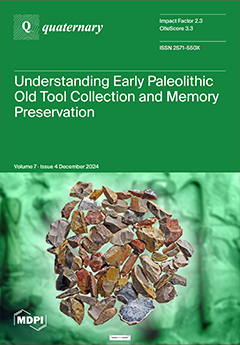
Cover Story: Paleolithic people intentionally collected and recycled old, patinated flint tools made by their predecessors—a practice found across the Old World, including the Early Paleolithic Levant. These recycled tools have distinct life cycles: initial use, discard, patination, collection after an unknown period, and recycling that revealed fresh flint surfaces. This act of collecting and recycling was not driven by scarcity, as fresh flint was available. Instead, it appears to be a deliberate choice, likely for functional and perceptual reasons. One prominent recycling method prioritized preserving the tool's original form, aged surfaces, and old scars while minimizing reshaping to create a new working edge. These findings raise questions about memory preservation in the deep past alongside functionality. View this paper
  • Issues are regarded as officially published after their release is announced to the table of contents alert mailing list .
  • You may sign up for email alerts to receive table of contents of newly released issues.
  • PDF is the official format for papers published in both, html and pdf forms. To view the papers in pdf format, click on the "PDF Full-text" link, and use the free Adobe Reader to open them.

Articles (19)

  • Article
  • Open Access
5 Citations
16,226 Views
19 Pages

Were Neanderthals the First Collectors? First Evidence Recovered in Level 4 of the Prado Vargas Cave, Cornejo, Burgos and Spain

  • Marta Navazo Ruiz,
  • Alfonso Benito-Calvo,
  • María Carmen Lozano-Francisco,
  • Rodrigo Alonso Alcalde,
  • Pedro Alonso García,
  • Héctor de la Fuente Juez,
  • Marta Santamaría Diez and
  • Paula Cristóbal Cubillo

12 November 2024

Collecting is a form of leisure, and even a passion, consisting of collecting, preserving and displaying objects. When we look for its origin in the literature, we are taken back to “the appearance of writing and the fixing of knowledge”,...

  • Review
  • Open Access
2 Citations
4,472 Views
23 Pages

Old and New Approaches in Rock Art: Using Animal Motifs to Identify Palaeohabitats

  • Mirte Korpershoek,
  • Sally C. Reynolds,
  • Marcin Budka and
  • Philip Riris

7 November 2024

Humans are well known to have made paintings and engravings on rock surfaces, both geometric motifs with an unclear representation, and representative motifs that refer to their activities and aspects of their environment. This kind of art is widespr...

  • Article
  • Open Access
2 Citations
2,928 Views
32 Pages

28 October 2024

A 7.4 m long sediment core has been retrieved from the central part of Lake Vrana on the island of Cres to reconstruct the paleoenvironmental conditions. Lake Vrana is the deepest freshwater lake in Croatia, located in the karst region of the eastern...

  • Article
  • Open Access
2 Citations
3,060 Views
19 Pages

22 October 2024

Quaternary stream sediments and beach black sand in north-western Saudi Arabia (namely Wadi Thalbah, Wadi Haramil and Wadi Al Miyah) are characterized by the enrichment of heavy minerals. Concentrates of the heavy minerals in two size fractions (63&n...

  • Article
  • Open Access
2,390 Views
17 Pages

17 October 2024

Two zoogenic deposits from the central part of the Negev Desert (Israel) were investigated by stable isotopes (carbon 13C/12C and nitrogen 15N/14N) and pollen analyses. The merger of these data and results of radiocarbon dating of Atzmaut and Ramon I...

  • Article
  • Open Access
1 Citations
2,401 Views
21 Pages

14 October 2024

We present the reconstruction of palaeoenvironmental conditions in the Gdansk, Bornholm, and Arkona Basins of the Baltic Sea over the last millennium. A multiproxy study (including geochemical, XRF, grain size, AMS, and micropalaeontological analyses...

  • Article
  • Open Access
9 Citations
2,816 Views
22 Pages

11 October 2024

The Villafranchian stage in the mammal fauna evolution in Eurasia (ca. 3.6/3.4 Ma—ca. 1.2 Ma) is associated with the beginning of the formation of the modern appearance of the mammal megafauna of today’s Palaearctic. The cooling and the a...

  • Article
  • Open Access
1 Citations
1,705 Views
11 Pages

Plio-Pleistocene Small Mammal-Based Biochronology of Eastern Anatolia and Transcaucasus

  • Alexey S. Tesakov,
  • Pavel Frolov,
  • Alexandra Simakova,
  • Albina Yakimova,
  • Vadim Titov,
  • Pranav Ranjan,
  • Hasan Çelik and
  • Vladimir Trifonov

29 September 2024

The known Plio-Pleistocene mammalian record, mainly represented by small mammals, and its biotic and geological context in the vast region of Eastern Turkey and Transcaucasus provides a sound base for regional biochronology. Recently obtained faunal...

  • Article
  • Open Access
6 Citations
4,925 Views
33 Pages

The Late Early–Middle Pleistocene Mammal Fauna from the Megalopolis Basin (Peloponnese, Greece) and Its Importance for Biostratigraphy and Paleoenvironment

  • George E. Konidaris,
  • Athanassios Athanassiou,
  • Vangelis Tourloukis,
  • Krystalia Chitoglou,
  • Thijs van Kolfschoten,
  • Domenico Giusti,
  • Nicholas Thompson,
  • Georgia Tsartsidou,
  • Effrosyni Roditi and
  • Eleni Panagopoulou
  • + 2 authors

24 September 2024

Recent investigations in the upper Lower–Middle Pleistocene deposits of the Megalopolis Basin (Greece) led to the discovery of several sites/findspots with abundant faunal material. Here, we provide an updated overview including new results on...

of 2

Get Alerted

Add your email address to receive forthcoming issues of this journal.

XFacebookLinkedIn
Quaternary - ISSN 2571-550X