

Alginate-Based Edible Coating to Preserve the Quality and Extend the Shelf Life of Fresh-Cut Salad

 ,
,  , ,
, ,  , and
, and 
Abstract
1. Introduction
2. Materials and Methods
2.1. Materials, Reagents, and Standards
2.2. Edible Coating Preparation
2.3. Rheological Characterization
2.4. Preparation and Coating for Salad Samples
2.5. Physicochemical Analysis
2.6. Sensory Analysis
2.7. Microbiological Assays
2.8. Data Analysis
3. Results
3.1. Choice and Characterization of Coating Formulation
3.2. Physical-Chemical Parameters of Coated (EC) and Uncoated (UC) Salad
3.3. Visual Appearance and Perception of Coated (EC) and Uncoated (UC) Salad
3.4. Microbial Analysis of Coated (EC) and Uncoated (UC) Salad
4. Discussion
5. Conclusions
Supplementary Materials
Author Contributions
Funding
Data Availability Statement
Conflicts of Interest
References
- Dilkes-Hoffman, L.S.; Lane, J.L.; Grant, T.; Pratt, S.; Lant, P.A.; Laycock, B. Environmental impact of biodegradable food packaging when considering food waste. J. Clean. Prod. 2018, 180, 325–334. [Google Scholar] [CrossRef]
- Versino, F.; Ortega, F.; Monroy, Y.; Rivero, S.; López, O.V.; García, M.A. Sustainable and bio-based food packaging: A review on past and current design innovations. Foods 2023, 12, 1057. [Google Scholar] [CrossRef]
- European Commission. Regulation (EU) 2025/40 of the European Parliament and of the Council of 19 December 2024 on Packaging and Packaging Waste, Amending Regulation (EU) 2019/1020 and Directive (EU) 2019/904, and Repealing Directive 94/62/EC (Text with EEA Relevance). 2025. Available online: http://data.europa.eu/eli/reg/2025/40/oj (accessed on 15 September 2025).
- Albu, E.; Prisacaru, A.E.; Ghinea, C.; Ursachi, F.; Apostol, L.C. Ready-to-use vegetable salads: Physicochemical and microbiological evaluation. Appl. Sci. 2024, 14, 3068. [Google Scholar] [CrossRef]
- Simko, I.; Hayes, R.J. Accuracy, reliability, and timing of visual evaluations of decay in fresh-cut lettuce. PLoS ONE 2018, 13, e0194635. [Google Scholar] [CrossRef]
- Alemu, T.T.; Oanh, V.T.K. Implications of Developmental Levels and Packaging Materials on the Quality of Iceberg Lettuce for Marketing System: A Review. Int. J. Food Sci. 2025, 2025, 5548305. [Google Scholar] [CrossRef]
- Paillart, M.; van der Vossen, J.; Levin, E.; Lommen, E.; Otma, E.; Snels, J.; Woltering, E. Bacterial population dynamics and sensorial quality loss in modified atmosphere packed fresh-cut iceberg lettuce. Postharvest Biol. Technol. 2017, 124, 91–99. [Google Scholar] [CrossRef]
- Kotiyal, A.; Singh, P. Applications of edible coatings to extend shelf-life of fresh fruits. In Food Process Engineering and Technology: Safety, Packaging, Nanotechnologies and Human Health; Springer: Berlin, Germany, 2024; pp. 99–118. [Google Scholar]
- Sharma, S.; Nakano, K.; Kumar, S.; Katiyar, V. Edible packaging to prolong postharvest shelf-life of fruits and vegetables: A review. Food Chem. Adv. 2024, 4, 100711. [Google Scholar] [CrossRef]
- Cofelice, M.; Cuomo, F.; Lopez, F. Rheological properties of alginate–essential oil nanodispersions. Colloids Interfaces 2018, 2, 48. [Google Scholar] [CrossRef]
- Song, H.; Jang, A.-R.; Lee, S.; Lee, S.-Y. Application of sodium alginate-based edible coating with citric acid to improve the safety and quality of fresh-cut melon (Cucumis melo L.) during cold storage. Food Sci. Biotechnol. 2024, 33, 1741–1750. [Google Scholar] [CrossRef] [PubMed]
- Tay, S.; Perera, C. Effect of 1-methylcyclopropene treatment and edible coatings on the quality of minimally processed lettuce. J. Food Sci. 2004, 69, 131–135. [Google Scholar] [CrossRef]
- Li, L.; Yi, P.; Li, C.; Xin, M.; Sun, J.; He, X.; Sheng, J.; Zhou, Z.; Zheng, F.; Li, J. Influence of polysaccharide-based edible coatings on enzymatic browning and oxidative senescence of fresh-cut lettuce. Food Sci. Nutr. 2021, 9, 888–899. [Google Scholar] [CrossRef] [PubMed]
- Das, S.; Vishakha, K.; Banerjee, S.; Mondal, S.; Ganguli, A. Antibacterial and antibiofilm effectiveness of bioactive packaging materials from edible sodium alginate and vanillin: Assessment on lettuce. J. Food Process. Preserv. 2021, 45, e15668. [Google Scholar] [CrossRef]
- Sessa, M.; Ferrari, G.; Donsi, F. Novel edible coating containing essential oil nanoemulsions to prolong the shelf life of vegetable products. Chem. Eng. Trans. 2015, 43, 55–60. [Google Scholar] [CrossRef]
- Cofelice, M.; Cinelli, G.; Lopez, F.; Di Renzo, T.; Coppola, R.; Reale, A. Alginate-assisted lemongrass (Cymbopogon nardus) essential oil dispersions for antifungal activity. Foods 2021, 10, 1528. [Google Scholar] [CrossRef]
- Bhargava, K.; Conti, D.S.; da Rocha, S.R.; Zhang, Y. Application of an oregano oil nanoemulsion to the control of foodborne bacteria on fresh lettuce. Food Microbiol. 2015, 47, 69–73. [Google Scholar] [CrossRef]
- Xylia, P.; Chrysargyris, A.; Tzortzakis, N. The combined and single effect of marjoram essential oil, ascorbic acid, and chitosan on fresh-cut lettuce preservation. Foods 2021, 10, 575. [Google Scholar] [CrossRef]
- Cofelice, M.; Iftikhar, A.; Lopez, F.; De Leonardis, A. Effect of edible coatings on quality parameters and phenol composition of ready-to-eat Salanova lettuce. Eur. Food Res. Technol. 2024, 250, 691–700. [Google Scholar] [CrossRef]
- Cofelice, M.; Lopez, F.; Cuomo, F. Quality control of fresh-cut apples after coating application. Foods 2019, 8, 189. [Google Scholar] [CrossRef]
- Iacovino, S.; Cofelice, M.; Sorrentino, E.; Cuomo, F.; Messia, M.C.; Lopez, F. Alginate-Based Emulsions and Hydrogels for Extending the Shelf Life of Banana Fruit. Gels 2024, 10, 245. [Google Scholar] [CrossRef]
- Fasciglione, G.; Goñi, M.G.; Yommi, A.K.; Perez-Bravo, J.J.; Ortueta, R.; Scampini, A.; Buffa, L.; Andreu, A.; Creus, C.M. Revaluation of waste from fishing industry through generation of chitosan coatings to improve quality and extend shelf-life of minimally processed lettuce. Postharvest Biol. Technol. 2020, 170, 111310. [Google Scholar] [CrossRef]
- Kang, S.; Kim, W.; Lee, J.W.; Cha, S. GC-MS and GC-FID analysis of citronella oil products for indicator ingredient identification. Mass Spectrom. Lett. 2023, 14, 160–165. [Google Scholar]
- ISO 4120:2004; Sensory Analysis-Methodology-Triangle Test. ISO: Geneva, Switzerland, 2021.
- Arienzo, A.; Murgia, L.; Fraudentali, I.; Gallo, V.; Angelini, R.; Antonini, G. Microbiological Quality of Ready-to-Eat Leafy Green Salads during Shelf-Life and Home-Refrigeration. Foods 2020, 9, 1421. [Google Scholar] [CrossRef]
- Viacava, G.E.; Ayala-Zavala, J.F.; González-Aguilar, G.A.; Ansorena, M.R. Effect of free and microencapsulated thyme essential oil on quality attributes of minimally processed lettuce. Postharvest Biol. Technol. 2018, 145, 125–133. [Google Scholar] [CrossRef]
- Kang, S.C.; Kim, M.J.; Choi, U.K. Shelf-life extension of fresh-cut iceberg lettuce (Lactuca sativa L.) by different antimicrobial films. J. Microbiol. Biotechnol. 2007, 17, 1284–1290. [Google Scholar] [PubMed]
- Vargas-Arcila, M.; Cartagena-Valenzuela, J.R.; Franco, G.; Correa-Londoño, G.A.; Quintero-Vásquez, L.M.; Gaviria-Montoya, C.A. Changes in the physico-chemical properties of four lettuce (Lactuca sativa L.) varieties during storage. Cienc. Tecnol. Agropecu. 2017, 18, 257–273. [Google Scholar]
- Jacxsens, L.; Devlieghere, F.; Debevere, J. Temperature dependence of shelf-life as affected by microbial proliferation and sensory quality of equilibrium modified atmosphere packaged fresh produce. Postharvest Biol. Technol. 2002, 26, 59–73. [Google Scholar] [CrossRef]
- Purgatorio, C.; Buccioni, F.; Maggio, F.; Rossi, C.; Torresi, M.; Pomilio, F.; Paparella, A.; Serio, A. Thymbra capitata L. hydrolate as a washing solution for controlling Listeria monocytogenes and spoilage microorganisms on rocket salad. Food Control. 2024, 159, 110285. [Google Scholar] [CrossRef]
- Gutierrez, J.; Rodriguez, G.; Barry-Ryan, C.; Bourke, P. Efficacy of plant essential oils against foodborne pathogens and spoilage bacteria associated with ready-to-eat vegetables: Antimicrobial and sensory screening. J. Food Prot. 2008, 71, 1846–1854. [Google Scholar] [CrossRef] [PubMed]
- Nemati, V. Advances in Lettuce postharvest processing: Implications for microbiological safety and storage quality. J. Agric. Food Res. 2025, 21, 101824. [Google Scholar] [CrossRef]
- Móricz, Á.M.; Baglyas, M.; Cselőtey, A.; Böszörményi, A.; Ott, P.G. Antibacterial compounds of Cymbopogon nardus essential oil exposed by high-performance thin-layer chromatography–direct bioautography. J. Planar Chromatogr. 2025, 38, 401–406. [Google Scholar] [CrossRef]
- Weng, S.; Marcet, I.; Rendueles, M.; Díaz, M. Edible films from the laboratory to industry: A review of the different production methods. Food Bioprocess Technol. 2025, 18, 3245–3271. [Google Scholar] [CrossRef]
- Jacxsens, L.; Devlieghere, F.; Ragaert, P.; Vanneste, E.; Debevere, J. Relation between microbiological quality, metabolite production and sensory quality of equilibrium modified atmosphere packaged fresh-cut produce. Int. J. Food Microbiol. 2003, 83, 263–280. [Google Scholar] [CrossRef] [PubMed]
- Gómez-López, V.M.; Ragaert, P.; Jeyachchandran, V.; Debevere, J.; Devlieghere, F. Shelf-life of minimally processed lettuce and cabbage treated with gaseous chlorine dioxide and cysteine. Int. J. Food Microbiol. 2008, 121, 74–83. [Google Scholar] [CrossRef] [PubMed]




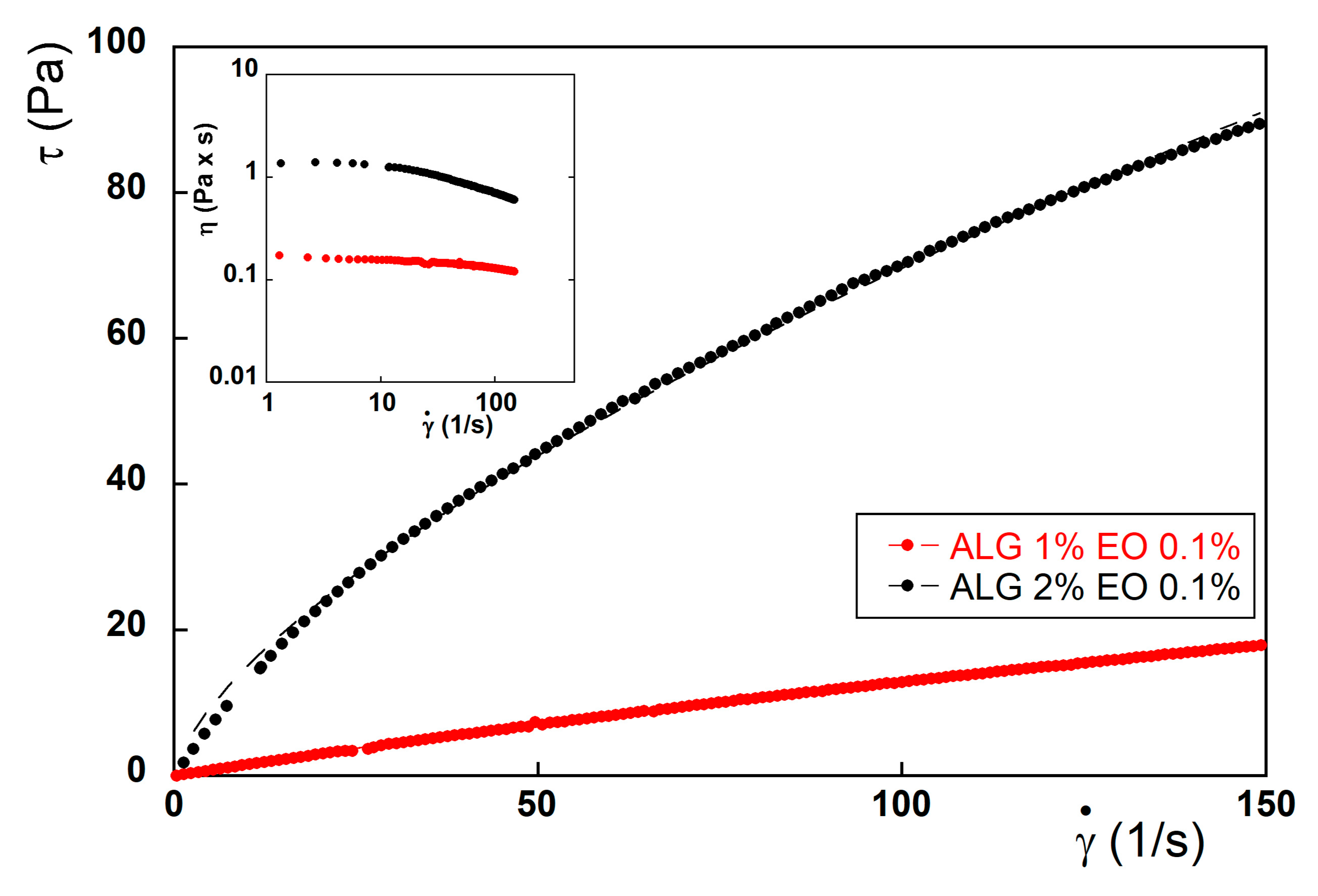
| k | n | R2 | |
|---|---|---|---|
| Alginate 1% EO 0.1% | 0.237 ± 0.003 | 0.866 ± 0.003 | 0.9994 |
| Alginate 2% EO 0.1% | 3.266 ± 0.053 | 0.665 ± 0.004 | 0.9986 |
| Days | Total Number of Responses | Number of Correct Responses | Significance |
|---|---|---|---|
| 0 | 36 | 24 | p < 0.05 |
| 2 | 36 | 22 | p < 0.05 |
| 7 | 36 | 16 | p > 0.05 |
| 10 | 36 | 12 | p > 0.05 |
| Descriptors | ||||||
|---|---|---|---|---|---|---|
| Time (Days) | Colour | Odour | Consistency | |||
| UC | EC | UC | EC | UC | EC | |
| 0 | 4.50 a | 4.60 a | 4.65 a | 3.95 b | 4.45 a | 4.40 a |
| 2 | 4.40 a | 4.35 a | 4.25 a | 4.15 a | 4.40 a | 3.90 b |
| 7 | 3.85 a | 4.00 a | 4.00 a | 3.60 b | 4.00 a | 3.85 a |
| 10 | 3.95 a | 4.00 a | 3.95 a | 4.05 a | 3.90 a | 3.75 a |
Disclaimer/Publisher’s Note: The statements, opinions and data contained in all publications are solely those of the individual author(s) and contributor(s) and not of MDPI and/or the editor(s). MDPI and/or the editor(s) disclaim responsibility for any injury to people or property resulting from any ideas, methods, instructions or products referred to in the content. |
© 2025 by the authors. Licensee MDPI, Basel, Switzerland. This article is an open access article distributed under the terms and conditions of the Creative Commons Attribution (CC BY) license (https://creativecommons.org/licenses/by/4.0/).
Share and Cite
Cofelice, M.; De Leonardis, A.; Letizia, F.; Iorizzo, M.; Cuomo, F.; Lopez, F. Alginate-Based Edible Coating to Preserve the Quality and Extend the Shelf Life of Fresh-Cut Salad. Colloids Interfaces 2025, 9, 87. https://doi.org/10.3390/colloids9060087
Cofelice M, De Leonardis A, Letizia F, Iorizzo M, Cuomo F, Lopez F. Alginate-Based Edible Coating to Preserve the Quality and Extend the Shelf Life of Fresh-Cut Salad. Colloids and Interfaces. 2025; 9(6):87. https://doi.org/10.3390/colloids9060087
Chicago/Turabian StyleCofelice, Martina, Antonella De Leonardis, Francesco Letizia, Massimo Iorizzo, Francesca Cuomo, and Francesco Lopez. 2025. "Alginate-Based Edible Coating to Preserve the Quality and Extend the Shelf Life of Fresh-Cut Salad" Colloids and Interfaces 9, no. 6: 87. https://doi.org/10.3390/colloids9060087
APA StyleCofelice, M., De Leonardis, A., Letizia, F., Iorizzo, M., Cuomo, F., & Lopez, F. (2025). Alginate-Based Edible Coating to Preserve the Quality and Extend the Shelf Life of Fresh-Cut Salad. Colloids and Interfaces, 9(6), 87. https://doi.org/10.3390/colloids9060087