Article

A Novel Airport-Dependent Landing Procedure Based on Real-World Landing Trajectories


by
Ensieh Alipour
* and
Seyed Mohammad-Bagher Malaek
Aerospace Engineering Department, Sharif University of Technology, Tehran 1458889694, Iran
*
Author to whom correspondence should be addressed.
Mach. Learn. Knowl. Extr. 2026, 8(3), 71; https://doi.org/10.3390/make8030071
Submission received: 31 January 2026 / Revised: 25 February 2026 / Accepted: 3 March 2026 / Published: 12 March 2026
(This article belongs to the Section Data)

Abstract

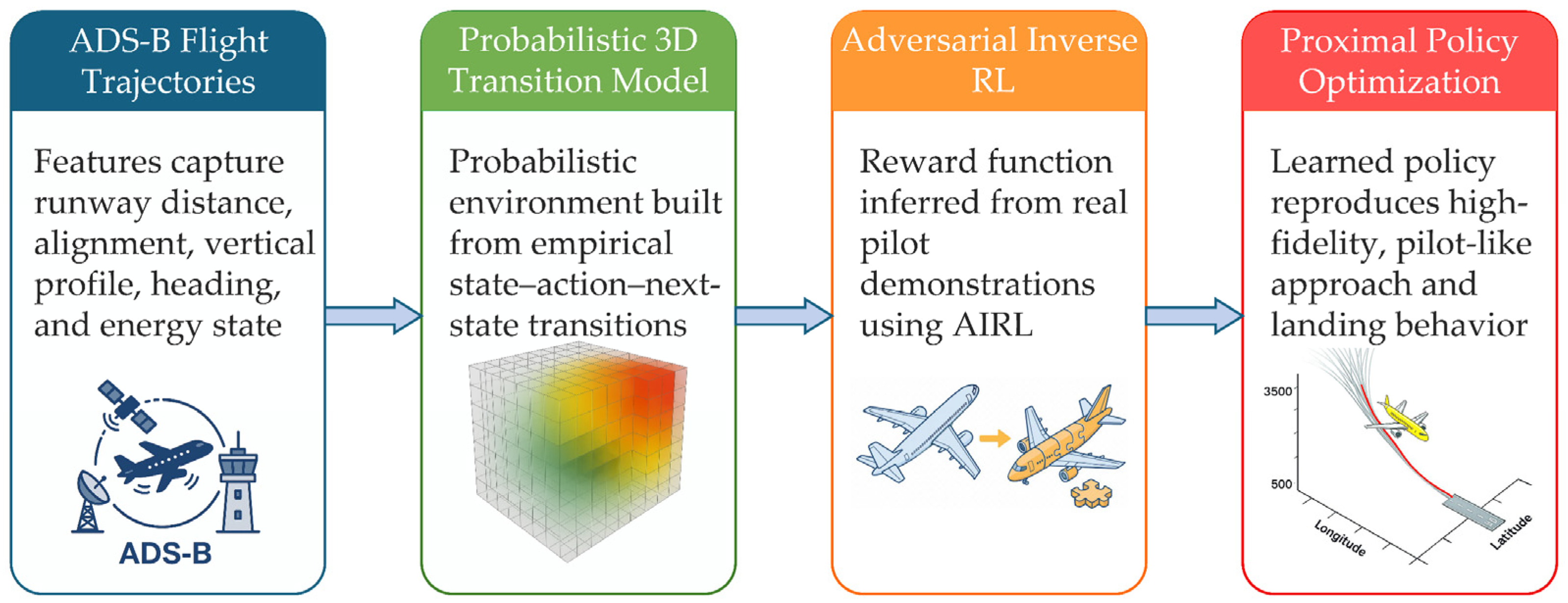
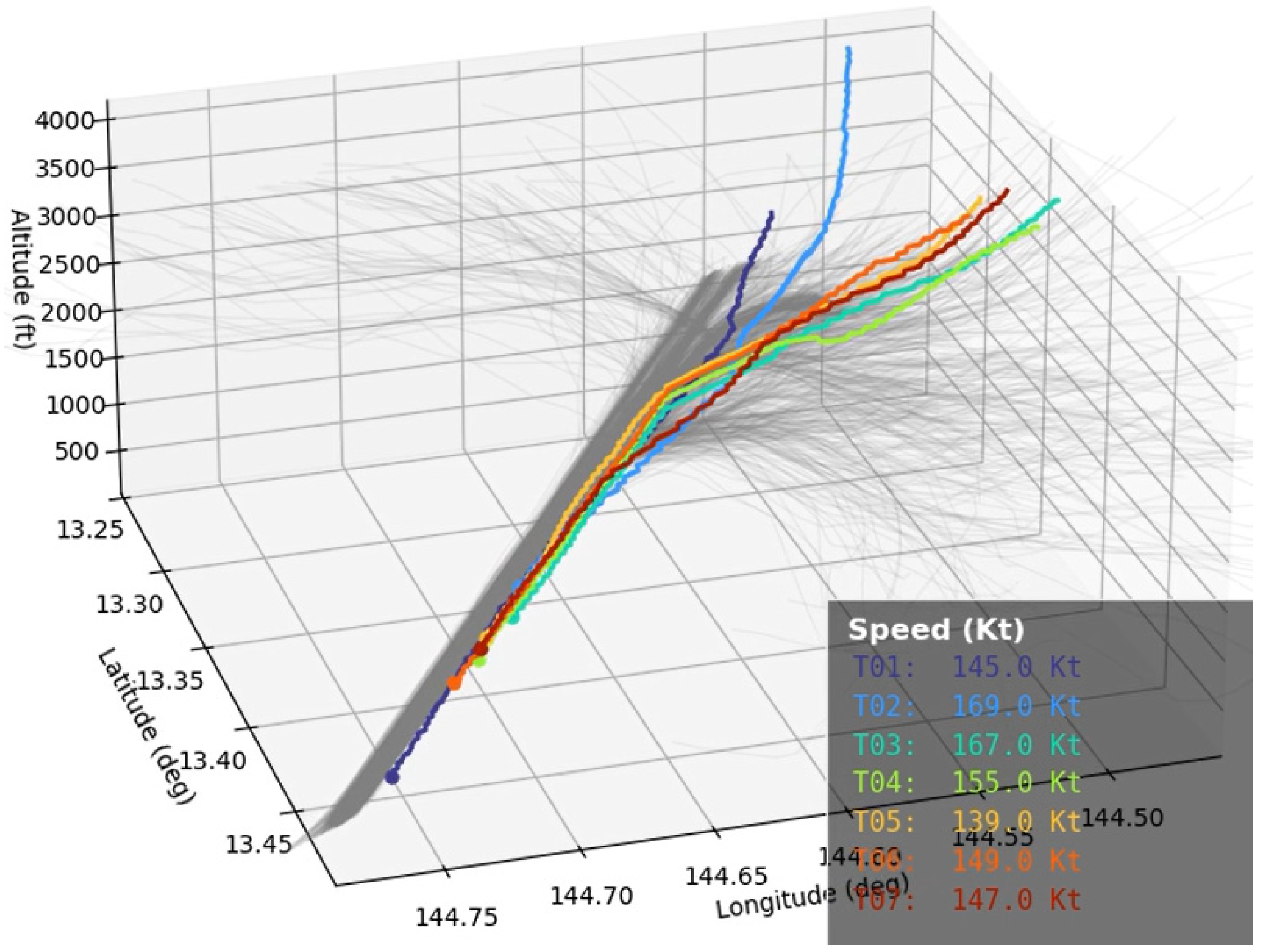
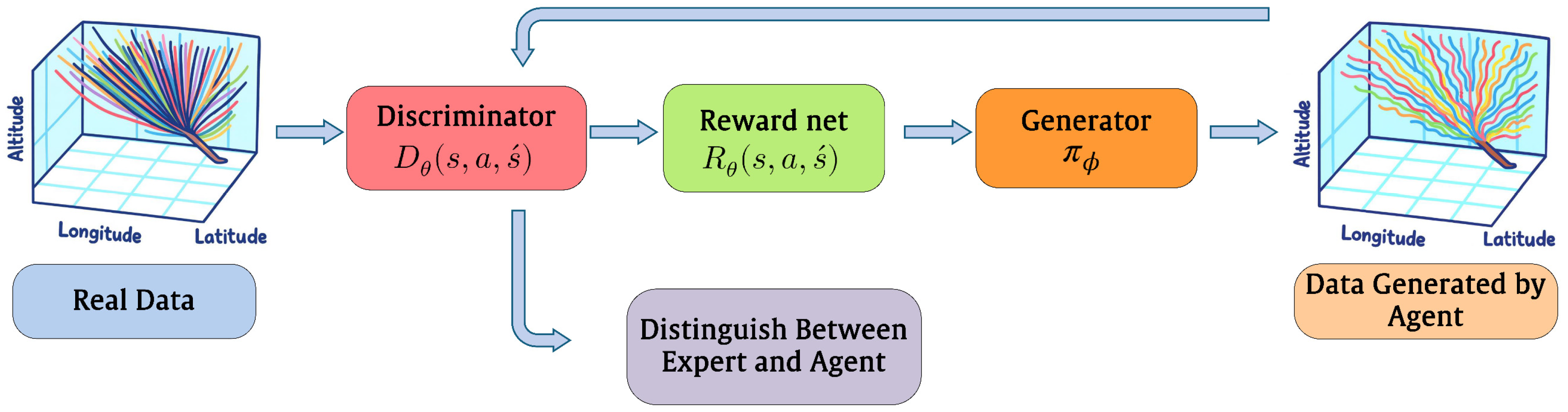
This study presents a novel data-driven framework for developing airport-specific landing policies and procedures from historical successful-landing data. The proposed process, termed the Airport-Dependent Landing Procedure (ADLP), is motivated by the fact that airports rely on uniquely tailored approach charts reflecting local operational constraints and environmental conditions. While existing approach charts and landing procedures are primarily designed based on expert knowledge, safety margins, and regulatory conventions, the authors argue that data science and data mining techniques offer a complementary and empirically grounded methodology for extracting operationally meaningful structures directly from historical landing data. In this work, we construct a probabilistic three-dimensional environment from real-world aircraft approach trajectories, capturing spatiotemporal relationships under varying atmospheric conditions during approach. The proposed methodology integrates Adversarial Inverse Reinforcement Learning (AIRL) with Recurrent Proximal Policy Optimization (R-PPO) to establish a foundation for automated landing without pilot intervention. AIRL infers reward functions that are consistent with behaviors exhibited in prior successful landings. Subsequently, R-PPO is employed to learn control policies that satisfy safety constraints related to airspeed, sink rate, and runway alignment. Application of the proposed framework to real approach trajectories at Guam International Airport demonstrates the efficiency and effectiveness of the methodology.
Keywords: adversarial inverse reinforcement learning (AIRL); proximal policy optimization (PPO); aircraft; imitation learning; landing procedure; data-driven framework; aviation adversarial inverse reinforcement learning (AIRL); proximal policy optimization (PPO); aircraft; imitation learning; landing procedure; data-driven framework; aviation