
Artificial Intelligence in Biomedical 3D Printing: Mapping the Evidence



Abstract
1. Introduction
2. Materials and Methods
2.1. Data Collection and Search Strategy
2.2. Bibliometric Analysis Tool
- Citation counts, represent global influence and recognition.
- Betweenness centrality indicates structural importance as a bridge between distinct thematic areas.
- Citation burstness, reflecting sharp increases in citation frequency over short intervals and marking rapidly emerging research frontiers.
- Sigma value, integrating both burstness and centrality to highlight nodes with transformative potential.
3. Results and Discussions
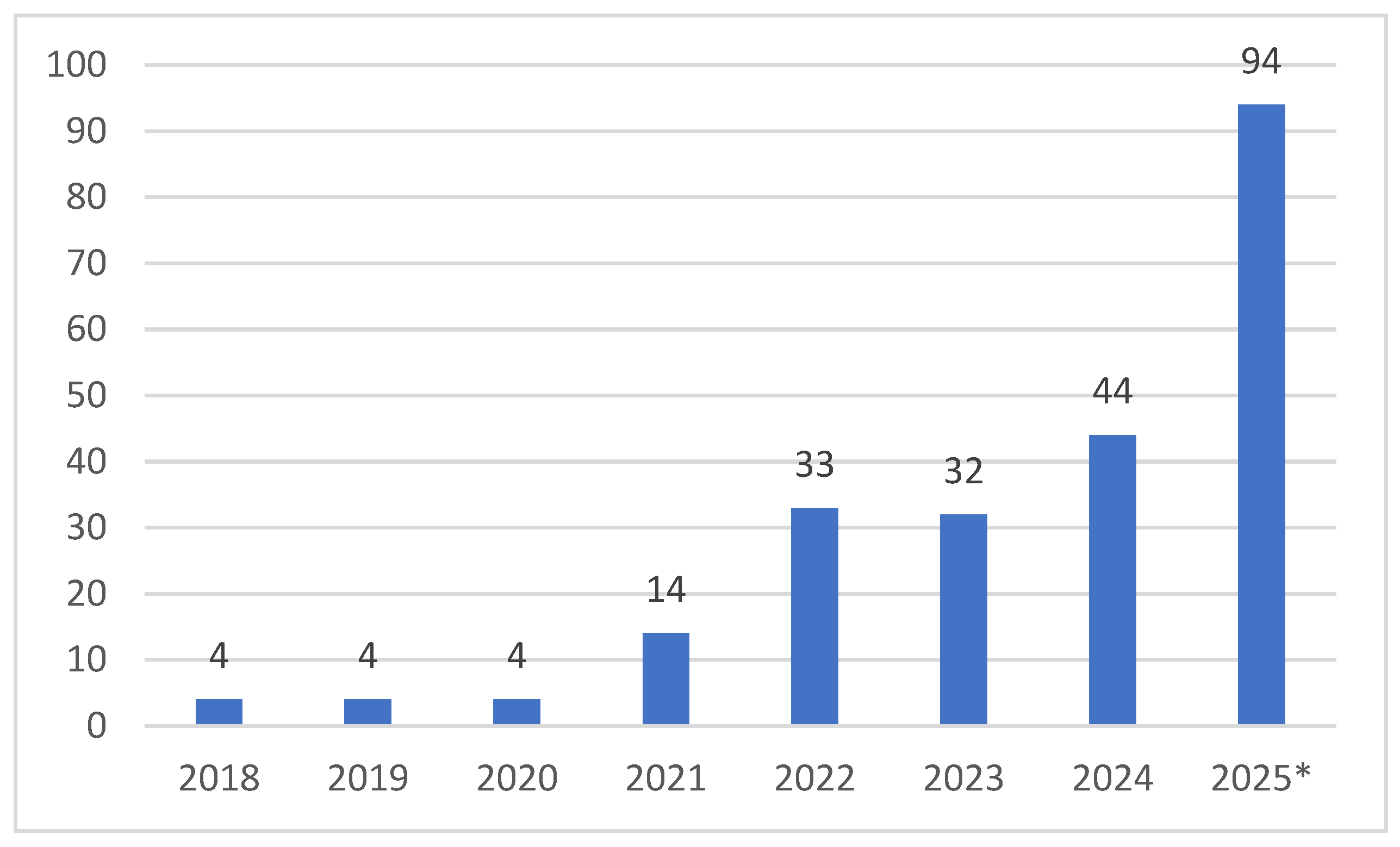
3.1. Publication Trend and Growth Dynamics
- Emergence (2018–2020)–sporadic and exploratory publications, mostly conceptual;
- Expansion (2021–2023)–steady growth and diversification of themes and techniques;
- Consolidation (2024–2025)–sustained output and increased analytical and review-type contributions.
3.2. Global Research Landscape and Journal Sources
3.2.1. Geographic Distribution
3.2.2. Source Journals
3.3. Co-Citation Analysis
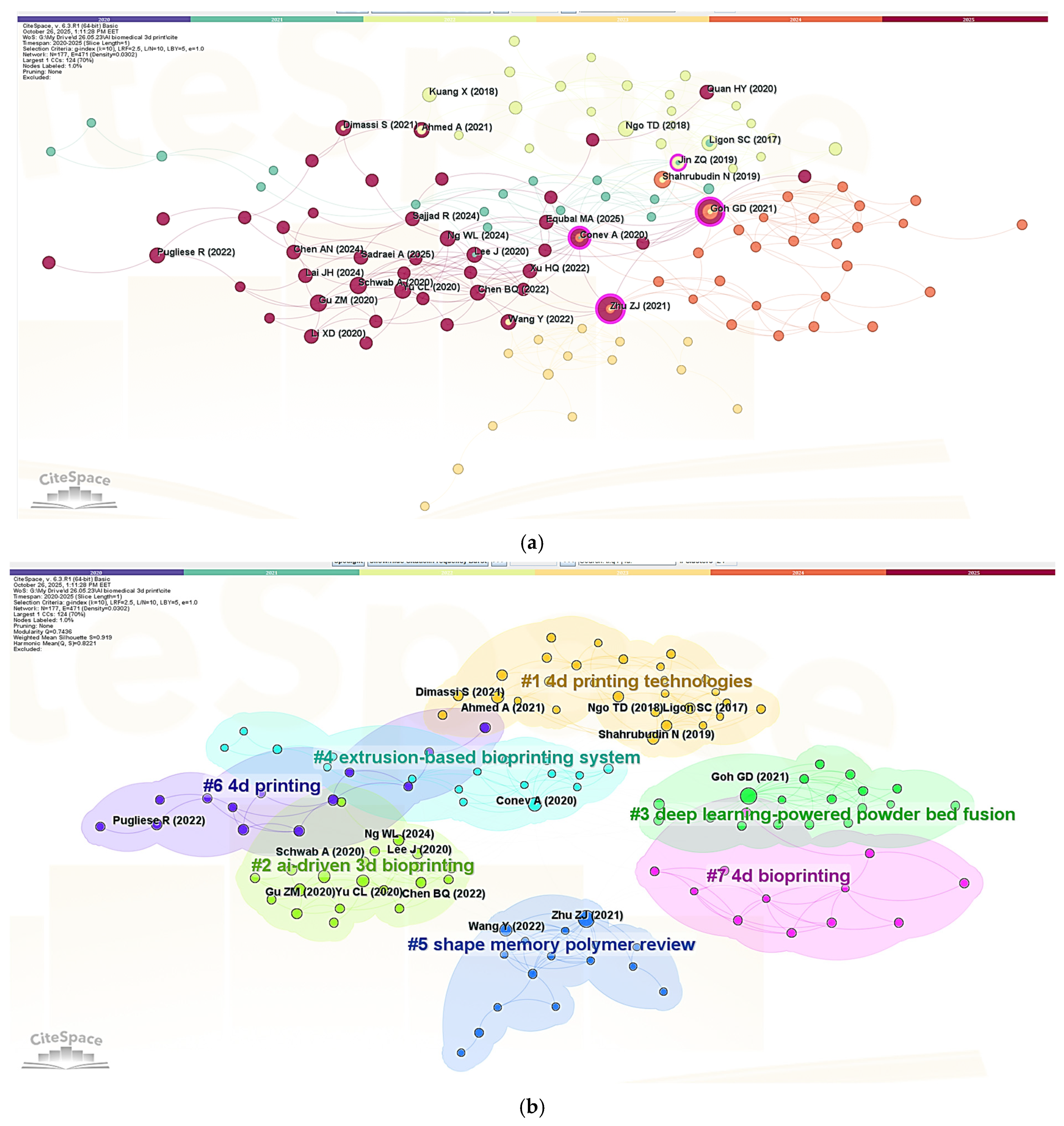
3.3.1. Co-Cited Reference Analysis
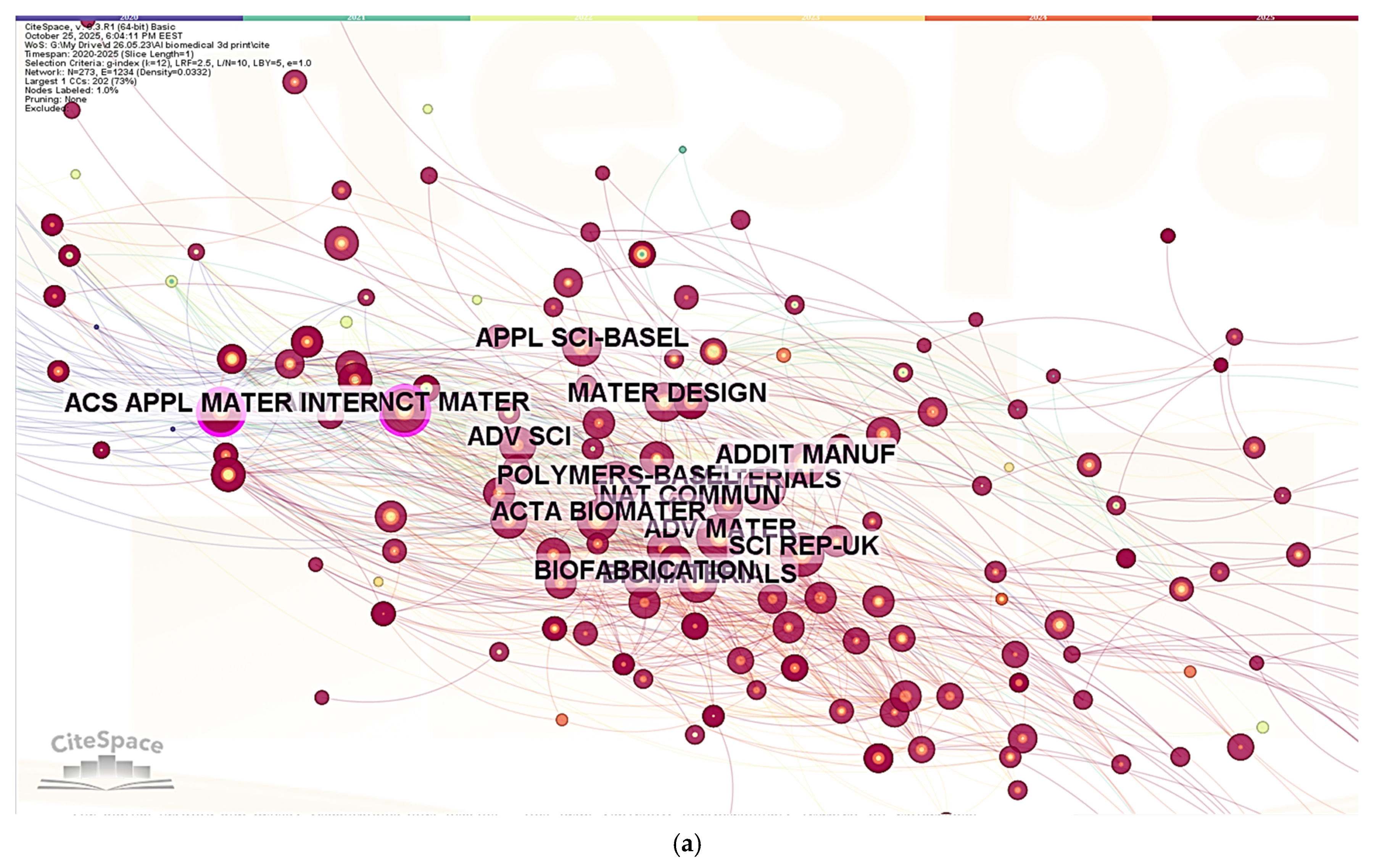
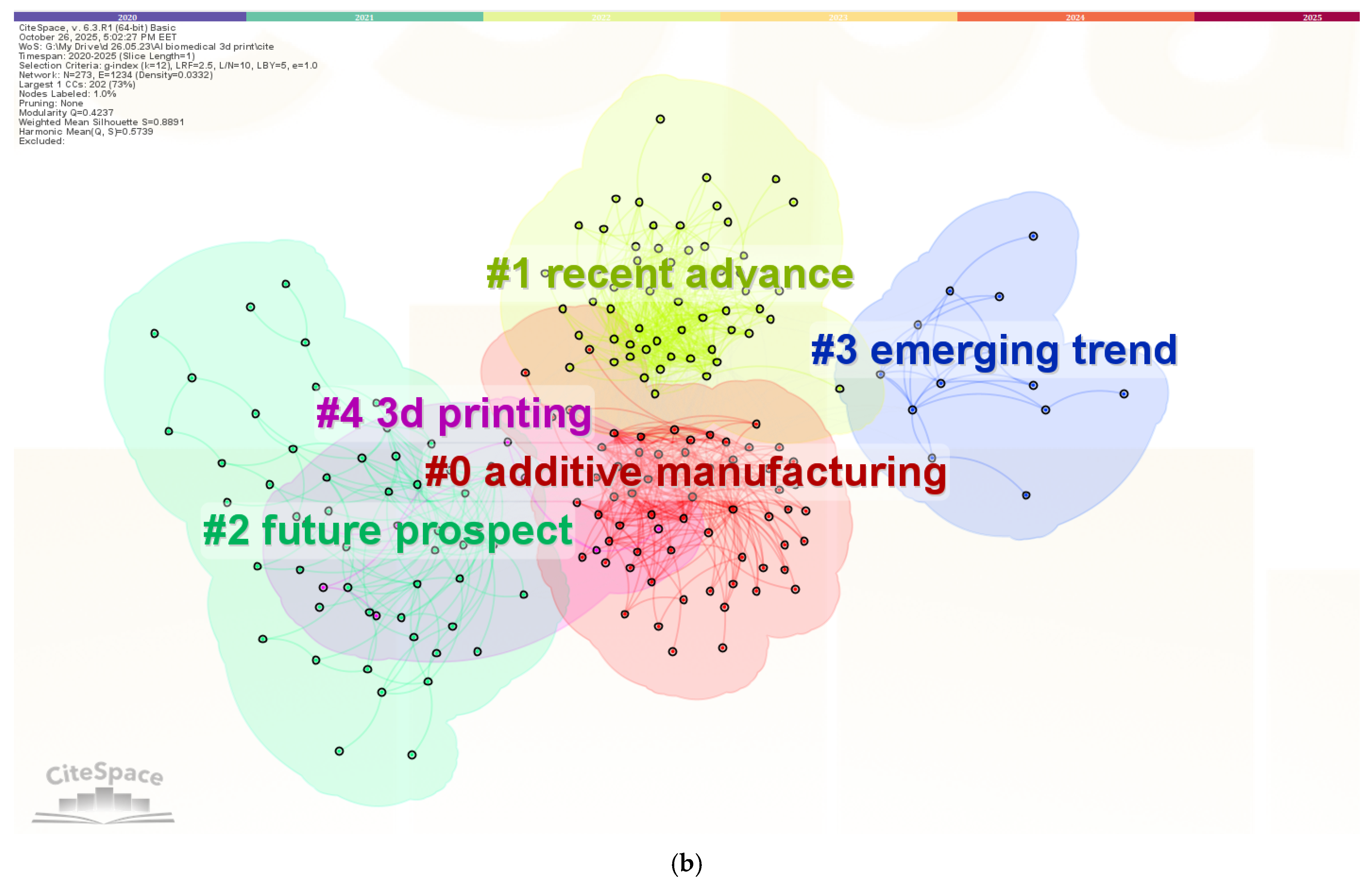
3.3.2. Journals Analysis
3.3.3. Country Co-Occurrence Analysis
3.3.4. Institutional Co-Occurrence Analysis
3.3.5. Analysis of Keywords
3.4. Qualitative Synthesis of Core Scientific Contributions
3.5. Study Limitations
4. Conclusions
Author Contributions
Funding
Data Availability Statement
Aknowledgements
Conflicts of Interest
References
- Ntalaperas, D.; Christophoridis, C.; Angelidis, I.; Iossifidis, D.; Touloupi, M.-F.; Vergeti, D.; Politi, E. Intelligent Tools to Monitor, Control and Predict Wastewater Reclamation and Reuse. Sensors 2022, 22, 3068. [Google Scholar] [CrossRef]
- Huang, G.; Guo, Y.; Chen, Y.; Nie, Z. Application of Machine Learning in Material Synthesis and Property Prediction. Materials 2023, 16, 5977. [Google Scholar] [CrossRef]
- Elgawish, M.S.; Almatary, A.M.; Zaitone, S.A.; Salem, M.S.H. Leveraging Artificial Intelligence and Machine Learning in Kinase Inhibitor Development: Advances, Challenges, and Future Prospects. RSC Med. Chem. 2025, 16, 4698–4720. [Google Scholar] [CrossRef]
- Izhar, A.; Idris, N.; Japar, N. Medical Radiology Report Generation: A Systematic Review of Current Deep Learning Methods, Trends, and Future Directions. Artif. Intell. Med. 2025, 168, 103220. [Google Scholar] [CrossRef] [PubMed]
- Cheng, Z.; Wu, Y.; Li, Y.; Cai, L.; Ihnaini, B. A Comprehensive Review of Explainable Artificial Intelligence (XAI) in Computer Vision. Sensors 2025, 25, 4166. [Google Scholar] [CrossRef] [PubMed]
- Ma, L.; Yu, S.; Xu, X.; Moses Amadi, S.; Zhang, J.; Wang, Z. Application of Artificial Intelligence in 3D Printing Physical Organ Models. Mater. Today Bio 2023, 23, 100792. [Google Scholar] [CrossRef]
- Abu-El-Ruz, R.; Hasan, A.; Hijazi, D.; Masoud, O.; Abdallah, A.M.; Zughaier, S.M.; Al-Asmakh, M. Artificial Intelligence in Biomedical Sciences: A Scoping Review. Br. J. Biomed. Sci. 2025, 82, 14362. [Google Scholar] [CrossRef]
- Mamo, H.B.; Adamiak, M.; Kunwar, A. 3D Printed Biomedical Devices and Their Applications: A Review on State-of-the-Art Technologies, Existing Challenges, and Future Perspectives. J. Mech. Behav. Biomed. Mater. 2023, 143, 105930. [Google Scholar] [CrossRef]
- Kapoor, D.U.; Pareek, A.; Uniyal, P.; Prajapati, B.G.; Thanawuth, K.; Sriamornsak, P. Innovative Applications of 3D Printing in Personalized Medicine and Complex Drug Delivery Systems. iScience 2025, 28, 113505. [Google Scholar] [CrossRef]
- Murphy, S.V.; Atala, A. 3D Bioprinting of Tissues and Organs. Nat. Biotechnol. 2014, 32, 773–785. [Google Scholar] [CrossRef] [PubMed]
- Dey, M.; Ozbolat, I.T. 3D Bioprinting of Cells, Tissues and Organs. Sci. Rep. 2020, 10, 14023. [Google Scholar] [CrossRef]
- Vijayavenkataraman, S.; Yan, W.-C.; Lu, W.F.; Wang, C.-H.; Fuh, J.Y.H. 3D Bioprinting of Tissues and Organs for Regenerative Medicine. Adv. Drug Deliv. Rev. 2018, 132, 296–332. [Google Scholar] [CrossRef]
- Zhan, S.; Guo, A.X.Y.; Cao, S.C.; Liu, N. 3D Printing Soft Matters and Applications: A Review. Int. J. Mol. Sci. 2022, 23, 3790. [Google Scholar] [CrossRef] [PubMed]
- Sayegh, M.-A.; Daraghma, H.; Mekid, S.; Bashmal, S. Review of Recent Bio-Inspired Design and Manufacturing of Whisker Tactile Sensors. Sensors 2022, 22, 2705. [Google Scholar] [CrossRef]
- Bao, C.; Kim, T.-H.; Hassanpoor Kalhori, A.; Kim, W.S. A 3D-Printed Neuromorphic Humanoid Hand for Grasping Unknown Objects. iScience 2022, 25, 104119. [Google Scholar] [CrossRef] [PubMed]
- Pugliese, R.; Regondi, S. Artificial Intelligence-Empowered 3D and 4D Printing Technologies toward Smarter Biomedical Materials and Approaches. Polymers 2022, 14, 2794. [Google Scholar] [CrossRef]
- Jain, P.; Kathuria, H.; Dubey, N. Advances in 3D Bioprinting of Tissues/Organs for Regenerative Medicine and in-Vitro Models. Biomaterials 2022, 287, 121639. [Google Scholar] [CrossRef] [PubMed]
- Bajaj, P.; Schweller, R.M.; Khademhosseini, A.; West, J.L.; Bashir, R. 3D Biofabrication Strategies for Tissue Engineering and Regenerative Medicine. Annu. Rev. Biomed. Eng. 2014, 16, 247–276. [Google Scholar] [CrossRef]
- Braun, N.J.; Galaska, R.M.; Jewett, M.E.; Krupa, K.A. Implementation of a Dynamic Co-Culture Model Abated Silver Nanoparticle Interactions and Nanotoxicological Outcomes In Vitro. Nanomaterials 2021, 11, 1807. [Google Scholar] [CrossRef]
- Chen, H.; Zhang, B.; Huang, J. Recent Advances and Applications of Artificial Intelligence in 3D Bioprinting. Biophys. Rev. 2024, 5, 031301. [Google Scholar] [CrossRef]
- He, R.; Cao, J.; Tan, T. Generative Artificial Intelligence: A Historical Perspective. Natl. Sci. Rev. 2025, 12, nwaf050. [Google Scholar] [CrossRef]
- Rojek, I.; Mikołajewski, D.; Kempiński, M.; Galas, K.; Piszcz, A. Emerging Applications of Machine Learning in 3D Printing. Appl. Sci. 2025, 15, 1781. [Google Scholar] [CrossRef]
- Bai, X.; Zhang, X. Artificial Intelligence-Powered Materials Science. Nano-Micro Lett. 2025, 17, 135. [Google Scholar] [CrossRef]
- Ikenson, B. The Paradigm-Shifting Potential of AI in Materials Science. Scilight 2025, 2025, 241103. [Google Scholar] [CrossRef]
- Mohammadnabi, S.; Moslemy, N.; Taghvaei, H.; Zia, A.W.; Askarinejad, S.; Shalchy, F. Role of Artificial Intelligence in Data-Centric Additive Manufacturing Processes for Biomedical Applications. J. Mech. Behav. Biomed. Mater. 2025, 166, 106949. [Google Scholar] [CrossRef]
- Shahidi Hamedani, S.; Aslam, S.; Shahidi Hamedani, S. AI in Business Operations: Driving Urban Growth and Societal Sustainability. Front. Artif. Intell. 2025, 8, 1568210. [Google Scholar] [CrossRef]
- Nosrati, H.; Nosrati, M. Artificial Intelligence in Regenerative Medicine: Applications and Implications. Biomimetics 2023, 8, 442. [Google Scholar] [CrossRef]
- Shahrubudin, N.; Lee, T.C.; Ramlan, R. An Overview on 3D Printing Technology: Technological, Materials, and Applications. Procedia Manuf. 2019, 35, 1286–1296. [Google Scholar] [CrossRef]
- Ahmed, A.; Arya, S.; Gupta, V.; Furukawa, H.; Khosla, A. 4D Printing: Fundamentals, Materials, Applications and Challenges. Polymer 2021, 228, 123926. [Google Scholar] [CrossRef]
- Ngo, T.D.; Kashani, A.; Imbalzano, G.; Nguyen, K.T.Q.; Hui, D. Additive Manufacturing (3D Printing): A Review of Materials, Methods, Applications and Challenges. Compos. Part B Eng. 2018, 143, 172–196. [Google Scholar] [CrossRef]
- Zhang, Z.; Zhou, X.; Fang, Y.; Xiong, Z.; Zhang, T. AI-Driven 3D Bioprinting for Regenerative Medicine: From Bench to Bedside. Bioact. Mater. 2025, 45, 201–230. [Google Scholar] [CrossRef]
- Yu, C.; Jiang, J. A Perspective on Using Machine Learning in 3D Bioprinting. Int. J. Bioprinting 2020, 6, 253. [Google Scholar] [CrossRef]
- Gu, Z.; Fu, J.; Lin, H.; He, Y. Development of 3D Bioprinting: From Printing Methods to Biomedical Applications. Asian J. Pharm. Sci. 2020, 15, 529–557. [Google Scholar] [CrossRef]
- Schwab, A.; Levato, R.; D’Este, M.; Piluso, S.; Eglin, D.; Malda, J. Printability and Shape Fidelity of Bioinks in 3D Bioprinting. Chem. Rev. 2020, 120, 11028–11055. [Google Scholar] [CrossRef]
- Lu, A.; Williams, R.O.; Maniruzzaman, M. 3D Printing of Biologics—What Has Been Accomplished to Date? Drug Discov. Today 2024, 29, 103823. [Google Scholar] [CrossRef]
- Goh, G.; Sing, S.; Yeong, W. A Review on Machine Learning in 3D Printing: Applications, Potential, and Challenges. Artif. Intell. Rev. 2021, 54, 63–94. [Google Scholar] [CrossRef]
- Equbal, M.A.; Equbal, A.; Khan, Z.A.; Badruddin, I.A. Machine Learning in Additive Manufacturing: A Comprehensive Insight. Int. J. Lightweight Mater. Manuf. 2025, 8, 264–284. [Google Scholar] [CrossRef]
- Zhou, L.; Miller, J.; Vezza, J.; Mayster, M.; Raffay, M.; Justice, Q.; Al Tamimi, Z.; Hansotte, G.; Sunkara, L.D.; Bernat, J. Additive Manufacturing: A Comprehensive Review. Sensors 2024, 24, 2668. [Google Scholar] [CrossRef]
- Zhang, Y.; Haghiashtiani, G.; Hubscher, T.; Kelly, D.; Lee, J.; Lutolf, M.; McAlpine, M.; Yeong, W.; Zenobi-Wong, M.; Malda, J. 3D Extrusion Bioprinting. Nat. Rev. Methods Primers 2021, 1, 75. [Google Scholar] [CrossRef]
- Conev, A.; Litsa, E.E.; Perez, M.R.; Diba, M.; Mikos, A.G.; Kavraki, L.E. Machine Learning-Guided Three-Dimensional Printing of Tissue Engineering Scaffolds. Tissue Eng. Part A 2020, 26, 1359–1368. [Google Scholar] [CrossRef]
- Gu, G.X.; Chen, C.-T.; Richmond, D.J.; Buehler, M.J. Bioinspired Hierarchical Composite Design Using Machine Learning: Simulation, Additive Manufacturing, and Experiment. Mater. Horiz. 2018, 5, 939–945. [Google Scholar] [CrossRef]
- Jin, Z.; Zhang, Z.; Gu, G.X. Automated Real-Time Detection and Prediction of Interlayer Imperfections in Additive Manufacturing Processes Using Artificial Intelligence. Adv. Intell. Syst. 2020, 2, 1900130. [Google Scholar] [CrossRef]
- Oladapo, B.I.; Kayode, J.F.; Akinyoola, J.O.; Ikumapayi, O.M. Shape Memory Polymer Review for Flexible Artificial Intelligence Materials of Biomedical. Mater. Chem. Phys. 2023, 293, 126930. [Google Scholar] [CrossRef]
- Zhu, Z.; Ng, D.; Park, H.; McAlpine, M. 3D-Printed Multifunctional Materials Enabled by Artificial-Intelligence-Assisted Fabrication Technologies. Nat. Rev. Mater. 2021, 6, 27–47. [Google Scholar] [CrossRef]
- Wang, Y.; Cui, H.; Esworthy, T.; Mei, D.; Wang, Y.; Zhang, L.G. Emerging 4D Printing Strategies for Next-Generation Tissue Regeneration and Medical Devices. Adv. Mater. 2022, 34, 2109198. [Google Scholar] [CrossRef]
- Gungor-Ozkerim, P.S.; Inci, I.; Zhang, Y.S.; Khademhosseini, A.; Dokmeci, M.R. Bioinks for 3D Bioprinting: An Overview. Biomater. Sci. 2018, 6, 915–946. [Google Scholar] [CrossRef]
- Azher, K.; Nazir, A.; Farooq, M.U.; Haq, M.R.U.; Ali, Z.; Dalaq, A.S.; Abubakar, A.A.; Hussain, S.; Syed, M.N.; Ullah, A.; et al. Revolutionizing the Future of Smart Materials: A Review of 4D Printing, Design, Optimization, and Machine Learning Integration. Adv. Mater. Technol. 2025, 10, 2401369. [Google Scholar] [CrossRef]
- Sajjad, R.; Chauhdary, S.T.; Anwar, M.T.; Zahid, A.; Khosa, A.A.; Imran, M.; Sajjad, M.H. A Review of 4D Printing—Technologies, Shape Shifting, Smart Polymer Based Materials, and Biomedical Applications. Adv. Ind. Eng. Polym. Res. 2024, 7, 20–36. [Google Scholar] [CrossRef]
- Chen, A.; Wang, W.; Mao, Z.; He, Y.; Chen, S.; Liu, G.; Su, J.; Feng, P.; Shi, Y.; Yan, C.; et al. Multimaterial 3D and 4D Bioprinting of Heterogenous Constructs for Tissue Engineering. Adv. Mater. 2024, 36, 2307686. [Google Scholar] [CrossRef]
- Tamir, T.S.; Teferi, F.B.; Hua, X.; Leng, J.; Xiong, G.; Shen, Z.; Liu, Q. A Review of Advances in 3D and 4D Bioprinting: Toward Mass Individualization Paradigm. J. Intell. Manuf. 2024, 36, 5217–5246. [Google Scholar] [CrossRef]
- Bozkurt, Y.; Karayel, E. 3D Printing Technology; Methods, Biomedical Applications, Future Opportunities and Trends. J. Mater. Res. Technol. 2021, 14, 1430–1450. [Google Scholar] [CrossRef]
- Liu, N.; Ye, X.; Yao, B.; Zhao, M.; Wu, P.; Liu, G.; Zhuang, D.; Jiang, H.; Chen, X.; He, Y.; et al. Advances in 3D Bioprinting Technology for Cardiac Tissue Engineering and Regeneration. Bioact. Mater. 2021, 6, 1388–1401. [Google Scholar] [CrossRef] [PubMed]
- Oh, D.; Shirzad, M.; Chang Kim, M.; Chung, E.-J.; Nam, S.Y. Rheology-Informed Hierarchical Machine Learning Model for the Prediction of Printing Resolution in Extrusion-Based Bioprinting. Int. J. Bioprinting 2023, 9, 308–324. [Google Scholar] [CrossRef]
- Huo, T.; Zhou, L.; Bian, X.; Wen, Y. Advancing Microneedle Technology for Multiple Distinct Target Organs Drug Delivery through 3D Printing: A Comprehensive Review. Adv. Compos. Hybrid Mater. 2025, 8, 266. [Google Scholar] [CrossRef]
- Razzaq, M.H.; Zaheer, M.U.; Asghar, H.; Aktas, O.C.; Aycan, M.F.; Mishra, Y.K. Additive Manufacturing for Biomedical Bone Implants: Shaping the Future of Bones. Mater. Sci. Eng. R Rep. 2025, 163, 100931. [Google Scholar] [CrossRef]
- Dananjaya, V.; Hansika, N.; Marimuthu, S.; Chevali, V.; Mishra, Y.K.; Grace, A.N.; Salim, N.; Abeykoon, C. MXenes and Its Composite Structures: Synthesis, Properties, Applications, 3D/4D Printing, and Artificial Intelligence; Machine Learning Integration. Prog. Mater. Sci. 2025, 152, 101433. [Google Scholar] [CrossRef]
- Tuninetti, V.; Narayan, S.; Ríos, I.; Menacer, B.; Valle, R.; Al-lehaibi, M.; Kaisan, M.U.; Samuel, J.; Oñate, A.; Pincheira, G.; et al. Biomimetic Lattice Structures Design and Manufacturing for High Stress, Deformation, and Energy Absorption Performance. Biomimetics 2025, 10, 458. [Google Scholar] [CrossRef]
- Hassoun, A.; Boukid, F.; Ozogul, F.; Aït-Kaddour, A.; Soriano, J.M.; Lorenzo, J.M.; Perestrelo, R.; Galanakis, C.M.; Bono, G.; Bouyahya, A.; et al. Creating New Opportunities for Sustainable Food Packaging through Dimensions of Industry 4.0: New Insights into the Food Waste Perspective. Trends Food Sci. Technol. 2023, 142, 104238. [Google Scholar] [CrossRef]
- Baila, D.I.; Sanfilippo, F.; Savu, T.; Górski, F.; Radu, I.C.; Zaharia, C.; Parau, C.A.; Zelenay, M.; Razvan, P. 3D Printing of Personalised Stents Using New Advanced Photopolymerizable Resins and Ti-6Al-4V Alloy. Rapid Prototyp. J. 2024, 30, 696–710. [Google Scholar] [CrossRef]
- Yadav, A.K.; Verma, D.; Thakkar, S.; Rana, Y.; Banerjee, J.; Bhatia, D.; Banerjee, S. Pioneering 3D and 4D Bioprinting Strategies for Advanced Wound Management: From Design to Healing. Small 2025, 21, e06259. [Google Scholar] [CrossRef]
- Omairi, A.; Ismail, Z.H. Towards Machine Learning for Error Compensation in Additive Manufacturing. Appl. Sci. 2021, 11, 2375. [Google Scholar] [CrossRef]
- Prasittisopin, L. How 3D Printing Technology Makes Cities Smarter: A Review, Thematic Analysis, and Perspectives. Smart Cities 2024, 7, 3458–3488. [Google Scholar] [CrossRef]
- Khalili, H.; Kashkoli, H.H.; Weyland, D.E.; Pirkalkhoran, S.; Grabowska, W.R. Advanced Therapy Medicinal Products for Age-Related Macular Degeneration; Scaffold Fabrication and Delivery Methods. Pharmaceuticals 2023, 16, 620. [Google Scholar] [CrossRef] [PubMed]
- Fouly, A.; Albahkali, T.; Abdo, H.S.; Salah, O. Investigating the Mechanical Properties of Annealed 3D-Printed PLA–Date Pits Composite. Polymers 2023, 15, 3395. [Google Scholar] [CrossRef] [PubMed]
- Lye, F.S.N.; Loo, Y.S.; Mat Azmi, I.D.; Lee, C.S.; Zahid, N.I.; Madheswaran, T. Microfluidic-Enabled Nanomedicine: A Comprehensive Review of Recent Advances and Translational Potential. Microfluid. Nanofluid. 2025, 29, 51. [Google Scholar] [CrossRef]
- Arora, N.; Dua, S.; Singh, V.K.; Singh, S.K.; Senthilkumar, T. A Comprehensive Review on Fillers and Mechanical Properties of 3D Printed Polymer Composites. Mater. Today Commun. 2024, 40, 109617. [Google Scholar] [CrossRef]
- Seoane-Viaño, I.; Trenfield, S.; Basit, A.; Goyanes, A. Translating 3D Printed Pharmaceuticals: From Hype to Real-World Clinical Applications. Adv. Drug Deliv. Rev. 2021, 174, 553–575. [Google Scholar] [CrossRef]
- Meng, M.; Wang, J.; Huang, H.; Liu, X.; Zhang, J.; Li, Z. 3D Printing Metal Implants in Orthopedic Surgery: Methods, Applications and Future Prospects. J. Orthop. Transl. 2023, 42, 94–112. [Google Scholar] [CrossRef]
- Dabbagh, S.R.; Sarabi, M.R.; Birtek, M.T.; Seyfi, S.; Sitti, M.; Tasoglu, S. 3D-Printed Microrobots from Design to Translation. Nat. Commun. 2022, 13, 5875. [Google Scholar] [CrossRef]
- Guo, A.; Cheng, L.; Zhan, S.; Zhang, S.; Xiong, W.; Wang, Z.; Wang, G.; Cao, S. Biomedical Applications of the Powder-Based 3D Printed Titanium Alloys: A Review. J. Mater. Sci. Technol. 2022, 125, 252–264. [Google Scholar] [CrossRef]
- Dananjaya, V.; Marimuthu, S.; Yang, R.; Grace, A.; Abeykoon, C. Synthesis, Properties, Applications, 3D Printing and Machine Learning of Graphene Quantum Dots in Polymer Nanocomposites. Prog. Mater. Sci. 2024, 144, 101282. [Google Scholar] [CrossRef]
- Ikram, H.; Al Rashid, A.; Koç, M. Additive Manufacturing of Smart Polymeric Composites: Literature Review and Future Perspectives. Polym. Compos. 2022, 43, 6355–6380. [Google Scholar] [CrossRef]
- Muhindo, D.; Elkanayati, R.; Srinivasan, P.; Repka, M.; Ashour, E. Recent Advances in the Applications of Additive Manufacturing (3D Printing) in Drug Delivery: A Comprehensive Review. Aaps Pharmscitech 2023, 24, 57. [Google Scholar] [CrossRef]
- Basu, B.; Gowtham, N.; Xiao, Y.; Kalidindi, S.; Leong, K. Biomaterialomics: Data Science-Driven Pathways to Develop Fourth-Generation Biomaterials. Acta Biomater. 2022, 143, 1–25. [Google Scholar] [CrossRef]
- Velásquez-García, L.; Kornbluth, Y. Biomedical Applications of Metal 3D Printing. Annu. Rev. Biomed. Eng. 2021, 23, 307–338. [Google Scholar] [CrossRef]
- Wang, Z.; Liang, X.; Wang, G.; Wang, X.; Chen, Y. Emerging Bioprinting for Wound Healing. Adv. Mater. 2025, 37, 2304738. [Google Scholar] [CrossRef] [PubMed]
- Dong, X.; Luo, X.; Zhao, H.; Qiao, C.; Li, J.; Yi, J.; Yang, L.; Oropeza, F.; Hu, R.; Xu, Q.; et al. Recent Advances in Biomimetic Soft Robotics: Fabrication Approaches, Driven Strategies and Applications. Soft Matter 2022, 18, 7699–7734. [Google Scholar] [CrossRef] [PubMed]
- Carou-Senra, P.; Rodriguez-Pombo, L.; Awad, A.; Basit, A.; Alvarez-Lorenzo, C.; Goyanes, A. Inkjet Printing of Pharmaceuticals. Adv. Mater. 2024, 36, 2309164. [Google Scholar] [CrossRef]
- Sarabi, M.; Jiang, N.; Ozturk, E.; Yetisen, A.; Tasoglu, S. Biomedical Optical Fibers. Lab Chip 2021, 21, 627–640. [Google Scholar] [CrossRef]
- Rahman, M.A.; Saleh, T.; Jahan, M.P.; McGarry, C.; Chaudhari, A.; Huang, R.; Tauhiduzzaman, M.; Ahmed, A.; Mahmud, A.A.; Bhuiyan, M.S.; et al. Review of Intelligence for Additive and Subtractive Manufacturing: Current Status and Future Prospects. Micromachines 2023, 14, 508. [Google Scholar] [CrossRef] [PubMed]
- Park, K.; Shin, Y.; Kim, K.; Shin, H. Tissue Engineering and Regenerative Medicine 2017: A Year in Review. Tissue Eng. Part B-Rev. 2018, 24, 327–344. [Google Scholar] [CrossRef] [PubMed]
- Ameta, K.; Solanki, V.; Singh, V.; Devi, A.; Chundawat, R.; Haque, S. Critical Appraisal and Systematic Review of 3D & 4D Printing in Sustainable and Environment-Friendly Smart Manufacturing Technologies. Sustain. Mater. Technol. 2022, 34, e00481. [Google Scholar] [CrossRef]
- Boban, J.; Ahmed, A.; Jithinraj, E.; Rahman, M.; Rahman, M. Polishing of Additive Manufactured Metallic Components: Retrospect on Existing Methods and Future Prospects. Int. J. Adv. Manuf. Technol. 2022, 121, 83–125. [Google Scholar] [CrossRef]
- Tian, C.; Li, T.; Bustillos, J.; Bhattacharya, S.; Turnham, T.; Yeo, J.; Moridi, A. Data-Driven Approaches Toward Smarter Additive Manufacturing. Adv. Intell. Syst. 2021, 3, 2100014. [Google Scholar] [CrossRef]



| Search Set | Concept | Search Term (WoS Query) | Initial Count |
|---|---|---|---|
| #1 | Artificial Intelligence | TS = (“Artificial Intelligence”) | 281,644 |
| #2 | Additive Manufacturing | TS = (“3d printing” OR “additive manufacturing”) | 161,274 |
| #3 | Biomedical Applications | TS = (“Biomedical”) | 259,500 |
| #4 | Bioprinting | TS = (“Bioprinting”) | 8863 |
| #5 | Smart Materials | TS = (“smart materials”) | 49,178 |
| Country | Documents | Percentage (%) |
|---|---|---|
| Peoples R China | 50 | 21.645% |
| India | 46 | 19.913% |
| USA | 44 | 19.048% |
| England | 20 | 8.658% |
| Germany | 14 | 6.061% |
| Journal Name | Documents | Percentage (%) |
|---|---|---|
| Applied Sciences Basel | 7 | 3.030% |
| Biomimetics | 5 | 2.165% |
| Polymers | 5 | 2.165% |
| Advanced Materials | 4 | 1.732% |
| Frontiers in Bioengineering and Biotechnology | 4 | 1.732% |
| Cluster ID | Size | Silhouette | Label (LSI) | Label (LLR) | Label (MI) | Average Year |
|---|---|---|---|---|---|---|
| 1 | 28 | 0.904 | 4D printing technologies | 4D printing technologies (28.65, 1.0 × 10⁻⁴) | 3D-printed microneedle feature (0.98) | 2019 |
| 2 | 20 | 0.874 | ai-driven 3D bioprinting | ai-driven 3D bioprinting (21.29, 1.0 × 10⁻⁴) | structure-function integrated tissue regeneration (0.63) | 2021 |
| 3 | 18 | 0.915 | deep learning-powered powder bed fusion | 3D printing (21.16, 1.0 × 10⁻⁴) | learning approach (0.56) | 2022 |
| 4 | 17 | 0.955 | extrusion-based bioprinting system | 3D extrusion bioprinting (30.09, 1.0 × 10⁻⁴) | applications potential (0.05) | 2018 |
| 5 | 16 | 0.994 | shape memory polymer review | shape memory polymer review (27.47, 1.0 × 10⁻⁴) | tissues engineering (0.69) | 2020 |
| 6 | 13 | 0.918 | 4D printing | recent advancement (16.88, 1.0 × 10⁻⁴) | learning approach (0.58) | 2022 |
| 7 | 12 | 0.885 | 4D bioprinting | 4D bioprinting (25.98, 1.0 × 10⁻⁴) | learning approach (0.1) | 2021 |
| Bursts | Node Name | DOI | Cluster ID |
|---|---|---|---|
| 3.29 | Ngo TD, 2018, COMPOS PART B-ENG, V143, P172 | 10.1016/j.compositesb.2018.02.012 | 1 |
| 2.76 | Ligon SC, 2017, CHEM REV, V117, P10212 | 10.1021/acs.chemrev.7b00074 | 1 |
| 2.73 | Kuang X, 2018, ACS APPL MATER INTER, V10, P7381 | 10.1021/acsami.7b18265 | 1 |
| 2.29 | Jin ZQ, 2019, MANUF LETT, V22, P11 | 10.1016/j.mfglet.2019.09.005 | 1 |
| 2.23 | Shahrubudin N, 2019, PROCEDIA MANUF, V35, P1286 | 10.1016/j.promfg.2019.06.089 | 1 |
| 2.18 | Momeni F, 2017, MATER DESIGN, V122, P42 | 10.1016/j.matdes.2017.02.068 | 1 |
| 2.18 | Aoyagi K, 2019, ADDIT MANUF, V27, P353 | 10.1016/j.addma.2019.03.013 | 1 |
| 1.92 | Goh GD, 2021, ARTIF INTELL REV, V54, P63 | 10.1007/s10462-020-09876-9 | 3 |
| 1.83 | Wan X, 2020, ADV SCI, V7, P0 | 10.1002/advs.202001000 | 5 |
| 1.83 | Jin ZQ, 2020, ADV INTELL SYST-GER, V2, P0 | 10.1002/aisy.201900130 | 4 |
| Degree | Node Name | DOI | Cluster ID |
|---|---|---|---|
| 36 | Cheng YH, 2017, ADV MATER, V29, P0 | 10.1002/adma.201703900 | 0 |
| 36 | Arslan H, 2019, ADV SCI, V6, P0 | 10.1002/advs.201800703 | 0 |
| 36 | Cheng Y, 2018, SENSOR ACTUAT B-CHEM, V255, P3117 | 10.1016/j.snb.2017.09.137 | 0 |
| 28 | Conev A, 2020, TISSUE ENG PT A, V26, P1359 | 10.1089/ten.tea.2020.0191, 10.1089/ten.TEA.2020.0191 | 4 |
| 23 | Goh GD, 2021, ARTIF INTELL REV, V54, P63 | 10.1007/s10462-020-09876-9 | 3 |
| 18 | Jin ZQ, 2019, MANUF LETT, V22, P11 | 10.1016/j.mfglet.2019.09.005 | 1 |
| 17 | Zhu ZJ, 2021, NAT REV MATER, V6, P27 | 10.1038/s41578-020-00235-2 | 5 |
| 14 | Lee J, 2020, BIOFABRICATION, V12, P0 | 10.1088/1758-5090/ab8707 | 2 |
| 12 | Chen BQ, 2022, ADV FUNCT MATER, V32, P0 | 10.1002/adfm.202201843 | 2 |
| 12 | Blaeser A, 2016, ADV HEALTHC MATER, V5, P326 | 10.1002/adhm.201500677 | 4 |
| Centrality | Node Name | DOI | Cluster ID |
|---|---|---|---|
| 0.35 | Conev A, 2020, TISSUE ENG PT A, V26, P1359 | 10.1089/ten.tea.2020.0191, 10.1089/ten.TEA.2020.0191 | 4 |
| 0.31 | Goh GD, 2021, ARTIF INTELL REV, V54, P63 | 10.1007/s10462-020-09876-9 | 3 |
| 0.25 | Zhu ZJ, 2021, NAT REV MATER, V6, P27 | 10.1038/s41578-020-00235-2 | 5 |
| 0.13 | Jin ZQ, 2019, MANUF LETT, V22, P11 | 10.1016/j.mfglet.2019.09.005 | 1 |
| 0.08 | Ngo TD, 2018, COMPOS PART B-ENG, V143, P172 | 10.1016/j.compositesb.2018.02.012 | 1 |
| 0.08 | Bayraktar Ö, 2017, POLYM ADVAN TECHNOL, V28, P1044 | 10.1002/pat.3960 | 4 |
| 0.07 | Shahrubudin N, 2019, PROCEDIA MANUF, V35, P1286 | 10.1016/j.promfg.2019.06.089 | 1 |
| 0.06 | Wan X, 2020, ADV SCI, V7, P0 | 10.1002/advs.202001000 | 5 |
| 0.06 | Kantaros A, 2024, APPL SCI-BASEL, V14, P0 | 10.3390/app14062550 | 6 |
| 0.05 | Chen BQ, 2022, ADV FUNCT MATER, V32, P0 | 10.1002/adfm.202201843 | 2 |
| Sigma | Node Name | DOI | Cluster ID |
|---|---|---|---|
| 1.68 | Goh GD, 2021, ARTIF INTELL REV, V54, P63 | 10.1007/s10462-020-09876-9 | 3 |
| 1.31 | Jin ZQ, 2019, MANUF LETT, V22, P11 | 10.1016/j.mfglet.2019.09.005 | 1 |
| 1.29 | Ngo TD, 2018, COMPOS PART B-ENG, V143, P172 | 10.1016/j.compositesb.2018.02.012 | 1 |
| 1.16 | Shahrubudin N, 2019, PROCEDIA MANUF, V35, P1286 | 10.1016/j.promfg.2019.06.089 | 1 |
| 1.12 | Wan X, 2020, ADV SCI, V7, P0 | 10.1002/advs.202001000 | 5 |
| 1.06 | Aimar A, 2019, J HEALTHC ENG, V2019, P0 | 10.1155/2019/5340616 | 3 |
| 1.06 | Hamel CM, 2019, SMART MATER STRUCT, V28, P0 | 10.1088/1361-665X/ab1439 | 1 |
| 1.06 | Gu GX, 2018, MATER HORIZ, V5, P939 | 10.1039/c8mh00653a | 4 |
| 1.06 | Ligon SC, 2017, CHEM REV, V117, P10212 | 10.1021/acs.chemrev.7b00074 | 1 |
| 1.04 | Momeni F, 2017, MATER DESIGN, V122, P42 | 10.1016/j.matdes.2017.02.068 | 1 |
| Cluster ID | Size | Silhouette | Label (LSI) | Label (LLR) | Label (MI) | Average Year |
|---|---|---|---|---|---|---|
| 0 | 62 | 0.851 | additive manufacturing | 3D-printed microrobot (34, 1.0 × 10⁻⁴) | drug delivery system (1.31) | 2021 |
| 1 | 56 | 0.862 | recent advance | 3D bioprinting (41.58, 1.0 × 10⁻⁴) | bacterial infection (1.59) | 2022 |
| 2 | 52 | 0.919 | Future prospect | additive manufacturing (118.12, 1.0 × 10⁻⁴) | bacterial infection (2.67) | 2022 |
| 3 | 13 | 0.961 | emerging trend | functional design (42.48, 1.0 × 10⁻⁴) | bacterial infection (0.21) | 2024 |
| 4 | 8 | 0.937 | 3D printing | biomedical application (34.64, 1.0 × 10⁻⁴) | bacterial infection (0.29) | 2024 |
| Citation Counts | Node Name | Cluster ID |
|---|---|---|
| 118 | Adv Mater | 0 |
| 113 | Sci Rep-UK | 0 |
| 111 | Materials | 2 |
| 105 | Adv Funct Mater | 0 |
| 100 | Polymers-Basel | 0 |
| 97 | Acs Appl Mater Inter | 0 |
| 94 | Mater Design | 2 |
| 94 | Addit Manuf | 2 |
| 92 | Nat Commun | 0 |
| 91 | Acta Biomater | 1 |
| Bursts | Node Name | Cluster ID |
|---|---|---|
| 7.20 | Nat Mater | 0 |
| 6.52 | Rapid Prototyping J | 2 |
| 6.22 | 3D Print Addit Manuf | 2 |
| 5.66 | Lab Chip | 0 |
| 5.40 | J Manuf Sci E-T Asme | 2 |
| 4.96 | P Natl Acad Sci Usa | 0 |
| 4.81 | Biomaterials | 1 |
| 4.65 | Mater Horiz | 0 |
| 4.58 | J Mater Sci | 4 |
| 4.53 | Angew Chem Int Edit | 0 |
| Degree | Node Name | Cluster ID |
|---|---|---|
| 65 | ADV FUNCT MATER | 0 |
| 63 | Acs Appl Mater Inter | 0 |
| 52 | Adv Healthc Mater | 1 |
| 48 | Biomaterials | 1 |
| 47 | Acs Nano | 0 |
| 44 | Adv Mater | 0 |
| 42 | Biofabrication | 1 |
| 39 | Acta Biomater | 1 |
| 38 | Sci Rep-Uk | 0 |
| 37 | Nat Commun | 0 |
| Centrality | Node Name | Cluster ID |
|---|---|---|
| 0.15 | Adv Funct Mater | 0 |
| 0.11 | Acs Appl Mater Inter | 0 |
| 0.08 | Mater Design | 2 |
| 0.08 | Addit Manuf | 2 |
| 0.07 | Rapid Prototyping J | 2 |
| 0.07 | Acta Mater | 2 |
| 0.06 | Acs Nano | 0 |
| 0.06 | Mat Sci Eng C-Mater | 1 |
| 0.05 | Adv Healthc Mater | 1 |
| 0.05 | Sensor Actuat B-Chem | 3 |
| Sigma | Node Name | Cluster ID |
|---|---|---|
| 1.59 | Rapid Prototyping J | 2 |
| 1.36 | Addit Manuf | 2 |
| 1.31 | Mater Design | 2 |
| 1.27 | Acta Mater | 2 |
| 1.21 | Biomaterials | 1 |
| 1.11 | Angew Chem Int Edit | 0 |
| 1.08 | J Control Release | 1 |
| 1.06 | Chem Soc Rev | 0 |
| 1.05 | Sci Adv | 0 |
| 1.05 | Nat Mater | 0 |
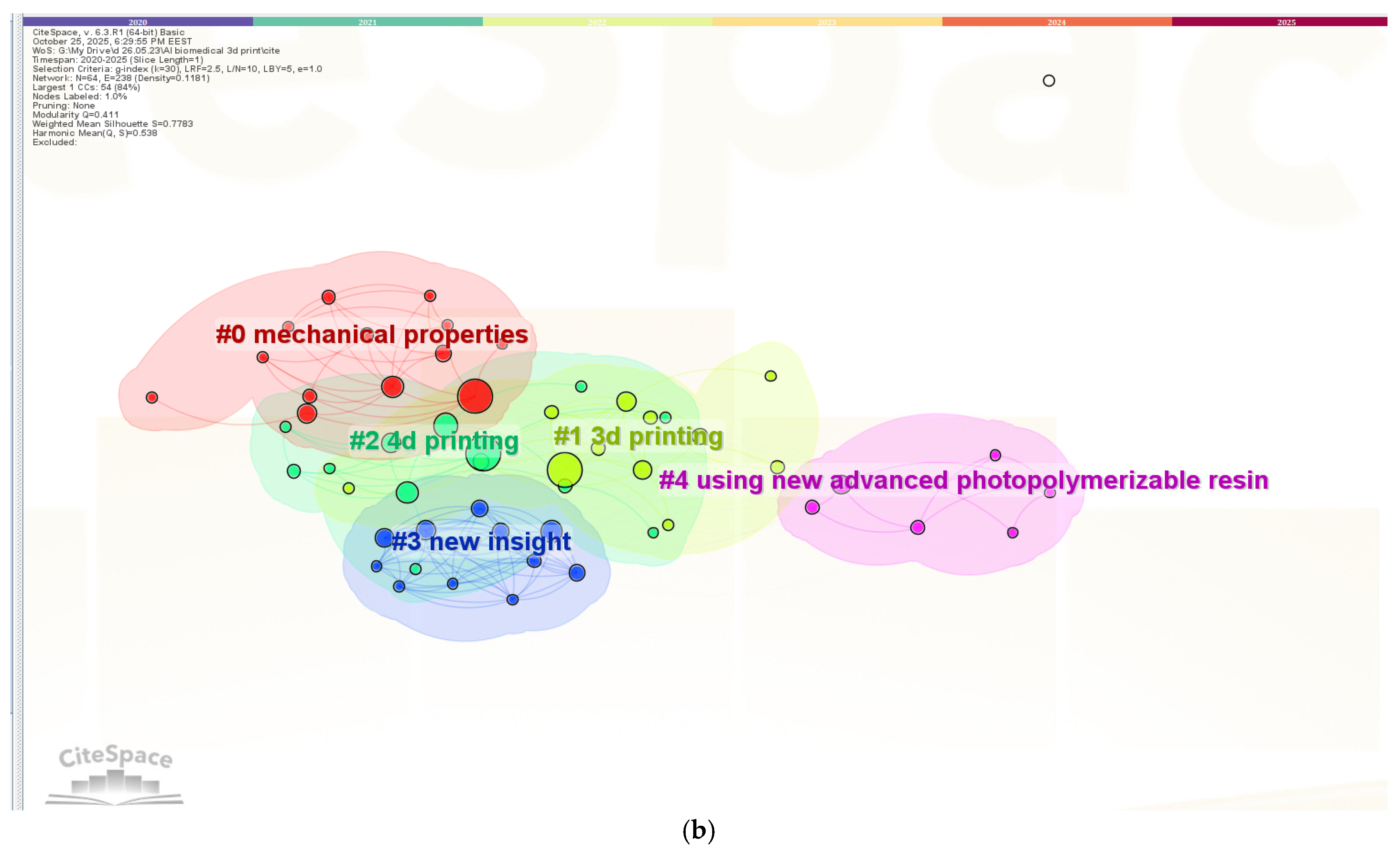
| Cluster ID | Size | Silhouette | Label (LSI) | Label (LLR) | Label (MI) | Average Year |
|---|---|---|---|---|---|---|
| 0 | 13 | 0.833 | mechanical properties | mechanical properties (65.4, 1.0 × 10⁻⁴) | smart glove (1.62) | 2023 |
| 1 | 12 | 0.63 | 3D printing | smart eyeglass frame (44.32, 1.0 × 10⁻⁴) | learning approach (1.3) | 2022 |
| 2 | 12 | 0.711 | 4D printing | synthesis properties application (59.31, 1.0 × 10⁻⁴) | using blockchain (1.83) | 2023 |
| 3 | 11 | 0.948 | new insight | creating new opportunities (37.53, 1.0 × 10⁻⁴) | synergies advantage (0.38) | 2022 |
| 4 | 6 | 0.78 | using new advanced photopolymerisable resin | using new advanced photopolymerisable resin (27.24, 1.0 × 10⁻⁴) | ti-based alloys quality evaluation (0.03) | 2022 |
| Citation Counts | Node Name | Cluster ID |
|---|---|---|
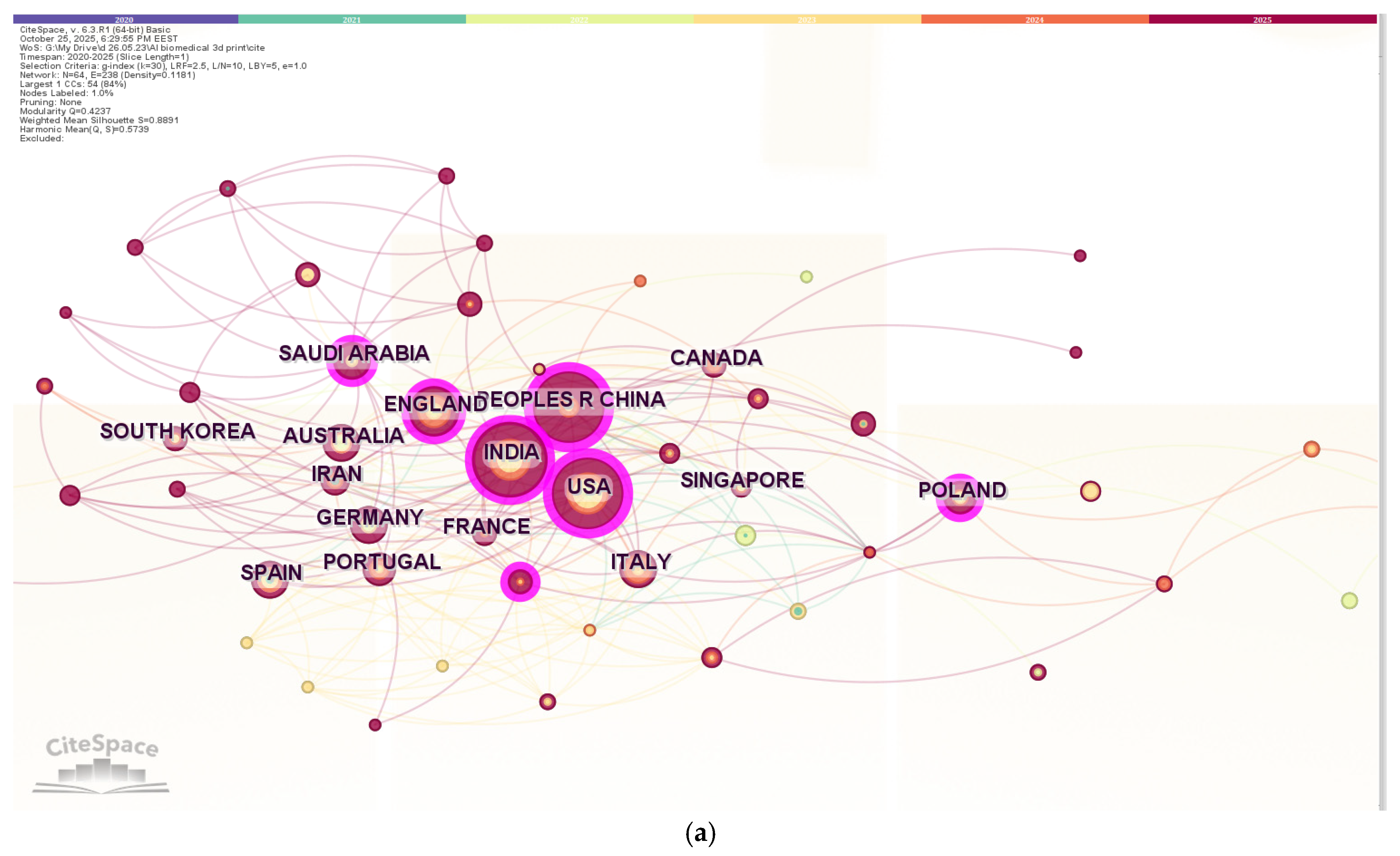
| 47 | Peoples R China | 0 |
| 45 | India | 2 |
| 43 | USA | 1 |
| 20 | England | 2 |
| 13 | Italy | 3 |
| 13 | Saudi Arabia | 0 |
| 13 | Germany | 2 |
| 11 | Canada | 1 |
| 10 | Singapore | 1 |
| 10 | South Korea | 0 |
| Bursts | Node Name | Cluster ID |
|---|---|---|
| 2.00 | Turkey | 2 |
| 1.52 | Singapore | 1 |
| 1.28 | Italy | 3 |
| 0.93 | Iran | 1 |
| 0.73 | Norway | 4 |
| 0.67 | Switzerland | 1 |
| 0.00 | Peoples R China | 0 |
| 0.00 | India | 2 |
| 0.00 | USA | 1 |
| 0.00 | England | 2 |
| Degree | Node Name | Cluster ID |
|---|---|---|
| 25 | USA | 1 |
| 22 | India | 2 |
| 20 | Peoples R China | 0 |
| 20 | Turkiye | 3 |
| 18 | Italy | 3 |
| 17 | Saudi Arabia | 0 |
| 17 | France | 3 |
| 16 | Portugal | 3 |
| 15 | England | 2 |
| 14 | Singapore | 1 |
| Centrality | Node Name | Cluster ID |
|---|---|---|
| 0.23 | Peoples R China | 0 |
| 0.21 | USA | 1 |
| 0.18 | India | 2 |
| 0.16 | Saudi Arabia | 0 |
| 0.16 | Poland | 4 |
| 0.13 | England | 2 |
| 0.10 | Turkiye | 3 |
| 0.06 | Italy | 3 |
| 0.06 | Portugal | 3 |
| 0.06 | Germany | 2 |
| Sigma | Node Name | Cluster ID |
|---|---|---|
| 1.11 | Turkey | 2 |
| 1.08 | Italy | 3 |
| 1.06 | Iran | 1 |
| 1.05 | Singapore | 1 |
| 1.00 | Peoples R China | 0 |
| 1.00 | USA | 1 |
| 1.00 | India | 2 |
| 1.00 | Saudi Arabia | 0 |
| 1.00 | Poland | 4 |
| 1.00 | England | 2 |
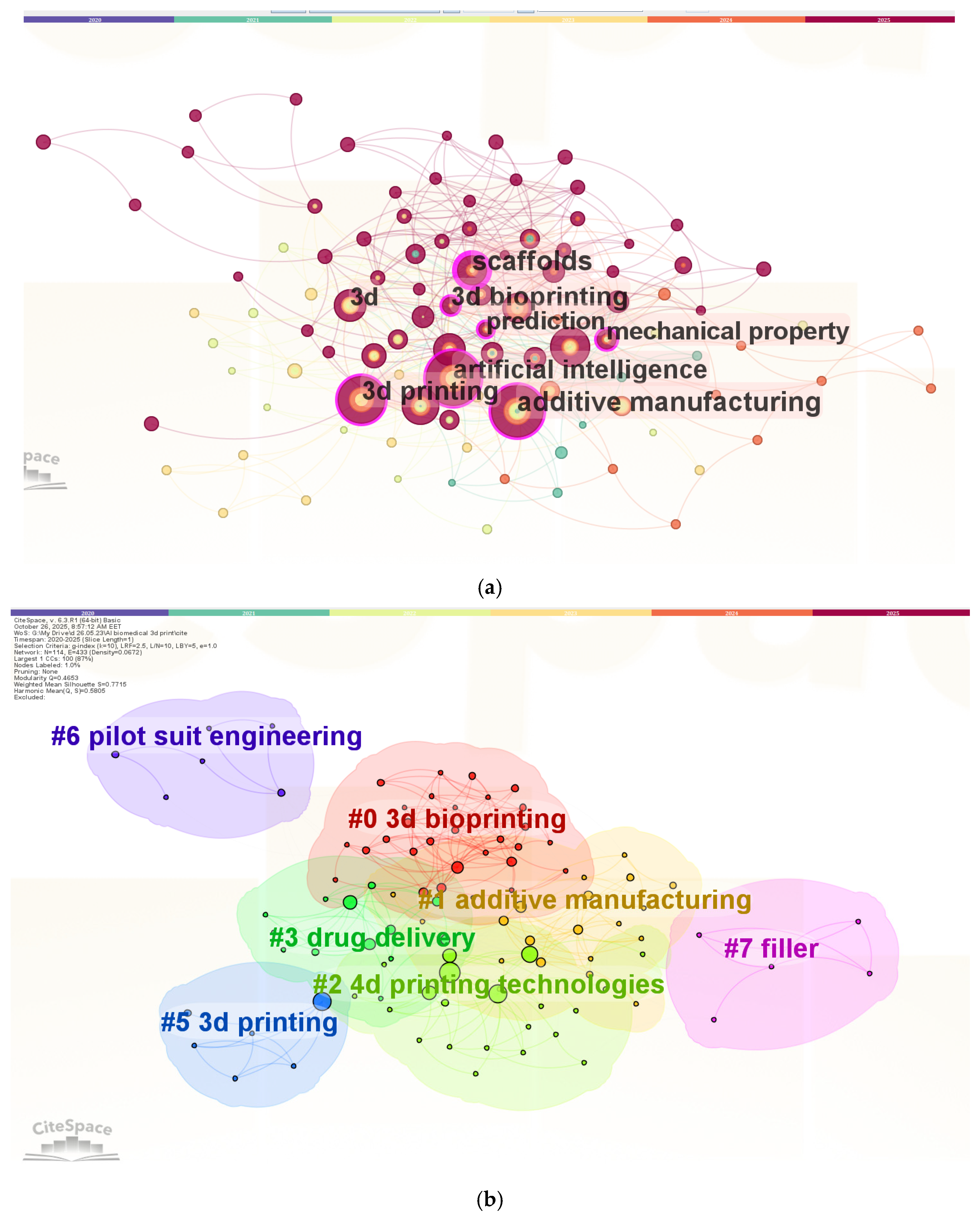
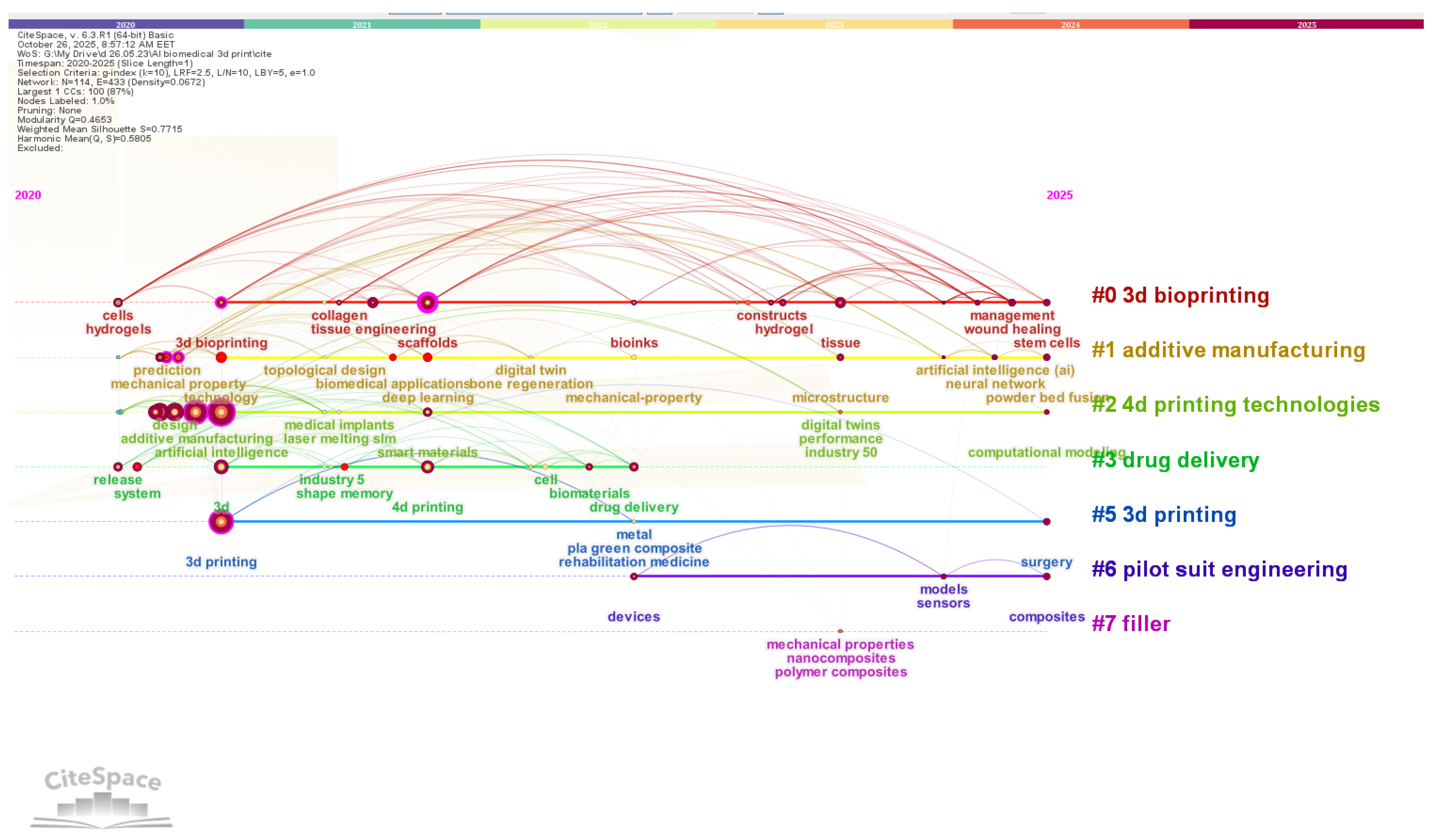
| Cluster ID | Size | Silhouette | Label (LSI) | Label (LLR) | Label (MI) | Average Year |
|---|---|---|---|---|---|---|
| 0 | 28 | 0.789 | 3D bioprinting | 3D bioprinting (74.36, 1.0 × 10⁻⁴) | 3D-manufactured monolithic stage (0.64) | 2023 |
| 1 | 21 | 0.666 | additive manufacturing | artificial intelligence technologies (43.93, 1.0 × 10⁻⁴) | redefining medical application (0.84) | 2022 |
| 2 | 21 | 0.73 | 4D printing technologies | additive manufacturing (60.7, 1.0 × 10⁻⁴) | 3D-manufactured monolithic stage (2.73) | 2022 |
| 3 | 13 | 0.752 | drug delivery | additive manufacturing (51.28, 1.0 × 10⁻⁴) | smart additive manufacturing (0.7) | 2022 |
| 5 | 6 | 1 | 3D printing | annealed 3D-printed pla-date pit (39.97, 1.0 × 10⁻⁴) | 3D-manufactured monolithic stage (0.56) | 2023 |
| 6 | 6 | 0.879 | pilot suit engineering | pilot suit engineering (33.59, 1.0 × 10⁻⁴) | molecular analysis (0.05) | 2024 |
| 7 | 5 | 0.938 | filler | polymer composite (22.06, 1.0 × 10⁻⁴) | additive manufacturing (0.06) | 2024 |
| Citation Counts | Node Name | Cluster ID |
|---|---|---|
| 72 | artificial intelligence | 2 |
| 55 | additive manufacturing | 2 |
| 52 | 3D printing | 5 |
| 40 | design | 2 |
| 30 | machine learning | 2 |
| 27 | fabrication | 2 |
| 25 | 3D | 3 |
| 23 | scaffolds | 0 |
| 19 | technology | 1 |
| 16 | 4D printing | 3 |
| Bursts | Node Name | Cluster ID |
|---|---|---|
| 3.01 | deep learning | 1 |
| 2.88 | technology | 1 |
| 2.18 | biomedical applications | 1 |
| 1.76 | shape memory | 3 |
| 0.88 | mechanical property | 1 |
| 0.78 | system | 3 |
| 0.62 | prediction | 1 |
| 0.00 | artificial intelligence | 2 |
| 0.00 | additive manufacturing | 2 |
| 0.00 | 3D printing | 5 |
| Degree | Node Name | Cluster ID |
|---|---|---|
| 27 | scaffolds | 0 |
| 26 | additive manufacturing | 2 |
| 23 | 3D bioprinting | 0 |
| 22 | artificial intelligence | 2 |
| 21 | 3D printing | 5 |
| 20 | mechanical property | 1 |
| 20 | prediction | 1 |
| 20 | 3D | 3 |
| 17 | system | 3 |
| 17 | fabrication | 2 |
| Centrality | Node Name | Cluster ID |
|---|---|---|
| 0.20 | scaffolds | 0 |
| 0.19 | additive manufacturing | 2 |
| 0.18 | 3D printing | 5 |
| 0.15 | artificial intelligence | 2 |
| 0.14 | mechanical property | 1 |
| 0.13 | prediction | 1 |
| 0.11 | 3D bioprinting | 0 |
| 0.10 | 3D | 3 |
| 0.10 | devices | 6 |
| 0.09 | fabrication | 2 |
| Sigma | Node Name | Cluster ID |
|---|---|---|
| 1.20 | technology | 1 |
| 1.15 | deep learning | 1 |
| 1.12 | mechanical property | 1 |
| 1.08 | prediction | 1 |
| 1.04 | system | 3 |
| 1.04 | biomedical applications | 1 |
| 1.01 | shape memory | 3 |
| 1.00 | scaffolds | 0 |
| 1.00 | additive manufacturing | 2 |
| 1.00 | 3D printing | 5 |
| N0 | Authors | Research Area | Main Focus | Key Findings | Times Cited |
|---|---|---|---|---|---|
| 1 | Goh et al. [36] | Computer Science | Examines the integration of machine learning techniques in additive manufacturing (AM) to improve design, process optimisation, in situ monitoring, and cybersecurity within smart manufacturing systems. | Identifies artificial neural networks (ANN) and convolutional neural networks (CNN) as the most effective algorithms for process optimisation and anomaly detection in AM. Highlights the importance of standardised data formats, high-resolution sensors, and advanced data-acquisition techniques to enable predictive modelling, real-time monitoring, and the creation of digital twins for future manufacturing and biomedical applications. | 511 |
| 2 | Zhang et al. [39] | Science and Technology | Examines extrusion-based three-dimensional (3D) bioprinting methodologies, emphasising the selection of hardware, software, and bioinks for fabricating complex and functional tissue constructs. | Identifies recent advancements that enhance the precision and versatility of 3D extrusion bioprinting, highlighting its growing role in tissue engineering and translational biomedical applications, and outlining future directions for improving biofabrication performance and reproducibility. | 289 |
| 3 | Zhu et al. [44] | Science and Technology | Explores the convergence of artificial intelligence, functional materials, and advanced 3D printing to enable the direct fabrication of wearable and implantable biomedical devices on complex target surfaces. | Demonstrates that AI-driven control systems enhance precision and adaptability in both ex situ and in situ 3D printing, supporting autonomous medical manufacturing, real-time environmental sensing, and the development of personalised therapeutic solutions. | 268 |
| 4 | Seoane-Viaño et al. [67] | Pharmacology and Pharmacy | Reviews the progress of 3D printing technologies in pharmaceutical development, emphasising their potential to create personalised drug products and accelerate clinical translation. | Highlights advances in producing flexible-dose medicines tailored to individual patient needs and outlines current challenges that hinder clinical adoption, proposing strategies to bridge the gap between experimental pharmaceutical 3D printing and its integration into routine medical practice. | 206 |
| 5 | Meng et al. [68] | Orthopaedics | Analyses the current state of 3D printing technologies for producing customised metal implants in orthopaedic surgery, focusing on their design, materials, and clinical applicability. | Highlights that 3D-printed metal implants enhance structural precision, biocompatibility, and osseointegration while reducing surgery time and costs. Notes challenges related to software, materials, and regulation, and envisions future integration with AI, 4D printing, and big data to achieve fully personalised orthopaedic solutions. | 147 |
| 6 | Dabbagh et al. [69] | Science and Technology | Reviews recent advances in 3D printing technologies for the fabrication of microrobots, emphasising their biomedical and environmental applications and the potential for intelligent actuation and control. | Describes how 3D-printed microrobots can perform targeted tasks such as drug delivery, minimally invasive surgery, and imaging. Identifies emerging trends in integrating smart materials, artificial intelligence, and physical intelligence to enhance autonomy and biocompatibility, while outlining current challenges in clinical translation and regulatory standardisation. | 123 |
| 7 | Mamo et al. [8] | Engineering; Materials Science | Provides a comprehensive overview of additive manufacturing technologies and their applications in the medical field, discussing process types, biomedical materials, and technological challenges. | Emphasises the potential of additive manufacturing to deliver customised, cost-effective medical devices, such as implants, prosthetics, and surgical guides. Identifies material limitations, regulatory barriers, and the need for standardisation, while highlighting the growing role of AI and the Internet of Medical Things (IoMT) in enhancing safety, efficiency, and personalisation in biomedical manufacturing. | 103 |
| 8 | Guo et al. [70] | Materials Science; Metallurgy and Metallurgical Engineering | Reviews state-of-the-art multi-material 3D printing technologies for titanium-based biomaterials, focusing on their structural design, mechanical optimisation, and biomedical applicability. | Highlights how 3D-printed titanium alloys enhance osseointegration, mechanical tunability, and biocompatibility in bone tissue engineering. Identifies challenges in balancing strength and elasticity and emphasises the potential of artificial intelligence and machine learning to optimise process parameters and design efficiency. | 94 |
| 9 | Dananjaya et al. [71] | Materials Science | Discusses the synthesis, properties, and applications of graphene quantum dots (GQDs) in polymer composites, emphasising their integration into 3D printing and the role of machine learning in materials optimisation. | Demonstrates that GQD-based composites improve electrical, mechanical, and thermal performance, expanding their use in sensors, energy devices, and biomedicine. Identifies how AI enables predictive modelling and accelerated material design for next-generation nanocomposites. | 94 |
| 10 | Ikram et al. [72] | Materials Science; Polymer Science | Reviews the development of functional polymer nanocomposites for additive and 4D printing of smart biomedical devices responsive to environmental stimuli. | Shows that additive manufacturing enables the creation of adaptive, cost-efficient, and durable structures for biomedical applications. Notes ongoing research into novel materials and intelligent manufacturing methods to enhance flexibility, stability, and patient-specific device functionality. | 92 |
| 11 | Muhindo et al. [73] | Pharmacology and Pharmacy | Reviews the expanding role of 3D and 4D printing technologies in pharmaceutical manufacturing, focusing on personalised drug delivery systems and production automation. | Highlights the potential of integrating AI, machine learning, and the Internet of Things to streamline biopharmaceutical manufacturing, reduce human intervention, and enable intelligent fabrication of personalised medicines. | 80 |
| 12 | Pugliese et al. [16] | Polymer Science | Analyses advances in 4D printing for biomedical applications, emphasising smart, stimuli-responsive materials capable of dynamic transformation and in situ adaptation. | Describes how AI accelerates material design, enhances printing precision, and supports real-time control for surgical and biomedical uses, while outlining the emerging concept of 5D printing as AI-driven intelligent fabrication. | 80 |
| 13 | Basu et al. [74] | Engineering; Materials Science | Introduces the concept of “biomaterialomics”, integrating AI, data science, and additive manufacturing to accelerate the development of next-generation biomaterials and implants. | Proposes a data-driven framework that connects processing, structure, and properties of biomaterials, enabling predictive modelling, patient-specific implant design, and digital twin simulations for biomedical innovation. | 79 |
| 14 | Velásquez-García et al. [75] | Engineering | Reviews additive manufacturing technologies for biomedical applications, particularly metal 3D printing, focusing on material diversity, process efficiency, and biocompatible design. | Identifies opportunities to enhance additive manufacturing through AI–based optimisation, multi-material printing, and the creation of advanced load-bearing and biodegradable implants for clinical use. | 76 |
| 15 | Wang, ZJ et al. [76] | Chemistry; Science and Technology | Reviews the use of bioprinting for developing smart wound dressings and biomedical devices, focusing on polymer-based inks, fabrication methods, and functional design strategies. | Highlights seven major modification approaches—ranging from chemical synthesis to multi-material and in situ bioprinting—that enhance healing efficacy and device performance, while discussing future directions involving 4D and AI-assisted bioprinting. | 68 |
| 16 | Dong et al. [77] | Chemistry; Materials Science; Physics; Polymer Science | Surveys the fabrication methods, driving mechanisms, and emerging applications of soft robotics designed to mimic biological systems and enhance interaction in complex environments. | Identifies advances in flexible materials, structural design, and control strategies that enable multi-degree actuation and adaptability in medical and industrial contexts, emphasising AI integration for next-generation functional robotics. | 64 |
| 17 | Carou-Senra et al. [78] | Chemistry; Science and Technology | Examines inkjet printing as an additive manufacturing technique for personalised drug delivery and biomedical applications, focusing on pharma-ink formulation and precise material deposition. | Demonstrates how the combination of tailored substrates, intelligent hardware, and AI-based control enhances drug printing accuracy and therapeutic efficiency, positioning inkjet printing as a key enabler of patient-specific medicine manufacturing. | 64 |
| 18 | Sarabi et al. [79] | Biochemistry and Molecular Biology | Reviews the biomedical applications of optical fibres made from soft, biocompatible, and biodegradable materials, with emphasis on their use in implants, sensors, and therapeutic devices. | Highlights the role of 3D printing in fabricating flexible optical systems and discusses how AI enhances data analysis and predictive modelling for next-generation optical diagnostics and treatment technologies. | 60 |
| 19 | Rahman et al. [80] | Chemistry; Science and Technology | Provides a comprehensive analysis of the integration of AI across additive, subtractive, and hybrid manufacturing processes across various industries, including the medical and aerospace sectors. | Identifies that AI-driven monitoring and defect detection improve manufacturing precision and process automation. Notes challenges in data quality, real-time optimisation, and model generalisation, emphasising the need for advanced connectivity and sensing systems. | 56 |
| 20 | Park et al. [81] | Cell Biology; Biotechnology and Applied Microbiology | Summarises technological progress in tissue engineering and regenerative medicine (TERM) driven by AI and big data analytics, focusing on innovation trends and convergence research. | Highlights three major advancements in 2017: biomaterial development with 3D cell printing, exosome-based regenerative therapies, and 3D culture systems. Suggests that AI and data integration will accelerate clinical translation in TERM. | 53 |
| 21 | Ameta et al. [82] | Science and Technology; Energy and Fuels; Materials Science | Reviews the evolution of sustainable 3D and 4D printing technologies and their expanding role in industrial and biomedical manufacturing. | Demonstrates that 3D/4D printing improves customisation, energy efficiency, and sustainability across sectors, particularly in medical applications. Foresees deeper integration with AI to enable adaptive smart materials and environmentally responsible production systems. | 49 |
| 22 | Zhang et al. [31] | Engineering; Materials Science | Proposes a structured methodology for integrating AI into 3D bioprinting within the Quality by Design (QbD) framework to enhance clinical translation. | Identifies AI’s role in improving bioink formulation, structural modelling, and real-time process control, emphasising data-driven design and sensing as key enablers for scalable, patient-specific bioprinting applications. | 45 |
| 23 | Oladapo et al. [43] | Materials Science | Analyses the evolution of flexible 4D printing technologies and their use in developing adaptive, self-healing polymer composites for biomedical applications. | Highlights the potential of AI-enhanced materials (AIM) to replicate dynamic tissue behaviour and improve actuation control. Notes that the field remains nascent, with challenges in demonstrating practical biomedical integration and large-scale applicability. | 43 |
| 24 | Boban et al. [83] | Automation and Control Systems; Engineering | Reviews post-processing methods used to improve surface quality and dimensional accuracy in metal additive manufacturing (MAM), focusing on their relevance to biomedical and industrial components. | Summarises laser, chemical, and hybrid finishing techniques that enhance mechanical and functional performance. Emphasises automation through AI and machine learning to optimise surface modification and process efficiency in metallic AM parts. | 43 |
| 25 | Tian et al. [84] | Automation and Control Systems; Computer Science; Robotics | Explores the integration of data-driven and machine learning tools into additive manufacturing for optimising material and structural design. | Shows that AI-driven topology optimisation and tool-path planning improve material efficiency and product performance. Suggests future frameworks combining digital manufacturing and intelligent data analytics to advance Industry 4.0-driven innovation. | 39 |
Disclaimer/Publisher’s Note: The statements, opinions and data contained in all publications are solely those of the individual author(s) and contributor(s) and not of MDPI and/or the editor(s). MDPI and/or the editor(s) disclaim responsibility for any injury to people or property resulting from any ideas, methods, instructions or products referred to in the content. |
© 2025 by the authors. Licensee MDPI, Basel, Switzerland. This article is an open access article distributed under the terms and conditions of the Creative Commons Attribution (CC BY) license (https://creativecommons.org/licenses/by/4.0/).
Share and Cite
Tănase, M.; Veres, C.; Szabo, D.-A. Artificial Intelligence in Biomedical 3D Printing: Mapping the Evidence. J. Manuf. Mater. Process. 2025, 9, 407. https://doi.org/10.3390/jmmp9120407
Tănase M, Veres C, Szabo D-A. Artificial Intelligence in Biomedical 3D Printing: Mapping the Evidence. Journal of Manufacturing and Materials Processing. 2025; 9(12):407. https://doi.org/10.3390/jmmp9120407
Chicago/Turabian StyleTănase, Maria, Cristina Veres, and Dan-Alexandru Szabo. 2025. "Artificial Intelligence in Biomedical 3D Printing: Mapping the Evidence" Journal of Manufacturing and Materials Processing 9, no. 12: 407. https://doi.org/10.3390/jmmp9120407
APA StyleTănase, M., Veres, C., & Szabo, D.-A. (2025). Artificial Intelligence in Biomedical 3D Printing: Mapping the Evidence. Journal of Manufacturing and Materials Processing, 9(12), 407. https://doi.org/10.3390/jmmp9120407