


Abstract
The agroecological (AE) transition of agri-food systems can help address climate change impacts in Tunisia, including reduced local food production and high import dependency, but it requires understanding consumer behavior toward eco-friendly food products. Thus, a survey of 521 Tunisian consumers was conducted to assess environmental awareness and willingness to pay (WTP) for food produced under AE practices. Principal Component Analysis (PCA) indicated that sustainable consumption is mainly influenced by knowledge of AE practices, which is stronger among consumers with higher education and income. However, WTP for sustainable products remains low, making it essential to develop marketing strategies that target distinct demographic groups, improve product labeling, and enhance environmental education.
1. Introduction
North Africa is a highly food-import-dependent region and a hotspot of climate change, with extreme weather events, like prolonged droughts and heatwaves, occurring with increasing frequency in recent years and leading to growing water scarcity. These conditions harm agricultural crops, significantly reducing local production and, in turn, increasing the need for importing food. Simultaneously, forecasts of population growth in North Africa show that the demand for water and food will continue to rise within the coming years, putting further pressure on the already limited resources and thus heightening ecological risks, such as water scarcity and worsening food insecurity. These challenges make North African countries vulnerable to both environmental crises and economic risks, as their strong reliance on food imports exposes them to fluctuations driven by changes in global market prices [1,2,3,4].
Agroecology appears to be a promising long-term solution for addressing these challenges and adapting to climate change and resource depletion in North Africa [5,6]. By applying ecological principles to agriculture and food systems through a holistic approach that considers the environmental, social, and economic dimensions of food systems, as well as the role and interdependence of multiple involved stakeholders, including farmers, producers, consumers, and others, agroecology goes beyond farm-level changes towards systemic changes across the entire value chain, from production to consumption, thereby enhancing sustainability [7].
Within this context, the role of consumers is particularly important, as AE food systems can only be developed if there is sufficient consumer demand for products with AE characteristics [8]. In addition to their purchasing power and individual choices, consumers can contribute to this sustainability transition in a more active and collective way by participating in eco-friendly initiatives, such as consumer organizations that set standards for certifying production processes, or in community-supported agriculture schemes where citizens and farmers can co-design food production practices that foster sustainability [9].
Given the critical role of consumers in the sustainable transformation of agri-food systems and the urgent need for an AE transition in North Africa, it is necessary to understand the factors that shape sustainable consumer behavior and eco-friendly choices in the region. However, most of the existing literature on sustainable consumer behavior includes surveys conducted in Western countries, while there are significant cultural, economic, political, and religious differences between Western communities and the MENA region (Middle East and North Africa) that lead to at least partially different consumer patterns. Furthermore, most of the MENA-based studies so far used convenience samples, such as students, highlighting the need to include more representative samples of the overall population so that the research results can better support policymaking and the development of environmental regulations that promote sustainability in this area [10]. To address these research gaps, this study investigates consumer perspectives on sustainable food consumption in Tunisia, a significant part of North Africa and the broader MENA region, using a representative sample of Tunisian consumers to capture their environmental awareness and attitudes, as well as their WTP for food produced under AE practices.
Tunisia was selected as a case study not only due to its geographical location but also because of its domestic challenges. Although the country’s national economic growth highly depends on agricultural productivity, local yields are severely undermined by growing water scarcity and prolonged droughts [11], with recent temperature records reaching 49 °C in the capital [12]. These climate pressures heighten food insecurity, import dependency, and economic instability [13]. Notably, the country’s import dependency ratio for cereals, which are fundamental to global nutrition, reached 87% during 2021–2023 [14]. These conditions highlight the importance of this study, as understanding Tunisian consumers’ perceptions of agroecology and their willingness to support AE food products is essential for facilitating the transition toward AE agri-food systems.
2. Materials and Methods
For the purposes of this study, a structured questionnaire was designed and organized into four parts capturing: (1) demographic and socioeconomic attributes of respondents, (2) attitudes towards environmental issues, including environmental awareness, perspectives on the importance of environmental protection and its trade-off with economic growth, and perceptions of the future of the environment, environmental responsibility factors, and technological solutions, (3) consumers’ knowledge of AE practices and perceptions of their effectiveness in enhancing agricultural productivity, soil quality, maintenance of natural resources, healthiness, and environmental protection, and (4) sustainable intentions and WTP for specific food categories produced locally under AE practices. A 5-point Likert attitudinal scale (1 = strongly disagree; 5 = strongly agree) was employed to investigate consumers’ attitudes, perceptions, and awareness.
After developing the questionnaire, the sampling was based on the most recent national census data so that the final sample would be representative of the adult population of Tunisia in terms of age and gender. Subsequently, 552 questionnaires were distributed to a nationally representative sample, of which 521 valid responses were included for data analysis after data cleaning.
To assess whether the dataset was suitable for PCA, the Kaiser–Meyer–Olkin (KMO) test of sampling adequacy [15] and Bartlett’s test of sphericity [16] were performed. PCA was conducted to summarize a large volume of Likert scale items into principal components [17] that reflect the main factors that shape sustainable consumer behavior and consumers’ WTP for food types produced under AE practices in Tunisia. To determine the relationship between the principal components and consumers’ demographic and socioeconomic profiles, multiple linear regression analysis was applied.
3. Results and Discussion
3.1. Descriptive Statistics
Regarding the demographic and socioeconomic attributes of respondents, the sample is highly representative of the Tunisian population, both in terms of gender (48% male and 52% female; almost identical to the 1:1 census proportion) and age distribution, which is very close to national census data, as observed in Figure 1.
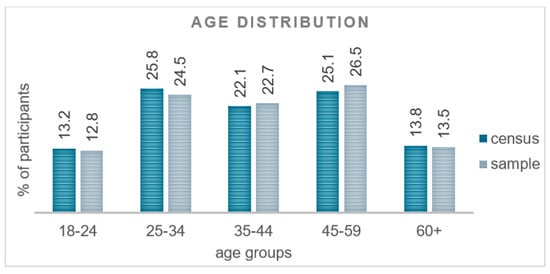
Figure 1.
Comparison of age distribution between the sample and national census data.
Μost of the participants (65.5%) are employed, while the remaining are students, retired, or unemployed. Regarding income satisfaction, 60.5% of the consumers reported being satisfied, 33.8% not satisfied, and 5.8% very satisfied, indicating a predominance of middle-income households in the sample. Educational level is relatively high, as 39.3% of respondents hold a bachelor’s degree and 32.1% a master’s or PhD. In terms of residence, most respondents live in urban areas (73.7%), while 8.3% live in peri-urban and 18% live in rural areas, reflecting Tunisia’s ongoing urbanization trends yet still capturing the perspectives of rural residents. Lastly, most households consist of two adults (42.4%), and almost half of the respondents have no children (47.4%).
3.2. PCA Results
The KMO test resulted in a KMO value of 0.957, which is well above the recommended threshold of 0.6 [15], thus confirming sampling adequacy. Bartlett’s test of sphericity was also significant (χ2 = 13,707.1, df = 561, p < 0.001), indicating that correlations among the variables were sufficiently strong to proceed with factor extraction [16].
As observed in Table 1, six components were extracted from PCA. Component 1 consists of many variables that capture knowledge about AE practices (i.e., cover crops, crop rotation, livestock integration, reduced use of agrochemicals), perceptions of their environmental, health, and social benefits, and awareness of the advantages of consuming local products. With the highest percent of variance (26.002%), this component is the most important factor shaping sustainable consumer behavior in Tunisia. However, its mean factor score is moderate (3.15), explaining that Tunisians’ limited familiarity with AE practices may partly lead to unsustainable patterns.

Table 1.
Results of PCA.
Subsequently, attitudes towards environmental protection, such as the perceived necessity of protecting natural resources through sustainable behavioral changes and perceptions of the trade-off between environmental and economic growth (Component 2), also play a very important role in the determination of Tunisians’ consumer behavior, showing that positive attitudes and prioritization of environmental protection could result in more sustainable consumption patterns. While the mean factor score of this component is somewhat higher (3.75), it still indicates a moderate prioritization of environmental issues, which may result in a moderate willingness to adopt sustainable behaviors.
The other components, such as general awareness of environmental issues, contribute as well to shaping consumer behavior and WTP for sustainable products, but to a lesser extent. Overall, the six components extracted from PCA explain almost 70% (69.73%) of the total variance, indicating strong explanatory power and proving that these principal factors capture most of the dimensions influencing sustainable behaviors among Tunisian consumers.
3.3. Results of Regression Analysis
The results of regression analysis showed that participants’ educational level was the most influential variable, significantly predicting three components: Component 1 (knowledge of AE practices; p < 0.001), Component 2 (attitudes toward environmental protection; p < 0.001), and Component 3 (environmental awareness; p < 0.001). Specifically, higher levels of knowledge of environmental issues and sustainable solutions, and more positive attitudes towards environmental protection, were associated with consumers who had higher levels of education. Place of residence also plays an important role, affecting both environmental awareness (Component 3) and eco-friendly intentions (Component 6), with urban consumers being more aware of environmental issues and more likely to adopt sustainable habits, like buying locally produced food. Moreover, sustainable consumption patterns are significantly influenced by income (p < 0.05 for Component 6) (Table 2), suggesting that economic comfort supports eco-friendly choices. Overall, the results prove the need for integrated educational and policy approaches that address less educated and lower-income groups to facilitate broader behavioral changes.
Table 2.
Correlation among the principal components and socioeconomic attributes of the sample.
3.4. WTP for AE Products
Despite the growing climate risks and food insecurity in Tunisia, and the importance of environmental protection, most consumers answered that they are unwilling to pay more for local food produced under sustainable practices. Instead, they would buy such products if the price was lower. This tendency was particularly obvious for meat, dairy, and cereals, even though cereals are among the most imported products in Tunisia. However, a notable percentage of respondents expressed their WTP 10% or 20% more for several food types produced under AE practices, particularly olive oil (53.7%) and locally produced fruits (52.1%).
4. Conclusions
Overall, this case study contributed to understanding consumers’ behavioral drivers of adopting sustainable patterns in Tunisia, where AE transition is necessary to face climate change and the high food import dependency. According to the results of the survey, citizens’ awareness of AE practices and their attitudes towards environmental protection are the main factors influencing the adoption of sustainable food practices and WTP more for food types produced under AE practices. However, this willingness is relatively low. To change this and raise environmental awareness, the following are recommended:
- ➢
- Cooperation with environmental NGOs;
- ➢
- Encouragement of educational campaigns about environmental issues;
- ➢
- Design of marketing strategies for promoting local, eco-friendly products;
- ➢
- Development of partnerships with academic institutions for research on sustainability-related topics.
Author Contributions
Conceptualization, G.V., G.K. and C.K.; methodology, L.S.K., K.K. and C.K.; software, M.V.; validation, G.K., C.K. and G.V.; formal analysis, C.K. and A.O.; investigation, D.D.T., A.O. and K.K.; data curation, M.B.M., H.B., K.H. and W.K.; writing—original draft preparation, K.K., C.K. and L.S.K.; writing—review and editing, M.B.M., H.B., K.H. and W.K.; visualization, M.V. and D.D.T.; supervision, G.V. All authors have read and agreed to the published version of the manuscript.
Funding
This research was funded by the European Union’s HE research and innovation program under grant number 101084647 and official acronym NATAE. Views and opinions expressed are, however, those of the authors only and do not necessarily reflect those of the European Union or the European Research Executive Agency (REA). Neither the European Union nor the granting authority can be held responsible for any use of the information contained in the document.
Institutional Review Board Statement
Not applicable.
Informed Consent Statement
Informed consent was obtained from all subjects involved in the study.
Data Availability Statement
All data used for this study are available upon request to the corresponding author.
Conflicts of Interest
The authors declare no conflicts of interest.
Abbreviations
The following abbreviations are used in this manuscript:
| AE | Agroecological |
| WTP | Willingness to pay |
| PCA | Principal component analysis |
| KMO | Kaiser–Meyer–Olkin |
References
- Le Mouël, C.; Forslund, A.; Marty, P.; Manceron, S.; Marajo-Petitzon, E.; Caillaud, M.A.; Dumas, P.; Schmitt, B. Can the Middle East-North Africa Region Mitigate the Rise of Its Food Import Dependency under Climate Change? Reg. Environ. Chang. 2023, 23, 52. [Google Scholar] [CrossRef] [PubMed]
- FAO. The Future of Food and Agriculture—Trends and Challenges. Food and Agriculture Organization of the United Nations. 2017. Available online: https://openknowledge.fao.org/server/api/core/bitstreams/2e90c833-8e84-46f2-a675-ea2d7afa4e24/content (accessed on 29 December 2025).
- Missanga, J.S.; Mmbando, G.S. Challenges of Food Security in Africa in the Face of Climate Change: Potential of the Clustered Regularly Interspaced Short Palindromic Repeats (CRISPR)-Cas9 Technology to Address These Challenges. Discov. Sustain. 2025, 6, 305. [Google Scholar] [CrossRef]
- Malak, A. Ecological Security Threats in North Africa for 2040: Water Scarcity and Desertification. Available online: https://councilonstrategicrisks.org/2024/07/18/ecological-security-threats-in-north-africa-for-2040-water-scarcity-and-desertification/ (accessed on 29 December 2025).
- Aguilera, E.; Díaz-Gaona, C.; García-Laureano, R.; Reyes-Palomo, C.; Guzmán, G.I.; Ortolani, L.; Sánchez-Rodríguez, M.; Rodríguez-Estévez, V. Agroecology for Adaptation to Climate Change and Resource Depletion in the Mediterranean Region. A Review. Agric. Syst. 2020, 181, 102809. [Google Scholar] [CrossRef]
- Boutagayout, A.; Belmalha, S.; Rehali, M.; Nassiri, L.; Bouiamrine, E.H. Agroecology as Agricultural Practices for Sustainable Management in North African Countries. Int. J. Plant Prod. 2023, 17, 389–436. [Google Scholar] [CrossRef]
- Chaudhary, S.; Shrestha, A.K.; Rai, S.; Acharya, D.K.; Subedi, S.; Rai, R. Agroecology Integrates Science, Practice, Movement, and Future Food Systems. J. Multidiscip. Sci. 2023, 5, 39–60. [Google Scholar] [CrossRef]
- Blare, T.; Roman, S.; del Pozo Loayza, C.; Borja, R.M.; Oyarzun, P.J.; Alem Zabalaga, M. The Role of Demand in the Agroecological Transition: An Analysis of Recent Literature. Curr. Opin. Environ. Sustain. 2023, 65, 101378. [Google Scholar] [CrossRef]
- Mehrabi, S.; Perez-Mesa, J.C.; Giagnocavo, C. The Role of Consumer-Citizens and Connectedness to Nature in the Sustainable Transition to Agroecological Food Systems: The Mediation of Innovative Business Models and a Multi-Level Perspective. Agriculture 2022, 12, 203. [Google Scholar] [CrossRef]
- Elhoushy, S.; Lanzini, P. Factors Affecting Sustainable Consumer Behavior in the MENA Region: A Systematic Review. J. Int. Consum. Mark. 2021, 33, 256–279. [Google Scholar] [CrossRef]
- Khalifa, J. The Impacts of Climate Change, Agricultural Productivity, and Food Security on Economic Growth in Tunisia: Evidence from an Econometrics Analysis. Res. World Agric. Econ. 2025, 6, 577–599. [Google Scholar] [CrossRef]
- Al Jazeera from Algeria to Syria, Heatwaves Scorch Middle East, North Africa|Climate Crisis News|Al Jazeera. Available online: https://www.aljazeera.com/news/2023/7/19/from-algeria-to-syria-heatwaves-scorch-middle-east-north-africa (accessed on 9 September 2025).
- Gannoun, I.; Liouane, N.; Jammali, D.; Jenana, H. Ben Quantifying the Impact of Cereal Price Changes on Food Security in Tunisia: A Panal Threshold Regression Model. Int. J. Econ. Financ. Issues 2025, 15, 156–165. [Google Scholar] [CrossRef]
- UNCTAD. Exploring Trade Actions to Fight Acute Food Insecurity and the Threat of Famine|UN Trade and Development (UNCTAD). Available online: https://unctad.org/news/exploring-trade-actions-fight-acute-food-insecurity-and-threat-famine (accessed on 22 August 2025).
- Kaiser, H.F. An Index of Factorial Simplicity. Psychometrika 1974, 39, 31–36. [Google Scholar] [CrossRef]
- Bartlett, M.S. A Note on the Multiplying Factors for Various χ2 Approximations. J. R. Stat. Soc. Ser. B 1954, 16, 296–298. [Google Scholar] [CrossRef]
- Jolliffe, I. Principal Component Analysis. Wiley StatsRef: Statistics Reference Online. 2014. Available online: https://onlinelibrary.wiley.com/doi/10.1002/9781118445112.stat06472 (accessed on 22 August 2025).
Disclaimer/Publisher’s Note: The statements, opinions and data contained in all publications are solely those of the individual author(s) and contributor(s) and not of MDPI and/or the editor(s). MDPI and/or the editor(s) disclaim responsibility for any injury to people or property resulting from any ideas, methods, instructions or products referred to in the content. |
© 2025 by the authors. Licensee MDPI, Basel, Switzerland. This article is an open access article distributed under the terms and conditions of the Creative Commons Attribution (CC BY) license.