Proceeding Paper

Adoption of Innovations and Advisory Services in the Context of Climate Change: Evidence from Imathia †
by
Evangelia Gianneli
* and
Georgios Kountios
Department of Agriculture, International Hellenic University, 57400 Thessaloniki, Greece
*
Author to whom correspondence should be addressed.
Presented at the 18th International Conference of the Hellenic Association of Agricultural Economists, Florina, Greece, 10–11 October 2025.
Proceedings 2026, 134(1), 22; https://doi.org/10.3390/proceedings2026134022
Published: 31 December 2025

Abstract

This study examines the impacts of climate change on agriculture in the Prefecture of Imathia and highlights the role of agricultural advisory services. The study evaluates existing adaptation measures and demonstrates the importance of agricultural advisory services. The methodology is based on a combined approach. A literature review was conducted, followed by the primary collection of data through structured questionnaires administered to a sample of 78 farmers in Imathia Prefecture. It was found that producers with access to advisory services more readily adopt innovative services and sustainable practices, thus contributing to reducing the impacts of climate change on their productivity.

1. Introduction

The primary objective of this study is to investigate the impacts of climate change on agricultural activity in the Prefecture of Imathia, as well as to assess the role of agricultural advisory services in managing and adapting to these changes. The study seeks to conceptually clarify and evaluate “agricultural advisory services” with the aim of drawing useful conclusions and formulate evidence-based improvement proposals. Moreover, the research focuses on analyzing innovative practices and technologies that can contribute to mitigating the impacts of climate change, through the lens of effective advisory service provision. Finally, it offers policy recommendations and practical solutions to strengthen the resilience of the agricultural sector in the study area.
Greece, as a Mediterranean country, is particularly vulnerable to the impacts of climate change, with average temperatures trending upward in recent decades. According to [1], there is a documented increase in average temperature, with hotter days and nights becoming increasingly frequent. The impacts of climate change on agriculture are multidimensional, as crop productivity and plant health are directly affected. Rising temperatures combined with changes in hydrological patterns lead to more frequent droughts and floods, causing plant stress and reduced yields [2]. However, there are also potential positive effects. Specifically, higher temperatures may extend the growing season for certain crops and enable the introduction of new species [3,4]. At a macroeconomic level, the effects of climate change on employment and GDP are considered moderate, though they are more pronounced in regions where agriculture plays a significant role [5]. Ref. [6] emphasizes that climate change significantly affects the pricing, quantity, and quality of agricultural products in Greece, with consequences for trade and agricultural income both at the national and European level.
Specifically, in Imathia, several challenges exist that require targeted interventions, such as:
  • Export restrictions due to pesticide residue levels [7].
  • Environmental and health concerns.
  • Fragmentation of agricultural holdings [8].
  • Fluctuations in international markets [9].
  • Limited participation in agricultural cooperatives [10].
Agricultural advisory services constitute a key mechanism for enhancing the competitiveness and productivity of farms [11]. Agricultural advisors play a critical role in disseminating evidence-based knowledge and supporting producers in adapting to the ever-evolving challenges of the primary sector. However, the effectiveness of these services is hindered by factors such as limited access, inadequate funding, and the increasing complexity of agricultural technologies [11]. Precision agriculture and the integration of technologies (e.g., Internet of Things–IoT) signal the transition to a new agri-food paradigm, offering technological solutions that improve the precision management of crops.
The implementation of these technologies reduces agricultural waste, improves product quality, and enhances efficiency through automated monitoring systems, smart irrigation networks, and high-precision data analysis [12]. Agricultural advisory services are at the core of the Agricultural Knowledge and Innovation System (AKIS), ensuring the effective dissemination of innovation and bridging the gap between research and farming practices [13,14].

2. Materials and Methods

This study adopts a quantitative methodological approach. The research population consists of farmers and agricultural workers in the Prefecture of Imathia, with the pilot sample selected through simple random sampling and comprising 78 participants. A structured questionnaire was used for the primary data collection, which was conducted in person. The questionnaire questions were developed based on the AKIS dimensions, focusing on access to information, collaboration with advisors and use of innovation. The data collection took place from 1 June to 31 August 2024. The questionnaires were distributed among individuals from the broader social circle of the researchers (friends, relatives, and acquaintances) who had a direct or indirect connection to the agricultural sector and rural communities in the area. The statistical analysis was conducted using the IBM SPSS Statistics 26 software, utilizing nominal, ordinal, and continuous variables. Descriptive statistical analysis was conducted, while Chi-Square test (x2) with Crosstabs was used to investigate associations, where the key indicators were the Asymptotic Significance value and the interpretation of the Standardized Residuals. For group comparisons, the Kruskal–Wallis test (based on Mean Ranks), the t-test, and Analysis of Variance (ANOVA) were applied. Finally, multiple regression was used to predict a continuous variable through nominal independent variables, with results presented in the Coefficients table.

3. Results

The statistical analysis through the Chi-Square test (x2) revealed significant associations between socio-economic factors and the adoption of innovation in the agricultural sector. Specifically, a statistically significant relationship (Asymptotic Significance < 0.05) was found between the education level of producers and the adoption of three innovations in the past five years (Table 1):
  • Purchase of a tractor
  • Purchase of a computer
  • Purchase of a GPS device
Since in all three cases the significance level is lower than 0.05, there is a statistically significant relationship between the two variables examined. This indicates that the level of education positively influences the adoption of technological innovations.
In this study, the term “innovation” is used in a broad sense, following the OECD/Eurostat (Oslo Manual) definition, which includes both technological and organizational improvements. Although the purchase of machinery or infrastructure (e.g., tractor, computer, GPS, irrigation system) may not constitute a radical innovation, in the specific context of small and medium-sized farms in Imathia, such investments represent significant steps toward modernization, digitalization, and adaptation to climate change. Therefore, these categories were included as proxies of innovation adoption.
A significant relationship was also found between innovation and agricultural income. A similar analysis showed that agricultural income is statistically significantly associated with the following innovations (Table 2):
  • Purchase of a tractor
  • Purchase of agricultural implements
  • Construction of infrastructure
  • Installation of irrigation systems (pipes, drip irrigation)
It is therefore observed that the higher the income, the more investments are made in infrastructure and equipment. This conclusion is supported by the fact that the significance level in all four cases is below 0.05. Thus, the null hypothesis (H0), which states that “there is no association” between the two variables, is rejected.
Furthermore, the analysis revealed that the following difficulties are significantly associated with the level of agricultural income:
  • The increase in the cost of inputs (such as fertilizers, pesticides, fuel, irrigation water, etc.), with a significance level of 0.043 < 0.05.
  • The difficulty in marketing agricultural products, with a significance level of 0.002 < 0.05.
As a result, the null hypothesis is rejected in both cases. This indicates that producers with lower incomes face these challenges more severely.
The non-parametric Kruskal–Wallis analysis revealed statistically significant differences in the perception of innovation among age groups. Younger farmers (18–34 years old) demonstrate a higher level of acceptance, while older farmers (55+) are not as open to innovation. Age has a significant effect on certain aspects of innovation, such as how cost-effective it is (p = 0.012 < 0.05), its impact on people’s living standards (p = 0.029 < 0.05), and the overall value of the innovation (p = 0.002 < 0.05). In all three cases, there are statistically significant differences in responses among the groups, indicating that age groups perceive innovation in notably different ways. According to the Mean Rank values, younger individuals (ages 18–24 and 25–34) tend to hold a more positive attitude towards innovation, especially regarding its economic and overall value. In contrast, older age groups (45–54 and particularly 55+) are more reserved, displaying lower Mean Ranks across all statements. Overall, younger generations appear to be more open and favorable toward innovation, whereas older individuals seem more cautious or less convinced of its value.
The ANOVA analysis revealed statistically significant differences in the choice of advisory sources in relation to the size of the agricultural holdings. According to the Asymptotic Significance (2-sided) value of 0.018 for ELGA (the Greek Agricultural Insurance Organization), since 0.018 < 0.05, there is a statistically significant difference between groups regarding the preference for ELGA as an advisory source. The same applies to private agronomists—sellers of agricultural chemicals and machinery, with an Asymptotic Significance (2-sided) of 0.040 < 0.05. Regarding ELGA, small-scale farmers (under 100 ha) show considerable variability in their responses, indicating that some turn to ELGA for advice while others do not. Medium-sized (100–175 ha) and large farmers (over 140 ha) display mixed responses but tend to have a negative attitude. Concerning private agronomists—sellers of agricultural inputs, small-scale farmers (14–100 ha) exhibit high variability, with many consulting private advisors while others do not. Medium-sized farmers (100–175 ha) show fluctuating responses but generally maintain a positive attitude. Farmers with large holdings rarely consult private advisors, likely because they already have organized and stable support from other sources. The variation in opinions may be attributed to factors such as age, education, farming experience, and the financial status of farmers, not solely the size of the holding. Younger or more innovative farmers may trust private agronomists more, whereas traditional farmers may prefer public organizations like ELGA.
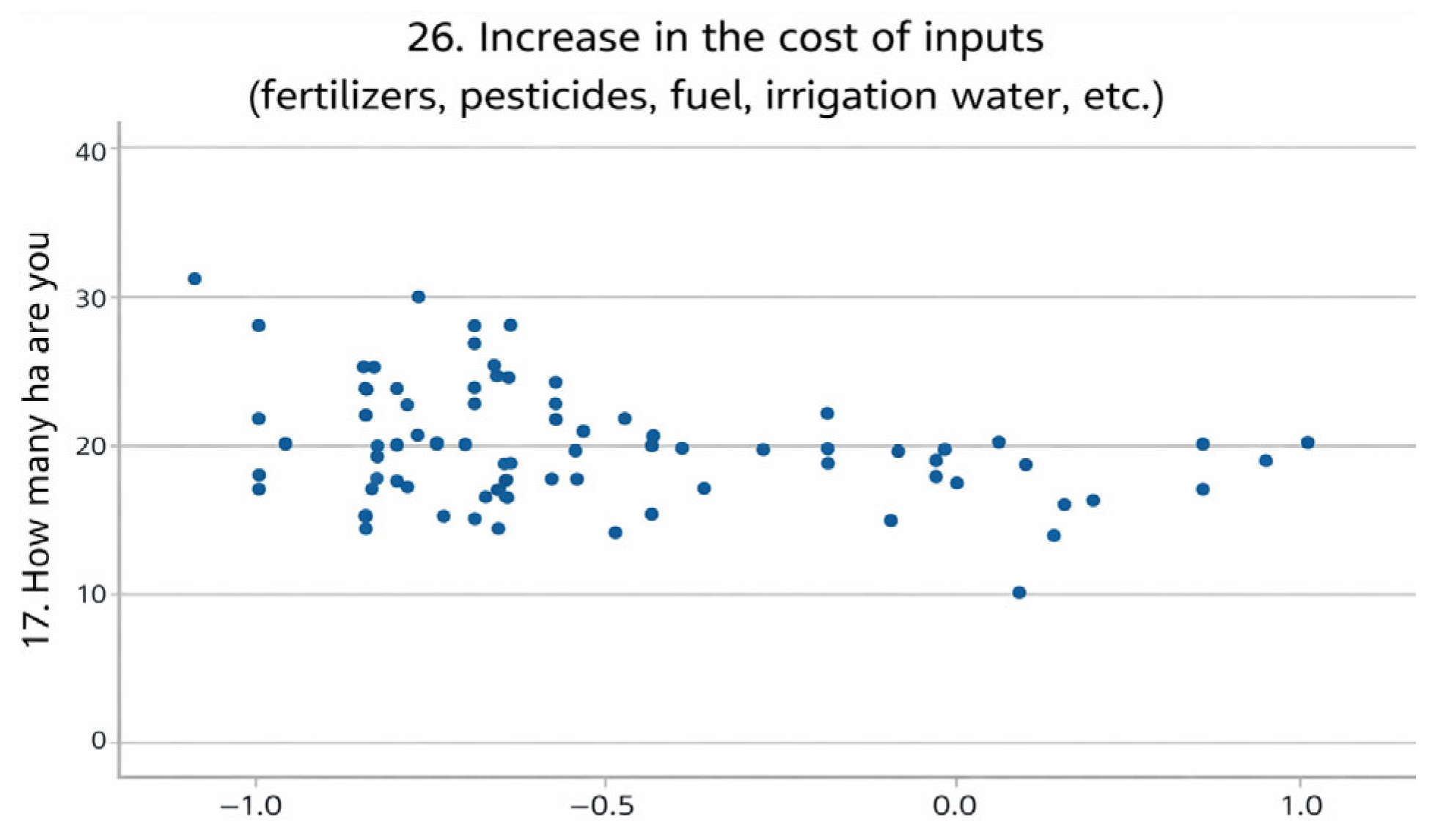
The multiple linear regression analysis revealed two statistically significant negative correlations between the two independent variables related to difficulty factors and farm size, with the dependent variable being “How many ha are you cultivating this year?”. The increase in input costs is associated with a reduction in cultivated land by 69.558 ha (p = 0.005 < 0.05), indicating that as the prices of inputs rise, the area under cultivation decreases (Figure 1). This suggests that due to higher expenses for fertilizers, pesticides, and fuel, farmers may reduce their cultivated land to lower their operational costs. The data exhibit considerable dispersion, indicating that the effect of rising input costs on cultivated area is not entirely linear. There are cases of large cultivated areas despite increased input costs, suggesting that other factors may influence farmers’ decisions. The fact that the relationship is statistically significant but with high variability means that the increase in input prices explains part of the reduction in cultivated land, but not all of it.
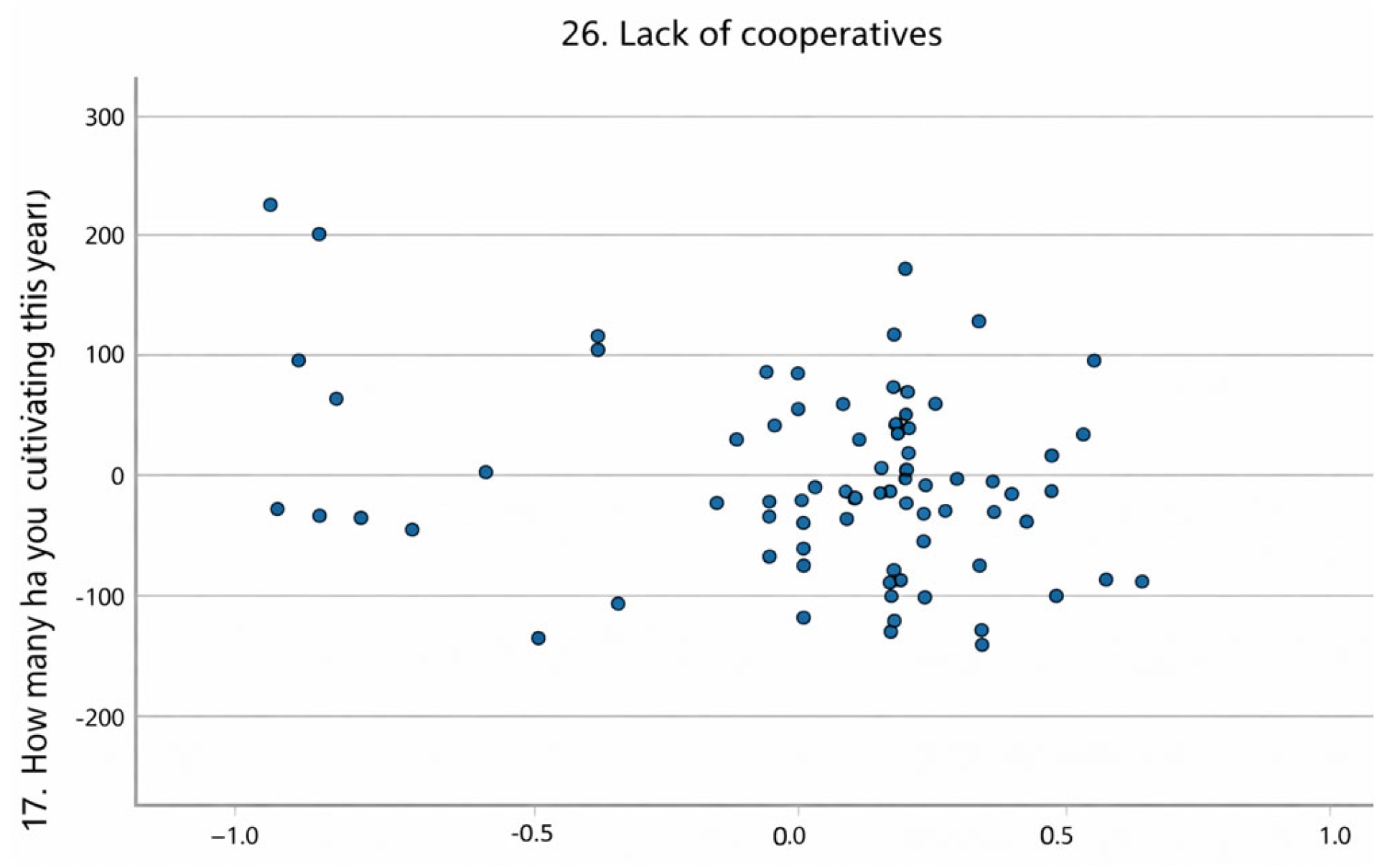
On the other hand, the absence of cooperative structures leads to an additional reduction of 59.591 ha, a statistically significant effect with a negative relationship (p = 0.038 < 0.05). Specifically, for each unit increase in the lack of cooperatives (B = −59.591), the cultivated area decreases by 59.591 ha (Figure 2). The dispersion of the data points suggests that the relationship is not strictly linear; however, the statistical significance of the result indicates that the lack of cooperative structures is a key factor contributing to the reduction in cultivated land.
The results show that when farmers lack sufficient resources or institutional support, a decline in their productive activity is observed. This highlights the importance of cooperatives and other forms of support.

4. Discussion

Producers’ decisions are influenced by socio-economic factors, such as educational level, income, age, and farm size [15]. These factors influence the adoption of innovations, the use of advisory information sources, and attitudes toward sustainable agricultural practices. The difficulties reported by farmers are directly related to their socio-economic profiles, while the lack of institutional support and organized structures limits their capacity for adaptation and discourages investment activity [16]. The strategy followed by the producer is not a decision made at random or without reason, but is influenced by the complex institutional, economic and social environment in which producers operate [17].

5. Conclusions

Farmers in the Prefecture of Imathia are facing significant challenges as a result of the impacts of climate change, which shows how necessary it is to strengthen the resilience and sustainability of agricultural holdings. Agricultural advisory services emerge as a critical tool for adaptation; however, the agricultural workforce in the area continues to face major barriers in adopting innovations, primarily economic, institutional, and technological. The main reported difficulties include increased production costs, price volatility of agricultural products, and lack of access to modern technologies and financial tools. Furthermore, limited participation in collective structures such as cooperatives, along with low utilization of advisory services, exacerbates the inability to adapt. Therefore, the adoption of targeted support policies and the development of appropriate infrastructure are essential to promoting sustainable agriculture at the local level.
For the agricultural sector in Imathia—and in similar regions—to become more sustainable and resilient, a comprehensive policy is needed that takes into account the real needs of producers. Promoting the digital transformation of agriculture can significantly contribute to optimizing production processes and boosting competitiveness. At the same time, simplifying subsidy procedures and the “ease” of financial support are critical conditions for improving liquidity and investment willingness Moreover, alternative forms of financing can provide solutions in cases where existing banks do not meet the needs of producers. Supporting cooperatives and producer groups—especially for achieving economies of scale and reducing production costs is also of vital importance. A central pillar of intervention should be the systematic training of farmers in new technologies and sustainable agricultural practices through organized training programs. Comprehensive development of comprehensive advisory services and supportive infrastructure will provide the necessary technical and scientific guidance for modernizing the sector. Policy recommendations should be tailored to local contexts, reflecting the specific socio-economic characteristics of farmers in Imathia, rather than generalized to the entire agricultural sector.

Author Contributions

Conceptualization, G.K. and E.G.; methodology, G.K. and E.G.; software, E.G.; validation, G.K. and E.G.; formal analysis, G.K. and E.G.; investigation, E.G.; resources, E.G.; data curation, G.K.; writing—original draft preparation, E.G.; writing—review and editing, E.G.; visualization, E.G.; supervision, G.K. All authors have read and agreed to the published version of the manuscript.

Funding

This research received no external funding.

Institutional Review Board Statement

Ethical review and approval were waived for this study, as no institutional review board was available at the time of data collection. The study was conducted in accordance with the principles of the Declaration of Helsinki. Participants were informed about the purpose of the research and voluntarily agreed to participate. Anonymity and confidentiality were strictly maintained.

Informed Consent Statement

Informed consent was obtained from all subjects involved in the study.

Data Availability Statement

The data supporting the findings of this study are available from the corresponding author upon reasonable request. To protect participants’ privacy, interview transcripts cannot be shared publicly.

Conflicts of Interest

The authors declare no conflicts of interest.

References

  1. Tramblay, Y.; Llasat, M.; Randin, C.; Coppola, E. Climate Change Impacts on Water Resources in the Mediterranean. Reg. Environ. Change 2020, 20, 1–15. [Google Scholar] [CrossRef]
  2. Karamanos, A.; Skourtos, M.; Voloudakis, D.; Kontogianni, A.; Machleras, A. Impacts of Climate Change on Agriculture. In The Environmental, Economic and Social Impacts of Climate Change in Greece; Bank of Greece: Athens, Greece, 2011; pp. 186–196. Available online: https://www.researchgate.net/publication/283407110_Impacts_of_climate_change_on_agriculture/references (accessed on 10 September 2025).
  3. Dalezios, N. Climate Change and Agriculture. In Agrometeorology: Analysis and Simulation; Dalezios, N., Ed.; Kallipos, Open Academic Editions: Athens, Greece, 2015; Available online: https://hdl.handle.net/11419/3739 (accessed on 10 September 2025).
  4. Kartalis, K.; Kokkosis, H.; Oikonomou, D.; Santamouris, M.; Agathangelidis, H.; Polydoros, A. The Impacts of Climate Change on Development: Key Findings of the Study; DIANEOSIS: Athens, Greece, 2017; Available online: https://www.dianeosis.org/wp-content/uploads/2017/06/executive-summary_climate_change.pdf (accessed on 10 September 2025).
  5. Georgopoulou, E.; Gakis, N.; Kapetanakis, D.; Voloudakis, D.; Markaki, M.; Sarafidis, Y.; Lalas, D.; Laliotis, G.; Akamati, K.; Bizelis, I.; et al. Climate Change Risks for the Mediterranean Agri-Food Sector: The Case of Greece. Agriculture 2024, 14, 770. [Google Scholar] [CrossRef]
  6. Gkiza, I. Economic Impacts of Climate Change on Cereal Crops: Application of a Spatial Econometric Model. Ph.D. Thesis, National and Kapodistrian University of Athens, Athens, Greece, 2021. [Google Scholar] [CrossRef]
  7. Abnett, K.; Blenkinsop, P. EU Plans to Restrict Imported Crops Treated with Banned Pesticides, Draft Shows. Reuters. 18 February 2025. Available online: https://www.reuters.com/markets/europe/eu-plans-restrict-imported-crops-treated-with-banned-pesticides-draft-shows-2025-02-18/ (accessed on 8 September 2025).
  8. Boulimpasis, D. The Environmental and Health Impacts of Intensive Use of Plant Protection Products. Master’s Thesis, Aristotle University of Thessaloniki, Thessaloniki, Greece, 2023. Available online: https://ikee.lib.auth.gr/record/346506/files/GRI-2023-38609.pdf (accessed on 8 September 2025).
  9. Yépez, C.; Dzkipe, F. Accounting for Real Exchange Rates in Emerging Economies: The Role of Commodity Prices. Int. Rev. Econ. Finance 2022, 79, 234–245. [Google Scholar] [CrossRef]
  10. Batzios, A.; Kontogeorgos, A.; Chatzitheodoridis, F.; Sergaki, P. What Makes Producers Participate in Marketing Cooperatives? The Northern Greece Case. Sustainability 2021, 13, 1676. [Google Scholar] [CrossRef]
  11. Kountios, G.; Konstantinidis, C.; Antoniadis, I. Can the Adoption of ICT and Advisory Services Be Considered as a Tool of Competitive Advantage in Agricultural Holdings? A Literature Review. Agronomy 2023, 13, 530. [Google Scholar] [CrossRef]
  12. Naresh, M.; Munaswamy, P. Smart Agriculture System Using IoT Technology. Int. J. Recent Technol. Eng. 2019, 7, 98–102. Available online: https://www.researchgate.net/publication/331148330_Smart_agriculture_system_using_IoT_technology (accessed on 10 September 2025).
  13. Prager, K.; Creaney, R.; Lorenzo-Arribas, A. Criteria for a System Level Evaluation of Farm Advisory Services. Land Use Policy 2017, 61, 86–98. [Google Scholar] [CrossRef]
  14. Stræte, E.; Hansen, B.; Ystad, E.; Kvam, G. Social Integration Mechanisms to Strengthen Absorptive Capacity in Agricultural Advisory Service Organisations. J. Agric. Educ. Ext. 2022, 29, 395–416. [Google Scholar] [CrossRef]
  15. Fan, X.; Wang, Y.; Dai, M. The Influencing Factors of Farming Households’ Production Decisions. In Proceedings of the 4th International Conference on Economic Management and Model Engineering, Guangzhou, China, 26–28 December 2022. [Google Scholar] [CrossRef]
  16. Cecconello, E.; Moro, L.; Foguesatto, C.; Breichtenbach, R.; Neckel, A.; Spanhol, C.; Vieira-Filho, J.; Mores, G. Challenges and Potentialities of Sustainability in the Institutional Food Market of Family Farming. Sustainability 2023, 15, 15796. [Google Scholar] [CrossRef]
  17. Surkova, V. Improvement of the Institutional Environment for the Innovative Development of Agricultural Enterprises. Herald Khmelnytskyi Natl. Univ. Econ. Sci. 2022, 312, 59–66. [Google Scholar] [CrossRef] [PubMed]
Figure 1. Partial Regression Plot.
Proceedings 134 00022 g001
Figure 2. Partial Regression Plot.
Proceedings 134 00022 g002
Table 1. Chi-Square test-Innovation/Education Level.
Innovation/Education LevelPearson Chi-SquaredfAsymptotic Significance (2-Sided)
Purchase of a tractor14.65160.023
Purchase of a computer13.03260.043
Purchase of a GPS device12.87860.045
Reference: Processing questionnaire data.
Table 2. Chi-Square test-Innovation/Agricultural Income.
Innovation/Agricultural IncomePearson Chi-SquaredfAsymptotic Significance (2-Sided)
Purchase of a tractor15.24150.009
Purchase of agricultural implements20.66150.001
Construction of infrastructure18.24250.003
Installation of irrigation systems (pipes, drip irrigation)15.49150.008
Reference: Processing questionnaire data.
Disclaimer/Publisher’s Note: The statements, opinions and data contained in all publications are solely those of the individual author(s) and contributor(s) and not of MDPI and/or the editor(s). MDPI and/or the editor(s) disclaim responsibility for any injury to people or property resulting from any ideas, methods, instructions or products referred to in the content.