


Abstract
Cavity optomechanics have become a promising route towards the development of ultrasensitive sensors for a wide range of applications including mass, chemical and biological sensing. We demonstrate the potential of Very Large Scale Integration (VLSI) with state-of-the-art low-loss performance silicon optomechanical microdisks for real-world applications. We report microdisks exhibiting optical Whispering Gallery Modes (WGM) with 1 million quality factors. These high-Q microdisks allow their Brownian motion to be resolved at few 100 MHz in ambient air. Such performance shows our VLSI process is a viable approach for the next generation of high-end sensors operating in vacuum, gas or liquid phase.
1. Introduction
Nano-optomechanical resonators have attracted much interest in the last decade and have shown record displacement sensitivities [1]. On-chip cavity optomechanics has been a privileged route towards quantum studies [2] and has now become mature enough to reach a more applied realm, like mass [3] or chemical [4] sensing, as well as operation in liquid [5]. In cavity optomechanics, displacement sensitivity is proportional to optical quality factor and disk resonators are canonical objects for experimental—and optical performance demonstration [6,7]. Industrial applications however, will require reaching state-of-the-art performance with VLSI processes and packaging.
2. Fabrication
We show here silicon optomechanical microdisks fabricated in an industrial-grade clean-room on 200 mm SOI wafers (Figure 1). The fabrication process of these resonators is illustrated in Figure 2. The disks were fabricated from SOI wafers with 220 nm thick top layer. Partial silicon etching was first performed to pattern grating couplers (Figure 2a). A second lithography level was performed by Variable Shape Beam (VSB) and the optical waveguides and resonators were patterned by Induced Coupled Plasma (ICP) dry etching (Figure 2b). Resist exposure with VSB as well as the ICP process were optimized in order to minimize silicon wall roughness. Finally, disks were released using vapor HF etching (Figure 2c). Typical disk dimensions range from 2 to 20 µm in radius, with optical gaps of a few hundred nm.
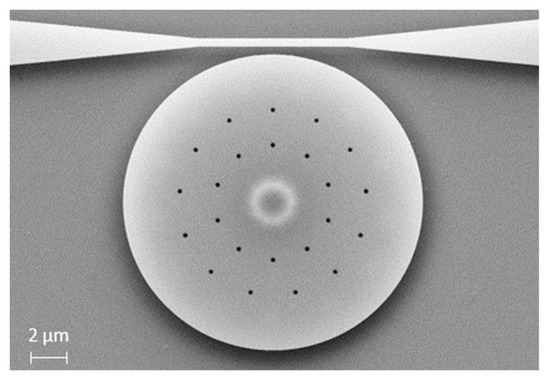
Figure 1.
Scanning electron microscope image of a Si optomechanical disk with an 8 µm radius and its tapered waveguide. The black circles are release holes.
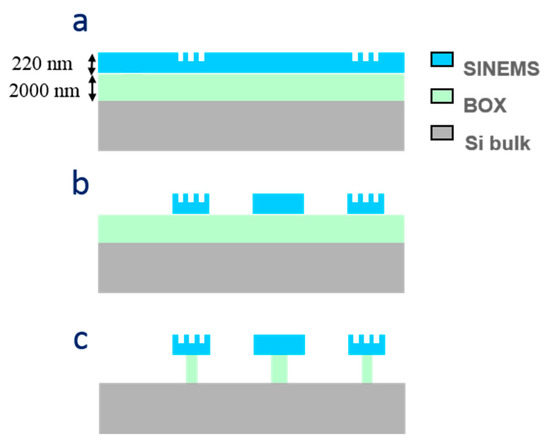
Figure 2.
Fabrication process of the optomechanical devices. (a) Partial silicon ICP etching to pattern grating couplers; (b) Patterning of the optical waveguides and microdisk resonators by ICP etching; (c) Microdisks release using vapor HF etching.
On-chip light coupling is compatible with standard silicon photonics packaging and uses grating couplers. The devices are the first optomechanical resonators fabricated on 200 mm wafers with Variable Shaped Beam (VSB) lithography, allowing for both high fabrication throughput and high patterning resolution: each wafer contains more than 120,000 optomechanical devices.
3. Results
Our optomechanical set-up is described in Figure 3. It consists of a tunable external cavity laser (with wavelength around 1.55 µm), a fiber polarization control (FPC), a lock-in amplifier and a low-noise, variable gain photodetector (PD). The laser wavelength was swept to obtain optical spectra.
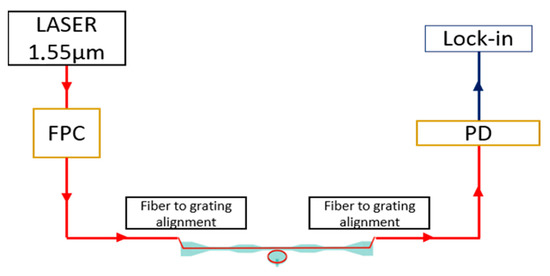
Figure 3.
Figure 3. Schematics of the optomechanical setup.
Typical examples of optical WGM close to 1.55 µm wavelength are shown in Figure 4. Most measured loaded quality factors are in the high 100,000 s, and many resonances show quality factors above 1 million. These figures are among the best measured in the literature with silicon disks of a few µm radius [6]. We attribute this to the very low silicon roughness obtained with our specifically developed lithography and etching processes.
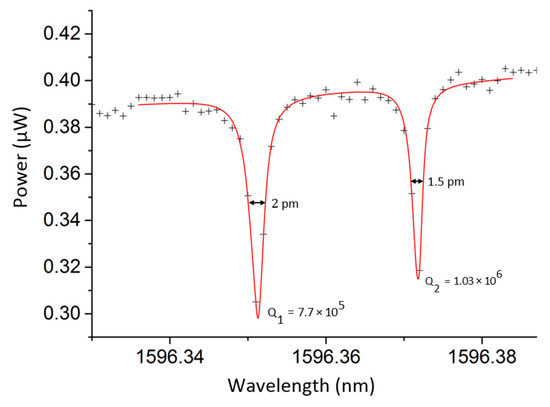
Figure 4.
Narrowband transmission spectrum of an 8 µm radius disk with high loaded optical quality factor WGM doublets.
Such high-Q microdisks show a strong coupling between optical WGMs and Radial Breathing Modes (RBM). We were able to resolve the thermomechanical motion of our resonators at a few 100 MHz frequencies at ambient pressure (Figure 5).
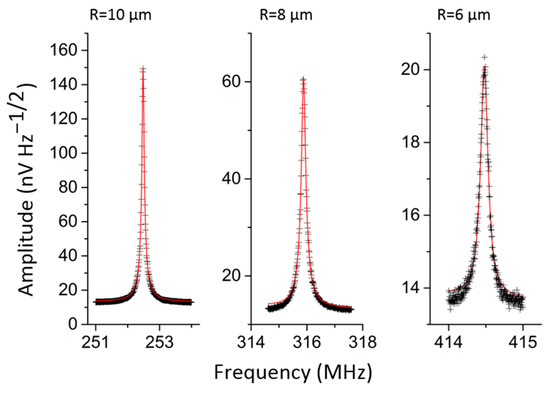
Figure 5.
Thermomechanical spectra of three different disks vibrating in air. Mechanical resonances are observed at 252.5 MHz (R = 10 µm), 315.9 MHz (R = 8 µm) and 414.5 MHz (R = 6 µm) with mechanical quality factors (Qm) of 4115, 2141 and 3778 respectively.
Sufficient signal to noise ratio was obtained without the need for an optical amplifier while the optical power was kept low (100 s of nW at the device output) in order to limit thermo-optical and back-action effects. Indeed, with such high Qs, the resonator operates in the good cavity (sideband-resolved) regime: strong back-action with blue- or red-detuned operation can be expected. These results show our VLSI process is a promising route towards real-world sensors with optomechanical devices operating in vacuum, gas or liquid medium.
Acknowledgments
This work was supported by the ERC Enlightened grant, the Carnot LETI Oppladiag project and the ANR Olympia project.
Conflicts of Interest
The authors declare no conflict of interest.
References
- Ding, L.; Baker, C.; Senellart, P.; Lemaitre, A.; Ducci, S.; Leo, G.; Favero, I. Wavelength-sized GaAs optomechanical resonators with gigahertz frequency. Appl. Phys. Lett. 2011, 98, 113108. [Google Scholar] [CrossRef]
- Aspelmeyer, M.; Meystre, P.; Schwab, K. Quantum optomechanics. Phys. Today 2012, 65. [Google Scholar] [CrossRef]
- Liu, F.; Alaie, S.; Leseman, Z.C.; Hossein-Zadeh, M. Sub-pg mass sensing and measurement with an optomechanical oscillator. Opt. Express 2013, 21, 19555. [Google Scholar] [CrossRef] [PubMed]
- Venkatasubramanian, A.; Sauer, V.T.K.; Roy, S.K.; Xia, M.; Wishart, D.S.; Hiebert, W.K. Nano-Optomechanical Systems for Gas Chromatography. Nano Lett. 2016. [Google Scholar] [CrossRef] [PubMed]
- Gil-Santos, E.; Baker, C.; Nguyen, D.T.; Hease, W.; Gomez, C.; Lemaître, A.; Ducci, S.; Leo, G.; Favero, I. High-frequency nano-optomechanical disk resonators in liquids. Nat. Nanotechnol. 2015, 10, 810–816. [Google Scholar] [CrossRef] [PubMed]
- Borselli, M.; Johnson, T.; Painter, O. Beyond the Rayleigh scattering limit in high-Q silicon microdisks: Theory and experiment. Opt. Express 2005, 13, 1515–1530. [Google Scholar] [CrossRef] [PubMed]
- Sun, X.; Zhang, X.; Tang, H.X. High-Q silicon optomechanical microdisk resonators at gigahertz frequencies. Appl. Phys. Lett. 2012, 100, 173116. [Google Scholar] [CrossRef]
Publisher’s Note: MDPI stays neutral with regard to jurisdictional claims in published maps and institutional affiliations. |
© 2017 by the authors. Licensee MDPI, Basel, Switzerland. This article is an open access article distributed under the terms and conditions of the Creative Commons Attribution (CC BY) license (https://creativecommons.org/licenses/by/4.0/).