


The authors wish to make the following corrections to this paper [1]:
- There are mistakes in this article about the percentage of positive IgM in JSF and ST because the number was based on the cut-off ≥40, not ≥320. On page 3, line 3–4, the sentence “high IgM titer of ≥320 against R. japonica was seen only in 9.7% (15/154) of JSF cases in the acute phase, whereas that against O. tsutsugamushi was seen in 73.2% (101/138) of ST cases” should be “high IgM titer of ≥320 against R. japonica was seen only in 5.2% (8/154) of JSF cases in the acute phase, whereas that against O. tsutsugamushi was seen in 47.1% (65/138) of ST cases”.
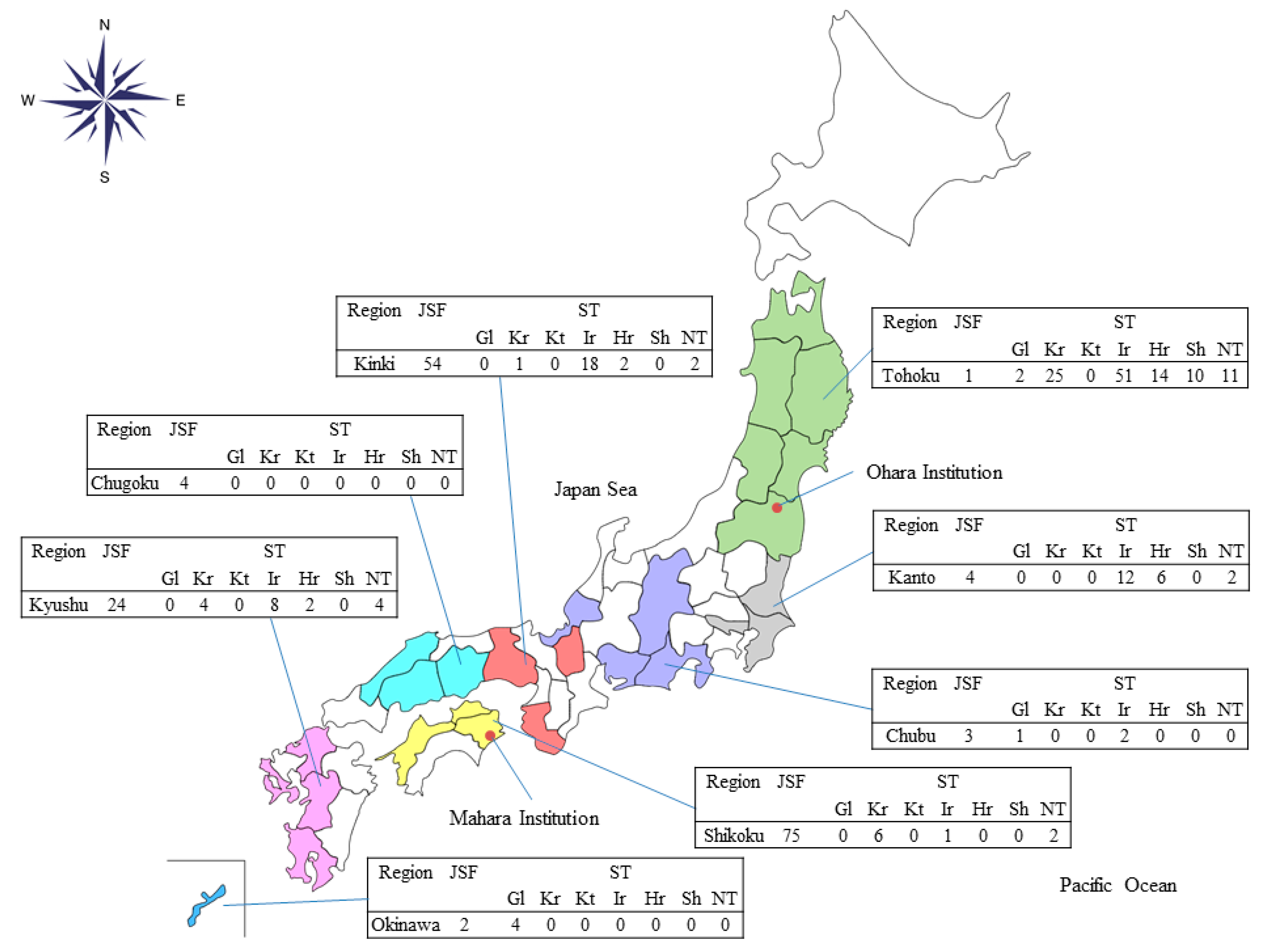
- The authors of Reference [1] wish to replace Figure 3 with the following:
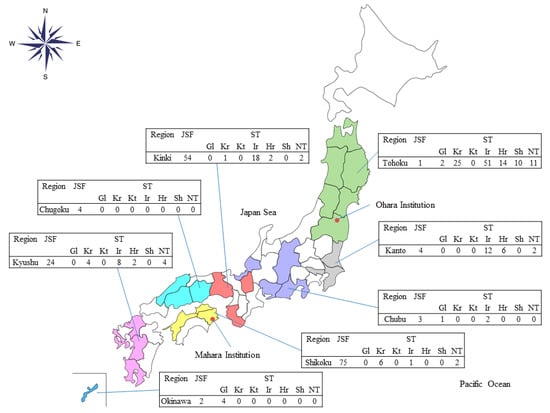 Figure 3. The number of cases serologically diagnosed as Japanese spotted fever or scrub typhus (serotypes) in each Japanese region at the reference centers. Abbreviation: JSF, Japanese spotted fever; ST, scrub typhus; Gl, Gilliam; Kr, Karp; Kt, Kato; Ir, Irie/Kawasaki; Hr, Hirano/Kuroki; Sh, Shimokoshi; NT, non-typeable; Ohara Institution, Ohara Research Laboratory, Ohara General Hospital; Mahara Institution, Mahara Institute of Medical Acarology.
In this corrected figure, the number of each disease has changed in some areas because the number was based on the cut-off ≥40, not ≥320.
These changes have no material impact on the conclusions of our paper. The authors would like to apologize for any inconvenience caused to the readers by these changes.
References
- Sando, E.; Ariyoshi, K.; Fujita, H. Serological Cross-Reactivity among Orientia tsutsugamushi Serotypes but Not with Rickettsia japonica in Japan. Trop. Med. Infect. Dis. 2018, 3, 74. [Google Scholar] [CrossRef] [PubMed]
© 2018 by the authors. Licensee MDPI, Basel, Switzerland. This article is an open access article distributed under the terms and conditions of the Creative Commons Attribution (CC BY) license (http://creativecommons.org/licenses/by/4.0/).