

Skip to Content

International Journal of Neonatal Screening, Volume 10, Issue 3

2024 September - 23 articles

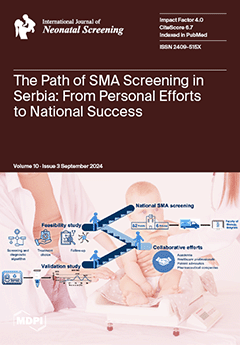
Cover Story: Through a stepwise approach—validating a newborn screening (NBS) assay, collaborating with patient organizations, healthcare professionals, and pharmaceutical companies, conducting a comprehensive feasibility study, and engaging public health representatives—we have transformed our strategy for the prevention of spinal muscular atrophy (SMA). The 17-month feasibility study yielded remarkable results, culminating in the integration of NBS for SMA into the national program on September 15, 2023. Since then, 54,393 newborns have been screened, identifying six SMA cases and providing them with critical early intervention. This work underscores the vital role of collaboration among academia, patient advocates, and industry, demonstrating that, together, we can achieve impactful outcomes for families in need and pave the way for a healthier future. View this paper
  • Issues are regarded as officially published after their release is announced to the table of contents alert mailing list .
  • You may sign up for email alerts to receive table of contents of newly released issues.
  • PDF is the official format for papers published in both, html and pdf forms. To view the papers in pdf format, click on the "PDF Full-text" link, and use the free Adobe Reader to open them.

Articles (23)

  • Article
  • Open Access
1 Citations
2,445 Views
11 Pages

From 2008 to 2024, the Newborn Screening Translational Research Network (NBSTRN), part of the National Institute of Child Health and Human Development (NICHD) Hunter Kelly Newborn Screening Program, served as a robust infrastructure to facilitate gro...

  • Article
  • Open Access
2 Citations
3,153 Views
10 Pages

Managing Newborn Screening Repeat Collections for Sick and Preterm Neonates

  • Ronda F. Greaves,
  • Jo-Ann Northfield,
  • Lauren Cross,
  • Nazha Mawad,
  • Thanh Nguyen,
  • Maggie Tan,
  • Michele A. O’Connell and
  • James Pitt

Some preterm and sick neonates have altered biochemical profiles and follow-up newborn screening (NBS) collections are recommended. The Victorian NBS program historically recommended repeat collections for babies with birth weight < 1500 g (manage...

  • Systematic Review
  • Open Access
17 Citations
9,894 Views
14 Pages

Wilson and Jungner Revisited: Are Screening Criteria Fit for the 21st Century?

  • Elena Schnabel-Besson,
  • Ulrike Mütze,
  • Nicola Dikow,
  • Friederike Hörster,
  • Marina A. Morath,
  • Karla Alex,
  • Heiko Brennenstuhl,
  • Sascha Settegast,
  • Jürgen G. Okun and
  • Stefan Kölker
  • + 2 authors

Driven by technological innovations, newborn screening (NBS) panels have been expanded and the development of genomic NBS pilot programs is rapidly progressing. Decisions on disease selection for NBS are still based on the Wilson and Jungner (WJ) cri...

  • Article
  • Open Access
1 Citations
2,092 Views
15 Pages

Understanding whether the long-term follow-up (LTFU) system is working for families is critical to measuring the success of newborn screening (NBS) and understanding why some families are lost to follow-up. Caregivers were recruited from six pediatri...

  • Article
  • Open Access
3 Citations
3,291 Views
13 Pages

Consistency in the Assessment of Dried Blood Spot Specimen Size and Quality in U.K. Newborn Screening Laboratories

  • Stuart J. Moat,
  • James R. Bonham,
  • Christine Cavanagh,
  • Margaret Birch,
  • Caroline Griffith,
  • Lynette Shakespeare,
  • Clare Le Masurier,
  • Claire Manfredonia,
  • Beverly Hird and
  • Lesley Tetlow
  • + 15 authors

In 2015, U.K. newborn screening (NBS) laboratory guidelines were introduced to standardize dried blood spot (DBS) specimen quality acceptance and specify a minimum acceptable DBS diameter of ≥7 mm. The UK ‘acceptable’ avoidable repeat...

  • Article
  • Open Access
2 Citations
3,017 Views
8 Pages

Clinical, Biochemical, and Molecular Characteristics of Filipino Patients with Tyrosinemia Type 1

  • Barbra Charina V. Cavan,
  • Leniza G. de Castro-Hamoy,
  • Conchita G. Abarquez,
  • Ebner Bon G. Maceda and
  • Maria Melanie Liberty B. Alcausin

Hereditary tyrosinemia type I (HT1), or hepatorenal tyrosinemia, is an amino acid disorder which may cause hepatic failure as well as renal and neurologic comorbidities. Early detection of this disorder is possible with newborn screening (NBS). The o...

  • Article
  • Open Access
15 Citations
3,334 Views
10 Pages

In the United States (U.S.), newborn screening (NBS) for spinal muscular atrophy (SMA) is implemented by individual states. There is likely variation in the practice patterns of state NBS programs and among the providers caring for newborns with SMA....

  • Article
  • Open Access
3 Citations
2,975 Views
11 Pages

Our Journey from Individual Efforts to Nationwide Support: Implementing Newborn Screening for Spinal Muscular Atrophy in Serbia

  • Miloš Brkušanin,
  • Nemanja Garai,
  • Jelena Karanović,
  • Tamara Šljivančanin Jakovljević,
  • Aleksandra Dimitrijević,
  • Kristina Jovanović,
  • Tanja Lazić Mitrović,
  • Željko Miković,
  • Goran Brajušković and
  • Dušanka Savić-Pavićević
  • + 1 author

Innovative treatments for spinal muscular atrophy (SMA) yield the utmost advantages only within the presymptomatic phase, underlining the significance of newborn screening (NBS). We aimed to establish statewide NBS for SMA in Serbia. Our stepwise imp...

  • Systematic Review
  • Open Access
20 Citations
5,456 Views
34 Pages

Systematic Review of Presymptomatic Treatment for Spinal Muscular Atrophy

  • Katy Cooper,
  • Gamze Nalbant,
  • Anthea Sutton,
  • Sue Harnan,
  • Praveen Thokala,
  • Jim Chilcott,
  • Alisdair McNeill and
  • Alice Bessey

Spinal muscular atrophy (SMA) causes the degeneration of motor neurons in the spinal cord. Treatments including nusinersen, risdiplam, and onasemnogene abeparvovec have been shown to be effective in reducing symptoms, with recent studies suggesting g...

  • Article
  • Open Access
1 Citations
2,033 Views
15 Pages

Continuity of Operations in Newborn Screening: Lessons Learned from Three Incidents

  • M. Christine Dorley,
  • Elizabeth Bair,
  • Patricia Ryland,
  • Amanda D. Ingram,
  • Emily Reeves,
  • Kara J. Levinson,
  • Ona O. Adair,
  • Jenny F. Meredith and
  • Susanne Crowe

Three incidents that impacted two US newborn screening (NBS) programs highlight the importance of contingency planning for the continuity of operations (COOP). Other NBS programs may benefit from the experience of these state programs for their own c...

  • Article
  • Open Access
2 Citations
4,904 Views
10 Pages

A Five-Year Review of Newborn Screening for Spinal Muscular Atrophy in the State of Utah: Lessons Learned

  • Kristen N. Wong,
  • Melissa McIntyre,
  • Sabina Cook,
  • Kim Hart,
  • Amelia Wilson,
  • Sarah Moldt,
  • Andreas Rohrwasser and
  • Russell J. Butterfield

Spinal muscular atrophy (SMA) is an autosomal recessive condition characterized by alpha motor neuron degeneration in the spinal cord anterior horn. Clinical symptoms manifest in the first weeks to months of life in the most severe cases, resulting i...

  • Case Report
  • Open Access
1 Citations
2,320 Views
7 Pages

Biochemical Pattern of Methylmalonyl-CoA Epimerase Deficiency Identified in Newborn Screening: A Case Report

  • Evelina Maines,
  • Roberto Franceschi,
  • Francesca Rivieri,
  • Giovanni Piccoli,
  • Björn Schulte,
  • Jessica Hoffmann,
  • Andrea Bordugo,
  • Giulia Rodella,
  • Francesca Teofoli and
  • Marta Camilot
  • + 2 authors

Methylmalonyl-CoA epimerase enzyme (MCEE) is responsible for catalyzing the isomeric conversion between D- and L-methylmalonyl-CoA, an intermediate along the conversion of propionyl-CoA to succinyl-CoA. A dedicated test for MCEE deficiency is not inc...

  • Article
  • Open Access
3 Citations
3,651 Views
11 Pages

Impact of Lowering TSH Cut-Off on Neonatal Screening for Congenital Hypothyroidism in Minas Gerais, Brazil

  • Nathalia Teixeira Palla Braga,
  • Jáderson Mateus Vilela Antunes,
  • Enrico Antônio Colosimo,
  • Vera Maria Alves Dias,
  • José Nélio Januário and
  • Ivani Novato Silva

A higher incidence of primary congenital hypothyroidism (CH) has been related to increased sensitivity in neonatal screening tests. The benefit of treatment in mild cases remains a topic of debate. We evaluated the impact of reducing the blood-spot T...

  • Article
  • Open Access
5 Citations
3,102 Views
10 Pages

CDC’s Laboratory Activities to Support Newborn Screening for Spinal Muscular Atrophy

  • Francis K. Lee,
  • Christopher Greene,
  • Kristina Mercer,
  • Jennifer Taylor,
  • Golriz Yazdanpanah,
  • Robert Vogt,
  • Rachel Lee,
  • Carla Cuthbert and
  • Suzanne Cordovado

Spinal muscular atrophy (SMA) was added to the HHS Secretary’s Recommended Uniform Screening Panel for newborn screening (NBS) in 2018, enabling early diagnosis and treatment of impacted infants to prevent irreversible motor neuron damage. In a...

  • Article
  • Open Access
4 Citations
2,538 Views
9 Pages

One-Year Pilot Study Results of Newborn Screening for Spinal Muscular Atrophy in the Republic of Croatia

  • Darija Šimić,
  • Ana Šarić,
  • Ana Škaričić,
  • Ivan Lehman,
  • Branka Bunoza,
  • Ivana Rako and
  • Ksenija Fumić

Spinal muscular atrophy (SMA) is a neuromuscular and neurodegenerative disease caused by the homozygous deletion of SMN1 exon 7 in 95% of cases. The prognosis for SMA patients has improved with the development of disease-modifying therapies, all of w...

  • Systematic Review
  • Open Access
25 Citations
7,448 Views
33 Pages

Systematic Review of Newborn Screening Programmes for Spinal Muscular Atrophy

  • Katy Cooper,
  • Gamze Nalbant,
  • Anthea Sutton,
  • Sue Harnan,
  • Praveen Thokala,
  • Jim Chilcott,
  • Alisdair McNeill and
  • Alice Bessey

Spinal muscular atrophy (SMA) is a genetic neuromuscular disorder causing the degeneration of motor neurons in the spinal cord. Recent studies suggest greater effectiveness of treatment in the presymptomatic stage. This systematic review synthesises...

  • Article
  • Open Access
2,934 Views
9 Pages

Sex chromosome aneuploidies (SCAs) collectively occur in 1 in 500 livebirths, and diagnoses in the neonatal period are increasing with advancements in prenatal and early genetic testing. Inevitably, SCA will be identified on either routine prenatal o...

  • Article
  • Open Access
6 Citations
2,781 Views
9 Pages

Counting Conditions on Newborn Bloodspot Screening Panels in Australia and New Zealand

  • Natasha Heather,
  • Ronda F. Greaves,
  • Kaustuv Bhattacharya,
  • Lawrence Greed,
  • James Pitt,
  • Carol Wai-Kwan Siu,
  • Mark de Hora,
  • Ricky Price,
  • Enzo Ranieri and
  • Dianne Webster
  • + 1 author

A greater number of screened conditions is often considered to equate to better screening, whereas it may be due to conditions being counted differently. This manuscript describes a harmonised Australasian approach to listing target conditions found...

  • Article
  • Open Access
2 Citations
1,978 Views
15 Pages

Evaluation of the Newborn Screening Pilot for Sickle Cell Disease in Suriname Using the Non-Adoption, Abandonment, Scale-Up, Spread, and Sustainability (NASSS) Framework

  • Ming-Jan Tang,
  • Jimmy Roosblad,
  • John Codrington,
  • Marjolein Peters,
  • Aartie Toekoen,
  • Patrick F. van Rheenen and
  • Amadu Juliana

The early detection of sickle cell disease (SCD) is vital to reduce mortality among affected children. Suriname currently lacks a newborn screening programme (NSP) for SCD. We performed a pilot programme to evaluate the scalability of such an initiat...

  • Article
  • Open Access
4 Citations
4,685 Views
21 Pages

Exploring the Cost-Effectiveness of Newborn Screening for Metachromatic Leukodystrophy (MLD) in the UK

  • Karen Bean,
  • Simon A. Jones,
  • Anupam Chakrapani,
  • Suresh Vijay,
  • Teresa Wu,
  • Heather Church,
  • Charlotte Chanson,
  • Andrew Olaye,
  • Beckley Miller and
  • Francis Pang
  • + 1 author

Metachromatic leukodystrophy (MLD) is a fatal inherited lysosomal storage disease that can be detected through newborn bloodspot screening. The feasibility of the screening assay and the clinical rationale for screening for MLD have been previously d...

  • Review
  • Open Access
2 Citations
2,953 Views
11 Pages

One Size Does Not Fit All: A Multifaceted Approach to Educate Families about Newborn Screening

  • Marianna H. Raia,
  • Molly M. Lynch,
  • Alyson C. Ward,
  • Jill A. Brown,
  • Natasha F. Bonhomme and
  • Vicki L. Hunting

All families deserve access to readily available, accurate, and relevant information to help them navigate the newborn screening system. Current practices, limited resources, and a siloed newborn screening system create numerous challenges for both p...

  • Opinion
  • Open Access
7 Citations
4,011 Views
8 Pages

Integrating health interventions in a growing economy like India, with a birth cohort of 27 million/year, one-fifth of all childbirths, and approximately one-third of neonatal deaths globally, is a challenge. While mortality statistics are vital, int...

  • Review
  • Open Access
9 Citations
4,764 Views
17 Pages

The Multi-Omic Approach to Newborn Screening: Opportunities and Challenges

  • Alex J. Ashenden,
  • Ayesha Chowdhury,
  • Lucy T. Anastasi,
  • Khoa Lam,
  • Tomas Rozek,
  • Enzo Ranieri,
  • Carol Wai-Kwan Siu,
  • Jovanka King,
  • Emilie Mas and
  • Karin S. Kassahn

Newborn screening programs have seen significant evolution since their initial implementation more than 60 years ago, with the primary goal of detecting treatable conditions within the earliest possible timeframe to ensure the optimal treatment and o...

Get Alerted

Add your email address to receive forthcoming issues of this journal.

XFacebookLinkedIn
Int. J. Neonatal Screen. - ISSN 2409-515X