
Intercultural and Active Classroom for Teaching and Learning Biomimicry: A Case Study with Singaporean and American Undergraduate Engineering Students


Abstract
1. Introduction
2. Literature Review
2.1. Learning in Engineering Higher Education
2.2. Biomimicry Education
2.3. Culture and Learning
2.4. Intercultural Learning
2.5. Intercultural Biomimicry Learning
3. Methodology
3.1. Workshop on Biomimicry in Engineering
3.1.1. Lecture on Biomimicry
3.1.2. Laboratory Tour with Hands-On Experiments
3.1.3. Presentation
3.2. Data Collection
3.3. Data Analysis
3.4. Participants’ Population and Diversity
4. Results
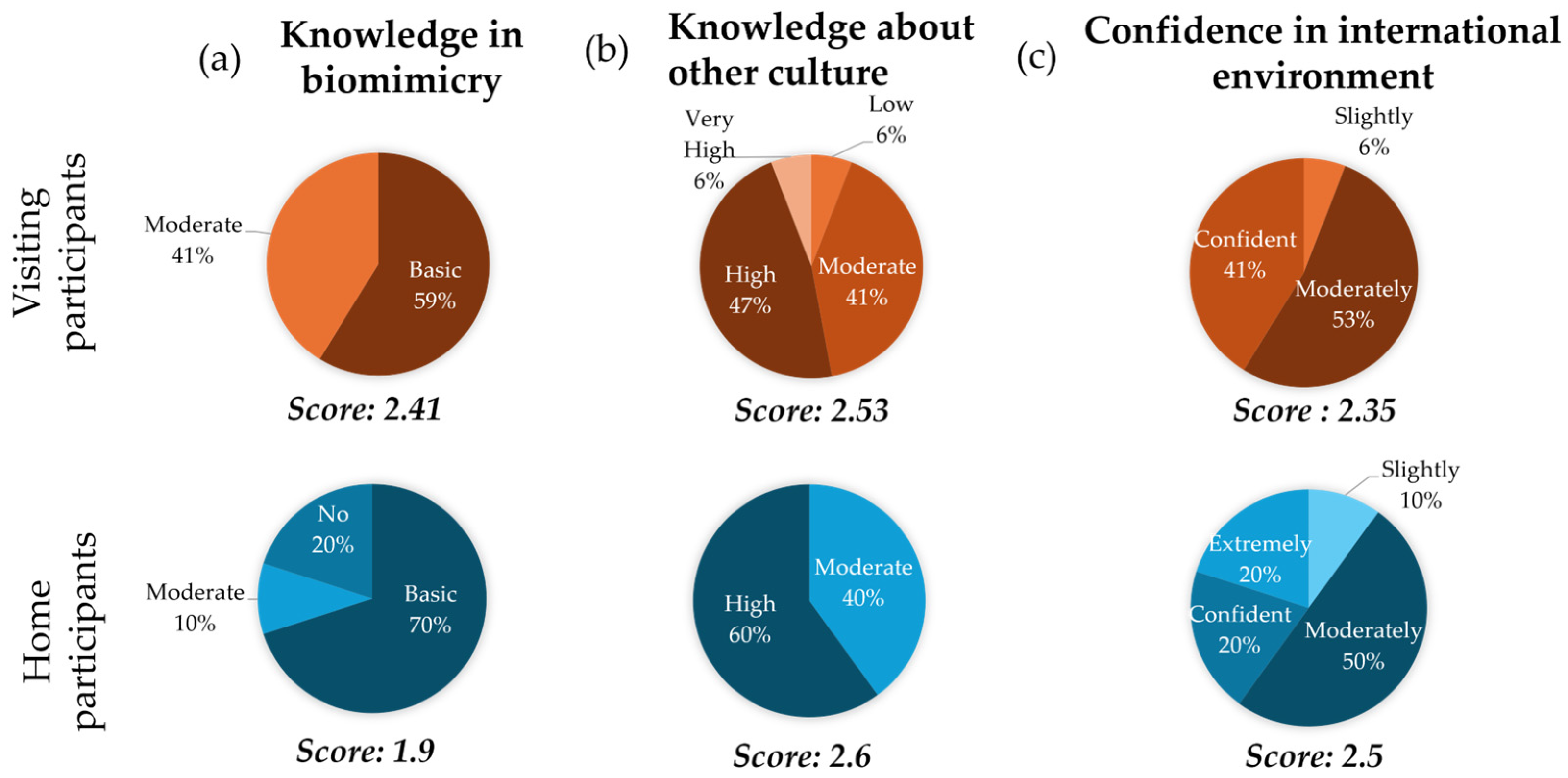
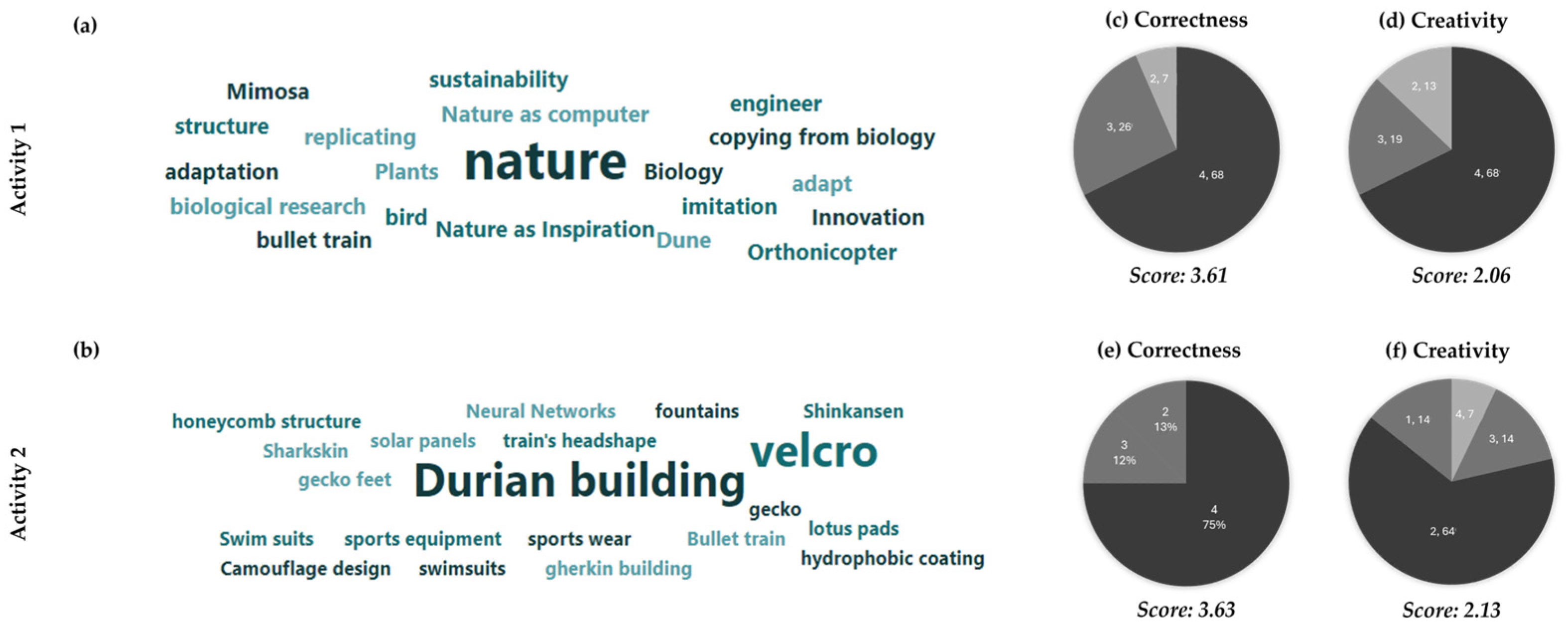
4.1. Participants’ Prior Knowledge
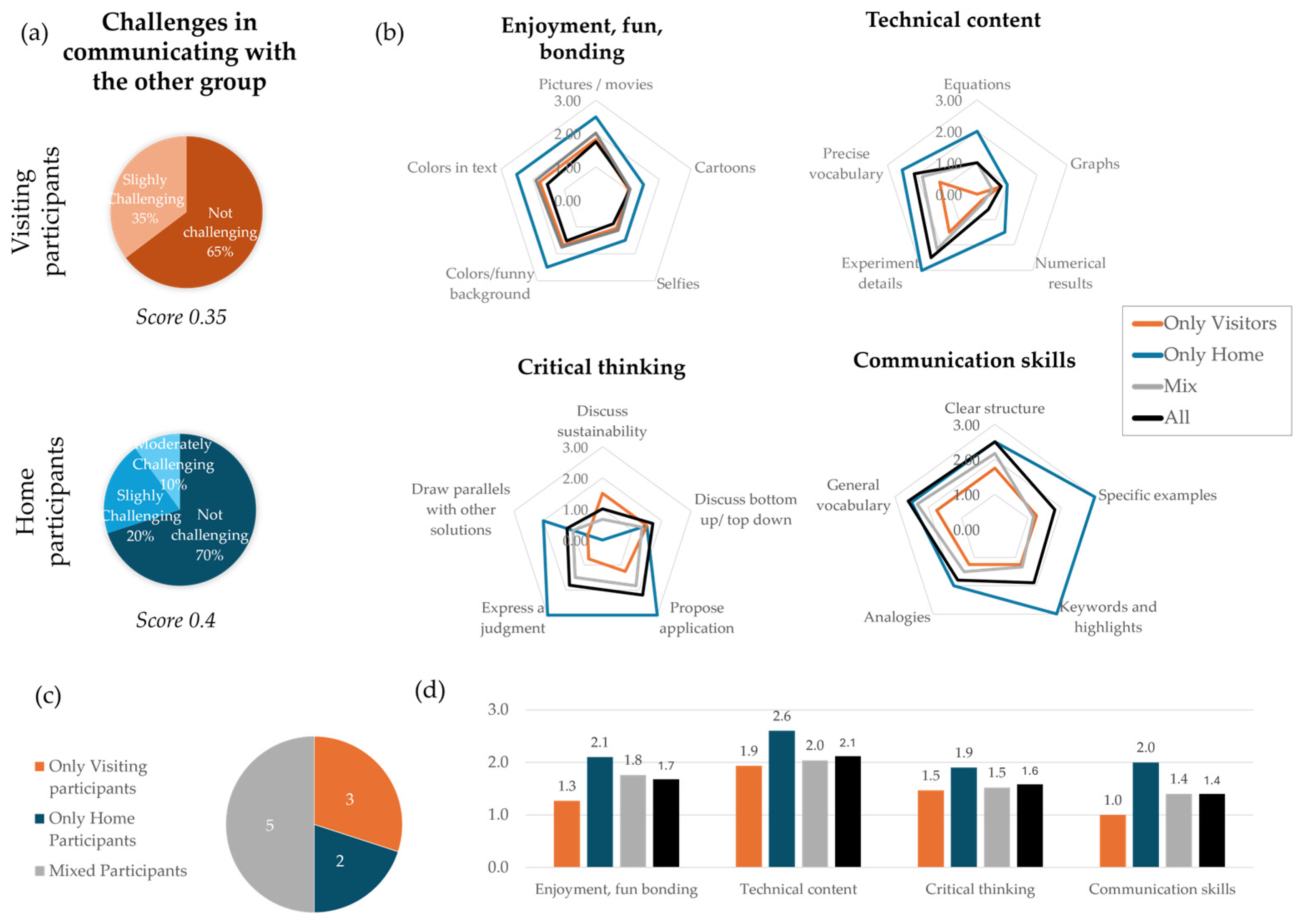
4.2. Effect of the International/Intercultural Context on the Motivation and Appreciation of the Students
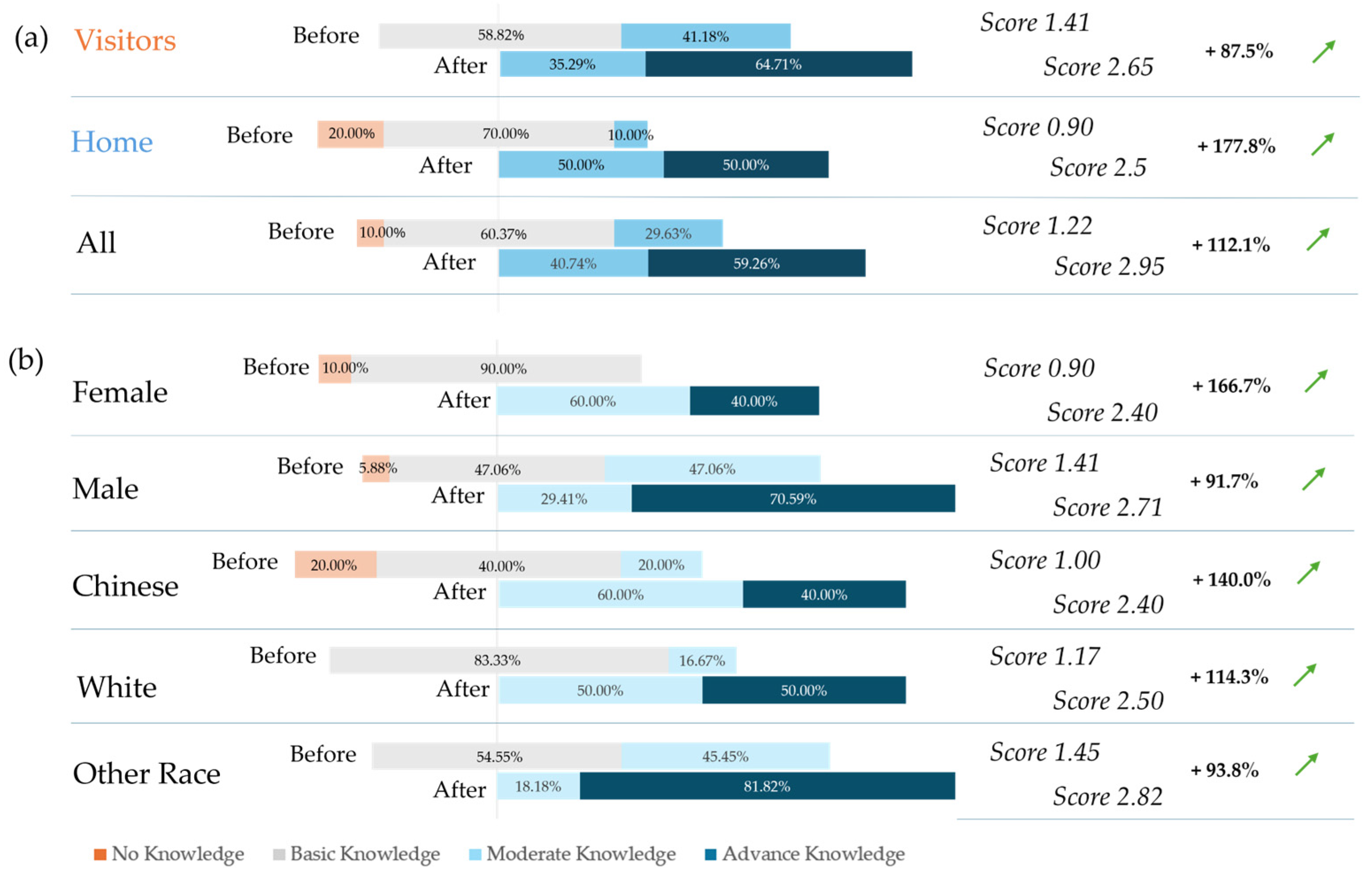
4.3. Effect of the International Context on Biomimicry Learning
4.4. Effect of the International Context on Enjoyment, Technical Content, Critical Thinking, and Communication Skills
5. Discussion
5.1. Discussion on the Results
5.2. Recommendations
- Provide participants from both groups with background information about the other country, including its history, social and economic landscape, climate, ecosystems, and pressing challenges. Include pre-workshop opportunities for informal interactions and connections among participants, and allocate time for self-study and reflection.
- Provide an introduction to the topic of sustainability including the Sustainable Development Goals (SDGs) as well as highlight the relationship between sustainability and biomimicry with examples of success stories. Outline the sustainability challenges of both countries and emphasize the role of context in developing solutions.
- Include prominent biomimicry examples from both countries in the lecture, and highlight the differences and similarities in ecosystem and biodiversity, if any.
- Provide more time for the students to reflect on the laboratory experiments and give them detailed instructions to evaluate the sustainability implications of the technologies introduced in the laboratory and propose feasible and realistic biomimicry applications that address specific SDGs.
- The groups should be formed with equivalent number of students selected based on nationality, ethnicity, language proficiency or preferred discourse style. These dimensions related to the diversity of the students should be carefully evaluated and taken into account when forming the groups.
6. Conclusions
Supplementary Materials
Author Contributions
Funding
Institutional Review Board Statement
Informed Consent Statement
Data Availability Statement
Acknowledgments
Conflicts of Interest
References
- ISO 18458:2015; Biomimetics-Terminology, Concepts and Methodology. International Organisation for Standardisation: Geneva, Switzerland, 2015.
- Raman, R.; Sreenivasan, A.; Suresh, M.; Nedungadi, P. Mapping biomimicry research to sustainable development goals. Sci. Rep. 2024, 14, 1–21. [Google Scholar] [CrossRef]
- Jamei, E.; Vrcelj, Z. Biomimicry and the built environment, learning from nature’s solutions. Appl. Sci. 2021, 11, 7514. [Google Scholar] [CrossRef]
- Cheran, L.-E.; Cheran, A.; Thompson, M. Biomimicry and Materials in Medicine. In Advanced Synthetic Materials in Detection Science; Reddy, S., Ed.; The Royal Society of Chemistry: London, UK, 2014; p. 1. ISBN 978-1-84973-593-3. [Google Scholar]
- Kapsali, V. 4-Biomimetic approach to the design of textiles for sportswear applications. In Textiles for Sportswear; Woodhead Publishing Series in Textiles; Shishoo, S., Ed.; Woodhead Publishing: Sawston, UK, 2015; pp. 77–94. ISBN 978-1-78242-229-7. [Google Scholar]
- Himel, M.H.; Sikder, B.; Ahmed, T.; Choudhury, S.M. Biomimicry in nanotechnology: A comprehensive review. Nanoscale Adv. 2022, 5, 596–614. [Google Scholar] [CrossRef]
- Sandzen, S.C. Biomimicry as Design Lens for Landscape Architecture. Master’s Thesis, Clemson University, Clemson, SC, USA, 2010. [Google Scholar]
- Yeter, I.H.; Tan, V.S.Q.; Le Ferrand, H. Conceptualization of Biomimicry in Engineering Context among Undergraduate and High School Students: An International Interdisciplinary Exploration. Biomimetics 2023, 8, 125. [Google Scholar] [CrossRef]
- Faludi, J.; Gilbert, C. Best practices for teaching green invention: Interviews on deisgn, engineering, and business education. J. Clean. Prod. 2019, 234, 1246–1261. [Google Scholar] [CrossRef]
- Nguyen, N.C.; Bosch, O.J.H. A systems thinking approach to identify leverage points for sustainability: A case study in the Cat Ba biosphere reserve, Vietnam. Syst. Res. Behav. Sci. 2013, 30, 104–115. [Google Scholar] [CrossRef]
- Bidwell, D.; Smirnoff, D. Nature as Mentor: Catalyzing First-Year Liberal Arts and Sciences Undergraduate Transition Through a Biomimicry First-Year Seminar. Int. J. Teach. Learn. High. Educ. 2022, 34, 124–143. [Google Scholar]
- Santulli, C.; Langella, C. Introducing students to bio-inspiration and biomimetic design: A workshop experience. Int. J. Technol. Des. Educ. 2011, 21, 471–485. [Google Scholar] [CrossRef]
- Kohsaka, R.; Fujihira, Y.; Uchiyama, Y.; Kajima, S.; Nomura, S.; Ebinger, F. Public Perception and Expectations of Biomimetics Technology: Empirical Survey of Museum Visitors in Japan. Curator Mus. J. 2017, 60, 427–444. [Google Scholar] [CrossRef]
- Topaz, M. Bioinspiration education at zoological institutions: An optimistic approach for innovation leading to biodiversity conservation. Int. Zoo Yearb. 2016, 50, 112–124. [Google Scholar] [CrossRef]
- Kim, S.-Y.; Kwon, Y.-J. Development of a Digital Textbook on ‘Structure and Contraction Mechanism of Skeletal Muscle’ with the Learning Model for Biomimicry-Based Convergence. J. Sci. Educ. 2018, 42, 95–105. [Google Scholar] [CrossRef]
- Mcadams, D.A. Biologically Inspired Design; Goel, A., McAdams, D., Stone, R., Eds.; Springer: London, UK, 2014; ISBN 9781447152477. [Google Scholar]
- Chao, M.M.; Takeuchi, R.; Farh, J.L. Enhancing Cultural Intelligence: The Roles of Implicit Culture Beliefs and Adjustment. Pers. Psychol. 2017, 70, 257–292. [Google Scholar] [CrossRef]
- Caligiuri, P.; Caprar, D.V. Becoming culturally agile: Effectively varying contextual responses through international experience and cross-cultural competencies. Int. J. Hum. Resour. Manag. 2023, 34, 2429–2450. [Google Scholar] [CrossRef]
- Keshtkar, S.; Tamborrell, P.; Kojima, H. Learning perceptions of STEM students partaking in an international experiential learning. Int. J. Interact. Des. Manuf. 2023, 17, 3279–3303. [Google Scholar] [CrossRef]
- Jaiswal, A.; Jin, L.; Acheson, K. Evaluation of STEM Program on Student Intercultural Development: Do Intercultural Interventions Work? Innov. High. Educ. 2024, 49, 541–559. [Google Scholar] [CrossRef]
- Speck, O.; Speck, T. Biomimetics and education in Europe: Challenges, opportunities, and variety. Biomimetics 2021, 6, 49. [Google Scholar] [CrossRef]
- Dalal, M.; Carberry, A.; Archambault, L. Developing a ways of thinking framework for engineering education research. Stud. Eng. Educ. 2021, 1, 108–125. [Google Scholar] [CrossRef]
- Subramaniam, R.C.; Morphew, J.W.; Rebello, C.M.; Rebello, N.S. Presenting a STEM ways of thinking framework for engineering design-based physics problems. Phys. Rev. Phys. Educ. Res. 2025, 21, 010122. [Google Scholar] [CrossRef]
- Denick, D.; Dringenberg, E.; Fayyaz, F.; Nelson, L.; Pitterson, N.; Tolbert, D.; Yatchmeneff, M.; Cardella, M. Stem thinking in informal environments: Integration and recommendations for formal settings. In Proceedings of the 2013 ASEE IL-IN Section Conference, Angola, IN, USA, 6 April 2013; American Society for Engineering Education: Washington, DC, USA, 2013; pp. 1–17. [Google Scholar]
- Mahmoudi, S.; Jafari, E.; Nasrabadi, H.A.; Liaghatdar, M.J. Holistic education: An approach for the 21 century. Int. Educ. Stud. 2012, 5, 178–186. [Google Scholar] [CrossRef]
- Arum, R.; Eccles, J.S.; Heckhausen, J.; Avakian, G.O.; von Keyserlingk, L.; Wegemer, C.M.; Wright, C.E.; Yamaguchi-Pedroza, K. A framework for measuring undergraduate learning and growth. Change Mag. High. Learn. 2021, 53, 51–59. [Google Scholar] [CrossRef]
- Wong, B.; DeWitt, J.; Chiu, Y.-L.T. Mapping the eight dimensions of the ideal student in higher education. Educ. Rev. 2023, 75, 153–171. [Google Scholar] [CrossRef]
- Coban, M.; Coştu, B. Integration of biomimicry into science education: Biomimicry teaching approach. J. Biol. Educ. 2023, 57, 145–169. [Google Scholar] [CrossRef]
- Stevens, L.; Kopnina, H.; Mulder, K.; De Vries, M. Biomimicry design thinking education: A base-line exercise in preconceptions of biological analogies. Int. J. Technol. Des. Educ. 2021, 31, 797–814. [Google Scholar] [CrossRef]
- Tavsan, C.; Tavsan, F.; Sonmez, E. Biomimicry in Architectural Design Education. Procedia-Soc. Behav. Sci. 2015, 182, 489–496. [Google Scholar] [CrossRef]
- Fisch, M. The Nature of Biomimicry: Toward a Novel Technological Culture. Sci. Technol. Hum. Values 2017, 42, 795–821. [Google Scholar] [CrossRef]
- Amadei, B. A Systems Approach to Modeling Community Development Projects; Momentum Pr: Longueuil, QC, Cananda, 2015. [Google Scholar]
- Charlesworth, Z.M. Learning styles across cultures: Suggestions for educators. Educ. Train. 2008, 50, 115–127. [Google Scholar] [CrossRef]
- Dasen, P.R. Culture and Cognitive Development. J. Cross. Cult. Psychol. 2022, 53, 789–816. [Google Scholar] [CrossRef]
- Lattuca, L.R. Learning interdisciplinarity sociocultural perspectives on academic work. J. High. Educ. 2002, 73, 711–739. [Google Scholar] [CrossRef]
- Hofstede, G. Cultural differences in teaching and learning. Int. J. Intercult. Relat. 1986, 10, 301–320. [Google Scholar] [CrossRef]
- Manikutty, S.; Anuradha, N.S.; Hansen, K. Does culture influence learning styles in higher education? Int. J. Learn. Change 2007, 2, 70. [Google Scholar] [CrossRef]
- Overton, W.F. Life-span development: Concepts and issues. In The Handbook of Life-Span Development; John Wiley & Sons: Hoboken, NJ, USA, 2010; pp. 1–29. [Google Scholar]
- Osher, D.; Cantor, P.; Berg, J.; Steyer, L.; Rose, T. Drivers of human development: How relationships and context shape learning and development1. Appl. Dev. Sci. 2020, 24, 6–36. [Google Scholar] [CrossRef]
- Cagiltay, K.; Bichelmeyer, B. Differences in learning styles in different cultures: A qualitative study. In Proceedings of the Annual Meeting of the American Educational Research Association, New Orelans, LA, USA, 24–28 April 2000; 23p. [Google Scholar]
- Yershova, Y.; DeJaeghere, J.; Mestenhauser, J. Thinking not as usual: Adding the intercultural perspective. J. Stud. Int. Educ. 2000, 59, 39–78. [Google Scholar] [CrossRef]
- Bennett, M.J. Defining, measuring, and facilitating intercultural learning: A conceptual introduction to the Intercultural Education double supplement. Intercult. Educ. 2009, 20, S1–S13. [Google Scholar] [CrossRef]
- Otten, M. Intercultural Learning and Diversity in Higher Education. J. Stud. Int. Educ. 2003, 7, 12–26. [Google Scholar] [CrossRef]
- Afsar, B.; Al-Ghazali, B.M.; Cheema, S.; Javed, F. Cultural intelligence and innovative work behavior: The role of work engagement and interpersonal trust. Eur. J. Innov. Manag. 2020, 24, 1082–1109. [Google Scholar] [CrossRef]
- Yassin, A.A.; Razak, N.A.; Qasem, Y.A.M.; Mohammed, M.A.S. Intercultural learning challenges affecting international students’ sustainable learning in Malaysian higher education institutions. Sustainability 2020, 12, 7490. [Google Scholar] [CrossRef]
- Gómez-Parra, M.E. Measuring intercultural learning through CLIL. J. New Approaches Educ. Res. 2020, 9, 43–56. [Google Scholar] [CrossRef]
- Vromans, P.; Korzilius, H.; Bücker, J.; Jong, E. de Intercultural learning in the classroom: Facilitators and challenges of the learning process. Int. J. Intercult. Relat. 2023, 97, 101907. [Google Scholar] [CrossRef]
- Luo, H.; Gao, P. Intercultural learning through Chinese-American telecollaboration: Results of a song sharing project. Comput. Assist. Lang. Learn. 2024, 37, 85–113. [Google Scholar] [CrossRef]
- Lepora, N.F.; Verschure, P.; Prescott, T.J. The state of the art in biomimetics. Bioinspir. Biomim. 2013, 8, 013001. [Google Scholar] [CrossRef]
- Wiek, A.; Withycombe, L.; Redmann, C.L. Key competencies in sustainability: A reference framework for academic program development. Sustain. Sci. 2011, 6, 203–2018. [Google Scholar] [CrossRef]
- Mukhtar, N.; Saud, M.S.; Kamin, Y.; Al-Rahmi, W.M.; Kosnin, A.M.; Yahaya, N.; Hamid, M.Z.; Latib, A.; Nordin, M.S. Environmental sustainability competency framework for polytechnics engineering programmes. IEEE Access 2019, 7, 125991. [Google Scholar] [CrossRef]
- Obi, S.O.; Obiakor, F.E.; Graves, J. Technology plus diversity is equal to innovation: Making education work. Prog. Educ. 2015, 37, 1–11. [Google Scholar]
- Bultseva, M.A.; Lebedeva, N.M. The role of intercultural competence, in the relationship between intercultural experiences and creativity among students. Int. J. Intercult. Relat. 2021, 82, 256–264. [Google Scholar] [CrossRef]
- Yu, H. A study of engineering students’ intercultural competence and its implications for teaching. IEEE Trans. Prof. Commun. 2012, 55, 185–201. [Google Scholar] [CrossRef]
- Stevens, L.L.; Whitehead, C.; Singhal, A. Cultivating cooperative relationships: Identifying learning gaps when teaching students systems thinking biomimicry. Biomimetics 2022, 7, 184. [Google Scholar] [CrossRef]
- Hadgraft, R.G.; Kolmos, A. Emerging learning environments in engineering education. Australas. J. Eng. Educ. 2020, 25, 3–16. [Google Scholar] [CrossRef]
- Lim, C.P.; Graham, C.R. Blended Learning for Inclusive and Quality Higher Education in Asia; Springer: Singapore, 2021; ISBN 9789813341067. [Google Scholar]
- Brundiers, K.; Barth, M.; Cebrian, G.; Cohen, M.; Diaz, L.; Doucette-Remington, S.; Dripps, W.; Habron, G.; Haare, N.; Jarchow, M.; et al. Key competencies in sustainability in higher education—Toward an agreed-upon reference framework. Sustain. Sci. 2021, 16, 13–29. [Google Scholar] [CrossRef]
- Hu, Y.; Li, H. Comparative analysis of Chinese and American students’ class performance and overall academic performance. Lect. Notes Educ. Psychol. Public Media 2023, 6, 724–729. [Google Scholar] [CrossRef]
- Boyle, G.J.; Wongsri, N.; Bahr, M.; Macayan, J.V.; Bentler, P.M. Cross-cultural differences in personality, motivation and cognition. in Asian vs. Western societies. Personal. Individ. Differ. 2020, 159, 109834. [Google Scholar] [CrossRef]
- Ho, L.C. Global multicultural citizenship education: A Singapore experience. Soc. Stud. 2009, 100, 285–293. [Google Scholar] [CrossRef]
- Kirlylo, J.D. An overview of multicultural education in the USA: Grandest social experiment. Soc. Stud. Res. Pract. 2017, 12, 354–357. [Google Scholar] [CrossRef]
- Marginson, S. What is global higher education? Oxf. Rev. Educ. 2022, 48, 492–517. [Google Scholar] [CrossRef]
- de Wit, H.; Altbach, P.G. Internationalization in higher education: Global trends and recommendations for its future. Policy Rev. High. Educ. 2021, 5, 28–46. [Google Scholar] [CrossRef]



| Terminology | Focus | Goal |
|---|---|---|
| Biomimicry | Mimic nature for sustainable solutions. | To create systems and designs that align with sustainable development (social, environmental, and economic). |
| Biomimetics | Imitate biological systems and mechanisms. | To solve engineering and technical problems. |
| Bionics | Replicate, increase, or replace biological functions. | To create functional designs for medical or technological use. |
| Bioinspiration | Take abstraction from natural system to extract fundamental principles and apply them in a synthetic model. | To develop new engineering solutions and generate technological innovation. |
| Activity No. | Question | Intended Objective |
|---|---|---|
| Activity 1 | What keywords do you think of when you hear about biomimicry? | This activity aimed to assess participants’ initial conceptual connections with the topic. |
| Activity 2 | Do you know any example of biomimicry/bioinspiration? For example, in a commercial product, machine, or building? | This activity was aimed at collecting data to evaluate participants’ pre-existing knowledge and exposure to the topic. |
| Activity 3 | What applications could you imagine for the morphing mechanism of the Venus Fly trap? | This activity aimed to encourage creative thinking and application of the concepts were discussed. |
| Group No. | Group Theme | Laboratory Experiment | Intended Learning Objective |
|---|---|---|---|
| 1 | Seashell |
|
|
| 2 | Fungi |
|
|
| 3 | Venus flytrap |
|
|
| 4 | Bones |
|
|
| 5 | Biological tissues |
|
|
| 6 | Plant leaves |
|
|
| 7 | Armadillo armors |
|
|
| 8 | Pangolin |
|
|
| 9 | Multifunctional hydrogel |
|
|
| 10 | Rice grains |
|
|
| Score | Correctness | Creativity |
|---|---|---|
| 1 | Completely wrong | Word/example already mentioned in lecture |
| 2 | Not entirely correct | Very common words/example |
| 3 | Correct but not specific | Culture-specific words/example |
| 4 | Correct | Uncommon and unique words/example |
| Dimensions | Enjoyment, Fun, Bonding | Technical Content | Critical Thinking | Communication Skills |
|---|---|---|---|---|
| E L E M E N T S | Pictures/movies | Equations | Discuss sustainability | Clear structure |
| Cartoons | Graphs | Discuss bottom up/top down | Specific examples | |
| Selfies | Numerical results | Propose applications | Keywords and highlights | |
| Colors/funny background | Experiment details | Express a judgment | Analogies | |
| Colors in text | Precise vocabulary | Draw parallels with other solutions | General vocabulary |
| Group Number | Group Theme | Content Given in Relation to Sustainability and Future Applications | Sustainability Competencies | Sustainability Theme |
|---|---|---|---|---|
| 1 | Seashell | “Most viable applications: supercapacitors” | Future-thinking | NA |
| 2 | Fungi | “Building bricks alternative: sustainable designs and creation; as strong or stronger than bricks, hydrophobic, greater insulation than bricks” | Future-thinking | Sustainable urbanization |
| 3 | Venus flytrap | “Pest control mechanism”; “robotics”; “safety” | Future-thinking | NA |
| 4 | Bones | “More sustainable than existing composite manufacturing because lack of unnatural pressure and temperature and reduction of steps saves energy” | System-thinking; Future-thinking | Natural resources (energy) |
| 5 | Biological tissues | “To improve the integrity of structures by adding water to the polymer to take shape and mold around intended structures” | Future-thinking | NA |
| 6 | Plant leaves | NA | NA | NA |
| 7 | Armadillo armors | “3D reduces waste”; “recyclable materials” | Future-thinking | Recycling/Reuse |
| 8 | Pangolin | “landing-gear support”; “soft hook structure”, “for robotic or manual arm” | Future-thinking | NA |
| 9 | Multifunctional hydrogel | “Property for long-term usage”; “biocompatibility” | Future-thinking | NA |
| 10 | Rice grains | “Protecting materials against falls”; “adaptable structures” | Future-thinking | NA |
| Survey Questions | Responses |
|---|---|
| Please share an example of something you learned today about Singapore. | “The culture around engineering is slightly different than in the US. I leaned about the main sports played on campus.” “The many different cultures here and how they come together.” |
| Do you feel that interacting with NTU students has changed your perspective in any way? Please elaborate. | “People are more interconnected globally than I initially thought.” “Definitely made gaps between cultures feel smaller, was very easy to communicate and despite some differences we had lots in common.” |
| Please share an example of something you learned today about Purdue/USA culture. | “People are easy to talk to and open.” |
| Do you feel that interacting with Purdue students has changed your perspective in any way? Please elaborate. | “They are very comfortable with public speaking and are able to communicate their ideas clearly. We might have to re-examine the local school system to see how we can achieve the same for our local students.” “Well, it definitely makes this workshop more interesting. I’m really excited about this opportunity to meet with US students. Been my dream to go there someday and experience their life myself, and that’s why I go out of the way to take a leave from internship work just to attend this workshop.” “Very eloquent in their presentations.” “I think they ask more questions and are more confident in expressing themselves which motivates me to adopt their learning behaviours.” |
| Additional Comments | “My favorite part was talking to the grad student.” |
Disclaimer/Publisher’s Note: The statements, opinions and data contained in all publications are solely those of the individual author(s) and contributor(s) and not of MDPI and/or the editor(s). MDPI and/or the editor(s) disclaim responsibility for any injury to people or property resulting from any ideas, methods, instructions or products referred to in the content. |
© 2025 by the authors. Licensee MDPI, Basel, Switzerland. This article is an open access article distributed under the terms and conditions of the Creative Commons Attribution (CC BY) license (https://creativecommons.org/licenses/by/4.0/).
Share and Cite
Islam, A.; Stephanie, F.L.; Arrieta, A.F.; Le Ferrand, H. Intercultural and Active Classroom for Teaching and Learning Biomimicry: A Case Study with Singaporean and American Undergraduate Engineering Students. Biomimetics 2025, 10, 809. https://doi.org/10.3390/biomimetics10120809
Islam A, Stephanie FL, Arrieta AF, Le Ferrand H. Intercultural and Active Classroom for Teaching and Learning Biomimicry: A Case Study with Singaporean and American Undergraduate Engineering Students. Biomimetics. 2025; 10(12):809. https://doi.org/10.3390/biomimetics10120809
Chicago/Turabian StyleIslam, Aminul, Felix Lena Stephanie, Andres F. Arrieta, and Hortense Le Ferrand. 2025. "Intercultural and Active Classroom for Teaching and Learning Biomimicry: A Case Study with Singaporean and American Undergraduate Engineering Students" Biomimetics 10, no. 12: 809. https://doi.org/10.3390/biomimetics10120809
APA StyleIslam, A., Stephanie, F. L., Arrieta, A. F., & Le Ferrand, H. (2025). Intercultural and Active Classroom for Teaching and Learning Biomimicry: A Case Study with Singaporean and American Undergraduate Engineering Students. Biomimetics, 10(12), 809. https://doi.org/10.3390/biomimetics10120809