1. Introduction
Aviation maintenance technicians (AMTs) play an important role in ensuring the safety of commercial air transportation. Under the 14 CFR Part 121, airlines must uphold strict maintenance and safety standards for passenger and cargo operations. Despite this regulatory framework, safety culture among maintenance personnel can vary widely across organizations. The National Transportation Safety Board [
1] has repeatedly emphasized the connection between maintenance practices and flight safety, noting that even minor maintenance errors can lead to serious incidents or accidents. Past accident investigations have shown that deficiencies in maintenance culture, such as nonadherence to procedures or a reluctance to report errors, can precipitate catastrophic outcomes [
1]. Chang and Wang [
2] also emphasized that maintenance errors are not isolated acts but are influenced by human risk factors such as a lack of resources. Accordingly, cultivating a robust safety culture in aviation maintenance is essential to prevent accidents and protect both workers and the flying public.
Safety culture is commonly defined as the shared values, beliefs, and perceptions regarding the risks involved in operations within an organization [
3]. Reason’s [
4] model provides a framework for understanding safety culture through five interrelated sub-dimensions: informed culture, just culture, learning culture, and flexible culture. Informed culture refers to management’s current knowledge of human, technical, organizational, and environmental factors that affect the safety of the system, supported by behaviors that encourage employees to understand safety risks [
5,
6]. Reporting culture denotes an environment in which employees are motivated to voluntarily report safety-related issues, errors, or near-misses without fear of blame or punishment [
7,
8,
9]; its effectiveness relies on the workforce’s willingness to participate [
7]. Just culture is closely aligned with reporting culture, emphasizing a distinction between acceptable and unacceptable safety-related behaviors, treating unintentional errors as opportunities for learning while reserving disciplinary action for intentional violations [
5,
9,
10]. Learning culture reflects the organization’s capacity and willingness to learn from mistakes, continuously gather and analyze safety information, and implement meaningful changes [
4,
5]. Finally, flexible culture describes an organization’s ability to adapt effectively to new situations, changing environments, and unforeseen consequences, thereby preventing emerging risks [
4,
5]. Kao et al. [
11] utilized structural equation modeling to demonstrate that safety factors, specifically management commitment and work environment, significantly predict safety performance outcomes such as rule compliance and safety participation for aviation cabin crew and ramp agents. Together, these perspectives emphasize that safety culture is shaped by organizational conditions and employee perceptions, providing a foundation for examining how safety is conceptualized and managed within complex, high-risk domains.
In aviation maintenance, however, this concept is often treated as a single, unified construct, despite the fundamentally dual nature of the maintenance environment. AMTs simultaneously operate within two independent safety domains: the safety of the aircraft and the occupational safety and well-being of the worker. Consistent with Kim and Song’s [
12] assertion that “safety” in maintenance inherently carries these two meanings, and building on the framework proposed by Truong and Lee [
13], this study adopts a dual-construct conceptualization consisting of Maintenance-Based Aviation Safety Culture (MASC) and Maintenance Occupational Safety Culture (MOSC).
MASC refers to the organizational norms, practices, and controls that prevent maintenance errors capable of compromising aircraft worthiness [
13]. It encompasses documentation quality, communication effectiveness, and training adequacy, and aligns with contemporary Safety-II and Safety-III perspectives that emphasize resilience, learning, and the capacity to succeed under variable operational conditions [
14,
15]. A robust MASC is characterized by empowered employees who openly report hazards or near-misses, support informed decision-making, and comply with evolving regulatory requirements [
16,
17,
18,
19,
20].
In contrast, MOSC addresses the physical safety and well-being of AMTs, encompassing exposure to environmental hazards, the use of personal protective equipment, ergonomic risks, and injury prevention [
13,
21]. Ensuring the safety of AMTs protects lives and safeguards the aviation industry’s reputation [
22]. Aburumman et al. [
23] found that most workplace interventions positively impacted safety culture, emphasizing the need for high-quality experimental research to validate these findings.
Historically, these dimensions have been measured separately using distinct instruments. Occupational safety has been assessed through tools focused on environmental and health risks, such as the Safety Health of Maintenance Engineers (SHoMeO) [
24,
25], the Maintenance Resource Management/Technical Operations Questionnaire (MRM/TOQ) [
26], and the Maintenance Operations Safety Survey (MOSS) [
27], which primarily capture aspects of MOSC. On the other hand, MASC has been evaluated using instruments such as the Commercial Aviation Safety Survey (CASS), and more recently, the FAA Maintenance Safety Culture Assessment and Improvement Toolkit (M-SCAIT) [
28]. FAA M-SCAIT is a comprehensive survey-based tool designed to assess safety culture within maintenance organizations. It considered multiple factors influencing safety culture and demonstrated content validity, face validity, and criterion validity. FAA M-SCAIT identified the need for a comprehensive safety culture assessment tool for aviation maintenance that accounts for multiple factors influencing safety culture. Key et al. [
28] recommended further research to strengthen the model by developing a shorter survey version to improve usability and response rates.
Despite their distinct orientations, MOSC and MASC are inherently interrelated; yet few studies have explored them in tandem. Most research has focused on either occupational safety or operational safety, limiting a holistic understanding of safety culture in aviation maintenance. Integrating these dimensions addresses a significant gap and reflects the complex reality of AMT responsibilities, which span both personal safety and aircraft airworthiness.
Adding further complexity, psychological factors such as trust and fear can play a critical role in shaping both MASC and MOSC. Drawing on organizational behavior and safety psychology, this study examines how these emotional dynamics impact MOSC and MASC. While prior research has examined a wide range of organizational, procedural, and managerial interventions aimed at improving safety culture in aviation maintenance, the present study intentionally narrows its focus to trust and fear as foundational psychological factors. These constructs are not proposed as exhaustive determinants of safety culture. Rather, they are conceptualized as upstream emotional mechanisms that may shape broader safety culture across both MOSC and MASC domains.
Trust is a foundational construct in high-reliability organizations and is central to effective safety management in aviation maintenance. Mayer et al. [
29] define trust as the willingness to accept vulnerability based on expectations of others’ competence, integrity, and benevolence. Rousseau et al. [
30] further defined trust as a psychological state characterized by the intention to accept vulnerability based on positive expectations regarding another’s intentions or behavior. Trust can be categorized into types, including interpersonal trust, organizational trust, and trust in technology, each with distinct characteristics and implications.
Interpersonal trust refers to the trust between individuals. It is foundational for cooperative behavior and effective communication. Interpersonal trust is built over time through repeated interactions and is influenced by factors such as honesty, reliability, and mutual respect [
31]. Organizational trust refers to employees’ confidence in their organization and its leaders. It encompasses trust in management’s competence, integrity, and benevolence [
29]. High levels of organizational trust are associated with increased job satisfaction, commitment, and performance [
32]. Organizational policies and practices play a crucial role in building trust. Practices that promote fairness, transparency, and leadership support contribute to higher levels of organizational trust [
33].
In aviation maintenance, trust in peers, supervisors, and organizational leadership has consistently been associated with open communication, voluntary hazard reporting, and adherence to safety procedures [
34,
35]. Taylor and Thomas [
26] further argue that professionalism and trust constitute a maintenance safety culture, noting that in the absence of trust, reporting systems are undermined by cynicism and disengagement. When AMTs perceive their work environment as fair and supportive, they are more likely to report hazards, seek help, and adhere to protocols. Trust is also critical for maintaining what Edmondson [
36] called psychological safety, a shared belief that interpersonal risk-taking (e.g., admitting mistakes or raising concerns) will not lead to punishment or embarrassment.
The role of trust in enabling safety communication is formalized in Chatzi’s [
37,
38] Diagnosis of Communication and Trust in Aviation Maintenance (DiCTAM) model, a cyclical framework linking interpersonal trust, communication satisfaction, and safety outcomes. The DiCTAM model conceptualizes trust as a prerequisite for effective information exchange and operates across four stages: detection of trust and communication breakdowns in incident data; assessment of training adequacy; measurement using validated survey instruments; and prediction of latent organizational vulnerabilities. When interpersonal trust erodes, communication channels degrade, allowing the latent conditions described in the Reason’s Swiss Cheese Model to propagate into active failures [
13]. Trust also underpins psychological safety, the shared belief that speaking up, admitting errors, or challenging unsafe practices will not result in embarrassment or punishment [
36], thereby supporting the reporting, learning, and just culture dimensions of a mature safety system.
Conversely, fear functions as the primary inhibitor of safety culture. From a psychological perspective, fear is a response to perceived threat that shapes cognition, emotions, and behavior [
39]. Modern appraisal theories emphasize that individuals’ interpretations of potential consequences determine whether they speak up or remain silent [
40]. Early theories, such as the Cannon-Bard Theory and the James-Lange Theory, focused on the physiological aspects of fear [
41]. Cannon emphasized the brain’s role in producing emotional experience, whereas James and Lange posited that physiological arousal precedes and defines emotional experience. Modern cognitive theories, such as Lazarus’s Cognitive-Mediational Theory [
40], emphasize the role of cognitive appraisal in fear responses. According to Lazarus [
40], an individual first evaluates the significance of an event, which then determines the emotional response. This appraisal process explains why individuals may respond differently to the same threat. Pavlovian conditioning and Operant conditioning provide insights into how fear responses can be learned and maintained [
42,
43]. Fear conditioning occurs when a neutral stimulus is paired with an aversive event, leading to a conditioned fear response. Operant conditioning further explains how avoidance behaviors are reinforced by fear reduction.
In organizational contexts, fear most saliently manifests as Fear of Negative Evaluation (FNE). FNE involves apprehension about being judged unfavorably by peers or superiors [
44]. This fear can reduce openness and transparency, as employees may withhold information or feedback to avoid criticism. Within aviation maintenance, FNE has been shown to suppress communication, reduce voluntary reporting, and promote defensive silence, depriving organizations of the feedback loops necessary for learning and continuous improvement [
5,
45,
46,
47]. The persistence of fear, even in regulated environments, can undermine both MOSC and MASC by discouraging proactive behavior and information sharing. Supporting this dynamic, agent-based modeling studies by Mols et al. [
48], and Passenier et al. [
49] demonstrated that safety commitment is an emergent organizational property: in contexts where experienced “old guard” technicians counterbalance production pressure through strict rule adherence, safety levels may be maintained or fluctuate; however, when such resistance erodes and production demands dominate in the absence of trust or effective safety leadership, safety performance deteriorates sharply. This illustrates how fear, coupled with diminished trust and increasing production pressure, can accelerate the collapse of both occupational and operational safety defenses.
Extending this line of evidence, prior research has shown that organizational justice climates and hierarchical dynamics critically shape whether fear is reinforced or mitigated in safety culture. Jaiswal et al. highlighted that while a “no blame” culture is unrealistic, a “just culture” is essential to prevent mistrust. Clare and Kourousis [
50] found that perceived commercial pressure and the potential for embarrassment are significant constraints on reporting. Furthermore, Naweed and Kourousis [
51] identified a power distance gap between management and AMTs, in which a perceived lack of support and excessive bureaucratization foster a negative safety culture, thereby reinforcing fear and reducing voluntary reporting. The theoretical framework for this research posits that trust enhances, while fear erodes, safety culture. High-trust environments are expected to yield stronger perceptions of safety, both with respect to occupational well-being and procedural compliance. Conversely, fear is hypothesized to undermine those perceptions [
10].
Integrating these perspectives, the present study conceptualizes trust and fear as simultaneous psychological drivers of safety culture. Trust is viewed as a motivational resource that enhances engagement, reduces defensive cognitive load, and strengthens both procedural compliance and proactive participation in safety activities. Conversely, fear of negative evaluation operates as a suppressor, undermining communication, learning, and willingness to change unsafe conditions. Consistent with the DiCTAM framework and just culture theory, this study models trust and fear as exogenous constructs that directly influence the endogenous safety culture dimensions of MAS and MOSC among U.S. Part 121 AMTs, thereby advancing understanding of the psychological mechanisms through which safety culture is enabled or constrained.
This leads to the following hypotheses:
H1. Trust positively influences MOSC;
H2. Trust positively influences MASC;
H3. Fear negatively influences MOSC;
H4. Fear negatively influences MASC.
By addressing these hypotheses, this study contributes to the evolving literature on safety culture by integrating emotional and organizational dimensions.
2. Methodology
2.1. Research Design
This study employed a cross-sectional non-experimental survey design to examine the relationships among trust, fear, and safety culture constructs within the aviation maintenance context. The research design was intentionally selected to assess theoretically grounded associations among latent constructs that are not directly observable and are best understood through AMTs’ subjective experiences. Given the cross-sectional design, the study does not permit causal inference among variables. Although trust is theoretically posited as an antecedent of safety culture, based on prior empirical and conceptual work, the relationships examined here should be interpreted as associational and explanatory rather than causal. The structural paths tested in the model represent hypothesized directional relationships grounded in theory, not definitive evidence of causality.
2.2. Population and Sample
The target population for this study consisted of U.S. AMTs employed in Part 121 airline maintenance operations. Eligibility criteria required participants to hold a valid FAA mechanic certificate and be actively employed in Part 121 maintenance operations. We employed a convenience sampling approach to recruit participants through both in-person outreach and electronic distribution. In May 2025, the researcher attended a major aviation maintenance conference in Seattle to network with industry professionals and invite AMTs to participate in the survey. Following the conference, an online survey link was disseminated nationally via primary professional organizations and industry networks, including SAE AEEC Avionic Maintenance Committee, the Professional Aviation Maintenance Association (PAMA), and the Aeronautical Repair Station Association (ARSA). Because these organizations distributed the link via member lists and internal communications, the total number of individuals who received the survey invitation could not be precisely determined; therefore, an overall participation rate could not be calculated. Participation was voluntary and anonymous. A total of 300 survey responses were received. After removing incomplete entries and potential pattern responses (straight-lining), a final sample of 240 AMTs was retained for analysis.
2.3. Measurement Instrument
A structured survey instrument was developed to measure the key constructs: MOSC, MASC, trust, and fear. The questionnaire included multiple Likert-scale items for each construct, as well as seven demographic questions to characterize the sample. All scale items used a 5-point agreement scale (1 = strongly disagree to 5 = strongly agree). The instrument drew on established literature to ensure content validity. For MOSC, items were adapted from occupational health and safety research relevant to maintenance environments (e.g., resource management, work environment, and training) [
2,
52,
53,
54,
55].
For MASC, we incorporated elements from the FAA’s M-SCAIT, developed by Key et al. [
28]. M-SCAIT was specifically designed for evaluating safety culture among AMTs and was developed using empirical data collected across a range of maintenance organizations in the U.S. In particular, three domains from M-SCAIT were included in the MASC construct: training (e.g., adequacy and frequency of training on safety procedures), communication of safety information (clarity and transparency in sharing incident reports and safety updates), and documentation practices (usability and currency of technical manuals and records). These domains reflect critical organizational support for aviation safety in maintenance.
The trust scale measured the extent to which AMTs feel confident that their colleagues prioritize safety. Items were designed to capture AMTs’ perceptions of fairness and transparency. Trust items were adapted from previously validated instruments developed in safety literature [
29,
32,
34,
35]. Example trust items included statements like “I believe my coworkers are honest about safety concerns” and “I feel confident that my coworkers will inform me if they discover a problem”. Fear was operationalized using items adapted from prior studies examining fear in safety contexts [
45,
46,
56]. Example fear items included “I avoid pointing out errors by others because I worry about being criticized by my team”, and “I feel reluctant to raise safety issues because I don’t want others to see me as a complainer”. Full item questions for the constructs are shown in the
Appendix A.
In the next stage, a preliminary version of the survey instrument was reviewed by a panel of subject-matter experts (SMEs) with backgrounds in aviation maintenance and safety management systems to assess the questionnaire’s face validity. Their feedback was used to refine item clarity, reduce redundancy, and ensure alignment with U.S. Part 121 operational environments. The final version of the instrument included 29 Likert-scale items across the four constructs: MASC, MOSC, trust, and fear. The data were collected using an anonymous online survey administered through the Qualtrics platform. Prior to distribution, the Institutional Review Board (IRB) approved the research application.
2.4. Data Analysis Process
We adopted a three-phase quantitative analytical approach: (1) EFA, (2) CFA, and (3) SEM. Data screening was first performed using IBM Statistical Package for the Social Sciences (SPSS) Statistics 28. This included handling missing values, assessing univariate outliers, and evaluating normality.
In the first phase, EFA was performed on the initial item set to identify underlying factor structures for MOSC, MASC, trust, and fear. Principal axis factoring with varimax rotation was used to extract factors, as this method is suitable for uncovering latent constructs while allowing for potential correlation among factors. The Kaiser-Meyer-Olkin (KMO) measure and Bartlett’s test of sphericity were examined to ensure sampling adequacy and factorability of the correlation matrix. During EFA, we applied standard decision rules to refine the item set: items with factor loadings below 0.40 or with high cross-loadings were removed. Using these criteria, a small number of poorly performing items were dropped to achieve a clean factor structure aligned with theoretical constructs. The results provided preliminary support for our conceptual model, suggesting distinct groupings corresponding to MOSC, MASC, trust, and fear.
In the second phase, CFA was carried out using SPSS Analysis of Moment Structures (AMOS) 27 to test the measurement model’s fit and to confirm the structure identified by EFA. The hypothesized measurement model included four latent variables (MOSC, MASC, trust, and fear). For modeling purposes, MOSC and MASC were each specified as second-order factors comprising their respective subdimensions (as indicated by EFA and theory). The CFA was performed using maximum likelihood estimation on the covariance matrix. Model fit was evaluated using multiple indices: Chi-square/degrees of freedom (CMIN/df), Comparative Fit Index (CFI), Goodness of fit index (GFI), Adjusted GFI (AGFI), Normed Fit Index (NFI), and Root Mean Square Error of Approximation (RMSEA). The CFA demonstrated an acceptable fit to the data. These values meet or approach conventional criteria for a well-fitting model (CFI, GFI, AGFI, and NFI > 0.90, RMSEA < 0.08). All factor loadings were significant and mostly high. Internal consistency and convergent validity were supported by composite reliability (CR) and average variance extracted (AVE) calculations for each construct. Cronbach’s alpha coefficients were tested. To assess discriminant validity, we used the Heterotrait-Monotrait ratio (HTMT) approach. HTMT values below 0.85 suggest adequate discriminant validity between two factors.
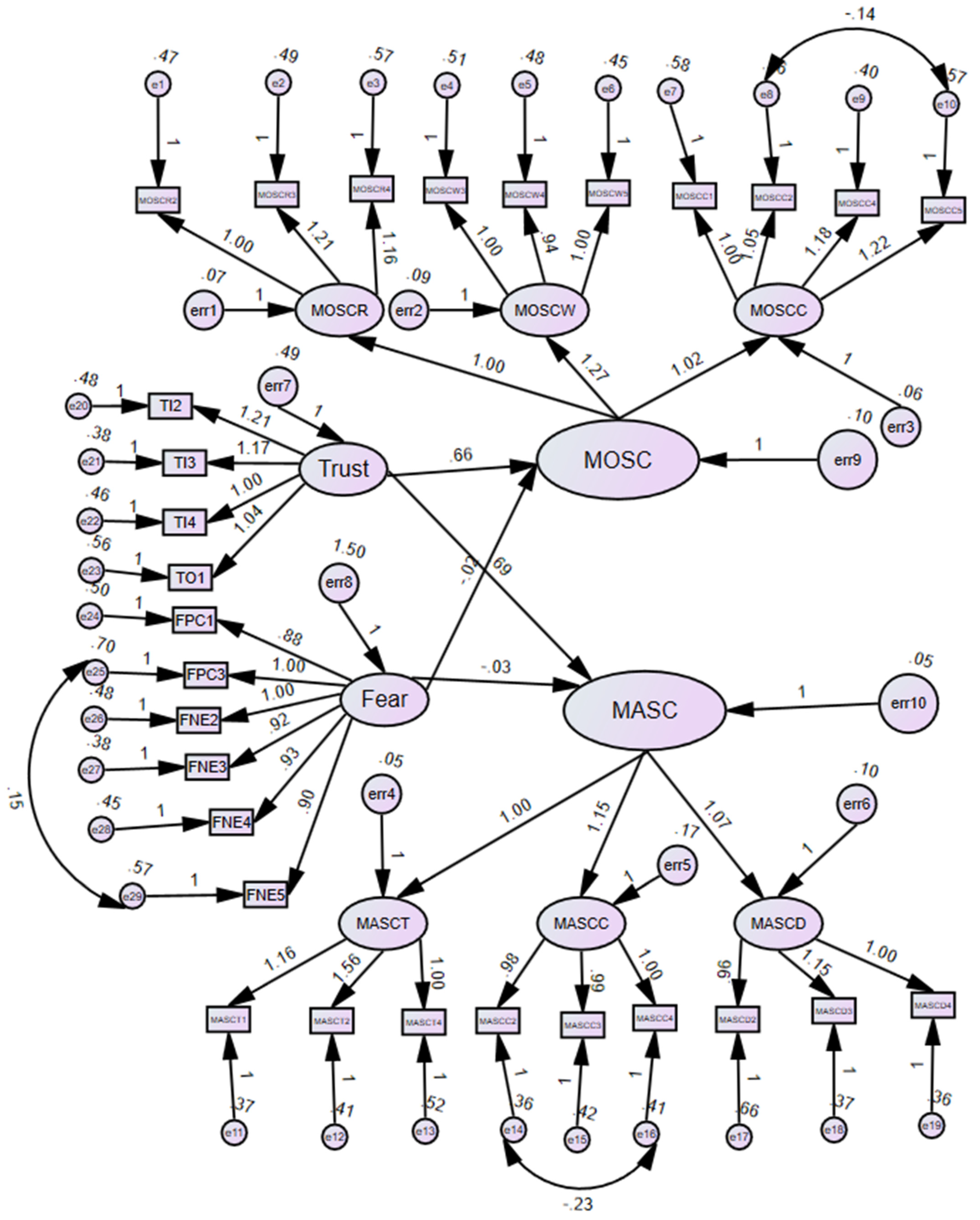
Finally, SEM was used to evaluate the full structural model and test the hypothesized relationships between constructs. This phase examined the direct effects of trust and fear on both MASC and MOSC. The overall fit of the model was assessed using the same indices mentioned above. The hypotheses were tested through path analysis using AMOS, with a report of standard regression weights, t-values, and p-values.
4. Discussion
The purpose of this study was to examine how trust and fear influence two distinct dimensions of safety culture—Maintenance Occupational Safety Culture (MOSC) and Maintenance-Based Aviation Safety Culture (MASC)—among AMTs employed by U.S. Part 121 air carriers. The structural equation modeling (SEM) results provide clear support for the hypothesized positive influence of trust on both safety culture domains. As predicted, trust significantly correlates with AMTs’ perceptions of occupational safety (H1) and maintenance-related aviation safety (H2), indicating that higher levels of perceived trust co-occur with stronger perceptions of safety culture across both day-to-day hazard protection and procedural adherence. These findings are consistent with prior safety literature suggesting that trust is closely linked to psychological safety, promotes transparency in reporting, and strengthens compliance with safety expectations [
34,
35].
One of the most notable findings is the consistency and magnitude of relationships between trust and both MOSC and MASC. The large, standardized coefficients suggest that trust is not confined to relational dynamics between AMTs and supervisors; rather, it appears to contribute to broader safety practices, documentation routines, and communication channels within maintenance organizations. Rather than implying causality, these results suggest that trust functions as a central explanatory construct linking interpersonal perceptions with organizational safety systems. This pattern provides empirical support for conceptualizing trust as a cross-cutting element of aviation maintenance safety culture, while remaining consistent with the associational limits of a cross-sectional design.
Conversely, the expected negative influence of fear on MOSC (H3) and MASC (H4) was not supported. The absence of significant effects—despite theoretical predictions and prior findings—constitutes a meaningful and unexpected outcome. Several interpretations are possible. First, the findings may reflect measurement-related limitations, as fear was operationalized as a relatively broad construct that may not capture more specific or situational forms of fear relevant to maintenance work. Second, the results may indicate contextual suppression, whereby established non-punitive reporting systems, just culture policies, or psychological safety initiatives within many U.S. Part 121 carriers attenuate the influence of fear on perceptions of general safety culture. Third, it is also possible that fear functions as a more context-specific construct, activated only in certain types of incidents or organizational climates, rather than as a broad emotional factor affecting all aspects of safety culture. This suggests an important direction for future research: exploring which subtypes of fear (disciplinary fear, reputational fear, peer judgment, or management distrust) are most likely to influence safety-relevant attitudes or behaviors.
Another important finding concerns the empirical distinction between MOSC and MASC. Although often treated implicitly as a single construct, the results demonstrate that AMTs differentiate between occupational safety (e.g., hazard mitigation, physical protection) and aviation safety (e.g., procedural rigor, error prevention). This separation aligns with the findings by Truong and Lee [
13] and reinforces the need to conceptualize and measure safety culture in maintenance contexts as a multi-domain construct rather than a single one. The discovery that trust strongly predicts both domains suggests that interventions aimed at cultivating trust may yield broad safety benefits that span operational and interpersonal elements of maintenance work.
A methodological consideration relevant to the interpretation of these findings concerns the use of varimax rotation during the EFA. While oblique rotation is generally recommended when theoretical expectations assume correlated factors, varimax rotation was initially employed to enhance factor interpretability and achieve a parsimonious measurement structure during the exploratory phase. Importantly, the subsequent CFA and SEM explicitly modeled correlations among latent variables, thereby aligning the final analytical framework with the study’s assumptions. As such, the use of orthogonal rotation at the exploratory stage does not preclude the correlated nature of the constructs as tested in the SEM; however, this consideration should be taken into account when interpreting the factor development process.
Finally, the successful validation of communication, documentation, and training as indicators of MASC provides empirical support for their importance in Part 121 maintenance operations. These components were theoretically integrated in the M-SCAIT but had not been fully tested in a large-scale AMT sample. Their confirmation in this study strengthens the argument that aviation safety within maintenance environments is inherently systemic and process-driven.
5. Conclusions
This study makes several important theoretical contributions. First, it confirms that safety culture in aviation maintenance is best understood as a dual-domain construct comprising MOSC and MASC—two dimensions that reflect distinct but interconnected aspects of AMTs’ safety perceptions. Second, it identifies trust as a central explanatory factor across both domains, providing new empirical evidence that trust is associated with stronger perceptions of personal safety in organizational safety systems. Third, the nonsignificant role of fear introduces a theoretically meaningful contrast to prior literature, suggesting that its influence may be more context-dependent, multidimensional, or sensitive to how it is operationalized, rather than uniformly influential across maintenance settings.
This study also offers practically relevant implications for aviation maintenance organizations. Because trust emerged as a consistent and robust predictor of MOSC and MASC, organizational leaders may benefit from supporting trust-enhancing conditions, such as transparent communication, consistent and equitable management practices, and recognition of proactive safety behaviors. Importantly, the distinction between MASC and MOSC suggests that different safety levers may be required: initiatives aimed at MOSC may focus on physical hazard mitigation, fatigue management, and ergonomic protections, whereas efforts targeting MASC may emphasize documentation quality, procedural clarity, training effectiveness, and communication processes that support error prevention. These strategies may enhance both physical and procedural safety outcomes. Additionally, although fear did not significantly influence safety perceptions, the theoretical risks associated with punitive climates persist; thus, organizations should continue to support non-punitive reporting systems and psychological safety initiatives.
Several limitations should be acknowledged. The cross-sectional survey design restricts causal interpretations. The reliance on self-report data may introduce response or social-desirability bias, even with guaranteed anonymity. The sample, although diverse across Part 121 operations, may not fully represent AMTs operating under Part 135 or in non-U.S. regulatory environments. Moreover, operationalizing fear as a broad construct may have obscured the effects of more specific fear subtypes.
Future research should employ longitudinal or intervention-based designs to determine whether trust-enhancing initiatives lead to measurable improvements in safety. Additional studies should explore the cultural, organizational, and situational contexts under which fear becomes more salient in shaping safety culture. Qualitative approaches—such as interviews, focus groups, or ethnographic observations—may provide deeper insights into how AMTs experience trust, fear, and safety expectations in everyday work. Expanding the model to include objective safety outcomes (e.g., maintenance error rates or hazard reports) would further advance its practical utility.
In conclusion, the study reinforces trust as a psychological and organizational factor in aviation maintenance safety culture and provides a validated framework for distinguishing between the occupational and aviation safety domains. Practically, organizations may consider implementing two targeted actions: (1) establishing structured trust-building practices such as regular safety dialogues, transparent feedback loops, and visible follow-up on reported hazards, and (2) strengthening non-punitive reporting and learning systems that translate reporting concerns into procedural improvements and communicated lessons learned. These concrete strategies can help operationalize trust within maintenance environments and inform future safety initiatives, regulatory strategies, and research efforts to strengthen the safety performance of AMTs and the organizations that support them.