


Identifying Future Skill Requirements of the Job Profiles for a Sustainable European Manufacturing Industry 4.0

Abstract
:1. Introduction
2. Identifying the Future Skill Requirements for the Manufacturing Industry
2.1. General Skill Trends for Manufacturing Sectors
2.2. Determination of Future Skill Requirements of the Sector
3. Development of the Sectorial Skills Database
3.1. Materials and Methods
3.2. Results and Discussion
4. Conclusions
Supplementary Materials
Author Contributions
Funding
Institutional Review Board Statement
Data Availability Statement
Acknowledgments
Conflicts of Interest
References
- Lieder, M.; Rashid, A. Towards Circular Economy Implementation: A Comprehensive Review in Context of Manufacturing Industry. J. Clean. Prod. 2016, 115, 36–51. [Google Scholar] [CrossRef]
- Behun, M.; Gavurova, B.; Tkacova, A.; Kotaskova, A. The Impact of the Manufacturing Industry on the Economic Cycle of European Union Countries. J. Compet. 2018, 10, 23–39. [Google Scholar] [CrossRef] [Green Version]
- European Commission. SETIS Magazine Digitalisation of the Energy Sector Looking Back 10 Years of Forward Thinking Set Plan Funding Low-Carbon Technologies Energy Systems Modelling Low-Carbon Heating and Cooling the Relevance of the Water-Energy Nexus for EU Policies Digitalis; European Commission: Brussels, Belgium, 2016. [Google Scholar]
- Bongomin, O.; Ocen, G.G.; Nganyi, E.O.; Musinguzi, A.; Omara, T. Exponential Disruptive Technologies and the Required Skills of Industry 4.0. J. Eng. 2020, 2020, 4280156. [Google Scholar] [CrossRef] [Green Version]
- International Renewable Energy Agency. Innovation Landscape for a Renewable-Powered Future: Solutions to Integrate Variable Renewables; IRENA: Abu Dhabi, United Arab Emirates, 2019. [Google Scholar]
- International Labour Organization. Skills for a Greener Future: A Global View Based on 32 Country Studies; International Labour Organization: Geneva, Switzerland, 2019. [Google Scholar]
- Ciliberto, C.; Szopik-Depczyńska, K.; Tarczyńska-Łuniewska, M.; Ruggieri, A.; Ioppolo, G. Enabling the Circular Economy Transition: A Sustainable Lean Manufacturing Recipe for Industry 4.0. Bus. Strategy Environ. 2021, 30, 3255–3272. [Google Scholar] [CrossRef]
- International Renewable Energy Agency. World Energy Transitions Outlook 1.5 °C Pathway; IRENA: Abu Dhabi, United Arab Emirates, 2021. [Google Scholar]
- Eirini, S.; Nikos, R.; Konstantinos, K. Environmental Productivity Growth and Convergence of European Manufacturing Industries. Are They under Pressure? MPRA: Munich, Germany, 2022. [Google Scholar]
- Kueppers, M.; Pineda, S.N.P.; Metzger, M.; Huber, M.; Paulus, S.; Heger, H.J.; Niessen, S. Decarbonization Pathways of Worldwide Energy Systems—Definition and Modeling of Archetypes. Appl. Energy 2021, 285, 116438. [Google Scholar] [CrossRef]
- Borowski, P.F. Digitization, Digital Twins, Blockchain, and Industry 4.0 as Elements of Management Process in Enterprises in the Energy Sector. Energies 2021, 14, 1885. [Google Scholar] [CrossRef]
- Forum Energii. Energy Boost for Poland over Pln 580 Bn (Eur 132.2 Bn) and 240 000 New Jobs Will Lift Poland from the Recession, Modernise Its Economy, and Increase the Welfare of Poles; Forum Energii: Warsaw, Poland, 2020. [Google Scholar]
- Freddi, D. Digitalisation and Employment in Manufacturing Pace of the Digitalisation Process and Impact on Employment in Advanced Italian Manufacturing Companies. AI Soc. 2017, 33, 393–403. [Google Scholar] [CrossRef]
- Ghobakhloo, M. The Future of Manufacturing Industry: A Strategic Roadmap toward Industry 4.0. J. Manuf. Technol. Manag. 2018, 29, 910–936. [Google Scholar] [CrossRef] [Green Version]
- Akyazi, T.; Goti, A.; Oyarbide, A.; Alberdi, E.; Bayon, F. A Guide for the Food Industry to Meet the Future Skills Requirements Emerging with Industry 4.0. Foods 2020, 9, 492. [Google Scholar] [CrossRef] [PubMed] [Green Version]
- Akyazi, T.; Goti, A.; Oyarbide-Zubillaga, A.; Alberdi, E.; Carballedo, R.; Ibeas, R.; Garcia-Bringas, P. Skills Requirements for the European Machine Tool Sector Emerging from Its Digitalization. Metals 2020, 10, 1665. [Google Scholar] [CrossRef]
- European Commission. Economic and Social Committee, the Committee of the Regions and the European Investment Bank Investing in a Smart, Innovative and Sustainable Industry a Renewed EU Industrial Policy Strategy; European Commission: Brussels, Belgium, 2017. [Google Scholar]
- Jacques, B.; Eric, H.; Susan, L.; Peter, D.; Anna, W.; Subramaniam, A. Automation and the Workforce of the Future; McKinsey: New York, NY, USA, 2018. [Google Scholar]
- Hernandez, D.M.; Peralta, G.; Manero, L.; Gomez, R.; Bilbao, J.; Zubia, C. Energy and Coverage Study of LPWAN Schemes for Industry 4.0. In Proceedings of the 2017 IEEE International Workshop of Electronics, Control, Measurement, Signals and Their Application to Mechatronics (ECMSM), Donostia, Spain, 24–26 May 2017. [Google Scholar] [CrossRef]
- Arcelay, I.; Goti, A.; Oyarbide-Zubillaga, A.; Akyazi, T.; Alberdi, E.; Garcia-Bringas, P. Definition of the Future Skills Needs of Job Profiles in the Renewable Energy Sector. Energies 2021, 14, 2609. [Google Scholar] [CrossRef]
- Faheem, M.; Shah, S.B.H.; Butt, R.A.; Raza, B.; Anwar, M.; Ashraf, M.W.; Ngadi, M.A.; Gungor, V.C. Smart Grid Communication and Information Technologies in the Perspective of Industry 4.0: Opportunities and Challenges. Comput. Sci. Rev. 2018, 30, 1–30. [Google Scholar] [CrossRef]
- Market Prospects the History of Industry 4.0 and How to Changing Machine Tools|Market Prospects. Available online: https://www.market-prospects.com/articles/industry-4-0-how-to-changing-machine-tools (accessed on 5 April 2022).
- Chen, B.; Wan, J.; Shu, L.; Li, P.; Mukherjee, M.; Yin, B. Smart Factory of Industry 4.0: Key Technologies, Application Case, and Challenges. IEEE Access 2018, 6, 6505–6519. [Google Scholar] [CrossRef]
- Rafael, L.D.; Jaione, G.E.; Cristina, L.; Ibon, S.L. An Industry 4.0 Maturity Model for Machine Tool Companies. Technol. Forecast. Soc. Chang. 2020, 159, 120203. [Google Scholar] [CrossRef]
- Akyazi, T.; Oyarbide, A.; Goti, A.; Gaviria, J.; Bayon, F. Creating a Roadmap for Professional Skills in Industry 4.0. Hydrocarb. Process. 2020, 99, 50–51. [Google Scholar]
- Hecklau, F.; Orth, R.; Kidschun, F.; Orth, R.; Kohl, H. Human Resources Management: Meta-Study-Analysis of Future Competences in Industry 4.0. In Proceedings of the 3th European Conference on Management, Leadership and Governance, London, UK, 11–12 December 2017. [Google Scholar]
- Vella, K.; Reines, R.; Gontarz, A.; Group, C.T.M. The European Machine Tool Sector and the Circular Economy; CECIMO: Brussels, Belgium, 2019. [Google Scholar]
- European Commission. European Commission; European Commission: Brussels, Belgium, 2019. [Google Scholar]
- Czako, V. Employment in the Energy Sector Status Report 2020; Publications Office of the European Union: Luxembourg, 2020. [Google Scholar] [CrossRef]
- Del Castillo Vera, E.P.P.P.; Jens Geier, S.S. BRIEFING EU Legislation in Progress Proposal for a Regulation Establishing the European Cybersecurity Industrial, Technology and Research Competence Centre and the Network of National Coordination Centres; EPRS European Parliamentary Research Service: Brussels, Belgium, 2021. [Google Scholar]
- Akyazi, T.; Alvarez, I.; Alberdi, E.; Oyarbide-Zubillaga, A.; Goti, A.; Bayon, F. Skills Needs of the Civil Engineering Sector in the European Union Countries: Current Situation and Future Trends. Appl. Sci. 2020, 10, 7226. [Google Scholar] [CrossRef]
- Spire-Sais Skills Alliance for Industrial Symbiosis—A Cross-Sectoral Blueprint for a Sustainable Process Industry|SPIRE. Available online: https://www.aspire2050.eu/sais (accessed on 14 April 2022).
- Accenture Building Greater Cyber Resilience in Renewables|Accenture. 2020. Available online: https://www.accenture.com/_acnmedia/PDF-125/Accenture-Cybersecurity-Renewables-Services.pdf#zoom=50 (accessed on 16 April 2022).
- Lindzon, J. How AI Is Changing the Way Companies Are Organized. Available online: https://www.fastcompany.com/3068492/how-ai-is-changing-the-way-companies-are-organized (accessed on 4 April 2022).
- Deming, D.J.; Barrera-Osorio, F.; Chandra, A.; Khwaja, A.; Manning, A.; Michaels, G.; Miratrix, L.; Muralid-haran, K.; Pager, D.; Rogers, T.; et al. The Growing Importance of Social Skills in the Labor Market. Q. J. Econ. 2017, 132, 1593–1640. [Google Scholar] [CrossRef] [Green Version]
- ISCO. International Standard Classification of Occupations; ILO: Geneva, Switzerland, 2012. [Google Scholar]
- Chan, S.W.; Zaman, I.; Ahmad, M.F.; Zaman, I.; Ko, W.S. Employers’ Perception on Important Employability Skills in the Manufacturing Industry E-Procurement Technology for Sustainable Procurement View Project Supply Chain Development for Entrepreneurship and Business View Project Employers’ Perception on Important Employability Skills in the Manufacturing Industry. Int. J. Eng. Technol. 2018, 7, 170–175. [Google Scholar] [CrossRef]
- Hecklau, F.; Orth, R.; Kidschun, F.; Orth, R.; Kohl, H. Human Resources Management: Meta-Study-Analysis of Future Competences in Industry 4.0. In Proceedings of the International Conference on Intellectual Capital, Knowledge Management & Organizational Learning, Hong Kong, China, 7–8 December 2017; pp. 163–174. [Google Scholar]
- Froy, F.; Giguère, S.; Meghnagi, M. Skills for Competitiveness: A Synthesis Report; OECD: Paris, France, 2012. [Google Scholar]
- Overton, T.; Mcgarvey, D.J. Development of Key Skills and Attributes in Chemistry. Chem. Educ. Res. Pract. 2017, 18, 401. [Google Scholar] [CrossRef]
- Grundke, R.; Jamet, S.; Kalamova, M.; Squicciarini, M. Having the Right Mix: The Role of Skill Bundles for Comparative Advantage and Industry Performance in GVCs; OECD: Paris, France, 2017. [Google Scholar] [CrossRef]
- University of Cambridge Institute for Sustainability Leadership (CISL). Working towards a Climate Neutral Europe: Jobs and Skills in a Changing World; CISL: Cambridge, UK, 2020. [Google Scholar]
- Esco. Available online: https://esco.ec.europa.eu/en/classification/occupation_main (accessed on 8 April 2022).
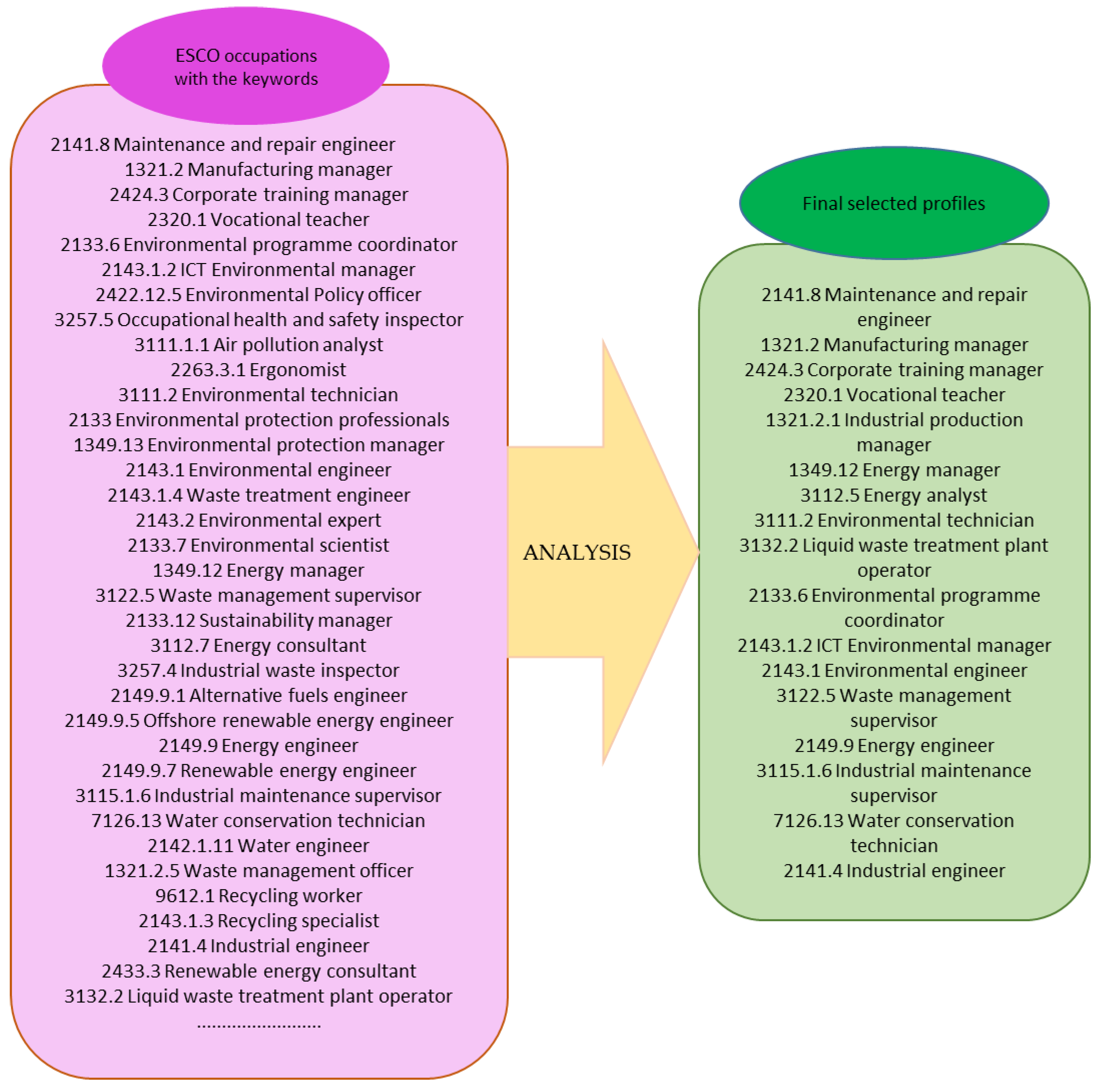

| Defined Keywords for IS- and EE-Related Occupations |
|---|
| Environment/al |
| Energy |
| Energy efficiency |
| Recycling |
| Waste |
| Water |
| Contamination |
| Pollution |
| Renewable |
| Trainer |
| Teacher |
| Maintenance |
| Industrial production |
| Identified Skills | Same Skills Defined by ESCO |
|---|---|
| Quality assurance | Quality assurance methodologies |
| Collaborative/Autonomous Robotics | Human–robot collaboration |
| Health and safety training | Health and safety in the workplace |
| Cloud computing | Cloud technologies |
| Supply chain | Supply chain principles/management |
| ERP | Business ICT systems |
| Job Profile | Corporate Training Manager | Environmental Technician | Environmental Programme Coordinator | Environmental Engineer |
|---|---|---|---|---|
| ESCO URL | http://data.europa.eu/esco/occupation/a14e96a7-6c4d-4d69-8c6f-7ccadf77bac5 (accessed on 8 April 2022). | http://data.europa.eu/esco/occupation/e8461d2e-3d75-477c-93a2-ea8d342bb55b (accessed on 8 April 2022). | http://data.europa.eu/esco/occupation/59883630-45f9-40e7-9732-9e5ff9758d2b (accessed on 8 April 2022). | http://data.europa.eu/esco/occupation/ac1fc6a9-70d2-475c-8fa0-82ef83830968 (accessed on 8 April 2022). |
| Alternative labels | Education and training manager/manager of corporate training/staff development director/talent development coordinator/learning programmes manager/etc. | Environmental technician/environmental protection technician/pollution prevention technician/pollution control technician/groundwater protection technician/environmental conservation technician | Environmental health officer/environment programme coordinator/environment compliance manager/environmental officer/programme coordinator environment/environmental assessment coordinator/environmental impact assessor/environmental auditor/environmental manager/environmental consultant/sustainability consultant/programme coordinator environment | air protection environmental engineer/environmental engineering expert/environment engineer/industrial environmental engineer/water pollution engineer/environmental engineering adviser/chemical environmental engineer/environmental engineering specialist/environmental engineering consultant/sanitary engineer/pollution engineer/environmental analyst/environmental specialist for water management/agricultural conservation engineer |
| Description | Corporate training managers coordinate all the training activities and development programmes in a company. They also design and develop new training modules and supervise all the activities related to the planning and delivery of these programmes. | Environmental technicians investigate sources of pollution and aid in the development of pollution prevention and environment protection plans. They take samples of soil, water or other materials and perform tests to analyse the pollution level and identify its source. | Environmental programme coordinators develop programmes for the improvement of environmental sustainability and efficiency within an organisation or institution. They inspect sites in order to monitor an organisation’s or an institution’s compliance with environmental legislation. They also ensure education for the public on environmental concerns. | Environmental engineers integrate environmental and sustainable measures in the development of projects of various natures. They seek to preserve natural resources and natural sites. They work together with engineers from other fields to envision all the implications that projects might have in order to design ways to conserve natural reserves, prevent pollution and deploy sanitary measures. |
| ISCO number | 1321.2 | 3111.2 | 2133.6 | 2143.1 |
| Job Profile | Corporate Training Manager | Environmental Technician | Environmental Programme Coordinator | Environmental Engineer |
|---|---|---|---|---|
| Current essential skills | adapt training to labour market | conduct environmental site assessments | analyse environmental data | abide by regulations on banned materials |
| apply company policies | advise on soil and water protection | assess environmental impact | address public health issues | |
| apply strategic thinking | advise on environmental risk management systems | carry out environmental audits | adjust engineering designs | |
| build business relationships | advise on environmental remediation | conduct environmental surveys | advise on environmental remediation | |
| comply with legal regulations | test samples for pollutants | develop environmental policies | analyse environmental data | |
| coordinate operational activities | analyse experimental laboratory data | ensure compliance with environmental legislation | approve engineering design | |
| develop corporate training programmes | collect samples for analysis | implement environmental action plans | carry out environmental audits | |
| develop employee retention programmes | perform laboratory tests | implement environmental protection measures | conduct environmental surveys | |
| develop training programmes | analyse environmental data | perform environmental investigations | develop environmental remediation strategies | |
| evaluate the performance of organisational collaborators | document analysis results | promote environmental awareness | ensure compliance with safety legislation | |
| evaluate training | assess environmental impact | provide training in sustainable tourism development and management | perform scientific research | |
| give constructive feedback | report on environmental issues | report on environmental issues | process customer requests based on the REACH Regulation 1907 2006 | |
| identify necessary human resources | use technical drawing software | |||
| identify with the company’s goals | ||||
| liaise with managers | ||||
| manage budgets | ||||
| manage corporate training programmes | ||||
| manage payroll | ||||
| monitor company policies | ||||
| monitor developments in their field of expertise | ||||
| negotiate employment agreements | ||||
| negotiate with employment agencies | ||||
| organise staff assessment | ||||
| promote gender equality in business contexts | ||||
| provide training in sustainable tourism development and management | ||||
| supervise staff | ||||
| track key performance indicators | ||||
| Current optional skills | apply technical communication skills | monitor legislation developments | carry out training in environmental matters | advise on mining environmental issues |
| coach employees | secure working area | conduct educational activities | advise on pollution prevention | |
| deliver online training | promote environmental awareness | conduct environmental site assessments | advise on waste management procedures | |
| develop professional network | communicate with external laboratories | conduct public presentations | assess the life cycle of resources | |
| plan medium to long term objectives | wear appropriate protective gear | develop educational resources | collect samples for analysis | |
| promote education course | remove contaminated materials | develop professional network | conduct field work | |
| provide information on study programmes | perform environmental remediation | issue licences | conduct quality control analysis | |
| teach corporate skills | implement environmental action plans | liaise with local authorities | design strategies for nuclear emergencies | |
| work with virtual learning environments | develop scientific research protocols | maintain relationships with government agencies | develop hazardous waste management strategies | |
| develop environmental remediation strategies | manage government policy implementation | develop non-hazardous waste management strategies | ||
| investigate contamination | monitor legislation developments | ensure material compliance | ||
| apply statistical analysis techniques | write inspection reports | inspect compliance with hazardous waste regulations | ||
| assess contamination | inspect industrial equipment | |||
| advise on pollution prevention | investigate contamination | |||
| ensure compliance with environmental legislation | manage air quality | |||
| report pollution incidents | perform laboratory tests | |||
| avoid contamination | perform project management | |||
| investigate pollution |
| Technical Skills | Social Skills | Green Skills |
|---|---|---|
| Machine learning | Problem solving | Material reutilisation |
| Artificial Intelligence | Autonomy | Resource efficiency |
| Electrical engineering | Critical thinking | Environmental awareness |
| Electronics | Coordination | Waste reduction |
| Use of drones | Process analysis | Waste management |
| Human–robot collaboration | Continuous learning | Energy conservation and energy efficiency |
| Digital twin | Teamwork | Sustainable resource management |
| Cyber-physical systems (CPS) | Adaptability to change | 3Rs, reuse, recycle, reduce |
| Preventive and predictive maintenance | Entrepreneurship skills | Renewable energy and advanced energy storage |
| Quality assurance methodologies | Business awareness | Understanding environmental management |
| Remote control and smart sensoring | Customer awareness | Circular business models |
| Supply chain | Self-management | |
| Monitoring systems of energy consumption | Legal literacy | |
| Virtual reality and augmented reality | Languages | |
| Smart grid technology knowledge | Advanced communication skills | |
| IoT | Leadership skills | |
| Cloud technologies | Social responsibility | |
| Cybersecurity | Ethical responsibility | |
| Smart factory and intelligent factory Internet of Services | Planning and scheduling | |
| Human machine interfaces | Decision-making | |
| ROVs remotely operated vehicles | People management | |
| Smart grid technology knowledge (smart grid systems) | Coordinating | |
| Advanced simulation | Negotiation | |
| VAM realities | Marketing skills | |
| Business ICT systems | Production planning | |
| E-commerce | Health and safety in the workplace | |
| Building Information Modelling (BIM) | Opportunity assessment | |
| 3d laser scanning | Common good | |
| Component printing | Psychological and mental flexibility | |
| Circular business models | Cultural empathy | |
| Big data analytics | Cross-functional process know-how | |
| AR | ||
| Robotic construction | ||
| Intelligent materials |
| Job Profile | Corporate Training Manager | Environmental Technician | Environmental Programme Coordinator | Environmental Engineer |
|---|---|---|---|---|
| Future essential skills | IoT | IoT | Big Data | IoT |
| cybersecurity | Big Data | Knowledge and understanding of quality procedures related to digital transformation | Big Data | |
| Business ICT systems | Artificial Intelligence | Use of digital communication tools | Artificial Intelligence (AI) | |
| BI | Virtual reality and augmented reality | Adaptability and adapt to change | Augmented Reality | |
| Decision making | Human–robot collaboration | Environmental awareness | Complex information processing and interpretation | |
| Marketing skills | Human machine interfaces | Energy efficiency | Sensors Technology | |
| energy conservation and energy efficiency | Online inspection and monitoring | Platforms for energy management of equipment and plants | Machine Learning | |
| Quality assurance methodologies | Preventive and predictive maintenance | Monitoring systems of energy consumption | Cloud technologies | |
| Entrepreneurship skills | Continuous learning | Waste reduction and waste management | Digital twin | |
| Business awareness | Cyber-physical systems (CPS) | Sustainable resource management | Waste reduction and waste management | |
| Customer awareness | Basic data input and processing | Water conservation | Traceability | |
| Finance skills | Use of digital communication tools | Circular economy | Advanced IT skills and programming | |
| Economics skills | Basic numeracy and communication | Legal literacy | Advanced data analysis and modelisation | |
| Team working | Quality assurance methodologies | 3Rs, reuse, recycle, reduce | Data management-safe storage | |
| Advanced communication skills | Environmental awareness | Cybersecurity | ||
| Adaptability to change | Resource efficiency and energy efficiency | Use of digital communication tools | ||
| Leadership skills | Platforms for energy management of equipment and plants | Opportunity assessment | ||
| Decision-making | Use of drones | Adaptability and adapting to change | ||
| People management | Monitoring systems of energy consumption | Critical thinking and decision making | ||
| Coordinating | Remote control (remote monitoring systems) and smart sensoring | Cross-functional process know-how | ||
| Critical thinking | Problem solving | Interdisciplinary thinking and acting | ||
| IT abilities | Solid literacy | Advanced literacy | ||
| Languages | Machine learning | Quantitative and statistical skills | ||
| Production planning | Complex information processing and interpretation | Appropriate linguistic skills | ||
| Scheduling | Electrical engineering | Problem solving | ||
| Electronics | Environmental awareness | |||
| Sustainable resource management | Energy efficiency | |||
| 3Rs, reuse, recycle, reduce | Platforms for energy management of equipment and plants | |||
| Smart factory and intelligent factory | Legal literacy | |||
| Internet of Services | Monitoring systems of energy consumption | |||
| Waste reduction and waste management | Entrepreneurship and initiative taking | |||
| Water conservation | Continuous learning | |||
| Sustainable resource management | ||||
| Water conservation | ||||
| Circular economy | ||||
| Risk management | ||||
| Product life cycle impact assessment | ||||
| Future optional skills | Health and safety in the workplace | Teamwork | Work autonomously | Business Intelligence (BI) |
| E-commerce | Active listening | Conflict resolution | Financial literacy | |
| Opportunity assessment | Appropriate linguistic skills | Interpersonal skills and empathy | Advanced communication skills | |
| Environmental awareness | Data management-safe storage | Cross-functional process know-how | Negotiation skills | |
| Waste reduction | Critical thinking | Active listening | Ethical skills | |
| Waste management | Coordination | Appropriate linguistic skills | Active listening | |
| Sustainable resource management | Teaching and training others | Teaching and training others | Teamwork skills | |
| Adaptability to change | ROVs remotely operated vehicles | Ethical skills | Conflict resolution | |
| 3Rs, reuse, recycle, reduce | Adaptability to change | Leadership and managing others | Leadership and managing others | |
| Supply chain principles/management | Cross-functional process know-how | Agile human–machine interfaces (HM) | ||
| Resource efficiency | Autonomy | Cyber-physical systems (CBS) | ||
| Continuous learning | Cross-functional thinking | Creativity | ||
| Energy conservation and energy efficiency | Cloud technologies | Resource reuse/recycling | ||
| Teaching and training others | Cybersecurity | Interpersonal skills and empathy | ||
| Supply chain principles/management | Teaching and training others | |||
| Work autonomously | ||||
| Conflict resolution | ||||
| Interpersonal skills and empathy |
| Professionals |
| Science and engineering professionals |
| Engineering professionals (excluding electrotechnology) |
| Industrial and production engineers |
| Maintenance and repair engineer |
| ESCO URL: http://data.europa.eu/esco/occupation/615920c5-4f63-4eb3-8b60-afaaed3ab1ff (accessed on 8 April 2022) |
| Machine engineer/mechanical engineer/production engineer/plant repair engineer/site superintendent/manufacturing engineer/repair engineer/maintenance engineer/manufacturing systems engineer/maintenance and repair superintendent/maintenance and repair manager/equipment engineer/plant maintenance engineer/engineering manager/plant engineer |
| Maintenance and repair engineers focus on the optimisation of equipment, procedures, types of machinery and infrastructure. They ensure their maximum availability at minimum costs. |
| 2141.8 |
| Current essential skills |
| advise on efficiency improvements |
| conduct quality control analysis |
| conduct routine machinery checks |
| create solutions to problems |
| inspect industrial equipment |
| inspect machinery |
| maintain equipment |
| maintain machinery |
| manage budgets |
| perform machine maintenance |
| perform test run |
| resolve equipment malfunctions |
| troubleshoot |
| use testing equipment |
| work safely with machines |
| write technical reports |
| Current optional skills |
| analyse big data |
| analyse test data |
| apply technical communication skills |
| assemble mechatronic units |
| assemble sensors |
| collaborate with designers |
| coordinate communication within a team |
| design automation components |
| develop strategies to solve problems |
| estimate restoration costs |
| execute software tests |
| install automation components |
| install hydraulic systems |
| install mechatronic equipment |
| lead process optimisation |
| maintain hydraulic systems |
| maintain nuclear reactors |
| maintain power plants |
| maintain robotic equipment |
| maintain sensor equipment |
| operate battery test equipment |
| operate hydraulic machinery controls |
| operate hydraulic pumps |
| operate hydrogen extraction equipment |
| optimise production |
| optimise production processes parameters |
| perform data analysis |
| perform data mining |
| perform maintenance on installed equipment |
| perform risk analysis |
| provide customer information related to repairs |
| provide technical documentation |
| read standard blueprints |
| record test data |
| repair battery components |
| research ocean energy projects |
| simulate mechatronic design concepts |
| solve technical problems |
| test mechatronic units |
| test sensors |
| use computerised maintenance management systems |
| use remote control equipment |
| use specific data analysis software |
| utilise machine learning |
| write records for repairs |
| Future essential skills |
| Preventive and predictive maintenance |
| Quality assurance methodologies |
| Remote control and smart sensoring |
| Digital literacy |
| Solid literacy |
| Supply chain principles/management |
| Machine learning |
| Artificial Intelligence |
| Material reutilisation |
| Resource efficiency |
| Electrical engineering |
| Electronics |
| Use of drones |
| Human–robot collaboration |
| Digital twin |
| Cyber-physical systems (CPS) |
| Monitoring systems of energy consumption |
| Process analysis |
| Continuous learning |
| Virtual reality and augmented reality |
| Smart grid technology knowledge |
| IoT |
| Cloud technologies |
| Cybersecurity |
| Smart factory and intelligent factory Internet of Services |
| Energy conservation and energy efficiency |
| Future optional skills |
| Problem solving |
| Autonomy |
| Critical thinking |
| Coordination |
| Environmental awareness |
| Waste reduction |
| Waste management |
| Cross-functional thinking |
| Human machine interfaces |
| ROVs remotely operated vehicles |
| Online inspection and monitoring |
| Sustainable resource management |
| Teamwork |
| Adaptability to change |
| 3Rs, reuse, recycle, reduce |
Publisher’s Note: MDPI stays neutral with regard to jurisdictional claims in published maps and institutional affiliations. |
© 2022 by the authors. Licensee MDPI, Basel, Switzerland. This article is an open access article distributed under the terms and conditions of the Creative Commons Attribution (CC BY) license (https://creativecommons.org/licenses/by/4.0/).
Share and Cite
Akyazi, T.; del Val, P.; Goti, A.; Oyarbide, A. Identifying Future Skill Requirements of the Job Profiles for a Sustainable European Manufacturing Industry 4.0. Recycling 2022, 7, 32. https://doi.org/10.3390/recycling7030032
Akyazi T, del Val P, Goti A, Oyarbide A. Identifying Future Skill Requirements of the Job Profiles for a Sustainable European Manufacturing Industry 4.0. Recycling. 2022; 7(3):32. https://doi.org/10.3390/recycling7030032
Chicago/Turabian StyleAkyazi, Tugce, Patricia del Val, Aitor Goti, and Aitor Oyarbide. 2022. "Identifying Future Skill Requirements of the Job Profiles for a Sustainable European Manufacturing Industry 4.0" Recycling 7, no. 3: 32. https://doi.org/10.3390/recycling7030032
APA StyleAkyazi, T., del Val, P., Goti, A., & Oyarbide, A. (2022). Identifying Future Skill Requirements of the Job Profiles for a Sustainable European Manufacturing Industry 4.0. Recycling, 7(3), 32. https://doi.org/10.3390/recycling7030032

