
Article

Modal Decomposition Techniques: Application in Coherent Structures for a Saccular Aneurysm Model

1
Department of Soils and Water Systems, University of Idaho, Moscow, ID 83844, USA
2
Department of Mechanical Engineering, University of Idaho, Moscow, ID 83844, USA
*
Author to whom correspondence should be addressed.
Fluids 2022, 7(5), 165; https://doi.org/10.3390/fluids7050165
Submission received: 1 April 2022 / Revised: 26 April 2022 / Accepted: 28 April 2022 / Published: 9 May 2022
(This article belongs to the Special Issue Coherent Structures in Fluid Mechanics)

Abstract

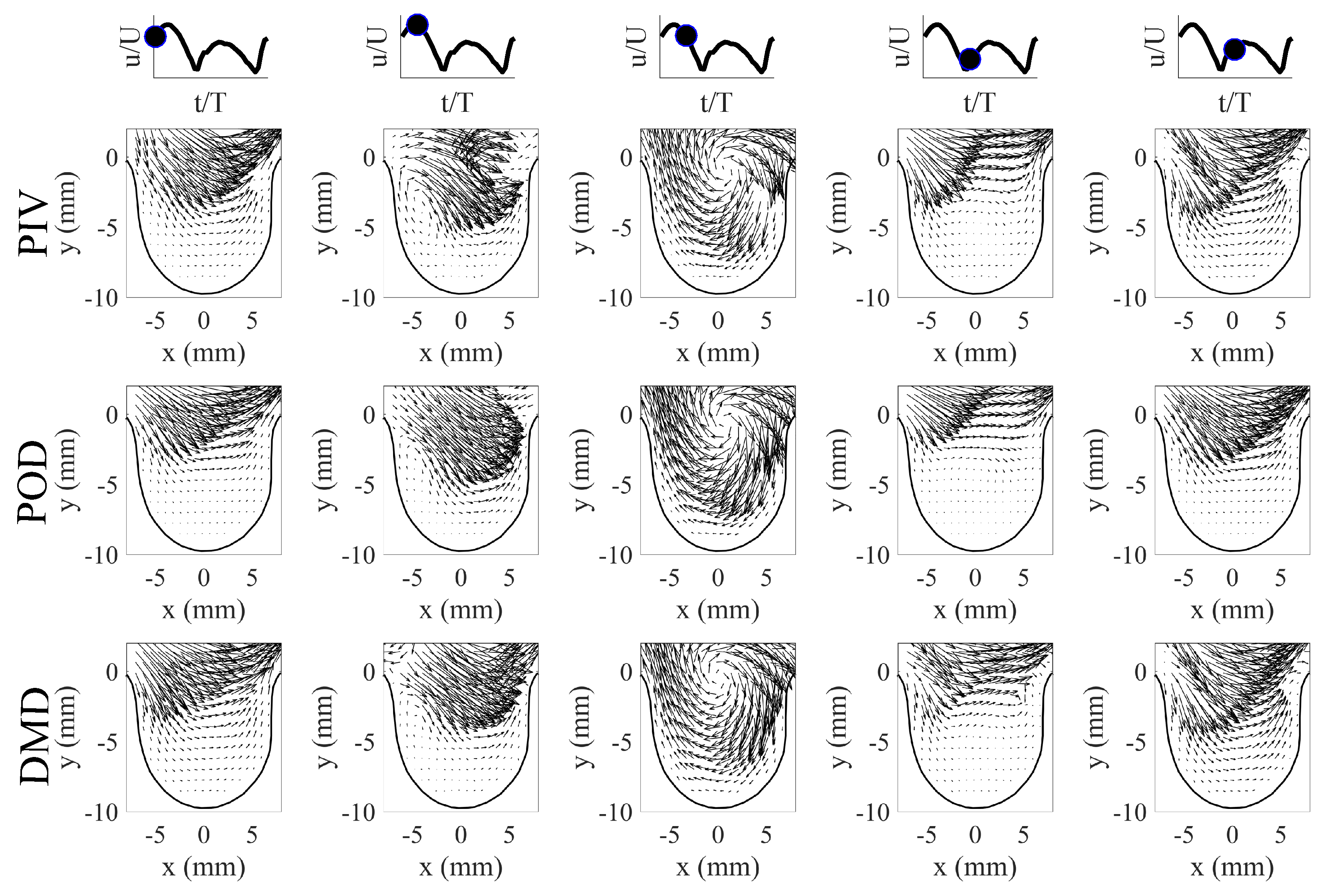
Aneurysms are localized expansions of blood vessels which can be fatal upon rupture. Studies have shown that aneurysm flows exhibit complex flow phenomena which consist of single or multiple vortical structures that move within the flow cycle. Understanding the complex flow behaviors of aneurysms remain challenging. Thus, the goal of this study is to quantify the flow behavior and extract physical insights into aneurysm flows using advance data decomposition methods, Proper Orthogonal Decomposition (POD) and Dynamic Mode Decomposition (DMD). The velocity field data were obtained by performing 2D Particle Image Velocimetry (2D PIV) on the mid-plane of an idealized, rigid, saccular aneurysm model. The input flow conditions were set to Rep=50 and 150 for a fixed α=2 using a precisely controlled piston pump system. POD was used to quantify the spatial features of the flows, while DMD was used to obtain insight on the dynamics. The results obtained from POD and DMD showed the capability of both methods to quantify the flow field, with the modes obtained providing different insights into the flow evolution in the aneurysm. The curve-fitting step of the POD time-varying coefficients, and the appropriate selection of DMD modes based on their energy contribution, allowed the mathematical flow models from POD and DMD to reconstruct flow fields at any given time step. This can be used for validation of numerical or computational data.
Keywords: Proper Orthogonal Decomposition; experimental fluid dynamics; aneurysm; Particle Image Velocimetry; Dynamic Mode Decomposition Proper Orthogonal Decomposition; experimental fluid dynamics; aneurysm; Particle Image Velocimetry; Dynamic Mode Decomposition