Review

Potential Role of Polyphenols in Platelet Aggregation and Blood Coagulation

1
Leeds Thrombosis Network, Discovery and Translational Science Department, Leeds Institute of Cardiovascular and Metabolic Medicine, University of Leeds, Leeds LS2 9NL, UK
2
School of Food Science and Nutrition, Faculty of Environment, University of Leeds, Leeds LS2 9NL, UK
*
Author to whom correspondence should be addressed.
J. Cardiovasc. Dev. Dis. 2026, 13(5), 219; https://doi.org/10.3390/jcdd13050219
Submission received: 13 February 2026 / Revised: 30 April 2026 / Accepted: 13 May 2026 / Published: 20 May 2026
(This article belongs to the Section Epidemiology, Lifestyle, and Cardiovascular Health)

Abstract

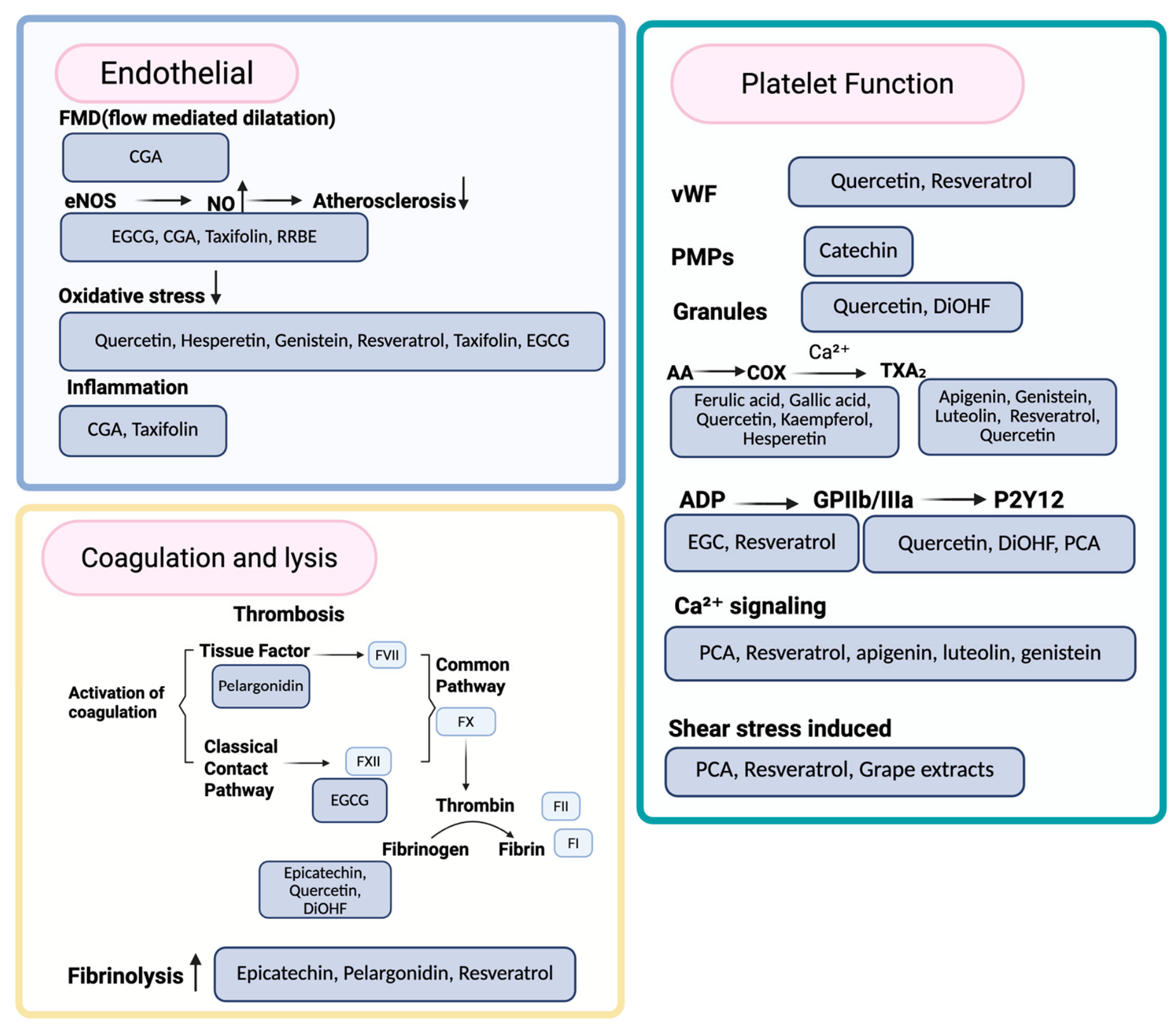
Cardiovascular diseases (CVDs) are a significant health burden worldwide. One of the key pathological processes underlying CVD is thrombosis–the formation of a blood clot (thrombus) within the blood vessel. Thrombus composition typically includes fibrin, platelets, red blood cells, leukocytes, and neutrophil extracellular traps (NETs). Polyphenols, a diverse group of naturally occurring compounds abundant in plant-based foods, have shown potential cardiovascular protective properties. This review discusses and summarizes the effects of polyphenols on the endothelium, platelet function and activity, and blood coagulation, and how this may potentially contribute to attenuated thrombus formation. The available evidence discussed in this review suggests that polyphenols may confer cardiovascular benefits not only through antioxidant and anti-inflammatory actions, but also by directly modulating thrombosis-related mechanisms. Nevertheless, in vivo studies remain limited, and the lack of standardized procedures contributes to discrepancies among reported results. Moreover, differences in compound structure, absorption and bioavailability should be considered when interpreting findings and their potential application as part of preventative strategies. The evidence presented in this review suggests that polyphenols may offer benefits towards lowering thrombosis risk and reducing recurrence among patients with thrombosis, although additional studies are required to further explore their mechanistic effects.
Keywords: polyphenols; platelets; fibrinogen; clot structure; blood coagulation; cardiovascular polyphenols; platelets; fibrinogen; clot structure; blood coagulation; cardiovascular