
A Manufacturing Protocol for Complete Dentures Using a Milling Cutting Method with an Individual Correction of the Prosthetic Plane



Abstract
1. Introduction
- As restorations made entirely using a digital protocol—currently, the quality of such a restoration cannot be accurately assessed due to numerous difficulties in scanning the denture foundation.
- As restorations made in a hybrid mode, where functional impressions and centric occlusion records are obtained in the analogue protocol, and, subsequently, after the impression and the occlusion records have been scanned, the fabrication is continued using the digital protocol.
2. Material and Methods
2.1. Inclusion Criteria
- •
- Complete edentulism.
- •
- The use of complete dentures ≥ 5 years.
- •
- The normal vertical dimension at centric occlusion in the complete dentures currently used by the patients.
- •
- Age ≥ 50 years.
- •
- Patients healthy in general.
2.2. Exclusion Criteria
- Prosthetic
- •
- No history of removable denture use.
- •
- Extremely difficult conditions of the denture-bearing area (cleft, the state post-mandibular resection, total alveolar resorption).
- •
- Inflammatory lesions of the denture-bearing mucosa.
- •
- Functional disorders of the masticatory system.
- •
- Poor oral hygiene and the hygiene of previously used dentures.
- b.
- Health-status-related exclusion criteria
- •
- Disability or impaired ability to independently place and remove the denture and maintain its hygiene
- •
- Diseases: neoplastic, type II diabetes, AIDS, mental disorders
- •
- Smoking, alcoholism, drug abuse
- •
- Use of specific drugs, e.g., steroids
- -
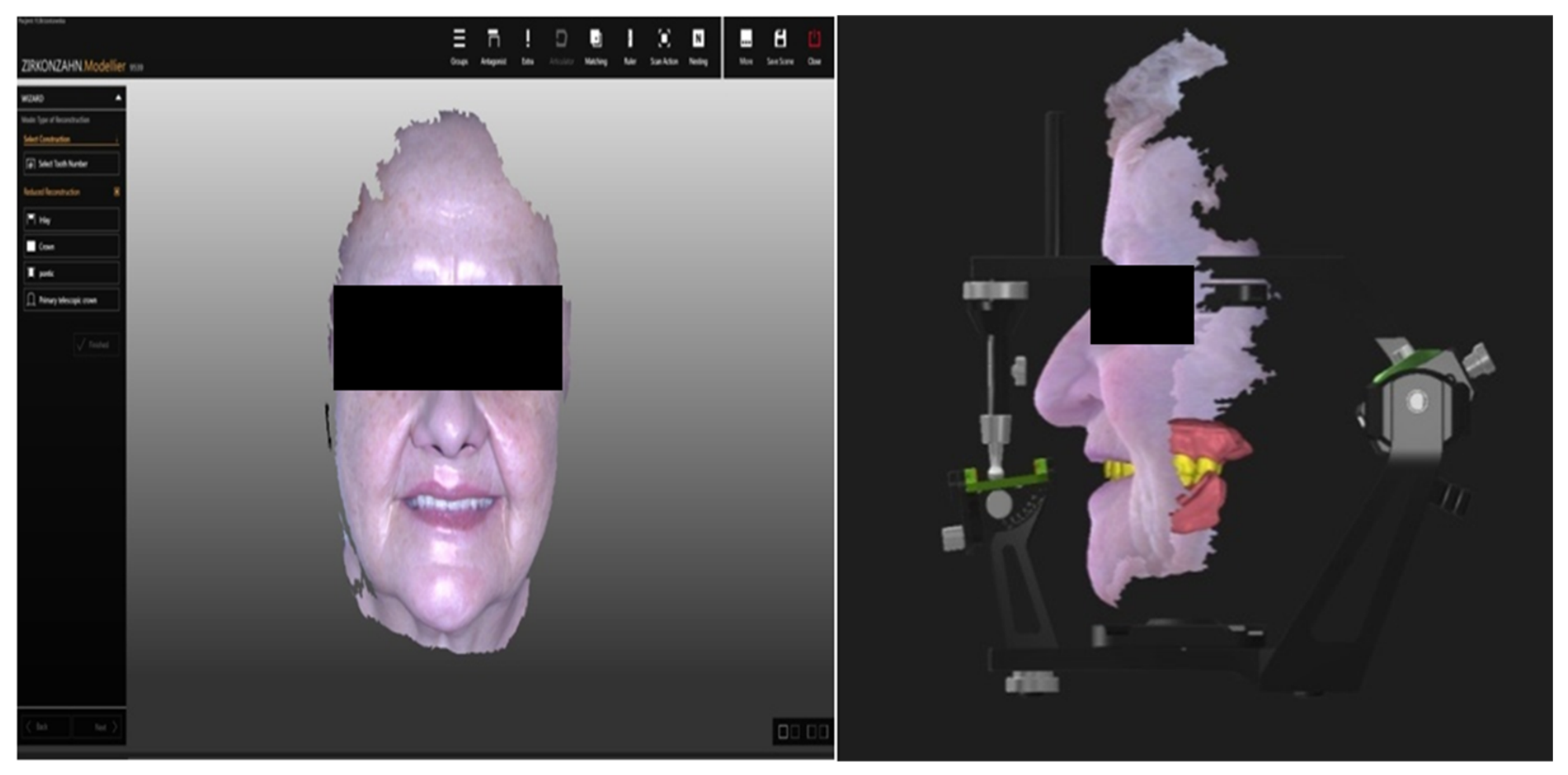
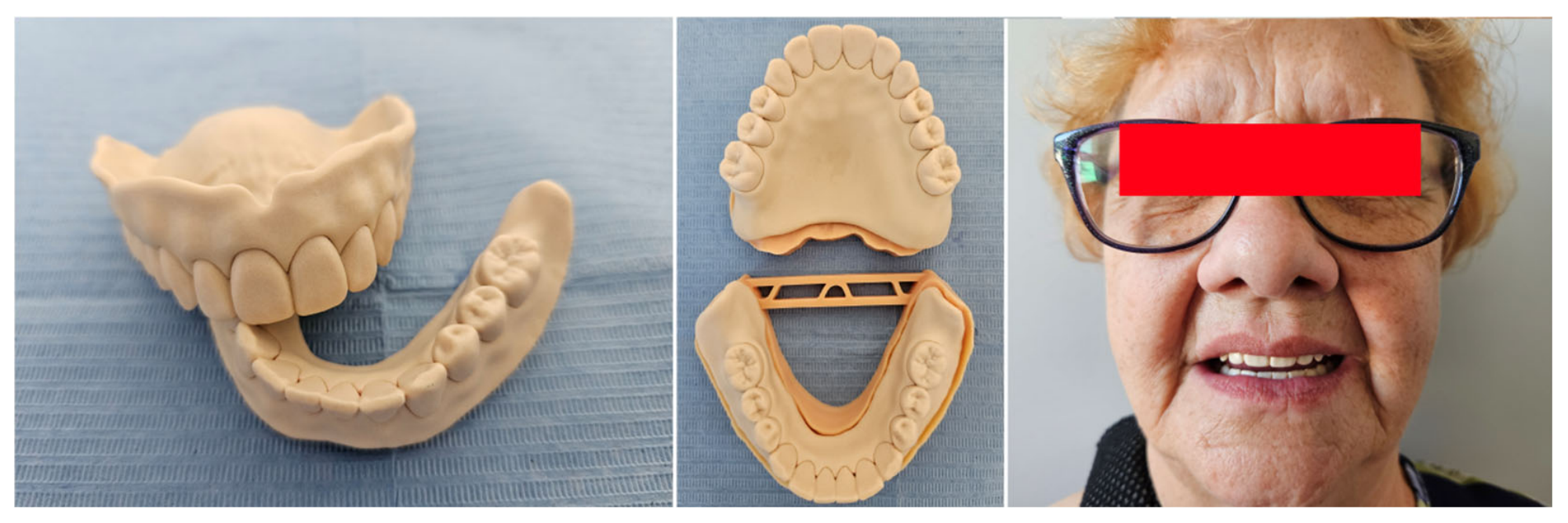
- Images en face and of the left and right profiles—these three images are combined to make a single block, creating an image of the patient’s whole face (ensure that the patient’s alae of the nose and ear lobes are fully visible in the images, as the Ala–Tragus plane is determined by referencing these images).
- -
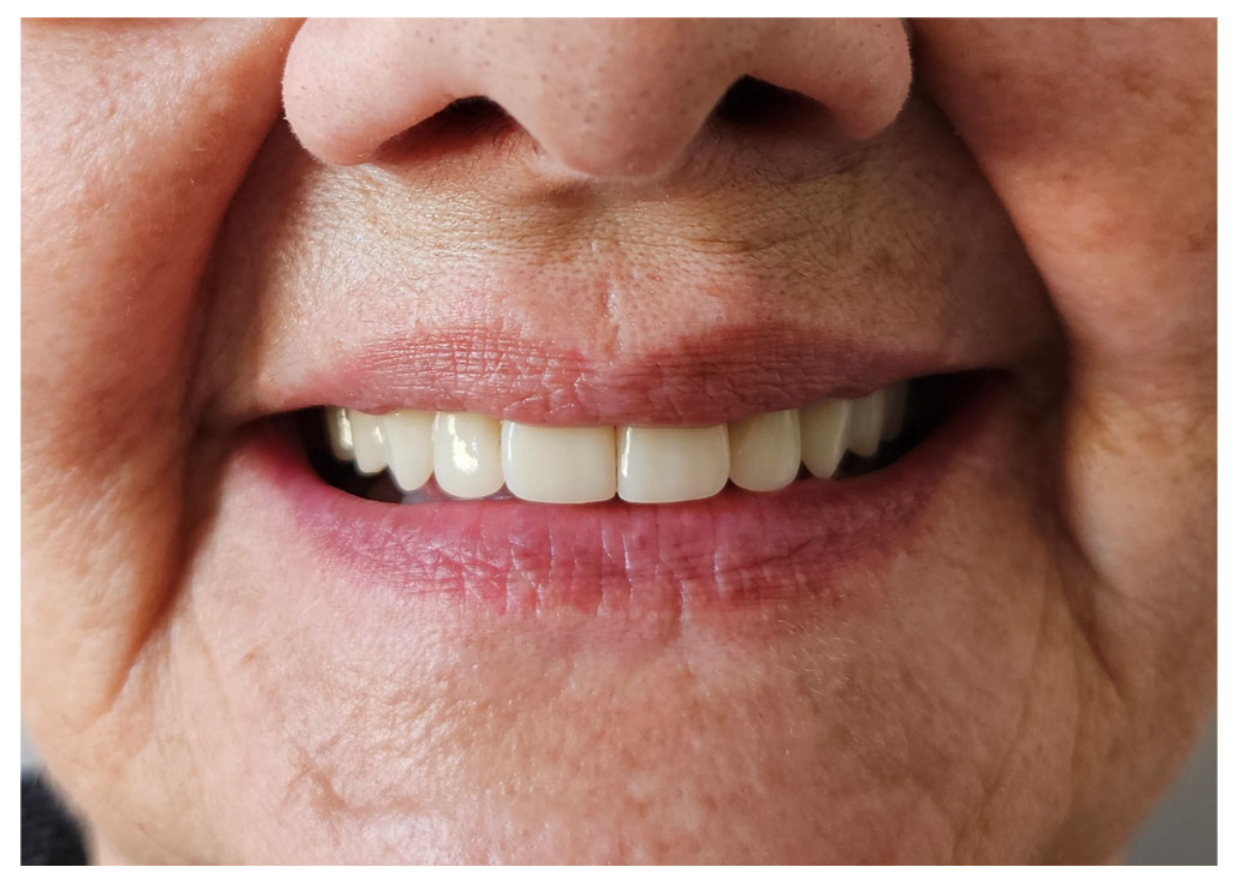
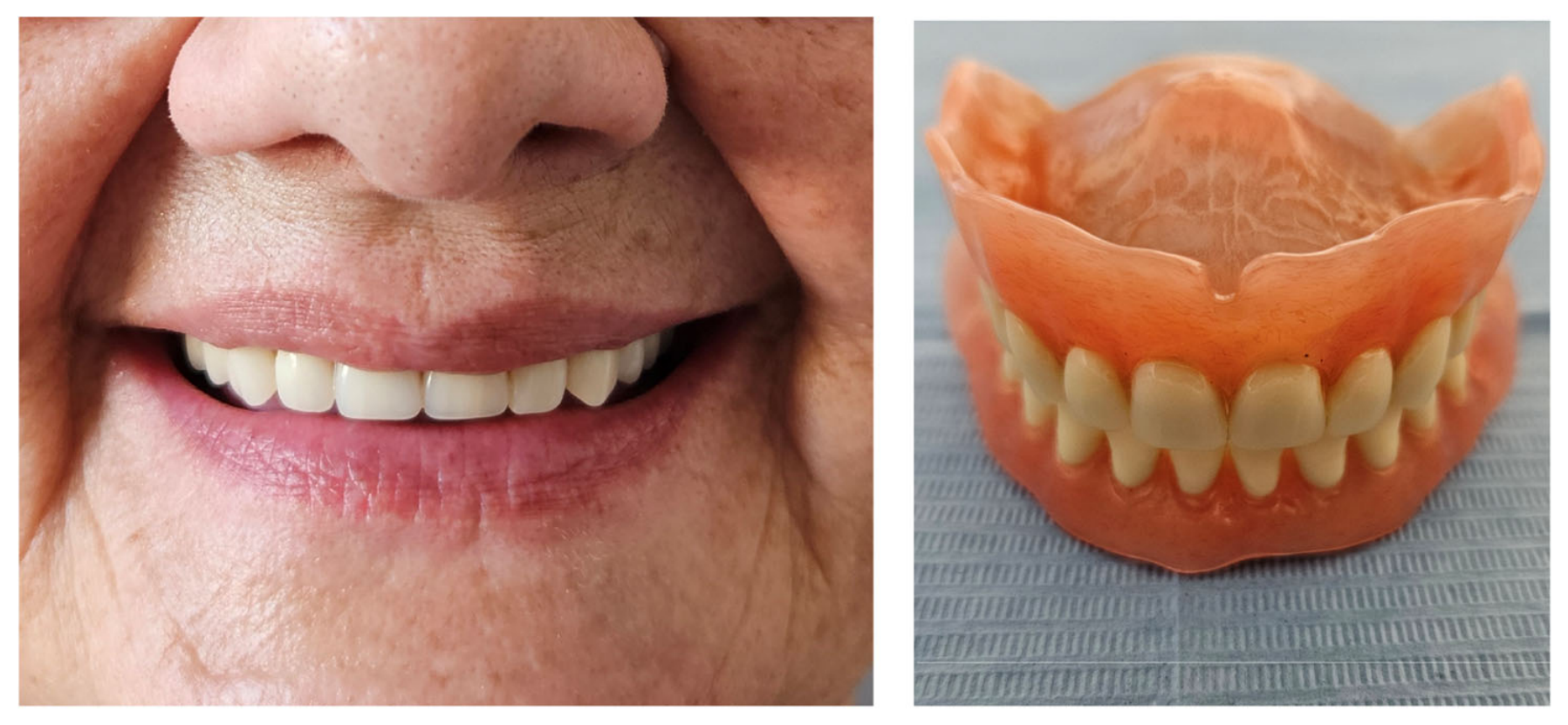
- An image taken while smiling.
- -
- An image with the mouth open.
3. Discussion
4. Conclusions
Author Contributions
Funding
Institutional Review Board Statement
Informed Consent Statement
Data Availability Statement
Acknowledgments
Conflicts of Interest
References
- Bessadet, M.; Nicolas, E.; Sochat, M.; Hennequin, M.; Veyrune, J.L. Impact of removable partial denture prosthesis on chewing efficiency. J. Appl. Oral Sci. 2013, 21, 392–396. [Google Scholar] [CrossRef] [Scilit] [PubMed]
- Rastogi, A.; Srivastava, S.; Gaur, A.; Dupare, A.; Rastogi, S.; Kamatagi, L. Electromyographic Evaluation of the effect of lined dentures on masticatory muscle activity in edentulous subjects. J. Clin. Diagn. Res. 2015, 9, ZC80–ZC83. [Google Scholar] [CrossRef] [Scilit] [PubMed]
- Mubaraki, M.Q.; Moaleem, M.M.A.; Alzahrani, A.H.; Shariff, M.; Alqahtani, S.M.; Porwal, A.; Al-Sanabani, F.A.; Bhandi, S.; Tribst, J.P.M.; Heboyan, A.; et al. Assessment of Conventionally and Digitally Fabricated Complete Dentures: A Comprehensive Review. Materials 2022, 15, 3868. [Google Scholar] [CrossRef] [Scilit] [PubMed]
- Kattadiyil, M.T.; AlHelal, A. An update on computer-engineered complete dentures: A systematic review on clinical outcomes. J. Prosthet. Dent. 2017, 117, 478–485. [Google Scholar] [CrossRef] [Scilit] [PubMed]
- Heikal, M.M.A.; Nabi, N.A.; Elkerdawy, M.W. A Study Comparing Patient Satisfaction and Retention of CAD/CAM Milled Complete Dentures and 3D Printed CAD/CAM Complete Dentures versus Conventional Complete Dentures: A Randomized Clinical Trial. Braz. Dent. Sci. 2022, 25, e2785. [Google Scholar] [CrossRef] [Scilit]
- Han, W.; Li, Y.; Zhang, Y.; Lv, Y.; Zhang, Y.; Hu, P.; Liu, H.; Ma, Z.; Shen, Y. Design and fabrication of complete dentures using CAD/CAM technology. Medicine 2017, 96, e5435. [Google Scholar] [CrossRef] [Scilit] [PubMed]
- Masri, G.; Mortada, R.; Ounsi, H.; Alharbi, N.; Boulos, P.; Salameh, Z. Adaptation of Complete Denture Base Fabricated by Conventional, Milling, and 3-D Printing Techniques: An In Vitro Study. J. Contemp. Dent. Pract. 2020, 21, 367–371. [Google Scholar] [CrossRef] [Scilit] [PubMed]
- AlHelal, A.; AlRumaih, H.S.; Kattadiyil, M.T.; Baba, N.Z.; Goodacre, C.J. Comparison of retention between maxillary milled and conventional denture bases: A clinical study. J. Prosthet. Dent. 2017, 117, 233–238. [Google Scholar] [CrossRef] [Scilit] [PubMed]
- Kattadiyil, M.T.; Jekki, R.; Goodacre, C.J.; Baba, N.Z. Comparison of treatment outcomes in digital and conventional complete removable dental prosthesis fabrications in a predoctoral setting. J. Prosthet. Dent. 2015, 114, 818–825. [Google Scholar] [CrossRef] [Scilit] [PubMed]
- Yilmaz, B.; Azak, A.N.; Alp, G.; Ekşi, H. Use of CAD-CAM technology for the fabrication of complete dentures: An alternative technique. J. Prosthet. Dent. 2017, 118, 140–143. [Google Scholar] [CrossRef] [Scilit] [PubMed]
- Contrepois, M.; Sireix, C.; Soenen, A.; Pia, J.P.; Lasserre, J.F. Complete denture fabrication with CAD/CAM technology: A case report. Int. J. Esthet. Dent. 2018, 13, 66–85. [Google Scholar] [PubMed]
- Janeva, N.; Kovacevska, G.; Janev, E. Complete Dentures Fabricated with CAD/CAM Technology and a Traditional Clinical Recording Method. Open Access Maced. J. Med. Sci. 2017, 5, 785–789. [Google Scholar] [CrossRef] [Scilit] [PubMed]
- de Mendonca, A.F.; Furtado de Mendonca, M.; White, G.S.; Sara, G.; Littlefair, D. Total CAD/CAM Supported Method for Manufacturing Removable Complete Dentures. Case Rep. Dent. 2016, 2016, 1259581. [Google Scholar] [CrossRef] [Scilit] [PubMed]
- Kim, M.-J.; Kim, K.-H.; Yeo, D.-H. Fabrication of computer-aided design/computer-aided manufacturing complete denture and conventional complete denture: Case report. J. Dent. Rehabil. Appl. Sci. 2016, 32, 141–148. [Google Scholar] [CrossRef] [Scilit]
- Bilgin, M.S.; Erdem, A.; Aglarci, O.S.; Dilber, E. Fabricating Complete Dentures with CAD/CAM and RP Technologies. J. Prosthodont. 2015, 24, 576–579. [Google Scholar] [CrossRef] [Scilit] [PubMed]
- Infante, L.; Yilmaz, B.; McGlumphy, E.; Finger, I. Fabricating complete dentures with CAD/CAM technology. J. Prosthet. Dent. 2014, 111, 351–355. [Google Scholar] [CrossRef] [Scilit] [PubMed]
- Joda, T.; Müller, P.; Zimmerling, F.; Schimmel, M. CAD/CAM produced complete dentures with the “Digital Denture Professional System”. Swiss Dent. J. 2016, 126, 899–909. [Google Scholar] [CrossRef] [Scilit] [PubMed]
- Maeda, Y.; Minoura, M.; Tsutsumi, S.; Okada, M.; Nokubi, T. A CAD/CAM system for removable denture. Part I: Fabrication of complete dentures. Int. J. Prosthodont. 1994, 7, 17. [Google Scholar] [PubMed]
- Kawahata, N.; Ono, H.; Nishi, Y.; Hamano, T.; Nagaoka, E. Trial of duplication procedure for complete dentures by CAD/CAM. J. Oral Rehabil. 1997, 24, 540–548. [Google Scholar] [CrossRef] [Scilit] [PubMed]
- Kattadiyil, M.T.; Goodacre, C.J.; Baba, N.Z. CAD/CAM complete dentures: A review of two commercial fabrication systems. J. Calif. Dent. Assoc. 2013, 41, 407–416. [Google Scholar] [CrossRef] [Scilit] [PubMed]
- McLaughlin, J.B.; Ramos, V., Jr.; Dickinson, D.P. Comparison of Fit of Dentures Fabricated by Traditional Techniques Versus CAD/CAM Technology. J. Prosthodont. 2019, 28, 428–435. [Google Scholar] [PubMed]
- Abdelnabi, M.H.; Swelem, A.A. 3D-Printed Complete Dentures: A Review of Clinical and Patient-Based Outcomes. Cureus 2024, 16, e69698. [Google Scholar] [CrossRef] [Scilit] [PubMed]
- Ragheb, N.; Ibrahim, W. Biting force and chewing efficiency of conventional and CAD/CAM complete dentures. A cross-over study. Egypt. Dent. J. 2021, 67, 3323–3335. [Google Scholar] [CrossRef] [Scilit]
- Hsu, C.Y.; Yang, T.C.; Wang, T.M.; Lin, L.D. Effects of fabrication techniques on denture base adaptation: An in vitro study. J. Prosthet. Dent. 2020, 124, 740–747. [Google Scholar] [CrossRef] [Scilit] [PubMed]
- Yoon, S.N.; Oh, K.C.; Lee, S.J.; Han, J.S.; Yoon, H.I. Tissue surface adaptation of CAD-CAM maxillary and mandibular complete denture bases manufactured by digital light processing: A clinical study. J. Prosthet. Dent. 2020, 124, 682–689. [Google Scholar] [CrossRef] [Scilit] [PubMed]
- Steinmassl, O.; Dumfahrt, H.; Grunert, I.; Steinmassl, P.A. Steinmassl CAD/CAM produces dentures with improved fit. Clin. Oral Investig. 2018, 22, 2829–2835. [Google Scholar] [CrossRef] [Scilit] [PubMed]




Disclaimer/Publisher’s Note: The statements, opinions and data contained in all publications are solely those of the individual author(s) and contributor(s) and not of MDPI and/or the editor(s). MDPI and/or the editor(s) disclaim responsibility for any injury to people or property resulting from any ideas, methods, instructions or products referred to in the content. |
© 2026 by the authors. Licensee MDPI, Basel, Switzerland. This article is an open access article distributed under the terms and conditions of the Creative Commons Attribution (CC BY) license.
Share and Cite
Kondrat, W.; Stocka, A.; Łasica, P.; Özcan, M.; Sierpińska, T. A Manufacturing Protocol for Complete Dentures Using a Milling Cutting Method with an Individual Correction of the Prosthetic Plane. Bioengineering 2026, 13, 878. https://doi.org/10.3390/bioengineering13080878
Kondrat W, Stocka A, Łasica P, Özcan M, Sierpińska T. A Manufacturing Protocol for Complete Dentures Using a Milling Cutting Method with an Individual Correction of the Prosthetic Plane. Bioengineering. 2026; 13(8):878. https://doi.org/10.3390/bioengineering13080878
Chicago/Turabian StyleKondrat, Wojciech, Anna Stocka, Paula Łasica, Mutlu Özcan, and Teresa Sierpińska. 2026. "A Manufacturing Protocol for Complete Dentures Using a Milling Cutting Method with an Individual Correction of the Prosthetic Plane" Bioengineering 13, no. 8: 878. https://doi.org/10.3390/bioengineering13080878
APA StyleKondrat, W., Stocka, A., Łasica, P., Özcan, M., & Sierpińska, T. (2026). A Manufacturing Protocol for Complete Dentures Using a Milling Cutting Method with an Individual Correction of the Prosthetic Plane. Bioengineering, 13(8), 878. https://doi.org/10.3390/bioengineering13080878