


Towards Coupling of 1D and 2D Models for Flood Simulation—A Case Study of Nilwala River Basin, Sri Lanka

 ,
,  , and
, and
Abstract
1. Introduction
2. Materials and Methods
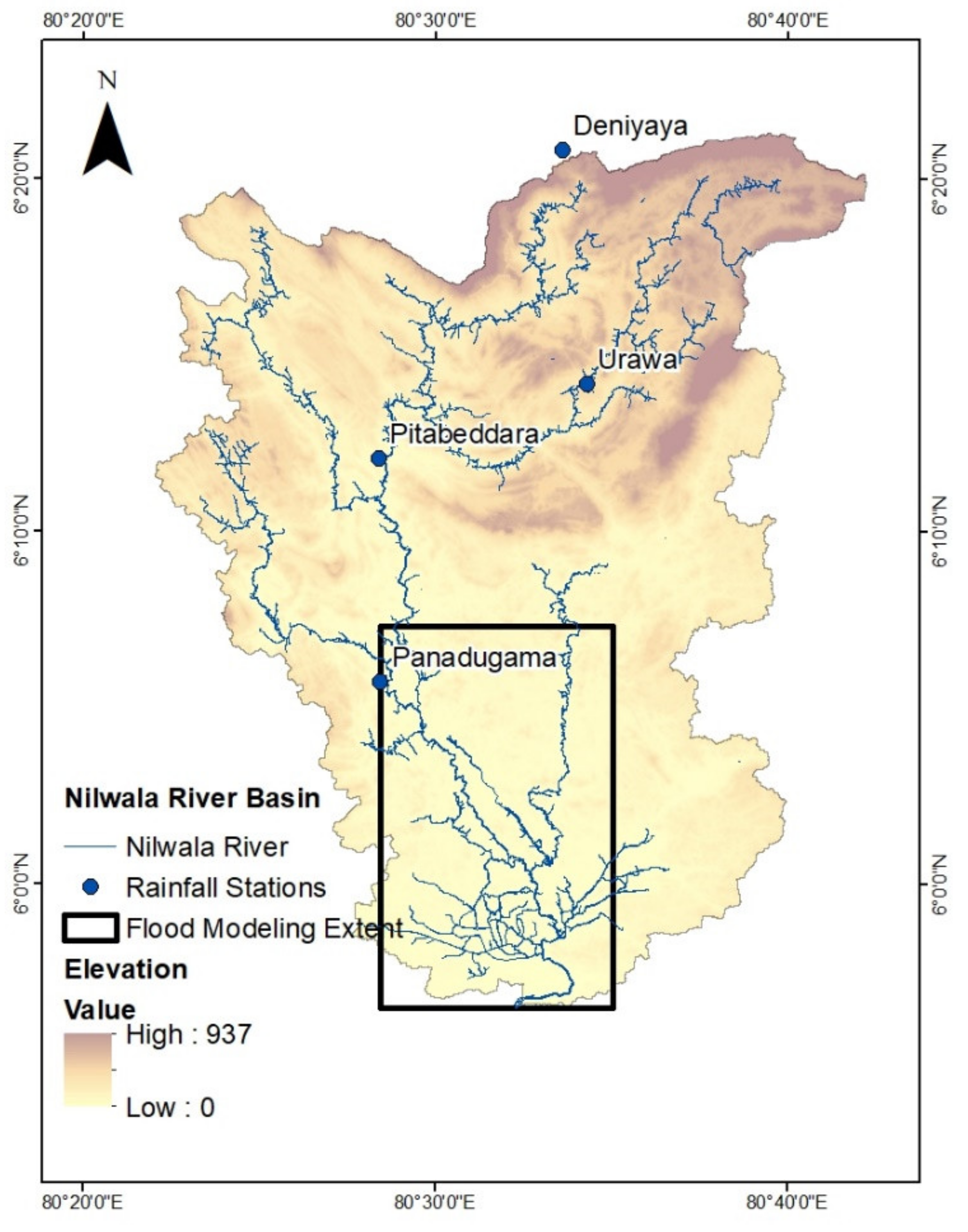
2.1. Study Area
2.2. Data
2.3. Rainfall-Runoff Modelling Using HEC-HMS
2.4. Hydrodynamic Modelling Using Nays2DFlood Solver in iRIC
2.5. Statistical Evaluation
3. Results and Discussion
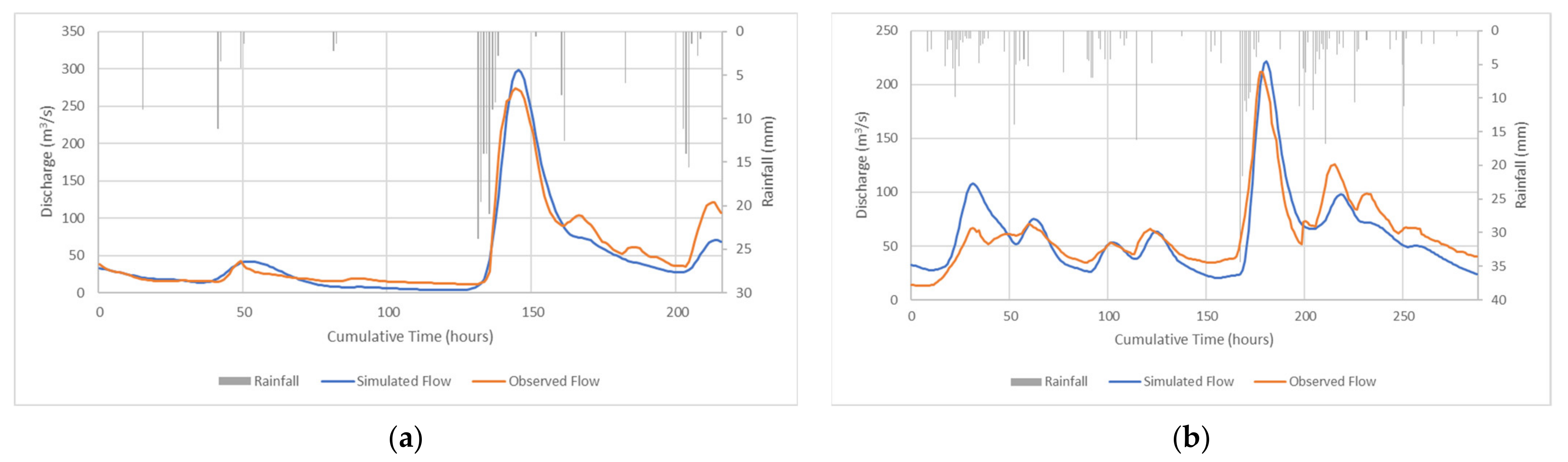
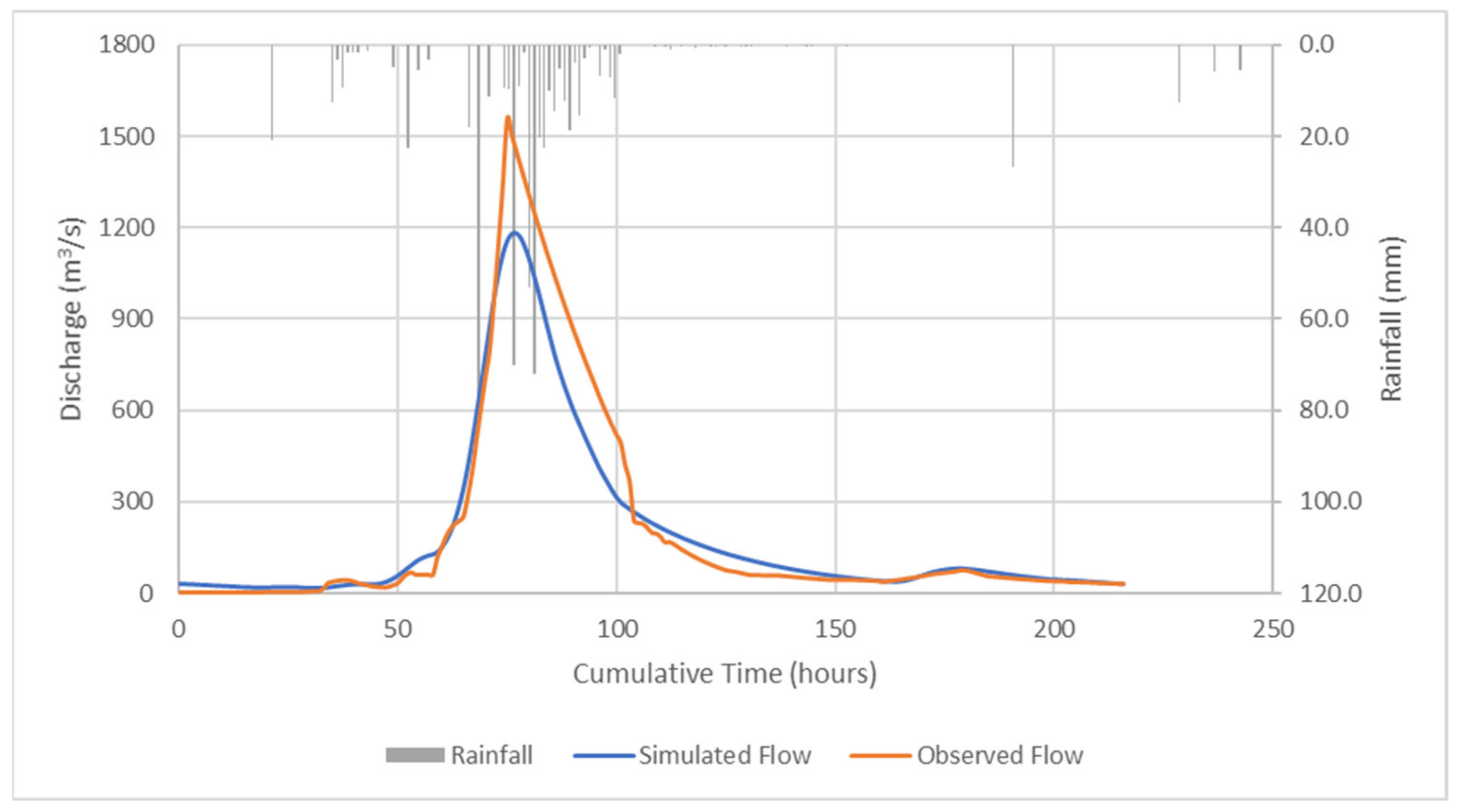
3.1. Calibration and Validation of HEC-HMS
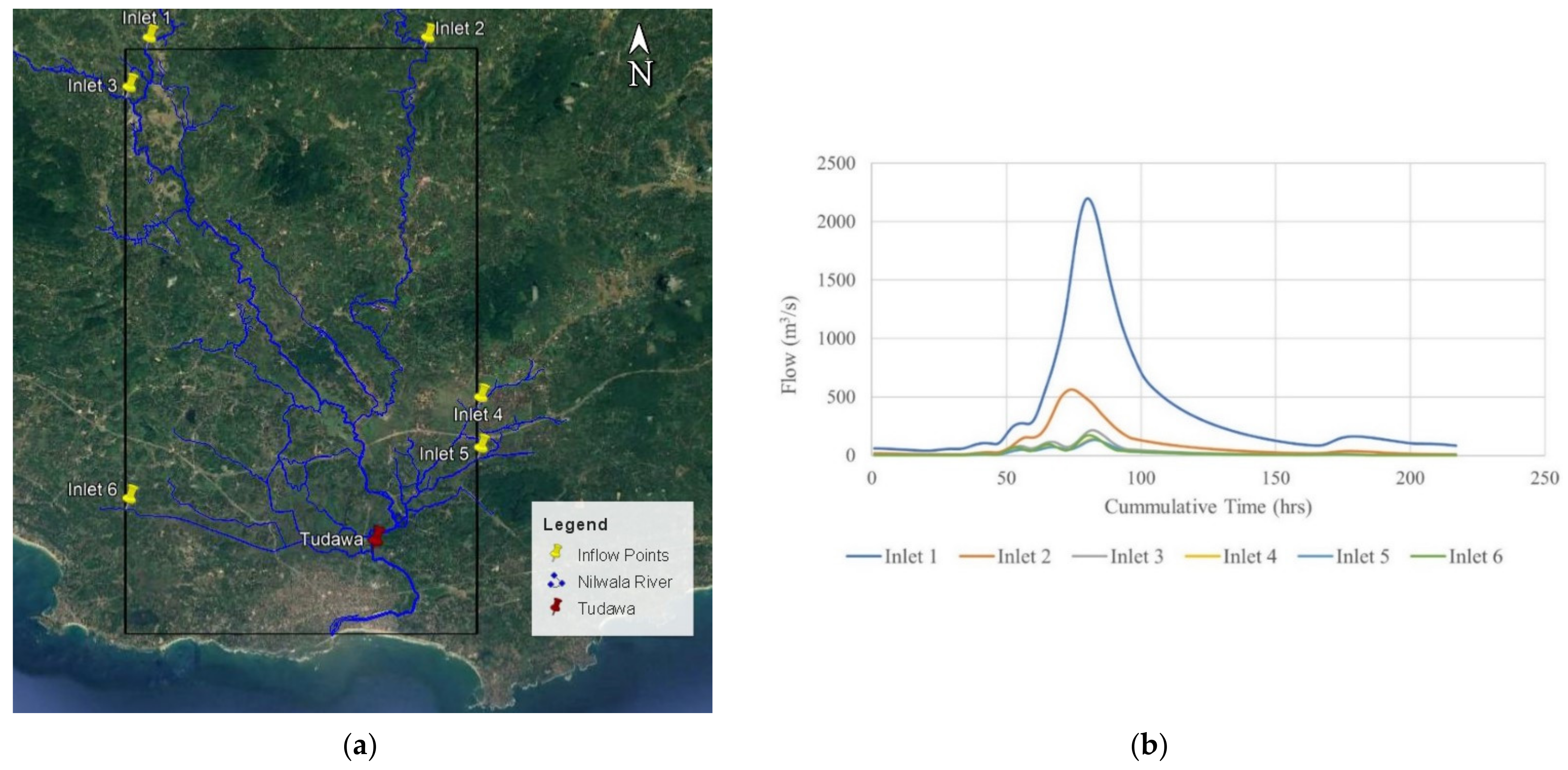
3.2. Hydraulic Model Simulation
4. Conclusions
Author Contributions
Funding
Conflicts of Interest
References
- IPCC. Climate Change 2013—The Physical Science Basis. Contribution of Group I to the Fifth Assessment report of the Intergovernmental panel on Climate Change; Stocker, T., Plattner, G., Tignor, M., Allen, S., Boschung, J., Nauels, A., Xia, Y., Bex, V., Midgley, P., Eds.; Cambridge University Press: Cambridge, UK; New York, NY, USA, 2013. [Google Scholar]
- Eckstein, D.; Kunzel, V.; Schafer, L.; Winges, M. Global Climate Risk Index 2020; Germanwatch: Berlin, Germany, 2019. [Google Scholar]
- Karunathilaka, K.L.A.A.; Dabare, H.K.V.; Nandalal, K.D.W. Changes in Rainfall in Sri Lanka during 1966–2015. Eng. J. Inst. Eng. Sri Lanka 2017, 50, 39–48. [Google Scholar] [CrossRef] [Scilit]
- Naveendrakumar, G.; Vithanage, M.; Kwon, H.H.; Iqbal, M.C.M.; Pathmarajah, S.; Obeysekera, J. Five decadal trends in averages and extremes of rainfall and temperature in Sri Lanka. Adv. Meteorol. 2018, 2018, 4217917. [Google Scholar] [CrossRef] [Scilit]
- Gunarathna, M.H.J.P.; Kumari, M.K.N. Rainfall trends in Anuradhapura: Rainfall analysis for agricultural planning. Rajarata Univ. J. 2013, 1, 38–44. [Google Scholar]
- Smith, K.; Ward, R. Floods: Physical Processes and Human Impacts; Wiley: Hoboken, NJ, USA, 1998; ISBN 978-0-471-95248-0. [Google Scholar]
- Herath, S. Flood Characteristics and Mitigation Issues Flood Trends around the world. UNU—Japan-Keio Joint Training Workshop on “Water Governance”; United Nations University Centre: Tokyo, Japan, 2002. [Google Scholar]
- Ministry of Disaster Management; Ministry of National Policies and Economic Affairs. Sri Lanka Rapid Post Disaster Needs Assessment: Floods and Landslides; Ministry of Disaster Management: Colombo, Sri Lanka; Ministry of National Policies and Economic Affairs: Colombo, Sri Lanka, 2017.
- Dayaratne, S.T.; Perera, B.J.C. Regionalisation of impervious area parameters of urban drainage models. Urban Water J. 2008, 5, 231–246. [Google Scholar] [CrossRef] [Scilit]
- Weerasinghe, K.D.N.; Elkaduwa, W.K.B.; Panabokke, C.R. Agro-climatic risk and irrigation need of the Nilwala Basin of southern Sri Lanka. In Proceedings of the Irrigation Drainage in the New Millenium, Fort Collins, CO, USA, 20–24 June 2000; pp. 455–469. [Google Scholar]
- Jonkman, S.N.; Vrijling, J.K. Loss of life due to floods. J. Flood Risk Manag. 2008, 1, 43–56. [Google Scholar] [CrossRef] [Scilit]
- Vojinovic, Z.; Tutulic, D. On the use of 1d and coupled 1d-2d modelling approaches for assessment of flood damage in urban areas. Urban Water J. 2009, 6, 183–199. [Google Scholar] [CrossRef] [Scilit]
- Timbadiya, P.V.; Patel, P.L.; Porey, P.D. A 1D–2D Coupled Hydrodynamic Model for River Flood Prediction in a Coastal Urban Floodplain. J. Hydrol. Eng. 2015, 20, 05014017. [Google Scholar] [CrossRef] [Scilit]
- Morales-Hernández, M.; Petaccia, G.; Brufau, P.; García-Navarro, P. Conservative 1D-2D coupled numerical strategies applied to river flooding: The Tiber (Rome). Appl. Math. Model. 2016, 40, 2087–2105. [Google Scholar] [CrossRef] [Scilit]
- Samuels, D. Cross-section locations in 1-D models. In Proceedings of the 2nd International Conference on River Flood Hydraulics, Wallingford, UK, 17–20 September 1990; White, W., Watts, J., Eds.; Wiley: Chichester, UK, 1990; pp. 339–350. [Google Scholar]
- Hunter, N.M.; Bates, P.D.; Horritt, M.S.; Wilson, M.D. Simple spatially-distributed models for predicting flood inundation: A review. Geomorphology 2007, 90, 208–225. [Google Scholar] [CrossRef] [Scilit]
- Anees, M.; Abdullah, K.; Nordin, M.N.; Rahman, N.N.N.; Syakir, M.; Kadir, O. One- and Two-Dimensional Hydrological Modelling and Their Uncertainties. In Flood Risk Management; Hromadka, T., Rao, P., Eds.; IntechOpen: London, UK, 2017; p. 324. [Google Scholar]
- Teng, J.; Jakeman, A.J.; Vaze, J.; Croke, B.F.W.; Dutta, D.; Kim, S. Flood inundation modelling: A review of methods, recent advances and uncertainty analysis. Environ. Model. Softw. 2017, 90, 201–216. [Google Scholar] [CrossRef] [Scilit]
- Rai, P.K.; Dhanya, C.T.; Chahar, B.R. Coupling of 1D models (SWAT and SWMM) with 2D model (iRIC) for mapping inundation in Brahmani and Baitarani river delta. Nat. Hazards 2018, 92, 1821–1840. [Google Scholar] [CrossRef] [Scilit]
- Lea, D.; Yeonsu, K.; Hyunuk, A. Case study of HEC-RAS 1D-2D coupling simulation: 2002 Baeksan flood event in Korea. Water 2019, 11, 2048. [Google Scholar] [CrossRef] [Scilit]
- Knebl, M.R.; Yang, Z.L.; Hutchison, K.; Maidment, D.R. Regional scale flood modeling using NEXRAD rainfall, GIS, and HEC-HMS/RAS: A case study for the San Antonio River Basin Summer 2002 storm event. J. Environ. Manag. 2005, 75, 325–336. [Google Scholar] [CrossRef] [Scilit] [PubMed]
- Zhang, W.; Zhang, X.; Liu, Y.; Tang, W.; Xu, J.; Fu, Z. Assessment of flood inundation by coupled 1d/2d hydrodynamic modeling: A case study in mountainous watersheds along the coast of southeast China. Water 2020, 12, 822. [Google Scholar] [CrossRef] [Scilit]
- Halwatura, D.; Najim, M.M.M. Application of the HEC-HMS model for runoff simulation in a tropical catchment. Environ. Model. Softw. 2013, 46, 155–162. [Google Scholar] [CrossRef] [Scilit]
- Gumindoga, W.; Rwasoka, D.T.; Nhapi, I.; Dube, T. Ungauged runoff simulation in Upper Manyame Catchment, Zimbabwe: Application of the HEC-HMS model. Phys. Chem. Earth 2016, 100, 371–382. [Google Scholar] [CrossRef] [Scilit]
- Tassew, B.; Belete, M.; Miegel, K. Application of HEC-HMS model for flow simulation in the Lake Tana Basin: The case of Gigel Abay Catchment, Upper Blue Nile Basin, Ethiopia. Hydrology 2019, 6, 21. [Google Scholar] [CrossRef] [Scilit]
- Wongsa, S. Simulation of Thailand Flood 2011. Int. J. Eng. Technol. 2014, 6, 452–458. [Google Scholar] [CrossRef] [Scilit]
- Jamrussri, S.; Toda, Y. Simulating past severe flood events to evaluate the effectiveness of nonstructural flood countermeasures in the upper Chao Phraya River Basin, Thailand. J. Hydrol. Reg. Stud. 2017, 10, 82–94. [Google Scholar] [CrossRef] [Scilit]
- Shokory, J.A.N.; Tsutsumi, J.I.G.; Sakai, K. Flood Modeling and Simulation using iRIC: A Case Study of Kabul City. E3S Web Conf. 2016, 7, 5–11. [Google Scholar] [CrossRef] [Scilit]
- Gopinatha, S.; Nagarajanb, N. Hydrodynamic simulation of urban stormwater drain (Delhi city, India) using iRIC model. J. Appl. Res. Technol. 2018, 16, 374–381. [Google Scholar]
- Nelson, J.M.; Shimizu, Y.; Abe, T.; Asahi, K.; Gamou, M.; Inoue, T.; Iwasaki, T.; Kakinuma, T.; Kawamura, S.; Kimura, I.; et al. The international river interface cooperative: Public domain flow and morphodynamics software for education and applications. Adv. Water Resour. 2016, 93, 62–74. [Google Scholar] [CrossRef] [Scilit]
- Atkins. Atkins CRP-DBIP Computational framework specific to Nilwala Ganga basin. In Climate Resilience Improvement Project (CRIP); Department of Irrigation: Colombo, Sri Lanka, 2017. [Google Scholar]
- Jayawardana, J.M.C.K.; Jayathunga, T.R.; Edirisinghe, E.A. Water quality of Nilwala River, Sri Lanka in relation to land use practices. Sri Lanka J. Aquat. Sci. 2016, 21, 77–94. [Google Scholar] [CrossRef] [Scilit]
- De Silva, M.P.; Karunatileka, R.; Thiemann, W. Study of some physicochemical properties of Nilwala River waters in Southern Sri Lanka with special reference to effluents resulting from anthropogenic activities. J. Environ. Sci. Health Part A Environ. Sci. Eng. 1988, 23, 381–398. [Google Scholar] [CrossRef] [Scilit]
- Scharffenberg, B.; Bartles, M.; Brauer, T.; Fleming, M.; Karlovits, G. Hydrologic Modeling System HEC-HMS—User’s Manual; USACE: Washington, DC, USA, 2018. [Google Scholar]
- USACE. Hydrologic Modeling System, HEC-HMS Applications Guide; USACE: Washington, DC, USA, 2017. [Google Scholar]
- Thiessen, A. Precipitation averages for large areas. Mon. Weather Rev. 1911, 39, 1082–1089. [Google Scholar] [CrossRef] [Scilit]
- Snyder, F.F. Synthetic unit-graphs. Eos Trans. Am. Geophys. Union 1938, 19, 447–454. [Google Scholar] [CrossRef] [Scilit]
- Te Chow, V.; Maidment, D.R.; Mays, L.W. Applied Hydrology, 2nd ed.; McGraw Hill Book Co.: Singapore, 1988. [Google Scholar]
- Cunge, J.A. On the subject of a flood propagation computation method (Muskingum method). J. Hydraul. Res. 1969, 7, 205–230. [Google Scholar] [CrossRef] [Scilit]
- Chow, V.T. Open Channel Hydraulics; McGraw-Hill: New York, NY, USA, 1959. [Google Scholar]
- Arcement, G.J.; Schneider, V.R. Guide for Selecting Manning’s Roughness Coefficients for Natural Channels and Flood Plains. Geol. Surv. Water-Supply Pap. 2339 1993, 42, 350–355. [Google Scholar]
- Shimizu, Y.; Inoue, T.; Suzuki, E.; Kawamura, S.; Iwasaki, T.; Hamaki, M.; Omura, K.; Kakegawa, E.; Yoshida, T. iRIC Software Nays2DFlood Solver Manual; The International River Interface Cooperative (iRIC): Hokkaido, Japan, 2015. [Google Scholar]
- Nash, J.; Sutcliffe, J. River flow forecasting through conceptual models, part 1—A discussion of principles. J. Hydrol. 1970, 10, 282–290. [Google Scholar] [CrossRef] [Scilit]
- Gupta, H.V.; Sorooshian, S.; Yapo, P.O. Status of Automatic Calibration for Hydrologic Models: Comparison With Multilevel Expert Calibration. J. Hydrol. Eng. 1999, 4, 135–143. [Google Scholar] [CrossRef] [Scilit]
- Ritter, A.; Muñoz-Carpena, R. Performance evaluation of hydrological models: Statistical significance for reducing subjectivity in goodness-of-fit assessments. J. Hydrol. 2013, 480, 33–45. [Google Scholar] [CrossRef] [Scilit]
- Ratnayake, U.; Sachindra, D.A.; Nandalal, K.D.W. Rainfall Forecasting for Flood Prediction in the Nilwala Basin. In Proceedings of the International Conference on Sustainable Built Environment (ICSBE-2010), Kandy, Sri Lanka, 13–14 December 2010. [Google Scholar]
- Feldman, A. Hydrologic Modeling System Technical Reference Manual; USACE: Washington, DC, USA, 2000. [Google Scholar]
- Moriasi, D.N.; Arnold, J.G.; Van Liew, M.W.; Bingner, R.L.; Harmel, R.D.; Veith, T.L. Model Evaluation Guidelines for Systematic Quantification of Accuracy in Watershed Simulations. Am. Soc. Agric. Biol. Eng. 2007, 50, 885–900. [Google Scholar] [CrossRef]
- Irrigation Department. Inundation Maps of the Nilwala River Flood in May 2017; Irrigation Department: Colombo, Sri Lanka, 2017.
- Hamdan, A.N.A.; Abbas, A.A.; Najm, A.T. Flood hazard analysis of proposed regulator on Shatt Al-Arab River. Hydrology 2019, 6, 80. [Google Scholar] [CrossRef] [Scilit]
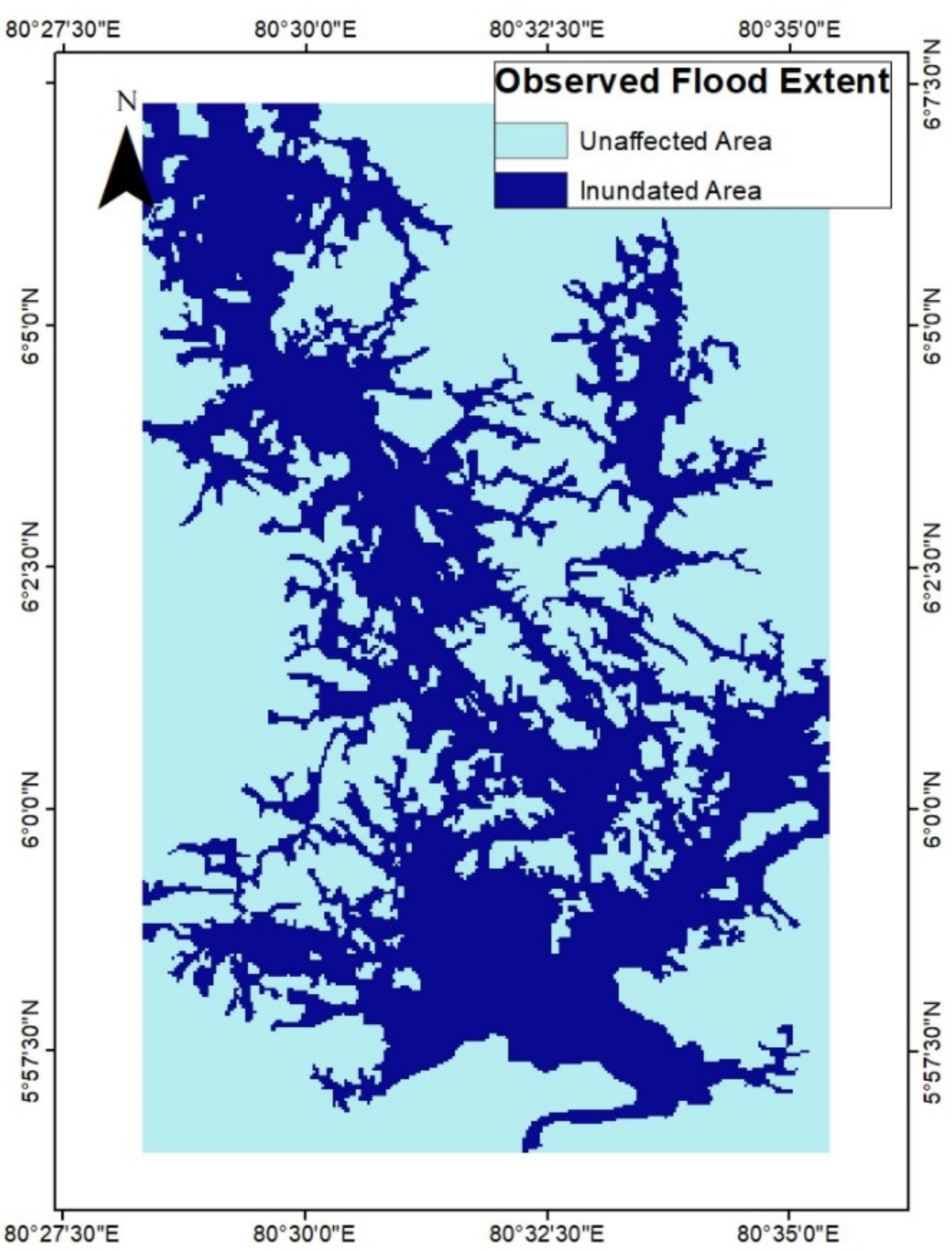
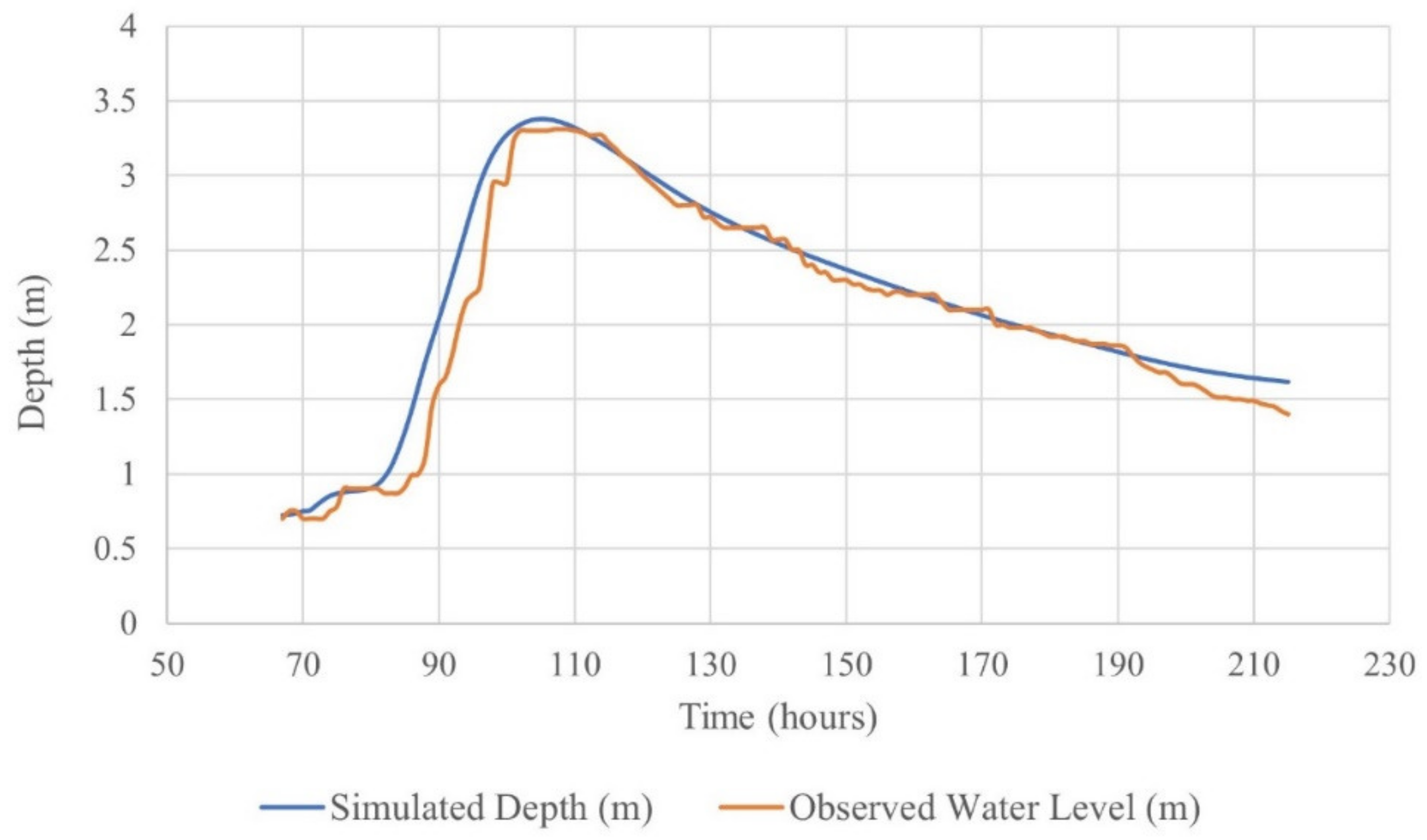
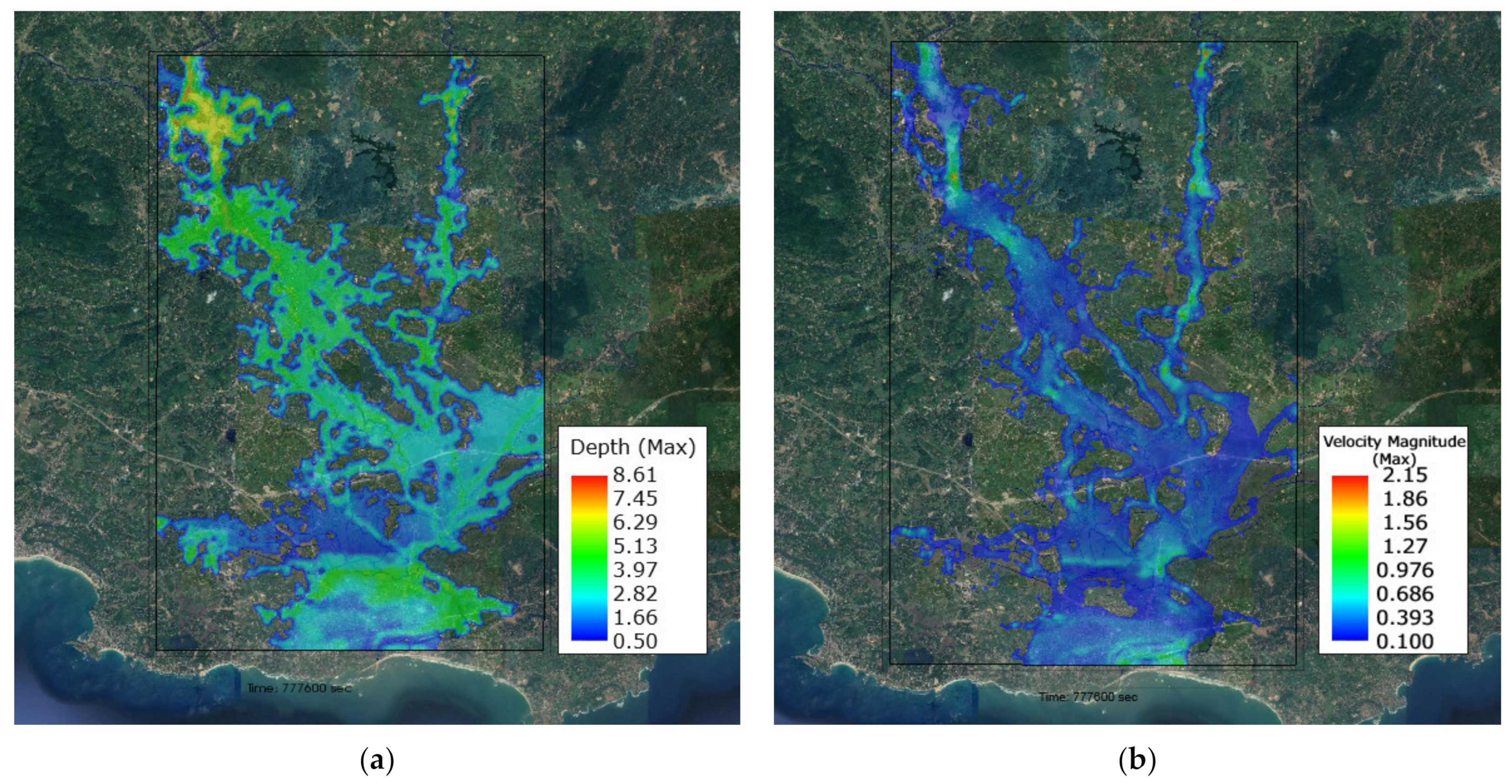
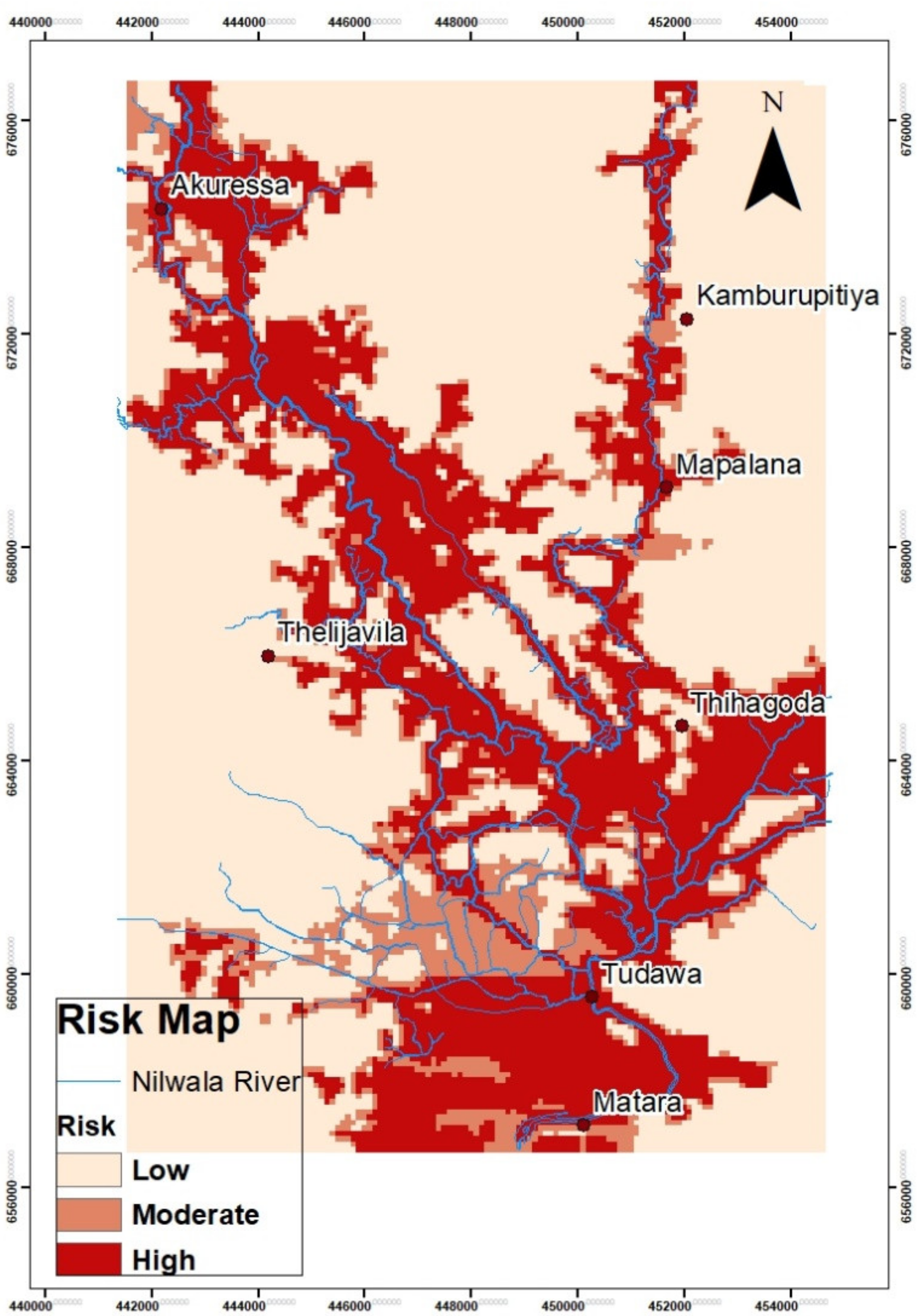

| Data Type | Source | Frequency | Period/Scale |
|---|---|---|---|
| Precipitation | Irrigation Department | Hourly | 2017–2019 |
| Streamflow | Irrigation Department | Hourly | 2017–2019 |
| Water level | Irrigation Department | Hourly | May–June 2017 |
| Digital Elevation Model (DEM) | United States Geological Survey (USGS) | - | 30 m |
| Parameter | Units | Optimized Value | Model |
|---|---|---|---|
| Initial deficit | mm | 3.62 | Deficit and constant loss |
| Maximum storage | mm | 67.575 | Deficit and constant loss |
| Constant rate | mm/h | 6.135 | Deficit and constant loss |
| Impervious | % | 30 | Deficit and constant loss |
| Initial discharge | m3/s/km2 | 0.1 | Recession baseflow |
| Recession constant | dimensionless | 0.45 | Recession baseflow |
| Ratio to peak | dimensionless | 0.25 | Recession baseflow |
| Title 1 | Event | NSE | PBIAS | RMSE |
|---|---|---|---|---|
| Calibration | May 2018 | 0.93 | −10.95% | 0.3 |
| September 2019 | 0.746 | −4.82% | 0.5 | |
| Validation | May 2017 | 0.927 | −8.33% | 0.3 |
| Type | Inundated/Unaffected | Accuracy (%) |
|---|---|---|
| Producer’s Accuracy | Inundated | 70.10 |
| Unaffected | 88.72 | |
| User’s Accuracy | Inundated | 79.76 |
| Unaffected | 82.40 | |
| Overall Accuracy | 81.50 |
Publisher’s Note: MDPI stays neutral with regard to jurisdictional claims in published maps and institutional affiliations. |
© 2022 by the authors. Licensee MDPI, Basel, Switzerland. This article is an open access article distributed under the terms and conditions of the Creative Commons Attribution (CC BY) license (https://creativecommons.org/licenses/by/4.0/).
Share and Cite
Dhanapala, L.; Gunarathna, M.H.J.P.; Kumari, M.K.N.; Ranagalage, M.; Sakai, K.; Meegastenna, T.J. Towards Coupling of 1D and 2D Models for Flood Simulation—A Case Study of Nilwala River Basin, Sri Lanka. Hydrology 2022, 9, 17. https://doi.org/10.3390/hydrology9020017
Dhanapala L, Gunarathna MHJP, Kumari MKN, Ranagalage M, Sakai K, Meegastenna TJ. Towards Coupling of 1D and 2D Models for Flood Simulation—A Case Study of Nilwala River Basin, Sri Lanka. Hydrology. 2022; 9(2):17. https://doi.org/10.3390/hydrology9020017
Chicago/Turabian StyleDhanapala, Lanthika, M. H. J. P. Gunarathna, M. K. N. Kumari, Manjula Ranagalage, Kazuhito Sakai, and T. J. Meegastenna. 2022. "Towards Coupling of 1D and 2D Models for Flood Simulation—A Case Study of Nilwala River Basin, Sri Lanka" Hydrology 9, no. 2: 17. https://doi.org/10.3390/hydrology9020017
APA StyleDhanapala, L., Gunarathna, M. H. J. P., Kumari, M. K. N., Ranagalage, M., Sakai, K., & Meegastenna, T. J. (2022). Towards Coupling of 1D and 2D Models for Flood Simulation—A Case Study of Nilwala River Basin, Sri Lanka. Hydrology, 9(2), 17. https://doi.org/10.3390/hydrology9020017

